What Historical Chinese Nicknames Reveal About Identity and Power
Imagine meeting someone who answers to five completely different names depending on who is speaking to them. His mother calls him by a childhood pet name. His friends address him by a formal alternative bestowed at his coming-of-age ceremony. Literary circles know him by a poetic alias he chose for himself. After death, the imperial court assigns him yet another name as a final judgment on his life. This isn't fiction. This was everyday reality for educated men in imperial China.
Why One Person Could Have Many Names
Take the poet Su Shi as a quick example. His birth name was Shi. His courtesy name was Zizhan. He called himself Dongpo Jushi, the retired scholar of the Eastern Slope. After death, he received the posthumous name Wenzhong. Each name served a distinct social function, activated in specific relationships and contexts. The importance of names in Chinese culture went far beyond identification. They encoded respect, intimacy, ambition, and even political verdict.
When you hear the word "nickname" in English, you probably think of something casual. A shortened name, a playful label friends toss around. Nicknames in Chinese history operated on an entirely different plane. They were formal, ritualized, and governed by strict social rules. Using the wrong name for the wrong person in the wrong setting could be a serious breach of etiquette, or in some dynasties, a criminal offense.
What Counts as a Nickname in Historical China
In Western cultures, a nickname replaces formality with familiarity. In historical China, alternative names added layers of formality, each one marking a different social boundary between speaker and subject.
Historical Chinese nicknames span a wide spectrum: protective childhood names whispered by parents, courtesy names earned through ritual, self-styled art names that declared philosophical allegiance, and posthumous titles that judged entire legacies. Some were intimate. Others were political tools. All of them reveal how China nicknames functioned as a sophisticated system for navigating hierarchy, expressing identity, and wielding power across every dynasty and social class.
What follows is a complete guide to every major type of nickname Chinese culture produced, from the humblest milk name to the grandest imperial title, and the fascinating rules that governed them all.
Every Type of Historical Chinese Nickname Explained
A single person in imperial China could accumulate names of different styles throughout their lifetime, each one activated by a specific relationship or occasion. These weren't random labels. They formed an interlocking system where every name type had clear rules about who could assign it, who could use it, and when it applied. Think of it as a naming architecture, with each layer built on top of the last as a person moved through life stages and social roles.
Here's the full taxonomy, broken into three functional categories: names that protected, names that elevated, and names that ruled.
Milk Names and Childhood Names for Protection
The first name a child received wasn't their official one. It was a milk name (乳名, ruming), given at birth during the first hundred days before a formal name was chosen. These names were deliberately humble or even ugly. Parents called a baby "little dog" or "iron egg" because folk belief held that evil spirits wouldn't bother stealing a child with an unappealing name. The logic was simple: make the child seem worthless to demons, and they'd survive infancy.
Closely related was the childhood name (小名, xiaoming), used by older relatives within the family. Only people close to your parents, like a mother's best friend or an older cousin, could use this name without causing offense. A teacher or classmate using your milk name? That would be completely inappropriate. These names carried deep intimacy and were never meant for public ears.
There was also the school name (学名, xueming), chosen when a child entered formal education. This name was used by teachers and sometimes carried forward into adult life. Sun Yat-sen and Chiang Kai-shek are both known by names that originated as school names.
Formal Alternative Names Earned or Bestowed
As a person matured, they gained styled nicknames that signaled their place in the adult world. The most important was the courtesy name (字, zi), chosen around the time of a coming-of-age ceremony, typically between ages eighteen and twenty-one. Because your given name was a gift from your parents, it was considered disrespectful for peers to use it directly. The courtesy name solved this problem. It became the standard form of address between friends, colleagues, and social equals.
Beyond the courtesy name sat the art name (號, hao), sometimes called a sobriquet. By sobriquets definition, these are self-assumed names that function almost like titles. Artists, poets, and scholars chose them to reflect philosophical ideals, life circumstances, or creative identity. Unlike courtesy names, art names could change multiple times throughout a person's life, marking new phases or important events. A scholar might adopt a fresh art name after a political exile, a spiritual awakening, or simply moving to a new residence.
Then there were earned nicknames (綽號, chuohao), the closest equivalent to Western-style nicknames. These came from peers or the public and were based on a person's appearance, behavior, or reputation. The difference? Even these carried more weight than a casual English nickname. A general known by a fearsome epithet wore it as part of his public identity for life.
Imperial Naming Categories Reserved for Rulers
Emperors operated in a naming universe of their own. Three additional categories applied exclusively to rulers:
- Posthumous names (諡號, shihao) were honorary titles assigned after death to judge a ruler's legacy. They could praise, remain neutral, or condemn. The character chosen told future generations exactly how history viewed that emperor's reign.
- Temple names (廟號, miaohao) appeared on ancestral tablets placed in grand temples built for dynastic worship. These were shorter, usually two characters, and indicated a ruler's role within the dynasty's lineage. Founders typically received "Taizu" (太祖, Grand Progenitor), while successors received names ending in "Zong" (宗, Ancestor).
- Era names (年號, nianhao) functioned as political branding for entire periods of time. An emperor chose a motto, like Qianlong (乾隆, "Lasting Eminence"), and that name defined the calendar itself. Every document, every official record was dated by the era name. Before the Ming dynasty, emperors frequently changed era names mid-reign. From the Ming onward, one emperor meant one era name, which is why we refer to rulers like "Emperor Kangxi" by their era name rather than their personal one.
The register name (名, ming) sat at the foundation of all these layers. This was the formal name written in genealogical records, used on marriage documents and legal papers. People outside the family were not permitted to use it until very recently in Chinese history.
To see how all these names of different styles fit together, here's a complete reference:
| Chinese Term | Pinyin | English Translation | Who Assigns It | When It Is Used |
|---|---|---|---|---|
| 名 (ming) | ming | Register name / Given name | Parents | Legal documents, used only by elders and oneself |
| 乳名 / 小名 | ruming / xiaoming | Milk name / Childhood name | Parents or grandparents | Infancy through childhood, by close family only |
| 学名 (xueming) | xueming | School name | Self-chosen or assigned by teacher | During education, used by teachers |
| 字 (zi) | zi | Courtesy name | Self-chosen at coming-of-age | Daily address among peers and in formal social settings |
| 號 / 別號 (hao) | hao / biehao | Art name / Sobriquet | Self-chosen (sometimes conferred by others) | Literary and artistic contexts, can change over a lifetime |
| 綽號 (chuohao) | chuohao | Earned nickname | Peers or the public | Informal reference based on reputation or traits |
| 諡號 (shihao) | shihao | Posthumous name | Court officials after death | Historical reference after the person has died |
| 廟號 (miaohao) | miaohao | Temple name | Successor emperor and court | Ancestral worship, historical reference for pre-Ming emperors |
| 年號 (nianhao) | nianhao | Era name | The emperor himself | Calendar dating, historical reference for Ming and Qing emperors |
You'll notice something striking about this system. The more public and powerful a person became, the more names accumulated around them. An emperor like Qianlong had a register name (Aisin Gioro Hongli), an era name (Qianlong), a temple name (Gaozong), and a posthumous name so long it stretched to over twenty characters. Each layer served a different audience across time itself.
Of all these categories, one stands above the rest in cultural significance: the courtesy name. It touched every educated person's life, governed daily social interaction, and was earned through one of China's most important rites of passage.
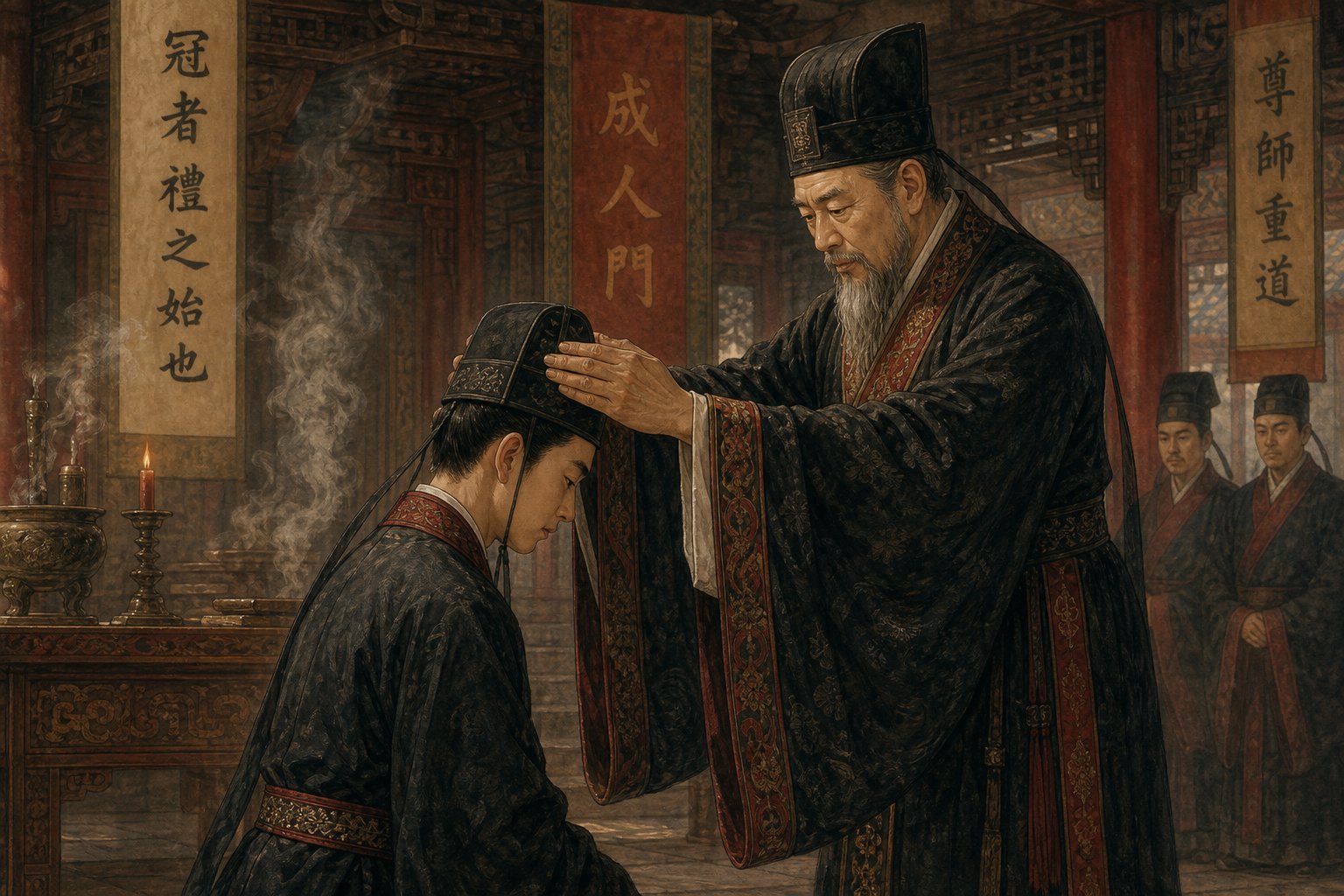
Courtesy Names and the Coming-of-Age Tradition
So what is a courtesy name, exactly? In Chinese it's called 字 (zi), literally meaning "character" or "word." It was an additional name bestowed upon a person at adulthood, designed to complement their given name and serve as the primary form of address among peers. If the given name belonged to your parents and elders, the courtesy name belonged to the social world. It was how you were known, spoken to, and written about by everyone outside your immediate family.
The Chinese courtesy name tradition wasn't casual. It was activated through one of the most significant rituals in a young person's life.
The Capping Ceremony and Receiving a Courtesy Name
Imagine turning twenty and, instead of a birthday party, your family hosts a solemn ceremony where an elder places a formal cap on your head for the first time. This was the capping ceremony (冠禮, guanli), and it marked the moment a young man officially entered adulthood. For women, a parallel ceremony called the hairpin rite (笄禮, jili) took place around age fifteen, often timed to a marriage engagement.
During this ritual, the young adult received their courtesy name. According to the Book of Rites, once a man was capped at twenty, it became disrespectful for others of the same generation to address him by his given name. The courtesy name replaced it in nearly all social interactions. This wasn't optional etiquette. It was a deeply embedded cultural rule that persisted for over two thousand years.
The ceremony itself carried weight. A respected elder, often a family friend or teacher, would select or approve the courtesy name. The choice signaled that the community recognized this person as a full adult, ready to participate in public life, hold office, and form alliances. If you're searching for the term courtesy 中文, you'll find it rendered as 字 (zi) or sometimes 表字 (biaozi), both referring to this same tradition of a formal adult name.
How Courtesy Names Connected to Given Names
A courtesy name wasn't random. Its meaning deliberately related to the person's given name, creating a thematic pair. The relationship could work in several ways: synonyms that reinforced the original meaning, expansions that broadened it, or occasionally contrasts that balanced it.
Consider these well-documented examples:
- Zhuge Liang (諸葛亮) had the given name Liang, meaning "bright." His courtesy name was Kongming (孔明), meaning "exceedingly brilliant." The courtesy name amplifies the given name's meaning, turning brightness into radiant clarity.
- Su Shi (蘇軾) carried the given name Shi, referring to the crossbar at the front of a carriage. His courtesy name Zizhan (子瞻) means "one who gazes forward," connecting to the idea of looking ahead from that same carriage rail. The names form a poetic image together.
- Li Bai (李白) had the given name Bai, meaning "white" or "pure." His courtesy name Taibai (太白) means "great whiteness," an expansion that also references the planet Venus (called Taibai in Chinese). Legend holds his mother dreamed of Venus before his birth.
Another common pattern used the character 子 (zi, meaning "master" or "sir") as the first syllable. Du Fu's courtesy name was Zimei (子美), and Zhao Yun's was Zilong (子龍). Birth order markers also appeared frequently. Confucius, the second son in his family, received the courtesy name Zhongni (仲尼), where zhong (仲) indicates second-born. The courtesy name meaning, in every case, was carefully constructed to resonate with the bearer's identity.
Social Rules Governing Courtesy Name Usage
Here's where things get strict. What is a courtesy name in China if not a social boundary marker? The rules were clear and rarely broken:
- Your given name was used only by your parents, grandparents, and yourself. Using it in self-reference was a sign of humility.
- Your courtesy name was used by friends, colleagues, and anyone of equal or lower social standing. It was the respectful default.
- Using someone's given name when you should have used their courtesy name was an act of disrespect, implying you held authority over them or considered them beneath you.
This system meant that the same person was effectively two different "people" depending on who was speaking. A father calling his son by his given name was exercising parental authority. A friend using that same given name was committing a social offense. The courtesy name acted as a buffer, a layer of respect that acknowledged the other person's adult dignity.
The practice also extended beyond China. Sinicized Koreans, Vietnamese, and Japanese adopted courtesy names following the same conventions. Even some Mongols and Manchus took up the tradition after the Qing conquest, recognizing its social utility. For anyone researching courtesy 中文 traditions across East Asia, the underlying logic remained consistent: the given name is private, the courtesy name is public.
By the early twentieth century, courtesy names began fading from daily use. But their cultural DNA persists. The instinct to maintain separate names for separate social spheres didn't vanish. It simply evolved, finding new expression in the self-chosen identities that scholars and artists crafted for themselves.
Art Names and the Poet's Philosophical Identity
Courtesy names were given to you. Art names you gave to yourself. That distinction matters enormously. The hao (號), sometimes called a sobriquet or art name, was the one name in the entire Chinese naming system where the individual held complete creative control. No elder chose it. No ceremony bestowed it. A scholar simply declared it, and in doing so, announced to the world exactly who they aspired to be.
Self-Chosen Names as Philosophical Statements
Why would someone need yet another name on top of their given name and courtesy name? Because those names were assigned within social structures. They reflected family expectations and generational relationships. The art name broke free from all of that. It was a philosophical declaration, a personal brand rooted in values rather than lineage.
The hao meaning in English is often translated as "art name," "literary name," or "sobriquet," but none of these fully capture its function. Think of it as a chosen identity that expressed how a person wanted to be understood intellectually and spiritually. These stylized personal names typically drew from three sources: the natural world, religious or philosophical concepts, and the physical spaces where a person lived or worked.
A scholar exiled to a remote province might name himself after the landscape he now inhabited, transforming punishment into poetic identity. A painter devoted to Buddhist practice might adopt a name referencing detachment from worldly affairs. A calligrapher proud of his studio might simply become "the master of" that space. Each choice told a story about values, circumstances, and aspirations.
Unlike courtesy names, which typically remained fixed for life, art names could multiply and change. A person might adopt a new hao after a major life event, a political setback, a spiritual awakening, or even a move to a new home. Some prolific scholars accumulated dozens over a lifetime, each one marking a different chapter of their intellectual journey.
Famous Art Names and Their Deeper Meanings
The chinese meaning of names becomes especially rich when you look at specific art names and unpack their layers. Here are some of the most celebrated examples, each revealing how literati used self-naming as a form of philosophical expression:
- Su Shi - Dongpo Jushi (東坡居士): Meaning "the retired scholar of the Eastern Slope." After being exiled to Huangzhou, Su Shi farmed a plot of land on the eastern slope outside town. He transformed his place of banishment into an identity of serene acceptance, embracing rural simplicity as a Daoist and Buddhist ideal. The name turned political disgrace into spiritual triumph.
- Zheng Xie - Banqiao (板橋): Meaning "Plank Bridge." One of the Eight Eccentrics of Yangzhou, Zheng Xie chose a name evoking rustic simplicity and humble utility. A plank bridge is plain, functional, and close to the earth. The name rejected aristocratic pretension in favor of directness, mirroring his bold, unconventional painting style.
- Zhu Da - Bada Shanren (八大山人): Meaning "Mountain Man of the Eight Greats." A Ming dynasty prince who became a Buddhist monk after the dynasty's fall, Zhu Da chose a deliberately cryptic name. Scholars have debated its meaning for centuries. When written in cursive, the four characters resemble the phrases "to cry" and "to laugh," suggesting the grief and absurdity he felt as a fallen royal living under Qing rule.
- Tao Qian - Wuliu Xiansheng (五柳先生): Meaning "Master of the Five Willows." The poet Tao Qian named himself after the five willow trees outside his home, signaling his commitment to pastoral withdrawal from corrupt politics. The name became synonymous with the recluse ideal in Chinese literature.
- Pu Songling - Liuquan Jushi (柳泉居士): Meaning "the retired scholar of Willow Spring." The author of Strange Tales from a Chinese Studio named himself after a willow-lined spring near his home where he reportedly served tea to travelers in exchange for their ghost stories.
You'll notice a pattern. Many of these names include terms like jushi (居士, "lay Buddhist scholar") or xiansheng (先生, "master"), which anchored the name within a philosophical tradition. Others reference specific geographic features, turning a physical location into a statement about the owner's relationship with nature and solitude.
Art names exploded in popularity during the Song dynasty, when literati culture reached its peak. Poets, painters, and calligraphers formed tight social circles where your hao was essentially your professional identity. By the Ming dynasty, the practice had spread beyond elite scholars to merchants, doctors, and even skilled artisans who wanted to signal cultural refinement. Having a well-crafted art name became a mark of education and taste, regardless of your official rank.
This proliferation meant that by the late imperial period, a well-known figure might be remembered primarily by their art name rather than their birth name. Ask most Chinese readers about Banqiao, and they'll know exactly who you mean. The self-chosen name outlasted the given one.
Art names celebrated individual choice. But not every name in the Chinese system honored the person it described. Some names were imposed after death as final, irreversible judgments, and the person who received them had no say in the matter at all.
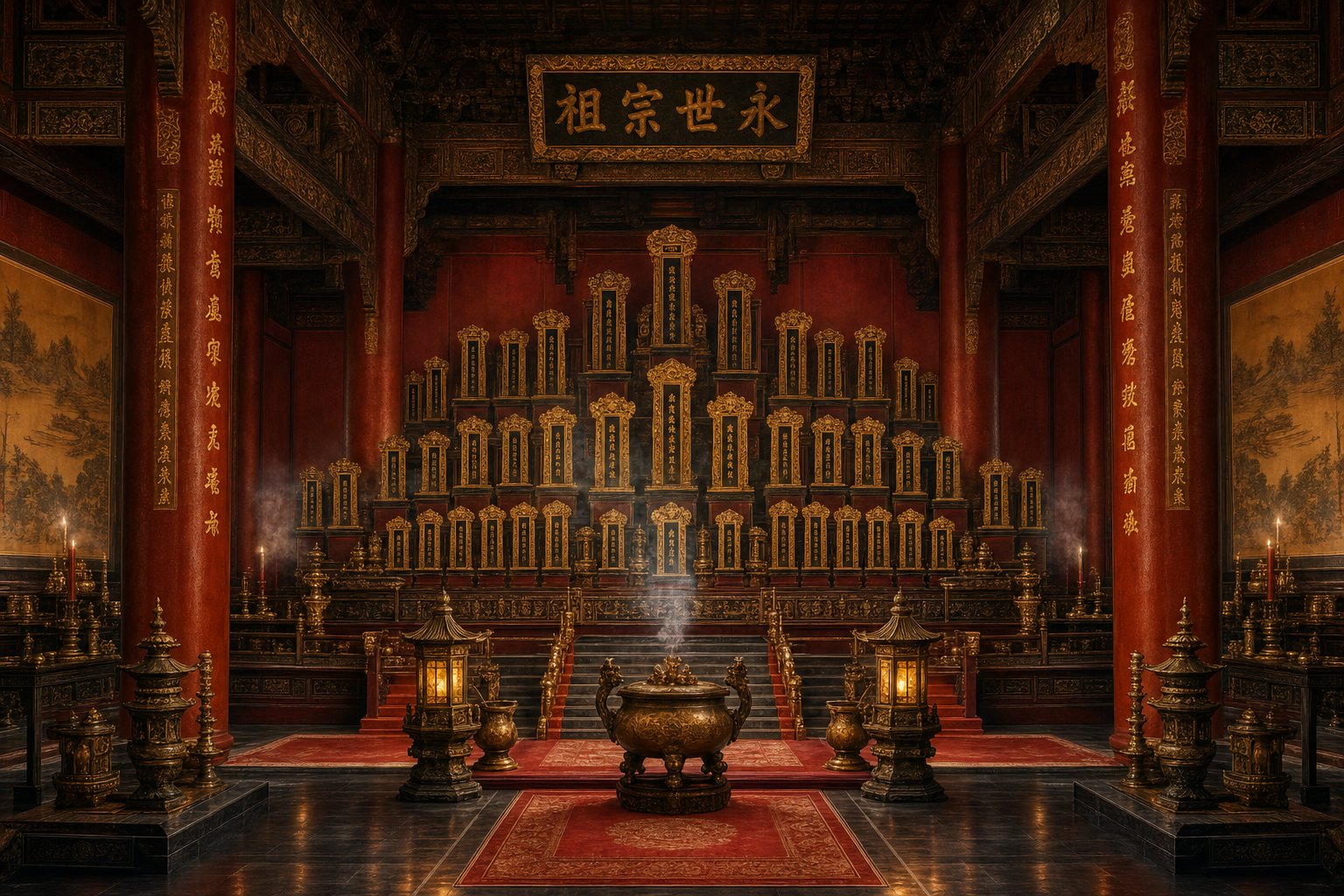
Posthumous and Temple Names as Political Judgment
Art names let a person shape their own legacy. Posthumous names did the opposite. They were verdicts handed down after death, assigned by court officials and successor emperors who held the final word on how history would remember you. Imagine spending decades on the throne, only to have your entire reign condensed into a single character chosen by people you can no longer influence. That's the power of the posthumous name system, and it made Chinese royal names function as something far more consequential than mere labels.
Laudatory Versus Derogatory Posthumous Names
The posthumous name (諡號, shihao) originated during the Western Zhou dynasty, when court historians began assigning evaluative titles to deceased rulers based on their conduct. The system operated on a simple but devastating principle: your name after death would tell future generations whether you ruled well or poorly.
Three categories existed:
- Laudatory posthumous names (美諡, meishi) praised a ruler's virtues. Characters like Wen (文, "cultured"), Wu (武, "martial"), Ming (明, "brilliant"), and Rui (睿, "perceptive") signaled that the court approved of the deceased's legacy.
- Neutral posthumous names (平諡, pingshi) expressed sympathy rather than praise or blame. Characters like Huai (懷, "cherished"), Ai (哀, "lamented"), and Min (愍, "pitied") typically described rulers who faced misfortune or died young without accomplishing much.
- Derogatory posthumous names (惡諡, eshi) condemned a ruler outright. Characters like Li (厲, "cruel"), Ling (靈, "inept"), and Yang (煬, "dissolute") were permanent marks of shame carved into the historical record.
The selection process wasn't arbitrary. Court officials consulted a codified text called the Yizhoushu: Interpretation of Posthumous Names (逸周書·諡法解), which defined exactly what each character meant and under what circumstances it applied. "Wu" meant the ruler had quelled rebellions or expanded territory through military strength. "Wen" meant he had governed with learning, ritual, and moral cultivation. "Yang" meant he had indulged in sensual pleasures while neglecting the rites of governance.
Consider the contrast between two famous Chinese titles. Emperor Wu of Han (漢武帝) received the character Wu (武) because he dramatically expanded Han territory, launched campaigns against the Xiongnu, and projected military power across Central Asia. His posthumous name celebrated martial achievement. Emperor Yang of Sui (隋煬帝), on the other hand, received Yang (煬) from the succeeding Tang dynasty. The character condemned him for exhausting the people through grandiose construction projects and failed military campaigns against Korea. His name became a permanent indictment.
Here's a comparison of laudatory and derogatory characters, the meanings they encoded, and the rulers who received them:
| Character | Pinyin | Meaning | Type | Notable Recipient |
|---|---|---|---|---|
| 文 (Wen) | wen | Cultured, learned, morally refined | Laudatory | King Wen of Zhou (周文王) |
| 武 (Wu) | wu | Martial, militarily accomplished | Laudatory | Emperor Wu of Han (漢武帝) |
| 明 (Ming) | ming | Brilliant, perceptive in governance | Laudatory | Emperor Ming of Wei (魏明帝) |
| 宣 (Xuan) | xuan | Proclaimed virtue far and wide | Laudatory | Emperor Xuan of Han (漢宣帝) |
| 哀 (Ai) | ai | Lamented, died young or pitifully | Neutral | Emperor Ai of Han (漢哀帝) |
| 懷 (Huai) | huai | Cherished, kind but died before fulfilling potential | Neutral | Emperor Huai of Jin (晉懷帝) |
| 煬 (Yang) | yang | Dissolute, indulgent in pleasure, neglectful of rites | Derogatory | Emperor Yang of Sui (隋煬帝) |
| 厲 (Li) | li | Cruel, tyrannical, merciless | Derogatory | King Li of Zhou (周厲王) |
| 靈 (Ling) | ling | Inept, chaotic without causing total ruin | Derogatory | Duke Ling of Wei (衛靈公) |
The political stakes were real. Qin Shi Huang actually abolished the entire posthumous name system because he found it intolerable that "sons would judge fathers and ministers would judge rulers." He declared himself First Emperor and intended his successors to simply be numbered. The Han dynasty restored the practice after the Qin fell, and it continued for over two thousand years until the end of imperial China.
One important nuance: most monarchs inherited the throne from the person they were naming. A son rarely gave his father a derogatory title. Truly negative posthumous names were usually assigned by a new dynasty condemning the last ruler of the previous one. The Tang dynasty gave Emperor Yang of Sui his damning name. The Sui court itself would never have done so.
Temple Names and Imperial Ancestral Worship
Temple names (廟號, miaohao) served a different function. Where posthumous names judged character, temple names defined a ruler's position within the dynasty's ancestral lineage. These were the names inscribed on spirit tablets placed in the imperial ancestral temple (太廟, taimiao), where successive emperors performed sacrificial rites to honor their predecessors.
The system used two key characters to distinguish founders from successors. "Zu" (祖, meaning "ancestor" or "founder") was reserved for emperors who established or dramatically restored a dynasty. "Zong" (宗, meaning "progenitor" or "continuator") went to those who maintained or expanded what the founder built. Liu Bang, who founded the Han dynasty, received the temple name Taizu (太祖, "Grand Ancestor"). His great-grandson Emperor Wu received Shizong (世宗, "Epochal Progenitor").
Early on, temple names were rare honors. During the Western and Eastern Han dynasties combined, only a handful of emperors received them. The standard was high: you needed genuinely exceptional achievements to earn a permanent place in the ancestral temple. Emperors without temple names eventually had their spirit tablets removed from the main hall after several generations, a process called "exhausting the kinship" (親盡).
This selectivity eroded over time. By the Tang dynasty, virtually every emperor received a temple name regardless of accomplishment. The honor became routine rather than exceptional. This shift had a practical consequence for how we refer to Chinese royal names today. Because Tang-era posthumous names grew absurdly long, sometimes reaching seven or more characters, historians switched to using the shorter two-character temple names instead. That's why we say "Tang Taizong" (唐太宗) rather than reciting Li Shimin's full posthumous title.
Era Names as Political Branding
Era names (年號, nianhao) operated on yet another level. They weren't about judging the dead. They were about branding the present. When an emperor declared a new era name, he was making a political statement about his reign's aspirations, stamping that message onto the calendar itself.
Every official document, legal contract, and historical record was dated by the current era name. If the emperor declared the era "Zhenguan" (貞觀, "Correct Vision"), then the year became Zhenguan Year One, Year Two, and so on. The name shaped how subjects perceived the times they lived in.
Before the Ming dynasty, emperors changed era names frequently. A military victory, a good omen, a natural disaster, or a political reset could all trigger a new era name. Emperor Wu of Han used eleven different era names across his fifty-four-year reign. Each change signaled a fresh start or a shift in imperial priorities.
The Ming dynasty simplified things dramatically. From the Hongwu Emperor onward, each ruler used a single era name for their entire reign. This one-emperor-one-era-name convention continued through the Qing dynasty, which is why we commonly refer to later emperors by their era names. "Kangxi," "Yongzheng," and "Qianlong" are all era names, not personal names or posthumous titles. The practice made these Chinese titles function almost like royal brand names, instantly recognizable shorthand for an entire period of governance.
Together, posthumous names, temple names, and era names formed a layered system of imperial identity that no single Western concept fully captures. They judged, they honored, and they branded. And they all operated under one absolute constraint that governed the entire naming culture: the taboo system that dictated which names could never be spoken aloud.
Name Taboos and the Strict Etiquette of Address
Posthumous names judged the dead. Name taboos controlled the living. The system called bihuì (避諱) made certain characters completely unspeakable and unwritable across the entire empire, simply because they appeared in a ruler's personal name. This wasn't a suggestion or a matter of polite custom. It was enforced by law, and violating it could derail a career, trigger punishment, or bring public shame on an entire family.
If you think of a person's first name Chinese culture treated as sacred, the emperor's given name was the most sacred of all. No one in the realm could use it. Not in speech, not in writing, not even by accident.
Imperial Name Taboos and Their Consequences
Imagine an entire nation forbidden from writing a common word because it happens to share a character with the emperor's birth name. That's exactly what happened, repeatedly, across Chinese history. When an emperor ascended the throne, his personal name became taboo throughout the realm. Scribes copying older texts had to alter any instance of the forbidden character, replacing it with a synonym or deliberately omitting a stroke. Official documents, literary works, even everyday correspondence all had to avoid the taboo character entirely.
The consequences for slipping up were real. Examination candidates who accidentally wrote a taboo character in their essays could be failed on the spot, regardless of the quality of their arguments. In some dynasties, using the emperor's name was treated as a criminal offense punishable by flogging or imprisonment. The system forced millions of people to constantly self-censor, mentally scanning every sentence for forbidden syllables before committing brush to paper.
Some emperors recognized the burden this placed on ordinary people. Emperor Xuan of Han, whose original given name Bingyi (病已) contained two extremely common characters, changed his own name to the rare character Xun (詢) specifically to ease the difficulty his subjects faced in avoiding his name. Emperor Taizong of Tang took a different approach. His given name Shimin (世民) also used common characters, so he ruled that people only needed to avoid writing both characters together in sequence, not individually. His son Emperor Gaozong later reversed this leniency, requiring full avoidance of each character in isolation and forcing the famous chancellor Li Shiji to drop a character from his name entirely.
The ripple effects went beyond individual words. During the reign of the Han dynasty's Ming Emperor (Liu Zhuang), people with the surname Zhuang (莊) were ordered to change their family name to the synonym Yan (嚴). An entire surname was erased from official use because it collided with the emperor's given name. Later dynasties learned from this chaos. Ming dynasty princes were deliberately given names containing rare, obscure characters so that fewer people would be inconvenienced if those princes eventually became emperor.
In 435 CE, Goguryeo ambassadors formally requested that the Northern Wei court issue them a document listing all imperial taboo names, so they could avoid accidentally offending the emperor in their diplomatic petitions. The emperor agreed, revealing a built-in contradiction of the system: you had to know the forbidden name in order to avoid it.
Family-Level Naming Prohibitions
Imperial taboos were only the most visible layer. The same logic applied within every family. Children could never speak or write the characters contained in their parents' or grandparents' given names. This family-level prohibition shaped daily life in ways that might seem extreme today.
When naming a child, parents had to check not only the imperial taboo list but also their own family's forbidden characters stretching back several generations. A boy couldn't be given a name that shared any character with his father, grandfather, or great-grandfather. If a common word in everyday speech happened to match an ancestor's name, the family would use a synonym instead, sometimes for generations.
This practice intersected directly with the chinese honorifics system. Within the family, you never addressed elders by name at all. You used kinship terms: father, mother, grandfather, elder uncle. The given name of a living parent was so private that speaking it aloud, even to a third party, felt like a violation. The poet Li He (李賀) was reportedly blocked from taking the imperial examination by rivals who argued that his father's name, Jinsu (晉肅), sounded too similar to the word jinshi (進士, the examination degree itself), making it improper for him to pursue it. Whether the story is fully accurate or not, it illustrates how seriously these prohibitions were taken.
The taboo extended to written texts as well. If you were copying a book and encountered a character matching your father's name, you were expected to leave it blank or substitute a variant. Students learning calligraphy would skip over certain characters entirely. The system created a web of personalized linguistic restrictions unique to each family, layered on top of the empire-wide imperial taboos that everyone shared.
Who Could Call Whom by Which Name
Name taboos didn't exist in isolation. They were part of a broader etiquette system governing exactly which name could be used by which person in which context. Honorifics in Chinese culture weren't just about adding "Mr." or "Mrs." before a surname. They involved selecting the correct name from a person's entire collection of names based on your relationship to them.
Here's how the system worked for a typical educated man in imperial China:
- His parents and grandparents called him by his given name (名, ming) or his milk name (乳名). They were the only people with this right.
- His peers, friends, and colleagues addressed him by his courtesy name (字, zi). Using the given name would imply they held parental authority over him.
- His subordinates and students used his official title or a respectful form of address, such as his surname plus his rank or profession. A magistrate would be "Magistrate Wang," never "Wang Mingde" or even his courtesy name.
- He himself used his given name when speaking humbly in formal contexts, or his art name (號) in literary and social settings among fellow scholars.
- The public might know him by an earned nickname (綽號) based on his reputation, but would never use it to his face.
This layered system meant that hearing which name someone used for another person instantly revealed the power dynamic between them. A character in a historical text addressed by their given name? The speaker is either a parent or someone deliberately asserting dominance. Addressed by courtesy name? The speaker is a respectful equal. Addressed by title? The speaker is a subordinate or stranger maintaining formal distance.
The asian honorific tradition across East Asia, including Korea, Japan, and Vietnam, drew heavily from this Chinese model. In all these cultures, using someone's chinese name first name directly, without the buffer of a title or alternative name, carried implications of intimacy or authority that couldn't be taken back. The wrong choice of address was a social statement whether you intended it or not.
This elaborate etiquette didn't remain frozen in place. Like every aspect of the naming system, it shifted across centuries, expanding in some dynasties and simplifying in others, shaped by the same political and cultural forces that transformed Chinese society itself.
How Nickname Practices Evolved Across Dynasties
Chinese naming culture spanned over three thousand years of continuous civilization, and it was never static. Each dynasty reshaped the rules, expanded the categories, or stripped away layers that previous eras had built. The system that governed a Zhou nobleman's identity looked nothing like the naming world a late Qing intellectual inhabited. Tracing these shifts reveals how political upheaval, philosophical movements, and foreign contact all left fingerprints on something as personal as what people called each other.
Zhou Through Tang Dynasty Naming Conventions
The Zhou dynasty (1046-256 BCE) laid the foundation. This was the era that formalized the capping ceremony and established courtesy names as a ritual institution. The Book of Rites codified when a young man reached chinese adulthood, what ceremony marked the transition, and how the courtesy name functioned in daily social life. Before the Zhou, naming practices existed but lacked the rigid ceremonial framework. The Zhou ritualists turned naming into a system with written rules, connecting it to their broader project of governing society through propriety (禮, li).
During the Spring and Autumn period (770-476 BCE) and the Warring States era that followed, courtesy names became universal among the educated class. Confucius, Mencius, Zhuangzi, and their contemporaries were all known primarily by their courtesy names or honorific titles rather than their given names. The practice was already so entrenched that historical texts from this period rarely record a philosopher's given name at all.
The Qin dynasty's brief unification (221-206 BCE) disrupted naming traditions along with everything else. Qin Shi Huang abolished posthumous names and attempted to centralize naming authority. But the Han dynasty restored Zhou-era conventions almost immediately after the Qin collapsed, and the courtesy name system continued largely unchanged for the next several centuries.
The Tang dynasty (618-907 CE) introduced new complexity at the imperial level. Posthumous names grew longer and more elaborate. Where earlier dynasties assigned one or two characters, Tang emperors received strings of laudatory characters that eventually stretched to seven or more. This inflation made posthumous names unwieldy for everyday reference, which is why historians shifted to using the shorter temple names for Tang rulers. Meanwhile, the Tang's cosmopolitan culture and thriving poetry scene encouraged scholars to adopt art names, though the practice hadn't yet reached its peak.
Song and Ming Dynasty Flourishing of Art Names
The Song dynasty (960-1279) transformed the naming landscape. Literati culture exploded. Printing technology made books widely available. The civil examination system expanded the educated class dramatically. And with that expansion came an unprecedented proliferation of art names.
Suddenly, having a hao wasn't just for elite court poets. Provincial scholars, retired officials, Buddhist monks with literary ambitions, even educated merchants began crafting art names that signaled their philosophical allegiances and aesthetic tastes. The Song dynasty produced figures like Su Shi (Dongpo Jushi), Mi Fu (Xiangyang Manshi), and Ouyang Xiu (Liuyi Jushi), all remembered primarily by their self-chosen names rather than their birth names or courtesy names.
The Ming dynasty (1368-1644) pushed this trend further. Art names multiplied per person. A single Ming scholar might accumulate five, ten, or even twenty art names over a lifetime, each marking a different period or mood. The painter Dong Qichang used over a dozen. This proliferation reflected the Ming literati's intense focus on self-cultivation and personal branding within competitive intellectual circles.
The Ming also standardized imperial naming in a new way. The one-emperor-one-era-name convention simplified how rulers were identified, while the practice of assigning generation characters (字辈, zibei) within the imperial clan created systematic naming patterns across the entire Zhu family. Each generation of princes shared a designated character in their names, making lineage immediately visible. This is one reason why do so many asians have the same last name or share naming elements within clans. Generational naming wasn't unique to royalty. Ordinary families adopted similar systems, embedding birth order and generational position directly into given names.
Late Qing Decline and Modern Echoes
The Qing dynasty (1644-1912) maintained traditional naming structures but planted the seeds of their decline. As Manchu rulers, the Qing emperors operated within both Manchu and Chinese naming systems simultaneously. Their Manchu clan names, Chinese era names, and Mongolian titles coexisted, adding yet another layer of complexity. But by the dynasty's final decades, Western contact was introducing fundamentally different ideas about personal identity and naming.
The abolition of the imperial examination system in 1905 struck a critical blow. The exams had been the primary social mechanism that kept courtesy names alive. Young men studied for years, received their courtesy names as part of entering scholarly life, and used those names throughout their careers in officialdom. Without the examination system, the ritual infrastructure supporting the courtesy 中文 tradition lost its institutional anchor. Fewer families bothered with formal capping ceremonies. Fewer young men received or used courtesy names in daily life.
The May Fourth Movement of 1919 accelerated the collapse. Reformers explicitly rejected Confucian ritual culture as backward and feudal. Courtesy names, art names, and the elaborate etiquette of address all belonged to the old world these intellectuals wanted to dismantle. Lu Xun, one of the movement's literary giants, used a pen name rather than a traditional art name. The distinction is subtle but significant. A pen name (筆名, biming) served a practical publishing function. A traditional hao declared philosophical identity within a Confucian-Daoist-Buddhist framework. The shift in terminology reflected a shift in worldview.
By the mid-twentieth century, courtesy names had essentially vanished from mainstream Chinese life. The People's Republic simplified naming further, and most citizens used only a surname plus a one- or two-character given name. The elaborate multi-name system that had defined Chinese identity for millennia compressed into a single legal name.
Yet the underlying instinct persisted. Why do chinese people have english names? The practice of adopting a Western name for international contexts, common among Chinese students, professionals, and emigrants, echoes the ancient logic of maintaining separate names for separate social spheres. A Chinese professional named Zhang Wei who goes by "Kevin" at work isn't doing something new. He's doing something very old in a modern form. The courtesy name was always a public-facing identity distinct from the private given name. The English name fills that same structural role, offering a name for contexts where the birth name feels too intimate, too difficult for others to pronounce, or simply belonging to a different social world.
This continuity runs deeper than individual choice. The cultural memory of multiple names, each activated by different relationships and settings, never fully disappeared. It simply adapted. And for anyone consuming Chinese historical media today, whether dramas, novels, or games, understanding this evolution is the key to decoding why characters shift between names and what each choice of address reveals about the relationships on screen.

Understanding Historical Nicknames in Chinese Media Today
You're watching a Chinese historical drama, and the same character gets called three different things in a single episode. The subtitles don't explain why. A web novel introduces a protagonist by one name, then switches to another fifty pages in. A video game character sheet lists a birth name, a courtesy name, and a title, and you're not sure which one other characters will actually use. Sound familiar?
This is where all the theory from previous centuries meets modern entertainment. Whether you're streaming a wangfei TV drama, reading translated xianxia fiction, or playing a game set in ancient China, the historical naming system is alive and active in the storytelling. Once you understand the logic, what seemed like confusing inconsistency becomes a rich layer of character development hiding in plain sight.
Decoding Names in Chinese Historical Dramas
Chinese historical dramas, often called C-dramas or costume dramas, use the full traditional naming system as a storytelling tool. Directors and screenwriters rely on name shifts to signal relationship changes without spelling them out in dialogue. A character who starts calling someone by their given name instead of their courtesy name is making a statement about intimacy or authority. That shift carries enormous emotional weight for Chinese-speaking audiences, but it often flies past international viewers who don't recognize what just happened.
Take The Untamed (Chen Qing Ling) as a widely known example. The protagonist Wei Ying has the given name Ying (婴), the courtesy name Wuxian (无羡), and the title Yiling Laozu (夷陵老祖). When Lan Wangji calls him "Wei Ying" rather than "Wei Wuxian," he's using the intimate birth name reserved for family and the closest of companions. Early in the story, this feels presumptuous. Later, it becomes a marker of their deep bond. Meanwhile, outsiders and juniors call him by his title, maintaining respectful distance. As Avenue X explains, calling an adult by their given name can signal either disrespect or intimacy, since "only the 'insider' of this person's circle can call him by ming."
The same logic applies across dozens of popular series. In Thousand Autumns, when Yan Wushi gives Shen Qiao the diminutive nickname "Ah-Qiao" and uses it publicly, translators note that this is "extremely overly familiar, and implies that he is either family or a very intimate close friend." Shen Qiao tolerating it without correction is itself a plot point, a silent acknowledgment of closeness that Chinese readers catch immediately.
Titles and honorifics layer on top of this. You'll hear characters addressed as daozhang (道長, Daoist master), zhenren (真人, realized one), gongzi (公子, young lord), or wangfei (王妃, princess consort). These aren't names at all. They're positional markers that tell you exactly where someone sits in the social hierarchy without ever touching their personal name. Using a title instead of a name is the safest, most distant form of address, appropriate for strangers, subordinates, and formal settings.
Common Naming Confusions for Western Audiences
If you're coming from English-language media, where characters typically have one name used by everyone, the Chinese system can feel overwhelming. Here are the patterns that trip up Western audiences most often, and what each one actually means:
- A character is called by two or three different names by different people. This isn't inconsistency. Each name reflects the speaker's relationship to that character. Parents use the birth name. Friends use the courtesy name. Strangers and juniors use a title or honorific. Pay attention to who uses which name, and you'll map the social web instantly.
- Using someone's given name is treated as shocking or intimate. In historical settings, the given name belongs to family and the self. A peer using it uninvited is either declaring deep closeness or committing a deliberate insult. When a love interest finally uses the birth name, it's the equivalent of a major romantic milestone.
- Characters address each other as "Brother" or "Sister" without being related. Terms like xiong (兄, elder brother), jie (姐, elder sister), or shidi (师弟, junior martial brother) are honorifics based on relative age or rank within a shared community. They signal respect and affiliation, not blood relation.
- A character's name changes after a major event. This often reflects a real historical practice. Taking a new art name after exile, receiving a posthumous name after death, or gaining a feared title after a battlefield victory all mirror how names accumulated in actual Chinese history.
- Titles like wangye, wangfei, gongzi, or guniang appear constantly. These are rank-based forms of address. Wangye (王爷) means a prince of royal blood. Wangfei (王妃) is his consort. Gongzi (公子) is a young man of noble birth. Guniang (姑娘) is a young unmarried woman. They function like "Your Highness" or "my lord" in English period dramas.
- Eunuch characters are addressed with specific titles. If you've wondered what is a eunuch's role in these stories, they were castrated male servants of the imperial palace. They're typically addressed as gonggong (公公) or by their surname plus gonggong, a unique honorific that marks their specific position within the court hierarchy.
- A villain or feared figure is known only by a title, never a personal name. This mirrors the real taboo system. Speaking a powerful person's true name could be dangerous, disrespectful, or simply forbidden. Characters in works like Tales of Demons and Gods and similar fantasy novels often follow this pattern, where knowing someone's true name implies power over them.
The key insight is this: in Chinese historical media, names are never just labels. They're dialogue. Every time a character chooses which name to use for another person, they're communicating something about power, intimacy, respect, or defiance. Once you start reading names as relationship markers rather than arbitrary identifiers, the social dynamics of any Chinese historical story become dramatically clearer.
For anyone exploring this genre, whether through dramas, web novels, games, or even a nobility name generator for creative writing, the naming system isn't an obstacle to enjoyment. It's one of the richest storytelling tools the genre offers. Three thousand years of naming culture didn't disappear. It migrated into fiction, where it continues to do exactly what it always did: reveal who holds power, who grants intimacy, and where every person stands in relation to everyone else.
Frequently Asked Questions About Historical Chinese Nicknames
1. Why did Chinese people have so many different names?
Each name served a distinct social function tied to specific relationships and life stages. A milk name protected infants from evil spirits, a courtesy name replaced the given name in adult social interactions, an art name expressed philosophical identity, and posthumous names judged a person's legacy after death. The system encoded respect, intimacy, authority, and ambition into everyday address, making names active tools for navigating hierarchy rather than simple identifiers.
2. What is a courtesy name in Chinese culture?
A courtesy name (字, zi) was a formal alternative name bestowed upon a person at their coming-of-age ceremony, typically around age twenty for men and fifteen for women. It thematically complemented the given name and became the standard form of address among peers, friends, and colleagues. Using someone's given name instead of their courtesy name was considered disrespectful unless you were their parent or elder, as the given name was considered private and intimate.
3. What is the difference between a posthumous name and a temple name?
Posthumous names (諡號) were evaluative titles assigned after death that judged a ruler's character and conduct. They could be laudatory, neutral, or derogatory. Temple names (廟號) defined a ruler's structural position within the dynasty's ancestral lineage and appeared on spirit tablets in imperial temples. Temple names used 'Zu' for founders and 'Zong' for successors, while posthumous names used specific characters like Wen (cultured) or Wu (martial) to summarize a reign's achievements or failures.
4. Why do characters in Chinese dramas get called by different names?
Chinese historical dramas use the traditional multi-name system as a storytelling device. Each name reflects the speaker's relationship to the character. Parents use the birth name, peers use the courtesy name, and strangers use titles or honorifics. When a character shifts from using someone's courtesy name to their given name, it signals a major change in intimacy or authority. Paying attention to which name each character uses reveals the social dynamics and emotional bonds between them.
5. What were name taboos in imperial China?
Name taboos (避諱, bihuì) were strict prohibitions against writing or speaking characters that appeared in an emperor's personal name. The ban applied empire-wide, affecting official documents, literary works, and daily speech. Violators could fail civil examinations or face criminal punishment. The system also operated at the family level, where children could never use characters from their parents' or grandparents' names. Some emperors deliberately chose rare characters for their names to reduce the burden on their subjects.