Why Chinese Married Couples Rely on Nicknames Over First Names
Imagine calling your spouse by their full government name every single day. In most Western households, that would barely raise an eyebrow. In Chinese culture, though, what you call your partner carries layers of meaning about respect, closeness, and where you stand in the family hierarchy. Husband and wife Chinese nicknames are not just cute labels. They are a social code.
Why Chinese Couples Avoid Using First Names
Chinese couples have historically avoided bare first names because direct address signals a specific level of familiarity that can feel inappropriate depending on the audience. A study on Chinese kinship terms explains that in the Confucian family system, the inferior is not allowed to call the superior by name, as doing so is considered against morality and social order. This principle extends into marriage: spouses use titles and Chinese nicknames to acknowledge their bond while respecting the relational structure around them. Even between husband and wife, traditional practice called for addressing each other by kinship-based terms like "child's father" or "child's mother" before initiating conversation.
So what are pet names in this context? They are far more than affectionate fluff. Each Chinese term of endearment encodes information about formality, generation, and emotional temperature.
The Cultural Roots of Spousal Nicknames
In Chinese society, naming does not simply identify a person. It positions them within a web of relationships, signaling who holds authority, who shows deference, and how intimate two people truly are.
This relational logic is rooted in Confucian philosophy, which organizes all human bonds into hierarchical pairs: sovereign and subject, parent and child, husband and wife. Chinese naming conventions reflect this structure at every level. People address close friends and relatives by their social status or relationship rather than by given name, and terms like Lao (old) or Xiao (young) signal generational closeness rather than literal age.
For married couples, this means Chinese terms of endearment shift depending on who is listening. A wife might use one term privately, a different one in front of colleagues, and yet another when addressing her husband around his parents. These terms of endearment in Chinese are context-sensitive tools, not fixed labels. Understanding Chinese couple nicknames requires grasping this layered system of public and private speech.
This guide covers the full landscape: historical spousal terms that shaped today's usage, modern pet names couples actually text each other, dialect variations beyond standard Mandarin, and the unwritten etiquette that governs when each nickname is appropriate. Every section focuses specifically on the husband-wife relationship rather than general vocabulary lists.

The Historical Evolution of Chinese Spousal Terms
The way Chinese couples address each other has never been static. Each dynasty, each political shift, and each wave of social reform left its fingerprint on the language of marriage. Tracing these chinese endearments across centuries reveals how power, gender roles, and intimacy have been renegotiated generation after generation.
Imperial Era Terms Like 相公 and 娘子
During imperial China, the most common way to say husband in mandarin was 相公 (xiānggōng). Break it down character by character: 相 means "minister" or "to assist," and 公 means "lord" or "public official." Together, the term literally translates to something like "minister lord," elevating the husband to a position of authority within the household. Wives used this term to show deference, and it carried connotations of respect rather than romance.
The wife's counterpart was 娘子 (niángzi). 娘 means "lady" or "mother," while 子 is a classical suffix indicating a person. The term painted the wife as graceful and dignified. You will hear both of these constantly in Chinese period dramas, but using them in real conversation today would sound like quoting Shakespeare at the dinner table.
Another imperial-era term worth noting is 夫君 (fūjūn), where 夫 means "man" or "husband" and 君 means "lord" or "gentleman." These names meaning beloved were less about emotional warmth and more about social positioning. The word for lover in chinese during this era did not exist in the romantic sense we understand today. Marriage was a contractual and familial arrangement first.
Republican Era Shift to 先生 and 太太
The early 20th century brought sweeping modernization. Western influence reshaped everything from government to grammar, and spousal terms followed. 先生 (xiānsheng) became the standard way to refer to one's husband. As Dear Dim Sum explains, 先 means "earlier" and 生 means "birth." The logic: someone born before you is assumed wiser and more deserving of respect. The term doubles as "Mr." or "Sir" in formal contexts.
For wives, 太太 (tàitai) rose to prominence. Traditionally reserved for wives of wealthy families, it carried an air of status. The Republican era democratized it somewhat, though it retained a formal, almost public-facing quality. A wife might introduce her husband as 我先生 (wǒ xiānsheng, "my husband") at a social gathering, and he would refer to her as 我太太 (wǒ tàitai, "my wife"). These terms still function in formal settings today.
How 老公 and 老婆 Became the Modern Standard
Walk into any Chinese household today and you will hear 老公 (lǎogōng) and 老婆 (lǎopó) more than anything else. 老 means "old," 公 means "man/husband," and 婆 means "woman/wife." The "old" prefix does not imply age. It signals familiarity and comfort, the same way English speakers might say "my old man" affectionately.
These terms gained traction through Cantonese pop culture in the 1980s and 1990s, spreading northward through Hong Kong television and music. They struck a balance that earlier terms never achieved: warm without being saccharine, casual without being disrespectful. Today, 老公 and 老婆 are the default for most Mandarin-speaking couples under 60. They work in text messages, across the living room, and even in front of friends. The lover in chinese language has evolved from a figure of authority into a partner addressed with easy, lived-in warmth.
| Term | Pinyin | Literal Meaning | Era of Peak Usage | Modern Status |
|---|---|---|---|---|
| 相公 (husband) | xiānggōng | Minister lord | Imperial China | Archaic (drama use only) |
| 娘子 (wife) | niángzi | Lady / young woman | Imperial China | Archaic (drama use only) |
| 夫君 (husband) | fūjūn | Lord husband | Imperial China | Archaic (literary/poetic) |
| 先生 (husband) | xiānsheng | Born earlier / sir | Republican era (1910s-1940s) | Still used (formal contexts) |
| 太太 (wife) | tàitai | Great / madam | Republican era (1910s-1940s) | Still used (formal contexts) |
| 老公 (husband) | lǎogōng | Old man | 1990s to present | Current everyday standard |
| 老婆 (wife) | lǎopó | Old woman | 1990s to present | Current everyday standard |
Here is how these terms sound in natural conversation:
- Imperial: "相公,您回来了。" (Xiānggōng, nín huílái le.) — "My lord husband, you have returned."
- Republican: "我先生今天加班。" (Wǒ xiānsheng jīntiān jiābān.) — "My husband is working overtime today."
- Modern: "老公,晚饭吃什么?" (Lǎogōng, wǎnfàn chī shénme?) — "Hubby, what should we eat for dinner?"
Each era's terms did not simply replace the last. They layered on top of one another, giving modern couples a full toolkit of formality levels. That layered system is exactly what makes choosing the right term so context-dependent, a challenge that becomes clearer when you look at how today's couples mix sweet, silly, and strategic nicknames in daily life.
Modern Everyday Nicknames Chinese Spouses Actually Use
Historical terms set the foundation, but what do Chinese couples actually say to each other when no one is watching a period drama? The answer depends on the moment: a quick text during lunch, a shout from the kitchen, or a soft word before sleep. These chinese pet names for lovers carry different weights depending on where and how they land.
Sweet Daily Terms Like 亲爱的 and 宝贝
Two terms dominate modern spousal vocabulary above all others. Think of them as the baseline, the equivalent of "honey" or "babe" in English households.
- 亲爱的 (qin'ai de) — Literally "dear one" or "beloved." This is the standard chinese for my love, carrying warmth without being overly cutesy. Best for: phone calls, greeting your spouse at the door, or starting a heartfelt message. Example: "亲爱的,我今天晚上回家吃饭。" (Dear, I'll be home for dinner tonight.)
- 宝贝 (baobei) — Literally "treasure" or "precious." The most popular pet name across all age groups. Gender-neutral and endlessly versatile. Best for: daily conversation, texting, calling across the house. Example: "宝贝,吃饭了吗?" (Babe, have you eaten?)
- 老公 / 老婆 (laogong / laopo) — "Hubby" and "wifey." Already covered historically, but in practice these function as both titles and pet names simultaneously. Best for: any situation from private to semi-public. Example: "老婆,我回来了!" (Honey, I'm home!)
- 爱人 (airen) — Literally "love person." This is my love in chinese language expressed with a slightly more formal, committed tone. Common among married couples over 40 and in northern China. Best for: introducing your spouse to acquaintances or in written contexts.
- 甜心 (tianxin) — "Sweetheart." A direct loan-translation from English that younger couples sometimes use. Best for: playful moments or couples influenced by Western media.
When and Where to Use Each Modern Nickname
Context shapes everything. A term that sounds perfectly natural in a WeChat voice message might feel awkward at a family dinner. Here is a quick guide to matching the right cute names for couples to the right setting:
- In front of colleagues or acquaintances: 老公/老婆 or 爱人. These signal commitment without making listeners uncomfortable. Saying 宝贝 in a work setting would feel too intimate, like whispering "baby" during a conference call.
- At home, calling from another room: 老公/老婆 or 宝贝. These carry well across distance and feel natural at conversational volume.
- In a private, tender moment: 亲爱的 or 宝贝. The softer tone of darling in chinese works best when the mood is quiet and close.
Texting Nicknames and Digital Pet Names
Chinese digital culture has spawned its own layer of spousal nicknames. When you are typing on WeChat rather than speaking aloud, playfulness increases and formality drops.
- 宝宝 (baobao) — "Baby." A cuter, more childlike version of 宝贝. Extremely common in text messages between spouses. The chinese babe equivalent that feels soft and affectionate in chat bubbles.
- 小可爱 (xiao ke'ai) — "Little cutie." Popular on social media and in private messages, especially among younger couples.
- 520 (wu er ling) — Sounds like 我爱你 (wo ai ni, "I love you") when spoken aloud. Couples send this as a standalone message, a red envelope amount, or a timestamp for sending sweet texts. It is one of the most recognizable number-based pet names in Chinese digital culture.
- 宝贝儿 (baobei'r) — Adding the 儿 suffix softens the word further, like appending "-ie" in English. Common in voice messages from northern speakers.
- 心肝 (xingan) — "Heart and liver." Sounds unusual in English, but this is honey in chinese with a deeply traditional, visceral tenderness. Reserved for private texts between very close couples.
You will notice that most of these chinese pet names overlap between texting and speech. The real difference is frequency and layering. In a single WeChat exchange, a spouse might open with 宝贝, drop a 520 red envelope, and sign off with 亲爱的晚安 (goodnight, my dear). Stacking terms is not redundant. It is how affection builds rhythm in digital conversation.
Of course, sweetness is only one register. Many Chinese couples express closeness through humor and gentle teasing, a dynamic that produces an entirely different category of nicknames.
Funny and Playful Nicknames Chinese Couples Love
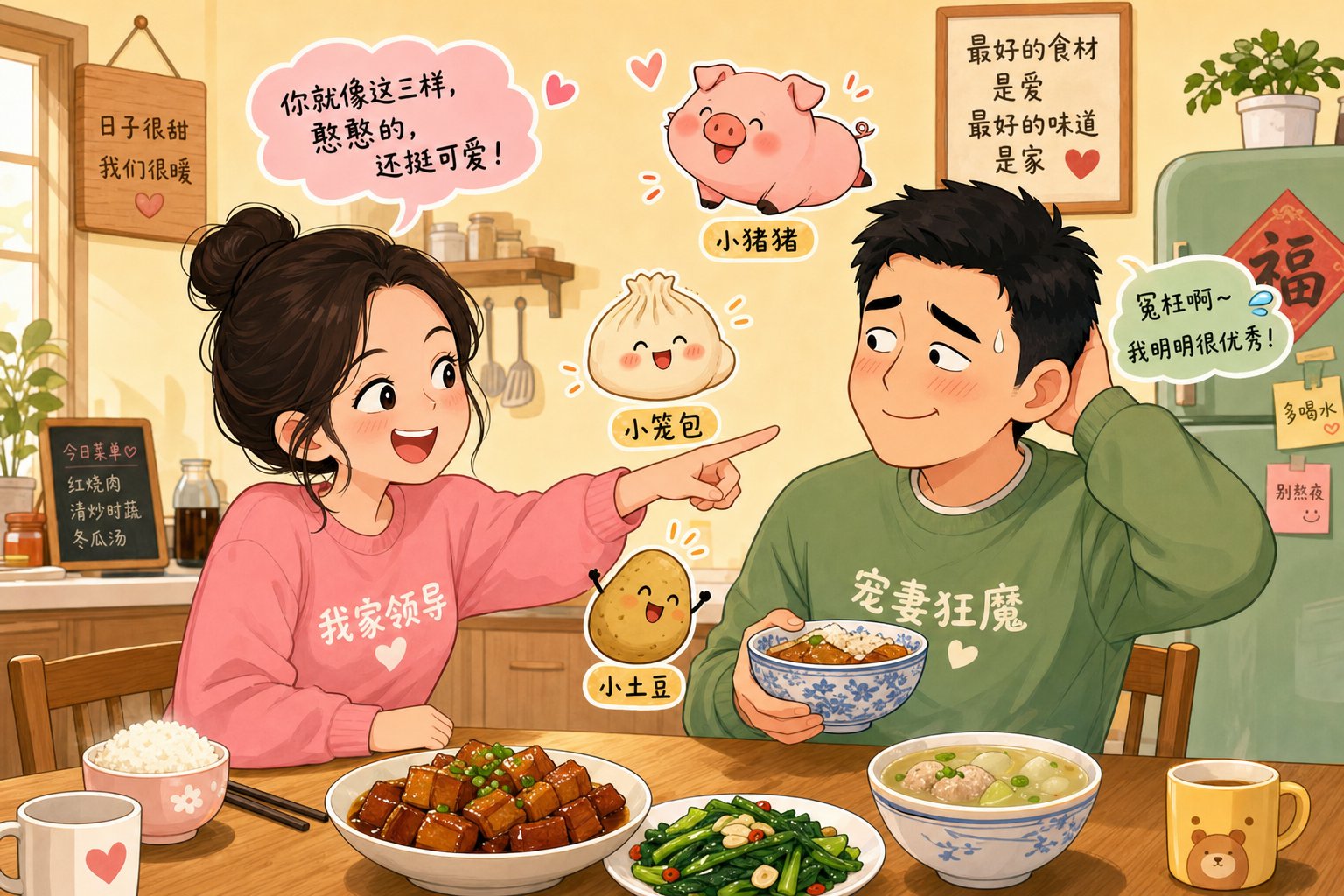
In English, calling your spouse a "pig" would probably start a fight. In Chinese, it might earn you a kiss. Some of the most beloved funny chinese nicknames work precisely because they sound rude on the surface. The logic is simple: if you can call someone a silly animal or a round dumpling and they laugh instead of flinch, that is proof of real intimacy. Only someone truly close gets away with it.
This pattern of affectionate teasing is deeply embedded in how humor works funny in chinese language and culture. Playful insults between spouses signal that the relationship is secure enough to absorb a joke. The more ridiculous the name, the stronger the implied trust.
Animal-Based Funny Pet Names for Spouses
Animals are the most popular source of funny names in chinese between married couples. These funny animal nicknames work because they reference personality quirks or physical traits with zero malice.
- 猪猪 (zhuzhu) — "Piggy." The single most common humorous spousal nickname. Implies someone is cute, lazy, or loves to eat. Universally safe and almost always received warmly. Example: "猪猪,起床了!" (Piggy, time to get up!)
- 臭猴子 (chou houzi) — "Stinky monkey." Used for a spouse who is restless, mischievous, or never sits still. The 臭 (stinky) prefix actually intensifies affection rather than insult. Example: "你这个臭猴子又偷吃零食了。" (You stinky monkey, you snuck snacks again.)
- 熊熊 (xiongxiong) — "Bear bear." For a spouse who is big, cuddly, or a bit clumsy. Warm and safe for any personality type.
- 小狐狸 (xiao huli) — "Little fox." Implies cleverness or playful cunning. Works well for a spouse who always wins arguments or finds sneaky solutions.
A note on tone: 猪猪 and 熊熊 are universally safe. Terms with 臭 (stinky) or 死 (dead/damn) as prefixes, like 死猴子, carry more edge. Some spouses love the dramatic flair. Others find it grating. Read the room.
Food-Inspired Nicknames Between Husband and Wife
Chinese culture ties food to love so tightly that calling your spouse a dumpling is genuinely romantic. These cute chinese nicknames draw on beloved comfort foods to express warmth.
- 小笼包 (xiao longbao) — "Soup dumpling." For someone with round cheeks or a soft, warm personality. The image of a plump, steaming dumpling is entirely positive.
- 汤圆 (tangyuan) — "Glutinous rice ball." Eaten during Lantern Festival to symbolize family togetherness. Calling your spouse 汤圆 implies they are the sweetness that holds the family together.
- 土豆 (tudou) — "Potato." A popular humorous nickname for someone who loves lounging around, like a potato sitting in soil. Lighthearted and low-risk.
- 糖糖 (tangtang) — "Sugar." Simple, sweet, and works for either spouse.
Affectionate Insults That Actually Mean I Love You
This category contains some of the most creative and cool chinese nicknames in the spousal repertoire. These funny chinese words sound harsh in translation but function as verbal hugs.
- 笨蛋 (bendan) — "Dumb egg." One of the most widespread affectionate insults. Used when a spouse does something adorably clueless. Example: "笨蛋,伞都忘带了。" (Dummy, you forgot your umbrella again.)
- 傻瓜 (shagua) — "Silly melon." Used affectionately when a partner does something innocent or naive. Carries zero real criticism.
- 臭老公 / 臭老婆 (chou laogong / chou laopo) — "Stinky husband / stinky wife." Adding 臭 before the standard spousal term transforms it into a mock complaint that actually drips with fondness. Think of it as the Chinese equivalent of "you jerk" said while smiling.
- 死鬼 (sigui) — "Dead ghost." Wives use this for husbands who come home late or forget errands. It sounds dramatic, but the theatrical exaggeration is the point. Reserved for couples with a well-established teasing dynamic.
The key rule across all these categories: the more absurd the insult, the more affection it carries. A spouse who calls you 猪猪 every morning is telling you they feel completely at ease. That comfort, however, operates on a spectrum. Some nicknames belong only at home, while others can safely appear in front of friends or even family, a distinction that becomes critical when you consider the full range of formality levels Chinese couples navigate daily.
The Formality Spectrum From In-Laws to Pillow Talk
Every nickname covered so far exists somewhere on a sliding scale. At one end: terms you would use while standing next to your father-in-law at a banquet. At the other: words that only make sense whispered under the covers. Most Chinese couples instinctively code-switch between these registers multiple times a day without thinking about it. For learners and cross-cultural partners, though, understanding what is pet name territory versus what qualifies as a formal title can prevent genuinely awkward moments.
The core principle is straightforward. The more people listening, the more formal the term. The fewer witnesses, the softer and sillier you can get. Chinese words of endearment are not interchangeable tokens. They are calibrated instruments, and using the wrong one in the wrong room sends a signal you may not intend.
In Chinese relational culture, the formality of a spousal nickname must match the social gravity of the setting. Using an intimate pet name in front of elders signals immaturity. Using a cold formal title in private signals emotional distance. Mastery lies in switching fluidly between registers.
Formal Terms for Public and Family Settings
When you are at a family dinner with your spouse's parents, at a work event, or introducing your partner to someone for the first time, formality protects everyone's face. These chinese terms of affection are restrained by design. They communicate respect for the audience as much as love for the spouse.
- 先生 (xiansheng) / 太太 (taitai) — "Mr." and "Mrs." Used when introducing a spouse to strangers, at official events, or in written correspondence. Carries dignity without warmth. Example: "这是我先生。" (This is my husband.)
- 爱人 (airen) — "Loved one." Slightly warmer than 先生/太太 but still appropriate in front of in-laws or colleagues. Common in northern China and among couples over 40. Example: "我爱人在医院工作。" (My spouse works at a hospital.)
- 丈夫 (zhangfu) / 妻子 (qizi) — "Husband" and "wife" in their most neutral, dictionary-definition form. Used in formal writing, legal contexts, or when speaking to authority figures. These carry zero affection but maximum clarity.
You will notice none of these terms of endearment words feel particularly warm. That is the point. In front of elders or strangers, Chinese culture values restraint over display. Showing too much sweetness publicly can embarrass both the spouse and the audience.
Casual Nicknames for Daily Home Life
Step inside the front door and the register drops. These are the pet names in chinese that couples use around the house, in front of their own children, or when chatting with close friends who already know the relationship well.
- 老公 (laogong) / 老婆 (laopo) — The workhorses of daily married life. Warm, familiar, and socially safe in almost any non-formal setting. You can use these in front of friends, siblings, and even relaxed in-laws without raising eyebrows.
- 亲爱的 (qin'ai de) — "Dear" or "darling." Sits right at the boundary between casual and intimate. Fine at home, fine in a text your mother-in-law might accidentally see, but slightly too sweet for a business dinner.
- 宝贝 (baobei) — "Treasure" or "babe." Comfortable in the home environment and among close friends. Some couples use it freely in front of their kids. Others reserve it for when the children are not listening. Personal preference dictates the line.
- 猪猪 (zhuzhu) / 笨蛋 (bendan) — Playful teasing names. Safe among close friends who understand the dynamic. Risky in front of traditional in-laws who might take the insult at face value.
Intimate Private Pet Names Between Spouses
These terms exist behind closed doors. Using them in public would feel like reading someone's diary aloud. They carry maximum vulnerability and tenderness, which is exactly why they stay private.
- 心肝 (xingan) — "Heart and liver." Viscerally intimate. Implies your spouse is as essential as your own organs. Reserved for quiet, close moments.
- 小心肝 (xiao xingan) — "Little sweetheart" (literally "little heart-liver"). Even softer, often whispered or texted late at night.
- 宝宝 (baobao) — "Baby." When used between spouses rather than for actual children, it signals a deliberately childlike, vulnerable tenderness. Strictly private or in one-on-one messages.
- 小坏蛋 (xiao huaidan) — "Little bad egg." Flirtatious and teasing, implying mischief. The kind of name that only works in a playful, private context.
- Custom creations — Many couples invent entirely personal nicknames based on inside jokes, shared memories, or physical features only they know. These are the most intimate pet names in chinese because they are untranslatable to anyone outside the relationship.
Here is the full spectrum organized for quick reference:
| Nickname | Formality Level | Appropriate Setting | Example Usage |
|---|---|---|---|
| 先生 / 太太 (xiansheng / taitai) | Formal | Official events, introductions, in-laws | "我先生出差了。" (My husband is on a business trip.) |
| 丈夫 / 妻子 (zhangfu / qizi) | Formal | Legal documents, formal writing | "妻子签字确认。" (Wife signs to confirm.) |
| 爱人 (airen) | Formal-casual | Colleagues, acquaintances, in-laws | "我爱人做的菜。" (A dish my spouse made.) |
| 老公 / 老婆 (laogong / laopo) | Casual | Home, friends, relaxed family gatherings | "老公,帮我拿一下。" (Hubby, hand me that.) |
| 宝贝 (baobei) | Casual-intimate | Home, private texts, close friends | "宝贝,早点睡。" (Babe, go to bed early.) |
| 猪猪 / 笨蛋 (zhuzhu / bendan) | Casual-playful | Home, close friends only | "猪猪又睡懒觉了。" (Piggy slept in again.) |
| 心肝 / 小心肝 (xingan / xiao xingan) | Intimate | Private only (bedroom, private messages) | "小心肝,想你了。" (Sweetheart, I miss you.) |
| 宝宝 (baobao) | Intimate | Private texts, voice messages, pillow talk | "宝宝晚安。" (Baby, goodnight.) |
| Custom inside-joke names | Intimate | Strictly between the couple | Varies entirely by relationship |
The pattern is clear: formality rises with audience size and social stakes, while intimacy deepens as privacy increases. A couple might cycle through three or four registers in a single evening, shifting from 先生 at a dinner party to 老公 in the car ride home to 宝宝 once the lights go off. Each shift is unconscious for native speakers but carries real social weight.
What makes this spectrum especially interesting is that it does not stay fixed across a marriage. The terms of endearment words couples favor at 25 often look nothing like the ones they reach for at 45 or 65. Life stages reshape the vocabulary of love just as powerfully as social context does.
How Spousal Nicknames Change Across Life Stages
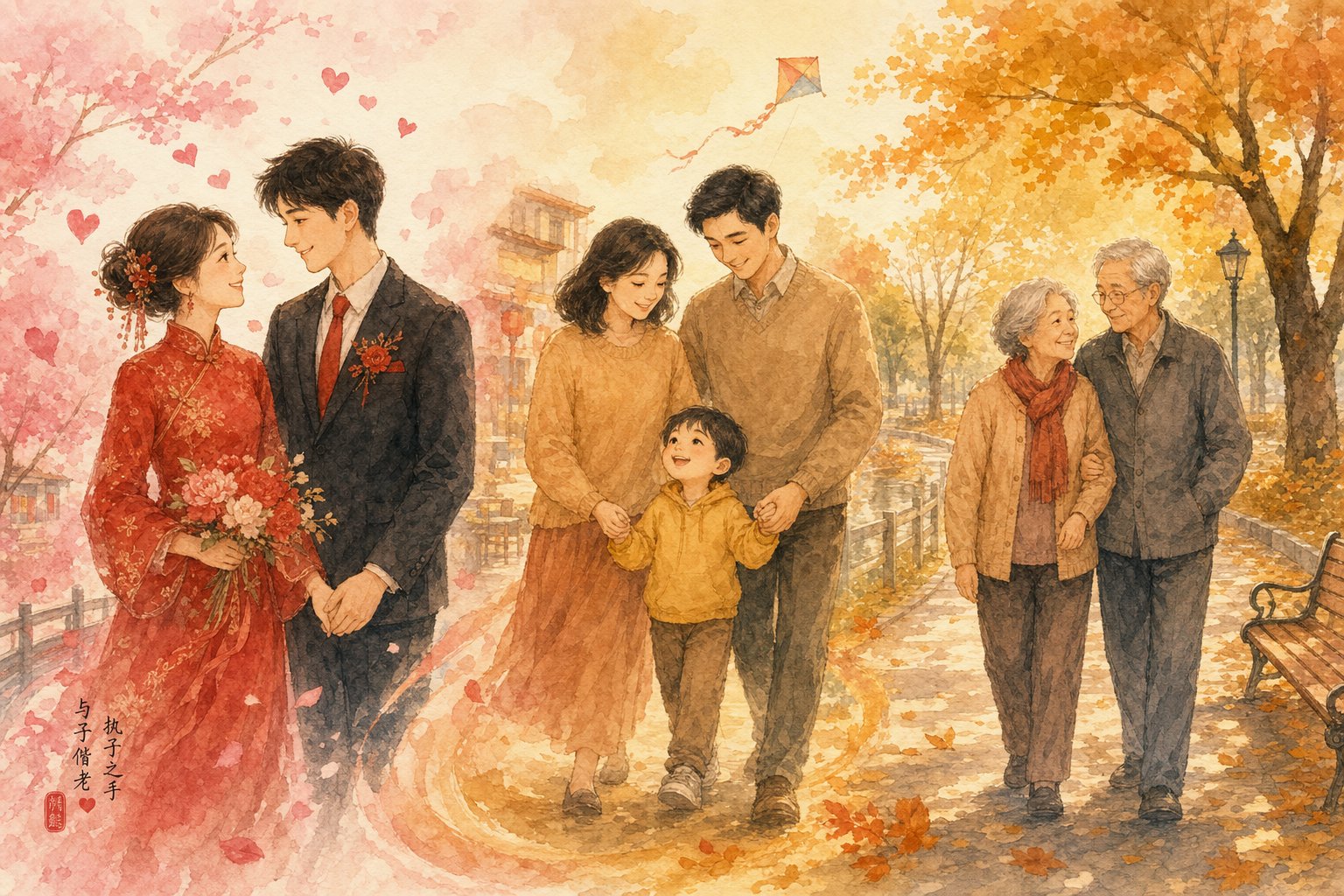
A couple married for two years and a couple married for twenty rarely sound the same when they call each other. The romantic words in chinese that feel natural during a honeymoon phase can feel performative a decade later, while the companionate shorthand of long-married partners would sound oddly flat to newlyweds. This evolution is not a sign of fading love. It is the language of a relationship maturing.
- Newlywed stage: Peak sweetness, frequent pet names, playful experimentation with terms.
- Parenthood stage: Shift toward parental titles and practical address patterns.
- Long-married stage: Settled, companionate terms that carry decades of shared meaning.
Newlywed Nicknames Full of Romance
In the first years of marriage, couples lean heavily into love words in chinese that drip with affection. This is the stage where 宝贝 (baobei, "treasure"), 亲爱的 (qin'ai de, "darling"), and 小心肝 (xiao xingan, "little sweetheart") get the most airtime. If you are wondering how to say my love in chinese, this is the life stage where that phrase actually gets used daily.
Newlyweds also tend to create private nicknames based on courtship memories. Maybe he called her 小笨蛋 (xiao bendan, "little dummy") after she got lost on their first date, and it stuck. These early-marriage terms are often the most creative because the couple is still actively building their shared language.
Example dialogue:
- "宝贝,今天下班早点回来,我做了你爱吃的。" (Babe, come home early today. I made your favorite food.)
- "好的亲爱的,等我!" (Okay darling, wait for me!)
How Parenthood Changes What You Call Your Spouse
Something fascinating happens once a baby arrives. Many Chinese couples gradually stop using romantic pet names and start addressing each other through their parental role instead. A sociolinguistic survey on spousal terms documented that terms like 孩子他爸 (haizi ta ba, "the child's father") and 孩子他妈 (haizi ta ma, "the child's mother") have long been common among Chinese parents.
The modern shorthand versions are even more widespread:
- 宝爸 (bao ba) — "Baby's dad." Used both as a direct address and when referring to a husband in parenting contexts.
- 宝妈 (bao ma) — "Baby's mom." Equally common in mommy groups and daily home life.
- 孩子爸 / 孩子妈 (haizi ba / haizi ma) — "The kid's dad / mom." Slightly more traditional, common among couples over 35.
To Western ears, this might sound like the romance has evaporated. In Chinese culture, it signals the opposite: the couple has built something larger than themselves. Their identity has expanded from lovers to co-parents, and the language reflects that shared pride. The child becomes the emotional center, and addressing your spouse through that connection is a chinese name for my love that carries weight no pet name can match.
Example dialogue at this stage:
- "孩子他爸,牛奶没了,下班带一箱回来。" (Kid's dad, we're out of milk. Grab a case on your way home.)
- "好的宝妈,还要别的吗?" (Got it, bao ma. Need anything else?)
Endearing Terms for Long-Married Couples
After decades together, many couples settle into a stripped-down vocabulary that outsiders might mistake for coldness. The chinese flirting phrases of youth give way to something quieter: a single syllable of the spouse's name, a grunt of acknowledgment, or simply 老头子 (laotouzi, "old man") and 老太婆 (laotaipo, "old lady").
These terms sound blunt, but they carry an enormous emotional payload. Calling someone 老头子 after forty years together is not an insult. It is a declaration: we made it this far, and I am still here beside you. The "old" prefix that once signaled casual familiarity in 老公/老婆 now signals something deeper: endurance.
Some long-married couples also circle back to using full names or single-character names, the same way they addressed each other during courtship. One teaching example illustrates how a husband might call his wife by her given name during dating, shift to pet names after marriage, and return to a simpler form of her name as the relationship matures. The cycle feels less like regression and more like coming home.
Example dialogue in later years:
- "老头子,别忘了吃药。" (Old man, don't forget your medicine.)
- "知道了,老太婆。" (I know, old lady.)
What looks like how to say love in chinese at 25 is all sweetness and fire. At 65, it sounds like a quiet reminder to take your pills. Both are love. The vocabulary just grew up.
These life-stage shifts play out in standard Mandarin, but the picture gets richer when you consider that China is not linguistically monolithic. Cantonese speakers, Hokkien families, and Taiwanese couples each bring their own regional flavor to spousal address, creating variations that standard Mandarin guides rarely capture.
Regional Dialect Variations Across Chinese Languages
Standard Mandarin gets all the attention in nickname guides, but China's linguistic landscape is far from uniform. A couple in Guangzhou, a pair of newlyweds in Taipei, and a long-married duo in Xiamen each draw from distinct phonetic and vocabulary pools when addressing their spouse. If you only learn the Mandarin terms, you will miss how millions of Chinese-speaking couples actually talk at home. These regional asian nicknames carry cultural flavor that generic lists never capture.
Cantonese Spousal Nicknames From Hong Kong and Guangdong
Cantonese speakers use many of the same characters as Mandarin but pronounce them entirely differently. The most common hong kong nickname for a husband is still 老公, but it sounds like lou5 gung1 in Jyutping romanization rather than Mandarin's laogong. Similarly, 老婆 becomes lou5 po4. The tonal contour and vowel quality give these familiar terms a completely different texture.
Beyond shared characters, Cantonese has its own exclusive cantonese nicknames that do not exist in standard Mandarin:
- 靚仔 (leng3 zai2) — "Handsome boy." Wives use this for husbands in a playful, admiring way. It doubles as a general compliment but carries flirtatious weight between spouses.
- 靚女 (leng3 neoi5) — "Pretty girl." The husband's equivalent response. Common in casual daily speech across Hong Kong and Guangdong.
- 心肝 (sam1 gon1) — Same characters as Mandarin's intimate term, but the Cantonese pronunciation gives it a softer, more melodic quality that many speakers find even more tender.
- BB (bi4 bi1) — Borrowed from English "baby," this is typed and spoken constantly among younger Hong Kong couples. You will see it in text messages far more than the full Chinese equivalent.
Cantonese pop culture, particularly 1980s and 1990s TV dramas, spread 老公/老婆 northward into Mandarin-speaking regions. The irony is that these terms originated as nickname mandarin speakers borrowed from Cantonese, not the other way around.
Hokkien and Shanghainese Variations
Hokkien, spoken across Fujian province, parts of Southeast Asia, and Taiwan's older generation, uses a different vocabulary set entirely. Taiwanese Hokkien remains a living language mixed into daily conversation, and spousal terms reflect that blend.
- 翁 (ang) — "Husband" in Hokkien. A single syllable with no Mandarin equivalent in daily speech.
- 某 (boo) — "Wife" in Hokkien. Commonly heard among older Taiwanese couples who grew up speaking the dialect at home.
- 水某 (sui2 boo) — "Beautiful wife." A complimentary Hokkien term husbands use, where 水 means "beautiful" rather than its Mandarin meaning of "water."
Shanghainese, or Wu dialect, adds yet another layer. Shanghainese couples might say:
- 老公 (lau ku) — Same characters, but the Shanghainese pronunciation is clipped and nasal, distinct from both Mandarin and Cantonese.
- 亲爱个 (qin e gheq) — The Shanghainese version of 亲爱的, with the possessive particle 个 replacing Mandarin's 的.
These dialect terms often surface at home even when couples speak Mandarin publicly. As one guide on Chinese family vocabulary notes, families from specific regions may use dialect terms at home while switching to Mandarin in public settings.
Taiwanese Mandarin Differences
Taiwanese Mandarin shares most spousal vocabulary with mainland Mandarin, but pronunciation and usage patterns diverge in subtle ways. The accent is softer, the retroflex sounds (zh, ch, sh) flatten, and certain terms carry different social weight.
Key differences for couples:
- 老公/老婆 — Used identically to mainland Mandarin, but pronounced with Taiwan's characteristic softer tones. This is the dominant taiwan nickname pattern for spouses across all age groups.
- 親愛的 (qin'ai de) — Written in traditional characters in Taiwan. Functionally identical but visually distinct in text messages.
- 拔拔/馬麻 (baba/mama) — Cutesy phonetic spellings of 爸爸/妈妈 that Taiwanese couples use after having children. These playful respellings appear constantly in Taiwanese parenting forums and LINE messages.
- Girlfriend in mandarin on the mainland is typically 女朋友 (nu pengyou), but in Taiwan you will also hear the more casual 女友 (nu you) or even the Japanese-influenced マイダーリン (my darling) among younger couples who mix languages freely.
The table below compares the same spousal concepts across all four major varieties:
| Concept | Mandarin (Mainland) | Cantonese (HK/Guangdong) | Hokkien (Fujian/Taiwan) | Taiwanese Mandarin |
|---|---|---|---|---|
| Husband | 老公 (laogong) | 老公 (lou5 gung1) | 翁 (ang) | 老公 (laogong, softer tone) |
| Wife | 老婆 (laopo) | 老婆 (lou5 po4) | 某 (boo) | 老婆 (laopo, softer tone) |
| Darling / Dear | 亲爱的 (qin'ai de) | 亲爱嘅 (can1 oi3 ge3) | No direct equivalent | 親愛的 (qin'ai de, traditional) |
| Sweetheart / Babe | 宝贝 (baobei) | BB (bi4 bi1) | 水某 (sui2 boo, for wife) | 宝贝 (baobei) or 北鼻 (bei bi) |
| Handsome / Pretty | 帅哥/美女 (shuaige/meinv) | 靚仔/靚女 (leng3 zai2/neoi5) | 緣投/水 (ian-tau/sui) | 帥哥/美女 (shuaige/meinv) |
Notice how Hokkien stands apart most dramatically. While Mandarin and Cantonese share written characters with different pronunciations, Hokkien uses entirely different vocabulary roots. A girlfriend in mandarin is 女朋友 across both mainland and Taiwanese usage, but in Hokkien the concept might be expressed as 查某朋友 (za-boo peng-iu), using the Hokkien word for "woman" instead.
The practical takeaway: if your spouse's family speaks a dialect at home, learning even one or two terms in their regional variety signals genuine effort. A Cantonese mother-in-law hearing you say lou5 po4 instead of laopo will notice. A Hokkien-speaking grandfather hearing you attempt ang for husband will smile. These small dialect touches carry outsized emotional weight, especially for non-Chinese partners navigating a multilingual family for the first time.
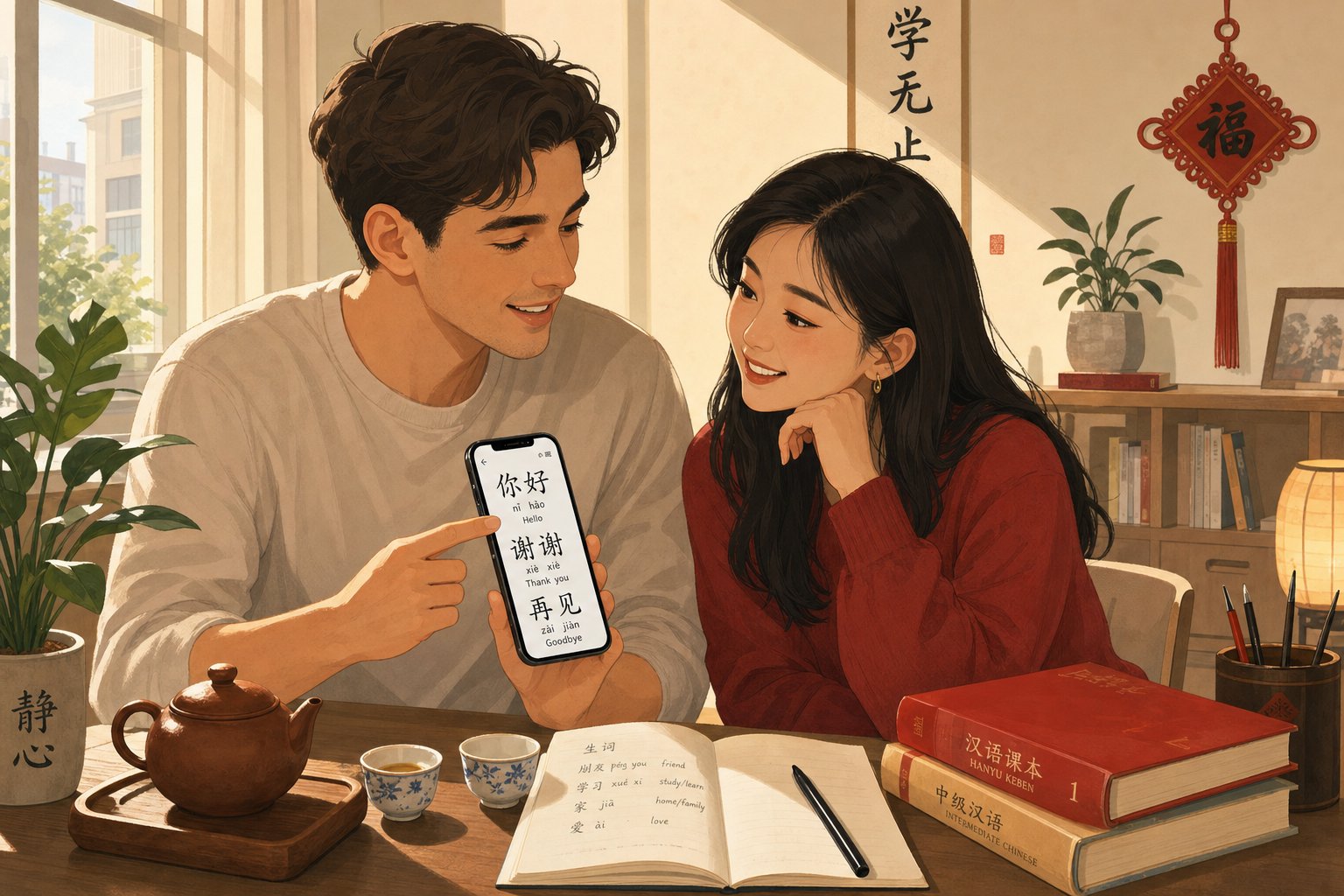
A Practical Guide for Cross-Cultural Couples
Knowing the vocabulary is one thing. Actually saying it to your Chinese spouse without stumbling, mispronouncing, or accidentally insulting their grandmother is another challenge entirely. If you are a non-Chinese partner in a cross-cultural marriage, the gap between reading nicknames in chinese on a screen and using them confidently in real life can feel wide. The good news: you do not need perfect tones to make your spouse smile. You just need the right starting point and a few guardrails.
Easiest Chinese Nicknames for Non-Native Speakers
Not all terms are equally forgiving for non-native tongues. Some chinese nicknames in english transliteration are straightforward. Others require tonal precision that takes months to develop. Start with the ones that sound natural even with imperfect pronunciation.
Here is a starter list ranked from easiest to most challenging:
- 宝贝 (baobei) — "Treasure / babe." Two syllables, both in the third-to-fourth tone pattern. Even with flat delivery, your spouse will understand. This works as a chinese pet names for girlfriend or boyfriend term equally well.
- 老公 / 老婆 (laogong / laopo) — "Hubby / wifey." The third tone on 老 can be tricky, but these are so universally recognized that approximate pronunciation still lands. Among the most common chinese pet names for boyfriend that wives use daily.
- 亲爱的 (qin'ai de) — "Dear / darling." Three syllables with a first-fourth-neutral tone pattern. Slightly harder, but the phrase is forgiving because context makes meaning obvious.
- 宝宝 (baobao) — "Baby." Two identical syllables in third tone. Simple to remember, though the consecutive third tones require a tone sandhi shift that beginners often miss.
- 心肝 (xingan) — "Sweetheart" (literally heart-liver). First tone followed by first tone. Phonetically simple, but reserve this for private moments since it carries deep intimacy.
If you are searching for a chinese name for girlfriend that feels natural to say, 宝贝 is your safest bet. It requires no tonal gymnastics and works in virtually any private context.
Pronunciation Pitfalls That Change Meaning
Mandarin tones are not optional decoration. They change meaning entirely. A few common traps for non-native speakers using chinese nicknames for girlfriend or husband terms:
- 老婆 (lao3 po2) vs. 萝卜 (luo2 bo) — Mispronouncing the vowels can turn "wife" into "radish." Amusing, not catastrophic.
- 亲 (qin1, "dear") vs. 禽 (qin2, "poultry") — Getting the tone wrong on this common texting abbreviation turns affection into livestock.
- 宝贝 (bao3 bei4) vs. 报备 (bao4 bei4) — Shifting the first tone turns "treasure" into "report for the record," which sounds bureaucratic rather than romantic.
The practical fix is simple: record your spouse saying the term, then mimic their exact melody. Tones are musical patterns, and matching pitch contour matters more than perfect vowel shape. Most chinese names for boyfriend and spousal terms are short enough that focused repetition builds muscle memory quickly.
Navigating Nickname Use With Chinese In-Laws
Your spouse might love being called 宝贝 at home. Their parents almost certainly do not want to hear it. As one guide on Chinese family culture explains, addressing relatives by their proper titles is a fundamental sign of respect, and using overly casual terms in front of elders can signal immaturity.
Before defaulting to generic nicknames around your spouse's family, ask your partner directly: what terms does your family actually use? Every household has its own comfort level, and your spouse is the only reliable guide to their family's specific expectations.
A few safe rules for in-law situations:
- Use 老公 or 老婆 when referring to your spouse in front of their parents. These are casual enough to sound natural but respectful enough to avoid raised eyebrows.
- Never use 宝宝, 猪猪, or any intimate or teasing nickname within earshot of elders. Save those for home.
- When addressing in-laws themselves, use proper kinship titles (爸爸/妈妈 for your spouse's parents if they have invited you to). Getting their titles right matters more than perfecting spousal pet names.
- Watch how your spouse addresses you in front of their family and mirror that register. If they switch to your name or a neutral term, follow their lead.
The effort itself communicates more than pronunciation accuracy ever could. A non-Chinese spouse attempting even basic nicknames in chinese signals investment in the relationship's cultural roots. Most families respond to that effort with warmth, not judgment. And if you do mangle a tone or pick the wrong term? That leads to the kind of funny stories couples tell for years, which brings us to the mistakes worth knowing about before they happen.
Common Mistakes and Embarrassing Faux Pas to Avoid
Every learner stumbles. The question is whether your mistake produces a gentle laugh or a genuinely confused silence. When it comes to spousal nicknames, a few predictable errors trip up non-native speakers repeatedly. Knowing them in advance saves you the awkward post-mortem.
Tonal Mistakes That Create Embarrassing Meanings
Mandarin tones are not cosmetic. As Hacking Chinese explains, tone errors that involve words used in the same context cause the most genuine confusion because neither speaker immediately realizes something went wrong. With spousal terms, the stakes are lower than, say, confusing "buy" and "sell," but the results can still be memorable.
| Intended Term | Common Error | What the Error Means | Correction |
|---|---|---|---|
| 亲 (qin1, "dear") | 禽 (qin2) | Poultry / fowl | Keep first tone flat and high |
| 老婆 (lao3 po2, "wife") | 老破 (lao3 po4) | Old and broken | Second tone on 婆, rising pitch |
| 宝贝 (bao3 bei4, "treasure") | 报备 (bao4 bei4) | Report for the record | Third tone dip on 宝 |
| 心肝 (xin1 gan1, "sweetheart") | 新干 (xin1 gan1) | Newly dried (food context) | Context usually saves you here |
| 老公 (lao3 gong1, "hubby") | 劳工 (lao2 gong1) | Manual laborer | Third tone dip on 老, not second tone rise |
Most of these errors will not derail a conversation. Context does heavy lifting. But getting them right shows you understand what does it mean to be affectionate in Chinese: precision is its own form of care.
Outdated Terms That Sound Strange Today
Some terms that appear in textbooks or older media have aged out of natural use. Calling your spouse 夫君 (fujun) or 娘子 (niangzi) in daily life sounds like reciting poetry at the grocery store. These carry a my dear meaning rooted in imperial literature, not modern romance.
Similarly, 哥哥 (gege) confuses many learners. So what does gege mean? Literally "older brother." In period dramas, wives sometimes address husbands this way to signal deference and sweetness. In real life, using gege meaning chinese familial hierarchy as a spousal address sounds performative to most people under 50. It belongs to fiction, not to your kitchen.
The term 郎君 (langjun) falls into the same trap. Beautiful in a Tang dynasty poem. Bizarre in a WeChat message.
Drama Nicknames vs Real-Life Usage
Chinese TV dramas are a goldmine of cute mandarin expressions, but they are scripted for emotional impact, not realism. Characters in romance dramas use chinese flirt phrases like 小傻瓜 (little fool) or darling chinese equivalents with theatrical frequency that would exhaust a real spouse in a week. The honey nickname meaning you absorb from a drama often carries exaggerated sweetness that real couples reserve for rare moments, not daily use.
A practical rule: if you only hear a term in historical or fantasy dramas, it probably does not belong in your real relationship. If you hear it in modern slice-of-life shows set in apartments rather than palaces, it is more likely to translate.
Here is the reassuring truth. Your Chinese spouse already knows your tones are imperfect. They know you might pick an outdated word or borrow something from a drama. Most partners find the attempt itself endearing. A mispronounced 宝贝 still communicates effort, vulnerability, and the desire to meet them in their language. That matters more than flawless delivery ever could.
Frequently Asked Questions About Chinese Spousal Nicknames
1. What do Chinese couples call each other in daily life?
Most Chinese couples today use 老公 (laogong, hubby) and 老婆 (laopo, wifey) as their default daily terms. These gained popularity through Cantonese pop culture in the 1980s-90s and strike a balance between warmth and respectability. For sweeter moments, couples add 宝贝 (baobei, treasure) or 亲爱的 (qin'ai de, darling). The choice shifts based on context: more formal terms appear in public, while playful or intimate names stay private.
2. Why do Chinese couples stop using romantic nicknames after having children?
Once a baby arrives, many Chinese couples shift to parental titles like 宝爸 (bao ba, baby's dad) and 宝妈 (bao ma, baby's mom) or 孩子他爸/孩子他妈 (the child's father/mother). This is culturally normal and does not signal fading romance. Instead, it reflects the couple's expanded identity as co-parents. The child becomes the emotional center of the family, and addressing a spouse through that shared role carries deep pride and connection in Chinese culture.
3. Is it rude to call your Chinese spouse by their first name?
In traditional Chinese culture, using a spouse's bare first name can feel overly direct, especially in front of elders or in formal settings. Confucian values emphasize relational hierarchy, where titles and nicknames position people within a web of social relationships. However, younger urban couples are increasingly relaxed about first-name use in private. The key rule is audience-awareness: what works at home may not be appropriate around in-laws or at formal gatherings.
4. What are the funniest Chinese nicknames married couples use?
Chinese couples often express closeness through playful insults that would sound rude in English. Popular funny nicknames include 猪猪 (zhuzhu, piggy) for a spouse who loves eating or sleeping, 笨蛋 (bendan, dumb egg) for adorable cluelessness, and 臭老公 (chou laogong, stinky hubby) as a mock complaint dripping with fondness. Food-based names like 小笼包 (soup dumpling) and 汤圆 (rice ball) are also common. The more absurd the insult, the more trust and intimacy it signals.
5. How should a non-Chinese spouse use Chinese nicknames without making mistakes?
Start with forgiving terms like 宝贝 (baobei) or 老公/老婆, which are universally recognized even with imperfect tones. Record your spouse saying the term and mimic their pitch contour rather than relying on textbook descriptions. Avoid using intimate terms like 宝宝 or 心肝 in front of in-laws, and always ask your partner what their family expects before defaulting to generic options. Most Chinese families appreciate the effort regardless of pronunciation perfection.