How Japanese Surnames Encode Centuries of Meaning in Kanji
Imagine looking at a name and seeing a landscape unfold. A mountain at the base of a village. A river cutting through a rice field. Wisteria climbing over a shrine gate. That is exactly what happens when you read Japanese surnames in their original kanji characters. These are not arbitrary labels assigned by a government clerk. They are miniature poems, compressed into one to four characters, carrying layers of meaning tied to geography, ancestry, and cultural identity.
Japan has over 138,000 documented family names, far more than neighboring China or Korea. Each one tells a story. Tanaka (田中) paints a picture of someone living in the center of a rice paddy. Yamamoto (山本) places a family at the foot of a mountain. Kobayashi (小林) sketches a small forest. When you explore japanese surnames and meanings at this level, you stop memorizing lists and start reading landscapes.
Why Japanese Surnames Carry Deep Meaning
The depth behind these names traces back to a specific historical moment. In 1875, the Meiji government required all Japanese commoners to register official surnames for the first time. Before that mandate, only samurai, nobles, and certain merchants carried family names. Millions of ordinary people, mostly farmers, had to choose a surname within a short window. They looked around them and picked what they saw: the mountain behind their home, the field where they worked, the well at the village center.
This origin story explains why nature-based surnames dominate Japan to this day. It also means that understanding japanese surnames meaning is less about rote memorization and more about learning a system of building blocks.
How Kanji Characters Shape Every Surname
Kanji are logographic characters, each carrying its own meaning and multiple possible pronunciations. A single surname typically combines two kanji, and each character contributes a distinct semantic layer. The character 川 means "river." The character 上 means "above" or "upper." Put them together as 上川 (Kamikawa), and you get "upper river" — likely describing where a family lived along a waterway.
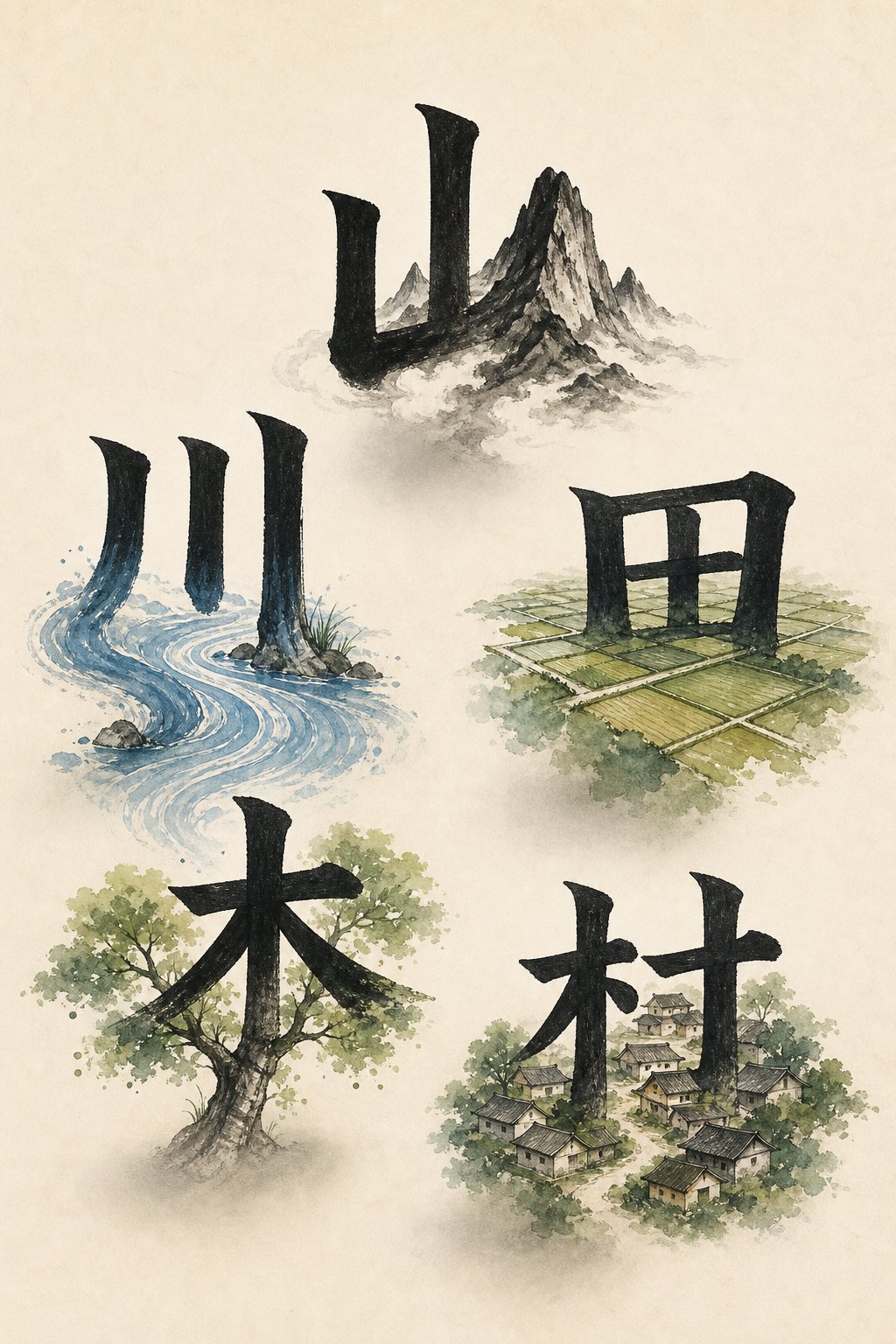
Most Japanese surnames can be decoded by understanding just 15-20 common kanji elements. These recurring characters, including mountain, field, river, tree, village, and wisteria, appear across thousands of name combinations.
What makes this system even richer is that kanji carry two reading systems: on'yomi (the Chinese-derived pronunciation) and kun'yomi (the native Japanese reading). The same written surname can sound different depending on which reading applies, and sometimes the reading shifts the nuance of meaning entirely. This dual-layer system is why japanese surnames names and meanings can surprise even native speakers when they encounter an unfamiliar combination.
Rather than offering a static list, this article gives you the framework to decode any Japanese surname you encounter. You will explore the historical forces that shaped these names, the kanji building blocks that construct them, and the thematic categories — from nature and geography to celestial imagery and warrior heritage — that organize Japan's vast surname landscape. The tools are simpler than you might expect, and the stories they reveal are endlessly rich.
The Historical Origins of Japanese Family Names
For most of Japan's history, a surname was a privilege, not a right. Roughly 90% of the population lived and died without an official family name. Samurai used surnames to claim territory and lineage. Nobles carried names tied to court rank. Wealthy merchants occasionally earned the right to bear one. But the vast majority of farmers, artisans, and laborers were identified only by given names and the villages they inhabited.
That centuries-old divide collapsed in a single government decree. Understanding japanese surnames and their meanings requires stepping back into this pivotal moment, because the choices made in the 1870s still echo in phone books and family registers across Japan.
The Meiji Mandate That Gave Japan Its Surnames
In 1875, the Meiji government issued a mandate requiring every citizen to register an official surname. The goal was administrative: a modernizing nation needed a census system, tax records, and military conscription rolls. You cannot track a population when millions of people share only a first name and a village association.
Before the Meiji period, only about 10,000 surnames were recorded in Japan. Within a few years of the mandate, that number exploded. Millions of commoners had to pick a family name, often with little guidance and under time pressure. The result is staggering: Japan now has over 100,000 distinct surnames, one of the highest counts of any nation on earth.
Some families did have informal names passed down through generations, used privately even when public use was banned during the Edo period. These people simply formalized what they already had. But many others started from scratch, choosing a name that would define their descendants for generations.
How Social Class Shaped Surname Choices
The Edo-era class system divided society into four tiers: samurai, farmers, artisans, and merchants. Each group approached the surname mandate differently.
Samurai families already held established surnames tied to clan lineage and territorial claims. Names like Takeda, Uesugi, and Shimazu carried centuries of military history. These families simply registered what they had always used. Their surnames often referenced strategic geography or martial qualities, reflecting a warrior identity built over generations.
Farmers, who made up the largest portion of the population, faced a different situation entirely. Most looked to their immediate surroundings for inspiration. A family living beside a rice paddy became Tanaka ("middle of the field"). Someone at the base of a mountain became Yamamoto. A household near a river crossing became Kawaguchi. About 80% of common japanese surnames and meanings trace back to geographic or topographic features, and this farming-class pattern is the reason why.
Artisans and merchants sometimes referenced their trades, though this was less common than geographic naming. Others adapted the surname of their feudal lord as a sign of loyalty or simply borrowed a name from a nearby temple or shrine.
Here are the main methods people used to select their surnames during this period:
- Nearby landmarks — mountains, rivers, rice fields, forests, and wells visible from the family home
- Occupation references — trades, crafts, or agricultural specialties
- Temple or shrine associations — names borrowed from local religious institutions
- Lord's surname adaptation — commoners adopting a variation of their feudal lord's name
- Aspirational meanings — choosing kanji that expressed hopes for prosperity, strength, or beauty
The speed of this adoption process also explains why so many japanese surnames meanings cluster around the same handful of kanji. When millions of farming families independently looked at the same types of landscapes, mountains, fields, rivers, and forests, they naturally gravitated toward the same characters. The result is a surname system where a small set of kanji building blocks recombines into thousands of unique names, each one a snapshot of a specific family's place in the world at a specific moment in history.
Those building blocks, the 15-20 kanji that appear again and again across Japan's most common family names, form a decoding system that makes the entire surname landscape readable.
Kanji Building Blocks Behind Japanese Surnames
A handful of kanji characters do an extraordinary amount of heavy lifting. Out of the thousands of kanji in regular use, roughly 15 to 20 specific characters appear across the majority of Japan's most common family names. Think of them as a periodic table for surnames: learn the elements, and you can decode the compounds.
Each of these characters carries its own meaning, its own imagery, and crucially, more than one pronunciation. When two or three of them combine, they create a surname that reads like a compressed description of place, aspiration, or identity. This japanese surname meanings list gives you the toolkit to read nearly any family name you encounter.
The Core Kanji That Build Most Surnames
The table below presents the essential kanji building blocks. You will notice that most relate to natural features, directions, or positions within a landscape. This is no coincidence. As millions of farming families chose surnames based on their surroundings during the Meiji era, these characters became the shared vocabulary of Japanese family names.
| Kanji | Kun'yomi (Japanese Reading) | On'yomi (Chinese Reading) | Meaning | Example Surnames |
|---|---|---|---|---|
| 山 | yama | san, zan | Mountain | Yamamoto (山本), Yamada (山田), Yamaguchi (山口) |
| 田 | ta, da | den | Rice field | Tanaka (田中), Yoshida (吉田), Yamada (山田) |
| 川 | kawa, gawa | sen | River | Hasegawa (長谷川), Kawaguchi (川口), Ogawa (小川) |
| 木 | ki, ko | boku, moku | Tree, wood | Suzuki (鈴木), Kimura (木村), Kobayashi (小林) |
| 村 | mura | son | Village | Nakamura (中村), Kimura (木村), Murakami (村上) |
| 井 | i | sei, shou | Well | Inoue (井上), Fujii (藤井), Matsui (松井) |
| 藤 | fuji | tou, dou | Wisteria | Sato (佐藤), Ito (伊藤), Kato (加藤), Saito (斉藤) |
| 野 | no | ya | Field, plain | Ueno (上野), Ono (小野), Takano (高野) |
| 中 | naka | chuu | Middle, inside | Tanaka (田中), Nakamura (中村), Nakata (中田) |
| 上 | ue, kami | jou | Above, upper | Inoue (井上), Murakami (村上), Ueno (上野) |
| 下 | shita, shimo | ka, ge | Below, lower | Kinoshita (木下), Yamashita (山下), Shimoda (下田) |
| 森 | mori | shin | Forest | Morimoto (森本), Mori (森), Morita (森田) |
| 石 | ishi | seki, shaku | Stone, rock | Ishikawa (石川), Ishida (石田), Oishi (大石) |
| 金 | kane, kana | kin, kon | Gold, metal | Kaneko (金子), Kaneda (金田), Kanamori (金森) |
| 本 | moto | hon | Origin, base | Yamamoto (山本), Matsumoto (松本), Morimoto (森本) |
| 松 | matsu | shou | Pine tree | Matsumoto (松本), Matsui (松井), Matsuoka (松岡) |
Notice how the same characters recombine in different positions. 田 (rice field) appears as the first character in Tanaka and as the second in Yamada. 上 (above) pairs with 井 (well) to form Inoue, and with 野 (field) to form Ueno. This combinatorial logic is what makes the system so productive: just 16 characters generate hundreds of distinct surnames.
When you look at a japanese surname list with meanings organized this way, patterns emerge fast. Surnames ending in -moto (本) typically reference an origin point or base of something. Surnames ending in -mura (村) point to a village. Surnames ending in -kawa or -gawa (川) trace a river. The position of each kanji within the name tells you whether it is describing a feature or locating someone relative to that feature.
How On'yomi and Kun'yomi Readings Change Meaning
Here is where things get genuinely interesting, and occasionally confusing even for native Japanese speakers. Every kanji has at least two pronunciation systems:
- Kun'yomi — the native Japanese reading, typically used when a kanji stands alone or in native Japanese compounds
- On'yomi — the Chinese-derived reading, often used in formal or compound words borrowed from Chinese
In surnames, kun'yomi readings dominate. Yamamoto uses the kun'yomi readings yama (mountain) and moto (origin). But on'yomi readings appear too, especially in surnames with historical or literary roots. The character 金, for instance, reads as kane (kun'yomi) in Kaneko but as kin (on'yomi) in certain other name contexts.
This dual-reading system creates a fascinating puzzle. Imagine you see the romanized surname "Kawaguchi" written in English. It almost certainly uses the kanji 川口, meaning "river mouth." But consider a surname romanized as "Ogawa." It could be written as 小川 ("small river"), which is by far the most common version. Yet in rare cases, entirely different kanji could produce the same romanized spelling with a completely different meaning.
The surname Suzuki offers a clear example. Written as 鈴木, it combines "bell" (鈴) and "tree" (木), translating to "bell tree." The name originated from sacred trees used in Shinto rituals. Without seeing the kanji, you might assume it relates to the common surname building blocks of nature, and it does, but through a ritual and spiritual lens rather than a purely geographic one.
This is precisely why a japanese surnames and meanings list organized by kanji is more useful than one organized alphabetically by romaji. The written characters reveal the actual meaning; the romanized spelling alone cannot. Two families named "Saito" might carry entirely different kanji: 斉藤 ("united wisteria") versus 斎藤 ("purification wisteria"). Same sound, different stories.
With these building blocks in hand, you can start reading the landscape encoded in Japan's most common surnames. The largest category by far draws directly from the natural world: mountains, rivers, fields, and forests that families saw every day when they chose their names over a century ago.
Japanese Surnames Rooted in Nature and Geography
Mountains, rivers, rice paddies, forests. These are not just scenic backdrops in Japan. They are the raw material from which the majority of Japanese family names were built. When millions of farming families needed surnames during the 1875 Meiji mandate, they turned to the landscape directly outside their doors. The result is a surname system where roughly 80% of the most common names reference a natural feature, a geographic position, or both.
This is the single largest thematic category among japanese surnames meaning nature, and it rewards close reading. Each name functions like a set of geographic coordinates compressed into two or three kanji. Let's break them apart by element.
Mountain and Earth Surnames
Japan is roughly 73% mountainous. It makes sense, then, that 山 (yama/mountain) ranks among the most frequently used kanji in family names. But the character rarely appears alone. It pairs with positional or descriptive kanji to pinpoint exactly where a family lived relative to the mountain.
- Yamamoto (山本) — ya-ma-mo-to — "base of the mountain." 本 means origin or root, placing the family at the mountain's foot. Approximately 1.05 million bearers in Japan.
- Yamaguchi (山口) — ya-ma-gu-chi — "mountain entrance." 口 means mouth or opening, suggesting a family living at the gap or pass leading into mountain terrain. Around 640,000 bearers.
- Yamada (山田) — ya-ma-da — "mountain rice field." A paddy situated on or near a mountainside. Roughly 820,000 bearers.
- Yamashita (山下) — ya-ma-shi-ta — "below the mountain." 下 places the family at the lower slope.
- Yamazaki (山崎) — ya-ma-za-ki — "mountain cape" or "mountain promontory." 崎 refers to a jutting landform.
Japanese surnames meaning earth and stone follow a similar logic. The kanji 石 (ishi/stone) appears in names like Ishikawa (石川, "stone river"), Ishida (石田, "stone field"), and Oishi (大石, "large stone"). These likely referenced rocky terrain or notable boulders near a family's home. The character 土 (tsuchi/earth, soil) shows up less frequently in common surnames but appears in names like Tsuchiya (土屋, "earth house") and Tsuchida (土田, "earth field").
Water and River Surnames
Water is life in an agricultural society, and the kanji 川 (kawa/river) threads through hundreds of family names. Anyone researching a japanese surname meaning water will find this character at the center of the pattern. Rivers defined village boundaries, irrigation routes, and trade paths, making them natural identity markers.
- Kawaguchi (川口) — ka-wa-gu-chi — "river mouth." The point where a river opens into a larger body of water or a plain.
- Hasegawa (長谷川) — ha-se-ga-wa — "long valley river." A three-kanji surname combining 長 (long), 谷 (valley), and 川 (river). About 540,000 bearers.
- Ogawa (小川) — o-ga-wa — "small river" or "stream." One of the most straightforward water surnames, with roughly 530,000 bearers.
- Furukawa (古川) — fu-ru-ka-wa — "old river." Likely referencing an ancient waterway or an oxbow channel.
- Shimizu (清水) — shi-mi-zu — "clear water" or "pure water." This surname uses 清 (clear, pure) and 水 (water) directly, making it one of the most literal japanese surname meaning water examples. Around 530,000 bearers.
Japanese surnames meaning ocean are rarer but carry striking imagery. The kanji 海 (umi/sea) appears in names like Umino (海野, "sea field"), Ueda (海田, occasionally read as "sea paddy" depending on kanji), and Kaito (海藤, "sea wisteria"). Coastal families sometimes used 浜 (hama/beach) instead, producing surnames like Hamada (浜田, "beach field") and Hamamoto (浜本, "beach origin").
Forest and Field Surnames
Two kanji dominate this subcategory: 森 (mori/forest) and 林 (hayashi/grove or woods). The distinction matters. 森 implies a dense, deep forest, while 林 suggests a thinner grove or a stand of trees. Both appear across extremely common surnames.
- Mori (森) — mo-ri — "forest." A single-kanji surname, simple and direct. About 250,000 bearers.
- Morimoto (森本) — mo-ri-mo-to — "forest origin" or "base of the forest."
- Kobayashi (小林) — ko-ba-ya-shi — "small grove." One of Japan's top 10 most common surnames with over 1 million bearers.
- Hayashi (林) — ha-ya-shi — "grove" or "woods." Another single-kanji surname, carried by roughly 550,000 people.
Field surnames split between 田 (ta/rice field) and 野 (no/open field or plain). Rice paddies were the economic engine of pre-modern Japan, so 田 appears in an enormous number of names. Tanaka (田中, "middle of the rice field") alone has over 1.3 million bearers, making it one of Japan's most common surnames. Tanabe (田辺) means "beside the rice field," while Noda (野田) combines "open field" with "rice paddy."
Snow and winter connections round out this geographic category. The kanji 雪 (yuki/snow) appears in surnames like Yukimura (雪村, "snow village") and Yukiyama (雪山, "snow mountain"), though these are considerably rarer. Families in Japan's heavy snowfall regions along the Sea of Japan coast sometimes chose these characters, marking climate as identity.
The table below organizes key nature-based surnames by element, giving you a quick reference for the patterns discussed above.
| Natural Element | Kanji | Romaji | Literal Meaning | Approx. Bearers in Japan |
|---|---|---|---|---|
| Mountain | 山本 | Yamamoto | Mountain base/origin | ~1,050,000 |
| Mountain | 山口 | Yamaguchi | Mountain entrance | ~640,000 |
| Mountain | 山田 | Yamada | Mountain rice field | ~820,000 |
| River | 長谷川 | Hasegawa | Long valley river | ~540,000 |
| River | 小川 | Ogawa | Small river | ~530,000 |
| Water | 清水 | Shimizu | Clear/pure water | ~530,000 |
| Forest | 小林 | Kobayashi | Small grove | ~1,020,000 |
| Forest | 林 | Hayashi | Grove/woods | ~550,000 |
| Rice Field | 田中 | Tanaka | Middle of the field | ~1,340,000 |
| Stone | 石川 | Ishikawa | Stone river | ~280,000 |
| Ocean | 浜田 | Hamada | Beach field | ~160,000 |
| Snow | 雪村 | Yukimura | Snow village | Rare |
The dominance of this category is no mystery. When the Meiji mandate arrived, Japan was still an overwhelmingly agrarian society. Farmers did not have clan histories or martial legacies to draw from. They had the land itself. A mountain behind the house, a river at the edge of the village, a forest on the hillside. These features were permanent, visible, and shared by neighbors, which is why you find clusters of similar surnames in the same geographic regions even today.
Japanese surnames meaning mountain, river, and forest are not just the most common. They are the foundation layer of the entire naming system. But not every family looked at the ground beneath their feet. Some looked up, choosing kanji that referenced the moon, the sun, the stars, and the wind, reaching for something beyond the immediate landscape.
Celestial and Elemental Japanese Surnames
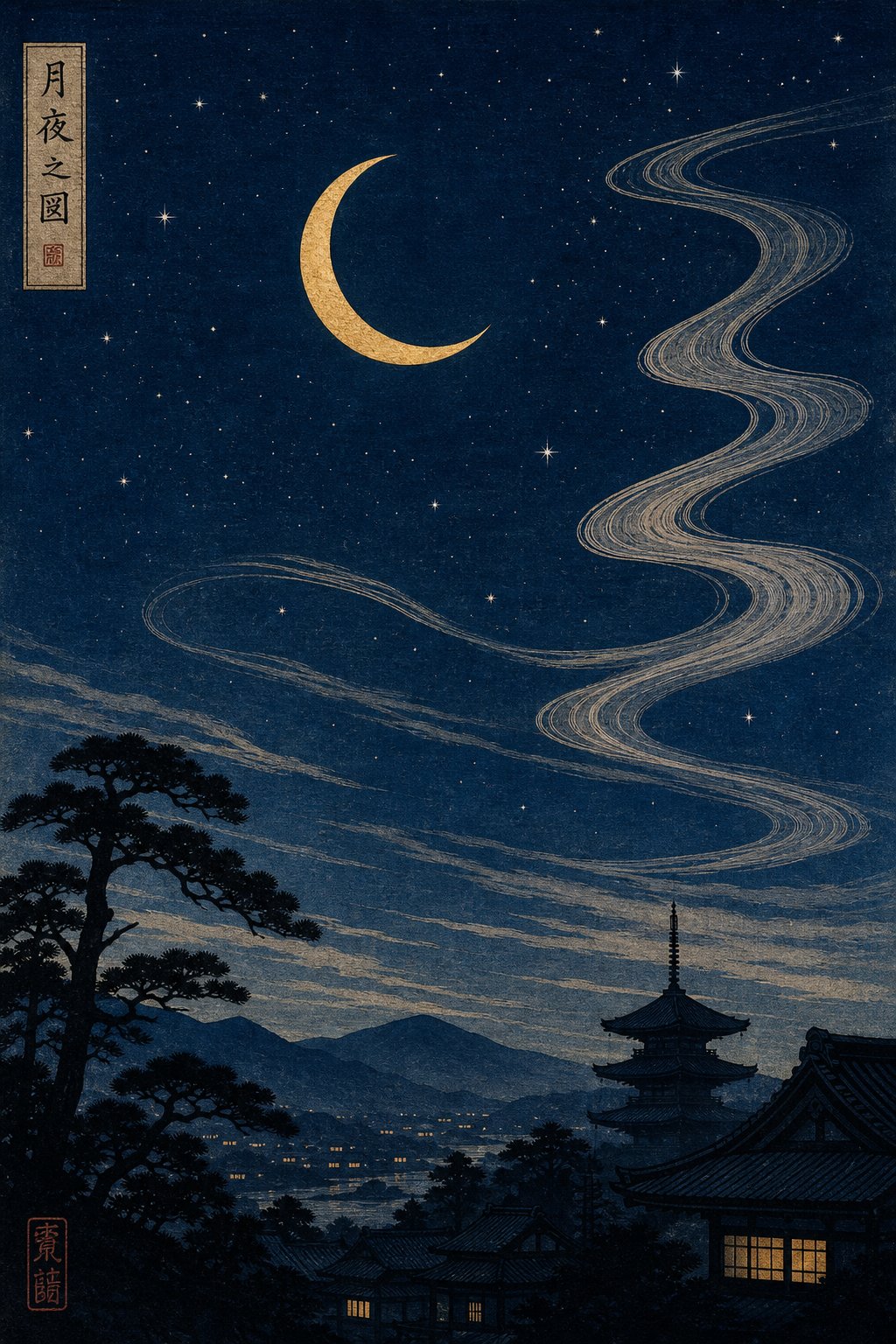
Not every family named themselves after the ground they stood on. Some chose to look skyward. Japanese surnames meaning moon, sun, stars, and sky form a smaller but deeply poetic category, one that often signals aspirational intent rather than geographic description. Where a farmer might name himself after the rice paddy outside his door, a family choosing celestial kanji was reaching for something more abstract: brightness, hope, eternity, or spiritual connection.
These names tend to be less common than the nature-and-geography surnames that dominate Japan's population registers, but they carry outsized cultural weight. Celestial imagery runs deep in Japanese aesthetics, from moon-viewing festivals (tsukimi) to the sun goddess Amaterasu at the heart of Shinto mythology. When these symbols appear in surnames, they compress entire cultural narratives into two or three characters.
Moon and Star Surnames
The kanji 月 (tsuki/moon) evokes quiet beauty, cycles of change, and the passage of time. Japanese surnames meaning moon are relatively rare compared to mountain or river names, which makes them stand out immediately. The moon held deep significance in court poetry and Buddhist philosophy alike, and families bearing these names often had connections to literary or spiritual traditions.
- Tsukiyama (月山) — tsu-ki-ya-ma — "moon mountain." Combines lunar imagery with the ever-present mountain kanji.
- Tsukimoto (月本) — tsu-ki-mo-to — "moon origin" or "base of the moon."
- Tsukida (月田) — tsu-ki-da — "moon field." A poetic blend of celestial and agricultural imagery.
- Mikazuki (三日月) — mi-ka-zu-ki — "crescent moon." Literally "three-day moon," referencing the thin crescent visible on the third night of the lunar cycle. Extremely rare as a surname.
Star-related surnames use the kanji 星 (hoshi/star). These are uncommon in everyday Japan but carry a striking visual quality that makes them memorable. Japanese surnames meaning star often appeared in families with ties to astronomy, divination, or simply a poetic sensibility.
- Hoshino (星野) — ho-shi-no — "star field" or "starry plain." The most common star surname, with the familiar 野 (field) as its second element.
- Hoshiyama (星山) — ho-shi-ya-ma — "star mountain."
- Hoshikawa (星川) — ho-shi-ka-wa — "star river." Evokes the image of starlight reflected on water.
Sun and Light Surnames
The sun occupies a central place in Japanese identity. The country's name itself, 日本 (Nihon), means "origin of the sun." Surnames built from 日 (hi, nichi/sun, day) and 光 (hikari/light) carry connotations of warmth, vitality, and visibility. Japanese surnames meaning sun and light tend to be more common than moon or star names, reflecting the sun's dominant cultural position.
- Hinata (日向) — hi-na-ta — "sunny place" or "facing the sun." 向 means "facing" or "direction." This surname describes a location that receives direct sunlight, a desirable quality for farming land.
- Asahi (朝日) — a-sa-hi — "morning sun." 朝 means morning, creating an image of sunrise. Roughly 25,000 bearers.
- Hikari (光) — hi-ka-ri — "light." A single-kanji surname, rare but striking.
- Mitsuda (光田) — mi-tsu-da — "light field" or "shining rice paddy."
- Akiyama (秋山) — while typically "autumn mountain," the related surname Akira (明) uses 明 (bright, clear) as a standalone character meaning "brightness."
Japanese surnames meaning light often use 明 (aki, mei/bright, clear) or 光 (hikari, kou/light, radiance). Names like Akimoto (明本, "bright origin") and Mitsumoto (光本, "light source") blend luminous imagery with the familiar positional kanji. Japanese surnames meaning sky draw from 空 (sora/sky) and 天 (ten, ama/heaven), producing names like Amanuma (天沼, "heavenly marsh") and Soramoto (空本, "sky origin"), though these remain quite rare in practice.
Wind and Storm Surnames
Wind represents something invisible yet powerful in Japanese culture, a force felt but never seen. The kanji 風 (kaze, fuu/wind) appears in surnames that often originated with families living on exposed ridgelines, open plains, or mountain passes where wind was a defining feature of daily life. Japanese surnames meaning wind blend geographic reality with poetic resonance, since wind also symbolizes freedom, impermanence, and spiritual movement in Buddhist and Shinto thought.
- Kazehaya (風早) — ka-ze-ha-ya — "swift wind." 早 means early or fast.
- Kazeyama (風山) — ka-ze-ya-ma — "windy mountain."
- Arashiyama (嵐山) — a-ra-shi-ya-ma — "storm mountain." Also a famous scenic district in Kyoto, this surname uses 嵐 (arashi/storm).
- Kamikaze (神風) — ka-mi-ka-ze — "divine wind." Historically significant but extremely rare as an actual surname.
Lightning and thunder surnames use 雷 (kaminari, rai/thunder) and occasionally 電 (inazuma/lightning). Names like Raikawa (雷川, "thunder river") and Kaminari (雷) itself exist in small numbers, typically in regions prone to dramatic summer storms. These atmospheric surnames sit at the boundary between geographic observation and something closer to awe, families naming themselves after forces that commanded respect.
What unites this entire celestial category is intent. Where geographic surnames describe a fixed position in the landscape, celestial and elemental names often express a quality: brightness, power, mystery, or beauty. They represent a different impulse in the naming process, one less concerned with "where do I live" and more with "what do I aspire to" or "what force defines this place." That aspirational quality becomes even more pronounced in the next category, where surnames draw from darkness, fire, and mythical creatures to project power and intensity.
Dark and Powerful Japanese Surnames
Celestial surnames reach toward light and beauty. But some families carry names that pull in the opposite direction, toward shadow, fire, ice, and predatory animals. These dark japanese surnames and meanings attract enormous interest from writers, gamers, and fans of Japanese media, and for good reason. They sound striking, carry intense imagery, and project a sense of power or mystery that lighter names do not.
Here is where honesty matters, though. Not every dramatic-sounding surname you encounter online actually exists in real Japanese family registers. Some are genuinely common. Others are vanishingly rare. And a few circulate purely because anime, manga, or video games invented them for fictional characters. Understanding which is which separates real cultural knowledge from creative fiction.
Dark and Shadow Surnames
The kanji 黒 (kuro/black) and 影 (kage/shadow) anchor this category. Japanese surnames meaning dark tend to use 黒 as a prefix combined with familiar geographic elements, producing names that are both atmospheric and grounded in real places.
- Kuroda (黒田) — ku-ro-da — "black field." A genuinely common surname with over 200,000 bearers. The historical Kuroda clan were prominent daimyo in Kyushu.
- Kurosawa (黒沢) — ku-ro-sa-wa — "black marsh." Made internationally famous by filmmaker Akira Kurosawa. A real surname with moderate frequency.
- Kuroki (黒木) — ku-ro-ki — "black tree." Real and reasonably common, particularly in southern Japan.
- Kuroiwa (黒岩) — ku-ro-i-wa — "black rock." References dark volcanic stone formations.
- Kageyama (影山) — ka-ge-ya-ma — "shadow mountain." A real surname describing the shaded side of a mountain. Less common than the 黒-based names but genuinely exists in family registers.
- Kurogane (黒金) — ku-ro-ga-ne — "black metal" or "iron." Rare as an actual surname but real. The word kurogane is an old Japanese term for iron.
Night-related surnames use 夜 (yoru/night) or 闇 (yami/darkness), but these are extremely uncommon in reality. You will encounter Yorikawa (夜川, "night river") or Yoru (夜) in fiction far more often than in actual Japanese phone directories. The kanji 闇 almost never appears in registered surnames. When people search for japanese surnames with dark meanings, the 黒-prefix names are where reality and atmosphere genuinely overlap.
What about a japanese surname meaning lost? The concept is difficult to express in a single surname kanji, but Mayoi (迷) means "lost" or "astray," and while it exists as a word, it is extraordinarily rare as an actual family name. You are far more likely to encounter it in fiction than in real life.
Fire and Blood Surnames
Fire carries dual symbolism in Japanese culture: destructive force and purifying energy. Japanese surnames meaning fire draw from several kanji, though they range widely in real-world frequency.
- Akagi (赤城) — a-ka-gi — "red castle." 赤 (aka/red) evokes fire and intensity. A real surname with historical samurai connections.
- Akai (赤井) — a-ka-i — "red well." Another genuine surname using the red kanji.
- Hinomoto (火本) — hi-no-mo-to — "fire origin." Uses 火 (hi/fire) directly. Very rare but documented.
- Homura (焔 or 炎) — ho-mu-ra — "flame." Exists as a surname but is extremely uncommon. Popularized through anime characters.
- Hibana (火花) — hi-ba-na — "spark" or "fire flower." Poetic but nearly nonexistent as a real surname.
People searching for japanese surnames meaning blood will find that the kanji 血 (chi/blood) essentially does not appear in real Japanese family names. Blood carries strong taboo associations in Shinto tradition, where it is linked to ritual impurity. Surnames that sound like they reference blood in anime or fiction typically use different kanji that merely evoke the association through color. The character 赤 (red) is the closest real-world equivalent, appearing in names like Akabane (赤羽, "red feather") and Akada (赤田, "red field").
Similarly, those looking for japanese surnames meaning death should know that 死 (shi/death) never appears in actual registered surnames. Death is the strongest taboo in Japanese naming conventions. Characters that sound similar, like 志 (shi/will, ambition) or 司 (shi/director, official), appear frequently but carry entirely different meanings. Fiction writers sometimes construct names that imply death through indirect kanji combinations, but these are creative inventions rather than real family names.
Mythical Creature Surnames
Dragon, wolf, and fox imagery carries deep mythological weight in Japan. These creatures represent power, cunning, and spiritual authority. Some animal-related surnames are genuinely old and well-documented, while others exist primarily in creative media.
- Tatsumi (辰巳/巽) — ta-tsu-mi — references the dragon (辰) and snake (巳) zodiac directions. A real surname with moderate frequency, particularly in western Japan.
- Ryuzaki (竜崎) — ryu-u-za-ki — "dragon cape." Uses 竜 (ryu/dragon) and 崎 (zaki/cape, promontory). Exists as a real surname but is rare. Gained massive visibility through the character L in Death Note.
- Tatsuno (龍野/辰野) — ta-tsu-no — "dragon field." A real place name and surname in Hyogo Prefecture.
- Inui (乾/犬井) — i-nu-i — when written as 犬井, literally "dog well." The more common writing 乾 means "dry" or "northwest" and has no animal connection despite the pronunciation.
- Okami (大神) — o-ka-mi — "great god." Sounds identical to 狼 (ookami/wolf) but uses entirely different kanji. A real surname with Shinto shrine connections.
- Kitsunezaki (狐崎) — ki-tsu-ne-za-ki — "fox cape." Uses 狐 (kitsune/fox) directly. Extremely rare but documented in some regions.
The japanese surname meaning dragon is one of the most searched in this category. The kanji 竜 and its traditional form 龍 (both read as ryu or tatsu) do appear in real surnames, though they are uncommon. Families bearing dragon surnames often had historical connections to shrines or temples where dragon deities were venerated, or they lived near geographic features named after dragons, such as waterfalls or winding rivers thought to resemble a dragon's body.
Ice and cold surnames round out this powerful category. The kanji 氷 (koori/ice) appears in the rare surname Himuro (氷室, "ice chamber," referencing historical ice storage houses). 冬 (fuyu/winter) shows up in Fuyuki (冬木, "winter tree") and Fuyuno (冬野, "winter field"). 雪 (yuki/snow), covered in the nature section, also carries cold associations. These names are uncommon but real, typically originating in Japan's heavy snowfall regions along the Sea of Japan coast.
The table below organizes these surnames by theme, with honest notes on how frequently each actually appears in modern Japan.
| Theme | Kanji | Romaji | Meaning | Real-World Frequency |
|---|---|---|---|---|
| Darkness | 黒田 | Kuroda | Black field | Common (~200,000+) |
| Darkness | 黒沢 | Kurosawa | Black marsh | Moderate |
| Shadow | 影山 | Kageyama | Shadow mountain | Uncommon but real |
| Shadow | 黒金 | Kurogane | Black metal/iron | Rare |
| Fire | 赤城 | Akagi | Red castle | Moderate |
| Fire | 赤井 | Akai | Red well | Uncommon but real |
| Fire | 焔/炎 | Homura | Flame | Very rare |
| Dragon | 竜崎 | Ryuzaki | Dragon cape | Rare (popularized by anime) |
| Dragon | 辰巳 | Tatsumi | Dragon-snake direction | Moderate |
| Wolf/Fox | 大神 | Okami | Great god (sounds like wolf) | Uncommon but real |
| Ice | 氷室 | Himuro | Ice chamber | Rare |
| Death | N/A | N/A | 死 never used in real surnames | Does not exist |
| Blood | N/A | N/A | 血 never used in real surnames | Does not exist |
A clear pattern emerges from this table. The surnames that actually exist in significant numbers use indirect darkness: black fields, shadow mountains, red castles. They reference real landscape features that happened to carry dark or intense imagery. The more extreme concepts, literal blood, death, or pure flame, either do not exist in real family registers or survive only in single-digit families.
This gap between reality and fiction matters if you are researching japanese surnames meaning dark for a novel, game, or creative project. Names like Kuroda, Kurosawa, and Kageyama give you atmospheric weight backed by genuine cultural authenticity. Names like Homura or Ryuzaki work in fictional contexts but will immediately signal "anime character" to a Japanese audience rather than "real person."
The most powerful real Japanese surnames, though, draw their intensity not from darkness or mythical creatures but from something more historically grounded: the warrior class itself. Samurai families carried names forged through centuries of military service, and those names encode strength, protection, and martial authority in ways that no fictional construction can replicate.
Japanese Surnames Meaning Warrior and Strength
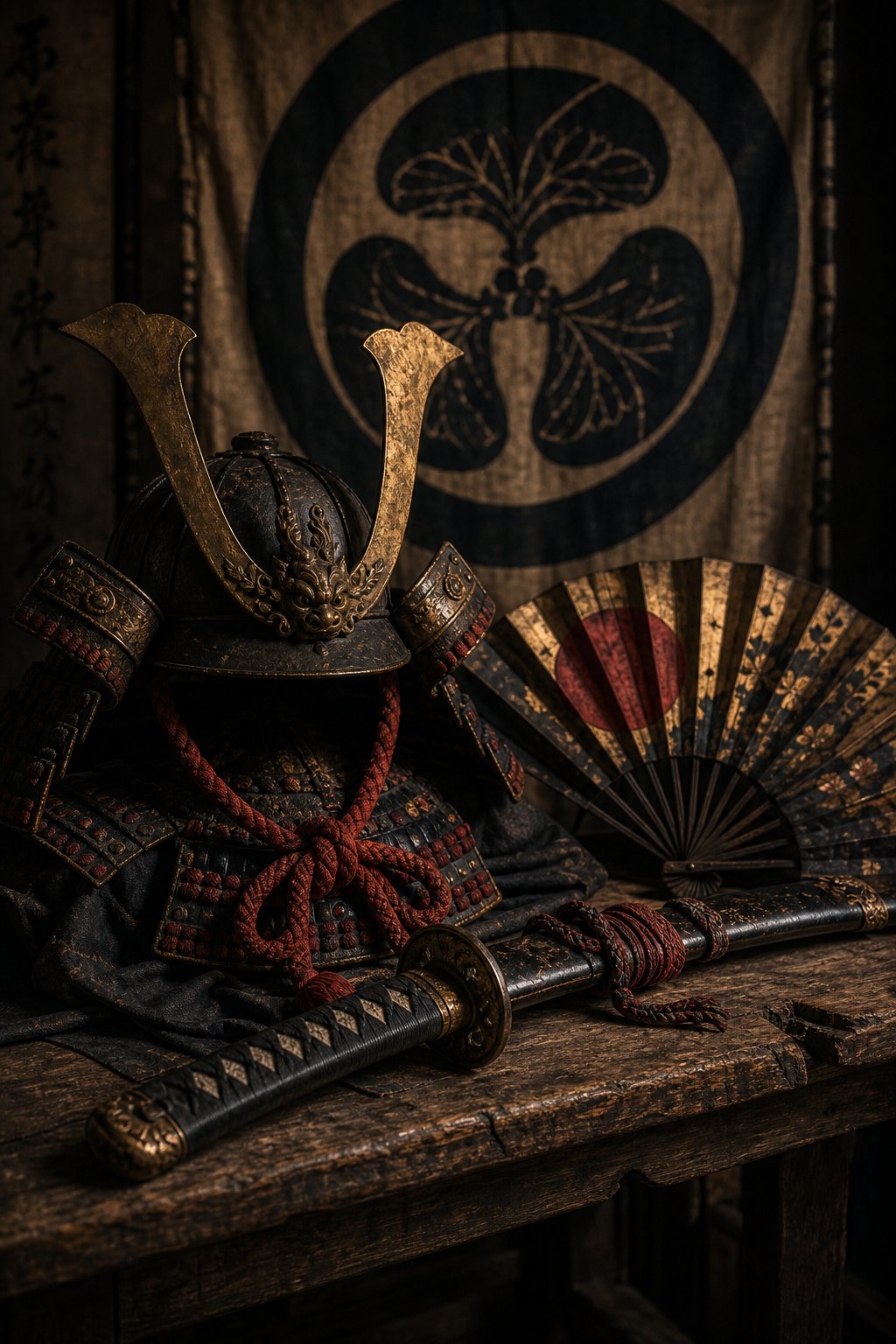
Samurai families did not need to invent surnames in 1875. They already had them, often stretching back five, ten, or even twenty generations. While commoners looked at rice paddies and mountains for naming inspiration, warrior-class families carried names forged through military service, territorial conquest, and feudal loyalty. These japanese surnames meaning warrior encode martial identity directly into their kanji, and many remain recognizable markers of samurai heritage today.
This distinction matters historically. When the Meiji mandate arrived, samurai families simply registered what they had always used. Their surnames referenced battlefields, strategic positions, martial virtues, and clan allegiances rather than the agricultural landscape that shaped commoner names. The result is a traceable split in Japan's surname system: nature-based names typically signal farming ancestry, while names built from characters like 武 (bu/martial), 守 (mori/protect), and 金 (kane/gold) often point toward warrior or noble lineage.
Warrior and Samurai Heritage Surnames
The kanji 武 (bu, take/martial, military) sits at the heart of japanese surnames meaning strength in the warrior tradition. It appears in some of Japan's most historically significant clan names, families whose influence shaped entire eras of Japanese history.
- Takeda (武田) — ta-ke-da — "martial rice field." The Takeda clan ruled Kai Province (modern Yamanashi Prefecture) and produced one of Japan's most famous warlords, Takeda Shingen. The name combines martial prowess with agricultural land, reflecting a warrior who governs farming territory.
- Takeuchi (武内) — ta-ke-u-chi — "within the martial" or "inside the warrior's domain." A surname tracing back to ancient court officials.
- Takemura (武村) — ta-ke-mu-ra — "martial village." Suggests a settlement defined by its military character.
- Murakami (村上) — mu-ra-ka-mi — "above the village." While geographically descriptive, the Murakami clan were powerful naval warriors who controlled the Seto Inland Sea during the medieval period. Context transforms a simple positional name into a warrior identity.
Other martial kanji appear across this category. The character 兵 (hei, hyou/soldier) shows up in Hyodo (兵藤, "soldier wisteria") and Heida (兵田, "soldier field"). The character 将 (shou/general, commander) appears in Masaki (将木) and other rare surnames. Families searching for a japanese surname meaning warrior will find 武 the most reliable and historically grounded character.
Surnames Meaning Strength and Protection
Protection and strength form a closely related cluster. The kanji 守 (mori, mamoru/protect, guard) carries deep resonance in a feudal society where lords were expected to defend their people. Japanese surnames meaning protector draw from this character and its associations with duty and guardianship.
- Morita (守田) — mo-ri-ta — "protected field" (when written with 守; note that the more common Morita uses 森田, "forest field"). The 守 version specifically implies guarding agricultural land.
- Moriyama (守山) — mo-ri-ya-ma — "protected mountain" or "guardian mountain."
- Okubo (大久保) — o-ku-bo — "great long protection." 保 (ho/protect, maintain) appears here. The Okubo clan were senior retainers of the Tokugawa shogunate.
Japanese surnames meaning strong and powerful use characters like 剛 (gou/strong, hard), 力 (chikara, riki/power), and 強 (tsuyoshi, kyou/strong). These appear less frequently than nature kanji but carry unmistakable intensity:
- Tsuyoshi (強) — tsu-yo-shi — "strong." Rare as a surname but exists.
- Goda (剛田) — go-da — "strong field" or "hard field."
- Riki (力) — ri-ki — "power." Extremely rare as a standalone surname.
- Chikamoto (力本) — chi-ka-mo-to — "power origin."
When you encounter japanese surnames meaning power, the kanji 力 is the most direct expression, though it appears far less often than the martial 武 or protective 守 in actual family registers. Real warrior families tended to encode strength through action (martial, protect, command) rather than abstract concepts.
Noble and Wealth-Related Surnames
Gold, fortune, and prosperity form the final strand in this power-related category. The kanji 金 (kane, kin/gold, metal) appears across numerous surnames, and japanese surnames meaning wealth often trace back to families involved in metalworking, mining, or trade rather than farming.
- Kaneko (金子) — ka-ne-ko — "gold child" or "money." One of the most common 金-based surnames, with over 230,000 bearers.
- Kaneda (金田) — ka-ne-da — "gold field." May reference land that produced valuable resources.
- Kanamori (金森) — ka-na-mo-ri — "gold forest." Possibly referencing forested land with mineral deposits.
- Kanazawa (金沢) — ka-na-za-wa — "gold marsh" or "metal stream." Also the name of a major city in Ishikawa Prefecture, historically known for gold leaf production.
Noble lineage surnames often use 宮 (miya/shrine, palace) or 王 (ou/king). Miyamoto (宮本, "shrine origin") is perhaps the most famous, carried by the legendary swordsman Miyamoto Musashi. The character 宮 connects a family to shrine authority, while 王 rarely appears in common surnames due to its imperial associations.
What ties this entire category together is continuity. Unlike the nature-based surnames that millions of families created in a single historical moment, warrior and noble surnames accumulated over centuries of feudal service. A name like Takeda carries the weight of specific battles, specific territories, and specific historical figures. That layered history is precisely what makes these names feel powerful, not just in their kanji meanings but in the stories attached to them.
One particular strand of noble heritage dominates Japan's surname landscape so thoroughly that it deserves its own examination: the wisteria connection. The kanji 藤 (fuji) appears in an astonishing number of Japan's most common surnames, and every single one traces back to a single aristocratic clan that shaped Japanese politics for centuries.
Why Wisteria Surnames Dominate Japan
A single flowering vine connects roughly 10% of Japan's top 100 family names. The kanji 藤 (fuji/wisteria) appears in surnames carried by tens of millions of people, from Sato at number one to Kato at number ten and beyond. No other single character dominates the japanese surname meaning landscape so completely. And every one of these names traces back to a single aristocratic dynasty: the Fujiwara clan.
Understanding why japanese surnames meaning wisteria are so prevalent is really understanding how political power radiates outward through generations, branching like the vine itself.
The Fujiwara Clan Legacy in Modern Surnames
In the 7th century, Emperor Tenji bestowed the name Fujiwara upon the aristocrat Nakatomi no Kamatari as a reward for loyal service. The name was inspired by Kamatari's wisteria garden. "Fuji" means wisteria, and "wara" (or "hara") means field or plain. From this single act of naming, one of Japan's most powerful political families was born.
The Fujiwara clan went on to dominate the Imperial Court for centuries, controlling government through strategic marriages to the imperial family and monopolizing key administrative positions. At their peak during the Heian Period (794-1185), virtually no political decision bypassed Fujiwara influence.
But here is the key to understanding modern japanese surnames with meaning tied to wisteria: the main Fujiwara line squeezed out lesser branches. These displaced relatives moved to the provinces, where they served as governors, military administrators, and regional nobility. To maintain their prestigious connection while distinguishing themselves from the main line, they created new surnames by combining "Fujiwara" with their new locality or official title.
The kanji 藤 can be read as "fuji" in its kun'yomi form, but in compound surnames it often takes the on'yomi reading "tou" or "dou," romanized as "to" or "do." This is why you do not immediately hear "wisteria" in names like Sato, Ito, or Kondo, even though the character is right there in the kanji.
How Wisteria Kanji Spread Across Japan
Each major 藤-based surname follows the same structural formula: a first character identifying the branch family's location or role, followed by 藤 declaring their Fujiwara heritage. The ito surname meaning japanese readers often search for illustrates this perfectly. Ito (伊藤) combines 伊 from Ise Province (modern Mie Prefecture) with 藤 from Fujiwara. A Fujiwara descendant became governor of Ise in the 9th century, and his family line adopted this compressed identity.
The same pattern repeats across Japan's most common names. Here are the most frequent 藤-based surnames ranked by approximate number of bearers:
- Sato (佐藤) — approximately 1.8 million bearers. Japan's single most common surname.
- Ito (伊藤) — over 1 million bearers. The fifth most common surname nationwide and number one in Mie Prefecture.
- Kato (加藤) — approximately 890,000 bearers. The tenth most common surname.
- Saito (斉藤/斎藤) — approximately 980,000 bearers.
- Ando (安藤) — approximately 350,000 bearers.
- Kudo (工藤) — approximately 350,000 bearers.
- Kondo (近藤) — approximately 560,000 bearers.
- Endo (遠藤) — approximately 440,000 bearers.
- Goto (後藤) — approximately 430,000 bearers.
- Sudo (須藤) — approximately 130,000 bearers.
The table below breaks down how each surname's first character differentiates meaning while 藤 remains constant, always pointing back to the Fujiwara connection.
| Surname | Kanji | First Character | First Character Meaning/Origin | Full Japanese Surname Meaning |
|---|---|---|---|---|
| Sato | 佐藤 | 佐 | From Sado Province (佐渡) in Niigata, where a Fujiwara served as governor | "Fujiwara of Sado" |
| Ito | 伊藤 | 伊 | From Ise Province (伊勢) in modern Mie Prefecture | "Fujiwara of Ise" |
| Kato | 加藤 | 加 | From Kaga Province (加賀) in modern Ishikawa Prefecture | "Fujiwara of Kaga" |
| Saito | 斉藤/斎藤 | 斉/斎 | From a purification ritual role (斎) or meaning "united" | "Purification Fujiwara" |
| Ando | 安藤 | 安 | From Awa Province (安房) or meaning "peace" | "Fujiwara of Awa" or "Peaceful Fujiwara" |
| Kudo | 工藤 | 工 | From a government engineering title (木工助) | "Craftsman-official Fujiwara" |
| Kondo | 近藤 | 近 | From Omi Province (近江) in modern Shiga Prefecture | "Fujiwara of Omi" |
| Endo | 遠藤 | 遠 | From Totomi Province (遠江) in modern Shizuoka Prefecture | "Fujiwara of Totomi" |
| Goto | 後藤 | 後 | Meaning "later" or "behind," possibly a junior branch | "Later Fujiwara" |
| Sudo | 須藤 | 須 | From Suwa (須波) or meaning "necessary" | "Fujiwara of Suwa" |
Notice the elegant consistency. Every name is a two-part code: "where this branch went" plus "we are Fujiwara." The wisteria kanji functions like a heraldic marker, a compressed claim of noble descent embedded in the family name itself. Ironically, the original Fujiwara surname now ranks only around 48th in frequency, far behind the branch families it spawned.
This pattern also explains something curious about Japanese naming culture. The wisteria plant is celebrated for its tenacity, beauty, and powerful life force. Its vines wrap around structures and climb relentlessly. As a metaphor for the Fujiwara clan's political reach, spreading across provinces, wrapping around local power structures, and producing new growth in every direction, the symbolism could not be more fitting.
When you encounter any surname ending in -to or -do in Japanese, there is a reasonable chance you are looking at a wisteria name with Fujiwara roots. That single insight unlocks the meaning behind millions of family names and reveals how deeply one clan's legacy is woven into the fabric of modern Japan. The pattern also highlights how differently surnames function across Japan's regions, a variation that becomes even more dramatic when you look beyond the mainland to Okinawa and other areas with distinct naming traditions.
Regional Patterns and Uncommon Japanese Surnames
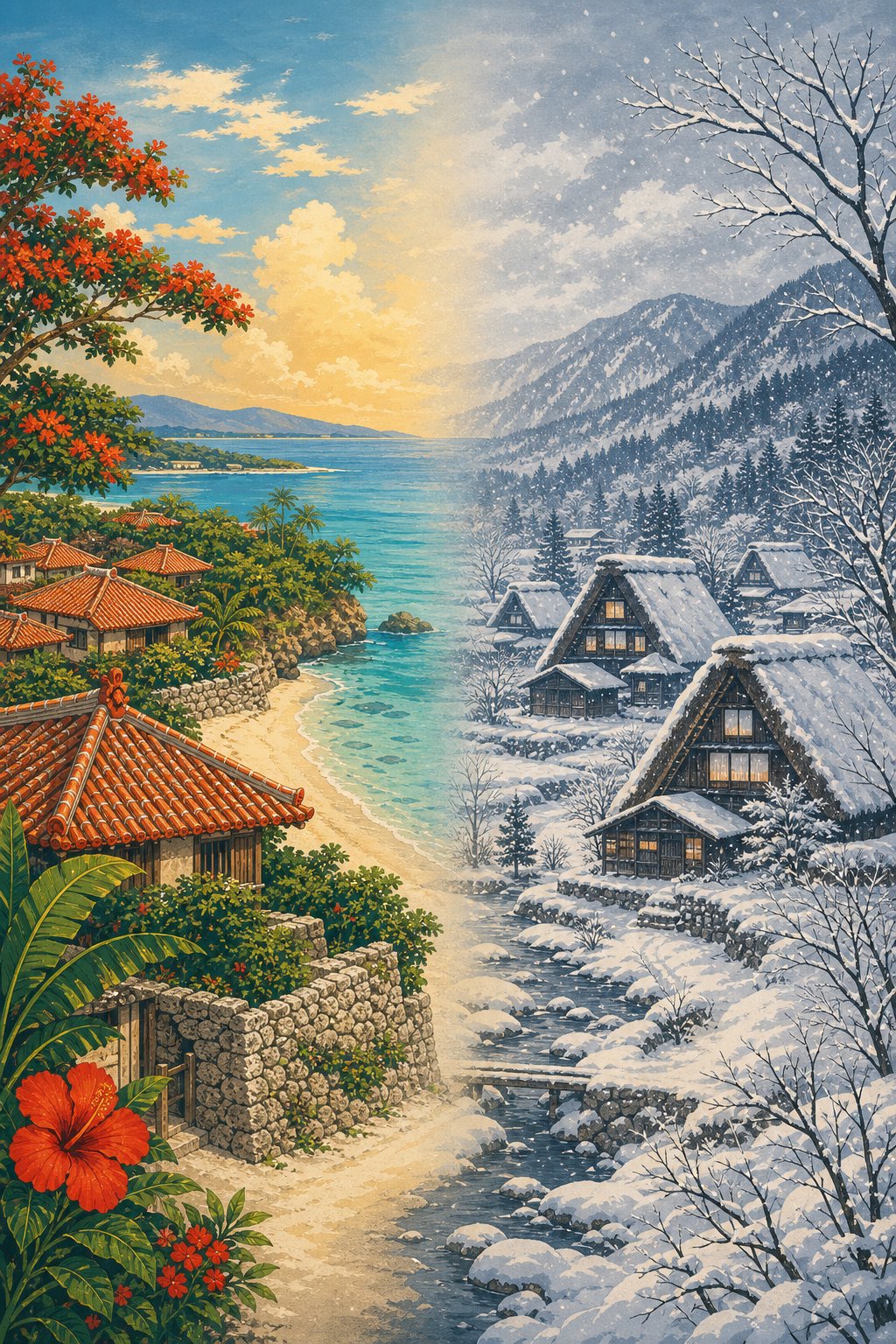
The wisteria pattern reveals how a single clan's influence radiates across an entire nation. But Japan is not a monolith. Travel from Hokkaido to Okinawa and you will notice the surname landscape shifting beneath you, sometimes subtly, sometimes dramatically. Regional clusters, linguistic heritage, and isolated cultural development have produced pockets of naming tradition that feel almost like different countries. And scattered throughout the entire system are rare, poetic surnames that break every common pattern, names meaning dream, love, music, and beauty that read like fragments of verse.
Okinawan and Regional Surname Differences
Nowhere is the regional divide more striking than in Okinawa. The islands that make up modern Okinawa Prefecture were an independent kingdom, the Ryukyu Kingdom, until Japan formally annexed them in 1879. The Ryukyuan people spoke their own languages (five distinct ones, in fact), maintained separate cultural traditions, and used a naming system entirely different from mainland Japan.
When the Meiji government forced Okinawans to adopt standard Japanese-style surnames, commoners often chose local place names as their new family names. Characters like 城 (castle), 宮 (shrine), and 川 (river) appear frequently. But here is what confounds mainland Japanese speakers: these kanji are often pronounced in Ryukyuan rather than standard Japanese. The surname 宮城, read as "Miyagi" on the mainland, was traditionally pronounced "Naagusuku" in Okinawa. The name 上村, usually "Uemura" elsewhere, often becomes "Kamimura" in Okinawan registers.
Then there are surnames that look nothing like mainland names at all:
- Higa (比嘉) — the most common surname in Okinawa. Its Ryukyuan pronunciation was originally "Fija."
- Shimabukuro (島袋) — "island bag" or "island pocket." A distinctly Okinawan three-kanji construction.
- Gushiken (具志堅) — combines kanji pronounced in Ryukyuan fashion, nearly unreadable to mainland Japanese speakers using standard rules.
- Nakandakari (仲村渠) — a three-kanji surname that most mainlanders cannot pronounce at all.
- Ganeko (我如古) — sometimes pronounced "Gajoko." The kanji combination follows no standard Japanese naming logic.
This divergence has a political dimension. During the Satsuma occupation (1609-1879), the ruling samurai actually banned Okinawans from using surnames that appeared too Japanese, fearing it would alert China to their colonial presence. Names like Nakamura were rewritten with variant kanji (仲村 instead of the mainland 中村) to maintain visual distinction. That enforced separation is still visible in Okinawan family registers today.
On the mainland, regional clusters are subtler but real. The Tohoku region (northern Honshu) shows high concentrations of surnames like Sasaki (佐々木) and Takahashi (高橋), while the Kansai region around Osaka and Kyoto favors names like Taniguchi (谷口, "valley mouth") and Hashimoto (橋本, "bridge origin"). Kyushu has elevated frequencies of Kuroda and other 黒-prefix names, reflecting the volcanic landscape. These patterns formed because families chose surnames based on local geography, and geography varies by region.
Rare and Beautiful Japanese Surnames
Beyond the common patterns, Japan's 138,000-plus surnames include names of extraordinary poetic beauty. These japanese surnames and meanings uncommon enough to turn heads even among native speakers often carry imagery drawn from dreams, love, music, and celestial wonder. If you are researching beautiful japanese surnames and meanings for creative or personal interest, this is where the language truly shines.
- Yumeno (夢野) — yu-me-no — "dream field." Uses 夢 (yume/dream) with the familiar 野 (field). Rare but documented. Japanese surnames meaning dream are uncommon precisely because 夢 was considered too abstract for the practical Meiji-era naming process.
- Aizawa (愛沢) — a-i-za-wa — "love marsh" or "love stream." Uses 愛 (ai/love). Japanese surnames meaning love exist in small numbers, with 愛 appearing in a handful of registered names.
- Koizumi (小泉) — ko-i-zu-mi — "small spring" or "small fountain." While not literally "love," the sound "koi" evokes 恋 (romantic love) to Japanese ears, giving this common surname a poetic double resonance.
- Amano (天野) — a-ma-no — "heaven field" or "celestial plain." Uses 天 (ten, ama/heaven). A moderately common surname with mythological overtones, referencing the heavenly plain of Shinto cosmology.
- Miyabi (雅) — mi-ya-bi — "elegance" or "refinement." A single-kanji surname that is extremely rare but captures the aesthetic ideal of Heian-period court culture. Among japanese surnames meaning beauty, this one distills the concept into a single character.
- Utsukushi (美) — u-tsu-ku-shi — "beauty." Virtually nonexistent as a standalone surname, but 美 appears as a component in names like Mikami (美上, "above beauty") and Yoshimi (吉美, "fortunate beauty"). Those searching for japanese surnames that mean beauty will find 美 (bi, mi) as the key character.
- Kochou (胡蝶) — ko-cho-u — "butterfly." Written with two kanji meaning "barbarian" and "butterfly" together. As a japanese surname meaning butterfly, Kochou is extraordinarily rare in real life but carries vivid imagery drawn from classical literature, particularly the Tale of Genji.
- Otoha (音羽) — o-to-ha — "sound feather." Uses 音 (oto/sound, music). Among japanese surnames meaning music, Otoha blends auditory and natural imagery. The related surname Otokawa (音川, "sound river") evokes the music of flowing water.
These names stand apart because they prioritize aesthetic or emotional meaning over geographic description. They represent the aspirational strand of the Meiji naming process, families who chose poetry over practicality.
How Japanese Surnames Compare and How to Use Them
Japanese surname structure is distinctive when placed beside its East Asian neighbors. Chinese surnames are overwhelmingly single characters drawn from a pool of roughly 400 common options (Wang, Li, Zhang). Korean surnames follow a similar single-character pattern with even fewer options, about 280 surnames covering the entire population. Japanese surnames, by contrast, typically combine two or more kanji into compound expressions, producing over 100,000 distinct names. This compound nature is what gives Japanese family names their descriptive, almost narrative quality.
Where a Chinese surname like 林 (Lin) simply means "forest," the Japanese system takes that same character and builds Kobayashi (小林, "small forest"), Hayashi (林, "grove"), and Moribayashi (森林, "deep forest grove"), each specifying a different relationship to the trees. This combinatorial richness is unique to Japanese naming conventions.
One practical note for anyone engaging with Japanese names in international contexts: Japanese naming order places the family name first. Tanaka Yuki means the Tanaka family's member named Yuki. In Western contexts, this order is often reversed for convenience (Yuki Tanaka), but the Japanese government officially recommends maintaining family-name-first order even in Roman letters. When you see a Japanese name written in all capitals for the surname (TANAKA Yuki), that formatting signals the original Japanese order is being preserved.
Whether you are tracing your own heritage, building a character for a story, or simply curious about the names you encounter in Japanese media, the system rewards attention. Every surname, from the most common Sato to the rarest Kochou, is a compressed piece of cultural information. Learn the kanji, understand the history, and you can read the poem hidden in any Japanese family name.
Frequently Asked Questions About Japanese Surnames and Their Meanings
1. How many surnames exist in Japan and why are there so many?
Japan has over 138,000 documented family names, far more than China (about 400 common surnames) or Korea (roughly 280). This extraordinary number exists because millions of commoners independently chose their own surnames during the 1875 Meiji mandate. Unlike Chinese and Korean single-character clan names, Japanese surnames combine two or more kanji into compound expressions. When millions of farming families each selected unique combinations of geographic and descriptive characters, the result was an explosion of distinct names that continues to grow through marriage registrations and regional variations.
2. What are the most common kanji used in Japanese surnames?
About 15-20 kanji characters appear across the majority of Japan's most common family names. The most frequent include 山 (mountain), 田 (rice field), 川 (river), 木 (tree), 村 (village), 井 (well), 藤 (wisteria), 野 (field), 中 (middle), 上 (above), 下 (below), 森 (forest), 石 (stone), 金 (gold), 本 (origin), and 松 (pine). These characters recombine in different positions to generate hundreds of distinct surnames. Learning these building blocks allows you to decode the meaning of most Japanese family names without memorization.
3. Why do so many Japanese surnames end in -to or -do (藤)?
Surnames containing the wisteria kanji 藤 (read as 'to' or 'do' in compounds) all trace back to the Fujiwara clan, one of Japan's most powerful aristocratic families. As branch families spread across provinces to serve as governors and administrators, they created new surnames by combining their new location with 藤 to declare their Fujiwara heritage. Sato (佐藤) means 'Fujiwara of Sado Province,' Ito (伊藤) means 'Fujiwara of Ise,' and Kato (加藤) means 'Fujiwara of Kaga.' This single pattern accounts for roughly 10% of Japan's top 100 surnames.
4. Do Japanese surnames meaning death or blood actually exist?
The kanji 死 (death) and 血 (blood) essentially never appear in real registered Japanese surnames. Blood carries strong taboo associations in Shinto tradition linked to ritual impurity, and death is the strongest naming taboo in Japanese culture. Surnames that seem to reference these concepts in anime or fiction typically use different kanji that merely evoke the association through color or sound. The character 赤 (red) is the closest real-world equivalent to blood imagery, appearing in names like Akagi (red castle) and Akabane (red feather).
5. Why are Okinawan surnames so different from mainland Japanese surnames?
Okinawa was an independent kingdom (the Ryukyu Kingdom) until Japan annexed it in 1879. Okinawans spoke distinct Ryukyuan languages and used entirely different naming conventions. When forced to adopt Japanese-style surnames, they often chose local place names pronounced in Ryukyuan rather than standard Japanese. Additionally, during the Satsuma occupation (1609-1879), Okinawans were banned from using surnames that appeared too Japanese. Names like Shimabukuro, Gushiken, and Higa follow phonetic and structural patterns that most mainland Japanese speakers cannot easily read or pronounce using standard rules.