The Art and Meaning Behind Japanese Names
When you name a child "Michael" in English, most people never think about its Hebrew origin meaning "who is like God." The meaning faded centuries ago. Japanese names work differently. Every single character in a Japanese name is chosen deliberately for what it means, how it sounds, and even how it looks when written. A name like Haruto (陽翔) isn't just a label — it's a composition of "sun" and "soar," painting a picture of ambition lit by warmth. Parents, writers, and creators who pick Japanese names without understanding this layered system are essentially choosing poetry they can't read.
That's the gap a japanese name generator with meanings is supposed to fill. But here's the problem: most generators spit out random combinations without explaining why those kanji sit together or what cultural weight they carry. You end up with a name that looks exotic on screen but might sound absurd to a native speaker. This guide teaches you how Japanese names actually work — the kanji logic, the reading systems, the gendered patterns — so you can use any japanese name generator as an informed tool rather than a slot machine.
Why Japanese Names Carry Hidden Meanings
In alphabetic languages, names are essentially sounds. Their etymological roots are buried under centuries of use. Japanese names exist in a completely different reality. Each kanji character is a living symbol with its own meaning, and combining two or three of them creates something new — a compressed wish, a family philosophy, or a poetic image.
Unlike alphabetic names where meaning is often forgotten, Japanese names are living compositions where every character is chosen for its meaning, sound, and visual beauty. A single name can encode a parent's hope, a seasonal reference, and an aesthetic ideal all at once.
Consider the name Sakura (桜). It doesn't just sound pretty — it literally means "cherry blossom," evoking spring, fleeting beauty, and renewal. Or take a name like Ren (蓮), meaning "lotus," which carries Buddhist associations of purity rising from muddy water. Even Japanese surnames reflect geography and nature, with over 291,000 distinct surnames recorded across the country. This depth is what makes a japanese name maker valuable only when you understand the system behind it.
Who Benefits From Understanding Japanese Name Meanings
You might be wondering, "what is my japanese name?" — or maybe you're after something more specific. The reasons people search for japanese names span a surprisingly wide range of creative and personal goals:
- Fiction writers and worldbuilders who need culturally accurate character names that subtly reveal personality or backstory
- Gamers and roleplayers looking for a japanese username generator approach that produces names with real weight behind them
- Parents exploring cross-cultural names who want to understand exactly what they're giving their child
- Language learners using names as a gateway to understanding kanji, readings, and cultural context
- Anime and manga fans who want to decode the hidden storytelling baked into their favorite characters' names
Each of these audiences needs more than a random list. They need the underlying logic — how kanji combine, which readings sound natural versus invented, and what cultural signals a name sends to Japanese ears. That's exactly what the following sections deliver, starting with the mechanics of how kanji characters build meaning when placed side by side.
How Kanji Combinations Create Name Meanings
A single kanji character already carries meaning. Put two of them together, and something new emerges — not just a sum of parts, but a layered concept that neither character expresses alone. This is the engine behind japanese names and meanings. Understanding how kanji compounds work is the difference between picking a name blindly and choosing one that tells a story.
In everyday Japanese, kanji compounds (jukugo) form the most common word structure in the language. Names follow the same principle. Two characters placed side by side create a relationship — one might modify the other, or both might reinforce a shared theme. When you convert a concept from name to kanji, you're not translating a word. You're composing an image.
Single Kanji vs Compound Kanji Name Construction
Some Japanese names use just one character. The name Aoi (葵) means "hollyhock" — a single image, clean and complete. The name Ren (蓮) stands alone as "lotus." These single-kanji names feel direct and modern, carrying one clear meaning without ambiguity.
Compound names work differently. Take Hiroto (大翔): 大 means "great" and 翔 means "soar." Together they paint a picture of vast, ambitious flight. Or consider Mizuki (美月): 美 is "beauty" and 月 is "moon," creating an image of elegant luminescence. The compound structure lets parents encode two wishes into one name — a technique that makes japanese family names with meanings equally rich. The surname Yamamoto (山本), for instance, combines "mountain" and "origin," suggesting someone whose roots trace back to highland terrain.
How Radicals Shape Kanji Meaning in Names
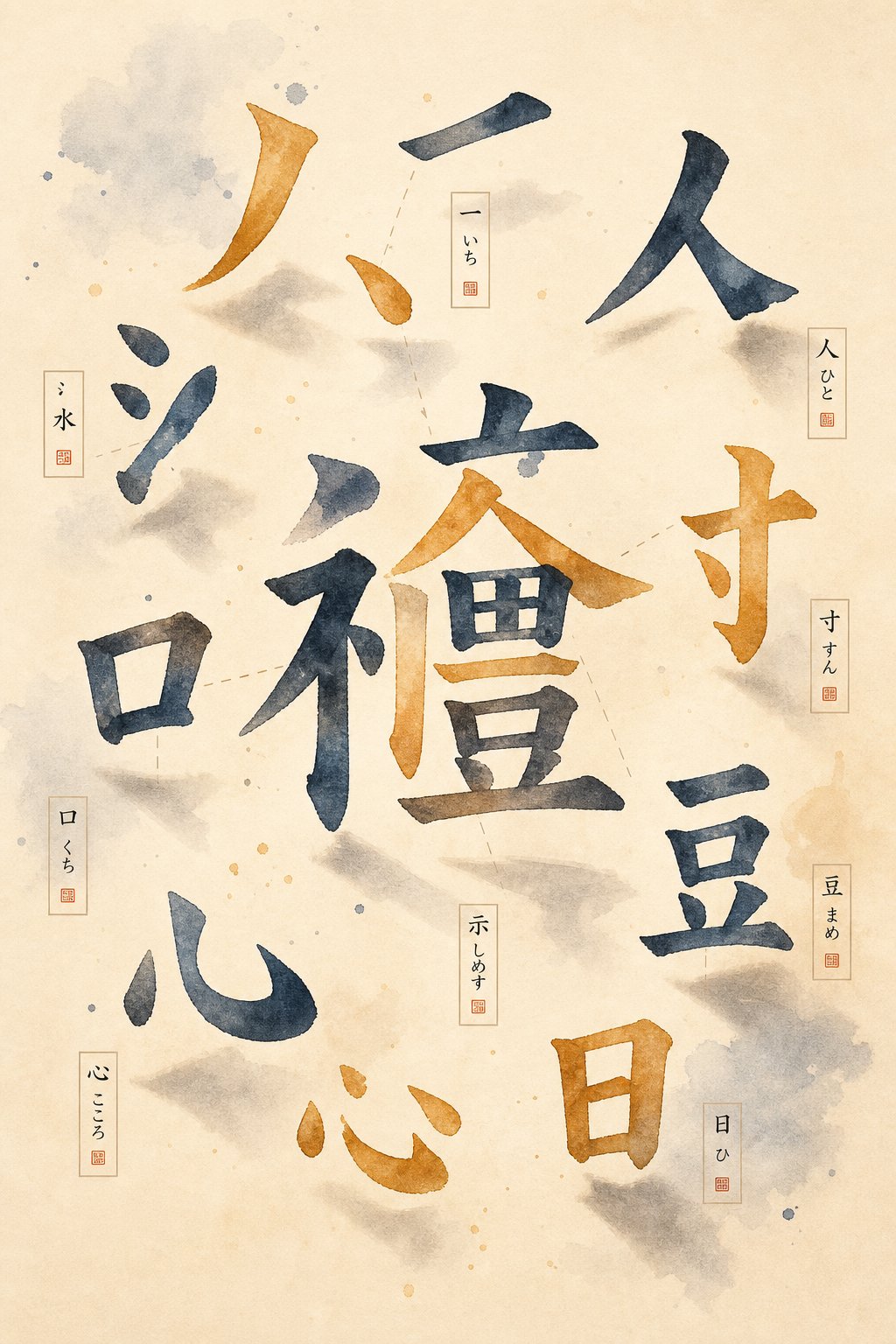
Look closer at individual kanji and you'll notice smaller components inside them. These are radicals (bushu) — the building blocks that hint at a character's meaning category. There are 214 radicals total, and recognizing even a few of them helps you read names more intuitively.
The water radical (氵, called sanzui) appears in kanji connected to liquid, flow, and purity. You'll spot it in characters like 海 (sea), 清 (pure), and 湊 (harbor). When these kanji show up in names, they carry aquatic associations — calm depth, cleansing clarity, or oceanic vastness. Similarly, the tree radical (木, kihen) anchors characters like 桜 (cherry blossom), 楓 (maple), and 樹 (timber/tree), grounding names in natural imagery.
This matters for anyone attempting a japanese translation of names. You're not just matching sounds — you're selecting visual and semantic DNA embedded in each character's structure.
| Full Name (Romaji) | Kanji | Individual Kanji Meanings | Combined Name Meaning | Gender |
|---|---|---|---|---|
| Haruka | 遥花 | Distant + Flower | A flower blooming far and wide | Female |
| Hiroto | 大翔 | Great + Soar | Soaring to greatness | Male |
| Mizuki | 美月 | Beauty + Moon | Beautiful moonlight | Female |
| Kaito | 海斗 | Sea + Dipper (constellation) | Navigating vast oceans | Male |
| Koharu | 心春 | Heart + Spring | A warm, springlike spirit | Female |
| Yamamoto | 山本 | Mountain + Origin | Roots at the mountain's base | Surname |
Context Changes Everything
Here's where things get interesting. The same kanji can shift meaning dramatically depending on its partner. Take 明 (bright/clear). In the name Akira (明), it stands alone as "brightness" or "clarity." Pair it with 日 to form Asahi (明日) and it becomes part of "tomorrow" — a forward-looking name. Place it beside 美 in Akemi (明美) and it means "bright beauty."
The kanji 大 (great/large) behaves similarly. In Daiki (大輝), it amplifies "radiance" into "great brilliance." In Daichi (大地), it transforms "earth" into "vast land." Same character, completely different emotional texture depending on context.
This contextual flexibility is exactly why japanese last names and meanings can be so tricky to interpret without seeing both characters together. The surname Tanaka (田中) combines "rice field" and "middle" — not dramatic individually, but together they describe someone living in the center of agricultural land. Meaning emerges from relationship, not isolation.
Grasping this compound logic is essential, but there's another layer that trips up even experienced learners: the same kanji compound can be pronounced in entirely different ways depending on which reading system you apply.
Understanding Name Readings and Pronunciation
You've seen how kanji combine to build meaning. But here's the twist that makes names in japanese genuinely complex: the same characters can be pronounced in completely different ways. Two people could share identical kanji in their names yet pronounce them nothing alike. This isn't a quirk — it's a fundamental feature of the writing system, and ignoring it means any japanese language name translation you attempt will be incomplete at best.
Kun'yomi and On'yomi Readings Explained for Names
Every kanji character carries at least two pronunciation layers. On'yomi (sound reading) derives from Chinese pronunciation at the time the character was borrowed into Japanese — roughly from the 5th century onward. Kun'yomi (meaning reading) is the native Japanese word that was mapped onto that same character.
Imagine the kanji 山 (mountain). Its on'yomi is "san" — you hear it in Fujisan (富士山). Its kun'yomi is "yama" — the everyday Japanese word for mountain. Both are correct. Context decides which one applies.
In names, the general pattern leans toward kun'yomi. The surname Takamori (高森) uses the kun'yomi readings "taka" and "mori" rather than the on'yomi "kou" and "shin." But exceptions are everywhere. Surnames ending in 藤 (wisteria) — Satou, Itou, Katou — use the on'yomi "tou" rather than the kun'yomi "fuji." The only reliable rule? When a kanji begins a surname, it often takes one reading; when it ends one, it may take another entirely.
Nanori — The Secret Third Reading System
Standard dictionaries won't save you here. Japanese names introduce a third category called nanori (名乗り) — special readings used exclusively in personal and place names. These readings don't follow on'yomi or kun'yomi rules, and they're one reason even native Japanese speakers need to ask each other how their names are read.
Consider the name 大翔. Using standard readings, you might guess "Daishou" (on'yomi) or "Ooto" (kun'yomi). In reality, this name is commonly read as Hiroto, Haruto, or even Taiga — all through nanori readings that exist only in naming contexts. Same two characters, wildly different pronunciations depending on the parents' choice.
This is why writing your name in japanese — whether converting a foreign name or selecting a Japanese one — requires more than matching sounds to characters. A katakana name converter handles foreign names phonetically, transcribing each syllable into katakana script. But choosing kanji for a name means navigating all three reading systems simultaneously. Someone seeing your chosen kanji might default to a reading you never intended.
How Readings Affect Name Perception
Different readings of the same kanji don't just change pronunciation — they shift the entire cultural feel of a name. To Japanese ears, certain readings sound classical, others modern, and others literary. When you write a name in katakana versus kanji, or choose one reading over another, you're signaling era, formality, and personality.
Take the kanji 美 (beauty) as an example:
- み (mi) — kun'yomi. Feels traditional and feminine. Common in names like Mika (美香) or Mizuki (美月). Evokes classic elegance.
- び (bi) — on'yomi. Sounds more formal or literary. Appears in compound words like 美術 (bijutsu, fine art) rather than typical given names.
- よし (yoshi) — nanori. Feels older, almost historical. You'll encounter it in names from earlier generations or period fiction.
Similarly, the kanji 歩 (walk/step) can be read as Ayumu (male-leaning) or Ayumi (female-leaning) — same character, different gender perception based purely on the reading chosen. As one language learner noted, a student named Ayamu (歩) was mistakenly registered as Ayumi at an event, accidentally shifting the perceived gender of the name.
This is critical context for anyone using a name to katakana tool or exploring how to render their name in hiragana versus kanji. Katakana signals "foreign origin" clearly. Hiragana feels soft and approachable — common for young girls' names. Kanji carries the full weight of meaning but introduces reading ambiguity. Each script choice sends a different message before anyone even processes the name's content.
Understanding these reading layers transforms how you evaluate generated names. A combination might look meaningful on paper, but if the readings clash or produce sounds that feel archaic when you wanted modern, the name misses its mark. The next step is knowing which meanings to aim for in the first place — and that's where organizing names by thematic category becomes genuinely useful.
Japanese Names Organized by Meaning Category
Most name lists sort alphabetically. That's fine for browsing, but useless when you already know what you want a name to express. Maybe you need a character who embodies quiet resilience, or you want a name that evokes ocean vastness. Starting from meaning and working toward specific names flips the discovery process into something actually useful — especially when paired with a generator that lets you filter by theme.
The categories below cover the most common meaning families found in both japanese girl names and japanese male names. Each one reflects values deeply embedded in Japanese culture, from reverence for nature to aspirations of moral strength. Think of this as a reference map: find the trait you want, then explore the names that carry it.
Nature-Inspired Japanese Names
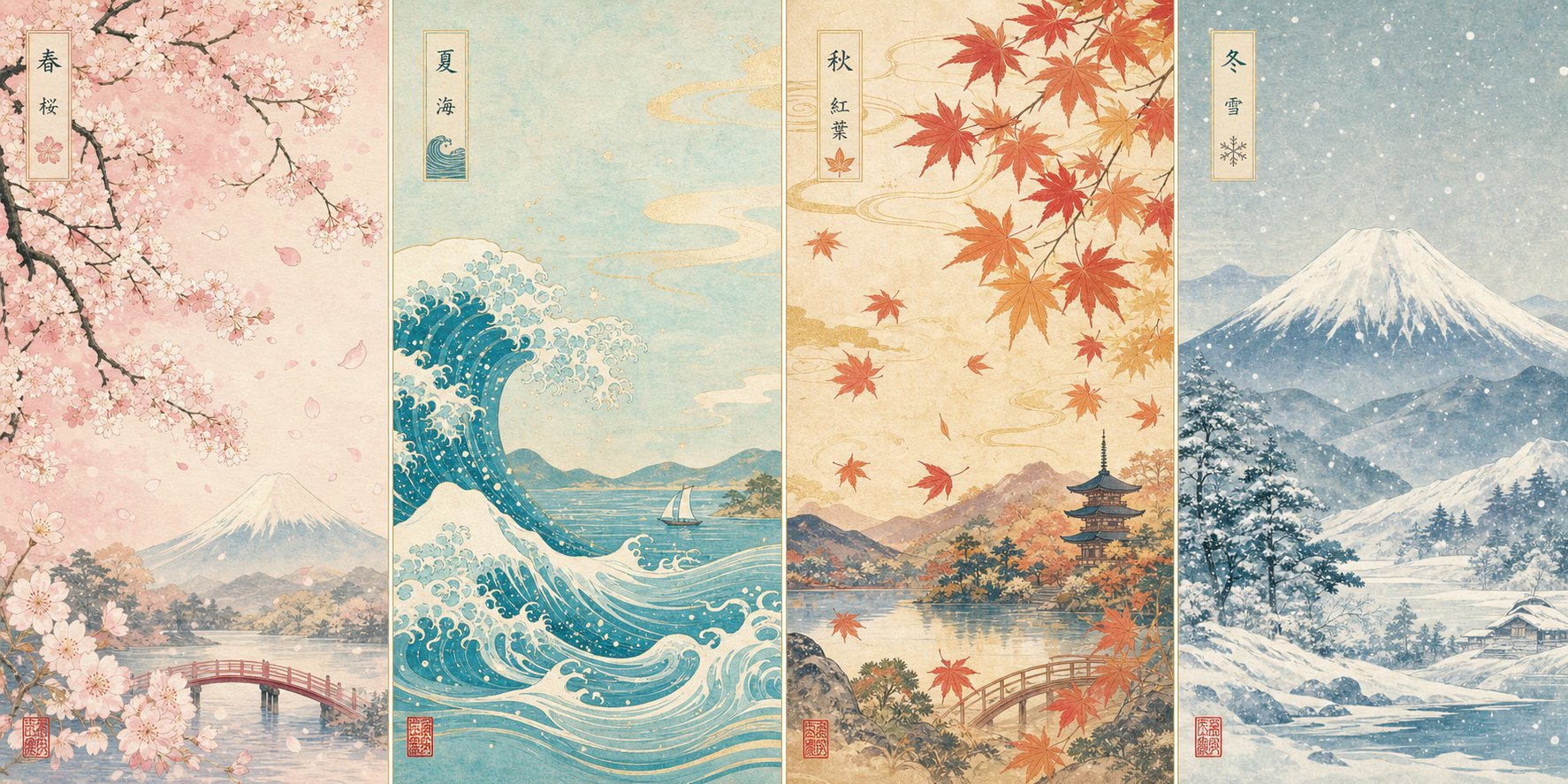
Nature dominates Japanese naming traditions. Flowers, seasons, celestial bodies, and landscapes all serve as raw material for names that connect identity to the natural world. These aren't just decorative — they carry cultural weight. Sakura (桜) doesn't just mean "cherry blossom." It evokes spring, impermanence, and the beauty of things that don't last forever.
For female japanese names, floral and seasonal imagery appears constantly. Sumire (菫, violet) suggests modesty and sincerity. Haru (春, spring) conveys warmth and new beginnings. On the male side, Kaito (海斗) combines "sea" with the constellation dipper, painting a picture of navigation and exploration. Riku (陸, land) grounds a name in stability and steadiness.
Parents often choose nature names to mark the season of a child's birth or to express a wish for their temperament — calm like water, bright like morning sun, enduring like a mountain.
Virtue and Character Names
When Japanese parents encode aspirations into a name, virtue kanji are their primary tool. These names express what a family hopes their child will become — honest, courageous, kind, or wise. The kanji 誠 (makoto, sincerity) and 勇 (isamu, bravery) appear across generations precisely because these qualities never go out of style.
Virtue names work well for both genders. Makoto and Akira (明, bright/clear) function as unisex choices expressing integrity and openness. Nozomi (望, hope) leans feminine while carrying universal emotional weight. For male japanese names, Tadashi (正, righteous) and Nobu (信, faith) project moral steadiness without sounding heavy-handed.
Fiction writers take note: virtue names are a subtle way to telegraph character traits without being obvious about it. A character named Makoto signals sincerity to any reader who knows the kanji.
Beauty and Elegance Names
Japanese aesthetics prize subtlety — the beauty of a single brushstroke, the grace of understatement. Names in this category reflect that sensibility. They don't shout "beautiful." They suggest it through imagery and sound.
Reika (麗華, lovely flower) and Ayaka (彩花, colorful flower) combine floral imagery with aesthetic kanji. Miyuki (美幸) merges beauty with happiness, creating a name that feels luminous. Kiyomi (清美, pure beauty) links clarity with grace — inner and outer elegance unified in two characters.
These names dominate lists of popular female japanese names, but elegance isn't exclusively feminine. Hiro (浩, vast/expansive) and Aki (明, bright) carry a refined quality that works beautifully for male names when parents want something sophisticated rather than forceful.
Strength and Ambition Names
Names expressing power, achievement, and determination draw from kanji associated with physical might, victory, and soaring ambition. Ken (剣, sword) is sharp and direct. Masaru (勝, victory) projects confidence. Daiki (大輝, great radiance) combines scale with brilliance — a name that aims high without apology.
Strength names aren't limited to brute force. Takumi (匠, artisan) suggests mastery through discipline and patience. Chikara (力, power) works as a unisex option expressing willpower rather than physical dominance. For those searching for unique names and surnames that stand apart from common choices, strength-category kanji offer bold combinations that feel distinctive without crossing into fictional territory.
| Category | Example Name (Romaji) | Kanji | Meaning | Gender |
|---|---|---|---|---|
| Nature | Sakura | 桜 | Cherry blossom | Female |
| Nature | Kaito | 海斗 | Sea navigator | Male |
| Nature | Haru | 春 | Spring | Unisex |
| Nature | Mizuki | 瑞希 | Auspicious hope | Female |
| Virtue | Makoto | 誠 | Sincerity, truth | Unisex |
| Virtue | Isamu | 勇 | Courage, bravery | Male |
| Virtue | Nozomi | 望 | Hope, wish | Female |
| Beauty | Reika | 麗華 | Lovely flower | Female |
| Beauty | Kiyomi | 清美 | Pure beauty | Female |
| Beauty | Akemi | 明美 | Bright beauty | Female |
| Strength | Ken | 剣 | Sword | Male |
| Strength | Masaru | 勝 | Victory | Male |
| Strength | Daiki | 大輝 | Great radiance | Male |
| Strength | Takumi | 匠 | Artisan, mastery | Male |
This table gives you a starting point, but the real value comes from understanding why these kanji pairings work. A name generator can surface options within each category — your job is recognizing which combinations feel natural versus forced. And that distinction often comes down to gendered patterns: certain kanji endings, sounds, and thematic clusters signal male or female to Japanese ears in ways that aren't immediately obvious to outsiders.
Male vs Female Japanese Naming Patterns
Certain kanji endings and sound patterns act like gender markers in Japanese names — subtle signals that native speakers pick up instantly but outsiders often miss entirely. If you've ever used a male japanese name generator or a japanese female name generator and wondered why some results "feel" masculine or feminine without knowing the meaning, these patterns are the reason. Learning them gives you a reliable filter for evaluating any name a tool produces.
Japanese names for boys and japan ladies names don't follow rigid rules, but they do follow strong tendencies. These tendencies are rooted in phonetics (how a name ends), semantics (what themes the kanji express), and aesthetics (how the written characters look on paper). Once you see the patterns, you can't unsee them.
Common Kanji Endings That Signal Gender
The final syllable of a Japanese name is often the strongest gender cue. For female names, certain endings have dominated for generations:
- -ko (子, child) — The classic feminine suffix. Names like Akiko (秋子), Keiko (恵子), and Sachiko (幸子) defined the Showa era. Its popularity has declined in recent decades, but it remains instantly recognizable as feminine.
- -mi (美, beauty) — Soft and melodic. Appears in Ayumi (歩美), Natsumi (夏美), and Kiyomi (清美). Signals grace without feeling dated.
- -ka (花/香, flower/fragrance) — Found in Haruka (遥香), Ayaka (彩花), and Reika (麗華). Evokes delicacy and natural beauty.
- -na (菜/奈) — Modern and popular. Haruna (春菜), Yuna (優奈), and Hina (陽菜) all use this ending, which feels fresh and contemporary.
- -e (恵/江) — Gentle and understated. Less common today but still recognizable in names like Kazue and Tomoe.
For japanese names male, the endings carry a different energy — assertive, grounded, or expansive:
- -to (斗/翔/人) — The dominant modern male ending. Haruto (陽翔), Kaito (海斗), and Masato (正人) all use it. The kanji 斗 references the Big Dipper constellation, suggesting guidance and ambition.
- -ta (太/大) — Conveys bigness and strength. Kenta (健太), Sota (颯太), and Ryota (涼太) sound solid and energetic.
- -ki (樹/輝) — Found in Daiki (大輝), Kazuki (和樹), and Haruki (春輝). The kanji 樹 means "tree" (stability), while 輝 means "radiance."
- -ro (郎/朗) — Traditional masculine suffix meaning "son" or "bright." Taro (太郎), Jiro (次郎), and Toshiro (俊郎) carry a classic, strong feel.
- -shi (志/司) — Suggests will or governance. Takeshi (武), Hiroshi (浩), and Satoshi (聡) use endings that sound assertive and decisive.
Worth noting: some of these boundaries are softening. A guy japanese name ending in -ki might feel perfectly natural, but the same ending increasingly appears in female names like Mizuki. The pattern holds as a tendency, not a law.
Meaning Themes by Gender
Beyond endings, the semantic content of kanji splits along gendered lines — though with more overlap than you might expect. Traditional naming conventions associate certain meaning clusters with each gender, reflecting cultural ideals parents wish to encode.
| Theme | Traditional Female Names | Example | Traditional Male Names | Example |
|---|---|---|---|---|
| Beauty / Aesthetics | 美 (beauty), 麗 (lovely), 彩 (color) | Miyuki (美幸) | 輝 (radiance), 光 (light) | Hikaru (光) |
| Nature / Flowers | 花 (flower), 桜 (cherry), 菜 (greens) | Sakura (桜) | 海 (sea), 陸 (land), 山 (mountain) | Kaito (海斗) |
| Gentleness / Grace | 優 (gentle), 静 (quiet), 和 (harmony) | Yuna (優奈) | 仁 (benevolence), 誠 (sincerity) | Jin (仁) |
| Strength / Ambition | 望 (hope), 凛 (dignified) | Rin (凛) | 勇 (courage), 武 (warrior), 勝 (victory) | Isamu (勇) |
| Vastness / Scale | 遥 (distant), 七海 (seven seas) | Nanami (七海) | 大 (great), 翔 (soar), 空 (sky) | Sora (空) |
Female names tend to draw from imagery that's intimate and sensory — fragrance, flowers, seasonal beauty, and emotional warmth. Male names lean toward scale, movement, and moral force — soaring, vastness, courage, and leadership. But notice the overlap column: kanji like 光 (light) and 望 (hope) cross gender lines comfortably depending on what they're paired with.
Gender-Neutral Japanese Names
The boundary between japanese names male and female is less rigid than it once was. Modern Japanese parents increasingly choose names that work across genders — names where the kanji and reading don't strongly signal one direction. A japanese name generator female setting might flag these as ambiguous, which is actually useful information rather than a flaw.
Popular gender-neutral names share certain traits: they tend to use nature kanji, avoid strongly gendered endings, and carry meanings that feel universal rather than tied to traditional masculine or feminine ideals.
- Aoi (葵) — Hollyhock. Ranked among the top names for both boys and girls in recent years.
- Haruka (遥) — Distant, far-reaching. The reading works for either gender; only the kanji pairing shifts perception.
- Ren (蓮) — Lotus. Currently one of the most popular male names in the Reiwa era, but historically used for both genders.
- Sora (空) — Sky. Evokes freedom and openness without gendered weight.
- Kaoru (薫) — Fragrance. A classic unisex name with literary associations dating back to The Tale of Genji.
- Hikari (光) — Light. Feels bright and positive regardless of the bearer's gender.
- Mizuki (瑞樹) — Auspicious tree. The "ki" ending might suggest male, but the name is widely used for girls as well.
- Shinobu (忍) — To endure. Carries quiet strength that transcends gender expectations.
This trend toward unisex naming reflects broader cultural shifts in Japan, where rigid gender roles are loosening — particularly in urban, younger demographics. For writers and creators, gender-neutral names offer flexibility. For parents, they sidestep assumptions about who their child should become based on a gendered label.
Knowing these patterns — which endings signal what, which themes cluster where, and which names float freely between genders — gives you a practical framework for evaluating any generated name. But there's another distinction that matters just as much: whether a name sounds like something a real person would carry, or something pulled from an anime character sheet. That gap between realistic and fictional naming is wider than most people realize.
Real Japanese Names vs Anime and Fictional Names
A name that works perfectly for an anime character might sound bizarre on a real person. This distinction matters more than most people realize when using a japanese character name generator. Fictional naming operates under completely different rules than real-world naming — and confusing the two can produce results that range from mildly awkward to culturally tone-deaf.
The gap exists because fiction uses names as storytelling devices. Real names encode parental hopes and cultural values. Both are valid systems, but they serve different purposes. Understanding where the line falls helps you choose names appropriate to your actual goal — whether that's building a believable OC maker character, writing a novel, or selecting something for real-world use.
What Makes Anime Names Different From Real Names
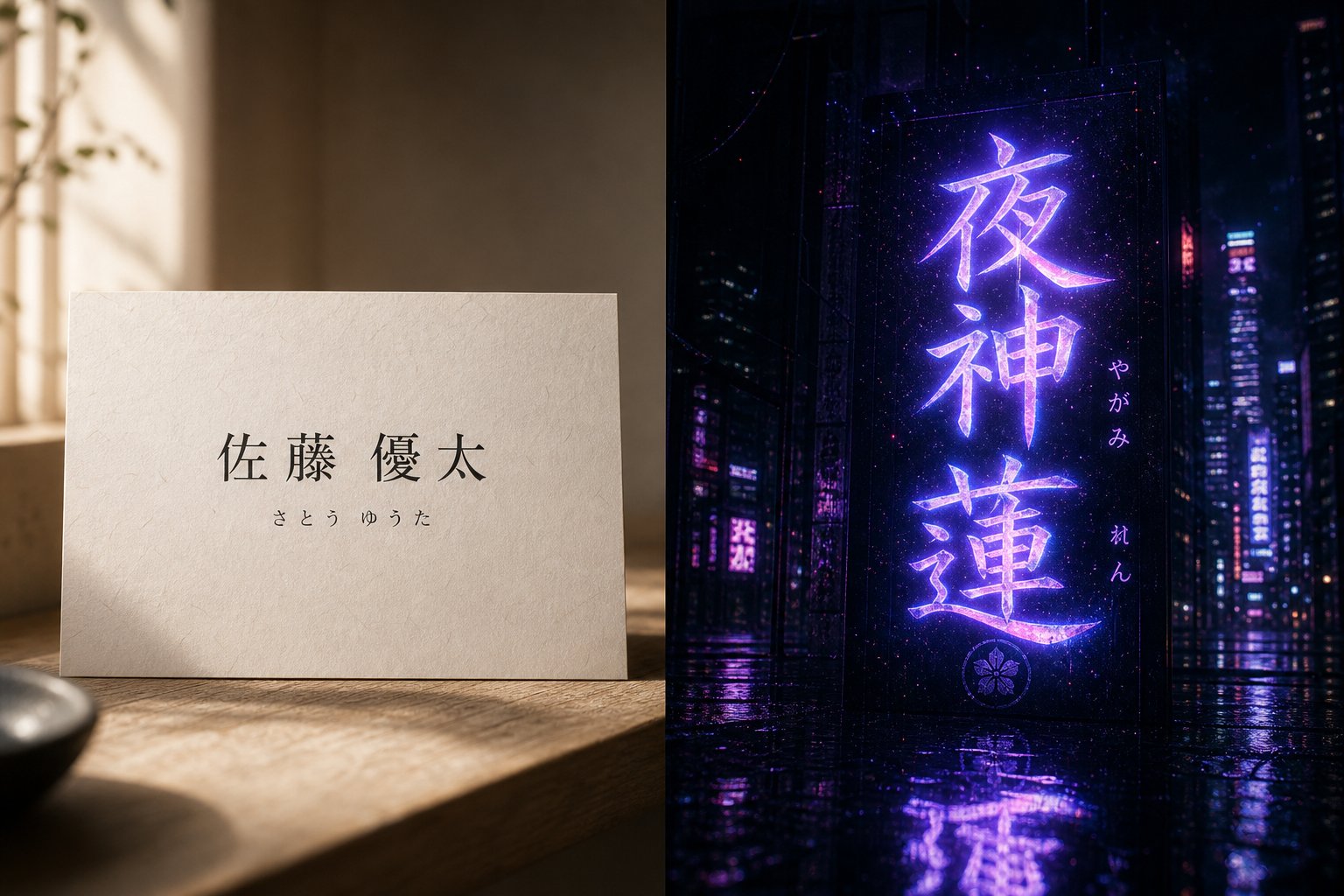
Think about the death note main character. His name is Yagami Light — written as 夜神月 (Yagami Raito). The surname 夜神 literally means "night god," and his given name 月 (moon) is read as "Raito" using the English word "light." This is a textbook example of what researchers classify as foreign-pronunciation naming — reading kanji with a non-Japanese word that matches the character's meaning. In real life, this naming pattern exists but remains uncommon and immediately signals something unusual. In fiction, it's a deliberate storytelling choice: the name telegraphs the character's god complex and his role as a bringer of judgment.
Anime and manga creators use names the way poets use metaphors — compressed, symbolic, and sometimes heavy-handed. Among death note characters, nearly every name carries thematic weight. Misa Amane (弥海砂) contains kanji for "sand" and "sea," suggesting something beautiful but impermanent. L's lack of a real name reinforces his mystery. These choices serve narrative, not realism.
The same principle applies across genres. Many mha female characters in My Hero Academia have names that directly reference their powers — Uraraka Ochako (麗日お茶子) contains kanji for "lovely day" and "tea child," hinting at her buoyant, gravity-defying ability. Spirited away characters follow similar logic: Chihiro (千尋) means "a thousand fathoms," reflecting the depth of her journey, while Haku (白) simply means "white," connecting to his dragon form and river spirit identity.
Real Japanese parents don't name children with this level of on-the-nose symbolism. A baby named 夜神 (Night God) as a surname would raise eyebrows immediately. The difference isn't that fictional names use wrong kanji — it's that they prioritize symbolic clarity over the subtlety real naming demands.
Choosing Names Appropriate to Your Purpose
Context determines which naming style serves you best. The question isn't "which is better" — it's "what am I using this name for?"
Fictional-style names work well when:
- Gaming and roleplay — Symbolic names help other players immediately grasp your character's identity. An anime girl names style works perfectly here because the audience expects and appreciates overt meaning.
- Creative writing with stylized tone — If your story operates in a heightened reality (fantasy, sci-fi, superhero narratives), names that telegraph traits fit the genre conventions.
- Fan projects and OC creation — When building an original character within an existing anime universe, matching that universe's naming conventions makes the character feel native to the world.
Realistic names are needed when:
- Literary fiction set in contemporary Japan — Readers familiar with Japanese culture will notice if every character has a suspiciously meaningful name. Subtlety matters here.
- Cultural projects and language learning — Using a name that actual Japanese people carry shows respect and demonstrates real understanding.
- Professional or personal adoption — If you're choosing a Japanese name for yourself, a realistic one avoids the impression that your understanding of the culture comes exclusively from anime.
The sweet spot for many users falls somewhere in between: a name with genuine meaning that doesn't scream its symbolism. A character named Haruto (陽翔, "sun" + "soar") carries optimistic meaning without being cartoonishly obvious. That's the kind of result a good japanese name generator with meanings should help you find.
Red Flags That a Generated Name Sounds Fictional
When evaluating output from any generator, watch for these warning signs that a name would sound invented or unnatural to native speakers:
- Kanji combinations that are too dramatic — Pairing 闇 (darkness) with 龍 (dragon) or 血 (blood) with 刃 (blade) creates something that belongs in a video game, not on a birth certificate. Real names avoid kanji with violent or extreme associations.
- Readings that don't follow any standard pattern — If the pronunciation doesn't match on'yomi, kun'yomi, or established nanori readings, it's likely invented. Research confirms that while parents can legally assign any reading to kanji in Japan, highly unusual readings still mark a name as uncommon and potentially fictional-sounding.
- Meanings that are too literal or edgy — A character named 死神 (Shinigami, "death god") works in Bleach. A real person with that name would face a lifetime of uncomfortable introductions. Names expressing death, destruction, or darkness are almost exclusively fictional.
- Surname-given name mismatches — Japanese surnames come from geography and occupation (Tanaka = rice field middle, Suzuki = bell tree). If a generated surname uses kanji typically found only in given names, or vice versa, the combination feels wrong — like naming someone "Bravery Smith" in English.
- Impossible kanji counts — Most real given names use one to three kanji. Surnames typically use one to three as well. A five-kanji given name signals fiction immediately.
- Foreign-word readings on every character — While reading 月 as "Runa" (from Latin "luna") exists in real naming, stacking multiple foreign-pronunciation readings in one name pushes it firmly into fictional territory.
None of these red flags are absolute rules. Japan's naming landscape is more creative than ever, and what seemed unusual a decade ago might appear on trending baby name lists today. But if a generated name triggers multiple flags simultaneously, you're looking at something designed for fiction rather than reality.
Recognizing this distinction is half the battle. The other half is knowing how to steer a generator toward the results you actually want — and how to verify that what it produces holds up under scrutiny.
How to Use a Japanese Name Generator Effectively
Clicking "generate" and hoping for the best is like spinning a roulette wheel with kanji on it. You might land on something beautiful — or something that makes a native speaker wince. The difference between a useful result and a wasted one comes down to how you approach the tool before and after you hit that button. A random japanese name generator can surface hundreds of options in seconds, but your job is filtering those options through everything you now understand about readings, gender patterns, and cultural context.
Getting Better Results From Name Generators
Not all japanese names generators work the same way. Some pull from databases of real names used by actual Japanese people — sourced from birth records, census data, or phone directories. Others function more like a name combiner, randomly pairing kanji characters that technically have valid readings but may never appear together in real life. Knowing which type you're using changes how much you can trust the output.
Before generating, narrow your parameters:
- Meaning filters — If the tool lets you select themes (nature, virtue, strength), use them. Starting from meaning produces more intentional results than pure randomness.
- Gender settings — As you've seen, kanji endings and thematic clusters signal gender strongly. Set this filter to match your intent, or deliberately choose "unisex" if you want ambiguity.
- Era or formality level — Some generators let you specify modern versus traditional. A name appropriate for a contemporary Tokyo university student differs from one suited to a Heian-era noblewoman.
- Reading preference — Tools that show both the kanji and the pronunciation (in hiragana or romaji) are far more useful than those showing kanji alone. You need to know how the name sounds, not just what it looks like.
A japanese nickname generator might offer shorter, more casual options — single-kanji names or abbreviated forms that work for gaming tags or informal contexts. These are fine for their purpose, but don't confuse casual output with names suitable for formal character creation or real-world use.
The strongest approach? Generate a batch of 10-20 names, then cross-reference each one against the meaning categories and gender patterns covered earlier. Discard anything that triggers the fictional red flags from the previous section. What remains is your shortlist of culturally grounded options.
Converting Your Name to Japanese
Many people searching for a japanese name converter aren't looking to generate something new — they want to convert name in japanese from their existing one. Maybe you need a name for a language class, a martial arts dojo, or a professional context in Japan. There are three distinct approaches, and each serves a different purpose.
1. Phonetic katakana transcription — This is the standard, practical method. Your name gets broken into Japanese syllables and written in katakana, the script reserved for foreign words. "Michael" becomes マイケル (Maikeru). "Sarah" becomes サラ (Sara). This is how Japanese institutions will write your name on official documents, and it's the approach most Japanese people consider appropriate for everyday use. No meaning is attached — it's purely phonetic.
2. Kanji with matching sound and meaning — This is the artful approach. You find kanji characters whose readings approximate your name's pronunciation while also carrying meaningful definitions. A language school instructor suggests that "Michael" could use 海 (Kai, sea), and "Sarah" maps naturally to 沙羅 (Sara, a flowering tree). The process is time-consuming because you're searching for kanji that satisfy both sound and meaning simultaneously — and you need to avoid characters with embarrassing definitions. As one calligrapher notes, choosing the kanji 痢 (diarrhea) for the "ri" sound in Mary would be a memorable mistake.
3. Choosing a completely new Japanese name — Rather than translating your existing name, you select a Japanese name that resonates with you personally. This is the name to japanese name approach — abandoning phonetic similarity entirely in favor of meaning. Someone named "Grace" might choose Miyabi (雅, elegance) not because it sounds similar, but because it captures the same essence.
Which approach fits depends on context. For official documents and business cards, katakana is expected. For calligraphy, martial arts, or creative projects, kanji transcription adds visual beauty. For personal identity or fiction writing, a fresh Japanese name gives you complete freedom to make name in japanese that carries exactly the meaning you want.
Verifying Your Generated Name Is Appropriate
You've generated a name or converted your own. It looks good on screen. But how do you confirm it actually works? Testing across multiple Japanese name generation tools reveals that some produce up to 35% invalid kanji combinations — characters that aren't on Japan's approved naming list or readings that don't correspond to any real pronunciation. Verification isn't optional. It's essential.
Run every generated name through this checklist before committing to it:
- Confirm the kanji readings are real — Look up each character in a Japanese dictionary and verify that the pronunciation shown actually exists as an on'yomi, kun'yomi, or nanori reading. If the reading doesn't appear anywhere, the generator may have invented it.
- Check the jinmeiyō kanji list — Japan legally restricts which kanji can appear in registered names. If you need a name that could theoretically be real, every character must appear on the approved list of 2,999 jinmeiyō kanji or the standard jōyō kanji set.
- Verify the combination isn't offensive or absurd — Speak the name aloud. Does it sound like an existing Japanese word with negative connotations? Some kanji pairings create unintentional homophones — words that sound identical to embarrassing or vulgar terms. A native speaker check catches what dictionaries miss.
- Confirm gender alignment matches your intent — Cross-reference the name's ending and kanji against the gendered patterns covered earlier. If you intended a female name but the result uses strongly masculine endings like -ta or -ro, something went wrong in the generation process.
- Research whether the name exists in actual use — Search the name in Japanese (using kanji) to see if real people carry it. Baby name ranking sites like Meiji Yasuda Life Insurance's annual lists confirm whether a name is currently in circulation or entirely invented.
- Check historical period accuracy — If the name is for a character set in a specific era, verify the kanji were used in names during that period. The character 翔 (soar) barely appeared in names before the 1980s — placing it in an Edo-period story breaks immersion immediately.
- Test surname-given name compatibility — Japanese surnames and given names follow different construction rules. A surname using kanji typically reserved for given names (or vice versa) sounds wrong to native ears, even if each part is individually valid.
This process takes ten minutes per name. That's a small investment compared to discovering months later that your character's name means something unintended, or that the name you've been using in a Japanese context marks you as someone whose cultural knowledge comes exclusively from generators rather than understanding.
The deeper your knowledge of naming conventions, the less verification you'll need — because you'll instinctively filter out problematic combinations before they reach your shortlist. And that knowledge extends beyond individual names into the historical and legal framework that shapes what Japanese names can and cannot be.
Historical Context and Cultural Guidelines for Name Selection
Japanese naming didn't arrive fully formed. It evolved through centuries of political upheaval, class warfare, and legal reform — each era leaving its fingerprint on what names look like, who gets to have them, and what they're allowed to mean. If you're using a japanese surname generator or picking names for historical fiction, this context isn't optional. A name that feels perfectly natural in modern Tokyo would sound absurd in feudal Japan, and vice versa.
Understanding this timeline also explains something practical: why the last name first name japanese order exists (family name precedes given name, reflecting collective identity over individual), and why certain kanji carry weight that goes far beyond their dictionary definitions.
How Japanese Names Evolved Across Historical Eras
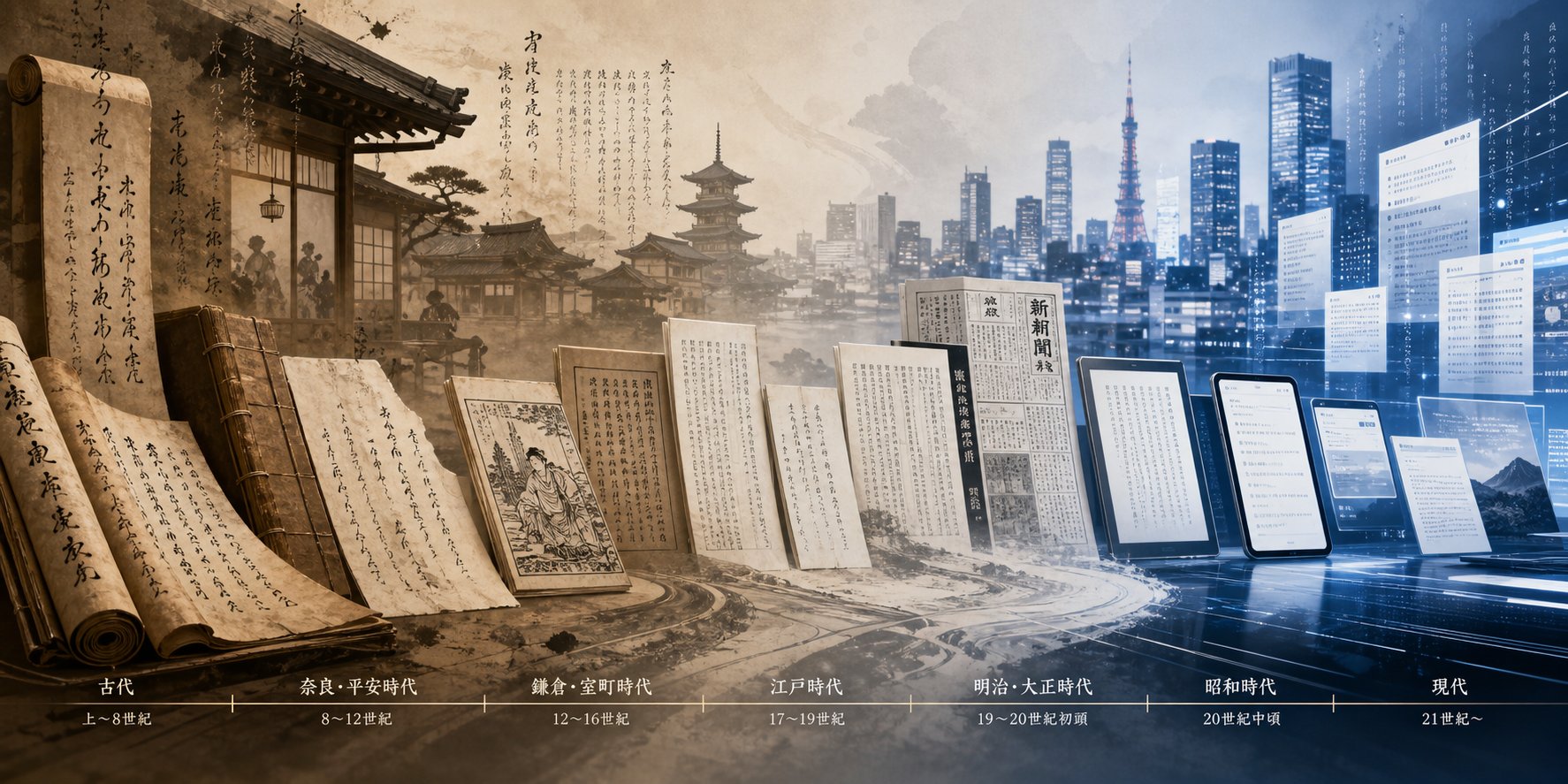
The story of japanese surnames begins in ancient clan systems and winds through over a thousand years of restructuring. Each era imposed different rules about who could have a name, what form it took, and what social information it encoded.
Ancient and Heian Period (pre-1185) — In heian japan, naming was an aristocratic affair. The powerful clans used elaborate multi-part names combining clan identifiers (uji), hereditary titles (kabane), and personal names. The Fujiwara clan grew so dominant that dozens of branch families needed additional identifiers — place-based nicknames called naazana — just to tell each other apart. These naazana eventually became the hereditary family names we recognize today. Commoners during this period had only given names, if they had formal names at all. Noble women's true names were often hidden entirely, referred to instead by their father's rank or the room they occupied.
Feudal Japan: Kamakura and Edo Periods (1185-1868) — The samurai era transformed naming into a four-part system. Warriors carried a true clan name (honsei), a family lineage name (myouji), an official nickname (tsuushou), and a personal name (imina). During the Edo period, the Shogunate restricted commoners from using family names entirely — only samurai, nobles, and a few prominent merchant families were permitted surnames. Everyone else had only a given name, perhaps with their village or occupation attached informally. This lasted over 250 years.
Meiji Era (1868-1912) — Everything changed. The meiji era government, modernizing Japan at breakneck speed, first banned commoners from having surnames (briefly), then reversed course and made family names mandatory for everyone. The law forcing universal surname adoption took effect on February 13, 1875 — now celebrated as Family Name Day in Japan. Many commoners had to invent surnames on the spot. Some borrowed from local geography (Yamamoto — mountain base), others adopted the name of their regional lord, and some simply made something up. This is why 86.4% of Japanese family names briefly became one of just four names (Minamoto, Taira, Fujiwara, or Tachibana) before the system was reformed again.
Taisho Period through Modern Era (1912-present) — The taisho period saw naming become more personal and creative, moving away from rigid class signifiers. After WWII, Japan simplified its writing system, and the kanji available for names was formally restricted. Modern naming trends lean toward creative readings, gender-neutral options, and kanji chosen primarily for aesthetic beauty rather than family tradition. The result is a naming landscape where a japanese last name generator needs to account for very different conventions depending on which era you're targeting.
For fiction writers, this timeline is a practical tool. A character in feudal japan wouldn't have a surname unless they're samurai or nobility. A Meiji-era commoner might carry a brand-new surname their grandfather invented. A modern character might have a trendy given name with creative kanji readings that would have been unthinkable two generations earlier.
Legal Naming Rules and the Jinmeiyō Kanji List
Japan doesn't let parents use just any kanji in a child's registered name. The government maintains an approved list — the jinmeiyō kanji (人名用漢字) — specifically designated for use in personal names. Combined with the jōyō kanji (常用漢字, the standard-use characters taught in schools), only kanji from these two lists are legally permitted in birth registrations.
This matters for anyone using a generator. A tool might produce a visually stunning kanji combination that isn't actually legal for a real Japanese birth certificate. Characters like 焔 (flame), 麒 (qilin), and 凰 (phoenix) look dramatic and meaningful — but they fall outside the approved lists. If your purpose is fiction or gaming, this restriction doesn't apply. If you're exploring names for a child or for personal adoption in Japan, it's non-negotiable.
Beyond kanji restrictions, Japanese law also intervenes when names carry clearly harmful meanings. The most famous rejected case involved parents attempting to register the name 悪魔 (Akuma, meaning "devil") — the ward office refused. Characters meaning death (死), excrement (糞), or other overtly negative concepts will be blocked at registration.
There's also the phenomenon of kirakira names (キラキラネーム) — flashy, creative names that push boundaries with unusual readings. Names like 光宙 read as "Pikachu" or 黄熊 read as "Pooh" technically use approved kanji but assign readings that raise eyebrows. While not illegal, these names generate social friction and are increasingly discussed as potentially burdensome for children. A responsible generator should flag when its output ventures into kirakira territory.
Cultural Respect When Choosing a Japanese Name
For non-Japanese speakers exploring these naming systems, a question lingers beneath the surface: is it appropriate to choose a Japanese name for yourself or your creative work? The answer depends entirely on how you approach it.
Understanding the meaning behind a Japanese name — its kanji composition, historical context, and cultural resonance — is itself an act of respect. The problem isn't choosing a Japanese name; it's choosing one carelessly, without regard for what it actually says.
Certain names carry associations that aren't visible from kanji meanings alone. Some surnames connect to specific historical clans or regions. Others are associated with burakumin (historical outcast communities) and carry social stigma that outsiders wouldn't recognize. Military-era names referencing imperial expansion can trigger strong reactions. A japanese last name generator won't flag these associations — that requires human cultural knowledge.
Practical guidelines for respectful name selection:
- Research beyond the kanji — A name's individual characters might seem beautiful, but the combination could reference a historical figure, a controversial political movement, or a well-known fictional villain. Search the full name in Japanese before committing.
- Avoid sacred or imperial associations — Kanji combinations referencing the emperor, specific shrines, or religious titles carry weight that casual use can trivialize.
- Understand the context you're entering — Using a Japanese name in a martial arts dojo where it's traditional differs from adopting one casually on social media. Match your level of engagement to the depth of your choice.
- Accept correction gracefully — If a Japanese speaker tells you a name sounds odd, carries unintended meaning, or feels inappropriate, that feedback is valuable. Names exist within a living culture, not a dictionary.
- Don't treat names as costumes — A Japanese name chosen with genuine understanding of its meaning, used consistently and respectfully, differs fundamentally from one grabbed for aesthetic novelty and discarded when the mood passes.
The entire framework this article has built — kanji mechanics, reading systems, gendered patterns, historical evolution — exists to move you from surface-level appreciation toward genuine understanding. A japanese name generator with meanings gives you raw material. Cultural literacy gives you the judgment to use it well. The two together let you engage with Japanese naming not as an outsider grabbing at exoticism, but as someone who took the time to learn what these names actually carry.
Frequently Asked Questions About Japanese Name Generators and Meanings
1. How do Japanese names differ from Western names in terms of meaning?
Japanese names are composed of kanji characters, each deliberately chosen for its meaning, sound, and visual appearance. Unlike Western names where etymological roots are often forgotten, every character in a Japanese name is a living symbol. Combining two or three kanji creates layered significance — a compressed wish, poetic image, or family philosophy. For example, Haruto (陽翔) combines 'sun' and 'soar,' encoding ambition and warmth into a single name. This makes understanding kanji mechanics essential before using any name generator.
2. Can the same kanji character be pronounced differently in Japanese names?
Yes, Japanese names use three distinct reading systems. On'yomi derives from Chinese pronunciation, kun'yomi is the native Japanese reading, and nanori are special readings used exclusively in personal names. The name 大翔 can be read as Hiroto, Haruto, or even Taiga depending on which nanori reading the parents chose. This is why even native Japanese speakers sometimes cannot read unfamiliar names correctly and must ask for the intended pronunciation.
3. What makes anime character names different from real Japanese names?
Anime names function as storytelling devices that telegraph character traits through overt symbolism. Real Japanese names encode parental hopes with more subtlety. Fictional names often use dramatic kanji combinations (like 'night god'), impossible readings, or meanings that are too on-the-nose for real life. A name like Yagami Light from Death Note uses the English word 'light' as a reading for the kanji 月 (moon) — a technique that exists in real naming but immediately signals something unusual to native speakers.
4. How can I convert my English name into Japanese?
There are three approaches. Phonetic katakana transcription breaks your name into Japanese syllables (Michael becomes マイケル) and is the standard method for official documents. The second approach finds kanji with readings that approximate your name's sound while carrying meaningful definitions. The third option abandons phonetic similarity entirely, choosing a Japanese name based purely on meaning — someone named Grace might select Miyabi (雅, elegance) for its shared essence rather than similar sound.
5. Are there legal restrictions on which kanji can be used in Japanese names?
Japan maintains the jinmeiyō kanji list — approximately 2,999 characters specifically approved for personal names — plus the jōyō kanji set taught in schools. Only characters from these two lists are legally permitted in birth registrations. Name generators may produce combinations using kanji outside these approved lists, so verification is necessary if you need a name that could theoretically be registered in Japan. Characters with overtly harmful meanings like death or excrement are also blocked at registration.