
What a Latinized Name Generator Actually Does
Imagine typing your everyday name into a tool and getting back something that sounds like it belongs on a Roman senate roll. That's the basic promise of a latinized name generator, but the reality is a bit more nuanced than a single trick.
What Is a Latinized Name Generator
A latinized name generator is a tool that does one of two things, depending on what you need. It either produces authentic ancient Roman names from scratch, complete with historically accurate structures, or it converts a modern name into proper Latin form using established linguistic rules. These are two very different tasks. A roman name generator pulls from historical databases of praenomina, nomina, and cognomina to build names that could have existed in classical antiquity. A name in latin generator, on the other hand, applies phonological adaptations and Latin suffixes to transform something like "William" into "Gulielmus."
Why does this distinction matter? Because the latinisation of names follows specific grammatical and phonetic conventions that go far beyond swapping letters. As Wikipedia's entry on the practice notes, Latinisation involves changing non-Latin names into a form that fits the style, structure, and rules of Latin, allowing names to function grammatically through declension. It can involve transforming sounds, adding suffixes, translating meaning, or even choosing an entirely new name based on personal attributes.
Latinization is not translation. Translating a name renders its meaning into another language. Latinization reshapes a name's sound and structure so it behaves like a native Latin word, complete with case endings and grammatical gender.
Who Uses Latinized Names and Why
The audiences for a latin names generator are surprisingly diverse:
- Fiction writers and worldbuilders crafting characters for historical or fantasy settings
- Tabletop RPG and video game players seeking authentic-sounding latinized names for their avatars
- Academics and scientists following taxonomic naming conventions
- Parents exploring baby names with classical Latin roots
- History enthusiasts curious about what their own name would have sounded like in ancient Rome
Each group needs something slightly different from a latin name generator. A novelist might want a full three-part Roman name that signals a character's social class. A biologist needs a Neo-Latin form that meets international nomenclature standards. A gamer just wants something that sounds cool and historically plausible.
The good news is that the underlying rules governing all these uses share common ground, rooted in how the Romans themselves structured their naming system.
The Roman Tria Nomina Naming System
Those common rules start with a system the Romans used for centuries to identify citizens, signal family allegiance, and mark social status. If you want to generate convincing roman names, or simply understand how your own name might map onto a classical structure, you need to know how the original system worked.
Praenomen Nomen and Cognomen Explained
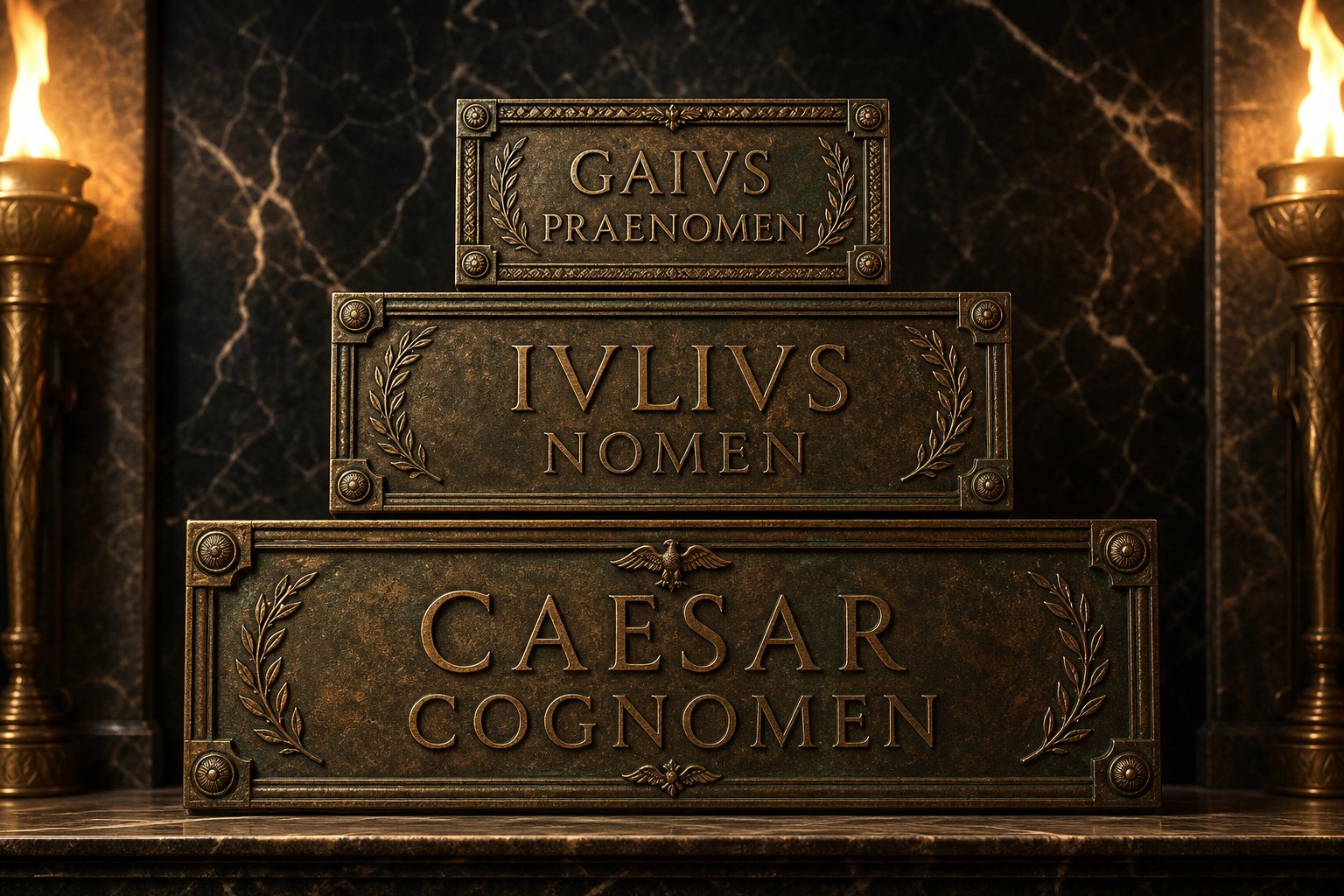
Roman citizens during the Republic carried up to three names, a convention scholars call the tria nomina. Each part served a distinct purpose. Take Marcus Tullius Cicero, the famous orator. "Marcus" is his praenomen, a personal name used by family and close friends, much like a modern first name. Romans had surprisingly few praenomina in circulation, and families reused the same ones across generations. The eldest son typically received his father's praenomen.
"Tullius" is his nomen, identifying the gens or clan he belonged to. All members of the Tullii shared this name, making it the closest equivalent to modern roman surnames. Think of it as a hereditary marker tying you to a broader kinship network.
"Cicero" is his cognomen, distinguishing his specific branch within the larger clan. Cognomina often originated as nicknames describing physical traits or personal quirks. "Cicero" means "chickpea," though the name was inherited rather than earned fresh each generation. Not every Roman had a cognomen. Gaius Marius, for instance, carried only two names, which was common among non-aristocrats until late in the Republic. These ancient roman second names and third names became more elaborate as Rome's social hierarchy grew more complex.
Additional honorific cognomina, sometimes called agnomina, could be awarded for military achievements. Publius Cornelius Scipio earned "Africanus" after defeating Hannibal, a title passed to his descendants as part of the family identity.
How Roman Women and Freedmen Were Named
Roman female names followed a simpler pattern. Women received the feminine form of their father's nomen. Every daughter of a man named Julius was called Julia. Every daughter of a Cornelius was Cornelia. If a family had multiple daughters, they were distinguished by maior and minor (elder and younger) or numbered: Prima, Secunda, Tertia. By the late Republic, some elite roman female names began incorporating a feminized form of the father's cognomen as well, like Livia Drusilla, whose father was Marcus Livius Drusus.
Freedmen followed yet another convention. When a slave was formally manumitted, he took the praenomen and nomen of his former master, keeping his slave name as a cognomen. Cicero's secretary Tiro, once freed, became Marcus Tullius Tiro. Freedwomen took the feminine nomen of their master or mistress plus their original name. These roman last names carried real social weight, publicly linking the freed individual to a patron's household.
When adoption occurred, the adopted man took all three names of his new father and appended the adjectival form of his birth clan with the suffix -anus. Gaius Octavius, adopted by Julius Caesar, formally became Gaius Julius Caesar Octavianus.
| Component | Function | Male Example | Female Example |
|---|---|---|---|
| Praenomen | Personal name, used among family and intimates | Marcus, Gaius, Publius | Rarely used; Gaia as legal fiction in manumission |
| Nomen | Clan (gens) identifier; hereditary | Tullius, Julius, Cornelius | Tullia, Julia, Cornelia |
| Cognomen | Branch of clan; often a descriptive nickname turned hereditary | Cicero, Caesar, Scipio | Drusilla, Agrippina (late Republic onward) |
Understanding this structure is what separates a historically grounded name from a random string of Latin-sounding syllables. The names of romans encoded identity, lineage, and social standing in a way that no single modern name can replicate. Any quality generator draws on these roman family names and their internal logic to produce results that feel authentic rather than invented.
Of course, knowing the structure is only half the puzzle. The other half involves understanding how Latin actually adapts foreign sounds and applies its grammatical endings, which determines whether a Latinized name rings true or falls flat.
Phonological Rules and Latin Suffix Conventions
Latin didn't simply bolt foreign sounds onto its existing system. It reshaped them. When Romans encountered names from Greek, Celtic, Germanic, or Semitic languages, they filtered those sounds through a strict phonological framework. The same framework applies today whenever you convert a modern name into proper Latin form. A latinized name generator that produces convincing results needs to follow these rules, and so do you if you're working by hand.
Phonological Adaptation Rules in Latin
Think of Latin as a language with strong opinions about which sounds are allowed. When a foreign name contained a sound Latin didn't use, scribes and scholars applied consistent substitutions rather than inventing new letters. Here are the core adaptations you'll encounter when working with names in latin:
'Th' becomes 't' (or 'th' in later periods). Classical Latin had no aspirated dental stop. Early inscriptions rendered Greek theta as plain t, so Theodoros appeared as Teodorus. As Wolfgang de Melo's research on Latin orthography explains, Greek aspirates were originally written as p, t, c in early Roman inscriptions and only later rendered as ph, th, ch after the influence of the Scipionic Circle in the 2nd century BC made Greek a prestige language. For a latin name rooted in the classical period, you'd write Teodorus. For medieval or later Latinization, Theodorus is standard.
'W' becomes 'v' or 'gu'. Latin lacked the bilabial approximant /w/ as a distinct phoneme separate from its semivowel u/v. Germanic names beginning with 'w' were typically adapted to v (written u in classical texts, since the letter v is a medieval invention). William becomes Villelmus or later Gulielmus, where the 'gu' cluster approximates the original /w/ sound through a Latinate spelling convention.
'J' does not exist in classical Latin. The letter j was introduced in the Middle Ages to distinguish the consonantal i from the vowel. In classical orthography, both were written i. A name like James traces back through French to Hebrew Ya'aqov, and its Latin form is Iacobus, not Jacobus, in strict classical practice. Medieval texts freely use j, so context determines which convention to follow.
'K' maps to 'c'. Romans inherited three letters for the /k/ sound from the Etruscans: C, K, and Q. As de Melo documents, K was eventually abolished except in archaic abbreviations like K for the praenomen Kaeso or KAL for Kalendae. In practice, 'c' handles nearly all /k/ sounds in Latin names. A modern name like Karl becomes Carolus, not Karolus, in standard Latinization.
Vowel adjustments. Latin has a clean five-vowel system (a, e, i, o, u) with phonemic length distinctions. Sounds like English short 'a' in "cat" or the schwa in "about" get mapped to the nearest Latin vowel. Diphthongs are simplified or adapted: English 'ay' typically becomes -ae- or -ai-, while 'ow' might become -au-.
Here's how these rules look in practice:
- Theodore → Teodorus (classical) or Theodorus (post-2nd century BC)
- Walter → Valterus or Gualterus
- John → Ioannes (from Greek Ioannes, itself from Hebrew Yohanan)
- Kenneth → Cenethus or Kenethus (medieval convention)
- Wolfgang → Volfgangus or Wolfgangus (later medieval)
You'll notice that the era matters. A name in latin characters from the 1st century BC follows stricter substitution rules than one from the 12th century AD, when scribes had relaxed many classical constraints. This is why random latin words pulled from a dictionary won't automatically produce a convincing Latinized name. The phonological layer has to match the historical period you're targeting.
Latin Suffix Conventions by Gender and Declension
Once you've adapted the sounds, you need the right ending. Latin is an inflected language, meaning every noun, including every name, must belong to a declension class and carry a grammatical gender. The suffix you attach determines how the name behaves in a sentence, whether it's the subject, the object, or indicates possession.
Sounds complex? It's actually quite systematic. Most masculine names land in the second declension with an -us ending. Most feminine names land in the first declension with an -a ending. But several other suffixes exist for specific contexts, and choosing the wrong one can make a name sound awkward or grammatically broken.
Here's how the main suffixes break down:
| Suffix | Gender | Declension | Usage Context | Example |
|---|---|---|---|---|
| -us | Masculine | 2nd | Standard masculine personal names | Robertus (from Robert) |
| -a | Feminine | 1st | Standard feminine personal names | Elisabetha (from Elizabeth) |
| -ius | Masculine | 2nd | Clan names (nomina); names ending in a vowel or soft consonant | Cornelius, Darwinus |
| -ium | Neuter | 2nd | Place-derived abstractions; scientific genus names | Londinium (from London) |
| -anus / -ana | Masc. / Fem. | 2nd / 1st | Indicating origin, adoption, or association with a place or person | Africanus (associated with Africa) |
| -inus / -ina | Masc. / Fem. | 2nd / 1st | Diminutive or derivative relationship; patronymic sense | Augustinus (derived from Augustus) |
| -ensis | Masc. / Fem. | 3rd | Geographic origin in taxonomy and academic contexts | Cantabrigiensis (of Cambridge) |
A few practical guidelines for choosing the right suffix:
- If the original name already ends in a consonant, adding -us (masculine) or -a (feminine) is usually the simplest path. Richard becomes Ricardus.
- If the name ends in a vowel, you often replace that vowel with the Latin suffix. Andrea becomes Andreas (third declension masculine) or stays Andrea if treated as feminine first declension.
- The -ius ending works well for names where you want to signal a clan or family association, echoing the Roman nomen structure.
- Use -ensis when the name derives from a geographic location, especially in scientific or academic Latinization. It's third declension and works for both genders.
- The -anus suffix implies "belonging to" or "coming from," making it ideal for adopted names or place-based identifiers.
These suffixes aren't just decorative. They're functional grammar. When you see latin words as names in historical documents, each ending tells you how that name would decline through all six Latin cases. Carolus in the nominative becomes Caroli in the genitive, Carolum in the accusative. The suffix choice locks in the entire declension pattern.
Getting both layers right, the phonological adaptation and the suffix convention, is what separates a well-formed latin name from something that merely looks vaguely Roman. These rules give you a framework for evaluating any generator's output or for building a Latinized form yourself from scratch. The real test comes in applying them step by step to an actual modern name.
How to Latinize Your Own Name Step by Step
You know the phonological rules. You know the suffix conventions. The question now is practical: how do you actually take your own name and transform it into a grammatically sound Latin form? Whether you're using a latinized name generator to get a starting point or working entirely by hand, the process follows a repeatable sequence. Let's walk through it.
Step-by-Step Process for Latinizing Modern Names
The latinization of names isn't guesswork. It's a structured method that scholars have followed for centuries. Here's the exact sequence, broken into steps you can apply to virtually any modern name:
- Identify the name's linguistic root. Before you change anything, figure out where the name comes from. "William" traces to Germanic Willahelm (will + helmet). "Catherine" comes from Greek Aikaterine. The root language determines which phonological adaptations apply and often reveals an existing historical Latinization you can use as a model.
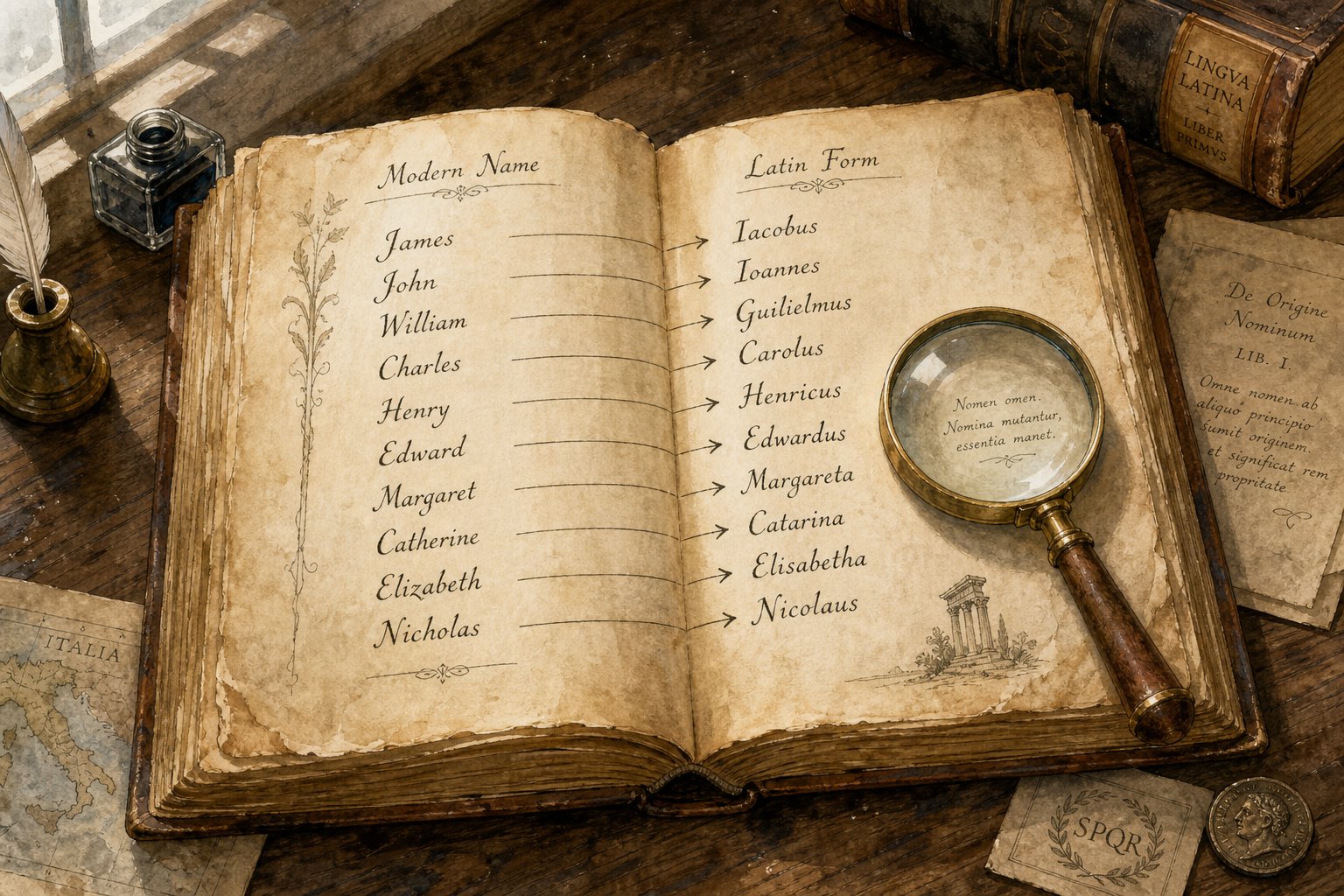
- Check for an established Latin equivalent. Many common names already have centuries-old Latin forms. John is Ioannes. James is Iacobus. Margaret is Margarita. If a standard form exists, use it rather than reinventing the wheel. Historical church records, university matriculation rolls, and papal documents are rich sources for these established forms.
- Apply phonological adaptation rules. If no standard form exists, adapt the name's sounds to Latin phonology. Replace 'w' with 'v' or 'gu', convert 'th' to 't' (classical) or keep it (medieval), map 'k' to 'c', eliminate 'j' in favor of 'i', and adjust vowels to fit Latin's five-vowel system. Work syllable by syllable.
- Determine the grammatical gender and declension class. Masculine names almost always enter the second declension (-us ending). Feminine names typically enter the first declension (-a ending). Names derived from Greek often follow third declension patterns (-es, -is). Your choice here locks in how the name will behave grammatically.
- Attach the appropriate Latin suffix. Strip any modern ending that doesn't fit Latin morphology and replace it with the correct suffix. If the name already ends in a consonant cluster that flows naturally into -us or -a, simply append. If it ends in a vowel, replace that vowel with the Latin termination.
- Verify grammatical consistency. Decline the name through at least the nominative, genitive, and accusative cases to confirm it works smoothly. If the genitive form sounds awkward or creates an unusual consonant cluster, revisit your suffix choice. A well-formed Latin name should decline as naturally as any native Latin noun.
Let's see this in action with two worked examples.
Example 1: "Brandon" (masculine, English)
- Root: Old English brom (broom/gorse) + dun (hill). No established Latin equivalent exists.
- Phonological adaptation: The sounds are already compatible with Latin. No 'w', 'th', 'j', or 'k' issues. The vowels map cleanly.
- Gender and declension: Masculine, second declension.
- Suffix: The name ends in a consonant (-n). Append -us to get Brandonus, or trim to the root and use -anus for a more classical feel: Brandanus.
- Verification: Brandanus, Brandani, Brandanum — declines cleanly through all cases.
Example 2: "Sophie" (feminine, French/Greek)
- Root: Greek sophia (wisdom). An established Latin form exists: Sophia.
- Since the Greek root already has a first-declension Latin form, use it directly. Sophia, Sophiae, Sophiam — perfect first-declension behavior.
- If you wanted a more distinctly Latinized variant, Sapentia (from Latin sapientia, wisdom) would be a semantic translation rather than a phonological adaptation.
This is the method behind every reliable latin creator tool. The software automates these steps, but understanding the logic lets you evaluate whether the output actually makes linguistic sense or just sounds vaguely Roman.
Latinizing Non-European Names
What about names from languages that share almost no phonological overlap with Latin? Arabic, Chinese, Japanese, and African names all posed challenges for European scholars who needed to create latin forms for academic correspondence and published works. The conventions they developed are instructive.
Arabic names. Medieval European scholars encountered Arabic names primarily through translated scientific and philosophical texts. The standard approach was heavy phonological transformation. Ibn Sina became Avicenna, where the patronymic "ibn" was dropped and "Sina" was reshaped with a Latin-friendly prefix and feminine-looking ending (though grammatically treated as indeclinable). Jabir became Geber, with the Arabic 'j' mapped to 'g' and the vowels simplified. The Arabic definite article "al-" was sometimes retained (Algebra, Alchemy) and sometimes dropped entirely.
Chinese names. Jesuit missionaries in the 16th and 17th centuries established the conventions still used in English today. Kong Fuzi became Confucius, where the honorific "Fuzi" (Master) was fused with the surname and given a second-declension -us ending. Mengzi became Mencius through the same pattern. The approach prioritized creating a pronounceable, declinable form over preserving the original syllable structure.
Japanese names. When Japanese scholars corresponded in Latin during the early modern period, names were typically left in their romanized form with a Latin suffix appended. A name like Tanaka might become Tanakius or simply remain indeclinable in running text. There was less standardization here because Japan's contact with Latin scholarship was briefer and more limited.
African names. Missionary and colonial records show varied approaches. Some names were phonologically adapted and given standard suffixes: a Yoruba name like Adeyemi might appear as Adeyemius in church records. More often, African individuals received entirely new Latin or European names at baptism, making direct Latinization examples rarer in the historical record.
The common thread across all these traditions is the same sequence: adapt the sounds to what Latin can handle, then attach a suffix that gives the name grammatical life. Whether you're trying to figure out what's my latin name or working out a name in latin translation for a character from a non-European culture, the method holds. The phonological distance just determines how much transformation is needed.
The further a source language sits from Latin phonology, the more the Latinized form becomes an interpretation rather than a direct adaptation, which is why the same Arabic name might appear as three different Latin forms across three centuries of scholarship.
If you want to create latin forms of names from any language, the six-step process above remains your foundation. Adjust the degree of phonological transformation based on how distant the source sounds are, choose your suffix based on gender and intended declension, and verify that the result declines without awkwardness. A latinized name generator can speed up this process, but the underlying logic is always the same sequence of decisions scholars have made since the medieval period.
These conventions didn't stay frozen in time, though. The way a 1st-century Roman, a 13th-century monk, and a 17th-century botanist would each Latinize the same name could produce strikingly different results, shaped by the era's own rules and cultural priorities.

Latinized Names Across Historical Eras
A name Latinized in 50 BC, 1250 AD, and 1750 AD would follow three different sets of conventions, even if the source name were identical. The rules shifted because the purpose of Latinization shifted. Romans named citizens to mark lineage and legal status. Medieval monks Latinized names to fit ecclesiastical records. Renaissance humanists did it for intellectual prestige. And modern scientists do it to meet international nomenclature standards. Each era left its fingerprint on how latin old names were formed, and understanding those differences helps you pick the right style for your own project, whether you're using a latinized name generator or crafting a name by hand.
Classical Roman Naming Conventions
During the early Republic, old roman names were relatively simple. Many citizens carried just two names, a praenomen and a nomen. The cognomen emerged gradually as Rome's population grew and families needed finer distinctions. By the late Republic, the full tria nomina was standard for freeborn male citizens, and the system had become a marker of social legitimacy.
The transition from Republic to Empire brought further elaboration. Emperors accumulated names like titles. Augustus was born Gaius Octavius, adopted as Gaius Julius Caesar Octavianus, and eventually held the honorific "Augustus" as a quasi-religious title. By the 2nd century AD, elite Romans might carry five or six names. Publius Aelius Traianus Hadrianus Augustus shows how imperial names from ancient rome stacked praenomen, adoptive nomen, birth cognomen, and honorific into a single identity.
For foreign names entering the Roman system during this period, the rules were strict. Greek names were the most common imports, and they were adapted with minimal fuss because Greek and Latin shared an alphabet and similar phonology. A Greek name like Alexandros simply became Alexander (third declension) or occasionally Alexandrus (second declension). Celtic and Germanic names required heavier transformation. A Gaulish chieftain named Vercingetorix kept his name largely intact because it already ended in a consonant cluster that could function in Latin, but less cooperative names were reshaped aggressively to fit second-declension patterns.
The key principle of classical Latinization: the name had to decline. It had to function as a grammatical noun in all six cases. If it couldn't, it was reshaped until it could.
Medieval and Renaissance Latinization
Medieval scholars operated under different pressures. Latin was the universal language of the Church, law, and learning across a continent of mutually unintelligible vernaculars. Every cleric, scholar, and official needed a Latin name for documents, correspondence, and publication. The result was a massive wave of Latinization that touched every European language.
Medieval conventions were more relaxed than classical ones. Scribes freely used 'j' and 'w' in ways classical Romans never would. They tolerated consonant clusters that would have been smoothed out in antiquity. A name like "Wulfstan" might appear as Wulfstanus in a 10th-century English charter, keeping the Germanic 'w' intact rather than converting it to 'v' or 'gu'. The priority was recognizability over classical purity.
Renaissance humanists reversed this trend. Inspired by rediscovered classical texts, they sought ancient latin names that would have satisfied Cicero himself. This is where you see the most creative Latinizations in European history. Gerhard Kremer, the Flemish cartographer, translated his surname ("merchant" in German) into Latin as Mercator. Nikolaj Kopernik became Copernicus, adapting his Polish surname with a second-declension ending. Carl von Linne reshaped his Swedish name into Linnaeus, choosing a first-declension form that echoed Greek patronymics.
These weren't arbitrary choices. Humanist Latinization often involved semantic translation rather than pure phonological adaptation. If your surname meant something, you could render that meaning in Latin instead of just reshaping the sounds. Kremer didn't become Kremerus; he became Mercator because both words mean "trader." Philipp Schwartzerdt became Melanchthon, translating his German surname ("black earth") into Greek rather than Latin, a common humanist flourish that signaled classical learning.
If you're building characters for a historical setting, this distinction matters enormously. A renaissance name generator should produce names that follow humanist conventions: semantically translated, classically pure in their endings, and often drawing on Greek as well as Latin roots. A medieval generator should allow rougher, more phonologically direct adaptations. Anyone searching for a byzantine name generator would want yet another style, one reflecting the Greek-Latin hybrid naming patterns of the Eastern Roman Empire, where names like Konstantinos and Theodoros dominated without full Latin adaptation.
The same German surname "Schwarz" (black) would appear as Swartus in a 12th-century monastery roll, Nigrinus in a 15th-century humanist publication, and Niger in an 18th-century botanical text, three eras producing three completely different Latin forms from identical source material.
Scientific and Taxonomic Latin Names
Modern scientific Latinization operates under its own formal ruleset, distinct from both classical and humanist conventions. When Linnaeus established binomial nomenclature in the 18th century, he created a system where every organism on Earth would carry a two-part Latin name: genus and species. This system persists today, governed by international codes like the International Code of Nomenclature of Bacteria, which states in Rule 6 that "the scientific names of all taxa must be treated as Latin."
Taxonomic Latinization follows specific suffix rules tied to rank. The Bacteriological Code prescribes exact suffixes for each taxonomic level: -ales for orders, -aceae for families, -oideae for subfamilies, -eae for tribes. Generic names must be "a substantive, or an adjective used as a substantive, in the singular number," and can be "taken from any source and may even be composed in an arbitrary manner" as long as they are "treated as a Latin substantive."
For species epithets, the Code allows three grammatical treatments: an adjective agreeing in gender with the genus (Staphylococcus aureus), a noun in apposition (Bacillus radicicola), or a noun in the genitive case (Erwinia lathyri). Personal names converted to species epithets follow Appendix 9 of the Code, which provides detailed rules for forming genitives and adjectival forms from modern surnames.
This means a scientist named "Park" would see her name Latinized differently depending on whether it becomes a genus (Parkia, with the feminine -ia suffix recommended for personal generic names regardless of the honoree's gender) or a species epithet (parkiae in the genitive, or parkiana as an adjective). The conventions are rigid, internationally enforced, and entirely distinct from how a medieval scribe or Renaissance humanist would have handled the same name.
Neo-Latin naming in pharmacy follows similar patterns. Drug names often combine Latin and Greek roots with standardized suffixes that signal drug class: -mab for monoclonal antibodies, -vir for antivirals, -statin for cholesterol reducers. These aren't classical Latin, but they draw on the same morphological logic of meaningful roots plus functional suffixes.
Astronomical naming adds another layer. Craters, mountains, and other features on planetary bodies receive names that must be Latinized according to International Astronomical Union guidelines. A Chinese astronomer's name might become a crater designation through a process that combines phonological adaptation with the geographic suffix -ensis or simply leaves the romanized form unaltered as an indeclinable proper noun.
The practical takeaway: ancient roman names, medieval church names, humanist pen names, and modern scientific names all use Latin, but they use it differently. When you're generating or evaluating a Latinized name, the first question isn't just "what are the rules?" but "which era's rules?" A name that's perfect for a Renaissance scholar character would be wrong for a Roman senator, and neither would pass muster as a valid taxonomic epithet. The era determines the convention, and the convention determines the form.
With these historical layers mapped out, the next useful step is seeing how specific modern names correspond to their established Latin equivalents, the forms that centuries of scholarship have already settled on.
English to Latin Name Equivalents: Latin First Names and Their Origins
Not every name needs to be Latinized from scratch. Centuries of church records, university rolls, and legal documents have already established standard Latin forms for the most common English names. These aren't guesses or modern inventions. They're the forms that parish clerks, papal scribes, and academic registrars used consistently from the medieval period onward. If your name appears on this list, you already have a "Roman twin" waiting for you.
Common Male Name Equivalents in Latin
Many of these latin first names look dramatically different from their English counterparts because they trace back through different linguistic paths. James doesn't simply become "Jamesius." Its Latin form, Iacobus, reflects the name's Hebrew origin (Ya'aqov) filtered through Greek and then Latin, bypassing the French detour that produced the English version entirely.
The same logic applies across the board. These are names latin origin scholars have documented in thousands of historical records, from English parish registers kept in Latin through the 18th century to Vatican correspondence spanning a millennium.
| English Name | Latin Equivalent | Declension | Historical Usage Context |
|---|---|---|---|
| John | Ioannes / Johannes | 3rd | Church registers, papal documents, university matriculation |
| William | Gulielmus / Willelmus | 2nd | Royal charters, legal records, monastic rolls |
| James | Iacobus / Jacobus | 2nd | Biblical texts, baptismal records, academic registers |
| Charles | Carolus | 2nd | Royal documents, Carolingian dynasty records |
| Henry | Henricus | 2nd | English royal charters, ecclesiastical records |
| Edward | Eduardus / Edvardus | 2nd | Anglo-Saxon chronicles in Latin, legal writs |
| Richard | Ricardus | 2nd | Crusade-era documents, English court records |
| Robert | Robertus | 2nd | Norman-era charters, monastic records |
| Geoffrey | Galfridus / Gaufridus | 2nd | Medieval chronicles, legal documents |
| Ralph | Radulphus | 2nd | Domesday Book entries, feudal records |
| Hugh | Hugo | 3rd | Monastic records, French-influenced registers |
| Walter | Gualterus / Valterius | 2nd | Parish registers, land grants |
You'll notice that most male names land in the second declension with the familiar -us ending. The exceptions, like Ioannes (third declension) and Hugo (third declension), reflect Greek or Germanic roots that resisted the standard pattern.
A few names deserve special attention for their unexpected forms:
- Gulielmus — the 'gu' cluster preserves the Germanic /w/ sound that Latin couldn't represent directly. Variant spellings include Willelmus, Wilelmus, and Uiliemus
- Iacobus — serves as the Latin form for both Jacob and James, since both English names descend from the same Hebrew root. The variant Jacomus appears in some medieval records
- Hugo — unusually, this third-declension form (genitive: Hugonis) was preferred over a hypothetical second-declension Hugus
It's worth noting that some names of latin origin never needed Latinization at all. Marcus, Julius, and Lucius were already Latin. The name Lucius meaning "light" (from lux) was one of the most common Roman praenomina, carried by senators and emperors alike. If your name already has a latin name origin, you're carrying a piece of Rome without any conversion needed.
Common Female Name Equivalents in Latin
Female names in latin with meaning follow a cleaner pattern. Most enter the first declension with an -a ending, which aligns with how Roman women's names already worked. The Wiktionary appendix on Latin name forms documents these equivalences across hundreds of entries.
| English Name | Latin Equivalent | Declension | Historical Usage Context |
|---|---|---|---|
| Mary | Maria | 1st | Biblical texts, devotional records, universal church usage |
| Elizabeth | Elisabetha / Ælisabetha | 1st | Royal documents, baptismal registers |
| Catherine | Catharina | 1st | Saints' records, university foundations, royal charters |
| Margaret | Margarita | 1st | Hagiographic texts, parish registers |
| Alice | Alicia | 1st | Medieval English registers, legal documents |
| Eleanor | Eleonora / Alienora | 1st | Royal records, Plantagenet-era documents |
| Joan / Jane | Johanna / Joanna | 1st | Parish registers, saints' calendars |
| Frances | Francisca | 1st | Post-Reformation registers, Catholic records |
| Grace | Gratia | 1st | Puritan-era registers, virtue name tradition |
| Dorothy | Dorothea | 1st | Greek-derived; saints' records, academic registers |
The consistency of the first-declension pattern makes female latin meaning names easier to predict. If you encounter an unfamiliar name in a historical document ending in -a or -ia, it's almost certainly feminine and first declension.
Additional variants and diminutive forms worth knowing:
- Maria — also covers Marie, Molly, and Miriam in many registers
- Elisabetha — sometimes rendered as Isabella in medieval records, since both names share the same Hebrew root. The variant Ælisabetha appears in earlier documents
- Catharina — covers Catherine, Katherine, Katrina, Karen, and Caitlin, all descendants of the same Greek name
- Margarita — literally means "pearl" in Latin, making it both a personal name and a latin origin names example where meaning and form align perfectly
- Johanna — the feminine counterpart of Ioannes, covering Joan, Jane, Janet, Jean, and even Siobhan
- Amabilia — the Latin form of Mabel, from amabilis (lovable)
- Gratia — a direct semantic Latinization of Grace, also used for the virtue itself
These established equivalents are exactly what a quality latinized name generator draws from when it recognizes a common input name. Rather than applying phonological rules from scratch every time, the tool matches against a database of historically attested forms. The result is a name that doesn't just sound Latin but carries the weight of actual documented usage across centuries of European record-keeping.
Knowing these equivalents is useful on its own, but the real value comes in understanding how to apply them. A name on a character sheet, in a novel, or on a professional document needs context, and the right Latin form depends entirely on what you're using it for.

Modern Uses for Latinized Names
A Latinized name sitting in isolation is just a linguistic curiosity. Put it into context, and it becomes a tool. The style of Latin name you need, its formality, its era, its grammatical structure, all depend on where you plan to use it. A name built for a fantasy RPG character follows different conventions than one destined for a pharmaceutical patent or a corporate logo. Here's how Latinized names function across the contexts where people actually use them.
Latin Names in Creative Writing and Gaming
Fantasy authors and game designers reach for Latin more than any other classical language when they need names that feel ancient, authoritative, or otherworldly. There's a reason for that. Latin roots carry built-in connotations that English-speaking audiences recognize instinctively, even without formal training in the language.
Consider how latin for fantasy worldbuilding works in practice. A faction called the "Luminari" immediately suggests light and enlightenment (from lumen). A villain named "Mordecus" echoes mordere (to bite) and sounds threatening without explanation. A city called "Altavera" combines alta (high) and vera (true), hinting at a place that values honesty or sits at elevation. These aren't random syllables. They're latin words for business names repurposed for narrative, carrying meaning beneath the surface.
Writers and worldbuilders use Latin-derived names to signal specific qualities:
- Strength and military power — roots like fort- (strong), bell- (war), ferr- (iron), vict- (conquer). A general named Victorinus or a fortress called Ferrata tells you what to expect.
- Wisdom and knowledge — roots like sap- (wise), clar- (clear/bright), sci- (know), cogn- (recognize). A scholar named Clarissimus or a library called the Cognitarium.
- Nobility and authority — roots like reg- (rule), nobl- (noble), imper- (command), august- (revered). A ruling dynasty called the Reganii or a throne room named the Augusteum.
- Darkness and danger — roots like umbr- (shadow), noct- (night), mort- (death), tenebl- (dark). A cursed forest called Tenebris or an assassin guild named the Umbraculi.
For tabletop RPG players searching for a world name generator fantasy tool, Latin provides a shortcut to names that sound coherent within a setting. A latin username generator pulling from classical roots can produce character names like Cassius Veranthor or Livia Nocturnae that feel grounded in a consistent linguistic system rather than assembled from random syllables. The trick, as The Writer's Cookbook notes, is that using old languages lets you "hide simplistic meanings behind a language barrier, which readers are often enticed by." Latin for fantasy works precisely because it rewards curious readers who look up the roots while remaining accessible to those who don't.
Fantasy in latin doesn't mean every name must be grammatically perfect classical Latin. Many successful fantasy settings use Latin as a flavor base, blending roots from different eras or combining them with invented suffixes. The goal is internal consistency within your world, not historical accuracy to a specific century. A latin fantasy setting might use second-declension endings for one culture's names and third-declension patterns for another, creating an audible distinction between civilizations without requiring readers to know any grammar.
Latin Names in Academia and Professional Contexts
Outside fiction, Latinized names remain actively functional in several professional fields. These aren't nostalgic holdovers. They serve practical purposes that no modern language has replaced.
- Biological taxonomy — Every species on Earth carries a binomial Latin name. New species described today still receive Latinized epithets following the International Code of Nomenclature. A researcher discovering a new beetle might name it Coleoptera smithiae, Latinizing her own surname into a genitive form.
- Pharmaceutical naming — The WHO's International Nonproprietary Names system uses Latin-derived stems to classify drugs by mechanism. As research published in the Journal of Medicinal Chemistry documents, stems like -vir (antivirals), -mab (monoclonal antibodies), and -tinib (tyrosine kinase inhibitors) create a universal naming language that works across all 7,000+ spoken languages worldwide.
- Catholic Church — Popes still take Latin regnal names. Religious orders use Latin designations. Church documents, canon law, and official communications employ Latinized personal names as standard practice.
- Legal terminology — Latin phrases permeate legal language (habeas corpus, pro bono, amicus curiae), and law firms occasionally adopt Latin names to signal tradition and gravitas.
- Academic publishing — Doctoral dissertations at some European universities still require a Latin abstract. Academic honors like summa cum laude and emeritus remain in active use.
- Astronomy — Lunar craters, Martian features, and constellation names follow Latin or Latinized conventions governed by the International Astronomical Union.
In each of these contexts, the Latinized form isn't decorative. It's functional, enabling international communication across language barriers. A Japanese biologist and a Brazilian pharmacologist can discuss Staphylococcus aureus without translation because the Latin name is the shared reference point.
Latin-Inspired Business and Brand Names
Latin roots show up constantly in corporate naming, and for good reason. They offer something rare in branding: words that sound familiar enough to feel trustworthy yet distinctive enough to trademark. Latin business names carry connotations of permanence, authority, and sophistication without tying a company to any single modern language or culture.
Common Latin roots used in latin company names include:
- Vita (life) — suggests vitality, health, growth. Used in healthcare, wellness, and insurance branding.
- Lux (light) — implies clarity, innovation, premium quality. Popular in technology and luxury goods.
- Fortis (strong) — conveys reliability and durability. Common in finance, construction, and security.
- Nexus (connection) — signals networking, integration, partnership. Favored by tech and consulting firms.
- Aureus (golden) — evokes value, excellence, prestige. Used across luxury and financial sectors.
- Veritas (truth) — communicates honesty and transparency. Appears in media, legal, and analytics companies.
The appeal of latin words for business names goes beyond meaning. As The World Magazine's guide to Latin business naming points out, Latin-inspired names "evoke a sense of tradition, authority, and timelessness" while lending "an air of sophistication and trustworthiness." They also tend to be easy to pronounce across multiple languages, making them practical for international branding.
Some companies combine Latin roots creatively: VitaNova (new life), CivitasLux (city of light), Fortuna Business (fortune/luck). Others use single Latin words as standalone brands: Claritas, Optimus, Excelsior. The key is matching the root's meaning to your brand's core value proposition. A security firm named Custos (guardian) communicates its purpose instantly to anyone who catches the Latin, while remaining a clean, memorable brand name for everyone else.
Whether you're naming a character, classifying an organism, or launching a startup, the underlying principle is the same: Latin provides a reservoir of meaningful, phonetically flexible roots that can be shaped to fit almost any context. The difference lies in which conventions you follow. A latinized name generator designed for creative writing prioritizes atmosphere and connotation. One built for scientific use prioritizes grammatical precision and compliance with international codes. And one aimed at branding prioritizes memorability and trademark availability. Knowing which context you're working in determines which output actually serves your needs.
Getting the Most From a Latin Name Generator
Knowing which context you're working in is one thing. Finding a tool that actually delivers quality output for that context is another. Not all generators are built the same way, and the difference between a useful latin name creator and a disappointing one often comes down to a handful of features you can evaluate before committing to any results.
Features That Matter in a Latin Name Generator
When you're evaluating a name generator roman tool, think about what's happening behind the interface. A generator that simply randomizes syllables will produce names that sound vaguely classical but fall apart under scrutiny. A well-built ancient roman name generator draws on a curated database and applies the linguistic rules we've covered throughout this article. Here's what separates the useful tools from the superficial ones:
- Database size and historical grounding — Does the tool pull from attested historical names, or is it combining random Latin-sounding syllables? A roman names generator backed by epigraphic and literary sources will produce names that actually existed or could have existed.
- Era specificity — Can you filter by time period? A name appropriate for the Roman Republic differs from one suited to the late Empire. An imperial name generator should produce names reflecting the elaborate multi-element conventions of the 2nd century AD, not the simpler two-name patterns of early Rome.
- Gender options — Does the tool handle both male and female naming conventions correctly? Roman female names followed distinct rules, and a generator that simply swaps -us for -a without adjusting the underlying structure is cutting corners.
- Meaning and root filters — Can you search by meaning or root word? If you want a name suggesting strength or wisdom, a good tool lets you filter by semantic category rather than forcing you to scroll through hundreds of random results.
- Generation type clarity — Does the tool distinguish between generating authentic classical names and Latinizing modern ones? These are fundamentally different operations. A romanized name generator that converts "Michael" into "Michael-us" without proper phonological adaptation isn't doing its job. Similarly, a roman surname generator should produce historically plausible cognomina, not just random second-declension words.
- Declension information — Does the output include which declension the name belongs to? Without this, you can't use the name correctly in a Latin sentence or verify its grammatical soundness.
If you're specifically looking for a noble last name generator with a classical feel, check whether the tool can produce cognomina and agnomina that reflect the aristocratic branch-naming conventions of Roman elite families. Names like Scipio, Crassus, and Pulcher weren't random. They carried social meaning, and a quality generator should reflect that.
Tips for Refining Generator Results
Even the best tool gives you raw material, not a finished product. Treat generator output as a starting point, then apply what you've learned about phonological rules and suffix conventions to refine the result. Here's how to evaluate and improve what a tool gives you:
- Check the suffix against the declension table. If the generator gives you a masculine name ending in -a or a feminine name ending in -us, something's off. Cross-reference with the suffix conventions from earlier in this article.
- Test the declension. Try forming the genitive case. If "Victorinus" becomes "Victorini" smoothly, you're good. If the genitive creates an unpronounceable cluster, consider a different suffix.
- Verify historical plausibility. Search for the generated name in Latin inscription databases or historical records. A name that appears nowhere in the historical record isn't necessarily wrong, but one that closely mirrors attested forms carries more weight.
- Match the era to your purpose. A name generated for a classical setting shouldn't include medieval conventions like the letter 'j' or unassimilated Germanic consonant clusters. If the tool doesn't filter by era, you'll need to do this check manually.
- Read it aloud. Latin names follow predictable stress patterns (penultimate rule). If the name feels awkward to pronounce with Latin stress, it may need adjustment. The second-to-last syllable carries the stress if it's long; otherwise, stress falls on the third-to-last.
The best results come from combining a generator's speed with your own knowledge of Latin conventions. Use the tool to explore possibilities quickly, then apply phonological rules, suffix logic, and historical context to validate and refine what it produces.
One final consideration: no single tool covers every use case perfectly. A generator optimized for classical Roman names won't help you Latinize a modern Korean surname, and a tool built for scientific nomenclature won't produce convincing character names for a fantasy novel. Match the tool to the task, use the linguistic framework from this article to evaluate its output, and you'll end up with Latinized names that are both authentic and fit for purpose.
Frequently Asked Questions About Latinized Name Generators
1. How do I find the Latin version of my name?
Start by checking whether your name already has an established Latin equivalent from centuries of church and academic records. Common names like John (Ioannes), William (Gulielmus), and Mary (Maria) have standard forms. If no established form exists, apply the six-step Latinization process: identify your name's linguistic root, adapt its sounds to Latin phonology (replacing 'w' with 'v', 'th' with 't', etc.), choose the correct grammatical gender and declension class, attach the appropriate suffix (-us for masculine, -a for feminine), and verify the name declines smoothly through Latin cases.
2. What is the difference between a Roman name generator and a Latinized name generator?
A Roman name generator creates authentic ancient Roman names from scratch using the tria nomina system of praenomen, nomen, and cognomen drawn from historical databases. A Latinized name generator converts existing modern names into proper Latin form by applying phonological adaptation rules and grammatical suffixes. The first produces names like Marcus Aurelius Severus; the second transforms a name like Brandon into Brandanus. Both use Latin conventions but serve fundamentally different purposes.
3. What suffix should I use when Latinizing a name?
The suffix depends on grammatical gender and intended declension class. Masculine names typically take -us (second declension), as in Robertus from Robert. Feminine names usually take -a (first declension), as in Catharina from Catherine. Use -ius for clan-style names or names ending in vowels, -anus to indicate origin or association, -inus for diminutive or derivative forms, and -ensis for geographic origins in scientific contexts. The suffix determines how the name declines through all six Latin grammatical cases.
4. Can non-European names be Latinized?
Yes, scholars have Latinized names from Arabic, Chinese, Japanese, and African languages for centuries. The process requires heavier phonological transformation because these languages sit further from Latin phonology. Arabic Ibn Sina became Avicenna, Chinese Kong Fuzi became Confucius, and Japanese names typically received a Latin suffix appended to their romanized form. The same six-step method applies, but the degree of sound adaptation increases with the linguistic distance between the source language and Latin.
5. Why do Latinized names differ depending on the historical period?
Each era had different purposes for Latinization and different standards of classical purity. Classical Romans required names to decline grammatically through all cases with strict phonological rules. Medieval scribes prioritized recognizability, tolerating sounds like 'w' that Romans would have converted. Renaissance humanists often translated name meanings into Latin rather than just adapting sounds, so a surname meaning 'merchant' became Mercator rather than a phonological adaptation. Modern scientific naming follows rigid international codes with prescribed suffixes for each taxonomic rank.