What a Legal Chinese Name in Pinyin Actually Means
Imagine you are applying for a visa, opening a foreign bank account, or signing an international contract. The officer or clerk looks at your documents and sees your name in Chinese characters on one form and a romanized version on another. If those two renderings do not match according to official standards, you have a problem. A legal Chinese name in pinyin is not simply how you might casually spell your name in Chinese for a friend. It is the official romanized representation of your name as it appears on government-issued documents like passports, national ID cards, and business registrations.
Your name in characters carries legal weight in China. The pinyin version of that name carries equal weight internationally. When you cross borders, open accounts, or execute contracts, institutions rely on that pinyin rendering to confirm you are who you claim to be. A single inconsistency between documents can trigger delays, rejections, or frozen assets.
Pinyin on legal documents is not a casual transliteration. It is a regulated, standardized representation governed by national standards, and inconsistency carries real consequences for immigration, banking, and contract enforcement.
What Makes a Chinese Name in Pinyin Legal
A name in Chinese becomes legally binding in its pinyin form when it follows the romanization rules set by the relevant government authority. In mainland China, this means Hanyu Pinyin as codified under national standards. The rendering must match what appears on your passport or official ID. Informal spellings, nickname-based transliterations, or outdated romanization systems do not qualify. Think of it this way: saying "my name is in Chinese" is one thing, but proving it through consistent, standards-compliant pinyin across every official document is what gives that name legal standing abroad.
This article covers how pinyin formatting works for both personal and corporate names, which romanization systems are legally recognized across jurisdictions including the PRC, Taiwan, Hong Kong, and Singapore, and what happens when your documents do not agree. Whether you need an english to chinese translation of a contract or you are verifying a counterpart's registered name, understanding these rules protects you from costly errors.
Why Pinyin Accuracy Matters for Identity Verification
Identity verification systems are unforgiving. Immigration authorities, banks, and legal bodies perform exact-match checks against your documents. A name rendered as "Xiaoming" on your passport but "Xiao Ming" on a visa application is not a minor formatting quirk. It is a name discrepancy that can trigger Requests for Evidence, processing delays, or outright denials. My name in chinese may seem straightforward to you, but the system reading it needs every letter and space to align perfectly across every document in your file.
The stakes extend beyond immigration. Contract disputes have hinged on whether a signatory's pinyin name matched their registered identity. Bank accounts have been frozen because the account holder's name did not match their passport pinyin exactly. These are not edge cases. They are predictable outcomes of a system that treats pinyin as a precise legal identifier rather than an approximate phonetic guide.
Chinese Name Structure and Pinyin Order on Documents
The way a Chinese name is structured differs fundamentally from Western naming conventions, and that difference creates real confusion when names in chinese must be rendered in pinyin on legal documents. In Chinese, the surname comes first and the given name follows. There is no middle name in the Western sense. A person named Wang Xiaoming has "Wang" as the surname and "Xiaoming" as the given name. Simple enough in conversation, but on official documents this ordering interacts with field layouts, machine-readable zones, and foreign systems that expect the opposite sequence.
Surname and Given Name Order in Legal Pinyin
On PRC-issued documents, the Chinese name order is preserved: surname first, given name second. Your passport, national ID, and birth certificate all follow this sequence. The confusion starts when that name enters a foreign system. Western documents typically place the given name first and the surname last. So "Wang Xiaoming" on a PRC passport becomes "Xiaoming Wang" on a U.S. visa application or a European bank form.
This is not just a cultural curiosity. It is a source of legal name mismatches. When a Chinese national's name appears as "WANG XIAOMING" on their passport but a foreign institution records it as "XIAOMING WANG," automated name-matching systems may flag the discrepancy. The U.S. SEVIS system, for example, uses the passport's machine-readable zone to determine which part of the name is the primary identifier and which is the secondary identifier. If a school official or visa processor enters the name in the wrong order, it creates a mismatch that can follow the applicant through multiple government databases.
You will notice that the chinese name first name confusion is not about ignorance of Chinese culture. It is about how rigid data systems interpret name fields. A passport's MRZ places the primary identifier (surname) before the secondary identifier (given name), separated by a specific delimiter. Foreign systems that reverse this order without noting the original sequence create a paper trail of inconsistency.
How Two-Character Given Names Are Joined
Many Chinese given names consist of two characters. Consider the name in chinese language for someone called Zhang Meiling. "Zhang" is the surname (one character), and "Meiling" is the given name (two characters: Mei and Ling). On PRC passports issued under current standards, two-character given names are written as a single word without a space or hyphen. So it appears as "Meiling," not "Mei Ling" or "Mei-Ling."
This matters because older documents, foreign systems, or informal transliterations may split or hyphenate the given name. A person whose passport reads "ZHANG MEILING" might have a previous visa showing "Mei-Ling Zhang" or a bank account under "Mei Ling Zhang." Each variation looks like a different person to an automated verification system. The rule is clear: on PRC passports, the two-character given name is one continuous word with no separator.
PRC Passport Name Field Layout
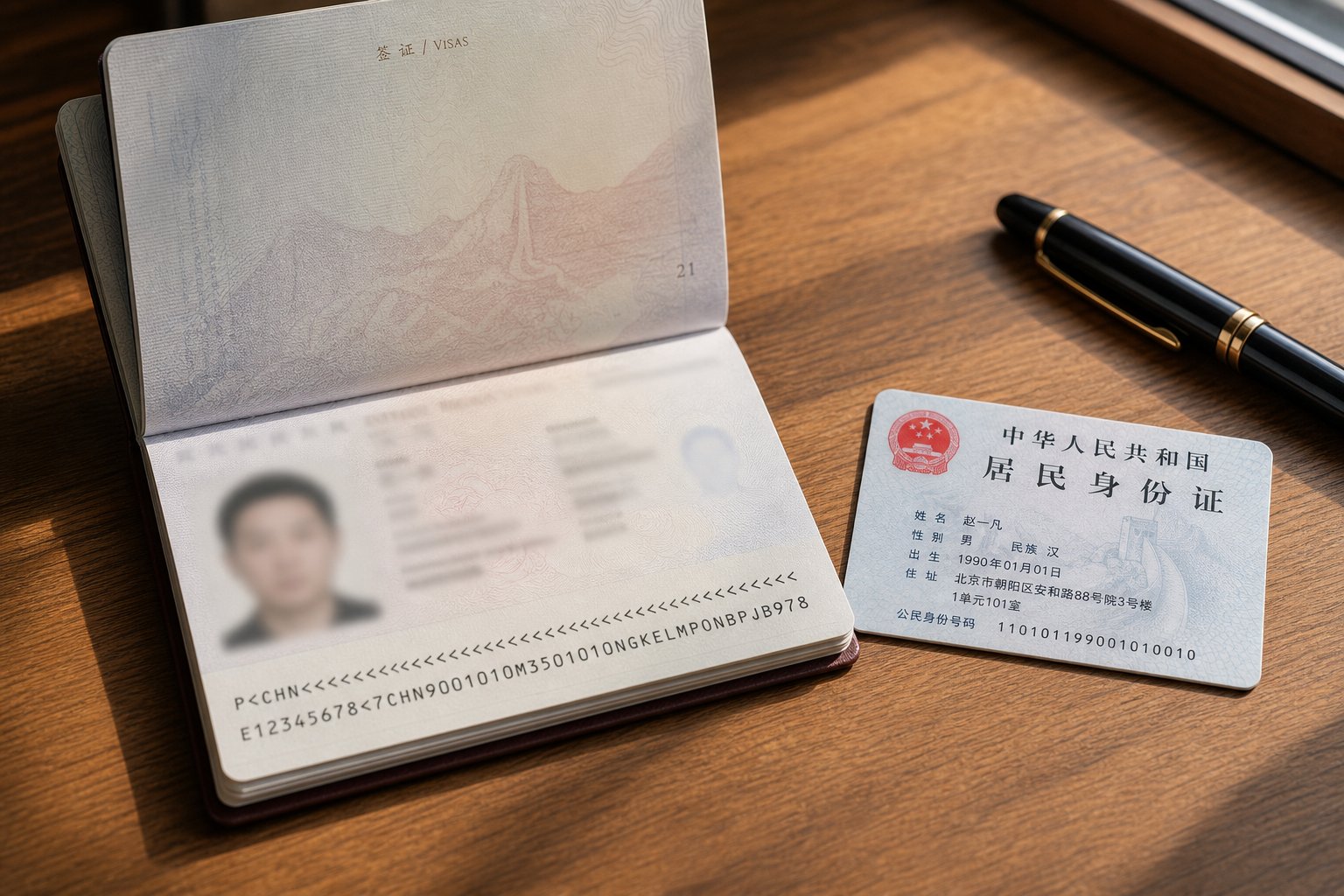
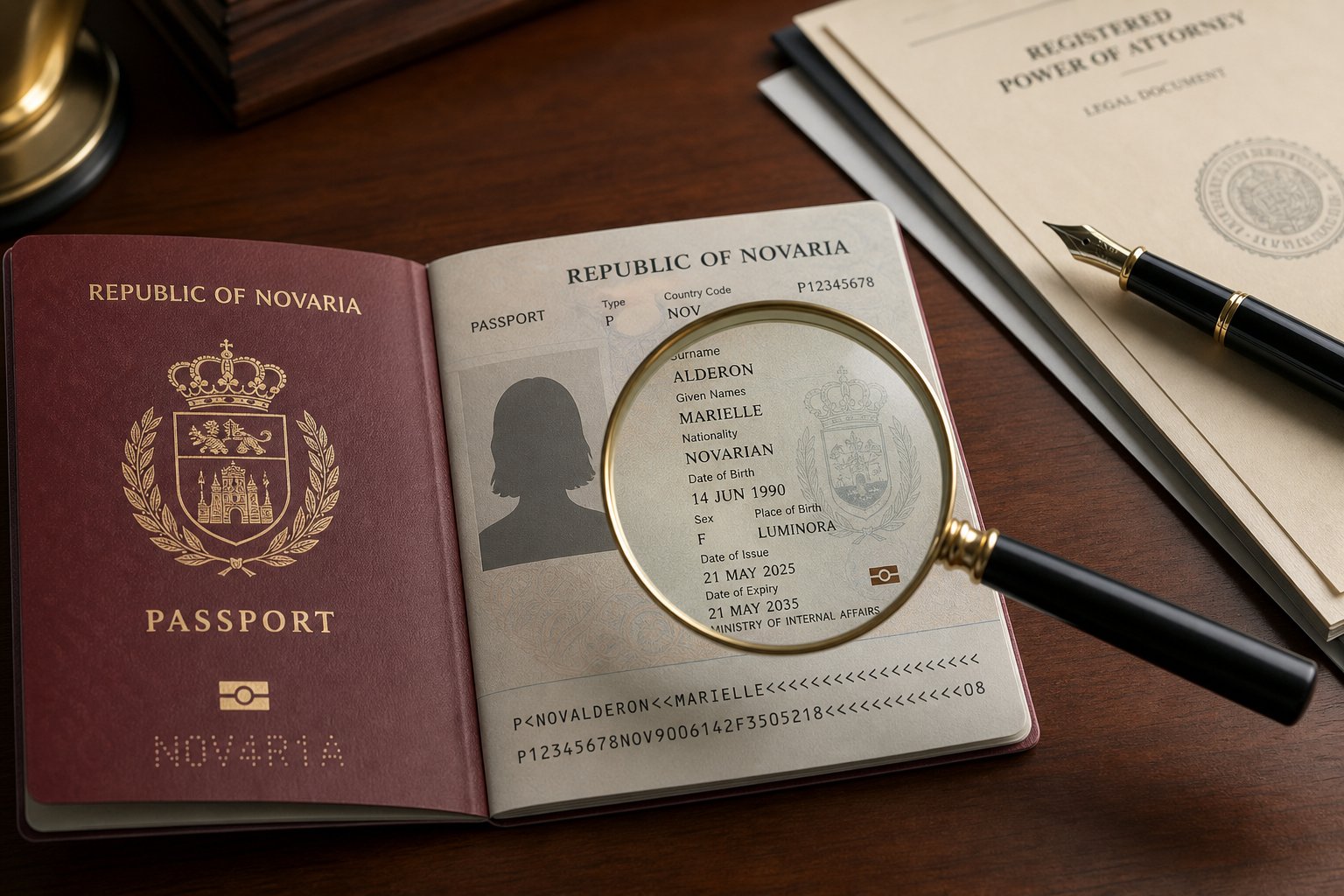
A PRC passport displays the holder's name in two scripts. The top line shows the name in Chinese characters. Below it, the name appears in pinyin using the Roman alphabet. The passport separates surname and given name into distinct labeled fields. In the machine-readable zone at the bottom of the biographic page, the surname appears as the primary identifier and the given name as the secondary identifier, following ICAO Doc 9303 standards.
The table below shows how the same person's name appears across different document contexts. Notice how the order and formatting shift depending on the system:
| Format | Example 1 | Example 2 | Example 3 |
|---|---|---|---|
| Chinese Characters | 王小明 | 张美玲 | 李建国 |
| PRC Passport (Surname Field) | WANG | ZHANG | LI |
| PRC Passport (Given Name Field) | XIAOMING | MEILING | JIANGUO |
| Passport MRZ | WANG<| ZHANG< | LI< | |
| Western-Order (Foreign Documents) | Xiaoming Wang | Meiling Zhang | Jianguo Li |
Each row represents the same person. Yet the visual differences are significant enough to cause verification failures. A chinese name in chinese language follows a fixed structure, but the moment that name crosses into a foreign system, the rendering can shift in ways that break consistency. The passport MRZ is the authoritative reference point. When foreign institutions need to verify a name, the MRZ format should govern how the name is entered into their systems.
Understanding this structure is the foundation. But which romanization system produces that pinyin in the first place, and what happens when different jurisdictions use different systems entirely, introduces another layer of complexity.
Which Romanization System Is Legally Recognized Where
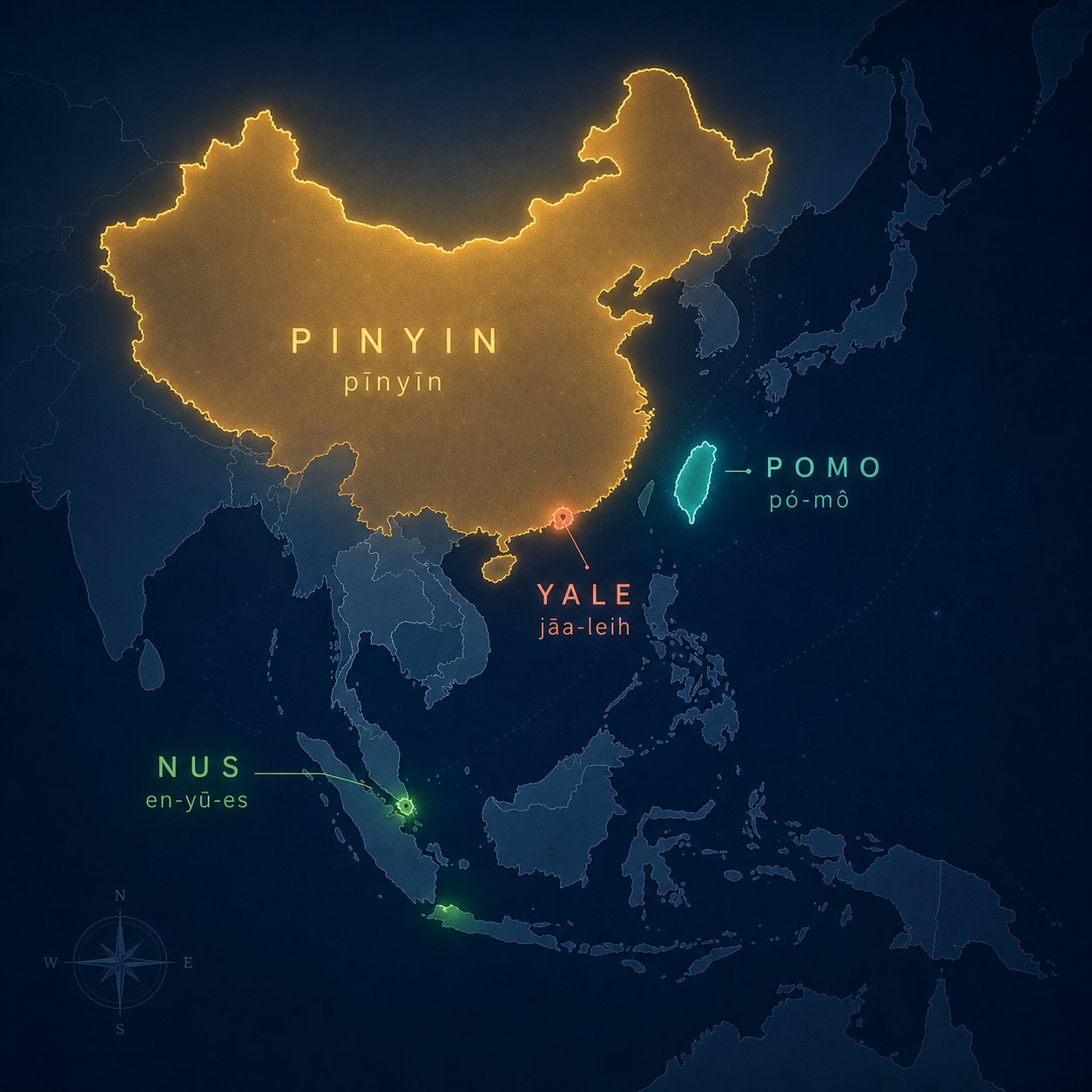
Not all pinyin is the same pinyin. Multiple romanization systems exist for rendering Chinese characters into the Latin alphabet, and each jurisdiction has its own rules about which system carries legal authority. If you use the wrong one on an official document, you are not just making a spelling choice. You are creating a legal name that does not match your identity records. For anyone working across borders, whether as a mandarin chinese translator, an immigration attorney, or an applicant trying to get a visa approved, knowing which system applies where is not optional knowledge.
Hanyu Pinyin as the PRC Legal Standard
Mainland China recognizes one romanization system and one only: Hanyu Pinyin. Adopted as the national standard in 1958 and later codified through multiple government regulations, Hanyu Pinyin is the sole legally valid method for rendering Chinese names in the Roman alphabet on PRC-issued documents. Passports, national ID cards, business registrations, and all official correspondence use this system exclusively.
The system was also adopted as the international standard for romanizing Mandarin Chinese under ISO 7098, first published in 1982 and revised in 2015. This means that when foreign governments, banks, or legal bodies need to convert to mandarin name spellings from Chinese characters, Hanyu Pinyin is the internationally recognized reference point for PRC nationals. Any other romanization, no matter how familiar it might look, does not constitute a legal rendering of a mainland Chinese name.
Sounds straightforward? It is, within the PRC. The complications begin the moment you cross into other Chinese-speaking jurisdictions where different systems hold legal weight.
Wade-Giles and Tongyong Pinyin in Taiwan
Taiwan's romanization history is considerably more complex. For decades, the Wade-Giles system dominated official documents. Developed in the 19th century by British diplomats Thomas Wade and Herbert Giles, this system produces spellings that look quite different from Hanyu Pinyin. The surname "Zhang" in Hanyu Pinyin becomes "Chang" in Wade-Giles. "Xu" becomes "Hsu." "Zhou" becomes "Chou."
In 2009, Taiwan officially adopted Hanyu Pinyin as the standard for romanizing place names and personal names on passports. However, the transition was not absolute. Individuals who already held passports with Wade-Giles spellings could retain them. Tongyong Pinyin, a system developed in Taiwan during the early 2000s as a local alternative, also remains in limited use in some municipal contexts. The result is that Taiwanese nationals may carry documents with names spelled in any of three different systems depending on when the document was issued and which local authority processed it.
For anyone needing to work with english to traditional chinese characters in a Taiwanese legal context, this creates a verification challenge. A person named "Xu Zhiming" in Hanyu Pinyin might appear as "Hsu Chih-ming" in Wade-Giles on an older passport, or "Syu Jhih-ming" in Tongyong Pinyin on certain local records. All three refer to the same individual, but automated systems treat them as three different people.
Hong Kong and Singapore Romanization Practices
Hong Kong presents the most fragmented romanization landscape of any Chinese-speaking jurisdiction. There is no single government-mandated system for romanizing personal names. Instead, Hong Kong residents use a Cantonese-based romanization that draws loosely from multiple schemes. The Education University of Hong Kong notes that several romanization systems coexist for Cantonese, including the Meyer-Wempe system developed by Catholic missionaries in the 1920s and 1930s, the Yale system designed at Yale University, and the Sidney Lau system adapted from Meyer-Wempe for the Hong Kong Government Language School's radio broadcasts in the 1960s. No single standard has emerged as the official government-mandated system for personal names on identity documents.
In practice, Hong Kong residents romanize their names based on Cantonese pronunciation rather than Mandarin, and the specific spelling often reflects family tradition or the preference of the registration clerk at the time of birth registration. The same Chinese character can produce different romanized spellings across siblings registered at different offices. This means a name like "Chan" in Hong Kong corresponds to "Chen" in Hanyu Pinyin, and "Wong" corresponds to "Wang." These are not errors. They reflect different phonological systems applied to the same characters.
Singapore takes a cleaner approach. For Mandarin-speaking Chinese Singaporeans, Hanyu Pinyin is the standard romanization system used on identity documents. However, many Singaporean Chinese families have dialect-based surnames that predate the adoption of Hanyu Pinyin, such as Hokkien or Teochew romanizations. Names like "Tan" (Hokkien for Chen), "Goh" (Hokkien for Wu), or "Teo" (Teochew for Zhang) remain legally valid on Singaporean documents even though they do not follow Hanyu Pinyin conventions. For given names, Hanyu Pinyin is more consistently applied on newer documents.
The table below summarizes which romanization system holds legal authority in each major jurisdiction:
| Jurisdiction | Official Romanization System | Governing Authority | Key Notes |
|---|---|---|---|
| PRC (Mainland China) | Hanyu Pinyin | State Council / Ministry of Public Security | Sole legal standard; no alternatives accepted on official documents |
| Taiwan | Hanyu Pinyin (since 2009); Wade-Giles and Tongyong Pinyin legacy | Ministry of the Interior | Existing Wade-Giles passport names may be retained; mixed systems in circulation |
| Hong Kong | No single mandated system; Cantonese-based romanization | Immigration Department | Spelling based on Cantonese pronunciation; varies by individual and registration period |
| Macau | Cantonese and Portuguese-influenced romanization | Identification Services Bureau | Portuguese transliteration conventions may appear on older documents |
| Singapore | Hanyu Pinyin (for Mandarin names); dialect romanizations for surnames | Immigration & Checkpoints Authority | Dialect-based surnames (Hokkien, Teochew, Cantonese) remain legally valid |
The practical consequence is clear: a legal chinese name in pinyin is only legal if it uses the romanization system recognized by the issuing jurisdiction. A PRC national whose passport spells their name in Hanyu Pinyin cannot have that name re-romanized into Wade-Giles on a Taiwanese document and expect the two to be treated as equivalent without additional notarization. Similarly, a Hong Kong resident whose name is romanized from Cantonese cannot simply convert that spelling to english to chinese mandarin Hanyu Pinyin equivalents and use the result on official forms without going through a formal name-change process.
Using the wrong romanization system is not a formatting preference. It is a legal mismatch that can result in rejected visa applications, failed background checks, and contracts that cannot be enforced because the signatory's name does not match their registered identity. An english to traditional chinese converter tool might help you understand what characters a name represents, but it cannot tell you which romanization system your jurisdiction requires on legal documents.
The romanization system determines which spellings are valid. But within each system, specific formatting rules govern how those spellings are laid out on the page: capitalization, spacing, hyphenation, and whether tone marks appear. These formatting details are just as legally significant as the system itself.
PRC Government Standards for Pinyin Name Formatting
Knowing that Hanyu Pinyin is the correct system is only half the equation. How you format that pinyin on a legal document is governed by a specific national standard, and getting the formatting wrong can be just as damaging as using the wrong romanization system entirely. The PRC does not leave these details to individual discretion. Every capital letter, every joined syllable, and every omitted tone mark follows a codified rule.
GB/T 28039-2011 Personal Name Standard
The governing document is GB/T 28039-2011, officially titled "Chinese Phonetic Alphabet Spelling Rules for Chinese Names." Published by the Standardization Administration of China, this standard specifies exactly how personal names in chinese characters must be rendered in pinyin on official documents. It applies to passports, ID cards, and all exit-entry documents issued by PRC authorities. The standard aligns with ISO 7098, the international specification for romanization of Chinese, ensuring that PRC pinyin formatting is recognized by foreign governments and institutions that follow international document standards.
If you have ever wondered how to spell in chinese names correctly for official purposes, this standard is the definitive answer. It removes ambiguity by prescribing a single correct format for every name, regardless of regional dialect or personal preference.
Capitalization and Spacing Rules
The formatting rules under GB/T 28039-2011 are precise. Here are the key requirements for rendering a legal chinese name in pinyin:
- The surname pinyin is written with all letters capitalized (e.g., WANG, ZHANG, LI)
- The given name has only the first letter capitalized (e.g., Xiaoming, Meiling, Jianguo)
- Two-character given names are written as one continuous word with no space or hyphen (e.g., "Jianguo" not "Jian Guo" or "Jian-Guo")
- Surname and given name are separated by a single space
- Tone marks are omitted entirely on official documents
- The letter "U" with umlaut (u) follows specific conversion rules: in surnames and given names containing LU (e.g., from characters like "吕") and NU (e.g., from characters like "女"), the "U" is printed as "YU"; in syllables like LUE and NUE, it is printed as "U"
That last rule about the umlaut deserves attention. The National Immigration Administration announced specific conversion rules for the letter "U" in pinyin-spelled names on exit-entry documents, confirming that "LU" (吕) becomes "LYU" and "NU" (女) becomes "NYU" in current passport printing. Holders of older documents printed under previous rules may request that new documents match their existing spelling to avoid cross-document inconsistencies.
So a person whose name chinese characters are 吕明 would see their passport printed as "LYU Ming" rather than "LU Ming" or "Lv Ming." Getting this wrong when you translate english to simplified chinese characters back into pinyin, or when you translate chinese characters to english for legal filings, creates exactly the kind of mismatch that triggers verification failures.
Why Tone Marks Are Omitted on Official Documents
If you are familiar with chinese name pronunciation in a language-learning context, you know that tone marks are essential for distinguishing meaning. "Ma" with a first tone means mother; with a third tone it means horse. So why drop them on legal documents?
The answer is technical rather than linguistic. Legal documents prioritize machine-readability over phonetic precision. The machine-readable zone on a passport uses a restricted character set defined by ICAO Doc 9303, which does not support diacritical marks of any kind. No accents, no umlauts rendered as diacritics, no tone marks. Extending this principle to the visual zone of the document ensures consistency between what a human reads and what a machine scans. Adding tone marks to the printed name but omitting them from the MRZ would create two different representations of the same name on a single document.
This is also why understanding how to spell in chinese names for legal purposes differs from academic pinyin. In a textbook, you write "Wang Xiǎomíng" with full tonal notation. On a passport, you write "WANG Xiaoming" with no marks at all. Both are correct in their respective contexts, but only the latter is legally valid on official documents.
These formatting rules create a predictable, verifiable standard. But standards only work when every document in your file follows them. The reality is that passports, birth certificates, business registrations, and visa stamps each have their own constraints, and the same person's name can look different across each one.

How Pinyin Names Appear on Passports and Official IDs
A single person can hold a passport, a national ID card, a birth certificate, and a business registration. Each document has its own layout, its own technical constraints, and its own way of rendering a name in pinyin. The formatting standard may be consistent in theory, but the practical output varies across document types in ways that matter for verification. Understanding these differences is essential if you want every document in your file to tell the same story.
Pinyin on PRC Passports and the Machine-Readable Zone
The PRC passport is the primary document where your legal chinese name in pinyin faces its strictest technical test. The biographic data page displays your name in two forms: Chinese characters on the top line and pinyin in the Roman alphabet below. Surname and given name occupy separate labeled fields, following the GB/T 28039-2011 formatting rules covered earlier.
The real constraint comes from the machine-readable zone at the bottom of the page. The MRZ follows ICAO Doc 9303 specifications, which limit the character set to uppercase Latin letters (A-Z), digits (0-9), and the filler character "<". No diacritics, no tone marks, no lowercase letters, no special characters. The surname appears as the primary identifier, the given name as the secondary identifier, separated by double angle brackets (<<).
As Regula Forensics notes, reading the MRZ on Chinese passports has its own peculiarities. The MRZ encodes the passport holder's name in Latin script as a coded representation of their Chinese name, not a straightforward transcription. Identity verification software must perform a dual workflow: converting the Latin script back into the original Chinese name and matching it against the visual data in the character fields. A valid document can produce a false mismatch if this logic is not handled correctly.
Passport numbers add another layer. Older PRC passports used a nine-character format (E + eight digits), but by 2017 this range was exhausted. Newer ordinary passports use E + one Latin letter + seven digits. This matters because when you use an english to chinese name converter tool or any automated system to verify identity, the passport number format itself signals which generation of document you are dealing with.
Corporate Name Pinyin Under SAMR Registration
Corporate names in pinyin follow entirely different rules than personal names. When a company registers with the State Administration for Market Regulation (SAMR), its official name is recorded in Chinese characters. The Regulations on the Administration of Enterprise Name Registration (State Council Decree No. 734, effective March 2021) specify that an enterprise name must consist of four components in order: administrative division, brand name, industry descriptor, and organization form.
There is no mandated pinyin rendering for domestic corporate names in the same way there is for personal names on passports. A company's pinyin name typically appears only when it needs to interact with international systems, such as opening a foreign bank account, signing cross-border contracts, or registering trademarks abroad. In these cases, the pinyin rendering is usually produced through notarized translation rather than pulled from a standardized government field.
This creates a gap. A chinese name converter designed for personal names will not produce a legally valid corporate name rendering. Enterprise names contain terms like "有限公司" (limited company) or "科技" (technology) that require translation rather than transliteration. The pinyin of "Beijing Zhongxin Keji Youxian Gongsi" is a transliteration, but the legal English name might be "Beijing Zhongxin Technology Co., Ltd." These are not interchangeable, and using the wrong form on a contract or bank document can invalidate the filing.
Birth Certificates and Other Civil Documents
PRC birth certificates display the child's name in Chinese characters. Pinyin does not appear on the standard domestic birth certificate. This becomes relevant when a Chinese national needs to prove their name's pinyin rendering for foreign applications. The birth certificate confirms the characters; the passport confirms the pinyin. If you need to name convert to chinese for a foreign-born child being registered in China, the process works in reverse: the foreign name is assigned Chinese characters, and those characters then generate the official pinyin.
National ID cards (Resident Identity Cards) present another variation. The standard domestic ID card displays the holder's name in Chinese characters only. However, ID cards issued in ethnic minority regions may include the holder's name in both Chinese and the local minority language script. Pinyin does not appear on the card itself, but the 18-digit citizen identification number encodes location, birth date, and gender data that verification systems cross-reference against the name fields.
The table below illustrates how the same individual's name can appear differently across document types:
| Document Type | Name Rendering | Script/Format | Pinyin Present? |
|---|---|---|---|
| PRC Passport (Visual Zone) | LYU / Mingze | Latin (Hanyu Pinyin) | Yes - surname and given name in separate fields |
| PRC Passport (MRZ) | LYU<| Uppercase Latin, ICAO restricted set | Yes - no diacritics, filler characters only | |
| Resident Identity Card | 吕明泽 | Chinese characters only | No |
| Birth Certificate | 吕明泽 | Chinese characters only | No |
| SAMR Business Registration | 北京明泽科技有限公司 | Chinese characters only | No (pinyin produced via notarized translation for international use) |
| Notarized Translation (for foreign use) | Lyu Mingze / Beijing Mingze Technology Co., Ltd. | Latin (translated/transliterated) | Yes - but format depends on translator and target jurisdiction |
You will notice that pinyin only appears natively on the passport. Every other document requires an additional step, whether notarization, translation, or cross-referencing, to produce the pinyin form. This is why the passport is the anchor document for your english to chinese name verification. If a foreign institution asks for your name in pinyin, the passport is the authoritative source. If your other documents do not align with what the passport shows, you have a discrepancy that needs resolution.
A name to chinese name converter tool might help you explore how characters map to pinyin, but it cannot replicate the specific formatting decisions made by the issuing authority on your actual documents. The gap between what a tool generates and what your passport actually says is precisely where verification failures occur. And when those failures stack up across multiple documents, the consequences go beyond inconvenience.

Resolving Pinyin Name Discrepancies Across Documents
Your passport says "WANG Xiaoming." Your bank account shows "Xiao Ming Wang." Your work permit reads "WANG Xiao Ming." Three documents, three versions of the same person, and every system treats them as three different identities. This is not a hypothetical scenario. It is one of the most common and disruptive problems facing anyone whose legal chinese name in pinyin must remain consistent across multiple administrative systems.
Chinese name translation errors do not announce themselves. They sit quietly in databases until a renewal, a compliance audit, or a cross-border transfer surfaces the mismatch. At that point, the burden of proving you are who you claim to be falls entirely on you.
Common Causes of Pinyin Name Mismatches
Discrepancies rarely stem from a single dramatic error. They accumulate through small, predictable failures across time and systems:
- Different transliteration standards applied at different times. A bank account opened in 2008 might use an older romanization convention, while a passport renewed in 2020 follows current GB/T 28039-2011 formatting. The result is two legitimate but non-matching records.
- Name order reversal. Chinese convention places the surname first. Foreign systems often reverse this. When a clerk enters "Xiaoming" as the surname and "Wang" as the given name, the error propagates through every linked record.
- Split or hyphenated given names. A two-character given name that should appear as one word ("Xiaoming") gets entered as two words ("Xiao Ming") or hyphenated ("Xiao-Ming") depending on the data entry clerk's interpretation.
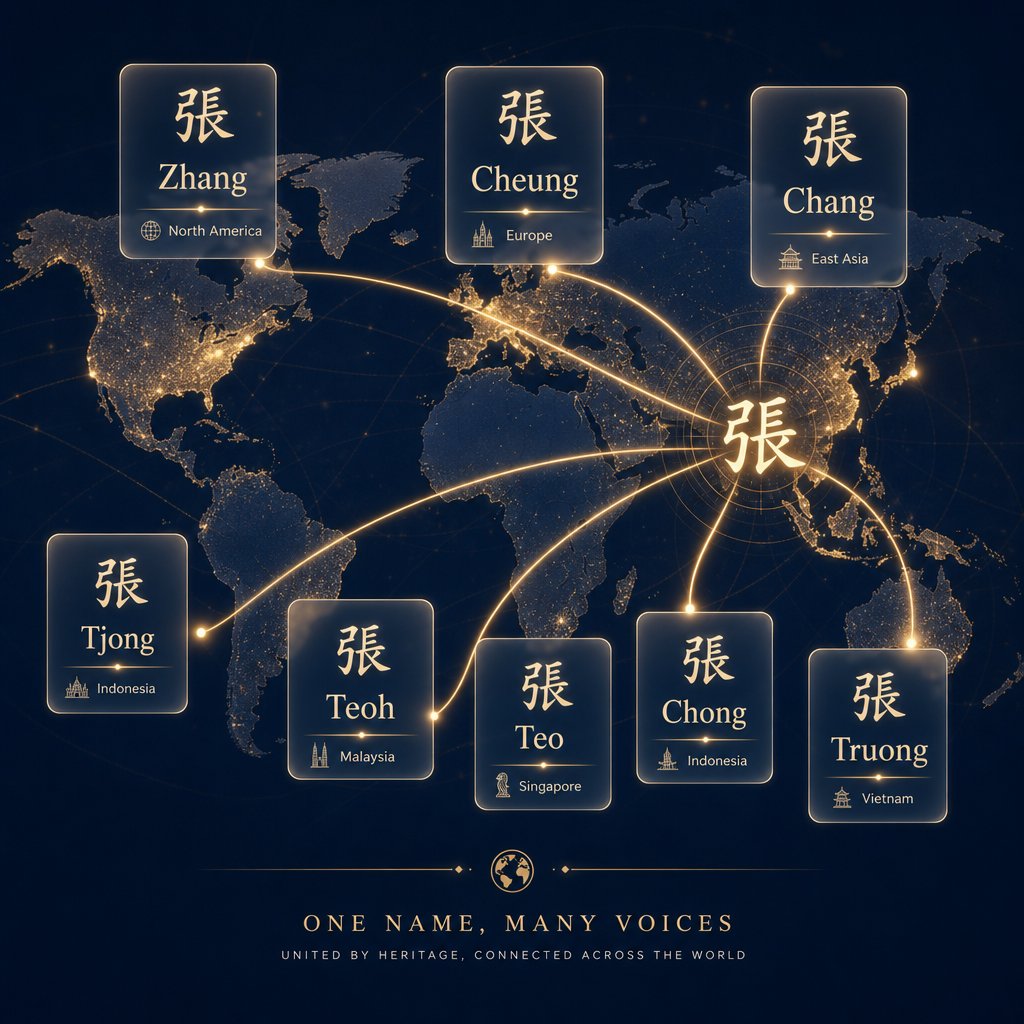
- Legacy Wade-Giles or dialect-based entries. Older documents or records created in Hong Kong, Taiwan, or overseas Chinese communities may use entirely different romanization systems. "Zhang" becomes "Chang," "Xu" becomes "Hsu."
- Manual data entry errors. A dropped letter, a transposed syllable, or a misspelling introduced at registration that no cross-system check exists to catch.
Each cause produces a different type of mismatch, in a different system, with different consequences. The challenge when you need to translate name chinese records back to a single identity is that no automated bridge connects these systems to flag inconsistencies before they become problems.
Steps to Resolve Cross-Document Discrepancies
Fixing a pinyin name mismatch requires a systematic approach. Tackling documents in the wrong order can create new inconsistencies or leave gaps that surface later. Here is the resolution sequence that addresses the highest-risk records first:
- Audit all your records. Lay out every document where your name appears in pinyin: passport, bank accounts, work permit, residence permit, tax registration, and any foreign visas or applications. Write down exactly how your name appears on each one. Identify every variation.
- Establish your authoritative name. Your current valid passport is the anchor. The pinyin on your passport, as formatted by the issuing authority, is your legal name. Every other record must match it.
- Correct the work permit first. Under China's December 2024 integration of work permits and social security cards, correcting the work permit simultaneously updates your Electronic Social Security Card record. Start here to resolve two systems at once.
- Update your bank records. Visit your bank branch with your new and old passports plus your residence permit. For name format discrepancies (not just passport number changes), an embassy-issued letter or a notarized statement from a Chinese notary office confirming both names belong to the same person is the most widely accepted supporting document.
- Obtain a notarized name declaration or affidavit of same-name identity. This is a sworn, notarized document that lists all variations of your name across all documents and affirms they refer to a single individual. A qualified name translator or certified translation service can prepare the linguistic explanation, while a notary provides the legal authentication.
- Update tax and residence permit records. File corrections through the Personal Income Tax app or local tax bureau, and visit the PSB or NIA service center for residence permit updates.
- Request corrections from foreign issuing authorities. If a foreign visa or document contains the error, contact the relevant embassy or consulate with your passport and notarized declaration to request amendment.
When you chinese translate name records across systems, the goal is not perfection in every historical record. It is consistency going forward, anchored to the passport as the single source of truth.
Legal Consequences of Inconsistent Pinyin Rendering
Unresolved discrepancies are not dormant paperwork issues. They carry tangible legal and financial consequences:
- Immigration delays and denials. A visa application where the applicant's name does not match their passport pinyin exactly can trigger Requests for Evidence or outright rejection. Chinese names english translation inconsistencies are among the most common flags in immigration processing.
- Frozen bank accounts. Under China's 2024 Anti-Money Laundering Law (effective January 2025), banks must continuously verify account holder identity. A name mismatch between your bank record and current passport is an active compliance problem that can block salary payments, suspend WeChat Pay and Alipay linkages, and reject overseas transfers.
- Contract disputes. If the signatory's pinyin name on a contract does not match their registered legal identity, the opposing party can challenge the contract's validity. This is especially relevant in cross-border transactions where name translate in chinese verification is part of due diligence.
- Rejected cross-border remittances. Outbound transfers above RMB 5,000 per transaction require verified name information. A discrepancy at this stage delays or blocks the transfer entirely.
- Work permit and tax complications. A name error on your work permit now propagates automatically to your social security record. Tax reconciliation filings flag mismatched names for manual review, delaying refund processing.
A pinyin name discrepancy is not a clerical footnote. It is an identity verification failure with consequences that compound across every system that touches your name.
The rules across Chinese administrative systems are strict: every record must match your passport. The gap is not in the law but in the infrastructure connecting systems together. Until that gap closes, proactive resolution is the only defense. And the approach you take depends heavily on who you are: a Chinese national heading abroad, a foreigner registering a Chinese name, or a legal professional verifying a counterpart's identity for compliance purposes.

Practical Guidance for Different User Scenarios
The resolution process outlined above assumes you already know what your correct pinyin should be. But the starting point differs dramatically depending on your situation. A Chinese national preparing to study abroad faces different obstacles than a foreigner trying to derive a chinese name from english for official registration, and both face different challenges than a lawyer running due diligence on a counterpart's identity. Each scenario demands its own workflow.
Guidance for Chinese Nationals Going Abroad
If you hold a PRC passport, your legal pinyin is already established. The challenge is keeping it consistent as you interact with foreign systems that may reformat, reorder, or truncate your name. Here is what to prioritize:
- Use your passport pinyin exactly as printed on every foreign application. Do not adjust spacing, capitalization, or name order to "look more Western." If the form has separate surname and given name fields, enter them as your passport shows: surname in one field, full given name (joined, no space) in the other.
- Carry a notarized name declaration when applying in jurisdictions that reverse name order. Some countries will automatically flip your name into given-name-first format. A notarized statement clarifying which part is the surname prevents downstream mismatches.
- Check older documents before renewal. If you held a passport issued before the current formatting standards, your previous pinyin may differ from what a new passport would show. Decide whether to request the old spelling be retained for consistency or accept the updated format and prepare supporting documentation linking both versions.
- Verify your pinyin matches across your visa history. Previous visas stamped in old passports create a trail. Immigration officers compare current applications against historical records. A name that shifted between renewals without explanation raises flags.
Foreigners Registering a Chinese Name
When a foreigner living or working in China adopts a Chinese name, the process is not as simple as picking characters from a chinese name generator and printing them on a business card. A legally recognized Chinese name for a foreign national must be registered through official channels, and its pinyin form must follow the same standards that apply to Chinese citizens.
Many foreigners start by choosing chinese names for english names through informal methods: a teacher assigns one, a colleague suggests one, or an online chinese name generator female or chinese name generator male tool produces options based on phonetic similarity. These are fine for social use, but they carry no legal weight until registered.
- Register your Chinese name through your residence permit or work permit application. The name you provide in Chinese characters on these documents becomes your official Chinese name within PRC systems. The pinyin is generated from those characters following standard rules.
- Ensure phonetic consistency with your passport name. If your legal name is "Michael" and you choose a chinese name from english name phonetics like "Mai Ke" (麦克), the pinyin "Mai Ke" will appear on Chinese-issued documents. This pinyin does not need to match your passport spelling of "Michael," but you should be prepared to explain the relationship between the two names when institutions cross-reference records.
- Do not change your Chinese name casually. Once registered, your Chinese name and its pinyin become part of your official record in China. Changing it requires formal application and creates the same cross-document inconsistency problems that Chinese nationals face.
Verifying Legal Pinyin for Business and Legal Purposes
For legal and business professionals conducting due diligence on a Chinese counterpart, the critical rule is this: never rely on a business card, email signature, or website to determine someone's legal pinyin name. These informal sources are self-assigned and carry no legal authority.
As China Justice Observer emphasizes, all Chinese individuals and enterprises have their legal names in Chinese characters, and they have no legal or standard names in foreign languages. Their English names are typically self-assigned, and back-translating those informal names to the legal Chinese version is often unreliable. If a dispute reaches a Chinese court, you must identify the counterpart by their legal Chinese name, or the court may not accept your case.
- For individuals: Request a copy of their passport or national ID. The passport provides the authoritative pinyin. Cross-reference the Chinese characters on the ID against the pinyin on the passport to confirm they match.
- For companies: Obtain the business license, which shows the legal Chinese name and unified credit code. Verify this name on China's National Enterprise Credit Information Publicity System. The pinyin rendering of a corporate name is not standardized in the same way personal names are, so any pinyin or English version used in contracts should be confirmed against the characters on the business license and official seal.
- For contracts: Include both the Chinese character name and the pinyin rendering in the contract header. Specify which version prevails in case of discrepancy. This eliminates ambiguity if the chinese name from english translation used informally does not match the registered identity.
- For cross-border enforcement: If you ever need to enforce a judgment or file a complaint with Chinese authorities, the legal Chinese name in characters is what matters. The pinyin is your bridge to identifying that name, but the characters are what Chinese courts and regulators recognize.
A chinese name generator tool can help you explore how characters and pinyin relate, but it is not a substitute for document-level verification. The gap between an informal transliteration and a registered legal name is exactly where fraud, misidentification, and unenforceable contracts live. Closing that gap requires checking primary source documents, not relying on convenience tools or self-reported information.
Ensuring Your Legal Pinyin Name Is Correct and Consistent
The gap between an informal transliteration and a legally valid pinyin rendering is where visas get denied, bank accounts get frozen, and contracts become unenforceable. Everything covered in this article points to one principle: your legal chinese name in pinyin is not a phonetic approximation. It is a regulated identifier that must remain consistent across every document in your file, formatted according to the standards of your issuing jurisdiction, and verifiable against primary source records.
Chinese name interpretation in a legal context means understanding that the same characters can produce different romanized spellings depending on the system applied, the era of issuance, and the technical constraints of the document type. A name that looks correct to you may not match what a machine-readable zone encodes, what a bank database stores, or what an immigration officer expects to see.
Legal pinyin consistency is not a formatting preference. It is an identity-verification requirement with tangible consequences for immigration, banking, contracts, and cross-border enforcement.
Key Takeaways for Legal Pinyin Compliance
Here is what matters most when you translate name records or verify identity across systems:
- Legal pinyin varies by jurisdiction. The PRC mandates Hanyu Pinyin. Taiwan permits legacy Wade-Giles. Hong Kong uses Cantonese-based romanization with no single enforced standard. Singapore allows dialect surnames alongside Hanyu Pinyin given names. Using the wrong system for your jurisdiction creates a legal mismatch, not just a spelling difference.
- Formatting is legally significant. Capitalization, spacing, joined given names, and umlaut handling all follow GB/T 28039-2011 for PRC documents. A space where none should exist, or a hyphen where the standard requires a joined word, is enough to trigger a verification failure.
- Your passport is the anchor document. Every other record, whether a bank account, work permit, tax filing, or foreign visa, must match the pinyin on your current valid passport. When discrepancies exist, the passport governs.
- Discrepancies compound silently. A mismatch introduced years ago in one system propagates to linked records without warning. Proactive auditing is the only defense against discovering the problem at the worst possible moment.
- Informal names carry no legal weight. Business cards, email signatures, and self-assigned English names are not substitutes for the registered pinyin on official documents. Chinese name interpretation for legal or business purposes requires checking primary source records.
Action Checklist for Name Consistency
Whether you are a Chinese national preparing international applications, a foreigner registering a Chinese name, or a professional verifying a counterpart's identity, these steps protect you from costly errors:
- Pull out every document where your name appears in pinyin. Compare them side by side. Note every variation in spelling, spacing, order, and capitalization.
- Confirm which romanization system applies to your jurisdiction and verify your documents follow it.
- If any document deviates from your passport pinyin, initiate correction with the issuing authority or obtain a notarized name declaration linking all variations to a single identity.
- For cross-border contracts or due diligence, include both Chinese characters and pinyin in document headers and verify both against official registration records.
- When discrepancies cannot be corrected at the source, prepare a certified translator's explanatory note or affidavit of identity that documents the linguistic basis for each variation.
A chinese name translator tool or online converter can help you explore how characters map to pinyin, but it cannot replace document-level verification. The chinese translation for names on your official records is what courts, banks, and immigration authorities recognize. Everything else is informal until proven otherwise. Get ahead of the problem before it finds you at a visa counter, a compliance audit, or a courtroom.
Frequently Asked Questions About Legal Chinese Names in Pinyin
1. How is a Chinese name written in pinyin on a PRC passport?
On a PRC passport, the surname appears fully capitalized in one field (e.g., WANG), and the given name appears with only the first letter capitalized in a separate field (e.g., Xiaoming). Two-character given names are joined as one word without spaces or hyphens. Tone marks are omitted entirely. The machine-readable zone renders both parts in all uppercase, separated by double angle brackets (<<). This formatting follows GB/T 28039-2011 and ICAO Doc 9303 standards.
2. What happens if my pinyin name is different across my documents?
Inconsistent pinyin across documents can lead to visa denials, frozen bank accounts, rejected remittances, and unenforceable contracts. Automated verification systems perform exact-match checks, so even minor differences like a space in a given name or reversed name order are treated as identity mismatches. Resolution requires establishing your passport as the authoritative source, then systematically correcting each record through the issuing authority or obtaining a notarized name declaration linking all variations.
3. Which romanization system is legally recognized for Chinese names?
It depends on the jurisdiction. Mainland China exclusively uses Hanyu Pinyin. Taiwan officially adopted Hanyu Pinyin in 2009 but still has legacy Wade-Giles and Tongyong Pinyin names in circulation. Hong Kong uses Cantonese-based romanization with no single enforced standard. Singapore uses Hanyu Pinyin for Mandarin given names but permits dialect-based surname spellings like Tan or Goh. Using the wrong system for your jurisdiction creates a legal name mismatch, not merely a spelling preference.
4. Can a foreigner register a legal Chinese name in pinyin in China?
Yes. A foreigner can register a Chinese name through their residence permit or work permit application. The Chinese characters provided on these documents become the official Chinese name within PRC systems, and the pinyin is generated from those characters following standard Hanyu Pinyin rules. The registered Chinese name does not need to phonetically match the foreign passport name, but the holder should be prepared to explain the relationship between both names when institutions cross-reference records.
5. How do I verify the legal pinyin name of a Chinese company for contracts?
Never rely on business cards, websites, or email signatures. Obtain the company's business license showing the legal Chinese name and unified credit code, then verify it on China's National Enterprise Credit Information Publicity System (gsxt.gov.cn). Corporate names have no standardized pinyin rendering the way personal names do, so any pinyin or English version used in contracts should be confirmed against the characters on the business license. Include both Chinese characters and pinyin in contract headers and specify which version prevails in case of discrepancy.