What Makes Singapore Chinese Names Unique
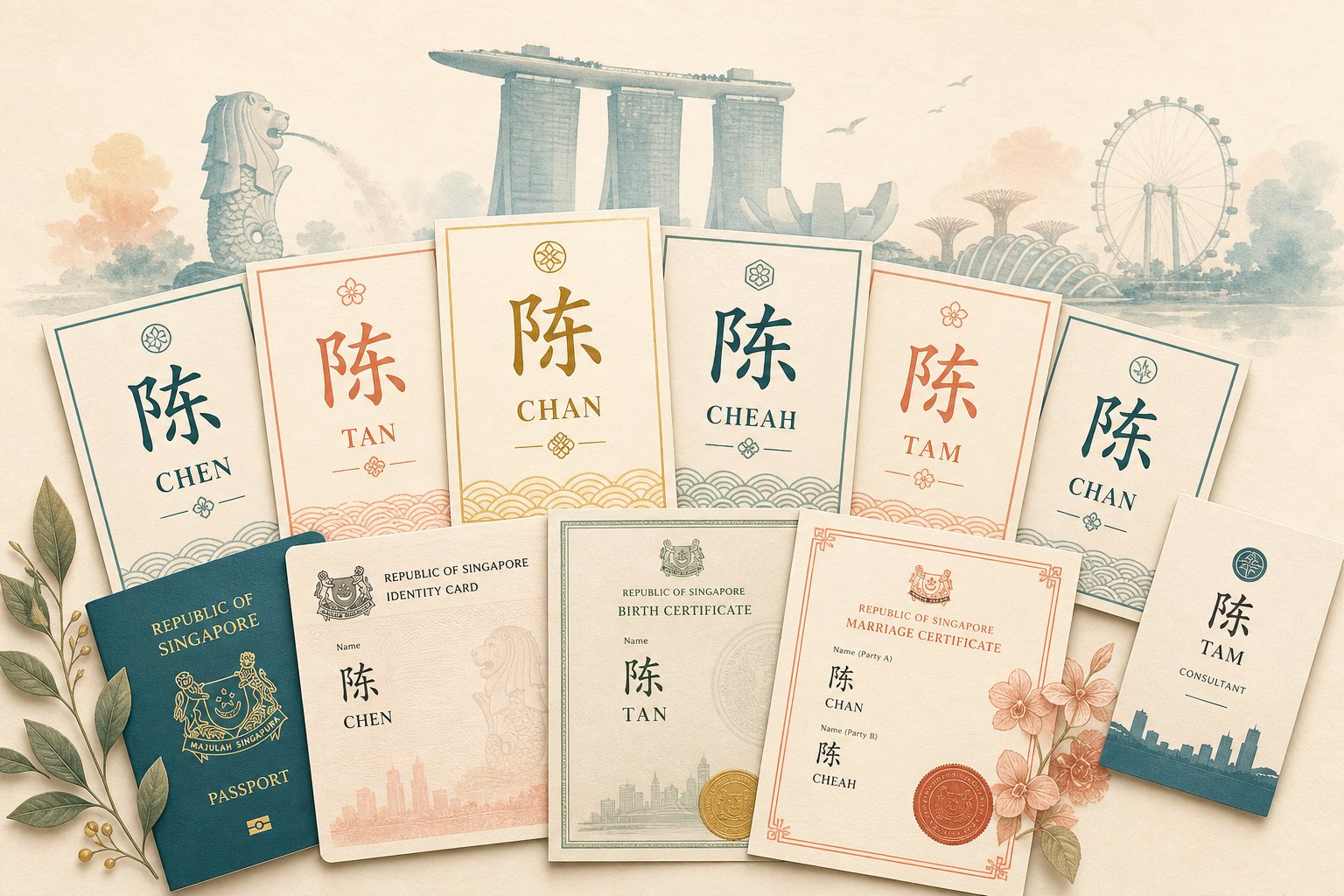
Imagine meeting four colleagues in Singapore named Tan, Chen, Chan, and Chin. They look unrelated on paper, yet all four share the exact same surname character: 陈. Same family name, four completely different spellings. If you have ever found yourself mispronouncing Chinese names or addressing someone incorrectly because the spelling threw you off, you are not alone. Singapore Chinese names operate under a system unlike anything found in mainland China, Hong Kong, or Taiwan.
Why Singaporean Chinese Names Look Different from Mainland Chinese Names
In mainland China, a standardized romanization system called Hanyu Pinyin ensures that 陈 is always spelled "Chen." Singapore has no such uniformity. The island's Chinese community is composed of multiple dialect groups, primarily Hokkien, Teochew, Cantonese, Hakka, and Hainanese, each with its own pronunciation of the same characters. When British colonial administrators needed to record these names in English, they romanized them based on local dialect pronunciations rather than any single standard. The result is a naming landscape where one surname character like 郑 (Zheng in pinyin) can appear as Teh, Tay, Tee, Cheng, or Chang depending on the speaker's dialect heritage.
This is not a quirk or an error. It is the natural outcome of Singapore's multilingual policy, dialect diversity, and colonial history layered on top of each other over two centuries. Chinese Singaporean names carry linguistic DNA that reveals ancestral dialect group, generational era, and even clan affiliation, all encoded in a handful of romanized syllables.
What This Guide Covers
This guide breaks down every layer of Singaporean Chinese names so you can read, pronounce, and address them correctly. You will learn how dialect groups shape surname spelling, why a grandparent and grandchild with the same family character may spell it differently, how generational naming traditions work, and what the rules are for professional etiquette. Whether you are an expatriate working with Singaporean colleagues, a new parent choosing a name, or simply curious about why Chinese names in Singapore look so varied, this is your single reference.
A single Singaporean Chinese person may have multiple legitimate name variants across different documents, from NRIC to passport to business card, none of them misspellings.
The key to understanding Singapore Chinese names is recognizing that spelling variation is not inconsistency. It is history, dialect, and identity made visible on paper. And the first piece of that puzzle is the structure of the name itself.
The Complete Anatomy of a Singaporean Chinese Name
Spelling variation is only half the puzzle. The other half is structure. A Singaporean Chinese name is not a random string of syllables. It follows a precise architecture, and once you understand the building blocks, you can decode any name you encounter, even one you have never seen before.
Every Chinese name in Singapore is built from up to three components, each serving a distinct function. Knowing which part is which prevents the most common mistakes people make when mispronouncing Chinese names or addressing someone by the wrong element.
Surname Plus Given Name Structure
The standard format for a Singaporean Chinese name follows this order: surname first, then given name. The surname (姓, xing) is inherited from the father and shared among siblings. It is almost always a single Chinese character and a single romanized syllable. The given name (名, ming) is the personal identifier chosen at birth. It typically contains one or two Chinese characters.
Between these two sits an optional third element: the generational name (字辈, zi bei). This is a character shared by all members of the same generation within a clan or extended family. When present, it occupies the first position of the two-character given name. So a full name with all three components reads as: [Surname] [Generational character] [Personal character].
Consider the name TAN Wei Ming (陈伟明). Here is how each piece functions:
| Component | Chinese Character | Romanised Form | Role |
|---|---|---|---|
| Surname (xing) | 陈 | TAN | Family name, inherited from father, shared with siblings |
| Generational name (zi bei) | 伟 | Wei | Shared character among same-generation clan members |
| Personal name (ming) | 明 | Ming | Individual identifier chosen at birth |
In this example, "TAN" is the Hokkien romanisation of 陈. A cousin in the same generation might be named TAN Wei Liang, sharing both the surname and the generational character "Wei." A sibling without the zi bei tradition might simply be TAN Shu Ting, where both characters of the given name are independently chosen.
You will notice that many Chinese characters can function as either a surname or part of a given name. This is exactly why it is common practice to write family names in capitals on formal documents, helping readers distinguish the surname from the rest.
How Names Appear on Official Documents
Here is where things get tricky for anyone unfamiliar with the Singapore name format of Chinese names. On a National Registration Identity Card (NRIC), you will see both the romanised version and the Chinese characters. The romanised spelling is the legally official name in Singapore, not the characters. This is the opposite of mainland China, where the characters hold legal authority.
On a passport, only the romanised name appears. The given name may be written as two separate words (Wei Ming), hyphenated (Wei-Ming), or joined together (Weiming), depending on how it was registered at birth. There is no single enforced standard, which means the same person's name can look slightly different across documents issued at different times.
The order also shifts depending on context. In Chinese, the surname always comes first: 陈伟明 reads as TAN Wei Ming. But in Western-oriented settings, some Singaporeans flip the order to Wei Ming TAN, placing the given name first and the surname last. Others keep the Chinese order. Without knowing which convention someone follows, you might mistake "Wei Ming" for a surname or call someone "Mr. Ming" when their family name is actually TAN.
A practical rule: if one element is written in all capitals, that is the surname. If nothing is capitalised differently, the first word in a Chinese-ordered name is almost always the family name. When in doubt, ask. Singaporeans are accustomed to this confusion and will not find the question rude.
This structural clarity helps, but it still does not explain why TAN, CHEN, and CHAN can all represent the same character. That answer lies in the dialect groups that shaped how these names were first written down in English.
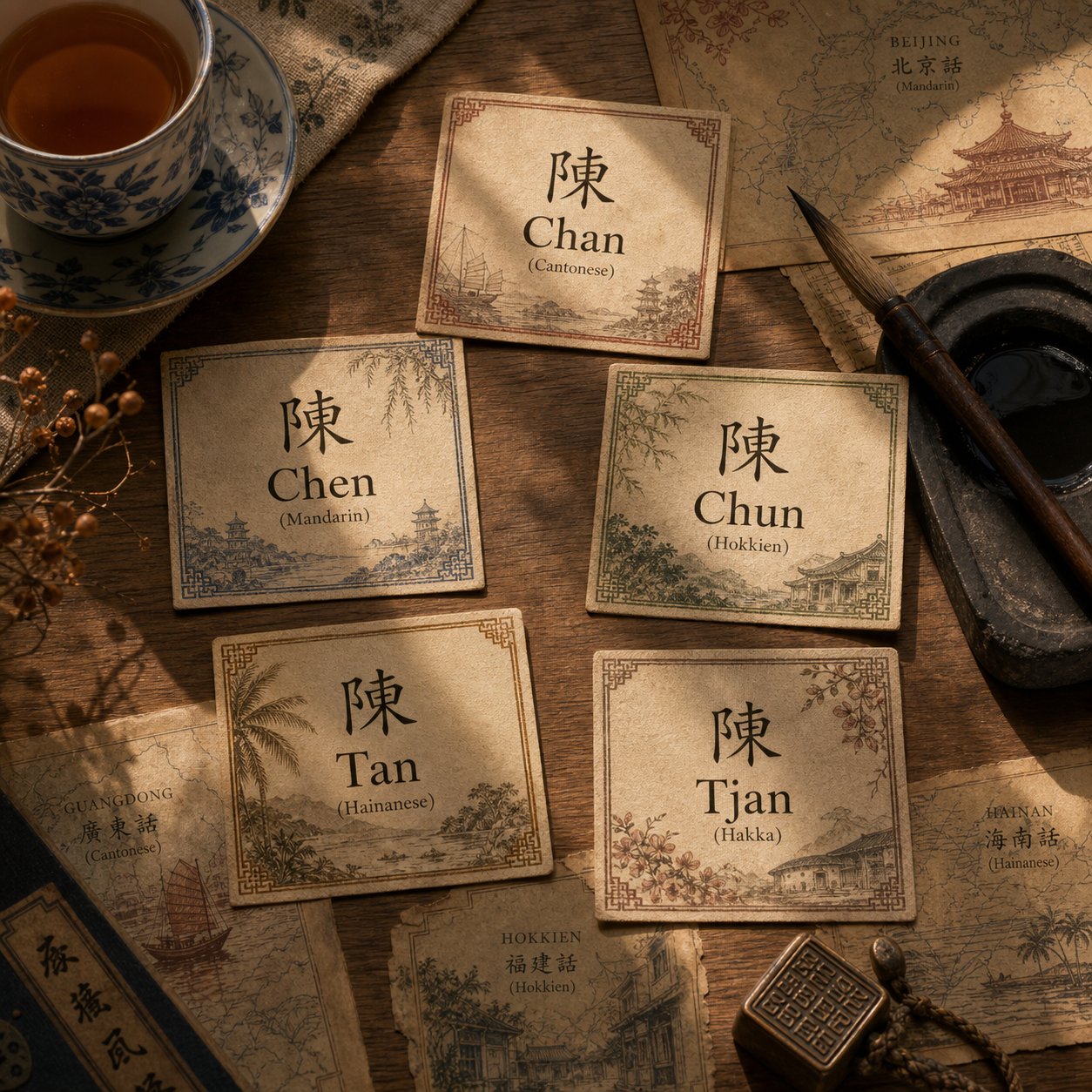
Dialect Group Romanisation and Why Surnames Vary So Much
The structural breakdown of a name tells you what each piece does. But it does not explain the most bewildering feature of Singaporean Chinese names: why the same surname character produces wildly different spellings depending on who carries it. The answer is dialect. Specifically, five major dialect groups whose pronunciations diverge so sharply that a single character can sound like an entirely different word from one group to the next.
Singapore's Chinese population descends primarily from immigrants who arrived from southern China's Fujian, Guangdong, and Hainan provinces between the 1800s and mid-1900s. These immigrants spoke Hokkien, Teochew, Cantonese, Hakka, or Hainanese, not Mandarin. When colonial clerks recorded their names in English, they wrote down what they heard. No universal romanisation standard existed. The result is that common Chinese names in Singapore carry the phonetic fingerprint of whichever dialect the original bearer spoke.
How Dialect Groups Shape Surname Spelling
Imagine two colleagues, one named Tan and the other named Chen. Both carry the character 陈 as their surname. The difference? Tan's family is Hokkien, while Chen's family registered their name using Mandarin pinyin, likely a generation or two later. Neither spelling is wrong. Each is a faithful transcription of how that character sounds in a different Chinese language variety.
This pattern repeats across every common surname in Singapore. The character 黄 sounds like "Huang" in Mandarin, "Wong" in Cantonese, "Ng" in Hokkien and Teochew, and "Vong" in Hainanese. As My China Roots documents, a single surname character like 黄 can have over 30 different romanised spellings across the global Chinese diaspora. In Singapore alone, you will encounter at least four or five variants for most popular Chinese names.
This is the core reason people end up mispronouncing Chinese names from Singapore. You cannot apply Mandarin pinyin rules to a name that was romanised from Hokkien or Cantonese. The spelling "Goh," for instance, does not follow any Mandarin sound pattern because it is the Hokkien pronunciation of 吴, which pinyin renders as "Wu." Reading "Goh" and attempting a Mandarin-based guess will lead you nowhere close to the correct sound.
Common Surnames Across Hokkien, Teochew, Cantonese, and Hakka
The table below compares the most common Chinese names in Singapore across all major dialect groups. Use it as a quick-reference lookup when you encounter an unfamiliar spelling and want to identify the underlying character or dialect origin.
| Chinese Character | Hokkien | Teochew | Cantonese | Hakka | Hanyu Pinyin |
|---|---|---|---|---|---|
| 陈 | Tan | Tan | Chan | Chin | Chen |
| 林 | Lim | Lim | Lam | Lim | Lin |
| 黄 | Ng / Ooi | Ng | Wong | Vong | Huang |
| 李 | Lee | Lee | Lei / Li | Li | Li |
| 王 | Ong / Heng | Heng | Wong | Vong | Wang |
| 吴 | Goh | Goh | Ng | Ng | Wu |
| 张 | Teo | Teo | Cheung | Chong | Zhang |
| 刘 | Lau | Lau | Lau | Liew | Liu |
| 杨 | Yeo / Yeoh | Yeo | Yeung | Yong | Yang |
| 郭 | Kuek / Kwek | Kuek | Kwok | Kok | Guo |
A few patterns emerge from this table. Hokkien and Teochew romanisations often overlap because both dialects originate from Fujian province and share linguistic roots. Cantonese spellings tend to look the most distinct, reflecting the phonological distance between Cantonese and the Min Nan language family. Hakka romanisations sometimes resemble Mandarin pinyin more closely than the others, though not consistently enough to rely on.
Notice how 黄 becomes "Ng" in Hokkien and Teochew but "Wong" in Cantonese. Meanwhile, 吴 is "Goh" in Hokkien but "Ng" in Cantonese. This means two completely different surname characters can share the same romanised spelling across dialect groups. An "Ng" in Singapore could be either 黄 or 吴, depending on whether the family is Cantonese or Hokkien. Context, or simply asking, is the only reliable way to tell.
For anyone working with Singaporean colleagues or trying to identify the most common Chinese name in Singapore from a list of romanised spellings, this dialect layer is essential knowledge. The surname "Tan" ranks among the most frequent in Singapore not because it is a unique name, but because Hokkien speakers form the largest dialect group on the island, and 陈 is one of the most widespread Chinese surnames globally.
Understanding dialect romanisation also explains a generational puzzle. Within the same family, a grandfather might spell his surname "Tan" while his university-educated grandchild registers as "Chen." Same character, same bloodline, different era of registration. That generational shift did not happen by accident. It was driven by one of Singapore's most ambitious language policies.
How History Shaped Modern Naming Conventions
In 1979, the Singapore government launched the Speak Mandarin Campaign, a sweeping language policy designed to replace Chinese dialects with Mandarin as the common tongue among Chinese Singaporeans. The campaign's goal was practical: unify a fragmented linguistic community where Hokkien, Teochew, Cantonese, Hakka, and Hainanese speakers often struggled to communicate with each other. Its impact on everyday life was enormous. Its impact on names was permanent.
The Speak Mandarin Campaign and Its Impact on Names
Two years after the campaign began, the policy reached directly into how children were registered. In 1981, pinyin names were introduced in pre-primary and Primary 1 classes, where pupils were told to write their names using Hanyu Pinyin alongside their dialect names. Singapore had already become the first country outside China to adopt the pinyin system in the 1970s, and this school-level mandate pushed it into the naming infrastructure itself.
The 1981 policy requiring pinyin names in schools marked the single sharpest turning point in Singapore Chinese name history, splitting naming conventions along generational lines that remain visible today.
For children born and registered during this era, their official documents began reflecting Mandarin-based romanisation rather than dialect pronunciation. A child from a Hokkien family who would previously have been registered as "Tan Wee Heong" might now appear as "Chen Weixiong" on school records. The underlying Chinese characters remained identical. Only the romanised spelling changed, but that spelling is what appears on identity cards, passports, and every official form a person encounters for life.
The policy was reversed in 1991, when the Ministry of Education allowed dialect surnames again from the following year. But a full decade of registrations had already passed. The effects were, as Dr Lee Wee Heong of the Singapore University of Social Sciences described them, "long-lasting."
The Generational Divide in Name Romanisation
The result is a visible generational split in how any Singapore Chinese name appears on paper. Older Singaporeans, those born before the late 1970s, almost universally carry dialect-based romanisations. Their children, born during the 1981-1991 window, may carry full pinyin names or hybrid forms. Younger generations born after 1992 show the widest variety: some parents returned to dialect surnames, others kept pinyin, and many created hybrid combinations pairing a dialect surname with pinyin given names.
Consider what this looks like within a single family. A grandfather registered in the 1950s carries the surname "Tan" (Hokkien for 陈). His son, born in 1983, might be registered as "Chen" (Mandarin pinyin for the same character). His granddaughter, born in 2005, could be "Tan Xin Yi," a hybrid blending the dialect surname with a pinyin given name. Three generations, three different spellings, one family name character. None of these are errors. Each reflects the registration norms of its era.
Today, as Dr Lee notes, Singapore sees "full pinyin names (for example, Li Weixiong), traditional dialect romanisation (for example, Lee Wee Heong), and hybrid forms combining dialect surnames with pinyin given names (for example, Lee Weixiong)" coexisting in the same population. Some Singaporeans even register both versions, with the pinyin name appearing in brackets on their identity card, like "Chua Sioh Ling (Cai Xiaoling)."
This layered history is precisely why mispronouncing Chinese names from Singapore is so common among outsiders. You cannot assume a single romanisation rule applies across all Singapore chinese male names or Singapore chinese female names. The spelling tells you not just the character, but the era and the policy environment in which that person was born. A name is a timestamp as much as an identity marker.
The Speak Mandarin Campaign reshaped surnames and given names alike. But it also accelerated the decline of another naming tradition that had connected clan members across generations for centuries: the zi bei system of generational characters.
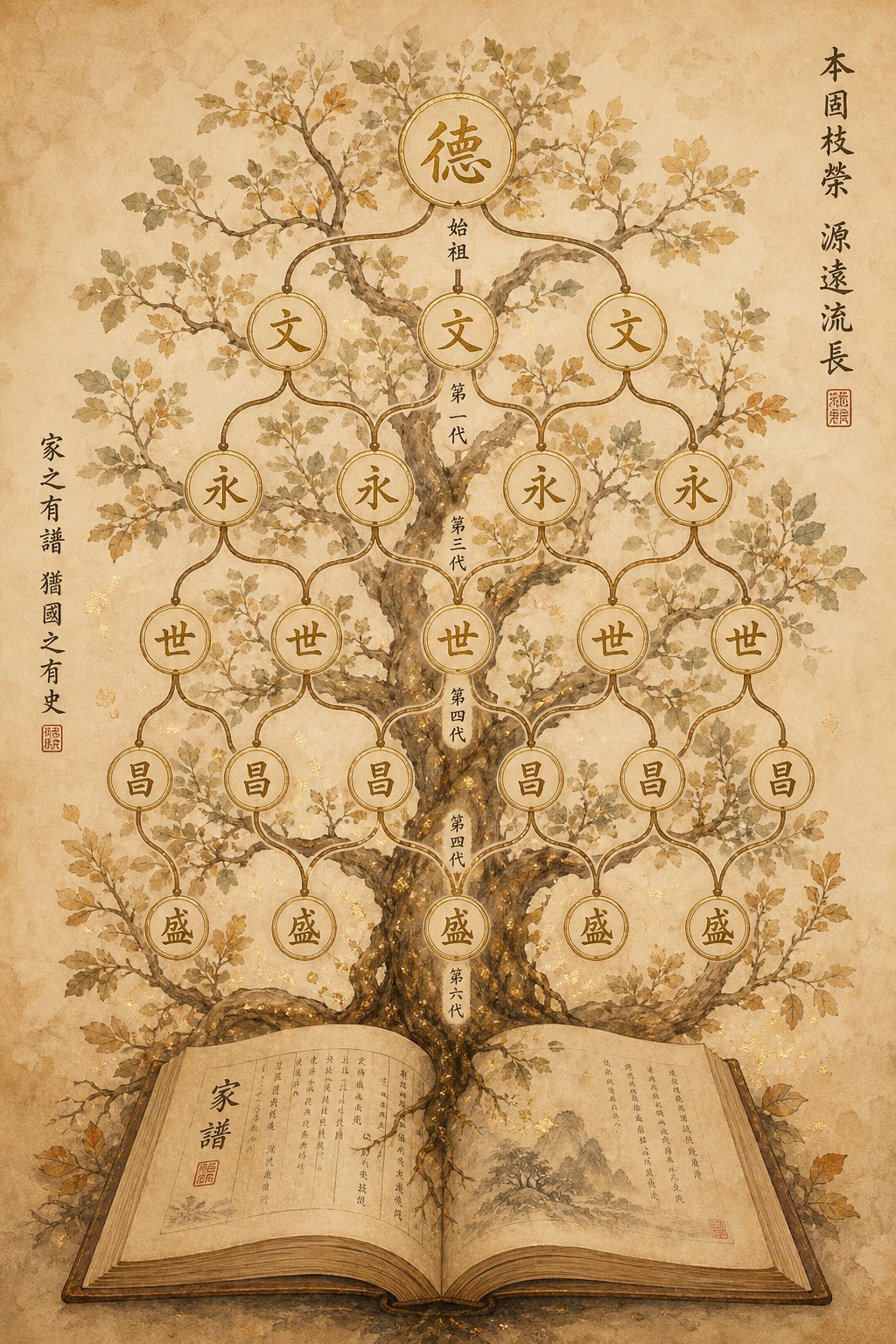
Generational Names and the Zi Bei Tradition
Long before government policy reshaped how names were spelled, clan associations shaped what characters those names contained. The zi bei (字辈) system, also called bei ming (辈名) or generational naming, is a centuries-old practice where every member of the same generation within a clan shares one specific character in their given name. It functions like a built-in family tree: just by reading someone's name, you can tell which generation they belong to and how they relate to cousins, uncles, or distant relatives they have never met.
For anyone trying to decode Singapore chinese names for male or female family members from older generations, understanding zi bei is essential. It explains why siblings and cousins often share a middle character that seems oddly uniform, and why that pattern suddenly disappears in younger family members.
How Generational Characters Were Assigned by Clans
The system works through a generational poem (字辈诗), a sequence of characters composed by clan elders and recorded in the family genealogy book (族谱, zu pu or 家谱, jia pu). Each character in the poem corresponds to one generation. When a child is born, the clan assigns the character matching their generation as one component of the given name. The other character is chosen freely by the parents.
Imagine a clan poem that includes the sequence: 伟, 志, 建, 国. The first generation uses 伟, the next uses 志, and so on. Three siblings born into the 伟 generation might be named:
| Sibling | Full Name | Generational Character | Personal Character |
|---|---|---|---|
| Eldest brother | TAN Wei Ming (陈伟明) | 伟 (Wei) | 明 (Ming) |
| Second brother | TAN Wei Liang (陈伟良) | 伟 (Wei) | 良 (Liang) |
| Youngest sister | TAN Wei Ling (陈伟玲) | 伟 (Wei) | 玲 (Ling) |
All three share "Wei" as the first character of their given name. Their cousins on the paternal side would also carry "Wei." The next generation down, their children, would all share "志" (Zhi) instead. This creates an instantly readable generational map across the entire extended family.
Historically, Hokkien and Teochew clans in Singapore practiced zi bei most rigorously, reflecting the strong clan association culture these dialect groups brought from Fujian and Guangdong provinces. Cantonese and Hakka families also followed the tradition, though with somewhat less uniformity. The practice was strongest among families who maintained active ties with their clan associations and kept updated genealogy books.
The generational character typically occupied the first position in a two-character given name, though some clans placed it second. For singapore male chinese names, the tradition was applied almost universally in families that followed it. For singaporean chinese female names, application was less consistent historically. Some clans included daughters in the generational naming system, while others reserved it for sons only, reflecting older patrilineal customs.
Why Zi Bei Naming Is Declining Today
Walk into any Singaporean university classroom and ask students whether their name contains a generational character. Associate Professor Lee Cher Leng of NUS Chinese Studies, who surveys each cohort in her undergraduate course, finds that only a small handful of students have been named according to their family's genealogy books. Most are thoroughly unfamiliar with the practice altogether.
Dr Peter Tan of NUS English, Linguistics and Theatre Studies confirmed this in a separate research project on generation names: the majority of students surveyed did not have one. He observed that modern young parents in Singapore primarily speak English and may view long-term traditions like generational naming as outdated.
Several forces have converged to push zi bei toward obsolescence:
- Smaller families: With most Singaporean couples having one or two children, the generational character has fewer carriers per generation, reducing its connective function.
- Reduced clan association influence: Clan associations that once maintained genealogy books and enforced naming conventions have seen declining membership and cultural authority among younger generations.
- Preference for unique names: Parents increasingly want their child's name to stand out rather than match a predetermined pattern. Sharing a character with dozens of cousins feels restrictive when individuality is prized.
- Shift toward meaning-based naming: As A/P Lee notes, Chinese Singaporeans have turned to naming children based on values they want them to embody, such as 智慧 (zhi hui, meaning "wisdom") for girls, rather than following lineage-based sequences.
- English-dominant households: Parents who primarily speak English may not feel connected to a Chinese-language tradition they never personally experienced.
- Westernised naming culture: The broader shift toward English first names and globally recognizable identities has displaced traditional Chinese naming frameworks.
Dr Tan suggests that some young parents may adapt the tradition in smaller ways, choosing common characters or shared initials for their children's names within the immediate family rather than following a clan-wide poem. It is a diluted echo of zi bei, personalized and voluntary rather than prescribed by elders.
The decline matters beyond nostalgia. Generational names helped dispersed family members recognize each other, kept track of lineage history, and maintained respectful relationships between generations. When everyone becomes simply "uncle" or "auntie" without a name-embedded generational marker, those connections grow harder to trace.
Still, the tradition has not vanished entirely. Some families, particularly those with strong dialect heritage, continue the practice deliberately. Mr Lim Tia Kiat, a Singaporean born in the 2000s, carries a full Hokkien dialect name because his father wanted his sons to remember their Hokkien roots and believed Chinese names carry deeper significance than English ones. Cases like his are increasingly rare, but they demonstrate that the tradition persists where families actively choose to preserve it.
With generational naming fading and dialect romanisation fragmenting across eras, the question of how parents actually choose a child's name today becomes more open-ended than ever. The answer involves a blend of metaphysical tradition and modern pragmatism that is distinctly Singaporean.
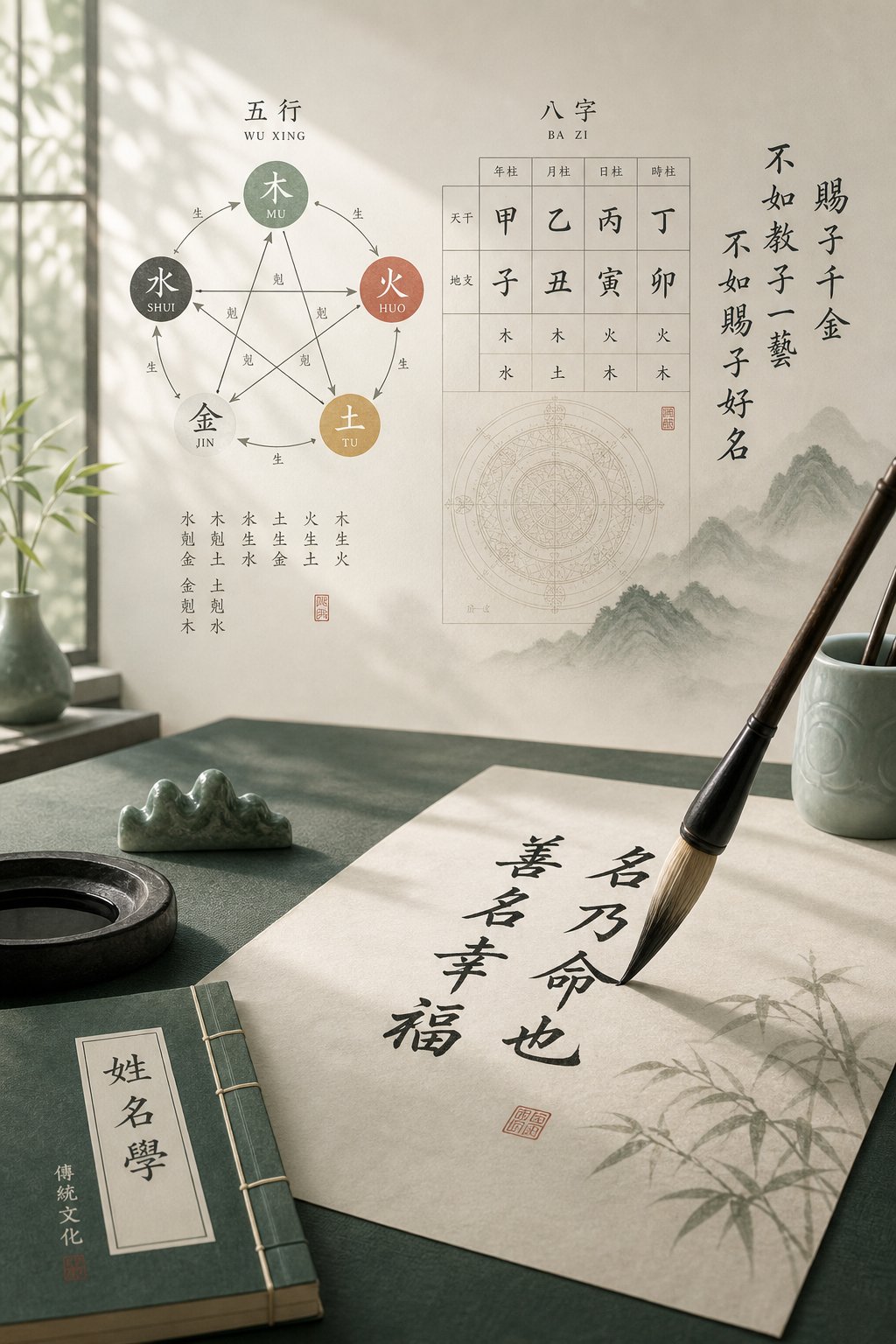
How Singaporean Parents Choose Chinese Names Today
With generational poems fading and no single romanisation standard in place, choosing a baby chinese name in Singapore has become a deeply personal process, one that often blends ancient metaphysical systems with thoroughly modern concerns. A parent today might consult a bazi chart and a baby-naming app in the same afternoon. The result is a naming culture where tradition and pragmatism coexist, sometimes harmoniously, sometimes in tension.
The old Chinese saying captures the weight many families still place on this decision: "不怕生坏命,最怕改坏名" (do not fear being born with a bad destiny, but fear being given a bad name). For parents navigating baby chinese name selection in Singapore, the process is rarely as simple as picking characters that sound pleasant. There is an entire framework of metaphysical analysis behind many of the names you encounter.
Stroke Count and Five Elements in Name Selection
Two traditional systems dominate the analytical side of Chinese name selection: stroke count numerology and five elements (wu xing) balancing.
Stroke count analysis, known as 笔画 (bi hua), assigns numerical significance to the total strokes in each character of a name. Different stroke totals correspond to different fortune patterns, and practitioners calculate multiple "grids" (格局) from the combined stroke counts of surname and given name characters. The surname is not excluded from this calculation. As Moon FengShui Consulting clarifies, the common belief that the birth surname does not affect a name's auspiciousness is a myth. The surname's stroke count directly influences the overall numerological profile.
Here is where a subtle complication arises. Simplified Chinese characters often have fewer strokes than their traditional equivalents. The character 华, for example, has 6 strokes in simplified form but 14 in traditional. Which count do you use? Most naming practitioners in Singapore follow the traditional (繁体) stroke count for numerological purposes, even though simplified characters are the standard in daily life. Parents who are unaware of this distinction may miscalculate when attempting the analysis independently.
The five elements system works differently. It draws on the child's bazi (八字), or Four Pillars of Destiny, which are derived from the birth year, month, day, and hour. Each pillar is associated with one of the five elements: Wood, Fire, Earth, Metal, and Water. A bazi analysis reveals which elements are strong, weak, or missing in the child's chart. The name then serves as a corrective tool. If a child's bazi shows a deficiency in Water, parents might select characters containing the water radical (氵) or characters whose meaning relates to water. The goal is balance, not simply loading up on the missing element.
Chinese name feng shui in Singapore often integrates both systems simultaneously. A character must satisfy stroke count requirements and element balancing while also sounding pleasant and carrying appropriate meaning. This multi-constraint puzzle is precisely why many parents turn to professionals rather than attempting it alone.
Consulting a Chinese Name Master
A chinese name master in Singapore typically holds expertise in bazi analysis, stroke count numerology, and the five elements framework. The consultation process is more structured than most first-time parents expect. Way Feng Shui's Master Goh Guan Leong, who has helped over 20,000 families with naming since 2005, represents the kind of specialist practice that has become a standard part of the newborn preparation process for many Singaporean Chinese families.
When you engage a baby chinese name master in Singapore, the typical process follows a clear sequence:
- Provide birth details: The child's exact date and time of birth are essential for generating the bazi chart. Some masters also request the parents' Chinese names to check for character conflicts or complementary energy.
- Bazi analysis: The master maps out the child's elemental composition, identifying which elements need strengthening and which are already dominant.
- Character selection: Based on the bazi reading, the master identifies characters that satisfy element requirements, produce auspicious stroke count combinations, and avoid conflicts with the surname or family naming taboos.
- Pronunciation and meaning review: Selected characters are checked for tonal harmony, unpleasant homophones, and visual balance. A name that looks good on paper but sounds awkward when spoken aloud will be discarded.
- Presentation of options: Most masters provide two to five name options for parents to choose from, explaining the reasoning behind each combination.
The cost of a professional consultation in Singapore ranges from around SGD 100 to over SGD 500, depending on the master's reputation and the depth of analysis provided. Some practitioners include follow-up adjustments if parents want modifications after seeing the initial options.
One important cultural note: in Chinese tradition, using a character that duplicates an older family member's name is considered disrespectful. A good naming master will ask about names within the extended family to avoid this conflict, something parents choosing independently might overlook.
Balancing Tradition with Modern Preferences
Not every family consults a master. Many parents choosing a chinese name for baby in Singapore take a hybrid approach, applying some traditional principles loosely while prioritizing factors that matter in a globalized, English-dominant society.
Modern considerations that increasingly influence chinese baby names in Singapore include:
- International usability: Will the romanised version of this name be easy for non-Chinese speakers to pronounce? Parents conscious of mispronouncing Chinese names as a lifelong friction point may favor characters whose romanisation maps cleanly to English phonetics.
- Cross-language sound matching: Some parents select a Chinese name whose sound echoes their child's English name, or vice versa. A child named "Rachel" might receive a Chinese name starting with a similar "R" or "L" sound.
- Character simplicity: Names with extremely complex characters (20+ strokes) can be burdensome for a child learning to write. Some parents deliberately choose visually clean characters.
- Gender clarity: While Chinese names are not strictly gendered, certain characters carry strong masculine or feminine associations. Parents may want the name to signal gender clearly, or deliberately choose neutral characters.
- Uniqueness versus recognition: Overly common names risk blending in, but overly unusual characters may be misread or mistyped throughout the child's life. The sweet spot is a name that feels distinctive without being obscure.
The tension between metaphysical optimization and practical usability is real. A character that perfectly balances a child's bazi might produce an awkward romanised spelling that foreigners will consistently mangle. A beautifully meaningful name might have an unfortunate stroke count. Parents who care about both dimensions often find themselves negotiating between what the numerology recommends and what sounds right in a bilingual society.
This is the reality of choosing chinese name in Singapore today. It is not purely traditional, nor purely modern. It is a negotiation between systems, a process where a feng shui master's recommendation meets a parent's instinct for how their child's name will sound in a Zoom meeting twenty years from now. The name that emerges from this process then enters another layer of complexity: whether to pair it with an English name, and how both names will coexist across the documents and social contexts of Singaporean life.
English Name Adoption and the Dual Identity System
A Chinese name chosen through bazi analysis and stroke count optimization is only one half of the naming picture for most Singaporean Chinese today. The other half is an English name, and the interplay between these two identities creates a layered system that confuses outsiders and occasionally trips up official paperwork. If you have ever encountered a Singaporean whose email signature reads "Emily Tan" but whose passport says "TAN Mei Ling," you have seen this dual identity system in action.
English is now the most common language spoken at home for more than half of Singaporeans. The adoption of English first names has followed that linguistic shift so thoroughly that, as Dr Peter Tan of NUS observed, nearly every Chinese newborn in recent years carries an English name alongside their Chinese one. But the practice is not new. It has simply accelerated from a minority pattern into a near-universal convention across a few decades.
When English Names Appear on Official Documents
Here is the part that catches people off guard: not all English names are official. Some appear on the NRIC and passport. Others exist only in social and professional life, never touching a government document.
When parents register a child's birth in Singapore, they can include an English name as part of the official registered name. The government-promoted format places names in this order: [Surname] [Chinese given name] [English given name]. So a girl registered as TAN Mei Ling Emily carries "Emily" as part of her legal identity. It appears on her NRIC, her passport, and every official record.
But many Chinese Singaporeans acquire their English name later, sometimes in primary school, sometimes at university, sometimes when entering the workforce. These self-chosen names never get registered. They exist purely in social circulation: on business cards, email signatures, LinkedIn profiles, and introductions. The person remains legally "TAN Mei Ling" on all government documents while being known as "Emily" to every colleague and friend.
This creates a situation where the same person legitimately goes by different names depending on context. It is not deception or inconsistency. It is simply how the system works. And it is one of the most common reasons outsiders end up mispronouncing Chinese names or addressing someone incorrectly: they see "Emily Tan" on an email and assume the full legal name matches, then encounter "TAN Mei Ling" on a formal document and wonder if they are dealing with the same person.
To illustrate how a single person's name shifts across contexts, consider this worked example for a Hokkien-heritage woman whose Chinese name is 陈美玲 and whose English name is Emily:
| Context | Name Format | Example |
|---|---|---|
| NRIC (with registered English name) | [Surname] [Chinese given name] [English name] | TAN MEI LING EMILY |
| Passport | [Surname] [Chinese given name] [English name] | TAN MEI LING EMILY |
| Business card | [English name] [Surname] or [English name] [Chinese given name] [Surname] | Emily Tan / Emily Mei Ling Tan |
| Email signature | [English name] [Surname] | Emily Tan |
| Social media | Any preferred combination | Emily Tan / Mei Ling / emilytml |
| Chinese-language contexts | [Surname][Given name] in characters | 陈美玲 |
If Emily's parents had not registered her English name at birth, the NRIC and passport would simply read "TAN MEI LING," and "Emily" would appear only in the informal contexts below. The legal name and the social name would be completely disconnected on paper.
The Social Function of English Names
Why do Chinese Singaporeans adopt English names at all? The reasons have shifted across generations. For older Singaporeans, English names often came through Christian baptism or mission school education. A woman baptized "Grace" in the 1960s carried that name as a marker of religious identity. For the generation that followed, English names became practical tools for navigating an increasingly English-dominant education system and workplace.
Today, the motivation is largely social convenience. Lim Zhi Xuan, a 29-year-old Singaporean profiled by RICE Media, adopted the English name "Shane" after years of having his Chinese name mangled by non-Chinese speakers. His Malay form teacher cycled through pronunciations from "Gee Chuan" to "Zee Shuan." When he entered an industry with international clients, he wanted a name people could say and remember without hesitation.
His experience is common. Chinese names with consonant clusters unfamiliar to English speakers, like "Xuan" or "Zhi," become friction points in daily interaction. An English name removes that friction entirely. It is a pragmatic response to the reality that mispronouncing Chinese names is not just an occasional inconvenience but a repeated social experience that shapes how people are perceived and remembered.
Gender patterns in English name adoption are worth noting. Among singapore chinese girl names, English names have become nearly universal for the younger generation. Popular choices for girls track global English-speaking trends: Sophia, Charlotte, Chloe, and Keira appear frequently in recent birth announcements. For boys, names like Jayden, Ethan, and Lucas dominate. Dr Peter Tan observed that Singapore largely follows global naming trends, with waves of popularity sweeping through, much like fashion cycles.
Among chinese female names in singapore, there is also a pattern of choosing English names that phonetically echo the Chinese name. A girl named 美雪 (Mei Xue) might become "Michelle." A boy named 明轩 (Ming Xuan) might go by "Max." This sound-bridging technique lets both names feel connected rather than arbitrary, and it makes the transition between Chinese and English contexts smoother for the person carrying them.
The generational divide is stark. Singaporeans born before the 1970s often have no English name at all, or adopted one late in life for professional reasons. Those born in the 1980s and 1990s frequently have an English name that was never officially registered. And children born after 2010? According to Dr Tan's observations, almost every single one has an English name from birth, often registered on official documents from day one.
This shift means that purely Chinese names, without any English component, are increasingly read as generational markers. A name like "Tan Boon Heng" with no English name attached immediately signals an older Singaporean to most locals. Whether that association carries positive or negative weight depends on context, but the pattern is unmistakable.
The dual identity system works smoothly in daily Singaporean life because everyone understands the convention. Problems arise at borders, in international banking, and on visa applications, where systems expect one consistent name across all documents. When "Emily Tan" books a flight but her passport reads "TAN MEI LING EMILY," airline systems may flag a mismatch. These formatting and registration questions, from hyphenation to character order, form their own layer of complexity.
Name Formatting, Hyphenation, and Official Registration
Airline check-in counters, bank compliance departments, and visa processing offices all share one thing in common: they expect your name to look exactly the same across every document. For Singaporean Chinese, that expectation collides with a system where a single given name can legitimately appear in three different written forms depending on when and where it was registered. Understanding the singapore chinese name format is not just academic. It has real consequences for travel, finance, and legal identity.
Hyphenation Formats and Their Official Implications
Take a two-character given name like 美玲. When romanised, it can appear in any of these forms:
- Mei Ling (two separate words) — the most common format among Chinese Singaporeans. The Cultural Atlas confirms this is the predominant convention in Singapore, with a space separating the two syllables of the given name.
- Mei-Ling (hyphenated) — less common in Singapore than in Taiwan or Hong Kong, but still appears on some older registrations and among families who preferred this style at the time of birth registration.
- Meiling (joined as one word) — follows the Hanyu Pinyin convention used in mainland China, where given name syllables are written together without separation. More likely to appear on names registered during the 1981-1991 pinyin mandate period.
What determines which format a person carries? It comes down to how the name was recorded at the Registry of Births and Deaths. There is no enforced national standard dictating one format over another. The registering officer wrote it one way, and that version became permanent. Some families had input; others did not. The result is that siblings born years apart might carry different formatting conventions on their birth certificates simply because a different clerk handled each registration.
On the NRIC, the romanised name appears exactly as registered, including its specific spacing or hyphenation. The passport follows the same format. This means your formatting is locked in from birth unless you go through a formal name change process. And here is where problems surface: if your NRIC reads "MEI LING" as two words, automated systems may interpret "MEI" as a middle name and "LING" as a last name, especially systems designed for Western naming conventions. International airline booking systems are notorious for this. A ticket booked as "Meiling Tan" will not match a passport reading "TAN MEI LING," and that discrepancy can trigger delays at check-in or immigration.
Banking creates similar friction. When opening accounts overseas, compliance teams compare your name against passport records character by character. A space where the system expects none, or a hyphen that does not appear in the passport, can flag identity verification failures. Singaporeans who travel frequently or hold international accounts learn to be meticulous about reproducing their name exactly as it appears on their passport, spaces and all.
For visa applications, the issue compounds. Some countries require names to be entered without spaces in the given name field. Others split given names across "first name" and "middle name" fields. A Singaporean named "TAN WEI MING" might need to enter "WEI MING" as a first name in one system and split it into "WEI" (first) and "MING" (middle) in another. Neither is wrong, but inconsistency across applications can create confusion in immigration databases.
Simplified vs Traditional Characters in Name Registration
Singapore officially uses simplified Chinese characters, the same system adopted by mainland China. NRICs display the simplified version of a person's name in Chinese characters alongside the romanised spelling. But this creates a cross-border recognition question.
In Taiwan and Hong Kong, traditional characters remain standard. A Singaporean whose NRIC shows 陈伟明 (simplified) would see the same name written as 陳偉明 in traditional characters. For most practical purposes, officials in Taiwan and Hong Kong can read both systems. But automated document-matching systems may not recognise them as identical. A Singaporean applying for a Taiwanese visa might find that their name in simplified characters does not match the traditional-character records in the Taiwanese system.
This also matters for personal items that carry your name in character form. A chinese name chop singapore, the traditional carved seal used for signing documents and artwork, can be made in either simplified or traditional characters. Many Singaporeans choose traditional characters for their name chop because the more complex strokes produce a more visually distinctive seal impression. Similarly, a chinese name stamp singapore ordered for calligraphy or formal correspondence often uses traditional forms for aesthetic reasons, even though the owner's official documents show simplified characters. A chinese name seal singapore serves both functional and cultural purposes, connecting the bearer to a centuries-old tradition of personal authentication through carved stone or wood.
For parents registering a newborn, the character system question is straightforward: Singapore uses simplified, and that is what appears on the birth certificate and NRIC. But families who maintain genealogy books or communicate with relatives in Taiwan and Hong Kong should be aware that the same name looks different in each system, and both versions are legitimate representations of the same identity.
Changing Your Chinese Name Officially
Sometimes the formatting issue, or the name itself, becomes enough of a problem that a person decides to change it. Maybe the romanisation causes constant mispronouncing of their Chinese name in professional settings. Maybe a feng shui consultation suggested different characters for better fortune. Maybe they simply want to add an English name that was never registered at birth. Whatever the reason, the process to change chinese name in Singapore follows a specific legal pathway.
To legally change your name in Singapore, you need a deed poll. This is a legal document drafted by a lawyer declaring that you renounce your current name and adopt a new one. The deed poll must be executed (signed) in the lawyer's physical presence, as they need to verify your identity. It cannot be done remotely.
What can you change? The scope is broad:
- Change the romanised spelling of your surname (for example, switching from dialect romanisation to pinyin, or vice versa)
- Change your given name characters entirely
- Add an English name that was not registered at birth
- Modify the formatting of your given name (changing "Mei Ling" to "Meiling," for instance)
- Remove or replace characters for personal, religious, or feng shui reasons
A standard deed poll costs around SGD 50 to SGD 100. Complex cases involving multiple changes may run up to SGD 200. After executing the deed poll, you must apply to ICA to update your NRIC within 28 days, which carries an additional SGD 60 application fee. A new passport reflecting the changed name costs SGD 70 online or SGD 80 over the counter.
There are limits. ICA may reject names that are offensive, vulgar, resemble famous politicians' names, or contain honorary titles like "Sir" or "Datuk." For anyone under 21, both parents generally must consent to the change. In divorce situations, the parent seeking the change should obtain consent from the other parent to avoid complications.
One important detail: a deed poll does not alter your birth certificate or marriage certificate. Those documents remain as originally issued. Your new name exists only on documents updated after the deed poll, which means your academic certificates, insurance policies, and bank accounts all need separate updates with each institution.
There is no restriction on how many times you can singapore change chinese name. Some people change names multiple times across their life, whether for marriage, religious conversion, or successive feng shui consultations. Each change requires a new deed poll and a fresh round of document updates.
For Singaporeans living overseas, a deed poll can be executed with a foreign lawyer, and NRIC updates can be submitted online through ICA's portal. Passport changes require contacting the Singapore embassy in your country of residence.
The practical reality is that name changes, while legally straightforward, create a documentation trail that follows you. Old records under your previous name do not disappear. Academic transcripts, employment records, and property titles may still carry the former version. Keeping a certified copy of your deed poll accessible is essential for bridging these identity gaps when they surface years later.
All of these formatting and registration details matter most in one specific context: when someone else needs to use your name correctly. Whether that is a colleague writing an email, a client preparing a contract, or a new acquaintance at a networking event, the question of how to address a Singaporean Chinese person properly brings its own set of conventions and common pitfalls.

Professional Etiquette for Using Singaporean Chinese Names
Knowing the structure, history, and formatting of Singaporean Chinese names is one thing. Using them correctly in a live professional interaction is another. Expatriates and international business contacts working with Singaporean colleagues often stumble not because they lack respect, but because the naming system offers few obvious clues to someone trained on Western conventions. A three-word name with no capitalisation, no hyphen, and no familiar English sound leaves you guessing which part is the surname, which is the given name, and what you should actually say out loud.
The good news: Singaporeans are thoroughly accustomed to this confusion and will rarely take offense at a polite question. But getting it right without asking signals cultural competence, and in business relationships, that matters.
Business and Email Addressing Conventions
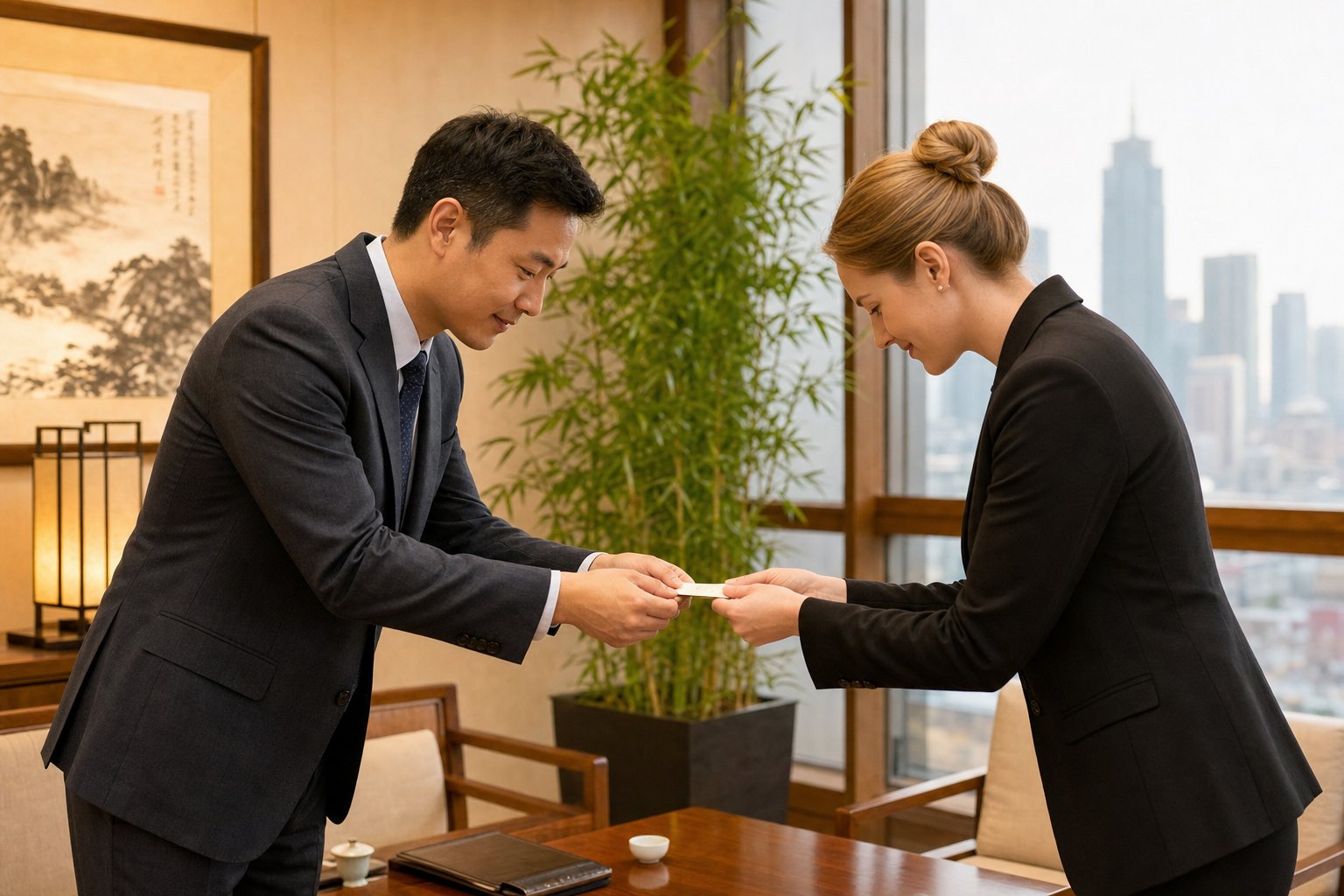
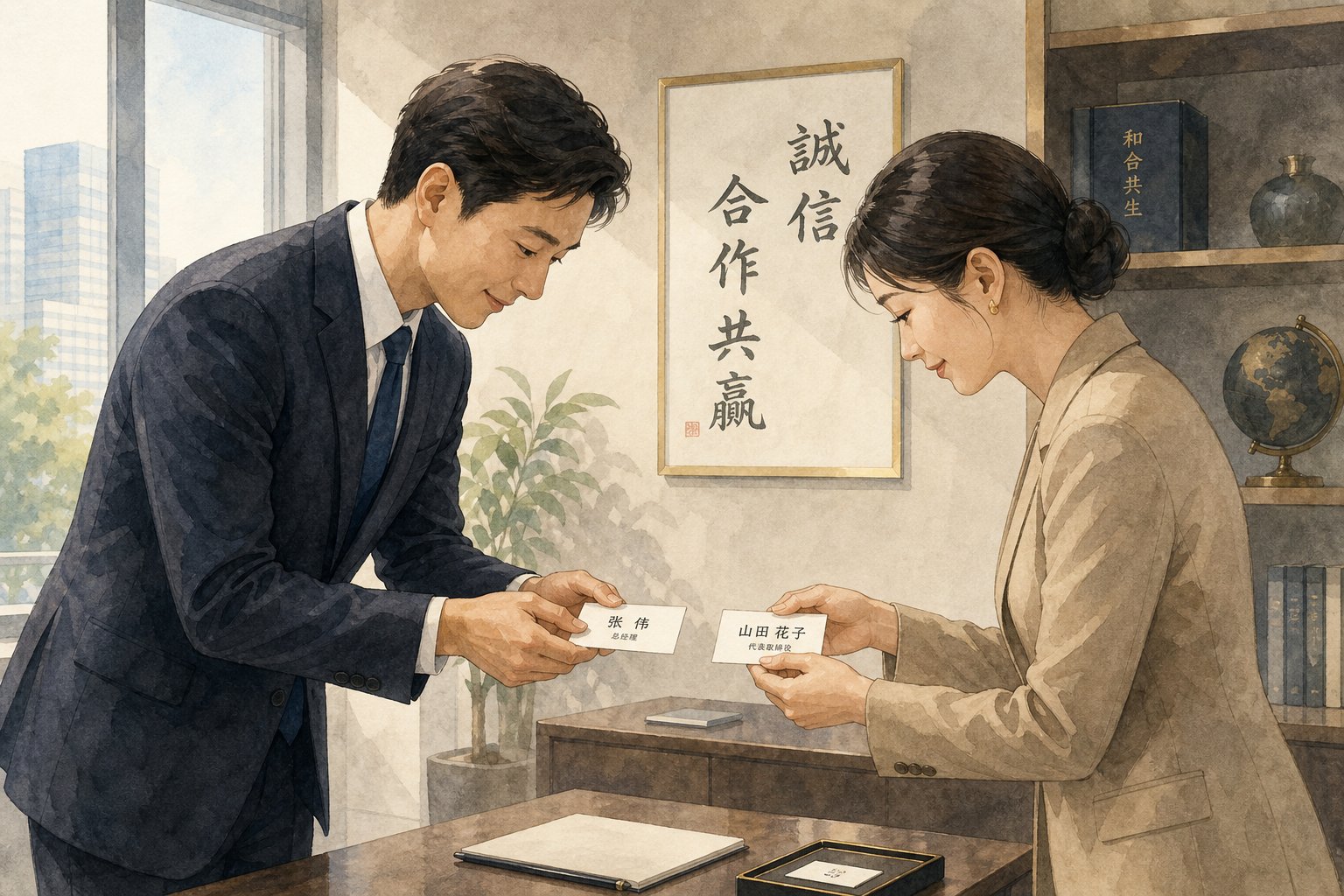
On a Singaporean business card, you will often find the surname written in capital letters: TAN Mei Ling, or LIM Wei Jie. This capitalisation convention exists precisely to help recipients identify the family name. When you receive a card formatted this way, the capitalised word is the surname. Address that person as "Ms Tan" or "Mr Lim" in formal correspondence.
If the card includes an English name, like "Emily TAN Mei Ling" or "TAN Mei Ling, Emily," that English name is your safest casual address. In email, "Hi Emily" works for most professional contexts. It is neither too formal nor too intimate. Many Chinese Singaporeans prefer their English name in educational and commercial settings because it is convenient and avoids the friction of repeated mispronunciation.
For formal emails, especially first contact, use the surname with a title: "Dear Ms Tan" or "Dear Mr Lim." Never address someone by their Chinese given name alone. In Singaporean Chinese culture, using only the given name (the personal characters, like "Mei Ling" without the surname) is reserved for family members, spouses, and very close friends. Doing so with a business contact feels overly intimate and can create awkwardness.
When in doubt, use the English name casually or the surname with a title formally. Never use the Chinese given name alone unless explicitly invited to do so.
What about people who have no English name on their card? This is common among older professionals and senior executives. In that case, use their full name or surname plus title. "Mr Tan Wei Ming" or simply "Mr Tan" are both appropriate. Some Singaporeans also go by their full Chinese name socially, like "Wei Ming," but wait for them to offer that before using it yourself.
Common Mistakes When Addressing Singaporean Chinese Names
International professionals make a handful of predictable errors. Most stem from applying Western naming logic to a system that does not follow it.
The most frequent mistake: assuming the last word in a name is the surname. In Western convention, "Tan Mei Ling" would make "Ling" the family name. In Chinese convention, "Tan" is the surname. If you address this person as "Ms Ling," you have used part of her personal name as a title, which is incorrect and confusing. This error is especially common with popular chinese names female singapore professionals carry, like "Lim Xin Yi" or "Ng Shu Ting," where the final syllable sounds plausibly like a Western surname.
Another common error: splitting a two-character given name and treating the first character as a middle name. "TAN Mei Ling" is not "Mei" (middle) and "Ling" (first). Both characters together form the given name. There is no middle name in the Western sense.
A third pitfall involves dialect surnames that look like English words or given names. "Ong," "Goh," "Sim," and "Seah" do not resemble typical Western surnames, so foreigners sometimes skip over them and latch onto the next word as the family name. If you see a name like "Goh Siew Tin," "Goh" is the surname, not a given name.
Here is a step-by-step approach for international professionals encountering an unfamiliar Singaporean Chinese name:
- Check for capitalisation. If one element is in all caps on a business card, document, or email signature, that is the surname.
- Apply the single-syllable rule. The vast majority of Chinese surnames are one syllable. In a three-syllable name like "Tan Wei Ming," the single opening syllable is almost certainly the family name.
- Look for known dialect surnames. Familiarise yourself with common Singaporean surnames: Tan, Lim, Ng, Ong, Goh, Teo, Koh, Chua, Sim, Seah, Yeo, Kwek. If the first word matches one of these, it is the surname.
- Check for an English name. If the name includes a recognisably Western name like "David" or "Rachel," that is the English given name, not the surname. The Chinese surname is the other single-syllable element.
- When uncertain, ask. A simple "How would you like me to address you?" is perfectly acceptable and appreciated. Singaporeans ask each other this routinely.
One final note on pronunciation. If you are unsure how to say a dialect-romanised name, ask the person directly. A name like "Ng" has no English equivalent sound (it is a nasalised syllable), and guessing will almost certainly produce something unrecognisable. Asking "Could you help me with the pronunciation of your name?" is far better than repeatedly mangling it in meetings. Most Singaporeans will either coach you through the correct sound or offer their English name as an alternative, whichever feels easier for the interaction.
Getting names right is not about memorising every dialect romanisation or mastering tonal pronunciation. It is about knowing where to look for the surname, which name to use in which context, and having the awareness to ask when the system does not give you obvious answers. In a city where the same person can legitimately appear as three different spellings across three different documents, that awareness is the most respectful thing you can bring to any professional relationship.
Frequently Asked Questions About Singaporean Chinese Names
1. Why do Singaporean Chinese names have so many different spellings?
Singapore's Chinese community comprises five major dialect groups: Hokkien, Teochew, Cantonese, Hakka, and Hainanese. Each group pronounces the same Chinese character differently. When British colonial administrators romanised these names, they wrote what they heard in each dialect. This is why the surname character 陈 appears as Tan (Hokkien), Chan (Cantonese), Chin (Hakka), or Chen (Mandarin pinyin) depending on the family's dialect heritage. None of these are misspellings; each is a legitimate phonetic transcription from a different Chinese language variety.
2. How do I identify which part of a Singaporean Chinese name is the surname?
In Chinese naming convention, the surname always comes first. For a three-syllable name like Tan Wei Ming, the first single syllable (Tan) is the family name. On business cards and formal documents, the surname is often written in capital letters to help readers distinguish it. If you are unsure, look for common Singaporean dialect surnames such as Tan, Lim, Ng, Ong, Goh, Teo, Chua, or Seah at the beginning of the name. When still uncertain, asking the person directly is perfectly acceptable in Singaporean professional culture.
3. Why do some Singaporean family members spell the same surname differently?
This generational split traces back to the 1981 Speak Mandarin Campaign policy, which required school children to use Hanyu Pinyin for their names. A grandfather registered in the 1950s might spell his surname as Tan (Hokkien romanisation), while his grandchild born during the 1981-1991 pinyin mandate period could be registered as Chen (Mandarin pinyin). After 1992, the policy was reversed, creating hybrid forms where dialect surnames pair with pinyin given names. Each spelling reflects the registration norms of its era rather than any error or inconsistency.
4. How should I address a Singaporean Chinese colleague in a professional setting?
For formal communication, use the surname with a title such as Ms Tan or Mr Lim. For casual interactions, use their English name if one is provided on their business card or email signature. Avoid using only the Chinese given name (like Mei Ling without the surname), as this level of familiarity is reserved for close friends and family in Chinese culture. If the person has no English name, use their full name or surname with a title. When unsure about pronunciation, asking them directly is considered respectful rather than rude.
5. What is the difference between a registered English name and a social English name in Singapore?
A registered English name is included in the official birth registration and appears on the NRIC and passport, typically formatted as Surname + Chinese given name + English name (e.g., TAN MEI LING EMILY). A social English name is self-chosen later in life and never appears on government documents. The person remains legally known by their Chinese name only, while using the English name in workplaces, emails, and social settings. Both types are common, and many Singaporeans carry social English names that have no official documentation.