The Chinese Character for Moon 月 at a Glance
When you first encounter the moon Chinese character, something clicks almost immediately. The character 月 looks like a crescent moon, and that visual resemblance is no accident. It is one of the oldest pictographs still in active use, carrying thousands of years of meaning in just four simple strokes.
月 (yuè) is the Chinese character for moon. It is pronounced in the fourth tone and carries two core meanings: "moon" and "month." The character visually represents a crescent moon shape, making it one of the most recognizable symbols in the Chinese writing system.
What Is the Chinese Character for Moon
The moon in Chinese is written as 月. This single character functions as both a standalone word and one of the most productive building blocks in the entire language. You will find it inside dozens of other characters, lending its meaning to words related to time, light, and even the human body.
The 月 meaning in English is straightforward on the surface: moon or month. But beneath that simplicity lies a fascinating story. The character connects celestial observation to everyday timekeeping, a link rooted in the ancient Chinese lunar calendar where one full cycle of the moon equals one month. This dual identity makes 月 far more than a pretty symbol. It is a window into how Chinese speakers have understood the natural world for millennia.
How to Pronounce 月 Yuè
Pronouncing the moon in Mandarin requires attention to tone. The pinyin is yuè, spoken with a falling fourth tone. Imagine your voice dropping sharply, like giving a firm command. The vowel sound sits between the English "you" and "eh," blending into a single smooth syllable.
A few tips to get it right:
- Start with your lips rounded, as if saying "you"
- Transition quickly into an "eh" sound
- Let your pitch fall decisively from high to low
The yue Chinese pronunciation trips up many beginners because English has no direct equivalent. Practice pairing it with familiar compounds like 月亮 (yuèliang, meaning "moon") to build muscle memory. Once you nail the tone, you will recognize it everywhere in spoken Mandarin, from calendar dates to poetry.
What makes this moon chinese character truly remarkable, though, is not just how it sounds or what it means today. Its story stretches back over three thousand years to the earliest known Chinese writing, where ancient scribes carved a tiny crescent into oracle bones and gave the night sky a permanent place in their language.
The Ancient Origins and Evolution of 月
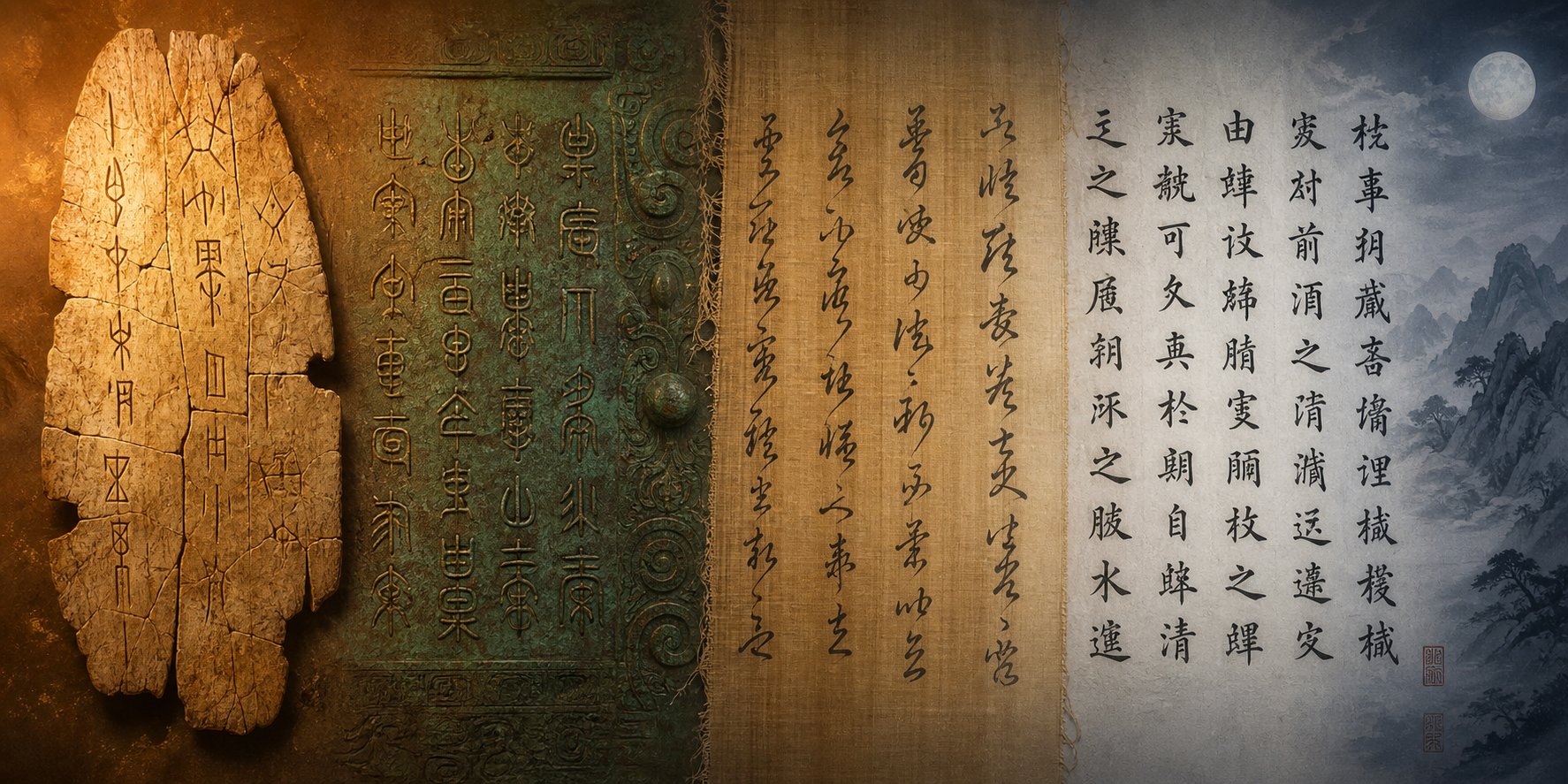
That crescent shape you see in the modern chinese character for moon is not a design choice made by calligraphers centuries ago. It is a direct inheritance from the Shang Dynasty, when scribes carved pictographs into animal bones and turtle shells over three thousand years ago. The yue chinese character has one of the clearest visual lineages in the entire writing system, and tracing it back reveals just how literal early Chinese writing really was.
Oracle Bone Origins of 月
Oracle bone inscriptions, known as 甲骨文 (jiǎgǔwén), represent the earliest confirmed body of Chinese writing, dating from roughly 1600 to 1100 BC. Researchers at institutions like Rutgers University note that the maturity of this archaic script suggests even earlier writing remains undiscovered. In oracle bone form, 月 was drawn as a literal crescent moon, sometimes with a small dot or line inside to distinguish it from the sun character 日.
Of the over 4,500 oracle bone characters identified so far, only about 1,600 have been fully deciphered. But 月 is among the most confidently understood, precisely because its pictographic origin is so transparent. When you look at random chinese characters from oracle bone inscriptions, many feel abstract and mysterious. The moon stands apart because its meaning is visually self-evident across every historical period.
How 月 Evolved Through Script Styles
The chinese characters moon learners study today went through several transformations, each shaped by the writing tools and materials of its era. Here are the major stages:
- Oracle Bone Script (甲骨文, 1600-1100 BC) — A thin, angular crescent carved with a stylus into bone or shell. The shape closely mimics an actual crescent moon.
- Bronze Inscriptions (金文, 1400-700 BC) — Cast into bronze vessels, the strokes became thicker and rounder. The crescent shape remained recognizable but gained a more solid, decorative quality.
- Seal Script (篆书, 221 BC onward) — Under Qin Shi Huang's standardization, the character took on uniform, elongated strokes with balanced symmetry. The crescent outline softened into smoother curves.
- Clerical Script (隶书, 200 BC onward) — Rapid, flowing strokes replaced the rigid seal forms. The character began flattening into a more rectangular shape, losing some of its curved pictographic quality.
- Regular Script (楷书, Han Dynasty to present) — The form we write today. The crescent is now abstracted into a rectangular frame with two inner horizontal strokes, but the open bottom still echoes that original lunar silhouette.
Understanding this progression does more than satisfy curiosity. It gives you a memorization anchor. Even in its modern form, 月 retains the DNA of that ancient crescent. The two short strokes inside can be imagined as the shadowed surface of the moon, while the open base suggests the curve of its lower edge.
This visual logic also helps when you encounter random chinese characters containing 月 as a component. Recognizing the moon radical inside unfamiliar compounds becomes intuitive once you understand what it originally depicted. And as you will see, 月 appears inside far more characters than you might expect, sometimes carrying meanings that have nothing to do with the night sky.
How to Write 月 Correctly Stroke by Stroke
Knowing the history behind the chinese symbol for moon is one thing. Putting brush to paper (or pen to notebook) and writing it correctly is another. The good news is that 月 uses only four strokes, making it one of the most beginner-friendly characters in the language. But those four strokes need to land in the right order, with the right proportions, or the character will look off.
Step-by-Step Stroke Order for 月
When learning how to write moon in Chinese, stroke order matters. Chinese characters follow strict sequencing rules that affect both legibility and writing flow. Here is the correct sequence for 月:
- Left downward stroke (撇, piě) — Start near the top-left and sweep downward to the left with a slight curve. This stroke forms the left side of the character and tapers to a point at the bottom. Think of it as the outer edge of the crescent.
- Horizontal-turning-hook (横折钩, héng zhé gōu) — Begin at the top where the first stroke started, draw a short horizontal line to the right, then turn sharply downward along the right side. At the bottom, add a small inward hook. This single continuous stroke creates the top and right side of the frame.
- First inner horizontal (横, héng) — Draw a short horizontal line inside the frame, connecting the left wall to the right wall. Position it roughly one-third down from the top.
- Second inner horizontal (横, héng) — Draw another short horizontal line below the first, positioned about two-thirds down. This creates the second internal division.
The result is an open-bottomed rectangular frame with two horizontal bars inside. According to Hanzi Stroke, 月 is classified as a single-body structure with exactly four strokes, and it appears as early as HSK Level 1.
Common Mistakes When Writing 月
Even a four-stroke character can go wrong in subtle ways. Here are the pitfalls to watch for when practicing moon in chinese writing:
- Closing the bottom. This is the most frequent error. The bottom of 月 stays open. If you connect the left stroke to the right stroke at the base, you have accidentally written 目 (eye) or something unrecognizable. Leave a clear gap.
- Making the frame too angular. The left stroke (撇) should have a gentle curve, not a rigid straight line. A stiff left side makes the character look mechanical and loses the organic quality that echoes its crescent moon origins.
- Inner strokes touching the left wall. The two horizontal lines inside should connect to the right vertical stroke but only touch or nearly touch the left curved stroke. Extending them too firmly into the left side creates a cramped appearance.
- Uneven spacing. The two inner horizontals should divide the interior into roughly three equal sections. If they cluster together or sit too high, the character loses its balanced proportions.
A helpful mental image: imagine the character as a small window with two shelves inside, open at the bottom to let air through. Keep the width slightly narrower than the height, roughly a 3:4 ratio, and let the left stroke extend just a touch below the right hook.
With the physical form mastered, a natural question follows. Why does this single four-stroke character pull double duty as both "moon" and "month"? The answer is not arbitrary. It is built into the very calendar system that shaped Chinese civilization.
Moon and Month The Dual Meaning of 月
Here is a question that trips up nearly every beginner: if 月 means "moon," why does it also mean "month"? It seems like two unrelated concepts sharing one character by coincidence. But it is not a coincidence at all. The yue meaning in Chinese carries both senses because, for thousands of years, the moon literally was the calendar.
Why 月 Means Both Moon and Month
Imagine living in ancient China without clocks, printed calendars, or smartphones. How do you track the passage of time beyond a single day? You look up. The moon offered the most reliable, visible cycle available to early civilizations. It waxes from a sliver to a full disc, then wanes back to darkness, completing one full cycle in approximately 29.5 days. That cycle became the basis for one "month."
So what does yue mean at its core? It means one complete lunar cycle. The word for the celestial body and the word for the time period it measures are the same because, in the Chinese understanding of time, they were never separate concepts to begin with. The moon does not merely represent a month. It defines one.
This is not a quirk unique to Chinese. English itself hides the same logic in plain sight. The word "month" derives from "moon" through Old English "mona." But where English eventually split these into distinct words, Chinese preserved the unity. One character, one concept: the moon's cycle is the month.
The Lunar Calendar Connection
The Chinese calendar is a lunisolar system, meaning it uses both the moon and the sun to mark time. Each month begins with a new moon and runs until the next new moon appears. A standard year contains twelve of these lunar months, totaling roughly 354 days. To stay aligned with the solar year and the seasons, a thirteenth intercalary month is added approximately every three years.
This system shaped Chinese agriculture, festivals, and daily life for millennia. The yue meaning chinese speakers internalize from childhood is inseparable from this calendar structure. When someone says 三月 (sānyuè), they are literally saying "third moon" — the third time the moon has completed its cycle since the year began.
The pattern is beautifully simple. Every month in Chinese is just a number plus 月:
| Chinese | Pinyin | Literal Meaning | English Equivalent |
|---|---|---|---|
| 一月 | yīyuè | First moon | January |
| 二月 | èryuè | Second moon | February |
| 三月 | sānyuè | Third moon | March |
| 四月 | sìyuè | Fourth moon | April |
| 五月 | wǔyuè | Fifth moon | May |
| 六月 | liùyuè | Sixth moon | June |
| 七月 | qīyuè | Seventh moon | July |
| 八月 | bāyuè | Eighth moon | August |
| 九月 | jiǔyuè | Ninth moon | September |
| 十月 | shíyuè | Tenth moon | October |
| 十一月 | shíyīyuè | Eleventh moon | November |
| 十二月 | shí'èryuè | Twelfth moon | December |
Notice how there are no arbitrary names to memorize. No "January" derived from a Roman god, no "August" honoring an emperor. The yue chinese meaning stays transparent: count the moons, and you know the month. For learners, this is a gift. Once you know the numbers one through twelve and the character 月, you can read and say every month of the year.
The yue in chinese also appears in the traditional calendar's more poetic month names. Historically, months carried phenological nicknames tied to nature — "apricot month" for the second moon, "lotus month" for the sixth. But the numerical system using 月 became standard precisely because of its clarity and elegance.
This dual identity of 月 reveals something deeper about how Chinese encodes knowledge. The language does not separate observation from measurement. The moon is not just something beautiful in the sky. It is a unit of time, a calendar page, a rhythm that governs planting seasons and festival dates. Every time you write or read 月, you are touching a system where astronomy and daily life were never pulled apart.
That tight bond between 月 and the structure of time also explains why this character became one of the most productive radicals in the entire writing system. It lends its shape to dozens of other characters, but not always with the meaning you would expect. In some cases, what looks like the moon radical is actually something else entirely.
Understanding 月 as a Radical and Its Hidden Twin
You have learned that 月 means moon and month. You know how to write it and why it carries dual meaning. But here is where things get genuinely strange. Open any Chinese dictionary, look up characters containing the 月 shape, and you will find words for "liver," "brain," "leg," and "stomach." What do body parts have to do with the moon?
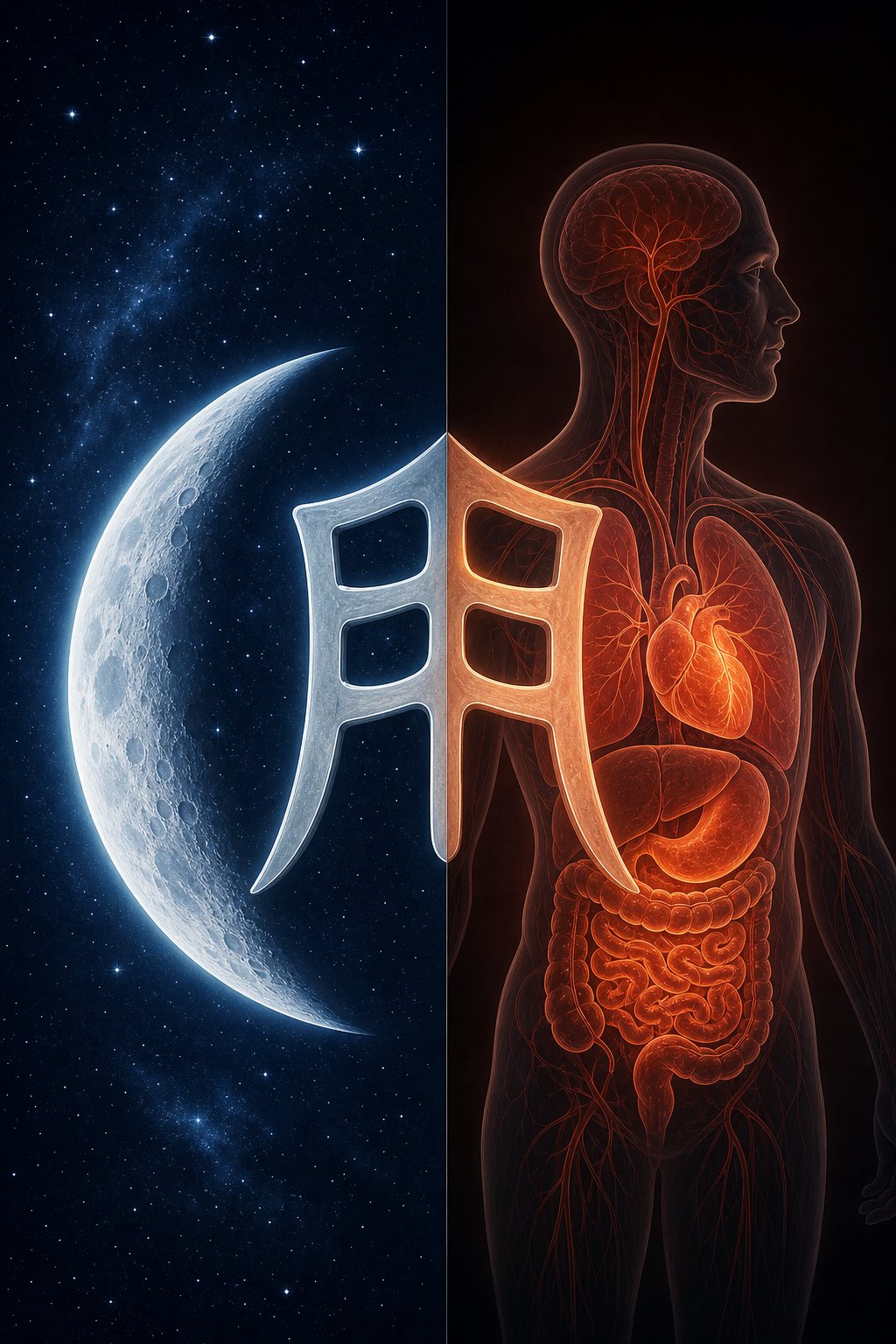
The answer: nothing. That 月 shape hiding inside body-related characters is not actually the moon at all. It is a completely different radical wearing the same disguise.
月 as a Radical in Chinese Characters
A radical in Chinese is a recurring component that gives a character part of its meaning. The moon chinese symbol 月 is one of the most productive radicals in the language, appearing in well over 50 commonly used characters. When you spot it inside a compound character, it typically signals one of three semantic categories: time, light, or the human body.
But wait. Time and light connect logically to the moon. The body does not. This is where the hidden twin enters the picture, and where most learners (and even some textbooks) get confused.
The moon radical is formally called 月字旁 (yuè zì páng). Characters built with the true moon radical relate to celestial observation, time periods, or brightness. Think of 明 (míng, bright — sun plus moon), 期 (qī, period of time), 朗 (lǎng, clear and bright), and 朝 (cháo/zhāo, dynasty or morning). These make intuitive sense. The moon governs time cycles and produces light, so characters in its family carry those associations.
Among cool chinese characters that learners encounter early, 明 is a favorite. It combines 日 (sun) with 月 (moon) to create "bright" — a poetic logic that feels almost too elegant to be real. The chinese symbol for sun and the moon symbol working together to express brightness is a perfect example of how radicals build meaning visually.
Moon Radical vs Flesh Radical Explained
Here is the twist that confuses everyone. There is a second radical that looks identical to 月 in modern Chinese but carries a completely different meaning. It is called 肉月旁 (ròu yuè páng), the "flesh-moon" radical, and it derives from the character 肉 (ròu, meat or flesh).
In ancient script forms, 肉 and 月 looked quite different. But as Chinese writing evolved through clerical and regular script, the simplified form of 肉 when used as a radical component gradually merged visually with 月. Today, they are indistinguishable in appearance — both render as the same four-stroke shape. Only context and etymology reveal which one you are actually looking at.
The practical rule is straightforward. According to Daily Zhongwen, characters with the 月 radical fall into three main groups:
- Most characters — relate to flesh, organs, limbs, and the body (the 肉 radical disguised as 月)
- A smaller group — relate to the actual moon, time, or light
- A very small group — derive from 舟 (boat) mistakenly written as 月 over centuries, such as 服 (fú, clothing/to serve) and 朕 (zhèn, the imperial "I")
When 月 appears on the left side or bottom of a character, it almost always represents flesh rather than the moon. Characters like 肝 (liver), 脑 (brain), 脸 (face), 腿 (leg), and 胃 (stomach) all use the flesh radical. The flesh-moon radical generates an enormous family of body-related vocabulary — far larger than the true moon family.
Here is a taxonomy that sorts common characters by their actual radical origin:
| Category | Character | Pinyin | Meaning | Actual Radical |
|---|---|---|---|---|
| Body (external) | 脸 | liǎn | face | Flesh 肉 |
| Body (external) | 脚 | jiǎo | foot | Flesh 肉 |
| Body (external) | 腿 | tuǐ | leg | Flesh 肉 |
| Body (external) | 胳膊 | gēbó | arm | Flesh 肉 |
| Body (external) | 肤 | fū | skin | Flesh 肉 |
| Body (internal) | 肝 | gān | liver | Flesh 肉 |
| Body (internal) | 脑 | nǎo | brain | Flesh 肉 |
| Body (internal) | 胃 | wèi | stomach | Flesh 肉 |
| Body (internal) | 肺 | fèi | lung | Flesh 肉 |
| Body (internal) | 脾 | pí | spleen | Flesh 肉 |
| Body (quality) | 胖 | pàng | fat/plump | Flesh 肉 |
| Body (quality) | 肥 | féi | fatty/fertile | Flesh 肉 |
| Time-related | 期 | qī | period/phase | Moon 月 |
| Time-related | 朝 | cháo/zhāo | dynasty/morning | Moon 月 |
| Time-related | 望 | wàng | gaze/hope (full moon day) | Moon 月 |
| Light-related | 明 | míng | bright | Moon 月 |
| Light-related | 朗 | lǎng | clear/bright | Moon 月 |
| Boat-derived | 服 | fú | clothing/to serve | Boat 舟 |
| Boat-derived | 朕 | zhèn | imperial "I" | Boat 舟 |
Sounds complex? A simple mnemonic helps. If the character describes something you could touch on a human body, the 月 inside it means flesh. If the character relates to time, brightness, or the sky, it is the real moon. And if it involves clothing or royalty, you might be looking at a disguised boat.
This distinction matters beyond trivia. When you encounter cool chinese symbols in the wild and try to guess their meaning from components, knowing whether that 月 shape signals "body" or "moon" gives you a genuine head start. A character with the flesh radical on the left and an unfamiliar phonetic component on the right? It probably names a body part or physical quality. A character with 月 contributing to a meaning about time or luminosity? That is the real moon doing its work.
The sheer productivity of this radical — in both its moon and flesh identities — means you will encounter it constantly as your vocabulary grows. And many of the most useful everyday words in Chinese are compounds built directly from 月 in its true lunar sense.
Common Words and Phrases Built with 月
Knowing that 月 powers dozens of characters as a radical is useful for recognition. But the real payoff comes when you see how it combines with other characters to form everyday vocabulary. If someone asks you how to say moon in Chinese, the single character 月 works in formal or literary contexts. In casual conversation, though, you will almost always hear a compound word instead.
The chinese word for moon in daily speech is 月亮 (yuèliang), not just 月 alone. This pattern repeats across the language. Chinese builds specificity by pairing characters together, and 月 is one of the most versatile partners available.
Essential Compound Words with 月
The following table covers the most important compounds you will encounter when studying the moon in chinese language. Each entry includes the characters, pronunciation, meaning, and a note on where and how you would actually use it.
| Character | Pinyin | Meaning | Usage Context |
|---|---|---|---|
| 月亮 | yuèliang | moon (colloquial) | Everyday conversation. "今晚的月亮真圆" (The moon is really round tonight.) |
| 月光 | yuèguāng | moonlight | Descriptive and literary contexts. Used in poetry, song titles, and romantic settings. |
| 月饼 | yuèbǐng | mooncake | Mid-Autumn Festival food. "你中秋节吃月饼了吗?" (Did you eat mooncakes for Mid-Autumn?) |
| 月份 | yuèfèn | month (as a unit) | Formal or written contexts when specifying which month. "请填写月份" (Please fill in the month.) |
| 岁月 | suìyuè | years / passage of time | Reflective or literary tone. Expresses nostalgia or the weight of time passing. |
| 明月 | míngyuè | bright moon | Classical poetry and formal writing. Rarely used in casual speech. |
| 新月 | xīnyuè | new moon / crescent moon | Astronomy, calendar references, and poetic descriptions of a thin crescent. |
| 满月 | mǎnyuè | full moon | Astronomy and festivals. Also means a baby's one-month birthday celebration. |
| 月初 | yuèchū | beginning of the month | Scheduling and business. "月初开会" (Meeting at the beginning of the month.) |
| 月底 | yuèdǐ | end of the month | Deadlines and finance. "工资月底发" (Salary paid at month's end.) |
Moon Vocabulary for Everyday Chinese
A few patterns emerge from this list that help with memorization. Notice how the chinese for moon splits into two registers:
- Spoken/casual: 月亮 is what people actually say when pointing at the sky. The added 亮 (bright) makes the word feel complete in conversation.
- Written/literary: 明月 appears in poetry and formal prose. You would not say it to a friend, but you will read it constantly in classical texts.
The time-related compounds follow their own logic. 月份 specifies "month" as a calendar unit, while 岁月 zooms out to mean years or an era. The character 岁 (suì, year/age) paired with 月 creates a word that captures the slow accumulation of time — something closer to "the passing years" in English.
Then there is 满月 (mǎnyuè), which carries a double life. Astronomically, it means full moon. Culturally, it refers to a baby reaching one month old, an occasion celebrated with a family banquet in Chinese tradition. How do you say moon in Chinese when toasting a newborn? You say 满月, and everyone at the table understands both the lunar and the familial meaning at once.
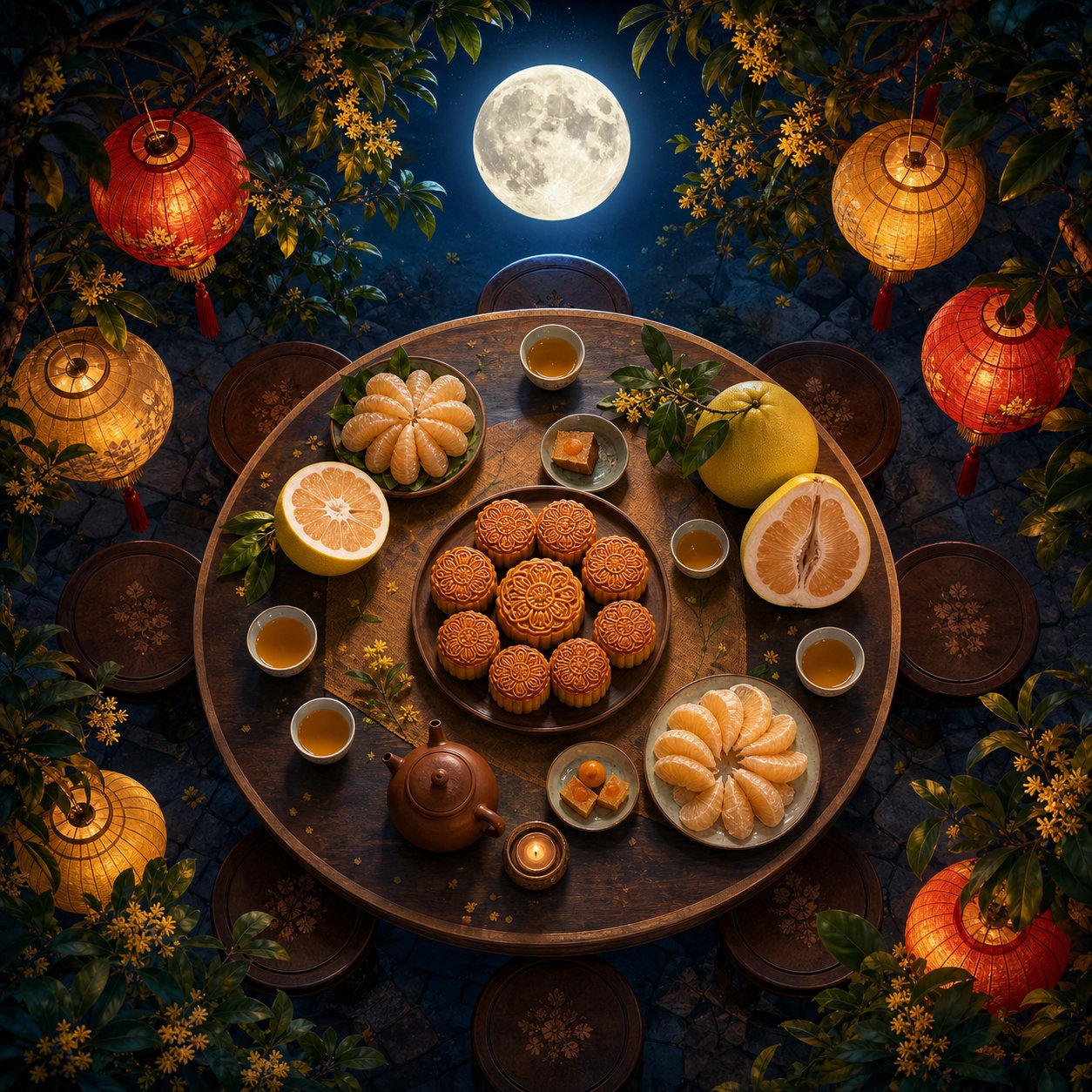
The compound 月饼 (yuèbǐng) deserves special attention. Literally "moon cake," it is the iconic food of the Mid-Autumn Festival. The round shape of a mooncake mirrors the full moon, symbolizing completeness and family reunion. You will hear phrases like 吃月饼 (eat mooncakes) and 送月饼 (gift mooncakes) every autumn across Chinese-speaking communities.
These compounds reveal something important about how the moon chinese character meaning extends far beyond a single definition. Each pairing unlocks a different facet — time, light, food, celebration, nostalgia. And some of the most powerful expressions using 月 are not modern vocabulary at all. They are idioms and poetry lines that have carried emotional weight for over a thousand years.
Moon Idioms and Classical Poetry with 月
Vocabulary lists give you the practical tools. But idioms and poetry reveal why the moon chinese character has lived at the emotional center of Chinese culture for millennia. The yue moon does not just mark time or label celestial objects in classical literature. It carries longing, reunion, impermanence, and beauty in ways that still resonate in everyday speech.
Chinese Idioms Featuring 月
Chinese idioms, called 成语 (chéngyǔ), are fixed four-character phrases drawn from history, literature, and folk wisdom. Several of the most widely used ones feature 月 as a core element. You will hear these in conversation, see them in advertising, and encounter them on greeting cards during festivals.
- 花好月圆 (huā hǎo yuè yuán) — "Flowers bloom and the moon is full." Expresses perfect happiness, especially family reunion and marital bliss. Often used in wedding blessings and Mid-Autumn greetings.
- 日月如梭 (rì yuè rú suō) — "The sun and moon move like a shuttle." Means time flies. The sun and moon represent days and months weaving past like thread on a loom.
- 月明星稀 (yuè míng xīng xī) — "The moon is bright and the stars are sparse." Describes a clear night sky, but often carries a literary undertone of solitude or contemplation. Famously used by the warlord-poet Cao Cao.
- 披星戴月 (pī xīng dài yuè) — "Wearing stars and carrying the moon." Describes working from before dawn until after dark. A vivid image of tireless effort.
- 水中捞月 (shuǐ zhōng lāo yuè) — "Fishing for the moon in water." Means chasing something impossible, grasping at illusions. Similar to the English "chasing shadows."
Notice how the moon yue in these idioms never appears as a neutral object. It always carries emotional weight — joy, loss, futility, or exhaustion. That emotional loading is what makes 月 so central to Chinese literary tradition.
The Moon in Classical Chinese Poetry
If idioms are the moon's everyday voice, poetry is where it sings. Two poems stand above all others in the Chinese literary canon when it comes to the moon chinese theme: Li Bai's "Quiet Night Thought" and Su Shi's "Water Melody."
Li Bai (李白, 701-762), the Tang dynasty's most celebrated poet, wrote 静夜思 (Jìng Yè Sī) — possibly the single most memorized poem in the Chinese language. Nearly every Chinese child learns it before age six:
床前明月光,疑是地上霜。举头望明月,低头思故乡。
Before my bed, bright moonlight gleams, like frost upon the ground it seems. I raise my head to gaze at the moon, then lower it, thinking of home.
In just twenty characters, Li Bai captures the universal experience of homesickness triggered by moonlight. The moon here is not decoration. It is the emotional catalyst — the thing that makes a traveler suddenly, painfully aware of distance from home.
Three centuries later, Su Shi (苏轼, 1037-1101) wrote his masterpiece 水调歌头 (Shuǐ Diào Gē Tóu) during the Mid-Autumn Festival of 1076, drinking merrily till dawn while missing his brother Zi You. The poem opens with one of the most famous lines in Chinese literature:
明月几时有?把酒问青天。
When did the bright moon first appear? One raises a cup and asks the blue sky.
Su Shi then moves between longing for the heavens and acceptance of earthly life, arriving at a conclusion that has comforted separated loved ones for nearly a thousand years:
人有悲欢离合,月有阴晴圆缺,此事古难全。但愿人长久,千里共婵娟。
People have sorrows, joys, parting and reunions; the moon is dark, bright, waxes or wanes. These problems have been this way since ancient times. Yet one hopes for longevity — a thousand miles apart, together seeing the moon's beauty.
The genius of this passage, as The World of Chinese notes, is that Su Shi uses the moon's imperfection — its constant changing — as consolation rather than complaint. Just as the moon cannot always be full, human life cannot always be together. And that is okay.
These poems reveal why the moon in Chinese is never just an astronomical object. It is a mirror for human emotion. Homesickness, separation, the passage of time, the ache of reunion not yet achieved — all of these find their symbol in 月. The character does not merely name the moon. It carries the accumulated feeling of every poet who ever looked up and wrote what they saw reflected back.
That emotional depth did not stay confined to literature. It spilled outward into festivals, mythology, and an entire cosmological worldview where the moon governs not just months but meaning itself.
Cultural Significance of the Moon in Chinese Tradition
Poets gave the moon its emotional vocabulary. But the cultural weight of 月 extends far beyond verse. Festivals, mythology, agriculture, and cosmology all orbit around the moon in Chinese tradition, forming a web of meaning so tightly woven that separating one strand from another is nearly impossible. The chinese moon symbolism you encounter in literature is really just the surface layer of a much deeper system.
Mid-Autumn Festival and Moon Mythology
The most visible expression of moon chinese culture is the Mid-Autumn Festival, known as 中秋节 (Zhōngqiū Jié). Held on the 15th day of the eighth lunar month — when the moon reaches its fullest and brightest — this festival has roots stretching back over 3,000 years to ancient royal sacrificial ceremonies tied to moon worship and agricultural thanksgiving. People worshiped the moon to express gratitude for the harvest and to encourage its "harvest-giving light" to return the following year.
The moon festival in chinese characters is written 中秋节, literally "middle autumn festival." The timing is deliberate. The eighth lunar month sits at autumn's midpoint, and the 15th day marks the moment when the moon is geometrically fullest. That fullness carries enormous symbolic weight. A round moon represents completeness, wholeness, and — most importantly — family reunion.
Imagine the logic from an ancient farmer's perspective. You have spent months planting, tending, and harvesting under the moon's guidance. The crops are in. The full moon rises, perfectly round. Your family gathers to eat, give thanks, and admire the sky together. The roundness of the moon mirrors the roundness of the family circle. Nothing is missing. Everyone is present.
This is why the Mid-Autumn Festival functions as a reunion holiday, similar in emotional tone to Thanksgiving in the United States. Families gather for dinner, share mooncakes (月饼), and sit outdoors to gaze at the full moon together. Those who cannot travel home look up at the same moon and feel connected across the distance — exactly the sentiment Su Shi captured in his famous poem.
Woven into the festival is the legend of Chang'e (嫦娥), the Moon Goddess. The story varies across tellings, but the core narrative remains consistent. Chang'e's husband, the archer Hou Yi, received an elixir of immortality as a reward for shooting down nine of ten suns that were scorching the earth. He entrusted the elixir to Chang'e for safekeeping. When a villain attempted to steal it, Chang'e swallowed the potion herself and ascended to the moon, choosing it as her immortal home so she could remain close to her husband and gaze down at him on Earth.
Chang'e is not alone on the moon. Legend places a companion beside her: the Jade Rabbit, called 玉兔 (Yùtù). White as jade, this rabbit is said to spend eternity pounding herbs with a mortar and pestle, preparing the elixir of immortality. The yùtù became so synonymous with the moon in Chinese culture that the name was given to China's lunar rover missions — a modern nod to an ancient myth.
The Moon in Chinese Cosmology and Daily Life
The moon's cultural role goes deeper than a single festival or legend. It shaped how Chinese civilization understood the universe, organized society, and worked the land. Here are the key cultural associations the moon carries in Chinese tradition:
- Reunion and togetherness (团圆, tuányuán) — The full moon's round shape symbolizes a complete family circle. Separation is the crescent; reunion is the full disc. This association drives not only Mid-Autumn celebrations but also wedding blessings and New Year wishes.
- Longing and distance (思念, sīniàn) — Because the moon is visible from anywhere, it became the universal symbol for missing someone far away. Two people separated by a thousand miles can look at the same moon and feel connected.
- Yin energy and femininity (阴, yīn) — In Chinese cosmology, the moon represents yin — the cool, receptive, nurturing complement to the sun's yang energy. This pairing structures everything from traditional medicine to architectural design.
- Cyclical time and impermanence (圆缺, yuánquē) — The moon's constant waxing and waning taught a philosophical lesson: nothing stays full forever, and nothing stays empty forever. This cycle mirrors human fortune and became a source of comfort during hardship.
- Agricultural rhythm (农时, nóngshí) — Lunar phases guided planting and harvesting schedules for millennia. Farmers tracked the moon to determine optimal times for sowing seeds, irrigating fields, and predicting weather patterns.
- Completeness and perfection (圆满, yuánmǎn) — The word 圆满 literally means "round and full," borrowing the moon's shape to express the idea of something being perfectly complete. A successful event, a fulfilled wish, a life well-lived — all are described as 圆满.
These associations are not relics of the past. They remain active in modern Chinese life. Businesses still consult lunar calendars for auspicious dates. Families still gather under the full moon each autumn. Parents still tell children the story of Chang'e and the Jade Rabbit. The moon chinese character 月 carries all of this cultural weight every time it appears on a page or screen.
Even China's space program draws on this tradition. The lunar exploration program is named 嫦娥 (Chang'e), and the rovers that explored the moon's surface are named 玉兔 (Yùtù). Ancient mythology and cutting-edge science share the same vocabulary because the moon has never stopped being central to Chinese identity.
What makes this cultural system remarkable is its coherence. The calendar, the festivals, the mythology, the philosophy, and the language all reinforce each other. The character 月 is not just a word. It is a node in a network of meaning that connects how Chinese speakers measure time, celebrate family, mourn distance, and understand the cosmos. Every layer you uncover reveals another connection.
That depth of meaning also explains why the moon appears so frequently in Chinese personal names. Parents who choose 月 or moon-related characters for their children are not simply picking something pretty. They are drawing on centuries of accumulated symbolism — beauty, brightness, cyclical renewal, and the hope for reunion.
Chinese Names That Mean Moon or Use 月
Parents who select 月 for a child's name are tapping into all the symbolism explored above — brightness, purity, cyclical renewal, and quiet elegance. The yue chinese name meaning goes far beyond "moon" as a label. It expresses a wish for the child to embody grace and luminosity, much like the moon itself lighting a dark sky.
In Chinese naming conventions, the given name (名, míng) follows the family surname and typically contains one or two characters chosen for their sound, meaning, and visual balance. A name in chinese symbols is never arbitrary. Each character carries weight, and 月 is among the most poetic choices available. According to GoEast Mandarin, 月 as a name character "signifies brightness and purity, often used in names to symbolize quiet beauty and grace."
Popular Chinese Names with Moon Meanings
Chinese names meaning moon come in several forms. Some use 月 directly. Others pair it with complementary characters that amplify its beauty. And a third category uses the yuè sound with entirely different characters that carry their own lunar associations.
| Name | Pinyin | Meaning | Cultural Connotation |
|---|---|---|---|
| 月华 | Yuèhuá | Moon blossom / moonlight glow | Evokes the soft halo around the moon; suggests radiant, understated beauty |
| 明月 | Míngyuè | Bright moon | Classical and literary; echoes Li Bai and Su Shi's poetry, symbolizing purity and elegance |
| 皓月 | Hàoyuè | Luminous moon | Suggests brilliance and clarity; 皓 carries connotations of white, vast light |
| 秋月 | Qiūyuè | Autumn moon | Ties to Mid-Autumn imagery; conveys maturity, harvest, and fullness |
| 月灵 | Yuèlíng | Moon spirit | Ethereal and mystical; suggests a connection to Chang'e mythology |
| 心月 | Xīnyuè | Heart moon | Intimate and tender; implies inner brightness and emotional depth |
| 安月 | Ānyuè | Peaceful moon | Calm and serene; combines tranquility with gentle luminosity |
| 玥 | Yuè | Precious jewel (mythical pearl) | Same sound as 月 but means a divine pearl; one of the trendiest girl names in China |
| 书月 | Shūyuè | Literary moon | Suggests scholarly elegance; pairs intellectual refinement with natural beauty |
| 盈月 | Yíngyuè | Full moon | Symbolizes completeness and abundance; a wish for a fulfilled life |
The yue name meaning shifts depending on which character carries the sound. The character 玥, for instance, shares the exact pronunciation of 月 but refers to a mythical luminous pearl bestowed by the heavens. Recent naming trends show 玥 ranking among the most popular choices for newborn girls in major Chinese cities, prized for its rarity and celestial associations.
Choosing a Chinese Name with 月
If you are considering a chinese name for moon-related meaning — whether for a child, a character in fiction, or yourself as a language learner — a few practical guidelines help:
- Check tonal harmony. The surname's tone should flow naturally into the given name. A fourth-tone surname followed immediately by yuè (also fourth tone) can sound abrupt. Pairing with a first or second tone character after 月 softens the rhythm.
- Avoid existing common words. 明月 works beautifully as a name because it reads as poetic rather than colloquial. But a combination like 月饼 (mooncake) would sound odd as a personal name, even though both characters are lovely individually.
- Consider gender associations. While no strict rule forbids any character for either gender, 月 leans feminine in naming practice. Names like 皓月 or 明月 occasionally appear for boys in literary families, but the majority of yue meaning name choices skew toward girls.
- Balance meaning with visual form. Chinese names are written as often as they are spoken. A name like 月华 looks elegant on paper — the open frame of 月 beside the symmetrical strokes of 华 creates visual harmony.
For those curious about luna in chinese, the closest equivalent is the literary term 太阴 (tàiyīn, "great yin") or simply 月. Chinese does not have a separate Latin-derived word for the moon the way English distinguishes "moon" from "lunar." The character 月 itself carries all those associations — celestial body, calendar unit, poetic symbol, and name element — in a single form.
Whether you encounter 月 in a vocabulary list, a line of poetry, a festival greeting, or someone's name, you are always looking at the same ancient crescent. It has traveled from oracle bones to birth certificates without losing its light.
Frequently Asked Questions About the Moon Chinese Character 月
1. What does the Chinese character 月 mean?
The character 月 (yuè) carries two core meanings: 'moon' as the celestial body and 'month' as a unit of time. This dual meaning originates from the ancient Chinese lunar calendar, where each month was defined by one complete cycle of the moon — approximately 29.5 days from new moon to new moon. In modern Chinese, 月 appears in month names (一月 through 十二月), moon-related vocabulary like 月亮 (moonlight), and as a radical inside dozens of other characters related to time, light, and the human body.
2. How do you pronounce the Chinese character for moon?
The character 月 is pronounced 'yuè' in Mandarin Chinese, using the fourth (falling) tone. To produce the sound, start with rounded lips as if saying 'you,' then quickly transition into an 'eh' sound while letting your pitch drop sharply from high to low. The syllable blends into one smooth sound with no pause between the 'y' and 'e' portions. Practicing with compound words like 月亮 (yuèliang, moon) helps build natural pronunciation.
3. Why does 月 appear in Chinese characters for body parts?
When you see 月 inside characters like 肝 (liver), 脑 (brain), or 腿 (leg), it is not actually the moon radical. It is the flesh radical (肉月旁), derived from the character 肉 (meat/flesh). Over centuries of script evolution, the simplified form of 肉 used as a radical component became visually identical to 月. A practical rule: if the character describes something on or inside the human body, the 月 shape represents flesh, not the moon. True moon-radical characters relate to time or light, such as 明 (bright) and 期 (period).
4. What is the cultural significance of the moon in Chinese tradition?
The moon holds deep cultural meaning in Chinese tradition beyond its astronomical role. It symbolizes family reunion (the round full moon mirrors a complete family circle), longing for distant loved ones, yin energy and femininity in cosmology, and cyclical impermanence in philosophy. The Mid-Autumn Festival (中秋节) centers entirely on moon worship and family gathering. Mythology places the goddess Chang'e and the Jade Rabbit (玉兔) on the moon, stories still told today and referenced in China's modern lunar exploration program.
5. What are common Chinese names that use the moon character 月?
Popular Chinese names incorporating 月 include 月华 (Yuèhuá, moon blossom), 明月 (Míngyuè, bright moon), 皓月 (Hàoyuè, luminous moon), and 秋月 (Qiūyuè, autumn moon). The character 玥 (yuè), which shares the same pronunciation but means a mythical divine pearl, ranks among the trendiest girl names in China today. Names with 月 generally convey brightness, purity, elegance, and quiet beauty, drawing on centuries of poetic and cultural associations with the moon.