Why the Most Common Chinese Characters Unlock Real Reading Ability
What if you could read nearly half of any Chinese text by learning just 100 characters? That's not a gimmick. It's backed by frequency data.
The top 100 most common Chinese characters cover approximately 42% of all written Chinese text. Learn 1,000 characters, and that coverage jumps to roughly 89%.
This statistic, drawn from modern Chinese character frequency research, flips the script on one of the biggest myths about Mandarin: that you need to memorize tens of thousands of symbols before you can read anything useful. You don't. The 80/20 principle applies here with striking precision. A focused effort on the most frequently used characters delivers outsized results in real-world reading ability.
Why Learning the Most Common Characters First Matters
Chinese doesn't use an alphabet. There's no set of 26 letters you can rearrange into words. Instead, it relies on a logographic system where each character functions as a complete unit of meaning. The char in Chinese writing, known as a hanzi, represents a syllable and typically carries its own definition. The character 人 means "person." The character 水 means "water." You can't break them into smaller phonetic letters the way you would in English or Spanish.
Sounds complex? Here's the good news. Not all Chinese characters are equally important. Frequency data reveals that a small core group does the heavy lifting across books, news articles, street signs, and digital conversations. Characters like 的, 一, 是, 不, and 了 appear so often that skipping them would be like trying to read English without knowing "the," "is," or "not."
The 42 Percent Rule That Changes Everything
Think of common Chinese characters as high-value building blocks. Each one you learn doesn't just add a single word to your vocabulary. It unlocks recognition across countless sentences and compound words. When you know that 中 means "middle" and 国 means "country," you can already decode 中国 (China). That kind of compounding effect makes frequency-based learning one of the most efficient strategies available.
This guide gives you exactly that advantage. You'll find the most common Chinese characters and meanings organized by category, complete with pinyin pronunciation, radical breakdowns, and real usage examples. Whether you're trying to parse a restaurant menu, read a street sign, or simply stop guessing at chinese words symbols and meanings in your study materials, the frequency approach turns an overwhelming task into a structured, achievable one.
Each chinese symbol you encounter below was selected because it appears constantly in modern written Chinese. By the end, you'll have a practical reference for the characters that matter most, along with strategies to remember them and recognize how they combine into everyday vocabulary.
How Many Chinese Characters Exist and How Many You Need
So how many chinese characters are there, really? The answer depends on where you look. Comprehensive dictionaries like the Zhonghua Zihai catalog over 85,000 entries. The Table of General Standard Chinese Characters, used as an official reference in mainland China, lists just over 8,000. These numbers sound staggering, but they paint a misleading picture of what literacy actually requires.
Total Characters Versus Characters You Actually Need
Here's the reality: most of those tens of thousands of characters are archaic, highly specialized, or so rare that even native speakers would never encounter them. An educated Chinese adult typically uses between 6,000 and 8,000 characters across their lifetime. Newspapers rely on roughly 3,000. And basic functional literacy, the ability to read everyday signs, messages, and simple articles, requires around 2,000 to 3,000 characters.
For learners wondering how many characters in mandarin they actually need to study, frequency data makes the path remarkably clear:
| Characters Learned | Text Coverage | Approximate HSK Level |
|---|---|---|
| 100 | ~42% | Below HSK 1 |
| 500 | ~70% | HSK 2-3 |
| 1,000 | ~89% | HSK 4 |
| 2,500 | ~97% | HSK 5-6 |
| 3,000 | ~99% | HSK 6+ |
The jump from 42% coverage to 89% happens within your first thousand characters. That's the sweet spot where reading transforms from guesswork into genuine comprehension. As HSK fluency research confirms, the frequency statistics of Chinese are incredibly skewed in the learner's favor: a small set of characters does most of the work.
So how many chinese letters are there that you should worry about? Not 85,000. Not even 8,000 to start. Your first milestone is the top 300 to 500 characters, which already unlock the majority of what you'll encounter in daily written Chinese.
What Hanzi Means and How the System Works
The term hanzi in Chinese (汉字) literally translates to "Han characters" or "characters of the Han people." It's the standard word for the writing system itself. When someone refers to how many characters in chinese exist, they're talking about hanzi.
One critical distinction trips up nearly every beginner: a character is not the same as a word. In Mandarin, most modern words consist of two characters placed side by side. The character 电 (dian, electricity) is a single hanzi. The character 脑 (nao, brain) is another. Together, they form the word 电脑 (diannao), meaning "computer." Knowing individual character meanings gives you a powerful decoding tool, but a single character and a complete word operate on different levels.
This compound structure is actually an advantage. Once you learn a core set of characters, they recombine into hundreds of words. The character 学 (xue, study) appears in 学生 (student), 学校 (school), 大学 (university), and 数学 (math). Each new character you master doesn't just add one vocabulary item. It multiplies your potential word recognition across the entire system.
With the scale of the task now in perspective, the real question shifts from "how many" to "how are these characters actually built?" Each hanzi follows structural rules involving strokes, radicals, and components that make them far more logical than they first appear.
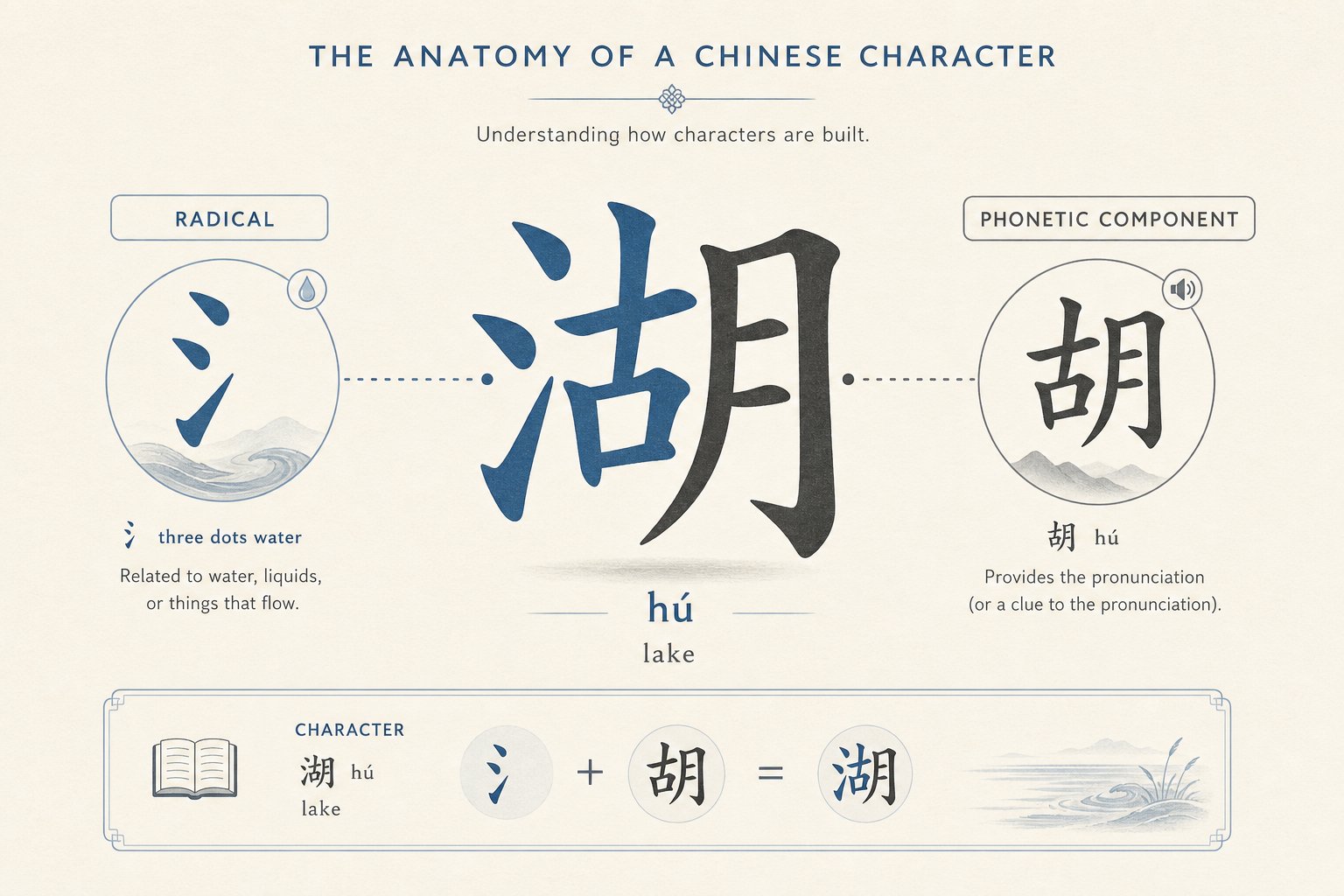
Understanding How Chinese Characters Are Built
Chinese characters might look like random arrangements of lines and dots, but every single one follows a structural logic. Think of it this way: English words are built from letters, and those letters follow spelling patterns. Chinese characters are built from strokes, grouped into components, and organized around radicals. Once you see the pattern, even unfamiliar characters start making sense.
People sometimes call them chinese hieroglyphics, but that comparison only goes so far. Egyptian hieroglyphs died out centuries ago. Chinese characters evolved continuously for over 3,000 years and remain a living, daily-use writing system. The structural principles behind them are what make basic chinese characters learnable rather than random.
Radicals as Meaning Clues Inside Characters
A radical is a component within a character that often signals its meaning category. Imagine radicals as filing labels: they tell you what semantic neighborhood a character belongs to. The water radical 氵appears in 河 (he, river), 海 (hai, sea), and 湖 (hu, lake). You'll notice that every time you spot those three drops on the left side of a character, there's a strong chance the meaning relates to liquid or water.
Here are some of the most productive radicals you'll encounter across common characters:
- 人 / 亻 (ren) — person: appears in 他 (he), 你 (you), 们 (plural marker), 休 (rest)
- 水 / 氵 (shui) — water: appears in 河 (river), 海 (sea), 没 (not have), 洗 (wash)
- 木 (mu) — wood/tree: appears in 林 (forest), 桌 (table), 校 (school), 树 (tree)
- 口 (kou) — mouth: appears in 吃 (eat), 喝 (drink), 叫 (call), 吗 (question particle)
- 心 / 忄 (xin) — heart: appears in 想 (think), 忙 (busy), 快 (fast/happy), 情 (emotion)
- 女 (nv) — woman: appears in 妈 (mother), 姐 (older sister), 好 (good), 她 (she)
- 言 / 讠 (yan) — speech: appears in 说 (speak), 话 (words), 语 (language), 读 (read)
This is why understanding chinese character symbol meanings becomes much easier once you recognize radicals. A character you've never seen before still gives you a clue if you can identify its radical. Spot 忄on the left? The character probably relates to feelings or mental states. See 讠? Expect something connected to language or communication.
It's worth noting that radicals and character components aren't exactly the same thing. Technically, a radical is the specific component used to index a character in a dictionary. Each character has only one radical, even if it contains multiple meaningful components. But for learners focused on decoding meaning, the practical takeaway is the same: recognizable components inside characters point toward meaning categories.
Stroke Order and Why It Helps Memory
Every Chinese character is written using a set of basic strokes: horizontal, vertical, left-falling, right-falling, dot, hook, and turning strokes. These combine according to consistent rules that dictate the order you write them in. Stroke order isn't arbitrary calligraphy tradition. It serves a practical purpose for learners.
The core rules are straightforward:
- Top to bottom (三 is written starting from the top stroke)
- Left to right (你 starts with the left-side component)
- Horizontal before vertical (十 draws the horizontal line first)
- Outside before inside, close the frame last (国 writes the outer box, fills the inside, then seals the bottom)
Why does this matter for reading, not just writing? Because stroke order creates muscle memory and visual chunking. When you internalize how simple chinese characters are constructed stroke by stroke, you start recognizing their components faster during reading. Your brain stops seeing a wall of lines and starts parsing familiar building blocks. Even if you never plan to write by hand, understanding stroke order helps you distinguish between characters that look similar at first glance.
The Four Types of Character Formation
Not all characters were created the same way. Chinese linguistics traditionally identifies four main formation methods, and knowing them helps you decode unfamiliar characters more efficiently.
Pictographs (象形, xiangxing) are the oldest and most intuitive type. These started as simplified drawings of objects. The character 山 (shan, mountain) still resembles three peaks. The character 日 (ri, sun) was originally a circle with a dot. If you're looking for a chinese pictograms list, these are the characters that trace directly back to images: 火 (fire), 水 (water), 木 (tree), 月 (moon), 目 (eye). They make up a small percentage of modern characters, but many serve as radicals inside more complex ones.
Ideographs (指事, zhishi) represent abstract concepts through symbolic positioning. The character 上 (shang, up) places a mark above a line. The character 下 (xia, down) places it below. These are chinese characters simple enough to grasp visually, but they're limited to concepts that can be shown through spatial relationships.
Compound ideographs (会意, huiyi) combine two or more meaningful components to suggest a new idea. The classic example: 休 (xiu, rest) shows a person 人 leaning against a tree 木. Another: 明 (ming, bright) pairs the sun 日 with the moon 月.
Phono-semantic compounds (形声, xingsheng) are the dominant category. Roughly 80% of all Chinese characters fall into this group. Each one contains a semantic component (usually the radical) that hints at meaning and a phonetic component that hints at pronunciation. Take 妈 (ma, mother): the left side 女 (woman) tells you the meaning category, while the right side 马 (ma, horse) tells you the approximate sound. The character has nothing to do with horses. That component is purely there for its pronunciation value.
This is the key insight that transforms how you approach any chinese ideograms list or character reference. Most characters aren't mysterious symbols you need to memorize in isolation. They're combinations of a meaning clue and a sound clue, assembled from components you'll see again and again. Once you internalize the most common radicals and recognize the phono-semantic pattern, new characters stop looking like puzzles and start looking like combinations of familiar parts.
With this structural foundation in place, the next step is seeing how these building blocks organize into the specific characters you'll encounter most often, grouped by the roles they play in everyday Chinese.
The Most Common Characters Organized by Meaning Category
Raw frequency rankings are useful, but they can feel disorienting when you're staring at a list of chinese letters and meanings without any logical grouping. The character 的 (de) ranks number one, but it's a grammar particle with no visual meaning. Not exactly inspiring for a beginner. A more practical approach organizes the most common characters by what they actually represent, giving you two ways to navigate: by frequency importance and by meaning category.
The following chinese characters list groups high-frequency characters into functional categories. Each entry includes pinyin, meaning, the radical that anchors the character, and the HSK level where it first appears. Use these tables as a quick-reference chart you can return to during study sessions.
Number Characters from One to One Hundred
Chinese number characters are among the simplest to learn because the system is purely logical. Once you know one through ten, you can construct every number up to 99 by combining them. There are no irregular forms like English "eleven" or "twelve." The number 21 is literally "two-ten-one" (二十一). This makes chinese number characters some of the most satisfying early wins for new learners.
| Character | Pinyin | Meaning | Radical | HSK Level |
|---|---|---|---|---|
| 一 | yi | one | 一 | HSK 1 |
| 二 | er | two | 二 | HSK 1 |
| 三 | san | three | 一 | HSK 1 |
| 四 | si | four | 囗 | HSK 1 |
| 五 | wu | five | 一 | HSK 1 |
| 六 | liu | six | 八 | HSK 1 |
| 七 | qi | seven | 一 | HSK 1 |
| 八 | ba | eight | 八 | HSK 1 |
| 九 | jiu | nine | 丿 | HSK 1 |
| 十 | shi | ten | 十 | HSK 1 |
| 百 | bai | hundred | 白 | HSK 2 |
Notice that the characters for one, two, and three are simply one, two, and three horizontal strokes. That visual logic is a hallmark of the earliest Chinese pictographs. Beyond ten, the character 百 (bai, hundred) opens up larger numbers: 三百 means 300, 九百 means 900. The pattern stays consistent all the way up.
People, Pronouns, and Relationship Characters
Pronouns and people-related characters appear in virtually every sentence. This category forms the backbone of any mandarin characters list because you simply cannot construct basic communication without them.
| Character | Pinyin | Meaning | Radical | HSK Level |
|---|---|---|---|---|
| 人 | ren | person, people | 人 | HSK 1 |
| 我 | wo | I, me | 戈 | HSK 1 |
| 你 | ni | you | 亻 | HSK 1 |
| 他 | ta | he, him | 亻 | HSK 1 |
| 她 | ta | she, her | 女 | HSK 1 |
| 们 | men | plural marker | 亻 | HSK 1 |
A few things stand out here. The character 他 (he) uses the person radical 亻, while 她 (she) uses the woman radical 女. Both are pronounced identically as "ta," and the distinction only exists in writing. The character 们 turns any pronoun into its plural form: 我们 (we), 你们 (you all), 他们 (they). One character, three new words unlocked.
Nature, Time, and Place Characters
These characters describe the physical world and the passage of time. Many of them originated as pictographs, making them some of the most visually intuitive entries on any list of chinese characters.
| Character | Pinyin | Meaning | Radical | HSK Level |
|---|---|---|---|---|
| 天 | tian | sky, day | 大 | HSK 1 |
| 地 | di | earth, ground | 土 | HSK 2 |
| 日 | ri | sun, day | 日 | HSK 2 |
| 月 | yue | moon, month | 月 | HSK 1 |
| 水 | shui | water | 水 | HSK 1 |
| 火 | huo | fire | 火 | HSK 2 |
| 年 | nian | year | 干 | HSK 1 |
Characters like 日 (sun) and 月 (moon) pull double duty. Beyond their literal meanings, they function as radicals inside hundreds of other characters and also serve as time words: 日 marks specific dates, while 月 names months. The character 年 (year) ranks 39th in overall frequency, making it one of the most encountered characters in modern Chinese text.
Action and Function Word Characters
This final group covers the verbs and grammatical particles that hold sentences together. If the previous categories give you nouns and context, these characters provide the action and structure. They dominate the top of every frequency-ranked list of chinese symbols because Chinese grammar relies on them constantly.
| Character | Pinyin | Meaning | Radical | HSK Level |
|---|---|---|---|---|
| 是 | shi | is, am, are | 日 | HSK 1 |
| 有 | you | have, exist | 月 | HSK 1 |
| 来 | lai | come | 木 | HSK 1 |
| 去 | qu | go | 厶 | HSK 1 |
| 说 | shuo | speak, say | 讠 | HSK 1 |
| 看 | kan | look, see | 目 | HSK 1 |
| 想 | xiang | think, want | 心 | HSK 1 |
| 做 | zuo | do, make | 亻 | HSK 1 |
| 的 | de | possessive particle | 白 | HSK 1 |
| 了 | le | completed action | 乛 | HSK 1 |
| 不 | bu | not, no | 一 | HSK 1 |
| 在 | zai | at, in, exist | 土 | HSK 1 |
| 这 | zhe | this | 辶 | HSK 1 |
| 那 | na | that | 阝 | HSK 1 |
Look at the radicals column and you'll see the structural principles from the previous section in action. The character 说 (speak) carries the speech radical 讠. The character 想 (think) sits on the heart radical 心. The character 看 (see) contains the eye radical 目. Each radical quietly signals the character's meaning category, even before you memorize the full definition.
Together, these four tables give you a working chinese character list of roughly 40 high-frequency characters spanning numbers, people, the natural world, and everyday actions. That's enough to start recognizing patterns in real text. But individual characters are only half the story. The real power of Chinese vocabulary emerges when these characters start combining into compound words, where meanings shift, merge, and sometimes surprise you.
How Characters Combine to Create Chinese Vocabulary
You know that 中 means "middle" and 大 means "big." Straightforward enough. But what happens when these characters pair up with others? The character 中 becomes part of 中国 (China), 中文 (Chinese language), and 中午 (noon). The character 大 shows up in 大学 (university), 大家 (everyone), and 大人 (adult). Suddenly, "middle" and "big" are doing far more work than their standalone definitions suggest.
This is the core mechanic of Chinese vocabulary. Meaning in modern Mandarin lives primarily in compound words, not isolated characters. Most common chinese words consist of two characters working together, and understanding how those chinese words characters interact is what separates someone who memorizes flashcards from someone who actually reads.
How Single Characters Build Into Compound Words
Sometimes the logic is transparent. When you see 火车 (huoche), you can break it down: 火 (fire) + 车 (vehicle) = train. That tracks historically, since early trains were steam-powered. Similarly, 电脑 (diannao) combines 电 (electricity) + 脑 (brain) = computer. The individual character meanings point you directly toward the compound's definition.
This predictability is one of the biggest advantages of learning common chinese words and symbols at the character level. You're not memorizing opaque vocabulary the way you might in English. Instead, each new word reveals its internal logic through its components. The character 学 (xue, study) generates an entire family: 学生 (student), 学校 (school), 大学 (university), 学习 (to study). One character, four words unlocked.
When Character Meanings Shift in Combinations
Not every compound plays by these rules. The word 东西 (dongxi) combines 东 (east) + 西 (west), but it doesn't mean "east-west." It means "thing" or "stuff." No amount of staring at the individual characters would lead you to that definition on your own.
Similarly, 大家 (dajia) pairs 大 (big) + 家 (home/family), yet it means "everyone" rather than "big family." And 好 (hao, good) + 看 (kan, look) creates 好看 (haokan), which means "good-looking" or "attractive" rather than literally "good to look at." The meaning shifts just enough to require learning the compound as its own unit.
This is where chinese word symbols get interesting. Knowing individual characters gives you a strong prediction tool, maybe 70-80% of the time, but it doesn't guarantee perfect comprehension. Some compounds carry meanings that neither character holds alone. Treat character knowledge as a head start, not a guarantee.
Common Word Pairs Every Beginner Should Know
The table below uses only characters from the high-frequency list covered earlier. Each compound demonstrates how two familiar characters merge into a new concept. This is a practical chinese list of words you can start recognizing immediately.
| Character 1 | Character 2 | Compound | Pinyin | Meaning |
|---|---|---|---|---|
| 中 (middle) | 国 (country) | 中国 | zhongguo | China |
| 中 (middle) | 文 (writing) | 中文 | zhongwen | Chinese language |
| 大 (big) | 学 (study) | 大学 | daxue | university |
| 学 (study) | 生 (life/born) | 学生 | xuesheng | student |
| 今 (now) | 天 (day) | 今天 | jintian | today |
| 明 (bright) | 天 (day) | 明天 | mingtian | tomorrow |
| 火 (fire) | 车 (vehicle) | 火车 | huoche | train |
| 电 (electric) | 话 (speech) | 电话 | dianhua | telephone |
| 好 (good) | 看 (look) | 好看 | haokan | good-looking |
| 东 (east) | 西 (west) | 东西 | dongxi | thing, stuff |
| 大 (big) | 人 (person) | 大人 | daren | adult |
| 中 (middle) | 午 (noon) | 中午 | zhongwu | noon/midday |
Look at the pattern across these chinese words symbols. Some compounds are perfectly logical: 今天 (now + day = today) and 学生 (study + life = student) make intuitive sense. Others require a small mental leap: 明天 (bright + day = tomorrow) works once you think of brightness as the coming dawn. And a few, like 东西 (east + west = thing), simply need to be learned as fixed vocabulary.
The takeaway? Character knowledge is your best prediction engine for most common chinese words, but it works on a spectrum. Some compounds are transparent, some are semi-transparent, and some are opaque. All three types benefit from knowing the individual characters, because even when the meaning isn't obvious, the components make the word far easier to remember than a random string of strokes.
This compounding behavior also means that characters which look identical can produce wildly different words depending on their partner. And that raises another practical challenge: characters that look nearly the same but carry completely different meanings, a confusion point that trips up learners at every level.
Chinese Characters That Look Alike but Mean Different Things
You've memorized a character's meaning, you're feeling confident, and then you encounter what looks like the exact same character in a completely different context. The sentence makes no sense. What happened? You probably confused two characters that differ by a single stroke, a tiny dot, or a subtle shift in proportions.
This is one of the most frustrating pain points when studying chinese characters with meanings side by side. Many popular chinese characters sit dangerously close to lookalikes that carry entirely unrelated definitions. The good news: once you know where to look, the differences become obvious.
Pairs That Trip Up Every Beginner
These confusion pairs show up constantly because both characters in each set rank among the most common characters in everyday Chinese. They're not obscure or rare. They're the kind of easy chinese characters you encounter in your first weeks of study, which makes the mix-ups even more disorienting.
Consider 人 (ren, person) and 入 (ru, enter). Both consist of just two strokes. Both look like an inverted "V" shape. But 人 has a longer left stroke, giving it an asymmetrical stance like a person standing with one leg forward. The character 入 has two more symmetrical strokes that seem to converge inward, as if something is entering a space.
Or take 大 (da, big) and 太 (tai, too much). The only difference? A small dot beneath the main strokes of 太. That single dot transforms "big" into "excessive." Think of the dot as the tipping point: something went past big and became too much.
The pair 己 (ji, self) and 已 (yi, already) confuses even intermediate learners. Both share the same basic shape, but the final stroke tells the story. In 己, the last horizontal stroke stays contained, with the opening facing right. In 已, that final stroke extends higher than the top horizontal stroke, as if reaching beyond a boundary. Already implies something has moved past a point, and the stroke reflects that visually.
Then there's 土 (tu, earth) versus 士 (shi, scholar). Same three strokes, completely different proportions. In 土, the bottom horizontal stroke is longer, representing wide, stable ground. In 士, the top stroke is longer, suggesting the broad-minded head of a learned person standing tall.
Visual Tricks to Tell Them Apart
Mnemonics turn these subtle differences into sticky memories. The table below collects the most problematic pairs for beginners, along with a visual distinction you can use as a quick mental check. These are beginner easy chinese symbols that you'll see daily, so locking in the differences early saves hours of confusion later.
| Character A | Meaning A | Character B | Meaning B | How to Tell Them Apart |
|---|---|---|---|---|
| 人 (ren) | person | 入 (ru) | enter | 人 has a longer left stroke (a person leaning); 入 has symmetrical strokes converging inward |
| 大 (da) | big | 太 (tai) | too much | 太 adds a dot below — the extra bit that pushes "big" into "excessive" |
| 己 (ji) | self | 已 (yi) | already | 已 has its final stroke extending above the top line; 己 stays contained within |
| 土 (tu) | earth | 士 (shi) | scholar | 土 has a longer bottom stroke (wide ground); 士 has a longer top stroke (broad mind) |
| 未 (wei) | not yet | 末 (mo) | end, final | 未 has a shorter top stroke (the tree hasn't fully grown); 末 has a longer top stroke (full maturity reached) |
| 力 (li) | power | 刀 (dao) | knife | 力 has its left stroke crossing the horizontal; 刀 has a clean, uninterrupted top like a blade edge |
| 今 (jin) | today, now | 令 (ling) | order, command | 令 has an extra slanted stroke at the bottom that 今 lacks |
Notice a pattern? Most of these easy chinese symbols differ by exactly one stroke, one dot, or one proportion shift. That's all it takes to flip a meaning entirely. The characters aren't trying to trick you. They evolved from different origins and just happen to look similar in their modern simplified forms.
The practical strategy here is simple: whenever you learn a new character, actively check whether a near-twin exists. If it does, learn them as a pair rather than in isolation. Your brain distinguishes contrasts far better than it memorizes individual items. Pairing lookalikes forces you to notice the exact feature that separates them, which is the same skill you'll need when those common characters appear in running text at full speed.
Spotting these visual differences gets easier once you train yourself to read characters component by component rather than as whole shapes. And that component-level reading is exactly what radicals enable, turning a handful of recurring building blocks into a decoding system that works across hundreds of unfamiliar characters.
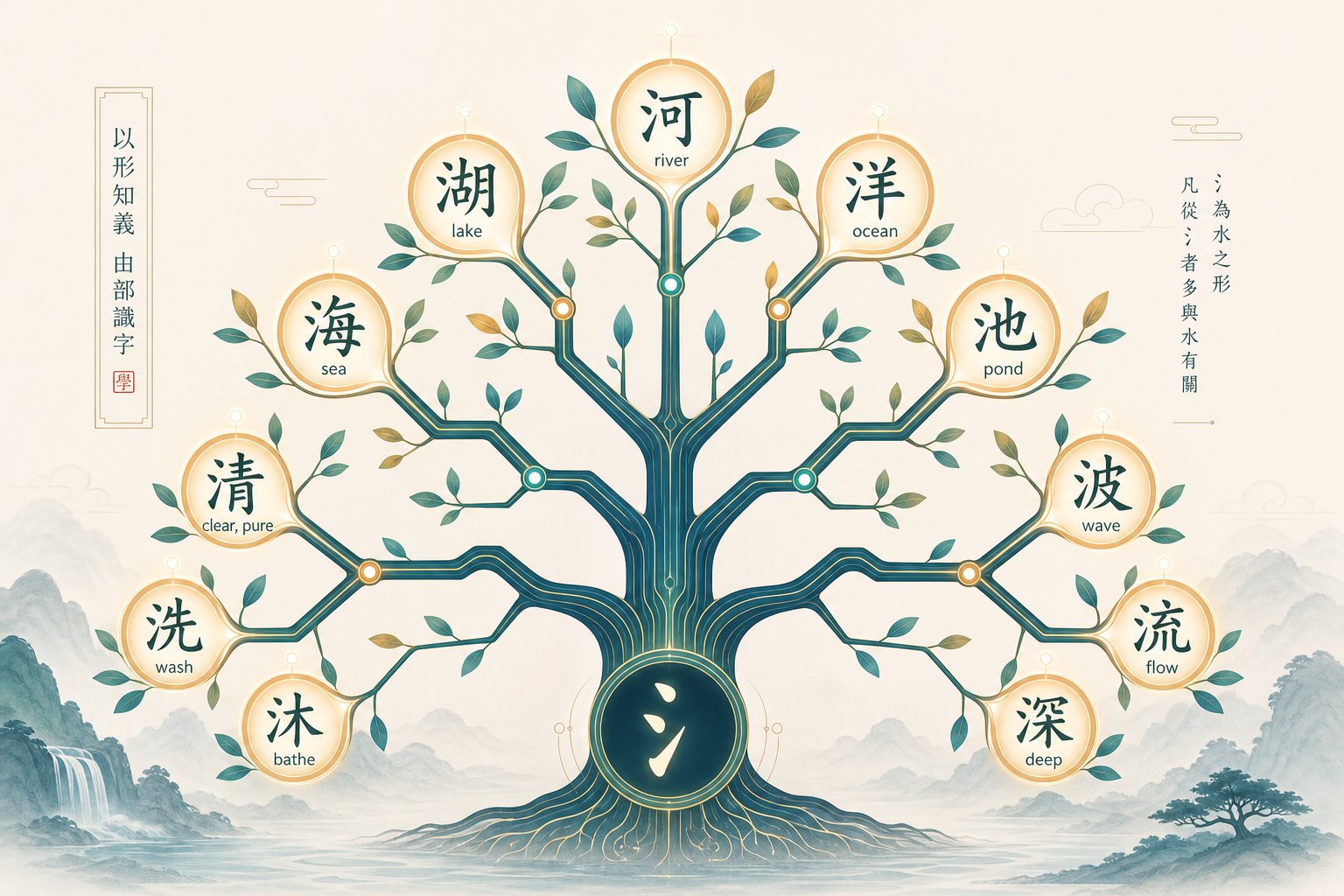
Radical-Based Shortcuts to Decode Any Character
A handful of recurring components show up inside hundreds of different characters. Learn those components, and you stop memorizing each character from scratch. Instead, you start decoding them, pulling meaning from familiar parts the way you'd recognize Latin roots in English words like "aqua" or "terra." This is one of the most effective chinese characters basics to internalize early: radicals are your built-in cheat code.
There are 214 radicals in the traditional system, but you don't need all of them. Most are rare or archaic. A focused set of 15 high-frequency radicals appears across the vast majority of characters you'll encounter in everyday reading. Think of this as your chinese character chart for meaning, a compact reference that unlocks pattern recognition across the entire writing system.
The Top 15 Radicals That Unlock Character Meanings
The radicals below are ranked by how many common characters they appear in. When you study chinese characters at the beginner level, these are the ones that deliver the highest return on investment. Each radical signals a semantic category, giving you an immediate clue about what a character means before you even look it up.
- 氵/水 (shui) — water: 河, 海, 湖, 江, 洗
- 亻/人 (ren) — person: 你, 他, 们, 仙, 例
- 忄/心 (xin) — heart/feelings: 忙, 快, 忘, 忆, 情
- 讠/言 (yan) — speech: 说, 话, 语, 讲, 试
- 扌/手 (shou) — hand: 打, 拉, 推, 抱, 找
- 女 (nv) — woman: 妈, 好, 姐, 姓, 安
- 木 (mu) — wood/tree: 林, 校, 根, 本, 桌
- 口 (kou) — mouth: 吃, 喝, 叫, 吗, 品
- 月 (yue) — moon/flesh: 服, 朋, 朝, 明, 期
- 土 (tu) — earth: 地, 在, 城, 场, 型
- 火/灬 (huo) — fire: 灯, 热, 点, 然, 烧
- 宀 (mian) — roof: 安, 定, 容, 宁, 家
- 子 (zi) — child: 字, 学, 孩, 季, 孔
- 辶 (chuo) — walk/movement: 过, 远, 运, 边, 达
- 刂/刀 (dao) — knife: 分, 切, 划, 刚, 到
Imagine you encounter an unfamiliar character with 氵on the left. Even without knowing the full character, you can predict it relates to water or liquid. Spot 忄? Expect something about emotions or mental states. See 讠? The character involves speech or language. This pattern holds reliably enough to serve as your primary decoding strategy when you learn mandarin characters systematically.
Using Radicals as a Memorization Shortcut
Radicals do more than hint at meaning. In phono-semantic compounds, which make up roughly 80% of all characters, the radical provides the meaning clue while a separate component suggests pronunciation. Take the speech radical 讠as an example. It appears in 说 (shuo, speak), 话 (hua, words), 语 (yu, language), and 讲 (jiang, explain). Every one of these characters relates to verbal communication. The right-side component in each case gives a pronunciation hint, but the radical on the left tells you the semantic family instantly.
The table below serves as a quick-reference chart of chinese characters organized by radical, showing exactly how the meaning connection works across multiple examples.
| Radical | Meaning | Example Characters | Meaning Connection |
|---|---|---|---|
| 氵(shui) | water | 河, 海, 湖, 洗, 江 | All relate to bodies of water or liquid actions |
| 亻(ren) | person | 你, 他, 们, 休, 做 | All involve people or human actions |
| 忄(xin) | heart | 忙, 快, 情, 想, 忘 | All relate to emotions or mental states |
| 讠(yan) | speech | 说, 话, 语, 讲, 试 | All involve speaking, language, or verbal expression |
| 扌(shou) | hand | 打, 找, 拉, 推, 抱 | All describe actions performed with hands |
| 女 (nv) | woman | 妈, 姐, 好, 她, 姓 | All relate to women or qualities historically associated with femininity |
| 木 (mu) | wood | 林, 校, 桌, 树, 本 | All connect to trees, wood, or wooden objects |
| 口 (kou) | mouth | 吃, 喝, 叫, 吗, 品 | All involve the mouth: eating, drinking, calling out |
| 火/灬 (huo) | fire | 灯, 热, 点, 然, 烧 | All relate to heat, burning, or light sources |
| 宀 (mian) | roof | 家, 安, 定, 容, 宁 | All suggest shelter, home, or containment |
This is how to learn chinese characters without brute-force memorization. Instead of treating each new character as a completely isolated symbol, you recognize its radical, place it in a semantic category, and then focus your memory on what makes it unique within that category. The radical handles the "what kind of thing is this?" question automatically.
A practical way to use this chinese writing chart: when you encounter a new character during reading, identify the radical first. Check the table above. If the radical is 氵, you already know the character relates to water. If it's 忄, you know it's about feelings. That single step narrows your guessing range from thousands of possibilities down to a manageable category, and it makes the correct meaning far stickier once you look it up.
With radicals giving you a systematic way to decode meaning, the next question becomes: can you actually read real Chinese text using only the common characters covered so far? The answer might surprise you.
Real-World Reading Practice with Common Characters Only
Here's where everything clicks. You've studied radicals, memorized character categories, and learned how compounds form. But can you actually read something real? The answer is yes, and you probably already can. The characters covered in this guide appear on street signs, restaurant menus, and in everyday greetings across every Chinese-speaking city. Let's prove it.
Signs and Labels You Can Already Read
Walk through any airport, train station, or shopping mall in China, and you'll encounter these characters within minutes. Each one is built entirely from high-frequency characters you've already seen. This is chinese writing with meaning you can use immediately, no dictionary required.
- 出口 (chukou) — 出 (out) + 口 (mouth/opening) = Exit. The "mouth" here represents an opening or passage. You'll see this on every building, subway station, and parking garage.
- 入口 (rukou) — 入 (enter) + 口 (opening) = Entrance. The mirror image of 出口. Remember the lookalike pair from earlier: 入 has symmetrical strokes converging inward, fitting its meaning perfectly.
- 大/中/小 (da/zhong/xiao) — Big/Medium/Small. These three characters appear on drink cups, clothing tags, and restaurant portion sizes. Order a coffee in China and you'll choose between these exact labels.
- 男 (nan) / 女 (nv) — Male/Female. Found on every restroom door. The character 男 combines 田 (field) + 力 (strength), while 女 is a standalone radical you already know.
- 开 (kai) / 关 (guan) — Open/Closed. Appears on shop doors, light switches, and business hour signs.
- 上 (shang) / 下 (xia) — Up/Down. Elevator buttons, escalator signs, and directional markers all use these.
Notice something? Every example of chinese writing above uses characters from the top 100 frequency list. You're not reading advanced text. You're reading the same high-frequency characters arranged into practical, real-world labels. That's the payoff of frequency-based learning: common chinese writing surrounds you, and you can already decode it.
Simple Sentences Built from Common Characters
Beyond signs, you can parse complete sentences using only basic chinese writing. These phrases appear in textbooks, daily conversation, and beginner reading materials. Each one is broken down character by character so you can see exactly how the meaning assembles.
- 你好 (ni hao) — 你 (you) + 好 (good) = Hello. The most recognized Chinese greeting worldwide. Two characters, both from the top 100.
- 谢谢 (xiexie) — 谢 (thank) + 谢 (thank) = Thank you. The repetition adds emphasis, a common pattern in Mandarin.
- 不好意思 (bu hao yisi) — 不 (not) + 好 (good) + 意 (meaning) + 思 (thought) = Excuse me / Sorry. Literally "not good meaning-thought," used for minor apologies or getting someone's attention.
- 我是中国人 (wo shi zhongguo ren) — 我 (I) + 是 (am) + 中 (middle) + 国 (country) + 人 (person) = I am Chinese. Five characters, all from the top 25 in frequency.
- 今天天气很好 (jintian tianqi hen hao) — 今 (now) + 天 (day) + 天 (sky) + 气 (air) + 很 (very) + 好 (good) = The weather is nice today. Six characters forming a complete, natural sentence.
- 我不知道 (wo bu zhidao) — 我 (I) + 不 (not) + 知 (know) + 道 (way) = I don't know. One of the most useful phrases in any language, built from four common characters.
- 这个多少钱 (zhege duoshao qian) — 这 (this) + 个 (measure word) + 多 (many) + 少 (few) + 钱 (money) = How much is this? Essential for shopping, markets, and restaurants.
Each phrase above demonstrates how chinese writing symbols and meanings combine in predictable patterns. The grammar is minimal: no verb conjugation, no articles, no plural markers beyond 们. Subject + verb + object, and you have a sentence. That structural simplicity means your character knowledge translates directly into reading ability with very little grammatical overhead.
For restaurant contexts specifically, recognizing just a handful of characters opens up an entire menu. The characters 面 (noodles), 饭 (rice), 肉 (meat), 鱼 (fish), and 汤 (soup) act as category markers. Combine them with size indicators like 大/中/小 and cooking methods like 炒 (fried), and you can make informed choices even at a local restaurant with no English menu.
The point isn't that you'll understand everything. You won't, not yet. But the gap between "completely lost" and "I can figure out the gist" is smaller than most learners expect. Chinese writing meanings become accessible surprisingly fast when you focus on high-frequency characters first. A few dozen characters give you street navigation. A hundred give you basic sentence comprehension. A few hundred, and you're reading simple articles with context filling in the gaps.
This real-world payoff raises a practical question: what's the most efficient order to tackle these characters, and how many should you aim for each day? A structured study plan turns scattered knowledge into steady, measurable progress.

How to Build a Study Plan Around Character Frequency
Knowing which characters matter most is only half the equation. The other half is deciding what order to learn them in and how to make them stick. A raw frequency list tells you that 的 ranks first and 了 ranks second, but jumping straight into abstract grammar particles isn't exactly motivating for day one. A smarter approach layers frequency with visual simplicity and structural usefulness, giving you quick wins early while building the foundation for faster progress later.
A Suggested Study Order Beyond Raw Frequency
Research on optimizing Chinese character learning order shows that pure frequency ranking isn't the most efficient path. Characters exist in a structural hierarchy: compound characters are built from simpler components, and learning those components first makes everything that follows easier to absorb. The ideal sequence balances frequency importance with structural logic, so you're always building on what you already know.
Here's a phased approach that does exactly that:
- Phase 1: High-frequency characters that are visually simple. Start with characters that rank high in frequency and require few strokes: 一, 二, 三, 人, 大, 小, 上, 下, 中, 不. These are mandarin basic characters you can memorize in days, and they appear in text immediately. They also build confidence because they look manageable rather than intimidating.
- Phase 2: Characters that double as radicals. Move to characters that serve as building blocks inside other characters: 水, 木, 火, 土, 金, 口, 日, 月, 心, 女. Learning these early pays compound interest. When you later encounter 河 (river), you already recognize the water component 氵as a variant of 水. Each radical-character you learn now makes dozens of future characters easier to decode.
- Phase 3: Compound-forming characters that unlock vocabulary. Tackle characters that combine into many common words: 中, 学, 生, 国, 电, 话, 车, 家. The character 学 alone gives you access to 学生 (student), 学校 (school), 大学 (university), and 学习 (to study). These are the chinese characters most common in compound words, and each one multiplies your readable vocabulary.
- Phase 4: Abstract function words and grammar particles. Finally, address the high-frequency characters that carry grammatical rather than visual meaning: 的, 了, 在, 是, 这, 那, 吗, 呢. These are harder to memorize because they lack concrete imagery, but by this point you've already encountered them repeatedly in example sentences from earlier phases.
This sequence means your first 100 chinese characters include the most visually intuitive, structurally useful, and vocabulary-generating options available. You're not just accumulating frequency coverage. You're building a scaffold that makes every subsequent character easier to learn.
Daily Targets and Spaced Repetition Strategy
How many new characters should you tackle per day? The temptation is to go fast, but retention matters more than speed. A character you forget after a week costs you double the time: once to learn it, once to relearn it.
Aim for 5 to 10 new characters per day. At that pace, you'll reach 100 mandarin characters in two to three weeks and 300 within two months, with strong retention throughout.
The key to making this pace sustainable is spaced repetition, a study technique that schedules reviews at increasing intervals based on how well you remember each item. Instead of cramming 50 characters in one sitting and forgetting 70% by next week, you review each character just before you'd naturally forget it. Research consistently shows that spaced repetition produces 85-90% retention after four weeks, compared to roughly 30% with massed study over the same period.
A practical daily routine looks like this:
- Morning (15-20 minutes): Clear your review queue first. These are characters you've already learned that are due for reinforcement. Reviews are non-negotiable because they protect your existing knowledge.
- After reviews (5-10 minutes): Add your daily batch of new characters. Study each one carefully: read the pinyin aloud, trace the stroke order, identify the radical, and try to use it in a compound word you already know.
- Evening (5 minutes, optional): Quick self-test on the day's new characters. This same-day review catches the steepest part of the forgetting curve and dramatically improves next-day recall.
The most frequent chinese characters will naturally get more review exposure because they appear in example sentences, compound words, and reading practice. Less common characters need the spaced repetition system to keep them active. Start conservatively with 5 new characters per day for the first two weeks, then increase to 8-10 once your review load stabilizes.
Connecting Character Study to HSK Proficiency Goals
If you're studying toward a specific proficiency benchmark, the HSK exam system provides clear character targets. HSK 1 requires approximately 150 characters. HSK 2 adds another 150, bringing the total to around 300. Together, HSK levels 1 and 2 cover roughly the top 300 most frequent chinese characters, which aligns closely with the first three phases of the study order above.
Here's how the phases map to proficiency milestones:
| Study Phase | Characters Covered | Approximate HSK Level | Timeline (at 7/day) |
|---|---|---|---|
| Phase 1-2 | ~100 | HSK 1 (partial) | 2-3 weeks |
| Phase 3 | ~300 | HSK 1-2 | 6-8 weeks |
| Phase 4 | ~500 | HSK 3 | 10-12 weeks |
| Continued study | ~1,000 | HSK 4 | 5-6 months |
The 100 most common chinese characters give you roughly 42% text coverage. The 100 most used chinese characters also happen to overlap heavily with HSK 1 vocabulary, meaning your frequency-based study and exam preparation reinforce each other naturally. You're not studying two separate lists. You're studying one efficient set that serves both goals.
One final consideration: simplified versus traditional forms. If you plan to read content from Taiwan, Hong Kong, or older Chinese texts, it's worth noting the traditional variants as you go. The differences between simplified and traditional are smaller than most learners expect. The ten most common characters are identical in both systems, and most changes follow systematic radical substitutions (like 讠becoming 言) that take seconds to learn once you recognize the pattern. There's no need to study both systems simultaneously as a beginner. Focus on simplified first, build your foundation to 1,000+ characters, and then the transition to reading traditional requires learning only around 500 tricky cases, a task that takes weeks rather than months at an advanced level.
The path from zero to functional reading ability in Chinese is shorter than it looks. Start with visually simple, high-frequency characters. Layer in radical-characters that unlock structural understanding. Build toward compound-forming characters that multiply your vocabulary. Review daily with spaced repetition. And track your progress against HSK milestones to stay motivated. The chinese most common characters aren't just a list to memorize. They're a system to master, and the system is designed to reward consistent, structured effort.
Frequently Asked Questions About Common Chinese Characters
1. How many Chinese characters do I need to know to read basic text?
You need approximately 2,000 to 3,000 characters for basic functional literacy in Chinese. However, frequency data shows that just 100 characters cover about 42% of written text, 500 characters reach roughly 70%, and 1,000 characters give you around 89% coverage. Newspapers typically use about 3,000 characters, while educated adults may know 6,000 to 8,000 over their lifetime. For practical reading of signs, menus, and simple messages, your first milestone should be the top 300 to 500 characters.
2. What is the difference between a Chinese character and a Chinese word?
A Chinese character (hanzi) is a single written unit representing one syllable and typically carrying its own meaning. A word, however, usually consists of two or more characters combined together. For example, the character 电 means electricity and 脑 means brain, but together they form the word 电脑 meaning computer. This compound structure means learning individual character meanings gives you a powerful tool to predict and remember multi-character vocabulary, though some compounds carry meanings that differ from their individual parts.
3. What are radicals and how do they help with learning Chinese characters?
Radicals are recurring components inside Chinese characters that signal meaning categories. For instance, the water radical 氵appears in characters related to liquid like 河 (river), 海 (sea), and 洗 (wash). About 80% of Chinese characters are phono-semantic compounds containing a radical for meaning and a separate component for pronunciation. Learning just 15 high-frequency radicals lets you predict the semantic category of hundreds of unfamiliar characters, turning brute-force memorization into systematic pattern recognition.
4. What is the best order to learn Chinese characters as a beginner?
Rather than following raw frequency rankings, an optimized study order progresses through four phases. Start with visually simple high-frequency characters like 一, 人, 大, and 小. Next, learn characters that double as radicals inside other characters, such as 水, 木, 火, and 心. Then tackle compound-forming characters like 学, 国, and 电 that unlock many vocabulary words. Finally, address abstract grammar particles like 的, 了, and 在. This layered approach builds structural understanding so each new character becomes easier to learn.
5. How many new Chinese characters should I study per day?
Aim for 5 to 10 new characters per day combined with spaced repetition reviews. At this pace, you can reach 100 characters in two to three weeks and 300 within two months while maintaining strong retention. The key is prioritizing daily reviews of previously learned characters before adding new ones. Research shows spaced repetition produces 85-90% retention after four weeks, compared to roughly 30% with cramming. Start with 5 per day for the first two weeks, then increase to 8-10 once your review load stabilizes.