The Paradox of Honoring Ancestors Without Using Their Names
Imagine you want to honor your late grandfather by giving your newborn his name. In many Western families, this is one of the highest tributes you can pay. Think of Harry Carey Jr., named directly after his famous father, or Diane Disney Miller, whose middle name carried her family legacy forward. Reusing an ancestor's exact name signals love, continuity, and remembrance.
Now picture a traditional Chinese family reacting to that same idea. Rather than feeling honored, the elder generation might be deeply uncomfortable, even offended. Why? Because in Chinese culture, one of the most ancestor-devoted civilizations in human history, directly reusing an ancestor's name for a child was not a tribute. It was a violation.
This is the central paradox behind naming a child after an ancestor in Chinese culture. The tradition that built elaborate ancestral halls, maintained genealogy books spanning dozens of generations, and observed annual tomb-sweeping rituals also developed a strict prohibition against placing an ancestor's name characters into a descendant's name. The practice is called 避讳 (bìhuì), the naming taboo, and it shaped Chinese naming conventions for over two thousand years.
Why Chinese Families Do Not Reuse Ancestor Names
The logic runs deeper than simple etiquette. In Chinese thought, a person's name carried something close to their essence. To speak or write an ancestor's name casually, or worse, to assign it to a child who would hear it called out daily in ordinary contexts, was considered a form of disrespect that diminished the ancestor's standing. A Leiden University dissertation on Chinese name tabooing describes how the practice affected lives for centuries: people avoided certain places, refused official positions, and even faced execution for writing a taboo character carelessly.
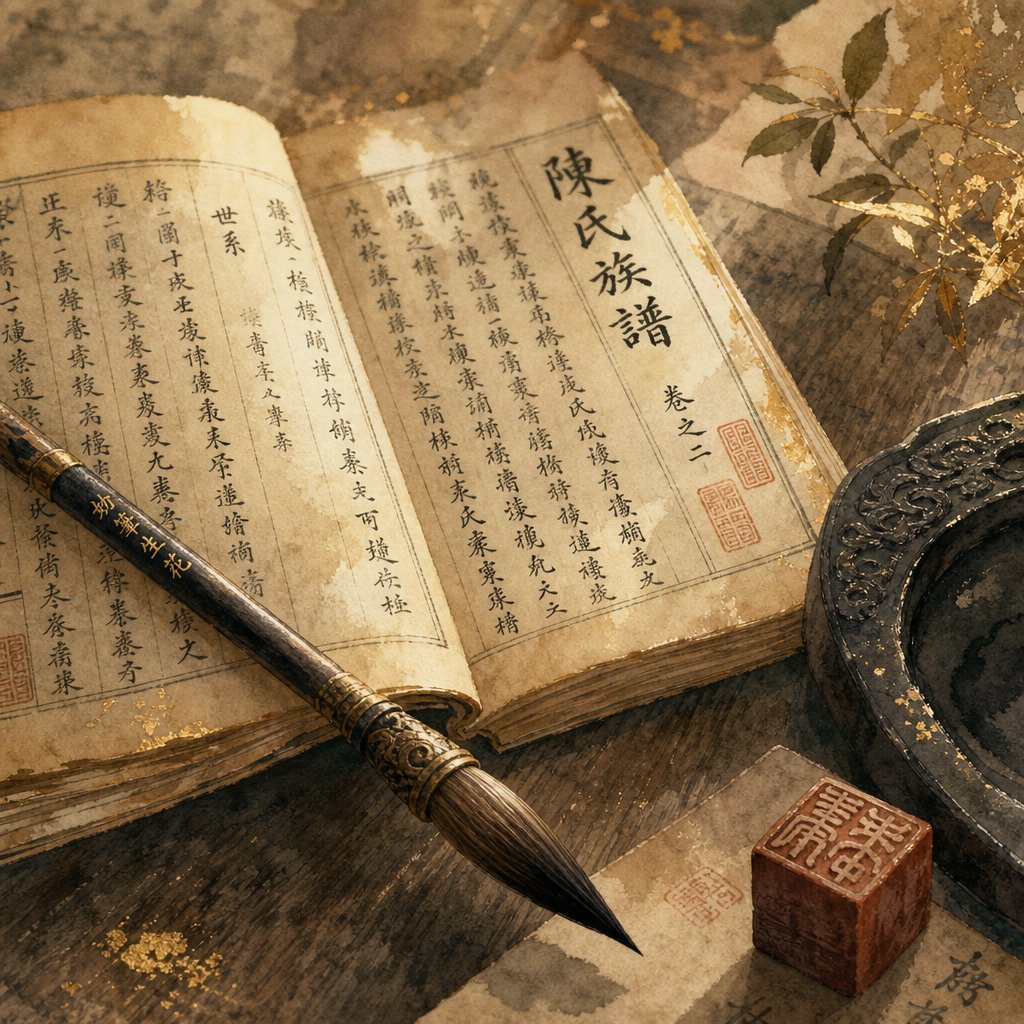
The prohibition extended beyond the exact character. Historically, even homophones, characters that sounded like an ancestor's name, could fall under the restriction. The family genealogy book, known as the 族谱 (zúpǔ), recorded every paternal ancestor's name, creating a growing list of characters that descendants could not use. Your position within this lineage, your 辈分 (bèifèn) or generational rank, determined which names you needed to avoid and which naming conventions you needed to follow.
In Chinese naming tradition, ancestors are honored through the structure of a name, not through the duplication of one. The system links every child to their lineage without ever repeating a forebear's characters.
The Cross-Cultural Confusion Behind This Search
If you are searching for information about naming a child after an ancestor in Chinese culture, you are likely navigating between two systems that express the same love in opposite ways. Western naming treats repetition as honor. Chinese naming treats repetition as transgression. Neither approach values ancestors less than the other. They simply encode respect through different mechanisms.
What Chinese culture developed instead was a sophisticated set of alternatives. Generational name poems assigned shared characters to entire generations of cousins, making lineage position visible at a glance. Research on generation names in China confirms that traditional Chinese names typically contained three parts: the family name, a generation name linking the bearer to their place in the clan sequence, and an individual given name. Males of the same generation in a family often shared the first character of their given names, a character drawn from a pre-composed poem that mapped out the family's future for generations to come.
These systems accomplished something remarkable. They made every name a statement of belonging, a thread connecting the individual to ancestors past and descendants yet to come, all without breaking the taboo. Understanding how this works, and how it has evolved from imperial strictness to modern flexibility, is essential for anyone making naming decisions that bridge Chinese and Western traditions today.
Understanding the Chinese Naming Taboo and Its Scope
The naming taboo was not a single, monolithic rule. It operated on multiple levels, each with its own scope, enforcement mechanisms, and consequences for violation. Think of it as a layered system: the closer you were to power or to your own bloodline, the stricter the prohibition became. To grasp why naming a child after an ancestor in Chinese culture was so deeply problematic, you need to understand these distinct layers and how they interacted.
The Chinese term 避讳 (bìhuì) literally translates to "avoiding that which is taboo." It encompassed not just the act of naming children but the broader cultural expectation that certain characters, once associated with a person of authority or reverence, became off-limits in everyday writing and speech. The system recognized three primary categories, though two dominated family life and governance for centuries.
State Taboo vs Family Taboo
The first and most powerful form was 国讳 (guóhuì), the state or imperial naming taboo. This applied to the emperor's given name and the names of his ancestors. Every subject in the empire was expected to avoid using the characters found in the ruler's personal name. The strength of this prohibition was reinforced by law, and transgressors could face severe punishment, including execution.
Consider a concrete example. During the Qin dynasty, the first emperor's given name was 政 (Zhèng). Because of this, the pronunciation of the first month of the year, 正月, was modified from Zhèngyuè to Zhēngyuè, and the month was eventually renamed entirely to 端月 (Duānyuè). One character belonging to one man reshaped the calendar terminology for an entire civilization.
The second form, 家讳 (jiāhuì), was the family or clan taboo. This is the layer most relevant to anyone exploring the tradition of naming a child after an ancestor in Chinese culture. Under family taboo, you could not give a child any character that appeared in the names of direct paternal ancestors recorded in the clan genealogy. This was not enforced by imperial law but by social expectation, family elders, and the weight of Confucian filial piety. Violating it brought shame to both the offender and the family.
A third, less commonly discussed category was 圣人讳 (shèngrén huì), the taboo of the sages. This discouraged using the names of revered cultural figures. Writing the name of Confucius, for instance, was considered taboo during certain dynasties.
- 国讳 (guóhuì) - State taboo: Applied empire-wide. Covered the emperor's name and his ancestors' names. Enforced by law with punishments ranging from demotion to execution.
- 家讳 (jiāhuì) - Family taboo: Applied within a clan. Covered all direct paternal ancestors in the genealogy book. Enforced by social pressure, family authority, and Confucian ethics.
- 圣人讳 (shèngrén huì) - Sage taboo: Applied broadly in educated circles. Covered names of revered figures like Confucius. Enforced by scholarly convention and cultural expectation.
How Far Back the Naming Restriction Extends
One of the most common questions people ask is: how many generations back does the restriction reach? The traditional answer, according to clan naming conventions, was seven generations. All ancestor names going back seven generations were to be avoided when choosing a child's name.
In practice, however, the restriction often extended even further. If a family maintained a complete 族谱 (zúpǔ), their genealogy book, then every ancestor recorded in that book effectively contributed characters to the "forbidden" list. For families with genealogies stretching back twenty or thirty generations, this meant dozens of characters were permanently unavailable. The longer and more meticulously a family maintained its records, the more constrained the naming pool became.
This created a practical challenge that grew with each generation. Imagine a family whose genealogy spans fifteen generations on the paternal side. Each ancestor typically had one or two characters in their given name. That could mean thirty or more characters, plus their homophones in stricter interpretations, that no descendant could use. Families developed creative workarounds, which later chapters will explore, but the constraint was real and shaped naming decisions for centuries.
At the imperial level, the restriction was even more absolute. When Wang Xihou published a dictionary in 1777 that included the Qianlong Emperor's name without omitting the required stroke, the result was his execution and the confiscation of his family's property. The stakes at the state level were not merely social embarrassment but life and death.
Paternal and Maternal Lineage Differences
The taboo did not apply equally across both sides of a family. Chinese naming restrictions were overwhelmingly patrilineal. The characters you needed to avoid came from your father's genealogy, your paternal grandfather's name, your paternal great-grandfather's name, and so on up the male line. The 族谱 itself was a paternal document, tracing descent through fathers and sons.
Maternal ancestors were treated differently. While showing respect to your mother's family was certainly expected, the formal naming taboo rarely extended to the maternal lineage with the same rigor. A child could, in many traditional contexts, bear a character that appeared in a maternal grandfather's name without violating convention. This asymmetry reflected the broader patrilineal structure of Chinese kinship, where children belonged to their father's clan and were recorded in his family's genealogy.
That said, courtesy and respect still applied. In diplomatic correspondence and formal letters between clans, each family's naming taboos were observed by the other party. If you were writing to someone from the Li family, you would take care to avoid the taboo characters of their ancestors as well, a practice that required knowing or inquiring about the other clan's restrictions beforehand. Historical records describe Goguryeo ambassadors in 435 AD formally requesting a document listing the Northern Wei emperor's taboo characters so they could avoid giving offense in their petitions.
The homophone restriction deserves special attention. In imperial contexts, it was not enough to avoid the exact character of the emperor's name. Characters that sounded the same, even if written completely differently, could also fall under the ban. This made the state taboo extraordinarily broad. A single imperial name could effectively remove an entire phonetic syllable from common use across the empire. At the family level, homophone avoidance was less universally enforced but still practiced by stricter clans, particularly in southern China where tonal distinctions between characters are more numerous.
These layered restrictions, from the emperor down to the family patriarch, from exact characters to mere homophones, created a naming environment unlike anything in Western tradition. The system was not designed to erase ancestors from memory. Quite the opposite: it elevated their names to a sacred status, too important to be spoken casually or recycled into the mouths of children. The question then becomes: how did this system evolve over two millennia of Chinese history, and what remains of it today?
Historical Evolution From Imperial Strictness to Modern Practice
The naming taboo did not remain static across Chinese history. It expanded, contracted, and transformed alongside the dynasties that enforced it. What began as a ritual practice rooted in ancestral reverence became, at its peak, a legal instrument capable of ending lives. Then, in the span of a single decade during the twentieth century, much of the infrastructure supporting these traditions was deliberately destroyed. The story of how naming a child after an ancestor in Chinese culture shifted from capital offense to personal choice spans over two thousand years of political upheaval, cultural revolution, and diaspora preservation.
Imperial Era Enforcement and Punishment
During the height of imperial China, the state naming taboo carried the force of law. This was not a suggestion or a social nicety. It was a mandate backed by the threat of severe punishment. The emperor's given name characters were, in effect, removed from public circulation the moment he took the throne.
Some emperors recognized the burden this placed on ordinary people. Emperor Xuan of Han, whose birth name Bingyi (病已) contained two extremely common characters, changed his own name to Xun (詢), a far rarer character, specifically to make compliance easier for his subjects. Emperor Taizong of Tang took a different approach: because his name Shimin (世民) also used common characters, he decreed that avoidance was only required when both characters appeared together in sequence, not when they appeared individually.
Yet even these concessions could be reversed. After Emperor Taizong's death, his son Emperor Gaozong reinstated full avoidance of both characters in isolation, forcing the chancellor Li Shiji to drop a character from his own name and become simply Li Ji. The rules shifted with each ruler's temperament, and subjects had little choice but to adapt.
The consequences for failure were not abstract. In 1777, scholar Wang Xihou published a dictionary that included the Qianlong Emperor's name without omitting the required stroke from the characters. The result was execution for Wang Xihou and confiscation of his family's property. Though his relatives were ultimately pardoned, the message was unmistakable: the naming taboo at the state level was a matter of life and death.
This top-down enforcement had a cascading effect on family-level practices. When the state demonstrated that a single miswritten character could destroy a household, families internalized the lesson. Clan taboos (家讳) gained additional weight not just from Confucian ethics but from the lived reality that name avoidance was a survival skill. Parents checking their genealogy books before naming a child were not merely following tradition. They were protecting their descendants from a culture where carelessness with names carried existential risk.
How the Cultural Revolution Disrupted Family Genealogies
For centuries, the 族谱 (zúpǔ) served as the physical anchor of Chinese naming traditions. These genealogy books recorded every paternal ancestor's name, mapped generational poems, and preserved the very information families needed to observe naming taboos correctly. Then, between 1966 and 1976, the Cultural Revolution's campaign against the "Four Olds" targeted these records for destruction.
The campaign rallied people to attack old customs, old culture, old habits, and old ideas. Genealogy books, ancestral halls, and even tombstones were destroyed as symbols of feudal thinking. My China Roots documents how many zupus were burned or lost during this period, severing the generational naming chains that families had maintained for centuries. Without the genealogy book, families could no longer verify which characters belonged to which ancestors. The forbidden character list, once meticulously maintained, simply vanished.
The destruction was not total, however. Some families took extraordinary measures. In one documented case, clan members smuggled their zupu to a neighboring village, buried it in the earth for over a decade, and dug it up again in 1979 after the political climate shifted. Others hid books in walls, sent them abroad with emigrating relatives, or memorized key passages. The 1980s saw a remarkable revival effort, with elders across China pooling fragmented memories and scraps of notes to reconstruct entire genealogies from scratch.
The practical consequence for naming traditions was profound. On mainland China, many families entering the 1980s and 1990s no longer had access to their generational poems or complete ancestor lists. Parents naming children in this era often did so without the traditional constraints, not because they rejected the old system, but because the information needed to follow it had been lost. The naming taboo did not die from philosophical rejection. It was severed from its documentary foundation.
Preservation of Traditions in Overseas Communities
While mainland genealogies burned, Chinese communities abroad often preserved theirs intact. Families who had emigrated to Southeast Asia, Taiwan, Hong Kong, and Western countries during earlier waves of migration frequently carried their zupus with them. Clan associations in Singapore, Malaysia, and beyond maintained these records as treasured links to ancestral villages.
One genealogy researcher's client described the discovery perfectly: "I was skeptical. My ancestors left Fujian seven generations ago, and our clan book was destroyed during the Cultural Revolution. However, My China Roots found it 4000 km away... in Singapore." This pattern repeated across the diaspora. Books that no longer existed in their village of origin survived in overseas clan halls, private collections, and family archives scattered from Penang to San Francisco.
Taiwan presents a particularly interesting case. Because the island was governed separately from mainland China after 1949, it never experienced the Cultural Revolution's destruction of cultural artifacts. Many Taiwanese families maintained unbroken genealogical records and continued observing generational naming conventions without interruption. The same is true for communities in Hong Kong, where British colonial governance insulated local clan traditions from mainland political campaigns.
This geographic split created a paradox that persists today. Overseas Chinese communities sometimes maintain stricter adherence to ancestral naming conventions than families in the ancestral homeland itself. A family in Guangdong province might name children with complete freedom, having lost their zupu decades ago, while their cousins in Kuala Lumpur still consult the generational poem before choosing a name. The tradition survived not where it originated, but where it was carried by migrants who left before the disruption.
| Historical Period | Taboo Strictness | Key Characteristics |
|---|---|---|
| Pre-Qin (before 221 BCE) | Moderate | Ritual and religious origins; oral tradition of name avoidance within aristocratic families |
| Qin and Han Dynasties (221 BCE - 220 CE) | High | State taboo formalized by law; emperors sometimes changed their own names to ease public burden |
| Tang Dynasty (618 - 907) | High with exceptions | Some emperors allowed partial avoidance; enforcement tightened or relaxed between reigns |
| Song Dynasty (960 - 1279) | High | Clan genealogies became widespread; family taboo deeply embedded in educated classes |
| Ming Dynasty (1368 - 1644) | High | Imperial princes given rare characters to reduce public burden; clan zupus formalized |
| Qing Dynasty (1644 - 1912) | Very High | Stroke-omission rules strictly enforced; violations punished by execution (Wang Xihou case, 1777) |
| Republic of China (1912 - 1949) | Declining | State taboo abolished with end of imperial system; family taboo continued in rural areas |
| Cultural Revolution (1966 - 1976) | Disrupted | Genealogy books destroyed; generational naming chains broken on mainland China |
| Modern Era (1980s - present) | Low to Voluntary | Revival of interest in genealogy; taboo observed by choice rather than obligation; overseas communities often stricter than mainland |
The timeline reveals a clear arc: from sacred ritual to legal mandate to voluntary cultural practice. What once carried the penalty of death now operates as a family preference, observed by those who choose to honor it and unknown to many who have lost the records that made it possible. Yet the underlying logic, that an ancestor's name deserves elevation above casual reuse, has not disappeared. It has simply moved from the realm of law into the realm of personal and family identity.
This shift raises a practical question for modern families. If the taboo no longer carries legal force and many genealogies have been lost, what mechanisms still connect a child's name to their ancestral lineage? The answer lies in one of Chinese culture's most elegant inventions: the generational name poem, a pre-composed sequence of characters that maps a family's future across dozens of generations without ever repeating an ancestor's name.
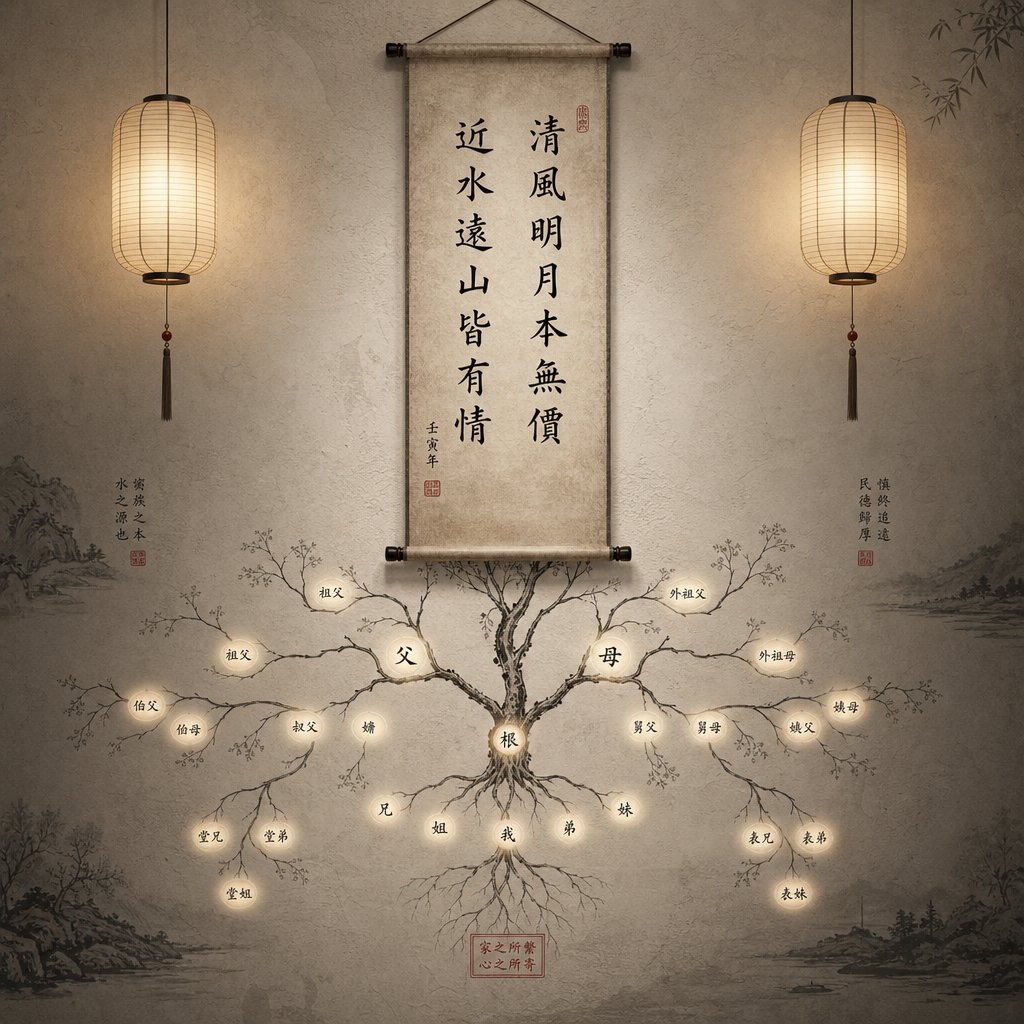
Generational Name Poems as the Primary Lineage Mechanism
If Chinese families could not reuse an ancestor's name, how did they make lineage visible in a child's identity? The answer is one of the most elegant naming systems ever devised: the generational name poem, known as 字辈谱 (zìbèi pǔ) or 字辈诗 (zìbèi shī). Rather than looking backward and copying a forebear's characters, this system looks forward, pre-assigning a unique character to each future generation through a composed poetic sequence. Every child born into a given generation shares that character in their name, creating an instant, readable marker of where they stand in the family line.
Imagine a poem written not to be read aloud at gatherings, but to be lived across centuries. Each character in the sequence corresponds to one generation. When a child is born, the family consults the poem, identifies which character belongs to the current generation, and incorporates it into the child's given name. The result is that all brothers, sisters, and cousins within the same generation carry a shared character, a visible thread binding them together while distinguishing them from the generations above and below.
How Generational Poems Assign Characters to Each Generation
A Chinese name typically has three parts: the surname comes first, followed by two given-name characters. In families that follow a generational poem, one of those given-name characters is fixed by the poem, and the other is chosen individually. FamilySearch's research on generation poems explains that the generation character most often appears as the first of the two given-name characters, though some clans place it second. The remaining character is the personal name, unique to each individual.
Here is how the structure breaks down for a person named Li Yao Ming:
- Li (李) - the family surname, inherited from the father
- Yao (耀) - the generation character, shared by all cousins in this generation
- Ming (明) - the personal character, unique to this individual
The poems themselves were typically composed in lines of five or seven characters, following classical Chinese poetic structure. Some rhymed, others did not, but all provided an ordered sequence that the clan would follow for generations. A progenitor, a respected elder, or sometimes even an emperor composed the poem and recorded it in the family's genealogy book (族谱). Author Wendy Chen describes how her father's family has used their generation poem for centuries, with the first character assigned to the first generation, the second to the next, and so on. When the family reaches the last character in the poem, they cycle back to the beginning.
Consider a simplified example. Suppose a clan's generational poem reads:
- Generation 1 - 仁 (Rén, "benevolence"): All children receive 仁 as their generation character. Example names: Zhang Ren Xiu, Zhang Ren Hua
- Generation 2 - 义 (Yì, "righteousness"): All children of the next generation share 义. Example names: Zhang Yi Jun, Zhang Yi Fang
- Generation 3 - 礼 (Lǐ, "propriety"): The following generation carries 礼. Example names: Zhang Li Cheng, Zhang Li Wei
- Generation 4 - 智 (Zhì, "wisdom"): The next generation uses 智. Example names: Zhang Zhi Qiang, Zhang Zhi Lan
- Generation 5 - 信 (Xìn, "trustworthiness"): The cycle continues with 信. Example names: Zhang Xin Bo, Zhang Xin Yu
Each character in this sequence carries meaning, often expressing Confucian virtues, hopes for prosperity, or aspirations for the clan's future. The characters were not chosen randomly. They conveyed the values the family wanted each generation to embody, functioning as both an identity marker and a moral aspiration embedded directly into a person's name.
Reading Lineage Position From a Person's Name
One of the most practical effects of this system is that any family member can immediately determine their generational relationship to another person simply by hearing their name. If you know the poem, you know the hierarchy. Meeting a relative named Zhang Yi Jun tells you instantly that this person belongs to the second generation in the sequence. If your own generation character is 智, you know you are two generations below them and should address them with the respect owed to an elder.
This is not a minor social convenience. In Chinese culture, where proper forms of address reflect generational rank, knowing whether someone is your uncle's generation or your grandchild's generation determines how you speak to them, how you seat them at banquets, and what obligations you owe them. The generation character makes this information public and unambiguous. There is no need to ask awkward questions about family trees at reunions. The name itself announces the answer.
This system also served a protective function against the naming taboo. Because each generation received a fresh character from the poem, and because the poem was composed to avoid repeating characters already used by ancestors, the system inherently prevented taboo violations. It was a forward-looking solution to a backward-looking problem. Rather than retrospecting through the genealogy to check every ancestor's name against a proposed choice, families simply followed the poem and knew they were safe.
Why Many Modern Families Have Lost Their Poems
The generational poem system depended on one critical piece of infrastructure: the written record. The poem had to be preserved, transmitted, and consulted with each new birth. For centuries, the 族谱 served this purpose. But as the previous chapter detailed, the Cultural Revolution destroyed countless genealogy books on mainland China, and with them, the poems they contained.
The consequences rippled forward. Parents in the 1970s and 1980s who wanted to follow their family's poem often could not, because no one remembered what came next in the sequence. FamilySearch notes that by the mid-twentieth century, single-character given names without a generation character grew more popular, partly because clan traditions had declined. A two-character given name shaped by a generational poem gave way to a one-character given name chosen purely for individual meaning.
Urban migration accelerated this shift. When young people moved from ancestral villages to cities like Shanghai, Shenzhen, or Beijing, they often left behind the elders who remembered the poem and the clan associations that enforced it. Without the social infrastructure of the village, the poem lost its practical authority. Parents in cities began choosing names based on personal taste, auspicious meaning, or even pop culture, much like the story of Wendy Chen's mother naming her after a character in Peter Pan while still embedding generational and floral meaning in the Chinese version of the name.
Yet the system has not vanished entirely. Many families in rural southern China and overseas communities still pass on generation characters. Clan associations in Malaysia, Singapore, and Taiwan continue to consult their poems when children are born. And a growing number of mainland families are actively searching for lost genealogies, hoping to reconnect with the naming traditions their grandparents once followed. The poem may be harder to find than it once was, but for those who locate it, it remains a living bridge between past and future, a way of honoring ancestors through structure rather than repetition.
The generational poem solved the problem of lineage visibility within a single clan. But Chinese naming culture is not monolithic. Across China's vast geography and diverse dialect groups, the strictness of these conventions, the structure of the poems, and even the definition of what counts as a taboo-violating homophone vary considerably from region to region.
Regional and Dialect Variations in Ancestor Naming Practices
China is not one culture when it comes to naming. A family in Guan Dong (Guangdong province) may follow conventions that would puzzle a family in Jiangsu, and a Hakka clan in rural Fujian might observe taboos that an urban Beijing household has never heard of. The generational poem system described above provides the framework, but how strictly families apply it, how they define taboo-violating homophones, and how deeply they consult their genealogy books all depend on where in the Chinese-speaking world the family is rooted.
Dialect is the key variable. Mandarin, Cantonese, Hokkien, Hakka, and Teochew each pronounce the same written characters differently. A character that sounds identical to an ancestor's name in one dialect may sound completely distinct in another. This means the homophone restriction, one of the strictest extensions of the naming taboo, does not produce the same forbidden-character list across all Chinese communities. Your regional and linguistic background shapes not just how you say a name but which names you are allowed to give.
Cantonese and Guangdong Naming Traditions
Cantonese-speaking families, concentrated in Guangdong province and Hong Kong, are widely recognized for maintaining some of the strongest genealogical traditions in the Chinese world. Clan associations in Guangdong have historically been powerful social institutions, preserving zupus across centuries and enforcing generational naming conventions with considerable authority. Many Cantonese families still consult their genealogy books before naming a child, particularly in rural areas of the Pearl River Delta.
The Cantonese dialect's tonal system also affects how the naming taboo operates in practice. Cantonese has six to nine tones depending on classification, compared to Mandarin's four. This richer tonal landscape means fewer characters are true homophones. Two characters that sound identical in Mandarin might be clearly distinguished in Cantonese pronunciation, effectively shrinking the list of taboo homophones for Cantonese-speaking families. The result is a slightly larger pool of available characters when naming children, even under strict taboo observance.
In the diaspora, the spelling of a family's surname often signals Cantonese heritage. A person surnamed Wong, for instance, is understood to have ancestral connections to Cantonese-speaking regions like Guangdong or Hong Kong, where the character 王 is pronounced Wong rather than the Mandarin Wang. These spelling conventions carry generational naming traditions with them, as clan associations in cities like Hong Kong, Vancouver, and Sydney often maintain the same poems and taboo lists their ancestors brought from Guangdong villages.
Hokkien and Hakka Approaches to Generational Names
Hokkien-speaking communities, originating from Fujian province and spread throughout Southeast Asia, developed their own distinct relationship with generational naming. In places like Singapore, Malaysia, and the Philippines, Hokkien clans established some of the earliest and most organized overseas Chinese associations. These groups preserved genealogy books that, in many cases, outlasted the originals back in Fujian.
Hokkien naming conventions share the generational poem structure but often differ in placement. Some Hokkien families place the generation character as the second given-name character rather than the first, reversing the more common pattern. The dialect's pronunciation system also creates unique homophone groupings. The character 陈, for example, is pronounced Tan in Hokkien rather than Chen in Mandarin or Chan in Cantonese. These phonetic differences mean that a character considered a taboo homophone in one dialect group may be perfectly acceptable in another.
Hakka communities deserve special attention. Known historically as "guest people" due to centuries of migration from northern China southward, Hakka families developed a reputation for preserving ancestral customs with particular tenacity. Migration itself reinforced the importance of genealogical records. When you are far from your ancestral village, the zupu becomes your proof of belonging, your connection to a homeland you may never see again. Hakka clans in places like Meizhou (Guangdong), parts of Jiangxi, and overseas communities in Borneo and Taiwan often maintained generational poems long after surrounding populations had abandoned them.
A 2023 study from the National University of Singapore found that generational naming practices have been dwindling among young Chinese Singaporeans, with only a small handful of students in a surveyed cohort having been named according to their family's genealogy books. Yet the researchers noted that these traditions still help families stay connected as members disperse globally, suggesting that diaspora Hokkien and Hakka communities face a tension between preservation and assimilation that plays out directly in naming decisions.
Northern Chinese Practices and Urban-Rural Differences
Northern China presents a different picture. Families in provinces like Hebei, Shandong, Shanxi, and Jiangsu historically followed generational naming conventions, but the disruptions of the twentieth century hit northern genealogies particularly hard. The Cultural Revolution's destruction of "Four Olds" was enforced with varying intensity across regions, and many northern clans lost their zupus entirely. Urban centers like Beijing and Tianjin saw especially rapid abandonment of generational naming as modernization, political campaigns, and population mobility eroded clan structures.
Rural northern communities retained more than their urban counterparts, but even here the picture is uneven. A farming family in Shandong might still follow a generational poem passed down orally through elders, while a family in a Shanxi mining town, perhaps in the same region where the north China leopard has made its comeback in recent years, may have lost all connection to such traditions decades ago. Geography, economic development, and the specific intensity of political disruption in each locality all shaped what survived.
The urban-rural divide cuts across all dialect groups and remains one of the strongest predictors of whether a family observes ancestral naming conventions today. In cities, parents increasingly choose names based on individual meaning, aesthetic appeal, or even trending characters from popular culture. In villages, particularly in southern provinces, elders still hold authority over naming decisions and may insist on consulting the generational poem. The difference is not merely about knowledge of the tradition but about the social infrastructure that enforces it: clan associations, village councils, and multi-generational households that make the poem a living document rather than a historical curiosity.
| Regional Group | Taboo Strictness | Generational Poem Use | Homophone Sensitivity | Key Characteristics |
|---|---|---|---|---|
| Cantonese (Guangdong, Hong Kong) | High | Widely maintained, especially in rural Pearl River Delta and diaspora | Moderate (more tones reduce true homophones) | Strong clan associations; diaspora communities preserve zupus actively |
| Hokkien (Fujian, Southeast Asia) | Moderate to High | Maintained in overseas clan associations; declining in urban Fujian | Moderate (distinct phonetic system creates different homophone sets) | Generation character sometimes placed second; strong overseas preservation |
| Hakka (Guangdong, Jiangxi, Taiwan, Borneo) | High | Strongly preserved due to migration-driven identity needs | Moderate to High | Migration reinforced genealogical record-keeping; tenacious cultural preservation |
| Northern Mandarin (Hebei, Shandong, Shanxi, Jiangsu) | Low to Moderate | Largely lost in urban areas; partially retained in rural communities | Higher (fewer tones mean more homophones per syllable) | Heavy Cultural Revolution disruption; rapid urbanization eroded clan structures |
| Urban China (Beijing, Shanghai, Shenzhen) | Low | Rarely followed; names chosen for individual meaning | Minimal observance | Individualistic naming; pop culture and aesthetic preferences dominate |
You'll notice a pattern in this table: the further south and the more connected to diaspora networks a community is, the more likely it preserves strict naming conventions. Northern and urban families, by contrast, tend toward individualistic naming that treats the taboo as optional or unknown. This is not a judgment on either approach. It reflects the historical reality that southern clans maintained stronger genealogical infrastructure, emigrated in larger numbers to Southeast Asia where clan associations thrived, and experienced the Cultural Revolution's destruction with slightly more opportunity to hide or export their records.
These regional differences create a practical challenge for modern families. When a Cantonese family with an intact generational poem marries into a northern family that has never heard of one, whose conventions take priority? When a Hakka family in Malaysia wants to honor an ancestor but their children speak primarily English, how do they bridge the gap between the tradition's requirements and their daily linguistic reality? The answers increasingly depend not on rigid rules but on creative compromise, a set of techniques that families across all dialect groups have developed to honor ancestors without breaking the taboo.
Creative Ways to Honor Ancestors Without Breaking Taboo
The naming taboo created a constraint, but constraints breed creativity. Over centuries, Chinese families developed a toolkit of techniques that allow a child's name to carry an ancestor's spirit, meaning, or legacy without ever duplicating their actual characters. These are not loopholes or workarounds. They are culturally sanctioned methods, refined across generations, that treat the taboo as a design challenge rather than a dead end.
If you are choosing a name that honors a Chinese ancestor, these techniques give you a practical path forward. Each one operates on a different dimension of the Chinese writing system, from visual structure to sound to meaning, offering multiple angles of connection between a child and the forebear they are named in honor of.
- Same radical, different character (共部首 gòng bùshǒu): Choose a character that shares the same radical (部首) as the ancestor's name character. Radicals are the building-block components of Chinese characters, and sharing one creates a visual and semantic echo. If an ancestor's name contained 海 (hǎi, "sea"), which uses the water radical (氵), you might choose 涵 (hán, "contain/encompass") or 澄 (chéng, "clear") for the child. The water radical links them visually on paper without repeating the forbidden character.
- Similar meaning, different character (同义 tóngyì): Select a character whose meaning parallels the ancestor's name character. If a grandfather's name included 勇 (yǒng, "brave"), a grandchild might receive 毅 (yì, "resolute") or 刚 (gāng, "strong"). The conceptual thread is preserved while the actual character remains untouched. This technique honors the quality the ancestor's name represented rather than its written form.
- Same sound, different character (同音不同字 tóngyīn bùtóng zì): Use a character that sounds the same as the ancestor's name character but is written differently. This technique works best in contexts where the stricter homophone ban is not observed. If an ancestor was named 明 (míng, "bright"), a child might receive 铭 (míng, "inscribe") or 鸣 (míng, "to sound/sing"). The phonetic echo is audible to anyone who hears the name, creating a subtle tribute that only those familiar with the ancestor's name would recognize.
- Reference to courtesy name or literary name: Draw inspiration from an ancestor's 字 (zì, courtesy name) or 号 (hào, literary sobriquet) rather than their given name (名 míng). As sinologist David K. Jordan explains, historically a Chinese man might have multiple names: a birth name, a courtesy name taken at adulthood, and one or more literary sobriquets assumed later in life. The naming taboo applied most strictly to the birth name. A family might freely draw meaning or characters from an ancestor's hào without violating convention, since the hào was a self-chosen literary identity rather than the name given by parents.
- Meaning derived from achievements or personality: Rather than referencing any specific character from the ancestor's name, encode their legacy through meaning. If a great-grandmother was known for her scholarship, a child might receive 慧 (huì, "wisdom") or 学 (xué, "learning"). If an ancestor was a physician, characters related to healing or compassion might appear. This approach honors the person's life rather than their label, sidestepping the taboo entirely while creating a narrative connection that the family can explain to the child as they grow.
Sharing Radicals and Meaning Without Sharing Characters
The radical-sharing technique deserves closer attention because it exploits a feature unique to Chinese writing. Every Chinese character contains at least one radical, a component that often signals the character's semantic category. The water radical (氵) appears in characters related to liquids, flow, and depth. The wood radical (木) appears in characters related to trees, growth, and nature. The heart radical (心 or 忄) appears in characters related to emotions and character traits.
When a family chooses a character with the same radical as an ancestor's name, they create a connection that is visible on the page. Anyone literate in Chinese can see the shared component and, if they know the family's history, understand the tribute. It functions like a visual rhyme, a structural echo that links two names across generations without repeating the forbidden character itself.
The meaning-based approach (同义) works similarly but operates at the conceptual level rather than the visual one. Imagine an ancestor named 林 (lín, "forest"). A descendant might receive 茂 (mào, "lush/flourishing"), which evokes the same natural imagery through a completely different character. The connection lives in the idea, not the ink. For families who want the tribute to be felt rather than seen, this technique offers the most flexibility.
Using Courtesy Names and Literary Names as Inspiration
The traditional Chinese system of multiple names provides a rich source of inspiration that many modern families overlook. In dynastic times, a man's birth name (名 míng) was considered intimate and private. His courtesy name (字 zì) was the name used in social interactions among peers, while his literary sobriquet (号 hào) was a self-chosen name reflecting personal philosophy or aspiration. Confucius himself illustrates this: his birth name was Kong Qiu (孔丘), but he is most commonly referred to by his courtesy name Zhongni (仲尼) in the classical texts.
The naming taboo applied most rigidly to the birth name. The courtesy name and literary sobriquet occupied a different cultural space. They were public-facing identities, often chosen precisely for their literary beauty or philosophical resonance. A family honoring an ancestor might draw a character or concept from the ancestor's hào without any sense of transgression. If a great-grandfather's literary sobriquet was 松涛 (Sōngtāo, "pine waves"), naming a child with the character 松 (sōng, "pine") references his chosen identity rather than his taboo birth name.
This technique requires knowing the ancestor's full set of names, which is another reason genealogy books were so valuable. A complete zupu recorded not just birth names but courtesy names, sobriquets, and sometimes even the nicknames (绰号 chuòhào) by which ancestors were known in daily life. Families with access to these records have a much richer palette of characters to draw from when crafting a tribute name.
Balancing Five Elements and Stroke Count in the Final Choice
None of these techniques operates in isolation. Once a family identifies a candidate character through one of the methods above, that character must still pass through additional filters rooted in Chinese cosmological thinking. The two most common are the Five Elements cycle (五行 wǔxíng) and stroke count analysis (笔画 bǐhuà).
The Five Elements, wood (木), fire (火), earth (土), metal (金), and water (水), form a cycle of generation and control. Traditional naming practice holds that a child's name should contain elements that harmonize with their birth date and time, as calculated through the Four Pillars system (八字 bāzì). If a child's birth chart is deficient in water, for example, the family would favor characters containing the water radical. This can either align with or complicate the ancestor-honoring techniques. A family wanting to use a wood-radical character to echo an ancestor's name might find it conflicts with the child's elemental needs, requiring a different approach from the list above.
Stroke count adds another layer. Fortune tellers and naming consultants traditionally analyzed the total number of strokes in a proposed name, checking it against numerological charts that assign auspicious or inauspicious meanings to specific totals. A character that perfectly honors an ancestor through shared meaning might be rejected if its stroke count produces an unfavorable total when combined with the surname and generation character.
The practical result is that naming a child in traditional Chinese culture was rarely a single decision. It was a negotiation between multiple systems: the taboo (which characters you cannot use), the generational poem (which character you must use), the Five Elements (which elemental category the name should belong to), stroke count (which numerical total is auspicious), and the desire to honor a specific ancestor (which meaning or structure you want to echo). Skilled naming consultants navigated all these constraints simultaneously, finding characters that satisfied every requirement while still sounding beautiful and carrying personal significance.
These creative techniques demonstrate that the naming taboo was never meant to sever the connection between generations. It redirected that connection through more sophisticated channels, channels that required deeper knowledge of the writing system, the ancestor's full identity, and the cosmological frameworks that governed Chinese life. The result was names that carried layers of meaning invisible to outsiders but immediately legible to anyone who understood the family's history and the system's logic.
All of these methods assume a family operating within a single cultural framework. But what happens when the tradition meets a very different reality: mainland China after decades of disruption, or overseas communities where genealogy books survived but daily life operates in English or Malay? The gap between preserved knowledge and lived practice creates its own set of challenges.
Mainland China vs Overseas Chinese Naming Traditions
The same family, split by migration and politics, can end up with radically different naming practices within a single generation. A branch that stayed in Guangdong through the Cultural Revolution may name children with no reference to generational poems or ancestor taboos, while their cousins in Penang still consult the clan's zupu before choosing a single character. This divergence is not hypothetical. It is the lived reality for millions of Chinese families worldwide, and it shapes how the tradition of naming a child after an ancestor in Chinese culture plays out in practice today.
On the mainland, many families lost the records that made traditional naming possible. Overseas, many families preserved those same records as their most treasured link to a homeland they could no longer visit.
Mainland China After the Cultural Revolution
The destruction of genealogy books during the 1966-1976 campaign against the "Four Olds" left a generational gap that proved difficult to repair. Parents naming children in the 1980s and 1990s often had no zupu to consult, no elder who remembered the poem's next character, and no clan association enforcing the old conventions. The result was a shift toward individualistic naming that accelerated with urbanization and economic reform.
Research supports this trajectory. A 2023 study published in F1000Research found that unique names increased in China between 1950 and 2009, reflecting a broader rise in individualism. The same study documented how Chinese culture became measurably more individualistic across multiple behavioral indicators, including household size shrinking from 4.3 people in 1953 to 3.1 by 2017. Smaller households mean fewer multi-generational living arrangements, which means fewer grandparents present to insist on traditional naming conventions.
The one-child policy (1980-2015) compounded the effect. With only one child per family, parents concentrated all their naming aspirations on a single individual rather than distributing characters across multiple siblings who would share a generation marker. The generational poem loses much of its social function when there are no cousins to share the character with. A generation name is most meaningful when it visibly connects you to a cohort of relatives. In a family of only children, that cohort barely exists.
Urban mainland parents today often choose names based on aesthetic beauty, auspicious meaning, or personal preference rather than clan convention. The naming taboo itself has become largely unknown to younger generations who grew up without exposure to genealogy books or clan structures. For many, the idea that you cannot use an ancestor's character feels like a historical curiosity rather than a living rule.
How Overseas Communities Preserved Genealogy Books
The picture looks strikingly different in Southeast Asia, Taiwan, and Western Chinatowns. Chinese families who emigrated before 1949, or who left during earlier waves of migration in the 19th and early 20th centuries, often carried their zupus with them. Clan associations in Singapore, Malaysia, and Indonesia became custodians of genealogical records that no longer existed in their villages of origin.
As writer Wee Kek Koon explains, Chinese names in Singapore and Malaysia are romanized based on ancestral dialect pronunciation rather than Mandarin pinyin. His own name, "Wee Kek Koon," reflects the Hokkien pronunciation of his Chinese characters. This naming convention itself is a preservation mechanism. It encodes dialect heritage, ancestral origin, and clan identity directly into the romanized form of a person's name, something that standardized pinyin erases.
Taiwan offers perhaps the clearest contrast with the mainland. Never having experienced the Cultural Revolution, Taiwanese families maintained unbroken genealogical records across the entire twentieth century. Generational poems continued in use without interruption. The naming taboo, while relaxed compared to imperial standards, remained a known and respected convention in many families. A Taiwanese family consulting their zupu in 2025 may be following the same poem their ancestors composed three hundred years ago.
Yet even in these preserving communities, the tradition faces pressure. A 2023 report from the National University of Singapore found that generational naming practices have been dwindling among young Chinese Singaporeans. Associate Professor Lee Cher Leng, who surveys her students about these practices, found that only a small handful had been named according to their family's genealogy books. Most were thoroughly unfamiliar with the tradition. Dr. Peter Tan noted that modern young parents in Singapore primarily speak English and may view generation names as outdated.
The Modern Revival of Interest in Ancestral Naming
Something unexpected is happening on the mainland. Despite decades of disruption, interest in genealogical naming is growing again. Families are actively searching for lost zupus, hiring genealogy researchers, and reconnecting with overseas branches that preserved records the mainland lost. Online platforms dedicated to zupu reconstruction have emerged, allowing scattered family members to pool fragments of knowledge and rebuild their ancestral records collaboratively.
This revival is driven partly by rising cultural pride and partly by a practical desire for roots in an increasingly mobile society. When you live thousands of kilometers from your ancestral village, work in a city where no one shares your surname, and raise children who may never meet their extended clan, a generational name becomes something more than tradition. It becomes an anchor, a declaration that this child belongs to something larger than their nuclear family.
The revival is selective, though. Few mainland families are returning to strict taboo observance or rigid generational poem adherence. Instead, they are adapting the tradition's spirit to modern life. A parent might research their family's poem, discover which character belongs to their child's generation, and incorporate it as a middle character or as inspiration for the name's meaning rather than following it literally. The taboo against reusing ancestor names persists as a general principle, a sense that copying a grandparent's exact characters feels wrong, even among families who could not articulate the historical reasons why.
The gap between mainland and overseas practice is narrowing in some ways and widening in others. Mainland families are rediscovering traditions that overseas communities preserved, while overseas communities are losing those same traditions to assimilation and English-dominant education. The two trajectories may eventually meet somewhere in the middle: a voluntary, flexible engagement with ancestral naming that honors the system's logic without demanding its imperial-era rigidity.
For families navigating this landscape, the question is no longer whether to follow the tradition but how to adapt it. And that question becomes especially complex when one parent comes from a culture that honors ancestors by reusing their names directly, while the other comes from a tradition that considers that very act a violation.
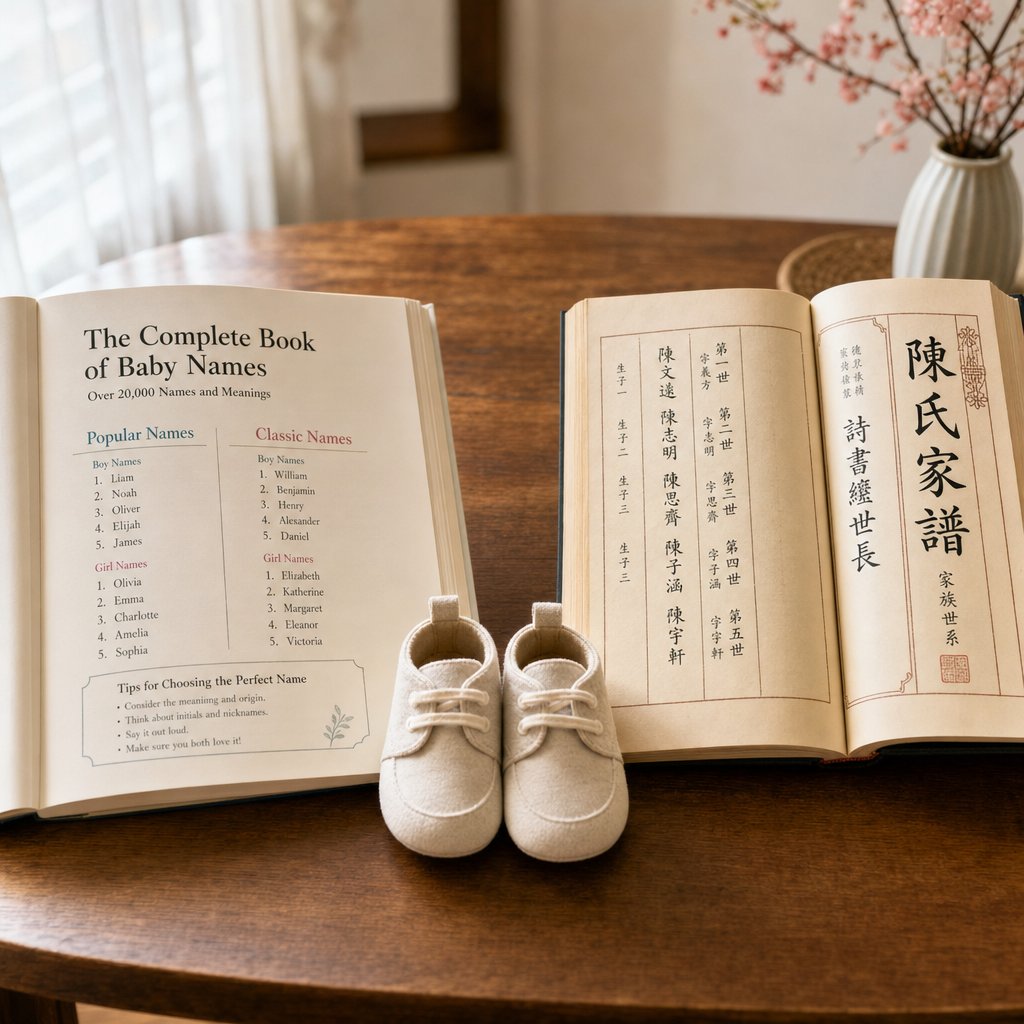
Navigating Ancestor Naming in Mixed-Heritage and Diaspora Families
Picture this scenario: a couple is expecting their first child. One partner's family assumes the baby will be named after a beloved grandmother, a gesture of love and continuity in their Western tradition. The other partner's family would find that same gesture deeply uncomfortable, even disrespectful, because their Chinese heritage treats an ancestor's name as something too sacred to place on a child. Both families want the same thing, to honor the people who came before, but their methods are in direct opposition.
This is not a theoretical dilemma. It plays out in households across North America, Europe, Australia, and anywhere bicultural Chinese families are raising children. The conflict is not about one tradition being right and the other wrong. It is about two equally valid systems of respect colliding in a single naming decision.
When Western and Chinese Naming Customs Conflict
In Western naming culture, particularly in English-speaking, Jewish, and many European traditions, giving a child a grandparent's or great-grandparent's exact name is among the highest honors a family can bestow. It says: this person mattered so much that we want their name to live on. The practice is so normalized that families sometimes feel hurt if a new baby does not carry a relative's name forward.
Chinese naming tradition operates on the opposite logic. As the previous chapters have detailed, the 避讳 (bìhuì) system treats an ancestor's characters as elevated beyond casual reuse. Honoring happens through structure, through generational poems, shared radicals, and meaning-based echoes, never through direct duplication. A Chinese grandparent hearing their exact name given to a grandchild might feel not honored but diminished, as though their identity has been flattened into a label to be recycled.
The tension intensifies when extended family on both sides has expectations. A Western grandmother may ask, "Will the baby carry my name?" while a Chinese grandfather may assume his name characters will never appear in the child's name. Neither expectation is unreasonable within its own cultural framework. The challenge falls on the parents to find an approach that respects both.
Compromise Approaches for Bicultural Families
Families navigating this space have developed practical strategies that honor both traditions without fully abandoning either. The key insight is that most bicultural children receive multiple names, an English legal name and a Chinese name, and these two names can follow different cultural rules simultaneously.
- Use the ancestor's name in the English name, follow Chinese conventions for the Chinese name: Give the child a Western first or middle name that directly honors the ancestor (satisfying the Western family's expectations), while ensuring the Chinese name follows generational poem conventions and avoids the ancestor's characters entirely. Each name operates within its own cultural logic.
- Apply creative honor techniques across both names: Use the meaning-based or radical-sharing methods from Chinese tradition to create an English name that echoes the ancestor without duplicating it. If a grandmother's name was Rose, choose a name meaning "garden" or "bloom" rather than Rose itself. This bridges both systems by honoring through meaning rather than repetition.
- Let each side of the family name within their own tradition: Some families, like writer Cecilia Huang's, invite a Chinese elder (in her case, the paternal great-grandfather) to choose the Chinese name while the parents select the English name independently. This approach respects the authority structure of Chinese naming tradition while giving parents freedom in the Western naming space.
- Use the ancestor's courtesy name or literary name as English name inspiration: If the Chinese ancestor had a 号 (hào) or 字 (zì) with a translatable meaning, use that meaning as the basis for the English name. This honors the ancestor through their chosen identity rather than their taboo birth name, satisfying Chinese convention while creating a meaningful English name.
- Explain the tradition to both families openly: Sometimes the most effective strategy is simply educating both sides. Western relatives who understand why Chinese naming avoids ancestor duplication are often fascinated rather than offended. Chinese relatives who understand that Western repetition is meant as tribute, not disrespect, can often accept a compromise they might otherwise resist.
Cecilia Huang's experience illustrates how these negotiations unfold in real life. Her family gave their daughter an English name (Rylee) chosen by the parents for its meaning of "valiant" and "courageous," while the Chinese name was gifted by the paternal great-grandfather following his family's tradition. The two names coexisted without conflict because each followed its own cultural logic. The tension she did encounter was not about ancestor duplication but about gendered naming conventions within the Chinese tradition itself, a reminder that cultural negotiation happens on multiple fronts simultaneously.
Respecting Evolving Traditions in Modern Naming Decisions
One reality that bicultural families sometimes overlook: both traditions are evolving. On the Chinese side, research from the National University of Singapore shows that generational naming practices are fading among younger Chinese Singaporeans, with most students surveyed being thoroughly unfamiliar with their family's genealogy books. Dr. Peter Tan noted that modern young parents primarily speaking English may view long-term traditions like generation names as outdated. On the Western side, naming-after conventions are also loosening, with many families choosing entirely new names that carry no ancestral reference at all.
This means there is no single "correct" answer. A family that gives their child a Chinese grandfather's exact character is not committing a cultural crime, particularly if that grandfather himself is comfortable with it. A family that strictly observes the taboo and uses only meaning-based echoes is equally valid. The tradition provides a framework, not a mandate. What matters is that the decision is informed, that parents understand what the taboo meant historically and why it existed, so their choice is deliberate rather than accidental.
Research on Chinese naming trends confirms that the landscape is diversifying rapidly. Compound surnames combining both parents' family names are emerging, maternal surnames are gaining ground in certain regions, and the rigid patrilineal structure that once governed all naming decisions is softening. In this environment, a bicultural family's creative compromise is not a departure from Chinese naming culture. It is part of the culture's ongoing evolution.
The most important gift you can give a child through their name is not adherence to any single system but a story. A name that carries meaning, that connects them to people and places and values, that gives them something to grow into. Whether that connection comes through direct repetition, structural echo, shared radicals, or a generational poem character, the intent is the same: to tell a child, through the very first word they will ever own, that they belong to something larger than themselves.
FAQs About Naming a Child After an Ancestor in Chinese Culture
1. Why is it disrespectful to name a child after an ancestor in Chinese culture?
In Chinese tradition, a person's name carries something close to their essence. Assigning an ancestor's exact characters to a child means that name would be spoken casually in everyday contexts, which diminishes the ancestor's elevated status. The practice called 避讳 (bihuì) treats ancestor names as sacred, too important to be recycled. Rather than erasing ancestors from memory, the taboo elevates their names above ordinary use, and families developed alternative systems like generational poems and meaning-based echoes to honor lineage without duplication.
2. How many generations back does the Chinese naming taboo extend?
The traditional rule required avoiding ancestor name characters going back seven generations on the paternal side. However, families with complete genealogy books (族谱) often extended the restriction to every ancestor recorded, which could mean fifteen or more generations. The taboo applied primarily to the paternal lineage, with maternal ancestors treated less strictly. In imperial contexts, even homophones of the emperor's name were forbidden across the entire empire, making the state-level restriction far broader than family-level observance.
3. What are generational name poems in Chinese naming tradition?
Generational name poems (字辈谱 or 字辈诗) are pre-composed poetic sequences where each character corresponds to one generation in a family. When a child is born, the family identifies which character belongs to the current generation and incorporates it into the child's given name. All siblings and cousins within the same generation share this character, making lineage position immediately visible. The poems typically follow classical five or seven-character line structures and express Confucian virtues or aspirations for the clan's future.
4. How can bicultural families honor a Chinese ancestor in a child's name without breaking taboo?
Bicultural families commonly use a dual-name strategy: the English legal name can directly honor an ancestor following Western convention, while the Chinese name follows traditional rules avoiding the ancestor's characters. Other approaches include choosing characters that share the same radical as the ancestor's name, selecting characters with similar meaning but different written form, drawing inspiration from the ancestor's courtesy name or literary sobriquet, or encoding the ancestor's achievements into the name's meaning rather than referencing their actual characters.
5. Do modern Chinese families still follow the naming taboo today?
Practice varies widely by region and community. Urban mainland Chinese families largely name children based on personal preference, as many genealogy books were destroyed during the Cultural Revolution. Rural southern Chinese families and overseas communities in Taiwan, Singapore, and Malaysia are more likely to maintain traditional conventions. A growing revival movement on the mainland sees families researching lost genealogies and reconnecting with naming traditions, though most adopt a flexible approach rather than strict imperial-era observance.