What Are Peranakan Chinese Surnames and Why They Matter
Imagine looking at your family name and seeing not just a word, but a centuries-old travel route. That is exactly what Peranakan Chinese surnames represent. They are living records of migration, trade, intermarriage, and cultural reinvention across Southeast Asia.
Peranakan Chinese surnames are dialect-specific romanizations of Chinese family names carried by the descendants of early Chinese migrants who settled in the Malay-Indonesian archipelago and intermarried with local communities, creating a distinct hybrid culture known as Peranakan or Straits Chinese.
The meaning of Peranakan itself offers a clue. Derived from the Malay root word anak (child), peranakan means "born of" and suggests someone locally born with heritage from elsewhere. As the Peranakan Museum explains, the term points to a mixture of cultures, a melding of ancestral Chinese traditions with the indigenous cultures of the Malay-Indonesian archipelago.
What Makes Peranakan Chinese Surnames Unique
Unlike mainland Chinese surnames written uniformly in Mandarin pinyin today, Peranakan Chinese surnames were romanized through southern dialects like Hokkien, Teochew, Cantonese, and Hakka. A single Chinese character can appear as Tan, Chan, or Chen depending on which dialect group the family belonged to and which colonial administration recorded the name. These spellings became permanent, locked into official records by British, Dutch, or Portuguese clerks who wrote down what they heard.
This makes every Peranakan surname a compressed piece of data. It tells you which province in southern China a family likely originated from, which dialect they spoke, and which port city they settled in. No mainland Chinese naming system carries this layered geographic and linguistic information in quite the same way.
The Straits Chinese Naming System at a Glance
Traditional Peranakan names followed a structured Chinese convention: the surname (seh) comes first, followed by a generational name shared among siblings or cousins, and finally a personal given name. As Baba Norman Cho documents, his own name illustrates this perfectly. Cho is the surname, Beng is the generational marker shared with brothers and male first-cousins, and Huat is the individual name.
Yet the Peranakan system went further than standard Chinese practice. Nyonya women often carried the suffix "Neo" (meaning lady in Hokkien) to distinguish locally born Straits Chinese women from later Chinese immigrants. Malay-inspired given names appeared alongside Chinese ones. English names layered on top during the colonial era. The surname, however, remained the anchor, the one constant linking a family back to its ancestral Chinese clan.
What follows is a deep exploration of how these surnames traveled from Fujian and Guangdong to every corner of Southeast Asia, how dialect and colonial policy shaped their spelling, and how you can use your own family name as a starting point for tracing your roots.
Historical Migration Routes That Shaped Peranakan Surnames
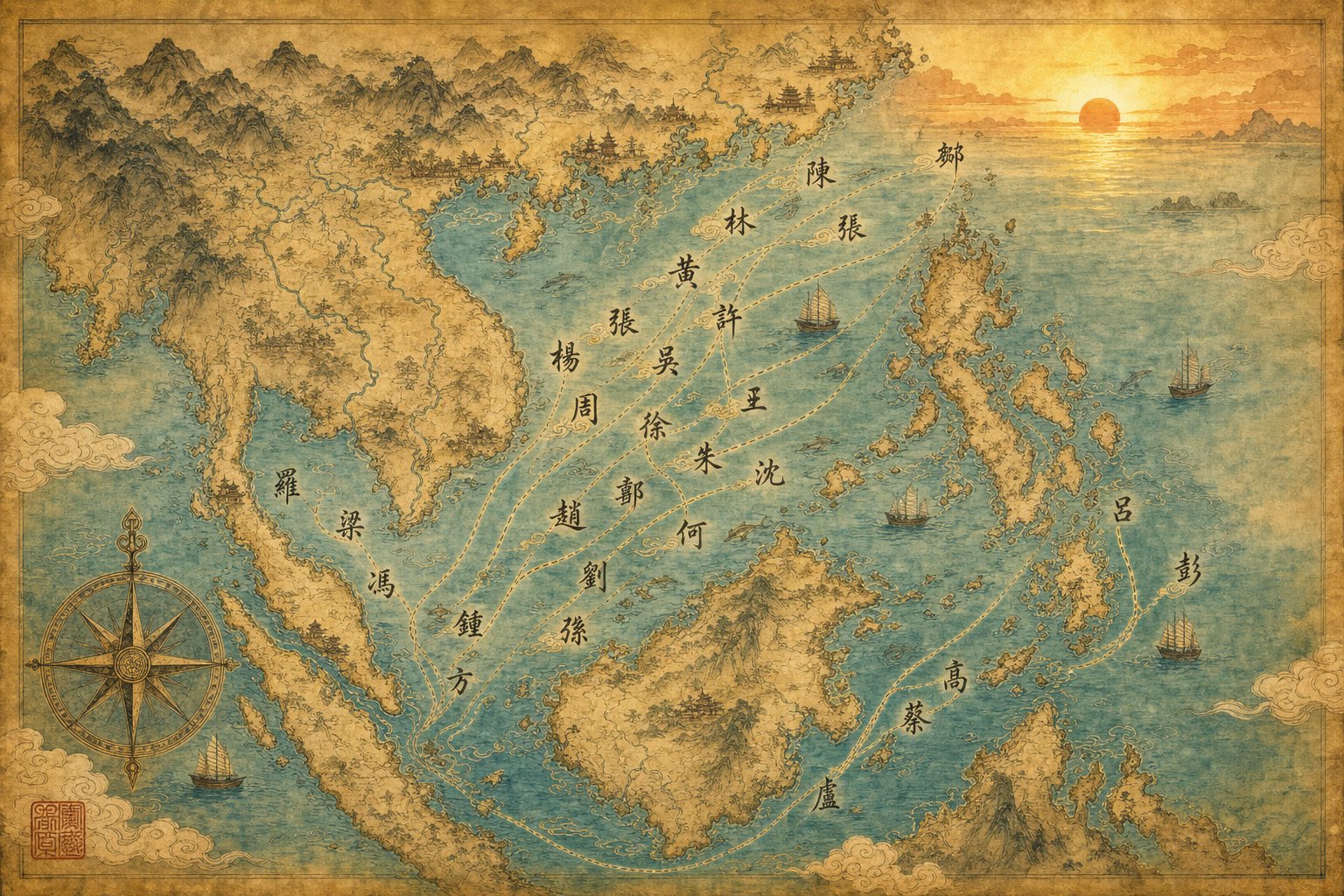
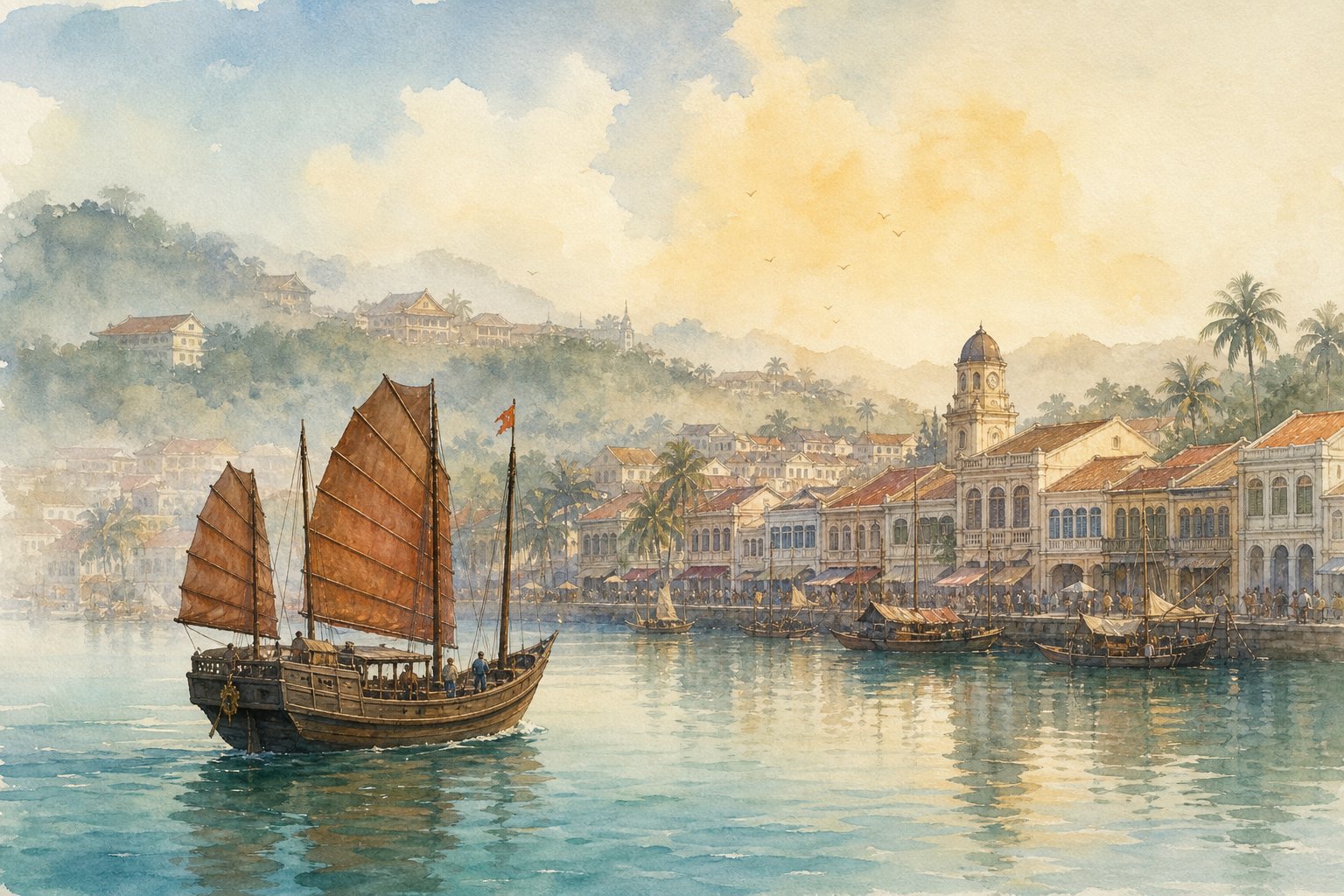
Every surname cluster in Southeast Asia traces back to a specific departure point in southern China. The provinces of Fujian, Guangdong, and Hainan did not send their people out in a single wave. Migration unfolded over centuries, shaped by trade winds, political upheaval, and economic desperation, and each wave deposited a distinct set of family names in a particular port city.
Fujian and Hokkien Traders in the Straits Settlements
The earliest Peranakans descended from Hokkien-speaking traders out of Fujian province. Chinese maritime commerce with Southeast Asia stretches back to at least the Song Dynasty (960-1279), when merchants from the port cities of Quanzhou and Guangzhou exported ceramics and received forest products in return. By the 15th century, when the Melaka Sultanate flourished as a spice redistribution hub, Hokkien traders had already established semi-permanent communities along the Straits of Malacca.
When the British founded Singapore in 1819, the first Chinese arrivals came from Melaka, and most were believed to be Hokkien, then known as Melaka-born Chinese. These Straits Chinese families carried surnames like Tan, Lim, Ong, and Goh, all romanized through the Hokkien dialect. Their early arrival gave them a commercial head start. As the National Library of Singapore documents, Hokkien Melakan Chinese held "a virtual monopoly of trade at Singapore" by the 1850s. They settled along Telok Ayer Street near the coast, dominated banking and shipping, and eventually controlled rubber planting and the import-export trade. Their surnames became the most common in both Penang and Singapore, where Hokkiens still account for over 40% of the Chinese population.
Teochew and Cantonese Migration Patterns
The Teochew, originating from the Chaozhou prefecture in Guangdong province, followed a different route. Some arrived in Singapore from the Riau Islands, where Teochew settlements already existed before British colonization. They brought surnames like Teo, Chua, and Koh, spelled according to Teochew pronunciation. Their economic strength centered on gambier and pepper cultivation rather than maritime trade, and they settled along the Singapore River. Beyond the Straits Settlements, Teochew migrants dominated the malay chinese communities of southern Thailand and Cambodia, where surnames like Teo might appear in Thai transliteration.
Cantonese speakers from the Pearl River Delta region arrived as the third-largest group. They carried surnames romanized differently again: Wong instead of Ong, Chan instead of Tan. Many were artisans, carpenters, and goldsmiths rather than merchants. Hakka migrants, known as the "guest families" of China, spread even more widely, settling in tin-mining regions across the Malay Peninsula and parts of Borneo.
How Provincial Origins Shaped Regional Surname Clusters
The connection between dialect group and geography was not accidental. New migrants turned to relatives who had arrived before them, and those relatives were almost always from the same dialect community. You'll notice this pattern repeated across every settlement: a few pioneering families established themselves, then drew in others who shared their language and provincial ties.
Here is how the major dialect groups distributed across the region:
- Hokkien (Fujian province) - dominant in Penang, Melaka, Singapore, and parts of the Philippines
- Teochew (Chaozhou, Guangdong) - concentrated in Singapore, southern Thailand, Cambodia, and Vietnam
- Cantonese (Pearl River Delta, Guangdong) - prominent in Kuala Lumpur, Ipoh, Hong Kong-linked communities
- Hakka (scattered across southern China) - settled in tin-mining areas of Perak, Selangor, and parts of Borneo
- Hainanese (Hainan Island) - late arrivals who settled in Singapore, Malaya, and parts of Thailand
The Hainanese arrived last, mainly because Hainan Island opened to foreign trade only around 1870. By then, the peranakans of Hokkien and Teochew descent had already locked down the lucrative commercial sectors. Hainanese families found their niche in the service industry, working as cooks and domestic staff for European and wealthy Straits Chinese households.
This layered timeline explains why certain surnames dominate in certain cities. A Tan in Penang almost certainly traces to Hokkien roots in Fujian. A Chan in Kuala Lumpur likely points to Cantonese origins in Guangdong. The surname itself is a geographic marker, a compressed record of which ship, which decade, and which port brought your ancestors to Southeast Asia.
Common Peranakan Chinese Surnames With Characters and Meanings
Knowing which dialect group settled where is useful, but what does your specific surname actually mean? For baba Peranakan families, the surname was more than an identifier. It connected each generation back to an ancestral Chinese character with its own origin story, often rooted in ancient kingdoms, natural imagery, or imperial honors. Here is a consolidated reference for the ten surnames you will encounter most frequently in Peranakan baba nyonya communities across the Straits.
The Ten Most Common Peranakan Surnames
The following table maps each romanized surname to its original Chinese character, Mandarin pinyin equivalent, primary dialect association, and ancestral meaning. You'll notice that most of these spellings reflect Hokkien or Teochew pronunciation, consistent with the southern Fujian and Guangdong origins of the majority of Straits Chinese families.
| Romanized Surname | Chinese Character | Mandarin Pinyin | Primary Dialect Group | Ancestral Meaning |
|---|---|---|---|---|
| Tan | 陈 | Chen | Hokkien / Teochew | Named after the ancient State of Chen (Zhou Dynasty) |
| Lim | 林 | Lin | Hokkien / Teochew | Forest |
| Ong | 王 | Wang | Hokkien | King or ruler |
| Lee | 李 | Li | Hokkien / Cantonese | Plum tree (associated with Tang Dynasty emperors) |
| Goh | 吴 | Wu | Hokkien | Named after the ancient State of Wu |
| Chua | 蔡 | Cai | Hokkien / Teochew | Named after the ancient State of Cai |
| Koh | 许 | Xu | Hokkien / Teochew | To permit or promise |
| Teo | 张 | Zhang | Hokkien / Teochew | To draw a bow (linked to archery and the bow's inventor) |
| Ng | 黄 | Huang | Teochew | Yellow (linked to the Yellow Emperor lineage) |
| Sim | 沈 | Shen | Hokkien | To sink or submerge (named after the ancient State of Shen) |
In Singapore alone, Tan accounts for roughly 9.5% of the total Chinese population, followed by Lim at 6.6% and Lee at 4.5%, according to Singapore's Statistics Department. These three surnames together represent over one in five Chinese Singaporeans.
Surname Characters and Their Original Meanings
Several patterns emerge from this list. Many of the most common surnames trace back not to descriptive words but to ancient feudal states. When those states fell, their people adopted the state name as a family identifier. The surname Chen (Tan) originated when the State of Chen was conquered by the State of Chu in 479 BC, and its displaced citizens carried the name forward. Similarly, Goh derives from the State of Wu, a powerful kingdom during the Spring and Autumn period.
Others carry vivid natural imagery. Lim means forest, rooted in a legend about a loyal minister's wife who gave birth while hiding in the woods. The character Ng (黄) means yellow and connects to the Huang Yi tribe of the ancient Dong Yi people, who used the yellow oriole as their totem. Even Ong, meaning king, and its Teochew variant Heng, reflect the prestige of royal lineage. Families with the character 王 sometimes also appear in records under the spelling Heng Pan or simply Heng, depending on the registrar's ear and the speaker's dialect.
What makes this table particularly useful for genealogical research is the dialect column. If your surname is Tan rather than Chan, your ancestors almost certainly spoke Hokkien or Teochew. If it is Teo rather than Cheong or Chong, you are likely tracing a Hokkien or Teochew line rather than a Hakka one. The spelling itself is a dialect fingerprint, and that fingerprint points to a specific region in southern China.
But the same Chinese character does not always produce the same romanized result. Depending on which dialect your ancestor spoke and which colonial clerk wrote it down, a single character could branch into four or five entirely different-looking surnames.
How Dialect Groups Created Different Spellings for the Same Surname
Picture two Peranakan families standing side by side in colonial Singapore. Both carry the exact same Chinese character on their ancestral tablets. Yet one family's official documents read "Tan" and the other's read "Chan." They share a bloodline character but appear completely unrelated on paper. How did this happen? The answer lies in the phonetic diversity of Chinese dialects and the colonial clerks who wrote down what they heard.
Why One Character Becomes Multiple Surnames
Chinese is not a single spoken language. It is a family of mutually unintelligible dialects that share a common writing system. The character 陈 looks identical whether you are in Fujian, Guangdong, or Beijing. But when spoken aloud, it sounds entirely different depending on which dialect group you belong to. A Hokkien speaker says "Tan." A Cantonese speaker says "Chan." A Hakka speaker says "Chin." And a Mandarin speaker says "Chen."
This is not a matter of accent or slight variation. These are fundamentally different sound systems that evolved over centuries of geographic isolation. Southern Chinese dialects like Hokkien and Teochew preserved ancient pronunciations from Middle Chinese, while Mandarin developed later in the north. As the Asia Media Centre explains, in territories with a sizeable Chinese diaspora like Singapore and Malaysia, the way a family name is spelled became a direct signifier of the region a person's ancestors came from.
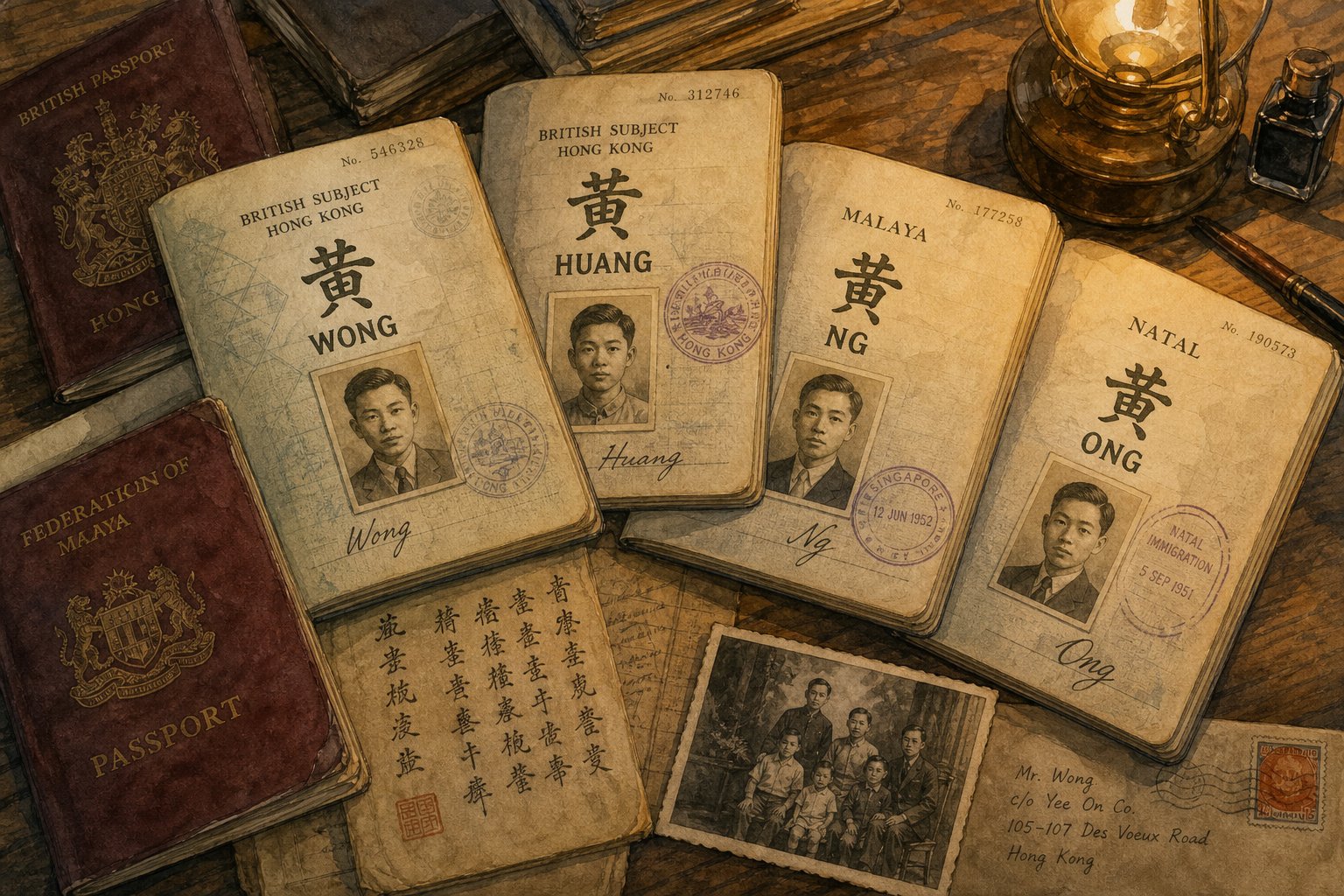
Consider the character 王, meaning "king." In Mandarin it is Wang. In Cantonese it becomes Wong. In Hokkien it transforms into Ong. And in Teochew it appears as Heng. Four completely different-looking surnames, one shared ancestor character. A person surnamed Wong is understood to have Cantonese heritage, likely tracing back to Guangdong province or Hong Kong. Someone named Ong almost certainly descends from Hokkien speakers out of Fujian.
Hokkien Versus Teochew Romanization Patterns
Hokkien and Teochew are closely related dialects, both originating from the Min Nan language group in southern Fujian and eastern Guangdong. Yet even between these two, pronunciation differences produce distinct surname spellings. The character 张 becomes "Teo" or "Teoh" in Hokkien but "Tio" in some Teochew communities. The character 黄 is "Ng" in Teochew but "Ong" or "Ooi" in certain Hokkien sub-dialects.
These subtle differences mattered enormously in practice. When a nonya or her husband registered a birth or marriage at a colonial office, the clerk transcribed the surname phonetically. If the family spoke Teochew, the clerk heard "Ng" for 黄. If they spoke Hokkien from a different sub-region, the same character might be recorded as "Ooi" or "Wee." Once written into an official register, that spelling became permanent, passed down through generations regardless of whether the family still spoke the original dialect.
Cantonese and Hakka Spelling Conventions
Cantonese romanization follows its own logic, heavily influenced by the Jyutping and Yale systems developed for Hong Kong. Hakka spellings reflect yet another phonetic tradition. The character 林 illustrates this clearly. Hokkien speakers registered it as "Lim." Cantonese speakers produced "Lam." Mandarin standardization gives "Lin." Three spellings, one forest.
The following table maps six common Chinese characters across all five major dialect romanizations. You'll see how a single character fractures into what appear to be entirely unrelated surnames:
| Chinese Character | Meaning | Hokkien | Teochew | Cantonese | Hakka | Mandarin |
|---|---|---|---|---|---|---|
| 陈 | State of Chen | Tan | Tan | Chan | Chin | Chen |
| 林 | Forest | Lim | Lim | Lam | Lim | Lin |
| 黄 | Yellow | Ong / Ooi | Ng | Wong | Vong | Huang |
| 王 | King | Ong / Heng | Heng | Wong | Wong | Wang |
| 李 | Plum tree | Lee | Lee | Lei / Lee | Li | Li |
| 刘 | Kill (archaic) | Lau / Low | Lau | Lau | Liew / Lew | Liu |
Notice how 黄 produces the widest variation. A family named Ong, a family named Wong, and a family named Ng could all share the same ancestral character without ever realizing it from their official documents alone. The nyonya meaning of identity in Peranakan culture was always layered, and surnames demonstrate this perfectly. What looks like diversity on paper often conceals shared origins underneath.
Colonial registration practices made these dialect spellings permanent. British administrators in the Straits Settlements did not standardize Chinese names into a single romanization system. They simply asked each person to state their name and wrote it down phonetically. Dutch colonial officers in the East Indies followed a similar approach, sometimes adding their own Dutch-influenced spelling conventions. A Hokkien family registering in Penang in 1870 had their surname locked into the Hokkien pronunciation forever, even if their grandchildren later switched to speaking Mandarin or English at home.
This is why surname spelling remains such a powerful genealogical tool. It freezes a moment in time, capturing which dialect your ancestor spoke on the day they walked into a registration office. That frozen pronunciation now points you back to a specific province, a specific port, and a specific community in southern China.
The same character did not just change sound across dialects. It also changed shape across national borders, as colonial administrations in Indonesia, the Philippines, and Thailand applied their own transliteration rules on top of dialect variation.
Regional Surname Variations Across Southeast Asia
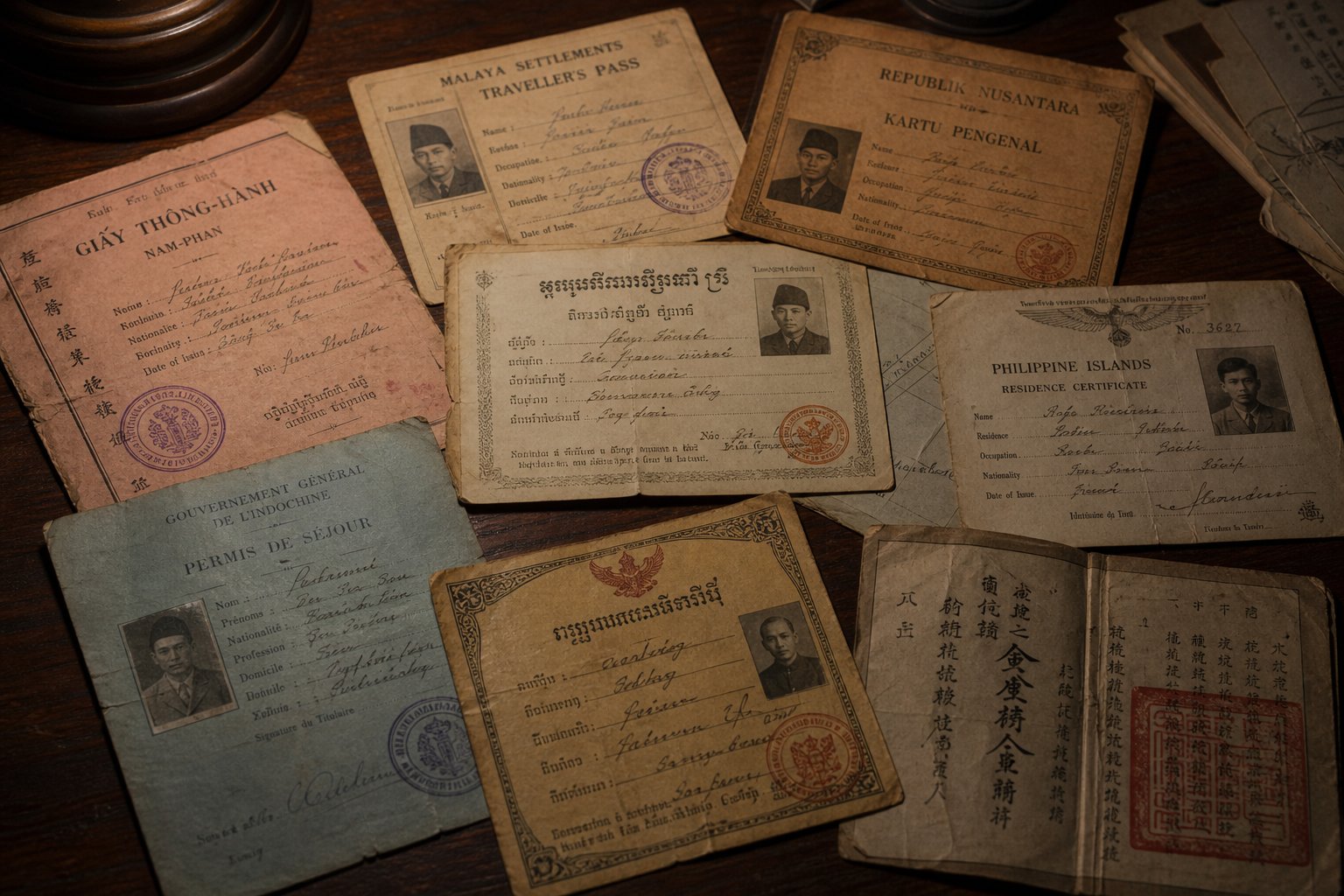
Dialect was only the first layer of transformation. Once a Chinese surname crossed a national border, it entered an entirely different bureaucratic and linguistic environment. The colonial power in charge, whether British, Dutch, Spanish, or Thai, imposed its own spelling logic on top of whatever dialect pronunciation the migrant offered. The result is that a single Peranakan family name can look radically different depending on which country's records you are reading.
Malaysian and Singaporean Surname Conventions
In Malaysia and Singapore, British colonial registration preserved dialect pronunciations with relatively minimal alteration. Clerks wrote surnames phonetically using English spelling conventions, which is why Hokkien and Teochew romanizations dominate. A baba nyonya family in Melaka registered as Tan stayed Tan. A Cantonese family in Kuala Lumpur registered as Chan remained Chan.
The British system did not force name changes or append local suffixes. What you said was what you got. This means Malaysian and Singaporean surnames remain the closest approximation to the original dialect pronunciation, making them the most useful baseline for genealogical comparison. Singapore culture and traditions around naming reflect this directness. The surname stands alone, unmodified, followed by given names in dialect or English.
One quirk worth noting: some families in Penang adopted a slightly different romanization than the same dialect group in Singapore, simply because different clerks heard the same sound differently. A Hokkien family might be "Khoo" in Penang but "Koh" in Singapore, both representing the character 许. These micro-variations reflect the individual registrar's ear rather than any systematic policy difference.
Indonesian Peranakan Name Adaptations
Indonesia presents the most dramatic transformation. Under Dutch colonial rule, Chinese surnames were already being recorded with Dutch-influenced spelling. But the real rupture came in 1967, when the Indonesian government issued a decree compelling all citizens of Chinese ancestry to abandon their Chinese names in favor of Indonesian-sounding ones.
Families responded by encoding their original surname within a longer Indonesian name. The Hokkien surname Ong (王) might become Ongkowijoyo. Tan might transform into Tantowi or Tanudirdjo. Lim could appear as Limanto or Halim. The original Chinese surname was buried inside the new name, hidden in plain sight. As the South China Morning Post reported, Surabaya-born Hwely Ongkowijoyo's grandparents converted their family name Wang (Ong in Hokkien) to Ongkowijoyo under the 1967 regulation. The Indonesian-ised name remained in use for two generations until 2013, when the family legally revived the original surname Wang for a newborn daughter.
Here are common patterns of Indonesian surname adaptation:
- Ong became Ongkowijoyo, Ongko, or Onggara
- Tan became Tantowi, Tanudirdjo, or Tanuwijaya
- Lim became Limanto, Halim, or Salim
- Goh became Gozali or Gunawan
- Chua became Tjuatja or Cahyadi
Some families abandoned the Chinese root entirely, choosing purely Indonesian names like Wijaya or Santoso. Others preserved just the first syllable as a subtle marker. The Dutch colonial period had already introduced some spelling shifts, such as using "Tj" for the "Ch" sound, but the 1967 policy went far beyond spelling. It attempted to erase the surname as an ethnic identifier altogether.
Thai and Filipino Surname Transformations
Thailand took a different approach. In 1913, King Vajiravudh (Rama VI) passed the Surname Act requiring all Thai citizens to adopt hereditary family names for the first time. Chinese families in Thailand, many of Teochew descent who had migrated through the thai singapore trade corridor, were required to create Thai-sounding surnames. Some translated their Chinese surname's meaning into Thai. Others appended Thai suffixes like "-porn" (blessing), "-chai" (victory), or "-kit" to their original Chinese name. A Teochew family surnamed Tan might become Tansiri or Tancharoen. Unlike Indonesia, Thailand did not ban Chinese culture outright, but the naming policy effectively disguised Chinese origins within Thai phonetic structures.
The Philippines produced perhaps the most elaborate transformations. Under Spanish colonial rule, Chinese converts to Catholicism often adopted their Spanish godparents' surnames entirely. Those who kept modified Chinese names had them Hispanicized with suffixes like -co, -son, -zon, and -tco. The majority of Chinese Filipinos trace their roots to Fujian province, so Hokkien pronunciations form the base of these hybrid names.
Examples of Filipino-Chinese surname transformations include:
- Tan became Tanseco, Tanchanco, Tantoco, Tancinco, or Tanhueco
- Ong became Ongpin, Ongkeko, Ongsiaco, or Ongtengco
- Lim became Limjoco, Limson, Limcaoco, or Limjap
- Go (Goh/Wu) became Gokongwei, Gosiengfiao, Gotiangco, or Golamco
- Sy (Shi) became Sycip, Syjuco, Syquia, or Sytengco
- Cojuangco derived from the Hokkien surname Ko combined with additional characters
The "-co" suffix in Filipino-Chinese surnames typically derives from the Hokkien word "ko" (哥), an honorific meaning elder brother. The "-son" or "-zon" ending often represents the Hokkien word "sun" (孙), meaning grandson. So a name like Limson literally encodes "grandson of Lim" within a Hispanicized spelling framework. Having such a surname signifies that a Chinese ancestor converted to Roman Catholicism and was integrated into Philippine colonial society.
What emerges from this regional comparison is a clear pattern: the more interventionist the colonial or national government, the more dramatically the original Chinese surname was altered. British Malaya preserved surnames almost intact. The Dutch East Indies modified spelling. Thailand required new constructions. Spain and the Philippines created entirely new hybrid forms. Each country's approach left a distinct forensic signature that modern descendants can now decode to trace their family's path across Southeast Asia.
Yet surnames did more than identify individuals. In the Straits Settlements, sharing a surname meant belonging to a powerful social network that controlled commerce, settled disputes, and arranged marriages.
Clan Associations and the Social Power of Shared Surnames
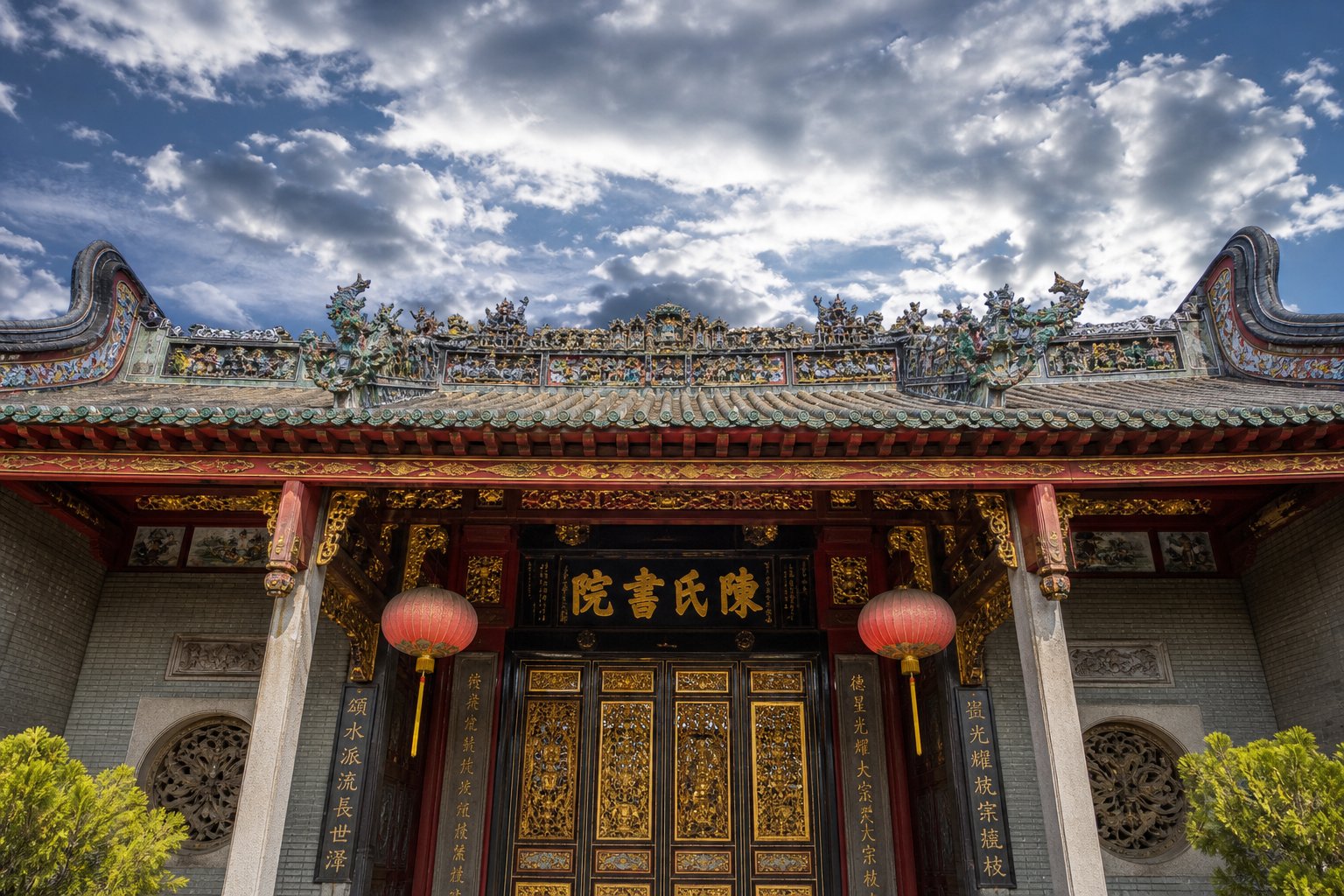
A surname was never just a label in the Straits Settlements. It was a membership card. When a Hokkien trader named Tan arrived in 19th-century Penang with little more than the clothes on his back, the first place he turned was the clan association, the kongsi, where every other Tan would help him find work, housing, and a foothold in an unfamiliar port city. Shared surnames built entire social ecosystems, and those ecosystems shaped the commercial and political landscape of Southeast Asia for generations.
The Kongsi System and Surname-Based Communities
Chinese associations in the Straits Settlements were established based on four organizing principles: kinship, locality, dialect, and profession. Among these, surname-based kongsi held a special status because they invoked the deepest possible bond, the claim of shared ancestry. A study of Chinese associations in Penang found that these organizations emerged as the community grew larger through successive waves of migration, with members gathering to help each other in a foreign land. The kongsi became the primary institution for building social order among overseas Chinese.
Imagine arriving in a port where you speak no Malay, have no British connections, and carry no capital beyond your labor. The clan hall bearing your surname offered immediate relief. It functioned as a one-stop institution covering nearly every aspect of life:
- Trade networks and employment - connecting new arrivals with established merchants who shared their surname and dialect
- Marriage arrangements - facilitating introductions between families of compatible social standing
- Temple maintenance and religious activity - organizing ancestral worship, festivals, and funeral rites
- Burial grounds - providing cemetery plots reserved for clan members
- Education - funding schools and scholarships for members' children
- Dispute resolution - mediating conflicts within the community before they reached colonial courts
- Mutual aid and welfare - offering financial support during illness, business failure, or family emergencies
The Penang Hokkien Kongsi, for example, served as both a religious center and a commercial clearinghouse. Wealthy baba and nyonya families who had been established for generations sat on its leadership committees, while newly arrived migrants relied on its networks for survival. This layered structure meant that surname associations were not egalitarian clubs. They were hierarchical organizations where the oldest, wealthiest families wielded influence over newer arrivals who shared their name.
How Clan Associations Shaped Peranakan Commerce
The commercial power of these surname networks cannot be overstated. In Penang, research into the five dominant Hokkien surnames revealed that clan-based business alliances controlled key sectors of the local economy. A Tan merchant extending credit to another Tan was not simply being generous. He was investing in a network where reputation, enforced by the kongsi, guaranteed repayment more reliably than any colonial court could.
The National Library of Singapore notes that prominent Peranakan leaders like Tan Jiak Kim, Seah Liang Seah, Lim Boon Keng, and Song Ong Siang came together in 1900 to form the Straits Chinese British Association. Notice the surnames: Tan, Seah, Lim, Song. Each man represented not just himself but an entire clan network. Their collective influence allowed the SCBA to advocate for Peranakan interests at the highest levels of colonial governance. The association initially promoted loyalty to the British Empire while simultaneously protecting the commercial privileges of established Straits Chinese families.
This pattern, where surname-based solidarity translated directly into economic and political power, repeated across every major settlement. In Singapore, the nyonya baba elite dominated real estate, shipping, and banking precisely because clan networks provided the trust infrastructure that formal institutions could not yet offer.
Yet the kongsi system also had to accommodate a defining feature of Peranakan identity: intermarriage. The intermarried definition in the Peranakan context refers specifically to unions between Chinese men and local Malay or Indonesian women, marriages that produced the hybrid culture we now call Peranakan. These unions posed a structural question for surname-based organizations. If the clan was built on patrilineal Chinese descent, what happened when the mother was Malay?
The answer was pragmatic. Patrilineal conventions held firm. Children of these mixed marriages inherited their father's Chinese surname and were accepted into his clan association. The mother's Malay heritage shaped domestic life, language, cuisine, and dress, but it did not alter the surname line. A child born to a Tan father and a Malay mother was still a Tan in the eyes of the kongsi, still entitled to clan membership, burial rights, and business networks. This is how baba and nyonya families maintained their connection to Chinese clan structures across generations, even as their daily culture became increasingly localized.
The system worked because it separated cultural identity from lineage identity. You could speak Baba Malay at home, wear a sarong kebaya, cook with rempah, and still carry a Chinese surname that linked you to a kongsi, a temple, and ultimately a village in Fujian. The surname was the thread that held the Chinese half of Peranakan identity intact, even when everything else had blended.
This delicate balance between cultural adaptation and surname preservation held for centuries. It took a 20th-century government decree, not gradual assimilation, to finally sever the link between Peranakan families and their ancestral Chinese names.
Indonesian Political Policies and Peranakan Surname Suppression
For centuries, baba nyonya Peranakan families in the Indonesian archipelago maintained their Chinese surnames through intermarriage, cultural blending, and colonial transitions. Then, in a matter of months, a government decree attempted to erase what generations had preserved. The forced name changes imposed during Indonesia's New Order regime represent one of the most dramatic disruptions to heritage Chinese naming traditions anywhere in Southeast Asia.
Forced Name Changes Under Indonesian Policy
After the political upheaval of 1965, Major General Suharto consolidated power and launched what became known as the Orde Baru (New Order). His government viewed the ethnic Chinese minority, though constituting less than 3% of the population, as economically dominant outsiders whose loyalty lay with the People's Republic of China. In 1967, the cabinet issued Cabinet Presidium Decision no. 127/1966, specifying that "in the process of nation and character building, Indonesia needs to accelerate the assimilation process of Indonesian citizens of foreign descent," and that name changes into Indonesian names "could support this assimilation process."
The policy did not stop at surnames. Displays of Chinese culture, including Chinese New Year celebrations, the use of Chinese characters, and learning Mandarin in public, were all prohibited. For baba Java communities and Peranakan families across the archipelago, the ganti nama (name change) decree struck at the most fundamental marker of ancestral identity: the family name itself.
Giving up one's family name could be experienced as tantamount to giving up one's identity and family. The ganti nama ruling disconnected Peranakan Chinese from their heritage background, obliging them to reside under a different name and essentially forcing them to trade one membership over the other.
The simplified process for changing names was valid from late 1966 until March 31, 1968. After that date, anyone still wishing to change had to follow a lengthier legal procedure. As one respondent in the Emerald study recalled, "Not doing it was seen as a risk not worth taking." Families faced practical pressures: children could be barred from university enrollment, business permits could be denied, and official documents became difficult to process without an Indonesian-sounding name.
How Families Preserved Surname Heritage in Secret
Despite the official erasure, families found ways to encode their Chinese surnames within the new Indonesian names. A family surnamed Thio might become Hadisaputro. The Sie family adopted Sidarto. A person named Lim might take on Limanto or Halim. As documented in the case of the Huang family, the surname Huang (or Wang in Mandarin, Ong in Hokkien) was transformed into Ingkiriwang, a name that buried the original within an Indonesian-sounding construction.
The encoding strategies varied widely:
- Embedding the surname as a prefix - Tan became Tanuwijaya, Sie became Sidarto, Ong became Ongkowijoyo
- Phonetic echoes - Siem became Simon, Ong Nio became Ony
- Meaning-based translation - some families chose Indonesian words reflecting the meaning of their Chinese character
- Complete replacement - others selected entirely unrelated Indonesian names like Wijaya or Santoso
One unintended consequence was that extended families became untraceable by surname. Since there was no requirement for relatives to choose the same Indonesian name, siblings, cousins, and branches of the same clan often ended up with completely different family names. "It's annoying, as we cannot search for cousins, relatives simply by looking at surnames," one family member recounted in the Emerald study. The most basic familial binding tie had been severed on paper.
Yet oral tradition kept the knowledge alive. Elderly relatives continued to use Chinese names in private. Family records, birth certificates, and ancestral tablets preserved the original characters. Parents taught children the three-part Chinese naming structure: surname first, generational marker second, personal name third. The heritage Chinese identity persisted in kitchens, family gatherings, and whispered conversations, even when it could not appear on any official document.
Reclaiming Ancestral Names After the New Order
In 1998, amid economic collapse and communal violence, Suharto resigned. His successor, B.J. Habibie, rolled back the discriminatory policies. Chinese cultural expression was no longer banned, and families could legally reclaim their original surnames.
The process of balik nama (returning to one's name) has unfolded gradually. As the South China Morning Post reported, Surabaya-born Hwely Ongkowijoyo waited until 2013 to legally name his newborn daughter Vivian Wang, reviving the original family name after two generations under Ongkowijoyo. His wife explained: "We felt that change was needed to move with the times. Ongkowijoyo sounded like it was from another era."
For Peranakan Chinese who emigrated to the Netherlands during the late 1960s migration wave, Dutch citizenship offered an opportunity to reclaim their birth names outside the reach of the Orde Baru regime. Research published in the Journal of Organizational Ethnography found that the reason for balik nama could be summarized simply: "because I was born with it." For those who carried active memories of their Chinese name, reclaiming it represented both a statement and a reinstatement of heritage against an imposed identity.
Not everyone chose to revert. Younger generations who grew up knowing only their Indonesian names often feel no emotional connection to the Chinese original. As one researcher noted, "I have no intention of doing that, as I identify myself with my Indonesian name." The decision is deeply personal, shaped by which name a person was raised with, which name their community knows them by, and which name feels like home.
What the Indonesian experience reveals is that surnames are not merely administrative labels. They carry emotional weight, ancestral memory, and a sense of belonging that no government decree can fully erase. For baba nyonya Peranakan descendants still navigating this legacy, the question of which name to carry forward remains an active, living conversation rather than a settled historical footnote.
The Indonesian policy disrupted surname transmission at the institutional level. But within individual families, naming conventions had always been more complex than a single surname suggested, involving generational markers, gendered suffixes, and the constant negotiation between Chinese tradition and local custom.
Naming Conventions Beyond the Surname in Peranakan Families
A Peranakan surname told the world which clan you belonged to. But the names that followed it, the generational marker, the personal name, and for women, the distinctive suffix, told a more intimate story about birth order, family aspirations, and gender. These naming layers reveal how Straits Chinese families wove Chinese patrilineal tradition together with local Malay sensibilities into a system entirely their own.
Baba Male Naming Conventions and Generational Patterns
A full Baba name was not chosen casually. It followed a structured Chinese convention where each component carried specific meaning and purpose. As Baba Norman Cho explains, his own name, Cho Beng Huat, illustrates the system perfectly: Cho is the surname, Beng is the generational name shared with all brothers and male first-cousins, and Huat is the individual given name.
The typical structure of a full Peranakan male name followed this order:
- Surname (seh) - the patrilineal clan name inherited from the father, always placed first
- Generational character - a shared name linking all male siblings and male first-cousins of the same generation
- Personal given name - the individual name chosen specifically for the child, often carrying auspicious meaning
The generational character was the glue binding a cohort of male relatives together. If one brother was named Beng Huat, his brothers might be Beng Hock and Beng Seng. You could identify cousins at a glance simply by spotting the shared middle name. This practice mirrored the Chinese zibei (字辈) tradition, where a predetermined sequence of generational characters was set by ancestors, sometimes mapped out for twenty or more generations in advance.
Choosing the personal name was a serious affair. Families believed names shaped destiny. Cho's maternal great-grandfather provided a list of three names in deliberate chronological order: Hock (fortune), Huat (prosper), Seng (rise). The logic was sequential. One must build fortune first, then prosper, then rise in status. When Cho's mother accidentally selected the second name for the firstborn, she disrupted the intended progression and received a stern reprimand. This level of intentionality was typical. Names were not decorative. They were prescriptive, encoding parental hopes into the child's identity from birth.
Sometimes the generational name was dropped entirely. This happened for practical reasons, to improve fortune according to a geomancer's advice, for convenience, or simply because a boy had no brothers or male first-cousins to share the generational marker with. Cho's own great-grandfather, born Cho Boon Poo, became commonly known as just Cho Poo.
Nyonya Names and the Neo or Niang Suffix
The nya name meaning in Peranakan culture carries a specific feminine marker that distinguished locally born Straits Chinese women from later Chinese immigrants. Among the most recognizable names of women in Singapore's Peranakan community was the suffix "Neo," the Hokkien pronunciation of the character Niang (娘), meaning "lady."
A typical Nyonya name followed a three-character structure: the clan surname, a middle name, and "Neo." So a daughter of the Tan family might be registered as Tan Choon Neo. As research from BabaGabra documents, this practice has ancient roots in southern Chinese culture, inherited from Tang and Song Dynasty conventions where women's names often included Niang to signify femininity and respectability. The tradition was mainly present among Hokkien communities, where it was supposedly inherited from those earlier dynasties. Hakka Nyonyas also used the character but spelled it "Nyong," reflecting Hakka pronunciation. Interestingly, Teochew and Cantonese Nyonyas did not follow this naming tradition.
Female generational names differed from their brothers'. While boys in the Cho family shared "Beng," their sisters and female cousins might share a feminine generational name like "Seok," producing names such as Seok Choo, Seok Kim, and Seok Chin. The "Neo" suffix could be added at birth as part of the official registered name, or it could be adopted later upon reaching adulthood, following the older Chinese custom where a girl's childhood house name gave way to a formal "Niang" name signifying maturity.
Some of the most prominent names of females in Singapore's history carried this marker. Dr. Lee Choo Neo, born in 1895, became Singapore's first female medical doctor. Amy Khoo Chwee Neo became a respected Buddhist leader. These women demonstrate that "Neo" was not merely decorative. It signified belonging to the Straits-born community and carried connotations of dignity and feminine strength traceable back to figures like Lim Bek Neo, the Song Dynasty woman later deified as Mazu, Goddess of the Sea.
A variation existed where the generational name was omitted entirely, leaving just the surname plus a personal name plus Neo. Cho's paternal grandmother was simply known as Koon Neo, and her sisters were Say Neo, Bock Neo, and Cheng Neo. This shorter form was common among many Nyonya names and gave the suffix even greater prominence as the defining identity marker.
Balancing Chinese and Local Naming Customs
The Peranakan naming system did not exist in a Chinese vacuum. Malay culture seeped into naming practices in ways that would have been unthinkable in mainland China. Some families officially registered children with names drawn directly from Malay words. A grandaunt in one family received the name Yeo Bulat (bulat meaning "circle" in Malay). Others were named Bah Chik (from Baba Kechik, meaning "youngest Baba") or Nya Chik (Nyonya Kechik, meaning "youngest Nyonya"). These Malay-inspired names sat comfortably alongside Chinese surnames on official documents, reflecting the dual cultural identity that defined Peranakan life.
Nicknames in Baba Malay added another informal layer. Known as nama-gelair, these were descriptive tags used within families and among friends: si katek (short), si puteh (fair-skinned), si gemok (plump). They were never registered officially but formed part of a person's social identity within the community.
From the early 20th century, English names entered the mix. English-educated Peranakans adopted Western names for practical reasons: ease of interaction with British administrators, the status symbol of English education, or Christian baptismal names upon religious conversion. Biblical names like John, Peter, and Mary were popular among converts. Names ending in "-ly" such as Molly, Nellie, and Lily were considered more feminine and became favorites for Nyonya daughters. One anglophile grandfather gave his sons only English names, Charlie and George, with no Chinese names at all, until the brothers later felt the loss of identity and registered Chinese names through the local court.
The 1980s brought another shift when Singapore introduced mandatory Hanyu Pinyin registration. A Peranakan father named Tan Kim Tian suddenly faced having a son registered as Chen Wenqing rather than Tan Boon Keng. The Hokkien flavor vanished. The dialect fingerprint that had survived centuries of migration was erased in a single bureaucratic stroke. As one father lamented, "I am a Tan but my children are Chens." The regulation has since been relaxed to allow dialect names alongside pinyin, but the episode illustrates how fragile these naming traditions remain in the face of standardization policies.
What emerges from this layered system is a naming culture that functioned like geological strata. The Chinese surname sat at the bedrock. Generational markers and Neo suffixes formed the next layer. Malay-inspired names, English additions, and modern pinyin requirements accumulated on top. Each layer recorded a different era of Peranakan history, and a full name could contain all of them simultaneously. Understanding these layers is not just academic. For anyone tracing Peranakan ancestry, each component of a name offers a distinct clue pointing toward a specific time, place, and cultural moment in the family's past.
How to Trace Your Peranakan Chinese Surname Origins
Every naming layer discussed so far, the dialect spelling, the generational marker, the Neo suffix, the Indonesian encoding, represents a clue waiting to be decoded. The question most Peranakan descendants eventually ask is practical: where do I actually start? Whether you are holding a faded birth certificate with your paternal grandma's name in Chinese characters you cannot read, or staring at a surname you have carried your whole life without knowing its provincial origin, the research process follows a logical sequence that begins with what you already have.
Starting Your Peranakan Surname Research
Your surname spelling is your first and most accessible piece of evidence. As the earlier dialect tables demonstrate, the romanization itself narrows your ancestral origin to a specific dialect group and, by extension, a specific region in southern China. A surname spelled "Tan" points to Hokkien or Teochew roots in Fujian or eastern Guangdong. "Chan" signals Cantonese heritage from the Pearl River Delta. "Chin" suggests Hakka origins. You do not need archives or DNA kits to extract this information. The spelling does the work for you.
From that starting point, here is a step-by-step process for tracing your family line back toward its source:
- Identify your dialect group from the surname spelling - Use the romanization tables in this article to determine whether your surname reflects Hokkien, Teochew, Cantonese, or Hakka pronunciation. If your family is Indonesian Peranakan, extract the original Chinese surname embedded within the Indonesian name (e.g., Ongkowijoyo contains Ong).
- Gather family oral history - Interview the oldest living relatives. Ask about ancestral villages, dialect spoken at home, clan associations the family belonged to, and any Chinese characters they remember for the surname. Even fragments like "my grandfather said we came from Amoy" provide critical geographic anchors.
- Locate your relevant clan association - Search for surname-based kongsi in your family's settlement city. The Tan clan association in Penang, the Lim See Tai Ong Si in Singapore, or the Khoo Kongsi all maintain membership records stretching back generations.
- Access colonial-era registration records - Birth, marriage, and death certificates from British Malaya, the Dutch East Indies, or the Straits Settlements contain Chinese characters alongside romanized names. Singapore's National Archives and Malaysia's Jabatan Pendaftaran Negara hold these records.
- Search Chinese genealogical databases - FamilySearch's China Collection of Genealogies (1239-2014) contains clan genealogies collected from institutions across China, Southeast Asia, and North America. These records include brief histories of family origins, dispersion patterns of branches, lists of male ancestors by generation, and spouse surnames.
- Cross-reference temple and burial records - Chinese temples and clan cemeteries maintained their own registers. Tombstone inscriptions often include the ancestral village name in Chinese characters, providing the exact geographic origin that surname spelling alone cannot pinpoint.
- Consider DNA testing for deeper confirmation - Services like 23andMe and WeGene can confirm southern Chinese ancestry and sometimes identify specific provincial clusters. DNA results are most useful when combined with documentary evidence rather than used in isolation.
Key Records and Resources for Tracing Ancestry
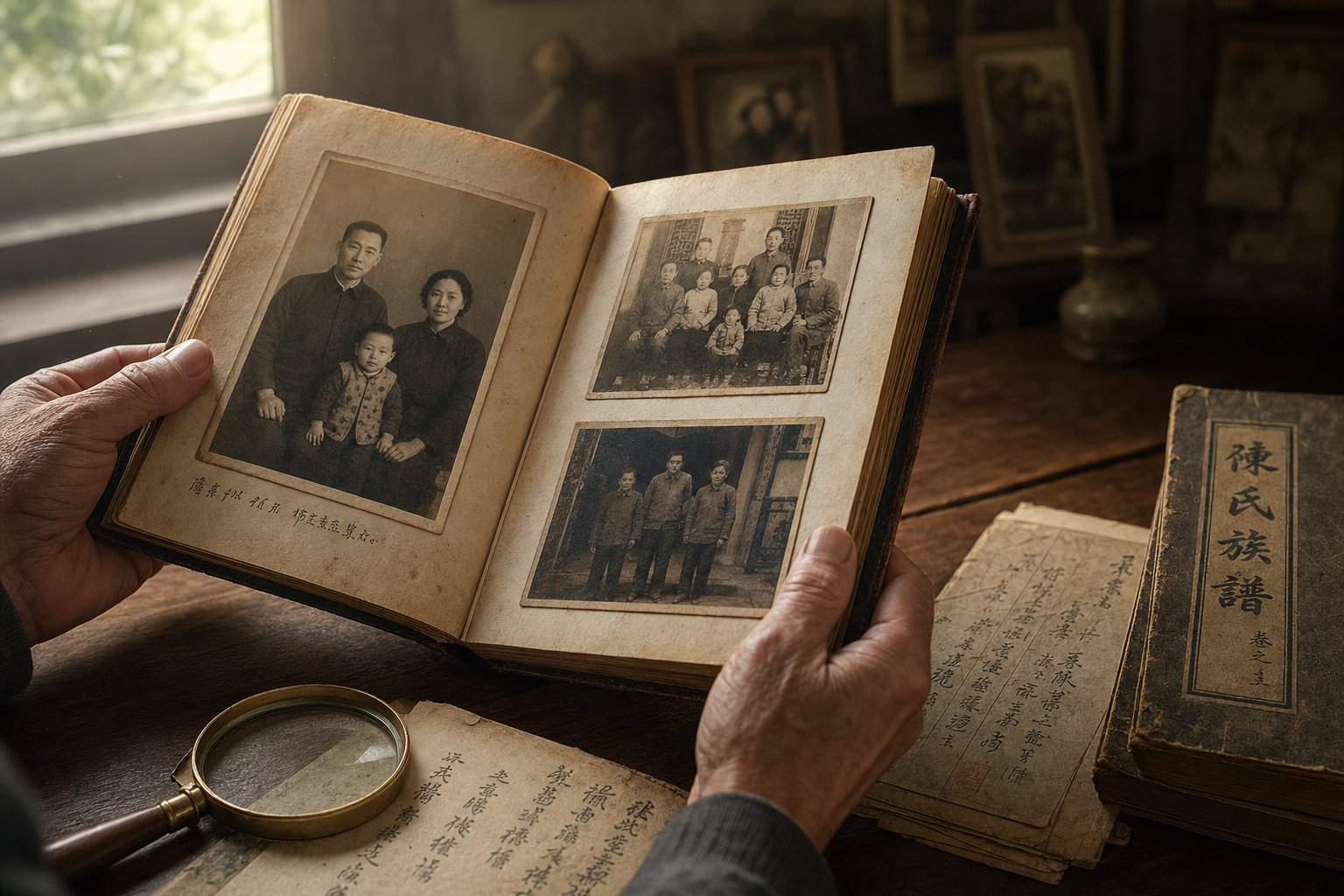
The richest documentary sources for Peranakan genealogy sit in overlapping archives that most people never think to check together. Colonial registration records capture the official moment when a dialect pronunciation became a permanent surname. Temple donation records list contributors by full Chinese name and ancestral village. Clan genealogies, the zupu (族谱), represent the deepest well of information.
FamilySearch's collection is particularly valuable because it aggregates genealogies from private households and collectors in Taiwan, Hong Kong, Southeast Asia, and the United States. As their collection description notes, these records primarily contain information from the Qing dynasty through the Republic era (1700s to early 1900s), precisely the period when most Peranakan ancestors departed southern China. The genealogies vary in depth. Some are hand-copied single-volume manuscripts covering only recent generations. Others are published multi-volume works averaging ten volumes per title, with detailed pedigree charts spanning centuries.
To search these records effectively, you'll need your ancestor's Chinese name (or at least the surname character), an approximate time period, and ideally a province. If you only have the romanized surname, the dialect tables in this article help you identify the likely Chinese character, which then becomes your search key.
Beyond FamilySearch, other valuable resources include:
- Singapore's National Archives (NAS) - holds Straits Settlements civil registration records from the 1860s onward
- Malaysia's Arkib Negara - contains colonial-era birth, marriage, and death registers for Penang, Melaka, and other states
- The Peranakan Museum (Singapore) - maintains research collections and can direct inquiries to relevant clan organizations
- Chinese clan genealogy websites - platforms like My China Roots and Zupu.cn offer searchable databases of digitized genealogies
- Dutch colonial archives (Nationaal Archief, The Hague) - essential for Indonesian Peranakan families seeking pre-1967 records
Physical heirlooms also carry genealogical data. A peranakan ring passed down through generations might bear an engraved Chinese character. Peranakan tiles decorating an ancestral home sometimes include family motifs linked to specific clans. Even vintage Chinese silk embroidery panels found in old Nyonya households occasionally contain embroidered characters identifying the commissioning family. These material objects supplement paper records and can confirm details that documents alone cannot provide.
Connecting With Clan Associations Today
Clan associations have not disappeared. Many have modernized, digitized their records, and actively welcome descendants seeking to reconnect. The Khoo Kongsi in Penang operates as both a heritage site and a living clan organization. Singapore's Federation of Hokkien Clan Associations coordinates among multiple surname groups. In Indonesia, post-Suharto cultural revival has seen Chinese clan organizations re-emerge after decades of suppression.
When approaching a clan association, come prepared. Bring whatever documentation you have: old identity cards, birth certificates, photographs of tombstones, or even just the romanized surname and the city where your earliest known ancestor lived. Many associations maintain registries of members dating back to the 19th century. If your great-grandfather was a member, his entry may include his ancestral village in Fujian or Guangdong, the exact detail needed to bridge the gap between Southeast Asia and China.
For descendants whose families underwent Indonesia's forced name changes, clan associations can sometimes help reconstruct the original surname from the Indonesian adaptation. The encoding patterns (Tan to Tanuwijaya, Ong to Ongkowijoyo) are well-known within these communities, and elder members often remember which Indonesian names correspond to which Chinese originals.
The genealogical journey does not end with finding a village name in Fujian. Chinese clan genealogies can extend your family line back centuries further. FamilySearch notes that some records in their collection reach as far back as 1239, though most Peranakan-relevant material clusters in the 1700s-1900s range. The depth available depends on whether your ancestral clan maintained a written zupu and whether that document survived war, revolution, and the Cultural Revolution's destruction of genealogical records.
What makes this research uniquely rewarding for Peranakan descendants is the convergence of multiple evidence streams. Your surname spelling identifies the dialect. The dialect identifies the province. Colonial records identify the settlement city. Clan genealogies identify the village. And DNA testing can confirm the biological connection across all those documentary links. Each piece reinforces the others, building a chain of evidence that transforms a single romanized surname into a complete migration narrative, the map written in your name.
Frequently Asked Questions About Peranakan Chinese Surnames
1. What is the difference between Tan, Chan, and Chen as surnames?
Tan, Chan, and Chen all represent the same Chinese character 陈 but were romanized through different dialect groups. Tan reflects Hokkien or Teochew pronunciation from Fujian province, Chan comes from Cantonese speakers in the Pearl River Delta, and Chen is the standard Mandarin pinyin used in mainland China today. Colonial clerks wrote down what they heard phonetically, so the spelling permanently recorded which dialect a family spoke at the time of registration.
2. Why do Indonesian Peranakan Chinese have different surnames from Malaysian or Singaporean Peranakan?
In 1967, the Indonesian government under Suharto forced all citizens of Chinese descent to abandon their Chinese surnames and adopt Indonesian-sounding names. Families encoded their original surnames within longer Indonesian names, such as Tan becoming Tanuwijaya or Ong becoming Ongkowijoyo. In contrast, British colonial administration in Malaysia and Singapore preserved dialect-based surname spellings without requiring modification, keeping them closer to the original pronunciation.
3. How can I find out which Chinese character my Peranakan surname represents?
Start by identifying your dialect group based on the surname spelling. Hokkien surnames like Tan, Lim, Ong, and Goh point to Fujian origins, while Cantonese spellings like Chan, Lam, and Wong suggest Guangdong roots. Cross-reference your romanized surname with dialect comparison tables to identify the likely Chinese character. Clan associations, colonial-era birth certificates, and ancestral tombstone inscriptions often contain the original Chinese characters alongside the romanized form.
4. What does the Neo suffix mean in Peranakan Nyonya names?
Neo is the Hokkien pronunciation of the Chinese character Niang (娘), meaning lady. It was added to the names of locally born Straits Chinese women to distinguish them from later Chinese immigrants. The tradition traces back to Tang and Song Dynasty naming conventions and was primarily used among Hokkien Peranakan communities. Hakka Nyonyas used the variant spelling Nyong, while Teochew and Cantonese Peranakan women generally did not follow this naming practice.
5. What resources are available for tracing Peranakan Chinese ancestry?
Key resources include clan association membership records, colonial-era civil registration documents held at Singapore's National Archives or Malaysia's Arkib Negara, FamilySearch's China Collection of Genealogies spanning 1239 to 2014, Chinese temple donation registers, and cemetery tombstone inscriptions. Physical heirlooms like engraved rings or embroidered textiles may also contain Chinese characters identifying the family clan. DNA testing services can confirm southern Chinese provincial origins when combined with documentary evidence.