The Phoenix Character in Chinese Is Not What You Think
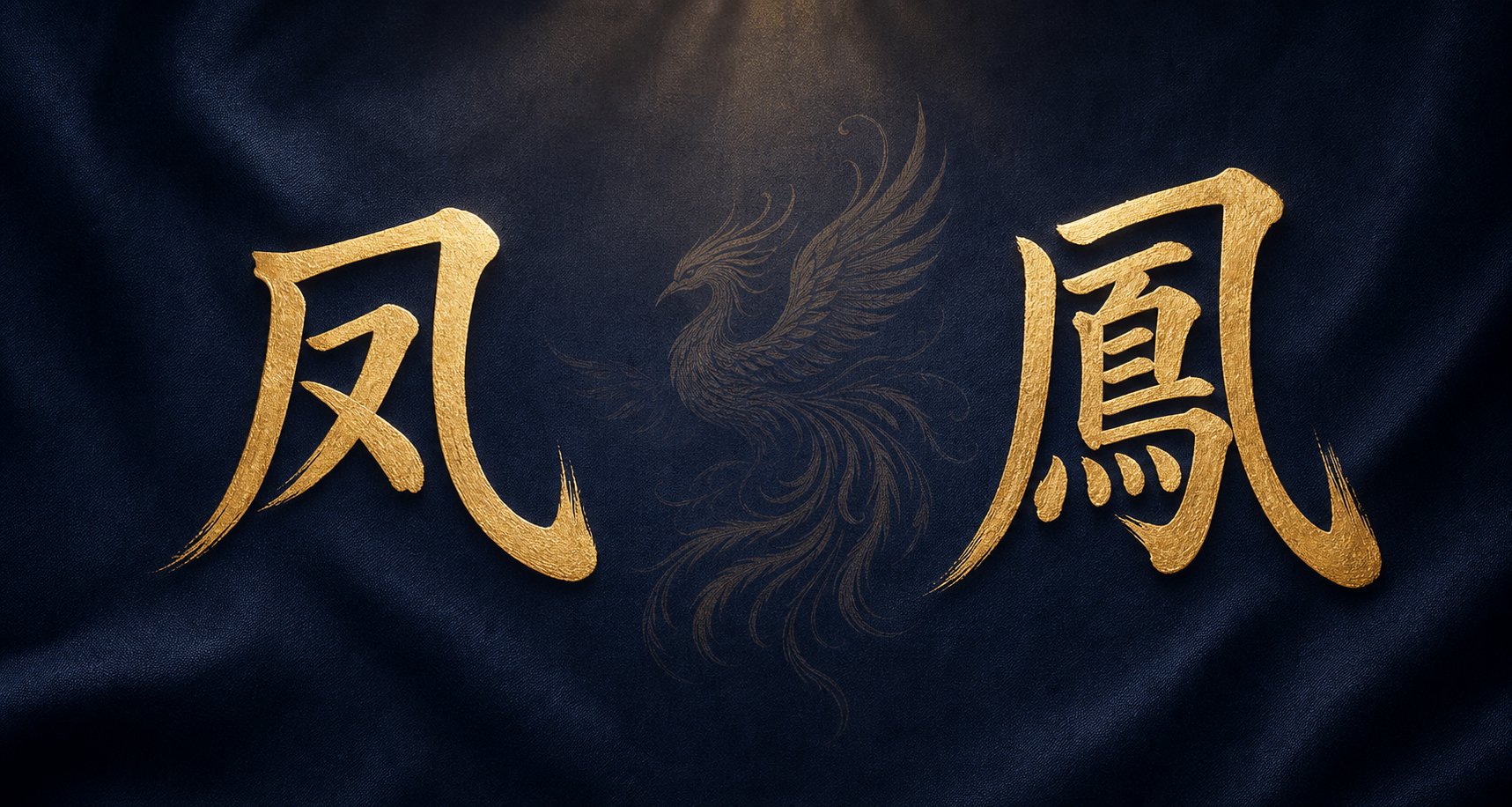
When you look up the phoenix in Chinese, you will find the character 凤 (or its traditional form 鳳), pronounced feng with a falling fourth tone (fèng). It refers to the feng huang — a mythical bird considered the king of all birds in Chinese tradition. But here is where most English speakers get tripped up: this creature has almost nothing in common with the Western phoenix you already know.
What Does the Phoenix Character Actually Mean in Chinese
The character 凤 (fèng) carries meanings of grace, nobility, and auspiciousness. In classical texts, it represented a sacred bird whose appearance signaled political harmony and virtuous leadership. The 4th-century BC text Classic of Mountains and Seas describes the feng huang as a creature whose very body parts encode moral qualities — its head represents virtue, its back propriety, its wings duty, its chest mercy, and its abdomen credibility.
So what does a phoenix symbolize in Chinese culture? Prosperity, peace, and the arrival of a new golden era. Ancient Chinese believed that the feng huang only appeared during times of great social harmony, making it a living omen of good fortune rather than a creature tied to destruction or flames.
Why the Chinese Phoenix Is Not About Death and Rebirth
If you have ever wondered what does phoenix symbolize across cultures, the answer depends entirely on which tradition you are asking about. The Western phoenix — rooted in Greek and Egyptian mythology — dies in fire every 500 years and rises reborn from its own ashes. That cycle of death and resurrection is central to its identity.
The Chinese feng huang operates on a completely different symbolic logic. It does not burn. It does not die. It does not resurrect.
Unlike the Western phoenix that dies and is reborn from ashes, the Chinese phoenix (凤凰) represents eternal grace, virtue, and cosmic harmony — it was never associated with death.
This distinction matters for language learners and culture enthusiasts alike. When you encounter 凤 in a Chinese name, a wedding decoration, or an ancient poem, the phoenix symbolism at play is about continuous blessing — not cyclical destruction. What does a phoenix represent in the Chinese context? An immortal bird of auspiciousness that embodies the highest Confucian virtues and signals that all is well in the world.
The confusion between these two birds traces back to modern translation choices. A 20th-century Chinese poet named Guo Moruo borrowed the Western rebirth concept in his poem "Nirvana of the Phoenix," blending the two traditions in a literary work that many readers later mistook for ancient mythology. In reality, the feng huang and the Western phoenix are, as a Chinese idiom puts it, completely unrelated — other than the fact that both are birds.
This article covers both sides of the character: its linguistic structure for those learning to read and write Chinese, and its deep cultural layers for anyone exploring what this mythical creature actually stands for. The story starts with a surprising detail — the phoenix character in Chinese originally described not one bird, but two.
Two Characters for One Mythical Bird
The title of this article is not a metaphor. The Chinese word for phoenix — 凤凰 (fènghuáng) — is literally built from two separate characters, each originally referring to a distinct bird. Understanding this split is key to grasping the full chinese phoenix meaning, and it is a detail that most English-language sources gloss over entirely.
凤 vs 凰 — The Male and Female Phoenix Distinction
In classical Chinese texts, 凤 (fèng) referred specifically to the male phoenix, while 凰 (huáng) referred to the female. These were not interchangeable labels. The Britannica entry on fenghuang confirms that the name is a combination of feng representing the male aspect and huang the female — together forming a yin-yang harmony similar to the qilin (a unicorn-like creature that also embodies dual male-female elements).
Imagine a pair of sacred birds, one male and one female, whose union represents cosmic balance. That is what the feng huang chinese phoenix originally described — not a single creature, but a bonded pair. Over centuries of literary use, the two characters fused into the compound word 凤凰, and the distinction between male and female faded. Modern Chinese treats 凤凰 as one unified concept: the fenghuang bird, king of all feathered creatures.
This merger has a practical consequence for language learners. You will rarely encounter 凤 or 凰 standing alone in modern text. They almost always appear together as 凤凰, or 凤 shows up inside compound words and names. The classical male-female split survives mainly in academic discussions and literary analysis.
| Character | Pinyin | Classical Meaning | Modern Usage | Traditional Form |
|---|---|---|---|---|
| 凤 | fèng | Male phoenix | Phoenix (general); used in names and compounds | 鳳 |
| 凰 | huáng | Female phoenix | Only appears in the compound 凤凰 | 凰 |
| 凤凰 | fènghuáng | Male and female phoenix pair | The Chinese phoenix as a single mythical creature | 鳳凰 |
Simplified 凤 vs Traditional 鳳 — What Changed
If you have seen both 凤 and 鳳 and wondered whether they are the same character — they are. The first is the simplified form used in mainland China; the second is the traditional form still used in Taiwan, Hong Kong, and classical texts. The difference between them reveals something interesting about how the chinese for phoenix was constructed in the first place.
The traditional character 鳳 is a phonosemantic compound with 14 strokes. It contains two components: the radical 鳥 (niǎo, meaning "bird"), which signals the character's semantic category, and the phonetic component 凡 (fán), which hints at the pronunciation. Originally, 鳳 was a pictograph depicting a mythical bird — you can still see bird-like shapes in oracle bone inscriptions from the Shang dynasty (around 1250-1000 BC). The phonetic element 凡 was added later to help readers recall the sound.
When China introduced simplified characters in the 1950s and 60s, 鳳 was reduced to just 4 strokes: 凤. The simplification preserved the outer frame (resembling 几) and a compressed internal mark, but it dropped the full bird radical 鳥 entirely. What remained is a streamlined shape that no longer visually signals "bird" the way the traditional form does.
For learners, this means the traditional 鳳 is more transparent — you can literally see the bird radical sitting inside it and decode the character's meaning at a glance. The simplified 凤 requires memorization since its visual logic has been stripped away. Both forms, however, carry identical meaning and pronunciation. Whether you encounter the chinese phoenix written as 凤凰 or 鳳凰, you are looking at the same mythical creature — the immortal fenghuang bird whose composite body, as ancient texts describe it, borrows features from half a dozen real birds.
Writing the Phoenix Character Stroke by Stroke
Knowing what the chinese phoenix symbol means is one thing. Being able to write it by hand is another. The good news: the simplified form 凤 requires only 4 strokes, making it one of the more approachable characters for learners tackling mythological vocabulary.
How to Write 凤 Step by Step
The character 凤 fits inside a roughly square frame. Its outer shape resembles the character 几 (jǐ, meaning "small table" or "several"), with a single dot tucked inside. Here is the stroke sequence:
- Horizontal stroke (横) — Start at the top left and draw a short horizontal line moving right. This forms the top edge of the outer frame.
- Left-falling vertical curve (撇弯钩) — From the left end of the horizontal stroke, sweep downward and curve to the right, hooking upward at the bottom. This creates the left side and base of the frame, similar to the left portion of 几.
- Vertical bend with hook (竖折折钩) — Begin inside the upper-right area, stroke downward, bend left, then bend downward again with a small hook. This forms the internal structure.
- Dot (点) — Place a small dot inside the enclosed space. This compressed mark is all that remains of the original bird radical after simplification.
For advanced learners interested in the traditional form 鳳 (14 strokes), the writing process is considerably more involved. You write the phonetic component 凡 at the top, then the full bird radical 鳥 (11 strokes on its own) beneath it. The traditional form rewards the effort — its structure makes the phoenix chinese meaning visually self-evident.
Understanding the Bird Radical Connection
The bird radical (鸟 in simplified, 鳥 in traditional) is Radical 196 in the Kangxi dictionary system, grouping over 750 characters related to birds. Recognizing this radical helps you decode unfamiliar characters on sight — if you spot 鳥 or 鸟 inside a character, you can reasonably guess it refers to a type of bird or something bird-related.
In the traditional 鳳, the bird radical sits prominently at the bottom, acting as a semantic signpost. The simplified 凤 lost this visual cue during the character reform, which is why many learners study both forms. Knowing the radical connection turns the chinese symbol for phoenix bird from an arbitrary shape into a logical composition: a phonetic hint (凡, suggesting the sound) plus a meaning hint (鳥, signaling "bird").
This character appears in HSK vocabulary and shows up constantly in Chinese names, place names, and brand names. Being able to recognize and write it unlocks a surprising amount of real-world reading — from the famous 凤凰古城 (Phoenix Ancient Town) on a travel itinerary to a friend's given name on a wedding invitation. The phoenix symbol chinese learners encounter in textbooks is the same one they will see on restaurant signs, TV channel logos, and classical poetry.
What the Fenghuang Looks Like in Ancient Literature
You can write the character. You know its radical structure and stroke order. But what does the creature behind the character actually look like? The answer is stranger and more deliberate than you might expect. The chinese phoenix is not a single bird — it is a composite of many birds, each chosen for a specific symbolic reason.
The Composite Body of the Fenghuang in Classical Texts
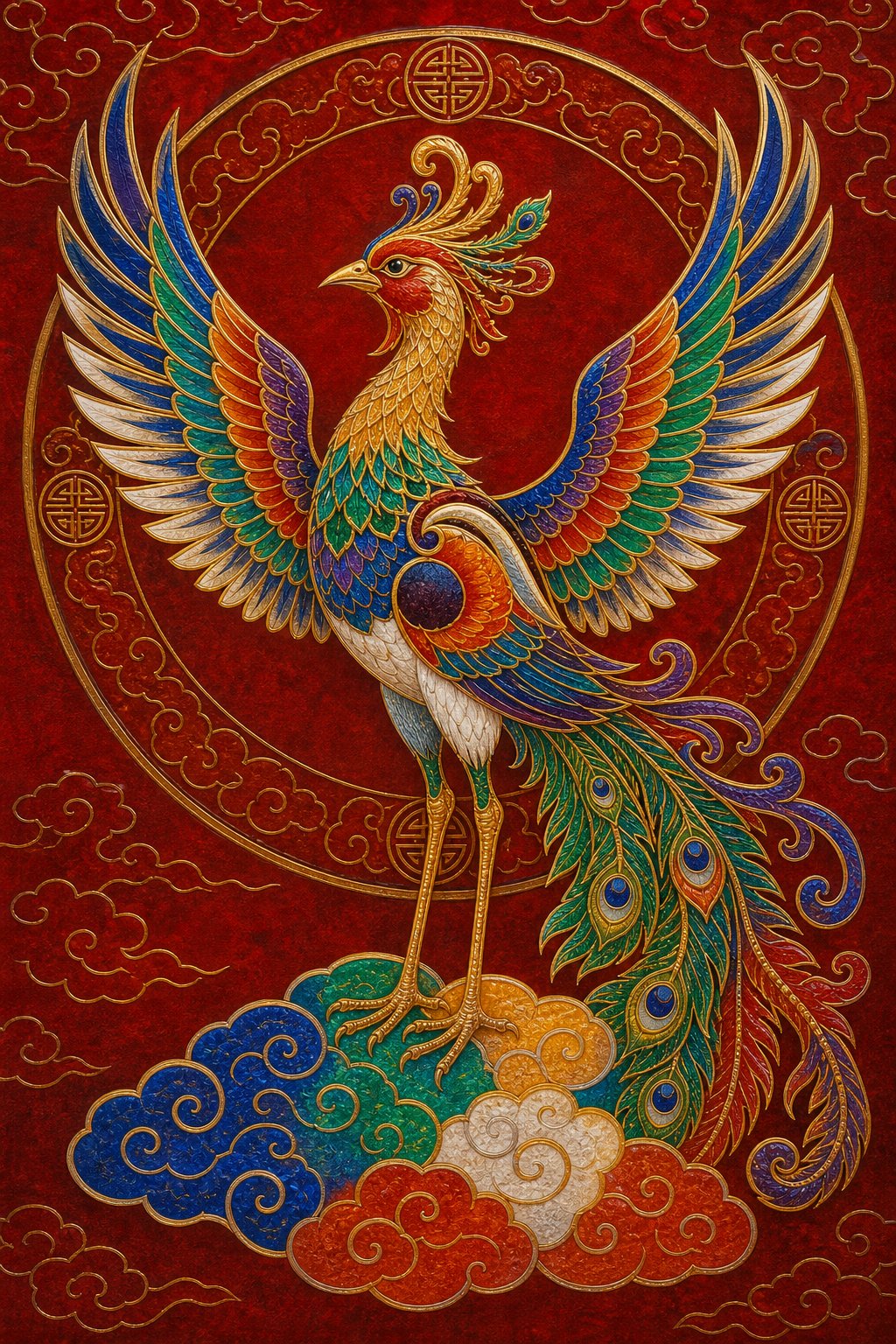
Ancient Chinese writers did not imagine the fenghuang as a vague, fiery bird. They described it with anatomical precision. The Erya, one of China's oldest dictionaries (dating to around the 3rd century BC), catalogs the fenghuang's body as a blend of real creatures: the beak of a rooster, the face of a swallow, the forehead of a fowl, the neck of a snake, the breast of a goose, the back of a tortoise, the hindquarters of a stag, and the tail of a fish.
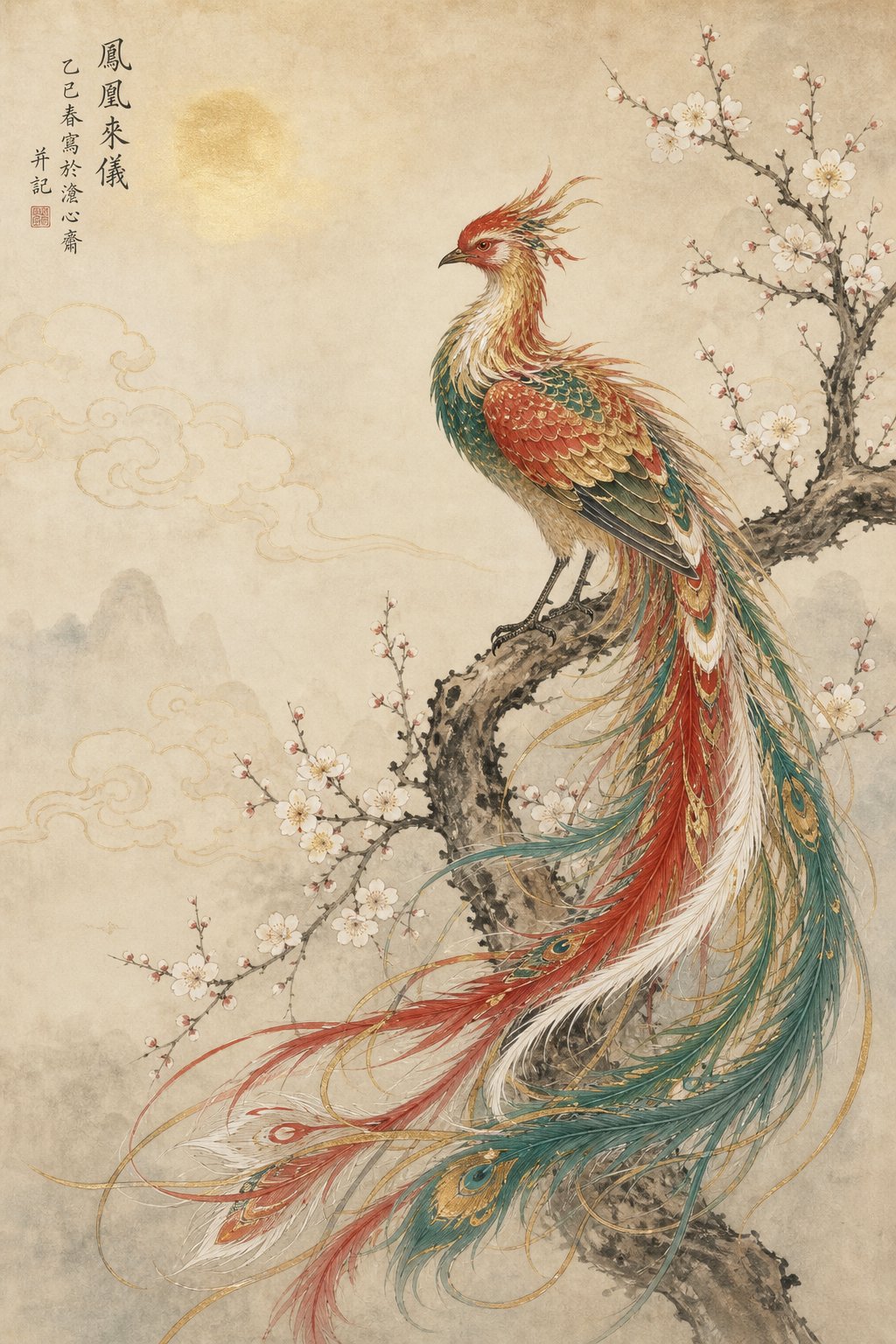
A more commonly cited modern description — drawn from later literary traditions — refines this into a purely avian composite: the head of a golden pheasant, the body of a mandarin duck, the tail of a peacock, the legs of a crane, the mouth of a parrot, and the wings of a swallow. Each bird was selected because it excels at something. The pheasant's head suggests regal bearing. The mandarin duck's body evokes fidelity. The peacock's tail represents splendor. The crane's legs signal longevity. The parrot's mouth implies eloquence. The swallow's wings embody agility and grace.
This is the core idea behind fenghuang mythology: the creature is not arbitrary. It is an intentional assembly of the finest qualities found across the bird kingdom, unified into a single form that rules over all others.
The Classic of Mountains and Seas (Shan Hai Jing) goes further, encoding moral meaning directly into the fenghuang's anatomy. Each body part carries a written inscription representing a Confucian virtue:
- Head — represents virtue (德, de), signaling moral leadership and integrity
- Wings — represent duty (義, yi), embodying righteousness and the obligation to act justly
- Back — represents propriety (禮, li), reflecting correct behavior and respect for social order
- Chest — represents mercy (仁, ren), the Confucian ideal of benevolence and compassion toward others
- Abdomen — represents credibility (信, xin), standing for trustworthiness and faithfulness
This is not decorative mythology. It is a moral blueprint. The phoenix in chinese mythology functions as a walking embodiment of the ideal ruler's character — a creature whose very body teaches you what virtues to cultivate.
Five Colors and Five Confucian Virtues
Beyond its composite anatomy, the fenghuang's plumage shimmers in five specific colors: black, white, red, yellow, and green (or blue, depending on the source). These are not random. They correspond to the Five Elements of Chinese cosmology — water, metal, fire, earth, and wood — and by extension, the five Confucian virtues: benevolence (仁), righteousness (義), propriety (禮), wisdom (智), and faithfulness (信).
The fenghuang myth ties color, element, and moral principle into a single visual system. When an artist paints the chinese phoenix in five colors, they are not simply making it look beautiful. They are encoding an entire ethical philosophy into its feathers. Each hue signals a different dimension of virtuous conduct, making the bird a kind of living diagram of Confucian thought.
Classical texts also map the fenghuang's body onto celestial phenomena: the head corresponds to the sky, the eyes to the sun, the back to the moon, the wings to the wind, the feet to the earth, and the tail to the planets. This layering — moral virtue, cosmic order, and biological form all compressed into one creature — is what makes chinese phoenix mythology so distinct from other traditions.
Compare this to the Western firebird. The Greek and Egyptian phoenix is described primarily through its relationship to fire and the sun. It is a solitary bird, often golden or red, defined by a single dramatic act: self-immolation and rebirth. Its appearance is secondary to its narrative function.
The fenghuang is the opposite. Its appearance is its meaning. Every feather, every limb, every color carries deliberate symbolic weight. There is no death scene, no ash, no resurrection. The chinese mythology phoenix communicates through what it looks like, not through what happens to it. This visual density is precisely why the character 凤 carries so much cultural freight — it points to a creature whose entire body is a philosophical statement.
That philosophical weight did not stay confined to ancient scrolls. It shaped one of the most powerful symbolic pairings in Chinese culture: the dragon and the phoenix together, representing the cosmic balance of masculine and feminine forces.
How the Chinese Phoenix Differs From the Western Firebird
A creature whose body encodes an entire moral philosophy is clearly not the same thing as a bird that burns itself alive every 500 years. Yet English translations flatten both into the single word "phoenix," creating confusion that trips up language learners and mythology enthusiasts alike. Before we can talk about what does a pheonix symbolize in either tradition, we need to separate three distinct creatures that constantly get tangled together: the Chinese fenghuang, the Western phoenix, and the Vermilion Bird (朱雀).
A quick note on spelling: you will see both "phoenix" and "pheonix" in online searches. The correct English spelling is phoenix (ph-o-e-n-i-x), but "pheonix" is such a common misspelling that search engines treat them interchangeably. Whether you type phoenix or pheonix, you are looking for the same mythical bird — the difference is just a transposed vowel, not a different creature.
Chinese Fenghuang vs Western Phoenix at a Glance
The symbolism of phoenix bird traditions varies dramatically depending on which culture you are examining. Here is a direct comparison across every major dimension:
| Feature | Chinese Fenghuang (凤凰) | Western Phoenix | Vermilion Bird (朱雀) |
|---|---|---|---|
| Origin | Chinese mythology; first recorded in the Classic of Mountains and Seas (pre-Qin era) | Greek and Egyptian mythology; described by Herodotus (5th century BC) | Chinese astronomy; one of the Four Symbols of the Chinese constellations |
| Symbolism | Virtue, prosperity, harmony, and auspiciousness | Renewal, rebirth, immortality, and the sun | Fire element, the south direction, and summer season |
| Appearance | Composite of multiple birds (pheasant head, peacock tail, crane legs); five-colored plumage | Eagle-sized or larger; red and gold feathers; surrounded by flames | Red bird resembling a pheasant; perpetually covered in flames |
| Death/Rebirth | No — never dies, never burns, never resurrects | Yes — self-immolates every 500 years and rises from ashes | No — exists as an eternal celestial guardian |
| Gender | Originally a male-female pair (凤 male, 凰 female); now treated as feminine | Genderless; only one exists at a time | Genderless; a spirit creature, not a biological bird |
| Cultural Role | King of all birds; paired with the dragon; associated with the empress | Symbol of cyclical renewal; associated with the sun god | Celestial guardian of the south; part of a four-creature directional system |
| Number | Can appear in pairs or flocks (in classical texts, many phoenixes gather during peaceful eras) | Strictly one at a time — solitary by nature | One — a singular cosmic entity |
The phoenix symbol meaning shifts entirely depending on which tradition you are referencing. In the West, pheonix symbolism centers on transformation through destruction — the idea that something must die before it can be reborn stronger. In China, the fenghuang carries no such narrative. Its power lies in presence, not in process. It simply appears when the world is in order, and vanishes when virtue declines.
The Vermilion Bird Is Not the Same as the Fenghuang
This is where the confusion deepens. The Vermilion Bird (朱雀, Zhūquè) looks superficially similar to the fenghuang — both are mythical Chinese birds associated with fire imagery. But they belong to completely different mythological systems and serve different functions.
The Vermilion Bird is one of the Four Symbols (四象) of the Chinese constellations, alongside the Azure Dragon, the White Tiger, and the Black Turtle-Snake. Each symbol guards a cardinal direction and corresponds to a season and element. The Vermilion Bird guards the south, represents fire, and governs summer. It is an astronomical and cosmological concept — a spirit creature mapped onto star patterns, not a biological king of birds.
The fenghuang, by contrast, exists within a different framework entirely. It is the sovereign of all feathered creatures, a moral symbol tied to Confucian virtue, and a counterpart to the dragon in imperial imagery. The fenghuang appears in wedding decorations, personal names, and political metaphors. The Vermilion Bird appears in star charts, Taoist ritual, and directional cosmology.
Think of it this way: the Vermilion Bird is to the fenghuang what a constellation is to an animal. One is a celestial pattern; the other is a mythological creature with personality, symbolism, and cultural agency. They share a bird-like form and a loose association with fire-colored plumage, but their origins, roles, and meanings are distinct. Confusing the vermilion bird vs phoenix (fenghuang) is like confusing the constellation Leo with an actual lion.
So what does a pheonix symbolize when someone uses that word in a Chinese context? You need to ask which creature they mean. If they are talking about virtue, weddings, and the empress — that is the fenghuang. If they are talking about directional guardians and star mansions — that is the Vermilion Bird. And if they are talking about death, fire, and resurrection — that is the Western pheonix bird, a concept that entered Chinese popular culture only in the 20th century through translation and literary borrowing.
The fenghuang's most culturally significant role has nothing to do with either the Western phoenix or the Vermilion Bird. It involves a pairing so deeply embedded in Chinese life that you will find it on everything from imperial robes to modern wedding invitations: the dragon and the phoenix together, representing the fundamental balance of yin and yang.
The Dragon and Phoenix Pairing Explained
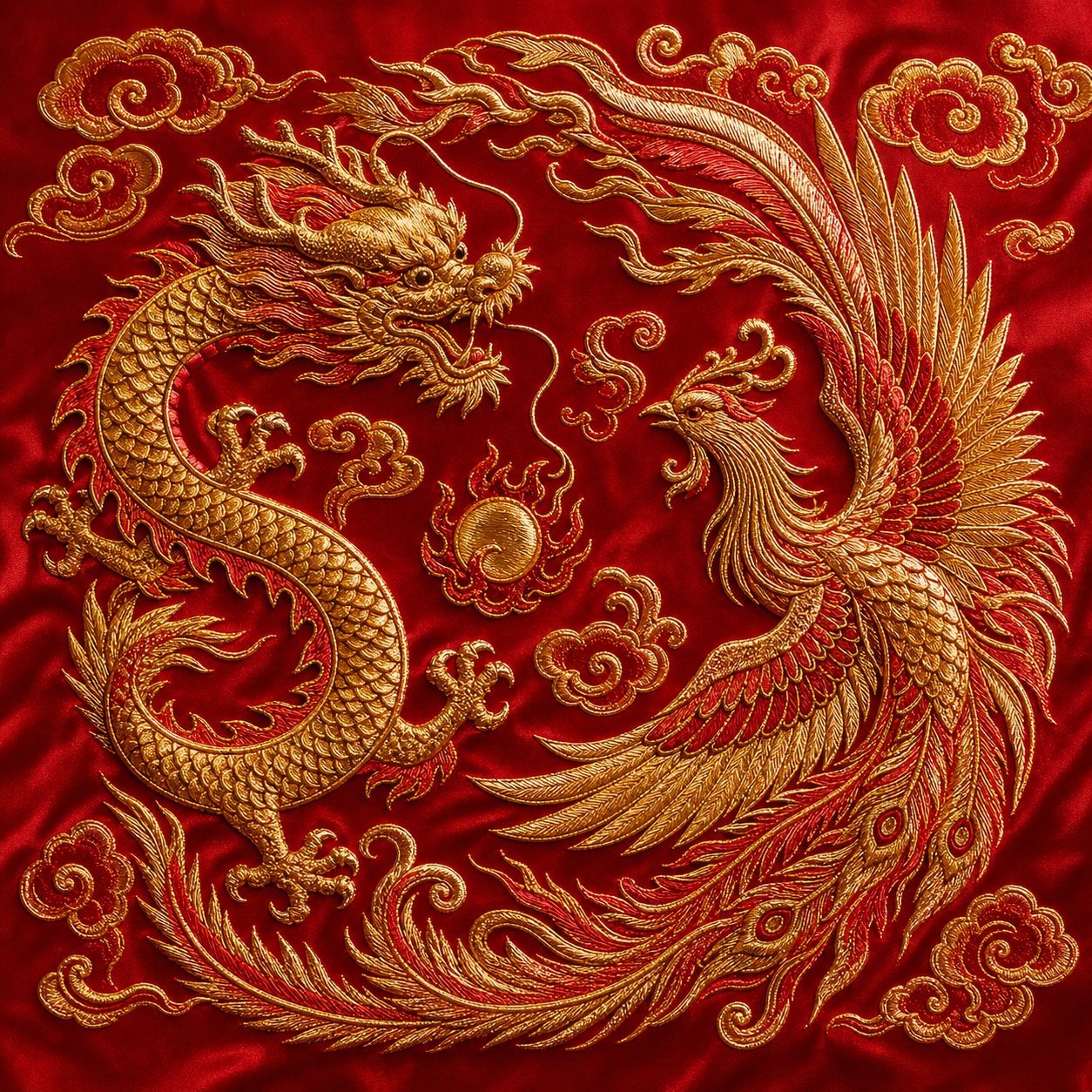
The dragon and phoenix meaning in Chinese culture runs deeper than decoration. The compound 龙凤 (lóngfèng) — dragon and phoenix — is one of the most recognizable symbolic pairs in the entire Chinese tradition, appearing on everything from imperial thrones to red wedding envelopes. When you encounter the phoenix character in real-world Chinese, it is most often sitting right next to the dragon. Understanding why these two creatures are paired unlocks a layer of meaning that the character 凤 carries silently in every context where it appears.
Dragon and Phoenix as Yin and Yang
The phoenix and dragon chinese pairing maps directly onto the yin-yang framework. The dragon (龙, lóng) represents yang energy — masculine, active, celestial, and associated with the emperor. The phoenix (凤, fèng) represents yin energy — feminine, receptive, earthly, and associated with the empress. Together, they form a complete whole: opposing forces in dynamic balance, neither dominant over the other.
This dragon and phoenix yin yang relationship shows up most powerfully in one four-character idiom that every Chinese person recognizes:
龙凤呈祥 (lóng fèng chéng xiáng) — "The dragon and phoenix bring auspiciousness." This phrase describes a state of perfect harmony and prosperity, used especially at weddings to bless the union of husband and wife.
You will find 龙凤呈祥 embroidered on bridal gowns, carved into architectural details on temples, and printed on banquet invitations. In traditional Chinese weddings, dragon and phoenix patterns on the bride's and groom's attire signal that the couple embodies cosmic balance — the dragon's strength paired with the phoenix's grace. The chinese dragon and phoenix motif also dominated imperial architecture: the emperor's robe bore dragons, while the empress's robe bore phoenixes. Their thrones, their ceremonial halls, even their coffins carried these respective symbols.
The phoenix dragon meaning extends beyond marriage. The idiom 人中龙凤 (rén zhōng lóng fèng) — literally "a dragon or phoenix among people" — describes someone of extraordinary talent. The phrase 龙凤胎 (lóng fèng tāi) refers to boy-girl fraternal twins, with the boy as the "dragon" and the girl as the "phoenix." In each case, the pairing implies complementary excellence rather than hierarchy.
How the Phoenix Became Feminine in Chinese Culture
Here is the historical twist that reshapes how you read the character 凤 in modern Chinese. As we covered earlier, the classical fenghuang was originally a male-female pair — 凤 was the male bird, 凰 the female. The earliest dragon-phoenix artifacts, dating back to the Yangshao culture (around 5000-3000 BC), show the two creatures as parallel symbols of power, with no gendered hierarchy between them.
The shift began during the Qin dynasty (221-206 BC). As the dragon consolidated its role as the exclusive symbol of the emperor, the fenghuang progressively absorbed feminine associations. The male 凤 and female 凰 merged into a single entity, and that unified creature was repositioned as the dragon's feminine counterpart. By the Yuan dynasty (1271-1368), the transformation was complete: the "King of Birds" had become the emblem of the empress, permanently paired with the masculine dragon.
This feminization matters for anyone studying the phoenix and dragon meaning in modern contexts. When a Chinese parent names their daughter 凤 today, they are drawing on the modern feminine reading — grace, beauty, and noble womanhood. When a business uses 龙凤 in its branding, it signals balanced partnership. The character 凤 now carries feminine connotations so deeply embedded that most native speakers are unaware the bird was ever considered male.
For language learners, this means the chinese phoenix and dragon pairing is not just cultural trivia — it actively shapes how the character 凤 is interpreted in names, idioms, and everyday speech. A character that once meant "male sacred bird" now reads as "feminine grace and imperial elegance." That semantic drift, spanning over two thousand years, is baked into every modern usage you will encounter.
The dragon-phoenix pairing is just one of many compound words and idioms where 凤 appears. Beyond 龙凤呈祥, the phoenix character shows up in phrases describing extreme rarity, bridal attire, place names, and even modern brand identities — each usage drawing on a slightly different facet of the character's layered meaning.
Phoenix Words and Phrases You Will Actually Encounter
The character 凤 does not live in isolation. It appears inside dozens of compound words, classical idioms, and proper nouns that you will run into while reading Chinese menus, watching period dramas, scrolling travel apps, or chatting with native speakers. Knowing these phrases turns the fenghuang phoenix from an abstract mythological concept into a practical vocabulary tool.
Essential Phoenix Idioms and Compound Words
Chinese idioms (成语, chéngyǔ) are four-character phrases packed with cultural meaning. Several of the most commonly used ones feature the phoenix character. Here is a reference table covering the phrases you are most likely to encounter, from wedding invitations to literary essays:
| Phrase | Pinyin | Literal Meaning | Usage Context |
|---|---|---|---|
| 凤凰 | fènghuáng | Male phoenix + female phoenix | The standard word for the Chinese phoenix; used in everyday speech, writing, and names |
| 龙凤呈祥 | lóng fèng chéng xiáng | Dragon and phoenix present auspiciousness | Weddings, blessings, and celebratory occasions; embroidered on bridal attire and banquet decor |
| 凤冠霞帔 | fèng guān xiá pèi | Phoenix crown and rosy cloud cape | Describes traditional Chinese bridal attire; appears in historical dramas and wedding discussions |
| 凤毛麟角 | fèng máo lín jiǎo | Phoenix feathers and unicorn horns | Describes something extremely rare and precious; used in formal writing and conversation |
| 凤凰涅槃 | fèng huáng niè pán | Phoenix nirvana | Metaphor for dramatic transformation after hardship; modern literary and journalistic usage |
| 人中龙凤 | rén zhōng lóng fèng | A dragon or phoenix among people | Compliment for someone of extraordinary talent; used in praise and formal introductions |
| 龙凤胎 | lóng fèng tāi | Dragon-phoenix fetus | Refers to boy-girl fraternal twins; common in everyday family conversation |
A few of these deserve closer attention because their backstories reveal how the phoenix fenghuang operates in living Chinese.
凤冠霞帔 — Picture a traditional Chinese bride. The phoenix crown (凤冠) is an elaborate headdress decorated with gold phoenix ornaments, pearls, and gemstones. The rosy cape (霞帔) is a long embroidered shawl draped over the shoulders. Together, they formed the standard bridal outfit from the Song dynasty onward. You will hear this phrase in any conversation about traditional weddings, and you will see it in period dramas set in imperial China. It signals formality, femininity, and celebration.
凤毛麟角 — This idiom translates to "phoenix feathers and unicorn horns" and describes something so rare it is almost mythical. The logic is straightforward: phoenixes and unicorns (麒麟, qílín) are already legendary creatures, so their individual feathers and horns would be impossibly scarce. You will encounter this phrase in news articles, book reviews, and academic writing whenever a writer wants to emphasize extreme rarity — a talented person, a unique artifact, or an exceptional opportunity.
凤凰涅槃 — This is the most interesting entry on the list because it is not ancient. The concept of a phoenix undergoing nirvana — dying in flames and being reborn — originates from a 1920 poem by Guo Moruo, not from classical Chinese mythology. Guo borrowed the Western phoenix's death-and-rebirth narrative and fused it with the Buddhist concept of nirvana to create a powerful metaphor for national renewal. The phrase caught on so thoroughly that many Chinese speakers today assume it is an ancient legend. In reality, it is a modern literary invention — barely a century old. You will see it in headlines, motivational speeches, and business contexts whenever someone describes a dramatic comeback or transformation after crisis.
Phoenix in Chinese Place Names and Brands
Beyond idioms, the chinese fenghuang shows up constantly in geography and commerce. The character 凤 carries such strong associations with beauty, prosperity, and good fortune that cities, towns, and businesses have adopted it for centuries.
The most famous example is 凤凰古城 (Fènghuáng Gǔchéng) — Phoenix Ancient Town in Hunan province. Built in 1704, this riverside town in southwest Hunan is often called "the most beautiful town in China." Its name literally means "Phoenix Ancient City," and the town has leaned into that identity with phoenix motifs throughout its architecture and branding. For travelers in phoenix china itineraries, this is one of the most photographed destinations in the country, known for its stilted buildings along the Tuojiang River and its rich Miao and Tujia minority cultures.
Other geographic uses of the character include:
- 凤凰山 (Fènghuáng Shān) — Phoenix Mountain, a name shared by peaks in Guangdong, Heilongjiang, and several other provinces
- 凤凰岭 (Fènghuáng Lǐng) — Phoenix Ridge, a scenic area in northwest Beijing popular for hiking
- 凤凰县 (Fènghuáng Xiàn) — Phoenix County, the administrative region containing the ancient town in Hunan
In the commercial world, 凤凰 appears in brand names across industries. Phoenix Television (凤凰卫视, Fènghuáng Wèishì) is a major Hong Kong-based Chinese-language broadcaster. Phoenix Bicycles (凤凰自行车) is one of China's oldest and most recognized bike brands, founded in Shanghai in 1958. The name signals quality, elegance, and enduring value — exactly the associations the fenghuang phoenix has carried for millennia.
You will also notice 凤 embedded in restaurant names, tea brands, and hotel chains. The logic is always the same: borrowing the character's deep cultural resonance — grace, rarity, prosperity — to elevate a brand's identity. When you can recognize 凤 on a sign or menu, you are reading a deliberate cultural choice, not just a random character.
These real-world appearances — in idioms, place names, and brand identities — demonstrate that the phoenix character is not confined to mythology textbooks. It is active vocabulary, woven into daily life across Chinese-speaking communities. That same living presence extends beyond China's borders, where the character traveled along with Chinese cultural influence into Japan, Korea, and Vietnam, taking on local pronunciations while retaining its core symbolic weight.
The Phoenix Character in Modern Life and Across Asia
The character 凤 is not a museum piece. It circulates through modern Chinese life in ways that are personal, commercial, and artistic — carrying thousands of years of phoenix symbolism chinese culture built up, compressed into a single four-stroke character that parents write on birth certificates and designers stamp onto luxury packaging.
Why 凤 Appears in Chinese Names and What It Signals
Walk through any Chinese classroom roster or company directory and you will find 凤 embedded in women's given names: 凤英 (Fèngyīng), 凤霞 (Fèngxiá), 凤兰 (Fènglán), 小凤 (Xiǎofèng). Parents choose this character for daughters because of what it communicates — grace, nobility, and the aspiration for an extraordinary life. The phoenix person meaning in Chinese naming culture is straightforward: a woman named 凤 is being wished the elegance and virtue of the fenghuang itself.
This naming pattern peaked among women born in the 1950s through 1980s, making 凤 one of the most common generational markers in Chinese female names. Younger generations have shifted toward less traditional characters, but 凤 still appears in names chosen by families who value classical chinese symbolism and its connection to feminine strength.
What emotions are associated with phoenix imagery in this context? Pride, hope, and a quiet confidence that the child will rise above ordinary circumstances. The character carries aspiration without arrogance — a wish for distinction rooted in virtue rather than wealth.
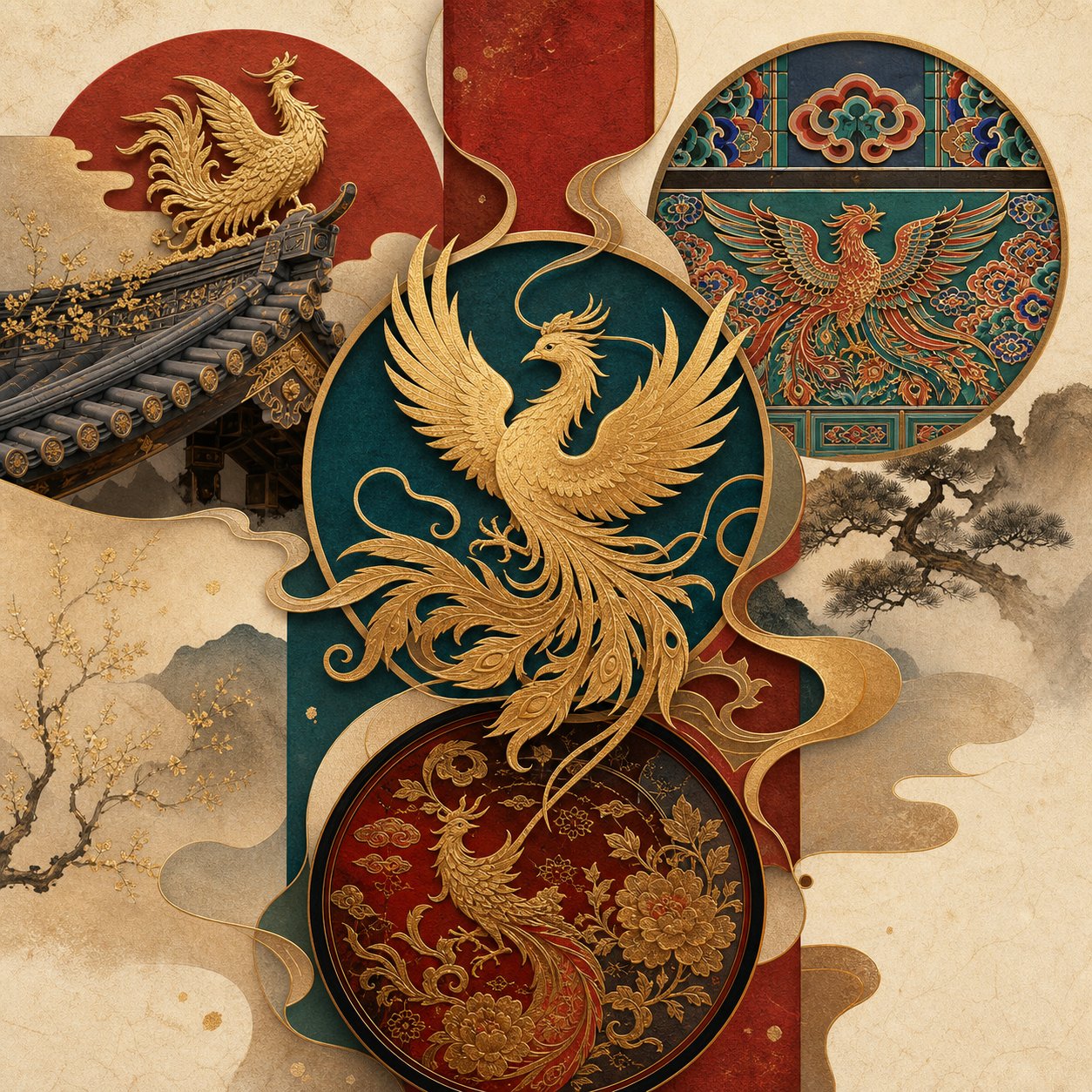
In contemporary art and design, the phoenix significance extends into visual culture. You will find fenghuang motifs in everything from high-end jewelry collections to public murals, fashion embroidery, and digital illustration. Phoenix in chinese art has evolved from imperial embroidery patterns into a modern design element that signals cultural sophistication. Luxury brands targeting Chinese consumers frequently incorporate fenghuang imagery because it resonates with deep aesthetic values — what do phoenixes represent to a modern audience? Heritage, refinement, and continuity with a living tradition.
The Phoenix Character Across East Asian Cultures
The character 鳳凰 did not stay within China's borders. As Chinese writing systems, literary traditions, and cultural frameworks spread across East Asia, the phoenix character traveled with them — adopted into local languages while retaining its core symbolic DNA. Each culture pronounces it differently and layers on local meaning, but the underlying character and what does the phoenix represent remain recognizable across the region.
- Japanese — Hō-ō (鳳凰 / ほうおう): Japan adopted the traditional characters 鳳凰 directly. The hō-ō appears in temple architecture, imperial regalia, and classical art. It decorates the roof of Kyoto's famous Byōdō-in temple (featured on the 10-yen coin) and symbolizes justice, fidelity, and the sun.
- Korean — Bonghwang (봉황 / 鳳凰): Korean culture inherited the same characters, pronounced bonghwang in Korean. The creature appears on the presidential seal of South Korea and in traditional dance costumes, representing authority and grace.
- Vietnamese — Phượng hoàng (鳳凰): Vietnamese adopted the Sino-Vietnamese pronunciation. The phượng hoàng appears in traditional lacquerware, temple carvings, and festival decorations, carrying associations of prosperity and harmony similar to its Chinese source.
In each case, the character's journey mirrors the broader pattern of Chinese cultural influence across the region. A learner who masters the meaning of 凤 in Chinese can recognize its echoes in Japanese shrine decorations, Korean national symbols, and Vietnamese folk art — all pointing back to the same mythical creature.
This cross-cultural reach is what makes the phoenix character worth studying beyond a single language class. From its radical structure (a bird hidden inside four strokes) to its classical symbolism (a composite creature encoding Confucian virtue) to its modern life (names, brands, wedding decor, and international art), 凤 compresses an extraordinary amount of meaning into a very small space. What does the phoenix represent when you finally see all these layers at once? A living thread connecting ancient philosophy to the name on a business card you received yesterday — still carrying the same wish for grace, harmony, and an auspicious future.
Frequently Asked Questions About the Phoenix Chinese Character
1. What does the Chinese phoenix character 凤 mean?
The character 凤 (fèng) represents grace, nobility, and auspiciousness. It refers to the fenghuang, the king of all birds in Chinese mythology. Unlike the Western phoenix associated with death and rebirth, the Chinese phoenix symbolizes virtue, prosperity, and cosmic harmony. It was believed to appear only during times of peace and good governance, serving as an omen of a flourishing society rather than a creature tied to fire or destruction.
2. Is the Chinese phoenix the same as the Western phoenix?
No, they are fundamentally different creatures sharing only an English translation. The Western phoenix is a solitary, genderless firebird that self-immolates every 500 years and rises from its ashes. The Chinese fenghuang is a composite bird made of parts from multiple real birds, originally existed as a male-female pair, never dies or burns, and symbolizes Confucian virtues like benevolence, righteousness, and propriety. The rebirth narrative was only introduced to Chinese culture in 1920 through a modern poem.
3. What is the difference between 凤 and 凰 in Chinese?
In classical Chinese, 凤 (fèng) referred specifically to the male phoenix while 凰 (huáng) referred to the female. They originally described a bonded pair of sacred birds whose union represented cosmic balance. Over centuries, the two characters merged into the compound word 凤凰 (fènghuáng), and the male-female distinction faded. Modern Chinese treats 凤凰 as a single unified concept, and 凰 rarely appears outside this compound.
4. Why is the phoenix paired with the dragon in Chinese culture?
The dragon-phoenix pairing (龙凤) maps onto the yin-yang framework. The dragon represents yang energy — masculine, active, and imperial — while the phoenix represents yin energy — feminine, graceful, and noble. Together they symbolize perfect harmony and complementary balance. This pairing dominates Chinese wedding imagery through the idiom 龙凤呈祥 (dragon and phoenix bring auspiciousness) and historically represented the emperor and empress respectively.
5. How do you write the simplified Chinese character for phoenix?
The simplified character 凤 requires only 4 strokes. Start with a short horizontal stroke at the top left, then sweep a left-falling vertical curve downward creating the frame's left side and base. Next, write a vertical bend with hook inside the upper-right area. Finally, place a small dot inside the enclosed space. The traditional form 鳳 has 14 strokes and visibly contains the bird radical 鳥, making its meaning more transparent at a glance.