What Is Pinyin Name Ambiguity and Why Does It Matter
Imagine two people with completely different names, different meanings, different family histories, showing up on a government form or academic database as the exact same person. That's not a hypothetical. It happens every day to millions of Chinese-language speakers whose names are converted into the Latin alphabet through Pinyin romanization.
Pinyin name ambiguity is the phenomenon where multiple distinct Chinese characters, and therefore distinct personal names, collapse into identical romanized spellings when converted to Pinyin. Because thousands of unique characters are compressed into roughly 375 syllables, people with entirely different names can end up sharing the same written identity in English.
What Pinyin Name Ambiguity Actually Means
Chinese uses tens of thousands of unique characters, each carrying its own meaning, pronunciation, and visual form. A person's name in characters is unmistakable. It looks different from every other name, and it communicates something specific about family lineage, parental hopes, or cultural heritage. But the moment that name gets romanized through Pinyin, the standardized system for representing Mandarin pronunciation in Latin letters, much of that uniqueness vanishes.
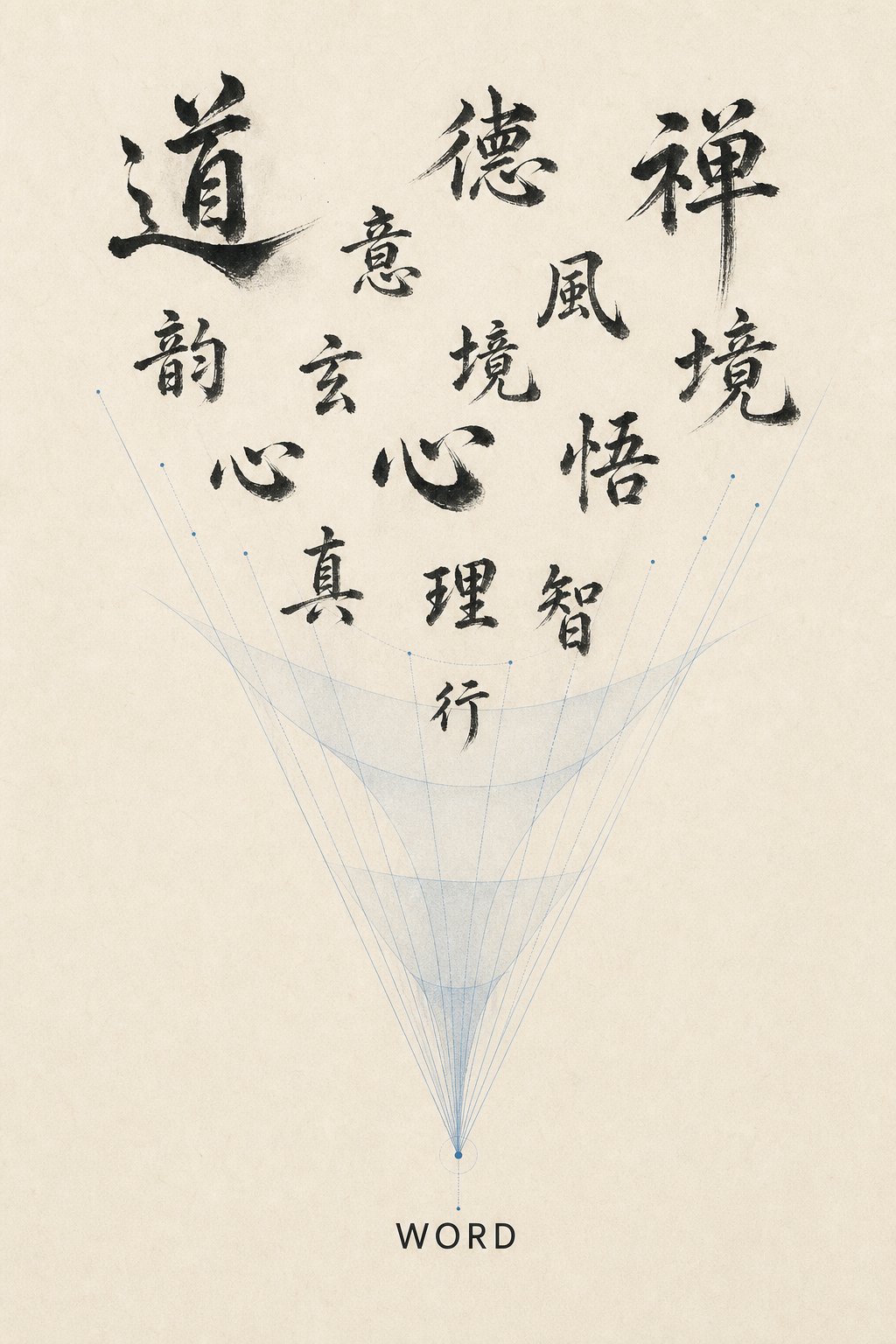
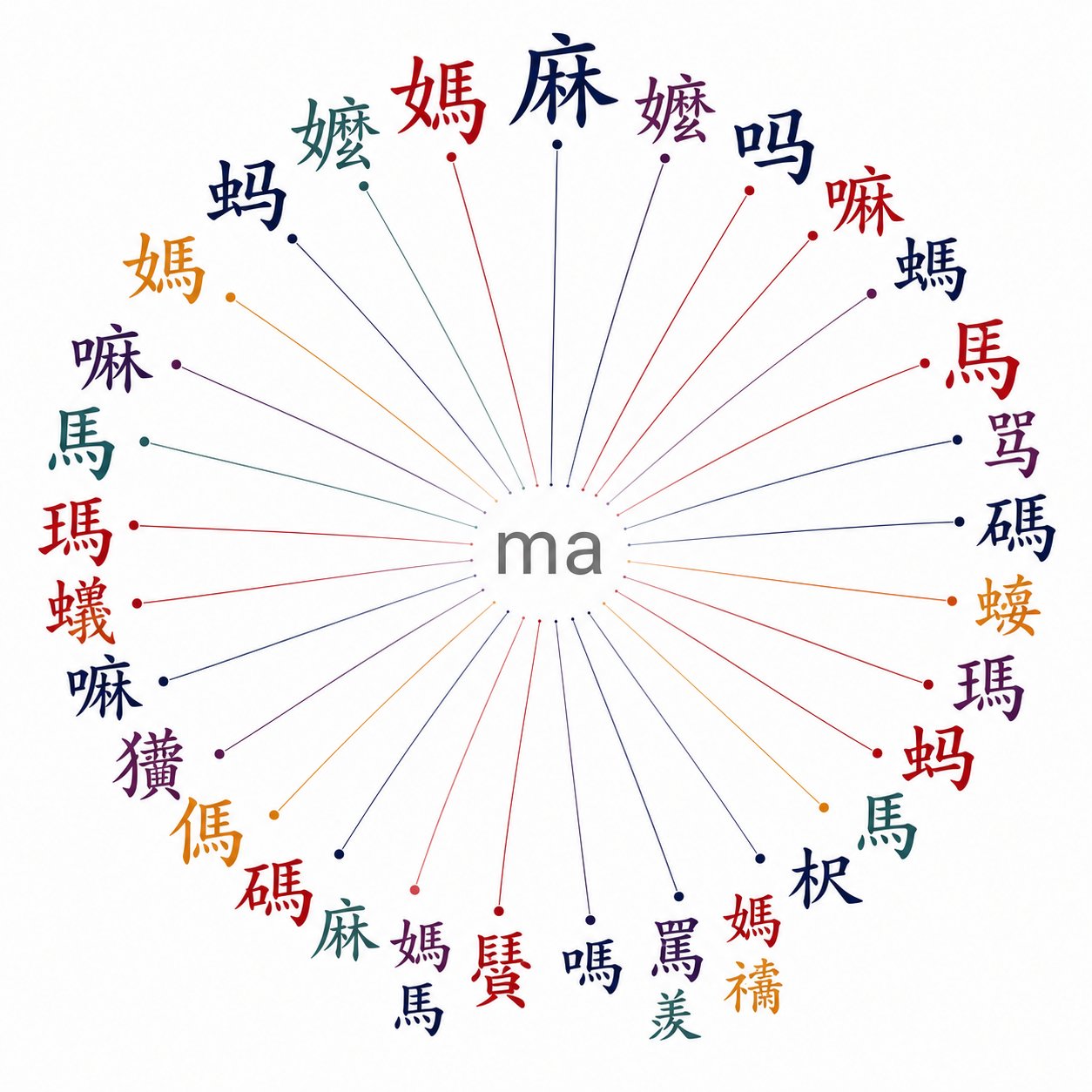
Why? Because Pinyin maps thousands of distinct characters to a very small set of syllables. As research from the Complexity Science Hub illustrates, the entire system compresses this vast character set into just 375 syllables. The result is a many-to-one problem: dozens of characters share a single Pinyin spelling. When you're dealing with personal names, that compression means people with different Chinese names end up with the same romanized name. They become indistinguishable on paper.
Consider the syllable "wei." It maps to numerous characters, each with a different meaning, from "great" to "not yet" to "protect." Chinese artist Ai Weiwei's given name (艾未未) uses two identical characters meaning "not yet," but someone unfamiliar with the original characters would have no way to distinguish his name from dozens of other possible "wei" combinations just by reading the Pinyin.
Why Romanization Creates Identity Collisions
The core issue is structural. In character-based writing, every name is visually and semantically unique. You can see the difference between 龍振飛 and 龙振飞 at a glance, even if one is traditional and the other simplified. But once romanized, both become "Long Zhenfei," and so might several other names built from different characters that happen to share those same sounds.
This isn't just a linguistic curiosity. It's a pinyin romanization identity problem that ripples through academic publishing, immigration processing, corporate HR systems, and everyday cross-cultural communication. When your name looks the same as thousands of other people's names in every English-language database, you lose something fundamental: the ability to be recognized as yourself.
The layers of this problem run deep. There's the linguistic mechanics of how Chinese characters map to sounds. There's the practical fallout in systems that rely on romanized names as unique identifiers. And there's the cultural dimension, where names rich with personal meaning get flattened into generic letter combinations that carry none of that significance. Each of these dimensions compounds the others, creating a challenge that no single fix can resolve.
How Chinese Characters Collapse Into Identical Pinyin
The mechanics behind this identity compression come down to a simple math problem. Mandarin Chinese has roughly 400 unique syllables without tones. Factor in the four tones (plus the neutral tone), and you get approximately 1,300 distinct sound combinations. That sounds like a lot, until you consider that the Chinese writing system contains over 50,000 characters, with around 6,000 to 8,000 in common use. The result is a dramatic many-to-one mapping of pinyin to characters, where dozens of characters routinely share a single romanized spelling.
Tones, Homophones, and the Many-to-One Problem
When names are written in characters, tones are implicit. You see the character, and you know the pronunciation. But standard Pinyin as used on passports, academic papers, and official documents almost never includes tone marks. That strips away one of the few remaining tools for differentiation, collapsing those 1,300 tonal syllables back down to around 400.
Think about how many Chinese characters share the same pinyin syllable "shi." As LTL Language School illustrates, characters like 是 (to be), 市 (city), 十 (ten), 时 (time), 食 (food), 使 (to make), 式 (style), 石 (stone), 世 (generation), and 事 (matter) all share that single syllable. That's ten completely different meanings from one sound. Now apply that same compression to personal names, and you'll see how mandarin homophones and name confusion become inevitable.
Surnames compound the problem. The character 王 (meaning "king") and 汪 (meaning "vast" or "pool") both romanize to "Wang." A person surnamed 王 and a person surnamed 汪 become indistinguishable the moment their names hit an English-language form. The same applies to given-name syllables: "Wei" could be 伟 (great), 薇 (fern), 威 (mighty), 维 (maintain), or 卫 (defend), among many others.
| Pinyin | Character | Meaning | Common Use in Names |
|---|---|---|---|
| Wang | 王 | King | Surname (101.8 million people) |
| Wang | 汪 | Vast, pool | Surname |
| Wei | 伟 | Great | Given name (male) |
| Wei | 薇 | Fern, rose | Given name (female) |
| Wei | 卫 | Defend, guard | Given name (unisex) |
| Li | 李 | Plum | Surname (101.4 million people) |
| Li | 黎 | Dawn, many | Surname |
| Li | 丽 | Beautiful | Given name (female) |
Surname and Given Name Structure in Chinese
A typical Chinese name follows a compact structure: a one-character surname followed by a one- or two-character given name. That's two or three syllables total. With so few syllables per name, every collision at the syllable level has outsized impact on the overall name's uniqueness.
The real amplifier is chinese surname frequency and pinyin overlap. China's population draws from a remarkably concentrated pool of family names. Data from the Seventh National Population Census shows that the top 100 surnames account for 84.55% of the national population. The top five alone, Wang, Li, Zhang, Liu, and Chen, cover over 30%. Wang leads with 101.8 million people, and Li follows closely at 101.4 million.
When you combine a small set of dominant surnames with a limited number of possible given-name syllables, the collision rate skyrockets. Two people named 王伟 and 汪薇 carry entirely different characters, different genders, different meanings, yet both appear as "Wang Wei" in any romanized system. Multiply that pattern across a population of 1.4 billion, and you begin to grasp the staggering scale of duplication that a few hundred Pinyin syllables produce.
The Staggering Scale of Pinyin Name Collisions
Knowing that multiple characters share the same Pinyin syllable is one thing. Grasping how many real people get swept into the same romanized identity is something else entirely. The scale of pinyin name duplication isn't a rounding error or an edge case. It's a systemic compression that affects hundreds of millions of individuals.
How Many People Share the Same Pinyin Name
Here's where the combinatorial math gets uncomfortable. Start with the fact that the top 100 surnames cover roughly 85.9% of China's 1.4 billion people. Then consider that standard Pinyin, without tone marks, offers only about 400 unique syllables for given names. A typical Chinese name has one surname syllable plus one or two given-name syllables. Even with two-syllable given names, the total number of possible Pinyin combinations is surprisingly small relative to the population.
The result? Enormous clusters of people sharing identical romanized names. How many people are named Wang Wei in China? According to a report from China's Ministry of Public Security, Zhang Wei alone is used by 252,224 men and 42,058 women, totaling nearly 300,000 individuals with that single name. Wang Wei, Li Wei, Li Na, Zhang Min, and Wang Fang all rank among the most common duplicate pinyin names, each shared by tens of thousands to hundreds of thousands of people.
But those figures only count people who share the exact same characters. The romanized collision is far larger. "Wang Wei" doesn't just capture everyone named 王伟. It also captures people named 王薇, 王威, 王维, 汪伟, 汪威, and dozens of other character combinations. Each of those is a different person with a different name in Chinese, yet they all become the same three letters on a passport, a journal article, or a background check.
A study published in Scientific Data quantified this compression directly: from a dataset of over 30 million individuals, researchers found 1,051,891 unique given names in Chinese characters. When those same names were converted to Pinyin, the number collapsed to just 96,797 unique entries. That's a compression ratio of roughly 11 to 1. For every distinct Pinyin name, an average of eleven different character-based names exist behind it.
Real Names That Illustrate the Problem
Numbers tell part of the story. Specific examples make it visceral. Consider two people: one named 王琦炅 and another named 王奇炯. In characters, these names are visually distinct. The strokes are different, the meanings are different, and any Chinese reader would immediately recognize them as separate individuals. But romanize both, and you get something nearly indistinguishable: "Wang Qijiong" versus "Wang Qijiong." The uniqueness evaporates.
This isn't limited to common characters. Even parents who deliberately choose rare or unusual characters to give their child a distinctive name find that the distinctiveness vanishes in translation. A character chosen for its poetic rarity still maps to the same Pinyin syllable as its more common homophones. The effort to be unique in Chinese gets erased the moment the name crosses into English.
Here are several chinese names that look identical in english once romanized, despite being completely different in characters:
- 李丽 (Li Li) meaning "plum, beautiful" vs. 黎莉 (Li Li) meaning "dawn, jasmine" — two different surnames, two different given names, one identical Pinyin output
- 张伟 (Zhang Wei) meaning "expand, great" vs. 张薇 (Zhang Wei) meaning "expand, fern" — same surname character, but the given names carry opposite gender associations
- 王芳 (Wang Fang) meaning "king, fragrant" vs. 汪方 (Wang Fang) meaning "vast, square" — different surnames, different given names, completely different meanings
- 刘洋 (Liu Yang) meaning "kill/surname, ocean" vs. 柳阳 (Liu Yang) meaning "willow, sun" — one is among China's most common surnames, the other is relatively rare, yet both become "Liu Yang"
- 陈静 (Chen Jing) meaning "display, quiet" vs. 程晶 (Cheng Jing) meaning "journey, crystal" — even the surname distinction between Chen and Cheng gets blurred in casual usage
Each pair represents real people who would never be confused in a Chinese-language context. Their names look different, sound slightly different (tones vary), and mean entirely different things. Yet in any English-language database, email system, or official document, they collapse into a single string of letters. The person disappears behind the transliteration.
This compression doesn't just create inconvenience. It creates concrete problems in specific professional and institutional contexts, where being correctly identified isn't optional but essential.
When Multiple Romanization Systems Clash
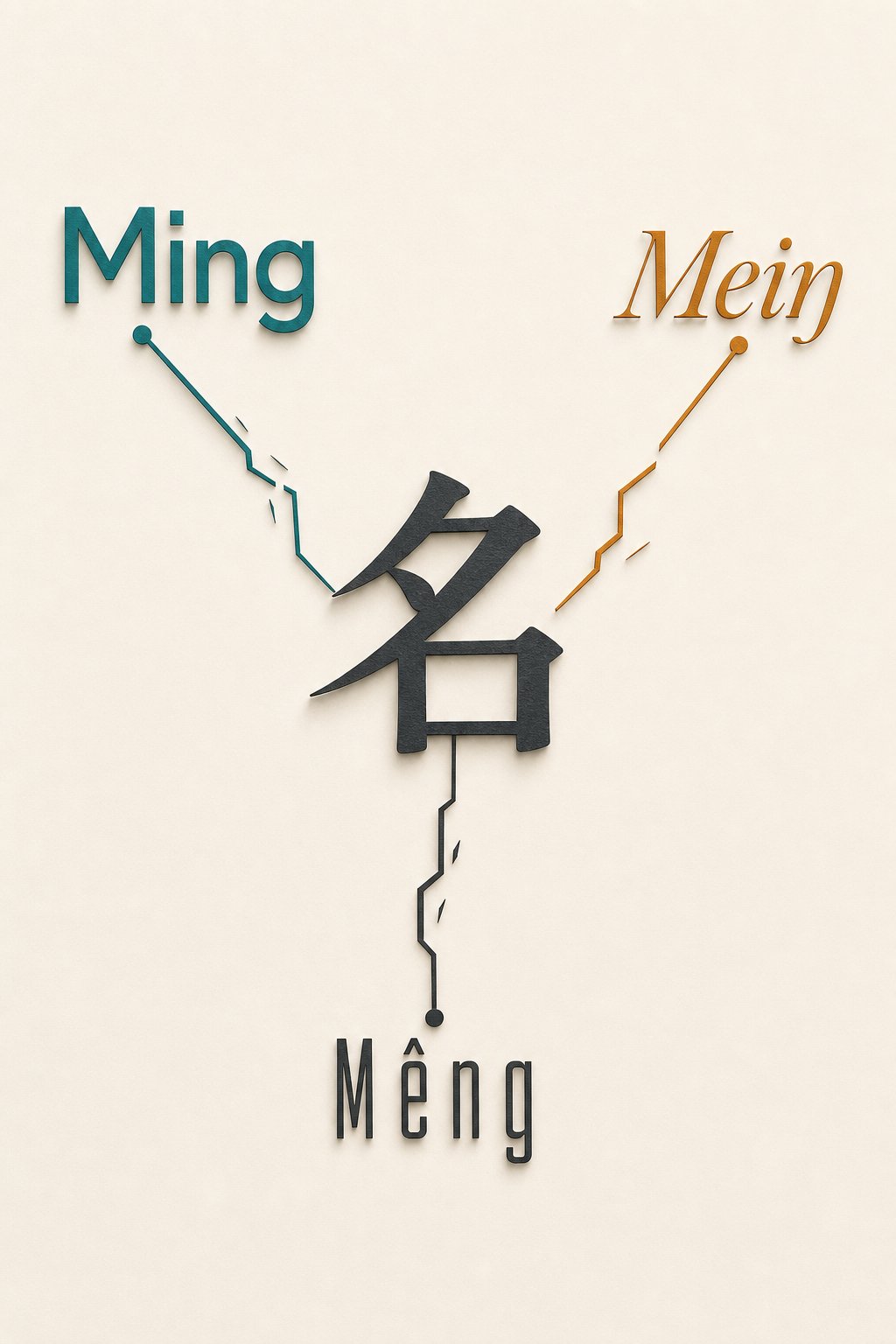
Pinyin isn't the only system that converts Chinese characters into Latin letters. It's simply the most widely used one today. Historically, and across different regions, several competing romanization systems have coexisted, each producing different spellings for the same characters. So the problem isn't just that many characters collapse into one Pinyin spelling. It's that the same chinese name can appear under different romanization spellings depending on which system was used, when it was recorded, and where the person comes from.
Wade-Giles, Yale, and Jyutping Add Layers of Confusion
Three systems dominate alongside Pinyin. Wade-Giles, developed in the 19th century by British diplomat Sir Thomas Francis Wade and later refined by Cambridge professor Herbert Allen Giles, was the standard in English-language scholarship for over a century. It remains common in older academic texts and is still used for many personal and place names in Taiwan. Yale romanization, created at Yale University in the late 1940s for teaching Mandarin and Cantonese to military and diplomatic personnel, appears in some academic contexts. And Jyutping, developed by the Linguistic Society of Hong Kong, is the standardized system for Cantonese pronunciation.
Each system applies its own rules for tones, aspiration, and spelling. Wade-Giles uses apostrophes to mark aspirated consonants, so what Pinyin writes as "qi" becomes "ch'i" in Wade-Giles. Yale uses diacritical marks differently. Jyutping represents Cantonese tones with numbers 1 through 6. The result? A single person's name can look completely different depending on which system a database, publisher, or immigration officer happened to use.
This isn't hypothetical. Yale University's library guide notes that the Pinyin system replaced Wade-Giles as the U.S. library standard, but well-established personal names like Chiang Ching-kuo (蒋经国) were never converted. Someone searching for that name in Pinyin as "Jiang Jingguo" might never find the Wade-Giles records, and vice versa. The same person, two different romanized identities, split across databases.
When the Same Person Has Multiple Romanized Identities
Consider a Cantonese speaker surnamed 陈. In Mandarin Pinyin, that's "Chen." In Jyutping, it's "Can4." Under Hong Kong's non-standardized government romanization, it might appear as "Chan." Three spellings, one character, one person. This jyutping cantonese name romanization confusion multiplies across every syllable of a full name.
The science fiction author 刘慈欣 illustrates the wade-giles vs pinyin name differences clearly. In Pinyin, his name is "Liu Cixin." In Wade-Giles, it would render as "Liu Tz'u-hsin." If he were a Cantonese speaker using Jyutping, the same characters would produce "Lau4 Ci4jan1." International publishers, citation databases, and library catalogs might each record a different version depending on their era and regional conventions.
A 2025 study in the International Journal of Population Data Science quantified this fragmentation directly. Researchers found that Hong Kong's non-standardized romanization system represented the same Chinese characters using different codes. For example, the character 周 appeared as "Chow," "Chau," or "Chiau" depending on the record. Meanwhile, the code "Chiu" was used for both 趙 (Zhao in Pinyin) and 邱 (Qiu in Pinyin), two entirely different surnames. Standardized systems like Jyutping and Pinyin achieved over 95% recall in data-linkage blocking strategies, while the non-standardized system managed only 68.8%.
Here's how the same names look across multiple romanization systems for chinese names:
| Chinese Characters | Pinyin (Mandarin) | Wade-Giles | Jyutping (Cantonese) |
|---|---|---|---|
| 王伟 | Wang Wei | Wang Wei | Wong4 Wai5 |
| 陈静 | Chen Jing | Ch'en Ching | Can4 Zing6 |
| 张明 | Zhang Ming | Chang Ming | Zoeng1 Ming4 |
| 刘慈欣 | Liu Cixin | Liu Tz'u-hsin | Lau4 Ci4jan1 |
| 李华 | Li Hua | Li Hua | Lei5 Waa4 |
You'll notice that some names look similar across Pinyin and Wade-Giles (like Wang Wei), while others diverge sharply (Zhang Ming vs. Chang Ming). The Cantonese Jyutping versions are often unrecognizable compared to their Mandarin equivalents. A person who publishes under "Zoeng Ming" in Hong Kong and "Zhang Ming" in Beijing is the same individual, but no automated system would connect those records without explicit cross-referencing.
This cross-system fragmentation means pinyin name ambiguity isn't just about many people collapsing into one spelling. It's also about one person being scattered across multiple spellings, invisible to any single search. The collision problem and the fragmentation problem work in opposite directions, but both erode the same thing: the ability to reliably identify who is who.
That erosion hits hardest in professional and institutional contexts where accurate identification isn't a convenience but a requirement.
Who Gets Affected and Where Pinyin Name Collisions Cause Real Problems
Collision and fragmentation sound like abstract linguistic problems until they land on your desk. A researcher discovers her publications are attributed to three different people. An immigration officer flags an application because the name matches someone on a watchlist. A genealogist traces a family line back four generations only to hit a wall of identical romanized names. The erosion of identity through romanization doesn't affect everyone equally. Some professions and contexts amplify the consequences dramatically, turning a spelling quirk into a career setback, a legal delay, or a lost family connection.
Researchers and Academic Publishing
For scholars, your name is your brand. Every citation, every publication, every grant application ties back to a single identifier: the name on the byline. When that name is shared by dozens or hundreds of other researchers, the consequences are measurable and career-altering.
Consider the case of "Y. Wang." Research published in Accountability in Research found that this name appeared in the bylines of 3,926 academic publications in a single year, an impossible publication rate of almost 11 papers per day. Further investigation revealed that "Y Wang" had authored around 30,000 articles between 2005 and 2015, was affiliated with more than 500 universities in nearly 100 countries, and had published over 100 papers in each of 73 distinct research areas. Obviously, no single person did this. The name simply aggregated the work of thousands of different researchers into one phantom super-author.
The downstream effects of pinyin name confusion in academic citations are concrete. Early-career researchers building their reputations find their work attributed to established namesakes, or worse, their citation counts diluted across multiple profiles. Hiring committees reviewing publication records can't distinguish between candidates. Journal editors misidentify peer reviewers based on inflated publication lists that actually belong to multiple people. The same study noted that a European national fund administration once invited an applied linguistics researcher to review a grant proposal on e-government, simply because his romanized name matched a namesake in that field.
How pinyin name collisions affect researchers goes beyond inconvenience. Fractured scholarly profiles mean lower h-indexes, missed collaboration opportunities, and inaccurate research impact assessments. For Chinese researchers publishing internationally, the problem is structural: approximately two-thirds of author names in PubMed were found to be ambiguous, and a search for "Wang X" alone returned 8,904 entries.
HR Professionals, Immigration Officers, and Genealogists
Academic publishing is high-stakes, but it's not the only domain where duplicate romanized names in HR records create serious problems. Any system that uses a romanized name as a primary identifier is vulnerable.
Immigration processing is particularly exposed. When a visa applicant's name matches hundreds of other individuals in a database, background checks become exponentially more complex. Officers must determine whether the "Zhang Wei" applying for a work visa is the same "Zhang Wei" flagged in another system, or one of the 300,000 other people who share that romanized name. Translation professionals report that name discrepancies across documents are among the most common causes of Requests for Evidence, processing delays, and outright rejections in immigration cases. Chinese name ambiguity in immigration background checks doesn't just slow things down. It can trigger false positives that take months to resolve, with applicants bearing the burden of proving they aren't someone else.
HR departments face a parallel challenge. Global companies with offices in China and abroad maintain employee databases where romanized names serve as identifiers. When multiple employees share the same Pinyin name, records can merge, benefits can be misrouted, and performance reviews can be misattributed. Onboarding a new hire named "Li Wei" into a system that already contains three other "Li Wei" entries requires manual disambiguation that most HR software isn't designed to handle.
Genealogy problems with common chinese names present yet another dimension. Family tree research depends on connecting individuals across generations through name records. But historical immigration documents, census records, and ship manifests all used romanized names, often inconsistently. My China Roots notes that the unique ordering of Chinese surnames and given names caused significant confusion among foreign immigration officers historically, leading to records where surnames and given names were swapped, nicknames were recorded as legal names, and the same individual appeared under multiple spellings. For diaspora families trying to trace their roots, these romanized records often represent the only surviving link to ancestors, and the ambiguity makes it nearly impossible to confirm whether a "Wong Ah Kee" in a 1920s immigration ledger is their great-grandfather or one of dozens of unrelated individuals.
Everyday Cross-Cultural Communication
You don't need to be a researcher or an immigration applicant to feel the friction. Everyday situations compound the problem in ways that are less dramatic but persistently frustrating. Booking international flights, registering for conferences, opening bank accounts abroad, receiving mail, or simply introducing yourself in a multinational workplace all become more complicated when your romanized name is shared by thousands of others.
Imagine explaining to a hotel front desk that yes, there are two "Chen Jing" reservations, and no, the other one isn't yours. Or discovering that your professional email was auto-assigned as "jwang47" because 46 other J. Wangs already exist in the company directory. These small indignities accumulate into a persistent sense of administrative invisibility.
Ranked from highest to lowest measurable impact, here are the contexts where this problem causes the most significant consequences:
- Academic publishing and research assessment — misattributed citations, fractured publication profiles, and inaccurate impact metrics directly affect career advancement, funding decisions, and scholarly reputation
- Immigration and legal identity verification — false-positive matches trigger delays, Requests for Evidence, and potential denials that carry financial and personal costs
- Background checks and security screening — shared names create false associations with unrelated individuals, requiring extensive manual review
- Corporate HR and employee records — merged or confused records lead to payroll errors, misrouted communications, and compliance risks
- Genealogical research — ambiguous historical records make it difficult or impossible to confirm ancestral connections across generations
- Medical records and healthcare systems — patient misidentification risks increase when multiple individuals share identical romanized names in the same facility
- Everyday administrative tasks — travel bookings, account registrations, and professional networking all suffer from reduced distinguishability
What connects all these contexts is a shared assumption baked into their systems: that a person's romanized name is a reliable identifier. For most of the world's naming traditions, that assumption holds reasonably well. For Chinese names filtered through Pinyin, it fails at scale. The question then becomes what individuals and institutions can do to restore the uniqueness that romanization strips away.
Self-Disambiguation Strategies for Individuals
Restoring uniqueness doesn't require waiting for institutions to fix their systems. You can take concrete steps right now to make your romanized chinese name unique and reduce the odds of being confused with someone else. The key principle is consistency: pick a strategy, apply it everywhere, and make it easy for others to find the real you.
Building a Consistent Romanized Identity
The single most effective thing you can do is choose one romanized spelling and use it across every platform, publication, and official document without variation. Sounds simple, but many people inadvertently create fragmentation by using "Xiao-Ming" on one paper, "Xiaoming" on another, and "X.M." on a third. Each variation splits your identity further.
Here are the best practices for consistent pinyin name usage that reduce ambiguity at the individual level:
- Lock in one spelling format. Decide whether you'll hyphenate your given name (Xiao-Ming), merge it (Xiaoming), or use initials (X.M.), then stick with that choice permanently across all professional and legal contexts.
- Include Chinese characters alongside Pinyin. On your CV, academic profiles, LinkedIn, and email signature, display your name in both scripts. This gives anyone who needs to verify your identity an unambiguous reference point.
- Use a middle name or initial strategically. Adding a middle initial, an English name, or even a generational character that might otherwise be dropped can create enough differentiation to separate you from namesakes. "Wei J. Wang" is more distinguishable than "Wei Wang."
- Register with a persistent identifier system. For researchers, this is non-negotiable. For professionals in any field, it's increasingly valuable.
These steps won't eliminate every collision, but they dramatically narrow the pool of people you might be confused with. The goal is to make disambiguation possible for anyone who encounters your name in a database, a citation list, or a search result.
Identifier Systems Compared
If you're a researcher facing pinyin name ambiguity, identifier systems offer the most robust solution. They assign you a unique numeric code that follows your work regardless of how your name is spelled, misspelled, or duplicated. Think of it as a digital fingerprint for your scholarly output.
Washington State University's research impact guide explains the core problem these systems solve: many researchers share the same name, while others have different name variations during their career. As a result, linking a researcher with their publications across an entire career becomes difficult without a persistent identifier.
Three systems dominate the landscape, and understanding their differences helps you decide where to invest your time:
ORCID (Open Researcher and Contributor ID) provides a persistent digital identifier that distinguishes you from every other researcher and supports automated linkages between you and your professional activities. It's free, open, and widely adopted across publishers, funders, and institutions. You can integrate it with other systems and push publications between platforms. For chinese researchers with common names, ORCID is the essential starting point because of its universal acceptance.
ResearcherID (now integrated with Publons and Clarivate's Web of Science) aggregates your publications as indexed in Clarivate's databases, collecting them together even if your name has been listed differently from item to item. However, it works primarily within the Web of Science ecosystem, which limits its reach.
Scopus Author ID is Elsevier's equivalent, automatically assigned to authors in the Scopus database. It distinguishes researchers and aggregates research outputs within Elsevier's ecosystem. The limitation is that not all institutions subscribe to Scopus, and the identifier is less portable than ORCID.
| System | Cost | Coverage | Platform Integration | Best For |
|---|---|---|---|---|
| ORCID | Free | Cross-platform, publisher-independent | Web of Science, Scopus, CrossRef, most major publishers and funders | All researchers; universal baseline identifier |
| ResearcherID (Clarivate) | Free | Web of Science ecosystem | ORCID integration available; primarily Clarivate products | Researchers publishing in WoS-indexed journals |
| Scopus Author ID | Free (auto-assigned) | Scopus database | ORCID integration available; primarily Elsevier products | Researchers with publications indexed in Scopus |
The practical recommendation? Start with ORCID, then link it to ResearcherID and Scopus Author ID if your publications appear in those databases. As WSU's guide notes, you can now integrate all three systems by logging into each profile and enabling access between them, pushing publications and research outputs from one to the other. This creates a unified identity layer that sits above any single romanized spelling of your name.
Strategies for Non-Academic Users
You don't need to be publishing papers to benefit from deliberate disambiguation. Anyone navigating cross-cultural professional life can apply similar principles to how they disambiguate their chinese name in pinyin contexts.
Add characters to your email signature. A simple line like "王维 (Wang Wei)" beneath your sign-off gives recipients an unambiguous reference. If they need to look you up, forward your information, or distinguish you from another Wang Wei in their contacts, the characters provide a definitive anchor.
Use phonetic clarifications proactively. When introducing yourself in international settings, briefly noting the tone or meaning of your name can help. "Wang as in 'king,' not 'vast'" takes three seconds and plants a memorable distinction. Some people include a brief pronunciation guide on their business cards or LinkedIn profiles.
Maintain consistent documentation across legal and professional contexts. This means using the same romanized spelling on your passport, driver's license, bank accounts, employment records, and professional memberships. Any variation between documents creates opportunities for confusion, delays, or failed identity verification. If your passport uses "Lyu" but your university diploma says "Lu," you've created a fragmentation problem that mirrors the multi-system clash discussed earlier.
Consider a consistent English name if you use one. Many Chinese professionals adopt an English given name for international contexts. If you go this route, use it consistently rather than switching between different English names or alternating between your English name and Pinyin name unpredictably.
The thread connecting all these strategies is intentionality. Pinyin name ambiguity is a structural problem you didn't create, but the way you present your name across systems and contexts is something you can control. Every consistent choice you make narrows the gap between your romanized label and your actual identity.
Individual strategies go a long way, but they can only do so much when the systems themselves aren't designed to accommodate the complexity of Chinese names. The larger question is what organizations and technologies can do to solve this problem at scale.
Institutional and Technological Solutions at Scale
Individual effort can only compensate for so much when the underlying infrastructure treats romanized names as definitive identifiers. The real leverage lies in how organizations design their databases, process their records, and deploy technology to distinguish between people whose names look identical on screen. Solving pinyin name ambiguity at the institutional level means rethinking assumptions that were baked into systems decades ago, when the designers never anticipated handling millions of names from tonal, character-based languages.
How Institutions Can Reduce Name Confusion
The most impactful change is also the most straightforward: stop treating a romanized name as the sole identifier. Organizations that collect, store, or process Chinese names can adopt institutional policies to reduce pinyin name confusion without overhauling their entire infrastructure. It starts with database design for chinese character names that accommodates the reality of how these names actually work.
What does that look like in practice? A 2025 study published in the International Journal of Population Data Science recommended that database managers switch to Unicode or other encoding standards capable of capturing non-alphabetical characters, and explore designs that additionally capture tonal information alongside people's names in their original languages. The researchers argued this enables data linkers to apply whichever romanization method is most appropriate for the intended linkage, rather than being locked into a single lossy representation.
Imagine a university enrollment form that includes fields for both the student's Chinese characters and their preferred romanization. Or a hospital intake system that stores the original script alongside the Latin-alphabet version. These aren't exotic requirements. They're design choices that preserve the information romanization discards.
Beyond storage, fuzzy matching algorithms for romanized names offer a powerful layer of disambiguation during record retrieval and linkage. Enterprise fuzzy name matching combines multiple techniques: Jaro-Winkler algorithms catch character-level typos and variants, Double Metaphone handles phonetic similarities, and nickname dictionaries resolve known alternate forms. For Chinese names specifically, these tools can flag potential collisions rather than silently merging records that happen to share the same Pinyin string.
The same research from UCL demonstrated that standardized romanization systems like Jyutping and Pinyin achieved over 95% recall in blocking strategies for data linkage, compared to just 68.8% for non-standardized systems. Incorporating tonal information further improved precision. The takeaway for institutions is clear: even without storing original characters, adding phonetic metadata like tone numbers dramatically improves the system's ability to distinguish between people.
Here are institutional best practices that reduce ambiguity in record-keeping systems:
- Store names in original script alongside romanized versions. Use Unicode-compatible fields that accept Chinese characters, not just ASCII Latin letters.
- Support multiple name fields in forms. Separate fields for surname, given name, generational name, preferred English name, and original-language name prevent the compression that single "full name" fields create.
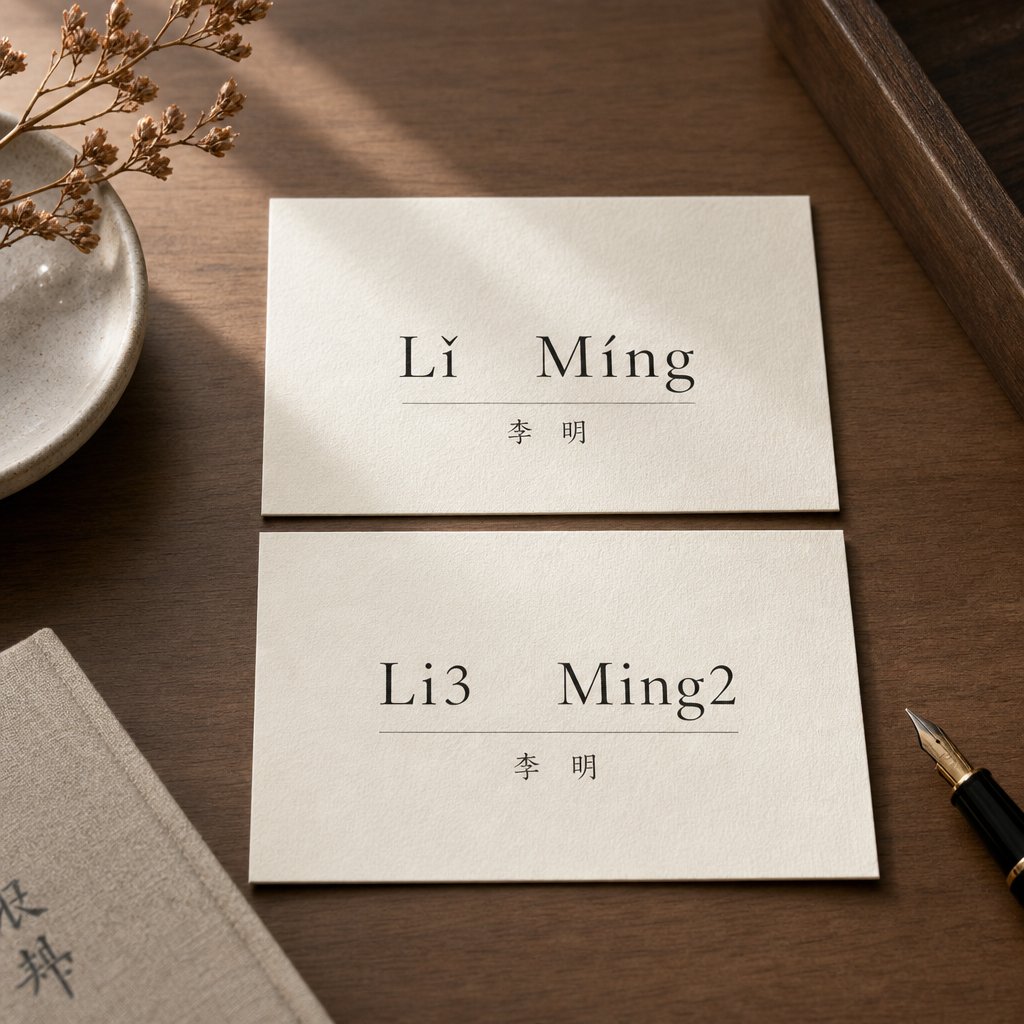
- Capture tonal and phonetic metadata. Even a simple numeric tone field (e.g., "Wang2" vs. "Wang4") adds a disambiguation layer that costs almost nothing to implement.
- Implement fuzzy matching with collision alerts. When a new record matches an existing one on romanized name alone, flag it for human review rather than auto-merging.
- Adopt persistent identifiers as primary keys. Use ORCID, employee IDs, or other unique codes as the true identifier, with names serving as secondary descriptors rather than primary keys.
- Standardize romanization protocols. Choose one system (Pinyin, Jyutping, or both) and apply it consistently across all records, documenting which system was used.
- Train staff on name-order conventions. Provide clear guidance on surname-first vs. given-name-first ordering to prevent the misplacement errors that fragment records further.
Technology-Driven Disambiguation Methods
Policy changes set the foundation, but machine learning chinese name disambiguation is where the real scalability emerges. Academic databases have been tackling this problem for over a decade, and the methods they've developed are beginning to migrate into government and corporate systems.
The core approach uses clustering algorithms that group publications or records not just by name, but by contextual signals. Two papers by "Wang Wei" that share co-authors, institutional affiliations, research topics, and citation networks are likely from the same person. Two papers by "Wang Wei" in completely different fields, from different institutions, with no overlapping collaborators, are almost certainly from different people. Machine learning models trained on these features can disambiguate with high accuracy, even when the name string is identical.
Co-authorship networks are particularly powerful. If you've published with a consistent set of collaborators, that network signature becomes a fingerprint that distinguishes you from every other person who shares your romanized name. Academic databases like Scopus and Web of Science already use these signals internally to maintain their author profiles, though the results aren't always perfect.
Natural language processing extends this further. NLP models can analyze writing style, topic vocabulary, and even citation patterns to probabilistically assign ambiguous records to the correct individual. These approaches work best when there's a substantial body of text to analyze, which makes them well-suited for academic disambiguation but less immediately applicable to, say, a two-line immigration record.
Government and corporate systems are catching up. Immigration databases are beginning to incorporate biometric data, document metadata, and travel history patterns as disambiguation signals that supplement name-based matching. HR platforms are exploring graph-based approaches that use reporting relationships, office locations, and project assignments to distinguish between employees who share romanized names.
Pronunciation guides and phonetic metadata represent a simpler but underutilized technology layer. The UCL researchers demonstrated that tonal combinations in Chinese names follow predictable frequency distributions. By storing tone information alongside romanized names, systems gain a low-cost disambiguation signal. A "Wang2 Wei3" and a "Wang1 Wei2" are clearly different people, even though both appear as "Wang Wei" in a standard database. Voice-to-text transcription offers a practical collection method: asking individuals to say their name in their mother tongue captures tonal information that can be stored as supplementary metadata for future linkage.
None of these technologies eliminates the problem entirely. Machine learning models require training data and can introduce their own biases. Fuzzy matching algorithms need careful threshold tuning to balance false positives against missed matches. Phonetic metadata only helps if it's consistently collected and stored. But layered together, these approaches transform a system that's blind to the difference between thousands of identically-spelled names into one that can distinguish between them with reasonable confidence.
Technology and policy address the mechanics of identification. They fix the plumbing. But for the people whose names get compressed, the problem isn't purely administrative. It touches something deeper: the sense that your name, chosen with care and rich with meaning, has been reduced to a generic label that could belong to anyone.
Cultural Identity and the Diaspora Experience
A name in Chinese characters isn't just a label. It's a compressed story. Parents spend weeks, sometimes months, selecting characters that carry specific hopes, family lineage markers, or philosophical ideals. A grandfather's generational character links you to cousins you've never met. A carefully chosen given-name character might reference a classical poem, a seasonal image, or a quality your parents wished into existence for you. That entire narrative layer, the cultural meaning embedded in pinyin romanization, disappears the moment your name becomes a string of Latin letters on a foreign document.
Names as Cultural Identity Markers
In Chinese naming traditions, characters are selected not just for sound but for meaning, visual beauty, and even stroke count. The character 慧 (hui, wisdom) communicates something fundamentally different from 辉 (hui, radiance), even though both romanize identically. A parent choosing between them is making a statement about what they value, what they see in their child, what legacy they want to pass forward. That statement is legible to any Chinese reader. It's invisible to anyone reading "Hui" on a passport.
CSH researcher Liuhuaying Yang's visualization project Not My Name captures this loss through a leaf-and-tree metaphor: just as no two leaves are alike, every Chinese character is unique. Yet when transliterated, these unique characters get grouped into clusters sharing the same syllable, blurring their individuality. The project strives to raise awareness of the barriers individuals face in cross-cultural communication when their names lose meaning.
The emotional impact of name ambiguity for chinese speakers goes beyond administrative frustration. It's the experience of introducing yourself and knowing that the version of your name the other person hears carries none of the significance your parents intended. It's filling out a form and watching your identity flatten into something generic. For many, it feels like a small erasure repeated hundreds of times across a lifetime, each instance reinforcing the sense that a part of you simply doesn't translate.
Navigating Identity Across Cultures
Chinese diaspora name identity challenges play out in deeply personal decisions. Do you introduce yourself with your Pinyin name and accept the ambiguity? Adopt an English name for convenience? Insist on your characters and spend every first meeting explaining pronunciation? Each choice involves a trade-off between accessibility and authenticity, between being easily remembered and being accurately represented.
Research on Chinese language learners and immigrants reveals that these decisions aren't passive. A study published in the Journal of Multilingual and Multicultural Development found that names function as "vehicles of meaning" that transmit messages to both the bearer and the people around them. Participants reported that their Chinese names symbolized nationality and cultural pride, functioning as stable sources of comfort and strength. Six out of ten interviewees preferred presenting foreign names in parallel with Chinese names during international encounters, asserting their national identity while pragmatically protecting their Chinese names from mispronunciation.
One participant in that study described foreign names as "gate passes" that position you and confer agency in specific contexts. But the gate pass works in one direction. It grants entry into international communication while leaving behind the semantic richness that made your original name yours. Another participant noted that her Chinese name "represents just me," while foreign names "can be other people." That distinction captures something essential about what romanization costs: it turns a singular identity into a shared one.
The growing movement toward preserving chinese character names internationally reflects a shift in how diaspora communities approach this tension. More professionals are including characters on business cards, LinkedIn profiles, and academic publications. More institutions are accepting non-Latin scripts in official records. More individuals are choosing to explain their names rather than replace them. These aren't just practical disambiguation strategies. They're acts of cultural assertion, quiet insistences that the full version of a name deserves to exist in global spaces.
Romanization enables global communication but strips names of their semantic richness and uniqueness. Every Chinese name compressed into Pinyin loses the visual distinctiveness of its characters, the meaning chosen by family, and the cultural context that makes it irreplaceable. The trade-off is not neutral: it asks one group to sacrifice legibility so another can have convenience.
This tension won't resolve itself through better algorithms or smarter databases alone. Technology can restore the mechanics of identification, but the cultural dimension requires something different: a willingness from global systems and the people who design them to treat non-Latin names not as edge cases to be accommodated, but as complete identities that deserve full representation. Until that shift happens, millions of people will continue navigating a world where their name, as the world sees it, is not quite their name at all.
Frequently Asked Questions About Pinyin Name Ambiguity
1. Why do so many Chinese names look the same in English?
Chinese uses tens of thousands of unique characters, but the Pinyin romanization system compresses them into roughly 375 syllables without tone marks. This many-to-one mapping means dozens of different characters produce the same Latin-letter spelling. When combined with the fact that the top 100 Chinese surnames cover over 85% of the population, the result is massive overlap. Names like Wang Wei, Zhang Wei, and Li Na are each shared by hundreds of thousands of people in characters alone, and the romanized collision is even larger because different character combinations also produce those same spellings.
2. How can I make my romanized Chinese name more unique?
Start by choosing one consistent romanization format and using it across all platforms, documents, and publications without variation. Include your Chinese characters alongside the Pinyin on professional profiles, CVs, and email signatures. Adding a middle initial or English name creates further differentiation. For researchers, registering with ORCID provides a persistent digital identifier that links your work regardless of how your name is spelled. Non-academic professionals can add phonetic clarifications to business cards and maintain identical spelling across passports, bank accounts, and employment records.
3. What is the difference between Pinyin, Wade-Giles, and Jyutping?
These are three separate systems for converting Chinese characters into Latin letters. Pinyin is the current international standard for Mandarin, used in mainland China and most modern publications. Wade-Giles is an older British system still common in Taiwan and historical texts, using apostrophes to mark aspiration (e.g., 'ch'i' instead of 'qi'). Jyutping is the standardized romanization for Cantonese, producing entirely different spellings because Cantonese pronunciation differs from Mandarin. A single person's name can appear under all three systems depending on context, fragmenting their identity across databases.
4. How does pinyin name ambiguity affect academic researchers?
Researchers with common romanized names face misattributed citations, fractured publication profiles, and inaccurate impact metrics. Studies have found that a name like 'Y. Wang' appeared on nearly 4,000 publications in a single year and roughly 30,000 articles over a decade, representing thousands of different individuals. This aggregation dilutes individual citation counts, confuses hiring committees, and leads to inappropriate peer review assignments. The problem is structural: approximately two-thirds of author names in major databases like PubMed are ambiguous, making persistent identifiers like ORCID essential for career advancement.
5. Can technology solve the pinyin name collision problem?
Technology significantly reduces the problem but cannot eliminate it entirely. Machine learning clustering algorithms use co-authorship networks, institutional affiliations, and research topics to distinguish between identically-named individuals in academic databases. Fuzzy matching algorithms flag potential collisions in HR and immigration systems rather than auto-merging records. Storing Chinese characters in Unicode alongside romanized names and capturing tonal metadata both add low-cost disambiguation layers. Research shows standardized romanization systems achieve over 95% recall in data linkage, compared to 68.8% for non-standardized approaches. Layering these methods together transforms blind systems into reasonably accurate ones.