What Is Pinyin Name Character Simplification
Imagine you're filling out an international form and your Chinese name looks different on your passport, your university transcript, and your birth certificate. The characters might differ, the spelling might shift, yet the name is unmistakably yours. This confusion sits at the heart of pinyin name character simplification, a topic that touches millions of people but rarely gets explained in one place.
What Pinyin Name Character Simplification Means
Pinyin name character simplification refers to the convergence of three interconnected systems: Hanyu Pinyin romanization, the simplification of Chinese characters, and the conventions governing how personal names are written and transmitted across languages and official documents.
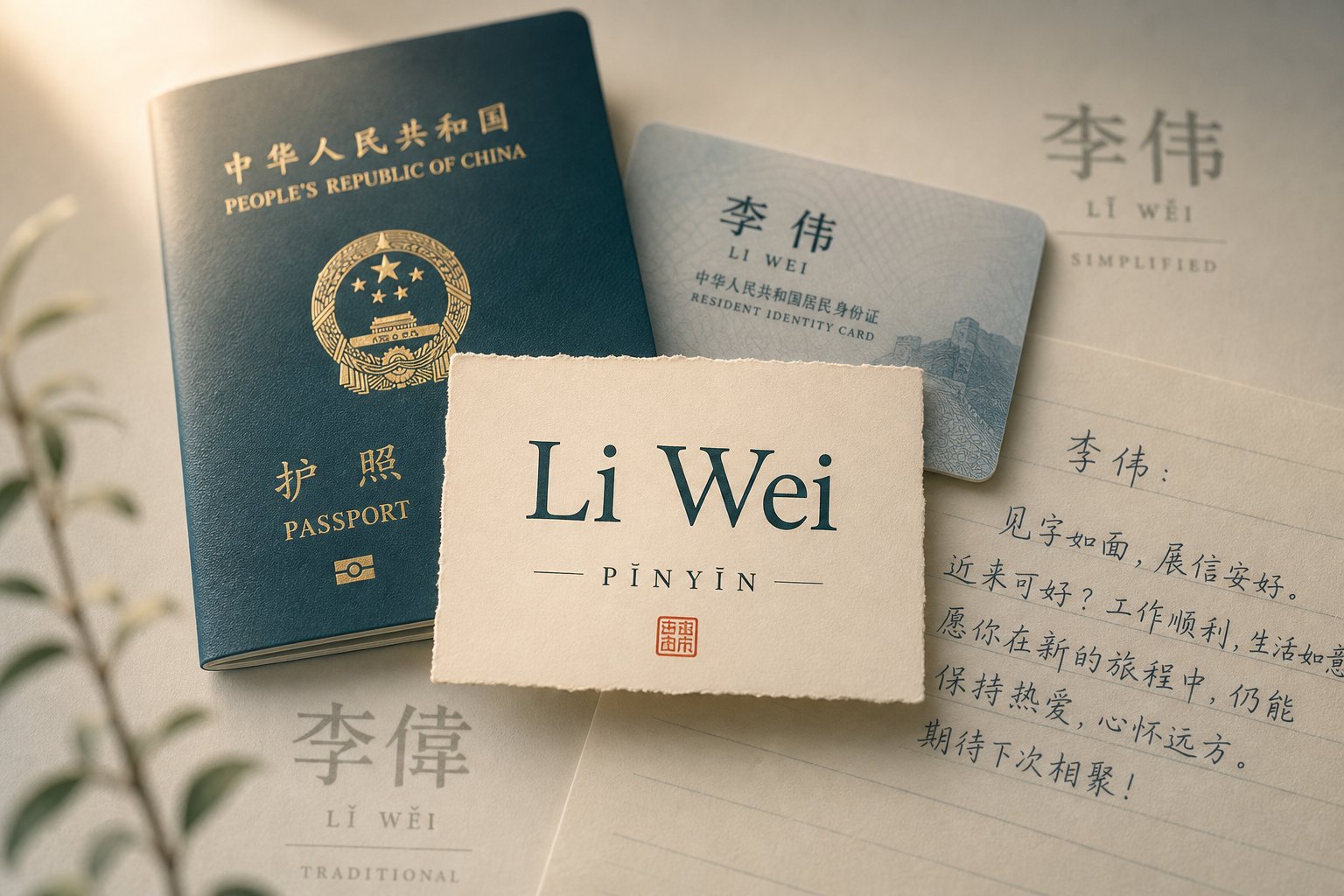
So what is Pinyin, exactly? It is a phonetic system developed in the 1950s that uses Latin letters to represent Mandarin pronunciation. It works alongside Chinese characters rather than replacing them. When the People's Republic of China reformed its writing system, reducing stroke counts in thousands of characters to create simplified Chinese, the way names appeared on paper changed. But the Pinyin spelling of those names often stayed the same. This creates a unique situation: a single person's name can exist as traditional characters, simplified characters, and a romanized Pinyin form, each version surfacing in different contexts.
People sometimes ask how many letters in the Chinese alphabet or how to spell Chinese names in English. The short answer is that Chinese doesn't use an alphabet at all. Chinese characters are logographic, meaning each character represents a syllable and a meaning rather than a single sound. Pinyin bridges that gap by providing a standardized Chinese transliteration system so that names built from these characters can be rendered in Latin script for international use.
Why This Matters for Chinese Names Today
The relationship between Chinese and Pinyin becomes especially high-stakes when personal names are involved. Names carry legal weight. A mismatch between the characters on a household registration document and the Pinyin on a passport can delay visa applications, complicate academic citations, or create confusion in genealogical records. Research published in the International Journal of Population Data Science highlights how the same Chinese surname can appear as entirely different romanized forms depending on whether Mandarin Pinyin, Cantonese romanization, or Hong Kong government spelling is used.
No single resource currently bridges these three topics together: the historical reforms that created simplified Chinese, the phonetic system that standardizes pronunciation, and the naming conventions that govern how real people represent their identities across borders. This article fills that gap, tracing the path from mid-century character reform all the way to the practical challenges you'll face when converting a name between writing systems today.
The story begins with why China reformed its characters in the first place, and how a parallel phonetic system emerged to carry those names into the wider world.
The History Behind Simplified Characters and Pinyin
China's writing system served its people for thousands of years without a standardized phonetic companion. By the mid-twentieth century, that gap had become a barrier. Illiteracy rates remained high, administrative communication across dialects was inconsistent, and international engagement demanded a way to render Chinese names and terms in Latin script. Two parallel reforms addressed these problems: character simplification and the creation of Pinyin.
Origins of Character Simplification in China
The idea of simplifying Chinese characters didn't appear overnight. Informal shorthand versions of complex characters had circulated for centuries, and the Republican government published its first official list of simplified forms as early as 1935. But the effort gained real momentum after 1949. In February 1952, the State Council established the Research Committee for the Reform of Chinese Characters under Ma Xulun and Wu Yuzhang. Their task was to define simplification in a systematic, enforceable way rather than leaving it to regional habit.
The committee produced a draft procedure for character simplification (Hanzi jianhua fang'an) in February 1955. After review by a group of scholars and writers headed by Dong Biwu, and public discussion at the National Conference for the Reform of Characters, the State Council accepted the final plan in January 1956. It was then published in the People's Daily (Renmin ribao), making it official policy across China.
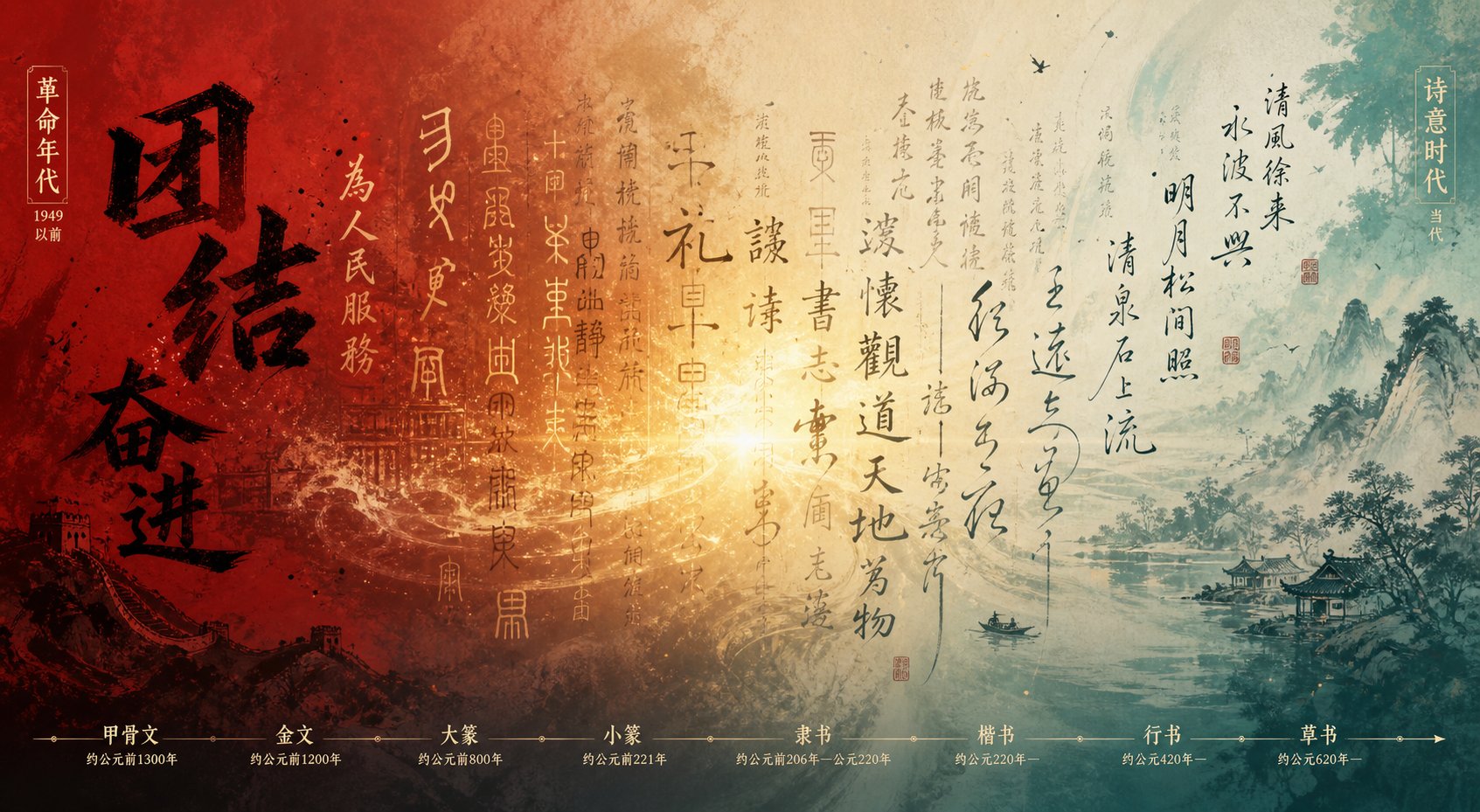
What did simplification actually do? It reduced stroke counts, often by officializing shorthand forms that people already used in daily writing. The character for "speech" (yan), for example, went from seven strokes to two when it appeared as a component inside other characters. Some whole characters were replaced entirely. The result was a writing system now labeled simplified Chinese, or zh-cn in digital encoding, that was faster to write, easier to learn, and more legible in print. For personal names, this meant that many surname and given-name characters changed their written appearance, sometimes dramatically.
How Pinyin Became the Standard Romanization
Character simplification solved one problem: making written Chinese more accessible. But it didn't address pronunciation. China's vast dialect landscape meant that the same character could be read aloud in dozens of ways depending on region. A phonetic system was needed, both to standardize spoken Mandarin (Putonghua) and to give Chinese names a consistent representation in Latin letters for international use.
Work on this began in October 1949 with the founding of the Committee for Language Reform in China, which included a dedicated research group for developing a phonetic scheme. Linguists like Luo Changpei, Wang Li, and Lu Shuxiang debated whether to base the system on existing Chinese phonetic symbols or adopt the Latin alphabet. After considering several approaches, the committee chose Latin letters as the most practical option for international communication. A first draft appeared in February 1956, initially containing six additional letters beyond the standard Latin set. After revision, the finalized version, called the Hanyu Pinyin Scheme, was adopted by the State Council in November 1957 and approved by the National People's Congress on February 11, 1958.
Pinyin gave every Chinese character a fixed romanized spelling based on its Mandarin pronunciation. In 1982, it became the international standard ISO 7098 for the romanization of Chinese. This meant that simple Chinese names, no matter how their characters looked in traditional or simplified form, now had one official Latin-letter spelling recognized worldwide.
You'll notice the key convergence here: simplification changed how name characters were written, but Pinyin stabilized how those same names were spelled in Roman letters. A person whose surname character lost half its strokes during reform still carried the same Pinyin on their passport. These two systems, one visual and one phonetic, became the twin pillars of how Chinese names are officially recorded domestically and transmitted internationally. That structural relationship between character form and phonetic spelling is exactly where formatting rules come into play.
How Pinyin Represents Chinese Names
Knowing that Pinyin provides a stable phonetic spelling for Chinese characters is one thing. Knowing exactly how to format a full name in Pinyin is another. When you convert Chinese to Pinyin for a personal name, specific structural rules govern the order, spacing, capitalization, and even whether tone marks appear. These rules aren't arbitrary. They come from a national standard, GB/T 28039-2011, titled "The Chinese Phonetic Alphabet Spelling Rules for Chinese Names," published in October 2011 and enforced since February 2012.
Capitalization and Spacing Rules for Pinyin Names
If you've ever wondered how to spell in Chinese words that form a person's name, the rules are more precise than most people realize. Here's how the standard breaks it down:
- Surname first, given name second. Chinese names maintain their native order in Pinyin. The family name comes before the given name, just as it does in characters.
- Both parts are capitalized. The first letter of the surname and the first letter of the given name each get a capital letter.
- A space separates surname from given name. This is the only space in the name. No extra spaces appear between syllables of a two-character given name.
- Two-character given names are written as one continuous unit. No hyphen, no space, no intercaps. A given name like "明辉" becomes "Minghui," not "Ming-Hui" or "Ming Hui."
These conventions apply whether you're referencing a pinyin chart for pronunciation or filling out an official form. The logic is straightforward: a Chinese personal name is typically two or three syllables total, and the spacing rule makes it instantly clear which part is the surname and which is the given name.
Consider a name like 王晓明 (Wang Xiaoming). "Wang" is the surname, capitalized and standing alone. "Xiaoming" is the two-syllable given name, written as a single word with only the first letter capitalized. Compare that to a compound surname like 欧阳 paired with a single-character given name 雪: the result is "Ouyang Xue," where the compound surname is also written as one word.
How Tone Marks Apply to Personal Names
The tones of Chinese language are central to correct pronunciation. Mandarin has four tones plus a neutral tone, and in a standard pinyin table, every syllable carries a diacritical mark indicating its tone. But do those marks appear on names?
It depends entirely on context:
- Educational materials: Tone marks are retained. Textbooks and language-learning resources write names with full diacritics so students can practice chi pronunciation and other sounds accurately.
- Passports and ID cards: Tone marks are dropped. Chinese passports print names in plain Latin letters without diacritics, following international machine-readable travel document standards.
- Business cards and email signatures: Tone marks are almost always omitted for practical readability in international settings.
- Academic publications: Varies by journal style. Some retain tones for precision; others drop them for typographic simplicity.
This means the same name carries different levels of phonetic detail depending on where it appears. A linguist might write "Wang Xiǎomíng" in a research paper, while a passport reads "WANG XIAOMING" in block capitals with no tones at all.
Correct vs. Incorrect Pinyin Name Formatting
Seeing the rules side by side makes the differences concrete. The table below shows how common Chinese names should appear in standard Pinyin versus the errors that frequently show up on documents and forms:
| Characters | Correct Pinyin | Common Errors | What's Wrong |
|---|---|---|---|
| 张伟 | Zhang Wei | ZHANGWEI / zhang wei / Zhang wei | Missing space, missing capitalization, or lowercase given name |
| 李晓红 | Li Xiaohong | Li Xiao Hong / Li Xiao-hong / LI XiaoHong | Split given name, hyphen, or intercaps |
| 欧阳修 | Ouyang Xiu | Ou Yang Xiu / OuYang Xiu / Ou-yang Xiu | Split compound surname, intercaps, or hyphen |
| 诸葛亮 | Zhuge Liang | Zhu Ge Liang / ZhuGe Liang | Split compound surname or intercaps |
You'll notice the pattern: the most frequent mistakes involve splitting what should be a single unit or adding punctuation that the standard explicitly prohibits. The Allset Learning pinyin rules guide confirms that two-syllable given names should be written as one word with no space, no intercaps, and no hyphen.
One additional detail worth noting: when syllable boundaries within a given name could cause ambiguity in Chinese pronunciation, an apostrophe separates them. A given name pronounced "Xi'an" (two syllables) needs the apostrophe to distinguish it from "Xian" (one syllable). This rule applies to names just as it does to place names and common words.
These formatting conventions create a clean, predictable system on paper. But paper isn't the only place names live. Passports, academic journals, and government databases each impose their own layer of formatting on top of these base rules, and the differences can catch people off guard.
Traditional vs Simplified Name Characters with Pinyin
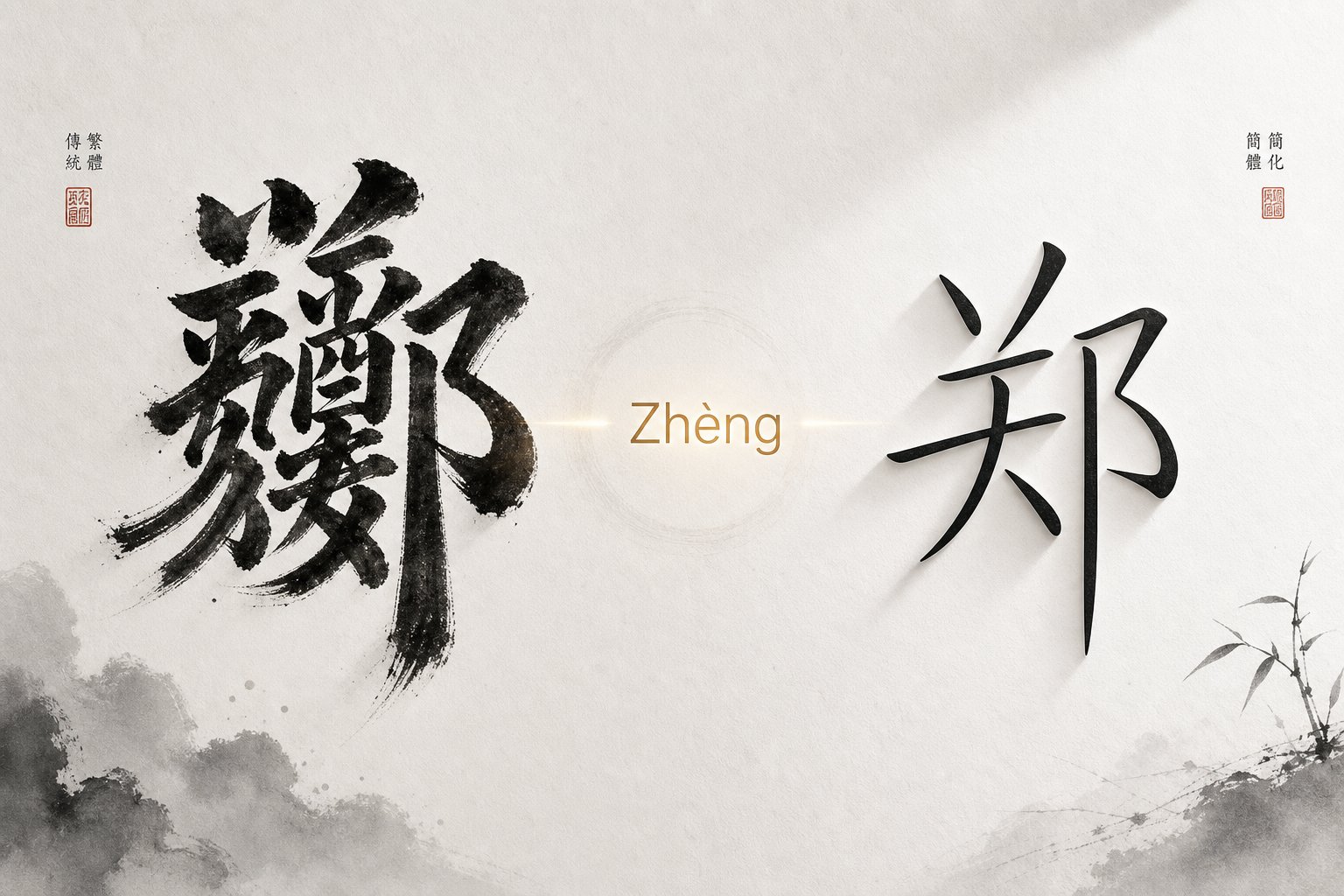
Formatting rules tell you how to arrange a Pinyin name on a page. But what happens to the characters themselves when you look at the same name across the traditional and simplified writing systems? This is where the relationship between chinese characters simplified vs traditional becomes personal. A surname that your grandparents wrote with twelve strokes might now take five, yet the Pinyin spelling hasn't moved an inch.
Name Characters That Changed During Simplification
When the PRC published the General List of Simplified Chinese Characters in 1964, it included 2,274 simplified forms and 14 simplified components. Many of these affected characters commonly used in surnames and given names. The simplification methods varied: some characters had frequently occurring radicals reduced (like the speech radical yan going from seven strokes to two), some were replaced by longstanding shorthand forms, and others had entire structural elements removed.
What stayed constant through all of this? The Pinyin. Whether you write the traditional form or the simplified form, the romanized spelling remains identical because Pinyin encodes pronunciation, not visual structure. This makes Pinyin a stable bridge when converting simplified to traditional Chinese or vice versa for name records.
The table below shows common surname and given-name characters in their traditional and simplified forms, alongside the shared Pinyin that applies to both:
| Traditional Character | Simplified Character | Pinyin | Usage in Names | Simplification Method |
|---|---|---|---|---|
| 劉 | 刘 | Liu | Surname (one of China's most common) | Reduced right-side component |
| 陳 | 陈 | Chen | Surname | Simplified east radical (東 to 东) |
| 華 | 华 | Hua | Surname and given name | Whole-character replacement |
| 葉 | 叶 | Ye | Surname | Whole-character replacement |
| 張 | 张 | Zhang | Surname | Simplified long radical (長 to 长) |
| 國 | 国 | Guo | Given name (meaning "nation") | Interior simplification |
| 書 | 书 | Shu | Given name (meaning "book") | Stroke reduction |
| 麗 | 丽 | Li | Given name (meaning "beautiful") | Radical and stroke removal |
| 學 | 学 | Xue | Given name (meaning "learning") | Upper component simplified |
| 鳳 | 凤 | Feng | Given name (meaning "phoenix") | Whole-character replacement |
Notice how dramatic some visual changes are. The surname Ye went from the ten-stroke 葉 to the five-stroke 叶, a completely different-looking character. The surname Liu lost its complex right-hand component entirely. Yet in both cases, the Pinyin remains "Ye" and "Liu" regardless of which script you're reading. When comparing traditional chinese characters vs simplified forms in the context of names, this phonetic consistency is what keeps identity intact across writing systems.
When Pinyin Stays the Same but Characters Differ
The stability of Pinyin across the simplified vs traditional Chinese divide works because Pinyin maps to pronunciation, and simplification didn't change how characters are spoken. A character's sound is determined by its phonetic component or by convention, not by its stroke count. Reduce the strokes, and you change the visual form but leave the sound untouched.
This principle holds even when simplification merged previously distinct characters. The reference material from UC San Diego's analysis of simplified characters highlights that the surname Hou (後) was merged with the character for "empress" (后), both now written 后. Two different traditional characters, two different meanings, but one shared Pinyin and one shared simplified form. For families who traced their lineage through the character 後 specifically, this merger created a genealogical ambiguity that Pinyin alone cannot resolve.
The same issue appears with chinese radicals that serve as surname components. The character Wei (衛), meaning "guard," was simplified to 卫, a form that had been used as regional shorthand in south coastal China for generations. The traditional form contained the radical wei (韋), which simplifies to 韦 in other contexts, but in this case the entire character was replaced rather than having its radical systematically reduced. The Pinyin "Wei" applies to both 衛 and 卫 without distinction.
Rare and Archaic Name Characters Outside Standard Simplification
Not every character used in Chinese names was included in the official simplification rounds. The 2013 List of Commonly Used Standard Chinese Characters covers 8,105 characters, but some families carry surnames or given-name characters that fall outside this list. Archaic characters, regional variants, and characters preserved only in genealogical records sometimes have no official simplified equivalent.
How are these handled? The 2013 standard explicitly states that "no analogy simplification will be used for characters beyond the table." This means if your name contains a rare character that wasn't part of the original simplification scheme, it stays in its traditional form even in mainland documents. The Pinyin is still assigned based on pronunciation, but the character itself doesn't get a simplified counterpart.
Some variant characters used in names, like 堃 (Kun) or 脩 (Xiu), were adjusted in the 2013 standard to be recognized as valid standard characters in specific naming contexts. These characters had previously been classified as non-standard variants, but their widespread use in personal names earned them official status with notes explaining their permitted scope.
This creates an interesting asymmetry in the traditional vs simplified chinese landscape for names: most name characters have a clean one-to-one mapping between traditional and simplified forms with shared Pinyin, but a small subset exists only in one form. For anyone working with genealogical records or historical documents, understanding which characters were simplified and which were left untouched is essential for accurate name matching.
The character forms tell you where a name was written and when. The Pinyin tells you how it sounds regardless of era or region. But once that name leaves China and enters international systems, the formatting rules shift again depending on whether it appears on a passport, in a journal citation, or on a business card.
Pinyin Name Conventions Across Official Documents
A name that looks perfectly formatted in one context can appear wrong in another. The same person might be "WANG XIAOMING" on a passport, "Wang, X." in a journal citation, and "Xiaoming Wang" on a business card handed out at a conference in London. Each version follows a legitimate set of rules, yet none of them match. For anyone trying to translate name Chinese records into a consistent international identity, this fragmentation is a daily headache.
Pinyin Names on Passports and Travel Documents
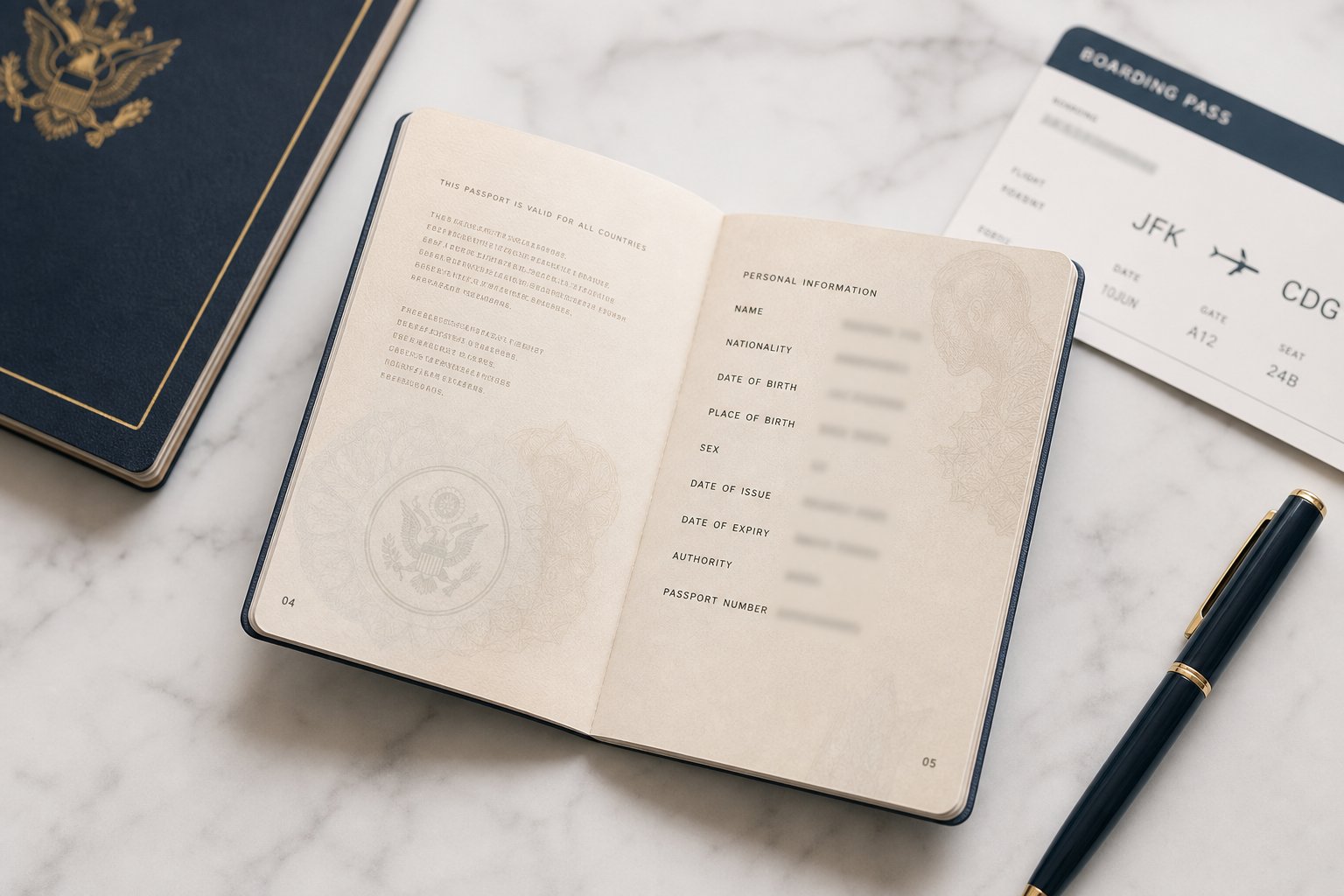
Chinese passports follow the standards set by the International Civil Aviation Organization (ICAO) for machine-readable travel documents. The formatting is strict and leaves no room for personal preference:
- All capital letters. The entire name appears in uppercase with no mixed case.
- No tone marks. Diacritics are stripped entirely, since ICAO's character set doesn't support them.
- Surname separated from given name. A single space divides the two, but the given name itself contains no internal spaces regardless of how many syllables it has.
- No hyphens or apostrophes. Even names that technically require an apostrophe for disambiguation (like Xi'an) lose it on the passport.
So a name like 李晓红 becomes "LI XIAOHONG" on the passport's machine-readable zone. The UK HM Passport Office guidance on China confirms that Chinese passports list the surname first, with forenames following. It also notes that forenames are sometimes transposed in Western contexts, creating further inconsistency when the same chinese text appears on documents issued by different countries.
Taiwan's approach adds another layer. The Guidelines for Transliteration of Chinese issued by Taiwan's Ministry of Education encourage citizens to use Hanyu Pinyin for passport names, but explicitly state that "the choice of the concerned party shall override the above-mentioned principles." This means Taiwanese passport holders can opt for Wade-Giles, Tongyong Pinyin, or other systems, making it impossible to assume a single chinese letter format for names from that region.
Academic and Professional Name Formatting
Academic citation styles each handle Chinese names differently, and the differences matter for researchers whose publication records need to be searchable and consistent. The Yale University Library citation guide for East Asian sources illustrates how major style manuals treat Chinese names:
- APA style: Surname followed by a comma, then the initial of the given name. "Hua, L.F." for a name like 华立夫. The given name is reduced to initials, which can make it difficult to distinguish authors who share a surname.
- Chicago Manual of Style: Full Pinyin given name is typically retained. "Hua Lifu" in running text, or "Hua, Lifu" in a bibliography entry.
- MLA style: Similar to Chicago, with the full romanized name preserved and surname listed first in Works Cited entries.
Notice the problem: if you search for a scholar using a chinese name converter or database lookup, the APA-formatted version ("Hua, L.F.") looks nothing like the Chicago version ("Hua, Lifu"). Researchers who publish across disciplines often find their work split across multiple author profiles because citation databases treat these as different people.
For anyone trying to name translate in chinese academic contexts, the safest approach is to establish one consistent romanization early in your career and use it across all publications. Some researchers add their Chinese characters in parentheses after the Pinyin to eliminate ambiguity entirely.
International business cards occupy a middle ground with no binding standard. Common practice is to print the Chinese name in characters on one side and a westernized order (given name first, surname last) in Pinyin on the other. Some professionals use a mandarin name generator or online tool to experiment with how their name reads in different orderings before settling on a preferred format. The key is consistency: pick one version and use it everywhere your name appears professionally.
Government documents within mainland China follow GB/T 28039-2011 strictly, but the moment a name crosses a border, it enters a system with its own rules. Immigration forms, bank accounts, university enrollment records, and employment contracts in different countries may each require a slightly different arrangement of the same Pinyin syllables. The challenge isn't converting english to chinese name forms or vice versa. It's maintaining a recognizable thread of identity when every institution reformats your name according to its own template.
These institutional formatting differences exist within a single romanization system. The picture gets far more complex when different regions don't even use the same romanization method to begin with.
Regional Variations in Name Romanization
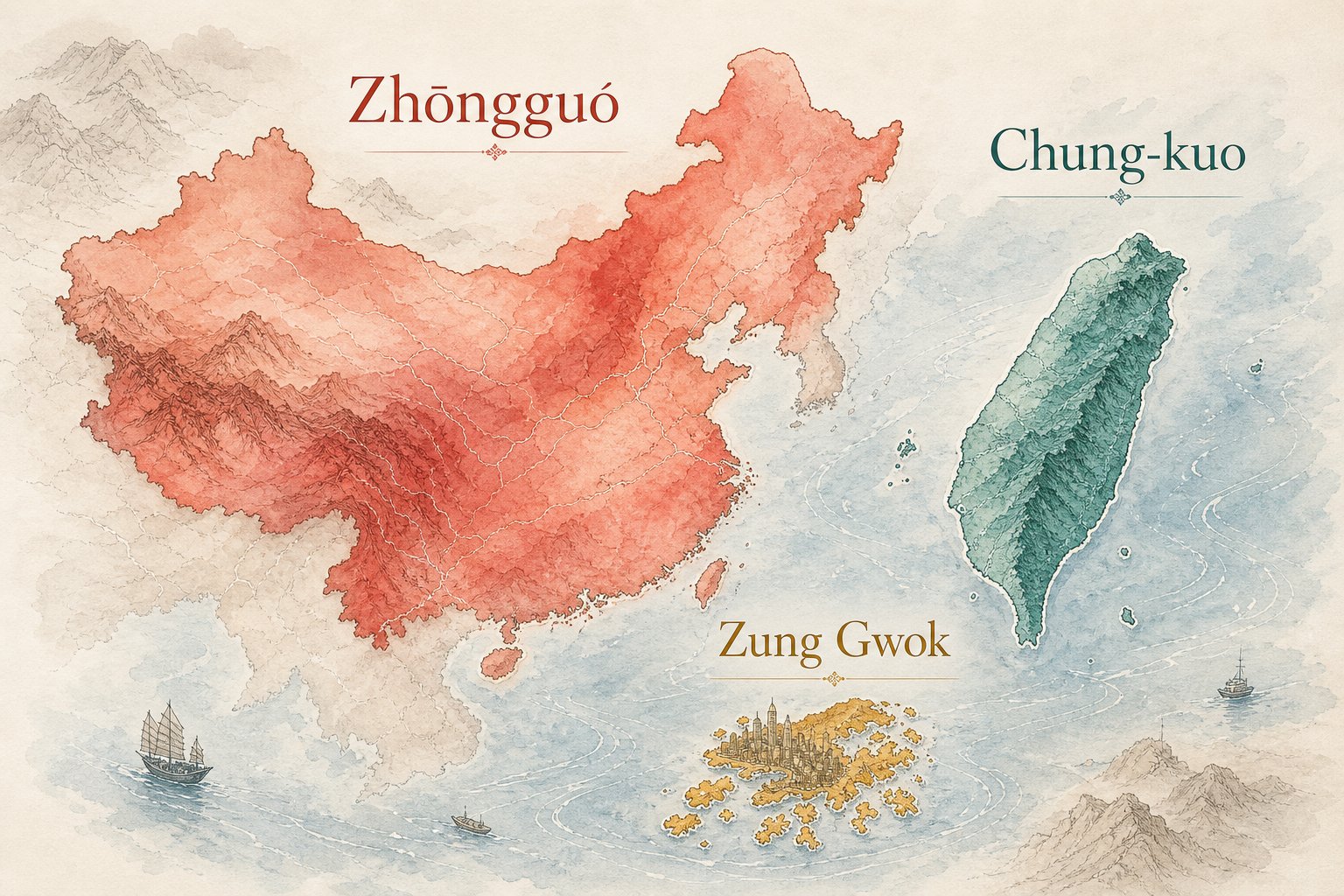
A single romanization system would be complicated enough. The reality is that Chinese-speaking regions never agreed on one. Mainland China, Taiwan, and Hong Kong each developed their own approach to converting names into Latin letters, and those approaches reflect different character sets, different phonetic priorities, and sometimes entirely different spoken languages. The result? One person's family name can appear three or more ways depending on where the document was issued.
Mainland China and Standard Pinyin
Mainland China's system is the most straightforward. Names are written in simplified characters and romanized exclusively through Hanyu Pinyin. The national standard leaves little room for variation: your characters determine your Pinyin, and your Pinyin appears on every official document from your ID card to your passport. A person named 陈伟华 is "Chen Weihua" everywhere within the mainland system. No alternatives, no regional spelling quirks.
This uniformity is relatively recent. Before Pinyin became the ISO standard in 1982, mainland names in international contexts sometimes appeared in Wade-Giles or postal romanization. But today, the simplified vs traditional mandarin divide maps cleanly onto a romanization divide as well: simplified characters pair with Pinyin, and that pairing is non-negotiable in PRC documents.
Taiwan and Hong Kong Romanization Differences
Taiwan tells a very different story. Most Taiwanese learn pronunciation through zhuyin (bopomofo), a phonetic notation system that uses unique symbols rather than Latin letters. Because romanization isn't taught systematically in schools, many people encounter it only when they need a passport or international document. The result has been decades of inconsistency.
Historically, most Taiwanese romanized their names using a simplified version of Wade-Giles that drops diacritics, tone marks, and apostrophes. Taiwan officially adopted Hanyu Pinyin in 2009, but the government explicitly allows individuals to choose their own romanization. Former presidents illustrate the chaos: Lee Teng-hui's surname would be "Li" in any standard system, Ma Ying-jeou's given name uses Gwoyeu Romatzyh spelling, and Chen Shui-bian's name most closely matches Hanyu Pinyin. All three held the same office, yet their romanized names follow three different systems.
Hong Kong adds yet another dimension because the dominant spoken language is Cantonese, not Mandarin. Names are written in traditional cantonese characters and romanized based on Cantonese pronunciation rather than Mandarin. The government romanization system used on Hong Kong identity cards follows its own conventions, while linguists use jyutping (粤语拼音) as a more systematic Cantonese transcription. The six cantonese tones create pronunciation distinctions that Mandarin Pinyin simply cannot capture, so a name romanized from Cantonese looks and sounds fundamentally different from its Mandarin equivalent.
Consider the surname 陳. If you tried to cantonese translate this character's pronunciation into Latin letters, you'd get "Chan" (Hong Kong government romanization) or "Can4" (jyutping with tone number). In Mandarin Pinyin, it's "Chen." In Wade-Giles, it's "Ch'en." Same character, same family, four different spellings. The yuen pronunciation of certain characters diverges even further. A surname like 袁 is "Yuan" in Pinyin but "Yuen" in Cantonese romanization, a spelling familiar to anyone who has encountered Hong Kong names like "Yuen Long" (the district) or the surname on older immigration records.
One Name Across Three Systems
The table below shows how a single name appears when processed through each region's conventions:
| Element | Mainland China | Taiwan (Wade-Giles) | Hong Kong (Cantonese) |
|---|---|---|---|
| Character set | Simplified: 陈伟华 | Traditional: 陳偉華 | Traditional: 陳偉華 |
| Romanization system | Hanyu Pinyin | Wade-Giles (simplified) | HK Government Romanization |
| Romanized name | Chen Weihua | Ch'en Wei-hua | Chan Wai-wah |
| Passport format | CHEN WEIHUA | CHEN WEIHUA or CH'EN WEIHUA | CHAN WAI WAH |
| Phonetic basis | Mandarin | Mandarin | Cantonese |
Look at the passport row. The same person, carrying the same characters in their family registry, could appear as three entirely different names in international databases. "Chen Weihua," "Ch'en Wei-hua," and "Chan Wai-wah" don't look like the same person at all to an immigration officer or a records clerk unfamiliar with Chinese naming conventions.
The Diaspora Problem: Multiple Spellings, Lost Connections
This fragmentation becomes especially painful in genealogical research. Legacy Tree Genealogists notes that the surname 陳 alone can be romanized as Chen, Chin, Chan, Chinn, Tan, Dan, Tin, Tjin, or Ting depending on dialect and romanization system. For descendants of Chinese immigrants who only have a romanized surname to work with, identifying the correct original character requires knowing which dialect their ancestor spoke and which romanization convention was in use at the time of immigration.
The Wade-Giles to Pinyin transition compounded this problem. Families who emigrated before the 1980s often carry Wade-Giles spellings on their legal documents, while relatives who stayed in mainland China switched to Pinyin. A family named 張 might have branches spelling their surname "Chang" (Wade-Giles, common in Taiwan and older diaspora records), "Cheung" (Cantonese, common in Hong Kong), and "Zhang" (Pinyin, standard in mainland China). Without understanding the historical romanization landscape, these look like three unrelated families.
Legal records, property deeds, and immigration files from the early twentieth century used whatever romanization the recording official preferred, often with no consistency even within a single document. This means that tracing a family line across borders requires not just knowing the characters but understanding which romanization system was dominant in a given place and time period.
Regional romanization differences are a product of history and politics. But a newer force is reshaping how names are chosen in the first place: the technology people use to type Chinese characters every day.
How Pinyin Input Methods Influence Modern Naming
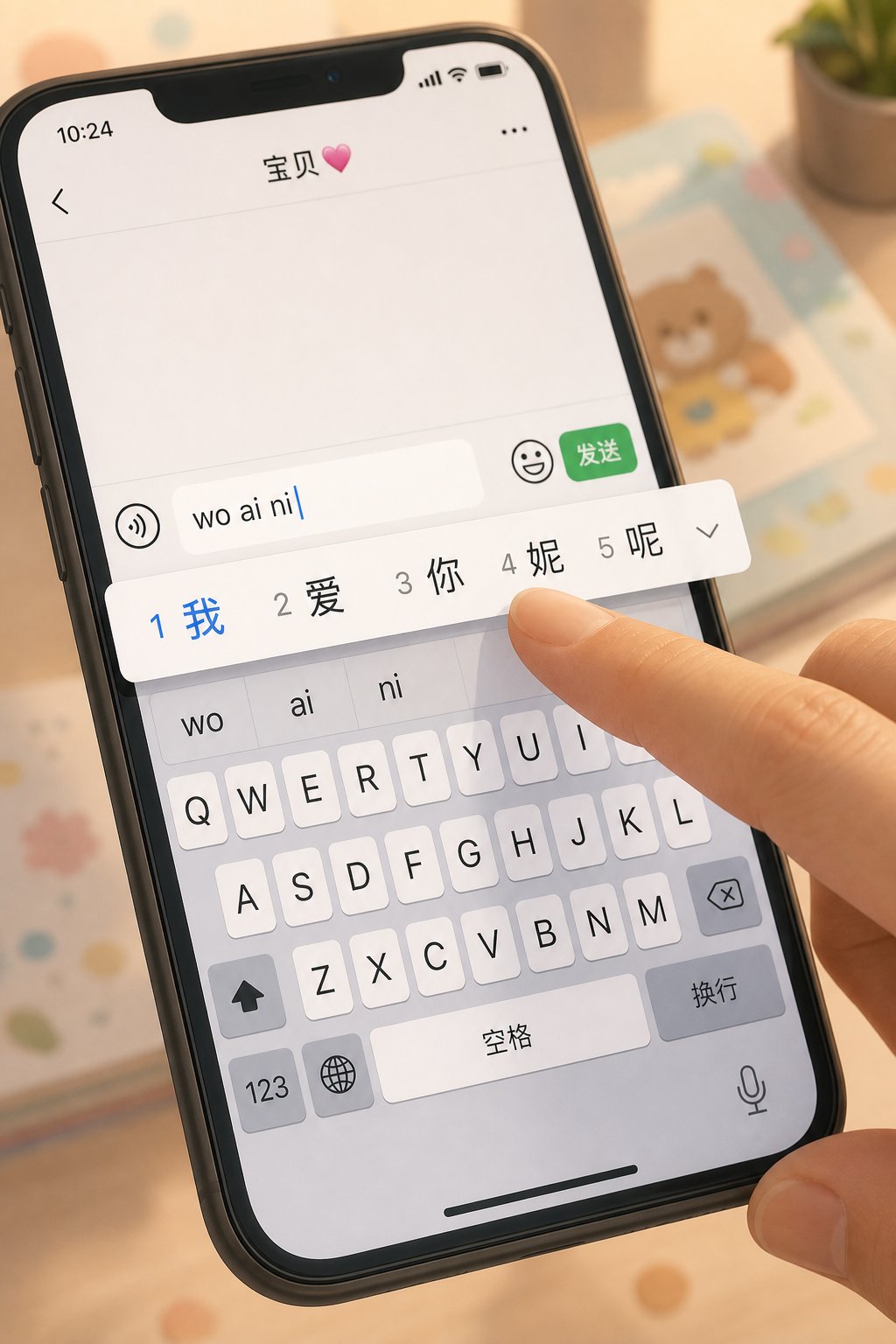
When you type on a pinyin keyboard, something subtle happens. You key in a string of Latin letters representing a sound, and the software presents a ranked list of characters that match that pronunciation. The first candidate is the one the algorithm considers most likely. The fifth or sixth candidate might be a rarer, more literary character that carries deeper meaning but requires extra effort to locate. Imagine you're a parent choosing a name for your child. You type a syllable, and the characters that appear first feel more accessible, more familiar, more "right." This small moment of interface design is quietly reshaping Chinese naming culture.
How Input Methods Shape Character Selection for Names
The pinyin input method works by converting romanized syllables into candidate characters. Whether you're using a desktop hanyu pinyin input system, a mobile pinyin keyboard, or even a chinese input method online, the process is the same: type the sound, scan the list, tap your choice. The ranking of candidates depends on frequency data, user history, and predictive algorithms. Characters that appear in everyday communication rise to the top. Characters that are poetic, archaic, or visually distinctive but rarely typed sink lower.
For most text messages and work emails, this ranking is a convenience. For naming a child, it becomes a filter. Parents who input chinese online or on their phones encounter the same high-frequency characters over and over. A syllable like "yi" might surface 义 (justice) or 一 (one) immediately, while the more elegant 翊 (assist in flight) or 熠 (glittering) requires scrolling or switching to a character lookup. The path of least resistance favors common characters, and over time, this nudges naming trends toward a narrower pool of choices.
Research from the University of Hong Kong, published in PNAS, found that children's reading scores were significantly negatively correlated with their use of the pinyin input method. The study demonstrated that pinyin typing bypasses the visuographic analysis of characters, meaning users interact with sounds rather than structures. For parents, this has a naming implication: if you primarily encounter characters through pinyin input rather than through reading or chinese handwriting input, your mental inventory of name-worthy characters shrinks to what the algorithm surfaces first.
The Relationship Between Pinyin Typing and Name Popularity
This creates a feedback loop. As more parents select characters that rank highly in input method candidate lists, those characters become even more common in everyday text. The algorithm notices the increased frequency and ranks them higher still. Meanwhile, distinctive characters that once appeared in names, characters chosen from poetry, classical texts, or family genealogies, become harder to find through typing alone.
Consider the explosion of names using 子 (zi, meaning "child" or a classical honorific) and 梓 (zi, meaning "catalpa tree") in recent years. Both share the same Pinyin syllable, but 梓 surged in popularity partly because it appears as an early candidate when parents type "zi" looking for something more refined than the ultra-common 子. The algorithm made 梓 visible at exactly the moment parents were searching for it, and its popularity snowballed.
Older generations chose name characters differently. They consulted dictionaries, asked calligraphers, or referenced family genealogy books. The selection process was visual and literary: you saw the character's full form, understood its radical structure, and appreciated its stroke composition. Tools like google pinyin input or any online chinese character input system flatten that experience into a linear list sorted by statistical probability rather than cultural resonance.
None of this means pinyin input produces "worse" names. It means the selection environment has changed. Parents who want to break free from algorithmic suggestions can switch to stroke-based input, consult character dictionaries, or use specialized naming tools that organize characters by meaning and classical usage rather than frequency. The technology isn't destiny, but it is a quiet influence that most people never notice until they see the same handful of characters appearing in every kindergarten classroom roster.
Understanding how technology shapes character choice is one piece of the puzzle. The practical challenge remains: once you've chosen your characters, how do you ensure the Pinyin version of your name is correct, consistent, and ready for international use?
Practical Guide to Converting Names with Pinyin
You've seen how history, regional politics, and even smartphone algorithms shape the way Chinese names appear in Latin letters. The question that remains is concrete: what do you actually do when you need your name standardized, verified, and consistent across every document that matters? Whether you're preparing immigration paperwork, setting up an international bank account, or ensuring your academic publications all point back to the same person, the steps below will get you there.
Steps to Standardize Your Pinyin Name
Getting from characters to a reliable, internationally usable Pinyin name isn't guesswork. Follow this sequence to lock down the correct romanization:
- Confirm your characters in their official form. Start with the characters as they appear on your household registration (hukou) or national ID card. If you're working from simplified characters, that's your baseline. If your family records use traditional characters, identify the simplified equivalents first, since mainland documents and most pinyin converter tools default to simplified input.
- Look up each character's standard Mandarin pronunciation. Use a reliable chinese character lookup resource or dictionary that shows Pinyin with tone marks. Cross-reference against the Xinhua Dictionary or the Modern Chinese Dictionary published by the Commercial Press. These are the authoritative sources for standard pronunciation in the PRC.
- Check for polyphonic characters. Some characters have multiple valid pronunciations depending on meaning or context. The surname 乐 can be "Yue" or "Le." The surname 单 is "Shan" as a surname but "dan" in other uses. The surname 仇 is "Qiu" rather than the more common reading "chou." If your name contains a polyphonic character, the correct reading is determined by family tradition and your existing official documents, not by the most common pronunciation.
- Apply GB/T 28039-2011 formatting rules. Capitalize the first letter of your surname and the first letter of your given name. Write multi-syllable given names as one continuous word. Place a single space between surname and given name. Drop tone marks for passport and legal use; retain them only for academic or educational contexts.
- Verify against your passport. If you already hold a Chinese passport, the Pinyin printed there is your legal romanization. Changing it later requires formal application and supporting documentation. Any new documents you create should match this spelling exactly.
- Document your chosen romanization. Keep a reference note listing your characters (both simplified and traditional if relevant), your standard Pinyin, and the specific formatting you use for different contexts (passport caps, academic style, business card order). This prevents drift over time.
For anyone converting chinese to han yu pin yin for the first time, steps two and three are where most errors happen. A pinyin translator tool can give you a starting point, but automated tools sometimes default to the most common pronunciation of a polyphonic character rather than the surname-specific reading. Always verify against authoritative dictionaries.
Common Mistakes to Avoid
Even people who understand the basics trip over these recurring issues:
- Splitting a two-syllable given name into two words. "Xiao Ming" instead of "Xiaoming" is the single most common formatting error. It violates the national standard and can cause database mismatches.
- Using the wrong pronunciation for a surname character. Automated chinese to mandarin pinyin tools don't always flag surname-specific readings. The character 区 is "Ou" as a surname but "qu" in common usage. The character 秘 is "Bi" as a surname but "mi" elsewhere.
- Inconsistency across documents. Spelling your name "Zhang Wei" on one form and "Wei Zhang" on another (Western order) creates two apparent identities in any database. Pick one order for each context type and stick with it.
- Assuming simplified vs traditional character choice changes the Pinyin. In the vast majority of cases, it doesn't. The Pinyin for 陈 and 陳 is identically "Chen." But rare edge cases exist: when simplification merged two characters with different pronunciations into one form, the Pinyin depends on which original character your name derives from. If your family uses 後 (hou, meaning "after") as a name element, and it was merged with 后 (hou, meaning "empress"), the Pinyin stays the same, but if you encounter a merged character where the two source characters had different tones, you'll need family knowledge to determine the correct one.
- Forgetting the apostrophe where syllable boundaries are ambiguous. A given name pronounced "Xi-an" (two syllables) must be written "Xi'an" to distinguish it from "Xian" (one syllable). This apostrophe disappears on passports but should appear in all other contexts.
If you need to go from pinyin to english for professional use, or from simplified chinese to english in a translation context, remember that Pinyin itself is not English. It's a romanization system with its own pronunciation rules. The letter "q" in Pinyin sounds nothing like "q" in English, and "x" represents a sound that doesn't exist in English at all. When introducing yourself internationally, you may want to include a phonetic guide alongside your Pinyin name so colleagues know how to say it correctly.
One final consideration: consistency beats perfection. If your passport already spells your name in a way that doesn't perfectly match current standards, perhaps because it was issued years ago or uses a slightly non-standard romanization, changing it creates more problems than it solves. Every visa, bank account, and academic record tied to that spelling would need updating. In most cases, the practical move is to adopt your passport spelling as your canonical international form and use it everywhere, even if a pinyinizer tool suggests a slightly different output. Your name is yours. The system exists to serve it, not the other way around.
Frequently Asked Questions About Pinyin Name Character Simplification
1. Does simplifying a Chinese character change its Pinyin spelling?
No. Pinyin encodes pronunciation rather than visual structure, so when a character's stroke count was reduced during simplification reforms, its romanized spelling remained identical. For example, the surname Liu is spelled the same whether written as the traditional 劉 or the simplified 刘. This phonetic consistency makes Pinyin a stable bridge for identifying names across both writing systems, regardless of when or where a document was produced.
2. Why does the same Chinese name appear spelled differently on documents from different regions?
Mainland China, Taiwan, and Hong Kong each use different romanization systems. Mainland China standardizes on Hanyu Pinyin, Taiwan historically uses Wade-Giles or allows personal choice, and Hong Kong romanizes based on Cantonese pronunciation rather than Mandarin. The surname 陳, for instance, appears as Chen (Pinyin), Ch'en (Wade-Giles), or Chan (Hong Kong Cantonese). These regional systems reflect different linguistic traditions and government policies rather than errors in spelling.
3. How should a two-character Chinese given name be written in Pinyin?
According to the Chinese national standard GB/T 28039-2011, a two-character given name is written as one continuous word with no hyphen, no space, and no intercapitalization between syllables. Only the first letter is capitalized. So a name like 晓明 becomes Xiaoming, not Xiao-Ming or Xiao Ming. The surname is separated from the given name by a single space, making the full name format: Surname Givenname.
4. Are tone marks included when writing Chinese names in Pinyin on official documents?
It depends on the document type. Chinese passports and most legal documents strip tone marks entirely because international machine-readable document standards do not support diacritics. Educational materials and some academic publications retain tone marks for phonetic accuracy. Business cards and email signatures almost universally omit them for practical readability in international settings.
5. How do Pinyin input methods on phones affect Chinese naming trends?
When parents type a Pinyin syllable to choose name characters, the input method presents candidates ranked by frequency and algorithm predictions. Characters that appear at the top of the list are easier to select, making them more accessible during the naming process. Over time, this creates a feedback loop where popular characters become even more visible in candidate lists, while rarer literary or classical characters require extra effort to find, gradually narrowing the pool of commonly chosen name characters.