What It Means to Add Jiejie to a Name
Imagine you meet a Chinese colleague a few years older than you. Instead of calling her by her bare name, everyone in the office calls her "Li jie" or "Mei jie." You've just witnessed one of the most common social naming conventions in Chinese culture: adding jiejie to a name.
This practice has nothing to do with legal documents or official records. It is purely a spoken and written convention where you place 姐姐 (jiějie) or its shortened form 姐 (jiě) after someone's surname or given name. The result is a form of address that signals respect, warmth, and acknowledgment that the person is an older female relative, friend, or acquaintance.
Adding jiejie to a name is the Chinese practice of placing 姐姐 or 姐 after a person's given name or surname to show respect and acknowledge that the person is an older sister or older female figure.
What Adding Jiejie to a Name Actually Means
In Chinese, 姐姐 (jiějie) literally translates to "older sister." But its use extends far beyond biological siblings. When you append jiejie or the single character 姐 to someone's name, you're treating that person with the same familiarity and deference you'd show an older sister. It communicates closeness without crossing into overly casual territory.
Think of it as a social title, similar to how English speakers might say "Miss" or "Ma'am," but warmer and more personal. The key difference is that jiejie in Chinese carries genuine affection. It tells the other person: "I see you as someone I look up to, and I feel comfortable enough to express that."
For learners encountering this convention for the first time, here's what you need to know:
- 姐姐 (jiějie) - the full reduplicated form, used on its own as a kinship term or standalone address
- 姐 (jiě) - the single-character form, typically appended directly after a name
- This is a social convention, not a legal name modification
- It applies only when addressing someone older than you or someone you wish to show elder-sister respect
Why This Naming Convention Matters
Chinese culture places significant weight on hierarchical relationships, and language reflects that structure at every turn. Adding jiejie to a name is one of the simplest ways to navigate social hierarchy without sounding stiff or overly formal. It strikes a balance that pure titles cannot achieve.
In workplaces, friend groups, and even online communities, this small addition shapes how people perceive your social awareness. Use it correctly, and you come across as respectful and culturally fluent. Use it incorrectly, and you risk awkwardness or even mild offense.
This article walks through the exact placement rules, the relationship contexts where this convention applies, regional differences across Chinese-speaking areas, and how digital culture has reshaped the tradition entirely. Whether you're a Mandarin learner, someone navigating a Chinese workplace, or simply curious about how jiejie in Chinese functions as more than a family label, the guidance ahead covers every angle you'll need.
Understanding the Meaning and Pronunciation of Jiejie
The convention of adding jiejie to a name only clicks once you understand what the character itself carries. Chinese characters are not arbitrary symbols. Each one is built from smaller components that hint at meaning, and 姐 is a clear example of that logic at work.
The Characters Behind Jiejie and Their Meaning
The character 姐 is composed of two parts, each contributing to its overall sense:
- 女 (nǚ) - the female radical, positioned on the left side. This signals that the character relates to a woman or a female concept.
- 且 (qiě) - the phonetic component on the right side. It originally depicted a ritual altar or offering table, but here it primarily serves to suggest the sound of the character rather than add direct meaning.
Together, these components form 姐: a female person of a specific relational status, namely an older sister. The jiejie meaning extends from this core. It identifies a woman who holds a position of seniority within a family or social group, someone you look up to by virtue of age or closeness.
When the character doubles into 姐姐, you're looking at reduplication, a pattern deeply embedded in Mandarin. Chinese kinship terms frequently use this structure: 妈妈 (māma, mother), 爸爸 (bàba, father), 哥哥 (gēge, older brother). As linguist Victor Mair notes in research on reduplicatives in Chinese, this doubling pattern is closely tied to how children first learn to speak. Babbling repetition of syllables becomes the foundation for family terms, and those reduplicated forms persist into adult speech. Terms like 姐姐, 叔叔 (shūshu, uncle), and 姑姑 (gūgu, aunt) all follow this pattern, carrying a warmth that single-syllable forms lack.
The practical distinction matters here: 姐姐 as a standalone word means "older sister" and functions as a kinship term or direct address on its own. The single 姐, by contrast, is the form that attaches to names. This is why you hear "Li jie" in conversation rather than "Li jiejie" in most everyday contexts.
How Jiejie Pronunciation Works in Mandarin
Getting the jiejie pronunciation right is essential if you plan to use this term out loud. Here's how it breaks down:
- First syllable: jiě - spoken in the third tone (a dipping tone that falls then rises). The vowel sound is similar to the "ye" in "yes."
- Second syllable: jie - in natural speech, this second character loses its full third tone and shifts to a neutral tone (light and unstressed). So the spoken rhythm is one stressed syllable followed by a softer, quicker one.
This tonal shift is standard across reduplicated kinship terms in Mandarin. You'll notice the same pattern in māma and bàba, where the second syllable relaxes into neutral tone during casual conversation.
If you're searching online, you'll encounter several romanization variations for the same word: jiejie, jie jie, jiějie, and occasionally chieh-chieh (from the older Wade-Giles system). All refer to the same term. Pinyin with tone marks, jiějie, is the most precise representation for learners, but informal contexts often drop the diacritics entirely.
The dual nature of this word, functioning both as a family label and as a respectful honorific you can attach to names, is what makes it so versatile in daily Chinese. That versatility, though, comes with specific placement rules that determine whether your usage sounds natural or slightly off.
How to Correctly Place Jiejie After a Name
Knowing what jiejie means is one thing. Knowing exactly where to put it in relation to a name is where most learners stumble. Chinese word order is strict here, and the placement you choose sends a specific social signal about your relationship with the person you're addressing.
Two core patterns govern how jie jie in Chinese attaches to names. Each pattern fits a different level of familiarity, and mixing them up can shift your tone from respectful to overly casual, or vice versa.
Surname Plus Jie for Respectful Address
The most widely used pattern in workplaces, among acquaintances, and in semi-formal social settings is straightforward: take the person's surname and add the single character 姐 (jiě) directly after it.
Imagine your colleague's surname is Wang (王). You'd address her as 王姐 (Wang jiě). That's it. No given name, no reduplication, just surname + 姐. This construction tells the listener two things at once: you respect her seniority, and you're on comfortable enough terms to skip rigid titles like 女士 (nǚshi, Ms.).
Native speakers default to this pattern in offices, neighborhood interactions, and any situation where you know someone's family name but aren't close friends. As EverydayChinese notes, you can address a woman by adding her surname in front of 姐 (jiě) as a polite form of address. It's the sweet spot between formal and familiar, which is exactly why it dominates professional Chinese communication.
A few things to keep in mind with this pattern:
- The surname always comes first. It's 王姐, never 姐王.
- Only the single 姐 is used here, not the full 姐姐.
- This works regardless of whether the surname is one character (王, 李, 张) or two characters (欧阳, 司马), though two-character surnames are rare.
Given Name Plus Jie for Friendly Address
When you're closer to someone, the pattern shifts. Instead of the surname, you use the person's given name (or part of it) followed by 姐. This signals genuine personal warmth, the kind of address you'd use with a friend, a close coworker you've known for years, or someone in your social circle who feels like an actual older sister.
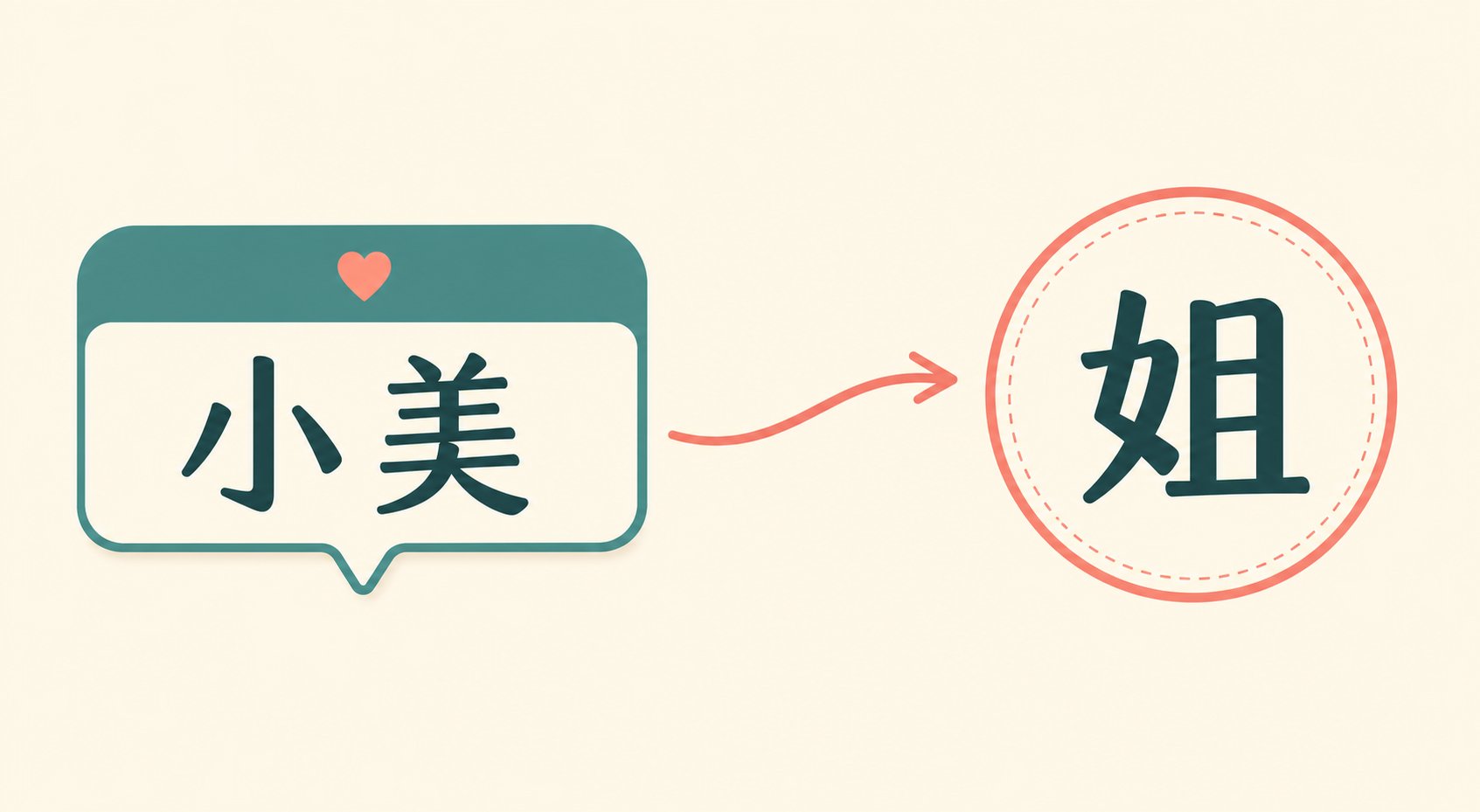
Say your friend's full name is 李小芳 (Li Xiaofang). Her given name is 小芳. Among close friends, you'd call her 小芳姐 (Xiaofang jiě) or even just 芳姐 (Fang jiě) if the group typically shortens names. The jie meaning in Chinese stays the same, but the intimacy level rises because you're using her personal name rather than the more distanced surname.
This pattern shows up constantly among friend groups, within families addressing older female cousins, and in casual social gatherings where everyone already knows each other well. You'll notice that the given-name pattern feels inappropriate if you've just met someone. Jumping straight to a person's given name plus 姐 without an established relationship can feel presumptuous, much like calling a new acquaintance by a nickname in English before they've invited you to.
When to Use Full Jiejie Versus Single Jie
Here's where many learners get confused. If 姐姐 means older sister, shouldn't you attach the full word to names? The answer is almost always no.
The full reduplicated form 姐姐 (jiějie) functions as a standalone kinship term. You use it on its own when speaking directly to your actual older sister, or when a child addresses an older girl without knowing her name. It works like a noun or a direct vocative: "姐姐, come here" or "I'll ask 姐姐."
The single 姐 is the form that attaches to names. When you combine jiejie Chinese conventions with a specific person's name, you drop the reduplication and use just one character. This is consistent across all kinship-based honorifics in Mandarin. You say 王哥 (Wang ge), not 王哥哥. You say 李姐 (Li jie), not 李姐姐.
The exception? Very young children sometimes use the full 姐姐 after a name (like 小芳姐姐) because reduplication feels natural in child speech. Adults doing the same would sound overly cutesy or deliberately playful, which might be the intent in certain online contexts but would land awkwardly in a workplace.
The table below pulls these patterns together with common Chinese names so you can see exactly how each construction works:
| Full Name | Pattern Used | Resulting Address | Context |
|---|---|---|---|
| 王丽 (Wang Li) | Surname + 姐 | 王姐 (Wang jie) | Workplace, acquaintances |
| 张美玲 (Zhang Meiling) | Surname + 姐 | 张姐 (Zhang jie) | Neighbors, semi-formal settings |
| 李小芳 (Li Xiaofang) | Given name + 姐 | 小芳姐 (Xiaofang jie) | Close friends, social circles |
| 陈雨 (Chen Yu) | Given name + 姐 | 雨姐 (Yu jie) | Close friends, casual settings |
| Unknown name (older girl) | Standalone 姐姐 | 姐姐 (jiejie) | Children addressing strangers, family |
Notice the pattern: surname + 姐 keeps things polite and slightly distanced, given name + 姐 pulls the relationship closer, and standalone 姐姐 works only when no name is involved or when speaking to an actual sister.
These placement rules aren't arbitrary. They map directly onto how Chinese social relationships are structured, with different levels of closeness calling for different linguistic choices. The real question becomes: which pattern fits your specific relationship with the person you're addressing?
When to Add Jiejie Based on Your Relationship
The placement rules from the previous section give you the mechanics. But knowing where to put 姐 doesn't tell you whether you should use it at all. That decision depends entirely on your relationship with the person you're addressing. The same word carries different weight depending on whether you're talking to a blood relative, a close friend, a coworker, or a stranger at a shop counter.
Here are the four main contexts where adding jiejie to a name comes into play, ordered from the most intimate to the most formal:
- Family relationships - addressing your actual older sister or older female cousin
- Friends and peers - using jiejie with someone slightly older as a sign of closeness
- Workplace interactions - the surname + 姐 pattern for older female colleagues or supervisors
- Strangers and service contexts - using jiejie or 姐 with people you don't know well
Adding Jiejie in Family Relationships
This is the original, most literal use. When you have a Chinese older sister, you call her 姐姐 (jiějie) directly, often without attaching any name at all. The standalone form works because the family context makes the reference obvious. Everyone knows who "姐姐" is when you say it at the dinner table.
For older female cousins or step-sisters, the pattern shifts slightly. You might use their given name plus 姐 to distinguish them from other relatives. If your older cousin is named 小雪 (Xiǎoxuě), calling her 小雪姐 (Xiǎoxuě jiě) feels natural and affectionate. It acknowledges her seniority while keeping the tone warm and familial.
Children in Chinese families also extend this convention to non-relatives. A family friend's older daughter, a neighbor's teenage girl, or a babysitter might all receive the 姐姐 address from a younger child. The term for older sister in Chinese language functions here as a relational marker rather than a biological fact.
Using Jiejie Among Friends and Peers
Among friends, jiejie becomes a tool for expressing closeness. When you call a slightly older friend "芳姐" or "雨姐," you're saying something beyond mere politeness. You're signaling that you see her as someone you trust and look up to, even if the age gap is just a year or two.
This usage is especially common among female friend groups in China. A woman born in 1995 might call her 1993-born friend by her given name plus 姐, not because the hierarchy demands it, but because it adds a layer of affection to the relationship. It's voluntary deference, and that's what makes it meaningful.
The social signal here is warmth, not formality. If someone in your friend group starts calling you "[name] + 姐," take it as a compliment. They're choosing to position you as an older sister Chinese culture would recognize: someone reliable, caring, and worth respecting.
Jiejie as Workplace Address
The workplace is where the surname + 姐 pattern dominates. In Chinese offices, calling an older female colleague 王姐 (Wáng jiě) or 张姐 (Zhāng jiě) is standard practice. It replaces stiffer options like 女士 (nǚshì) without dropping into the overly casual territory of using someone's given name alone.
This convention applies to colleagues, supervisors, and even clients who are older than you. As DigMandarin explains, you can use 大姐 (dà jiě) or 姐 (jiě) for people who are not much older than you to show respect or establish a more friendly tone. In practice, most office workers drop the 大 and simply go with surname + 姐 for any female colleague who is visibly or known to be older.
One important nuance: this pattern works laterally and upward, but not downward. You wouldn't call a younger female colleague "姐." That would confuse the age dynamic the term is built on. For younger colleagues, Chinese speakers typically use given names, nicknames, or the 小 (xiǎo) + surname pattern instead.
Strangers and Service Contexts
Using jiejie with strangers requires more caution. You won't attach it to a name here because you likely don't know the person's name. Instead, the standalone 姐姐 or the casual 姐 functions as a general address for a woman who appears older than you.
At a market stall, you might say "姐, 这个多少钱?" (Jiě, how much is this?) to a vendor who looks a few years your senior. It's friendlier than the formal 女士 and avoids the complications of 小姐 (xiǎojiě), which carries different connotations depending on region and context.
The internet slang term 小姐姐 (xiǎo jiějie) has also entered stranger interactions, particularly among younger speakers. It's used to address young women in a flattering, lighthearted way, though it relaxes the traditional age requirement. In face-to-face encounters with strangers, though, the safest approach remains simple: if she looks older than you, 姐 works. If you're unsure about the age gap, err on the side of a neutral term like 美女 (měinǚ) in casual settings.
Each of these four contexts carries its own unspoken rules about formality, and the construction adjusts accordingly. But jiejie isn't the only kinship honorific that follows this pattern. Its male counterpart, gege, operates on nearly identical logic, and understanding how the two compare reveals why some kinship terms work as honorifics while others don't.
How Jiejie Compares to Gege and Other Honorifics
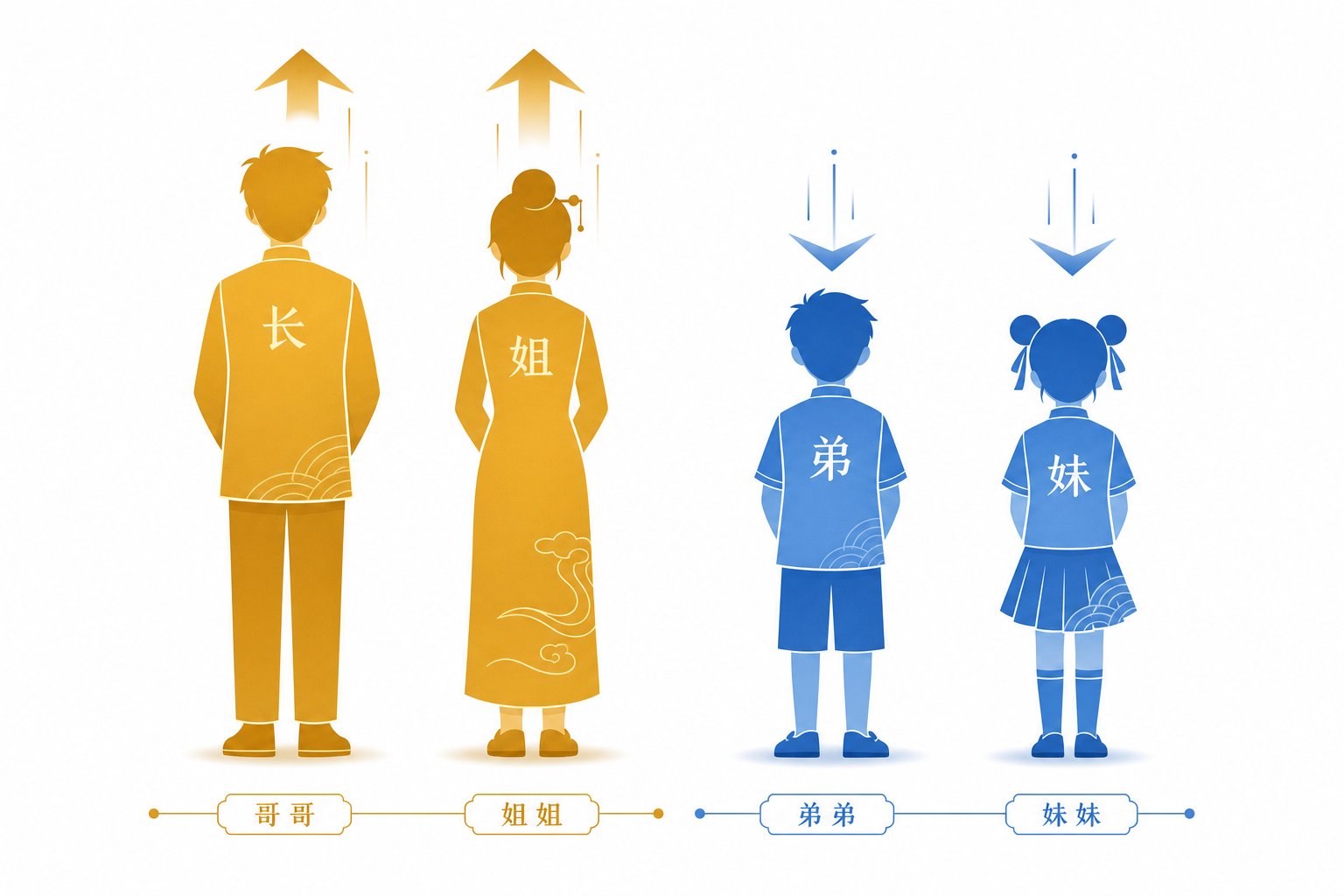
Jiejie doesn't exist in isolation. It belongs to a set of four kinship terms that Chinese speakers use to map sibling relationships, and each one follows its own rules about when it can be attached to a name. Understanding the full set clarifies why adding jiejie or gege to someone's name feels natural, while doing the same with meimei or didi would raise eyebrows.
Jiejie Versus Gege in Chinese Naming
The male counterpart to jiejie is gege in Chinese: 哥哥 (gēge), meaning older brother. The placement logic is identical. You take a surname or given name and append the single character 哥 (gē) to create a respectful, familiar form of address for an older male.
Say your older male colleague's surname is Wang. You'd call him 王哥 (Wáng gē), just as you'd call an older female colleague 王姐 (Wáng jiě). The social signal is the same: respect for seniority combined with personal warmth. As GoEast Mandarin explains, it is common practice to add gege after the surname as a polite title, such as "Wang gege" for an older brother figure with the surname Wang.
Both jiejie and gege share these characteristics:
- The full reduplicated form (姐姐 or 哥哥) works as a standalone address or kinship term
- The single character (姐 or 哥) is the form that attaches to names
- Both can be used with non-family members as honorifics, not just biological siblings
- Both require the addressee to be older than the speaker
You'll hear 哥 used in workplaces, friend groups, and even with strangers. A customer might call a slightly older male vendor 哥 at a street market, just as they'd use 姐 for a female vendor. The Chinese ge functions as a universal respectful address for older males in the same way 姐 does for older females. Variations like 大哥 (dàgē, big brother) and 老哥 (lǎo gē, a more informal, affectionate form) expand the range further, but the core surname + 哥 pattern remains the default in semi-formal settings.
Why Meimei and Didi Work Differently
Here's where the symmetry breaks down. Chinese has parallel terms for younger siblings: 妹妹 (mèimei, younger sister) and 弟弟 (dìdi, younger brother). You might expect these to follow the same honorific pattern, but they don't, at least not in the same social contexts.
The reason is rooted in what these terms signal. Jiejie and gege convey respect upward. They acknowledge someone's seniority. Meimei and didi point downward in the age hierarchy. Attaching 妹 or 弟 to someone's name doesn't elevate them; it marks them as junior. That's fine within families or very close friend groups, but it becomes awkward or even condescending in workplaces and formal interactions.
Imagine calling a younger female colleague 小芳妹 in a meeting. It would sound patronizing, as if you're emphasizing her junior status. In contrast, calling an older colleague 王姐 sounds warm and appropriate. The directionality of respect makes all the difference.
That said, meimei and didi do appear in casual, intimate contexts. An older sibling might call a younger sister 小雪妹 at home. Close friends sometimes use 妹 playfully. But you ge (哥) and jie (姐) are the only two that function as broadly accepted social honorifics outside the family.
| Term | Pinyin | Meaning | Can Be Added to Names as Honorific? | Typical Contexts |
|---|---|---|---|---|
| 姐姐 / 姐 | jiějie / jiě | Older sister | Yes, widely used | Family, friends, workplace, strangers |
| 哥哥 / 哥 | gēge / gē | Older brother | Yes, widely used | Family, friends, workplace, strangers |
| 妹妹 / 妹 | mèimei / mèi | Younger sister | Limited, mostly family and close friends | Family, intimate friend groups |
| 弟弟 / 弟 | dìdi / dì | Younger brother | Limited, mostly family and close friends | Family, intimate friend groups |
Notice the pattern: the two "elder" terms cross freely into professional and social honorific territory, while the two "younger" terms stay confined to personal relationships. This asymmetry reflects a core principle in Chinese social language: terms that elevate are versatile, terms that diminish are restricted.
This distinction matters practically. If you're learning when to add a kinship term to someone's name, the safe rule is simple: 姐 and 哥 work almost anywhere the age relationship is clear. 妹 and 弟 require genuine closeness and a context where marking someone as younger won't feel dismissive. The digital world, however, has started bending even these rules, with online communities using jiejie in ways that traditional age hierarchy never anticipated.
Adding Jiejie to Names in Digital and Online Spaces
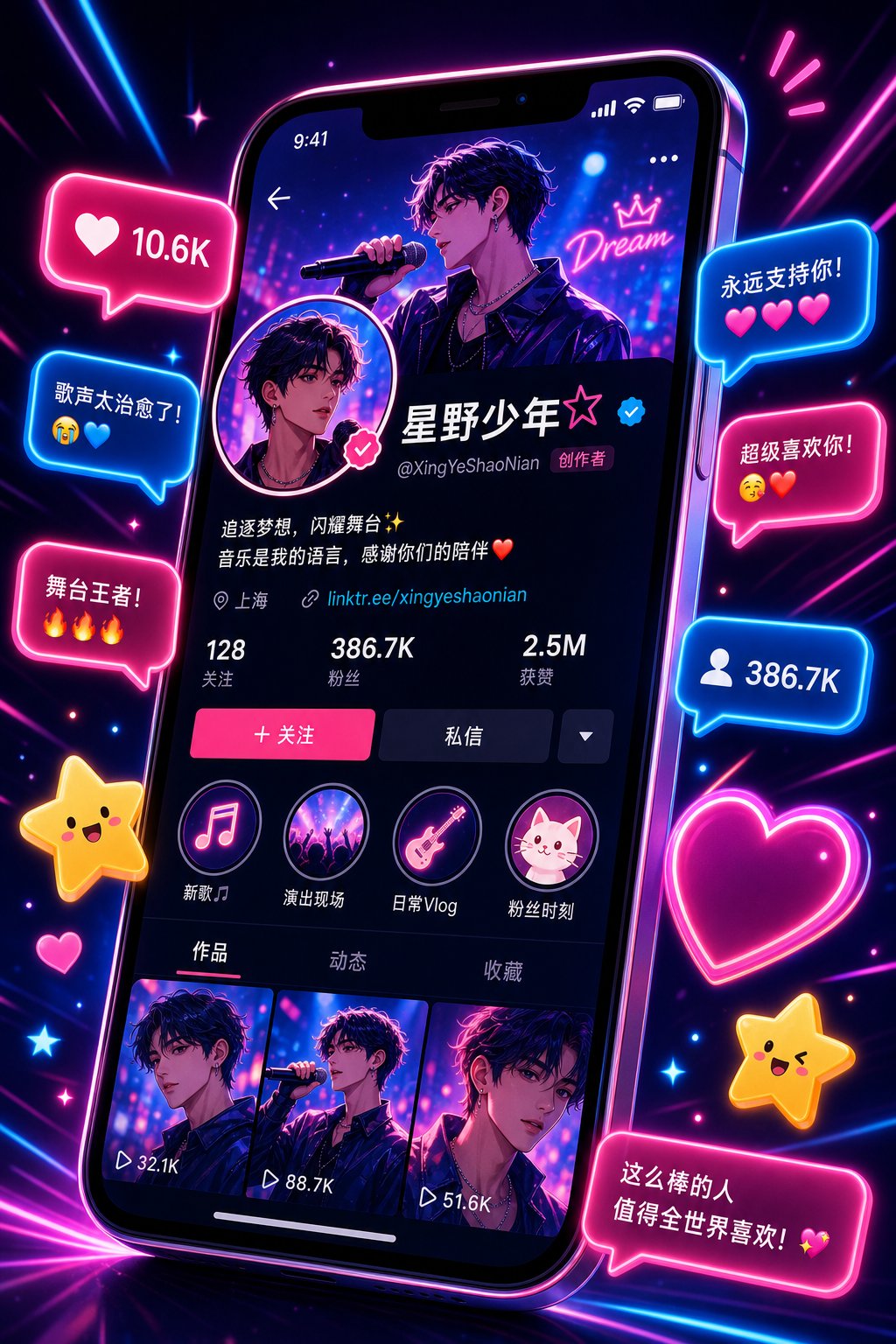
Online, the rules bend. The traditional age-based logic that governs jie jie in face-to-face interactions loosens considerably once you enter the world of social media profiles, gaming handles, and fan communities. In digital spaces, adding jiejie to a name becomes less about actual seniority and more about admiration, aspiration, or playful self-branding.
Jiejie in Social Media Display Names
Scroll through Weibo, Douyin, or Xiaohongshu and you'll notice a pattern: users append 姐姐 or 姐 to celebrity names, fictional characters, or even their own display names. A fan of actress Zhao Lusi might set their username to something like "露思姐姐粉" (Lusi jiejie fan). A beauty influencer might brand herself as "化妆姐姐" (makeup jiejie). The convention signals confidence, capability, or a persona the user wants to project.
What makes this different from offline usage? In real life, you'd never call someone jiejie unless she's older than you. Online, a 20-year-old content creator can brand herself with 姐姐 in her handle because the term has shifted from a strict age marker to a vibe. It says: "I'm competent, I'm in charge of this space, I'm someone you can look up to."
Common digital naming patterns you'll encounter include:
- [Celebrity name] + 姐姐 - fans expressing admiration, e.g., 迪丽热巴姐姐 (Dilireba jiejie)
- [Skill or niche] + 姐姐 - creators branding expertise, e.g., 健身姐姐 (fitness jiejie)
- [Surname] + 姐 - streamers and influencers using a casual persona, e.g., 刘姐 (Liu jie)
- 小姐姐 + [topic] - playful accounts, e.g., 小姐姐聊穿搭 (xiao jiejie talks outfits)
- [Game character] + 姐姐 - gaming community nicknames for powerful female characters
In gaming communities specifically, players often tag 姐姐 onto the names of skilled female players or popular female characters. A top-ranked female player in Honor of Kings might earn the community nickname "大神姐姐" (godlike jiejie) regardless of whether she's actually older than the people using the term. The honorific here rewards skill and status rather than age.
Xiao Jie Jie and Internet Slang Usage
No discussion of jiejie in digital culture is complete without addressing xiao jie jie (小姐姐), the term that exploded across Chinese internet culture starting around 2016. The phrase literally means "little older sister," which sounds contradictory, and that playful tension is part of its appeal.
Research published in PLOS ONE traced the viral origin of xiaojiejie to Chinese fans of the Japanese idol group mu's (Muse) from the Love Live! franchise, whose 2016 Fan Meeting Tour in Shanghai popularized the term among fans who used it admiringly for the young performers. After that event, Baidu search interest in xiaojiejie surged sharply and continued climbing through subsequent years.
In its current internet usage, xiao jie jie refers broadly to an attractive, youthful woman. It carries connotations of cuteness, approachability, and a kind of aspirational femininity rooted in East Asian kawaii aesthetics. The same research found that among Chinese users under 29, xiaojiejie has significantly overtaken the older social address 美女 (meinü, beautiful woman) in popularity, with younger demographics showing far higher search interest in the newer term.
The key shift here is that xiao jie jie doesn't require the addressee to be older than the speaker. A 25-year-old man might comment "这个小姐姐好好看" (this xiao jiejie is so pretty) about a woman his own age or even younger. The age hierarchy that defines traditional jiejie usage dissolves entirely. What remains is the warmth and familiarity of the kinship framing, repurposed as flattery.
WeChat stickers, short video captions, and comment sections are saturated with xiaojiejie references. The term has become so pervasive that even Chinese state media outlets adopted it in their headlines to drive engagement, using phrases like "小姐姐, 你太太太太太太可爱啦!" (Xiaojiejie, you are toooooo cute!) to attract clicks on stories about young women performing heroic acts.
Fan Community Naming Conventions
International fan communities, particularly those following K-pop and C-drama, have adopted jiejie as part of their cross-cultural vocabulary. English-speaking fans of Chinese entertainment regularly use "jiejie" in social media posts, fan fiction tags, and group chats to refer to female idols and actresses they admire.
In C-drama fandoms, you'll see fans refer to actresses like "Yang Mi jiejie" or "Zhao Liying jiejie" in tweets and forum posts, blending English syntax with the Chinese honorific. K-pop fans familiar with Korean honorifics (unnie/noona) often pick up jiejie when they cross into Chinese idol fandoms, applying it to members of groups like THE9 or Bonbon Girls 303.
The guore jiejie phenomenon illustrates this crossover well. Fans create compound nicknames by combining a celebrity's name or persona with 姐姐, turning the honorific into a term of endearment that doubles as a fandom identity marker. These names circulate through fan accounts, hashtags, and dedicated social media pages, reinforcing community belonging.
What's notable about fan usage is that it strips jiejie of any awkwardness around age. A 30-year-old fan might call a 25-year-old idol "jiejie" without anyone blinking. In fandom spaces, the term expresses devotion and admiration rather than acknowledging a real age gap. It's aspirational: you're elevating someone to elder-sister status because you respect or adore them, not because they're literally older.
This digital evolution has created a split in how jiejie functions. Offline, the age requirement remains firm. Online, it's optional. For anyone navigating both worlds, the distinction matters. Using jiejie playfully in a Weibo comment is perfectly normal. Using it the same way in a face-to-face introduction with someone younger than you would land very differently, which raises the question of how non-Chinese speakers should approach this convention when they encounter it outside digital spaces.
Cultural Sensitivity When Non-Chinese Speakers Use Jiejie
Fandom comments and social media posts are one thing. Standing in front of a real person and deciding whether to call her jiejie is something else entirely. For non-Chinese speakers who've picked up the term through language study, friendships, or pop culture, the question isn't just about grammar. It's about whether using a Chinese kinship honorific feels genuine or performative in your specific situation.
Is It Appropriate for Non-Chinese Speakers to Use Jiejie
The short answer: yes, but context determines everything. If you're living in China, studying Mandarin, working in a Chinese-speaking environment, or embedded in a Chinese community, using jie jie Chinese conventions shows cultural awareness. People around you will likely appreciate the effort. A foreign colleague calling an older Chinese coworker "Wang jie" signals that you understand how relationships work in that space.
Where it gets awkward is when the context doesn't support it. Calling someone jiejie at a dinner party in New York where no one else is using Chinese honorifics can feel forced, like you're performing cultural knowledge rather than participating in a shared social norm. The key question to ask yourself: would the people around me naturally use this term in this setting? If yes, go ahead. If you'd be the only one doing it, pause and read the room.
The big sister Chinese honorific also requires one non-negotiable condition: the person you're addressing must actually be older than you, or at least someone you genuinely wish to show elder-sister respect to.
Only add jiejie to the name of someone who is older than you or whom you wish to show elder-sister respect.
Calling someone jiejie who is younger than you isn't just grammatically wrong. It can feel patronizing or confusing, as if you're mocking the convention rather than honoring it. In Chinese social logic, the term points upward in age hierarchy. Reversing that direction breaks the entire premise.
Reading Social Cues Before Adding Jiejie
Even when the age relationship is correct and the setting is appropriate, you'll want to watch for signals that the person welcomes this form of address. Here are practical ways to gauge comfort:
- Listen first. If other people in the group already call her "[name] + 姐," you're safe to follow their lead.
- Start formal, then adjust. Use her full name or a neutral title initially. If she or others invite you to use 姐, shift naturally.
- Watch her reaction. A smile or relaxed response means you've landed well. A brief pause or correction means she may prefer something else.
- Consider her background. Some Chinese speakers living abroad prefer Western naming conventions in mixed-language settings. Don't assume everyone wants kinship terms applied to them outside of Chinese-speaking environments.
One common misstep: assuming that because you know the word, you've earned the right to use it in any situation. As The World of Chinese notes, Chinese terms of address vary precisely based on seniority and closeness relative to the addressee, and the rules become doubly confusing when someone's social status isn't immediately obvious. This applies even more when you're navigating the convention as an outsider.
The safest approach is simple: treat jiejie like any other culturally specific term of endearment. It works beautifully when the relationship, setting, and mutual understanding all align. It falls flat when any one of those elements is missing. If you're unsure, there's no shame in asking directly. A quick "Can I call you Wang jie?" shows more cultural sensitivity than guessing wrong.
Getting the social dynamics right is half the challenge. The other half is avoiding the mechanical errors that trip up even well-intentioned speakers, from incorrect word order to confusing jiejie with terms that carry very different connotations.
Common Mistakes When Adding Jiejie to a Name
Even learners who understand the social logic behind this convention stumble on execution. Some errors sound slightly off. Others change the meaning entirely or create genuinely uncomfortable moments. Here are the five most common mistakes people make when adding jiejie to a name, along with the correct alternatives.
Incorrect Placement and Word Order Errors
Chinese word order for honorifics is rigid: the name always comes first, the kinship term always follows. English speakers sometimes reverse this instinctively because English puts titles before names ("Miss Wang," "Sister Li"). That logic doesn't transfer.
- Placing jiejie before the name instead of after.
Incorrect: 姐王 (jiě Wáng) or 姐姐丽丽 (jiějie Lìli)
Why it's wrong: Chinese honorific suffixes attach after the name, never before it. Putting 姐 first sounds like broken syntax to a native ear and won't be understood as a form of address.
Correct: 王姐 (Wáng jiě) or 丽丽姐 (Lìli jiě) - Using the full 姐姐 reduplication attached to a name.
Incorrect: 王姐姐 (Wáng jiějie) in adult conversation
Why it's wrong: The reduplicated form 姐姐 functions as a standalone kinship term, not as a suffix you glue onto names. Adults using this construction sound childish or overly cutesy. The single 姐 is the correct attachment form.
Correct: 王姐 (Wáng jiě) - Using jiejie with someone younger than you.
Incorrect: Calling a 22-year-old colleague 小芳姐 (Xiǎofāng jiě) when you're 28
Why it's wrong: The entire premise of jiejie is upward respect. Applying it to someone junior reverses the age hierarchy and can feel sarcastic or confusing. If she's younger, she's not your 姐.
Correct: Use her given name directly, or 小芳 (Xiǎofāng), or the 小 + surname pattern like 小李 (Xiǎo Lǐ)
Confusing Jiejie With Xiaojie
- Substituting 小姐 (xiǎojiě) where you mean 姐 (jiě).
Incorrect: Using 王小姐 (Wáng xiǎojiě) as a casual friendly address among peers
Why it's wrong: 小姐 and 姐 are not interchangeable. While 小姐 historically meant "Miss" and still works in formal contexts like 李小姐 (Lǐ xiǎojiě, Miss Li), it has taken on negative connotations in many regions of China, where it's associated with sex workers. The term 姐 carries none of that baggage. It's purely a kinship-based honorific signaling warmth and respect.
Correct: For respectful-casual address, use 王姐 (Wáng jiě). For formal situations where you need "Miss," pair the surname carefully: 王女士 (Wáng nǚshì) is the safest formal alternative.
This confusion trips up many learners who see both terms translated loosely as "sister" or "miss" in dictionaries. The distinction is critical: 姐 elevates someone as an older-sister figure. 小姐 is a formal title that, depending on region and tone, can land anywhere from polite to deeply offensive.
Tone Mistakes That Change the Meaning
- Mispronouncing the third tone and producing a different word.
Incorrect: Saying "jiē" (first tone) or "jié" (second tone) instead of "jiě" (third tone)
Why it's wrong: Mandarin is a tonal language, and the jie jie pronunciation requires a third tone (the dipping tone) on the first syllable. Saying jié (second tone, rising) produces 节, which means "festival" or "section." Saying jiē (first tone, flat) produces 街, meaning "street." Neither has anything to do with older sisters. The shi jie meaning (世界, shìjiè) shows how different tones on similar-sounding syllables create entirely unrelated words. The same principle applies here.
Correct: jiě - start mid-low, dip down, then rise slightly. In the full form jiějie, the second syllable relaxes to neutral tone in natural speech.
A quick self-check before you use the term: Is the name before the 姐? Is it a single 姐, not doubled? Is she actually older? Are you saying 姐 and not 小姐? Is your tone dipping, not rising or flat? If all five answers are yes, you're good.
These mistakes are universal among learners, but they're not the only source of confusion. Even native speakers navigate variation in how jiejie is used, because the convention doesn't look the same in Beijing as it does in Taipei or Hong Kong.
Regional and Generational Variations in Jiejie Usage
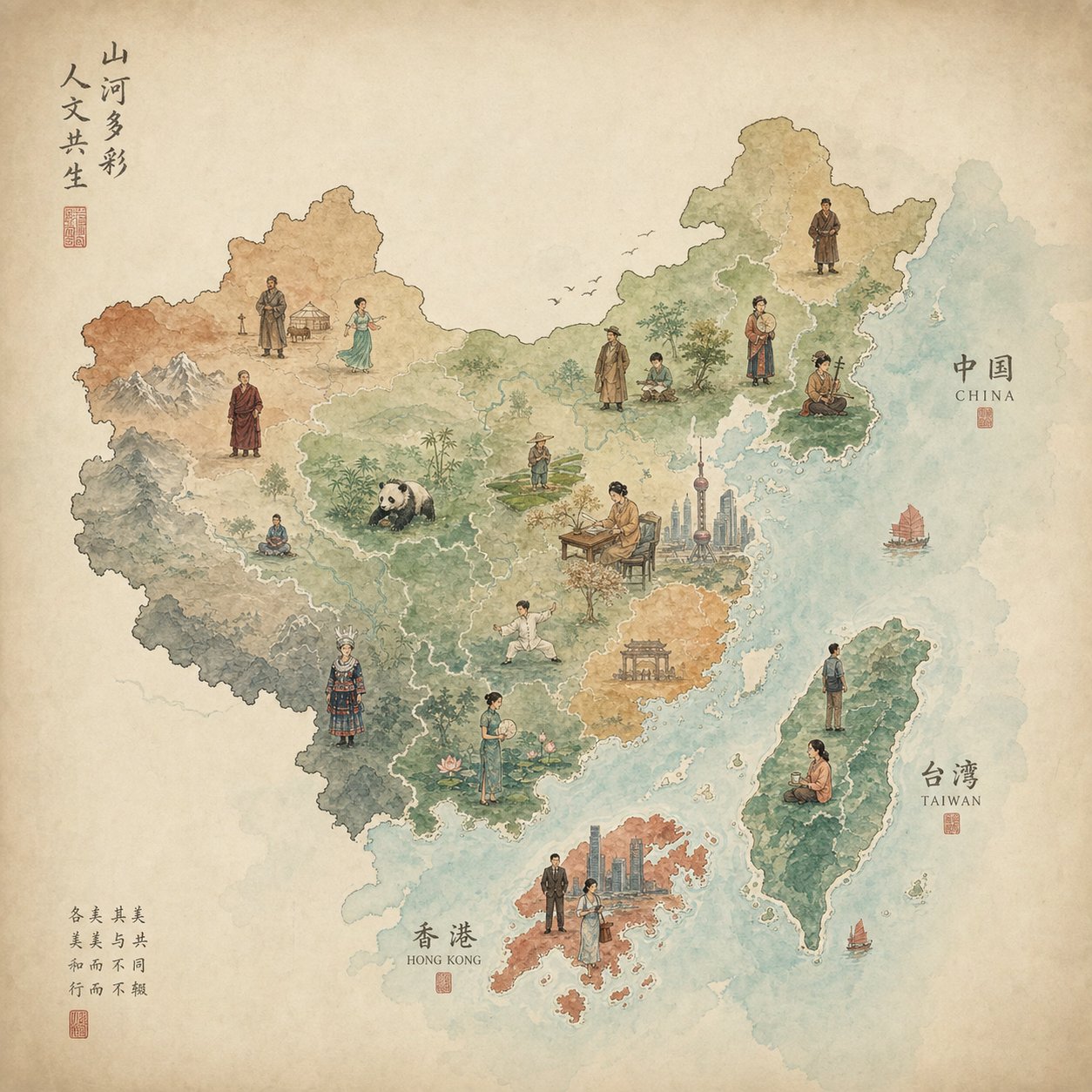
A perfectly natural use of 姐 in a Taipei office might raise eyebrows in a Hong Kong tea house. The convention of adding jiejie to a name isn't monolithic across Chinese-speaking communities. Geography, local dialect, and generational attitudes all shape how the term gets deployed, how formally it reads, and whether it even sounds like the right word to use.
Regional Differences Across Chinese-Speaking Areas
If you're navigating multiple Chinese-speaking environments, you'll notice that the same honorific carries different weight depending on where you are. Here's how the major regions handle it:
- Mainland China (Mandarin-speaking regions) - The surname + 姐 pattern is standard in workplaces and social settings. Usage follows the age-hierarchy rules closely in formal contexts, though younger urban speakers in cities like Shanghai and Shenzhen have relaxed the convention in casual interactions. The term 大姐 (dàjiě) can sound slightly too familiar or even mildly condescending if used with someone who doesn't know you well, so most speakers stick with plain surname + 姐.
- Taiwan - Taiwanese Mandarin speakers tend to use 姐 more liberally in professional settings. It's common to hear 姐 appended to names even in relatively formal business contexts where Mainland speakers might opt for 女士 (nǚshì) or a job title instead. The warmth of 姐 fits the generally softer, more relationship-oriented communication style that characterizes Taiwanese workplaces. You'll also hear 姐 used across a wider age range, with smaller age gaps still warranting the honorific.
- Hong Kong and Cantonese-speaking areas - This is where things diverge most noticeably. Cantonese speakers don't typically use the Mandarin 姐姐 (jiějie) in daily speech. Instead, the parallel term is 家姐 (gaa1 ze2, literally "family elder sister") for referring to one's own older sister, while 阿姐 (aa3 ze2) serves as the honorific address form. In Hong Kong workplaces, you might hear someone called "陈姐" using the Cantonese pronunciation of 姐 (ze2) rather than the Mandarin jiě. The function is identical, but the sound and feel differ. Jiejie in Cantonese contexts sounds distinctly like a Mandarin import, which means using it in Hong Kong can mark you as a Mandarin speaker rather than a local Cantonese speaker.
- Overseas Chinese communities - Diaspora communities in Southeast Asia, North America, and Europe often blend conventions. A Malaysian Chinese family might use 姐 in Hokkien pronunciation (ché or chí) at home while switching to Mandarin jiě in more formal community settings. In Western countries, younger overseas Chinese frequently code-switch, using "jiejie" in English conversation as a loanword rather than a full Chinese honorific. The term becomes a cultural identity marker as much as a form of address.
These regional differences mean that what you learn about adding jiejie to a name in a standard Mandarin textbook won't always match what you encounter on the ground. A Cantonese speaker hearing you say "Wong jie" in Mandarin might appreciate the intent but find the pronunciation slightly foreign to their ear. Matching your usage to the local linguistic environment shows a deeper level of cultural fluency.
How Younger Generations Use Jiejie Differently
Generational shifts have reshaped this convention as much as geography has. If you compare how a 60-year-old in Beijing uses 姐 with how a 22-year-old in the same city uses it, you'll see two different social logics at work.
Older generations maintain stricter age-hierarchy rules. For speakers born before the 1970s, adding 姐 to someone's name is a deliberate social act. It acknowledges a clear age gap, signals deference, and follows predictable patterns. You wouldn't use it playfully. You wouldn't apply it to someone only a year older. And you certainly wouldn't use it ironically or as internet slang. The term carries weight because the social hierarchy it references carries weight.
Younger speakers, particularly those born after 1990, treat the convention more flexibly. Several shifts stand out:
- Smaller age gaps trigger usage. A 25-year-old might call a 26-year-old friend "姐" where an older generation would consider a one-year gap too small to warrant the honorific.
- Playful and ironic usage is common. Among close friends, calling someone 姐 can be teasing rather than deferential, especially when the "older sister" in question is known for being bossy or protective.
- Digital-first adoption. Many younger speakers encountered jiejie as internet slang (小姐姐) before they used it in traditional face-to-face contexts. Their mental model of the term includes its online connotations of attractiveness and coolness alongside its offline meaning of seniority.
- Gender-neutral spaces are emerging. In some progressive online communities, 姐 gets applied regardless of the addressee's gender presentation, used more as a marker of admiration than a gendered kinship term. This remains niche but reflects how younger speakers experiment with inherited language structures.
The generational divide creates occasional friction. An older colleague might feel that a younger coworker's casual use of 姐 lacks the genuine respect the term traditionally carries. Conversely, a younger speaker might find an older person's insistence on strict age-based address overly rigid. Neither is wrong. They're operating from different cultural reference points shaped by when and how they learned to use the term.
For anyone learning to use this convention, the practical takeaway is straightforward: observe the people around you. Match the formality level and frequency of 姐 usage to what you hear in your specific environment. A Taiwanese tech startup, a Hong Kong trading firm, and a Beijing state-owned enterprise will each have their own unwritten norms. The rules outlined throughout this article give you the foundation, but local observation gives you the nuance that makes your usage sound genuinely natural rather than textbook-correct.
Frequently Asked Questions About Adding Jiejie to a Name
1. What does adding jiejie to someone's name mean in Chinese?
Adding jiejie (姐姐) or the shortened form jie (姐) after someone's name is a Chinese social convention that expresses respect and affection toward an older female. It positions the person as an elder-sister figure in your social relationship. This is not a legal name change but a spoken and written form of address used across family, friendship, workplace, and even online contexts. The term signals warmth and acknowledgment of seniority without being overly formal.
2. Do you put jiejie before or after the name?
Jie (姐) always goes after the name in Chinese, never before it. The correct patterns are surname + 姐 (e.g., Wang jie) for polite semi-formal address, or given name + 姐 (e.g., Xiaofang jie) for closer relationships. Placing jiejie before the name, like saying 'jie Wang,' follows English title logic but sounds ungrammatical in Chinese and will not be understood as a form of address by native speakers.
3. What is the difference between jiejie and xiaojie in Chinese?
Jiejie (姐姐) and xiaojie (小姐) serve very different functions despite both relating to women. Jie (姐) is a kinship-based honorific that conveys warmth and elder-sister respect when attached to a name. Xiaojie historically meant 'Miss' and still works in formal contexts like hotel service, but in many regions of mainland China it has acquired negative connotations associated with sex workers. Using surname + 姐 is the safer, warmer choice for everyday respectful address, while 女士 (nushi) works better for formal situations where you need a 'Miss' or 'Ms.' equivalent.
4. Can you call someone jiejie if they are younger than you?
In traditional face-to-face interactions, no. The entire premise of jiejie is upward respect in the age hierarchy, so calling someone younger than you jiejie contradicts the term's meaning and can feel confusing or even mocking. However, online culture has relaxed this rule significantly. In fan communities and social media, people use jiejie for women they admire regardless of actual age, treating it as a marker of admiration rather than seniority. The key distinction is context: offline, age matters; online, it is often optional.
5. What is the difference between using full jiejie versus single jie with a name?
The full reduplicated form 姐姐 (jiejie) functions as a standalone kinship term, used on its own when addressing an actual older sister or when a child speaks to an older girl without knowing her name. The single character 姐 (jie) is the form that attaches directly to names, such as Wang jie or Xiaofang jie. Adults who attach the full 姐姐 to a name (like Wang jiejie) sound childish or deliberately cutesy, which may work in playful online contexts but lands awkwardly in workplaces or formal settings.