Understanding Pinyin and Famous Chinese Historical Names
You're watching a documentary about ancient China, and the narrator mentions "Qin Shi Huang." You've seen the name in textbooks for years, but how do you actually say it? Is the Q silent? Does it rhyme with "Quinn"? If you've ever stumbled over the names of famous Chinese people while reading history or listening to a lecture, you're not alone. The disconnect between seeing a romanized Chinese name and knowing how to pronounce it is one of the most common frustrations for English-speaking history enthusiasts.
The root of the problem is simple: most readers never learned pinyin, the official romanization system that mainland China uses to spell out Mandarin sounds using Latin letters. Pinyin literally means "spell out the sound," and it follows specific rules that don't always match English phonetics. Without understanding those rules, names like Cao Cao, Xu, or Zhuge Liang become guessing games.
Why Pinyin Matters for Historical Chinese Names
Pinyin is the key that connects written names to spoken pronunciation. When you encounter notable chinese people in any English-language source published after the late 1970s, their names almost always appear in pinyin. Yet pinyin letters like Q, X, and Zh represent sounds with no direct English equivalent. Knowing even the basics transforms a string of confusing letters into a name you can say with confidence.
Pinyin doesn't change the names you already know. It reveals how they were always meant to sound.
Who This Guide Helps
This guide is for anyone who reads about china famous personalities in history books, encounters famous chinese personalities in academic courses, or watches documentaries and wants to bridge the gap between the printed name and its actual pronunciation. Think of it as the missing layer between a biography list and a language lesson. You don't need to learn Mandarin. You just need enough pinyin literacy to stop second-guessing every name you read.
The pages ahead break down naming conventions, walk through pronunciation traps, and give you pinyin-with-tones for dozens of notable chinese people spanning thousands of years. By the end, names that once looked like alphabet soup will finally click into place.
How Chinese Naming Conventions Work for Historical Figures
Before you can pronounce a name correctly, you need to understand what kind of name you're actually looking at. Chinese historical figures often appear under multiple names across different sources, and each name type follows its own rules. One person might be listed as Zhuge Liang in one book, Kongming in another, and Wolong in a third. These aren't errors or aliases in the suspicious sense. They're different categories of names, each with a specific cultural function. Understanding this system is essential for anyone studying famous chinese figures, because it explains why the same person seems to have several identities in English-language texts.
Family Names and Given Names in Chinese Order
The most fundamental rule of Chinese names is this: the family name comes first. In Chinese, the surname is called xing (姓), and the given name is called ming (名). So when you see "Zhuge Liang," Zhuge is the family name and Liang is the given name. This is the opposite of Western convention, where "Albert Einstein" puts the given name first.
Why does this matter? Because English-speaking readers often reverse the order without realizing it. If someone writes "Liang Zhuge" thinking they're being helpful, they've actually created confusion. The family name always leads in Chinese, and pinyin preserves that order. Most Chinese historical figures have a one-character surname and a one- or two-character given name. However, compound surnames like Zhuge (诸葛), Sima (司马), and Ouyang (欧阳) do exist and are particularly common among famous chinese characters in pre-modern history.
The given name, or ming, was a personal name used from childhood. It carried deep meaning chosen by the parents. Zhuge Liang's ming, Liang (亮), means "bright" or "luminous." Unlike Western naming traditions with a fixed pool of biblical or traditional names, Chinese given names can draw from virtually any character in the language, making each one a deliberate statement about hopes, virtues, or circumstances.
Courtesy Names and Posthumous Titles Explained
Here's where things get layered. Beyond the basic family-plus-given structure, historical chinese figures accumulated additional names throughout their lives and after death. The main categories are:
- Courtesy name (字 zi): Given at age 20 during a coming-of-age ceremony. Among adults, it was considered disrespectful to use someone's ming directly. Peers and colleagues used the zi instead. The courtesy name often mirrored or complemented the meaning of the given name.
- Style or pseudonym (号 hao): A self-chosen literary or artistic name. Scholars and officials frequently adopted these, sometimes multiple ones, often referencing a place, philosophy, or personal ideal.
- Posthumous name (谥号 shihao): Awarded after death by the court, based on the person's conduct and achievements during their lifetime. Characters like Wen (文, "cultured") or Wu (武, "martial") described their legacy.
- Temple name (庙号 miaohao): Reserved for emperors, inscribed on tablets in the dynastic ancestral temple. Terms like Taizu (太祖, "Grand Ancestor") or Taizong (太宗, "Grand Forebear") indicated the ruler's role in the dynasty's lineage.
- Era name (年号 nianhao): A reign motto proclaimed by an emperor. From the Ming dynasty onward, each emperor used only one, which is why names like "Kangxi" and "Qianlong" feel like personal names even though they're actually reign slogans.
Each of these name types has its own pinyin rendering, and each appears in different contexts. A history textbook might use the temple name for an emperor but the courtesy name for a poet. Recognizing which type you're reading is half the battle.
Why One Figure Has Multiple Pinyin Names
Imagine encountering all of these name types for a single person. Zhuge Liang is the perfect case study. He was a chancellor and military strategist of the Shu Han kingdom during the Three Kingdoms period (220-280 CE), and he appears under at least four distinct names in historical sources. His ming, Liang (亮), means "bright." His courtesy name, Kongming (孔明), means "enlightened opening," directly echoing the brightness of his given name. His self-chosen style, Wolong (卧龙), means "Sleeping Dragon," a poetic reference to his years of quiet seclusion before entering political life. And after death, he received the posthumous title Zhongwu (忠武), meaning "Loyal and Martial."
All four names refer to the same person. All four have distinct pinyin spellings with their own tone marks. If you're reading a novel about the Three Kingdoms, you might see "Kongming" on one page and "Wolong" on the next without any indication they're the same figure. This is why understanding the naming system matters as much as understanding pronunciation.
| Name Type | Chinese Characters | Pinyin (with tones) | English Meaning |
|---|---|---|---|
| Family + Given Name (姓名) | 诸葛亮 | Zhūge Liàng | Zhuge clan + Bright |
| Courtesy Name (字) | 孔明 | Kǒngmíng | Enlightened Opening |
| Style / Pseudonym (号) | 卧龙 | Wòlóng | Sleeping Dragon |
| Posthumous Title (谥号) | 忠武侯 | Zhōngwǔ Hóu | Loyal-Martial Marquis |
This layered system applies across all eras. The Ming dynasty founder, for example, had the personal name Zhu Yuanzhang (朱元璋), the courtesy name Guorui (国瑞), the temple name Taizu (太祖), the posthumous title Gaodi (高帝), and the era name Hongwu (洪武). Five names, one person, each serving a different historical and cultural function.
The takeaway for readers encountering chinese historical figures in English texts is straightforward: when a name looks unfamiliar, it may not be a new person at all. It may simply be a different name category for someone you already know. Pinyin gives each variant a consistent, pronounceable spelling, but only if you recognize which layer of the naming system you're looking at. That recognition becomes especially important when older romanization systems enter the picture, turning familiar names into something unrecognizable.

Connecting Western Names to Their Pinyin Equivalents
Older romanization systems don't just make names look unfamiliar. They create an entirely separate identity for chinese famous people that bears little resemblance to how those names actually sound in Mandarin. If you've ever wondered why "Confucius" looks nothing like "Kong Qiu," or why "Sun Tzu" doesn't match "Sun Wu," the answer lies in centuries of translation history that predates pinyin by hundreds of years.
Western Names vs Actual Pinyin Equivalents
Many of the most famous people in asian history carry Western names that were never meant to be Chinese at all. "Confucius" is a Latinized form created by Jesuit missionaries in the sixteenth century, derived from "Kong-fu-zi" (Master Kong). The actual person was named Kong Qiu (孔丘), born in 551 BC in the state of Lu. Similarly, "Mencius" is a Latin adaptation of "Meng-zi" (Master Meng), while the philosopher's birth name was Meng Ke. "Sun Tzu" and "Lao Tzu" follow the same pattern, where "Tzu" is an older romanization of zi (子), meaning "master."
These Latinized names stuck because they entered European languages during the 1500s and 1600s, long before any standardized romanization system existed. Jesuit scholars working in China translated philosophical texts for European audiences and adapted the names to sound natural in Latin. The result: every famous person from china in the classical philosophical tradition carries a Western name that obscures the original Chinese pronunciation entirely.
Pinyin vs Wade-Giles Romanization Differences
Beyond the Jesuit-era Latin names, there's a second layer of confusion. The Wade-Giles system, developed by Sir Thomas Francis Wade and later modified by Herbert Allen Giles in 1912, became the dominant romanization method in English-speaking countries for most of the twentieth century. It uses apostrophes to mark aspirated sounds (t' vs t, ch' vs ch) and hyphens to separate syllables in names. So "Mao Tse-tung" is Wade-Giles; "Mao Zedong" is pinyin. "Pei-ching" is Wade-Giles; "Beijing" is pinyin.
The practical differences are easy to spot once you know what to look for. As the Library of Congress pinyin conversion guide explains, Wade-Giles syllables never begin with B, D, G, Q, X, or Z. If you see those letters starting a syllable, you're reading pinyin. Wade-Giles also hyphenates multi-syllable given names (Tse-tung), while pinyin joins them (Zedong). Mainland China officially replaced Wade-Giles with pinyin in 1979, which is why any source published after that date uses the newer system. Older books, however, still circulate widely, and the spelling differences can make the same person look like two different figures.
Here's a reference table covering major historical figures you'll encounter under different romanization systems. Recognizing all three columns helps you connect names across sources, whether you're reading a 1960s translation or a modern textbook about someone famous in chinese history.
| Western / Common Name | Wade-Giles | Pinyin (with Tones) | Chinese Characters |
|---|---|---|---|
| Confucius | K'ung Ch'iu / K'ung-tzu | Kǒng Qiū / Kǒngzǐ | 孔丘 / 孔子 |
| Mencius | Meng K'o / Meng-tzu | Mèng Kē / Mèngzǐ | 孟轲 / 孟子 |
| Sun Tzu | Sun Wu / Sun-tzu | Sūn Wǔ / Sūnzǐ | 孙武 / 孙子 |
| Lao Tzu | Lao Tan / Lao-tzu | Lǎo Dān / Lǎozǐ | 老聃 / 老子 |
| Mao Tse-tung | Mao Tse-tung | Máo Zédōng | 毛泽东 |
| Chuang Tzu | Chuang-tzu | Zhuāngzǐ | 庄子 |
| Empress Tzu-hsi | Tz'u-hsi | Cíxǐ | 慈禧 |
| Chiang Kai-shek | Chiang Chieh-shih | Jiǎng Jièshí | 蒋介石 |
Notice how dramatically different the same name can look across systems. "Chuang Tzu" becomes "Zhuangzi." "Tzu-hsi" becomes "Cixi." Without this cross-reference, you might read about a famous person from china in one source and never realize a different source is discussing the same individual under a completely different spelling. The gap between seeing these names on a page and actually pronouncing them correctly, though, requires one more piece: understanding how pinyin letters map to real sounds.
Pronouncing Pinyin Names as an English Speaker
Pinyin uses the same 26 Latin letters you already know, but several of them represent sounds that don't exist in English. This is exactly where mispronunciation starts. You see a familiar letter, your brain assigns it an English sound, and the result lands nowhere near the actual Chinese pronunciation. The good news? Only a handful of pinyin initials cause real trouble, and once you learn those, the names of famous chinese historical figures become far less intimidating.
Pinyin Sounds That Confuse English Speakers
Imagine seeing the name "Qin Shi Huang" for the first time. Most English speakers want to pronounce that Q like "kwin" or stay silent altogether. But in pinyin, Q represents a sound closer to "ch" with your tongue pushed forward against the roof of your mouth. It's not the deep "ch" of "church." It's lighter, sharper, produced near your front teeth.
Here are the initials that trip up English speakers most often, based on pronunciation research for American English speakers:
- Q sounds like "ch" with the tongue forward (not like English Q). Qin = "Chin," not "Kwin."
- X sounds like "sh" with the tongue forward, closer to a hissing "see." Xu = roughly "Shyoo," not "Zoo" or "Eks-oo."
- Zh sounds like "j" in "John" with the tongue curled back. Zhuge = "Joo-guh," not "Zoo-gee."
- C sounds like "ts" in "boots." Cao = "Tsao," not "Cow" or "Say-oh."
- R sounds closer to the "s" in "vision" than the English "r." Ren = more like "Jen" with a soft start.
- U after J, Q, X, or Y is actually the vowel u (like the French "tu" or saying the English letter "u"). Qu Yuan = "Chyoo Ywen," not "Koo Yoo-an."
A helpful shortcut from the same research: think of J, Q, and X as versions of Zh, Ch, and Sh with a "y" sound blended in. So "xia" is like "sh-ya" and "qi" is like "ch-yee." That single mental adjustment fixes the pronunciation of dozens of names you'll encounter among famous chinese people in history.
The Four Tones in Historical Names
Mandarin has four tones, and each one changes a syllable's meaning entirely. When you read pinyin with tone marks, those small diacritics above the vowels aren't decorative. They tell you the pitch contour of each syllable, and getting them wrong can turn one word into a completely different one.
Here's how the four tones work, illustrated with names you'll recognize:
| Tone | Pitch Pattern | English Feel | Historical Name Example |
|---|---|---|---|
| 1st (macron: ā) | High and flat | Holding a steady note | Cāo in Cáo Cāo (first syllable of his given name) |
| 2nd (rising: á) | Mid to high | Surprised "hm?" | Máo in Máo Zédōng |
| 3rd (dipping: ǎ) | Low dip, slight rise | Drawn-out "well..." | Lǎo in Lǎozǐ |
| 4th (falling: à) | Sharp high-to-low drop | Firm "No!" | Liàng in Zhūgě Liàng |
The third tone deserves extra attention. In isolation, it dips low and rises back up. But in connected speech, before another syllable, it usually just dips low and stays there. This shortened form is what you'll actually hear in natural pronunciation of most names.
Tone Sandhi in Names
Tones don't always stay as written. When two third-tone syllables appear back to back, the first one shifts up to a second tone in actual speech. This rule, called tone sandhi, applies directly to historical names.
Take Lǐ Bǎi, for example. Wait. Actually, the famous Tang poet's name is Lǐ Bái (李白), with a second tone on Bai, so no sandhi applies there. But consider the name Lǚ Bù (吕布), the warlord from the Three Kingdoms era. Both syllables carry third-tone marks, so in natural speech, the first syllable rises: it sounds closer to "Lyoo Boo" with the first syllable pronounced as a rising tone.
Another common example: the greeting nǐ hǎo (你好) sounds like "ni hao" with the first syllable rising to a second tone. The same pattern applies whenever you encounter consecutive third tones in any name. The written pinyin keeps the original tone marks, but your pronunciation should follow the sandhi rule.
Phonetic Approximations for Common Names
Theory only goes so far. Here are practical, say-it-out-loud approximations for names of the most famous chinese people that English speakers encounter regularly. These aren't perfect transcriptions, but they'll get you close enough that a Mandarin speaker would recognize the name immediately:
| Pinyin (with Tones) | English Approximation | Common Mistake |
|---|---|---|
| Qín Shǐ Huáng | "Chin Shir Hwahng" | Saying "Kwin Shy Hwang" |
| Zhūgě Liàng | "Joo-guh Lyahng" | Saying "Zoo-gee Lee-ang" |
| Cáo Cāo | "Tsao Tsao" (rhymes with "cow") | Saying "Kay-oh Kay-oh" |
| Lǐ Bái | "Lee Bye" | Saying "Lie Bay" |
| Sūn Wǔ | "Swun Woo" | Saying "Sun Wuh" |
| Kǒngzǐ | "Kong-dzuh" | Saying "Kong-zee" |
| Wǔ Zétiān | "Woo Dzuh-tyen" | Saying "Woo Zee-tee-an" |
| Zhèng Hé | "Jung Huh" | Saying "Zeng Hee" |
You'll notice a pattern: the biggest mistakes come from reading pinyin letters as if they were English. The letter Z in pinyin is closer to "dz," the letter E often sounds like the "u" in "duh" rather than "ee," and the letter H is never silent. Every consonant in pinyin is pronounced.
For any famous person in china whose name you want to say correctly, apply these three steps: identify the tricky initials (Q, X, Zh, C), check the tone marks, and remember that vowels shift depending on their neighbors. Even rough approximations built on these principles will sound dramatically better than English-default guesses. The real payoff comes when you start applying this pronunciation knowledge to specific historical figures, era by era, starting with the ancient names that shaped Chinese civilization from its earliest chapters.
Ancient and Classical Era Figures with Pinyin Breakdowns
China's earliest chapters are populated by figures whose names are strikingly short. Single-character names like Yao and Shun reflect an era when naming conventions were minimal and populations small enough that brevity caused no confusion. As centuries passed and societies grew more complex, names lengthened, titles multiplied, and the naming patterns you see among important historical and mythological figures in ancient china evolved dramatically. Tracing that evolution through pinyin reveals both linguistic history and cultural priorities.
Mythological and Legendary Figures in Pinyin
The earliest ancient chinese people in the historical record are semi-divine rulers from the mythological period before 2000 BCE. Their names tend to be descriptive titles rather than personal names in the modern sense.
Huangdi (黄帝, Huang Di), the Yellow Emperor, carries a name that functions as a title: Huang (黄) means "yellow," associated with the earth element in Daoist cosmology, and Di (帝) means "emperor" or "sovereign." His traditional reign dates place him around 2698-2598 BCE. The single-character rulers who followed him, Yao (尧, Yao) and Shun (舜, Shun), are even simpler. Yao's character suggests "high" or "lofty," while Shun's character relates to a type of flowering plant. These names were likely posthumous designations rather than birth names, which is why they feel more like labels than personal identifiers.
Notice the pattern: people from ancient china in the mythological era carry names that are essentially one meaningful character, sometimes paired with a title like Di. This stands in sharp contrast to the multi-syllable, meaning-rich names that emerged in later periods.
Philosophers and Strategists of the Classical Era
By the Eastern Zhou dynasty (770-221 BCE), naming had become far more elaborate. The famous people in ancient china from this period carry full surname-plus-given-name structures, courtesy names, and the honorific suffix zi (子, "master").
Kong Qiu (孔丘, Kong Qiu), known in the West as Confucius, was born in 551 BCE in the state of Lu. His surname Kong (孔) means "opening" or "aperture," and his given name Qiu (丘) means "hill," reportedly a reference to the unusual shape of his head. The honorific Kongzi (孔子) simply means "Master Kong." His contemporary Laozi (老子, Laozi), traditionally identified as Li Er (李耳), carries the surname Li (李, "plum tree") and the given name Er (耳, "ear"). The title Laozi itself means "Old Master."
Sun Wu (孙武, Sun Wu), the military strategist known as Sun Tzu, has the surname Sun (孙, "grandchild" or "descendant") and the given name Wu (武, "martial"). Meng Ke (孟轲, Meng Ke), Latinized as Mencius, carries the surname Meng (孟, "eldest") and the given name Ke (轲, a type of axle). Zhuang Zhou (庄周, Zhuang Zhou), the Daoist philosopher called Zhuangzi, has the surname Zhuang (庄, "village" or "solemn") and the given name Zhou (周, "complete" or "cycle").
Two more important people in ancient china round out this era. Qu Yuan (屈原, Qu Yuan), the patriotic poet of the state of Chu (c. 340-278 BCE), has the surname Qu (屈, "bent" or "wronged") and the given name Yuan (原, "origin" or "plain"). And Qin Shi Huang (秦始皇, Qin Shi Huang), who unified China in 221 BCE, carries a name that is actually a title: Qin (秦) is his state, Shi (始) means "first," and Huang (皇) means "emperor." His birth name was Ying Zheng (嬴政).
Name Meanings and Character Breakdowns
A clear pattern emerges when you line up these figures chronologically. The earliest names are single characters functioning as titles. By the Spring and Autumn period (770-476 BCE), full two-part names with distinct surnames and given names become standard. And by the Warring States period (475-221 BCE), the zi honorific system is fully established, giving famous people in ancient china both a personal name and a public title.
Certain surnames also cluster by era and region. The surname Kong was concentrated in the state of Lu (modern Shandong). Sun was common in the state of Qi, also in Shandong. Li, which later became China's most common surname partly due to Tang dynasty imperial prestige, already appears in the classical period with Laozi. These regional surname concentrations reflect the feudal structure of Zhou-era China, where families remained rooted in specific territories for generations.
| Era | Chinese Characters | Pinyin (with Tones) | Name Meaning | Known For |
|---|---|---|---|---|
| Mythological (c. 2698 BCE) | 黄帝 | Huang Di | Yellow + Emperor | Legendary founder of Chinese civilization |
| Mythological (c. 2333 BCE) | 尧 | Yao | Lofty / High | Sage emperor, model of virtuous rule |
| Mythological (c. 2294 BCE) | 舜 | Shun | Hibiscus plant | Sage emperor chosen by merit over birth |
| Spring and Autumn (551-479 BCE) | 孔丘 | Kong Qiu | Opening + Hill | Founder of Confucianism |
| Spring and Autumn (c. 500 BCE) | 李耳 | Li Er | Plum tree + Ear | Founder of Daoism (Laozi) |
| Spring and Autumn (c. 500 BCE) | 孙武 | Sun Wu | Descendant + Martial | Author of The Art of War |
| Warring States (c. 340-278 BCE) | 屈原 | Qu Yuan | Bent + Origin | Patriotic poet, Dragon Boat Festival origin |
| Warring States (371-289 BCE) | 孟轲 | Meng Ke | Eldest + Axle | Second sage of Confucianism |
| Warring States (c. 350 BCE) | 庄周 | Zhuang Zhou | Solemn + Complete | Daoist philosopher, author of parables |
| Qin Dynasty (259-210 BCE) | 嬴政 / 秦始皇 | Ying Zheng / Qin Shi Huang | Win + Governance / Qin + First + Emperor | First emperor of unified China |
Each name in this table tells a micro-story about its era. The mythological names are elemental and symbolic. The philosophers' names are personal and grounded. And Qin Shi Huang's name is pure political declaration: "First Emperor of Qin." As China moved into the imperial age, naming conventions shifted again. Poets chose names dripping with literary allusion, emperors accumulated layers of posthumous titles, and the relationship between a person's birth name and their historical identity grew ever more complex.
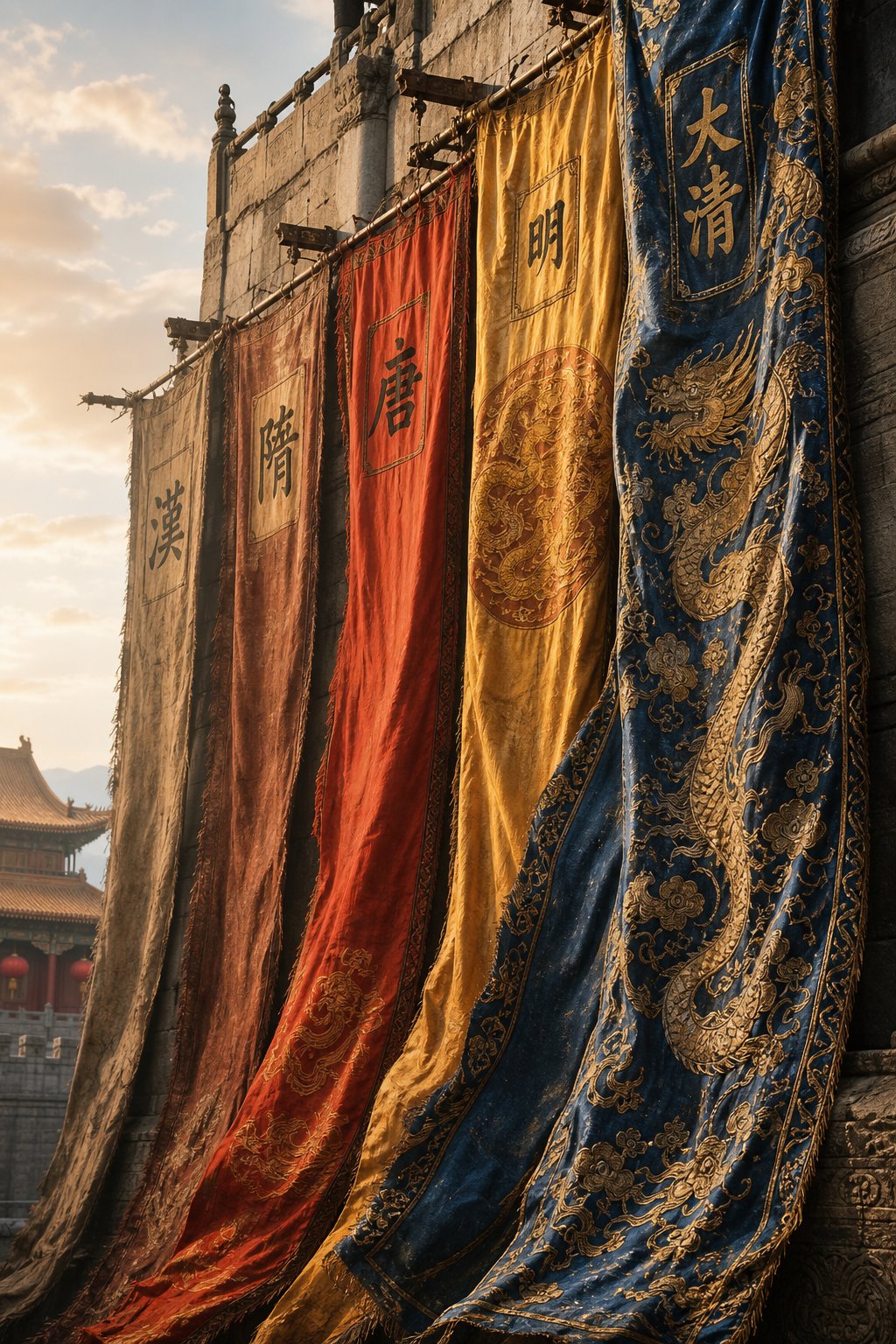
Imperial Dynasty Figures from Han to Qing in Pinyin
The imperial age stretched nearly two thousand years, from the founding of the Han dynasty in 206 BCE to the collapse of the Qing in 1912. Across that span, naming conventions didn't stay static. Han-era names tend toward blunt simplicity. Tang dynasty names shimmer with literary ambition. Ming and Qing names carry layers of formality and generational structure. Tracing these shifts through pinyin reveals how chinese famous people in history expressed identity, aspiration, and social position through the characters in their names.
Tang Dynasty Poets and Their Pinyin Names
The Tang dynasty (618-907) produced China's most celebrated poets, and their names reflect the era's literary culture. You'll notice something immediately: the surname Li (李) appears everywhere. Li Bai, Li Shangyin, Li He, Li Qingzhao. This isn't coincidence. Li was the imperial surname of the Tang ruling house, and the emperors granted it to loyal subjects, allies, and even foreign generals as an honor. Over three centuries, the surname spread far beyond the original clan, which is why Li remains one of China's most common surnames today.
Li Bai (李白, Li Bai), the "Immortal Poet," carries a given name that means simply "white" or "pure." His courtesy name was Taibai (太白), meaning "great whiteness" or "Venus" (the planet). In Europe, he's sometimes still listed under the Wade-Giles spelling Li Po. His close friend and counterpart, Du Fu (杜甫, Du Fu), has the surname Du (杜, a type of birch tree) and the given name Fu (甫, meaning "just beginning" or "a man"). Du Fu's courtesy name was Zimei (子美), meaning "son of beauty." He earned the posthumous title "Poet-Sage" (诗圣, Shi Sheng) and was also called Du Gongbu (杜工部) after his official post as Minister of Works.
Wang Wei (王维, Wang Wei) rounds out the trio of great Tang poets. His surname Wang (王) means "king," and his given name Wei (维) means "to maintain" or "dimension." His courtesy name, Mojie (摩诘), was taken from the Buddhist figure Vimalakirti, reflecting his deep engagement with Chan Buddhism. Su Shi (苏轼, Su Shi), the Song dynasty polymath often grouped with Tang poets in literary discussions, has the surname Su (苏, "revive") and the given name Shi (轼, the crossbar on a chariot). His courtesy name Zizhan (子瞻) means "son who gazes far," and his literary pseudonym Dongpo Jushi (东坡居士, "Retired Scholar of the Eastern Slope") is so famous that he's commonly called Su Dongpo.
These names reveal a pattern: Tang and Song literary figures chose given names and courtesy names rich with philosophical or aesthetic meaning. The names weren't just labels. They were artistic statements, often paired so the ming and zi echoed each other's meaning, as the naming conventions of the era demanded.
Military Leaders and Emperors Across Dynasties
Military and political figures tell a different naming story. Their names often emphasize martial virtue, loyalty, or dynastic ambition, and their posthumous titles carry judgments about their legacy.
Cao Cao (曹操, Cao Cao) dominated the late Han and early Three Kingdoms period. His surname Cao (曹) originally referred to a type of official department, and his given name Cao (操) means "conduct" or "to grasp." His courtesy name was Mengde (孟德), meaning "eldest virtue." The repetition of the "Cao" sound in his full name makes it one of the most distinctive among famous people of china, though English speakers often mangle it as "Kay-oh Kay-oh" instead of the correct "Tsao Tsao."
Yue Fei (岳飞, Yue Fei), the Song dynasty general, has the surname Yue (岳, "great mountain") and the given name Fei (飞, "to fly"). His courtesy name was Pengju (鹏举), meaning "the roc rises," directly echoing the flight imagery of his given name. This mirroring between ming and zi was standard practice, as historical naming conventions required the two names to share a semantic connection.
Wu Zetian (武则天, Wu Zetian) stands alone as China's only female emperor who ruled in her own name. Her surname Wu (武) means "martial," and Zetian (则天) means "model after heaven" or "standard of heaven." This was actually a name she chose for herself after taking power. Her birth given name is recorded as Zhao (曌), a character she invented by combining the characters for "sun" and "moon" above "sky," symbolizing her illumination of the world.
The Kangxi Emperor (康熙帝, Kangxi Di) illustrates the Ming-Qing convention where rulers are remembered by their era name rather than their personal name. Kangxi (康熙) means "peaceful prosperity." His actual personal name was Xuanye (玄烨, "mysterious brilliance"), but using an emperor's personal name was taboo during and after his reign. This is why Qing dynasty rulers are almost always identified by their reign mottos in both Chinese and Western sources.
Scholars in Medicine and Science
Beyond poets and generals, the imperial era produced famous people from china in medicine and exploration whose names carry their own stories.
Hua Tuo (华佗, Hua Tuo) was a physician of the late Eastern Han dynasty (c. 140-208 CE), legendary for performing surgery under anesthesia. His surname Hua (华) means "magnificent" or "China," and his given name Tuo (佗, an archaic character meaning "other" or "to carry"). His courtesy name was Yuanhua (元化), meaning "original transformation," suggesting the healing arts' power to restore the body's natural state.
Zhang Zhongjing (张仲景, Zhang Zhongjing) is considered the father of Chinese clinical medicine. His surname Zhang (张) means "to stretch" or "to open," and his given name Zhongjing (仲景) combines Zhong (仲, "second-born") with Jing (景, "scenery" or "admiration"). His medical treatise, the Shanghan Lun, remains foundational in traditional Chinese medicine.
Zheng He (郑和, Zheng He), the Ming dynasty admiral who led massive naval expeditions across the Indian Ocean between 1405 and 1433, has the surname Zheng (郑, an ancient state name) and the given name He (和, "harmony" or "peace"). Born Ma He (马和) into a Muslim family, he received the surname Zheng from the Yongle Emperor as an honor after the Battle of Zhenglunba. This name change reflects a common practice among important people in china: emperors bestowing new surnames on favored subjects.
How Naming Evolved Across Dynasties
When you line up these figures chronologically, a clear evolution emerges. Han dynasty names are compact and direct. Cao Cao, Hua Tuo, Zhang Zhongjing: short surnames, functional given names, minimal ornamentation. Tang dynasty names grow more literary. Li Bai's "whiteness," Wang Wei's Buddhist courtesy name, Du Fu's poetic pseudonym Shaoling Yelao (少陵野老, "Old Rustic of Shaoling"): these names aspire to art. By the Ming and Qing, formality dominates. Emperors are known exclusively by reign mottos. Officials accumulate posthumous double-titles. And generational naming within families becomes systematic, with brothers sharing a character in their given names to mark their place in the family lineage.
| Dynasty | Chinese Characters | Pinyin (with Tones) | Name Meaning | Historical Role |
|---|---|---|---|---|
| Han (c. 140-208) | 华佗 | Hua Tuo | Magnificent + To Carry | Pioneer surgeon and physician |
| Han (c. 150-219) | 张仲景 | Zhang Zhongjing | Stretch + Second-born Scenery | Father of clinical medicine |
| Three Kingdoms (155-220) | 曹操 | Cao Cao | Department + Conduct | Warlord, poet, founder of Cao Wei |
| Three Kingdoms (181-234) | 诸葛亮 | Zhuge Liang | Zhuge clan + Bright | Chancellor and military strategist |
| Tang (701-762) | 李白 | Li Bai | Plum + White/Pure | "Immortal Poet," romantic verse |
| Tang (712-770) | 杜甫 | Du Fu | Birch tree + Beginning | "Poet-Sage," realist verse |
| Tang (699-759) | 王维 | Wang Wei | King + Maintain | Poet-painter, Buddhist landscape art |
| Tang (624-705) | 武则天 | Wu Zetian | Martial + Model Heaven | China's only ruling empress |
| Song (1037-1101) | 苏轼 | Su Shi | Revive + Crossbar | Poet, essayist, calligrapher |
| Song (1103-1142) | 岳飞 | Yue Fei | Mountain + Fly | Patriotic general against Jurchen invasion |
| Ming (1371-1433) | 郑和 | Zheng He | Zheng state + Harmony | Admiral, seven maritime expeditions |
| Qing (r. 1661-1722) | 康熙 | Kangxi | Peaceful + Prosperity | Longest-reigning emperor, era of stability |
Each row in this table encodes a miniature biography. The martial characters in Yue Fei's name. The Buddhist resonance in Wang Wei's courtesy name. The political symbolism of Zheng He's imperially granted surname. For anyone studying famous people in china history, these character-by-character breakdowns transform names from opaque labels into windows on the values, relationships, and ambitions of each era. The imperial period's naming richness eventually collided with modernity, though, when revolution, Western contact, and the adoption of pinyin as an international standard reshaped how Chinese names appeared to the outside world.
Modern Famous Chinese Figures and Pinyin Standardization
Revolution didn't just reshape China's politics. It reshaped Chinese names. The fall of the Qing dynasty in 1912 swept away courtesy names, posthumous titles, and era names almost overnight. Modern figures typically carry just a surname and a given name, sometimes paired with a pen name or a Western-adapted version for international use. Yet this apparent simplicity hides a new kind of complexity: many of the most popular chinese people of the twentieth century are known abroad under names that aren't Mandarin pinyin at all. Understanding why requires a look at how dialect, politics, and international standardization collided during China's most turbulent century.
Revolutionary and Political Figures in Pinyin
The founding father of modern China is a perfect case study in naming confusion. English speakers know him as Sun Yat-sen, but that name is Cantonese, not Mandarin. "Yat-sen" is the Cantonese pronunciation of his art name 逸仙 (Mandarin pinyin: Yixian, meaning "Liberated Transcendent"). In mainland China, he's called Sun Zhongshan (孙中山, Sun Zhongshan), a name derived from a Japanese pseudonym given to him while in hiding. His formal personal name was Sun Wen (孙文, Sun Wen). So one person, at least three commonly used names, and only one of them follows Mandarin pinyin conventions.
Why Cantonese? Before the mid-twentieth century, Cantonese was the dominant Chinese language in overseas communities. Sun operated extensively in Hong Kong, Guangzhou, and among diaspora networks where Cantonese was the lingua franca. Western journalists and diplomats learned his name through those communities, and the Cantonese form stuck permanently in English.
A similar situation applies to Chiang Kai-shek. His Mandarin pinyin name is Jiang Jieshi (蒋介石, Jiang Jieshi), but because the Republican government was based in Canton, a Cantonese-speaking region, Western media adopted the Cantonese pronunciation of his courtesy name. Chiang himself was actually a native speaker of Wu Chinese from Zhejiang province, making his internationally known name neither his native dialect nor standard Mandarin.
Mao Zedong (毛泽东, Mao Zedong) represents the transition point. During his lifetime, English media rendered his name as "Mao Tse-tung" using Wade-Giles. Mao was a native speaker of Hunanese, but unlike Sun and Chiang, his international name was always based on Mandarin pronunciation rather than a regional dialect. The shift from "Mao Tse-tung" to "Mao Zedong" in global media happened gradually after 1979, when pinyin became the official international standard.
Modern Cultural Icons and Their Names
Literary and artistic figures of the modern era often adopted pen names that became more famous than their birth names. This practice replaced the old courtesy name system with something more personal and politically charged.
Lu Xun (鲁迅, Lu Xun), widely considered the father of modern Chinese literature, was born Zhou Shuren (周树人, Zhou Shuren). His pen name combines Lu (鲁, his mother's ancestral region) with Xun (迅, "rapid"), reportedly chosen to suggest swift progress. Ba Jin (巴金, Ba Jin), the novelist, was born Li Yaotang (李尧棠, Li Yaotang). His pen name blends syllables from the Chinese transliterations of Bakunin and Kropotkin, reflecting his early anarchist sympathies.
Among scientists, Qian Xuesen (钱学森, Qian Xuesen), the aerospace engineer sometimes called the father of Chinese rocketry, illustrates another modern naming pattern. His name follows standard pinyin perfectly: surname Qian (钱, "money"), given name Xuesen (学森, "learning forest"). In American publications from the 1940s and 1950s, he appeared as "Hsue-Shen Tsien," a Wade-Giles rendering that looks nothing like the pinyin version. Tu Youyou (屠呦呦, Tu Youyou), the Nobel Prize-winning pharmacologist, carries a name where Youyou (呦呦) comes from the Book of Songs, imitating the cry of a deer. Her name is already in pinyin and requires no conversion, a benefit of being born after the system's development.
Famous chinese sportsmen also demonstrate the modern naming landscape. Yao Ming (姚明, Yao Ming), the basketball player who bridged Chinese and American sports culture, has a name that translates cleanly into pinyin: Yao (姚, an ancient surname) and Ming (明, "bright"). Liu Xiang (刘翔, Liu Xiang), the Olympic hurdler, carries the surname Liu (刘) and the given name Xiang (翔, "to soar"). Both names follow pinyin conventions without complication, reflecting how china's famous people born after 1949 generally have names that map directly to the standard system. Among famous chinese sportsmen of the current generation, athletes like Su Bingtian (苏炳添, Su Bingtian) and Quan Hongchan (全红婵, Quan Hongchan) appear in international media under their pinyin names without any alternate Western form.
- Sun Yat-sen → Pinyin: Sun Zhongshan (孙中山) or Sun Wen (孙文)
- Chiang Kai-shek → Pinyin: Jiang Jieshi (蒋介石)
- Mao Tse-tung → Pinyin: Mao Zedong (毛泽东)
- Lu Hsun → Pinyin: Lu Xun (鲁迅)
- Pa Chin → Pinyin: Ba Jin (巴金)
- Hsue-Shen Tsien → Pinyin: Qian Xuesen (钱学森)
- Yao Ming → Pinyin: Yao Ming (姚明) — no change needed
- Bruce Lee → Pinyin: Li Xiaolong (李小龙)
How Pinyin Standardization Changed Global Recognition
The turning point came on June 15, 1979, when the United Nations Secretariat issued guidelines adopting Chinese pinyin as the international standard for romanizing Chinese personal and geographical names. Three years later, ISO 7098:1982 formalized pinyin as the global documentation standard. These decisions meant that any famous people in china entering the international stage after 1979 would be identified by their pinyin names rather than Wade-Giles or dialect-based spellings.
The practical effect was immediate. Deng Xiaoping (邓小平, Deng Xiaoping) became the first major Chinese leader whose name appeared in global media exclusively in pinyin from the start of his international prominence. Compare that to his predecessor: "Mao Tse-tung" persisted in headlines for decades even after pinyin became official, because the older spelling was too deeply embedded in English-language consciousness.
For popular people in china today, pinyin is simply the default. Xi Jinping (习近平, Xi Jinping), Jack Ma's Chinese name Ma Yun (马云, Ma Yun), filmmaker Zhang Yimou (张艺谋, Zhang Yimou): all appear in international media under their pinyin spellings without any competing romanization. The only remaining complication is name order. In Chinese, the surname always comes first: Xi Jinping, not Jinping Xi. Most international media now preserve this Chinese order for political figures and historical names. But some china famous people in entertainment and sports choose to present their names in Western order (given name first) when working internationally, creating occasional inconsistency.
This standardization also means that verifying the correct pinyin for any modern figure is straightforward. Unlike ancient figures with multiple name types and competing romanizations, modern names map one-to-one to pinyin. The challenge shifts from "which name am I looking at?" to "how do I find the correct pinyin when I only have an older spelling?" That practical question of looking up and verifying pinyin for any historical figure, ancient or modern, is exactly what the right tools and methods can solve.

How to Look Up and Verify Pinyin for Historical Names
You've encountered someone famous from china in a book published in 1965, and the name is spelled in Wade-Giles. Or you're watching a documentary that flashes Chinese characters on screen and you're thinking, "who is this in chinese, and how do I say it?" The tools for answering that question are more accessible than you might expect. A few reliable methods will let you verify the correct pinyin for any historical figure, regardless of how their name first appears.
Reliable Methods to Verify Pinyin for Any Figure
Whether you're tracking down the most famous person in china or an obscure provincial official from the Song dynasty, the same lookup process applies:
- Start with the Chinese characters. If your source provides characters alongside the romanized name, you already have what you need. Any pinyin dictionary or input tool can convert characters to pinyin with tone marks instantly.
- Use library catalog systems. Academic libraries romanize Chinese names using ALA-LC standards based on pinyin. The University of Toronto's catalog, for example, separates the surname from the given name: "Li Bai" for 李白, "Deng Xiaoping" for 邓小平. Searching a university catalog confirms both the standard spelling and the character form.
- Cross-reference with Chinese-English dictionaries. Online dictionaries like MDBG, Pleco, or LINE Dictionary let you paste characters or type Wade-Giles approximations and return full pinyin with tone marks.
- Check academic databases. Resources like CNKI, WorldCat, or the Chinese Classic Ancient Books Database index historical figures under their pinyin names, giving you a verified reference point.
- Use Wikipedia's Chinese-language version. Search the English name, switch to the Chinese article, and the pinyin is typically listed in the opening line alongside characters and tone marks.
When sources disagree, the characters are your ground truth. Different romanization systems produce different spellings, but the characters never change. If you can identify the characters, you can always regenerate the correct pinyin.
Pinyin Formatting Rules for Names
Correct formatting matters when you're writing about historical figures in your own work. The official pinyin spelling rules for personal names are straightforward:
- Capitalize the surname and capitalize the given name as separate words: Li Bai, not "li bai" or "LI BAI."
- Two-syllable given names are written as one word with no space, no hyphen, and no intercaps: Deng Xiaoping, not "Deng Xiao-ping" or "Deng XiaoPing."
- Compound surnames stay together as one capitalized unit: Sima Qian, not "Si Ma Qian" or "Si-ma Qian."
- Titles and honorifics attach directly to the name they modify: Kongzi (Master Kong), not "Kong Zi" with a space.
These rules align with how library systems catalog names. If you follow them, anyone searching for the figure you're writing about will find consistent results across sources.
Applying Pinyin Knowledge in Research and Study
Pinyin literacy pays off in practical situations beyond pronunciation. When you're reading a history text and encounter an unfamiliar name, knowing pinyin formatting tells you immediately where the surname ends and the given name begins. When you're searching a database for the most famous chinese person of a particular era, entering the name in correct pinyin with proper spacing returns far better results than guessing at an English approximation.
For documentary viewing, even basic pinyin recognition lets you connect spoken names to on-screen text. You'll start noticing when a narrator anglicizes a name versus pronouncing it in something closer to Mandarin. And when you encounter a figure listed differently across two sources, say "Zhu-ko Liang" in one and "Zhuge Liang" in another, you'll recognize both as attempts to romanize the same characters rather than assuming they're different people.
The question "who is the most famous person in china" has a different answer depending on the era, the field, and who you ask. But regardless of which figure you're researching, the path to their correct name always runs through the same process: find the characters, generate the pinyin, apply the formatting rules, and speak with confidence.
Frequently Asked Questions About Pinyin Names of Historical Figures
1. Why do Chinese historical figures have multiple names?
Chinese naming conventions include several layers beyond a birth name. Historical figures often had a courtesy name (zi) given at adulthood, a self-chosen literary pseudonym (hao), a posthumous name awarded after death based on their legacy, and for emperors, temple names and era names. For example, Zhuge Liang was also known as Kongming (courtesy name), Wolong (style name), and Zhongwu Hou (posthumous title). Each name type served a different social function, and different historical sources may reference the same person under any of these names.
2. What is the difference between pinyin and Wade-Giles romanization for Chinese names?
Pinyin and Wade-Giles are two different systems for spelling Chinese sounds using Latin letters. Wade-Giles, developed in the 19th century, uses apostrophes to mark aspirated sounds and hyphens between syllables (e.g., Mao Tse-tung). Pinyin, adopted internationally in 1979, uses letters like Q, X, and Zh that have no English equivalent sounds (e.g., Mao Zedong). A quick way to tell them apart: if a syllable starts with B, D, G, Q, X, or Z, you are reading pinyin. Older English-language texts typically use Wade-Giles, while anything published after 1979 generally uses pinyin.
3. How do you pronounce the Q, X, and Zh sounds in Chinese pinyin names?
These three initials cause the most confusion for English speakers. Q sounds like 'ch' with the tongue pushed forward toward the front teeth (Qin = 'Chin'). X sounds like 'sh' with the tongue forward, producing a hissing quality (Xu = roughly 'Shyoo'). Zh sounds like 'j' in 'John' with the tongue curled back (Zhuge = 'Joo-guh'). A useful shortcut is to think of Q and X as versions of Ch and Sh with a 'y' sound blended in, so 'qi' sounds like 'chee' and 'xi' sounds like 'shee.'
4. Why is Confucius called Kong Qiu in pinyin instead of Confucius?
The name 'Confucius' was created by Jesuit missionaries in the 16th century as a Latin adaptation of 'Kong-fu-zi' (Master Kong). The philosopher's actual birth name was Kong Qiu (孔丘), where Kong is his family name meaning 'opening' and Qiu is his given name meaning 'hill.' The Latinized form entered European languages centuries before any standardized romanization existed and became permanently embedded in Western scholarship. His Chinese honorific title Kongzi (孔子) simply means 'Master Kong.'
5. How can I look up the correct pinyin spelling for any Chinese historical figure?
The most reliable method starts with identifying the Chinese characters for the person's name, since characters never change across romanization systems. You can then use online Chinese-English dictionaries like MDBG or Pleco to generate pinyin with tone marks. Academic library catalogs following ALA-LC standards also provide verified pinyin spellings. For figures you only know by a Wade-Giles or Western name, searching the English Wikipedia article and switching to the Chinese version will typically show both characters and pinyin in the opening line.