Why Pronouncing Chinese Names Correctly Changes Everything
Imagine you are at a conference, about to introduce a new colleague to your team. You glance at the name badge: Zhang Xiuying. Your mouth opens, hesitates, and what comes out sounds nothing like what your colleague actually goes by. The moment passes quickly, but the impression lingers. That small stumble just told someone, however unintentionally, that their identity was not worth the effort.
This is not a rare scenario. Research from Race Equity Matters found that 73% of people have had their name mispronounced, and 43% said it made them feel disrespected. When it comes to Chinese name pronunciation specifically, the challenge runs deeper than unfamiliar spelling. Mandarin is a tonal language, meaning pitch changes the meaning of a syllable entirely. The same letters can refer to completely different words depending on how you voice them.
In Mandarin, mispronouncing a tone does not just sound "off" - it changes the word itself. Saying a name with the wrong tone can accidentally turn it into a different word or even something offensive.
Why Getting Chinese Names Right Matters
Names are not just labels. They connect people to family, culture, and history. When you pronounce chinese names correctly, you signal that you see and respect the person in front of you. Research published in MIT Sloan Management Review highlights that proper name pronunciation promotes belonging and psychological safety in the workplace. Our brains literally activate when we hear our own name spoken correctly, and mispronunciation has been shown to induce feelings of alienation.
The professional stakes are real too. Studies have found that individuals with Chinese-sounding names must submit 68% more job applications to receive an interview callback. Pronouncing chinese names accurately in meetings, emails, and introductions is one of the simplest ways to build trust across cultural lines. It costs nothing but a few minutes of learning, and the payoff in rapport and respect is immediate.
What This Guide Covers and Who It Helps
This guide takes a name-first approach. Rather than walking you through the entire pinyin system from scratch, it focuses on the practical task of hearing and reproducing Chinese names accurately. You will learn how to pronounce chinese names you encounter on conference badges, in email signatures, and on LinkedIn profiles, using pinyin name pronunciation audio as your anchor.
If you are a manager onboarding international team members, a professor calling roll in a diverse classroom, or a sales professional building relationships with Chinese clients, this is for you. You do not need prior knowledge of Mandarin. You just need the willingness to listen carefully and practice a handful of sound patterns that unlock hundreds of names.
The key insight driving this guide is simple: mandarin name pronunciation is learnable. The sounds that trip up English speakers follow predictable patterns, and once you recognize those patterns, even unfamiliar names become approachable. Pronunciation chinese names well is less about talent and more about knowing where to direct your attention, starting with the building blocks of how Chinese names are structured.
How Chinese Names Are Structured and Written in Pinyin
Before you can pronounce a name, you need to know how to parse it. Chinese names follow a structure that is the reverse of most Western naming conventions, and understanding that structure is the first step toward confident pronunciation. When you see a name like Li Mingzhe on a conference badge or email signature, knowing which part is the surname and which is the given name tells you exactly where to focus your attention.
Family Name Plus Given Name Structure
In Chinese, the family name comes first, followed by the given name. Think of it as the opposite of English: instead of "John Smith," you get "Smith John." The family name is almost always a single syllable, while the given name is typically one or two syllables. So when you encounter a three-syllable name like Wang Xiaoming, the first syllable (Wang) is the surname, and the remaining two syllables (Xiaoming) form the given name.
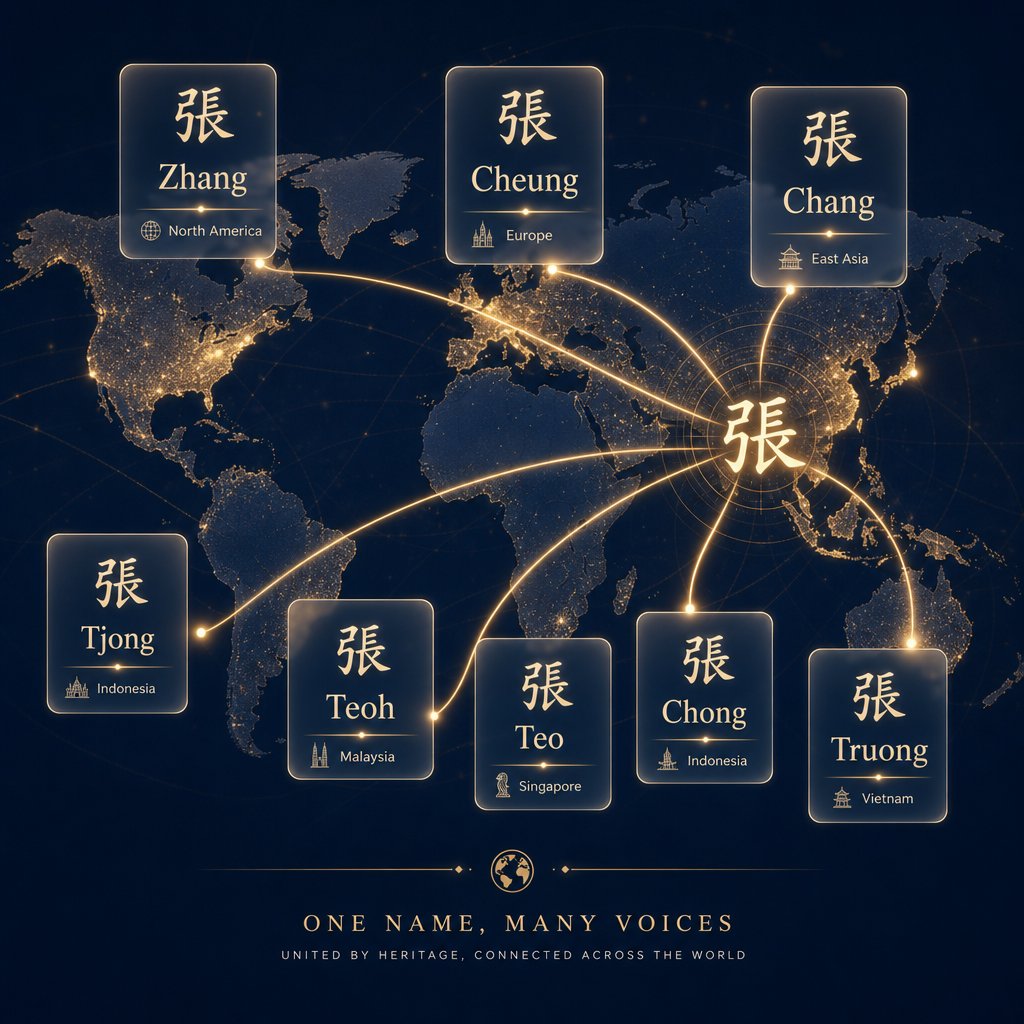
This pattern holds remarkably consistent. The Asia Media Centre notes that all of the top 100 Chinese family names have only one syllable, and these surnames cover about 85 percent of China's citizens. The most common three family names in mainland China are Li, Wang, and Zhang, shared by more than 270 million people. There are only about 400 different family names in total, which means you will encounter the same surnames repeatedly in professional settings.
A small number of compound surnames do exist, such as Ouyang, Zhuge, and Shangguan, but these are rare. If you see a name with four syllables, like Ouyang Xiwen, the two-syllable surname is the exception rather than the rule.
One practical tip: many Chinese professionals fully capitalize their surnames on business cards to prevent confusion. If you see "WANG Xiaoming" or "Wang, Xiaoming," the capitalized or comma-preceding portion is the family name. In English-speaking countries, some Chinese individuals also reverse the order to match local conventions, writing "Xiaoming Wang" instead. When in doubt, ask which name is which.
| Chinese Characters | Pinyin | Structure | Syllable Count |
|---|---|---|---|
| 王明 | Wang Ming | 1-syllable surname + 1-syllable given name | 2 |
| 李小龙 | Li Xiaolong | 1-syllable surname + 2-syllable given name | 3 |
| 张伟 | Zhang Wei | 1-syllable surname + 1-syllable given name | 2 |
| 陈秀英 | Chen Xiuying | 1-syllable surname + 2-syllable given name | 3 |
| 刘洋 | Liu Yang | 1-syllable surname + 1-syllable given name | 2 |
| 欧阳修文 | Ouyang Xiuwen | 2-syllable surname + 2-syllable given name | 4 |
How Pinyin Maps Sounds to Roman Letters
Here is where things get tricky. Pinyin uses the same 26 letters as English, but many of those letters represent completely different sounds. The word "pinyin" itself literally means "spell out the sound" in Chinese. It was adopted by the People's Republic of China as the official romanization system for Mandarin Chinese, designed to represent the pronunciation of the Beijing dialect using Latin characters.
The problem? English speakers instinctively read pinyin letters as if they were English. The letter "q" in pinyin does not sound like the "q" in "queen." The letter "x" does not sound like the "x" in "box." And "zh" is not the same as the English "z" or "zh" sound you might imagine. These mismatches are the single biggest source of mispronunciation when people encounter names in chinese written in pinyin.
Consider the name Xu. An English speaker might guess it rhymes with "zoo" or sounds like "ex-oo." In reality, it sounds closer to "shoo" but with the tongue positioned differently. Or take the surname Qian. It does not start with a "kw" sound. It starts with a "ch" sound followed by "yen." These are not random exceptions. They follow consistent rules that, once learned, apply to every name you will ever encounter in pinyin.
This is exactly why pinyin name pronunciation audio is so valuable. Written approximations can point you in the right direction, but hearing the actual sounds produced by a native speaker closes the gap between "close enough" and genuinely accurate. When you look at chinese name letters on a page, you are seeing a code. Pinyin is the key to that code, but your ears need to confirm what your eyes are reading.
The good news is that the system is finite and learnable. Mandarin characters number in the tens of thousands, but the total number of distinct syllables in Mandarin is only about 400 (around 1,200 if you count tonal variations). Master a handful of pinyin-to-sound patterns, and you unlock the pronunciation of hundreds of names. If you have ever wondered how to write your name in chinese, you have already encountered pinyin working in reverse, mapping sounds to characters. For reading Chinese names, you are doing the opposite: mapping characters and their pinyin spellings back to sounds.
The patterns that cause the most confusion, those misleading initials like q, x, zh, and c, follow predictable rules. Each one maps to a specific mouth position and airflow pattern that, once you hear it clearly, becomes easy to reproduce.

Pinyin Initials English Speakers Mispronounce Most Often
Those misleading letters are where most name mispronunciations begin. You see a "q" and your brain reaches for "queen." You see an "x" and think of "box." These reflexes are wrong every single time in pinyin, and they are the reason so many Chinese names get mangled in English-speaking workplaces. The good news: there are only nine initials that cause real trouble, and each one follows a consistent rule you can learn once and apply forever.
A critical point before diving in: written descriptions of sounds are inherently limited. You can read about tongue placement all day, but pinyin name pronunciation audio is what actually trains your ear and mouth to produce these sounds correctly. Think of the explanations below as a map. The audio is the territory. Use both together for the strongest results.
Sounds That Look Familiar but Sound Different
The core problem is that pinyin borrows Latin letters but assigns them to sounds that do not exist in English. This is not a flaw in the system. Pinyin was designed for native Mandarin speakers who already knew the sounds and just needed a way to write them down using a standard alphabet. Foreign learners were not the target audience, which is why so many letters feel like traps.
Three groups cause the most confusion:
- The palatals: j, q, x - These look like English j, q, and x but sound closer to English "j," "ch," and "sh" with a twist. The tongue position is completely different from their English counterparts.
- The retroflexes: zh, ch, sh, r - These involve curling the tongue backward in a way English rarely demands. They sound somewhat like English "j," "ch," "sh," and "r," but produced farther back in the mouth.
- The dental sibilants: z, c - These are produced with the tongue tip against the back of the upper teeth, creating sounds that have no clean English equivalent.
So how do you pronounce x in chinese? Not like the "x" in "xylophone" or "fox." The pinyin x is closer to "sh" in "sheep," but produced with the tongue tip resting against the lower front teeth while the blade of the tongue presses up toward the roof of the mouth. It is a softer, more forward sound than English "sh." When you see the surname Xie or the given name Xuan, that initial sound is this palatal fricative, not anything resembling the English letter x.
Tongue and Mouth Positioning for Difficult Initials
The key distinction that unlocks these sounds is where your tongue tip goes. For the palatal group (j, q, x), your tongue tip drops down and rests against the gum line behind your lower front teeth. The surface of your tongue, called the blade, rises up to make contact with the hard palate. This is what linguists call a dorsal sound, meaning the tongue surface does the work rather than the tip.
For the retroflex group (zh, ch, sh, r), the opposite happens. Your tongue tip curls backward, pulling away from the teeth and reaching toward the area behind the alveolar ridge. Imagine starting to say the English word "shirt" but stopping right as the "r" begins. That pulled-back tongue position is where Mandarin's retroflex sounds live.
For the dental sibilants (z, c), the tongue tip stays forward, pressing lightly against the back of the upper front teeth. These sounds are produced at the very front of the mouth, which gives them a sharper, buzzier quality than their retroflex cousins.
English Word Analogies for Every Tricky Sound
The table below gives you a practical starting point for each difficult initial. Remember that these are approximations. How is x pronounced in chinese compared to English "sh"? Close, but not identical. The tongue position creates a subtly different timbre that native speakers will notice. Audio resources remain essential for closing that final gap.
| Pinyin Initial | English Approximation | IPA | Tongue Position | Example Name |
|---|---|---|---|---|
| j | Like "j" in "jeep" but softer, with a "y" quality | [tɕ] | Tip rests against lower front gum line; blade presses against hard palate | Jian, Jing |
| q | Like "ch" in "cheese" with a strong puff of air and a "y" quality | [tɕʰ] | Same as j, but with aspiration (a burst of air follows) | Qian, Qiang |
| x | Like "sh" in "sheep" but lighter and more forward | [ɕ] | Tip against lower gum line; blade approaches hard palate without full contact | Xu, Xie, Xue |
| zh | Like "j" in "judge" but unvoiced, tongue curled back | [ʈʂ] | Tip curled back past the alveolar ridge toward the hard palate | Zhang, Zhao, Zhi |
| ch | Like "ch" in "church" but tongue curled back | [ʈʂʰ] | Same as zh, but with a strong puff of air | Chen, Cheng |
| sh | Like "sh" in "shirt" with tongue pulled back | [ʂ] | Tip curled back; air passes over the curled tongue | Shen, Shi |
| r | Like "r" in "vision" meets "r" in "run," tongue curled back | [ɻ] | Tip curled back like sh, but vocal cords vibrate; tongue does not bunch up as in American "r" | Ren, Rui |
| z | Like "dz" in "kids" but sharper | [ts] | Tip presses against back of upper front teeth | Zeng, Zou |
| c | Like "ts" in "pants" or "cats" with a puff of air | [tsʰ] | Same as z, but aspirated | Cai, Cui |
A few patterns worth noting. The pairs j/zh, q/ch, and x/sh produce similar-sounding results but from different tongue positions. A good approximation for j, q, and x is to take zh, ch, and sh and append a "y" sound, because Mandarin pronunciation rules mandate a "y" glide after these palatals most of the time. Think of "xia" versus "sha," or "xu" versus "shu." That added "y" quality is what separates the two groups.
Also notice that z and c are not voiced in Mandarin. English speakers often add voicing to z (making it buzz like "zoo"), but pinyin z is voiceless, more like the "ds" at the end of "kids" said very crisply. And pinyin c is not the "k" sound of English "cat" or the "s" sound of English "city." It is the "ts" of "boots" with an extra puff of air. These are among the most commonly misread initials in Chinese names.
The chinese pronunciation x, in particular, trips people up because English has no equivalent palatal fricative. If you can say "she" and then try to produce that same "sh" sound with your tongue tip dropped to your lower teeth, you will feel the sound shift forward and become lighter. That is the x sound. Practice it with names like Xu, Xiao, and Xin until it feels natural.
Written guides like this one get you 80 percent of the way there. The remaining 20 percent, the subtle differences in airflow, voicing, and resonance, is where pinyin name pronunciation audio becomes irreplaceable. Listen to native speakers producing these initials in actual names, mimic what you hear, and your accuracy will improve faster than any amount of reading alone can achieve. These sounds will feel awkward at first, but with even a few minutes of focused practice, the muscle memory builds quickly.
With the consonant sounds mapped out, the next challenge is what follows them: the vowels and vowel combinations that form the second half of every syllable in a Chinese name.
Pinyin Finals and Vowel Sounds Found in Chinese Names
Consonants start a syllable, but vowels carry it. In Mandarin, the vowel portion of a syllable is called the "final," and it is where most of the sound's duration and tonal information lives. If you nail the initial consonant but mangle the final, the name still comes out wrong. The good news: the finals that show up in Chinese names follow a manageable pattern, and a relatively small set covers the vast majority of names you will encounter professionally.
So what is a syllable in pinyin terms? Each Chinese character maps to exactly one syllable, built from an optional initial consonant plus a mandatory final. The final is the vowel core of that syllable, sometimes a single vowel, sometimes a combination of two or three sounds gliding together. If you define syllable as the smallest pronounceable unit of a word, then in Mandarin each character is one syllable, and the final is its sonic backbone.
Common Name Endings and How to Voice Them
Rather than memorizing every possible final in the pinyin vowel chart, focus on the ones that actually appear in names. About 15 finals account for the overwhelming majority of Chinese surnames and given names. Here they are, grouped by how often you will run into them:
- High frequency (appear in dozens of common names): -ang [ɑŋ] (as in Wang, Zhang, Yang), -ing [iŋ] (as in Ming, Jing, Ying), -en [ən] (as in Chen, Wen, Ren), -an [an] (as in Tian, Qian, Dan), -ong [ʊŋ] (as in Dong, Zhong, Rong), -ei [eɪ] (as in Wei, Mei, Fei)
- Medium frequency (appear in many given names): -ian [iɛn] (as in Jian, Tian, Lian), -iao [iɑʊ] (as in Xiao, Miao, Jiao), -ui [weɪ] (as in Hui, Rui, Cui), -ao [ɑʊ] (as in Hao, Zhao, Tao), -in [in] (as in Lin, Xin, Bin)
- Lower frequency but important: -ü [y] (as in Lü, Xu, Yu), -ue [yɛ] (as in Xue, Yue, Jue), -uai [waɪ] (as in Shuai, Kuai), -eng [əŋ] (as in Cheng, Feng, Peng)
A practical framework helps here. Think of it as "good enough" versus "best effort." For a good-enough approximation, treat -ang like the "ong" in English "song," -ing like English "sing," and -ian like "yen." These get you close. For best effort, refine the details: -ang actually uses the open "ah" vowel before the nasal, not the closed "o" of English "song." The -ian final is not "ee-an" but closer to "ee-en" with the vowel shifting toward [ɛ]. These refinements matter when you want to sound polished, but the good-enough versions still communicate respect and effort.
The syllable meaning of each final stays consistent regardless of which initial precedes it. Once you learn that -ang sounds like "ahng," it sounds that way whether it follows W (Wang), Zh (Zhang), or Y (Yang). This consistency is what makes the system learnable. Master the final once, and it works everywhere.
The Tricky ü Sound and Other Vowel Surprises
The final that causes the most grief for English speakers is ü, written with an umlaut (those two dots above the u). English simply does not have this sound. It exists in French (the "u" in "lune") and German (the "ü" in "über"), but if you speak only English, you need to build it from scratch.
Here is how: say "ee" as in "meet," hold that tongue position, and then round your lips into a tight circle as if you were about to whistle. The sound that comes out is ü [y]. Your tongue says "ee" while your lips say "oo." It feels strange at first, but it clicks quickly with practice.
Why does this matter for names? The ü sound hides in more places than you might expect. According to pinyin romanization rules, when u follows j, q, x, or y, it is actually ü in disguise. The name Xu is not "soo" or "zoo." It is the x-initial (that forward "sh" sound) followed by ü. The name Yu is not "yoo" but "y" plus ü. The given name Xue combines x + ü + the "e" of "bet." Once you know this rule, a whole category of names suddenly makes sense.
A few other vowel surprises worth flagging:
- -ian sounds like "yen," not "ee-an." The name Tian sounds like "tee-en," not "tee-ann." This catches almost everyone off guard. The nasal final -ian is pronounced closer to the English word "yen" with a consonant in front.
- -iu is actually -iou compressed. The name Liu does not rhyme with "blue." It sounds more like "lee-oh" glided together quickly, similar to the vowel combination in "trio."
- -ui is actually -uei compressed. The name Hui sounds closer to "hway" than "hooey." Think of the vowel in "wait" with a "w" glide in front.
- -ong is not the English "ong." The "o" in pinyin -ong is closer to the "oo" in "book" followed by the nasal "ng." The name Dong sounds more like "doong" than "dong."
Each of these finals represents a distinct phoneme, the smallest unit of sound that distinguishes one syllable from another. The phoneme definition matters here because swapping one final for another does not just sound "a little off." It produces a completely different syllable, potentially a different word. Saying "yen" versus "yan" is the difference between two distinct finals in Mandarin, each carrying different meaning potential.
Pinyin name pronunciation audio is especially valuable for finals because the gliding, blending quality of compound vowels is nearly impossible to capture in text alone. Written approximations point you in the right direction, but hearing a native speaker voice the smooth transition from "i" to "ao" in Xiao, or the rounded ü melting into "e" in Xue, trains your ear in ways that reading cannot replicate.
With about 15 finals committed to memory and a few minutes of audio practice, you can confidently approach the vowel portion of any Chinese name. The remaining piece that ties initials and finals together into a complete, recognizable name is tone: the pitch pattern that gives each syllable its identity.

Chinese Tones and Why They Matter for Names
You have the consonant right. You have the vowel right. But if the pitch is wrong, the name is still wrong. This is the reality of Mandarin as a tonal language. Chinese tones are not inflection or emphasis the way English speakers use pitch. They are structural. They determine which word a syllable actually is. Get the tone wrong on someone's name, and you are not just mispronouncing it. You may be saying a completely different word.
Tones are not optional decoration on a Chinese name. They are fundamental to the sound identity of every syllable. Changing a tone does not make a name sound "a little off" - it turns it into a different word entirely.
If you want to define tone in the Mandarin context, think of it this way: tone is a prescribed pitch pattern that is as essential to a syllable's identity as its consonants and vowels. The tonal definition of Mandarin classifies it among languages where pitch distinguishes meaning at the word level, not just at the sentence level. English uses pitch too, but only for intonation, the rise and fall that signals questions, statements, or emotions. The intonation meaning in English is grammatical or emotional. In Mandarin, pitch carries lexical meaning. That distinction is everything.
The Four Tones and How They Shape Names
Mandarin has four main tones plus a neutral tone. Each one prescribes a specific pitch contour over the duration of a syllable. When you see diacritical marks above vowels in pinyin, like the macron in "a," the rising accent in "a," the caron in "a," or the grave accent in "a," those marks tell you exactly which tone to use. They are not decorative. They are pronunciation instructions.
| Tone Number | Description | Pitch Pattern | Example Name Syllable |
|---|---|---|---|
| First tone (ā) | High and level, sustained at the top of your pitch range | Starts high, stays high (like saying "aah" at the dentist) | Fāng, Gāo, Fēi |
| Second tone (á) | Rising, like a one-word question in English | Starts mid-range, rises to the top (like saying "What?") | Chén, Lín, Míng |
| Third tone (ǎ) | Low and dipping, often just low in connected speech | Drops to the bottom of your range, may rise slightly at the end in isolation | Hǎo, Lǐ, Wěi |
| Fourth tone (à) | Falling sharply, like a firm command | Starts at the top, drops quickly to the bottom (like saying "No!" to a child) | Zhào, Wàng, Jìn |
| Neutral tone | Light and unstressed, pitch depends on the preceding syllable | Short, no fixed pitch of its own | -zi, -de, -me (in given name suffixes) |
For names specifically, the neutral tone rarely appears because most name syllables carry full tones. The four main tones are what you need to focus on. A helpful analogy: the first tone sounds like you are singing and holding a high note. The second tone sounds like you are asking a surprised "Huh?" The third tone drops your voice low, almost like a grumble. The fourth tone is a sharp, decisive drop, like barking a command.
These tone examples show up constantly in common surnames. The name Wáng (second tone) means "king." The name Wāng (first tone) is a different surname entirely. And Wàng (fourth tone) means "to gaze" or "to hope." Same consonant, same vowel, three different words. This is why pinyin name pronunciation audio matters so much for tones. Reading about pitch patterns helps, but hearing the difference between Wáng and Wàng is what trains your ear to reproduce it.
Tone Sandhi Rules That Change How Names Actually Sound
Here is where things get interesting for multi-syllable names. Tones do not always stay as written. In connected speech, certain tone combinations trigger automatic changes called tone sandhi. The most important rule for names involves two consecutive third tones.
When two third-tone syllables appear back to back, the first one shifts to a second tone in pronunciation. The classic example from everyday Mandarin is nǐhǎo (hello), which is actually pronounced as níhǎo. The same rule applies directly to names. Consider the given name Hǎiyǔ. Both syllables are third tone, so in natural speech, the first syllable rises: Háiyǔ. The pinyin still shows ǎ on both, but the spoken reality is different.
This matters because if you carefully pronounce both syllables with a low, dipping third tone, you will sound unnatural and choppy. Native speakers will still understand you, but the name will sound stilted. Applying the sandhi rule makes your pronunciation flow the way a Chinese speaker expects to hear it. As Hacking Chinese notes, this third-tone sandhi is obligatory, not optional. It happens every time two third tones meet, no exceptions.
Two other sandhi rules are worth knowing, though they affect common words more than names directly. The word bù (not, fourth tone) shifts to second tone before another fourth tone. And yī (one, first tone) changes to fourth tone before non-fourth tones and to second tone before fourth tones. You will encounter these in full Chinese sentences, but for the specific task of pronouncing someone's name, the third-tone rule is the one that matters most.
When Wrong Tones Change a Name's Meaning
The intonation definition in English treats pitch as emotional or grammatical coloring. You can say "tea" with rising or falling pitch and it still means the same beverage. Mandarin does not work this way. A single tone error can turn a name syllable into an unrelated or embarrassing word.
Consider the surname Lǐ (third tone), one of the most common in China. Pronounced with a fourth tone, lì means "sharp" or "profit." With a second tone, lí means "to leave" or "pear." None of these are the person's name. Or take the given name syllable měi (third tone, meaning "beautiful"). Say it with a second tone, méi, and you have said "not have" or "coal." Say it with a fourth tone, mèi, and you have said "younger sister" or something less flattering depending on context.
Research from Hacking Chinese identifies tone words that are particularly prone to causing real confusion: pairs like mǎi/mài (buy/sell) and shānxī/shǎnxī (two different Chinese provinces) where a single tone difference changes meaning entirely and context cannot easily rescue the listener. For names, the stakes are personal. Saying someone's name with the wrong tone does not just sound foreign. It can sound like you are calling them something else altogether.
The practical takeaway: when you look up a colleague's name in a pronunciation tool, pay attention to the diacritical marks over the vowels. Those small symbols encode the tone, and the tone is half the identity of the name. Pinyin name pronunciation audio resources let you hear exactly how each tone shapes the syllable, which is far more reliable than trying to imagine pitch from a written description alone. Even a few seconds of focused listening per syllable builds the muscle memory that keeps you from accidentally turning a name into an insult.
Tones complete the picture of how individual syllables work. The next step is seeing how initials, finals, and tones combine in real full names, from the straightforward to the genuinely challenging.
Common Chinese Names Pronounced Step by Step
Theory only gets you so far. You know the initials, the finals, and the tones. But when you stare at a full name like Zhao Xuequan on a conference badge, all those pieces need to snap together in real time. This section walks you through 12 complete Chinese names, from the simplest to the most challenging, breaking each one into its component sounds so you can hear the logic behind the pronunciation.
Think of each name as a short recipe: initial + final + tone for each syllable, assembled in sequence. Once you see the pattern repeated across multiple names, the pronunciation of chinese names stops feeling like guesswork and starts feeling like a skill you can apply on the fly.
Walkthrough of Common Surnames with Audio Guidance
Before tackling full names, it helps to lock in the surnames. Chinese surnames are single syllables, which makes them ideal warm-up material. The ASU SILC pronunciation guide provides audio files for the most common ones, and the patterns below match what you will hear in those recordings.
A few surnames that trip people up repeatedly:
- Wang - Not like the English word "wang." The -ang final uses the open "ah" vowel: think "wahng" with a nasal ending. Rhymes more with "song" if you open the vowel.
- Zhang - The zh- initial sounds like the "j" in "judge" but unvoiced and with the tongue curled back. Combined with -ang, it comes out roughly as "jahng" (not "zang").
- Chen - The ch- is retroflex, tongue curled back, followed by -en which sounds between "un" and the "en" in "taken." Roughly "chuhn."
- Zhao - Zh- (retroflex "j") plus -ao (like "ow" in "cow"). Sounds close to "jow" with the tongue pulled back. As Sishu Mandarin notes, think "J + ow as in wow."
- Xu - The x- initial (forward "sh" with tongue tip down) plus the tricky u sound. Remember, u after x is actually u with an umlaut. Sounds like "shoo" but with rounded lips and the tongue saying "ee." Not "zoo" or "ex-oo."
These five surnames alone cover hundreds of millions of people. Get them right, and you have a solid foundation for the full-name examples below.
Full Name Pronunciation Examples from Easy to Advanced
The following table breaks down 12 complete names, progressing from straightforward combinations to names that stack multiple difficult sounds together. For each entry, the English approximation column gives you a "say it like this" shortcut, while the notes flag specific challenges to watch for.
| Full Pinyin Name | Syllable Breakdown | English Approximation | Tone Pattern | Difficulty |
|---|---|---|---|---|
| Wang Wei (王伟) | Wang + Wei | "wahng" + "way" | 2nd + 3rd | Easy |
| Li Ming (李明) | Li + Ming | "lee" + "ming" | 3rd + 2nd | Easy |
| Chen Jing (陈静) | Chen + Jing | "chuhn" + "jing" | 2nd + 4th | Easy |
| Liu Yang (刘洋) | Liu + Yang | "lee-oh" + "yahng" | 2nd + 2nd | Easy |
| Zhang Hao (张浩) | Zhang + Hao | "jahng" + "how" | 1st + 4th | Medium |
| Zhao Rui (赵瑞) | Zhao + Rui | "jow" + "rway" | 4th + 4th | Medium |
| Xu Zhi (徐志) | Xu + Zhi | "shoo(u)" + "jr" | 2nd + 4th | Medium |
| Huang Xue (黄雪) | Huang + Xue | "hwahng" + "shoo-eh" | 2nd + 3rd | Medium |
| Wu Qiang (吴强) | Wu + Qiang | "woo" + "chee-ahng" | 2nd + 2nd | Hard |
| Zhou Xiaojuan (周小娟) | Zhou + Xiao + Juan | "joe" + "shee-ow" + "joo-en" | 1st + 3rd + 1st | Hard |
| Gao Ruixue (高瑞雪) | Gao + Rui + Xue | "gow" + "rway" + "shoo-eh" | 1st + 4th + 3rd | Hard |
| Zheng Qiangsheng (郑强生) | Zheng + Qiang + Sheng | "juhng" + "chee-ahng" + "shuhng" | 4th + 2nd + 1st | Advanced |
Let's unpack a few of the trickier ones in detail.
Zhao Rui combines two medium-difficulty sounds. The surname Zhao uses the retroflex zh- (tongue curled back, like "j" in "jerk" stopped early) plus the -ao final ("ow" as in "cow"). For Rui, the r- initial is the Mandarin retroflex approximant, closer to the "zh" in "pleasure" than the English "r." The -ui final is actually -uei compressed, sounding like "rway" glided together. Both syllables carry the fourth tone, so you drop sharply on each one.
Wu Qiang stacks the q- initial, which sounds like "ch" in "cheese" with a puff of air and a "y" quality, onto the -iang final. The result is "chee-ahng" said as one smooth syllable. Many English speakers want to say "kwee-ang" because of the English letter q, but there is no "kw" sound here at all.
Zhou Xiaojuan is a three-syllable name that tests multiple skills. Zhou sounds like "Joe" (the zh- is close to English "j" and -ou sounds like "oh"). Xiao uses the palatal x- ("sh" with tongue tip down) plus -iao ("ee-ow" glided). And the juan pronunciation here is the key challenge: the j- initial (soft "j" with tongue tip against lower gum) combines with -uan, but because j is a palatal initial, the u is actually u with an umlaut. So juan sounds like "joo-en" with rounded lips, not like the English name "Juan" or the Spanish pronunciation. This is one of the most commonly mispronounced syllables in Chinese names.
Huang Xue pairs a relatively easy surname with a tricky given name. Huang is "hwahng" with the -uang final gliding from "w" into "ahng." Xue combines x- (forward "sh") with -ue, which is u-umlaut plus the "e" in "bet." The result sounds roughly like "shoo-eh" with rounded lips on the first part. If you have ever looked up the feng shui pronunciation and noticed that "shui" sounds nothing like English "shoo-ee," you have already encountered this same principle: pinyin vowels after certain initials behave differently than English intuition suggests.
A note on tone sandhi in these examples: Li Ming features a third tone (Li) followed by a second tone (Ming). No sandhi applies here because the rule only triggers with two consecutive third tones. But imagine the name Li Hao, where both syllables are third tone. In natural speech, it would sound like "Lee (rising) How (dipping)," with the first syllable shifting to a second-tone rise. Whenever you see two third-tone syllables side by side in a name, remember that the first one rises.
The chinese pronunciation of names becomes much less intimidating once you see the same building blocks repeating. The -ang ending in Wang, Zhang, Huang, and Qiang is identical every time. The x- initial in Xu, Xue, Xiao, and Xiaojuan follows the same tongue position in every name. You are not learning hundreds of unique sounds. You are learning a few dozen components that recombine in predictable ways.
If you want to pronounce a chinese name you have never seen before, the process is always the same: identify the initial, identify the final, apply the tone, and check for sandhi. With the 12 examples above as reference points, you can triangulate the pronunciation of almost any new name by finding the closest match in your mental library and adjusting from there.
Pinyin name pronunciation audio takes these written approximations from "probably close" to "confidently correct." Hearing a native speaker voice Zhao Rui or Zhou Xiaojuan lets you calibrate the subtle details, the exact degree of tongue curl on zh-, the precise rounding on u-umlaut, the speed of the -iao glide, that text alone cannot fully convey. Use the written breakdowns as your roadmap, and audio as your confirmation.
Of course, these examples assume you are seeing pinyin with tone marks neatly printed. In the real world, you are more likely to encounter names without tone marks, on a LinkedIn profile, a conference lanyard, or an email signature. The next challenge is decoding those names on the spot, with no diacritical marks to guide you.

Reading and Decoding Pinyin Names You Encounter
You are scanning a conference lanyard. The name reads: Qiu Zhengxiang. No tone marks. No audio button. Just letters on a badge. Your brain needs to turn those letters into sounds in the next few seconds before you walk over and introduce yourself. This is the real-world challenge most professionals face, and it is entirely solvable with a short mental checklist.
The pinyin you encounter in professional settings almost never includes tone marks. Email signatures, LinkedIn profiles, academic paper bylines, and name badges all strip away the diacritical marks that indicate tones. What remains is the raw romanization: consonants and vowels that you can still decode into a respectful approximation using the initial and final knowledge from earlier sections. Think of it as reading a chinese language pronunciation guide in compressed form. The tones may be missing, but the consonant and vowel information is all there.
Decoding Pinyin on Name Badges and Email Signatures
When you encounter an unfamiliar Chinese name in pinyin, run through this process:
- Identify the surname. It is almost always the first word. If the name has two or three space-separated parts, the first part is the family name. If it is written as one continuous string like "Zhengxiang Qiu," the person has likely reversed the order for a Western audience, making the last word the surname.
- Break the given name into syllables. Each syllable in Mandarin follows a consonant-vowel structure and ends in either a vowel, -n, or -ng. A two-syllable given name like "Zhengxiang" splits at the boundary between the trailing consonant of one syllable and the initial of the next: Zheng + xiang.
- Identify each initial. Check whether the syllable starts with a tricky consonant (zh, ch, sh, x, q, j, z, c, r). If it does, recall the tongue position and English approximation. If it starts with a familiar consonant like m, l, or f, pronounce it as you would in English.
- Identify each final. Look at what follows the initial. Match it to the common finals you know: -ang, -eng, -ian, -iao, -ui, -ong, and so on. Apply the "good enough" approximation for each.
- Apply tones if marks are present. If you are looking at an academic paper or a resource that includes tone marks, use them. If not, produce the syllables with a neutral, even pitch. This is not perfect, but it is far better than guessing wildly or avoiding the name altogether.
- Say it smoothly without mushing syllable boundaries. As the pinyin cheatsheet by Peng Qi notes, Chinese does not blend syllable boundaries the way English does. Keep each syllable distinct: "Zheng-xiang," not "Zhengshang."
Returning to our example: Qiu Zhengxiang. The surname Qiu uses the q- initial ("ch" with a puff of air and a "y" quality) plus -iu (which is actually -iou compressed, sounding like "chee-oh"). The given name splits into Zheng (retroflex zh- plus -eng, roughly "juhng") and xiang (palatal x- plus -iang, roughly "shee-ahng"). Put together: "chee-oh juhng shee-ahng." Not perfect without tones, but respectful and recognizable.
If you want to verify your mental decode before a meeting, tools that function as a phonetic spelling generator for Chinese names can help. Sites like Yoyo Chinese's pinyin chart let you click individual syllables and hear native audio for each one. You can also search for the phonetic spelling of your name in reverse, typing pinyin syllables to hear how they sound, which builds familiarity with the system from both directions.
Regional Variations You Might Hear
Even after you decode a name perfectly from its pinyin spelling, the person standing in front of you might pronounce it slightly differently than what standard Mandarin audio tools produce. This is normal. Mandarin is spoken across a vast geographic area, and regional accents shape how names actually sound in practice.
A few common variations you might encounter:
- Southern speakers often merge the retroflex initials (zh, ch, sh) with the dental sibilants (z, c, s). A person named Zheng might introduce themselves with a pronunciation closer to "Zeng." This is not a different name. It is a regional accent pattern affecting the initial consonant.
- Speakers from certain regions may not distinguish -n from -ng endings clearly. Someone named Lin might sound closer to "Ling" or vice versa. Hacking Chinese notes that depending on region, many native speakers cannot distinguish these two phonemes and pronounce both as -n.
- Cantonese-background speakers may romanize their names using systems other than pinyin entirely. As Glossika explains, Cantonese uses different transliteration systems like Jyutping or Yale, and names from Hong Kong or Guangdong often follow Cantonese pronunciation rather than Mandarin. A surname spelled "Chan" is the Cantonese equivalent of Mandarin "Chen." "Wong" is Cantonese for "Wang." "Ng" is a Cantonese surname with no Mandarin equivalent spelling.
- Taiwanese speakers sometimes use older romanization systems like Wade-Giles, where "Tsai" corresponds to pinyin "Cai" and "Hsieh" corresponds to pinyin "Xie." If a name does not parse cleanly using pinyin rules, it may be romanized from a different system altogether.
The practical lesson: if someone's spoken pronunciation does not match your pinyin-based expectation, do not assume you decoded it wrong. Regional variation is the most likely explanation. Your pinyin chart knowledge gives you the standard Mandarin baseline, which is the right starting point. But real people speak with real accents, and flexibility matters more than perfection.
This is also why asking remains valuable even after you have done your homework. A name decoded from pinyin gets you close. A name confirmed by its owner gets you all the way there.

Practicing and Politely Asking About Chinese Names
Decoding pinyin from a badge gets you close. But close is not the finish line. The final step is confirming your pronunciation with the person who owns the name, and then practicing until it sticks. This is where social skills and muscle memory meet. Knowing how to pronounce mandarin sounds is one thing. Knowing how to ask, practice, and retain those sounds in a way that feels natural and respectful is what turns knowledge into a lasting habit.
Most Chinese speakers genuinely appreciate the effort, even when the result is imperfect. A stumbled attempt signals care. Avoiding the name entirely signals the opposite. As inclusion expert Ritu Bhasin notes, many people wish others had simply asked rather than defaulting to a wrong pronunciation for years.
How to Ask Someone to Say Their Name
The awkwardness people feel about asking is almost always worse than the actual interaction. A simple, direct approach works best. Try something like: "I want to make sure I say your name correctly. Would you mind saying it for me?" This framing puts the emphasis on your respect for them, not on your ignorance. It invites help without making the other person feel like their name is a problem.
A few guidelines that keep the exchange comfortable:
- Ask early. The first meeting is the natural moment. Waiting weeks or months makes it more awkward, not less.
- Listen actively. When they say their name, focus on the sounds rather than mentally rehearsing your next sentence. If you need a second repetition, say so: "One more time? I want to get it right."
- Repeat it back. Say the name aloud immediately and ask if you got it close. This gives them a chance to correct you gently in the moment.
- Do not over-apologize. A brief "thank you" is better than a long speech about how hard their name is. The name is not hard. It is just new to you.
- Write it down phonetically. After the conversation, jot a quick note using whatever English approximation helps you remember. This is your personal phonetic spelling of your name reference for next time.
If you have already done your pinyin homework, you can frame the ask differently: "I looked up the pinyin for your name and I think it sounds like 'shee-ow joo-en.' Am I close?" This shows effort and gives the person a specific starting point to correct rather than asking them to teach from zero.
Practice Strategies That Build Lasting Muscle Memory
Hearing a name once is not enough. Your mouth needs repetition to form new sound patterns reliably. VOA Learning English reports that pronunciation teacher Elizabeth Marner-Brooks compares this to learning to ride a bicycle: the muscles need repeated practice before the action becomes automatic. She recommends short, frequent sessions over long, infrequent ones, suggesting 3-5 minutes of focused practice four times per day rather than one 20-minute block.
Applied to Chinese names specifically, here are techniques that work:
- The three-repetition rule. When you learn a colleague's name, say it aloud three times in a row immediately. Then say it again an hour later, and once more before bed. This spaced repetition locks the sound into long-term memory.
- Shadow native audio. Find the name's syllables in a chinese name pronunciation tool and play the audio. Repeat what you hear immediately, matching the pitch and rhythm as closely as possible. The shadowing method builds both listening accuracy and speaking confidence simultaneously.
- Record and compare. Use your phone to record yourself saying the name, then play it back alongside native audio. The gap between the two recordings reveals exactly which sounds need adjustment. Apps like Speechling let you compare your recording directly with a native speaker's version.
- Practice in context. Do not just repeat the name in isolation. Say it in a sentence: "I have a meeting with Zhao Xuequan at three." This trains your mouth to produce the sounds at natural speaking speed, embedded in English rhythm.
- Use a mirror. Watch your mouth shape as you practice tricky initials like x-, q-, and zh-. Seeing your lip rounding and jaw position helps you self-correct without needing external feedback.
The key insight from muscle memory research is that speaking is a physical skill, not just an intellectual one. You cannot think your way to correct pronunciation. You have to move your mouth through the shapes repeatedly until the neural pathways solidify. Even brief daily practice with just two or three names builds noticeable confidence within a week.
Audio Tools and Resources for Continued Learning
Combining written phonetic guides with audio playback creates the strongest learning pathway. Text tells you where to put your tongue. Audio tells you what the result should sound like. Together, they close the gap faster than either one alone.
Several resources serve this purpose well for anyone wondering how do you pronounce chinese names they encounter at work:
- Pinyin charts with clickable audio let you hear every possible syllable in Mandarin. Sites like Yoyo Chinese and Dong Chinese offer free interactive charts where you click a syllable and hear a native speaker produce it with each of the four tones.
- Name-specific pronunciation databases on sites like howtopronounce.com provide audio recordings of common names submitted by native speakers. You can search for a specific name and hear multiple pronunciations.
- Text-to-speech tools like Google Translate's audio feature let you type any pinyin name and hear a synthesized pronunciation. The quality is not perfect, but it gives you a quick reference when you need to pronounce chinese words audio confirmation before a meeting.
- Audio comparison apps like Speechling and AccentLab let you record yourself and compare against native recordings, providing feedback on where your tones or initials drift off target.
- Browser extensions like Language Reactor add clickable pronunciation to Chinese text you encounter online, turning passive reading into active chinese language pronunciation audio practice.
How do you pronounce mandarin names with confidence over time? The answer is not a single tool but a habit. Spend two minutes before a meeting looking up unfamiliar names. Listen to the audio twice. Say it aloud once. That tiny investment compounds. After a few weeks of this routine, you will find that new Chinese names feel less foreign because your ear has learned the patterns and your mouth has practiced the shapes.
The effort you put into pronouncing someone's name correctly is one of the smallest, most meaningful gestures of respect available to you. It costs minutes. It builds trust that lasts years. And with the pinyin knowledge, practice strategies, and audio resources covered in this guide, you have everything you need to get it right.
Frequently Asked Questions About Pinyin Name Pronunciation
1. How do I pronounce the pinyin letter X in Chinese names?
The pinyin X sounds like a lighter, more forward version of English 'sh' in 'sheep.' To produce it, rest your tongue tip against your lower front teeth while the blade of your tongue rises toward the hard palate. It is not like the English X in 'box' or 'xylophone.' Common names using this initial include Xu, Xie, Xiao, and Xue. Pairing written guides with native speaker audio helps you hear the subtle difference between pinyin X and English 'sh.'
2. Why do tones matter when pronouncing Chinese names?
Mandarin is a tonal language where pitch determines word meaning at the syllable level. The same consonant and vowel combination can represent completely different words depending on the tone used. For example, the surname Wang with a second tone means 'king,' while the same syllable with a first or fourth tone refers to entirely different words. Mispronouncing a tone does not just sound slightly off - it can accidentally turn a name into an unrelated or even offensive word.
3. What is the correct order of a Chinese name in pinyin?
In standard Chinese naming convention, the family name (surname) comes first, followed by the given name. The surname is almost always one syllable, while the given name is one or two syllables. For example, in Wang Xiaoming, Wang is the surname and Xiaoming is the given name. Some Chinese professionals reverse this order in Western contexts, so if you see 'Xiaoming Wang,' the last word is the surname. Capitalized surnames or comma placement on business cards can help clarify the order.
4. How can I practice pronouncing a Chinese colleague's name correctly?
Start by politely asking your colleague to say their name for you, then repeat it back immediately. Use the three-repetition rule: say it aloud three times right away, once an hour later, and once before bed. Between meetings, look up the pinyin syllables on interactive charts with clickable audio to shadow native pronunciation. Recording yourself and comparing against native audio reveals which sounds need adjustment. Even 2-3 minutes of daily practice builds reliable muscle memory within a week.
5. What tools provide audio pronunciation for Chinese names?
Several free resources offer native speaker audio for Chinese name pronunciation. Interactive pinyin charts from sites like Yoyo Chinese and Dong Chinese let you click individual syllables to hear all four tones. Name-specific databases like HowToPronounce.com feature recordings submitted by native speakers. Google Translate provides quick text-to-speech for any pinyin input. For active practice, apps like Speechling let you record yourself and compare directly against native recordings to identify where your tones or initials drift off target.