What Are Pinyin Name Tones and Why Do They Matter
Imagine you receive an email from a new colleague named Wáng Lì. You see the name on a conference badge, a co-authored paper, or a LinkedIn profile. You want to say it right, but those small marks above the vowels look unfamiliar. What do they mean, and how much do they actually matter?
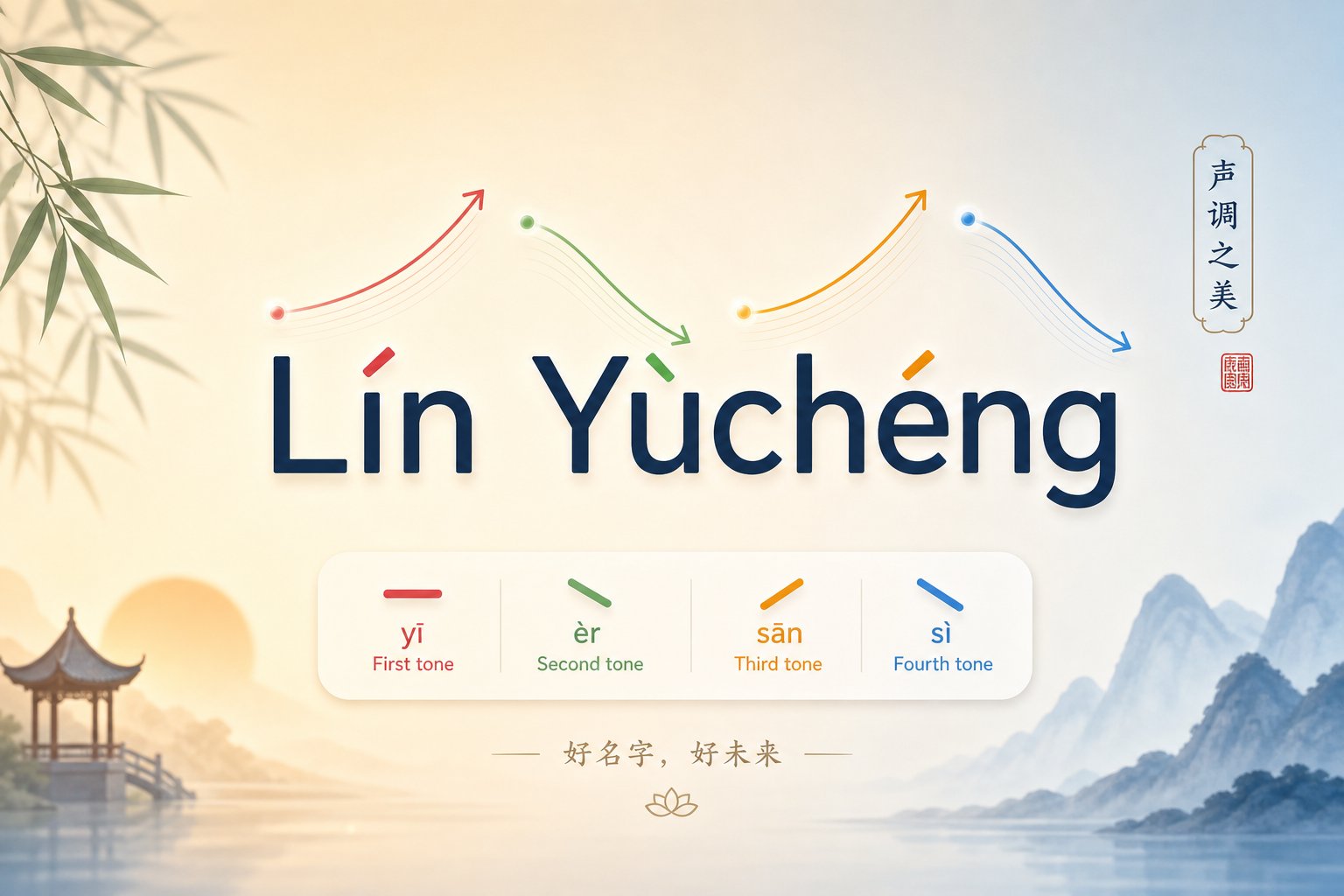
Those marks are pinyin tones, and they change everything. Pinyin is the standard romanization system for Mandarin Chinese, and the diacritical marks above its vowels indicate pitch contour: the direction your voice should move when pronouncing each syllable. A flat line (ā) means high and steady. A rising accent (á) means your pitch climbs. A dipping mark (ǎ) signals a low, falling-then-rising movement. A falling accent (à) means you start high and drop sharply.
What Pinyin Name Tones Are and Why They Matter
When you encounter a Chinese name written in pinyin, each syllable carries one of these four tonal markers, or occasionally no marker at all for a neutral tone. Together, they form the phonetic meaning of the name. This is not decoration. In Mandarin, tone is as fundamental to a word as the vowel itself. Changing the pitch pattern transforms one syllable into an entirely different word with a different meaning.
So what are the phonetics behind a name like Lǐ versus Lì? The first, with a third tone, is one of China's most common surnames. The second, with a fourth tone, is a popular given-name character meaning "beautiful" or "strength." Same letters, different intonation meaning, different identity.
In Mandarin Chinese, the same syllable pronounced with different tones becomes an entirely different word — and potentially a different name with a different meaning.
How Tones Change the Meaning of Chinese Names
In English, mispronouncing someone's name might feel awkward, but the person still recognizes it as theirs. In Mandarin, tone words function differently. Saying a name with the wrong pitch contour does not just sound off; it can reference a completely unrelated character. Pronouncing Wáng (king) as Wǎng (net) does not just mangle the sound. It points to a different word altogether.
This is why getting pinyin name tones right matters for respectful cross-cultural communication. Every explanation in this guide uses real Chinese name examples rather than generic vocabulary drills, so you can apply what you learn the next time you see a toned name on a business card or in an inbox.
The good news: Chinese names are short, typically just two or three syllables. That means you only need to handle two or three tones per name, and the system for reading them is surprisingly learnable once you know what each mark represents.
The Four Tones Explained Through Chinese Name Examples
Each mark above a vowel tells you exactly what your voice should do. Rather than drilling abstract syllables, you can learn all four Chinese tones through names you are likely to encounter in professional and academic settings. The han yu pin yin system assigns one of four pitch patterns, plus an occasional neutral tone, to every syllable in a name.
First Tone and Second Tone in Chinese Names
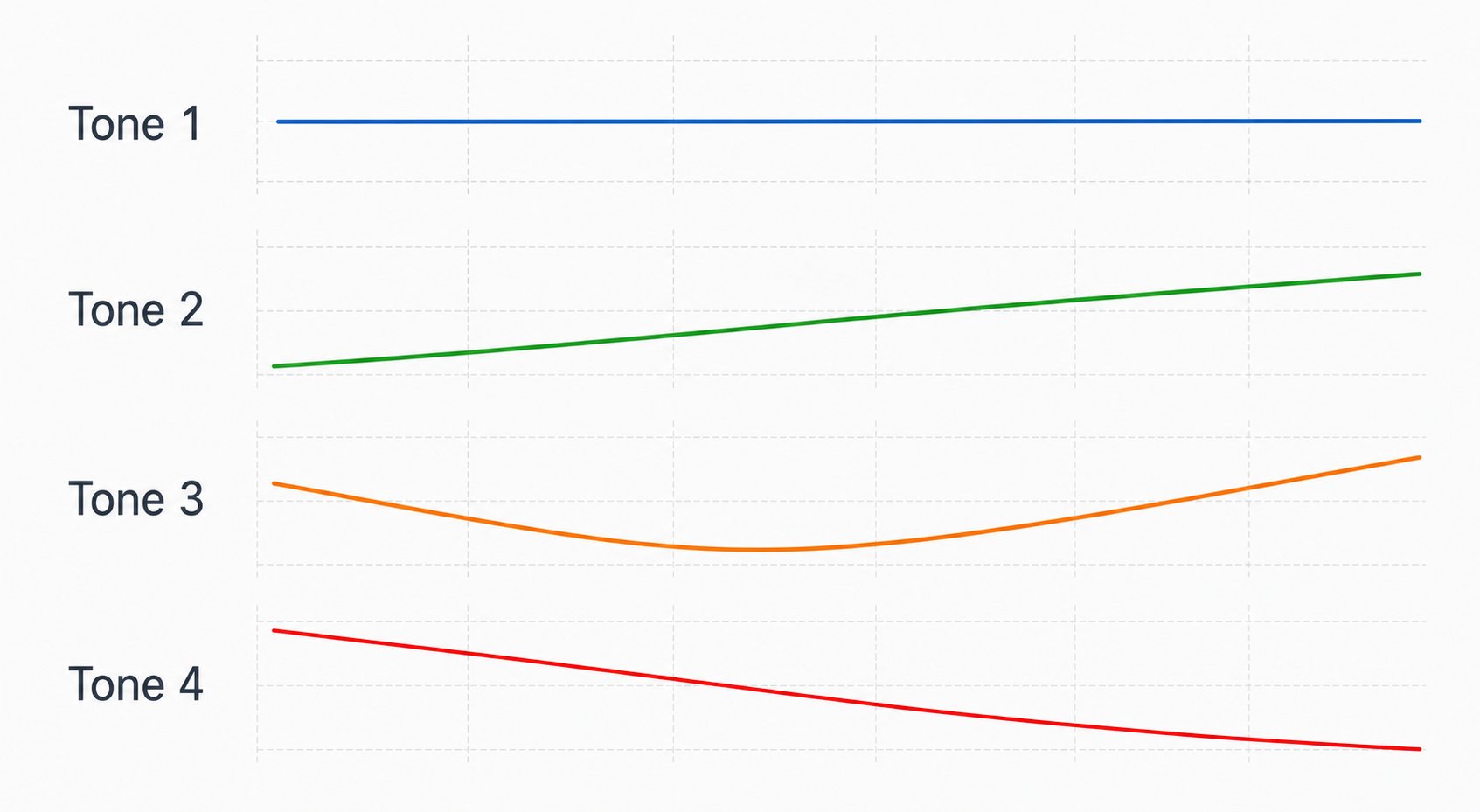
The first tone is high and level. Hold your pitch steady at the top of your comfortable range, as if sustaining a musical note. You will hear this in the surname Zhāng (张) and in given-name characters like Fēi (飞, meaning "fly"). The macron above the vowel, that flat horizontal line, is your visual cue to keep the pitch even from start to finish.
The second tone rises. Start at a middle pitch and let your voice climb upward, similar to the inflection English speakers use at the end of a question. The surname Wáng (王, meaning "king") is a perfect tone example: the acute accent above the a tells you to rise. Given-name characters like Míng (明, meaning "bright") follow the same upward contour. Because Mandarin Chinese has four main tones that differentiate meaning, getting this rising pitch right on Wáng prevents confusion with other characters spelled the same way.
Third Tone and Fourth Tone in Chinese Names
The third tone dips low before rising slightly. Your voice drops to the bottom of your range, then comes back up. The surname Lǐ (李, meaning "plum") carries this tone, as does the given-name character Yǔ (雨, meaning "rain"). The caron mark, a small v-shape above the vowel, signals this dipping motion. In natural speech, the rising tail is subtle, so focus on getting low.
The fourth tone falls sharply. Start slightly above your neutral pitch and drop quickly and decisively, like a firm command. The surname Zhào (赵) uses this tone, along with given-name characters like Lì (丽, meaning "beautiful"). The grave accent slanting downward is your reminder to let the pitch fall. If you have ever referred to a han yu pin yin chart, you will notice the fourth tone line drops steeply from upper left to lower right, mirroring what your voice should do.
The Neutral Tone in Name Pronunciation
Beyond the four main tones, Mandarin has a neutral tone: a short, unstressed syllable with no fixed pitch of its own. In names, it rarely appears in the surname or core given-name characters. You will encounter it in particles and suffixes attached to names in conversation, such as the possessive de (的) or the question particle ma (吗) when asking about someone. The neutral tone takes its pitch from the syllable before it, making it lighter and shorter than a fully toned syllable.
In pinyin transliteration, the neutral tone is indicated by the absence of any diacritical mark. If you see a syllable in a name with no mark above its vowel, it is either neutral or the tone marks were simply omitted from the text, a distinction the next sections of this guide will help you navigate.
The table below serves as a quick-reference pinyin chart, pairing each tone with real name examples you can practice immediately.
| Tone Number | Pitch Description | Tone Mark | Surname Example | Given Name Example |
|---|---|---|---|---|
| 1st Tone | High and level | ā (macron) | Zhāng (张) | Fēi (飞) |
| 2nd Tone | Rising from mid to high | á (acute accent) | Wáng (王) | Míng (明) |
| 3rd Tone | Dipping low, slight rise | ǎ (caron) | Lǐ (李) | Yǔ (雨) |
| 4th Tone | Falling sharply | à (grave accent) | Zhào (赵) | Lì (丽) |
| Neutral | Short, unstressed, pitch follows preceding tone | No mark | — | de (的), ma (吗) |
With these tone examples anchored to familiar surnames and given-name characters, you already have a framework for reading any toned pinyin name. The next step is recognizing which tones belong to the most common Chinese surnames, a surprisingly small set you can commit to memory.
Common Chinese Surnames and Their Correct Pinyin Tones
Chinese surnames form a surprisingly small, closed set. While given names draw from thousands of mandarin characters, only about 100 surnames cover the vast majority of China's population. That makes them the ideal starting point for anyone learning to read pinyin name tones: memorize the tones on a short list, and you will already know the correct pitch for the first syllable of most Chinese names you encounter.
Top Chinese Surnames and Their Correct Tones
The table below covers the 20 most common Chinese surnames ranked by population. Each entry pairs the chinese characters and pinyin together so you can see exactly which tone mark belongs to each name. The pronunciation guide offers an approximate English-language anchor for the consonant and vowel sounds, though remember that the tone itself has no English equivalent and must be produced separately.
| Surname (Character) | Pinyin with Tone Mark | Tone Number | Approximate Pronunciation |
|---|---|---|---|
| 王 | Wáng | 2nd (rising) | "wahng" with rising pitch |
| 李 | Lǐ | 3rd (dipping) | "lee" with a low dip |
| 张 | Zhāng | 1st (high level) | "jahng" held high and flat |
| 刘 | Liú | 2nd (rising) | "lyoh" with rising pitch |
| 陈 | Chén | 2nd (rising) | "chuhn" with rising pitch |
| 杨 | Yáng | 2nd (rising) | "yahng" with rising pitch |
| 黄 | Huáng | 2nd (rising) | "hwahng" with rising pitch |
| 赵 | Zhào | 4th (falling) | "jaow" with a sharp drop |
| 吴 | Wú | 2nd (rising) | "woo" with rising pitch |
| 周 | Zhōu | 1st (high level) | "joe" held high and flat |
| 徐 | Xú | 2nd (rising) | "shyu" with rising pitch |
| 孙 | Sūn | 1st (high level) | "swuhn" held high and flat |
| 马 | Mǎ | 3rd (dipping) | "mah" with a low dip |
| 朱 | Zhū | 1st (high level) | "joo" held high and flat |
| 胡 | Hú | 2nd (rising) | "hoo" with rising pitch |
| 郭 | Guō | 1st (high level) | "gwoh" held high and flat |
| 何 | Hé | 2nd (rising) | "huh" with rising pitch |
| 林 | Lín | 2nd (rising) | "lin" with rising pitch |
| 高 | Gāo | 1st (high level) | "gow" held high and flat |
| 罗 | Luó | 2nd (rising) | "lwoh" with rising pitch |
Beyond the top 20, you will also encounter surnames like Zōu (邹, 1st tone). If you have ever wondered about the zou meaning in a Chinese name context, it is a less common but well-established surname with chinese symbols and meanings tied to an ancient feudal state.
Tone Patterns Among Common Surnames
Scan the tone column in the table above and a clear pattern emerges. The second tone, that rising pitch, dominates Chinese family names. Among the top 20 surnames alone, 11 carry a second tone. Here are the key observations worth noting:
- Second tone (rising) accounts for over half of the top 20 surnames, including the single most common surname in China and the world: Wáng.
- First tone (high level) is the next most frequent, covering surnames like Zhāng, Zhōu, Sūn, Zhū, Guō, and Gāo.
- Third tone (dipping) appears in only two of the top 20: Lǐ and Mǎ.
- Fourth tone (falling) is the rarest among top surnames, with Zhào as the sole representative in the top 10.
- When in doubt about a surname's tone and you have no other information, a rising second tone is statistically the safest guess.
This distribution is practical knowledge. Because surnames are a finite, memorizable set rather than an open vocabulary, you can build reliable tonal accuracy for the first syllable of any common Chinese name with relatively little effort. Commit the top 10 to memory and you have covered hundreds of millions of people.
Surnames, however, are only one piece of the puzzle. A full Chinese name pairs that surname with a given name of one or two syllables, each carrying its own tone. Understanding how these tonal syllables combine across a complete name is where pronunciation starts to feel natural rather than mechanical.
How Chinese Names Are Structured and How Tones Distribute
A Chinese name is compact. Most are just two or three syllables long, and each syllable maps to exactly one character. If you can define syllable boundaries in a name, you already know how many tones you need to produce. So what is a syllable in this context? In mandarin chinese pinyin, every syllable represents a single character with its own fixed tone. There are no multi-syllable characters and no silent letters. One character, one syllable, one tone.
Surname Plus Given Name Structure
Chinese names follow a consistent order: surname first, given name second. The surname is almost always a single character (one syllable), while the given name is one or two characters (one or two syllables). This means a full Chinese name contains either two or three syllables in total.
Consider the basketball legend Yao Ming. His surname is 姚 (Yáo), one syllable with a second tone. His given name is 明 (Míng), one syllable also carrying a second tone. Two syllables, two tones, and you are done. The ming meaning here is "bright" or "brilliant," and knowing that single syllable's tone is all you need to say his given name correctly.
For a three-syllable name like Wáng Xiǎolì, the structure breaks down as: surname Wáng (one syllable, 2nd tone) plus given name Xiǎolì (two syllables, 3rd tone + 4th tone). Each syllable carries independent tonal information. Understanding the syllables meaning within a name helps you treat each one as its own small pronunciation task rather than trying to tackle the full name as a single unit.
Worked Examples of Full Name Tone Patterns
When you encounter a pinyin name with tone marks, here is a step-by-step process for breaking it into manageable pieces:
- Identify the surname. In pinyin, the surname is the first word (or the portion before a space). It is almost always one syllable.
- Identify the given name. Everything after the surname is the given name, which will be one or two syllables. Some pinyin styles write two-character given names as one joined word (Xiǎolì), while others separate them (Xiǎo Lì).
- Read the tone mark on each syllable individually. Look at the diacritical mark above the vowel in each syllable and recall its pitch pattern: macron for high-level, acute for rising, caron for dipping, grave for falling.
- Produce each tone in sequence. Say the name syllable by syllable at first, giving each tone its full shape. Speed will come naturally with practice.
Here are three full names broken down using this process:
| Full Name | Surname | Given Name | Tone Sequence | Pitch Pattern |
|---|---|---|---|---|
| Lǐ Míng | Lǐ (李) | Míng (明) | 3rd + 2nd | Dip low, then rise |
| Wáng Xiǎolì | Wáng (王) | Xiǎolì (小丽) | 2nd + 3rd + 4th | Rise, dip low, fall sharply |
| Zhāng Wěi | Zhāng (张) | Wěi (伟) | 1st + 3rd | Hold high, then dip low |
Notice how manageable this is. Even the longest common name structure, three syllables in syllable-by-syllable pronunciation, requires you to produce just three distinct pitch movements. A name like Zhāng Zhìmíng (张志明) breaks into 1st + 4th + 2nd: hold high, drop sharply, then rise. Three quick tonal gestures and you have said the full name.
The key insight is that Chinese names never ask you to sustain a tone across multiple syllables the way English stress patterns work. Each syllable resets. You get a fresh start with every character, which keeps the task contained and repeatable.
Of course, this syllable-by-syllable approach works perfectly in careful speech. In natural conversation, adjacent tones influence each other, and certain combinations trigger automatic pitch adjustments that native speakers make without thinking. These tone-pairing effects become especially noticeable in two-character given names where specific tone sequences sit side by side.
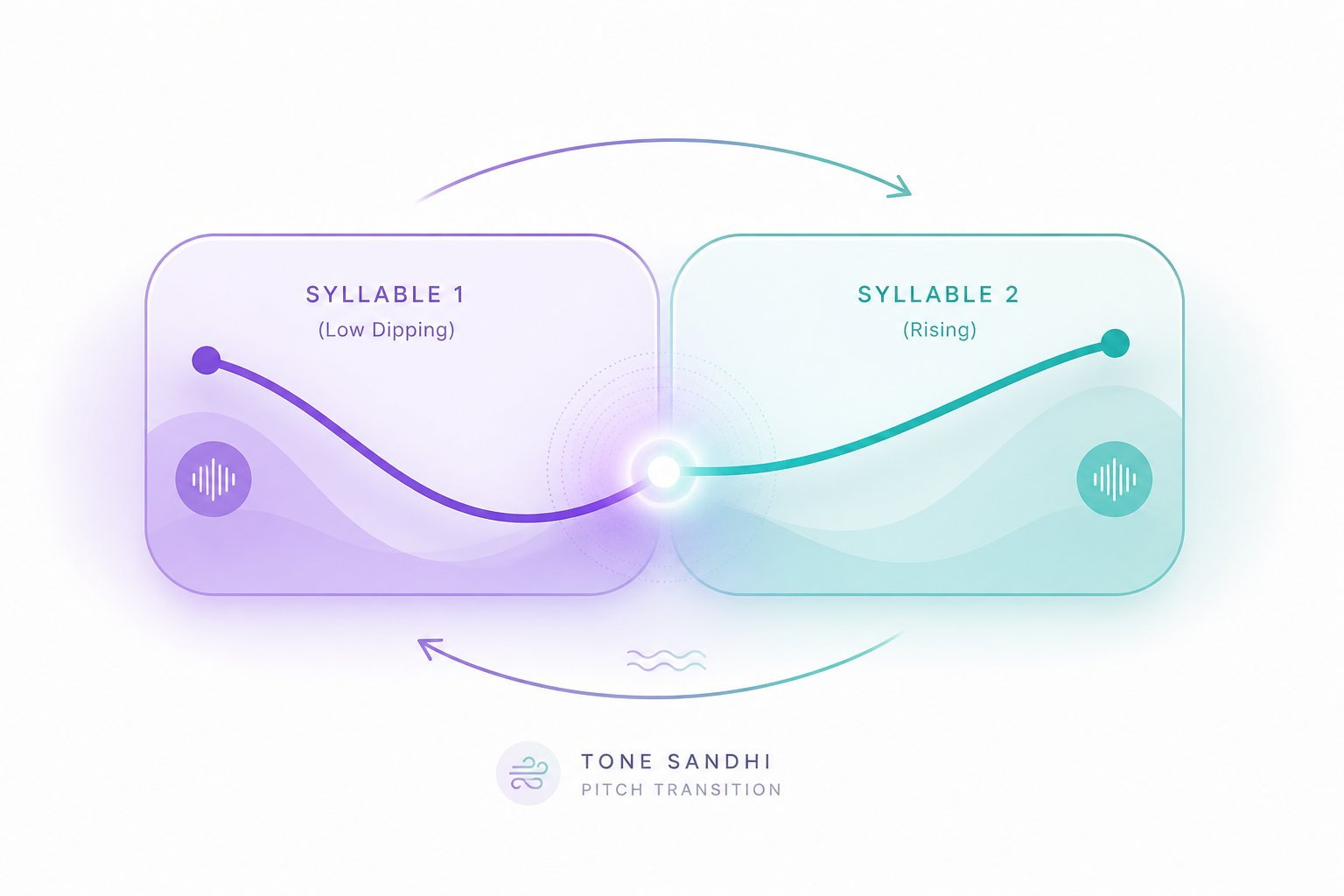
Tone Pairs and Tone Changes in Two-Character Given Names
Saying each syllable with its dictionary tone works fine in isolation. But when two tones sit next to each other in a name, they interact. Your voice does not reset completely between syllables in natural speech; it flows from one pitch contour into the next. This is where tone pairs come in, and where one critical rule quietly rewrites what you actually hear.
Third Tone Sandhi in Chinese Names
The most important tone change rule in Mandarin is called third tone sandhi. Here is how it works: when two third tones appear in sequence, the first one shifts to a second tone in spoken pronunciation. The written pinyin stays the same, but the sound changes.
Imagine you meet someone named Lǐ Yǔ (李雨). Both syllables carry a third tone on paper. But if you try to produce two consecutive dipping tones, your voice has to drop low, rise slightly, drop low again, and rise again. It feels unnatural and choppy. Native speakers resolve this automatically: they pronounce the first syllable with a rising pitch, making it sound like Lí Yǔ in connected speech. The tonal definition on paper remains 3rd + 3rd, but the spoken reality is 2nd + 3rd.
This is not optional or stylistic. It is a systematic rule that applies every time two third tones appear consecutively. Common examples beyond names include 你好 (nǐ hǎo, "hello"), which is actually pronounced ní hǎo, and 可以 (kě yǐ, "can"), pronounced ké yǐ.
For names specifically, this means:
- Lǐ Yǔ (李雨) sounds like Lí Yǔ
- Mǎ Yǐng (马颖) sounds like Má Yǐng
- Lǐ Měi (李美) sounds like Lí Měi
The written form never changes. You will still see the caron mark (ǎ) on both syllables in any chinese word pinyin dictionary or name reference. But when you say the name aloud, apply the sandhi rule and let that first syllable rise.
How Adjacent Tones Interact in Given Names
Beyond the third tone sandhi rule, every tone pair has its own characteristic feel. Think of it this way: a two-character given name creates one of 20 possible tone combinations (four tones times five options including neutral tone for the second syllable). Each combination produces a distinct melodic shape, and some flow more smoothly than others.
To define tone pairs practically, consider how your pitch moves across two syllables. A 1+4 pair (high-level followed by sharp fall) creates a dramatic drop. A 2+1 pair (rising followed by high-level) lifts your voice and holds it there. A 4+2 pair (falling then rising) creates a valley shape. These intonations are not just linguistic mechanics; they influence how a name sounds and feels when spoken aloud.
Chinese parents often consider tonal harmony when selecting given names. A name where the tones create a pleasing melodic contour is preferred over one that feels monotonous or jarring. For instance, repeating the same tone across all syllables (like 1+1+1) can sound flat, while a mix of rising and falling tones gives the name rhythmic variety. The tonal flow of a name is one of the four dimensions traditional Chinese naming considers, alongside visual form, meaning, and elemental balance.
Tone Combinations That Commonly Appear in Names
The table below shows the most frequently encountered tone pair combinations in two-character given names, along with a real name example for each. Use it as a reference for practicing how adjacent tones connect in natural speech.
| Tone Pair | Pitch Movement | Name Example | Pronunciation Note |
|---|---|---|---|
| 1 + 2 | High-level then rising | Fēimíng (飞明) | Hold high, then let pitch climb |
| 1 + 4 | High-level then falling | Tiānlì (天丽) | Hold high, then drop sharply |
| 2 + 4 | Rising then falling | Míngzhì (明志) | Climb up, then fall decisively |
| 2 + 1 | Rising then high-level | Chéngfēng (成峰) | Rise into a sustained high pitch |
| 3 + 3 | Dipping then dipping (spoken as 2+3) | Yǔměi (雨美) | First syllable rises; second dips low |
| 3 + 4 | Dipping then falling | Hǎijùn (海俊) | Dip low, then start high and fall |
| 4 + 2 | Falling then rising | Zhìmíng (志明) | Drop sharply, then climb back up |
| 4 + 4 | Falling then falling | Jìnglì (敬丽) | Two decisive drops in sequence |
| 1 + 3 | High-level then dipping | Jūnyǔ (军宇) | Hold high, then drop to a low dip |
| 2 + 3 | Rising then dipping | Chéngwěi (成伟) | Climb up, then settle into a low dip |
A few patterns are worth highlighting. Pairs that alternate between high and low pitch movements (like 1+3, 2+4, or 4+2) tend to sound dynamic and are very common in given names. The 3+3 pair is notable because, thanks to sandhi, it sounds identical to a 2+3 pair in actual speech. This means there are really only 19 acoustically distinct tone combinations in practice, even though 20 exist on paper.
Pairs like 4+4 (two consecutive falling tones) create a strong, assertive sound. Names with this pattern, such as Jìnglì or Shùnlì, often carry connotations of decisiveness. Meanwhile, a 2+1 pair like Chéngfēng lifts the voice upward and holds it, producing an open, optimistic feel. These are not rigid rules, but they reflect the intonation patterns that native speakers intuitively associate with certain qualities.
For learners, the practical takeaway is this: practice names in tone pairs rather than syllable by syllable. Once you internalize how a 2+4 pair feels in your mouth, every name with that combination becomes easier. You are building muscle memory for melodic shapes, not memorizing individual names one at a time.
Tone pairs and sandhi rules govern how names sound in flowing speech. But what happens when you encounter a name in writing, on a business card or in an email signature, and need to decode those diacritical marks visually before you ever open your mouth? That is a different skill, and it starts with recognizing what each mark looks like in the real-world contexts where pinyin names actually appear.
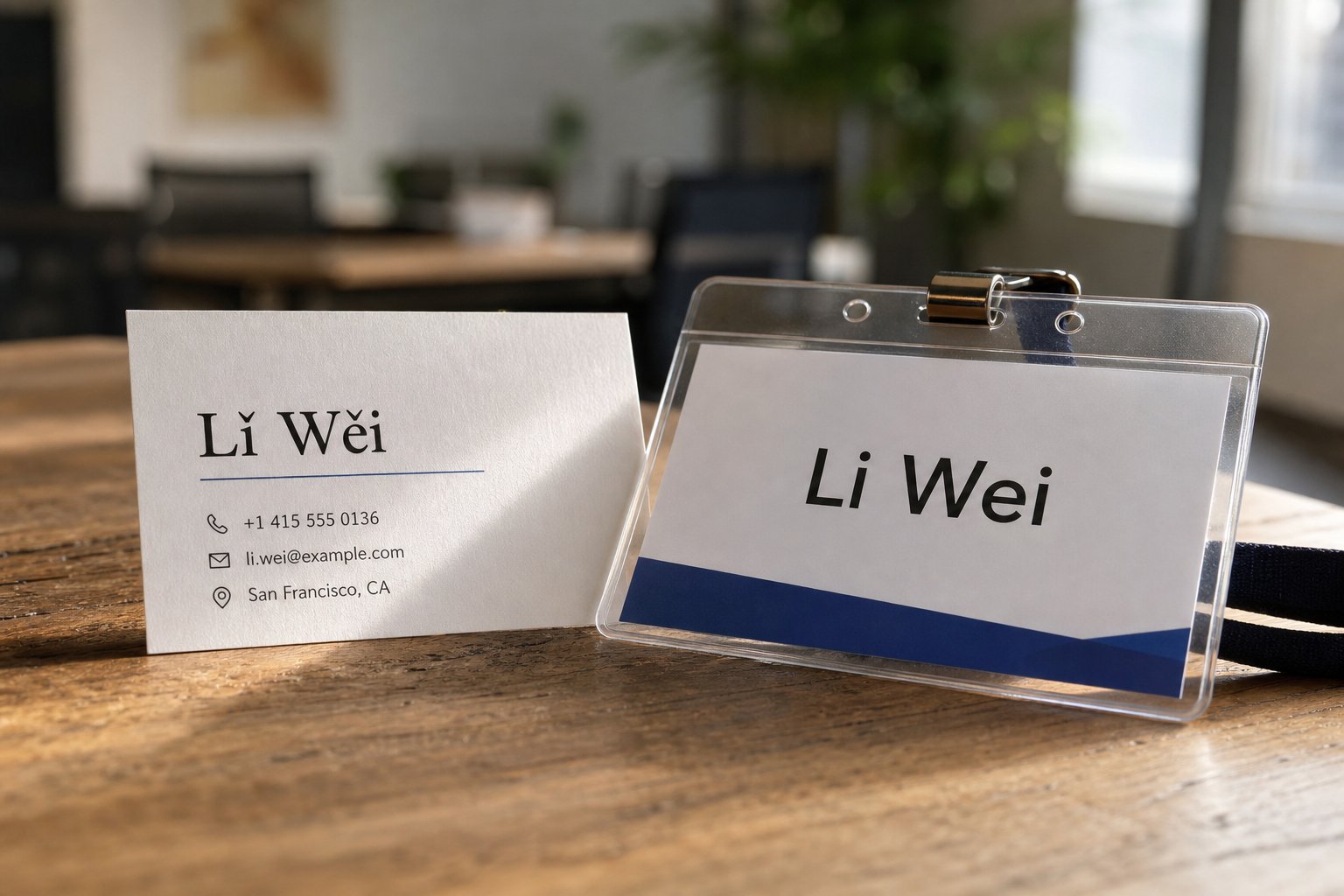
Reading Tone Marks on Names in Real-World Contexts
You know what each tone sounds like. You understand how they pair up in given names. But in daily life, pinyin name tones do not always arrive in a neat textbook format. Sometimes you see full diacritical marks on an academic paper. Other times you get a bare, unadorned romanization on a passport or email signature. Knowing how to read both situations is what separates theoretical knowledge from practical confidence.
Recognizing Tone Marks on Pinyin Names
When tone marks are present, they appear as small symbols sitting directly above the main vowel of each syllable. You will encounter them in academic publications, language-learning materials, formal name cards from mainland China, and some digital profiles where the author has taken care to include them. Here is what each diacritical mark looks like and what it tells you:
| Tone | Mark Name | Symbol | Visual Description | Name Example |
|---|---|---|---|---|
| 1st | Macron | ā | A flat horizontal line above the vowel | Zhāng (张) |
| 2nd | Acute accent | á | A short line rising from lower-left to upper-right | Wáng (王) |
| 3rd | Caron | ǎ | A small v-shape (or inverted hat) above the vowel | Lǐ (李) |
| 4th | Grave accent | à | A short line falling from upper-left to lower-right | Zhào (赵) |
| Neutral | None | a | No mark at all | de (的) |
Think of these marks as tiny pitch diagrams. The macron is flat because your voice stays flat. The acute accent rises because your voice rises. The caron dips like a valley because your voice dips. The grave accent falls because your voice falls. Once you internalize this visual logic, you can read the phonetic spelling of any toned pinyin name at a glance, even if you have never seen that particular name before.
A useful trick: if you are unsure whether a mark is an acute accent (2nd tone) or a grave accent (4th tone), look at which direction it slants. Rising from left to right means rising pitch. Falling from left to right means falling pitch. The mark literally mirrors the voice movement, functioning like a miniature alphabet chart for pitch direction.
Why Many Pinyin Names Appear Without Tone Marks
Here is the reality that catches many people off guard: most pinyin names you encounter in professional settings carry no tone marks at all. Your colleague's email signature says "Wang Li," not "Wáng Lì." The conference badge reads "Zhang Wei," not "Zhāng Wěi." Passports, airline tickets, university enrollment records, LinkedIn profiles, and most digital platforms strip the diacritics entirely.
Why? Several reasons converge:
- International travel documents follow ICAO (International Civil Aviation Organization) standards, which require names in unaccented Latin letters in phonetics for universal machine readability.
- Many software systems, databases, and email clients cannot reliably store or display characters beyond basic ASCII. Mapping characters with diacritics to plain text is the path of least resistance for IT systems worldwide.
- Standard English keyboards do not produce tone marks without special input methods, so most people default to unmarked pinyin in everyday digital communication.
- Cultural convention plays a role too. In English-speaking environments, Chinese professionals often present their names without marks because they know most readers would not recognize them anyway.
The result is that you cannot rely on tone marks being present. The ability to spell phonetic details from context, or to look them up when needed, becomes an essential skill rather than a nice-to-have.
How to Determine Tones When Marks Are Missing
When you see an unmarked pinyin name and want to pronounce it correctly, you have several strategies available. None of them require you to be a Mandarin speaker. They just require a bit of initiative and the willingness to treat someone's name as worth getting right.
- Ask the person directly. This is the simplest and most respectful approach. A question like "I want to make sure I say your name correctly, could you help me with the tones?" signals genuine interest. Most people appreciate the effort.
- Check if the person has published a toned version elsewhere. Academic authors sometimes include toned pinyin in their publication bios. Personal websites, faculty pages, or social media profiles occasionally show the full diacritical spelling.
- Look up the Chinese characters. If you have access to the person's name in characters (from a bilingual business card, a WeChat profile, or a co-authored paper with Chinese text), you can use a character-to-pinyin converter to get the tones instantly. This is the most reliable method because it removes all ambiguity.
- Use surname frequency as a guide. If you only have the romanized surname, recall the common surnames table from earlier in this article. Surnames are a closed set, so "Wang" is almost certainly Wáng (2nd tone), "Li" is almost certainly Lǐ (3rd tone), and "Zhang" is almost certainly Zhāng (1st tone).
- Search for the name in context. A quick search for the person's name alongside their institution or field may surface a version with tone marks or characters, especially in academic or journalistic contexts.
- Learn the most common character for ambiguous given-name syllables. Some given-name syllables have one overwhelmingly common character. "Wei" in a male name is very often Wěi (伟, 3rd tone, meaning "great"). "Li" in a female given name is frequently Lì (丽, 4th tone, meaning "beautiful"). These statistical defaults are not guarantees, but they improve your odds.
The key mindset shift is this: an unmarked pinyin name is not a name without tones. The tones still exist; they are just not written down in that particular context. Every Chinese character has a fixed, unchanging tone. The information is always recoverable if you know where to look.
With the ability to both read visible tone marks and track down missing ones, you are equipped to handle pinyin names in any format they appear. The next question becomes more active: how do you efficiently look up the correct tones for a specific name when you need them, and which tools make that process fast and reliable?
How to Look Up the Correct Tones for Any Chinese Name
You have a name in front of you. Maybe it is on a conference program, maybe in a journal citation, maybe in a Slack message from a new team member. You want to say it right, but the tone marks are missing and you are not sure which pitch pattern belongs to each syllable. Where do you start?
The answer depends on what information you already have. If you can see the Chinese characters, the lookup is fast and definitive. If you only have the bare romanization, it takes a bit more detective work. Either way, the process is straightforward once you know which tools to reach for.
Using Pinyin Converters and Dictionaries
The fastest path from characters to pinyin with full tone marks runs through a character-to-pinyin converter. These tools accept Chinese characters as input and return the complete toned romanization instantly. You paste in 王小丽 and get back Wáng Xiǎolì. No guesswork, no ambiguity.
Here is a step-by-step lookup process when you have access to the characters:
- Copy the Chinese characters from wherever you found them: a bilingual business card, a WeChat profile, an academic paper's author list in the original language, or a company directory.
- Paste the characters into a chinese to pinyin converter. Platforms like ArchChinese and Yabla Chinese both offer reliable character-to-pinyin tools with tone marks displayed clearly.
- Read the output. The converter will show each character matched to its pinyin syllable with the correct diacritical mark above the vowel.
- Note any characters with multiple possible readings. A small number of Chinese characters are polyphonic, meaning they can be pronounced with different tones depending on context. In names, the reading is fixed by the person themselves, so if the converter flags multiple options, you may need to confirm with the person which reading applies.
These converters essentially perform a chinese to mandarin pinyin translation at the character level. Each character maps to exactly one pinyin syllable with one tone, so the output is deterministic for the vast majority of names. Think of it as a pinyin translator that works character by character rather than translating meaning.
For dictionary-style lookups, you can also search individual syllables. If you know the character 明 appears in someone's given name, entering it into any standard Chinese dictionary returns míng (2nd tone) along with its definition. This approach works well when you want to understand both the tone and the meaning behind a name character.
Looking Up Tones From Characters vs. From Romanization
What if you do not have the characters at all? This is the trickier scenario. You see "Chen Wei" on a name badge and have no way to know which of several possible characters each syllable represents. The romanization alone does not tell you the tone because multiple characters share the same base pinyin spelling.
Consider "Wei" as a given name. It could be:
- Wěi (伟) — 3rd tone, meaning "great" (very common in male names)
- Wēi (薇) — 1st tone, meaning "fern" or "rose" (common in female names)
- Wèi (卫) — 4th tone, meaning "guard" or "protect"
- Wéi (维) — 2nd tone, meaning "maintain" or "dimension"
Four different tones, four different characters, four different meanings. Going from pinyin to chinese characters without additional context is inherently ambiguous. This is why the characters-first approach is always more reliable.
When characters are unavailable, try these strategies in order:
- Search for the person's name on their institutional page or publication profile. Academic websites, faculty directories, and research databases sometimes display names in characters alongside the romanization. A quick search often surfaces what you need.
- Check if the person uses toned pinyin anywhere online. Some professionals include the full toned spelling on personal websites, CVs, or social media bios. A pinyin to english name guide on their own page is the most authoritative source after asking directly.
- Use statistical likelihood. For surnames, the common surnames table gives you near-certainty. For given names, certain syllable-tone combinations are far more frequent than others. "Ming" in a name is almost always Míng (2nd tone, 明). "Li" as a female given name is most often Lì (4th tone, 丽). These defaults are not guarantees, but they are strong starting points.
- Ask the person. This remains the gold standard. A simple, respectful question works well: "I'd like to pronounce your name correctly. Could you tell me the tones, or show me the characters?" Most people respond warmly to this kind of genuine interest. It signals respect rather than ignorance.
The key distinction to remember: converting chinese characters to pinyin is a one-to-one process with a definitive answer. Going the other direction, from bare romanization to tones, is a one-to-many problem that requires additional context to resolve. Whenever possible, find the characters first.
Recommended resource types for tone lookups include:
- Character-to-pinyin converters (paste characters, get toned pinyin)
- Pinyin dictionaries with audio, such as those on Yabla Chinese and ArchChinese
- University pronunciation guides with audio recordings, like the ASU SILC Chinese name pronunciation page
- Mobile dictionary apps that allow handwriting or camera input for character recognition
- Pinyin to english lookup tools that show all possible characters for a given syllable, helping you narrow down which one matches the name in question
With these tools and strategies, you can resolve the tones for virtually any Chinese name you encounter, whether it arrives with full diacritical marks, bare romanization, or original characters. The lookup itself takes seconds once you know where to go. The harder question for many people is the reverse: how do you correctly write your own Chinese name in pinyin with proper tone marks and placement? That requires understanding a different set of rules entirely.
Writing Your Own Name in Pinyin and Pronouncing Others
Knowing how to look up tones is one thing. Knowing where to physically place the mark when you write your own name in pinyin is another. And building the confidence to actually say someone else's name aloud with correct tones? That takes a bit of guided practice. This section tackles both directions of the challenge.
Adding Correct Tone Marks to Your Own Name
If you have a Chinese name and want to produce the phonetic spelling of your name with proper diacritical marks, you need two pieces of information: the tone number for each character (which you can find using the lookup methods from the previous section) and the rule for where the mark goes within each syllable.
The first step is practical: how do you actually type pinyin with tone marks? Standard English keyboards do not produce these characters natively. You will need either a chinese input method that supports toned pinyin output, a dedicated pinyin input tool, or a character map utility built into your operating system. On most systems, you can type pinyin diacritics by switching to a hanyu pinyin input mode or by using Unicode character shortcuts. Some people use online phonetic spelling generators that accept tone numbers (like "wang2") and convert them to proper diacritical output (Wáng). Either approach works; the goal is simply to get the correct mark above the correct vowel.
Once you can type pinyin on a chinese pinyin keyboard layout or input tool, the question becomes: which vowel in the syllable receives the tone mark? This is where the placement rules come in.
Tone Mark Placement Rules for Pinyin
The pinyin alphabet has a clear hierarchy for tone mark placement. You never need to guess. The rules from the official Hanyu Pinyin system boil down to three guidelines that cover every possible syllable:
- If the syllable contains an a or an e, the tone mark always goes there. No Mandarin syllable in pinyin contains both a and e, so there is never a conflict between them.
- In the combination ou, the o takes the mark.
- In all other vowel combinations, the tone mark goes on the last vowel.
If the syllable contains an a or e, the tone mark goes there. Otherwise, it goes on the last vowel.
Here is how this plays out with real name syllables. In the surname Huáng, the mark goes on the a because a always wins, even though u appears first. In the given name Ruì, there is no a or e, and the vowel combination is ui, so the mark goes on the last vowel: i. In Zhōu, the combination is ou, so the o takes the mark per rule two. In Liú, the combination is iu, no a or e is present, and it is not ou, so the mark goes on the final vowel: u.
These three rules handle every syllable in the entire pinyin system. Once you internalize them, you can confidently write any Chinese name with correct mark placement, whether you are filling out a form, updating your email signature, or adding toned pinyin to a publication bio.
Practicing with Well-Known Chinese Names
Reading rules is useful. Hearing yourself say names correctly is what builds real confidence. A strong practice framework anchors new tonal patterns to names you already recognize from media, sports, or public life. When you can connect a tone pattern to a familiar person, the pitch movement sticks in memory.
Try these well-known names as pronunciation anchors:
| Person | Pinyin with Tones | Tone Pattern | Practice Focus |
|---|---|---|---|
| Yao Ming (basketball) | Yáo Míng | 2nd + 2nd | Two consecutive rising tones |
| Xi Jinping (politics) | Xí Jìnpíng | 2nd + 4th + 2nd | Rise, fall, rise pattern |
| Liu Cixin (author) | Liú Cíxīn | 2nd + 2nd + 1st | Rising pair into a high hold |
| Zhang Ziyi (film) | Zhāng Zǐyí | 1st + 3rd + 2nd | High hold, dip, then rise |
| Deng Xiaoping (politics) | Dèng Xiǎopíng | 4th + 3rd + 2nd | Sharp fall, low dip, then climb |
Start by saying each name slowly, giving every syllable its full tonal shape. Then speed up gradually until the name flows as a single unit. You will notice that some combinations feel natural quickly (Yáo Míng's double rise is smooth and easy) while others take more repetition (the 4th + 3rd + 2nd pattern in Dèng Xiǎopíng requires your voice to cover a wide range).
The goal is not perfection on day one. It is building a library of tonal shapes in your muscle memory. Each name you practice adds another pattern to your repertoire. After working through even five or six well-known names, you will find that new names with similar tone sequences feel immediately familiar rather than foreign.
With tone mark placement rules in hand and a set of practiced reference names in your ear, the final piece is putting everything together into a repeatable routine that builds lasting confidence with pinyin name tones over time.

Putting It All Together for Confident Name Pronunciation
You now have every piece of the process: recognizing tone marks on sight, understanding what each pitch contour sounds like, breaking a full name into its tonal components, applying sandhi rules in connected speech, and looking up tones when marks are missing. What remains is turning that knowledge into a repeatable habit that builds real confidence over time.
The complete lifecycle looks like this: you see a Chinese name, you identify the tone mark on each syllable (or look up the tones if marks are absent), you recall the pitch movement each mark represents, and you produce the pronunciation of each syllable in sequence. That is the entire skill. Everything in this guide feeds into those four steps.
Your Pinyin Name Tones Practice Routine
Consistency matters more than volume. A focused ten-minute routine practiced regularly will build more durable muscle memory than an occasional hour-long study session. Here is a structured sequence you can follow:
- Start with the common surnames table. Pick five surnames and say each one aloud with its correct tone. Wáng (rising), Lǐ (dipping), Zhāng (high and level), Liú (rising), Zhào (falling). Cycle through them until the pitch feels automatic rather than deliberate.
- Move to full names with tone pairs. Choose two or three complete names from the worked examples earlier in this article and practice them as connected units. Focus on the transition between syllables: how does your voice move from the surname tone into the given-name tone?
- Apply tone sandhi. Find or construct a name with two consecutive third tones, like Lǐ Yǔ, and practice producing it with the natural sandhi adjustment (first syllable rises). This trains your ear and voice to handle the most common tone change rule without overthinking it.
- Use audio references. Listen to native speaker recordings of Chinese names and mimic what you hear. Platforms like Yabla Chinese provide pinyin charts with audio for every syllable and tone combination, giving you a reliable model to match your own pronunciation against.
- Test yourself with unmarked names. Take a name you encounter in daily life without tone marks, look up the correct tones using the strategies from this guide, and then say the name aloud with full tonal accuracy. This closes the loop between recognition and production.
Building Confidence With Tonal Pronunciation
The progression from hesitant to confident happens faster than most people expect. Surnames are a closed set you can memorize in a week. Tone pairs number only 20 combinations, and practicing even a handful covers the patterns you will encounter most often. A mandarin chinese translator tool can help you verify characters and tones when you are unsure, but the real skill lives in your voice and your ear.
What makes this effort worthwhile goes beyond linguistic accuracy. Pronouncing a person's name correctly is a sign of respect and cultural understanding. Chinese names carry carefully chosen meanings, family heritage, and parental aspirations within their characters. When you take the time to learn the correct tones, you are acknowledging all of that. You are saying, in effect, that this person's identity is worth your attention.
You do not need to become fluent in Mandarin. You do not need a mandarin chinese translator at your side for every interaction. You just need to treat the two or three tones in a colleague's name as something learnable and worth learning. That small investment pays dividends in trust, rapport, and mutual respect every time you say their name correctly.
A name is the first word someone ever owns. Pronouncing it correctly, tones and all, tells them you see who they actually are.
Frequently Asked Questions About Pinyin Name Tones
1. What are the four tones in pinyin and how do they affect Chinese names?
Mandarin Chinese has four main tones plus a neutral tone. The first tone is high and level (marked with a macron, e.g., Zhāng). The second tone rises from mid to high pitch (acute accent, e.g., Wáng). The third tone dips low then rises slightly (caron, e.g., Lǐ). The fourth tone falls sharply from high to low (grave accent, e.g., Zhào). Each tone changes the meaning of a syllable entirely, so pronouncing a name with the wrong tone can reference a completely different character and identity.
2. Why do most Chinese names written in pinyin not have tone marks?
Most pinyin names in professional settings lack tone marks due to several converging factors. International passport standards (ICAO) require unaccented Latin letters for machine readability. Many software systems and databases cannot reliably store or display diacritical characters. Standard English keyboards lack native tone mark input. Additionally, Chinese professionals in English-speaking environments often omit marks knowing most readers would not recognize them. The tones still exist for every character; they simply are not written in these contexts.
3. How do I find the correct tones for a Chinese name without tone marks?
You have several reliable strategies. The most definitive method is finding the Chinese characters and using a character-to-pinyin converter like ArchChinese or Yabla Chinese. You can also ask the person directly, check their academic or professional profiles for toned versions, use the common surnames table as a statistical guide, or search for the name alongside their institution to find a version with characters or diacritics. For surnames specifically, memorizing the top 20 covers the majority of names you will encounter.
4. What is third tone sandhi and how does it change name pronunciation?
Third tone sandhi is an automatic pronunciation rule in Mandarin: when two third tones appear consecutively, the first syllable shifts to a second (rising) tone in spoken speech. For example, the name Lǐ Yǔ (both 3rd tone) is actually pronounced like Lí Yǔ in natural conversation. The written pinyin remains unchanged with both caron marks, but the spoken reality adjusts the first syllable upward. This rule applies universally and is not optional, making it essential knowledge for anyone pronouncing Chinese names with consecutive third tones.
5. Where does the tone mark go when writing a pinyin name?
Pinyin has three clear placement rules that cover every syllable. First, if the syllable contains an 'a' or 'e,' the mark always goes on that vowel (e.g., Huáng places the mark on 'a'). Second, in the combination 'ou,' the mark goes on the 'o' (e.g., Zhōu). Third, for all other vowel combinations, the mark goes on the last vowel (e.g., Liú places the mark on 'u,' and Ruì places it on 'i'). No Mandarin syllable contains both 'a' and 'e,' so there is never a conflict between the first two rules.