Why Your Pinyin Dictionary Misleads You About Name Pronunciation
Imagine you meet a colleague named 李小美. You look up the pinyin: Li Xiao Mei. You see the tone marks clearly: Lǐ Xiǎo Měi. Three third tones in a row. You practice saying each syllable with a careful dipping contour, confident you have it right. Then a native Mandarin speaker calls her name across the room, and it sounds nothing like what you rehearsed. The tones you hear do not match the tones you read.
This is not a problem with your ears. It is a problem with how pinyin represents pronunciation. The chinese tone marks written above each vowel show what linguists call the citation form, the tone a syllable carries when spoken in isolation. In connected speech, tones interact with their neighbors and change. This phenomenon is called tone sandhi, and it is one of the most common sources of confusion for Mandarin learners who rely on dictionaries alone.
Why Chinese Names Sound Different Than Their Pinyin Suggests
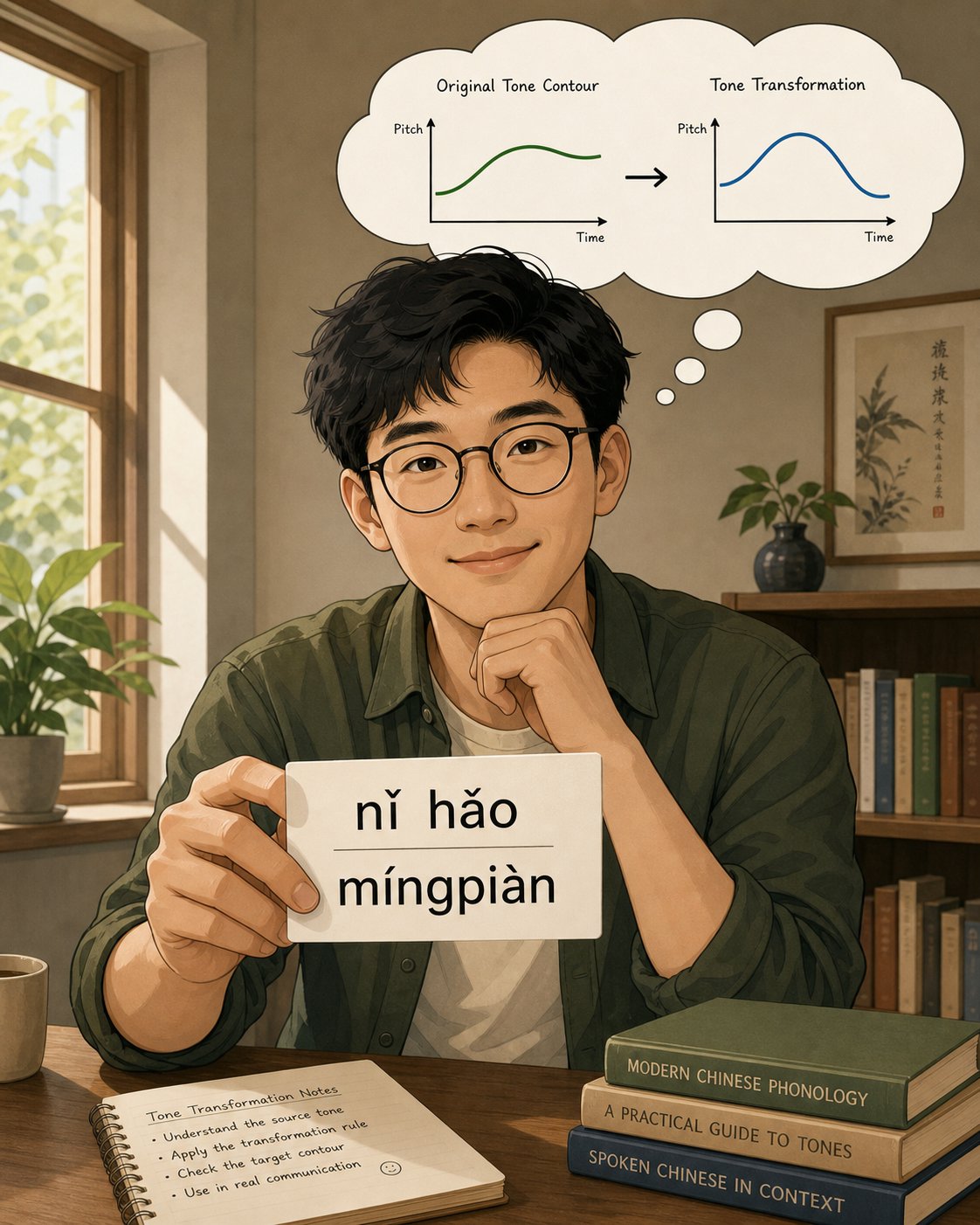
Tone sandhi applies across all of Mandarin, from everyday vocabulary to formal speech. When you say 你好 (nǐ hǎo), the first syllable shifts from a third tone to a second tone because two consecutive third tones trigger an automatic change. Most learners eventually pick up this rule for common words. But names catch people off guard because they combine unfamiliar syllables in fixed sequences, and learners have no memorized "correct sound" to fall back on.
Chinese tones in names follow the same sandhi rules as regular vocabulary, yet the application feels less intuitive. You cannot rearrange the syllables or swap in a synonym. The name is what it is, and the mandarin tones pinyin displays will always reflect underlying forms rather than spoken reality.
Names as Fixed Tone Sandhi Units
Here is what makes personal names a special case worth studying on their own: their syllable grouping is predetermined. A Chinese name has a fixed structure, typically one-syllable surname plus one or two-syllable given name. This structure creates predictable prosodic units, small rhythmic groups where sandhi rules apply in consistent, rule-governed ways.
Chinese names are fixed prosodic units. Once you know the underlying tones and the surname-given name boundary, tone sandhi becomes entirely predictable.
Unlike a sentence where phrasing can shift depending on emphasis or speech rate, a name always groups the same way. The surname 李 (Lǐ) always precedes the given name 小美 (Xiǎo Měi). That boundary never moves. This means you can learn a small set of rules and apply them reliably to any name you encounter in pinyin, bridging the gap between what chinese tone marks show on paper and what actually reaches your listener's ear.
The challenge, then, is not memorizing hundreds of name pronunciations. It is understanding how tone sandhi operates within these fixed structures so you can decode any name on sight. That starts with a clear picture of how Mandarin's four tones behave in isolation versus in sequence.
Mandarin Tones and Why They Change in Connected Speech
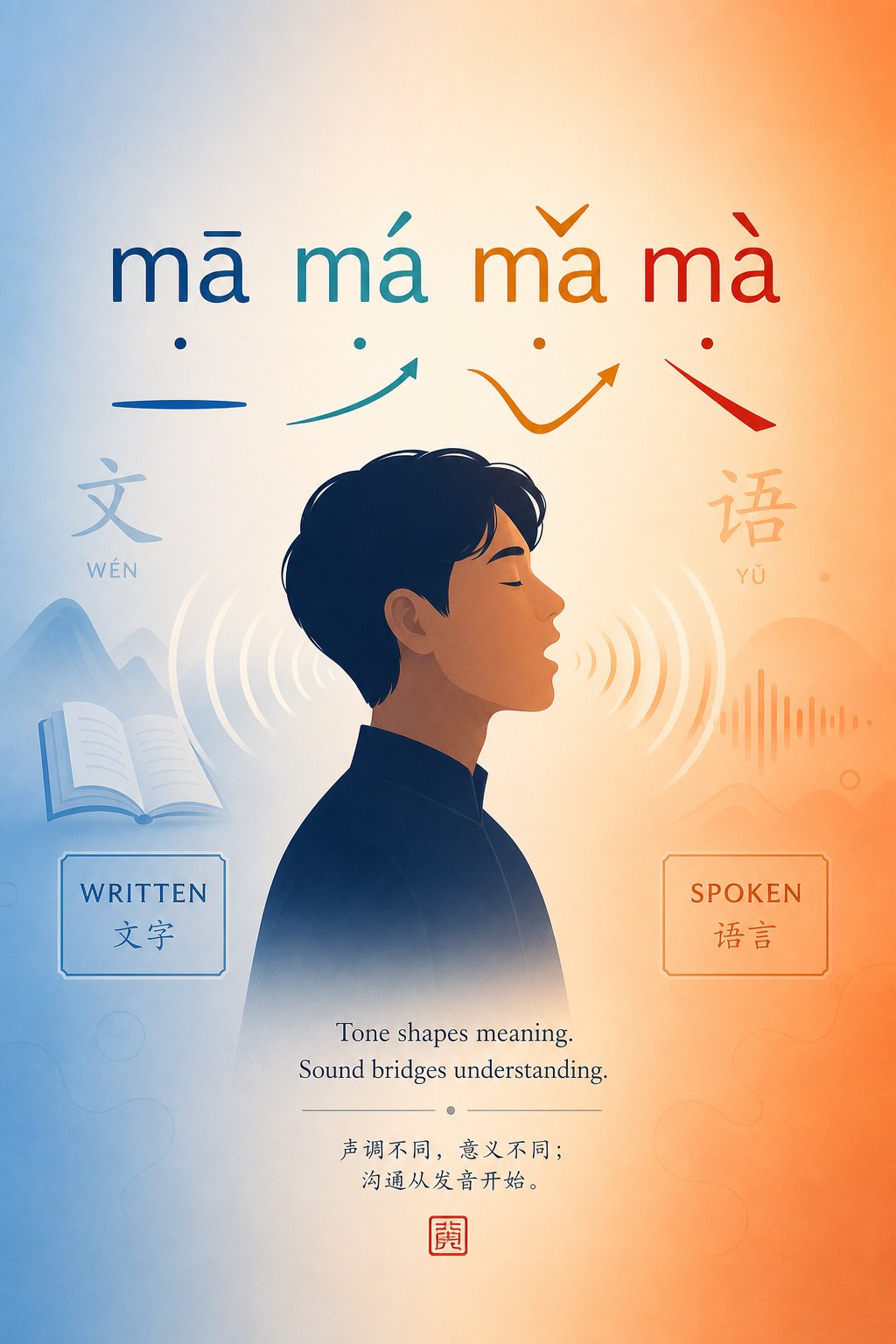
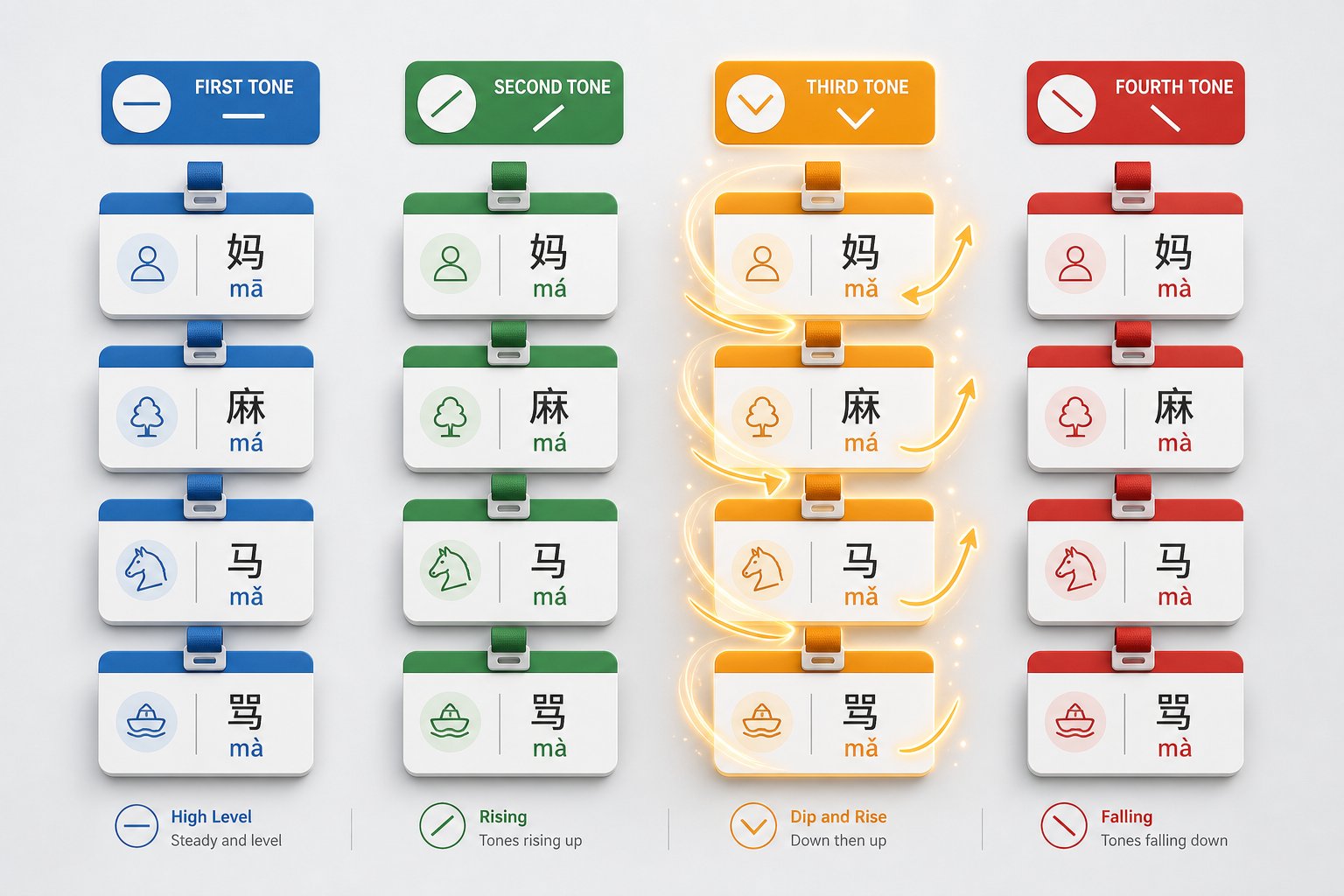
Before you can predict how a name actually sounds, you need a solid grasp of what each tone does on its own. Mandarin tones are not decorative. They are contrastive units that distinguish one word from another the way vowels do in English. Change the tone on a syllable and you change the word entirely: mā (mother), má (hemp), mǎ (horse), mà (scold). Same consonant, same vowel, four completely different meanings.
The Four Tones in Mandarin Chinese
The four tones in chinese each follow a distinct pitch contour. Linguists describe these contours on a scale from 1 (lowest) to 5 (highest). Here is a quick mandarin tone chart for reference:
| Tone | Name | Pitch Contour | Description | Example |
|---|---|---|---|---|
| 1st | High Level | 55 | Stays high and flat, like holding a sustained note | 妈 (mā) - mother |
| 2nd | Rising | 35 | Rises from mid to high, like a surprised "hm?" | 麻 (má) - hemp |
| 3rd | Low / Dipping | 214 | Dips to the lowest point, then rises slightly | 马 (mǎ) - horse |
| 4th | Falling | 51 | Falls sharply from high to low, like a firm command | 骂 (mà) - to scold |
A fifth option, the neutral tone, appears in unstressed syllables like grammatical particles. It has no fixed pitch of its own and borrows its contour from the preceding syllable. You will encounter it in certain name suffixes, but the tones of mandarin that drive sandhi behavior are these four contour tones.
Citation Form vs Connected Speech
Here is the critical distinction most learners miss. The mandarin tones you see marked in pinyin represent citation forms, the way a syllable sounds when spoken alone or listed in a dictionary. In real connected speech, tones interact with their neighbors. A third tone followed by another third tone does not stay a third tone. A third tone before a first, second, or fourth tone loses its final rise and becomes a short low dip.
When you look up a name like 李小美 (Lǐ Xiǎo Měi), the pinyin faithfully records each syllable's underlying tone. But nobody pronounces three full dipping contours in a row. The tones in chinese shift automatically based on what comes next, and native speakers do this without thinking. They are not being sloppy or fast. They are following systematic phonological rules that apply every single time a particular tone sequence occurs.
This gap between what pinyin shows and what speakers produce is exactly where learners get tripped up with names. The written form tells you the starting ingredients. The sandhi rules tell you what actually comes out of the speaker's mouth.

Essential Tone Sandhi Rules Applied to Names
Knowing that tones change in connected speech is one thing. Knowing exactly when and how they change is what lets you pronounce a name correctly on the first try. Mandarin has a small set of obligatory sandhi tone rules that apply every time their trigger conditions are met, no exceptions, no optional variation. When you apply these rules to personal names, the results are completely predictable because the syllable structure never changes.
The Third Tone Sandhi Rule
The third tone in chinese is the most sandhi-active tone in the language. Its most famous rule is straightforward: when two third tones appear in sequence, the first one is pronounced as a second tone (rising). The underlying tone does not change in writing, but the spoken output shifts entirely.
- Trigger: Third tone immediately followed by another third tone
- Result: The first third tone is pronounced as a rising tone (second tone)
- Example in vocabulary: 你好 (nǐ hǎo) is pronounced as ní hǎo
- Example in a name: 马伟 (Mǎ Wěi) is pronounced as Má Wěi
This rule is not optional. It is not a matter of speaking quickly or casually. Every native speaker applies it automatically, whether reading a name aloud from a list or calling someone across a crowded room. The chinese third tone simply cannot maintain its full dipping contour when another 3rd tone follows immediately after.
When three or more third tones appear consecutively, the situation gets more complex. The key principle is grouping: you break the sequence into meaningful units and apply the rule within each group. In regular vocabulary, a phrase like 我想买 (wǒ xiǎng mǎi) typically groups as 我 + 想买, producing wǒ xiáng mǎi. The grouping determines which syllables undergo the change.
The Half-Third Tone in Context
The second major rule involves what happens to a third tone before any non-third tone, meaning before a first, second, or fourth tone syllable. In these environments, the third tone loses its characteristic final rise and becomes what phonologists call a half-third tone: a low dip that stays low without bouncing back up.
- Trigger: Third tone followed by a first, second, or fourth tone (or most neutral tone syllables)
- Result: The third tone is realized as a low tone only, no final rise
- Example in vocabulary: 老师 (lǎo shī) - the lǎo is pronounced as a short low dip, not a full fall-and-rise
- Example in a name: 李明 (Lǐ Míng) - the Lǐ becomes a brief low tone before the rising Míng
This tone variation is so pervasive that some linguists, including Olle Linge at Hacking Chinese, argue the third tone should be taught as an essentially low tone from the start. The full dipping contour (falling then rising) only surfaces in isolation or occasionally at the end of an utterance. In connected speech, the half-third is what you hear the vast majority of the time. This is a form of pronunciation assimilation driven by the phonological environment, not by speaker choice.
For names, this means any third-tone surname followed by a non-third-tone given name will always surface as a half-third. 李明 (Lǐ Míng), 马超 (Mǎ Chāo), 吕强 (Lǚ Qiáng) - in every case, the surname stays low without rising.
Yi and Bu Sandhi: A Brief Overview
Two additional sandhi rules apply to the characters 一 (yī, "one") and 不 (bù, "not"). While less central to most personal names, they matter when these characters appear in given names or compound names:
- 一 (yī) before a fourth tone: Pronounced as second tone (yí). Example: 一定 (yīdìng) becomes yídìng
- 一 (yī) before first, second, or third tones: Pronounced as fourth tone (yì). Example: 一天 (yītiān) becomes yìtiān
- 不 (bù) before a fourth tone: Pronounced as second tone (bú). Example: 不对 (bùduì) becomes búduì
- 不 (bù) before first, second, or third tones: Retains its fourth tone. Example: 不好 (bùhǎo) stays bùhǎo
Names containing 一, such as 一凡 (Yīfán) or 一鸣 (Yīmíng), will trigger these rules in speech. The character 不 appears less frequently in given names but shows up in some literary or courtesy names.
How Name Structure Determines Sandhi Boundaries
In everyday vocabulary, sandhi boundaries can shift depending on phrasing, emphasis, or speech rate. A four-syllable phrase might group as 2+2 in one context and 1+3 in another, producing different sandhi outcomes. This flexibility is what makes general tone sandhi feel unpredictable to learners.
Names eliminate that ambiguity. The surname-given name boundary is fixed. A three-character name like 李小美 always groups as 李 | 小美 (one-syllable surname + two-syllable given name). A two-character name like 马伟 always functions as a single two-syllable unit. These boundaries do not shift with speech rate or emphasis.
This fixed structure means sandhi in names is entirely rule-governed with no room for changing tone patterns based on context. Once you identify the surname, the given name, and each syllable's underlying tone, you can apply the rules mechanically and arrive at the correct pronunciation every time. The same sandhi tone rules that feel slippery in general conversation become completely deterministic when applied to the rigid architecture of a Chinese name.
The real question, then, is whether sandhi operates across the surname-given name boundary or only within each unit. That boundary behavior turns out to be the key factor that determines how an entire name sounds in natural speech.
Where Tone Sandhi Starts and Stops in a Full Name
You know the rules. Third tone before third tone becomes second tone. Third tone before anything else becomes a half-third. But here is the question that trips up even advanced learners: does sandhi care about the boundary between surname and given name, or does it treat the whole name as one continuous string of syllables?
This is not a trivial distinction. If sandhi applies across the surname-given name boundary, a name like 马伟 (Mǎ Wěi) undergoes the third-tone rule and the surname shifts to a rising tone. If sandhi respects that boundary and treats each part independently, the surname stays as a low dip. The answer depends on how many syllables the name contains and how those syllables group into prosodic units in standard Chinese phonology.
Sandhi Across the Surname-Given Name Boundary
In Mandarin Chinese phonology, tone sandhi does not operate on individual words or characters in isolation. It operates on prosodic domains, rhythmic groupings that speakers naturally form during connected speech. The critical factor is not whether two syllables belong to the same "word" in a grammatical sense, but whether they fall within the same prosodic unit during production.
For names, the prosodic grouping depends on syllable count:
- Two-syllable names (one-syllable surname + one-syllable given name): The entire name forms a single prosodic unit. Sandhi applies freely across the surname-given name boundary.
- Three-syllable names (one-syllable surname + two-syllable given name): The surname typically separates into its own prosodic unit, and the two-syllable given name forms a second unit. Sandhi applies primarily within the given name, not across the boundary.
- Four-syllable names (two-syllable surname + two-syllable given name): Each pair forms its own prosodic unit. Sandhi applies within each pair independently.
This grouping pattern mirrors how Mandarin phonology handles disyllabic and trisyllabic sequences more broadly. Research on tone sandhi acquisition confirms that even young children apply sandhi productively to disyllabic units, while trisyllabic prosodic structures remain challenging well into age five. The prosodic boundary in three-syllable names is real and phonologically active.
Two-Syllable Names as Single Prosodic Units
Consider a name like 马伟 (Mǎ Wěi). Two syllables, both third tone. Because the name is only two syllables long, speakers naturally compress it into one prosodic foot. There is no internal boundary strong enough to block sandhi. The result is automatic: Mǎ + Wěi becomes Má Wěi in speech, with the surname surfacing as a full rising tone.
This applies regardless of the tone combination. A two-character name behaves identically to a two-syllable compound word in mandarin chinese phonology. The surname and given name fuse into a single rhythmic unit, and whatever sandhi rules the tone sequence triggers will apply across the boundary without hesitation.
Other two-syllable name examples:
- 李强 (Lǐ Qiáng): Third tone before second tone. The surname Lǐ becomes a half-third (low dip, no rise).
- 王伟 (Wáng Wěi): First tone before third tone. No sandhi triggered; both tones surface as written.
- 吕杰 (Lǚ Jié): Third tone before second tone. The surname becomes a half-third.
In each case, the phonology of mandarin treats the two syllables as a single domain. The surname-given name boundary is grammatically real but prosodically invisible.
In two-syllable Chinese names, the surname-given name boundary does not block tone sandhi. The entire name functions as one prosodic unit, and sandhi rules apply across the boundary exactly as they would within any disyllabic word.
Three-syllable names behave differently. When you say 李小美 (Lǐ Xiǎo Měi), the natural grouping is Lǐ | Xiǎo Měi. The surname stands alone as a half-third tone (low, no rise, because it precedes a third-tone syllable in the next unit). Within the given name, the standard third-tone sandhi fires: Xiǎo Měi becomes Xiáo Měi. The surname does not participate in the given name's sandhi chain because it sits in a separate prosodic domain.
Fast or casual speech can blur this boundary slightly. A speaker rushing through a three-syllable name may compress all three syllables into a tighter unit, allowing some sandhi interaction between the surname and the first syllable of the given name. But in careful, standard pronunciation, the 1+2 grouping holds firm. This is the pattern you should target as a learner, and it is the pattern native speakers default to in clear speech contexts like introductions, roll calls, and formal address.
Understanding this boundary behavior is what transforms sandhi from an abstract rule into a practical pronunciation tool. You do not need to guess whether the surname participates in the given name's tone changes. You just need to count syllables and identify the grouping. From there, the specific tone patterns within each unit determine exactly what sandhi produces, which is where concrete examples of two-character and three-character names make the process tangible.

Two-Character vs Three-Character Name Pronunciation Patterns
Rules are useful, but nothing beats walking through real names syllable by syllable. The difference between a two-character and three-character name is not just length. It changes which sandhi rules fire, where boundaries fall, and what the final spoken output sounds like. Let's break both patterns down with concrete examples so you can apply the same logic to any name you encounter.
Two-Character Name Sandhi Patterns
A two-character name like 王伟 (Wang Wei) forms a single prosodic unit. Both syllables sit inside one rhythmic group, so sandhi applies across the surname-given name boundary without restriction. The question is simply: what are the two tones, and do they trigger a rule?
Take 王伟 (Wang Wei). The citation tones are first tone (Wang) plus third tone (Wei). A first tone followed by a third tone does not trigger the third-tone sandhi rule because the rule only fires when two third tones meet. So Wang stays high and flat. But what about Wei? It sits at the end of the name, either before silence or before the next word in a sentence. When a third tone appears before a pause, it can surface as a full dipping contour (fall then rise). When the name continues into a sentence, the following syllable's tone determines whether Wei becomes a half-third or triggers another sandhi change.
Compare that with 马伟 (Ma Wei). Here both syllables carry a third tone: Ma (tone 3) + Wei (tone 3). Two consecutive third tones in a single prosodic unit means the first one shifts to a 2nd tone. The spoken result is Ma Wei, where Ma sounds like a rising tone. The pinyin still writes Ma Wei with third-tone marks, but what you actually hear is a rising tone followed by a dipping tone.
This pattern holds for every two-character name. The chinese 4 tones create 16 possible tone-pair combinations (4 x 4), and only one combination triggers the third-tone sandhi rule: tone 3 + tone 3. All other combinations involving a third-tone surname simply produce a half-third on that surname, while non-third-tone surnames remain unchanged.
Three-Character Name Sandhi Patterns
Three-character names introduce a prosodic boundary that changes everything. The natural grouping is 1+2: one-syllable surname as its own unit, two-syllable given name as a second unit. Sandhi applies within each unit independently.
Consider 李小美 (Li Xiao Mei). The citation tones are all third: Li (tone 3) + Xiao (tone 3) + Mei (tone 3). Three third tones in a row. How does this resolve?
Step by step:
- Group the syllables: Li | Xiao Mei (surname separate from given name)
- Process the given name first: Xiao + Mei are both third tone within the same prosodic unit. The 3+3 rule fires: Xiao becomes a rising tone (2nd tone). Result: Xiao Mei is pronounced as Xiao (rising) + Mei (dipping).
- Process the surname: Li stands alone before the given name unit. It precedes Xiao, which is now realized as a rising tone. A third tone before a non-third tone becomes a half-third (low dip, no rise). Result: Li is pronounced as a short low tone.
The final spoken output: Li (half-third) + Xiao (rising) + Mei (full third). Compare that to the citation form Li Xiao Mei, where all three syllables carry identical dipping marks. The actual pronunciation is dramatically different from what the pinyin suggests.
This grouping principle aligns with how native speakers handle multiple consecutive third tones in general. In practice, strings of third tones are broken into groups, and the last syllable in each group retains its third tone while preceding syllables shift. For names, the surname-given name boundary provides the natural break point every time.
What about a three-character name where only the given name has consecutive third tones? Take 张小雨 (Zhang Xiao Yu). Zhang is first tone, Xiao is third tone, Yu is third tone. The grouping is Zhang | Xiao Yu. Within the given name, Xiao + Yu triggers 3+3 sandhi: Xiao becomes rising. Zhang, already a first tone, stays unchanged. Simple.
Step-by-Step Decision Process for Any Name
You can apply this same logic to any Chinese name you encounter, regardless of which of the 4 tones in chinese each syllable carries. Here is the process:
- Step 1: Identify the surname and given name. Determine the syllable count (2 or 3 characters).
- Step 2: Assign prosodic grouping. Two-character names form one unit. Three-character names group as 1+2.
- Step 3: Check for third-tone sequences within each prosodic unit. Apply 3+3 sandhi (first third tone becomes 2nd tone) wherever two third tones are adjacent inside the same unit.
- Step 4: Apply the half-third rule to any remaining third tone that precedes a non-third tone within its unit or at a boundary.
- Step 5: Leave first, second, and fourth tones unchanged (they do not undergo sandhi in these environments).
The following table puts this decision process into action across several common name patterns, showing how the 4 tones of chinese interact in real names:
| Name | Citation Tones | Prosodic Grouping | Sandhi Rule Applied | Actual Pronunciation |
|---|---|---|---|---|
| 马伟 (Ma Wei) | 3 + 3 | [Ma Wei] (single unit) | 3+3 → 2+3 | Ma (rising) + Wei (dipping) |
| 王伟 (Wang Wei) | 1 + 3 | [Wang Wei] (single unit) | None triggered | Wang (high) + Wei (full third at pause) |
| 李强 (Li Qiang) | 3 + 2 | [Li Qiang] (single unit) | Half-third on Li | Li (low dip) + Qiang (rising) |
| 李小美 (Li Xiao Mei) | 3 + 3 + 3 | [Li] + [Xiao Mei] | 3+3 in given name; half-third on surname | Li (low dip) + Xiao (rising) + Mei (dipping) |
| 张小雨 (Zhang Xiao Yu) | 1 + 3 + 3 | [Zhang] + [Xiao Yu] | 3+3 in given name; no change on surname | Zhang (high) + Xiao (rising) + Yu (dipping) |
| 赵美丽 (Zhao Mei Li) | 4 + 3 + 4 | [Zhao] + [Mei Li] | Half-third on Mei before Li (tone 4) | Zhao (falling) + Mei (low dip) + Li (falling) |
| 马小龙 (Ma Xiao Long) | 3 + 3 + 2 | [Ma] + [Xiao Long] | Half-third on Xiao before Long; half-third on Ma | Ma (low dip) + Xiao (low dip) + Long (rising) |
Notice the pattern in the table. The chinese tones 1-4 only undergo sandhi when specific trigger conditions are met, and those conditions depend entirely on what tone comes next within the same prosodic unit. First, second, and fourth tones pass through unchanged. Third tones are the active players, shifting to either a rising tone or a half-third depending on their neighbor.
Once you internalize this five-step process, you will not need to memorize individual name pronunciations. You will be able to decode any name on sight, converting pinyin citation forms into accurate spoken forms in seconds. The system is mechanical and reliable, which is exactly what makes names easier to handle than free-form sentences where grouping boundaries can shift.
Of course, some surnames are far more sandhi-active than others. Third-tone surnames like 李, 马, and 吕 participate in sandhi every single time they appear, while first-tone and fourth-tone surnames pass through the system untouched. Knowing which common surnames carry which tones gives you a head start before you even look at the given name.
Common Chinese Surnames and Their Tone Sandhi Behavior
Not all surnames behave equally when sandhi rules kick in. A first-tone surname like 王 (Wáng) sails through every given-name combination without changing at all. A third-tone surname like 李 (Lǐ) shifts its pronunciation every single time it appears before another syllable. Knowing which tone your surname carries tells you immediately whether sandhi will affect it, and how dramatically.
The top 100 Chinese surnames cover the vast majority of people you will encounter. Sorting them by tone reveals a clear pattern across the chinese four tones: third-tone surnames are the most phonologically active, while first-tone and 4th tone surnames remain stable regardless of context.
Common Surnames Sorted by Tone
Here is how some of the most frequently encountered surnames distribute across the 4 tones chinese uses:
| Tone | Common Surnames | Sandhi Behavior |
|---|---|---|
| 1st (High Level) | 王 Wáng, 张 Zhāng, 周 Zhōu, 孙 Sūn, 高 Gāo, 林 Lín, 郭 Guō | Never changes. Stays high and flat before any given-name tone. |
| 2nd (Rising) | 陈 Chén, 黄 Huáng, 杨 Yáng, 刘 Liú, 吴 Wú, 胡 Hú, 罗 Luó | Never changes. The chinese second tone remains rising in all environments. |
| 3rd (Low/Dipping) | 李 Lǐ, 马 Mǎ, 吕 Lǚ, 许 Xǔ, 沈 Shěn, 董 Dǒng, 蒋 Jiǎng | Always changes. Becomes rising (tone 2) before another third tone, or half-third before tones 1, 2, and 4. |
| 4th (Falling) | 赵 Zhào, 谢 Xiè, 宋 Sòng, 郑 Zhèng, 魏 Wèi, 贺 Hè, 万 Wàn | Never changes. The falling contour stays intact before any following tone. |
The takeaway is immediate. If you see a second tone chinese surname like 陈 or 黄, you can skip the sandhi analysis for that syllable entirely. Same for first-tone and 4th tone surnames. They pass through unchanged. Your attention should focus on the given name that follows.
Surname Tone Interactions With Given Names
Third-tone surnames deserve closer attention because they react to every possible following tone. Here is what happens when a surname like 李 (Lǐ) or 马 (Mǎ) meets each of the four given-name tone categories:
| Surname (Tone 3) | Given Name Tone | Example | Surname Realization |
|---|---|---|---|
| 李 Lǐ | 1st tone | 李飞 Lǐ Fēi | Half-third (low dip, no rise) |
| 马 Mǎ | 2nd tone | 马龙 Mǎ Lóng | Half-third (low dip, no rise) |
| 李 Lǐ | 3rd tone | 李伟 Lǐ Wěi | Rising tone (sounds like tone 2) |
| 马 Mǎ | 4th tone | 马亮 Mǎ Liàng | Half-third (low dip, no rise) |
Notice the asymmetry. Three out of four combinations produce a half-third. Only one combination, third tone before third tone, triggers the full shift to a rising contour. Yet that single combination is remarkably common because third-tone characters are frequent in given names (伟 Wěi, 美 Měi, 海 Hǎi, 小 Xiǎo).
Surnames in the first, second, and fourth tone categories behave identically to each other in one important respect: they never change. 王明 (Wáng Míng), 陈明 (Chén Míng), and 赵明 (Zhào Míng) all keep their surname tones intact. The only variable is what happens inside the given name itself, which follows the same internal sandhi rules regardless of what surname precedes it.
This means your mental workload drops significantly once you recognize the surname's tone. For the majority of Chinese names you encounter, the surname will carry a first, second, or fourth tone and require zero sandhi adjustment. It is only the third-tone surnames, led by 李 (the single most common surname in China), that demand active processing every time they appear.
Knowing these surname-tone categories gives you a fast filter. But surnames are only half the picture. Given names introduce their own complications, particularly when they contain characters like 一 (yī), neutral-tone suffixes, or sequences that interact with less common sandhi rules.
Special Sandhi Cases for Yi, Neutral Tones, and Place Names
The third-tone sandhi rule handles the majority of changing tone situations in personal names. But certain characters carry their own special tone rules that override the standard system. When these characters appear in given names or place names, they introduce a layer of complexity that pinyin tone marks alone cannot communicate. Three cases deserve specific attention: the character 一 (yī), neutral-tone suffixes like 子 (zi), and the character 不 (bù) in literary or compound names.
Yi Sandhi in Given Names
The character 一 (yī, meaning "one") is popular in Chinese given names. Names like 一凡 (Yīfán), 一鸣 (Yīmíng), and 一帆 (Yīfān) all use it. In isolation or when functioning purely as a numeral, 一 keeps its first tone. But in compound words and names, it follows its own special tone change rules that differ from standard third-tone sandhi.
Here is how 一 behaves when it appears in a given name:
- 一 before a fourth-tone syllable: Pronounced as second tone (yí). Example: 一世 (Yīshì) becomes Yíshì in speech. The name 一诺 (Yīnuò) is pronounced Yínuò.
- 一 before a first, second, or third-tone syllable: Pronounced as fourth tone (yì). Example: 一飞 (Yīfēi) becomes Yìfēi. The name 一鸣 (Yīmíng) is pronounced Yìmíng. The name 一品 (Yīpǐn) becomes Yìpǐn.
- 一 at the end of a name or in isolation: Retains its original first tone. Example: in a name like 唯一 (Wéiyī) used as a given name, the 一 stays as yī.
This changing tone pattern means a name written with identical pinyin tone marks on 一 will sound different depending on what follows it. The pinyin always writes yī regardless of context, so learners who rely only on tone marks in chinese pinyin will mispronounce these names consistently. You need to check what tone the next syllable carries and apply the yi sandhi rule before speaking.
Neutral Tone Suffixes in Names
Some Chinese names, particularly informal or childhood nicknames, include suffixes that carry a neutral tone. The most common is 子 (zi) when used as a diminutive or name-forming suffix. In these cases, the suffix loses its underlying third tone entirely and becomes light and unstressed.
- 子 (zi) as a name suffix: Pronounced with neutral tone, its pitch determined by the preceding syllable. Example: a nickname like 小子 (Xiǎozi) has zi floating at a higher pitch after the low third tone. In a name like 燕子 (Yànzi), the zi drops low after the falling fourth tone.
- 头 (tou) in place-name suffixes: Loses its second tone and becomes neutral. Example: 桥头 (Qiáotou) as a place name has tou unstressed and lower than the preceding rising tone.
- Reduplicated nicknames: Names like 明明 (Míngming) or 丽丽 (Lìli) often reduce the second syllable to a neutral tone in casual speech. The repeated character loses its full tonal contour and becomes lighter and shorter.
The key principle with neutral-tone suffixes is that the preceding syllable's tone determines the pitch height of the unstressed syllable. As Hacking Chinese explains, the neutral tone generally falls lower than the preceding tone, except after a third tone, where it rises slightly. This means the same suffix sounds different depending on what name character precedes it, even though pinyin tone marks show no tone on the neutral syllable at all.
Bu Sandhi in Compound and Courtesy Names
The character 不 (bù, "not") appears less frequently in modern given names, but it shows up in literary names, courtesy names (字 zì), and some traditional compound names. Its sandhi rule mirrors the pattern of 一 but in a simpler form:
- 不 before a fourth-tone syllable: Pronounced as second tone (bú). Example: a courtesy name like 不惧 (Bùjù, "fearless") is pronounced Bújù.
- 不 before first, second, or third-tone syllables: Retains its fourth tone. Example: 不凡 (Bùfán, "extraordinary") stays Bùfán.
While you will encounter 不 in names less often than 一, the rule is worth knowing because it applies automatically in connected speech whenever the character appears, regardless of whether the context is a name, a phrase, or a sentence.
Tone Sandhi in Place Names and Geographic Nouns
Place names in pinyin follow the same sandhi principles as personal names, but their syllable structures can be longer and their prosodic groupings less obvious. A two-syllable city name like 武汉 (Wǔhàn) behaves like a two-character personal name: the third tone before a fourth tone becomes a half-third, producing a low dip on Wǔ without a final rise.
Longer geographic names require you to identify internal grouping boundaries, just as you would with a three-character personal name:
- 海口 (Hǎikǒu): Two third tones in a single prosodic unit. The first shifts to rising: Háikǒu.
- 五台山 (Wǔtái Shān): Groups as 五台 + 山. Within the first unit, Wǔ before tái (second tone) becomes a half-third. Shān stands alone.
- 景德镇 (Jǐngdé Zhèn): Groups as 景德 + 镇. Jǐng before dé (second tone) becomes a half-third. Zhèn is independent.
The same logic applies to street names, province names, and any geographic proper noun written in pinyin. Identify the prosodic units, check for third-tone sequences or special characters like 一 within each unit, and apply the rules mechanically. The pinyin tone marks on a map or sign always show citation forms, never the sandhi output you actually need to produce.
These special cases round out the full picture of how tones shift in proper nouns. The core third-tone rule handles most situations, yi and bu sandhi cover their respective characters, and neutral-tone awareness helps with informal names and suffixes. What remains is the practical question: how do you take all of this knowledge and apply it fluently when you encounter a name in the real world, whether on a page or in conversation?
Practical Tips for Pronouncing Chinese Names Correctly
Understanding the rules is one thing. Using them in real time, when you are reading a name off a business card, hearing it spoken in a meeting, or introducing someone mid-sentence, is where the knowledge actually pays off. The gap between theory and fluent application closes faster when you practice in the specific scenarios where names actually appear in daily life.
Reading Pinyin Names vs Hearing Them Spoken
When you see a name written in pinyin with its tone marks, you are looking at underlying tones, not a pronunciation guide. Imagine you receive an email from someone named 许小伟 (Xu Xiao Wei). The pinyin reads Xǔ Xiǎo Wěi, three third tones. If you try to produce three consecutive dipping contours, you will sound unnatural and possibly confuse a native listener who expects the sandhi output.
Instead, run the decision process before you speak:
- Group the name: Xǔ | Xiǎo Wěi (1+2 structure)
- Process the given name: Xiǎo + Wěi triggers 3+3 sandhi. Xiǎo becomes rising.
- Process the surname: Xǔ precedes a now-rising syllable. It becomes a half-third.
- Spoken result: Xǔ (low dip) + Xiáo (rising) + Wěi (full dipping at pause)
The reverse scenario is equally important. When you hear a native speaker say a name, the tones you perceive are the sandhi output, not the citation forms. If someone introduces themselves and you hear what sounds like a rising tone on the first syllable of their given name, that syllable might actually be an underlying third tone that shifted because of what follows. To write the name correctly in pinyin, you need to reverse-engineer the sandhi and recover the underlying tone in mandarin for each syllable.
This is why learners sometimes misspell names in pinyin. They transcribe what they hear rather than what the tone in chinese actually is at the underlying level. A name that sounds like "Má Wěi" in speech is still written Mǎ Wěi because the pinyin writing system records base tones, not surface pronunciations.
Official Pinyin Orthography for Proper Names
This convention is not informal or accidental. It is codified in China's national standard for pinyin orthography. The GB/T 16159-2012 standard, officially titled "Basic Rules of the Chinese Phonetic Alphabet Orthography," specifies that tone marks in pinyin represent the underlying tonal category of each syllable. Sandhi is not reflected in the written form.
Pinyin tone marks always show the underlying (citation) tone of each syllable. Pronunciation follows sandhi rules, but the written form does not change to reflect those shifts.
This means every name you encounter in standard pinyin, whether on a passport, an academic paper, or a map, uses citation-form tone marks. The name 李小美 will always be written Lǐ Xiǎo Měi, never Lǐ Xiáo Měi, even though the second form more closely represents what a speaker actually produces. The mandarin pinyin tones on the page are a code for the underlying phonology, and you supply the sandhi mentally before speaking.
For learners, this creates a consistent system once you understand the convention. You never have to wonder whether a particular pinyin source has "pre-applied" sandhi or not. The answer is always no. Every tone mark reflects the dictionary entry for that character, and you apply the rules yourself. This consistency is actually an advantage: it means the same name is always spelled the same way regardless of context, making names searchable, sortable, and unambiguous in writing.
The standard also specifies that proper names capitalize the first letter of each component. A surname-given name combination like 李明 is written Lǐ Míng with a space between surname and given name, both capitalized. Two-syllable given names are written as a single unit: 小美 becomes Xiǎoměi (no space, no hyphen). These orthographic details, combined with the tone-mark convention, give you everything you need to read and write Chinese names correctly in the pinyin writing system.
Applying Sandhi Knowledge Beyond Standard Pinyin
Pinyin is not the only romanization system you will encounter. Older academic texts, library catalogs, and historical references often use Wade-Giles, a system developed in the 19th century that maps Chinese sounds to English letters differently. Wade-Giles uses apostrophes to distinguish aspirated from unaspirated consonants (p' vs. p, t' vs. t) and superscript numbers for tones rather than diacritical marks.
The critical difference for tone pronunciation is this: Wade-Giles, like pinyin, records underlying tones rather than sandhi output. A name written as Li3 Hsiao3 Mei3 in Wade-Giles notation still requires you to apply the same sandhi rules before speaking. The romanization system changes how you decode the consonants and vowels, but the tone sandhi logic remains identical because it is a property of spoken Mandarin, not of any particular writing system.
Other systems you might encounter include Tongyong Pinyin (used briefly in Taiwan), Yale romanization (common in older American textbooks), and Zhuyin Fuhao (Bopomofo), the phonetic script used in Taiwan. In every case, the chinese accent marks or tone indicators represent citation forms. The sandhi rules you have learned apply universally across all of them because they describe how the language works at the phonological level, independent of how it is transcribed on paper.
This transferability is the real payoff of learning sandhi rules rather than memorizing individual name pronunciations. Whether you are reading a name in pinyin on a conference badge, decoding Wade-Giles in a history book, or hearing a name spoken aloud in conversation, the same small set of rules tells you exactly what is happening with the tones and how to produce or interpret them correctly. The tone pronunciation you need is always derivable from the underlying forms plus the rules, no matter what system delivered those underlying forms to you.
Frequently Asked Questions About Pinyin Name Tone Sandhi
1. Does tone sandhi apply across the surname and given name boundary in Chinese names?
It depends on syllable count. In two-character names (one-syllable surname plus one-syllable given name), the entire name forms a single prosodic unit and sandhi applies freely across the boundary. For example, 马伟 (Ma Wei) with two third tones becomes Ma (rising) + Wei (dipping). In three-character names, the surname typically separates into its own prosodic unit, so sandhi applies primarily within the two-syllable given name rather than across the boundary. The surname receives only a half-third realization when followed by a non-third tone in the next unit.
2. Why does pinyin not show the actual pronunciation after tone sandhi?
China's national standard for pinyin orthography (GB/T 16159-2012) specifies that tone marks represent the underlying tonal category of each syllable, not the spoken output after sandhi. This keeps names consistent, searchable, and unambiguous in writing. The name 李小美 is always written Li Xiao Mei with three third-tone marks, even though speakers produce a half-third plus a rising tone plus a dipping tone. Learners must apply sandhi rules mentally before speaking, treating pinyin as a code for underlying phonology rather than a direct pronunciation guide.
3. How do you pronounce three consecutive third tones in a Chinese name?
For a three-character name like 李小美 (Li Xiao Mei) with three third tones, group the syllables as surname plus given name: Li | Xiao Mei. Within the given name, the 3+3 rule fires and Xiao shifts to a rising tone. The surname Li, now preceding a rising-tone syllable, becomes a half-third (low dip without the final rise). The spoken result is Li (low) + Xiao (rising) + Mei (full dipping at pause). The key is always identifying the prosodic boundary first, then applying sandhi within each group independently.
4. Which Chinese surnames are most affected by tone sandhi?
Third-tone surnames are the most sandhi-active because they change pronunciation every time they appear before another syllable. Common examples include 李 (Li), 马 (Ma), 吕 (Lu), 许 (Xu), and 沈 (Shen). These surnames become a rising tone before another third tone, or a half-third before first, second, or fourth tones. First-tone surnames like 王 and 张, second-tone surnames like 陈 and 黄, and fourth-tone surnames like 赵 and 谢never change regardless of what given-name tone follows them.
5. How does the character 一 (yi) change tone in Chinese given names?
When 一 appears in a given name, it follows special sandhi rules separate from the standard third-tone rule. Before a fourth-tone syllable, 一 shifts to second tone (rising): 一诺 (Yinuo) becomes Yi (rising) + nuo. Before first, second, or third-tone syllables, 一 shifts to fourth tone (falling): 一鸣 (Yiming) becomes Yi (falling) + ming. Only when 一 appears at the end of a name or in isolation does it retain its original first tone. Pinyin always writes yi with a first-tone mark regardless of context, so learners must check the following syllable's tone to determine the correct pronunciation.