What Is Pinyin Name Translation to English
You have a Chinese name written in pinyin, and you need to figure out how it works in English. Maybe it is your own name, a colleague's, or someone you found on a document. Either way, the process is not as straightforward as reading the letters at face value. Pinyin name translation to English is the practice of converting a Chinese name, rendered in the Hanyu Pinyin romanization system, into a form that English speakers can read, write, and pronounce with reasonable accuracy.
What Pinyin Name Translation Actually Means
Pinyin is the official romanization system for Standard Mandarin Chinese, adopted by the People's Republic of China and recognized as an international standard (ISO 7098). It uses Latin letters to represent Mandarin sounds, but here is the catch: those letters do not behave the way English speakers expect. The "x" in "Xu" is not the "x" in "fox." The "q" in "Qian" sounds nothing like the "q" in "queen." So when you try to translate a pinyin name to English, you are not simply copying letters across. You are interpreting a phonetic code designed for Mandarin and adapting it for an English-speaking audience.
Pinyin letters do not always correspond to English pronunciation expectations. A direct letter-for-letter reading will almost certainly produce the wrong sound.
This distinction matters because a pinyin to English name conversion explained poorly leads to mispronounced names, confused paperwork, and awkward introductions. Understanding what a pinyin name means in English requires grasping both the sound system it encodes and the cultural naming conventions behind it.
Why This Skill Matters in a Globalized World
Imagine filling out an international application, printing a bilingual business card, or introducing a new team member at a meeting. In each scenario, knowing how to translate a pinyin name to English correctly determines whether the name lands with clarity or confusion. With over a billion Mandarin speakers worldwide and growing cross-border collaboration in business, academia, and immigration, this is a skill that touches real lives daily. The good news is that once you understand the underlying logic, the process becomes predictable and repeatable. The key is learning the system rather than guessing from appearances.
That logic, however, depends heavily on which romanization system produced the spelling you are looking at in the first place, and not all Chinese names in English follow the same set of rules.

Romanization Systems That Shape Chinese Name Spelling
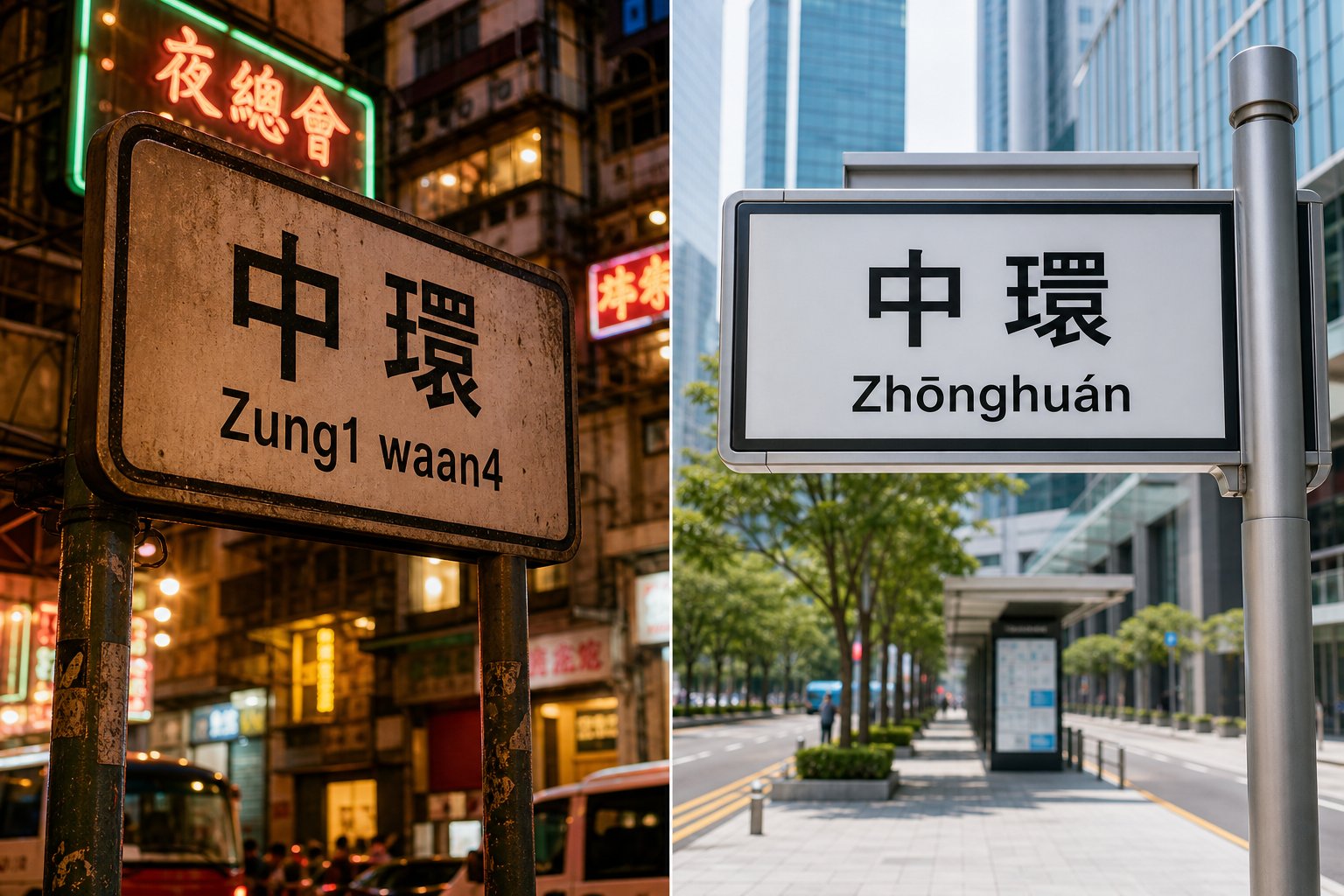
Ever wonder why Chinese names are spelled differently in English depending on where you look? The same person's surname might appear as "Zhang" in one source and "Chang" in another. This is not a typo. It is the result of competing romanization systems, each with its own history, logic, and geographic footprint. Understanding the difference between pinyin and Wade-Giles names is essential before you attempt any conversion.
Hanyu Pinyin and Its Global Adoption
Hanyu Pinyin was announced by the PRC government in 1958 after roughly 20 years of development. Its goal was to create a single, standardized way to represent Mandarin sounds using Latin letters. The system gained international traction quickly. The International Standards Organization certified it, and the United Nations adopted Hanyu Pinyin in 1986 as its official romanization for Chinese. Libraries, museums, and educational organizations worldwide followed suit.
Today, Hanyu Pinyin dominates mainland China passports, international signage, and language instruction globally. If you encounter a Chinese name on a modern document, business card, or academic paper from mainland China, you are almost certainly looking at Hanyu Pinyin.
Wade-Giles and Yale Systems Explained
Before Hanyu Pinyin existed, English speakers relied on the Wade-Giles system, devised in 1867 by Thomas Wade and Herbert Giles. This system shaped decades of sinological scholarship and remains the general system of choice in Taiwan. You will also find it in older library catalogs, historical texts, and the names of well-known figures like Chiang Kai-shek (which would be "Jiang Jieshi" in pinyin).
The Yale system, developed in 1948 for teaching Chinese at the university level, took a different approach. It was once used extensively in Chinese language instruction worldwide but has largely been replaced by Hanyu Pinyin in classrooms. You may still encounter it in older textbooks or linguistic research.
How Romanization Choice Affects Name Spelling
Here is why this matters for anyone working with Chinese romanization systems for names: the same Chinese character can produce completely different English spellings depending on which system was used. A person surnamed 张 might appear as Zhang, Chang, or Jang depending on the context. This is the core reason why Chinese names are spelled differently in English, and it trips up even experienced professionals.
| Chinese Surname | Hanyu Pinyin | Wade-Giles | Yale |
|---|---|---|---|
| 张 | Zhang | Chang | Jang |
| 谢 | Xie | Hsieh | Sye |
| 周 | Zhou | Chou | Jou |
| 钱 | Qian | Ch'ien | Chyan |
| 林 | Lin | Lin | Lin |
Notice how some surnames like Lin remain identical across all three systems, while others like Xie versus Hsieh look like entirely different names. This is the hanyu pinyin vs Wade-Giles name spelling problem in action. When you see an unfamiliar spelling, your first question should always be: which romanization system produced this?
Knowing the system tells you the rules. And knowing the rules is what lets you correctly identify the underlying Chinese name, which brings us to the structural patterns that govern how those names are actually built.
How Chinese Names Are Structured and Why It Matters
Chinese name structure explained for English speakers comes down to one fundamental rule: the family name leads, and the given name follows. This is the opposite of English naming conventions, and it is the single biggest source of confusion when people try to parse an unfamiliar pinyin name.
Surname and Given Name Order in Chinese
So, is the Chinese name order surname first or last? It is always first. A name like Wang Xiaoming places the surname (Wang) before the given name (Xiaoming). This pattern holds across all Chinese naming contexts, whether written in characters or romanized in pinyin.
The question of how to tell surname from given name in pinyin becomes easier once you recognize the most common structural patterns:
- Single-syllable surname + two-syllable given name (most common): Li Mingzhi, Zhang Xiaoping
- Single-syllable surname + single-syllable given name: Wang Wei, Chen Jing
- Compound surname (two syllables) + given name: Ouyang Xiu, Shangguan Fei
Since the top 100 Chinese family names are all single-syllable and cover roughly 85 percent of China's population, a safe default is to treat the first syllable as the surname. Compound surnames like Ouyang or Zhuge exist but are relatively rare, with only about 81 in use.
Cultural Meaning Behind Name Patterns
Surnames connect individuals to ancestral lineage. Children traditionally inherit their father's family name, and women do not change their surnames after marriage. With only around 400 distinct family names in circulation, surnames function as markers of clan identity rather than personal expression.
Given names, on the other hand, carry aspirational weight. Parents choose characters that express hopes for their child: Kang (healthy), Yong (brave), Mei (beautiful), Ling (wise). Some families follow generation naming traditions, where siblings or cousins share one character in their given names to signal their place within the family lineage. Other names reflect the era of a person's birth. Jianguo, meaning "establishment of the nation," was popular for children born in the 1950s and 1960s.
Deciding Name Order for English Contexts
When moving a Chinese name into English, you face a choice: keep the original surname-first order or reverse it to match Western expectations. There is no single correct answer. It depends on context. Many Chinese professionals working internationally reverse the order, presenting themselves as "Mingzhi Li" rather than "Li Mingzhi." Others keep the original sequence and capitalize the surname (LI Mingzhi) to signal which part is which.
Two-syllable given names introduce another decision. Should Xiaoping be written as one word, hyphenated (Xiao-Ping), or split into two (Xiao Ping)? Writing it as a single unit is generally clearest, since splitting it can make English readers mistake the second syllable for a middle name.
These structural choices directly shape how you execute each step of the translation process, from identifying the surname boundary to formatting the final English rendering.

A Step-by-Step Method for Translating Pinyin Names
You understand the structure. You know which romanization system you are dealing with. The question now is practical: how do you actually convert a Chinese pinyin name to English spelling in a way that is clear, consistent, and correct? The process breaks down into three distinct steps, each building on the last. Follow them in order, and you will handle any pinyin name with confidence.
- Identify the surname boundary
- Parse the given name syllables
- Choose your English rendering style based on context
Let's walk through each one.
Step One: Identify the Surname Boundary
Your first task is figuring out where the surname ends and the given name begins. In most cases, the surname is the first syllable. If you see "Li Xiaoming," the surname is Li. If you see "Wang Junkai," the surname is Wang.
Watch for compound surnames. Names like Ouyang, Shangguan, or Sima are two-syllable family names. These are uncommon, but they exist. If the first two syllables match a known compound surname, treat them as a unit. When in doubt, a quick check against a list of Chinese compound surnames resolves the ambiguity.
Before-and-after example: You encounter "Zhuge Liang." Zhuge is the compound surname, Liang is the given name. Treating "Zhu" as the surname and "Geliang" as the given name would be incorrect.
Step Two: Parse Given Name Syllables
Once you have isolated the surname, everything remaining is the given name. Most given names are either one or two syllables. A name like "Chen Jing" has a single-syllable given name. A name like "Chen Mingzhi" has a two-syllable given name.
Here is where standard pinyin spelling rules matter. Two-syllable given names should be written as one word, not split apart. "Mingzhi" stays together. You do not write it as "Ming Zhi" or "Ming-Zhi." Splitting it creates the false impression of a middle name, which does not exist in Chinese naming conventions.
One critical detail: if the second syllable of a given name begins with a, o, or e, insert an apostrophe to mark the syllable boundary. For instance, a given name combining "Xi" and "an" becomes "Xi'an" rather than "Xian," which would represent a completely different sound.
Step Three: Choose Your English Rendering Style
Context determines how you write the final result. Here is a step by step pinyin to English name translation guide for the most common scenarios:
- Standard international format: Surname first, given name second, both capitalized at the initial letter only. Zhang Wei. Chen Mingzhi. This follows pinyin name capitalization and spacing rules as defined by the official orthography.
- Western-adapted format: Given name first, surname last. Wei Zhang. Mingzhi Chen. Common in English-speaking workplaces where the person has chosen to adapt.
- Passport and official document format: Surname in capitals, given name syllables joined without a space. ZHANG WEI. CHEN MINGZHI. This is how names appear on Chinese passports and many government forms.
To write a pinyin name in English correctly, match the format to the situation. A legal document calls for the passport style. A business email works fine with either standard or Western-adapted format, depending on the person's preference. Academic citations follow their own style guide conventions.
Consider this before-and-after comparison. The pinyin name "Zhang Wei" (with tone marks: Zhang Wei) renders as:
| Context | Correct Rendering | Common Error |
|---|---|---|
| Standard pinyin-based English | Zhang Wei | Chang Wei (Wade-Giles mixing) |
| Western name order | Wei Zhang | Wei Chang |
| Passport format | ZHANG WEI | ZHANG W. |
| Two-syllable given name | Zhang Mingzhi | Zhang Ming Zhi |
Notice how the errors all stem from the same root causes: mixing romanization systems, splitting syllables incorrectly, or applying English abbreviation habits where they do not belong. The three-step method keeps you on track by forcing you to make each decision deliberately rather than by instinct.
Of course, knowing the correct method is only half the battle. The other half is recognizing where things go wrong, especially when pinyin letters trick English-trained eyes into hearing sounds that are not there.
Common Mistakes When Converting Pinyin Names to English
English-trained eyes see familiar Latin letters and immediately assign familiar sounds. That instinct is exactly where pinyin name translation errors begin. The system was designed for Mandarin phonology, not English phonology, and several of its letter choices actively mislead anyone who reads them through an English lens.
Pinyin Letters That Mislead English Speakers
When you see the name "Xu," your brain probably wants to say "zoo" or "ksoo." Neither is correct. The pinyin "x" represents a sound closer to "sh" but produced with the tongue positioned near the front teeth. Similarly, the "q" in "Qian" is not the "kw" sound from "queen." It is closer to "ch" but lighter and more forward in the mouth. These are among the most common pinyin pronunciation mistakes in English, and they distort names beyond recognition.
Here is a reference for pinyin letters that sound different in English than you would expect:
| Pinyin Initial | English Speakers Expect | Approximate Actual Sound | Example Name |
|---|---|---|---|
| x | "ks" as in "fox" | "sh" (tongue near front teeth) | Xu, Xie, Xiao |
| q | "kw" as in "queen" | "ch" (light, aspirated) | Qian, Qin, Qi |
| zh | "z" as in "zoo" | "j" (tongue curled back) | Zhang, Zhou, Zhu |
| c | "k" as in "cat" | "ts" (aspirated) | Cai, Cui, Chen |
| z | "z" as in "zebra" | "dz" (unaspirated) | Zeng, Zou, Zhan |
| r | "r" as in "red" | Between English "r" and French "j" | Ren, Rui, Rong |
Knowing how to pronounce x, q, and zh in Chinese names does not require perfect Mandarin. It simply requires recognizing that these letters are placeholders for sounds that have no direct English equivalent. When you read a name aloud using English letter values, you are essentially saying a different name entirely.
Why Tone Marks Matter for Name Identification
Mandarin has only about 1,200 distinct syllables. Tones multiply that number by four, but strip the tone marks away and you lose the ability to distinguish between dozens of characters that share the same spelling. The syllable "li" alone maps to characters meaning "plum" (Li, second tone), "ritual" (Li, third tone), and "power" (Li, fourth tone), among others.
On passports and most English-language documents, tone marks disappear. This is standard practice, but it creates a real problem: two people named "Zhang Wei" in pinyin might have completely different characters and completely different names. Mandarin Chinese has extensive homophones where a single pronunciation maps to multiple unrelated meanings. Without tones, you cannot verify which specific name you are looking at from the romanization alone.
This does not mean you should add tone marks to English documents. It means you should be aware that pinyin without tones is inherently ambiguous, and confirming the correct characters matters whenever precision is required.
Mixing Romanization Systems by Accident
This error is subtler but surprisingly common. Someone writes "Hsieh" for a surname (Wade-Giles) and then renders the given name in Hanyu Pinyin. Or they see "Chang" on an older document and assume it is the pinyin spelling, when it is actually the Wade-Giles form of Zhang. Mixing conventions within a single name produces a hybrid that does not belong to any system.
A related mistake involves syllable boundaries. Joining syllables that should be separate, or splitting a two-syllable given name into what looks like a first and middle name, changes how English readers interpret the name's structure. "Li Ming" and "Liming" read differently to someone unfamiliar with Chinese naming patterns.
The fix for all of these pinyin name translation errors to avoid is the same: identify your system first, apply its rules consistently, and resist the urge to "correct" unfamiliar spellings based on English phonetic intuition. The letters are not wrong. They are just speaking a different phonetic language than the one you learned in school.
These pronunciation and formatting pitfalls become especially high-stakes when names appear on official documents, where a single inconsistency can trigger delays, rejections, or identity verification failures.
Pinyin Names on Official Documents and Professional Settings
A mispronounced name in conversation is awkward. A misformatted name on a passport, visa application, or academic transcript can stall an immigration case, delay a degree verification, or create a permanent mismatch in government databases. The stakes rise sharply when pinyin names move from casual introductions into official paperwork, and the formatting rules are not always intuitive.
How Pinyin Names Appear on Passports and Visas
Chinese passports follow a specific format governed by China's National Immigration Administration. The rules are straightforward but strict:
- Names are rendered in Hanyu Pinyin without tone marks.
- The surname appears first, in all capital letters.
- Given name syllables are joined together without a space or hyphen. A two-syllable given name like Mingwei becomes MINGWEI, not MING WEI.
- The Machine Readable Zone (MRZ) at the bottom of the passport page follows ICAO standards, displaying the surname and given name in separate fields.
So a person named 张明伟 appears as ZHANG MINGWEI on the photo page. Someone named 王伟 appears as WANG WEI. Notice that in the second case, you cannot tell from the passport alone whether "WEI" is a single-syllable given name or part of a longer name that was truncated. Context and the MRZ data resolve this.
Here is where things get tricky. China's National Immigration Administration has specific rules for edge cases. The surname 吕 (Lü in standard pinyin) is printed as LYU on exit-entry documents because the umlaut character creates technical problems in machine-readable systems. Holders of older passports may retain earlier spellings for consistency, meaning two valid passports for the same person could show different romanizations.
This creates a real-world problem for immigration systems. A name spelled one way on a passport might not match the spelling on a visa application, university transcript, or bank record. Verification teams handling non-Latin ID documents must account for these rule-based spelling variations rather than flagging them as identity mismatches.
Academic and Professional Citation Formats
Academic publishing has its own conventions for how Chinese names appear in English, and they differ depending on the style guide. If you are citing a Chinese-language source or referencing a Chinese author, the format matters for both accuracy and discoverability.
Here is how the major citation styles handle Chinese name format for academic citations:
| Style Guide | Name Format | Example |
|---|---|---|
| Chicago (footnote) | Surname Given name (no comma between them for Chinese names) | Hua Linfu, "Qingdai yilai..." |
| Chicago (bibliography) | Surname, Given name (comma only when inverting for alphabetization) | Hua, Linfu. "Qingdai yilai..." |
| APA 7th edition | Surname, Initial(s). | Hua, L. |
| MLA | Surname Given name (no inversion for Chinese names) | Hua Linfu |
Chicago style, widely used in humanities and East Asian studies, preserves the full given name rather than reducing it to an initial. This is important because Chinese given names rendered as single initials become nearly useless for identification. "L. Zhang" could refer to thousands of people. Yale's citation guide for East Asian sources demonstrates this practice clearly, showing full romanized names alongside original characters in brackets.
Journalism follows yet another pattern. AP style and most major English-language news outlets use the Western name order (given name first) on second reference, treating the surname as the "last name" for English readers. So a first reference might read "Chinese President Xi Jinping," with subsequent references using "Xi" alone. Reuters and the BBC follow similar conventions.
Filling Out English-Language Forms Correctly
Imagine you are staring at an immigration form, a university application, or a job registration system. The fields say "First Name," "Middle Name," and "Last Name." You have a Chinese name in pinyin. Where does everything go?
The answer depends on how your name appears on your passport, because official forms should match your travel document exactly. Here is a practical guide for how to write a Chinese name on English forms:
- Last Name / Family Name / Surname field: Enter your surname exactly as it appears on your passport. If your passport says ZHANG, write Zhang or ZHANG depending on the form's capitalization requirements.
- First Name / Given Name field: Enter your full given name as one unit, matching your passport. If your passport shows MINGWEI, write Mingwei. Do not split it into "Ming" and "Wei" across the first and middle name fields.
- Middle Name field: Leave it blank unless you have adopted an English middle name. Splitting your two-syllable given name across the first and middle name fields creates a permanent mismatch with your passport data.
- Preferred Name or English Name field: If the form offers this option, you can enter an adopted English name here without affecting your legal name record.
Database systems in many countries were designed around Western naming conventions. They expect a clear first-middle-last structure that does not map neatly onto Chinese names. Some systems cannot handle names without a middle name, or they truncate long given names. When you encounter these limitations, consistency with your passport is always the safest default.
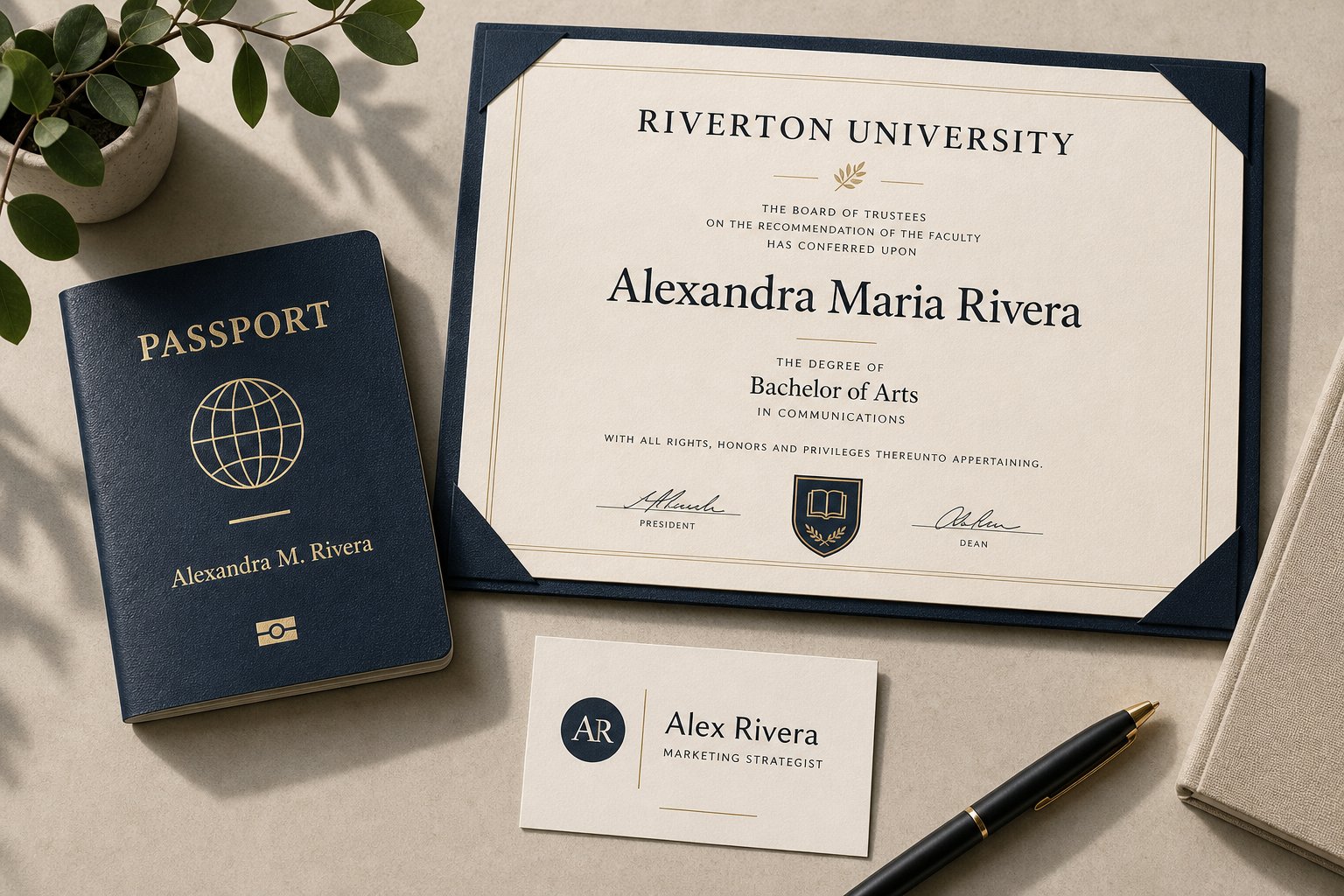
For business correspondence, the pinyin name format for official documents applies less rigidly. Email signatures, LinkedIn profiles, and business cards give you flexibility. Many professionals use a format like "Mingwei (David) Zhang" to bridge both worlds, placing an adopted English name in parentheses while keeping the legal pinyin name visible. Others simply reverse the order to match local expectations.
The key principle across all these contexts is consistency. Pick one rendering and use it everywhere within a given system. A name that appears as "Zhang Mingwei" on your passport, "Mingwei Zhang" on your university diploma, and "David M. Zhang" on your business card is three legitimate choices for three different contexts. Problems only arise when the same system contains conflicting versions, or when you cannot trace one spelling back to the original pinyin.
That tracing process, working backward from an English spelling to identify the correct pinyin, is its own skill. And it becomes essential when you encounter common surnames that have multiple legitimate English variants floating around simultaneously.
Common Surname Reference and Bidirectional Verification
You see the name "Lee" on a business card. Is that the pinyin surname Li? Or is it a Cantonese romanization of the same character? What about "Wong"—is that Wang in pinyin, or something else entirely? The Li vs Lee and Wang vs Wong name differences trip people up constantly because multiple legitimate English spellings exist for the same Chinese surname, each rooted in a different dialect or romanization tradition.
A Chinese surname pinyin to English spelling list helps you navigate these overlaps. Here are the most common Chinese surnames in English alongside their variant forms:
Most Common Chinese Surnames and Their English Variants
| Chinese Character | Hanyu Pinyin | Wade-Giles | Cantonese / Other Variants |
|---|---|---|---|
| 王 | Wang | Wang | Wong, Vong |
| 李 | Li | Li | Lee, Lei |
| 张 | Zhang | Chang | Cheung, Cheong |
| 刘 | Liu | Liu | Lau, Low |
| 陈 | Chen | Ch'en | Chan, Tan |
| 杨 | Yang | Yang | Yeung, Yeong |
| 黄 | Huang | Huang | Wong, Ng, Ooi |
| 赵 | Zhao | Chao | Chiu, Chio |
| 吴 | Wu | Wu | Ng, Goh |
| 周 | Zhou | Chou | Chow, Jow |
Notice that both Wang (王) and Huang (黄) can appear as "Wong" in Cantonese contexts. And "Ng" might represent either Wu (吴) or Huang (黄) depending on the dialect. These overlaps are why a single English spelling can never guarantee a unique match to one Chinese character.
Verifying Pinyin When You Only Have an English Spelling
So how do you find pinyin from an English Chinese name when all you have is a Westernized spelling? The process works in reverse, and it requires a bit of detective work:
- Identify the likely romanization system. If the person is from mainland China and under 50, the spelling is almost certainly Hanyu Pinyin already. If they are from Taiwan, Hong Kong, or an older diaspora community, you may be looking at Wade-Giles, Cantonese, Hokkien, or another regional romanization.
- Cross-reference against known variants. Use the table above or a comprehensive surname database to map the English spelling back to possible Chinese characters. "Chan" likely corresponds to Chen (陈) in Cantonese. "Chow" maps to Zhou (周).
- Confirm with the person directly. When accuracy matters—for legal documents, academic citations, or database records—ask. A polite "Could you confirm the pinyin spelling of your surname?" resolves ambiguity faster than any lookup table.
- Check for context clues. A passport or official document from mainland China will use standard Hanyu Pinyin. A Hong Kong ID card uses Cantonese romanization. The document's origin narrows your options significantly.
The bidirectional challenge is real. Going from pinyin to English is relatively straightforward because pinyin follows consistent rules. Going from an English variant back to pinyin requires you to account for dialect, geography, generation, and personal choice.
Using Pinyin vs Choosing an English Name
Many Chinese people navigating English-speaking environments face a practical question: should I use my pinyin name as-is, or adopt an English name? The answer depends on context and personal preference, but the distinction between the two approaches matters.
Using pinyin as-is means presenting your romanized Chinese name directly. Zhang Wei stays Zhang Wei. This approach preserves your legal identity, maintains consistency across documents, and respects the cultural meaning embedded in your name. As Columbia University's Asia for Educators resource explains, Chinese names carry layered significance—surnames connect to ancestral lineage, and given names often reflect family aspirations or generational identity. Adopting a completely different English name severs that visible connection.
Choosing an English name—like David, Grace, or Kevin—serves a different function. It eases social interactions where colleagues struggle with unfamiliar sounds, and it creates a clear separation between professional and personal identity. Many people use both: an English name for casual workplace interactions and their pinyin name for all legal, academic, and formal purposes.
Here is the key distinction:
- Legal documents, academic publications, immigration forms: Always use your pinyin name exactly as it appears on your passport. Consistency prevents identity verification problems.
- Business cards, email signatures, social introductions: Either approach works. Many professionals use a hybrid format like "Wei (David) Zhang" to bridge both worlds.
- Published works and professional reputation: Pick one form and stick with it. Switching between "Li Wei" and "David Lee" across publications fragments your professional identity and makes your work harder to find.
Neither choice is more correct than the other. What matters is understanding that pinyin is your name transliterated, not translated. It represents how your name sounds, not what it means. An English name is a separate identity marker adopted for convenience. Keeping that distinction clear helps you make deliberate choices rather than accidental ones.
These surname variants and naming strategies play out differently depending on the specific situation you are navigating—whether that is introducing yourself at a conference, printing wedding invitations, or troubleshooting a database that cannot handle your name's format.

Practical Scenarios for Pinyin and English Name Translation
Knowing the rules is one thing. Applying them when you are standing in front of a new team, designing a wedding invitation, or debugging a database field that keeps rejecting your name is something else entirely. Real-world situations demand quick, confident decisions about how to present a Chinese name in English or how to render an English name in Chinese pinyin. Here is how to handle the most common scenarios.
Introducing Your Chinese Name in English-Speaking Contexts
Picture your first day at a new job in London, Toronto, or Sydney. Someone asks your name. You have about three seconds before the moment gets awkward. How do you introduce a Chinese name in English without losing your identity or confusing your listener?
The challenge is not just spelling. It is pronunciation. English speakers will read your pinyin name using English phonetic rules, which means "Xu" becomes "zoo" and "Qian" becomes "kee-ann." You need a strategy that bridges the gap without requiring a linguistics lecture.
- Lead with your preferred name. If you use an English name socially, open with that: "Hi, I'm David. My Chinese name is Zhang Wei." If you prefer your pinyin name, own it: "Hi, I'm Zhang Wei. Zhang is my family name."
- Offer a pronunciation anchor. Give colleagues something familiar to latch onto. "It's Xu, like 'shoe' without the 'oe.'" Or "Qian—think 'chee-en.'" These are not perfect phonetic matches, but they get people close enough for respectful daily use.
- Clarify name order once. A simple "Zhang is my surname, Wei is my given name" prevents weeks of confusion. In Chinese business culture, addressing someone by surname plus a title is standard etiquette, so you might also mention whether you prefer "Mr. Zhang" or just "Wei."
- Put it in your email signature. A line like "Zhang Wei (Wei Zhang) | Pronunciation: jahng way" saves you from repeating the explanation in every meeting.
The goal is not perfect Mandarin pronunciation from your English-speaking colleagues. It is mutual respect and a name that people feel comfortable saying out loud rather than avoiding.
Translating English Names into Chinese Pinyin
The translation process works in both directions. English speakers living in China, studying Mandarin, or marrying into Chinese families often want to translate their English name to Chinese pinyin. This is a fundamentally different process from transliterating a Chinese name into English, because it involves phonetic approximation rather than systematic conversion.
Chinese does not have native equivalents for many English sounds. There is no "th," no "v" (in standard Mandarin), and no distinction between "l" and "r" in the way English uses them. So English names get adapted to fit Mandarin phonology, character by character, with each syllable mapped to a Chinese character that sounds similar.
- Common phonetic adaptations: "David" becomes Da-wei (大卫), "Michael" becomes Mai-ke-er (迈克尔), "Sarah" becomes Sa-la (萨拉). These are standardized transliterations used in media and official contexts.
- Choose characters with positive meaning. Since every Chinese character carries meaning, the characters selected for a transliterated name matter. A good transliteration sounds close to the original while using characters with neutral or positive connotations.
- Consider a culturally native name instead. Some people prefer to adopt a fully Chinese name rather than a phonetic approximation. A teacher or Chinese friend might help choose characters that reflect your personality or aspirations, following the same naming logic Chinese parents use.
- Keep your legal name separate. A Chinese name adopted for social use does not replace your legal English name on documents. Treat it as a parallel identity, similar to how Chinese professionals use English names abroad.
If you are putting a Chinese name on business cards in English, the standard approach is to print both: your English name prominently on one side and your Chinese name (in characters and pinyin) on the other. For wedding invitations that bridge both cultures, couples often print bilingual versions with the Chinese name in characters alongside the English rendering.
Handling Names in Digital Systems and Databases
Software does not care about cultural nuance. It cares about field lengths, character encoding, and validation rules. And many systems were built with Western naming assumptions baked into their architecture. If you have ever had a form reject your name because it was "too short," or watched a system split your given name across two fields, you have experienced this firsthand.
Here is how to handle Chinese names in databases and digital systems:
- Character encoding: Ensure your system supports UTF-8 or UTF-16 if it needs to store Chinese characters alongside pinyin. ASCII-only fields will strip diacritics and reject characters entirely.
- Field length minimums: Some systems require a minimum of two or three characters per name field. Single-syllable surnames like "Li" or "Wu" may trigger validation errors. Padding with spaces is a workaround, but a better fix is removing arbitrary minimums from the validation logic.
- No middle name: Systems that require a middle name create friction for Chinese users. Make the middle name field optional, or allow it to remain blank without throwing an error.
- Name order assumptions: If your system assumes "first name = given name" and "last name = family name," it will work correctly for Chinese names entered in Western order. But if a user enters their name in Chinese order (surname first), the system will misfile them. Offering a "display name" or "preferred name" field alongside legal name fields solves this gracefully.
- Apostrophes and special characters: Pinyin names like Xi'an (as a given name component) use apostrophes as syllable separators. Systems that strip apostrophes or treat them as invalid characters will corrupt these names. The same applies to the umlaut in names containing "u" (like Lu vs. Lü).
For developers building international systems, the principle is simple: do not assume names follow a first-middle-last pattern, do not enforce character minimums, and support the full Unicode range. For users navigating these imperfect systems, consistency with your passport spelling remains the safest fallback when a form forces you into an awkward choice.
Whether you are introducing yourself, choosing a Chinese name, or fighting with a form field, every scenario comes back to the same core principles: know your system, stay consistent, and match your format to the context. Those principles deserve a final, consolidated summary you can reference anytime the situation calls for a quick decision.
Bringing It All Together for Accurate Name Translation
Every pinyin name you encounter sits at the intersection of a linguistic system, a cultural tradition, and a specific real-world context. Get any one of those wrong, and the name lands incorrectly on a document, in a database, or in someone's memory. The good news? The key rules for Chinese to English name conversion are few, consistent, and easy to internalize once you see them laid out together.
Key Principles to Remember
Think of accurate pinyin name translation as resting on four pillars. Each one addresses a different source of error:
- Identify the romanization system first. Is the spelling you are looking at Hanyu Pinyin, Wade-Giles, Cantonese romanization, or something else? The answer determines every rule that follows. A name spelled "Chang" means something different depending on whether it came from a mainland Chinese passport or a Taiwanese academic paper.
- Respect the surname-given name structure. The surname leads. The given name follows. Two-syllable given names stay together as one unit. Do not split them into a first and middle name. Do not reverse the order unless the person has chosen to present it that way.
- Understand that pinyin is phonetic, not semantic. Pinyin represents how a name sounds, not what it means. "Zhang Wei" is not a translation of meaning into English—it is a transliteration of sound into Latin letters. This distinction matters when deciding whether to use pinyin as-is or adopt a separate English name. As one analysis of naming approaches puts it, pinyin preserves pronunciation and cultural identity, while meaning-based names prioritize accessibility and personal expression. They serve different purposes.
- Match your format to the context. A passport demands one format. An academic citation demands another. A business card gives you flexibility. There is no single "correct" way to render a pinyin name in English—only the correct way for the situation you are in.
Accurate pinyin name translation requires understanding both the linguistic system and the context in which the name will be used. Neither alone is sufficient.
Your Quick-Reference Checklist
Next time you need to convert a Chinese name or verify one you have encountered, run through this pinyin name translation checklist:
- Determine which romanization system produced the spelling (Hanyu Pinyin, Wade-Giles, Cantonese, or other).
- Identify the surname boundary—usually the first syllable, unless it matches a known compound surname.
- Parse the given name as a single unit. Do not split two-syllable given names across separate fields or add hyphens unless the person prefers it.
- Confirm the intended name order for your context (Chinese order for official documents, Western order if the person has adapted).
- Apply capitalization and spacing rules appropriate to the format: standard (Zhang Wei), passport (ZHANG WEI), or Western-adapted (Wei Zhang).
- Resist reading pinyin letters with English pronunciation values. When in doubt, ask the person how they say their name.
- Stay consistent within any single system. Use the same spelling on all documents, profiles, and records that belong to the same context.
That is the entire accurate pinyin to English name guide summary in seven steps. Print it, bookmark it, or keep it in your head. The process is the same whether you are filling out an immigration form, citing a researcher, introducing a colleague, or building a database that needs to handle names from multiple cultures without breaking.
Names carry identity. Getting them right is not a technical nicety—it is a basic act of respect. And now you have the tools to do it correctly every time.
Frequently Asked Questions About Pinyin Name Translation to English
1. How do I translate my Chinese pinyin name to English correctly?
Start by identifying the surname boundary (usually the first syllable), then parse the given name as a single unit without splitting two-syllable names. Finally, choose a rendering style based on context: standard format (Zhang Wei), passport format (ZHANG WEI), or Western-adapted order (Wei Zhang). Always match your passport spelling on legal documents and stay consistent within any single system to avoid identity verification issues.
2. Why are Chinese names spelled differently in English?
Multiple romanization systems exist for Chinese, each producing different English spellings for the same character. Hanyu Pinyin (used in mainland China), Wade-Giles (common in Taiwan and older texts), and Cantonese romanization (used in Hong Kong) all follow different rules. For example, the surname 张 appears as Zhang in pinyin, Chang in Wade-Giles, and Cheung in Cantonese. Geographic origin, generation, and personal choice all influence which spelling a person uses.
3. What is the difference between pinyin and Wade-Giles for Chinese names?
Hanyu Pinyin was adopted by China in 1958 and is now the international standard used on mainland Chinese passports and in global education. Wade-Giles, created in 1867, remains common in Taiwan and older academic texts. The two systems use different letter combinations for the same sounds: pinyin writes Zhang where Wade-Giles writes Chang, pinyin uses Xie where Wade-Giles uses Hsieh. Knowing which system produced a spelling is essential before attempting any conversion.
4. Should I put my Chinese surname or given name first in English?
It depends on context. In Chinese convention, the surname always comes first (Li Mingzhi). For English-speaking environments, many people reverse the order (Mingzhi Li) to match Western expectations. On official documents and passports, keep the original Chinese order. In professional settings, either approach works as long as you clarify which part is your family name. Some people capitalize the surname (LI Mingzhi) or use both formats in their email signature to prevent confusion.
5. How do Chinese names appear on passports and official English documents?
Chinese passports render names in Hanyu Pinyin without tone marks. The surname appears first in capital letters, and given name syllables are joined without spaces or hyphens. So 张明伟 becomes ZHANG MINGWEI, not ZHANG MING WEI. When filling out English-language forms, match your passport exactly: put your surname in the Last Name field and your full joined given name in the First Name field. Leave the Middle Name field blank rather than splitting your given name across two fields.