What the Tiger Chinese Character Means and How to Pronounce It
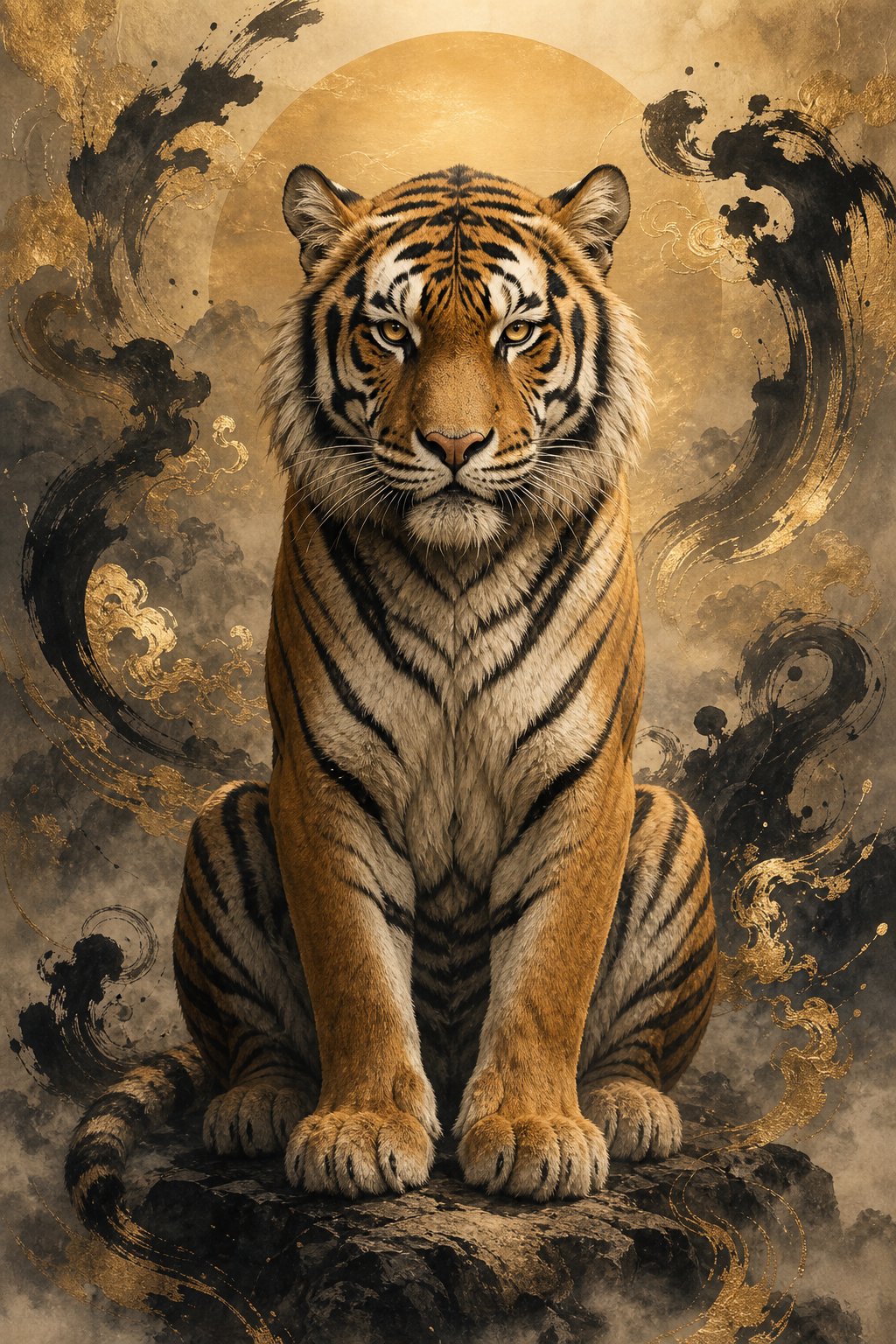
So how do you say tiger in Chinese? The answer is a single, powerful syllable: 虎 (hǔ). This character means "tiger" and ranks among the most culturally loaded symbols in the entire Chinese writing system. It carries thousands of years of attitudes toward power, danger, and protection packed into just eight strokes.
How to Say Tiger in Chinese
Pronunciation: hǔ (third tone). Start at a mid-low pitch, dip down, then rise — like the vocal shape of saying "huh?" in English with a slight scoop. The "h" is aspirated, and the vowel sounds close to "oo" in "book."
If you want to know how to say tiger in Mandarin in everyday conversation, you will almost always hear 老虎 (lǎohǔ) rather than 虎 alone. The prefix 老 literally means "old," but here it functions as a familiar, almost affectionate marker — not an indicator of age. Chinese uses this pattern for several animals and social roles. A teacher is 老师 (lǎoshī) regardless of how young they are, and a mouse is 老鼠 (lǎoshǔ) whether it was born yesterday. Adding 老 before 虎 softens the word just enough for casual speech while preserving the animal's gravitas.
On its own, 虎 tends to appear in literary contexts, idioms, and compound words. You will encounter it in classical texts, four-character proverbs, and place names. But in a sentence like "I saw a tiger at the zoo," Mandarin speakers reach for 老虎 every time.
Why 虎 Is the Same in Simplified and Traditional
Here is a detail most resources overlook: the Chinese word for tiger looks identical whether you are reading simplified or traditional script. When the People's Republic of China standardized its simplified character set, 虎 was left untouched. It belongs to a group of roughly 4,700 characters that required no simplification at all. Why? The character was already compact and visually efficient — its structure had been streamlined over millennia of natural evolution from pictograph to modern form.
This means whether you are studying tiger in Mandarin Chinese for use in mainland China, Taiwan, Hong Kong, or Singapore, you are learning the exact same character. No conversion needed, no alternate form to memorize. For learners, that is one less thing to worry about.
The tiger character matters far beyond translation. As scholar Cao Zhenfeng, a specialist on Chinese folk tradition, observed: the tiger "is both loved and hated; it is a frightening beast as well as a protecting god; it is a sign of danger and a symbol for good luck." That cultural complexity lives inside 虎 itself — in its radical structure, its historical evolution, and the dozens of words and idioms it generates.
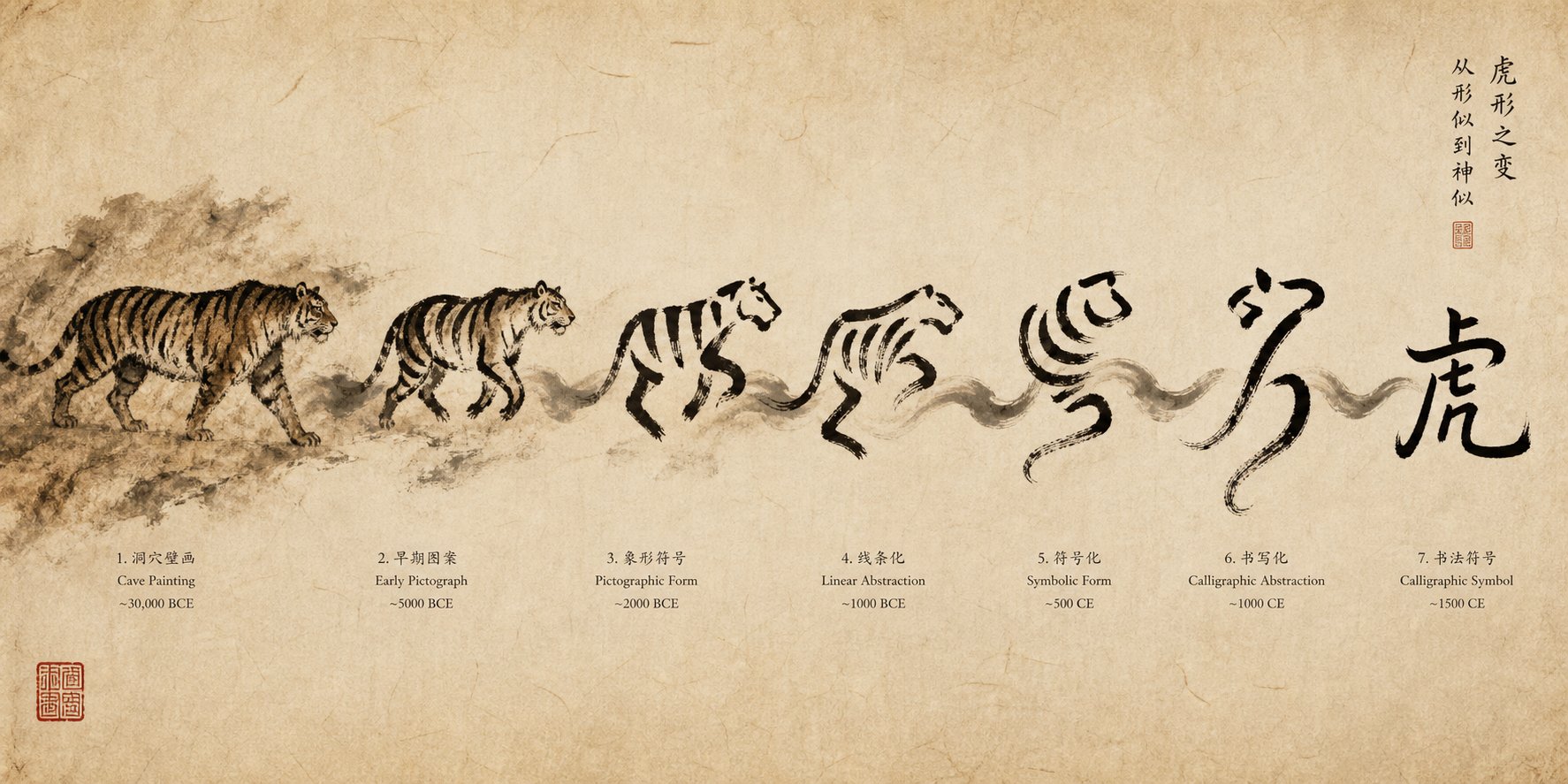
How the Tiger Character Evolved Over 3000 Years
That cultural complexity did not appear overnight. The tiger chinese character carries its history visibly in its strokes — each line a fossil record of how ancient scribes saw the animal and chose to represent it. Tracing the chinese character for tiger back to its origins reveals something remarkable: you can still see the beast inside the modern form if you know where to look.
Oracle Bone and Bronze Inscription Forms
Imagine a Shang dynasty scribe around 1200 BCE, carving into a turtle shell or ox bone. The earliest known version of the tiger character chinese scholars have identified is unmistakably pictographic. It depicts a tiger in profile with its jaws wide open, a curved body marked with stripes, prominent claws, and a long tail. The animal is caught mid-roar — frozen in a posture of aggression. You could show this oracle bone form to someone with no knowledge of Chinese writing, and they would likely guess "some kind of big cat."
Bronze inscriptions from the Western Zhou period (roughly 1046-771 BCE) refined this image. The tiger's body became slightly more stylized, but scribes preserved the essential visual cues: the gaping mouth at the top, the striped torso in the middle, and the legs or claws at the bottom. These bronze forms still read as drawings rather than abstract symbols. Oracle bone specialists like Cao Zhenfeng have documented how the character maintained its pictographic clarity across several centuries of bronze-age use, with regional variations in how prominently the stripes and claws were rendered.
What makes the tiger etymology especially interesting is how long the character resisted abstraction. Many animal characters lost their pictographic quality early. The tiger held on — perhaps because its distinctive silhouette (open jaws, striped body, powerful limbs) was too visually compelling to abandon quickly.
From Seal Script to Modern Regular Script
The real transformation began with seal script (篆书) during the Qin dynasty's standardization effort around 221 BCE. Here, the tiger's body was compressed and regularized into flowing, symmetrical curves. The open jaws migrated to the top of the character, becoming the strokes that would eventually form the 虍 radical. The body and legs merged into the lower portion. The image was still recognizable as a tiger to a trained eye, but it had crossed the threshold from picture to symbol.
Clerical script (隶书) during the Han dynasty pushed the abstraction further. Curved lines straightened. The flowing seal-script forms snapped into angular, brush-friendly strokes optimized for speed. By the time regular script (楷书) emerged and stabilized — the form we write today — the chinese character tiger had completed its journey from realistic portrait to structured glyph.
Yet the architecture of the original picture persists. The top portion of modern 虎 (the 虍 component) descends from those open jaws. The lower strokes echo the crouching body. Three thousand years of evolution, and the tiger never fully disappeared from its own character.
| Script Type | Approximate Era | Key Visual Features |
|---|---|---|
| Oracle Bone Script (甲骨文) | c. 1200-1050 BCE | Fully pictographic tiger in profile: open jaws, striped body, visible claws and tail |
| Bronze Inscription (金文) | c. 1050-771 BCE | Refined pictograph with stylized stripes; body slightly more compact but still recognizable as an animal |
| Seal Script (篆书) | c. 221 BCE onward | Symmetrical, flowing curves; jaws abstracted to top component; body compressed into lower portion |
| Clerical Script (隶书) | c. 200 BCE - 200 CE | Angular strokes replace curves; optimized for brush writing; pictographic origin fading |
| Regular Script (楷书) | c. 200 CE - present | Modern standard form (虎); 8 strokes; top radical 虍 derived from jaws, lower portion from body |
This layered history is what makes the tiger character chinese learners encounter today so much more than a vocabulary item. Each stroke connects to a visual decision made thousands of years ago — a scribe looking at a real animal and deciding which features mattered most. The open mouth won. The stripes won. And those choices ripple outward into an entire family of related characters built on the same radical foundation.
Breaking Down the Radical and Stroke Structure of 虎
That radical foundation deserves a closer look. If you are learning tiger in Chinese writing, understanding how 虎 is built stroke by stroke — and how its components generate an entire family of related characters — turns a single vocabulary word into a key that unlocks dozens more.
Stroke Count and Stroke Order for 虎
The character 虎 is written in exactly 8 strokes and belongs to radical 141: 虍 (hǔ zìtóu), commonly called the tiger radical. This radical forms the upper portion of the character — those strokes descended from the tiger's open jaws in ancient pictographs.
Here is the stroke order you will want to practice:
- Vertical stroke (丨) dropping down on the left
- Short horizontal (一) extending right from the top
- Curving stroke (フ) forming the top-right corner
- Short left-falling stroke (丿)
- Horizontal (一) crossing through the middle
- Vertical bend forming the lower-left frame
- Sweeping left stroke (丿) inside the lower body
- Bending hook completing the lower-right portion
The general rule: write the 虍 radical (top portion) first, working left to right and top to bottom, then complete the lower body strokes. You will notice the top half feels open and angular — those old tiger jaws — while the bottom half curves inward like a crouching body. Once you internalize this structure, the Chinese writing tiger learners find intimidating starts to feel logical.
The Tiger Radical 虍 in Other Characters
Here is where things get interesting. The 虍 radical does not just sit inside 虎 — it functions as a semantic component across multiple characters, carrying the tiger's cultural associations of ferocity, intensity, and overwhelming force into new meanings. Think of it as the tiger lending its energy to other concepts.
- 虐 (nuè) — cruelty, tyranny. The tiger radical combined with a claw-like element. Cruelty imagined as tiger-like savagery inflicted on others.
- 虑 (lǜ) — worry, consideration, anxiety. The tiger looming over the mind (心). Deep thought carries the weight of something dangerous circling overhead.
- 虚 (xū) — empty, void, hollow. A tiger over a mound or hill — the emptiness left after a powerful force has passed through. Also carries connotations of falseness or insubstantiality.
- 虔 (qián) — reverent, sincere, devout. The tiger radical paired with a kneeling figure. Genuine reverence as the posture one takes before overwhelming power.
- 處/处 (chù) — place, location; to dwell. The tiger radical with a component suggesting rest or stopping. A place where even a tiger settles — somewhere significant enough to pause.
- 虞 (yú) — worry, concern; to anticipate. The tiger combined with a figure looking ahead. Vigilance in the face of lurking danger.
- 虏 (lǔ) — captive, prisoner. The tiger's power turned to domination — taking someone by force.
Notice the pattern? Every character in this family channels some aspect of the tiger's nature: its violence (虐), the dread it inspires (虑, 虞), the awe it commands (虔), or the emptiness it leaves behind (虚). The symbol for tiger in Chinese is not just a label for an animal — it is a root concept that branches across the writing system, encoding how Chinese civilization processed the experience of living alongside apex predators.
For learners, recognizing the 虍 radical on sight is a practical shortcut. When you spot those angular top strokes in an unfamiliar character, you already know something about its semantic territory: intensity, power, or the emotional responses that power provokes. The Chinese symbol for tiger becomes a reading tool, not just a word to memorize.
This structural logic extends beyond the radical itself. The tiger's cultural weight — its association with kingship, authority, and raw dominance — shaped not only how Chinese speakers write about the animal but how they think about power in general. And nowhere is that connection more vivid than in the marking nature placed on the tiger's own forehead.
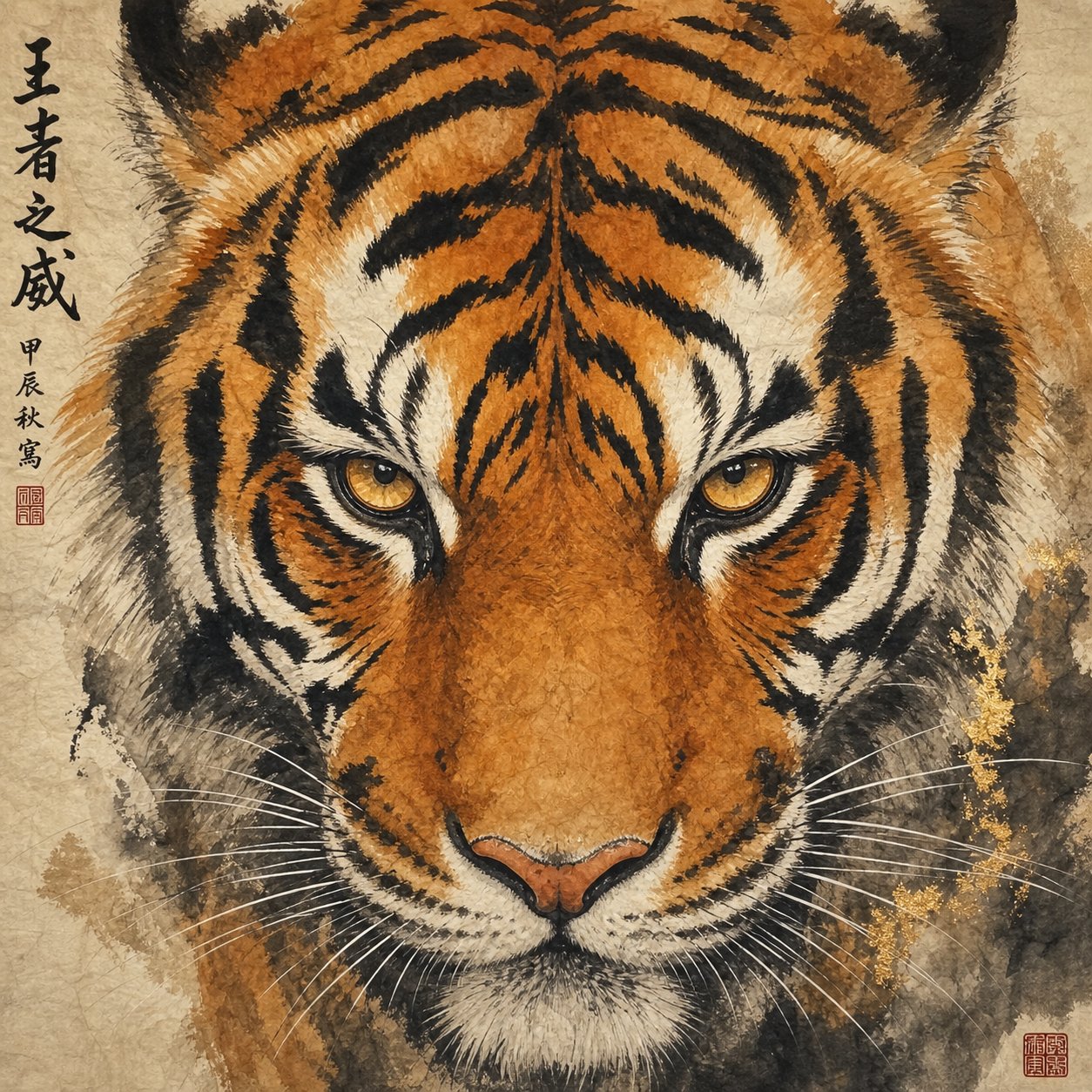
Why the Tiger Wears the King Character on Its Forehead
Look closely at the face of a tiger — specifically the dark stripes running across its brow. Three bold horizontal lines, connected by a faint vertical crease down the center. Sound familiar? That pattern mirrors the chinese character king: 王 (wáng). Three horizontal strokes joined by one vertical stroke. Chinese culture noticed this resemblance centuries ago and drew a conclusion that still shapes art, folklore, and children's clothing today: the tiger is born wearing a crown.
The 王 Marking on the Tiger's Forehead
The character 王 in Chinese writing is elegantly simple — just four strokes representing heaven (top line), earth (bottom line), and humanity (middle line), all connected by a ruler who bridges them (the vertical stroke). When people observed that a tiger's forehead markings naturally echo this king in Chinese character form, it reinforced what they already felt instinctively: this animal rules.
This is folk etymology at its most powerful. The connection is not linguistically derived — it is visual. The wang tiger association comes from pattern recognition, from looking at the animal's face and seeing royalty written there by nature itself. Chinese artists leaned into this. Traditional tiger paintings deliberately emphasize the forehead stripes, rendering them as a clear, unmistakable 王. Military shields and textile hangings documented by the British Museum depict tigers with the character for king prominently displayed on their brows, blending the natural marking with intentional calligraphy.
Parents dress young children in 虎头帽 (tiger-head hats) and 虎头鞋 (tiger-head shoes) featuring this same motif — a fierce tiger face with 王 boldly stitched across the forehead. The belief is straightforward: the king of beasts protects the child from evil spirits and illness. You will still find these items in markets across China, the chinese character for king embroidered in gold thread between two round, watchful eyes.
Tiger as King of Beasts in Classical Texts
The visual connection between the tiger's brow and the king in Chinese writing did not emerge in a cultural vacuum. Classical texts had already established the tiger's royal status long before folk artists began emphasizing the forehead marking.
"Of all the animals, the tiger and the boar are the bravest." — Book of Rites (礼记)
The Eastern Han scholar Ying Shao went further in his Comprehensive Meaning of Customs and Mores (风俗通义), writing that the tiger is a yang animal and "the king of all beasts" — capable of quelling war and devouring ghosts. This was not poetic exaggeration. It reflected a cosmological system where the dragon ruled the sky and the tiger ruled the earth. Together they represented the complete spectrum of power: celestial and terrestrial, yang ascending and yang grounding.
That dual monarchy shows up everywhere in Chinese visual culture. Dragon-and-tiger pairings appear on temple walls, imperial garments, and martial arts iconography. The dragon soars above; the tiger prowls below. Neither outranks the other — they govern different domains. But on land, among flesh-and-blood creatures, the tiger answers to no one. The 王 on its forehead is simply nature confirming what the classics already declared.
This royal identity does more than inspire art and folklore. It saturates the Chinese language itself — generating compound words, idioms, and expressions that carry the tiger's authority into everyday speech.
Common Chinese Words and Phrases Built from the Tiger Character
That royal authority does not stay locked inside classical texts. In modern Mandarin, 虎 works overtime — appearing in compound words that range from literal animal references to vivid metaphors for danger, deception, and even household reptiles. Understanding the tiger chinese meaning inside these compounds reveals how a single character radiates outward into daily conversation.
Essential Tiger Compound Words for Learners
Chinese has a strong preference for two-character words. As Hacking Chinese explains, meaning in modern Chinese is conveyed through words rather than standalone characters — and 虎 is a perfect example. On its own it feels literary. Paired with other characters, it comes alive in everyday speech.
Consider 老虎 (lǎohǔ). If you look up laohu in Chinese dictionaries, this is the standard word for "tiger" — the form people actually use in conversation. The 老 prefix does not mean the animal is old. It is a familiarity marker, the same pattern found in 老鼠 (mouse) and 老鹰 (eagle). The laohu meaning is simply "tiger," no age implied.
From there, the compounds get creative. Each tiger in Chinese word below uses 虎 as a building block, but the resulting meanings stretch far beyond the animal itself:
| Compound | Pinyin | Literal Meaning | Actual Usage |
|---|---|---|---|
| 老虎 | lǎohǔ | old + tiger | Tiger (standard spoken form) |
| 虎口 | hǔkǒu | tiger's mouth | A dangerous situation; also the webbing between thumb and index finger |
| 壁虎 | bìhǔ | wall + tiger | Gecko (a tiny "tiger" that climbs walls) |
| 虎牙 | hǔyá | tiger tooth | Canine tooth; also a popular Chinese livestreaming platform |
| 老虎机 | lǎohǔjī | tiger machine | Slot machine (it devours your money like a tiger) |
| 纸老虎 | zhǐlǎohǔ | paper tiger | Something that appears powerful but is actually weak |
Notice how the chinese meaning of tiger shifts depending on context. In 虎口, the tiger represents mortal danger — "escaping the tiger's mouth" (虎口逃生) means narrowly surviving a life-threatening situation. In 壁虎, the tiger lends its predatory energy to a harmless gecko, as if ancient Chinese speakers saw something fierce in the way geckos stalk insects on walls. And 老虎机 captures the gambling machine's appetite: it eats coins the way a tiger eats prey.
These are not random pairings. Each compound preserves some facet of the tiger's cultural identity — its danger, its appetite, its power — and applies it metaphorically to something else entirely.
马马虎虎 and the Tiger's Role in Everyday Speech
Ask any Mandarin learner which tiger-related phrase they learned first, and the answer is almost always 马马虎虎 (mǎmǎhūhū). It means "so-so" or "careless," and it is one of the most commonly taught four-character expressions in beginner courses. But why would "horse horse tiger tiger" mean anything close to mediocrity?
The most popular folk explanation involves a painter. According to the story, a man was painting a tiger when someone asked him to paint a horse instead. Too lazy to start over, he simply added a horse's body beneath the tiger's head. When his sons asked what the painting depicted, he told one it was a tiger and the other it was a horse. The confusion led to tragedy: one son killed a horse thinking it was a tiger, and the other tried to ride a tiger thinking it was a horse. The painter became known as "Mr. Horse-Tiger" — a byword for dangerous carelessness.
Whether this origin story is historically accurate remains debated among linguists. What matters is the logic it encodes: confusing two fundamentally different things (a horse and a tiger) represents the worst kind of inattention. From that core idea, 马马虎虎 developed its two modern uses:
- Describing carelessness: 他做事太马虎了 (He does things too carelessly)
- Meaning "so-so": 最近怎么样?马马虎虎。(How have you been lately? So-so.)
The expression works because it is playful. The reduplication (AABB pattern) gives it a casual, almost dismissive rhythm — perfect for brushing off a question about how things are going. It is also one of the few places in Mandarin where 虎 appears with a first-tone pronunciation (hū) rather than its standard third tone, a phonetic shift that happened naturally through frequent colloquial use.
These compounds and expressions only scratch the surface. The tiger character generates an even richer layer of meaning in classical four-character idioms — proverbs that distill centuries of Chinese thinking about power, deception, and the consequences of underestimating your situation.
Tiger Idioms and Proverbs That Reveal Chinese Thinking
Four-character idioms, or 成语 (chéngyǔ), are where the tiger's significance in Chinese culture becomes most vivid. These compact proverbs compress entire fables, historical episodes, and philosophical observations into four syllables. And the tiger appears in more of them than almost any other animal. Each idiom captures a different facet of what the tiger symbolizes: raw power, deception, danger you cannot escape, and authority that may or may not be real.
Classical Tiger Idioms Every Student Should Know
If you are building vocabulary beyond basic compounds, these tiger idioms are essential. They appear in newspapers, business meetings, and casual conversation alike. Here they are ranked roughly by how often you will encounter them in modern usage:
- 骑虎难下 (qí hǔ nán xià) — "Riding a tiger, hard to dismount." Imagine you have climbed onto a tiger's back. You cannot stay there forever, but jumping off means getting eaten. This idiom describes being trapped in a situation you started voluntarily but now cannot exit safely. A manager who launched an expensive project that is failing but cannot be canceled is 骑虎难下.
- 狐假虎威 (hú jiǎ hǔ wēi) — "The fox borrows the tiger's might." Recorded in the Strategies of the Warring States (《战国策》), this fable tells of a fox who, about to be eaten, convinces the tiger that all forest animals fear him. He invites the tiger to walk behind him as proof. Sure enough, every animal flees — from the tiger, not the fox. The idiom describes someone who bullies others by flaunting a powerful patron's authority.
- 虎头蛇尾 (hǔ tóu shé wěi) — "Tiger head, snake tail." A project that launches with ferocious energy but fizzles into nothing — all roar at the start, a thin whimper at the end. You will hear this in workplaces when someone abandons a task halfway through: 做任何事都要认真,决不能虎头蛇尾 (Take everything seriously; you cannot abandon it midway).
- 三人成虎 (sān rén chéng hǔ) — "Three people make a tiger." This one comes from a story in the Han Feizi and the Strategies of the Warring States. A chancellor named Pang Cong asked his king: if one person claimed a tiger was roaming the marketplace, would you believe it? No. Two people? Doubtful. Three? The king admitted he would believe it. Pang's point: repeated rumors gain the force of truth, no matter how absurd. In an era of viral misinformation, this idiom feels startlingly current.
Other tiger idioms worth knowing include 卧虎藏龙 (crouching tiger, hidden dragon — hidden talent), 狼吞虎咽 (wolfing down food with tiger-like ferocity), and 虎视眈眈 (glaring like a tiger eyeing prey — watching with predatory intent). Together, they form a portrait of what does the tiger symbolize across Chinese thought: power that can protect or destroy, depending on which side of it you stand.
Paper Tiger and Its Political Legacy
No tiger idiom has traveled further into global consciousness than 纸老虎 (zhǐ lǎohǔ) — paper tiger. The phrase denotes something that appears powerful or threatening but is actually weak and ineffective. Its paper tiger origin in Chinese predates its most famous user by centuries. British sinologist John Francis Davis documented the expression as early as 1836, noting that Chinese speakers called "a blustering, harmless fellow" a paper tiger. By the 1840s, English-language newspapers were already borrowing the phrase to describe political blusterers and empty threats.
But the term gained its modern political charge in August 1946, when Mao Zedong used it in an interview with American journalist Anna Louise Strong. Asked about the threat of U.S. atomic weapons, Mao replied: "The atom bomb is a paper tiger which the U.S. reactionaries use to scare people. It looks terrible, but in fact it isn't." He extended the metaphor broadly — "All reactionaries are paper tigers" — applying it to the Tsar, Hitler, Mussolini, Japanese imperialism, and Chiang Kai-shek in a single sweep.
From that interview onward, the phrase became a staple of Cold War rhetoric. Western commentators debated whether China is a paper tiger or a genuine threat. The expression entered English dictionaries, United Nations speeches, and editorial pages worldwide. It remains one of the rare cases where a Chinese idiom reshaped international political vocabulary — proof that the tiger's significance extends well beyond linguistics into geopolitics.
What makes 纸老虎 so effective is its visual simplicity. Everyone understands the gap between a real tiger and one made of paper. That intuitive clarity is exactly why tiger idioms endure: they ground abstract ideas in the physical reality of an animal people instinctively respect and fear. The same instinct drives the tiger's role in one of China's oldest cosmological systems — the twelve-year zodiac cycle, where the tiger holds a position of honor.
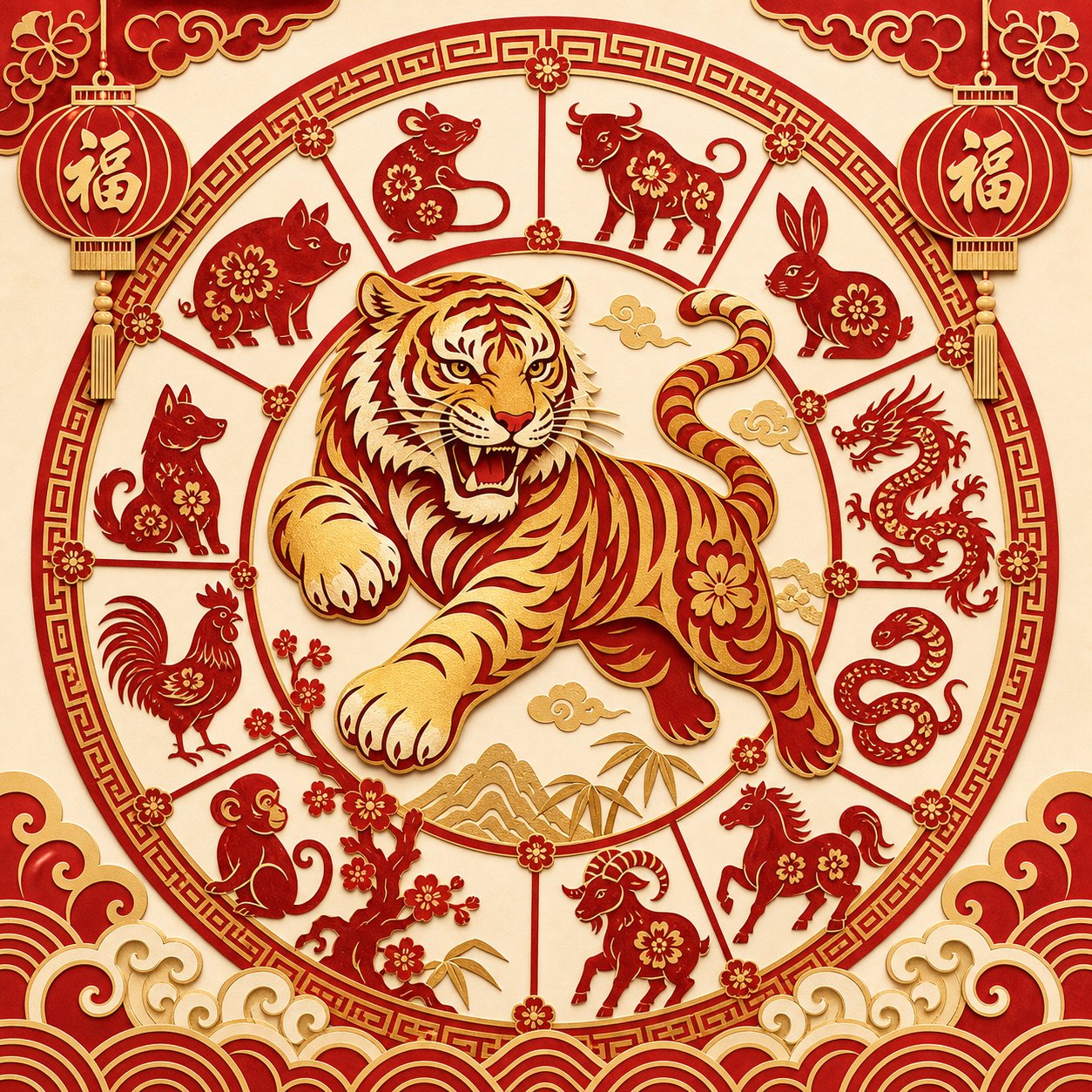
The Tiger Character in the Chinese Zodiac System
The Chinese zodiac (生肖 shēngxiào) is a twelve-year cycle where each year corresponds to an animal sign. The tiger holds the third position — and its placement there is not arbitrary. Understanding the chinese tiger meaning within this system requires looking beyond the animal itself and into an older cosmological framework that predates the familiar twelve-animal cycle by centuries.
The Earthly Branch 寅 and Its Tiger Connection
Before the zodiac animals existed as a popular system, ancient Chinese astronomers used a set of twelve symbols called the Earthly Branches (地支 dìzhī) to mark time. The third branch is 寅 (yín), and it corresponds to the tiger. This pairing is ancient — documented in texts from the Han dynasty onward — and it carries specific temporal associations: 寅 maps to the hours between 3 and 5 AM, the period when tigers were believed to be most active, prowling through darkness at their most powerful.
Linguistically, the Year of the Tiger is expressed as 虎年 (hǔ nián) — simply "tiger" plus "year." In formal or classical contexts, you might see 寅年 (yín nián) instead, using the Earthly Branch character. Both refer to the same thing, but 虎年 dominates in everyday speech because it is immediately transparent. The most recent tiger years were 2010 and 2022; the next falls in 2034.
Why third place? The most widely told origin story is the myth of the Great Race, in which the Jade Emperor (玉皇 Yùhuáng) declared a contest among animals to cross a river. The rat finished first through cunning, the ox came second through sheer endurance, and the tiger — a powerful swimmer battling strong currents — arrived third. Its competitive nature and raw athleticism earned it a permanent position near the top of the cycle, outranked only by cleverness and persistence.
Cultural Traditions in the Year of the Tiger
People born in tiger years are said to inherit the animal's temperament: brave, confident, competitive, and magnetically drawn to leadership. They are described as self-assured and imposing — the kind of personality that commands a room without trying. But that strength cuts both ways. The traditional chinese tiger personality also includes impulsiveness, stubbornness, and a restless energy that resists compromise. As the idiom 骑虎难下 reminds us, riding a tiger's momentum is exhilarating until you need to stop.
Tiger years also trigger specific cultural practices, especially around children. Parents and grandparents dress babies born in tiger years in 虎头帽 (tiger-head hats) and 虎头鞋 (tiger-head shoes) — the same protective garments mentioned earlier with the 王 marking on the forehead. The logic is layered: a child born under the tiger's sign already carries its fierce energy, and dressing them in tiger imagery amplifies that protective power. Some families call their young children 小老虎 (xiǎo lǎohǔ, "little tiger") as an affectionate nickname, reinforcing the connection between the zodiac sign and personal identity. You might also hear xiao laohu used playfully for any energetic, fearless toddler regardless of birth year.
The meaning of chinese tiger within the zodiac is ultimately about identity. When someone says 我属虎 (wǒ shǔ hǔ — "I was born under the tiger sign"), they are not just stating a birth year. They are claiming membership in a personality archetype that tiger in chinese culture has defined for millennia: bold, protective, occasionally reckless, and impossible to ignore. That archetypal power extends even further — beyond personality and into mythology, where the tiger guards not just individual children but entire cosmic directions.
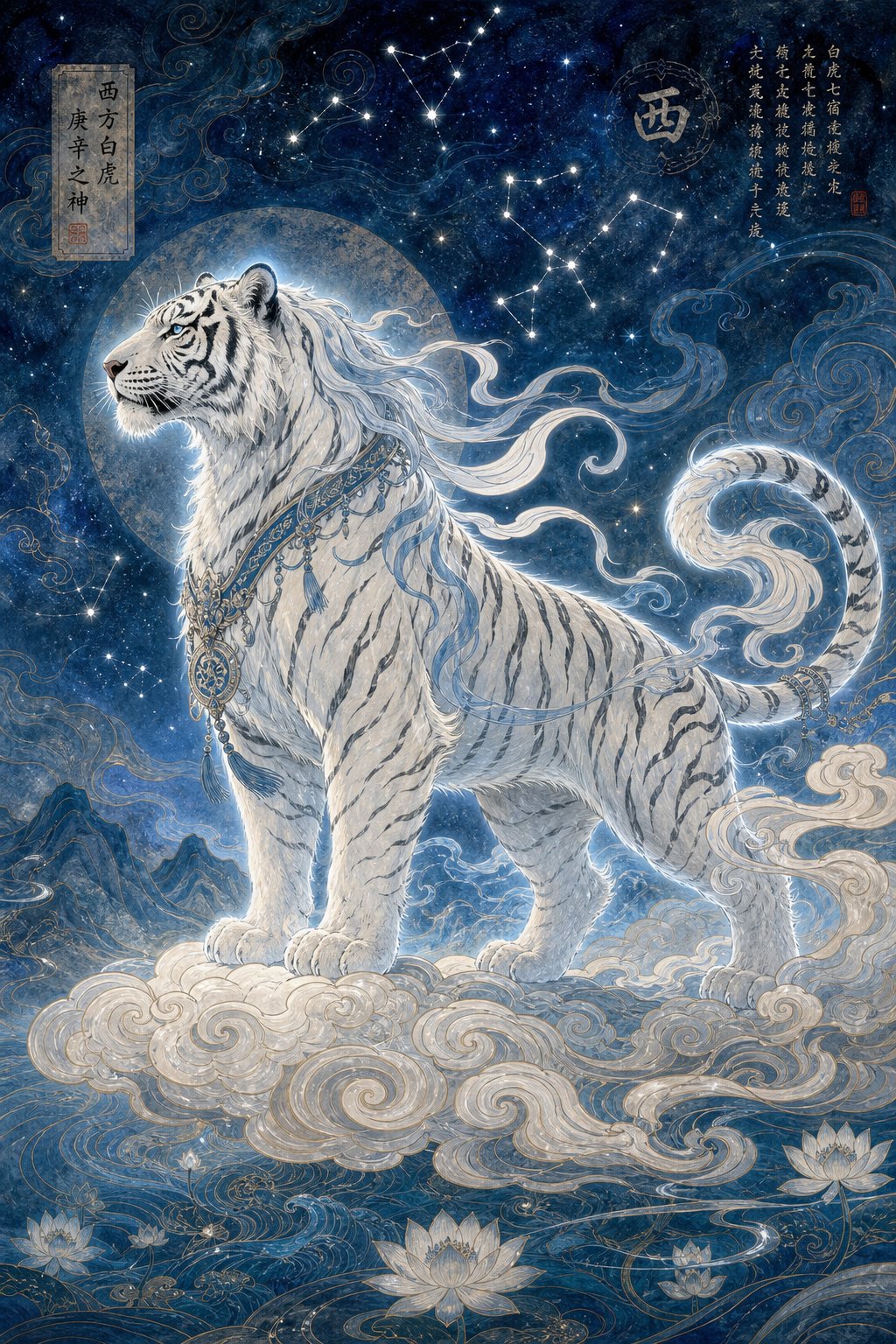
Tiger Symbolism in Chinese Mythology and Folk Belief
Guarding cosmic directions is no small job. In Chinese cosmology, the tiger does not merely represent strength in the abstract — it occupies a fixed position in the architecture of the universe itself. The symbolism of the tiger reaches across military strategy, children's wardrobes, temple walls, and star maps, making it one of the most versatile protective symbols in East Asian culture. So what do tigers symbolize at this deeper mythological level? Protection, cosmic order, and the raw terrestrial power that balances heaven's authority.
The White Tiger and the Four Celestial Symbols
The White Tiger (白虎 Báihǔ) is one of the Four Symbols (四象 sìxiàng) of Chinese astronomy — a system that divides the night sky into four quadrants, each governed by a mythical creature. The Azure Dragon guards the east, the Vermilion Bird watches the south, the Black Turtle-Snake holds the north, and the White Tiger commands the west. Each symbol also corresponds to a season: the White Tiger rules autumn, the time of harvest and, traditionally, of military campaigns.
This is not merely decorative mythology. The Four Symbols structured how ancient Chinese astronomers organized constellations. The White Tiger's domain contains seven lunar mansions (宿 xiù) — specific star groupings that guided calendrical calculations and agricultural planning. Tigers in Chinese mythology are not just earthbound predators. The White Tiger is a celestial guardian mapped onto the heavens themselves.
Within this cosmological framework, the tiger represents yin and earth energy, complementing the dragon's yang and heaven energy. As one source on traditional Chinese symbolism explains, the dragon is a celestial creature representing yang — male, light, action — while the tiger embodies yin — grounded, protective, receptive. An ancient proverb captures their partnership: "Dragons bring the clouds, while tigers call forth the wind." Together they summon rain and peace. Neither is complete without the other, just as the taijitu symbol shows a seed of dark within the light and light within the dark.
Tiger as Protective Talisman and Military Emblem
The tiger symbol did not stay in the sky. It descended into daily life as one of China's most trusted protective devices. The British Museum documents how the Chinese word 虎 (hǔ, tiger) sounds similar to 护 (hù, to protect) — a phonetic coincidence that reinforced the animal's talismanic role. Elite soldiers exchanged tiger paintings as marks of respect for bravery. Calligraphers wrote 虎 in beautiful forms as protective gifts for friends.
The military applications run deep. Ancient Chinese commanders used 虎符 (hǔfú) — tiger tallies — as authentication devices. These were bronze tiger figurines split in half: the emperor kept one piece, and the general kept the other. Only when both halves matched could troops be mobilized. The tiger symbol here encoded the highest level of military authority, a physical key to the power of war.
Beyond the battlefield, the tiger's protective reach extended to the most vulnerable members of society. Children's tiger-head shoes, hats, and jackets — documented extensively in museum collections — served as wearable talismans. The British Museum's research on Qing dynasty textiles shows painted and embroidered tiger designs on children's garments, with the 王 character prominently displayed on the forehead. The logic was simple: dress a child as the king of beasts, and evil spirits will not dare approach.
Here are the major symbolic roles the tiger fills across different cultural domains:
- Celestial guardian: The White Tiger (白虎) protects the western quadrant of the sky and governs autumn.
- Military authority: Tiger tallies (虎符) authenticated troop commands; tiger flags and shields marked regiments; soldiers wore tiger-patterned uniforms.
- Child protection: Tiger-head hats, shoes, and clothing ward off evil spirits and illness from infants and young children.
- Door guardian: Tiger images painted or hung on doors repel malevolent forces — functioning like spiritual sentries.
- Anti-evil talisman: Folk belief holds that tigers devour ghosts and demons; their image on household objects provides ongoing spiritual defense.
- Cosmic balance: The tiger represents terrestrial yin power, complementing the dragon's celestial yang — together forming a complete cosmological whole.
The symbols for tiger in Chinese visual culture are not decorative afterthoughts. They encode a worldview where the boundary between the natural and supernatural is thin, and where the right image — placed on the right object, facing the right direction — actively shapes reality. The tiger's ferocity is not feared here. It is harnessed, directed outward against threats both physical and spiritual.
This protective energy also attaches to geography. Across China, places bearing the tiger's name inherit its fierce reputation — and in some cases, that reputation shaped the course of history itself.
The Tiger Character in Names, Places, and Modern Life
Some of those tiger-named places did more than inherit a fierce reputation — they became turning points in world history. The character 虎 lives not only in dictionaries and idiom collections but in the geography, personal names, and brand identities that shape daily life across China today.
Tiger in Chinese Place Names and History
The most historically significant example is 虎门 (Hǔmén) — literally "Tiger Gate." This town in Guangdong province sits at the narrow mouth of the Pearl River, a strategic chokepoint that earned its name from the fierce currents and imposing fortifications guarding the passage. In June 1839, Imperial Commissioner Lin Zexu chose this location to destroy over 1,000 tons of seized British opium — an act that provided the direct trigger for the First Opium War (1839-1842). The event is still known in Chinese as 虎门销烟 (Hǔmén xiāo yān, "the destruction of opium at Humen"), and the site now houses the Opium War Museum. For a tiger in China place name, 虎门 carries extraordinary weight: it marks where modern Chinese history pivoted.
Other tiger place names dot the map: 虎丘 (Tiger Hill) in Suzhou, a famous scenic and historical site; 虎林 (Tiger Forest) in Heilongjiang province, near habitat where wild chinese tigers still roam; and 虎跳峡 (Tiger Leaping Gorge) in Yunnan, one of the world's deepest river canyons, named for the legend of a tiger jumping across its narrowest point.
Using the Tiger Character in Personal Names
As a given name component, 虎 signals strength, courage, and vitality — qualities parents hope their children will embody. Names like 建虎 (Jiànhǔ, "building strength"), 虎生 (Hǔshēng, "tiger-born"), and 小虎 (Xiǎohǔ, "little tiger") appear predominantly in male names, particularly in rural and northern Chinese communities where direct, powerful naming conventions remain common. The china tiger connection in personal names is straightforward: you name a child after the king of beasts to give them its fearless energy.
Less commonly known is that 虎 also exists as a surname, found primarily among the Hui and other ethnic minority communities in northwestern China. It is rare — far outside the common hundred surnames — but its existence shows how deeply the chinese tiger symbol has embedded itself in identity at every level.
In modern commercial life, 虎 continues to project power. The livestreaming platform 虎牙 (Huya, "tiger tooth") chose the character for its aggressive, competitive connotations. Tiger imagery saturates Chinese New Year marketing during tiger years, and the character appears on everything from energy drinks to athletic brands seeking to channel its vitality.
From oracle bone carvings to app store logos, 虎 has traveled further than almost any character in the Chinese writing system. It began as a picture of an animal with open jaws and ended up encoding an entire civilization's relationship with power, nature, and protection — all in eight strokes. That is the real tiger chinese culture story: not just what the character means, but how much meaning a single character can hold.
Frequently Asked Questions About the Tiger Chinese Character
1. How do you say tiger in Chinese?
The Chinese character for tiger is 虎, pronounced 'hǔ' with a third tone (dipping then rising pitch). However, in everyday Mandarin conversation, speakers almost always use the two-character word 老虎 (lǎohǔ) rather than 虎 alone. The prefix 老 is a familiarity marker, not an indicator of age. On its own, 虎 appears mainly in literary contexts, idioms, compound words, and place names.
2. What does the tiger symbolize in Chinese culture?
In Chinese culture, the tiger symbolizes power, protection, courage, and terrestrial authority. It serves as the king of all land animals, complementing the dragon's celestial rule. The tiger functions as a protective talisman on children's clothing, a celestial guardian of the western sky (the White Tiger or 白虎), a military emblem through tiger tallies (虎符), and a ward against evil spirits. Its forehead markings resemble the character 王 (king), reinforcing its royal status in folk belief.
3. Is the tiger character different in simplified and traditional Chinese?
No. The character 虎 is identical in both simplified and traditional Chinese writing systems. When China standardized its simplified character set, 虎 was left unchanged because its structure was already compact and visually efficient after millennia of natural evolution. This means learners studying for use in mainland China, Taiwan, Hong Kong, or Singapore only need to memorize one form.
4. What does paper tiger mean and where did it originate?
Paper tiger (纸老虎, zhǐ lǎohǔ) describes something that appears powerful or threatening but is actually weak and ineffective. The phrase existed in Chinese for centuries before Mao Zedong popularized it internationally in 1946, when he called the atomic bomb 'a paper tiger which the U.S. reactionaries use to scare people.' British sinologist John Francis Davis documented the expression as early as 1836. It has since entered English dictionaries and global political vocabulary.
5. What is the tiger radical and which characters contain it?
The tiger radical is 虍 (hǔ zìtóu), classified as radical 141. It forms the upper portion of 虎 and appears as a semantic component in many other characters, carrying associations of ferocity and intensity. Characters containing it include 虐 (cruelty), 虑 (worry), 虚 (empty/void), 虔 (reverent), 處/处 (place), 虞 (concern), and 虏 (captive). Recognizing this radical helps learners identify unfamiliar characters related to power or intense emotion.