The Chinese Character for Wind Defined
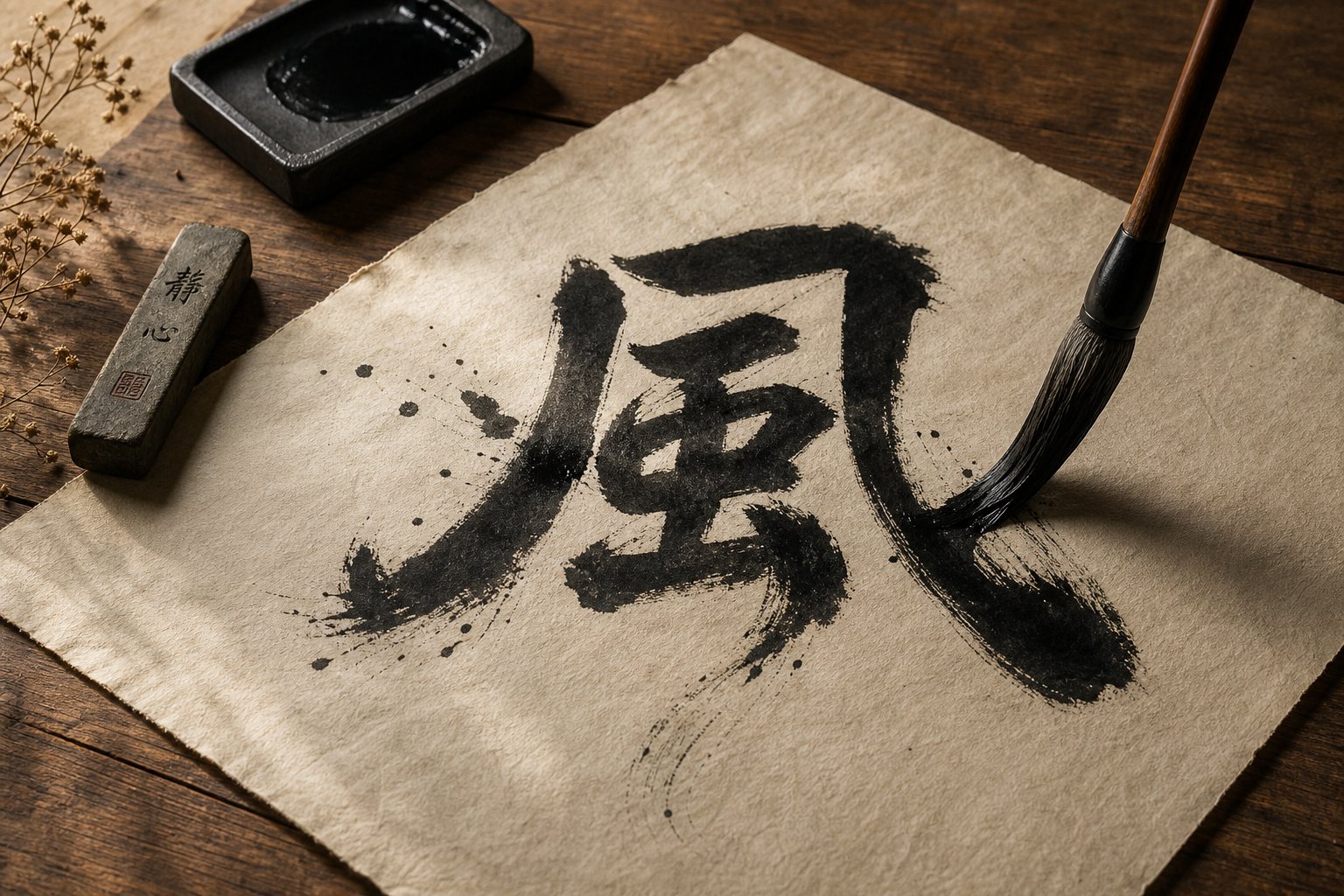
You look up a single Chinese character and discover it means wind, style, custom, rumor, and landscape all at once. That's exactly what happens when you encounter 风 (simplified) or 風 (traditional), pronounced feng in Mandarin with a high, level first tone (fēng). This one character packs an extraordinary range of meaning into a few elegant strokes.
What Does the Wind Character Mean in Chinese
The Chinese character for wind (风/風, pinyin: fēng) refers primarily to the natural movement of air, but extends to mean style, custom, manner, rumor, scenery, and even risk depending on the compound word and context in which it appears.
Wind in Chinese is far more than a weather term. The character first appeared on oracle bones over 3,000 years ago, and across those millennia it absorbed layers of cultural, philosophical, and social meaning. When Chinese speakers say 风格 (fēngge), they mean personal style. When they say 风俗 (fēngsu), they mean local customs. And 风险 (fēngxian) refers to risk. All built from the same root character: 风.
Why One Character Carries So Many Meanings
Chinese characters often function as semantic building blocks rather than fixed-definition words. Think of 风 as a concept cluster. Wind is invisible, ever-moving, and capable of shaping everything it touches. That metaphorical flexibility is exactly why the character branched into meanings related to trends, atmosphere, reputation, and influence. Context and compound pairing tell you which meaning applies in any given sentence.
This article takes a layered approach. You've got the quick definition above. From here, we'll trace how the character evolved from ancient pictographs, compare its simplified and traditional forms, map out its full semantic range, and explore how it shaped Chinese philosophy, medicine, and poetry. Each layer reveals something new about why this character sits at the heart of Chinese language and thought.
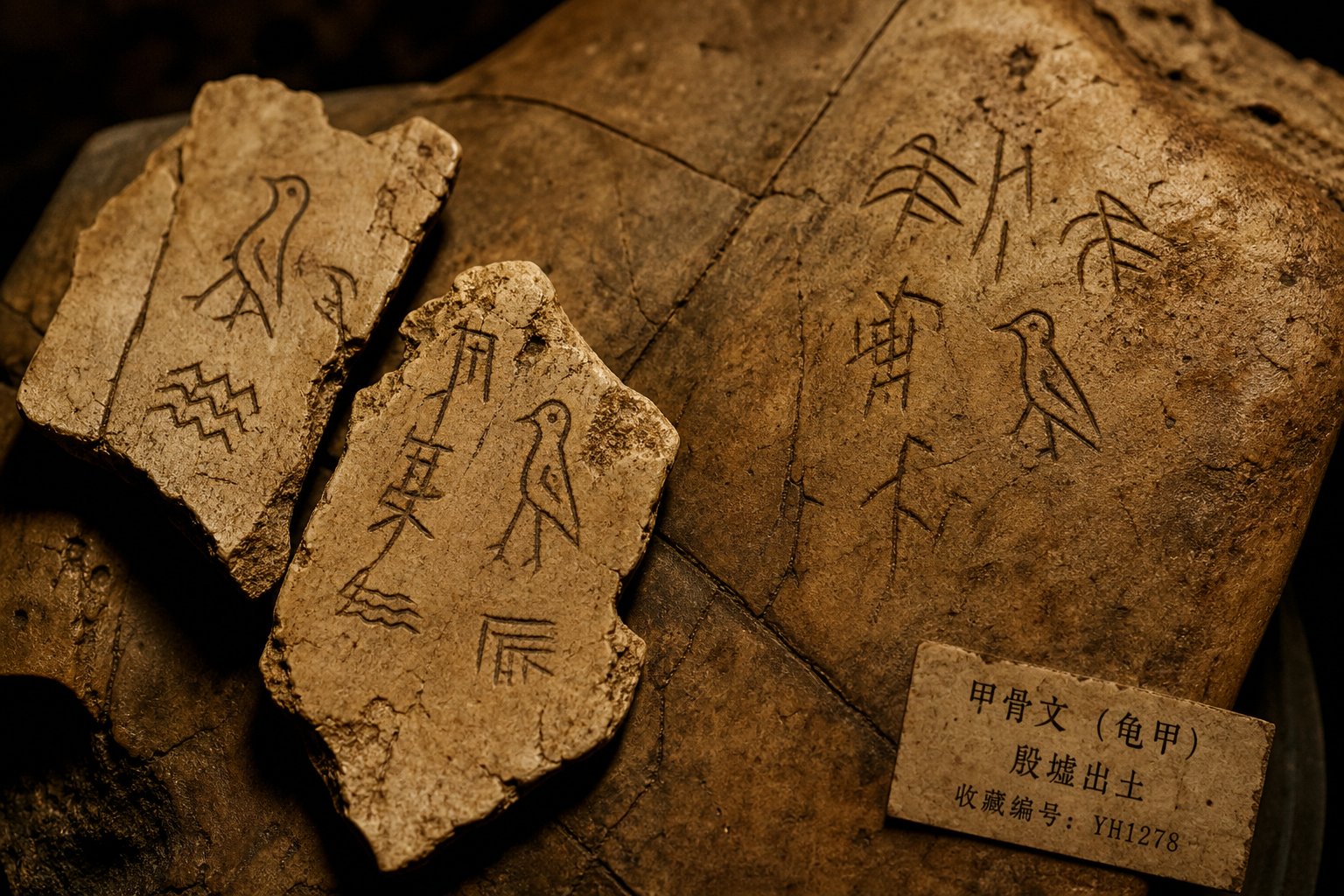
How the Wind Character Evolved Over Millennia
Imagine trying to draw something you can never see. That was the challenge facing scribes in ancient China more than 3,000 years ago when they needed a written symbol for wind. Their solution tells a fascinating story about mythology, nature observation, and linguistic creativity that stretches across thirty centuries of continuous evolution.
Oracle Bone Origins and the Insect Connection
The earliest known forms of the Chinese wind symbol appear on oracle bones from the Shang dynasty (roughly 1200 BCE). These inscriptions reveal something surprising: the original character for wind looked almost identical to the character for the mythical phoenix, 鳳 (feng). Why? Because ancient Chinese believed that a divine bird with enormous wings created wind when it flew. This creature, considered the god of wind, had a large crown signifying divinity, sweeping feathers, and a long trailing tail. When it flapped those massive wings, it brought forth gusts and gales.
The oracle bone forms show this mythical bird alongside a sail, a shape borrowed from 凡 (fan), which originally depicted a large piece of cloth stretched between masts. A divine bird and a sail to catch its breath: together they meant "wind." The logic is elegant. You can't draw the invisible, so you draw what causes it and what captures it.
By the Qin dynasty (221-207 BCE), the character split into two distinct seal script forms: 鳳 kept the bird meaning (phoenix), while 風 took on the weather meaning exclusively. Here's where the famous insect connection enters the story. The seal script form of 風 placed the element 虫 (chong, insect or creature) inside the outer frame. The ancient dictionary Shuowen Jiezi explained this by stating that when winds from all eight directions blow, creatures (蟲) are brought forth. This reflects a real observation: seasonal winds in ancient China coincided with the emergence of insects. Spring breezes signaled the return of buzzing life; autumn winds marked their disappearance.
Some scholars, including the renowned etymologist Shirakawa Shizuka, interpret the inner element not as a common insect but as a dragon (龍), another mythical creature believed to ride the wind and ascend through clouds. Either way, the character's interior represents living things animated by this invisible force.
From Seal Script to the Modern Form
The outer frame of 風 serves a different purpose entirely. It derives from 凡 (fan), which functions as the phonetic component, giving the character its approximate pronunciation. This is a common pattern in Chinese: one part of a character hints at meaning (the semantic component) while another hints at sound (the phonetic component). In 風, the outer enclosure says "this sounds like fan" and the inner 虫 says "this relates to creatures stirred by moving air."
As the character traveled from seal script through clerical script (隶书) during the Han dynasty, its strokes became more angular and standardized. The flowing curves of the seal form gave way to the brushstroke efficiency that scribes needed for administrative documents. The traditional form 風 stabilized with nine strokes: the outer sail-like frame enclosing the insect radical within.
The wind character origin story, then, is really two stories merged into one. The first is mythological: a divine bird whose wings generate storms. The second is naturalistic: seasonal air currents that summon insects from the earth. Both narratives capture something true about wind as ancient people experienced it, an unseen power known only through its effects on living things and physical objects.
This dual heritage explains why the character eventually absorbed so many abstract meanings. A force that moves creatures, bends trees, fills sails, and changes with the seasons became a natural metaphor for trends, customs, and influence. The simplified and traditional forms that exist today each preserve a piece of this layered history, though they look quite different on the page.
Simplified and Traditional Forms Compared
Two versions of the same character exist in active daily use across different regions. If you've searched for the wind kanji or tried reading a menu in Hong Kong versus Beijing, you've likely noticed the difference. The traditional form 風 retains the ancient insect radical inside its frame, while the simplified form 风 replaces that interior with a simple cross-stroke (乂). Understanding why both exist and where each one appears clears up a common source of confusion for learners.
Simplified 风 vs Traditional 風 at a Glance
In the 1950s and 1960s, the People's Republic of China launched a sweeping literacy campaign that included simplifying hundreds of commonly used characters. The goal was practical: reduce stroke counts so that millions of people could learn to read and write more quickly. The wind character was among those reformed.
How did 風 become 风? The simplified version wasn't invented from scratch. Scribes and calligraphers had been using cursive shorthand forms for centuries, and the government standardized one of these existing variants. The outer frame (from 凡) stayed intact, but the interior 虫 was replaced by 乂, a minimal two-stroke element. The result dropped the stroke count from nine to four, making it one of the more dramatically simplified characters in the standard set.
| Feature | Traditional 風 | Simplified 风 |
|---|---|---|
| Stroke count | 9 | 4 |
| Interior component | 虫 (insect/creature) | 乂 (cross-stroke) |
| Outer frame | Derived from 凡 (phonetic) | Same frame, streamlined |
| Regions of use | Taiwan, Hong Kong, Macau, Japan | Mainland China, Singapore, Malaysia |
| Unicode | U+98A8 | U+98CE |
You'll notice the outer enclosure looks similar in both forms. That shared frame is the visual thread connecting them, the echo of 凡 that has persisted since seal script. The real difference is what sits inside: a full semantic component in the traditional form versus a minimal placeholder in the simplified one.
Where Each Form Is Used Today
Geography determines which version you'll encounter. Mainland China adopted simplified characters officially in 1964, and Singapore followed in the 1970s. Taiwan never adopted simplification, so all formal writing, signage, and education there uses 風. Hong Kong and Macau also retained traditional characters through their colonial periods and continue using them today.
What about the kanji for wind in Japanese? Japan uses the traditional form 風, pronounced kaze (in kun'yomi, the native Japanese reading) or fuu (in on'yomi, the Sino-Japanese reading). So if you're studying the wind in kanji, you're looking at the same nine-stroke traditional character used in Taiwan and Hong Kong. Japanese did undergo its own simplification reforms after World War II, but 風 was kept unchanged because it was already common enough in its traditional shape.
This means learners who master the traditional form 風 gain recognition across Japanese, Taiwanese, and Hong Kong texts simultaneously. Those who learn simplified 风 first can still read the traditional version easily once they understand the structural relationship between the two. The outer frame is your anchor either way.
Both forms carry identical meanings. Whether you write 风景 in a mainland Chinese textbook or 風景 in a Taiwanese newspaper, the word still means scenery. The semantic range of the character, its many layered definitions, remains constant regardless of which visual form appears on the page.
Every Meaning the Wind Character Carries
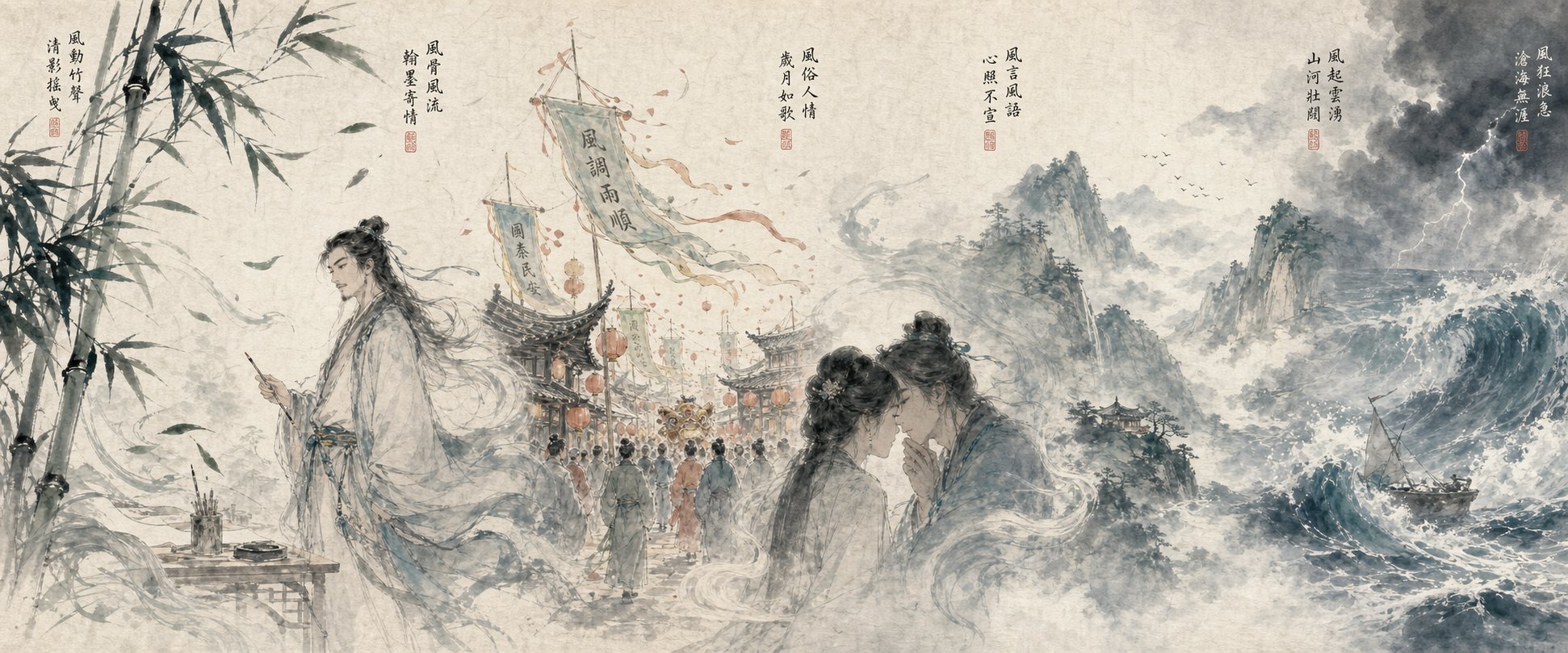
Identical visual form, identical pronunciation, six distinct meanings. That's the reality of working with 风 in Chinese. When you encounter this character in a sentence, the word around it tells you whether someone is talking about a breeze, a personal style, a local tradition, a piece of gossip, a beautiful view, or a financial gamble. Each meaning connects back to the original concept of wind as an invisible, pervasive force, but the practical differences are enormous.
Six Core Meanings of 风 with Examples
The feng meaning in Chinese branches far beyond weather. Below is a unified reference showing how one character operates across six distinct semantic categories. Each meaning pairs with a common compound word that locks in the specific sense.
| Meaning Category | Pinyin | Example Compound | Usage Context |
|---|---|---|---|
| Wind (natural phenomenon) | feng (first tone) | 大风 (dafeng) - strong wind | Weather reports, daily conversation about climate and air movement |
| Style / Manner | feng (first tone) | 风格 (fengge) - style, character | Art criticism, personal branding, describing someone's distinctive approach |
| Custom / Tradition | feng (first tone) | 风俗 (fengsu) - customs, folkways | Anthropology, travel writing, discussions of regional cultural practices |
| Rumor / Hearsay | feng (first tone) | 风闻 (fengwen) - to hear through the grapevine | Journalism, gossip, indirect reports of unverified information |
| Scene / Landscape | feng (first tone) | 风景 (fengjing) - scenery, landscape | Tourism, photography, describing natural or urban views |
| Risk / Danger | feng (first tone) | 风险 (fengxian) - risk | Finance, business planning, insurance, medical decision-making |
Notice that the pinyin stays the same across all six categories. The tone never shifts. There's no pronunciation trick to help you distinguish between meanings. Context does all the heavy lifting.
How did a weather word absorb meanings like "style" and "risk"? The logic follows a pattern of metaphorical extension that's well-documented in Chinese linguistics. A character starts with an original meaning (本义), then develops extended meanings (引申义) through association over centuries of use. Wind is invisible yet powerful. It shapes landscapes, carries seeds, and changes direction without warning. Those qualities map naturally onto abstract concepts: trends that sweep through a culture (customs), impressions that spread without a clear source (rumors), and unpredictable forces that can help or harm (risk).
How Context Determines Which Meaning Applies
Imagine you see the character 风 standing alone. Which of the six meanings applies? Truthfully, you can't tell yet. Chinese for wind and Chinese for style use the same character, and only the surrounding compound or sentence resolves the ambiguity.
This is where compound words become essential. In modern Chinese, most concepts are expressed through two-character combinations rather than single characters. Each compound acts like a semantic lock: the second character narrows the first into one specific meaning. Consider these pairs:
- 风 + 景 (scene) = scenery. The character 景 pulls 风 toward its "atmosphere" sense.
- 风 + 险 (danger) = risk. The character 险 activates the "unpredictable force" dimension of 风.
- 风 + 格 (frame, standard) = style. Here 格 channels 风 into meaning a distinctive manner or bearing.
- 风 + 俗 (common practice) = custom. The character 俗 grounds 风 in collective social behavior.
- 风 + 闻 (hear) = rumor. Pairing with 闻 evokes something carried on the air, heard indirectly.
This disambiguation system is remarkably efficient. Readers and listeners process compound words as single units, so the ambiguity that exists at the single-character level rarely causes confusion in practice. You'll notice that even beginning learners quickly stop thinking of 风景 as "wind + scene" and start recognizing it instantly as "scenery."
The feng meaning in Chinese also shifts slightly depending on register. In classical literary Chinese, 风 often carries poetic weight, referring to the moral atmosphere of an era or the emotional tone of a poem. The first section of the Book of Songs (诗经) is titled 国风 (guofeng), meaning "Airs of the States," where 风 refers to folk songs that reflect local sentiment. In modern Mandarin, the same character operates more concretely in everyday compounds.
For learners, the practical takeaway is straightforward: memorize the common compounds rather than trying to master 风 as an isolated unit. Each compound gives you a fixed, reliable meaning. And because these compounds appear in predictable contexts, like 风险 in financial news or 风景 in travel guides, real-world exposure reinforces the distinctions naturally.
What makes this character especially rewarding to study is how its compound words reveal cultural priorities. The fact that Chinese built "risk" from "wind" plus "danger" tells you something about how traditional Chinese thought conceptualized uncertainty: as a powerful, directional force that could shift without warning. Similarly, building "custom" from "wind" plus "common practice" reflects the idea that traditions spread through a community the way wind moves across a field, touching everything in its path without being seen directly.
These compounds don't just label concepts. They encode a worldview. And once you start collecting them, you'll find that 风 appears in dozens more combinations, each one extending the metaphor in a slightly different direction.
Common Compound Words Built from Feng in Chinese
Dozens of compound words branch out from 风, and each one locks the character into a specific, concrete meaning. You've seen the six semantic categories. Here's where those categories come alive in everyday language. Rather than memorizing abstract definitions, think of each compound as a small story: two characters meet, and together they create something neither could express alone.
Essential 风 Compounds Every Learner Should Know
The following eight compounds represent the most frequently encountered and practically useful words built from the chinese feng character. You'll find them in news headlines, travel brochures, weather apps, and daily conversation.
- 风景 (fengjing) - scenery, landscape
Literal breakdown: 风 (wind, atmosphere) + 景 (scene, view)
Pinyin: fengjing
The pairing suggests a scene shaped by atmosphere and natural forces. Picture a mountain valley where mist drifts between peaks. That interplay of air and vista is exactly what 风景 captures.
Usage: 这里的风景太美了。(The scenery here is incredibly beautiful.) - 风格 (fengge) - style, character
Literal breakdown: 风 (manner, bearing) + 格 (frame, standard, pattern)
Pinyin: fengge
Think of style as a personal wind pattern: the distinctive way someone moves through the world. The character 格 adds structure to that movement, giving it a recognizable framework.
Usage: 她的写作风格很独特。(Her writing style is very distinctive.) - 台风 (taifeng) - typhoon
Literal breakdown: 台 (platform, elevated) + 风 (wind)
Pinyin: taifeng
The etymology here is debated. Some linguists trace 台风 to a transliteration of the English "typhoon" or the Greek "typhon," while others connect it to older Chinese regional terms. Either way, the compound pairs an intensifying element with wind to describe the massive tropical storms that strike East and Southeast Asia each year.
Usage: 台风快要登陆了,大家注意安全。(The typhoon is about to make landfall; everyone stay safe.) - 风水 (fengshui) - feng shui, geomancy
Literal breakdown: 风 (wind) + 水 (water)
Pinyin: fengshui
Two elemental forces that shape the landscape and, according to traditional Chinese philosophy, direct the flow of qi (vital energy). Wind disperses energy; water retains it. The practice of feng shui seeks locations where these forces reach balance.
Usage: 这栋房子的风水很好。(This house has excellent feng shui.) - 风险 (fengxian) - risk
Literal breakdown: 风 (wind, unpredictable force) + 险 (danger, peril)
Pinyin: fengxian
Wind shifts without warning. Pair that unpredictability with outright danger, and you get the Chinese concept of risk: a hazard you can't fully see coming. This compound dominates financial reporting, insurance documents, and medical consent forms.
Usage: 投资都有风险。(All investments carry risk.) - 风俗 (fengsu) - customs, folkways
Literal breakdown: 风 (prevailing influence) + 俗 (common practice, convention)
Pinyin: fengsu
Customs spread through a community the way wind moves across open ground: invisibly, steadily, touching everyone. The compound captures traditions that feel natural to insiders but distinctive to outsiders.
Usage: 每个地方都有不同的风俗。(Every place has different customs.) - 风筝 (fengzheng) - kite
Literal breakdown: 风 (wind) + 筝 (a stringed instrument, zheng)
Pinyin: fengzheng
A kite is literally a "wind instrument." The bamboo-framed kites of ancient China sometimes had strings or reeds attached that hummed in the breeze, producing musical tones as they flew. The name preserves that acoustic origin even though modern kites are usually silent.
Usage: 春天很适合放风筝。(Spring is perfect for flying kites.) - 微风 (weifeng) - breeze, gentle wind
Literal breakdown: 微 (tiny, slight, subtle) + 风 (wind)
Pinyin: weifeng
Where 台风 amplifies wind to destructive scale, 微风 shrinks it to its gentlest form. The character 微 means minute or subtle, so the compound describes air movement you barely feel on your skin.
Usage: 湖边吹来一阵微风。(A gentle breeze blew in from the lake.)
Breaking Down Compound Meanings Component by Component
A pattern emerges when you line these compounds up. The feng chinese character meaning shifts depending on which role it plays in the pair. Sometimes 风 contributes its literal "moving air" sense (台风, 微风, 风筝). Other times it brings an abstract quality: atmosphere (风景), manner (风格), invisible influence (风俗), unpredictability (风险), or elemental force (风水).
Position matters too. When 风 appears first in a compound, it usually acts as a modifier or category marker. 风景 is a scene defined by its atmosphere. 风格 is a pattern defined by its bearing. When 风 appears second, it's typically the core noun being modified: 台风 is a wind of typhoon scale, 微风 is a wind of subtle degree.
This positional logic applies broadly across Chinese. Once you internalize it, you can make educated guesses about unfamiliar compounds. See 暴风 (baofeng)? 暴 means violent or sudden, so 暴风 is a violent wind: a storm. See 风衣 (fengyi)? 衣 means clothing, so 风衣 is wind-clothing: a windbreaker. The system is remarkably productive.
For learners building vocabulary, these eight compounds offer a strong foundation. They cover weather, aesthetics, geography, philosophy, finance, culture, recreation, and sensory experience. Each one appears in the extensive compound lists documented in major Chinese dictionaries, and each one shows up frequently enough in real-world text that you'll encounter them within your first year of study.
What's worth noticing is how many of these compounds have crossed into English usage. Feng shui needs no translation. Typhoon entered English centuries ago. Even "feng" alone is starting to appear in English-language design and lifestyle writing as shorthand for aesthetic sensibility. The character's reach extends well beyond Chinese-language contexts, carrying its layered meanings into global conversation.
These practical compounds, though, only scratch the surface of how 风 operates in Chinese thought. The character's deepest cultural resonance lives in philosophy and poetry, where wind becomes a metaphor for cosmic energy, moral influence, and the passage of time.
Wind in Philosophy, Poetry, and Feng Shui
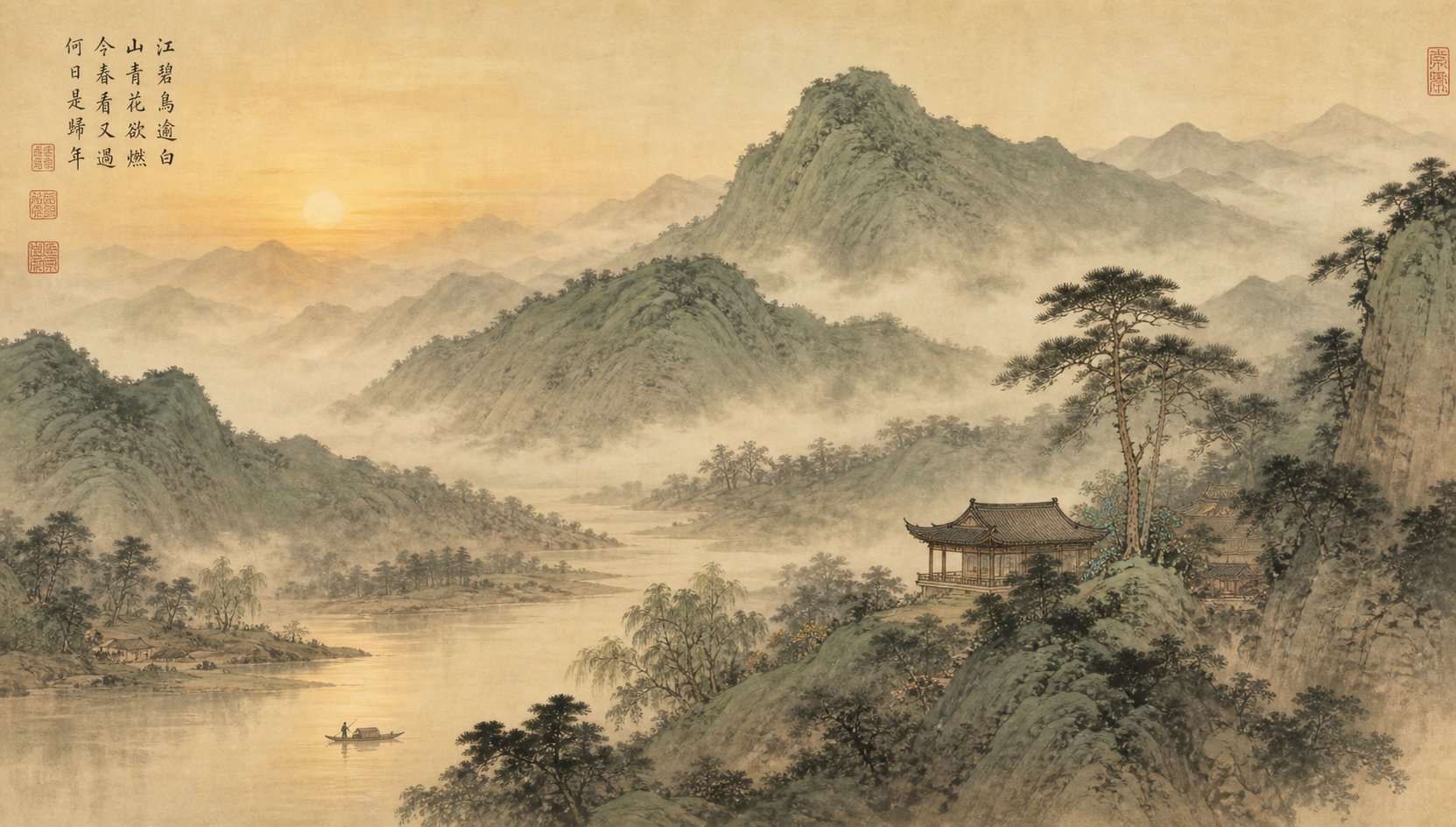
The wind chinese symbol carries weight far beyond vocabulary lists. In Chinese philosophical tradition, wind is not merely a weather event but a cosmic force that shapes the flow of life energy itself. Nowhere is this more evident than in feng shui, the ancient system of spatial harmony whose very name places wind at the foundation of how humans relate to their environment.
Wind in Feng Shui Philosophy
To define feng in the context of feng shui, you need to understand what the ancient Chinese observed about invisible energy. The term feng shui literally translates to "wind-water," and the pairing is not arbitrary. It reflects a core principle from Daoist cosmology: qi (vital energy) flows through landscapes, buildings, and living bodies. Wind and water are the two forces that govern how qi behaves.
The classical text Zangshu (Book of Burial), attributed to the Jin dynasty scholar Guo Pu, provides the foundational explanation. The principle states that when qi encounters wind, it scatters and disperses. When qi encounters water, it stops and accumulates. The entire practice of feng shui grew from this single observation: find locations where wind is gentle enough not to scatter energy, and where water is present to hold energy in place.
If the qi meets the wind it will surely disperse, and if it encounters the water it will be prevented from stopping. Ancient people have always taught us to do everything to let the qi gather, not scatter.
This is the feng shui wind meaning at its most essential. Wind represents dispersal, movement, and change. Water represents retention, stillness, and accumulation. A well-chosen site balances both forces: sheltered from harsh winds that would blow qi away, yet positioned near water that collects and circulates energy gently. Mountains block excessive wind. Rivers and lakes hold qi in place. The interplay creates what practitioners call a "qi pocket," an area where life energy concentrates naturally.
The philosophy connects directly to the five elements system (wood, fire, earth, metal, water) and the yin-yang framework that underlies traditional Chinese thought. Wind belongs to the wood element in the bagua trigram system, associated with the trigram xun (☴), which represents gentle penetration. Like wind slipping through a forest, this energy enters gradually and influences everything it touches without force.
The Character in Classical Poetry and Idioms
Chinese poets recognized wind's metaphorical power thousands of years before feng shui manuals were written. The Book of Songs (诗经), China's oldest poetry anthology compiled around the 6th century BCE, titles its largest section 国风 (guofeng), meaning "Airs of the States." Here, 风 refers to folk songs that carry the emotional atmosphere of a region, the way a prevailing wind carries the scent of whatever landscape it crosses. Poetry itself was understood as a kind of wind: an invisible force that moves people emotionally.
Several four-character idioms (成语) built from 风 remain in active use today, each one compressing a philosophical idea into a compact phrase:
- 风花雪月 (feng hua xue yue) - literally "wind, flowers, snow, moon." Originally described the four most beautiful natural scenes that inspired poetry. Over time it came to mean romantic affairs or flowery but empty writing. The idiom captures how wind participates in aesthetic experience alongside other sensory elements.
- 风调雨顺 (feng tiao yu shun) - literally "wind harmonious, rain smooth." Describes ideal weather conditions for agriculture and, by extension, a period of peace and prosperity. When wind and rain cooperate, harvests succeed and people thrive. This idiom appears frequently in blessings and New Year greetings.
- 风雨同舟 (feng yu tong zhou) - literally "wind and rain, same boat." Means to weather hardship together, to share a difficult journey with solidarity. Wind and rain here represent adversity, and the shared boat represents mutual commitment.
- 风起云涌 (feng qi yun yong) - literally "wind rises, clouds surge." Describes a situation developing rapidly and powerfully, often used for social movements or dramatic historical changes. Wind initiates the action; clouds respond with momentum.
Each idiom treats wind as an active agent rather than passive background. It initiates, it transforms, it tests. This is consistent with how the character functions across all its meanings: 风 is never static. Whether describing a breeze, a custom, a risk, or a poetic mood, the character always implies motion and influence.
Classical poets like Li Bai and Du Fu used 风 constantly, not just to set physical scenes but to evoke political climates, emotional states, and the passage of time. A "cold wind" in a Tang dynasty poem rarely means only temperature. It signals loneliness, political exile, or the approach of old age. A "spring wind" signals renewal, opportunity, or romantic longing. The character became a vehicle for saying what could not be said directly, carrying meaning the way actual wind carries pollen: invisibly, inevitably, across great distances.
This philosophical and poetic depth explains why 风 appears so frequently in traditional Chinese medicine as well. A character already loaded with associations of invisible force, sudden change, and penetrating influence was a natural fit for describing how illness enters the body. The medical dimension of the wind chinese symbol reveals yet another layer of meaning embedded in this single, ancient character.

Wind in Medicine and Japanese Kanji Usage
An invisible force that arrives without warning, changes direction unpredictably, and penetrates wherever it finds an opening. That description fits a gust of autumn air, but in Traditional Chinese Medicine (TCM), it also describes how illness enters the human body. The medical use of 风 draws directly from the same metaphorical logic that shaped its philosophical and poetic meanings: wind is what you cannot see but absolutely feel.
Wind as a Force in Traditional Chinese Medicine
TCM identifies six external pathogenic factors (六淫) that cause disease: wind, cold, heat, dampness, dryness, and fire. Among these six, wind (风邪, fengxie) holds a special status. Classical texts call it the "leader of the hundred diseases" (百病之长) because it rarely acts alone. Wind carries other pathogens into the body the way actual wind carries dust, pollen, or cold air. You get wind-cold (风寒), wind-heat (风热), or wind-dampness (风湿) as combined patterns, with wind serving as the vehicle that delivers the secondary factor past the body's defenses.
Why did ancient physicians choose this character? The reasoning maps perfectly onto wind's observable behavior in nature:
- Sudden onset - Wind-related illnesses appear quickly, just as a gust arrives without gradual buildup. A stiff neck upon waking, a sudden headache, or an acute skin rash all fit the wind pattern.
- Movement and wandering - Symptoms associated with wind tend to migrate. Joint pain that shifts from knee to shoulder, itching that appears in different locations, or a headache that moves from one side to the other all suggest wind pathology.
- Trembling and shaking - Tremors, dizziness, convulsions, and spasms are classified as "internal wind" (内风) symptoms. The body moves involuntarily, mimicking the way trees shake in a storm.
- Upward and outward direction - Wind rises. In TCM, wind pathogens tend to attack the upper body first: the head, face, throat, and skin surface. This matches the observation that wind affects the tops of trees before their roots.
The concept of 风邪 isn't merely historical. Modern TCM practitioners still diagnose wind patterns and prescribe formulas designed to "expel wind" (祛风) or "calm wind" (息风). Herbal categories like wind-dispelling herbs (祛风药) form a major section of the Chinese materia medica. Whether or not you accept TCM's theoretical framework, the linguistic connection is clear: the same character that means breeze, custom, and style also means a pathogenic force that invades the body. All these meanings share the core concept of something invisible that moves, penetrates, and transforms whatever it touches.
The Same Character in Japanese Kanji
The wind japanese symbol is identical to the traditional Chinese form: 風. When this character crossed the sea to Japan centuries ago as part of the kanji writing system, it carried its meanings along. In Japanese, 風 has two standard readings. The kun'yomi (native Japanese reading) is kaze, and the on'yomi (Sino-Japanese reading) is fuu or kaza in compounds.
Here's where the TCM connection creates a fascinating linguistic bridge. The Japanese word for a common cold or flu is 風邪, written with the exact same characters that mean "wind pathogen" in Chinese medicine. In Japanese, this compound is pronounced kaze, the same pronunciation as the standalone kanji wind reading. The medical concept traveled with the character: catching a cold is literally catching the wind. When Japanese speakers say "風邪を引いた" (kaze wo hiita, I caught a cold), they're using language rooted in the ancient Chinese medical idea that wind enters the body and causes illness.
Other common Japanese words built from this kanji for wind include:
- 風景 (fuukei) - scenery, landscape (same compound as Chinese 风景)
- 台風 (taifuu) - typhoon (same compound as Chinese 台风)
- 風呂 (furo) - bath, bathtub (unique to Japanese usage)
- 風船 (fuusen) - balloon (literally "wind ship")
- 和風 (wafuu) - Japanese style (literally "harmonious wind")
The japanese symbol for wind shares most of its semantic range with the Chinese original, but Japanese added its own extensions. 風呂 (bath) likely derives from an older meaning related to steam rooms where heated air circulated. 和風 uses wind in its "style" sense, just as Chinese uses 风格, but pairs it with 和 (harmony, Japan) to mean specifically Japanese aesthetic sensibility.
For learners studying both languages, the kanji wind character offers a rare efficiency. Master 風 once, and you unlock vocabulary across two major East Asian languages. The character's pronunciation differs between Mandarin (fēng) and Japanese (kaze/fuu), but its written form and core meanings remain remarkably stable across the linguistic border. That stability reflects how deeply the original Chinese concept of wind, as invisible force, as carrier, as agent of change, resonated with Japanese culture when it adopted the character over a thousand years ago.
Whether describing a pathogen in a TCM clinic or a cold in a Tokyo pharmacy, the character 風 performs the same conceptual work. It names something you cannot see but must respect. Pronouncing it correctly, and understanding how it fits into the broader system of Chinese radicals and phonetics, is the final practical step for learners ready to use this character with confidence.
How to Pronounce Feng in Chinese: Pronunciation, Radical Classification, and Common Mistakes
Knowing what a character means is only half the equation. Saying it correctly, finding it in a dictionary, and avoiding mix-ups with lookalike characters complete the picture. The chinese symbol for wind is straightforward to pronounce once you understand Mandarin's tone system, but a few common pitfalls trip up learners repeatedly.
Mandarin and Cantonese Pronunciation Guide
In Mandarin, the chinese symbol wind is pronounced feng with the first tone: a high, level pitch that stays flat from start to finish. In tone number notation, that's feng1. In tone mark notation, it's written fēng, with the macron (horizontal line) over the "e" indicating that steady high pitch. Imagine holding a single musical note without letting it rise or fall. That's the first tone.
The initial consonant "f" is identical to English. The vowel combination "eng" sounds roughly like the "ung" in English "sung" but with the tongue positioned slightly more forward. It's not "fang" and it's not "fong." The vowel sits between those two sounds, closer to a short, clipped "uh" followed by the nasal "ng" ending.
Cantonese speakers pronounce the same character quite differently. In Jyutping romanization, the primary reading is fung1 (high level tone), with a secondary reading of fung3 (mid-level tone) when the character functions as a variant of 讽 (to satirize). The vowel shifts from Mandarin's "eng" to Cantonese's rounder "ung," closer to the English word "funk" without the final "k."
| Language/Dialect | Romanization | Tone | Approximate Sound |
|---|---|---|---|
| Mandarin (Pinyin) | feng1 / fēng | 1st tone (high level) | Like "fung" with a flatter vowel, held high and steady |
| Cantonese (Jyutping) | fung1 | High level | Like English "fung" with a rounder vowel |
| Japanese On'yomi | fuu / fu | N/A (pitch accent varies) | Like English "foo" |
| Japanese Kun'yomi | kaze | N/A | Like "kah-zeh" |
| Korean | pung | N/A | Like English "poong" |
| Vietnamese | phong | Ngang (level) | Like "fawng" with an aspirated initial |
The character also carries a third-tone reading in Mandarin (feng3, written fěng) when used as a literary variant of 讽, meaning to satirize or admonish indirectly. This reading is rare in modern speech but appears in classical texts.
Radical Classification: What Kangxi Radical 182 Means for Learners
In traditional Chinese dictionaries organized by the Kangxi system, 風 is classified as Radical 182. This means the character doesn't just appear under another radical; it is a radical. Other characters are organized beneath it.
What does that mean in practice? The Kangxi Dictionary (published in 1716) sorts all Chinese characters under 214 radicals. Each radical acts like a filing category. Characters that contain 風 as a structural component get filed under Radical 182. The dictionary lists 182 characters under this radical, including words for various types of wind, storms, and wind-related phenomena like 颱 (typhoon in traditional form), 飄 (to flutter or drift), and 飆 (violent wind, or to surge).
For learners using modern digital dictionaries, radical lookup is less critical than it once was since you can search by pinyin or handwriting input. But understanding that 風 functions as a radical helps you recognize character families. When you spot that distinctive outer frame in an unfamiliar character, you can reasonably guess the word relates to wind, air movement, or atmospheric conditions.
Characters Often Confused with 风
The simplified form 风 has only four strokes, which makes it easy to write but also easy to confuse with other minimal characters. Here are the most common mix-ups:
- 风 vs 丰 (fēng, abundant/lush) - Identical pronunciation, completely different meaning and appearance. The character 丰 has just three strokes and means abundant, rich, or plentiful. It appears in words like 丰富 (fēngfu, abundant) and 丰收 (fēngshou, bumper harvest). Because both are pronounced fēng with the first tone, learners sometimes confuse them when listening. Visually, 丰 is a simple vertical stroke crossed by three horizontals, nothing like the enclosed frame of 风.
- 風 vs 虱 (shī, louse) - The CantoDict reference specifically warns against this confusion. The traditional form 風 contains 虫 inside an outer frame, while 虱 places a similar-looking element in a different configuration. At small font sizes or in handwriting, the two can look deceptively similar.
- 风 vs 凤 (feng4, phoenix) - The simplified phoenix character 凤 shares the same outer frame as 风 but contains a different interior element (又 instead of 乂). Their historical connection runs deep, as both descended from the same oracle bone form, but in modern usage they are entirely separate characters with different tones (fēng vs feng4).
The most frequent pronunciation mistake is tonal. Learners who speak non-tonal languages often let the pitch drift downward at the end of the syllable, accidentally producing a fourth tone (falling) instead of a first tone (level). The fix is simple: think of the first tone as a sustained note, not a starting point. Hold the pitch steady for the full duration of the syllable. Recording yourself and comparing against native audio helps build the muscle memory.
Mastering this single character, its sound, its structure, and its place in the radical system, gives you a key that unlocks doors across Chinese language, culture, medicine, and philosophy. From oracle bones to weather apps, from Daoist temples to Tokyo pharmacies, 风 carries its ancient meanings forward into modern life. Learn it once, and you'll recognize it everywhere.
Frequently Asked Questions About the Wind Chinese Character
1. What does the Chinese character for wind (风) mean?
The Chinese character 风 (simplified) or 風 (traditional), pronounced fēng in Mandarin, carries six core meanings: literal wind as a natural phenomenon, style or manner (风格), custom or tradition (风俗), rumor or hearsay (风闻), scenery or landscape (风景), and risk (风险). Context and compound pairing determine which meaning applies in any given sentence. All these extended meanings trace back to wind's qualities as an invisible, pervasive, and transformative force.
2. Why does the traditional wind character 風 contain the insect radical?
The traditional form 風 contains the insect radical 虫 inside its outer frame because ancient Chinese observed that seasonal winds coincided with the emergence of insects. Spring breezes signaled the return of buzzing life, while autumn winds marked their disappearance. The ancient dictionary Shuowen Jiezi explained this by stating that when winds blow from all eight directions, creatures are brought forth. Some scholars alternatively interpret the inner element as representing a dragon, another mythical creature believed to ride the wind.
3. What is the difference between simplified 风 and traditional 風?
Both forms share the same outer frame derived from 凡 (the phonetic component), but differ in their interior. Traditional 風 has nine strokes and contains 虫 (insect) inside, preserving the ancient semantic connection between wind and creatures. Simplified 风 has only four strokes, replacing the interior with a minimal cross-stroke 乂. Mainland China and Singapore use 风, while Taiwan, Hong Kong, Macau, and Japan use 風. Both forms carry identical meanings and pronunciation.
4. Is the kanji for wind the same as the Chinese character?
Yes, Japanese kanji uses the traditional Chinese form 風 unchanged. In Japanese, it has two readings: kaze (kun'yomi, native Japanese reading) and fuu (on'yomi, Sino-Japanese reading). Many Japanese compounds mirror Chinese ones directly, such as 風景 (fuukei, scenery) and 台風 (taifuu, typhoon). Japan also created unique compounds like 風呂 (furo, bath) and 風船 (fuusen, balloon). Learning the traditional form 風 gives you recognition across both Chinese and Japanese texts.
5. How do you pronounce feng in Chinese correctly?
In Mandarin, 风 is pronounced fēng with the first tone, a high and level pitch held steady from start to finish without rising or falling. The initial 'f' sounds like English, while the vowel 'eng' sits between 'ung' and 'ang,' closer to a short clipped 'uh' followed by a nasal 'ng' ending. The most common mistake is letting the pitch drift downward, accidentally producing a fourth tone. In Cantonese, the same character is pronounced fung1 with a rounder vowel sound.