How Yin and Yang Shape Chinese Naming Traditions
Imagine giving a child more than just a name. Imagine giving them a blueprint for balance, woven into the very strokes of a character. That is exactly what Chinese parents have done for centuries when selecting yin and yang names for their children.
What Yin and Yang Mean in Chinese Naming
In Chinese culture, every character carries energy. Some characters pulse with brightness, action, and heat — that is yang. Others hold stillness, depth, and coolness — that is yin. When parents choose a name, they are not simply picking something that sounds pleasant. They are selecting characters whose energetic qualities will shape a child's personality, fortune, and path through life.
The significance of yin yang in naming goes far deeper than aesthetics. Each Chinese character contains layers of meaning tied to natural forces: water or fire, moon or sun, softness or strength. A name built from these characters becomes a deliberate act of calibration, designed to explain balanced forces within a single person's identity.
In Chinese tradition, naming a child is considered an act of shaping destiny — a careful alignment of cosmic energies meant to bring harmony between who a person is and who they are meant to become.
Why Balance Matters When Choosing a Name
You'll notice that balance is the operative word here, not dominance. A name overloaded with yang energy might produce restlessness or aggression. One weighted entirely toward yin could invite passivity or withdrawal. The goal is equilibrium — a name that compensates for what a child's birth chart may lack while reinforcing what it already holds.
This is where yin yang meaning in life intersects directly with naming philosophy. The same principle that governs seasons, health, and relationships also governs the characters etched into a person's identity. Parents, naming masters, and families treat this selection process as one of the most consequential decisions they will ever make.
So which characters carry yin energy? Which ones radiate yang? And how do you read the hidden balance inside any Chinese name? The answers lie in the characters themselves — their radicals, their meanings, and the ancient system that classifies them.
The Philosophy Behind Yin-Yang Naming
The characters in a Chinese name do not exist in a vacuum. They draw their energy from a philosophical system that stretches back thousands of years, rooted in the observation that all things in nature exist as complementary pairs. Understanding where this system comes from helps you see why yin vs yang classification matters so deeply in naming.
Roots in Taoism and the I Ching
The earliest written references to yin and yang appear on oracle bones dating to at least the 14th century BCE, where they described simple natural phenomena — sunlight during the day (yang) and its absence at night (yin). According to the Internet Encyclopedia of Philosophy, the original characters referred to the sunny and shady sides of a hill, a concrete observation that gradually evolved into a full cosmological framework.
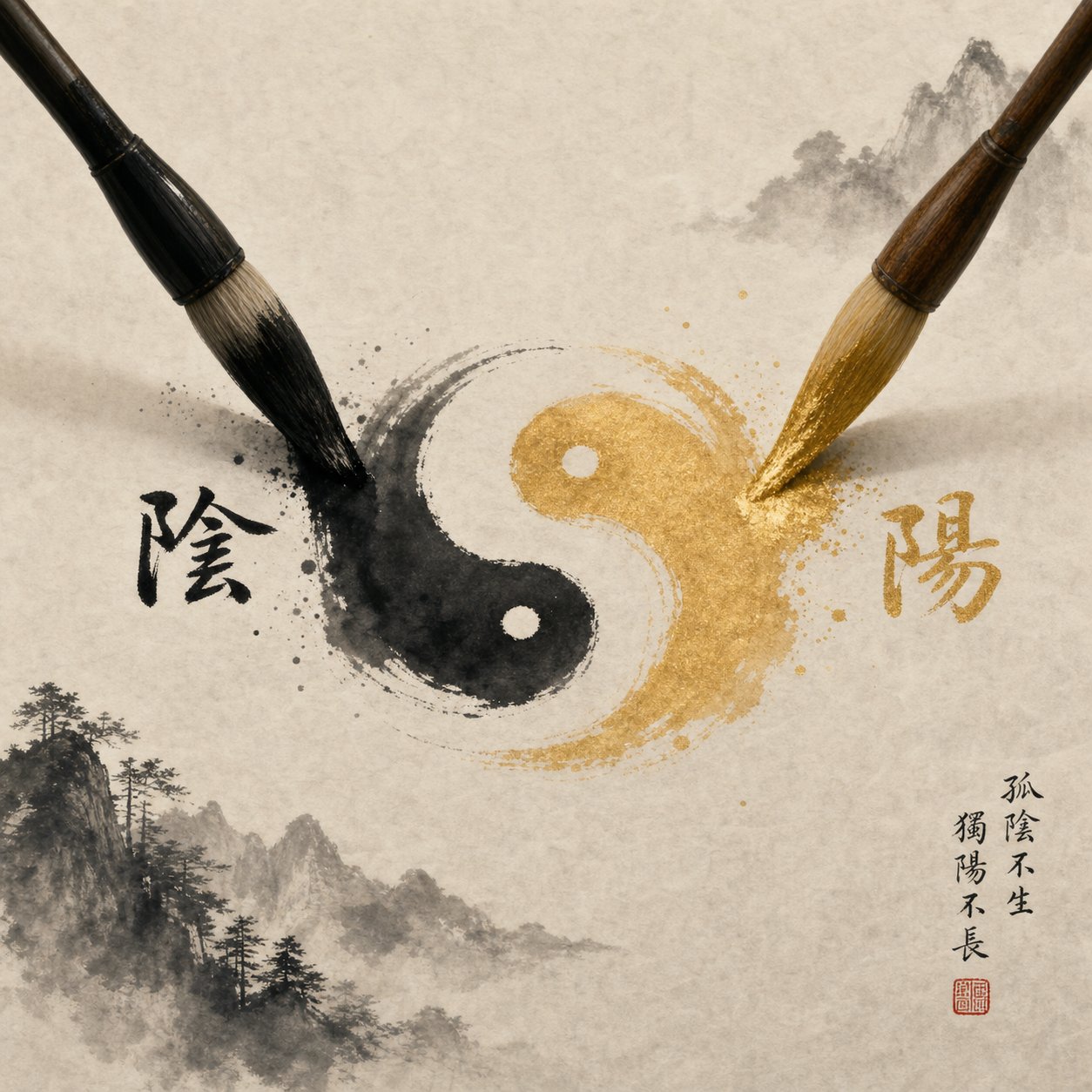
By the time the I Ching (Yijing) was compiled, yin and yang had become the foundational building blocks of reality. The sixty-four hexagrams of the I Ching are constructed entirely from broken (yin) and unbroken (yang) lines, mapping every possible state of change in the universe. The tao symbol — that familiar circle of swirling black and white — emerged from this tradition as a visual representation of constant transformation.
Taoism embraced yin-yang as the mechanism through which the Tao generates all things. Chapter 42 of the Tao Te Ching states that everything is "embedded in yin and embraces yang," achieving harmony through their interaction. The taoism symbol of interlocking forces became a guide not just for meditation or medicine, but for naming children. If the universe itself operates through balanced duality, then a person's name — their identity marker from birth to death — should reflect that same principle.
Confucianism applied this differently. Where Taoism emphasized natural flow, the confucianism symbol of social harmony meant that names carried moral weight. Confucian scholars like Dong Zhongshu (195-115 BCE) argued that heaven and human beings share the same yin-yang structure, creating an intrinsic connection between cosmic forces and personal identity. A name, in this view, was not merely a label. It was a tool for achieving cosmic harmony — aligning a person's inner nature with the moral order of the universe.
This interconnectedness meaning — the idea that a name links a person to universal forces — is what separates Chinese naming from simple preference. An interconnectedness synonym you might use is "interdependence," and that captures it well: the name depends on the person's energy, and the person's trajectory depends on the name.
Core Dualities That Define Yin and Yang Characters
When you look at how naming masters classify characters, they rely on a set of fundamental oppositions. Each duality maps onto specific Chinese characters that carry that energy into a name.
| Duality | Yin Character | Pinyin | Yang Character | Pinyin |
|---|---|---|---|---|
| Moon vs Sun | 月 | yue | 日 | ri |
| Water vs Fire | 水 | shui | 火 | huo |
| Earth vs Heaven | 地 | di | 天 | tian |
| Passive vs Active | 静 | jing | 动 | dong |
| Dark vs Light | 暗 | an | 明 | ming |
| Soft vs Strong | 柔 | rou | 刚 | gang |
These pairings are not arbitrary. They reflect the original observations of early Chinese peasants who noticed that yang is movement (dong) and yin is rest (jing) — a pattern derived from the daily cycle of working under the sun and resting after dark. When a naming master selects characters, they are drawing from this ancient map of natural forces, placing a child's identity within the larger rhythm of the cosmos.
The real craft lies in knowing which side of these dualities a particular child needs. That determination depends on specific characters, their radicals, and the elemental system that classifies them — a system with precise rules for reading energy in every stroke.
Chinese Characters With Yin Energy for Names
So what does yin actually look like when it shows up in a name? It looks like moonlight on still water. It sounds like a whispered promise. Each yin character carries qualities of darkness, cold, stillness, softness, and introversion — but none of those words mean what Western ears might assume.
Characters of Moon, Water, and Stillness
Yin characters used in Chinese names tend to cluster around a few natural images: the moon, water, snow, night, and quiet spaces. Each one channels a specific facet of yin energy into the person who carries it. Here is a reference list of the most commonly used yin characters in given names, with their yin pinyin pronunciation and core qualities:
| Character | Pinyin | Meaning | Yin Quality |
|---|---|---|---|
| 月 | yue (4th tone) | Moon | Reflective light, cycles, intuition |
| 静 | jing (4th tone) | Quiet, still | Inner calm, contemplation, depth |
| 柔 | rou (2nd tone) | Gentle, soft | Flexibility, yielding strength |
| 雪 | xue (3rd tone) | Snow | Purity, coolness, transformation |
| 水 | shui (3rd tone) | Water | Adaptability, flow, hidden power |
| 夜 | ye (4th tone) | Night | Mystery, rest, renewal |
| 幽 | you (1st tone) | Secluded, serene | Depth, subtlety, refinement |
| 婉 | wan (3rd tone) | Graceful, elegant | Diplomacy, beauty, composure |
Notice the pattern. These characters do not describe weakness. They describe water that carves canyons, snow that silences entire landscapes, and moonlight that guides travelers when the sun cannot. Each one embodies a force that operates through patience and persistence rather than confrontation.
Why Yin Names Carry Quiet Power
Here is where a common misconception needs correcting. Many people outside Chinese culture assume yin is the negative side of the equation — the lesser half. This confusion partly stems from what does the color black represent in Western symbolism, where darkness often signals danger or evil. In Chinese philosophy, the relationship between negative positive, red black, dark and light is entirely different. Yin is not inferior. It is essential.
Dark feminine energy in the Chinese tradition refers to receptivity, intuition, nurturing strength, and the capacity to hold space for growth. Think of it this way: yang is the seed that breaks through soil, but yin is the soil itself — the medium that makes all growth possible. A name like 静婉 (Jingwan, "quietly graceful") does not suggest a passive person. It suggests someone whose power operates beneath the surface, like deep currents that move entire oceans without disturbing the waves above.
Parents who choose yin-dominant names are not wishing softness upon their children. They are selecting for depth, emotional intelligence, and the kind of resilience that bends without breaking. In a culture that values harmony over dominance, these qualities carry tremendous weight.
The counterpart to these characters — the ones that burn with solar fire and crackling energy — follows a completely different logic in how they shape a name's identity.
Chinese Characters With Yang Energy for Names
Where yin characters draw power from stillness and depth, yang characters announce themselves. They blaze. They rise. They project outward like sunlight hitting a mountainside at dawn. In Chinese naming, yang characters function as an energy symbol of action, ambition, and visible strength — the opposite of passive, inward-facing yin.
Characters of Sun, Fire, and Strength
Yang characters cluster around images of heat, height, light, and force. You'll find them in names that evoke the sun breaking through clouds, dragons ascending through storms, and fire that refuses to be contained. Here are the most commonly used yang characters in Chinese given names:
| Character | Pinyin | Meaning | Yang Quality |
|---|---|---|---|
| 阳 | yang (2nd tone) | Sun, positive | Radiance, warmth, life-giving force |
| 刚 | gang (1st tone) | Strong, firm | Unyielding resolve, structural strength |
| 明 | ming (2nd tone) | Bright, clear | Clarity, intelligence, illumination |
| 龙 | long (2nd tone) | Dragon | Imperial power, transformation, ascent |
| 火 | huo (3rd tone) | Fire | Passion, energy, purification |
| 威 | wei (1st tone) | Mighty, awe-inspiring | Authority, commanding presence |
| 昊 | hao (4th tone) | Vast sky | Boundless ambition, expansiveness |
| 烈 | lie (4th tone) | Fierce, intense | Courage, passionate conviction |
Each of these characters contains radicals or structural elements that signal yang energy. The character 阳 itself includes the sun radical 日, while 明 combines 日 (sun) with 月 (moon) — brightness emerging from the interplay of both forces. 火 is a pictograph of flames rising upward, and 昊 places 天 (heaven) above 日 (sun), suggesting a sky so vast it dwarfs even sunlight. Among all the yangs used in naming, 龙 holds a special place: the dragon is China's ultimate symbol of ascending power, and names containing it — like 龙威 (Longwei, "dragon's might") — carry centuries of imperial resonance.
Characters like 刚 and 烈 represent a different flavor of yang. Rather than celestial imagery, they channel raw physical and moral force. A name like 刚毅 (Gangyi, "firm and resolute") projects unbreakable will, while 烈 appears in words like 烈士 (martyr) and 烈火 (raging fire), connecting the name-bearer to fierce dedication.
Gender Traditions and Modern Shifts in Yang Naming
Historically, yang characters were reserved almost exclusively for boys. The logic was straightforward: in traditional Chinese society, male female symbols mapped directly onto yang and yin. The male symbol was associated with outward action, public life, and assertive strength — qualities encoded in characters like 威, 刚, and 龙. Girls received yin characters suggesting grace, beauty, and inner virtue.
This convention held for centuries, but it is shifting. Contemporary Chinese parents — particularly in urban centers and diaspora communities — increasingly select yang characters for daughters. A girl named 明昊 (Minghao, "bright and boundless") or 烈华 (Liehua, "fierce brilliance") carries the same solar energy that once belonged only to sons. This shift reflects broader cultural changes: as rigid gender expectations loosen, the old alignment between male female symbols and yin-yang naming breaks down.
The result is a richer naming landscape. Parents today choose yang characters based on what energy their child's birth chart needs, not on gender alone. A boy born with excessive yang in his bazi might actually receive a yin-leaning name to restore balance, while a girl whose chart lacks fire might be given 烈 or 火 to compensate.
This raises a practical question: how do you actually determine whether a given character is yin or yang? The answer involves a systematic analysis of radicals, stroke counts, and elemental associations — a method that naming masters have refined over generations.

How to Tell If a Chinese Character Is Yin or Yang
Knowing which characters carry yin or yang energy is one thing. Being able to classify any character on your own — that is where real understanding begins. Chinese naming masters do not rely on intuition alone. They follow a systematic method built on structural analysis, numerical patterns, and elemental theory. Each character contains multiple signals, and reading them correctly is what separates a balanced name from a misaligned one.
Radical and Stroke Count Analysis
The first place to look is the character's radical — the structural component that anchors its meaning. Radicals function like a character's DNA, revealing its elemental origin before you even consider the full meaning. Here is how the yin yang sign embedded in a character's structure breaks down:
Yin-indicating radicals:
- 氵(water radical) — found in characters like 清 (qing, clear), 涵 (han, contain), 洁 (jie, pure)
- 月 (moon radical) — found in characters like 朦 (meng, hazy), 朗 (lang, bright moonlight)
- 雨 (rain radical) — found in characters like 雪 (xue, snow), 霜 (shuang, frost), 露 (lu, dew)
- 玉 (jade radical) — found in characters like 瑶 (yao, precious jade), 琳 (lin, fine jade)
Yang-indicating radicals:
- 火 or 灬 (fire radical) — found in characters like 炎 (yan, blazing), 煜 (yu, brilliant), 熙 (xi, prosperous)
- 日 (sun radical) — found in characters like 昊 (hao, vast sky), 晨 (chen, morning), 旭 (xu, rising sun)
- 山 (mountain radical) — found in characters like 峰 (feng, peak), 岳 (yue, great mountain)
- 金 or 钅 (metal radical) — context-dependent, but often yang when suggesting weapons or hardness
Sounds complex? There is a second layer. Traditional Chinese numerology assigns yin or yang value based on stroke count. Characters with an even number of strokes carry yin energy, while those with an odd number carry yang. The character 明 (ming, bright) has 8 strokes — an even number — which introduces a subtle yin undertone despite its yang meaning. This tension between semantic meaning and numerical value is exactly what naming masters spend years learning to navigate.
Phonetic quality adds a third dimension. Softer, flowing sounds (like the "sh" in shui or the "r" in rou) lean yin. Harder, explosive sounds (like the "g" in gang or the "zh" in zhuang) lean yang. When you combine radical analysis, stroke count, and phonetic texture, you get a composite reading of where any character falls on the yin-yang spectrum.
Five Elements and Birth Chart Connections
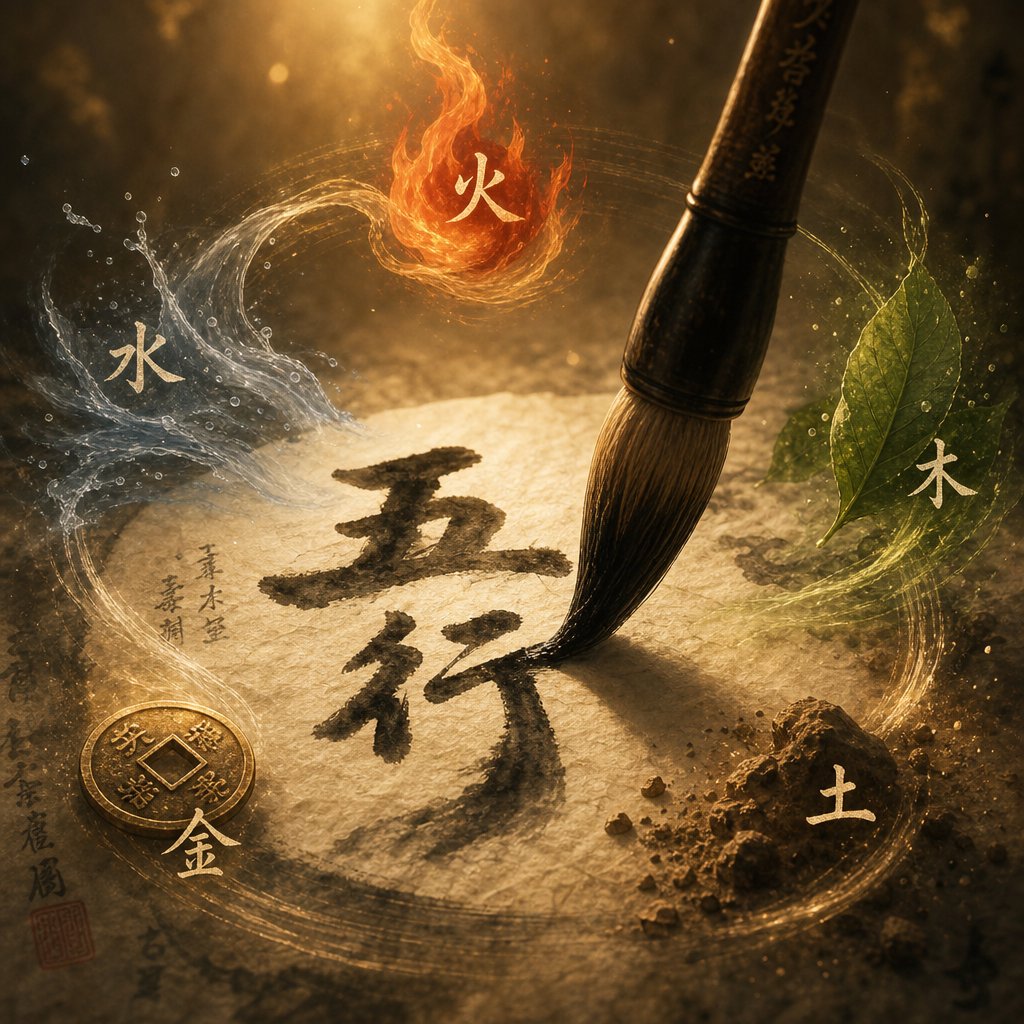
The yin yang symbol meaning extends beyond simple duality into a five-part system. The Five Elements (五行, wuxing) — Wood, Fire, Earth, Metal, and Water — each carry their own yin-yang orientation:
| Element | Chinese | Yin/Yang Lean | Associated Qualities |
|---|---|---|---|
| Water (水) | shui | Yin | Wisdom, adaptability, flow |
| Metal (金) | jin | Yin | Precision, clarity, refinement |
| Fire (火) | huo | Yang | Passion, visibility, transformation |
| Wood (木) | mu | Yang | Growth, ambition, upward movement |
| Earth (土) | tu | Neutral/Balanced | Stability, nourishment, grounding |
A naming master (命名师) does not evaluate characters in isolation. They cross-reference every factor against the child's birth chart — the bazi (八字), or "Eight Characters" — which maps the exact balance and force of elemental energies present at the moment of birth. The bazi reveals whether a child already carries excess fire, insufficient water, or a deficiency of metal. The name then compensates, channeling pure qi into the areas that need strengthening.
Here is the step-by-step process a naming master follows when classifying a character and building a balanced name:
- Calculate the bazi: Using the child's birth year, month, day, and hour, determine the elemental composition and identify which elements are strong, weak, or absent.
- Identify the deficiency: Determine whether the chart lacks yin energy, yang energy, or a specific element. This gap is what the name must fill.
- Select candidate characters: Choose characters whose radicals align with the needed element or energy direction.
- Verify stroke count: Confirm that the total stroke count of the given name supports the desired yin-yang orientation (even for yin, odd for yang).
- Assess phonetic harmony: Ensure the sounds of the full name (surname plus given name) flow naturally and reinforce the intended energy through tonal balance.
- Check elemental interaction: Verify that the elements in the name characters do not conflict with each other or with the surname's elemental association (e.g., water and fire in direct opposition can create tension unless mediated by wood or earth).
- Final balance review: Evaluate the complete name as a unified system — radicals, strokes, sounds, and elements working together to produce harmony.
This process reveals why yin and yang chinese names are never arbitrary. Every character is chosen through a layered analysis where structure, number, sound, and cosmic timing converge. A single character might read as yang by meaning, yin by stroke count, and neutral by element — and the naming master must weigh all three signals to determine its true contribution to the name's overall balance.
For families with twins or siblings, this system opens up a fascinating possibility: creating paired names where one child carries the yin complement and the other carries the yang, forming a complete circle of harmony between them.
Yin-Yang Name Pairs for Twins and Siblings
Two children. Two names. One complete circle. In Chinese families, giving siblings or twins names that mean yin and yang is more than a creative exercise — it is a statement about family unity. The idea is simple but profound: each child carries one half of a duality, and together they form wholeness. Their names become a living yin and yang symbol name, a reminder that neither sibling is complete without the other.
This tradition runs deep. In classical Chinese culture, complementary sibling names signaled that a family understood cosmic harmony and wished to embed it into their lineage. Parents would select characters from opposite ends of the same duality — moon and sun, water and fire, stillness and motion — so that the children's names, spoken together, would sound like a balanced poem. The practice persists today, especially among families welcoming twins who want names meaning yin and yang woven into their children's identities from day one.
Moon and Sun Name Pairs
The moon-sun duality is the most iconic pairing in Chinese cosmology. Moon represents reflection, intuition, and quiet cycles. Sun represents clarity, action, and radiant warmth. Names built from these images give one child the energy of night and the other the energy of day.
| Yin Name | Pinyin | Meaning | Yang Name | Pinyin | Meaning | Duality Theme |
|---|---|---|---|---|---|---|
| 月婉 (Yuewan) | yue wan | Graceful moon | 日昊 (Rihao) | ri hao | Vast sun | Moon vs Sun |
| 朦月 (Mengyue) | meng yue | Hazy moonlight | 旭明 (Xuming) | xu ming | Rising brightness | Moon vs Sun |
| 夜宁 (Yening) | ye ning | Peaceful night | 晨阳 (Chenyang) | chen yang | Morning sun | Night vs Day |
Notice how each pair shares a structural logic. 月婉 pairs the moon radical with gracefulness, while 日昊 stacks the sun beneath heaven's vastness. Spoken together — Yuewan and Rihao — they create a tonal rhythm that moves from falling to rising, mirroring the cycle they represent.
Water and Fire Name Pairs
Water and fire represent the most dramatic opposition in the Five Elements system. Yet in naming, they do not clash — they complete. Water brings depth and adaptability; fire brings passion and visibility. Siblings carrying these names that mean yin and yang embody the full spectrum of human energy.
| Yin Name | Pinyin | Meaning | Yang Name | Pinyin | Meaning | Duality Theme |
|---|---|---|---|---|---|---|
| 清涵 (Qinghan) | qing han | Clear and deep | 煜炎 (Yuyan) | yu yan | Brilliant flame | Water vs Fire |
| 润泽 (Runze) | run ze | Nourishing moisture | 烈辉 (Liehui) | lie hui | Fierce radiance | Water vs Fire |
| 雪澄 (Xuecheng) | xue cheng | Snow-clear purity | 焱昊 (Yanhao) | yan hao | Blazing sky | Water vs Fire |
The character 润 (run, nourish) paired with 泽 (ze, grace) creates a name that feels like gentle rain on dry earth. Its counterpart 烈辉 combines fierce intensity with shining light — a name that burns bright. Together, these siblings carry both the capacity to soothe and the power to ignite.
Gentle and Strong Name Pairs
Not every pairing needs celestial imagery. Some of the most effective names meaning yin yang draw from human qualities directly — softness paired with firmness, flexibility paired with resolve.
| Yin Name | Pinyin | Meaning | Yang Name | Pinyin | Meaning | Duality Theme |
|---|---|---|---|---|---|---|
| 柔安 (Rouan) | rou an | Gentle peace | 刚毅 (Gangyi) | gang yi | Firm resolve | Soft vs Strong |
| 静幽 (Jingyou) | jing you | Serene stillness | 威龙 (Weilong) | wei long | Mighty dragon | Calm vs Power |
| 婉仪 (Wanyi) | wan yi | Graceful poise | 昊天 (Haotian) | hao tian | Boundless heaven | Grace vs Grandeur |
A pair like 柔安 and 刚毅 works beautifully because the characters share a structural simplicity — neither name overwhelms the other visually. When written side by side in calligraphy, they balance on the page just as they balance in meaning. This visual harmony matters in Chinese culture, where a name's calligraphic beauty carries real weight in formal contexts.
When selecting paired names, consider more than just opposition. The best complementary names share something — a tonal pattern, a stroke density, or a literary reference — that ties them together even as their energies diverge. They should sound like siblings when spoken aloud: clearly different, yet unmistakably related.
These pairings work as a starting framework, but real-world naming involves another layer entirely. Historical figures, literary characters, and cultural icons have carried yin-yang balanced names for centuries — and their examples reveal how these principles play out across actual lifetimes.
Famous Chinese Names That Reflect Yin-Yang Balance
Theory is one thing. Seeing it play out across centuries of real lives and legendary stories is another. The yin yang name tradition is not an abstract concept locked in philosophy texts — it shaped the identities of emperors, poets, and fictional heroes whose names still resonate today. When you study chinese symbols and meanings embedded in these famous names, you find the same balancing logic at work generation after generation.
Historical Figures and Their Balanced Names
In classical China, a person often carried multiple names: a given name (名, ming), a courtesy name (字, zi) granted at adulthood, and sometimes a literary pseudonym (号, hao). This layered system gave families and scholars multiple opportunities to calibrate yin-yang balance. If the birth name leaned too heavily toward one energy, the courtesy name could compensate.
Consider how this worked in practice:
- 李白 (Li Bai) — The Tang dynasty poet's given name 白 means "white" or "pure," carrying a light symbol quality associated with yang clarity. Yet his courtesy name 太白 (Taibai) references the planet Venus, which in Chinese astronomy belongs to the Metal element and carries yin energy. The pairing balances celestial brightness with reflective, inward-pulling metal.
- 诸葛亮 (Zhuge Liang) — The legendary strategist's given name 亮 means "bright" — pure yang illumination. His courtesy name 孔明 (Kongming, "exceedingly bright") doubles down on yang energy, which aligns with his role as a figure of dazzling intellect and decisive action. Here, the name light meaning reinforces the person's destiny rather than compensating for a deficiency.
- 武则天 (Wu Zetian) — China's only female emperor carried 则天 ("model for heaven") as a posthumous title, projecting maximum yang authority. Yet her birth name 曌 (zhao) — a character she invented — combines 明 (bright) above 空 (sky/void), fusing yang radiance with the expansive emptiness of yin. The ying yang symbol of interlocking forces is literally built into her character's structure.
- 杜甫 (Du Fu) — The "Poet Sage" bore the courtesy name 子美 (Zimei, "child of beauty"), a softer, more yin-leaning name that balanced the assertive energy of 甫 ("beginning, just now"), which carries forward-moving yang momentum.
These examples reveal a pattern: the most enduring figures in Chinese history often carried names where yin and yang existed in deliberate tension, as though the name itself was designed to hold contradictions together.
Literary and Cultural Name Examples
Classical Chinese novels used naming as a storytelling device, encoding a character's fate directly into their name. Authors understood that readers would instinctively read the yin-yang balance of a name and anticipate the character's arc.
- 林黛玉 (Lin Daiyu) from Dream of the Red Chamber — 黛 means "dark pigment" and 玉 means "jade." Both characters lean heavily yin: darkness, coolness, precious interiority. Her tragic, introspective nature is written into every stroke of her name.
- 贾宝玉 (Jia Baoyu) from the same novel — 宝 ("treasure") and 玉 ("jade") combine material preciousness with yin-associated jade. Despite being male, his yin-dominant name signals his sensitive, unconventional personality — a deliberate subversion of yang expectations for men.
- 孙悟空 (Sun Wukong) from Journey to the West — 悟 means "awakening" (yang clarity) and 空 means "emptiness" (yin void). The Monkey King's name holds both explosive action and Buddhist emptiness in a single breath, reflecting his journey from chaos toward enlightenment.
- 赵云 (Zhao Yun) from Romance of the Three Kingdoms — 云 means "cloud," a yin image of softness and movement. His courtesy name 子龙 (Zilong, "child of the dragon") injects pure yang power. Together, the names suggest a warrior whose strength flows like clouds yet strikes like a dragon.
What makes these literary names so effective is that readers familiar with the name of yin yang symbol — the taijitu — can see its logic operating within each character's identity. The authors were not just naming characters. They were encoding destiny.
These traditions have not faded. In modern China, Taiwan, Hong Kong, and diaspora communities across Southeast Asia and the West, parents still consult the same principles when naming children. The characters may shift with generational taste — 昊 and 梓 are popular now where 龙 and 凤 once dominated — but the underlying logic of balancing yin and yang energy remains intact. A family in Taipei selecting a name in 2025 draws from the same well as a Song dynasty scholar choosing a courtesy name a thousand years ago.
Knowing these historical and literary precedents is valuable, but applying the tradition to your own family requires a more practical framework — one that bridges classical philosophy with the realities of modern naming across cultures and languages.
How to Choose a Yin-Yang Balanced Chinese Name
You understand the philosophy. You can identify yin and yang characters. You have seen how historical figures and literary icons carried balanced names across centuries. The question now is personal: how do you actually choose a name for your own child, student, or yourself — especially if you are navigating this tradition from outside Chinese culture?
Whether you are a diaspora family reconnecting with heritage or a non-Chinese parent drawn to the depth of this naming system, two paths exist. Each has strengths, and understanding both helps you decide which fits your situation.
Traditional Naming Masters vs Modern DIY Methods
The traditional route involves consulting a naming master (命名师, mingmingshi). These specialists — still active across China, Taiwan, Hong Kong, and in overseas Chinese communities — treat naming as a diagnostic art. They calculate the child's bazi (birth chart), identify elemental gaps, and select characters that restore balance. The process is personalized, rigorous, and rooted in centuries of practice. For families who want the full depth of the tradition, this remains the gold standard.
The modern DIY approach works differently. It draws on the same principles but simplifies the process for families without access to a naming master or those who prefer a hands-on role. You research character meanings, cross-reference radicals and elements, and select yin yang names based on the qualities you want to cultivate. Online databases, character dictionaries, and step-by-step naming guides make this accessible even for beginners.
You might hear people use other words for yin yang when describing this balance — terms like "complementary forces," "dual harmony," or "opposing energies." Another word for yin yang that captures the naming philosophy well is simply "equilibrium." Whatever language you use, the goal stays the same: a name that feels complete rather than lopsided.
Practical Steps for Choosing a Balanced Name
Imagine you are starting from scratch. You want a name grounded in yin-yang principles but are not sure where to begin. Here is a decision-making framework that moves from philosophy to a specific, balanced name:
- Determine the child's birth season and time. A child born in summer (fire season) already carries natural yang energy. A winter birth leans yin. This gives you a starting orientation — the name should gently counterbalance what the season provides in excess.
- Identify desired personality qualities. Do you want the name to encourage resilience, creativity, calm, or ambition? Map those qualities onto the yin-yang spectrum. Resilience and ambition lean yang. Creativity and calm lean yin. This step clarifies which type of character energy you are seeking.
- Analyze the family surname's energy. Surnames carry their own yin-yang weight. A surname like 火 (Huo) or 阳 (Yang) already injects yang into the full name. A surname like 林 (Lin, forest) leans toward wood-yang but with softer phonetics. The given name should complement — not duplicate — the surname's energy.
- Select characters using radical and meaning checks. Choose one or two characters whose radicals, meanings, and elemental associations align with the energy gap you identified. Cross-reference the tables from earlier sections to verify each character's yin or yang classification.
- Test phonetic harmony. Say the full name aloud — surname plus given name. Listen for tonal flow. A name that alternates between rising and falling tones (like 2nd tone followed by 4th tone) creates natural rhythm. Avoid three consecutive characters in the same tone, which sounds flat in Mandarin.
- Verify stroke count balance. Add the total strokes of the given name characters. If you need yin energy, aim for an even total. For yang, aim for odd. This is a secondary check, not a dealbreaker, but it adds another layer of intentionality.
- Consider cross-cultural pronunciation. If the child will live in a non-Chinese-speaking environment, test whether the name's pinyin sounds natural in that language. Names like 明 (Ming) or 安 (An) cross linguistic boundaries easily. Characters with sounds unfamiliar to English speakers — like 雪 (Xue) or 昊 (Hao) — may need more introduction but carry beautiful meaning.
This framework works whether you are choosing from different names for yin and yang traditions or blending approaches. The key is treating the process as layered rather than linear — each step refines your choice rather than replacing the previous one.
For non-Chinese families engaging with this tradition, respect matters more than perfection. Learn the meanings behind the characters you choose. Understand that other names for yin yang — balance, duality, harmony — all point toward the same core value: wholeness. You do not need to master every nuance of bazi calculation to select a meaningful, energetically thoughtful name. What matters is approaching the tradition with genuine curiosity rather than surface-level borrowing.
Diaspora families often navigate a middle path — honoring ancestral naming customs while adapting to the realities of multilingual households. Many choose a Chinese given name that follows yin-yang principles alongside a Western legal name, giving the child access to both cultural identities. Others select characters whose pinyin doubles as an English-friendly name: 安 (An, peace — yin), 明 (Ming, bright — yang), or 凯 (Kai, triumph — yang).
Whatever path you take, the underlying principle holds: a well-chosen name is not about rigid rules. It is about intention, awareness, and the quiet confidence that comes from understanding what each character secretly carries within its strokes.
Common Myths and Final Guidance on Yin-Yang Names
Even with a solid understanding of characters, radicals, and elemental theory, certain misconceptions persist — especially among those encountering this tradition for the first time. These myths can lead to poorly balanced names or, worse, a fundamental misreading of what yin and yang actually represent. Clearing them up is the difference between surface-level naming and genuinely thoughtful selection.
Misconceptions About Yin and Yang in Names
The most stubborn myth? That yin is bad and yang is good. Western culture tends to associate darkness with evil and light with virtue, so people unfamiliar with Chinese philosophy project that binary onto yin-yang naming. They assume a yin-heavy name burdens a child with weakness, while a yang-dominant name guarantees strength. Neither is true.
Yin is not passivity in the pejorative sense. It is the stillness that precedes action, the depth that gives meaning to surface, the root system that feeds the visible tree. Yang is not inherently superior — unchecked yang produces burnout, aggression, and instability. A name loaded entirely with fire and sun characters does not create a powerful person. It creates an imbalanced one.
A second misconception: that a "balanced" name must contain one yin character and one yang character. In practice, balance is contextual. If a child's birth chart already overflows with water and metal (yin elements), the name might need two yang characters to compensate. Conversely, a child born at noon in midsummer — peak yang conditions — might benefit from a fully yin name like 静雪 (Jingxue, "still snow"). Balance refers to the whole system, not to the name in isolation.
A third myth worth addressing: that synonyms for yin and yang are interchangeable with the original concepts. People sometimes substitute "passive/aggressive" or "negative/positive" as a synonym yin yang replacement, but these English terms carry moral weight that the Chinese originals do not. Yin and yang are descriptive, not evaluative. They describe how energy moves — inward or outward, contracting or expanding — without ranking one direction above the other.
Yin-yang naming is about harmony and completeness, not opposition or hierarchy. A name does not pit one force against another — it weaves them into a single identity where nothing essential is missing.
Balancing Tradition With Modern Naming Needs
Contemporary Chinese naming operates at an intersection that did not exist a century ago. Parents today weigh traditional yin-yang principles alongside concerns their grandparents never faced: international pronunciation, digital searchability, cross-cultural legibility, and personal aesthetics that shift with generational taste.
This does not mean tradition is fading. It means tradition is adapting. A family in Shanghai might consult a naming master for the elemental analysis, then adjust the final character choice so the pinyin works as an English-friendly name abroad. A Taiwanese couple might honor stroke-count numerology while also ensuring the name does not produce awkward romanization in their child's future passport. These are not compromises — they are extensions of the same principle. Harmony means fitting all the relevant forces together, and in a globalized world, those forces now include linguistic context beyond Mandarin.
What stays constant is the core insight: a name is not decoration. It is architecture. Every character you select builds a structure around a person's identity — one they will inhabit for a lifetime. Whether you follow every classical rule or adapt the tradition to your family's specific circumstances, the depth of intention matters more than rigid adherence to any single method.
Here is what to carry forward from this entire tradition:
- Yin and yang are equally valuable. Neither needs correction — only imbalance does.
- A name compensates for what is missing, not what is already present.
- Radicals, stroke counts, phonetics, and elements all contribute to a character's energy. No single factor overrides the others.
- Respect the tradition's depth even if you simplify its application. Understanding why matters as much as knowing how.
- The best name feels inevitable — as though the person and the characters were always meant to find each other.
Yin and yang chinese names carry thousands of years of philosophical weight in just two or three characters. That compression is what makes them powerful. When you understand what each character secretly reveals — its elemental pull, its radical ancestry, its place in the cosmic balance — you stop seeing names as labels and start seeing them as living blueprints, quietly shaping the person who carries them forward into the world.
Frequently Asked Questions About Yin and Yang Chinese Names
1. What makes a Chinese character yin or yang in naming?
A character's yin or yang classification depends on multiple factors working together. Naming masters analyze the radical (water and moon radicals indicate yin; fire and sun radicals indicate yang), stroke count (even strokes lean yin, odd strokes lean yang), Five Elements association, and phonetic quality. Softer sounds like 'sh' and 'r' suggest yin energy, while harder sounds like 'g' and 'zh' suggest yang. These layers combine to give each character a composite energy reading that determines its role in a balanced name.
2. Can a boy have a yin name or a girl have a yang name?
Yes, and this practice is increasingly common in modern Chinese naming. Traditionally, yang characters were reserved for boys and yin characters for girls, but contemporary parents select characters based on what energy the child's birth chart needs rather than gender alone. A boy born with excessive yang energy might receive a yin-leaning name to restore balance, while a girl whose chart lacks fire might be given yang characters like 烈 (fierce) or 明 (bright) to compensate for the deficiency.
3. Is yin energy negative or inferior to yang in Chinese names?
No. This is one of the most persistent misconceptions about yin-yang naming. In Chinese philosophy, yin represents receptivity, depth, intuition, and nurturing strength — qualities like water carving canyons or moonlight guiding travelers. Yang is not superior; unchecked yang produces burnout and instability. Both energies are equally necessary, and a well-balanced name draws on whichever force the child needs most, regardless of whether that force is yin or yang.
4. How do Chinese naming masters use birth charts to select names?
Naming masters calculate the child's bazi (Eight Characters) using the exact birth year, month, day, and hour to map elemental composition. They identify which of the Five Elements are strong, weak, or absent, then determine whether the chart lacks yin energy, yang energy, or a specific element. Characters are selected whose radicals and elemental associations fill that gap. The master then verifies stroke count, phonetic harmony, and elemental interactions to ensure the complete name functions as a unified, balanced system.
5. What are good yin-yang name pairs for Chinese twins?
Effective twin name pairs draw from complementary dualities. Moon and sun pairs like 月婉 (Yuewan, graceful moon) and 日昊 (Rihao, vast sun) represent night and day. Water and fire pairs like 清涵 (Qinghan, clear and deep) and 煜炎 (Yuyan, brilliant flame) embody depth versus passion. Gentle and strong pairs like 柔安 (Rouan, gentle peace) and 刚毅 (Gangyi, firm resolve) contrast softness with firmness. The best pairs share tonal rhythm or stroke density so they sound like siblings when spoken together.