Understanding Yin and Yang as a Foundation for Name Selection
Imagine giving a child a name that does more than identify them. In East Asian naming traditions, a name is a carefully calibrated vessel of energy, shaped by forces that have guided Chinese philosophy for thousands of years. At the heart of this practice sits one deceptively simple idea: yin and yang.
What Yin and Yang Mean in the Context of Naming
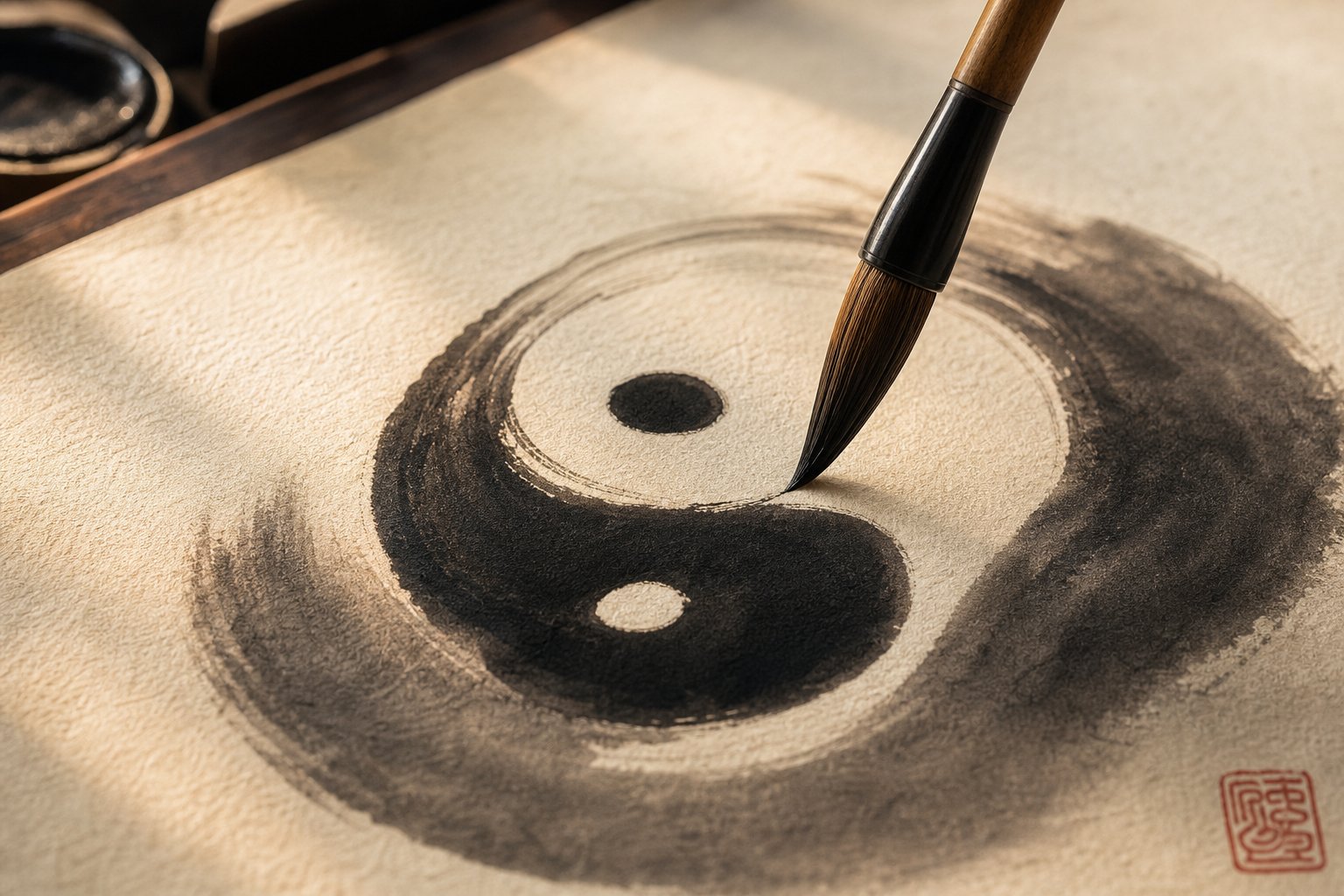
Yin and yang represent complementary opposites woven into everything that exists. Yin carries qualities of darkness, stillness, receptivity, and even numbers. Yang embodies light, movement, assertiveness, and odd numbers. Neither is good or bad on its own. They function as two halves of a whole, each giving the other meaning and momentum.
In nameology, these forces become practical tools. Every character in a name carries measurable yin or yang weight through its stroke count, internal structure, tonal pronunciation, and semantic meaning. A yin yang name is one where these dimensions work together rather than pulling against each other. Practitioners across China, Korea, Japan, and Vietnam still apply these principles when selecting yin and yang names for newborns, businesses, and even adults seeking a fresh start.
Why Balance Matters in a Name
This is not historical trivia. Parents consult naming specialists today, and digital tools have made the tradition more accessible than ever. The underlying belief remains consistent: a name is not passive. It interacts with the bearer's destiny.
A name carries energetic weight. Yin-yang balance within it is believed to shape a person's fortune, temperament, and life trajectory from the moment it is spoken aloud.
Think of it like tuning an instrument. Too much tension in one direction and the sound distorts. A name heavy in yang energy without yin counterbalance may project aggression rather than strength. One saturated in yin without yang support might feel withdrawn rather than graceful. The goal is resonance, a name that sounds right, looks right, and feels right across every dimension practitioners evaluate.
So how do practitioners actually measure these forces inside a name? The answer begins with something surprisingly concrete: counting strokes.
Philosophical Roots and the Eight Foundations of Name Harmony
Stroke counting is one tool in a much larger system. Before diving into mechanics, it helps to understand where these ideas come from and how they fit together. The philosophical architecture behind naming chinese characters traces back to one of the oldest texts in human civilization.
The Yijing (Book of Changes), originating in shamanic practices of the third millennium BCE and taking written form around the seventh or eighth century BCE, encodes the interplay of yin and yang into sixty-four hexagrams. Each hexagram is built from broken lines (yin) and whole lines (yang), representing every fundamental combination of these two forces. The Yijing treats change itself as the eternal round of yin and yang transforming into each other, cycling through seasons, growth, decay, and renewal.
This cosmological framework did not stay confined to divination. Over centuries, it migrated into medicine, architecture, martial arts, and eventually into the practice of selecting names in chinese writing. The reasoning was straightforward: if yin-yang balance governs health, fortune, and natural harmony, then a person's name, spoken thousands of times across a lifetime, should also reflect that balance. A name became understood as a microcosm, a small hexagram of its own, carrying energetic weight that interacts with the bearer's destiny.
The Eight Foundations of Auspicious Name Selection
Professional naming consultants do not rely on a single metric. Chinese Name Selection, known as 姓名学, operates through an integrated system of eight foundational principles that work together rather than in isolation:
- 三才 (San Cai) — Represents the triad of Heaven, Earth, and Man. The name must harmonize with all three cosmic layers.
- 字义 (Zi Yi) — The semantic meaning of each character. Words carry inherent energy through what they signify.
- 音灵 (Yin Ling) — The tone and pitch of the character when spoken aloud. Sound creates vibration, and vibration carries yin or yang quality.
- 阴阳 (Yin Yang) — The direct interaction of yin and yang forces across the entire name structure.
- 五行 (Wu Xing) — The Five Elements and their movement of energy. Each character connects to Wood, Fire, Earth, Metal, or Water.
- 数理 (Shu Li) — The mathematical study of reality through stroke numerology and structural patterns.
- 八字 (Ba Zi) — The Four Pillars of Destiny. The birth chart reveals which elements the name must supply.
- 姓 (Xing) — The family surname. This is fixed at birth and constrains every subsequent naming decision.
You'll notice that yin-yang balance is listed as its own foundation, yet it also runs through every other principle. Stroke numerology measures yin and yang through even and odd counts. Sound analysis classifies tones as yin or yang. Meaning carries yin or yang weight. The Five Elements each have yin and yang polarities. In this sense, yin-yang is both a single pillar and the overarching logic binding all eight together.
Schools of Thought in Metaphysical Naming
Not every practitioner weighs these foundations equally. Different schools of thought in chinese name selection prioritize different dimensions, which is why two consultants can examine the same birth chart and propose different names.
One school emphasizes stroke numerology above all else. In this approach, the five structural positions of a name (Heaven, Person, Earth, External, and Total) must each produce favorable numerical outcomes. The characters chosen matter less for their meaning and more for their stroke count fitting the required mathematical pattern.
A second school places semantic meaning and elemental association at the center. Here, practitioners focus on what a character represents and which of the Five Elements it channels. If a birth chart lacks Water energy, this school selects characters whose meaning and radical composition directly supply that element.
A third approach treats phonetic harmony as the primary vehicle of yin-yang balance. Since a name is spoken far more often than it is written, these practitioners listen carefully to how tonal patterns flow across syllables, ensuring the auditory experience carries balanced energy.
The most skilled consultants integrate all three approaches simultaneously. They treat the eight foundations as a single interconnected system, calibrating each character in a name to satisfy stroke requirements, elemental needs, tonal flow, and semantic resonance at once. This is what makes professional name selection genuinely difficult and why the process involves extensive back-and-forth rather than a simple formula.
Each of these dimensions, strokes, structure, sound, and meaning, carries its own method for classifying yin and yang energy. The most tangible starting point is the one you can literally count on your fingers.
How Stroke Counts Map to Yin and Yang Energy
Every Chinese character is built from individual pen movements called strokes. A single horizontal line is one stroke. A downward slash is another. These strokes are not just calligraphic details. In name stroke analysis, they become the most direct way to measure whether a character carries yin or yang energy.
Even Strokes as Yin and Odd Strokes as Yang
The rule is refreshingly simple. Characters with an even number of strokes are classified as yin. Characters with an odd number of strokes are classified as yang. The character 人 (person) has two strokes, making it yin. The character 天 (heaven) has four strokes, also yin. Meanwhile, 口 (mouth) carries three strokes and registers as yang.
This classification echoes the oldest numerical symbolism in Chinese cosmology: even numbers belong to earth and receptivity, odd numbers belong to heaven and activity. When practitioners evaluate chinese name strokes, they are reading a name's energetic signature one character at a time.
One important detail: stroke counting in name numerology follows traditional (unsimplified) character forms, even if the person uses simplified characters in daily life. A character that appears to have six strokes in its simplified version might carry nine in its traditional form, flipping its classification entirely from yin to yang.
How Surname Strokes Guide Given Name Choices
A Chinese name typically consists of three characters: the surname (one character) and the given name (one or two characters). Each position contributes its own yin or yang value to the name's overall profile. The surname is fixed at birth, which means its stroke classification becomes a constraint that shapes every subsequent decision.
Here is where it gets interesting. When determining whether the surname is yin or yang, practitioners add one to its stroke count before classifying. A surname with four strokes becomes five for classification purposes, making it yang rather than yin. This adjustment reflects the surname's position as the "heavenly" element of the name, carrying ancestral energy that requires a numerical shift.
Once the surname's polarity is established, practitioners select given name characters that create an acceptable pattern. Traditional practice recognizes four balanced configurations:
- Yang - Yang - Yin
- Yin - Yin - Yang
- Yang - Yin - Yin
- Yin - Yang - Yang
Notice what these patterns share: none of them are all yin or all yang. A name reading Yin-Yin-Yin would lack dynamism. Yang-Yang-Yang would lack grounding. The system demands contrast, a push-pull rhythm across the three positions.
Reading a Name's Stroke Profile
Imagine you are evaluating chinese character stroke names for a child whose surname is 王 (Wang). In traditional form, 王 has four strokes. Adding one gives five, which is odd, so the surname classifies as yang. You now need given name characters that produce one of the four acceptable patterns. Since position one is yang, your options are Yang-Yang-Yin or Yang-Yin-Yin.
Here is a practical example showing how characters break down:
| Character | Meaning | Stroke Count (Traditional) | Yin or Yang |
|---|---|---|---|
| 王 | King (surname) | 4 (+1 = 5) | Yang |
| 建 | Build | 9 | Yang |
| 国 | Nation | 11 | Yang |
| 佳 | Beautiful | 8 | Yin |
| 明 | Bright | 8 | Yin |
| 宏 | Grand | 7 | Yang |
| 涵 | Contain | 12 | Yin |
Using this table, the name 王建国 (Wang Jianguo) produces a Yang-Yang-Yang pattern, which falls outside the balanced configurations. A practitioner might suggest 王宏佳 (Wang Hongjia) instead, yielding Yang-Yang-Yin, a harmonious arrangement.
Characters with high stroke counts, like 鑫 (prosperity, 24 strokes) or 龍 (dragon, 16 strokes), carry significant weight in this system. Both happen to be even-numbered and therefore yin, which can surprise people who associate their bold meanings with yang energy. This tension between a character's semantic force and its numerical classification is something practitioners navigate constantly. The stroke count provides the mathematical foundation, but it is only one layer of the analysis.
Beneath the raw count, the internal architecture of each character, its radicals, its spatial composition, its structural density, carries its own yin-yang signature waiting to be read.
Character Radicals and Structural Yin-Yang Qualities
A character's stroke count tells you its numerical polarity. But look closer. Inside every character, smaller components called radicals carry their own elemental identity. These radicals are the semantic building blocks of Chinese writing, and each one channels a specific type of energy. Practitioners who understand chinese strokes names at this deeper level read a character the way a geologist reads rock layers, finding meaning in composition, not just surface measurement.
Radical Classification and Elemental Energy
Radicals are the recurring components that give characters their meaning category. The three-dot water radical (氵) tells you a character relates to liquid or flow. The fire radical (火 or 灬) signals heat and intensity. In yin and yang name selection, these radicals do more than indicate meaning. They broadcast energetic quality.
Think of it this way: a character might have an even stroke count (yin by number), yet contain a fire radical that pulses with yang energy. The structural layer adds nuance that raw counting misses. Practitioners weigh both dimensions when evaluating a name's true balance.
Here are the most common radicals grouped by their yin-yang classification:
Yin-associated radicals:
- 氵(water) — Flow, adaptability, depth. Found in characters like 海 (sea), 河 (river), 涵 (contain).
- 月 (moon) — Nighttime, cycles, softness. Appears in 朦 (hazy), 朗 (clear moonlight), and body-related characters.
- 土 (earth) — Stability, receptivity, groundedness. Present in 坤 (feminine earth), 城 (city), 培 (nurture).
- 雨 (rain) — Descent, nourishment, quiet accumulation. Found in 霖 (sustained rain), 露 (dew), 霜 (frost).
- 艹 (grass) — Yielding growth, gentleness. Seen in 芳 (fragrant), 蕊 (flower pistil), 萱 (daylily).
Yang-associated radicals:
- 火/灬 (fire) — Intensity, transformation, upward movement. Found in 炎 (blazing), 煜 (brilliant), 烨 (splendid).
- 日 (sun) — Brightness, visibility, active energy. Present in 明 (bright), 昊 (vast sky), 晨 (morning).
- 金/钅(metal) — Sharpness, decisiveness, structure. Appears in 锋 (blade edge), 铭 (inscribe), 鑫 (prosperity).
- 山 (mountain) — Height, immovability, commanding presence. Found in 峰 (peak), 岳 (great mountain), 崇 (lofty).
- 力 (strength) — Exertion, power, action. Seen in 勇 (brave), 劲 (vigor), 功 (achievement).
The Five Elements framework reinforces these classifications. Water and Earth elements align with yin qualities of depth and receptivity, while Fire and Metal align with yang qualities of radiance and decisiveness. Wood sits between them, carrying yang energy in its upward growth but yin energy in its flexibility.
Positional Analysis Within Character Structure
Radicals do not just exist inside a character. They occupy specific positions, and position matters. Chinese characters follow predictable spatial arrangements: left-right, top-bottom, and enclosing-enclosed. Each position carries different energetic weight in structural analysis.
In left-right compositions, the left component typically signals the character's categorical meaning while the right provides phonetic information. Practitioners read the left side as the character's "inner nature" and the right as its "outward expression." A character with a yin radical on the left and a yang phonetic component on the right embodies a particular dynamic: quiet essence expressing itself through active sound.
Top-bottom arrangements follow a heaven-earth logic. The top component relates to aspiration and external influence (yang position), while the bottom relates to foundation and support (yin position). A character like 花 (flower) places the grass radical above, suggesting gentle growth reaching upward, with the phonetic component 化 (transformation) below as its root energy.
Enclosing structures create yet another dynamic. The outer frame acts as a container (yin, receptive) while the enclosed element represents concentrated inner force (yang, active). Characters like 国 (nation), where 玉 (jade) sits inside the enclosure 囗, express contained power, yang energy held within yin boundaries.
Practitioners who work at this level are reading a character's internal story. They ask: does the yin element support the yang element, or do they conflict? Is the active component properly grounded, or does it float without foundation? These are subtle judgments, but they influence which characters feel harmonious in a name versus which create internal tension.
Structural density adds one more consideration. The chinese character with the most strokes, like 齉 (stuffy nose, 36 strokes) or 龘 (dragon flying, 48 strokes), pack enormous visual weight into a single square. Characters this dense carry heavy yin gravity regardless of whether their stroke count is technically odd or even. The sheer mass of ink on the page creates a sense of groundedness and weight. Practitioners rarely use such extreme characters in names, but the principle applies at smaller scales too. A 20-stroke character paired with a 4-stroke character creates visual imbalance on the page, and that imbalance registers as energetic asymmetry.
This is why experienced consultants look at a name written out in full before finalizing their recommendation. The visual rhythm of dense and sparse, complex and simple, mirrors the yin-yang interplay they seek in every other dimension. A name that balances structural weight across its characters feels settled on paper, each part supporting the others rather than overwhelming them.
Structure and stroke count give practitioners two layers of spatial analysis. But a name is not only seen. It is spoken aloud thousands of times across a lifetime, and the sounds themselves carry their own polarity.

Phonetic Tones and Meaning-Level Balance in Names
Say a name out loud. You'll notice it has a melody, a rise and fall that shapes how it lands on the ear. In Mandarin, that melody is not accidental. Every syllable carries one of four distinct tones, and each tone has its own yin or yang classification. When writing chinese names with balanced energy, practitioners pay as much attention to how a name sounds as to how it looks on paper.
Tonal Yin and Yang in Mandarin Pronunciation
Mandarin's tonal system divides neatly into two energetic categories. The first tone (high and level, called yinping) and the second tone (rising, called yangping) both belong to the ping category, which carries yin-level energy. These tones feel smooth, open, and sustained. The third tone (dipping-low, called shangsheng) and the fourth tone (sharp falling, called qusheng) belong to the ze category, carrying yang energy. These tones feel abrupt, forceful, or compressed.
Here is how the classification breaks down with example characters:
| Tone | Chinese Name | Contour | Yin/Yang | Example Character |
|---|---|---|---|---|
| 1st Tone | Yin Ping (阴平) | High-level (55) | Yin | 天 (tian, heaven) |
| 2nd Tone | Yang Ping (阳平) | Rising (35) | Yin | 明 (ming, bright) |
| 3rd Tone | Shang Sheng (上声) | Dipping-low (214) | Yang | 美 (mei, beautiful) |
| 4th Tone | Qu Sheng (去声) | Falling (51) | Yang | 建 (jian, build) |
Sounds complex? The practical application is intuitive. A name where every syllable sits in the same tonal category feels monotonous when spoken aloud. Three first-tone characters in a row produce a flat, droning quality, all yin with no dynamic contrast. Three fourth-tone characters create a staccato burst, all yang with no breathing room. Practitioners listen for alternation, a name that rises and falls naturally, mixing ping and ze tones so the ear experiences both openness and punctuation.
Consider the name 王明建 (Wang Mingjian). The tonal pattern is second tone, second tone, fourth tone, producing Yin-Yin-Yang in phonetic classification. That gives the name a gentle opening that resolves with a decisive close. Compare it to 王建志 (Wang Jianzhi), which runs fourth tone, fourth tone, fourth tone: Yang-Yang-Yang. Spoken aloud, it sounds clipped and aggressive, lacking the softness that yin tones provide.
Semantic Meaning as a Yin-Yang Dimension
Beyond how a name chinese character sounds, what it means also radiates polarity. This is the most intuitive layer of yin and yang in chinese writing. Characters that evoke softness, depth, stillness, or receptivity carry yin energy through their meaning alone. Characters suggesting brightness, height, speed, or force carry yang.
Yin-meaning characters include:
- 静 (quiet), 柔 (gentle), 月 (moon), 雪 (snow), 梦 (dream), 淑 (graceful)
Yang-meaning characters include:
- 刚 (firm), 飞 (fly), 昊 (vast sky), 峰 (peak), 勇 (brave), 旭 (rising sun)
A character like 海 (sea) is interesting because it carries yin energy through its water radical and its association with depth, yet the sea also has immense power. Practitioners read this as predominantly yin with latent yang potential, making it a versatile choice that adds depth without passivity.
The real skill in writing chinese names lies in reading all these layers simultaneously. A name might achieve perfect stroke balance (alternating even and odd counts), contain structurally harmonious radicals, yet sound tonally flat or carry meanings that all push in one direction. A truly balanced name harmonizes across every dimension: stroke, structure, sound, and meaning working as a unified expression rather than isolated checkboxes.
This multi-layered approach raises a natural question. How does a practitioner know which direction to push the balance? The answer does not come from the name itself. It comes from the person who will carry it, specifically from the elemental blueprint encoded in their moment of birth.
Five Elements and Birth Chart Integration With Naming
That elemental blueprint is called a BaZi chart, and it holds the key to every naming decision a practitioner makes. Where stroke counts and tonal patterns tell you about the name itself, the Five Elements tell you about the person who needs it. Five elements chinese naming works by reading what a birth chart already contains, identifying what it lacks, and then selecting characters that supply exactly that missing energy.
Five Elements and Their Yin-Yang Polarities
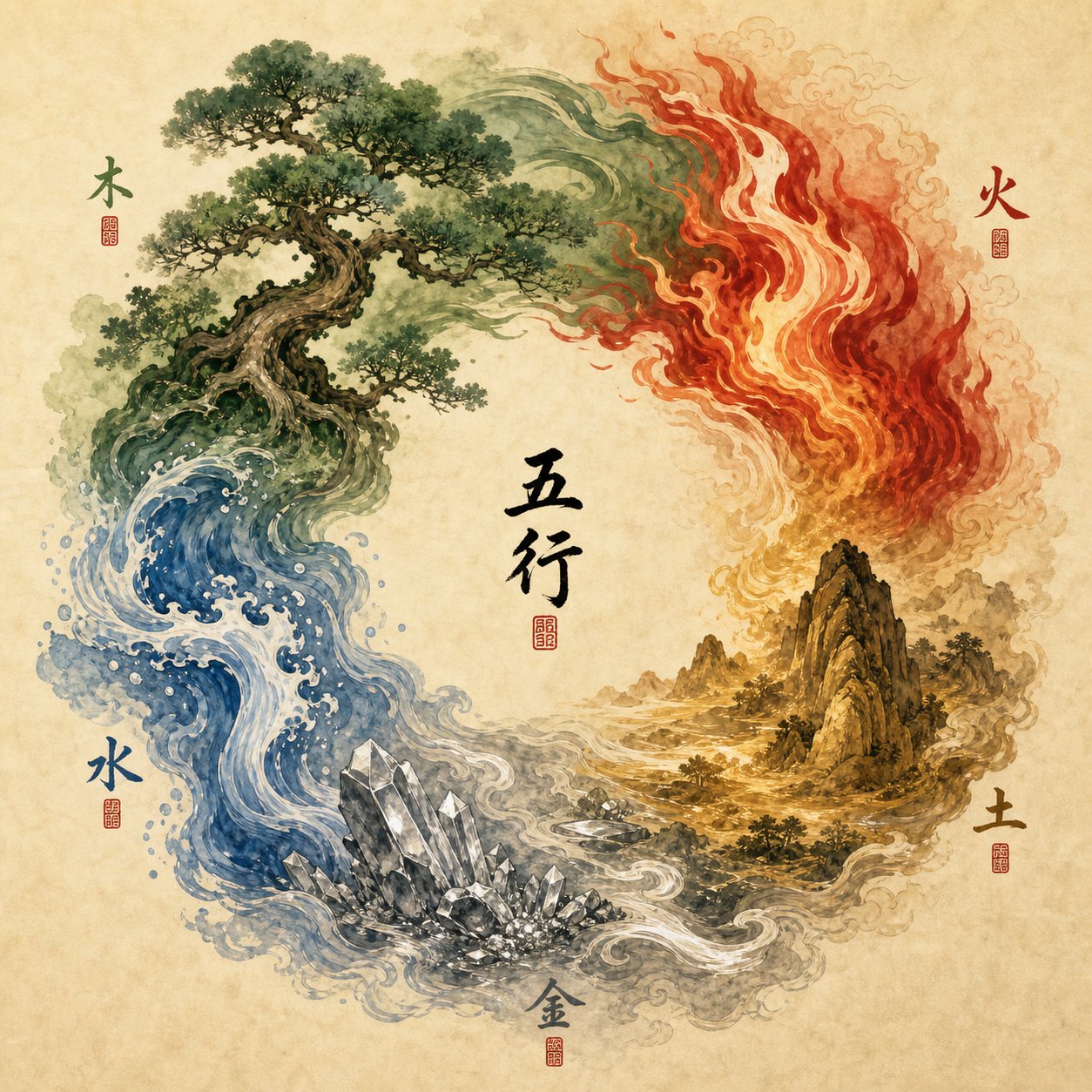
Each of the Five Elements, known as Wu Xing (五行), exists in both a yin and a yang form. These ten manifestations correspond to the ten Heavenly Stems used in BaZi charting. Yang Wood is a towering tree; Yin Wood is a flexible vine. Same family, completely different energy. This distinction matters enormously in naming because a chart deficient in Yang Fire needs a different remedy than one lacking Yin Fire.
| Element | Yang Form (Stem) | Yang Quality | Yin Form (Stem) | Yin Quality | Associated Radicals |
|---|---|---|---|---|---|
| Wood | Jia (甲) | Towering tree, principled | Yi (乙) | Vine, adaptive | 木, 艹, 竹 |
| Fire | Bing (丙) | Sun, bold and generous | Ding (丁) | Candle, refined and focused | 火, 灬, 日 |
| Earth | Wu (戊) | Mountain, steady and protective | Ji (己) | Fertile soil, nurturing | 土, 山, 石 |
| Metal | Geng (庚) | Sword, decisive | Xin (辛) | Jewel, elegant and strategic | 金, 钅 |
| Water | Ren (壬) | Ocean, ambitious | Gui (癸) | Mist, intuitive and subtle | 氵, 雨, 冫 |
These elements also interact through two fundamental cycles. In the generative cycle (Sheng), Wood feeds Fire, Fire creates Earth, Earth produces Metal, Metal carries Water, and Water nourishes Wood. In the controlling cycle (Ke), Wood breaks Earth, Earth absorbs Water, Water extinguishes Fire, Fire melts Metal, and Metal cuts Wood. Wu xing name balance depends on understanding both cycles, because a name character does not just add an element. It activates relationships with every other element already present in the chart.
Using BaZi Analysis to Determine Name Needs
A BaZi chart consists of eight characters arranged in four pillars: Year, Month, Day, and Hour of birth. Each pillar contains a Heavenly Stem on top and an Earthly Branch below, and every one of these characters maps to a specific element. The Day Stem, called the Day Master, represents the person themselves. Everything else in the chart is read in relation to this anchor.
Practitioners tally the elemental distribution across all eight characters, including hidden stems within the Earthly Branches. The result reveals which bazi name selection elements are dominant, which are weak, and which may be entirely absent. A chart heavy in Water with a weak Fire Day Master faces a flooding problem. That person might benefit from name characters carrying Fire or Earth energy to restore equilibrium.
Here is the critical insight most guides miss: a missing element is not automatically a problem. If the absent element would be unfavorable for the Day Master, its absence is actually beneficial. Practitioners evaluate elemental need relative to the Day Master's strength, not as an abstract checklist. A strong Day Master may need elements that control or drain it. A weak Day Master needs elements that support or generate it.
Selecting Characters to Compensate Elemental Imbalance
Once the chart analysis identifies which elements and polarities a person needs, practitioners search for characters that deliver on multiple levels simultaneously. A child whose chart lacks Yin Water might receive a name containing 涵 (contain, 12 strokes, water radical) or 露 (dew, 20 strokes, rain radical). These characters supply Water energy through their radical composition, carry yin polarity through their even stroke counts, and reinforce the quality through their semantic meaning of depth and gentle nourishment.
The most effective character choices align across all dimensions. A character that supplies the needed element through its radical, carries the correct yin or yang stroke polarity, sounds tonally appropriate, and means something that reinforces the desired energy is considered an ideal selection. When all layers point in the same direction, the name becomes a concentrated expression of what the birth chart requires.
Some practitioners also consult the Ziwei Dou Shu (Purple Star Astrology) system as a complementary framework. While BaZi focuses on elemental balance through the Four Pillars, a step by step guide to calculate ziwei dou shu chart involves mapping 108 stars across twelve life palaces. This system provides additional nuance about which life areas need strengthening, helping practitioners refine character choices beyond pure elemental compensation. The two systems often confirm each other's findings, giving consultants greater confidence in their final recommendations.
The Five Elements framework transforms name selection from aesthetic preference into targeted energetic prescription. But what happens when this prescription is wrong, or when a name was chosen without any elemental analysis at all? The consequences, at least within this tradition's belief system, follow predictable patterns.
Consequences of Imbalance and How Practitioners Correct Names
A name chosen without elemental or yin-yang analysis is not necessarily doomed. But within this tradition's framework, imbalance carries recognizable signatures. Practitioners describe these patterns the way a doctor describes symptoms: not as certainties, but as tendencies that accumulate over time.
Cultural Beliefs About Imbalanced Names
An overly yang name, one loaded with odd stroke counts, fire radicals, sharp falling tones, and meanings of force or height, is believed to generate excess heat in a person's life. The traditional associations follow a consistent logic:
Signs of yang excess in a name:
- Restlessness and difficulty settling into stable routines
- Interpersonal conflict, particularly with authority figures
- Burnout from relentless drive without recovery
- Impulsive decision-making and difficulty with patience
- Tendency toward inflammatory health conditions
Signs of yin excess in a name:
- Passivity and difficulty asserting personal boundaries
- Low vitality or chronic fatigue
- Lack of motivation or forward momentum in career
- Emotional withdrawal and social isolation
- Susceptibility to cold-related or stagnation-type ailments
These are cultural beliefs, not medical diagnoses. Yet they carry real weight in communities where names meaning yin and yang balance are taken seriously. As Hong Kong feng shui practitioner Mak Ling-ling explains, a name is "similar to one's clothes - it represents one's personality and possibly class." The belief is that an imbalanced name does not cause misfortune directly but creates an energetic environment where certain difficulties become more likely to take root.
Zodiac Year Influence on Yin-Yang Naming Decisions
The Chinese zodiac adds another layer to this equation. Each of the twelve animal years carries an inherent yin or yang polarity. Yang years include the Rat, Tiger, Dragon, Horse, Monkey, and Dog. Yin years belong to the Ox, Rabbit, Snake, Goat, Rooster, and Pig. A child born in a yang year already carries strong active energy from their birth timing alone.
Practitioners use this information to decide whether a name should reinforce or counterbalance the birth year's polarity. A Tiger-year child (strongly yang) paired with an aggressively yang name may amplify restless tendencies beyond what serves them. A Rabbit-year child (yin) given an entirely yin name might lack the assertive spark needed to navigate competitive environments. The goal is not to cancel out the zodiac energy but to complement it, giving the person access to both polarities rather than being locked into one.
This is why names that mean yin yang balance are not about achieving a flat, neutral state. They are about creating dynamic range, ensuring a person can draw on both receptive and active qualities as life demands.
Correcting an Imbalanced Name
What if the damage is already done? Many adults discover, through consultation or personal reflection, that their names carry significant imbalance. Correction methods range from subtle to dramatic.
The most common approach is character substitution: replacing one character in the given name with another that supplies the missing polarity. A person named with two strongly yang characters might swap one for a yin-leaning alternative that preserves the name's sound or meaning while shifting its energetic profile. In Hong Kong, government data shows that name-change applications have increased annually over recent years, with practitioners reporting that roughly 60 to 70% of adult clients seek changes specifically to address perceived bad luck.
A less disruptive option involves adopting a courtesy name or pen name that carries the balancing energy. In Chinese tradition, a person might use different names in different contexts. A professional name, a literary name, or even a social media handle used daily can introduce compensating yin or yang energy without the legal process of changing one's registered name. The key, practitioners say, is frequency of use. A balancing name only works if people actually call you by it.
Some practitioners also recommend names meaning yin yang harmony as generational corrections. If a parent recognizes imbalance in their own name, they may deliberately select a child's name that breaks the pattern, choosing characters that introduce the missing polarity into the family's naming lineage.
Regardless of method, practitioners emphasize realistic expectations. As feng shui consultant Mak Ling-ling cautions, "changing one's name can help with bringing luck to a new direction, but it certainly doesn't go far and beyond one's fundamental capabilities." A rebalanced name is understood as removing friction, not manufacturing miracles. It clears energetic static so a person's natural abilities can express themselves more freely.
These correction practices are not unique to Chinese culture. Across East Asia, parallel traditions apply the same underlying logic through different terminologies and methods, revealing just how deeply yin-yang naming principles are woven into the region's shared philosophical heritage.
Cross-Cultural Yin-Yang Naming Traditions Compared
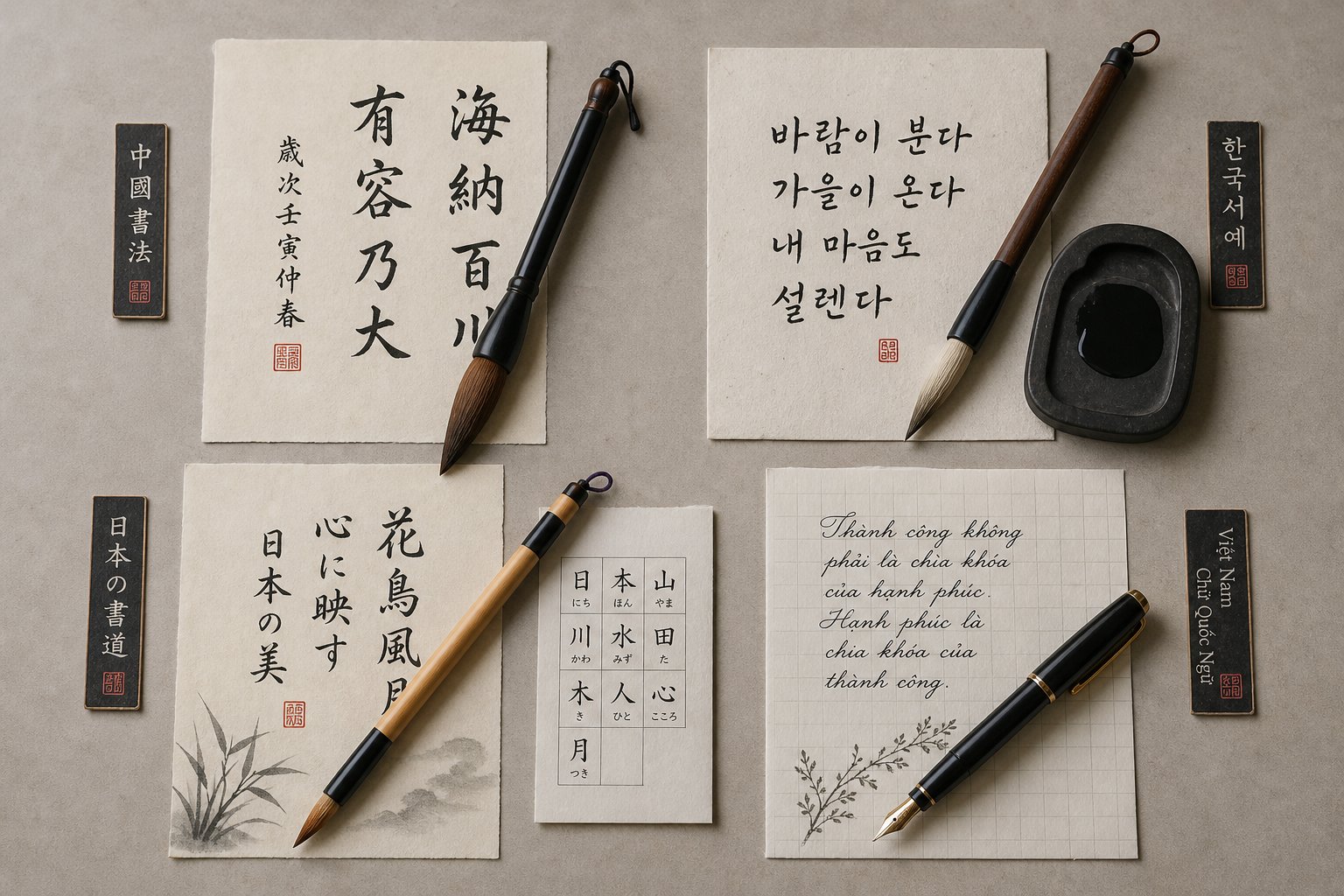
Chinese naming practices did not develop in isolation. As Chinese philosophy, writing systems, and cosmological frameworks spread across East Asia over millennia, neighboring cultures absorbed yin-yang principles and adapted them to their own languages, scripts, and social structures. The result is a family of parallel traditions that share deep philosophical roots while diverging in fascinating ways at the level of method and emphasis.
Understanding these east asian naming traditions yin yang connections reveals something important: the belief that a name carries energetic polarity is not a quirk of one culture. It is a regional conviction, tested and refined across four distinct civilizations over centuries.
Korean Eum-Yang Naming and Saju Analysis
In Korea, the practice of selecting names based on cosmological principles is called Jangmyeong (작명), and it remains deeply embedded in contemporary culture. Korean naming draws on the same philosophical foundation as Chinese practice but filters it through a distinctly Korean astrological system called Saju (사주), or Four Pillars of Destiny.
Saju operates almost identically to Chinese BaZi. A person's birth year, month, day, and hour generate four pillars, each containing a Heavenly Stem and Earthly Branch. The resulting chart reveals elemental distribution and eum-yang (음양) balance. Korean practitioners read this chart to identify which elements are deficient and whether the person needs more eum (yin) or yang energy in their name.
Where the practice diverges is in character selection. Korean names use Hanja, the Korean adaptation of Chinese characters, for their given names. Each Hanja character carries a stroke count classified as eum (even) or yang (odd), just as in Chinese practice. The practitioner's goal is to select Hanja characters whose stroke profiles, elemental associations, and semantic meanings compensate for whatever the Saju chart lacks.
Korean eum yang naming also places significant weight on the Five Elements cycle. A child whose chart is heavy in Water but weak in Fire might receive a name containing Hanja characters associated with brightness or warmth. Professional naming services in Korea analyze the Saju chart and propose names that balance these elemental and polarity factors, often providing multiple options with detailed explanations of each name's energetic profile.
One notable difference from Chinese practice: Korean naming culture has embraced pure Korean (Hangul-only) names in recent decades, which creates an interesting tension. Hangul characters do not carry stroke-based eum-yang classification the way Hanja does. Practitioners working with Hangul-only names must rely more heavily on phonetic and semantic analysis rather than structural stroke counting, shifting the balance of methods while preserving the underlying philosophy.
Japanese In-Yo Principles in Kanji Selection
Japanese naming traditions incorporate yin-yang principles through the concept of in-yo (陰陽), using the same Chinese characters but pronounced differently. The application to japanese kanji name balance follows familiar logic: stroke counts classify characters as in (yin, even) or yo (yang, odd), and practitioners seek harmonious patterns across the full name.
Japan adds a unique layer of complexity through its multiple reading systems. Every kanji character has at least two types of pronunciation: on'yomi (the Sino-Japanese reading derived from Chinese) and kun'yomi (the native Japanese reading). These readings carry different energetic weight in naming analysis. On'yomi readings tend to sound more formal and carry the historical resonance of their Chinese origins, while kun'yomi readings feel more grounded in Japanese sensibility and everyday speech.
Some practitioners classify on'yomi readings as carrying slightly more yang energy due to their association with scholarship, formality, and outward-facing communication. Kun'yomi readings, being more intimate and domestic in register, lean toward in (yin) energy. A name that uses the on'yomi reading of its kanji projects differently than the same characters read in kun'yomi, even though the written form is identical.
Japanese naming also intersects with a numerological system called Seimei Handan (姓名判断), which analyzes stroke counts across five structural positions in a name: Heaven, Person, Earth, External, and Total. Each position produces a number that is evaluated for auspiciousness. While not exclusively an in-yo system, the even-odd classification of these positional numbers maps directly onto yin-yang polarity, making it a parallel framework to chinese stroke names analysis.
Another distinctive feature: Japan's naming laws restrict which kanji can legally be used in given names. The Jinmeiyou kanji list (approximately 860 characters designated specifically for names) and the Jouyou kanji list (2,136 characters for general use) define the available pool. Practitioners must find balance within these legal constraints, which sometimes limits options in ways Chinese or Korean consultants do not face.
Shared Foundations Across East Asian Naming Traditions
Despite surface differences in terminology and method, these four traditions share a remarkable structural unity. All of them treat a name as an energetic object that interacts with the bearer's destiny. All classify characters or sounds along a binary polarity axis. All use birth-time analysis to determine what a person needs. And all seek balance rather than maximization of any single quality.
Vietnamese naming traditions reference am-duong (âm-dương) principles, the Vietnamese pronunciation of yin-yang. While Vietnam shifted from Chinese characters (Chu Nom) to a Romanized script (Quoc Ngu) in the early twentieth century, the philosophical framework persists. Vietnamese practitioners evaluate names through tonal quality (Vietnamese has six tones, offering even richer phonetic polarity analysis), semantic meaning, and elemental association. The loss of character-based stroke counting shifted emphasis toward sound and meaning as primary carriers of am-duong energy.
Here is how the four traditions compare across key dimensions:
| Dimension | Chinese | Korean | Japanese | Vietnamese |
|---|---|---|---|---|
| Terminology | Yin-Yang (阴阳) | Eum-Yang (음양) | In-Yo (陰陽) | Am-Duong (âm-dương) |
| Script Used | Hanzi (Chinese characters) | Hanja / Hangul | Kanji / Hiragana | Quoc Ngu (Romanized) |
| Birth Chart System | BaZi (Four Pillars) | Saju (Four Pillars) | Seimei Handan + Shichusuimei | Tu Vi (Purple Star) |
| Primary Stroke Method | Even = Yin, Odd = Yang | Even = Eum, Odd = Yang | Five-position stroke analysis | Not applicable (Romanized script) |
| Phonetic Analysis | Four tones (Ping/Ze) | Vowel harmony + tone | On'yomi vs. Kun'yomi register | Six tones (rich polarity range) |
| Unique Feature | Eight Foundations system | Generational syllable (dollimja) | Legal kanji restrictions | Six-tone phonetic depth |
One pattern stands out across all four cultures: the tradition is not static. Each has adapted its methods as scripts evolved, legal systems changed, and modern parents brought new aesthetic preferences. Korean parents increasingly choose Hangul-only names. Japanese parents push creative kanji readings. Vietnamese naming lost its character-based dimension entirely yet preserved the philosophical core. Chinese naming has gone digital, with apps performing stroke analysis instantly.
What remains constant is the conviction that balance matters. Whether you call it yin-yang, eum-yang, in-yo, or am-duong, the principle is the same: a name should not pull entirely in one direction. It should hold both poles in productive tension, giving the bearer access to the full spectrum of human energy.
These cross-cultural parallels confirm that yin-yang naming is not an esoteric niche. It is a shared East Asian inheritance with living practitioners in every country. The question for modern parents, whether they sit in Seoul, Tokyo, Hanoi, or Shanghai, is the same: how do you actually apply these principles in practice, step by step, when choosing a name today?
Practical Framework for Applying Yin-Yang Name Selection Today
The principles covered so far, strokes, radicals, tones, meaning, elements, and birth charts, can feel overwhelming when considered all at once. But practitioners do not juggle these dimensions randomly. They follow a structured sequence, moving from the fixed and unchangeable toward the flexible and creative. Whether you are a parent researching how to choose a balanced chinese name or simply curious about the methodology, this yin yang name selection guide breaks the process into a clear workflow.
A Multi-Dimensional Framework for Name Evaluation
Think of name selection as a funnel. You start with broad constraints that eliminate large categories of characters, then progressively narrow your options through finer filters until only a handful of candidates remain. Each stage evaluates a different dimension of yin-yang balance.
- Establish the birth chart. Calculate the BaZi (or Saju, Seimei Handan, or Tu Vi depending on cultural tradition) using the exact birth date and time. Identify the Day Master element and assess overall elemental distribution. Determine whether the chart needs more yin or yang energy and which specific elements are deficient or excessive.
- Assess the surname constraint. Count the surname's strokes using traditional character forms, apply the positional adjustment (add one), and classify it as yin or yang. This is fixed and non-negotiable, so it defines which stroke patterns are available for the given name.
- Identify target stroke patterns. Based on the surname's polarity, determine which of the four balanced configurations (Yang-Yang-Yin, Yin-Yin-Yang, Yang-Yin-Yin, Yin-Yang-Yang) are available. This gives you the required stroke parity for each given name character.
- Filter by elemental need. From the pool of characters matching your stroke requirements, select those whose radicals supply the element your birth chart needs. If the chart lacks Water, prioritize characters containing the water radical or rain radical.
- Evaluate structural harmony. Among your elemental candidates, assess radical positioning and visual density. Ensure the characters create balanced visual weight when written together with the surname. Avoid pairing extremely dense characters with extremely sparse ones unless the contrast is intentional.
- Test tonal flow. Speak each candidate name aloud. Check whether the tonal pattern alternates between ping (yin) and ze (yang) categories. Eliminate combinations that sound monotonous, clipped, or awkward when called across a room.
- Verify semantic alignment. Confirm that the meaning of each character reinforces the desired yin or yang energy rather than contradicting it. A character chosen for its yin stroke count should not carry aggressively yang meaning unless that tension is deliberate.
- Cross-check for conflicts. Screen final candidates against homophones with negative connotations, historical figures with problematic associations, and regional dialect meanings that might create embarrassment. As one parent documented in their naming process, checking against taboos in regional expressions across China and Southeast Asia prevents unintended associations.
Each step narrows the field. By the time you reach step eight, you are typically working with three to five strong candidates rather than hundreds of possibilities.
The Modern Practitioner's Workflow
Professional naming consultants still follow this sequence, but modern chinese naming practices have introduced tools that accelerate the analytical stages. Digital calculators instantly generate BaZi charts from birth data. Stroke-counting databases eliminate manual lookup errors. Some platforms even filter character pools by element and stroke parity simultaneously, producing shortlists in seconds that would have taken a traditional practitioner hours to compile.
Yet experienced consultants consistently emphasize that digital tools handle the mechanical filtering while human judgment handles the art. A four-dimensional naming approach evaluating Sound, Form, Meaning, and Element simultaneously requires interpretive skill that no algorithm fully replicates. The tool can tell you that a character has twelve strokes and a water radical. It cannot tell you whether that character feels right alongside the surname in calligraphy, whether its literary associations carry the emotional weight the family wants, or whether its sound creates a pleasing rhythm in the specific dialect the family speaks daily.
This is why the most thorough modern practitioners use a hybrid approach. They let technology handle constraint-checking and combinatorial analysis, then apply human sensitivity to the final selection. The AI-assisted methodology some parents now use, feeding birth data and family constraints into language models that generate analyzed candidate lists, represents the latest evolution of this hybrid model. The technology expands the range of possibilities considered while the parents supply cultural context and emotional resonance.
Applying Yin-Yang Principles as a Contemporary Parent
You do not need to be a professional consultant to apply these principles meaningfully. Even a simplified version of this framework produces more intentional results than choosing characters purely by aesthetic preference. Start with what you can verify: count strokes, identify the surname's polarity, and ensure your chosen characters create an alternating pattern rather than a monotone one.
If you want to go deeper, a basic BaZi calculator reveals your child's elemental profile, pointing you toward characters that supply what the chart needs. Tonal checking requires nothing more than speaking the full name aloud several times, listening for whether it flows or stumbles. Semantic evaluation is the most accessible dimension of all: you already know whether a character's meaning feels soft or strong, still or active.
The families who engage most successfully with this tradition treat it as a creative constraint rather than a rigid formula. The rules do not eliminate choice. They focus it. Within the boundaries of balanced stroke patterns, appropriate elements, and harmonious tones, enormous creative space remains for literary beauty, family meaning, and personal resonance.
Yin-yang name selection is both systematic analysis and intuitive art. The framework tells you where to look. Your ear, your eye, and your heart tell you when you have found it.
A name spoken with love thousands of times across a lifetime carries weight no formula can fully measure. The yin-yang framework ensures that weight is distributed well, giving a person access to both stillness and motion, both depth and height, both receptivity and force. That balance, encoded in strokes and sound and meaning, is the quiet gift these traditions have offered for centuries and continue to offer today.
Frequently Asked Questions About Yin and Yang in Name Selection
1. How do you determine if a Chinese character is yin or yang in naming?
Characters are classified by their stroke count using traditional (unsimplified) forms. Even stroke counts designate a character as yin, while odd stroke counts make it yang. However, stroke counting is only one layer. Practitioners also evaluate the character's internal radicals (water and moon radicals lean yin; fire and sun radicals lean yang), its tonal pronunciation (flat tones are yin, falling tones are yang), and its semantic meaning (stillness and depth suggest yin; brightness and action suggest yang). A thorough analysis considers all four dimensions together.
2. What happens if a name has too much yin or yang energy?
Within traditional belief systems, an overly yang name is associated with restlessness, interpersonal conflict, and burnout from relentless drive. An overly yin name may correlate with passivity, low vitality, and difficulty asserting boundaries. These are cultural interpretations rather than medical diagnoses, but they carry significant weight in communities that practice metaphysical naming. Correction methods include substituting one character for a more balanced alternative, adopting a courtesy or pen name with compensating energy, or using a professional name in daily life that introduces the missing polarity.
3. How does a BaZi birth chart influence name selection?
A BaZi chart maps the exact birth date and time into four pillars, each containing elemental information. Practitioners tally the distribution of Wood, Fire, Earth, Metal, and Water across all eight characters in the chart, then identify which elements are weak or absent. The critical step is assessing whether a missing element would actually benefit the Day Master (the element representing the person). Based on this analysis, practitioners select name characters whose radicals, stroke counts, and meanings supply the specific elemental and yin-yang energy the chart requires.
4. Do Korean and Japanese naming traditions also use yin and yang principles?
Yes. Korean naming (Jangmyeong) applies eum-yang principles through Saju analysis, which parallels Chinese BaZi. Practitioners select Hanja characters whose stroke profiles and elemental associations balance the birth chart. Japanese naming uses in-yo concepts through kanji stroke analysis and the Seimei Handan system, which evaluates five structural positions in a name. Vietnamese naming references am-duong principles primarily through tonal and semantic analysis, since the shift to Romanized script removed character-based stroke counting. All four traditions share the core conviction that a name should hold both polarities in productive tension.
5. Can I apply yin-yang naming principles without consulting a professional?
A simplified version is accessible to anyone. Start by counting your surname's strokes in traditional form, add one, and classify it as yin (even) or yang (odd). Then select given name characters that create an alternating pattern rather than all-yin or all-yang. For deeper analysis, free BaZi calculators reveal your child's elemental profile, pointing toward characters that supply missing elements. Speaking the full name aloud tests tonal balance, and evaluating whether character meanings feel soft or strong checks semantic polarity. Professional consultants add interpretive depth, but the basic framework produces more intentional results than aesthetic preference alone.