What Zhuangzi Really Means in English
When you encounter the name "Zhuangzi" in a philosophy book or a college syllabus, it looks like a single opaque word. No obvious meaning jumps out. Compare that to a name like "Aristotle," which at least sounds familiar. For English readers, the zhuangzi name meaning is hidden behind romanization, a system that converts Chinese characters into Latin letters but strips away all semantic content in the process.
Here is the short answer:
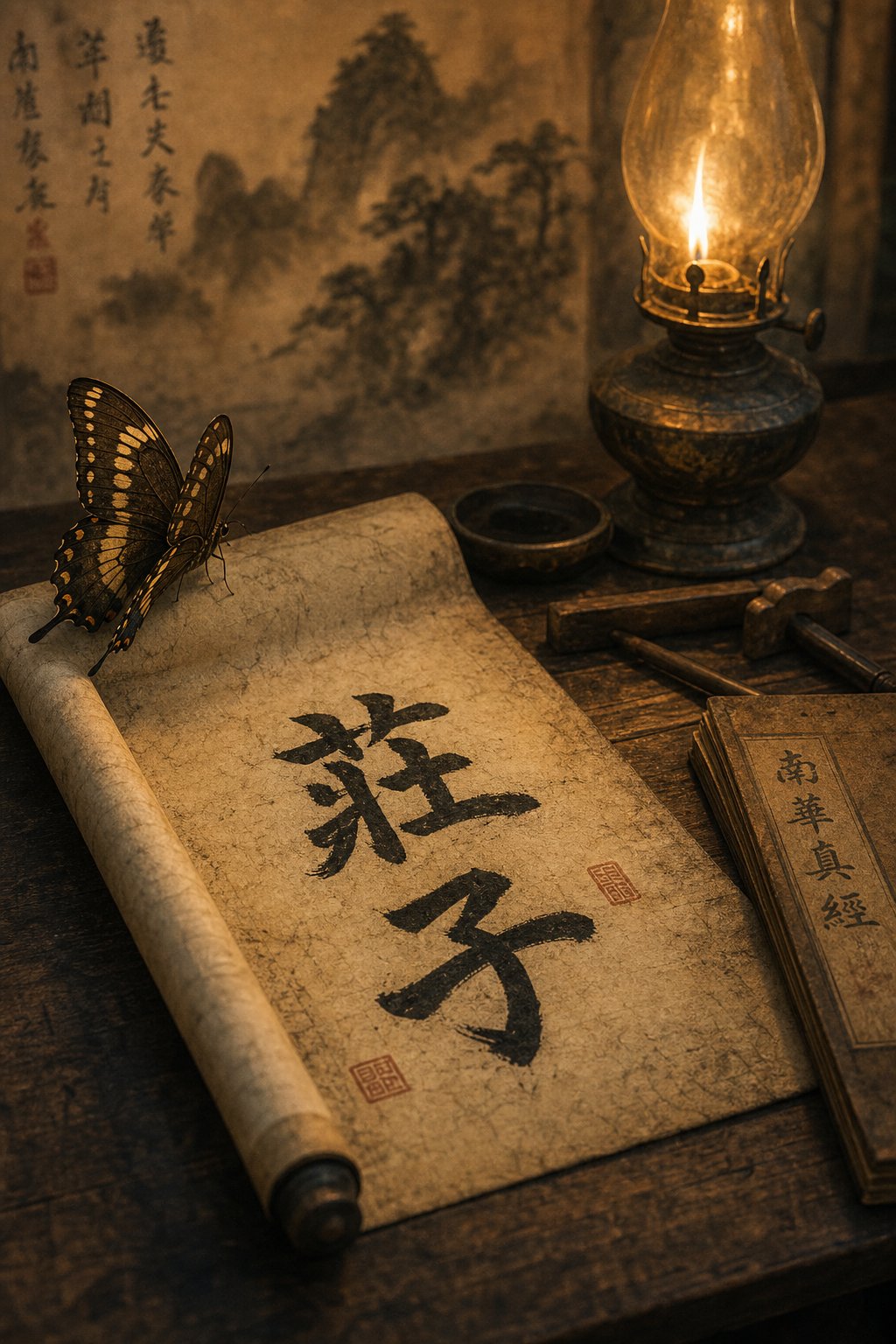
Zhuangzi (莊子) literally means "Master Zhuang" — an honorific title for the ancient Chinese philosopher Zhuang Zhou (莊周), whose surname 莊 carries connotations of solemnity, dignity, and seriousness.
That single definition unlocks a surprising amount. The name is not a given name in the Western sense. It is a title of respect, built from a family name (Zhuang) and an honorific suffix (zi, meaning "Master"). The philosopher himself lived during the Warring States period (roughly 369-286 BCE), a time of political fragmentation and intellectual explosion in ancient China. He is one of the two foundational figures of Daoism, alongside Laozi, and his writings rank among the greatest literary and philosophical masterpieces China has produced.
What Does Zhuangzi Mean in Chinese
In Chinese, each character carries its own meaning. 莊 (Zhuang) means solemn, dignified, or serious. 子 (zi) means master. Put them together and you get "The Solemn Master" or "The Dignified Master." This is not a nickname or a casual label. It is the kind of respectful title that students and later generations bestowed on a revered teacher. Imagine calling someone "Professor Stern" and having that title stick for two thousand years.
The Zhuangzi philosopher was born Zhuang Zhou, with Zhou (周) as his personal name. But history remembers him by his honorific, just as it remembers Confucius by a Latinized version of "Kong Fuzi" (Master Kong). The difference is that English speakers can at least recognize "Confucius" as a name. "Zhuangzi" remains a puzzle unless you know what the characters mean.
Why the Name Matters for Understanding the Philosophy
You might wonder why any of this matters beyond trivia. Consider this: the zhuangzi meaning — "The Solemn Master" — sits in direct tension with the actual content of his philosophy. This ancient Chinese philosopher is famous for wild humor, absurd parables, and a playful refusal to take anything too seriously. His text features a giant fish that transforms into a bird spanning the sky, a butcher whose knife never dulls because he cuts with spiritual precision, and a man who cannot tell whether he is a philosopher dreaming he is a butterfly or a butterfly dreaming he is a philosopher.
A solemn name for an irreverent mind. That contrast is not accidental, and it is not visible to anyone who treats "Zhuangzi" as just a label. Decoding the layers of meaning in this philosopher's name opens a window into Chinese intellectual culture — how titles were earned, how language encoded respect, and how a single word can contain an entire philosophical joke.
The characters that make up this name have more to tell us. Each one carries multiple connotations, tonal distinctions, and historical weight that shaped how readers in ancient China understood the man behind the text.
Decoding the Character 莊 Zhuāng
The character 莊 is where the real semantic weight of the zhuangzi name meaning lives. Strip away the romanization and you find a single Chinese character loaded with centuries of connotation. For Zhuang Zhou (莊周), this character was not just a surname — it was a word that ancient readers would have immediately associated with gravity and composure.
The Character 莊 and Its Multiple Meanings
Structurally, 莊 is what linguists call a phonosemantic compound. The top component 艹 (grass radical) contributes to the meaning, while the bottom component 壯 (strong, robust) provides the phonetic clue. The Shuowen Jiezi — China's earliest comprehensive dictionary, compiled by Xu Shen during the Eastern Han dynasty (around 100 CE) — records the character with the terse notation typical of that work. Historical phonologists have reconstructed its Old Chinese pronunciation as *tsraŋ, with the core gloss being "dignified" and "grave."
Over time, 莊 accumulated a range of meanings that branch in different directions. Here are the primary senses you will encounter:
- Solemn, dignified, grave — the oldest attested meaning, referring to a serious and composed demeanor. This is the sense preserved in the modern compound 莊嚴 (zhuangyan, "solemn" or "majestic").
- Village, hamlet, farmstead — a later extension referring to a rural settlement or estate. Think of 村莊 (cunzhuang, "village").
- Manor, estate, holdings — related to the village sense, this refers to a landlord's property or a place of business, as in 莊園 (zhuangyuan, "manor").
- Surname — one of the most common Chinese surnames, ranked 113th in mainland China as of recent counts, shared by approximately 1.6 million people.
When the character functions as a surname — as it does for the daoism Zhuangzi philosopher — the "dignified" meaning is the one that resonates most strongly. Historical records trace the Zhuang surname back to King Zhuang of Chu, a ruler whose posthumous title literally meant "the solemn one." Surnames derived from posthumous royal titles carried that original semantic flavor forward through generations.
Tonal Distinctions That Change the Meaning
Mandarin Chinese uses four tones, and a single syllable can mean entirely different things depending on which tone you use. This matters here because the syllable "zhuang" appears in two relevant tones:
- Zhuāng (first tone, flat and high) — solemn, dignified, village. This is the philosopher's surname.
- Zhuàng (fourth tone, sharp and falling) — strong, robust, vigorous. This is the character 壯, which actually appears as the phonetic component inside 莊 but carries a different meaning.
The distinction is subtle in romanization but unmistakable in spoken Chinese. Zhuang Zhou's name uses the first tone — Zhuāng — confirming that the intended association is dignity and solemnity, not physical strength. The historical pronunciation data from Middle Chinese (tsrjang) further supports this: the character consistently glossed as "dignified, grave" across centuries of lexicographic tradition.
So when ancient Chinese readers encountered the name 莊周, they heard something like "The Dignified One" or "The Solemn One" before they even opened his book. That immediate association — seriousness, composure, propriety — set up an expectation that the philosopher's actual writings would gleefully demolish. But the surname alone only tells half the story. The honorific suffix attached to it, the character 子, carried its own weight of meaning and belonged to a naming tradition shared by every major thinker of the era.
The Master Title in Chinese Philosophical Names
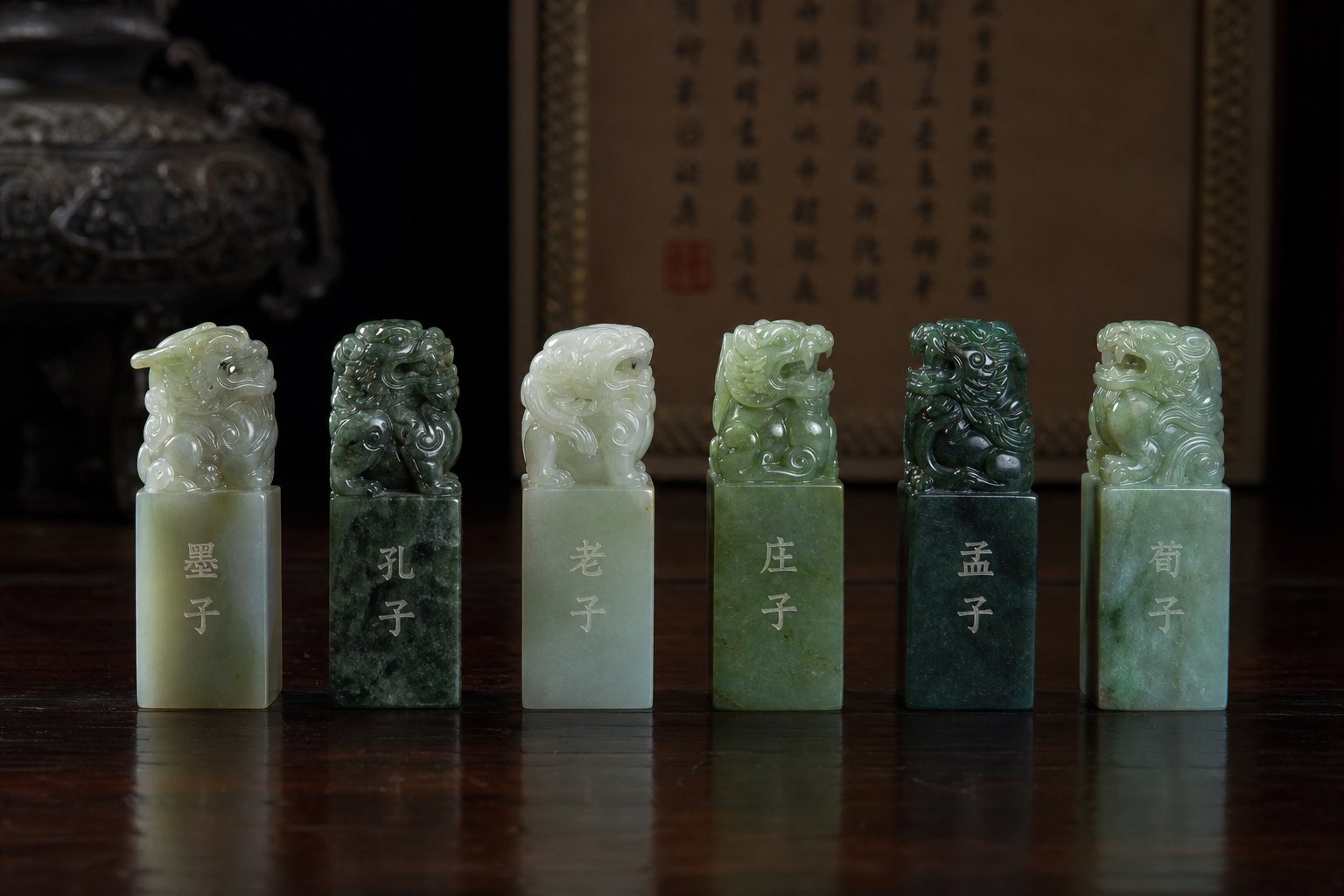
Every major Chinese philosopher tzu you have heard of — Confucius, Laozi, Mencius — shares the same two-letter ending in romanization: "zi" or "tzu." That is not a coincidence. It is a naming convention so consistent that once you recognize it, you can decode an entire tradition of intellectual history at a glance.
The Honorific 子 Master in Chinese Philosophy
The character 子 (zǐ) started life meaning "child" or "son." You can still see this basic sense in modern Chinese words like 孩子 (haizi, "child"). But sometime during the Zhou dynasty, the character took on a second life as a term of deep respect. According to historical research, the use of 子 as a suffix attached to a surname became an honorific indicating "a person of profound knowledge and moral virtue." The names of the philosophers who make up the Hundred Schools of Thought were created by this method.
How did a word for "child" become a title for masters? The evolution followed a logical path. In early Zhou court culture, 子 was used as a respectful second-person pronoun — roughly equivalent to addressing someone as "sir" or "my lord." Confucius extended this practice by giving most of his disciples names ending in 子: Zi Lu, Zi Gong, Zi Xia, Zi Zhang. The suffix encoded his high expectations for his students. Over time, the convention solidified: any thinker worthy of a following earned the 子 suffix after their surname.
This is why asking "who was the most famous Daoist teacher" leads you straight to two names ending in the same syllable — Laozi and Zhuangzi. The suffix itself is the marker of their status.
How Other Philosophers Received the Same Title
The pattern is remarkably uniform. A philosopher's surname plus 子 equals their historical title. Here is how it works across the major thinkers of the classical period:
| Chinese Name | Romanization (Pinyin) | Older Romanization | Literal Meaning |
|---|---|---|---|
| 孔子 | Kǒngzǐ | Kung Fu Tze / K'ung-tzu | Master Kong |
| 老子 | Lǎozǐ | Lao Tzu | Old Master |
| 莊子 | Zhuāngzǐ | Chuang Tzu | Master Zhuang (The Solemn Master) |
| 孟子 | Mèngzǐ | Meng Tzu | Master Meng |
| 墨子 | Mòzǐ | Mo Tzu | Master Mo |
| 荀子 | Xúnzǐ | Hsun Tzu | Master Xun |
| 文子 | Wénzǐ | Wen Tzu | Master Wen |
| 韓非子 | Hán Fēizǐ | Han Fei Tzu | Master Han Fei |
Notice that Laozi is the odd one out. His title uses 老 (lao, "old") rather than a surname, giving us "Old Master" — possibly because his real name was lost to history, or because the title itself became his identity. The Wen Tzu, attributed to a student of Laozi, follows the same convention: "Master Wen," the cultured or literary master.
The older Wade-Giles romanization rendered 子 as "tzu" or "tze," which is why you still see spellings like Kung Fu Tze for Confucius in older English texts. Every Chinese philosopher tzu you encounter in a library catalog — whether spelled with a "z" or "tz" — carries this same honorific marker. The spelling changed; the meaning never did.
What makes this convention powerful is its simplicity. A single character, appended to a surname, elevated a person from ordinary scholar to recognized master. For Zhuang Zhou, receiving the title 莊子 meant that later generations considered his thought worthy of the same respect given to Confucius and Laozi. The honorific placed him in a lineage — not of blood, but of intellectual authority.
Yet the title tells you nothing about the man's personal identity. For that, you need his given name — the character 周 (Zhou) — which carries its own layer of meaning that no competitor analysis has explored.
Zhuang Zhou and the Meaning of His Personal Name
The honorific title tells you how the world regarded him. The personal name tells you something about the world he was born into. Zhuang Zhou (莊周) — that is the philosopher's actual name, the one his family gave him, the one that existed before students and commentators elevated him to "Master" status. And the character 周 (zhōu) is far from arbitrary.
The Meaning of Zhou 周 in His Personal Name
The character 周 carries a cluster of related meanings, all orbiting a central idea of completeness and enclosure:
- Complete, thorough, comprehensive — as in 周全 (zhōuquán, "thorough and complete") or 周到 (zhōudào, "considerate, attending to every detail").
- Cycle, circuit, circumference — as in 周期 (zhōuqī, "cycle" or "period") and 圓周 (yuánzhōu, "circumference").
- All-encompassing, universal — as in 周遍 (zhōubiàn, "pervading everywhere").
- The Zhou dynasty — the longest-lasting dynasty in Chinese history, whose name itself meant "all-encompassing" or "complete."
Imagine naming a child "Completeness" or "Wholeness." That is roughly what 周 communicates to a Chinese reader. The character's earliest forms in oracle bone script depict a field densely planted on all sides — a visual metaphor for something filled in completely, with no gaps left open. From that concrete agricultural image grew the abstract senses of thoroughness and universality.
Put the two characters together and the full name 莊周 reads like a philosophical statement in miniature:
莊周 (Zhuāng Zhōu): "Solemn Completeness" or "Dignified Thoroughness" — a name suggesting composed, all-encompassing wholeness.
Whether his parents intended that philosophical resonance or simply chose an auspicious character is impossible to know. But in classical Chinese culture, the line between those two motivations barely existed. Names were chosen with deliberate semantic intent. As Temple University's Center for Chinese Language Instruction explains, Chinese given names are carefully selected to reflect desirable qualities and aspirations — the process of naming is believed to influence a person's destiny. This was even more true during the Warring States period, when literacy was confined to the educated elite and every character carried weight.
For readers familiar with zhou philosophy and the intellectual landscape of the era, the resonance deepens further. The Zhou dynasty (周朝) — which was collapsing during Zhuang Zhou's lifetime — had lent its name to an entire civilizational ideal of completeness and order. A man named 周 living through the dynasty's final fragmentation would have carried that irony in his very identity: wholeness as a name, disintegration as a reality. The daoism political context of the Warring States made such contrasts inescapable.
Warring States Naming Conventions Explained
To understand why Zhuang Zhou's name works the way it does, you need to understand how names functioned in his era. The system was nothing like modern Western naming. A person did not simply have a first name and a last name. They moved through a layered structure where different names served different social purposes.
Here is how the system broke down during the Warring States period:
- 姓 (xìng) — Clan surname: Originally traced through the mother's line. The character 姓 itself contains the radical 女 (woman) and 生 (birth), literally meaning "born of a woman." By the Warring States period, this matrilineal system was fading, and surnames merged with the patrilineal 氏 (shì) into a single family name.
- 名 (míng) — Birth name: Given by parents, used only within the family and by elders. Using someone's 名 in public was considered deeply disrespectful — the equivalent of stripping away their social standing. "Zhou" (周) was Zhuang Zhou's 名.
- 字 (zì) — Courtesy name: Received around age twenty, this was the name peers and colleagues used in polite address. The courtesy name was often semantically linked to the birth name through synonyms, antonyms, or thematic extensions. Unfortunately, no historical record preserves Zhuang Zhou's courtesy name — if he had one, it was lost along with most biographical details of his life.
The key insight here is that the birth name (名) was private and powerful. It was not something you threw around casually. The idiom 指名道姓 (zhǐ míng dào xìng) — meaning to publicly call out someone's full name — described an act of open hostility. Even bitter enemies in the Warring States period would use each other's courtesy names rather than their birth names, because to do otherwise was to declare someone beneath all respect.
This is why history remembers the philosopher as "Zhuangzi" (Master Zhuang) rather than "Zhuang Zhou." The honorific title was the public-facing identity. The personal name 周 was intimate — something his family and close associates would have used, something that encoded parental hopes for a child who would grow into completeness and thoroughness.
The Zhuang Zhou books that survive — the text we call the Zhuangzi — never use his personal name in a casual way. Later commentators and historians like Sima Qian recorded "Zhuang Zhou" as a biographical fact, but the text itself operates under the authority of the title. Person, title, and book all share overlapping names, creating a tangle of referents that has confused readers for centuries.
Separating the Person the Title and the Book
That tangle of overlapping names is not just a minor inconvenience. It is a genuine source of confusion that trips up anyone approaching Chinese philosophy for the first time. When someone says "Zhuangzi," they could be referring to three entirely different things — and context is the only way to tell which one they mean.
Person Title and Book Three Distinct Referents
Here is the breakdown, laid out as clearly as possible:
- Zhuang Zhou (莊周) — the historical person. A man who lived during the Warring States period (late 4th century BCE), held minor official posts, and produced philosophical writings of extraordinary literary quality. This is the flesh-and-blood individual.
- Zhuangzi (莊子) — the honorific title. "Master Zhuang," the respectful name by which later generations referred to the philosopher. When someone writes "Zhuangzi believed..." or "Zhuangzi argued...," they are using this title to refer to the person.
- The Zhuangzi (《莊子》) — the book. A thirty-three-chapter anthology of philosophical writings attributed to the philosopher and his intellectual descendants. When you see the name italicized in academic writing, it refers to the text, not the man.
Sounds straightforward enough on paper. But in practice, the boundaries blur constantly. A sentence like "Zhuangzi says that all things are one" could mean the historical person believed this, or that the book of Zhuangzi contains this claim — and those are not the same thing, because much of the text was not written by Zhuang Zhou himself.
Who Actually Wrote the Zhuangzi Text
This is where textual scholarship gets interesting. The Zhuangzi book as we have it today is not a single-author work. It is an anthology compiled over centuries, shaped by multiple hands, and edited into its current form roughly six hundred years after the philosopher lived.
The key figure in that editorial history is Guo Xiang (d. 312 CE), a Jin dynasty scholar who took what was then a sprawling collection of fifty-two chapters and trimmed it down to thirty-three. He divided the result into three sections: the Inner Chapters (1-7), the Outer Chapters (8-22), and the Miscellaneous Chapters (23-33). This is the version that survives today — every modern translation of the book of Zhuangzi descends from Guo Xiang's editorial decisions.
The scholarly consensus, supported by researchers like A.C. Graham and Liu Xiaogan, holds that only the seven Inner Chapters were actually authored by the historical Zhuang Zhou. The remaining chapters represent the work of later followers, rival schools, and syncretists who added their own perspectives to the growing text of Daoism over subsequent generations. Graham identified at least four distinct groups of contributors: a "School of Zhuangzi" that closely followed the master's ideas, a group of Primitivists influenced by Laozi, followers of the egoist Yang Zhu, and Syncretists who attempted to blend multiple philosophical traditions into a comprehensive whole.
What does this mean for readers? When you pick up the Zhuangzi, you are not reading a single philosopher's notebook. You are reading a living tradition — a text that grew as new thinkers responded to, elaborated on, and sometimes departed from the original seven chapters. The butterfly dream, the cook carving an ox, the vast fish transforming into a bird — these iconic passages all come from the Inner Chapters and are most reliably attributed to Zhuang Zhou himself. Venture into the Outer and Miscellaneous Chapters and you enter territory where authorship becomes genuinely uncertain.
This layered authorship also explains why the Zhuangzi book can seem to contradict itself. Different chapters reflect different philosophical temperaments because they were written by different people across different decades. Recognizing this does not diminish the text — it enriches it. The Zhuangzi is less a monologue and more a centuries-long conversation, with the historical Zhuang Zhou's voice as its opening statement.
That conversation, however, reached English-speaking readers through a maze of different spellings — Chuang Tzu, Chuang-tzu, Zhuangzi, Zhuang Zi — each reflecting a different era's attempt to render Chinese sounds into Roman letters.
Every Spelling of Zhuangzi and Why They Exist
If you have ever searched for this philosopher online, you have probably noticed something strange. The same person appears under half a dozen different spellings: Zhuangzi, Chuang Tzu, Chuang-tzu, Chuang Tse, Chuang Zi, Zhuang Zi. Library catalogs list the Chuang Tzu book under one spelling while university syllabi use another. Older paperback translations on your shelf say "Chuang Tsu" on the cover, while the Stanford Encyclopedia of Philosophy spells it "Zhuangzi." None of these are typos. They are all attempts to solve the same impossible problem: rendering the Chinese characters 莊子 into Roman letters.
As translator Christopher Tricker puts it bluntly: "Chuang Tzu's name isn't really Chuang Tzu. It's 莊子." Every romanized spelling is an approximation — a set of Latin-alphabet letters standing in for sounds that do not map neatly onto English phonetics. No system is inherently better than another. The differences come down to which system was in use when a particular book was published.
Pinyin Versus Wade-Giles Romanization
Two systems account for the vast majority of spellings you will encounter. Understanding when each dominated explains why the same philosopher has two identities in English.
The Wade-Giles system was developed by Sir Thomas Francis Wade in the mid-19th century and refined by Herbert Allen Giles in his 1912 Chinese-English Dictionary. It became the standard romanization for English-speaking scholars and general readers throughout most of the 20th century. Under Wade-Giles, 莊子 becomes "Chuang Tzu" — sometimes hyphenated as Chuang-tzu, sometimes with a space. This is why classic English translations from the 1960s and 1970s, like Burton Watson's influential version, use "Chuang Tzu" on their covers. Thomas Merton's beloved The Way of Chuang Tzu (1965) cemented this spelling in the minds of a generation of Western readers.
In 1958, China adopted the Pinyin system as its official romanization standard. Pinyin was designed to be more phonetically intuitive and to eliminate the confusing apostrophes and duplicate symbols that plagued Wade-Giles. Under Pinyin, 莊子 becomes "Zhuangzi" — written as one word, no spaces, no hyphens. In 1979, mainland China officially replaced all other romanization systems with Pinyin for international communications. The United Nations, the Library of Congress, and most academic publishers followed over the next two decades. By the early 2000s, Pinyin had become the near-universal standard in English-language scholarship.
The practical result: any book published before roughly 1980 almost certainly uses "Chuang Tzu." Anything published after 2000 almost certainly uses "Zhuangzi." The transition period in between produced a chaotic mix of both.
Which Spelling to Use and When
Beyond the two major systems, you will occasionally encounter other variants. "Chuang Tse" comes from an older French-influenced romanization. Some German-language sources used similar spellings. These are rare in contemporary English but still appear in reprints of early 20th-century translations.
Here is a complete comparison of every major spelling variant you are likely to encounter:
| Spelling | Romanization System | Period of Dominance | Where You Will See It |
|---|---|---|---|
| Zhuangzi | Pinyin | 1979-present | Academic journals, university courses, modern translations, encyclopedias |
| Zhuang Zi | Pinyin (spaced) | 1979-present | Some publishers who separate surname from honorific |
| Chuang Tzu | Wade-Giles | 1912-1980s | Classic translations (Watson, Merton, Graham), older library catalogs |
| Chuang-tzu | Wade-Giles (hyphenated) | 1912-1980s | Academic texts following strict Wade-Giles conventions |
| Chuang Tse | French/German-influenced | Early 20th century | European translations, older comparative religion texts |
| Chuang Tsu | Informal Wade-Giles variant | Mid-20th century | Popular paperback editions, some anthologies |
| Chwang-tsze | Pre-Wade romanization | 19th century | Victorian-era sinology, rare reprints |
The confusion runs deeper than just the philosopher's name. The Chuang Tzu book — meaning the text itself — appears under all these same variant spellings depending on when and where it was published. A reader browsing a used bookstore might find three different editions of the same work filed under three different letters of the alphabet.
Which spelling should you use today? Pinyin ("Zhuangzi") is the current international standard. Academic style guides, including those of the American Philosophical Association and the Journal of Chinese Philosophy, require it. But if you are quoting or referencing an older translation — say, Watson's 1968 edition — it is perfectly acceptable to use "Chuang Tzu" when discussing that specific work. The key is consistency within a single piece of writing and clarity about which referent you mean.
What matters most is recognizing that Zhuangzi, Chuang Tzu, Chuang Zi, Chuang Tse, and every other variant all point to the same two characters: 莊子. The spelling is a historical artifact of which romanization system happened to be dominant when a translator sat down to work. The meaning underneath — Master Zhuang, the Solemn Master — never changed.
That meaning, though, sets up one of philosophy's great ironies. A title radiating gravity and dignity belongs to a thinker whose entire body of work is dedicated to puncturing exactly that kind of seriousness.
The Irony of a Dignified Name for a Playful Thinker
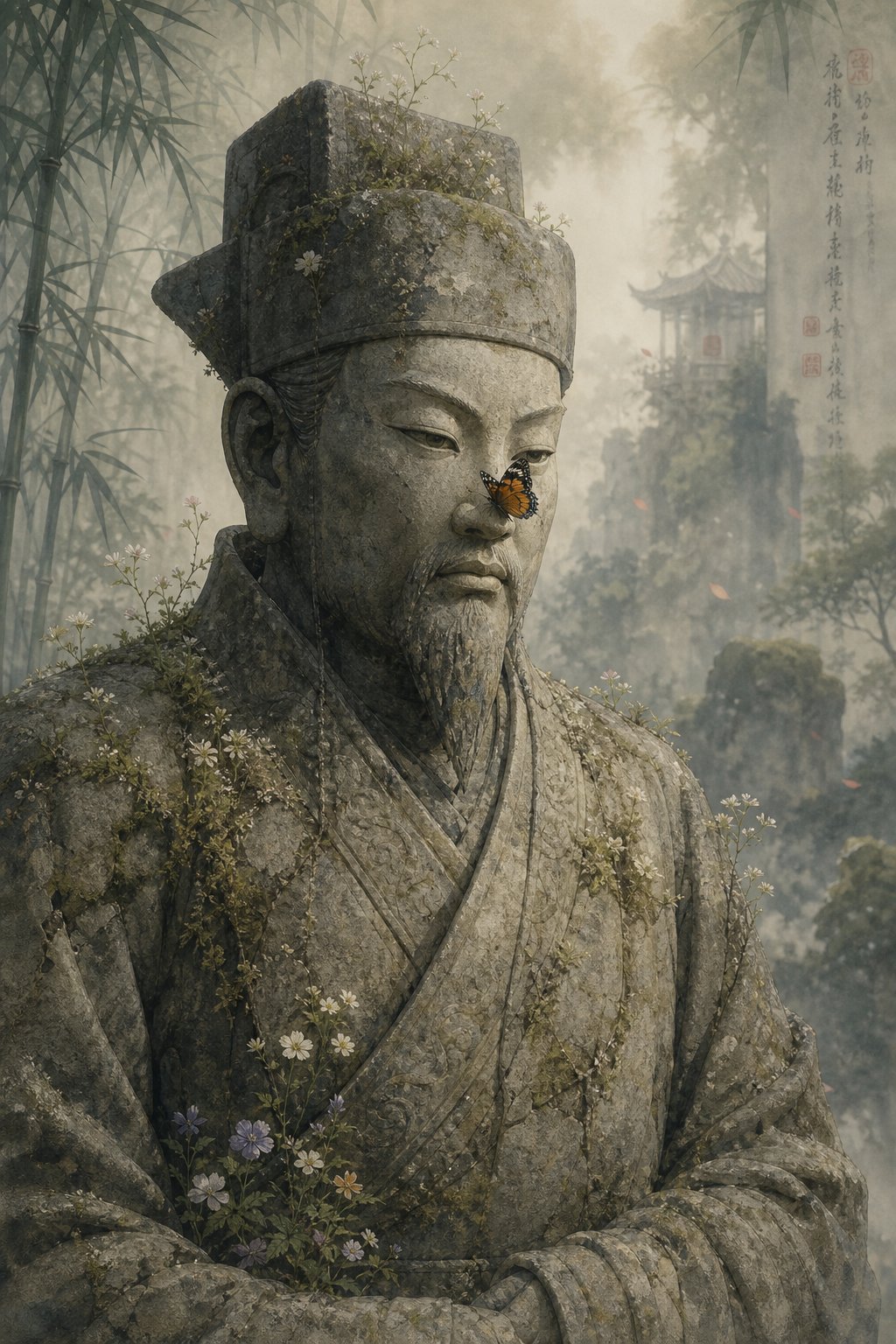
Picture a philosopher whose title translates to "The Solemn Master." You might expect dry treatises on moral duty, carefully structured arguments about the nature of virtue, or stern instructions on how to govern a state. You would expect, in other words, something like Confucius. What you get instead is a man who tells a story about dreaming he was a butterfly, then wonders aloud whether he might actually be a butterfly dreaming it is a philosopher.
This is the cosmic joke buried inside the zhuangzi name meaning. The title 莊子 — Master Zhuang, The Dignified One — belongs to the most irreverent, playful, and deliberately absurd thinker in the entire Chinese philosophical tradition. His prose style is its own distinctive literary treasure, built on parables that are "short, pithy, and amusing," as the Stanford Encyclopedia of Philosophy describes them — tales that "both entertain and make you think."
A Solemn Name for an Irreverent Philosopher
Zhuangzi philosophy operates through paradox, fantasy, and humor rather than systematic argument. His text features talking skulls, debating winds, a giant fish that transforms into a bird spanning thousands of miles, and a butcher whose knife stays sharp for nineteen years because he cuts with spiritual awareness rather than brute force. His characters include hunchbacks, criminals missing limbs, and gnarled trees that survive precisely because they are useless to carpenters. The Internet Encyclopedia of Philosophy characterizes his style as "mythical, poetic, narrative, humorous, indirect, and polysemic."
None of this sounds particularly solemn. And that is exactly the point.
Consider his most famous concepts and how thoroughly they subvert the gravity his name implies:
- The Butterfly Dream — Zhuang Zhou dreams he is a butterfly, "simply happy and doing as it pleased." Upon waking, he cannot determine whether he is a man who dreamed of being a butterfly or a butterfly now dreaming of being a man. This is not a solemn meditation on epistemology. It is a playful dissolution of the boundary between self and world, delivered with a shrug.
- Free and Easy Wandering — The opening chapter describes a fish so vast that no one knows its length, transforming into a bird whose wings are "like clouds hung from the sky." Meanwhile, a cicada and a dove laugh at the bird's ambition. The chapter title, Xiaoyao You, evokes spontaneous, aimless roaming — the opposite of the composed dignity that 莊 suggests.
- The Useless Tree — Zhuangzi tells his friend Huizi about a gnarled ailanthus tree too twisted for any carpenter to use. His advice? Plant it "in the village of Nothing-at-All" and "wander free and easy lying asleep beneath it." Uselessness becomes the highest form of self-preservation — a joke dressed as wisdom, or wisdom dressed as a joke.
Once Zhuang Zhou dreamt he was a butterfly, a butterfly fluttering about, simply happy and doing as it pleased. He knew no Zhou. Suddenly he awoke, and surprisingly, he was Zhou. But he didn't know if he was Zhou who had dreamt he was a butterfly, or a butterfly dreaming he was Zhou.
That passage — among the most quoted Zhuangzi quotes in world philosophy — captures everything his name is not. There is no solemnity here, no dignity standing on ceremony. There is wonder, lightness, and a willingness to let the ground dissolve beneath your feet.
How the Name Contrasts With His Philosophy
For readers in the Warring States period, this contrast would have been immediately legible. They knew what 莊 meant. They could hear the word "solemn" every time someone mentioned his name. And then they opened his book and found a philosopher who used Confucius — the most revered figure in Chinese intellectual life — as a fictional character in comic dialogues, putting Daoist arguments into the sage's mouth. They found a man who, when offered a prestigious government position, compared it to being a sacred tortoise kept dead in a box, and said he would rather be alive dragging his tail in the mud.
The humor was not incidental to the philosophy. It was the philosophy. Zhuangzi's parables work by destabilizing certainty, by making you laugh at the very categories — right and wrong, useful and useless, life and death — that other philosophers treated with utmost seriousness. His text was, as the Stanford Encyclopedia notes, "a respite from the dry moralizing of Confucians" and "a favorite of the Chinese intellectual, literati class" precisely because it refused to moralize.
Modern English readers miss this tension entirely. "Zhuangzi" arrives as an opaque string of letters, carrying no semantic weight. You cannot hear "The Solemn Master" in those syllables the way a Chinese reader hears 莊子. The joke is invisible — which is perhaps fitting for a philosopher who believed the deepest truths resist being pinned down in language.
Whether Zhuang Zhou himself appreciated the irony of his own name is something we will never know. But for anyone who understands what the characters mean, reading his text becomes a richer experience. You are watching a man named Dignity spend thirty-three chapters demonstrating that dignity, seriousness, and fixed categories are exactly what prevent us from seeing clearly. The solemn title hides a cosmic joke — and the joke is on anyone who takes the title at face value.
That layered irony is not just entertaining. It points toward something practical: how understanding the name can change the way you actually read and engage with the philosophical text itself.

From Name to Philosophy and Where to Begin
A name that means "The Solemn Master" belonging to a philosopher who spent his career dissolving solemnity — that tension is not trivia. It is a lens. Once you can see it, the entire text reads differently. Every parable, every absurd dialogue, every talking skull and dreaming butterfly gains an extra dimension: you are watching a man named Dignity argue that dignity is beside the point.
Why Name Meaning Enriches Philosophical Reading
Here is what the zhuangzi name meaning gives you as a reader. 莊子 (Zhuangzi) means Master Zhuang — the solemn, dignified master. 莊周 (Zhuang Zhou) combines that solemnity with 周, completeness and thoroughness, suggesting a person of composed wholeness. Whether you encounter the philosopher spelled as Zhuangzi, Chuang Tzu, or Chuang Tse, all roads lead back to those same two characters and the same layered irony.
Knowing this transforms your reading in a concrete way. When Zhuangzi puts Confucius in a fictional dialogue and has him praise uselessness, you are not just reading a philosophical argument. You are watching "The Solemn Master" use China's most solemn figure as a puppet for anti-solemn ideas. The humor becomes structural, not incidental. The name is the setup; the philosophy is the punchline.
Where to Start Reading Zhuangzi
If this exploration of the name has sparked curiosity about the philosophy itself, the text is waiting. The good news: you do not need to read all thirty-three chapters. The Inner Chapters (1-7) are the core — almost certainly written by the historical Zhuang Zhou himself — and they contain every major idea the tradition is known for. Burton Watson's The Complete Works of Zhuangzi (Columbia University Press, 2013) remains one of the most accessible English translations, while Brook Ziporyn's edition (Hackett, 2009) offers rich commentary for readers who want deeper context.
For newcomers, here is a reading path that builds understanding gradually:
- Chapter 1: "Free and Easy Wandering" (Xiaoyao You) — Start here. It introduces Zhuangzi's literary style, his sense of scale, and the motif of boundless freedom. You will meet the enormous Peng bird and the laughing cicada within the first few pages.
- Chapter 2: "Discussion on Making All Things Equal" (Qi Wu Lun) — The philosophical heart of the text. This is where the butterfly dream appears, along with arguments about perspective, language, and the limits of knowledge.
- Chapter 4: "In the Human World" (Ren Jian Shi) — Practical philosophy. The useless tree, the story of Carpenter Shi, and meditations on how to survive in a dangerous political world without losing yourself.
- Chapter 7: "Fit for Emperors and Kings" (Ying Di Wang) — The most entertaining of the Inner Chapters, bringing everything together through a rapid sequence of stories, including the famous parable of Chaos (Hundun) whose friends drill holes in his face to help him see and hear — killing him in the process.
- Chapters 11-12 (Outer Chapters) — Once the Inner Chapters feel familiar, these sections offer a half-way to harmony between Zhuangzi's radical freedom and the practical demands of living in society. They expand on themes from the core text with additional parables and dialogues.
Thomas Merton's The Way of Chuang Tzu offers a different entry point — not a scholarly translation but a poet's creative engagement with the text, rendering key passages into vivid English prose. For readers who want the spirit before the letter, Merton's version captures the playfulness that makes the philosophy come alive. Martin Palmer's The Book of Chuang Tzu (Penguin, 2006) provides another reliable complete translation with helpful introductions to each section.
Whatever edition you choose, carry the name meaning with you as you read. Remember that 莊子 means "The Solemn Master" — and then watch how thoroughly the text earns that title by refusing to be solemn about anything at all. The cosmic joke is not hidden. It is right there in the name, waiting for anyone who knows how to read it.
Frequently Asked Questions About Zhuangzi Name Meaning
1. What does Zhuangzi literally mean in English?
Zhuangzi (莊子) literally translates to 'Master Zhuang.' The character 莊 (Zhuang) means solemn, dignified, or serious, while 子 (zi) is an honorific suffix meaning 'master' that was given to respected philosophers in ancient China. Together, the name can be understood as 'The Solemn Master' or 'The Dignified Master' — an ironic title given that Zhuangzi's philosophy is famous for humor, paradox, and playful storytelling.
2. Why is Zhuangzi also spelled Chuang Tzu?
The different spellings result from two competing romanization systems used to convert Chinese characters into Latin letters. 'Chuang Tzu' comes from the Wade-Giles system, which dominated English-language scholarship from 1912 through the 1980s. 'Zhuangzi' uses the Pinyin system, adopted by China in 1958 and now the international standard. Both spellings represent the same Chinese characters (莊子) and refer to the same philosopher — the difference is purely a matter of which transliteration convention was in use when a particular book was published.
3. What is the difference between Zhuangzi and Zhuang Zhou?
Zhuang Zhou (莊周) is the philosopher's personal birth name, while Zhuangzi (莊子) is his honorific title meaning 'Master Zhuang.' In classical Chinese culture, using someone's birth name publicly was considered disrespectful, so later generations referred to him by his title instead. Additionally, 'the Zhuangzi' (italicized) refers to the philosophical text attributed to him — a 33-chapter anthology. So the same syllables can point to the historical person, his respectful title, or his book, depending on context.
4. What does the zi (子) suffix mean in Chinese philosopher names?
The character 子 (zi) originally meant 'child' or 'son' but evolved during the Zhou dynasty into an honorific title for teachers and scholars of exceptional knowledge and virtue. It functions like 'Master' in English. Nearly every major Chinese philosopher carries this suffix: Kongzi (Master Kong/Confucius), Laozi (Old Master), Mengzi (Master Meng/Mencius), Mozi (Master Mo), and Xunzi (Master Xun). The older Wade-Giles romanization rendered it as 'tzu' or 'tze,' which is why you see spellings like 'Chuang Tzu' and 'Kung Fu Tze' in older texts.
5. Did Zhuangzi write the entire book attributed to him?
No. Scholarly consensus holds that only the seven Inner Chapters (chapters 1-7) were written by the historical Zhuang Zhou. The remaining 26 chapters were composed by later followers, rival schools, and syncretists over several centuries. The text was edited into its current 33-chapter form by Guo Xiang around 312 CE. The most iconic passages — the butterfly dream, Cook Ding's ox, and the Peng bird — all come from the Inner Chapters and are most reliably attributed to Zhuang Zhou himself.