What Is the Ah Prefix in Chinese Names
You've seen it in old family photos, immigration documents, or maybe your grandmother's address book: names like Ah Wong, Ah Mei, Ah Sam. It looks like a first name. It feels like a title. But what does Ah mean in Chinese names, and why does it keep showing up?
The Ah (阿) prefix in Chinese names is not a name, surname, or formal title. It is a vernacular particle placed before a person's name or kinship term to signal familiarity, affection, or closeness between the speaker and the person being addressed.
Think of it this way: Ah is a relationship marker. It tells you something about how two people relate to each other, not about the person's legal identity. When someone says "Ah Sang" instead of "Yip Sang," they're communicating warmth, closeness, or casual respect, much like calling someone "Jimmy" instead of "James."
What the Ah Prefix Actually Means
The character 阿 functions as an affectionate or familiar marker that attaches before names and kinship terms. It carries no independent meaning on its own. There is no English language equivalent, though Alexander Don, a Presbyterian missionary who spoke fluent Cantonese in the 1890s, compared it to the English diminutive suffix "-y" or "-ie." Just as James becomes Jimmy and Thomas becomes Tommy, a person named Wing might become Ah Wing among friends and family.
The ah prefix meaning in Cantonese and other southern Chinese dialects covers a range of social functions:
- A sign of affection between family members or close friends
- A marker of casual respect, similar to a friendly "Mr." or "Ms."
- A diminutive form expressing endearment, the way you'd nickname a pet or a child
- A softening particle attached to kinship terms like mother, father, or auntie
As Carsey Yee, a Cantonese heritage speaker, explained it: the "ah" is best understood as "a softening, relationship-affirming sound particle added to a name or title. It's not part of the name or title in Chinese." Someone addressed as Ah Bing would never think of "Ah" as being part of their actual name.
Why Searchers Get Confused About Ah
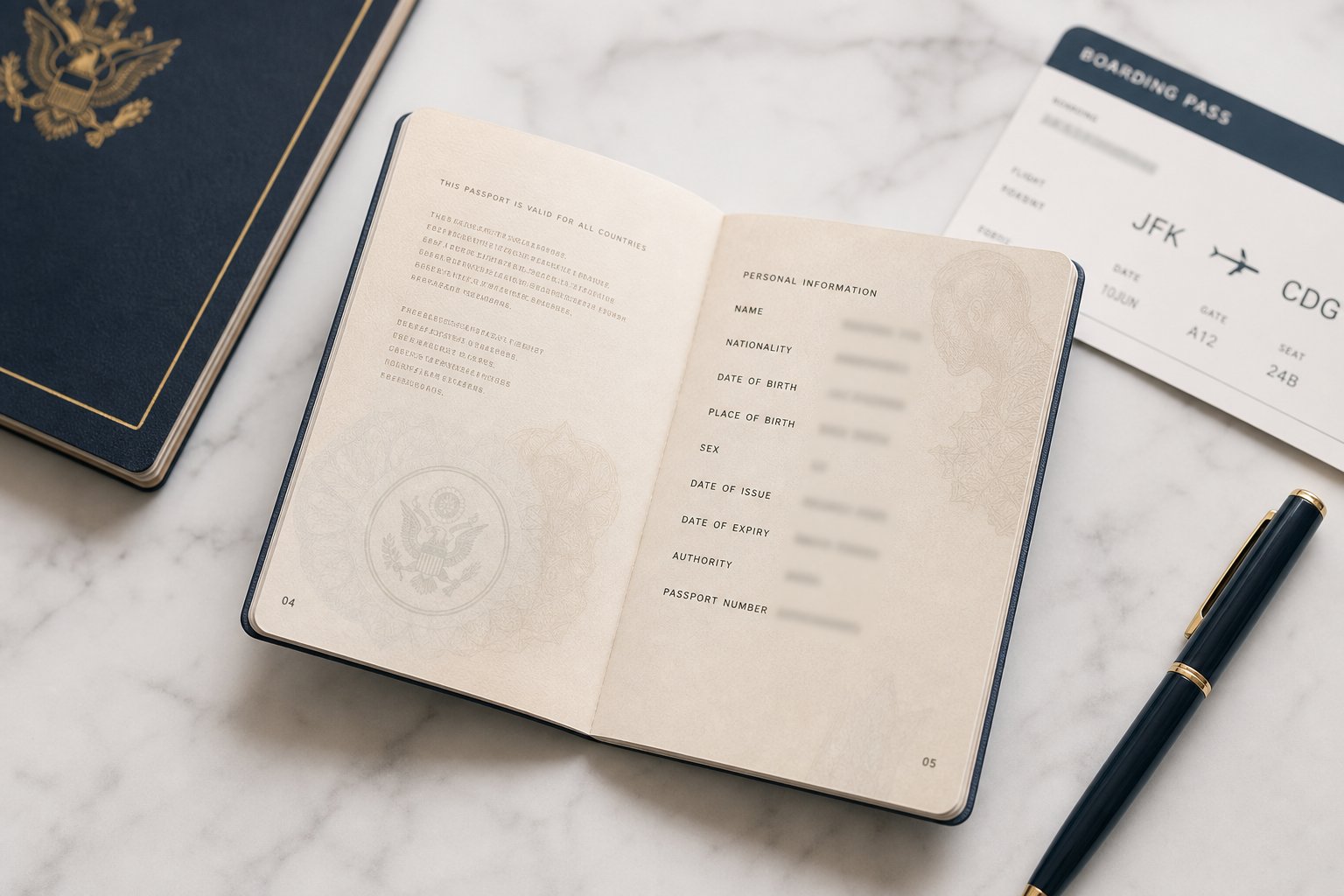
So is Ah a Chinese surname or prefix? The confusion is understandable. Ah appears in legal documents, census records, passenger manifests, and official immigration papers, places where you'd expect to find real names, not informal nicknames. When you encounter "Ah Wong" on a 19th-century ship manifest, it looks like a complete legal name. It isn't.
The problem traces back to a simple miscommunication. When immigration officials asked Chinese arrivals "What is your name?" the question was often understood or translated as "What are you called?" The answer came back in the familiar form: Ah Wing, Ah Sam, Ah Ping. Officials wrote it down as a legal name, and that record stuck for generations. As My China Roots notes, the prefix Ah- in many Australian and American Chinese surnames is a direct result of this confusion between informal address and formal identity.
This is why Chinese names start with Ah in so many historical records, not because Ah was ever part of anyone's real name, but because a casual form of address got permanently frozen into official paperwork. The person recorded as "Ah Wong" might have been surnamed Wong, or Wong might have been their given name. Without additional context, the prefix alone doesn't tell you which.
Understanding this distinction matters whether you're researching family history, learning Chinese, or simply trying to decode a name you've encountered. The prefix is a window into relationships, not identity documents, and that difference shapes everything about how it works in practice.
Linguistic Rules Behind the Ah Prefix
Relationships explain why the prefix exists. Grammar explains how it actually works. The character 阿 is what linguists call a bound morpheme, a unit of language that cannot stand alone as a word. It must attach to something else, specifically to monosyllabic or disyllabic elements, to form a complete address term. You'll never hear someone say just "Ah" and leave it hanging. It always reaches forward and grabs onto a name, a surname, or a kinship noun.
So how does the ah prefix work in Chinese on a structural level? The rules are surprisingly consistent across dialect groups, even though pronunciation varies. The prefix slots in before a single-syllable element, creating a two-syllable address form that rolls naturally off the tongue. This rhythmic preference for two syllables is deeply embedded in Chinese phonology, and it shapes when the prefix can and cannot be used.
How Ah Attaches to Surnames and Given Names
The ah prefix grammar rules for Chinese names follow a clear pattern. Imagine you know someone's surname is Wong (黃). Among friends or peers, you can address them as Ah Wong (阿黃). The same logic applies to Chan, Lee, Lam, or any other monosyllabic surname. The ah plus surname naming convention is one of the most common patterns in Cantonese-speaking communities.
But surnames aren't the only attachment point. The prefix also connects to given names, and here's where it gets interesting. When a given name has two syllables, like Mei Ling (美玲), the prefix typically attaches to just the last character: Ah Ling (阿玲). Alternatively, it can attach to the first character: Ah Mei (阿美). The choice often depends on which syllable the family or friend group settled on as the familiar form.
Here are the core grammatical attachment patterns:
- Ah + monosyllabic surname: Ah Wong (阿黃), Ah Chan (阿陳), Ah Lee (阿李) — used among peers, by elders to younger people, or between colleagues
- Ah + single-character given name: Ah Sang (阿生), Ah Mei (阿美) — common among close friends and family members
- Ah + last character of a two-character given name: Ah Ling from Mei Ling, Ah Wai from Chi Wai — the most frequent pattern for constructing nicknames by dropping the surname and using Ah with the given name
- Ah + kinship noun: Ah Ma (阿媽, mother), Ah Ba (阿爸, father), Ah Gong (阿公, grandfather), Ah Yih (阿姨, auntie) — kinship terms softened with the prefix
There are constraints, though. The prefix resists attaching to polysyllabic elements that would create an awkward three-syllable or four-syllable cluster. You wouldn't typically say "Ah Mei Ling" because it breaks the preferred two-syllable rhythm. The system naturally compresses: pick one syllable, attach Ah, and you have your address form. When to add Ah before a Chinese name comes down to this rhythmic rule plus the social relationship between speaker and listener.
The Grammar Behind the Prefix
Here's what makes 阿 linguistically distinct from other Chinese address forms. Honorific titles like 先生 (sin saang, Mr.) or 小姐 (siu je, Miss) follow the name and establish formality. They push social distance outward. They say: I respect your position, and I acknowledge the boundary between us.
The Ah prefix does the opposite. It precedes the name and collapses social distance. It says: we are close enough that I don't need formality with you. This is a fundamental grammatical and social difference. Titles formalize. The prefix familiarizes.
Consider the same person addressed three ways:
- 陳先生 (Chan sin saang): Mr. Chan — formal, distant, respectful of hierarchy
- 阿陳 (Ah Chan): familiar, warm, peer-level or affectionate
- 陳偉明 (Chan Wai Ming): full name — neutral, official, no relationship signal
The prefix doesn't just change how a name sounds. It changes what the name communicates about the relationship. A title adds weight. The Ah prefix strips it away, leaving only the warmth of recognition between people who share a bond.
This grammatical behavior, reducing rather than adding formality, is precisely why the prefix caused so much confusion when it crossed into Western record-keeping systems. Officials expected names to carry identity information. Instead, they were hearing relationship information, a linguistic signal that only makes sense when you understand who is speaking to whom, and why.
How Different Chinese Dialects Use Ah
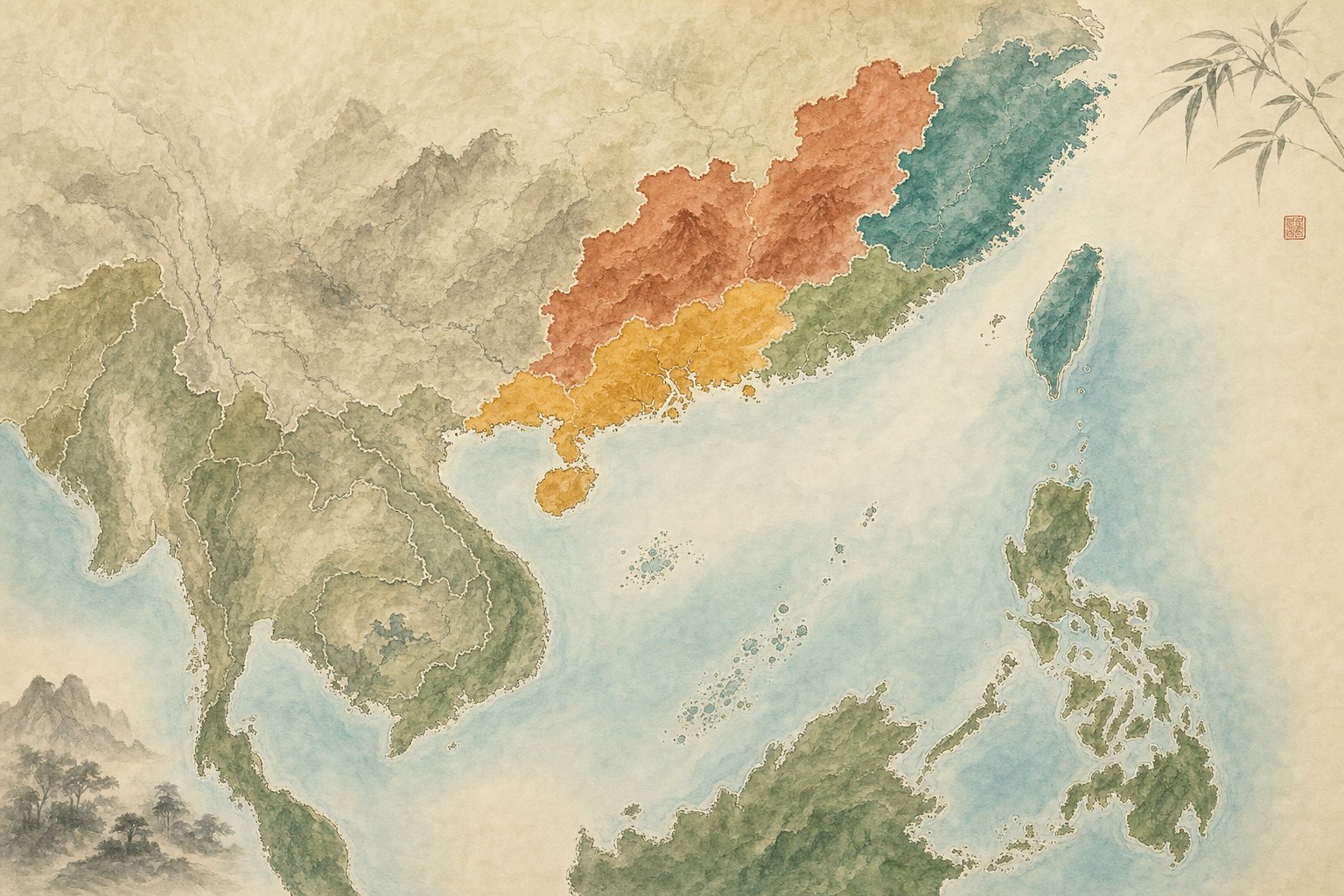
The grammar is consistent, but the sound and social reach of the prefix shift dramatically depending on which dialect group you're listening to. Chinese is not one language. It's a family of mutually unintelligible dialect groups, each with its own phonology, vocabulary, and social conventions. The 阿 prefix exists across most of them, but its pronunciation, frequency, and cultural weight vary in ways that matter, especially if you're trying to trace family origins or understand a specific community's naming habits.
So what are the Chinese dialect differences in ah usage? The short answer: Cantonese speakers use it the most, Mandarin speakers use it the least productively, and the other southern dialect groups fall somewhere in between with their own distinctive flavors.
Cantonese and the Dominance of Ah
If you've encountered the Ah prefix at all, chances are it came through a Cantonese-speaking context. There's a reason for that. Cantonese uses 阿 more extensively and in more social situations than any other Chinese dialect group. It attaches freely to surnames, given names, kinship terms, and even descriptive nicknames. A Cantonese speaker might use Ah-prefixed names dozens of times in a single day without thinking twice about it.
Why the dominance? Several factors converge. Cantonese has a strong preference for disyllabic address forms, and the prefix satisfies that rhythmic need perfectly. The dialect also maintains a rich system of informal address that resists the standardizing pressure Mandarin has exerted on other dialect groups. Cantonese-speaking communities in Hong Kong, Guangdong, and Macau preserved these patterns through generations of daily use.
The diaspora factor amplified this visibility. The majority of early Chinese immigrants to Australia, the United States, Canada, and Southeast Asia came from Cantonese-speaking regions of Guangdong province. Their speech patterns, including heavy use of the Ah prefix, became the default "Chinese" that Western officials, neighbors, and record-keepers encountered. When people think of ah prefix in Cantonese vs Mandarin, they're often surprised to learn how much more productive and socially embedded the prefix is in Cantonese daily life.
Ah in Hakka, Hokkien, and Teochew
Cantonese isn't alone. The other major southern dialect groups all use a cognate prefix, but each brings its own phonological twist and social conventions.
The Hakka ah prefix naming tradition runs deep. Hakka speakers pronounce the prefix similarly to Cantonese, as a short, open "ah" sound, and attach it to given names and kinship terms with high frequency. Hakka communities, historically mobile and tightly knit, used the prefix extensively within family and clan networks. You'll find Ah-prefixed names throughout Hakka diaspora records in Southeast Asia, particularly in Malaysia, Indonesia, and Taiwan.
Hokkien speakers, concentrated in Fujian province, Taiwan, and communities across the Philippines and Southeast Asia, also use the prefix but with slightly different phonological realization. Hokkien ah names examples include forms like Ah Huat (阿发, prosperity), Ah Kow (阿狗, dog, a humble childhood name meant to ward off evil spirits), and Ah Seng (阿成). The prefix in Hokkien tends to appear most frequently in childhood nicknames and family address, with somewhat less casual use among adult peers compared to Cantonese.
Teochew ah prefix pronunciation sits close to Hokkien, which makes sense given the linguistic kinship between these two Min dialect groups. Teochew speakers, prominent in Thailand, Cambodia, and parts of Vietnam, use the prefix in family contexts and among close community members. The vowel quality may be slightly more centralized than in Cantonese, but the social function remains the same: marking closeness and informality.
Mandarin uses 阿 as well, but with a narrower scope. You'll hear it in kinship terms like 阿姨 (ayi, auntie) and 阿爸 (aba, father), and in some regional Mandarin dialects it attaches to names. Standard Mandarin, however, favors other informal markers like 小 (xiao, little) or 老 (lao, old) for creating familiar address forms. The prefix 阿 in Mandarin feels more limited, more fixed to specific set phrases rather than being a freely productive tool for generating nicknames on the fly.
| Dialect Group | Pronunciation of 阿 | Common Usage Patterns | Frequency of Use |
|---|---|---|---|
| Cantonese | "ah" (short, open vowel, mid tone) | Surnames, given names, kinship terms, descriptive nicknames | Very high — used daily across most social contexts |
| Hakka | "ah" (similar to Cantonese) | Given names, kinship terms, clan and family address | High — especially within family and community networks |
| Hokkien | "ah" (slightly shorter vowel) | Childhood nicknames, kinship terms, close family address | Moderate to high — strongest in family contexts |
| Teochew | "ah" (centralized vowel, close to Hokkien) | Family address, kinship terms, community nicknames | Moderate — common in family, less among peers |
| Mandarin | "a" or "ah" (first tone or neutral tone) | Fixed kinship terms (阿姨, 阿爸), some regional name use | Low — limited to set phrases, not freely productive |
Notice the pattern: the further south you go, the more freely and frequently the prefix operates. This isn't coincidental. Southern Chinese dialects preserved older layers of Chinese linguistic structure that Mandarin standardization gradually smoothed away. The Ah prefix is, in a sense, a living fossil of an older, more intimate mode of Chinese address that thrives wherever southern dialect communities maintain their linguistic traditions.
This dialect variation matters beyond linguistics. It shapes the kinds of names that ended up in historical records, because the dialect a person spoke determined whether they'd introduce themselves with an Ah-prefixed form at all, and how naturally that prefix would surface when officials asked for a name.
Common Ah Prefix Patterns and Real Examples
Dialect shapes pronunciation, but the naming patterns themselves are remarkably consistent. Whether you're hearing Cantonese in Hong Kong or Hokkien in Penang, the prefix attaches to the same categories of words in the same predictable ways. If you've encountered a specific Ah-prefixed name and want to decode it, this is your practical reference.
Examples of ah prefix Chinese names fall into three distinct categories, each carrying its own social context and rules of use. You'll notice that the category tells you something about the relationship between the speaker and the person being addressed.
Ah Plus Surname Examples
The most straightforward pattern: Ah attaches directly to a one-syllable surname. So what does Ah Wong meaning in Chinese actually convey? It's simply the surname Wong (黄) with the familiarity prefix attached. Not a full name. Not a title. Just a warm, casual way to address someone whose surname you know.
Here are common ah plus surname examples in Cantonese and other southern dialects:
- Ah Wong (阿黄) — addressing someone surnamed Wong among peers, coworkers, or neighbors. Think of it as the equivalent of calling a colleague "Wong" in a friendly tone rather than "Mr. Wong."
- Ah Chan (阿陈) — same pattern with the surname Chan. An elder might use this when speaking to a younger person they know casually.
- Ah Lee (阿李) — peers at work or in a social group might default to this form after a few interactions. It signals: we're past formalities.
- Ah Lam (阿林) — common in workplace settings where colleagues share a relaxed rapport but aren't close friends outside of work.
When do people reach for this form? Typically among peers of similar age or status, by elders addressing younger people they feel warmth toward, or between colleagues who've moved past stiff politeness. You wouldn't use it with a stranger or someone significantly senior to you. The surname-based form sits in a middle zone: familiar enough to drop the title, but not intimate enough to use a given name.
Ah Plus Given Name and Kinship Terms
Given-name forms signal a closer relationship than surname forms. When someone calls you Ah Mei instead of Ah Chan, they're reaching past your family identity and addressing you personally. This is the territory of close friends, family members, and childhood companions.
- Ah Mei (阿美) — a woman whose given name is Mei or whose name contains the character Mei. Used by family, close friends, or a romantic partner. The genealogy researcher Past Presence notes that to construct this kind of nickname, you drop the surname and use Ah with the given name: Yip Sang becomes Ah Sang among friends.
- Ah Boy (阿仔) — literally "Ah" plus the Cantonese word for boy or son. Used affectionately for a young male child or sometimes a younger male in a group. Not a proper name at all, but a term of endearment.
- Ah Girl (阿女) — the female equivalent. A grandmother might call her granddaughter Ah Girl well into adulthood.
- Ah Tat (阿达) — a given-name form. Could refer to anyone whose name contains the character Tat/Da. Common in Cantonese communities as a familiar address between neighbors or friends.
Kinship terms form their own rich subcategory. If you've ever wondered about Ah Ma Ah Ba meaning in Chinese family contexts, these are among the most emotionally loaded uses of the prefix:
- Ah Ma (阿妈) — mother, in Cantonese. The prefix softens the kinship term into something warm and intimate, the way "mama" feels different from "mother" in English.
- Ah Ba (阿爸) — father. Same softening effect. These are the forms children use at home, and many adults never stop using them.
- Ah Gong (阿公) — paternal grandfather. In Hoklo (Taiwanese), a-gong and a-ma refer to paternal grandparents, though usage has broadened in modern families to cover grandparents on both sides.
- Ah Yih (阿姨) — auntie. Not necessarily a blood relative. In many Chinese communities, any older woman your family is close to might be called Ah Yih as a sign of respect and affection.
- Ah Sook (阿叔) — uncle. Same principle: the prefix plus the kinship noun creates an address form that affirms the relationship.
The prefix Ah doesn't change the meaning of the word it attaches to. It changes the feeling. Mother becomes Ah Ma. Uncle becomes Ah Sook. The information is the same, but the warmth is different.
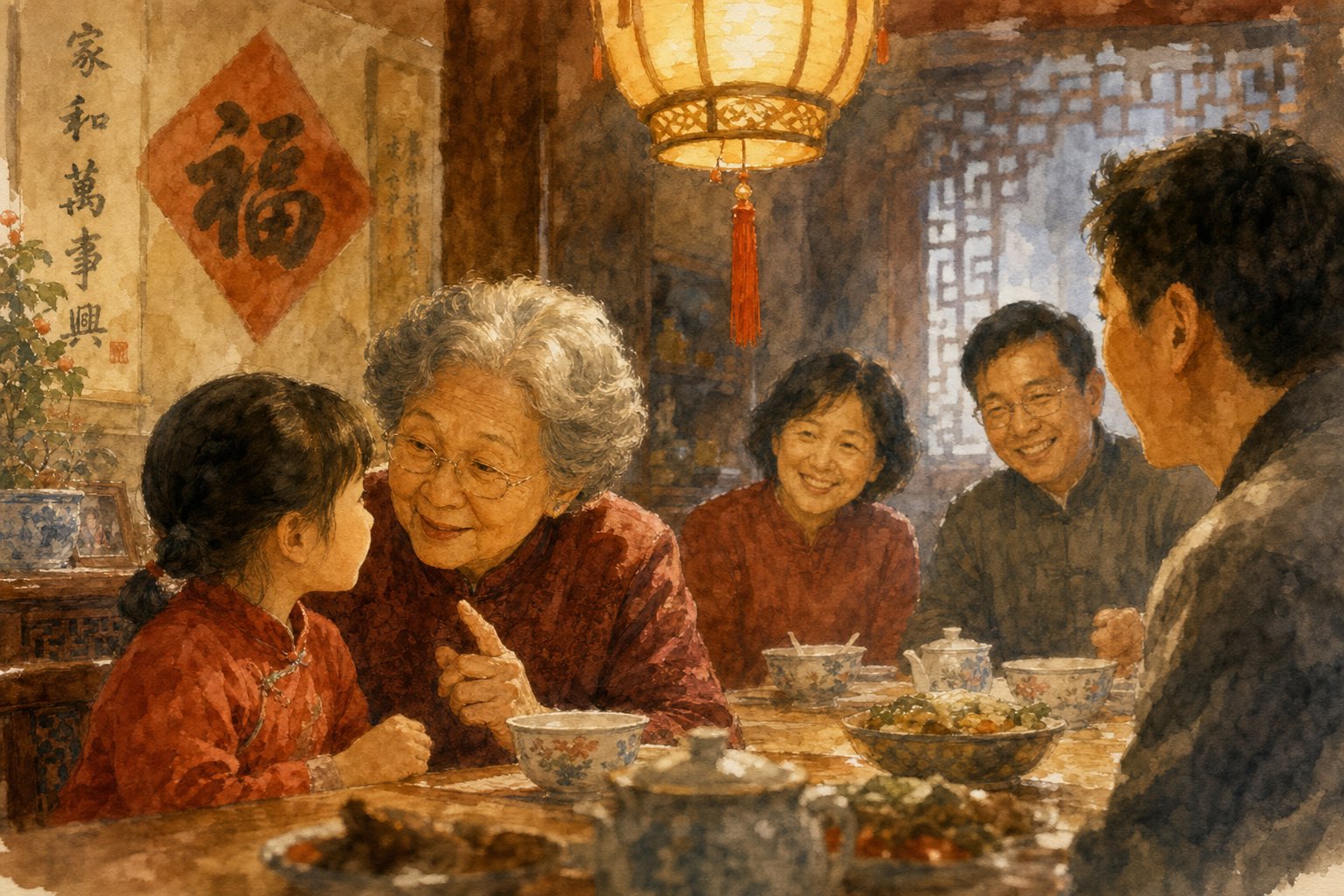
Imagine you're at a family gathering. The children call out "Ah Ma" and "Ah Ba." The adults address each other as "Ah Wing" or "Ah Mei." An older uncle gets "Ah Sook" from the younger generation. Every single use of the prefix is doing the same work: affirming connection, softening formality, saying "you belong here with us."
That sense of belonging is exactly what makes the prefix so socially powerful, and so easy to misuse. The same syllable that communicates warmth within a family can carry a very different weight when spoken across the wrong social boundary.

Social Meaning and Relationship Dynamics of Ah
A single syllable, two very different messages. Whether the Ah prefix lands as affection or disrespect depends entirely on who is speaking, who is listening, and what social ground exists between them. This is the part of ah prefix social etiquette in Chinese culture that no grammar rule can teach you. It lives in context.
Intimacy, Hierarchy, and Familiarity Signals
When you hear a grandmother call her grandson "Ah Boy," the prefix radiates warmth. When close friends greet each other as "Ah Wing" or "Ah Mei," it signals ease and mutual comfort. Between family members, the prefix is almost automatic, a verbal hug woven into daily speech. Between peers who've built rapport, it says: we don't need walls between us.
But the same prefix carries hierarchical information too. An elder addressing a younger person as "Ah Chan" can express gentle authority blended with affection, the way a mentor might use a first name with a junior colleague. The direction matters. When the younger person initiates the Ah form toward someone older or higher in status, the dynamic shifts. It can read as presumptuous, overly familiar, or even dismissive of the other person's position.
Chinese sociolinguistic research identifies three factors governing address choices: power differential between speakers, social distance, and the weight of the situation. The Ah prefix operates in the zone where power is low or equal and distance is minimal. Push it outside that zone, and it misfires.
So is the ah prefix rude in Chinese culture? Not inherently. But it can become rude instantly when it crosses a boundary the relationship hasn't earned. An ah nickname can signal affection or disrespect in Chinese depending on a single variable: does the speaker have the relational standing to use it?
When Using Ah Is Inappropriate
Knowing when to use Ah before someone's name means knowing when not to. Here are the situations where the prefix would land poorly:
- Addressing strangers: You haven't established familiarity. Using Ah with someone you just met implies a closeness that doesn't exist, which can feel intrusive or presumptuous.
- Formal contexts: Business meetings, official ceremonies, professional introductions. These settings demand titles and full names. Dropping into Ah-prefixed address here signals that you don't take the situation seriously.
- People of significantly higher status: Addressing your boss, a senior professional, or a respected elder with "Ah" plus their surname can come across as flippant or condescending, especially if the age or rank gap is large.
- Cross-boundary condescension: When someone in a position of power uses the prefix toward a subordinate they barely know, it can feel belittling rather than warm. The prefix strips formality, and stripping formality from someone without their implicit consent reduces their social standing.
The same "Ah Wong" that sounds like home when spoken by a childhood friend can sound like dismissal when spoken by a stranger or a superior who hasn't earned that closeness.
Tone and body language amplify these signals. A warm smile and soft voice make the prefix land gently. A curt tone or public setting can make the same syllable feel like a put-down. Context does the heavy lifting, not the word itself.
This social sensitivity explains something important about the historical record. When Western officials used Ah-prefixed forms in documents, they were unknowingly encoding a level of intimacy they hadn't earned, freezing an informal, relationship-dependent address into cold bureaucratic permanence. The prefix was never meant for paper. It was meant for people who knew each other well enough to use it.

The Ah Prefix in Western Historical Records
That bureaucratic permanence left a paper trail stretching across four continents. If you've ever searched for a Chinese ancestor in immigration records or census databases, you've likely hit a wall of entries that all look eerily similar: Ah Wong, Ah Sam, Ah Sing, Ah Chee. Dozens of them. Sometimes hundreds. All filed under "Ah" as though it were a surname shared by half the Chinese population. It wasn't. But understanding why do old Chinese records say Ah requires stepping into the shoes of a 19th-century immigration clerk who had never heard Cantonese before.
Ah in Immigration and Census Records
Picture the scene. A Chinese man steps off a ship in Sydney, San Francisco, or Victoria, British Columbia. An official asks his name. The man responds the way anyone would when addressed by a stranger in a port town: with the familiar form his shipmates and community members used daily. "Ah Lum." The clerk writes it down as a legal name. No follow-up question. No interpreter clarifying that "Ah" is a prefix of address, not a given name. The record is sealed.
This scenario played out thousands of times across Australia, the United States, Canada, and Southeast Asia throughout the 1800s and early 1900s. The State Library of Queensland documents how many indexes of public records "unfortunately took Ah to be the family name, and listed many Chinese persons under 'Ah' — for example, Ah Sing, Ah Poon and Ah Chee." This indexing error made it extraordinarily difficult to distinguish between individuals with similar names.
The consequences compounded over time. Consider William Lum Chew of Dalby, Queensland, a Chinese immigrant who arrived in the 1880s. Across his lifetime in Australia, official records captured his name as Ah Lum Chew, Lum Quee, Lim Chew, William Lum Chee, William Lum, William Lum-Choo, William Ah Chu, and Jung Gum Chew. Eight different recorded names for one person. The "Ah" prefix drifted in and out of his official identity depending on which clerk was writing and what form of address was offered that day.
The National Library of Australia confirms this pattern was widespread: "It is not uncommon to find Chinese personal names having an 'Ah' or 'A' in Australian records such as Ah Chin or Ah Foon. This prefix doesn't have a meaning. It's added before a given name in spoken language to express familiarity." Yet the prefix was routinely entered into documentation and, in some cases, fused with a given name to become one word.
In Canada, the same confusion reshaped entire family lineages. Genealogist Past Presence recounts how one ancestor, ENG Wing Him, lost his actual family name upon entering the country. The immigration process effectively renamed his descendants "Wing" instead of "Eng." Multiply that by thousands of families, and you begin to see the scale of identity disruption caused by a simple misunderstanding about what "Ah" meant.
The thinking among researchers is that the question "What is your name?" was either misunderstood or mistranslated as "What are you called?" — a subtle difference with major consequences. The answer came back in the familiar form, and officials recorded it as permanent legal identity.
Interpreting Ah-Prefixed Names in Historical Documents
If you're tracing Chinese ancestors through Western archives, encountering the ah prefix in immigration records for genealogy purposes is almost inevitable. The good news: once you understand the pattern, you can work around it. The element after "Ah" is your real clue. It's typically the person's actual surname or given name, and knowing which one requires cross-referencing with other records.
Here are practical tips for decoding ah names in historical documents:
- Treat "Ah" as invisible. Strip it away mentally. The meaningful name element is whatever follows. "Ah Wong" means you're looking for someone surnamed Wong or with a given name containing Wong.
- Search under multiple variations. The same person might appear as Ah Chee, Archie, A. Chee, or simply Chee in different records. Say the name aloud and imagine how a non-Chinese speaker might spell what they heard.
- Don't assume all "Ah" entries are the same person. An ah surname in census records for Chinese ancestors can look identical across dozens of entries. Ah Sam, Ah Sam, Ah Sam — these are almost certainly different individuals. Use age, occupation, and location to differentiate.
- Check whether the element after Ah is a surname or given name. "Ah Wong" likely references the surname Wong. "Ah Mei" likely references a given name. Context clues like family groupings in the same record can help you determine which.
- Look for the same person under anglicized names. Many Chinese residents eventually adopted English first names. William Lum Chew, Joseph Lum, and Ah Lum Chew were all the same man at different points in his life. Keep a running list of every name variation you find.
- Cross-reference with naturalization and exemption records. These later documents often contain photographs, handprints, and more detailed personal information that can confirm identity across multiple "Ah" entries.
- Remember that Chinese names could change over a lifetime. Marriage, coming of age, starting a business, or other significant events could prompt a name change — a cultural practice entirely separate from the Ah prefix confusion.
The irony runs deep. A prefix that existed solely to express human warmth and connection became, through bureaucratic misunderstanding, one of the biggest obstacles to reconnecting families across generations. Every "Ah" entry in a colonial ledger represents a moment where intimacy was mistaken for identity, and a relationship marker was frozen into a legal fiction that descendants are still untangling today.

Modern Evolution and the Future of the Ah Prefix
Those frozen records belong to the 1800s and early 1900s. But what about the living language? Do young Chinese people still use the Ah prefix the way their grandparents did? The honest answer: less and less, at least in certain contexts. The prefix hasn't disappeared, but its territory has shrunk. Where it once operated freely across workplaces, neighborhoods, and marketplaces, it now retreats toward the domestic sphere and specific cultural pockets where older speech patterns hold firm.
This isn't a sudden death. It's a slow contraction driven by forces that have been reshaping Chinese-speaking societies for decades. Understanding the ah prefix decline in modern Chinese naming means tracking several converging pressures that all push in the same direction: toward formality, standardization, and globalized naming conventions.
Why Younger Generations Use Ah Less
Imagine growing up in Shenzhen, Shanghai, or even modern Hong Kong. Your schooling happens in Mandarin or English. Your social media handles are English nicknames or internet slang. Your professional life demands business cards with standardized romanized names. Where does a Cantonese vernacular prefix fit in that world?
Several factors drive the shift:
- Mandarin standardization: Decades of Putonghua promotion across mainland China pushed regional dialect features to the margins. Since Mandarin uses the prefix far less productively than Cantonese or Hakka, younger speakers educated primarily in Mandarin simply don't have the habit. The prefix feels like something their parents or grandparents do.
- Urbanization and social mobility: In dense urban environments, people interact with strangers and acquaintances far more than with tight-knit community members. The prefix requires established familiarity to function properly. When your daily interactions are with people you barely know, the social conditions for using it rarely arise.
- Western naming conventions in diaspora communities: Second and third-generation Chinese in Australia, Canada, the US, and the UK often adopt English first names as their primary identifiers. "Kevin" or "Michelle" replaces the need for an Ah-prefixed familiar form entirely. The prefix becomes something only the oldest family members still use.
- Shifting norms around formality: Younger generations in Hong Kong and Guangdong increasingly use English nicknames, internet handles, or abbreviated given names among friends. The social work that the Ah prefix once performed — signaling closeness and informality — gets done through other linguistic tools now.
The result isn't that young people reject the prefix. Most simply never develop the habit of using it outside the family home. It becomes a passive feature they recognize and respond to, rather than an active part of their own speech.
Where Ah Still Thrives Today
Strip away the urban, educated, globally connected layer, and the prefix is alive and well. It persists in exactly the contexts you'd expect: wherever southern Chinese dialect communities maintain their linguistic traditions without heavy pressure from standardization or globalization.
Older family members remain the strongest carriers. A grandmother in Hong Kong's New Territories still calls her grandchildren Ah Boy and Ah Girl. A Hakka elder in a Malaysian kampung still addresses neighbors as Ah Kow or Ah Huat. Within the family home, across Cantonese-speaking regions, the prefix remains the default mode of address between generations. Children hear it from birth, absorb it as the sound of home, and carry that association even if they don't reproduce it in their own peer interactions.
Rural and semi-rural communities in Guangdong, Fujian, and parts of Southeast Asia also preserve heavy usage. Where everyone knows everyone, where social networks are dense and multigenerational, the conditions that make the prefix natural haven't changed much. The village grocer is still Ah Kee. The neighbor's son is still Ah Wai.
Then there's popular culture. The ah nickname in Chinese pop culture today carries a specific nostalgic charge. Hong Kong cinema and television have long used Ah-prefixed names for characters to signal authenticity, working-class identity, or emotional warmth. Think of classic TVB dramas where characters call each other Ah Sir, Ah Jeh, or Ah Ming. These forms instantly communicate a social world — one rooted in Cantonese community life, neighborhood bonds, and familial closeness. When a screenwriter gives a character an Ah-prefixed name, they're reaching for a particular emotional register that audiences recognize immediately.
The Children's Paradise magazine in Cold War-era Hong Kong offers a telling historical parallel. When translators adapted Japanese manga characters for Cantonese-speaking children in the 1970s, they renamed them using Ah-prefixed Cantonese forms — "Ah-Man," "Ah-Cou," "Naughty Boy" — embedding Chinese cultural connotations within the familiar dialectal structure. That translation choice worked precisely because the prefix carried warmth and recognition for young readers. It made foreign characters feel like neighborhood kids.
For diaspora communities, the prefix increasingly functions as a marker of Cantonese ah prefix diaspora identity. Third and fourth-generation Chinese Australians, Canadians, and Americans who are reconnecting with their heritage often encounter the prefix through family stories, old letters, or genealogy research. For them, hearing "Ah" before a name isn't just linguistic information. It's an emotional bridge to a world their great-grandparents inhabited. Some actively reclaim it, using Ah-prefixed forms within family contexts as a deliberate act of cultural continuity.
The prefix occupies a curious position: declining in daily frequency but growing in symbolic weight. For older speakers, it's simply how you talk. For younger generations, it's becoming something more intentional — a choice that says "I remember where this comes from, and I value it." Whether that shift from habit to heritage marker sustains the prefix long-term or accelerates its transformation into a cultural artifact remains an open question, one that depends on how strongly Cantonese-speaking communities maintain their linguistic distinctiveness in the decades ahead.
What's clear is that the prefix hasn't lost its meaning. It still does what it always did: compress an entire relationship into a single syllable. The question is simply how many people still reach for it when they want to say "you're one of mine."
Putting It All Together
One syllable. No independent meaning. Yet 阿 carries the full weight of a relationship every time it's spoken. Understanding ah prefix Chinese names means recognizing that this particle was never about identity on paper. It was always about connection between people.
Key Takeaways for Understanding Ah-Prefixed Names
Here's a quick summary of how to interpret Ah in Chinese family names:
- It's a prefix, not a name. Ah (阿) is a familiarity marker that attaches before surnames, given names, and kinship terms. It never stands alone.
- It signals relationship, not identity. The prefix tells you how two people relate to each other — not what someone's legal name is.
- It varies by dialect. Cantonese uses it most freely. Hakka, Hokkien, and Teochew all share the feature. Mandarin uses it narrowly in fixed phrases.
- It was widely misrecorded. Western immigration officials captured it as a legal name component, creating generations of confusing records where "Ah Wong" looks like a full name but isn't.
- Context determines tone. The same prefix conveys warmth between intimates or condescension across inappropriate social boundaries.
Using This Knowledge in Practice
What you do with this understanding depends on why you came looking for it.
If you're a language learner, resist the urge to sprinkle Ah into conversations before you've earned the relational standing. Listen for how native speakers use it around you. The social context matters more than the grammar.
If you're a genealogy researcher, this is your ah prefix guide: strip "Ah" away mentally, search under every spelling variation you can imagine, and never assume two "Ah Sam" entries are the same person. The real name hides behind the prefix, waiting for you to look past it.
If you're a diaspora descendant encountering the prefix in family stories or old letters, know that every "Ah" you find is a trace of intimacy. Someone, somewhere, was close enough to your ancestor to address them with warmth rather than formality. That's not a bureaucratic artifact. That's a relationship preserved in sound.
The Ah prefix is proof that language carries more than information. It carries feeling. A single syllable before a name says: I know you, you belong to me, and we are close enough that I don't need your full name to reach you.
Chinese ah prefix cultural significance can't be reduced to a grammar rule or a genealogy tip. It's a living piece of how Chinese-speaking communities have expressed belonging for centuries — compressed into the smallest possible linguistic unit, and still doing its work wherever people are close enough to use it.
Frequently Asked Questions About the Ah Prefix in Chinese Names
1. Is Ah a Chinese surname or part of a legal name?
No, Ah (阿) is not a surname or legal name component. It is a vernacular prefix that signals familiarity or affection between the speaker and the person being addressed. It appears in many Western historical records because immigration officials mistakenly recorded it as part of a legal name when Chinese arrivals introduced themselves using their informal, everyday address forms. The actual surname or given name is the element that follows the prefix.
2. What does Ah mean before a Chinese name?
The character 阿 placed before a Chinese name functions as a relationship marker expressing closeness, warmth, or casual familiarity. It works similarly to how English speakers might shorten 'James' to 'Jimmy' to show affection. The prefix attaches to surnames (Ah Wong), given names (Ah Mei), or kinship terms (Ah Ma for mother) and tells you about the bond between two people rather than providing identity information.
3. Which Chinese dialects use the Ah prefix most frequently?
Cantonese uses the Ah prefix most extensively, applying it freely to surnames, given names, kinship terms, and descriptive nicknames in daily conversation. Hakka ranks second, using it heavily within family and clan networks. Hokkien and Teochew employ it primarily in family contexts and childhood nicknames. Mandarin uses it the least productively, limiting it mostly to fixed kinship phrases like 阿姨 (ayi, auntie) rather than generating new nickname forms on the fly.
4. How do I research Chinese ancestors with Ah in their recorded name?
Strip 'Ah' away mentally and focus on the element that follows, which is typically the person's actual surname or given name. Search under multiple spelling variations since the same person may appear differently across records. Never assume two entries with the same Ah-prefixed name are the same individual — use age, occupation, and location to differentiate. Cross-reference with naturalization records, exemption certificates, or anglicized name entries, as many individuals adopted English first names later in life.
5. Can using the Ah prefix be considered rude or disrespectful?
Yes, in certain contexts. The prefix is appropriate between family members, close friends, and peers of similar status. However, using it with strangers, in formal settings, or toward people of significantly higher social standing can come across as presumptuous or condescending. The key factor is whether the speaker has earned enough relational closeness to use it. Without that standing, the same prefix that conveys warmth among intimates can signal disrespect or inappropriate familiarity.