Lin and Lim Are Usually the Same Surname
Imagine two cousins at a family reunion. One introduces herself as "Lin," the other as "Lim." Different spelling, same bloodline. Confusing? It doesn't have to be.
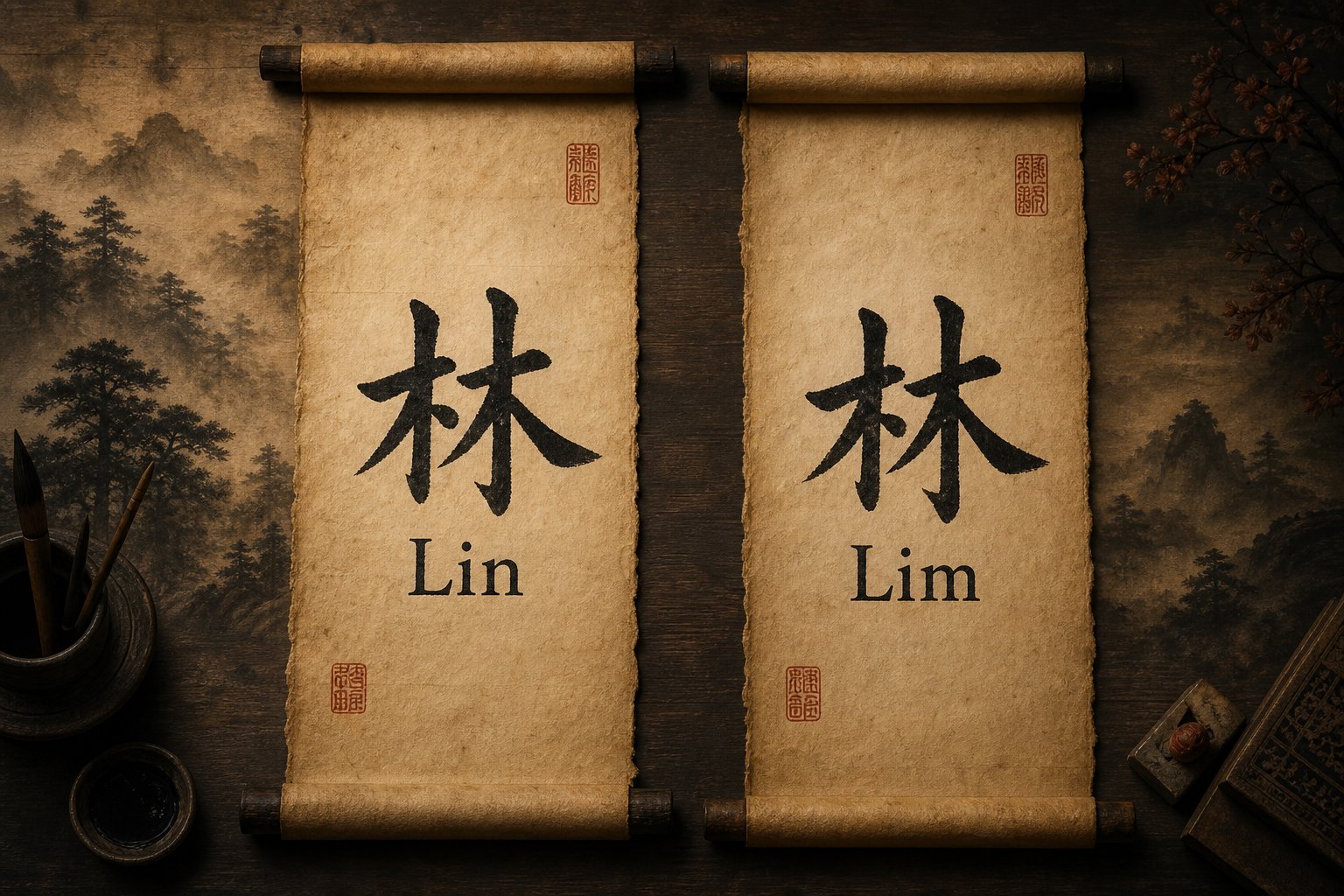
The lim and lin surname question comes up constantly in diaspora communities, genealogy forums, and immigration offices. The short answer: both spellings almost always represent the exact same Chinese character — 林, meaning "forest." The difference comes down to dialect. When your ancestors left China, the way they pronounced their surname determined how it was spelled in Latin letters. Mandarin speakers say "Lin." Hokkien and Teochew speakers say "Lim." Same family, same character, different sound.
Lin and Lim usually share the same Chinese character 林 — the difference is which dialect was used to romanize it.
Why the Same Family Can Have Two Different Spellings
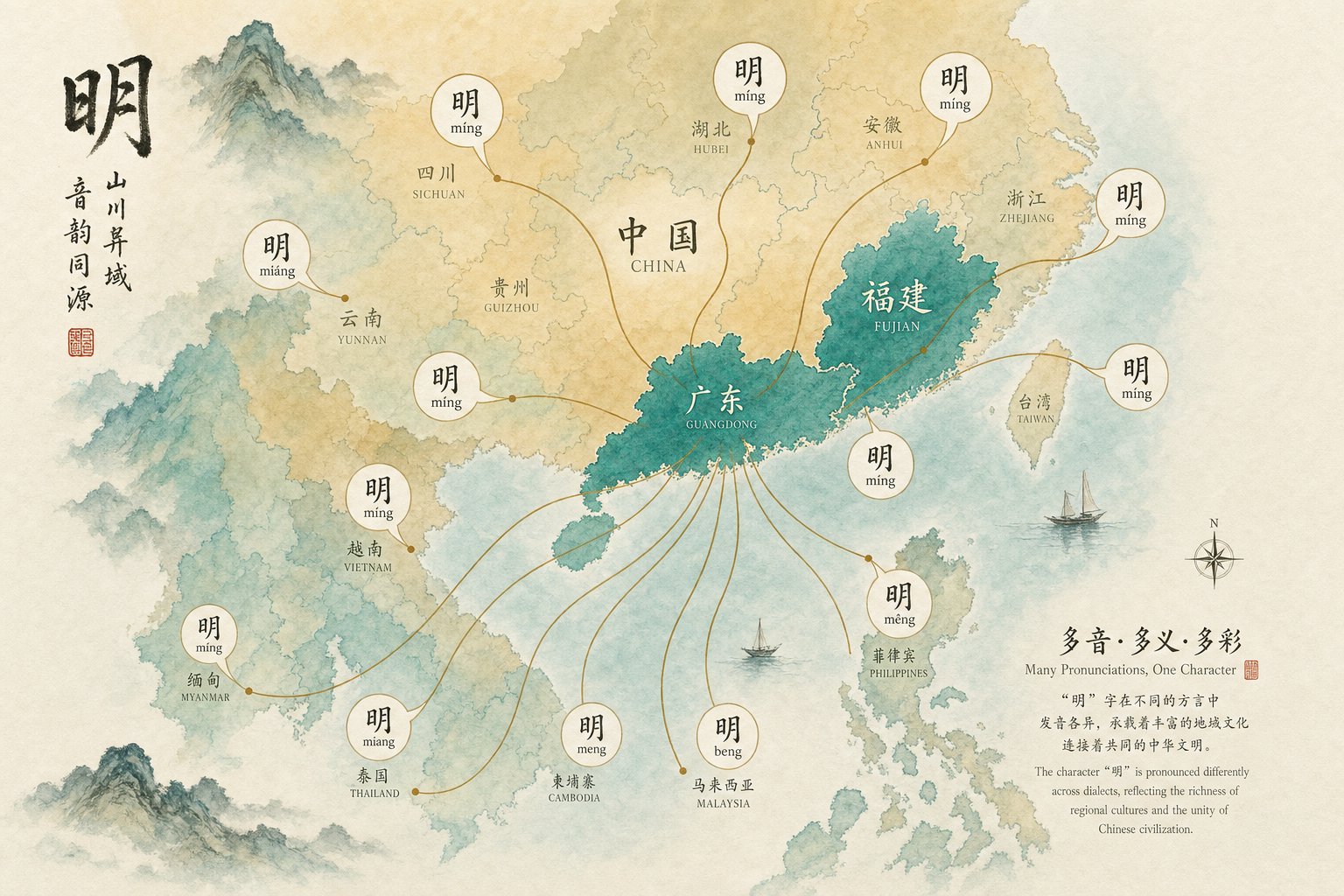
Chinese is not one language — it is a family of dialects that can sound as different from each other as French does from Spanish. The lin surname, ranked as the 18th most common in China, is pronounced distinctly across dialect groups. Mandarin renders 林 as "Lin." Hokkien, Teochew, and Hakka render it as "Lim." Cantonese produces "Lam." When millions of Chinese families emigrated to Southeast Asia, North America, and beyond, colonial officials and immigration clerks simply wrote down what they heard. No standardized system existed to unify these spellings, so the romanization stuck — and passed down through generations.
Is Lin a surname you've encountered in mainland China or Taiwan? That tracks. Is Lim the version you see in Singapore or Malaysia? Also expected. The spelling is a geographic and linguistic fingerprint, not a sign of a different family.
What This Guide Covers
This guide breaks down every major romanization variant of 林 — from Lin and Lim to Lam, Hayashi, and Im. You'll learn which dialect and country produces each spelling, how to trace family connections across different versions, and what to do if you're unsure whether two relatives with different last names actually share common ancestry. Whether you're researching your own roots or simply curious about why one character spawns so many spellings, the full picture starts with understanding how romanization systems work — and why they don't always agree.
How Dialect and Romanization Create Different Spellings
Every romanization system has one job: translate a Chinese sound into Latin letters. The problem? Different dialects produce entirely different sounds from the same character. So when you see the chinese surname lin spelled multiple ways, you're looking at multiple systems doing their job correctly — just from different starting points.
How Romanization Systems Work
Think of romanization as a phonetic translator. A linguist listens to how a character is pronounced in a specific dialect, then assigns a combination of English letters that best approximates that sound. Several major systems exist, and each one was designed for a particular dialect or political context:
- Hanyu Pinyin (Mandarin): The official system of the People's Republic of China. It renders 林 as Lín — second tone, rising pitch. This is the lin surname in chinese as standardized by Beijing.
- Wade-Giles (Mandarin): An older British system used before Pinyin became dominant. It also produces "Lin" for 林, though with different diacritical conventions.
- Pe̍h-ōe-jī (Hokkien/Teochew): A missionary-developed system for Southern Min dialects. It renders 林 as "Lim" because Hokkien speakers pronounce the final consonant as an "m" rather than an "n."
- Jyutping (Cantonese): The standard romanization for Cantonese, which produces "Lam" — reflecting how the vowel shifts entirely in Guangdong and Hong Kong speech.
Each system is internally consistent. None of them is wrong. They simply capture different pronunciations of the same logographic character.
Why One Character Produces Multiple Spellings
The lín surname chinese speakers recognize as 林 has existed for thousands of years — long before anyone tried to write it in the Latin alphabet. When romanization finally became necessary for passports, shipping records, and colonial registries, officials used whatever dialect the person in front of them spoke. A Hokkien farmer in 1890s Singapore had his name recorded as "Lim" because that's what the British clerk heard. His cousin who stayed in Fujian and later got a PRC passport became "Lin." Singapore's romanization practices reflect this ad hoc, dialect-driven approach — no single policy governed how Chinese names were spelled, and the local community's mix of Hokkien, Teochew, and Cantonese speakers produced a patchwork of variants.
The spelling a family carries depends on two factors: which dialect their ancestors spoke, and which country's official system was applied at the time of registration. A family that emigrated before standardized systems existed might carry a spelling that doesn't match any formal romanization at all.
One important edge case worth noting: "Lim" doesn't always mean 林. In certain dialects, it can romanize other characters like 廉 (meaning "honest") or 任 (meaning "responsibility"). These are far less common, but if genealogy research hits a dead end, verifying the underlying Chinese character — not just the romanized spelling — is essential. The character is the anchor; the spelling is just the surface.
Lin — The Mandarin Pinyin Romanization
So what makes "Lin" the version you'll encounter most often in international media, academic papers, and official documents? It comes down to one system: Hanyu Pinyin. And Hanyu Pinyin is backed by the two largest Chinese-speaking governments on the planet.
Lin as the Mandarin Standard
In Mandarin Chinese, the character 林 is pronounced with a second tone — a rising pitch, written with a tone mark as lin. The sound is crisp: the initial "l" flows into a short "in" that rhymes with English "seen" but cut shorter. No nasal "m" at the end, no vowel shift. Just a clean, two-letter syllable.
The surname Lin traces its lin surname origin back over 3,000 years to the Shang Dynasty. According to traditional genealogies, the progenitor was Bi Gan, a loyal minister whose descendants adopted the character 林 (forest) as their family name. That history stays constant regardless of spelling — but "Lin" became the internationally dominant form because Mandarin is the prestige dialect used in government, education, and diplomacy across both mainland China and Taiwan.
Where Lin Is the Official Spelling
Two major jurisdictions mandate this spelling on passports and official records:
- Mainland China (PRC): Hanyu Pinyin has been the national standard since 1958 and the sole system used on PRC passports. Every lin surname China issues on an official document follows this romanization.
- Taiwan (ROC): After years of debate between competing systems, Taiwan adopted Hanyu Pinyin as its nationwide standard in 2009. Before that, most Taiwanese used a simplified Wade-Giles variant — which also produced "Lin" for 林. So the lin surname Taiwan residents carry has been consistently spelled this way across both the old and new systems.
Wade-Giles, the older British romanization system that dominated academic use for over a century, also renders 林 as "Lin." This means whether you're reading a 1950s sinology paper or a modern PRC passport, the spelling stays the same — giving "Lin" an unusual level of continuity across eras and political systems.
Pros and Cons of the Lin Romanization
If you carry the surname Lin or are considering which romanization to use on documents, here's what the spelling offers — and where it falls short:
Pros
- Internationally recognized as a Chinese surname due to Pinyin's global adoption
- Matches official systems in both the PRC and Taiwan, simplifying cross-strait paperwork
- Used consistently in English-language media, academic citations, and international organizations
- Simple two-letter spelling that's easy to pronounce for non-Chinese speakers
Cons
- Doesn't reflect Hokkien, Teochew, or Cantonese pronunciation — families from these dialect groups may feel it erases their linguistic heritage
- Can be confused with non-Chinese surnames (e.g., Scandinavian "Lin" or short forms of "Linda")
- Loses the tonal information (second tone) that distinguishes it from other Mandarin syllables spelled the same way
For families rooted in Mandarin-speaking regions, "Lin" is the natural and official choice. But millions of 林 families don't come from Mandarin-speaking backgrounds at all — they come from the Hokkien and Teochew communities of Southeast Asia, where a completely different pronunciation locked in a completely different spelling generations ago.

Lim — The Hokkien and Teochew Romanization
That different pronunciation isn't a minor regional quirk. It's the daily reality for tens of millions of people across Southeast Asia who write their lin chinese surname as "Lim" — and have done so for generations.
Lim as the Hokkien and Teochew Standard
In Southern Min dialects — primarily Hokkien and Teochew — the character 林 ends with a bilabial nasal "m" rather than the alveolar "n" heard in Mandarin. Say it out loud: your lips close at the end of "Lim," while they stay open for "Lin." That single consonant shift is the entire phonetic difference, but it's enough to produce a completely distinct romanization.
This pronunciation isn't a corruption or simplification. It reflects an older layer of Chinese phonology. Linguists note that Southern Min dialects preserve features of Middle Chinese that Mandarin has since lost. So when you encounter chinese names surname lin spelled as "Lim," you're actually looking at a pronunciation with deeper historical roots than the Mandarin version.
Countries Where Lim Predominates
The vast majority of Chinese emigrants to Southeast Asia between the 17th and early 20th centuries came from Fujian and Guangdong provinces — Hokkien and Teochew heartland. When they arrived, colonial administrators in British Malaya, the Dutch East Indies, and Spanish Philippines registered their names phonetically. No one consulted a Mandarin dictionary. The clerk wrote what the immigrant said, and "Lim" became permanent.
This colonial-era process locked the spelling into official identity systems that persist today:
- Singapore: The NRIC (National Registration Identity Card) system records "Lim" as one of the most common chinese surnames lin families carry. It ranks among the top five surnames in the country.
- Malaysia: The IC (Identity Card) system follows the same pattern. Among Malaysian Chinese, Hakka, Hokkien, Teochew, and Hainan communities all romanize 林 as "Lim."
- Philippines: Filipino Chinese families overwhelmingly use "Lim," reflecting Hokkien-speaking ancestry from Fujian province.
- Indonesia: Indonesian Chinese often spell it "Liem" (a Dutch-influenced variant of the same Hokkien pronunciation) or have adopted Indonesianized forms like "Salim" or "Halim" with the Lim element embedded.
The lin surname history in Southeast Asia is inseparable from these migration waves. Families didn't choose "Lim" from a menu of options — it was assigned based on how they spoke, then cemented by bureaucratic systems that offered no mechanism for change.
Pros and Cons of the Lim Romanization
For families who carry this spelling, it functions as both an identity marker and a geographic signal. Here's what it communicates — and where it creates friction:
Pros
- Reflects the actual spoken dialect of the family's ancestral community
- Deeply established across Southeast Asian legal, business, and social systems
- Carries strong community identity — other Hokkien or Teochew speakers immediately recognize shared heritage
- Distinguishes Southeast Asian Chinese diaspora families from mainland or Taiwanese families at a glance
Cons
- Less recognized internationally as a Chinese surname — people unfamiliar with dialect romanization may not connect "Lim" to China at all
- Sometimes confused with the Korean surname 임 (Im/Lim), which derives from a different character entirely
- Creates administrative complications when dealing with PRC or Taiwanese institutions that only recognize Pinyin
Despite these friction points, changing from "Lim" to "Lin" is rare in Southeast Asian communities. The spelling carries too much family history, too many legal documents, and too strong a sense of dialect identity to swap for the sake of international legibility. It's not just a name — it's a record of where your ancestors came from and what language they spoke when they arrived.
Of course, Hokkien and Teochew speakers aren't the only dialect group that produced a distinct romanization. Cantonese speakers created yet another variant — and so did the Japanese, Koreans, and Vietnamese who adopted the same character centuries ago.
Lam, Hayashi, Im, and Other Variants of 林
Cantonese, Japanese, and Korean speakers all inherited the same character — but their languages shaped it into forms that sound nothing like "Lin" or "Lim." If you only search for those two spellings, you'll miss entire branches of the 林 family tree.
Lam — The Cantonese Romanization
In Cantonese, 林 is pronounced with a broad open vowel: "Lam" (rhyming with English "calm"). The vowel shifts dramatically compared to Mandarin or Hokkien, and the final consonant lands on "m" — similar to the Hokkien version but with a completely different vowel core. This is the lin surname cantonese speakers carry, and it dominates in Hong Kong and among Cantonese-speaking communities in Guangdong province.
You'll also encounter "Lum" in older records. This variant reflects an earlier Cantonese romanization style common among 19th-century immigrants to North America — particularly those from Taishan (Toisan) and surrounding Siyi districts. Genealogical records confirm that "Lem" appears as yet another Siyi Cantonese subdialect variant of the same character. Families in San Francisco's Chinatown or Vancouver's historic Chinese community may carry "Lum" or "Lem" on documents that predate any standardized system.
Hayashi — The Japanese Reading of 林
Here's where things get surprising. The character 林 exists in Japanese as a standalone kanji — and it's read as "Hayashi" in native Japanese pronunciation (kunyomi). The meaning stays identical: a grove or small forest. As a surname, Hayashi is one of the more common Japanese family names, ranking in the top 20 nationally.
The lin surname in japanese context also has an onyomi (Chinese-derived) reading: "Rin." You'll see this in compound words like 林業 (ringyō, meaning "forestry") and 林立 (rinritsu, meaning "standing densely"). So a Japanese surname lin connection is real — Hayashi families and Lin families literally share the same written character, even though the spoken forms diverged centuries ago when Japan adapted Chinese writing to its own phonological system.
For genealogy purposes, a Hayashi family in Japan and a Lin family in China aren't necessarily blood relatives. Japan adopted the character independently for native Japanese families who lived near groves. But the logographic link is undeniable, and some Japanese families of Chinese descent do trace their 林 back to the same ancestral roots.
Im and Rim — Korean Variants
Korean uses the character 林 as well, but pronounces it "Im" (임) in South Korea and "Rim" (림) in North Korea. The difference between Im and Rim is purely a matter of North-South Korean orthographic convention — South Korean phonological rules drop the initial "r" sound before "i," while North Korean preserves it.
The lin korean surname connection runs deep historically. According to genealogical research, the founding ancestors of Korean Im clans originally immigrated from China. The P'yŏngt'aek Im family traces its lineage to Im P'algŭp, who arrived during the Tang Dynasty. Over 216 clans use the 林 character in Korea, though only a handful have fully documented lineages. When romanized for international use, Korean 림/임 appears as "Im," "Lim," or "Rim" depending on the individual's preference and the romanization system applied.
This creates a notable overlap: the korean surname lin (written 林) and the Hokkien surname "Lim" look identical in English despite coming from entirely different linguistic traditions. A Korean "Lim" likely traces to 林 through Korean pronunciation of the Chinese character, while a Singaporean "Lim" traces to 林 through Hokkien pronunciation. Same character, same spelling, different phonological paths.
All Variants at a Glance
When you consolidate every known romanization of 林 into a single list, the scope becomes clear:
- Lin — Mandarin Pinyin, Wade-Giles (China, Taiwan)
- Lim — Hokkien, Teochew, Hakka (Singapore, Malaysia, Philippines)
- Lam — Cantonese (Hong Kong, Guangdong)
- Lum — Older Cantonese / Taishanese (North American diaspora)
- Lem — Siyi Cantonese subdialect (historical records)
- Liem — Dutch-influenced Hokkien (Indonesia)
- Hayashi — Japanese kunyomi reading (Japan)
- Rin — Japanese onyomi reading (used in compounds)
- Im — Korean, South Korean romanization
- Rim — Korean, North Korean romanization
- Ling — Occasional variant in older Cantonese records
Every single entry on this list traces back to the same logographic character: 林. Two trees standing side by side, meaning "grove" or "forest." The character hasn't changed in thousands of years. What changed is the sound each language community assigned to it — and then how that sound was captured in Latin script.
With this many variants scattered across East and Southeast Asia, the practical question becomes: which spelling dominates in which country, and why? The answer maps directly onto migration history, colonial administration, and national language policy.

Country-by-Country Spelling Breakdown
Migration history and government policy together determine which spelling of 林 you'll find on passports, identity cards, and family records in any given country. Some nations enforce a single romanization standard. Others inherited a patchwork of dialect-based spellings from colonial-era registration and never unified them. Here's how it plays out region by region.
East Asia — China, Taiwan, Japan, Korea
In East Asia, national language policy drives the spelling. The lin surname in China is standardized as "Lin" on all PRC-issued documents because Hanyu Pinyin has been the sole official romanization system since 1958. With an estimated lin surname population of over 14 million bearers in mainland China alone, this makes "Lin" the single most common romanized form worldwide. Within China's borders, 林 ranks as the 18th most common surname nationally — but regional concentration tells a more dramatic story. In Fujian province, it's the 2nd most common surname, and in Guangdong's Haikou it ranks 4th. So how many lin second most common surname rankings does it hold? At least one provincial-level claim in Fujian, the ancestral homeland of most Hokkien speakers.
Taiwan also uses "Lin" on passports following its 2009 adoption of Hanyu Pinyin. Before that, Wade-Giles was standard — but since both systems produce "Lin" for 林, Taiwanese families have carried this spelling consistently across both eras.
The surname lin Japan recognizes is written with the same character but read as "Hayashi" in everyday use. It's the 19th most common surname in Japan, carried by hundreds of thousands of families. Japanese passports render it in romaji as "Hayashi" — you won't see "Lin" on a Japanese document unless the bearer is ethnically Chinese and registered under a Chinese reading.
In Korea, 林 becomes "Im" (South Korea) or "Rim" (North Korea). South Korean passports typically romanize it as "Im" or "Lim" depending on individual preference, since Korea's romanization rules allow some flexibility for surnames. The character is shared, but the pronunciation and cultural context are entirely Korean.
Southeast Asia — Singapore, Malaysia, Philippines, Indonesia
Southeast Asia is where "Lim" dominates — and it's not close. The overwhelming majority of Chinese emigrants to this region came from Hokkien and Teochew-speaking communities in southern Fujian and eastern Guangdong. Colonial registration systems captured their dialect pronunciation, and post-independence governments inherited those records without converting them to Pinyin.
In Singapore, "Lim" is one of the top five most common surnames in the entire country. Malaysia follows the same pattern: Hokkien, Teochew, and Hakka communities all registered as "Lim," while Cantonese families registered as "Lam." The Philippines mirrors Singapore's Hokkien dominance — Filipino Chinese families almost universally spell it "Lim."
Indonesia is the most complex case. Older records use "Liem" (reflecting Dutch colonial spelling conventions for the Hokkien pronunciation), while newer documents may show "Lim" or even Indonesianized forms like "Halim," "Salim," or "Limantoro." A government policy in the late 1960s encouraged Chinese Indonesians to adopt Indonesian-sounding names, which produced dozens of creative derivatives — all traceable back to 林 if you know what to look for.
Western Diaspora Communities
In the United States, Canada, Australia, and Europe, you'll find every variant coexisting — sometimes within the same extended family. The spelling a Western diaspora family carries depends entirely on where their ancestors emigrated from and when they arrived. A family that left Fujian for San Francisco in the 1870s might carry "Lum" (Taishanese Cantonese). A family that left Singapore for Sydney in the 1990s carries "Lim." A recent immigrant from Beijing carries "Lin."
Western countries generally don't impose a romanization system on immigrant surnames. Whatever spelling appears on the origin country's passport gets transferred to the new country's records. This means a single family reunion in Los Angeles could include Lins from Taiwan, Lims from Malaysia, Lams from Hong Kong, and Lums whose great-grandparents arrived during the Gold Rush — all sharing the character 林 and a common ancestor.
Complete Regional Reference Table
| Country/Region | Dominant Spelling | Romanization System | Official Policy |
|---|---|---|---|
| Mainland China | Lin | Hanyu Pinyin | Mandatory on all PRC documents since 1958 |
| Taiwan | Lin | Hanyu Pinyin (post-2009); Wade-Giles (pre-2009) | Pinyin standard on passports; some older documents retain Wade-Giles |
| Singapore | Lim | Dialect-based (Hokkien/Teochew) | No conversion to Pinyin; NRIC preserves original dialect spelling |
| Malaysia | Lim (Hokkien/Teochew); Lam (Cantonese) | Dialect-based | IC system retains family's historical spelling |
| Philippines | Lim | Dialect-based (Hokkien) | No standardized Chinese romanization policy |
| Indonesia | Liem, Lim, or Indonesianized forms | Dutch-era Hokkien; post-1966 Indonesianization | Many families adopted Indonesian-sounding derivatives (Halim, Salim, Limantoro) |
| Hong Kong | Lam | Cantonese romanization | No mandatory Pinyin; Cantonese spelling standard on HKID |
| Macau | Lam | Cantonese romanization | Portuguese-era conventions preserved |
| Japan | Hayashi | Romaji (Hepburn system) | Native Japanese reading used; "Lin" only for Chinese nationals |
| South Korea | Im or Lim | Revised Romanization / personal preference | Flexible; individuals choose their own romanization |
| North Korea | Rim | McCune-Reischauer variant | Initial "r" preserved in North Korean orthography |
| Vietnam | Lam (Lâm) | Vietnamese Quốc Ngữ | Standard Vietnamese spelling with diacritics |
| Thailand | Lim- (prefix in Thai surname) | Thai transliteration | Chinese element embedded in longer Thai-style surnames (e.g., Limjaroenrat) |
| United States / Canada / Australia | Mixed (Lin, Lim, Lam, Lum) | Inherited from origin country | No conversion; passport spelling from country of origin preserved |
This table reveals a clear pattern: the spelling on your family's documents is a direct artifact of dialect, geography, and the administrative system that was in place when your ancestors first registered their name. It's not a choice anyone made freely — it's a historical record frozen in bureaucratic amber.
That frozen record is exactly what makes genealogy research both challenging and rewarding. When you're trying to connect relatives across these different spelling systems, the romanization becomes a clue rather than an obstacle — if you know how to read it.

Genealogy Guide for Connecting Lin and Lim Families
You've found a relative named "Lim" in Singapore and another named "Lin" in Taiwan. Are they from the same family? The romanized spelling won't answer that question — but the underlying Chinese character will. In genealogy research, the character 林 is your anchor. Everything else is surface noise created by dialect and bureaucracy.
Connecting Lin and Lim Relatives in Family Research
The single most important step in linking relatives across different spellings is confirming they share the same Chinese character. A "Lin" in Taipei and a "Lim" in Penang almost certainly both write 林 — but you need to verify, not assume. The lins surname etymology traces back to the same founding ancestor (Lin Jian, son of Prince Bi Gan), meaning families who share the character 林 share a common origin story stretching over 3,000 years. That's the real connection — not the English spelling on a passport.
Traditionally, Chinese surnames are inherited through the male line. Does a direct male line keep the same surname across generations? In almost all cases, yes. The patrilineal system means the character 林 passes from father to children without alteration. What changes is only the romanization — when a branch of the family migrates to a different dialect region or country, the spelling shifts while the character stays constant.
Here's a practical workflow for researchers trying to bridge the spelling gap:
- Confirm the Chinese character. Ask family members or check old documents for the handwritten character. If it's 林, you're dealing with the same surname regardless of whether the romanization reads Lin, Lim, Lam, or Lum.
- Identify the dialect group. Determine whether your family spoke Hokkien, Teochew, Hakka, Cantonese, or Mandarin. This tells you why the spelling diverged and narrows down the ancestral region in China.
- Trace the ancestral village. The lin surname origins for most families point back to Fujian or Guangdong province. Chinese genealogy books (zupu) are organized by village and clan branch — not by romanized spelling. Two families with different spellings from the same village are almost certainly related.
- Cross-reference migration records. Check ship manifests, colonial registration records, and clan association membership lists. These documents often record both the Chinese character and the romanized name, bridging the gap directly.
- Consult clan associations. Lin/Lim clan associations exist in most countries with significant Chinese populations. They maintain genealogical records that connect branches across national borders and spelling systems.
Migration Patterns That Determine Spelling
Imagine a family in a Fujian village during the 1800s. One brother stays home — his descendants eventually get PRC passports reading "Lin." Another brother sails to Malaya — his descendants carry Malaysian ICs reading "Lim." A third moves to Hong Kong — his line becomes "Lam." Three spellings, one grandfather. This scenario played out thousands of times during the great Southern Chinese emigration waves of the 19th and early 20th centuries.
The surname inherited through the male line never changed. What changed was the administrative context. A direct line change surname situation — where someone actually switches to a different character — is extremely rare in Chinese culture and typically only happened under political pressure (like Indonesia's 1960s name-change policies). In the vast majority of cases, spelling differences between relatives reflect nothing more than geography and dialect.
Understanding the lins surname as a single family dispersed across multiple romanization systems reframes the research question entirely. You're not looking for people with the same English spelling. You're looking for people with the same Chinese character, the same ancestral village, and compatible migration timelines.
When Lim Might Not Be the Same as Lin
Here's the edge case that trips up researchers: "Lim" doesn't always mean 林. In certain dialects, the romanization "Lim" can represent entirely different characters:
- 廉 (Lian in Mandarin): Meaning "honest" or "incorruptible." Romanized as "Lim" in some Hokkien contexts.
- 任 (Ren in Mandarin): Meaning "responsibility" or "to appoint." Can appear as "Lim" or "Lam" in certain Cantonese subdialects.
- 林 vs 임 (Korean): A Korean person named "Lim" likely carries the character 林 — but through Korean phonological history, not Hokkien. The genealogical connection to Chinese Lin families may exist historically but is far more distant.
If your research hits a wall — family stories don't align, ancestral villages don't match, dialect groups conflict — go back to the character. Ask to see it written. A mismatch at the character level means you're dealing with a different surname entirely, no matter how similar the English spelling looks.
The character is the truth. The romanization is just the accent.
Complete Lin vs Lim Comparison Summary
All the dialect history, migration patterns, and country-level policies covered so far boil down to a single practical question: what exactly separates Lin from Lim? Here's the consolidated answer.
Lin vs Lim at a Glance
Is Lin a Chinese surname? Yes. Is Lim? Also yes — the same one. The table below puts every distinguishing factor side by side so you can see exactly where these two spellings align and where they diverge.
| Category | Lin | Lim |
|---|---|---|
| Chinese Character | 林 | 林 |
| Meaning | Forest / Grove | Forest / Grove |
| Dialect Origin | Mandarin | Hokkien / Teochew |
| Pronunciation | Lín (rising tone, ends in "-n") | Lîm (ends in "-m", lips close) |
| Primary Countries | Mainland China, Taiwan | Singapore, Malaysia, Philippines, Indonesia |
| Population Estimate | 14+ million in mainland China (18th most common surname) | Millions across Southeast Asia (top 5 in Singapore) |
| Official Romanization System | Hanyu Pinyin, Wade-Giles | Dialect-based registration (no single standard) |
| Founding Ancestor | Lin Jian (林坚), son of Prince Bi Gan | Lin Jian (林坚), son of Prince Bi Gan |
| Common Confusion Points | Confused with Scandinavian names or short forms of "Linda" | Confused with Korean surname 임 (Im/Lim) from a different linguistic path |
The lin surname chinese families carry and the "Lim" that Southeast Asian families carry share identical entries in every row except dialect origin, pronunciation, and geography. Everything else — character, meaning, ancestor — is the same.
Key Similarities and Differences
The spelling difference between Lin and Lim is purely a matter of dialect romanization — both represent the same ancestral surname 林 in the vast majority of cases.
Which variant is more common globally? By raw population numbers, "Lin" wins — mainland China's 14 million bearers alone outnumber the combined Southeast Asian "Lim" population. The lin surname Wikipedia entry confirms 林 as the 18th most common surname in mainland China, while also noting its presence across Japan (as Hayashi), Korea (as Im), and Vietnam (as Lam). When you add all romanization variants together, the global 林 population likely exceeds 20 million people.
But population size doesn't determine correctness. Neither spelling is more "authentic" than the other. The lin surname wiki documentation and genealogical records both confirm that these are parallel romanizations of a single character — two windows into the same family history, shaped by the dialect your ancestors happened to speak.
So which spelling should you actually use? That depends on your specific situation — your ancestral dialect, your country of residence, and what you're trying to communicate about your heritage.
Final Recommendations and Key Takeaways
Your situation determines the answer. Someone filling out a passport application faces a different question than someone building a family tree or someone who just stumbled across this topic out of curiosity. Here's clear guidance for each scenario.
Which Spelling Should You Use
If you're choosing a romanization for official documents, two factors matter above everything else: your ancestral dialect and your country of residence.
- Your family speaks Mandarin and you live in China or Taiwan: Use "Lin." It matches the official Hanyu Pinyin system and will appear on government-issued documents automatically.
- Your family speaks Hokkien or Teochew and you live in Southeast Asia: Use "Lim." It reflects your dialect heritage and aligns with the spelling already embedded in your country's identity card system.
- Your family speaks Cantonese and you're based in Hong Kong or Macau: Use "Lam." That's what your HKID will show regardless of personal preference.
- You're in a Western country choosing freely: Go with whatever spelling your family has used historically. Consistency across legal documents matters more than matching any particular standard.
Thinking about good names with surname Lin or Lim for a child? The romanization choice should follow the same logic. Pick the spelling that matches your family's existing documents and dialect identity. Mixing systems within a nuclear family — one sibling as "Lin" and another as "Lim" — creates unnecessary administrative headaches down the road.
For genealogy researchers, the lin surname meaning ("forest" or "grove") stays constant across every variant. Don't let spelling differences stop your search. Confirm the Chinese character 林, identify the dialect group, and trace the ancestral village. The romanization is a clue about geography, not a barrier to connection.
The Bottom Line on Lin vs Lim
Neither spelling is more correct, more authentic, or more "Chinese" than the other. Both are valid romanizations of 林 — a character that has represented the same family lineage for over 3,000 years. The difference is purely a product of which dialect your ancestors spoke and which administrative system recorded their name.
Here are the key takeaways worth remembering:
- Lin and Lim represent the same Chinese character 林 in the vast majority of cases
- The spelling difference reflects dialect (Mandarin vs. Hokkien/Teochew), not a different family origin
- Your country of residence and its romanization policy determine which spelling appears on official documents
- Surnames ending in lin (like "Merlin" or "Devlin") are unrelated — the Chinese surname is always a standalone syllable
- For genealogy, the Chinese character is the true identifier, not the English spelling
- Changing your spelling to match a different system is a personal choice, not a correction
At the end of the day, a Lin in Shanghai and a Lim in Singapore can sit at the same ancestral hall, look at the same genealogy book, and point to the same founding ancestor. The letters on their passports differ. The family doesn't.
Frequently Asked Questions About Lin vs Lim Surname
1. Are Lin and Lim the same surname?
Yes, in the vast majority of cases. Both Lin and Lim represent the Chinese character 林, which means forest or grove. The spelling difference exists because Mandarin speakers pronounce it as 'Lin' while Hokkien and Teochew speakers pronounce it as 'Lim.' The character, meaning, and ancestral lineage are identical — only the romanization differs based on which Chinese dialect was used when the name was first written in Latin letters.
2. Why is the same Chinese surname spelled differently in different countries?
The spelling depends on two factors: the dialect the family spoke and the country's official romanization system. Mainland China and Taiwan use Mandarin-based Pinyin, producing 'Lin.' Singapore, Malaysia, and the Philippines inherited Hokkien dialect-based spellings from colonial-era registration, producing 'Lim.' Hong Kong uses Cantonese romanization, giving 'Lam.' No single international standard exists for Chinese surnames, so each country's administrative history determines the spelling.
3. Is Lim a Chinese or Korean surname?
Lim can be both. As a Chinese surname, it romanizes the character 林 through Hokkien or Teochew dialect pronunciation and is extremely common in Southeast Asia. As a Korean surname, it also represents 林 but through Korean phonology — South Korea romanizes 임 as 'Im' or 'Lim' depending on personal preference. The character is shared, but the linguistic paths are different. Context such as the person's country of origin usually clarifies which tradition the name comes from.
4. How do I find out if my Lin and Lim relatives are from the same family?
The key step is confirming both families use the same Chinese character 林. Romanized spellings alone cannot prove or disprove a connection. Start by asking family members for the handwritten character, then identify each branch's dialect group and ancestral village in China. Cross-reference migration records, ship manifests, and clan association membership lists. Two families from the same village in Fujian who share the character 林 are almost certainly related, regardless of whether they spell it Lin, Lim, or Lam today.
5. Can I change my surname spelling from Lim to Lin or vice versa?
Legally, this depends on your country's name-change policies. Some nations allow it through a formal application process, while others make it difficult. However, most Southeast Asian families choose not to change from Lim to Lin because the spelling carries significant dialect heritage and is embedded across generations of legal documents. Neither spelling is more correct — the choice reflects your family's linguistic history and geographic roots rather than any error that needs correcting.