The Deep Roots of Ancient Chinese Family Names
Imagine carrying a name that connects you, unbroken, to a clan that existed five thousand years ago. That is the reality for hundreds of millions of people today. Chinese surnames are not recent inventions or bureaucratic labels. They are living fossils, each one a thread stretching back to prehistoric clan identities formed long before written history began. China is, in fact, the first country known to have used surnames, and the system that produced them shaped how families, politics, and even marriage worked across millennia.
So what were ancient chinese family names, exactly? The original term is xing (姓), and it meant something far richer than a modern last name. A xing encoded blood kinship, territorial belonging, and spiritual identity all at once. It told the world which ancestral clan you descended from, which land your people called home, and which mythological figure watched over your lineage. Modern chinese surnames carry echoes of this system, but the depth of meaning has largely faded from everyday awareness.
What Makes Ancient Chinese Family Names Different From Modern Surnames
Today, chinese last names function mainly as identifiers. You inherit one from your father, it appears on official documents, and it distinguishes your family from others. In ancient China, the purpose ran deeper. Your xing determined who you could marry, what rituals you performed, and where you stood in a web of clan alliances. It was not a personal label but a collective identity shared by everyone tracing descent from the same ancestral mother. Yes, mother. The earliest chinese family names passed through the maternal line, a detail preserved in the very structure of the character 姓, which contains the radical for "woman" (女).
This distinction matters because it reveals that surnames were social technology. They organized entire communities, prevented inbreeding, and maintained political order across generations.
Why Understanding Surname Origins Matters Today
Over 85% of China's total population shares fewer than 100 common chinese names, and every one of those surnames traces back to ancient clan origins thousands of years old.
That statistic, drawn from FamilySearch research on Chinese surnames, reveals something striking. Despite China's enormous population, the naming system funnels back to a remarkably small set of ancient roots. Understanding the chinese name meaning behind surnames like Li, Wang, Zhang, or Chen is not just academic curiosity. It is a way to decode layers of history, migration, and cultural identity embedded in a single character.
This article traces the full arc of that story. You will see how matriarchal clans first created surnames, how a dual naming system split identity into clan and rank, how legendary emperors gave rise to the eight foundational names, and how dynasties reshaped the system into what exists today. Each stage reveals something about how chinese names carried power, purpose, and belonging across one of the longest continuous civilizations on earth.
The story begins with women, and with a single radical hidden inside the character for "surname" itself.
Matrilineal Origins and the Female Radical
Look closely at the Chinese character for surname, 姓 (xing). On the left side sits 女 (nu), the radical meaning "woman." On the right, 生 (sheng), meaning "born" or "to give birth." The character literally reads as "born of a woman." This is not coincidence or artistic flourish. It is linguistic evidence, preserved in written form for over three thousand years, pointing to a time when clan identity passed exclusively through the mother's line.
The logic behind this becomes clear when you consider Neolithic life. In early agricultural settlements, women managed crop cultivation and remained in fixed locations while men ranged outward for hunting or trade. Paternity was uncertain, but maternity never was. A child's mother was always known, making her the natural anchor for kinship tracking. Ancient chinese names, at their origin, were maternal markers. They told the community which woman's bloodline you belonged to.
The Female Radical in Ancient Surname Characters
The matrilineal fingerprint goes far beyond the character 姓 itself. The oldest ancient surnames in Chinese history all contain the female radical 女. These are the names scholars trace to the earliest clan structures, predating written records and surviving into the historical period as markers of the most prestigious lineages. Here are the six most commonly cited ancient chinese surnames that retain this radical:
- 姬 (Ji, jī, first tone) - Pronounced like "jee." Connected to the Yellow Emperor and the Zhou royal house.
- 姜 (Jiang, jiāng, first tone) - Pronounced like "jee-ahng." Linked to the Yan Emperor and the origins of agriculture.
- 姚 (Yao, yáo, second tone) - Pronounced like "yow." Associated with the legendary Emperor Shun. The yao last name origin traces to one of China's most revered sage-kings.
- 嬴 (Ying, yíng, second tone) - Pronounced like "ying." Ancestor surname of the Qin dynasty that unified China.
- 妫 (Gui, guī, first tone) - Pronounced like "gway." Connected to the descendants of Emperor Shun through a different branch.
- 姒 (Si, sì, fourth tone) - Pronounced like "suh" with a falling tone. Linked to the Xia dynasty founders.
Every single one carries 女 as its radical component. Linguistic research from UC San Diego confirms that this pattern has long supported the theory that xing originally referred to matrilineal identity, while the later term shi (氏) tracked patrilineal descent. These ancient last names were not just identifiers. They were declarations of which maternal clan held claim over you.
From Matrilineal Clans to Patrilineal Lineage
So what changed? Why did ancient china names shift from the mother's line to the father's?
The transition happened gradually during the late Neolithic and early Bronze Age, roughly between 3000 and 2000 BCE. As communities grew larger and surplus agriculture created wealth, control over land and resources became the dominant social concern. Men who accumulated livestock, bronze tools, and territorial claims wanted to pass those assets to their own biological children. Patrilineal inheritance solved that problem. If descent tracked through the father, property stayed within his direct line.
This economic shift restructured everything. Marriage patterns changed from men joining women's clans to women leaving their birth families to join their husband's household. Clan leadership consolidated around male elders. The ancient surnames persisted, but their transmission flipped. A child now inherited the father's xing rather than the mother's.
The character 姓 kept its female radical as a fossil of the older system, even as the practice it described became entirely patrilineal. By the time of the Shang and Zhou dynasties, ancient chinese surnames passed strictly through male lines. Yet the linguistic evidence remained, quietly testifying to an era when women defined the bloodlines that held communities together.
This shift did more than change inheritance rules. It created the conditions for a new layer of naming, one that tracked political rank and territorial grants alongside blood descent. That second layer, called shi, would eventually merge with xing to form the unified surname system still in use today.
The Dual Naming System of Xing and Shi
A single name was not enough. As clans expanded and political structures grew more complex during the Zhou Dynasty (1046-256 BCE), one identifier could not carry both biological kinship and social rank. The solution was a dual system: xing (姓) for blood descent and shi (氏) for political and territorial identity. Understanding how do chinese names work in this period means grasping that every person of status carried two layers of naming, each serving a completely different social function.
How the Xing and Shi System Worked in Daily Life
Think of xing as your deep ancestry and shi as your social address. Your xing told people which primordial clan you descended from, tracing back to a shared ancestor often thousands of years earlier. Your shi, on the other hand, told people your current branch, your fief, your rank, or your occupation. One was fixed and eternal. The other could change within a generation.
Here is how the two operated side by side:
| Feature | Xing (姓) - Clan Name | Shi (氏) - Branch Name |
|---|---|---|
| Function | Identified blood descent from a common ancestor | Indicated fief, official rank, or occupation |
| Inheritance Rules | Fixed and unchanging across generations | Could change with new fiefs or titles; father and son might carry different shi |
| Social Purpose | Regulated marriage (same-xing marriages were strictly taboo) | Distinguished social status and political affiliation |
| Historical Period | Originated in Neolithic matrilineal clans; used through Zhou Dynasty | Emerged during Shang Dynasty; proliferated under Zhou feudalism |
The marriage rule was the most consequential. Two people sharing the same xing could never marry, regardless of how many centuries separated their lineages. The ancient principle held that shared xing meant shared blood, and mixing that blood would bring misfortune. Meanwhile, two people with different shi but the same xing were still forbidden from marrying. The chinese surname you carried at the xing level was the deciding factor, not your branch name.
In practice, men were typically referred to by their shi in public life, while women retained their xing. This made sense given the system's logic. A woman's xing needed to remain visible so that marriage eligibility could be assessed at a glance. A man's shi communicated his political standing, which mattered more in court and military contexts.
The Zhou Dynasty's feudal system accelerated the creation of new shi names. Every time a king granted land to a noble, that noble's descendants might adopt the fief's name as their shi. A single xing like Ji (姬), the royal surname of the Zhou house, spawned dozens of shi branches as princes received territories across the realm. As Baidu's research on Chinese surnames notes, the Zhou feudal system was the primary engine driving surname proliferation during this era.
The Qin-Han Unification of Chinese Surnames
Sounds complex? It was. And that complexity eventually collapsed under its own weight.
By the Warring States period (475-221 BCE), the old feudal order was disintegrating. Noble houses fell, new powers rose from common origins, and the rigid social hierarchies that gave shi its meaning eroded. When the Qin Dynasty unified China in 221 BCE, the political landscape that sustained the dual system no longer existed. Fiefs were abolished. Aristocratic ranks lost their hereditary power. The distinction between xing and shi became irrelevant in a centralized bureaucratic state.
Sima Qian's Records of the Grand Historian (Shiji), written during the early Han Dynasty, documents this merger clearly. In his biographical entries, Sima Qian treats xing and shi as interchangeable, a practice that would have been unthinkable two centuries earlier. The Han Dynasty (206 BCE-220 CE) completed the consolidation. Every person now carried a single surname in chinese, functioning as both bloodline marker and social identifier. The layered system flattened into the one-surname structure familiar today.
This is why the modern convention of chinese names surname first feels so natural. The surname carries the weight of both ancient functions, clan identity and social belonging, compressed into a single character placed before the given name. When you see chinese names first last in their traditional order, you are looking at the surviving architecture of a system that once required two separate names to accomplish what one now does.
The merger also explains a common question about chinese first name last name order. In the original dual system, the collective identifiers (xing and shi) always preceded the personal name because group identity outranked individual identity. That principle carried forward. The chinese last name first convention is not arbitrary. It is a direct inheritance from an era when your clan mattered more than your personal name, and your surname announced your place in a web of kinship and obligation before anything else about you was known.
With xing and shi fused into a single system, the question became: which ancient names survived the merger, and what stories did they carry forward? The answer lies in eight legendary surnames, each tied to mythological founders whose influence still echoes in the most common family names used today.
The Eight Ancient Surnames and Their Legendary Origins
Eight names. That is all it took to seed the vast majority of Chinese surnames in existence today. The shanggu bada xing (上古八大姓), or Eight Great Surnames of Chinese Antiquity, represent the oldest traceable clan identities in Chinese civilization. Each one connects to a mythological ancestor, carries the female radical 女 in its character, and branched over millennia into dozens or even hundreds of modern surnames. These were the original royal chinese surnames, the names of ruling clans whose descendants built dynasties, conquered territories, and shaped a civilization.
Very few people carry these exact surnames today. Research on the Eight Great Surnames shows that only Yao and Jiang remain common in modern China. The rest have largely dissolved into their descendant branches. Yet their influence is everywhere, hidden inside the wang last name, the liu last name, and nearly every other surname on a modern Chinese ID card.
Ji, Jiang, and the Legendary Emperors
The surname Ji (姬, jī) belongs to the Yellow Emperor, Huangdi, the mythological ancestor of the entire Chinese nation. Legend holds that Huangdi took this name because he grew up beside the Ji River. From that single origin, the Ji clan became the royal house of the Zhou Dynasty and eventually spawned more descendant surnames than any other lineage in Chinese history. The historical record of the Ji surname documents that 411 modern surnames trace directly back to Ji, accounting for 82% of all surnames listed in the Hundred Family Surnames. When you encounter someone with the wang last name, the Zhou surname, or the Wu surname, you are likely looking at a distant descendant of this single ancient clan.
Jiang (姜, jiāng) carries an equally powerful origin story. The Yan Emperor, also called Shennong or the Divine Farmer, took this surname because he matured by the Jiang River. The Discourses of the States records this directly: "The Yellow Emperor matured by the Ji River, and the Yan Emperor matured by the Jiang River... therefore the Yellow Emperor took the surname Ji, and the Yan Emperor took the surname Jiang." The Yan Emperor is credited with inventing agriculture, herbal medicine, and market trade. His Jiang clan produced famous descendants including Jiang Ziya, the legendary strategist who helped found the Zhou Dynasty, and the ruling house of the State of Qi. Modern surnames descended from Jiang include Lu, Xu, Gao, and Cui.
Together, Ji and Jiang represent the two founding lineages of Chinese civilization. The phrase "Descendants of Yan and Huang" (炎黄子孙) refers to these two clans merging into the Huaxia people. These were the original chinese noble last names, the surnames that conferred legitimacy on kings and defined who could rule.
Yao, Ying, Si, and Their Dynastic Legacies
Yao (姚, yáo) connects to Emperor Shun, one of the legendary sage-kings celebrated for his virtue and wisdom. The yao last name origin traces to Shun's birthplace at Yaoqiu (姚墟). Unlike most ancient surnames that have nearly vanished, Yao remains recognizable today. The basketball player Yao Ming is perhaps the most famous modern bearer. The chen surname also traces partial roots through this lineage, as the state of Chen descended from Emperor Shun's line through the related surname Gui (妫).
Ying (嬴, yíng) carries the weight of empire. This was the ancestral surname of the Qin royal house, the dynasty that first unified China in 221 BCE. Qin Shi Huang, the First Emperor, bore this surname. Modern descendants include the Zhao, Huang, and Xu surnames. The huang surname, now one of China's most common, traces part of its origin to this ancient Ying clan.
Si (姒, sì) links to the Xia Dynasty, traditionally considered China's first hereditary dynasty. The legendary Yu the Great, who tamed catastrophic floods, belonged to this clan. Yun (妘, yún) connects to the fire god Zhurong, while Gui (媯, guī) branches from Emperor Shun through a different line than Yao. Ren (妊, rèn), sometimes replaced by Ji (姞, jí) in variant lists, rounds out the eight.
| Ancient Surname | Pinyin | Legendary Ancestor | Modern Descendants |
|---|---|---|---|
| 姬 Ji | jī (first tone) | Yellow Emperor (Huangdi) | Wang, Zhou, Wu, Zheng, Yang, Wei, Zhang |
| 姜 Jiang | jiāng (first tone) | Yan Emperor (Shennong) | Lu, Xu, Gao, Cui, Jiang |
| 姚 Yao | yáo (second tone) | Emperor Shun | Yao, Chen (partial), Tian |
| 嬴 Ying | yíng (second tone) | Boyi (minister to Emperor Shun) | Zhao, Huang, Xu, Qin, Liang |
| 姒 Si | sì (fourth tone) | Yu the Great (Xia Dynasty) | Si, Xia, Bao, Zou |
| 妘 Yun | yún (second tone) | Zhurong (fire god) | Yun, Yan, Zou |
| 妊 Ren | rèn (fourth tone) | Taihao (Fu Xi) | Ren, Xue, Zhang (partial) |
| 媯 Gui | guī (first tone) | Emperor Shun (alternate branch) | Chen, Tian, Yuan, Sun |
The scale of Ji's influence deserves emphasis. A single ancient surname producing 411 modern derivatives means that when you meet someone named Wang, Zhang, Yang, or Zhou, their lineage likely traces back to the same Yellow Emperor clan. The liu last name, one of China's most populous, also connects to this web through the royal house of the Han Dynasty, which descended from the Yao-Qi branch. These eight surnames functioned as root systems. Each one grew outward through feudal grants, territorial migrations, and dynastic successions until the original trunk became invisible beneath the canopy of branches.
Yet the eight ancient surnames only tell part of the story. Alongside these legendary lineages, entirely different mechanisms were generating new surnames: official titles turned into family names, occupations became hereditary identifiers, and rulers granted or revoked names as political tools.
Beyond the Eight Ancient Surnames
The eight legendary surnames account for a vast number of modern descendants, but they represent only one pathway through which chinese surnames and meanings came into existence. Dozens of other mechanisms operated simultaneously, generating names from the fabric of daily life rather than mythological ancestry. Official titles, skilled trades, rivers, hills, and even royal decrees all became raw material for new family names. These alternative origins reveal the full richness of chinese last name meanings and show that not every lineage traces to a legendary emperor.
Surnames From Official Titles and Occupations
Imagine holding a government post so important that your descendants carry its title as their family name forever. That is exactly what happened across ancient China. When a family held an official role for generations, the title itself became their identifier, eventually hardening into a hereditary surname.
Sima (司马) is one of the clearest examples. The title meant "master of horses," essentially a military commander responsible for cavalry and chariots. The Han Dynasty historian Sima Qian, author of the Records of the Grand Historian, inherited this surname from ancestors who held that military post. Situ (司徒), meaning "minister of education" or "minister of the masses," followed the same pattern. These title-based names often became compound surnames, carrying two characters instead of one.
Occupations worked similarly. Tao (陶) originated from families who made pottery. Wu (巫) came from shamans and ritual specialists who communicated with spirits. These were not arbitrary assignments. They reflected generations of specialized knowledge passed within a single family line, until the craft and the name became inseparable.
Geographic features contributed another layer. Families living beside the Jiang River (江) adopted it as their surname. Those settled near hills took Qiu (丘). The meaning of chinese last names in this category is often transparent: the character itself describes the landscape that shaped a clan's identity.
Here is how scholars categorize these diverse origins:
- Title-based: Sima (司马, military commander), Situ (司徒, minister of education), Sikong (司空, minister of works), Shangguan (上官, senior official)
- Occupation-based: Tao (陶, potter), Wu (巫, shaman), Pu (卜, diviner), Tu (屠, butcher)
- Geography-based: Jiang (江, river), Qiu (丘, hill), Chi (池, pond), Dong (东, east)
- Ruler-granted: Names bestowed as political rewards for loyalty or military achievement
- Totemic: Ma (马, horse), Xiong (熊, bear), Long (龙, dragon), derived from clan animal symbols
This diversity explains why chinese family names and meanings vary so dramatically. Some encode mythology, others encode geography, and still others preserve the memory of an ancestor's craft or rank.
Compound Surnames and Their Ancient Roots
Most mandarin surnames are a single character. Compound surnames (复姓, fuxing) use two or more characters, and they stand out immediately. Zhuge, Ouyang, Sima, Huangfu. These names carry an antique quality that single-character surnames often lack, and their origins are just as varied as their sound.
Ancient China once had over 1,000 compound surnames. Research from the South China Morning Post reports that fewer than 100 remain in use today. Ouyang is currently the most common, with over 1.1 million bearers according to China's 2020 National Name Report. Shangguan follows with 88,000 people, then Huangfu, Linghu, Zhuge, Situ, and Sima.
Their origins mirror the broader surname categories. Some came from official titles, like Sima and Situ. Others were hereditary names tied to regions, like Ouyang (south of the Ou River) and Dongguo (eastern city wall). Still others were adapted from ethnic minority tribal names as non-Han peoples integrated into Chinese society. These unique chinese surnames are considered rare last names today, valued for their historical depth and poetic resonance.
Most compound surnames disappeared through simplification. Ouyang, for instance, split into the single-character surnames Ou and Yang as descendants dropped one character for convenience. Some were lost entirely when family lines ended or when bearers deliberately changed their names during periods of political upheaval. The compound surname Xushi reportedly has only one living inheritor, a descendant of a 15th-century Ceylon prince who settled in Fujian province.
Political Surnames Granted and Revoked by Rulers
Surnames were not always inherited. They could be given and taken away. Chinese emperors wielded naming as a political instrument, rewarding loyal subjects with prestigious surnames and stripping disgraced officials of theirs.
The most coveted gift was the imperial surname itself. During the Tang Dynasty, the emperor could grant the Li surname to generals, ministers, or allied tribal leaders as a mark of supreme favor. Receiving the royal name meant being symbolically adopted into the ruling family. It conferred status, protection, and political legitimacy in a single gesture.
Revocation worked as the mirror image. An emperor could strip a family of their surname and assign a degrading replacement. The Tang empress Wu Zetian famously changed the surnames of rival clans to humiliating characters like "snake" (蝮) as punishment for opposition. Losing your surname meant losing your lineage, your ancestors, and your place in the social order. Few punishments cut deeper in a culture where family identity defined personal worth.
The chinese surnames meaning embedded in these granted names often reflected the political moment of their creation rather than any ancient bloodline. They remind us that surnames were never purely biological. They were always, at some level, instruments of power.
These diverse origins, from pottery wheels to imperial decrees, all fed into a system that shifted and adapted across centuries. Each dynasty left its mark on the surname landscape, adding names, merging others, and reshaping the rules governing how family identity passed from one generation to the next.
How Ancient Surnames Evolved Across Dynasties
Surnames did not freeze in place once created. Each dynasty reshaped the landscape of china surnames through conquest, policy, and migration. Tracing where surnames originate from requires walking through nearly four thousand years of political upheaval, each era leaving distinct fingerprints on how families identified themselves. What follows is that dynasty-by-dynasty arc, from the earliest hereditary names scratched into bone to the stabilized system that carried forward into modern China.
From Oracle Bones to Feudal Fiefs
The Xia Dynasty (c. 2070-1600 BCE) represents the earliest period of hereditary surname transmission. Historical texts like the Shiji (Records of the Grand Historian) attribute the Si (姒) surname to the Xia royal house, marking the first known case of a ruling family passing its clan name across generations. Evidence is largely textual rather than archaeological for this period, but the tradition it established, surnames as inherited markers of ruling legitimacy, persisted for millennia.
The Shang Dynasty (c. 1600-1046 BCE) provides the first physical proof. Oracle bone inscriptions unearthed at Yinxu contain clan emblems and ancestral names used to identify lineage groups participating in royal rituals. These inscriptions confirm that traditional chinese surnames were already functioning as organized identity markers by the late second millennium BCE. Shang clan names appeared on bronze vessels too, linking family identity to ritual authority and ancestor worship.
The Zhou Dynasty (1046-256 BCE) exploded the number of surnames in circulation. Feudal grants created hundreds of new shi names as the Zhou king parceled territory to relatives and allies. The Zuozhuan, a historical narrative covering 722-468 BCE, records these branch names in detail, documenting how traditional chinese last names multiplied through political fragmentation. A single generation of feudal grants could produce a dozen new surnames, each tied to a specific territory.
How Wars and Migrations Transformed Surnames
Dynastic collapse did not just end governments. It scattered populations and forced families to abandon or alter their names. When the Qin Dynasty fell in 206 BCE, descendants of the Ying royal house changed their surnames to avoid persecution. The same pattern repeated across centuries. Losing a war often meant losing your name.
The Northern Wei Dynasty (386-534 CE) offers the most dramatic example of deliberate surname transformation. Emperor Xiaowen's sinicization reforms of 496 CE ordered Xianbei tribal names converted into single-character Chinese surnames. The royal Tuoba clan became Yuan (元). Qiufumu became Mu (穆). Buliugu became Lu (陆). Over one hundred Xianbei last names ancient in origin were systematically replaced, permanently altering the chinese roots of millions of descendants who today carry surnames that appear entirely Han Chinese.
Wars and migrations continued reshaping ancient chinese last names through every subsequent dynasty. Southern migrations during the Jin Dynasty (266-420 CE) carried northern surnames into regions where they had never existed. The Tang Dynasty's cosmopolitan policies absorbed Central Asian and Persian names into the system. Each disruption added new layers to an already complex inheritance.
| Dynasty | Period | Key Surname Development | Notable Changes |
|---|---|---|---|
| Xia | c. 2070-1600 BCE | First hereditary royal surname (Si 姒) | Established principle of surname inheritance through ruling houses |
| Shang | c. 1600-1046 BCE | Oracle bone evidence of clan names | Clan emblems on bronze vessels linked surnames to ritual authority |
| Zhou | 1046-256 BCE | Feudal expansion of shi names | Hundreds of new branch surnames created through territorial grants |
| Qin | 221-206 BCE | Unification of xing and shi into single surname | Abolition of feudal ranks collapsed the dual naming system |
| Han | 206 BCE-220 CE | Stabilization of the modern surname system | Single-surname convention became universal across all social classes |
| Northern Wei | 386-534 CE | Mass conversion of non-Han tribal names | Over 100 Xianbei surnames replaced with Chinese single-character equivalents |
The Han Dynasty completed what the Qin began. By the second century CE, the single-surname system was fully standardized. Census records from this period show surnames applied uniformly across commoners and elites alike, a sharp departure from earlier eras when only aristocrats carried formal clan names. This was the moment traditional chinese surnames became truly universal, belonging to every person regardless of rank.
Yet having a surname and understanding its social power were two different things. The name on your family register did more than identify you. It governed who you could marry, which ancestors you worshipped, and which clan hall held your genealogical records. Those social functions turned surnames into instruments of community governance, enforced through rituals, taboos, and meticulously maintained family registers.
Clan Governance and the Social Power of Surnames
A surname was never just a label you wrote on documents. It was a set of rules you lived by. In ancient China, your family name determined who you could marry, which ancestral hall you entered for worship, and whose genealogical register recorded your birth. Clans enforced these rules with the weight of community law, making surnames function as governance systems long before centralized bureaucracies existed.
Marriage Taboos and the Social Logic of Surnames
同姓不婚 (tong xing bu hun) - Those sharing a surname do not marry.
This principle, recorded in the Zuozhuan and codified during the Zhou Dynasty, was not a suggestion. It was an absolute prohibition. Two people bearing the same surname could not wed, even if their common ancestor lived a thousand years earlier and no traceable blood relationship existed. The logic was both biological and political. Ancient Chinese thinkers observed that marriages between close kin produced weaker offspring, a remarkably early recognition of inbreeding risks. The Zuozhuan states plainly: "If one marries someone of the same surname, the offspring will not thrive."
The political rationale ran equally deep. Marriage between different surname clans created alliances. Every wedding was a diplomatic act, binding two lineages together through shared descendants. If the most common chinese surnames like Wang, Li, and Zhang all intermarried freely within their own groups, no new alliances would form. The taboo forced clans outward, weaving a web of obligations across communities that strengthened social cohesion.
This rule persisted for millennia. Even today, some rural communities in China maintain a cultural reluctance toward same-surname marriages, though it no longer carries legal force. The taboo shaped settlement patterns too. Villages dominated by a single surname often arranged marriages with neighboring villages bearing different names, creating predictable networks of kinship exchange.
Genealogical Records and Ancestor Worship Traditions
How did clans enforce these rules across centuries? Through meticulous record-keeping. The zupu (族谱) or jiapu (家谱), clan genealogical registers, documented every birth, marriage, death, and adoption within a surname lineage. Some of these records stretch back over fifty generations, representing continuous documentation spanning more than a thousand years.
These were not casual family trees. A zupu typically included lineage charts, biographies of notable ancestors, clan rules and moral codes, records of property holdings, and instructions for ritual observance. Clans appointed dedicated keepers to maintain and update the registers, and new editions were printed or hand-copied at regular intervals. Losing a zupu was considered a catastrophe, equivalent to severing the clan's connection to its ancestors.
Ancestral halls (citang, 祠堂) served as the physical anchors of surname identity. Every major clan maintained a hall where tablets bearing ancestors' names received offerings during festivals. These halls functioned as community centers, courtrooms, and schools simultaneously. Clan elders settled disputes, distributed charitable funds, and enforced behavioral codes within their walls. The surname carved above the entrance was not decoration. It was a declaration of collective identity and mutual obligation.
Ritual practices reinforced this identity through repetition. Spring and autumn sacrifices, Qingming tomb-sweeping, and New Year ancestor veneration all required participation organized by surname group. You worshipped with your clan, not your neighbors. This created a sense of belonging that transcended individual households and bound scattered families into a coherent social unit. Some families even maintained what might loosely be called a chinese family crest, distinctive symbols or hall names (tanghao, 堂号) that identified their specific branch within a larger surname group.
The Hundred Family Surnames (百家姓, Bai Jia Xing) emerged from this culture of surname consciousness. Compiled during the early Song Dynasty (960-1279 CE), it listed common surnames china had accumulated over millennia, arranged in rhyming couplets for easy memorization. Children recited it alongside the Thousand Character Classic and the Three Character Classic as part of basic education. The text begins with Zhao (赵), placed first because it was the imperial surname of the Song ruling house, followed by Qian, Sun, and Li.
The title says "hundred," but the text actually contains over 400 surnames. Its real significance lies not in completeness but in cultural function. It taught every child that surnames were a shared national inheritance, connecting individual families to a collective civilization. The most popular surnames in china today, Wang, Li, Zhang, Liu, and Chen, all appear in this Song Dynasty text, but their roots reach back thousands of years before it was written. The Bai Jia Xing was a snapshot, not an origin point. It captured a system already ancient by the time anyone thought to catalog it.
The most common surnames in china reflect this deep history of clan governance. Wang alone accounts for over 100 million bearers. Li, Zhang, Liu, and Chen each exceed 70 million. These are not random distributions. They reflect which clans successfully maintained their genealogical records, enforced their marriage networks, and preserved their ancestral halls through centuries of upheaval. The most common surname in china, Wang, traces to multiple independent origins, including descendants of the Zhou royal house whose title (王, meaning "king") became their hereditary name. Its dominance today is the cumulative result of thousands of years of clan expansion.
This system of surname-based governance did not stay confined within China's borders. As Chinese political and cultural influence spread across East Asia, neighboring civilizations adopted and adapted these naming conventions, creating parallel systems that still echo the original Chinese model.
How Ancient Chinese Names Shaped East Asian Naming
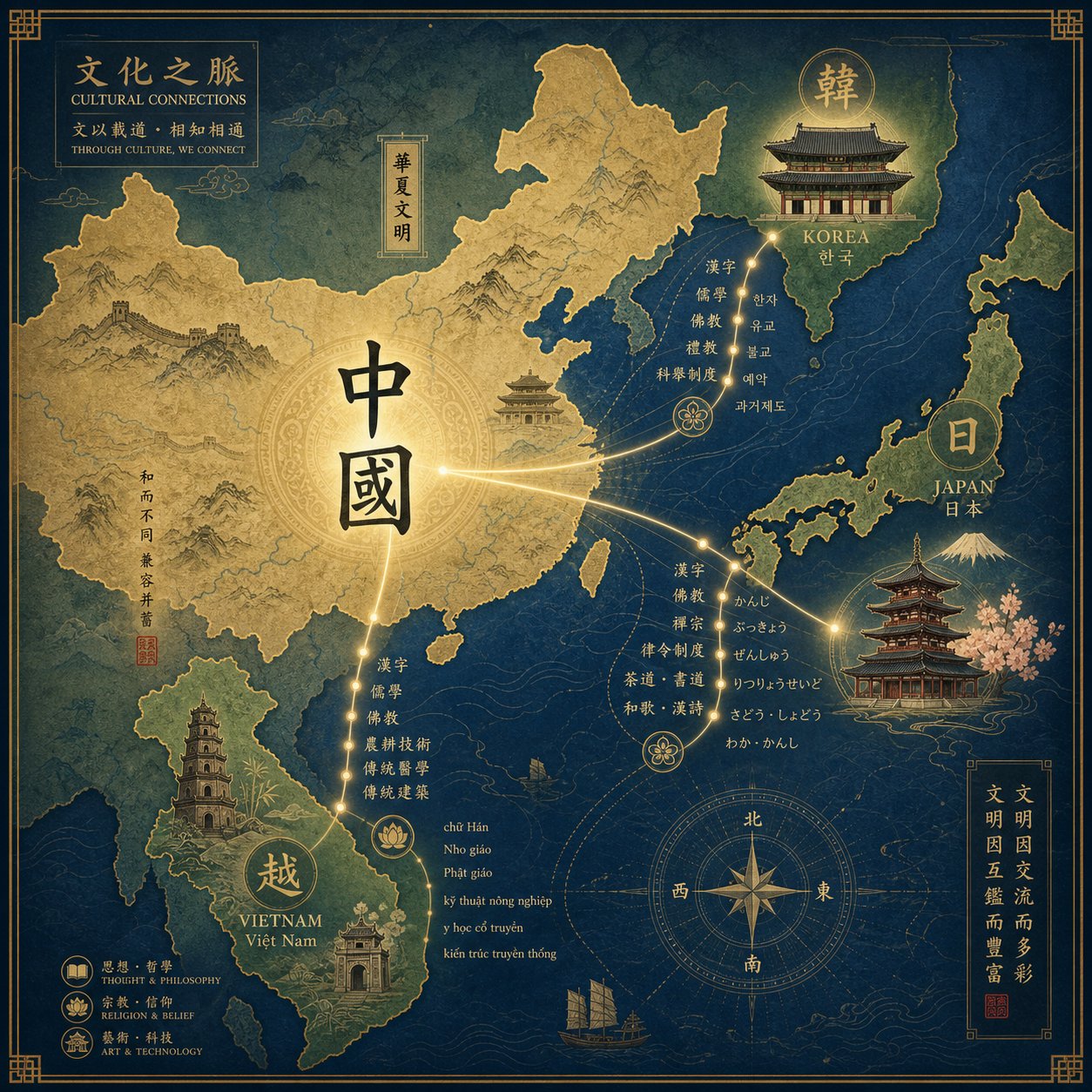
China did not develop its surname system in isolation, and the system did not stay within its borders. Over two millennia of political dominance, trade, and cultural exchange carried Chinese naming conventions outward into Korea, Vietnam, and Japan. The result is a shared pattern visible across the entire region today. Asian last names in these four countries follow strikingly similar structural rules, not because the cultures are identical, but because they all drew from the same ancient Chinese model at formative moments in their histories.
You will notice that surnames in Asia overwhelmingly come first, given names follow, and the pool of common surnames is remarkably small compared to Western naming traditions. These are not coincidences. They are direct inheritances from the clan-based system that ancient China pioneered thousands of years ago.
Chinese Surname Influence on Korean and Vietnamese Names
Korean surnames trace their formal structure to Chinese administrative influence during the Three Kingdoms period (57 BCE-668 CE). Before Chinese contact, Korean communities used native clan identifiers, but the adoption of Chinese characters and Confucian social organization reshaped naming into a system nearly identical to China's. Korean surnames are single-syllable, written in Chinese characters (Hanja), and placed before the given name. The three most common, Kim (金), Park (朴), and Lee (李), account for nearly half the Korean population.
The parallels run deeper than structure. Korea adopted the same-surname marriage taboo directly from Chinese practice, enforcing it legally until 2005. Korean clans maintain genealogical registers called jokbo (족보), functionally identical to Chinese zupu. The bon-gwan system, which identifies a clan's ancestral hometown, mirrors the Chinese practice of linking surnames to geographic origins. Korea has only about 280 surnames in total, an extreme concentration that reflects how thoroughly the Chinese model replaced earlier native naming.
Vietnamese surnames show an even more direct Chinese imprint. During over a thousand years of Chinese rule (111 BCE-938 CE), Chinese administrators imposed their naming system on the local population. Vietnamese surnames are overwhelmingly Chinese-origin characters pronounced in Vietnamese. Nguyen (阮), carried by roughly 40% of all Vietnamese people, was the surname of the last ruling dynasty. Tran (陈) and Le (黎) similarly trace to dynastic houses that adopted Chinese-style naming wholesale.
Why does one asian surname, Nguyen, dominate so completely? Each time a new dynasty seized power in Vietnam, subjects often adopted the new imperial surname for protection or favor, exactly mirroring the Chinese practice of rulers granting their surname to loyal followers. Centuries of this pattern concentrated the population under a handful of names. The mechanism is pure Chinese political naming logic, transplanted into Vietnamese soil.
The Sinosphere Naming Tradition Across East Asia
Japan followed a different path but still shows Chinese fingerprints. Japanese surnames developed later than Korean or Vietnamese ones. Commoners did not carry hereditary surnames until the Meiji government mandated them in 1875. Before that, only aristocrats and samurai used family names. When millions of Japanese families suddenly needed surnames, many drew from geographic features, occupations, or local landmarks, producing Japan's enormous pool of over 100,000 distinct surnames.
The Chinese influence in Japan appears not in surname structure but in the writing system itself. Japanese surnames use kanji, characters borrowed directly from Chinese, and many carry meanings identical to their Chinese equivalents. Yamamoto (山本, mountain base), Tanaka (田中, rice field middle), and Watanabe (渡辺, crossing edge) all use Chinese characters with Japanese pronunciations. The surname-first convention was also standard in Japan until Western contact prompted the adoption of given-name-first order in international contexts.
Across the region, these shared features define what scholars call the Sinosphere naming tradition. The convention of placing asian family names before given names reflects the same Confucian principle that shaped Chinese naming: collective identity outranks individual identity. Your family, your clan, your lineage speaks before you do.
| Country | Surname Position | Historical Chinese Influence | Number of Common Surnames |
|---|---|---|---|
| China | Surname first | Origin of the system; clan-based naming from Neolithic period | ~100 surnames cover 85% of population |
| Korea | Surname first | Adopted Chinese characters, Confucian clan structure, and marriage taboos | ~280 total; top 3 cover 45% of population |
| Vietnam | Surname first | Direct imposition during 1,000+ years of Chinese rule; dynastic surname adoption | ~100 total; Nguyen alone covers 40% |
| Japan | Surname first (traditional) | Kanji writing system borrowed; surname structure developed independently | Over 100,000 distinct surnames |
The contrast with Japan is revealing. Because Japanese commoners created their own surnames relatively recently and without centralized clan systems controlling the process, the result was massive diversity rather than concentration. China, Korea, and Vietnam, where ancient clan governance shaped naming over millennia, all show the opposite pattern: a small number of popular asian last names shared by enormous populations. The concentration is not a flaw in the system. It is evidence of how powerfully clan structures channeled identity through narrow surname lineages over thousands of years.
East asian last names, taken as a group, represent the largest interconnected naming tradition on earth. Over 1.5 billion people use surnames that trace their structural logic, and often their actual characters, back to the ancient Chinese clan system. The names have been pronounced differently, romanized in dozens of ways, and adapted to local languages, but the architecture remains recognizable. Surname first. Single character or syllable. Inherited patrilineally. Tied to clan identity rather than individual choice.
That architectural consistency raises a practical question for anyone carrying one of these surnames today. If your name connects to this ancient system, how do you trace it back? And why does the same surname appear spelled five different ways depending on which dialect, romanization system, or country your ancestors passed through?
Tracing Your Chinese Surname to Its Ancient Origins
Your chinese last name is not just an identifier on a passport. It is a compressed archive, a single character holding centuries of migration, clan politics, and ancestral memory. The question is how to unpack it. Whether your surname is Wang, Li, Chen, or something far less common, practical tools exist for tracing it back through the layers of history covered in this article. The challenge is knowing where to look and understanding why the same ancient name might appear spelled three or four different ways depending on where your family settled.
Tracing the Ancient Roots of Common Modern Surnames
The most common chinese last names today each carry distinct origin stories that connect directly to the ancient systems discussed earlier. Here is what the top five reveal:
Wang (王) means "king." It originated from descendants of the Zhou royal house who, after losing political power, were identified simply as "the king's family." Multiple independent origins exist, including branches from the Shang royal line and the state of Bi. This is the most common chinese last name, carried by over 100 million people.
Li (李) traces to the ancient office of li (理), a judicial official. The surname shifted characters over time, settling on 李 (plum tree). It became the imperial surname of the Tang Dynasty, when emperors granted it widely to loyal subjects, dramatically expanding its population.
Zhang (张) connects to Huī, a grandson of the Yellow Emperor credited with inventing the bow and arrow. The character 张 itself means "to draw a bow," preserving the origin story within the name's visual structure.
Liu (刘) descends from Emperor Yao's lineage and became the imperial surname of the Han Dynasty (206 BCE-220 CE). Four centuries of Han rule, combined with the practice of granting the imperial name to allies, made Liu one of the most common chinese last names in existence.
Chen (陈) traces to the state of Chen, founded by descendants of Emperor Shun. The chen last name origin connects directly to the ancient surname Gui (妫), one of the eight primordial clan names. When the state of Chen fell, its people adopted the state name as their hereditary surname.
Each of these surnames appears on any chinese last names list as a top-ten entry. Together, Wang, Li, Zhang, Liu, and Chen account for over 400 million people. Their dominance reflects not random chance but the accumulated advantage of imperial patronage, successful clan governance, and strategic marriage networks maintained over millennia.
Understanding Romanization Variants of Chinese Surnames
Here is where tracing ancestry gets complicated. The same Chinese character can appear as completely different English spellings depending on which romanization system was used, which dialect the family spoke, and which country they emigrated to. Someone named Wong, Wang, and Huang might all share the exact same chinese last name in Chinese characters: 王 or 黄.
This happens because Mandarin, Cantonese, Hokkien, and other Chinese dialects pronounce identical characters differently. On top of that, multiple romanization systems have competed over the past 150 years. Pinyin (mainland China's official system since 1958), Wade-Giles (used in older academic texts and Taiwan until recently), and dialect-specific romanizations all produce different spellings. Taiwanese last names, for instance, often follow Wade-Giles conventions, so the same surname spelled "Zhang" in mainland Pinyin appears as "Chang" on a Taiwanese passport.
This table shows how five common surnames appear across different systems:
| Character | Pinyin (Mainland) | Wade-Giles (Taiwan) | Cantonese | Hokkien |
|---|---|---|---|---|
| 王 | Wáng | Wang | Wong | Ong / Heng |
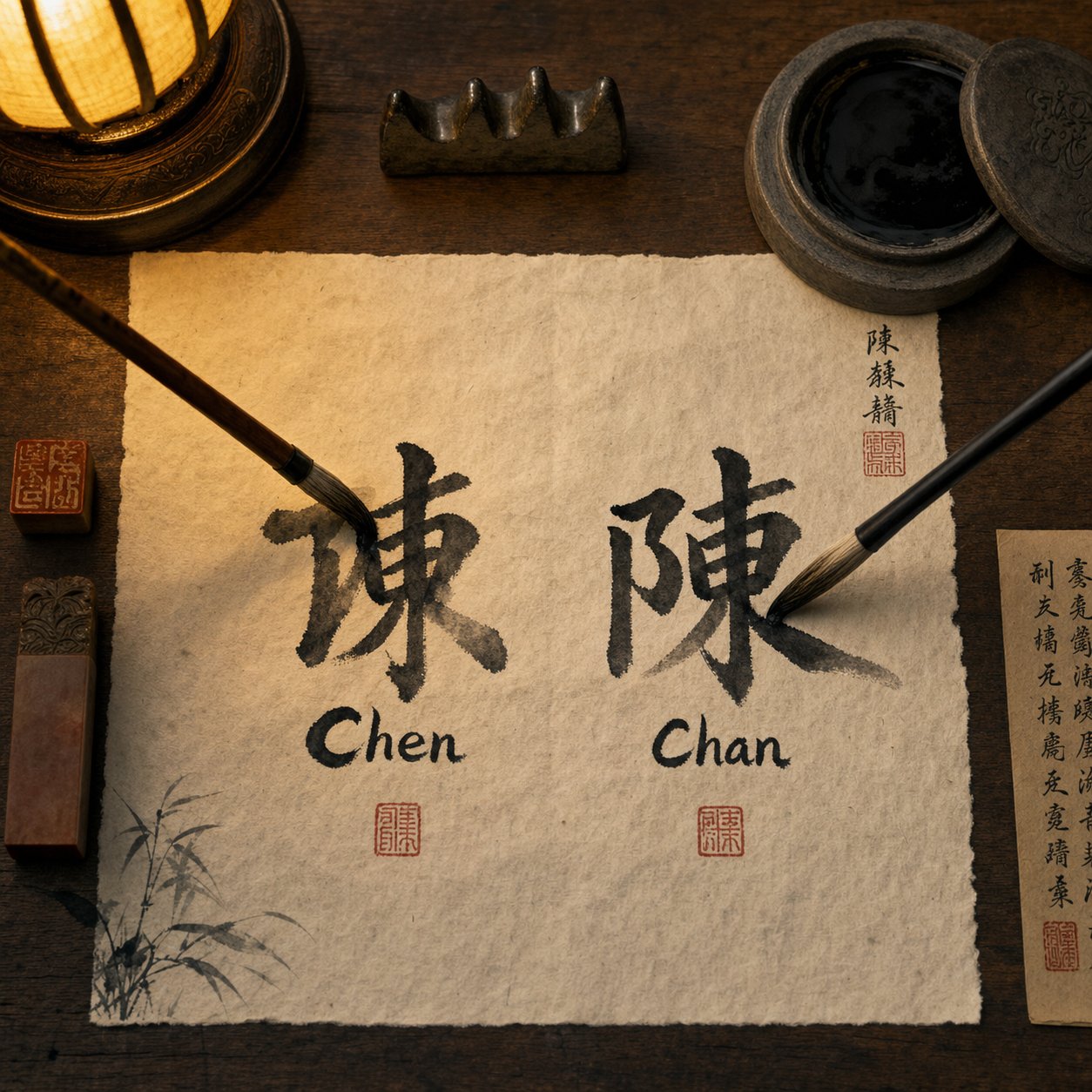
| 陈 / 陳 | Chén | Ch'en | Chan | Tan / Chin |
| 黄 / 黃 | Huáng | Huang | Wong | Ng / Ooi |
| 林 | Lín | Lin | Lam | Lim |
| 李 | Lǐ | Li | Lei / Lee | Lee |
Notice that Cantonese "Wong" could represent either 王 (Wáng in Mandarin) or 黄 (Huáng in Mandarin). Two completely different surnames, with different ancient origins, collapse into the same English spelling when romanized from Cantonese. This is why cantonese surnames can be particularly confusing for genealogical research. The English spelling alone cannot tell you which character, and therefore which lineage, you are dealing with.
Chinese diaspora communities across Southeast Asia, North America, and Europe carry these variant spellings as permanent markers of their migration history. A family surnamed "Tan" in Singapore likely speaks Hokkien and writes 陈. A family surnamed "Chan" in Hong Kong writes the same character but speaks Cantonese. Both connect to the same ancient state of Chen and the same legendary ancestor, Emperor Shun. The romanization difference is a dialect artifact, not a lineage difference.
If you are interested in researching your own surname history, here are practical steps that move from accessible resources toward deeper investigation:
- Identify the Chinese character. If you only know the romanized spelling, determine which character it represents. Online dictionaries and surname databases can help match romanizations across dialects.
- Consult published surname origin texts. The Yuan He Xing Zuan (元和姓纂, compiled 812 CE) and the Tongzhi (通志, compiled 1161 CE) are classical references. Modern compilations like Zhonghua Xingshi Dacidian provide accessible summaries.
- Search for your family's zupu (族谱). Clan genealogical registers, if they survive, contain the most detailed lineage information. Libraries in China, Taiwan, and major diaspora cities hold collections. FamilySearch maintains digitized records accessible online.
- Contact regional clan associations. Many surnames have active associations (宗亲会) in cities with significant Chinese populations. These organizations maintain records, host reunions, and can connect you with lineage-specific research.
- Identify your ancestral village. Chinese genealogy ultimately traces to a specific village of origin. Older family members, immigration records, and clan association databases can help pinpoint this location.
- Cross-reference dialect and migration patterns. Your surname's romanization often reveals which province and dialect group your ancestors belonged to, narrowing the geographic search considerably.
The most common chinese last names have the most documentation available, but even rare surnames often have dedicated researchers or small clan associations preserving their histories. The key insight is that every modern Chinese surname, no matter how it is spelled in English, connects back to the ancient systems described throughout this article: matrilineal clans, feudal grants, official titles, geographic features, or imperial decrees. Your name is not where the story ends. It is where the trail begins.
Frequently Asked Questions About Ancient Chinese Family Names
1. Why do ancient Chinese surnames contain the female radical?
The Chinese character for surname, 姓 (xing), contains the female radical 女 because the earliest clan names passed through the mother's line. During the Neolithic period, maternity was always certain while paternity was not, making mothers the natural anchors for tracking kinship. The six oldest known surnames, Ji, Jiang, Yao, Ying, Gui, and Si, all retain this female radical as linguistic evidence of matrilineal origins dating back over 5,000 years.
2. What are the eight ancient Chinese surnames and why are they important?
The eight ancient surnames (上古八大姓) are Ji (姬), Jiang (姜), Yao (姚), Ying (嬴), Si (姒), Yun (妘), Ren (妊), and Gui (媯). They represent the oldest traceable clan identities in Chinese civilization, each linked to a mythological ancestor like the Yellow Emperor or Yan Emperor. Ji alone spawned 411 modern surnames, meaning the vast majority of Chinese people today descend from one of these eight original clans.
3. What is the difference between xing and shi in ancient Chinese naming?
Xing (姓) was the original clan name indicating blood descent from a common ancestor, while shi (氏) was a branch designation based on fief, rank, or occupation. Xing determined marriage eligibility since same-xing marriages were strictly forbidden. Shi indicated social status and political affiliation and could change within a generation. The Qin and Han dynasties merged these two systems into the single unified surname system used in China today.
4. Why is the same Chinese surname spelled differently in English?
Chinese surnames appear with different English spellings because of dialect differences and competing romanization systems. Mandarin, Cantonese, and Hokkien pronounce the same character differently, and systems like Pinyin, Wade-Giles, and dialect-specific romanizations produce variant spellings. For example, the character 王 appears as Wang (Mandarin Pinyin), Wong (Cantonese), or Ong (Hokkien). The character 陈 becomes Chen, Chan, or Tan depending on dialect and region.
5. How did ancient Chinese surnames influence naming in Korea and Vietnam?
Korea adopted Chinese-character surnames, Confucian clan structures, and the same-surname marriage taboo during the Three Kingdoms period. Korean clans still maintain genealogical registers modeled on Chinese zupu. Vietnam's surnames were shaped by over 1,000 years of Chinese rule, with names like Nguyen, Tran, and Le derived from Chinese characters. The practice of subjects adopting the imperial surname, a Chinese political tradition, explains why 40% of Vietnamese people share the surname Nguyen.