Ancient Origins of Chinese Surnames
Imagine carrying a family name that stretches back over 4,000 years. For hundreds of millions of people, that is not a hypothetical scenario — it is everyday reality. Chinese surnames rank among the oldest hereditary naming systems on Earth, with roots reaching into the Neolithic period. While most European surnames only became fixed between the 11th and 16th centuries, ancient chinese surnames were already functioning as markers of kinship and tribal identity during the Shang dynasty (circa 1600-1046 BCE) and likely even earlier.
This is not just a quirk of record-keeping. The history of chinese surnames is a story woven from threads of power, identity, migration, and social transformation — one that still shapes how over a billion people identify themselves today.
Why Chinese Surnames Are the World's Oldest Naming System
What makes surnames in chinese culture so remarkably ancient? The answer lies in how early Chinese societies organized themselves. Tribal groups in the Yellow River valley used clan names to distinguish lineage, regulate marriage between groups, and establish political alliances. These were not casual labels. A surname in chinese society carried legal and ritual weight — it determined whom you could marry, which ancestors you honored, and where you stood in the social hierarchy.
By the time of the Zhou dynasty (1046-256 BCE), a formal two-tier system had emerged: the xing (姓) represented the broader clan, while the shi (氏) indicated a specific branch or lineage within that clan. This level of structural complexity predates comparable European systems by well over two millennia.
The Female Radical and Matrilineal Roots
Here is where things get especially fascinating. Look closely at the Chinese character for surname itself:
The character 姓 (xing, meaning surname) is composed of 女 (woman) and 生 (born) — literally suggesting "born of a woman." This etymology points directly to a matrilineal origin, where identity and clan membership passed through the mother's line.
This is not an isolated clue. Many of the oldest chinese surnames — including Ji (姬), Jiang (姜), Yao (姚), and Si (姒) — contain the 女 (female) radical. These characters are linguistic fossils, preserving evidence of a social order in which women were the anchors of kinship and lineage tracking.
Over centuries, as agricultural societies consolidated and patriarchal structures took hold, the system shifted. Surnames began passing through the father's line, and the distinction between xing and shi gradually collapsed into a single patrilineal surname. Yet the characters themselves never forgot. They remain etched with the memory of an older world — one where mothers defined the bloodline.
This shift from matrilineal to patrilineal naming did not happen overnight. It unfolded across dynasties, driven by changes in land ownership, political authority, and ritual practice. And the mechanisms that generated new surnames during this transformation reveal just as much about ancient Chinese society as the names themselves.
How Chinese Surnames Were Originally Created
So where did all these names actually come from? A chinese surname did not appear out of thin air. Each one was generated by a specific social mechanism — a concrete event or role that became permanently attached to a family line. Understanding the chinese surname origin story means looking at the forces that shaped ancient society: land, power, labor, and royal favor.
Five Sources of Ancient Chinese Surname Assignment
Scholars of traditional chinese surnames have identified five primary mechanisms through which names were assigned. Think of these as the "factories" that produced the vast majority of surnames still in use today:
- Feudal territories (fiefdoms): When a king granted land to a noble, the noble's descendants often adopted the territory's name as their surname. The surname Chen (陈) traces back to the ancient state of Chen, granted to descendants of the legendary Emperor Shun.
- Official titles and ranks: Families took surnames from the government positions their ancestors held. The surname Sima (司马) derives from the title "Master of Horses," a high military office. Wang (王), meaning "king" or "ruler," originated from descendants of royal houses who used their ancestor's rank as an identifier.
- Occupations and trades: Just as the English surname "Smith" comes from metalworking, some Chinese families adopted names tied to their craft. Tao (陶) connects to pottery-making, and Wu (巫) to shamanic or ritual practices.
- Ancestral states: During the Zhou dynasty's fragmentation into competing kingdoms, citizens of defeated or dissolved states preserved their identity by adopting the state's name as a surname for chinese descendants. Song (宋), Lu (鲁), and Zheng (郑) all follow this pattern.
- Imperial grants: Rulers could bestow their own royal surname upon loyal subjects or meritorious officials as a mark of supreme honor. This practice created entire new lineages bearing the emperor's name — a tradition that would have enormous demographic consequences in later dynasties.
These five pathways were not mutually exclusive. A single family might carry a name rooted in territory while another branch adopted a title-based surname, creating parallel lineages from the same ancestor.
The Zhou Feudal System as Surname Generator
Of all five mechanisms, one stands above the rest in sheer output: the fengjian system of the Western Zhou dynasty (1046-771 BCE). Under this decentralized governance structure, the Zhou king allocated areas of land to clan relatives and fellow warriors in return for political loyalty. Each noble became the ruler of that region, and his title and domain could be legitimately inherited by his descendants. This created large numbers of local autonomous domains — and, critically, large numbers of new surnames.
You can see the logic clearly. A noble granted the territory of Wei (卫) produced generations of descendants surnamed Wei. The lord of the state of Zheng (郑) spawned the Zheng surname lineage. Multiply this across dozens of vassal states, and you have the single greatest engine of chinese surname creation in history.
The fengjian system's impact was amplified by its collapse. As Zhou central authority weakened during the Eastern Zhou period, vassal states fractured further into smaller domains. Each fragmentation event generated new branch surnames. When states were eventually conquered during the Warring States period, displaced populations carried their state-derived names into new territories, scattering these surnames across a widening geographic range.
By the time the Qin dynasty unified China in 221 BCE and abolished the fengjian system in favor of centralized prefectures, the surname landscape was already deeply established. Hundreds of distinct names — most traceable to Zhou-era territories, titles, or grants — had become permanent fixtures of Chinese identity. The political system vanished, but the names it generated endured for millennia.
These surnames were not just labels. They carried encoded information about ancestry, geographic origin, and social standing — a kind of compressed family history readable by anyone who knew the code. And eventually, someone decided to organize all of them into a single, teachable text.
The Hundred Family Surnames Text Explained
That single, teachable text arrived during the early Song dynasty (960-1279) and became one of the most influential documents in Chinese educational history. Known as the Baijiaxing (百家姓), or "Hundred Family Surnames," it organized the chinese surnames list into a compact, memorizable format that children across the empire would recite for the next thousand years. But this was never a neutral reference document. From its very first character, the Baijiaxing was a political statement disguised as a literacy exercise.
Political Power Behind the Surname Order
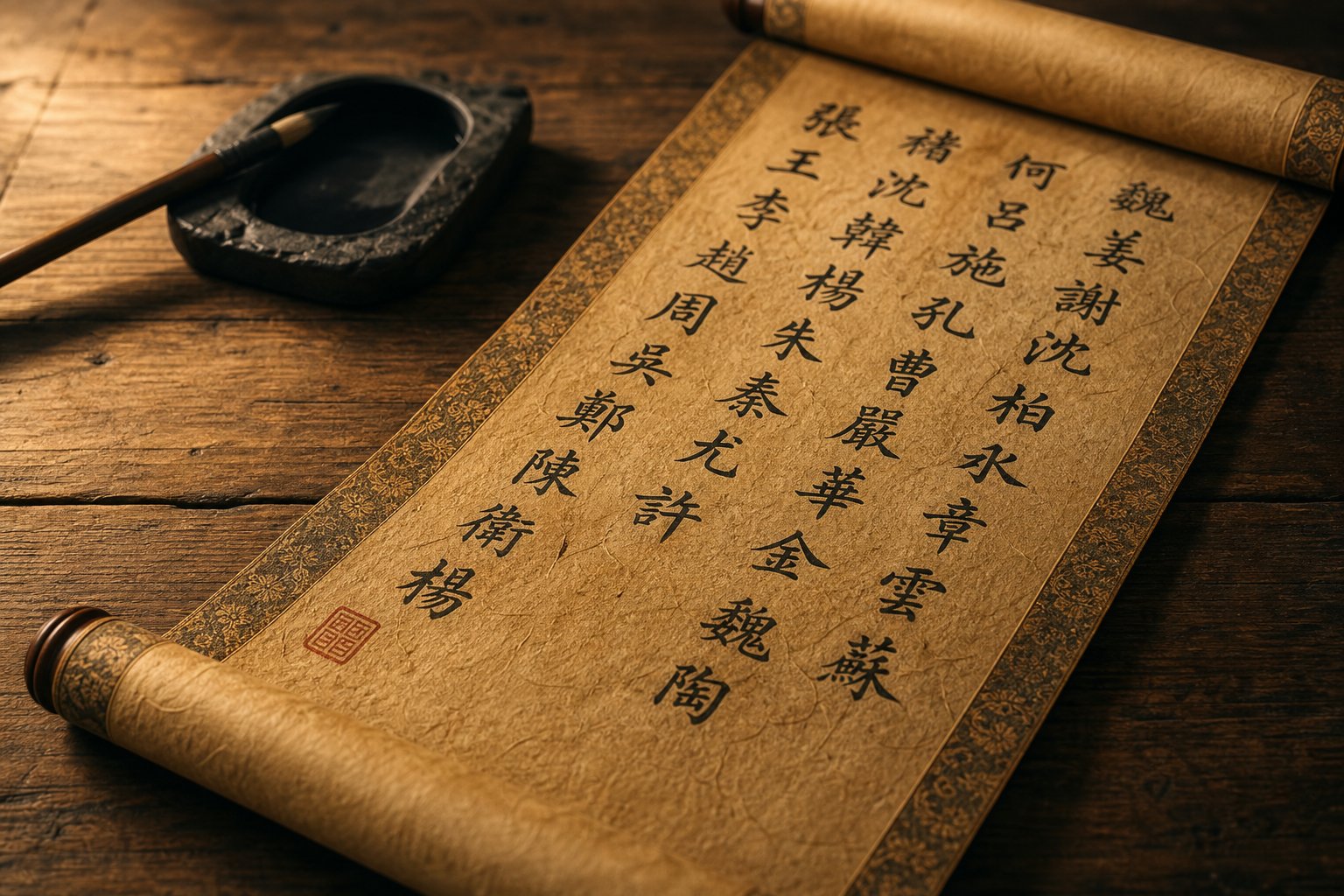
The text opens with a line that every educated Chinese person once knew by heart:
Zhao, Qian, Sun, Li, Zhou, Wu, Zheng, Wang — the famous opening eight surnames of the Baijiaxing were not arranged alphabetically, by frequency, or by any linguistic logic. They were ordered by political power.
Why does Zhao (赵) come first? Because it was the imperial surname of the Song dynasty emperors. Placing it at the head of the list was an act of deference to the ruling house — a reminder, embedded in every child's earliest lessons, of who held supreme authority.
The second surname, Qian (钱), belonged to the rulers of the Wu-Yue state (907-978), a kingdom that had peacefully surrendered to the Song. According to research on the text's origins, the anonymous compiler may have had the surname Qian himself, or may have originated from the city of Qiantang in Zhejiang — Wu-Yue's former territory. Either way, placing Qian second expressed loyalty to that recently absorbed dynasty.
The third and fourth positions follow the same logic. Sun (孙) was the family name of the Wu-Yue queen (the empress of the last Wu-Yue ruler, Qian Chu). Li (李) belonged to the kings of the Southern Tang dynasty, another state that had recently fallen to Song conquest. The next four — Zhou, Wu, Zheng, and Wang — were all surnames of the consorts of Wu-Yue rulers.
You'll notice the pattern: this was not a list of chinese surnames ranked by how common they were. It was a political hierarchy frozen in text, reflecting the power relationships of a specific historical moment. The 100 surnames chinese children memorized carried an implicit civics lesson about who ruled, who submitted, and who mattered.
The Baijiaxing as a Literacy and Cultural Tool
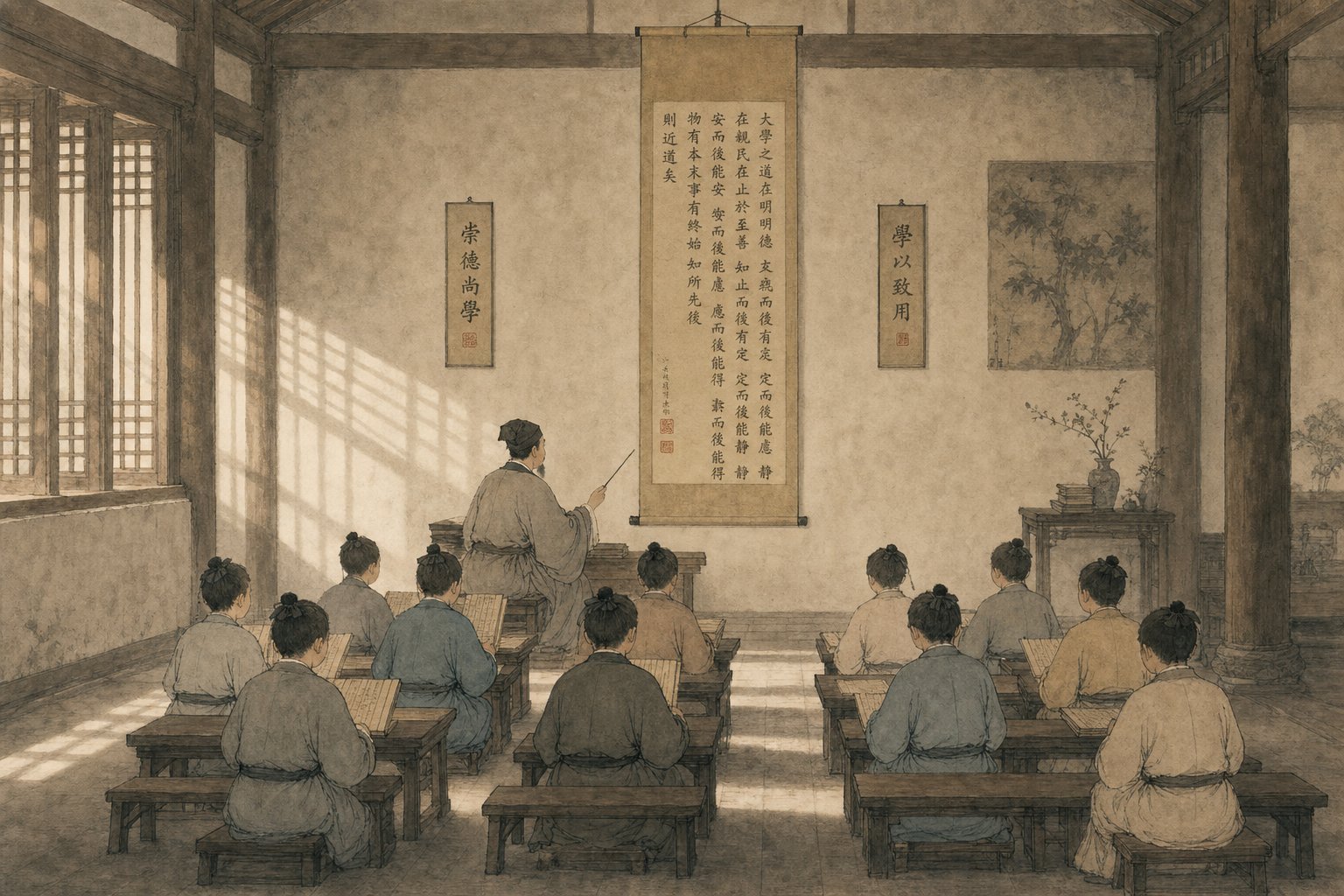
Politics aside, the Baijiaxing served a deeply practical purpose. It was structured as a rhyming poem in lines of eight characters, making it ideal for oral recitation. Young students could chant the text rhythmically, absorbing hundreds of characters through repetition and melody — long before they understood the political subtext.
The text belonged to the "San-Bai-Qian" (三百千) canon of elementary education, a trio of primers that also included the Sanzijing (Three Character Classic) and the Qianziwen (Thousand Character Classic). Together, these three texts formed the foundation of literacy training for centuries. The Baijiaxing's specific contribution was teaching children to recognize surname characters — a practical skill in a society where knowing someone's surname instantly communicated information about their lineage, regional origin, and social standing.
Here is something that surprises many people: despite its name suggesting only 100 surnames, the list of chinese surnames in the Baijiaxing actually contains far more. The standard version includes approximately 503 surnames — 444 single-character surnames and around 60 double-character surnames. The title "Hundred Family Surnames" uses "hundred" in its classical Chinese sense of "numerous" or "all," not as a literal count. Later expanded editions pushed the number even higher, with one Ming dynasty version cataloging 1,968 family names.
The text's influence extended well beyond the Song. During the Yuan dynasty (1271-1368), a version was produced with Phags-pa script spellings — the Mongolian-derived writing system mandated by Kublai Khan — serving as a study aid for Chinese officials learning the new script. The Kangxi Emperor (r. 1662-1722) personally compiled his own version, placing Kong (孔, Confucius's surname) first instead of Zhao, signaling a shift from political to moral authority. A Ming dynasty edition naturally placed Zhu (朱), the Ming imperial surname, at the top.
Each revision tells the same story: whoever controls the list of 100 chinese surnames controls a piece of the cultural narrative. The ordering was never innocent. It was always a mirror reflecting who held power at the moment of composition.
The Baijiaxing captured a snapshot of Chinese surnames at one point in time, but the actual surname landscape was never static. Across two thousand years of imperial rule, names were created, merged, imposed, and erased as dynasties rose and fell — each era leaving its own distinct mark on the naming system.
How Surnames Evolved Across Chinese Dynasties
Every dynasty that ruled China left fingerprints on the naming system. Emperors did not simply inherit a static roster of chinese surnames names — they actively shaped it, using surnames as instruments of reward, punishment, and assimilation. Tracing chinese surname history dynasty by dynasty reveals a pattern: whoever held the throne also held the power to decide who you were.
From Zhou Clans to Qin Standardization
During the Shang dynasty (circa 1600-1046 BCE), clan surnames existed but remained limited to the aristocratic elite. Commoners had no hereditary family names at all. The Zhou dynasty changed that equation dramatically. Its feudal system generated hundreds of new surnames tied to territories and titles, spreading named identity deeper into the social hierarchy. The two-tier system of xing (broad clan name) and shi (branch lineage name) gave the nobility a precise way to map relationships and regulate marriage between clans.
Then came the Qin unification in 221 BCE. When Qin Shi Huang abolished feudalism and imposed centralized bureaucratic control, he also standardized the writing system. This had a direct effect on surnames: characters were unified, regional variants were eliminated, and the administrative machinery of the new empire required every household to be registered under a fixed surname chinese officials could track. The era of informal or fluid naming was over.
The Han dynasty (206 BCE - 220 CE) completed the transformation. The old distinction between xing and shi — which had already been blurring for centuries — collapsed entirely into a single surname per family. From this point forward, every person in China carried one hereditary family name passed through the paternal line. The system we recognize today was fully in place.
Imperial Surname Control From Tang to Qing
If the early dynasties built the surname system, the later empires weaponized it. Tang dynasty emperors (618-907) turned the royal chinese surnames into a tool of political loyalty. The Li (李) imperial family famously granted their own surname to generals, officials, and even foreign leaders who demonstrated allegiance. This single practice flooded the population with new "Li" families who had no blood connection to the royal house — a decision with demographic consequences still visible today.
The Tang era also marked a turning point for non-Han peoples. As FamilySearch research notes, people of Persian, Sogdian, Turkic, and Indian origin adopted Chinese surnames like Hu (胡) to integrate into society. The surname chinese communities used became a gateway to participation in the empire's economic and political life.
During the Song dynasty (960-1279), surname scholarship flourished. Genealogical texts multiplied, and the Baijiaxing codified the naming tradition into a cultural monument. The Yuan dynasty (1271-1368) brought Mongol rule and a different dynamic — some Mongol and Central Asian families adopted Chinese surnames to govern more effectively, while others imposed naming changes on subject populations. The final imperial dynasty, the Qing (1644-1912), saw Manchu rulers carrying their own multi-syllable clan names (such as Aisin Gioro, the imperial house) while simultaneously absorbing Chinese naming conventions. After the dynasty's fall, many Manchu families adopted single-character Chinese surnames — Jin (金), Guan (关), Zhao (赵) — to avoid persecution during the transition to republican rule.
The table below maps these key turning points:
| Dynasty | Period | Key Surname Development |
|---|---|---|
| Shang | c. 1600-1046 BCE | Clan surnames limited to aristocracy; commoners unnamed |
| Zhou | 1046-256 BCE | Feudal system generates hundreds of territory-based surnames; xing/shi dual system formalized |
| Qin | 221-206 BCE | Writing standardized; household registration requires fixed surnames for all |
| Han | 206 BCE - 220 CE | Xing and shi merge into single patrilineal surname system |
| Tang | 618-907 | Imperial surname granted to loyal subjects; non-Han peoples adopt Chinese surnames en masse |
| Song | 960-1279 | Surname scholarship peaks; Baijiaxing compiled; genealogical records proliferate |
| Yuan | 1271-1368 | Mongol rulers adopt or impose Chinese surnames; cross-cultural naming accelerates |
| Qing | 1644-1912 | Manchu clan names coexist with Chinese system; post-dynasty Manchu families adopt Han surnames |
Each row in that timeline represents a shift in who controlled naming and why. Surnames were never just personal — they were political currency. An emperor could elevate a family by granting his royal name or destroy one by revoking it. The concentration of certain surnames across modern China is not random. It is the accumulated result of these dynastic decisions, repeated over centuries, favoring some lineages while absorbing or erasing others.
The Most Common Chinese Surnames and Their Dominance
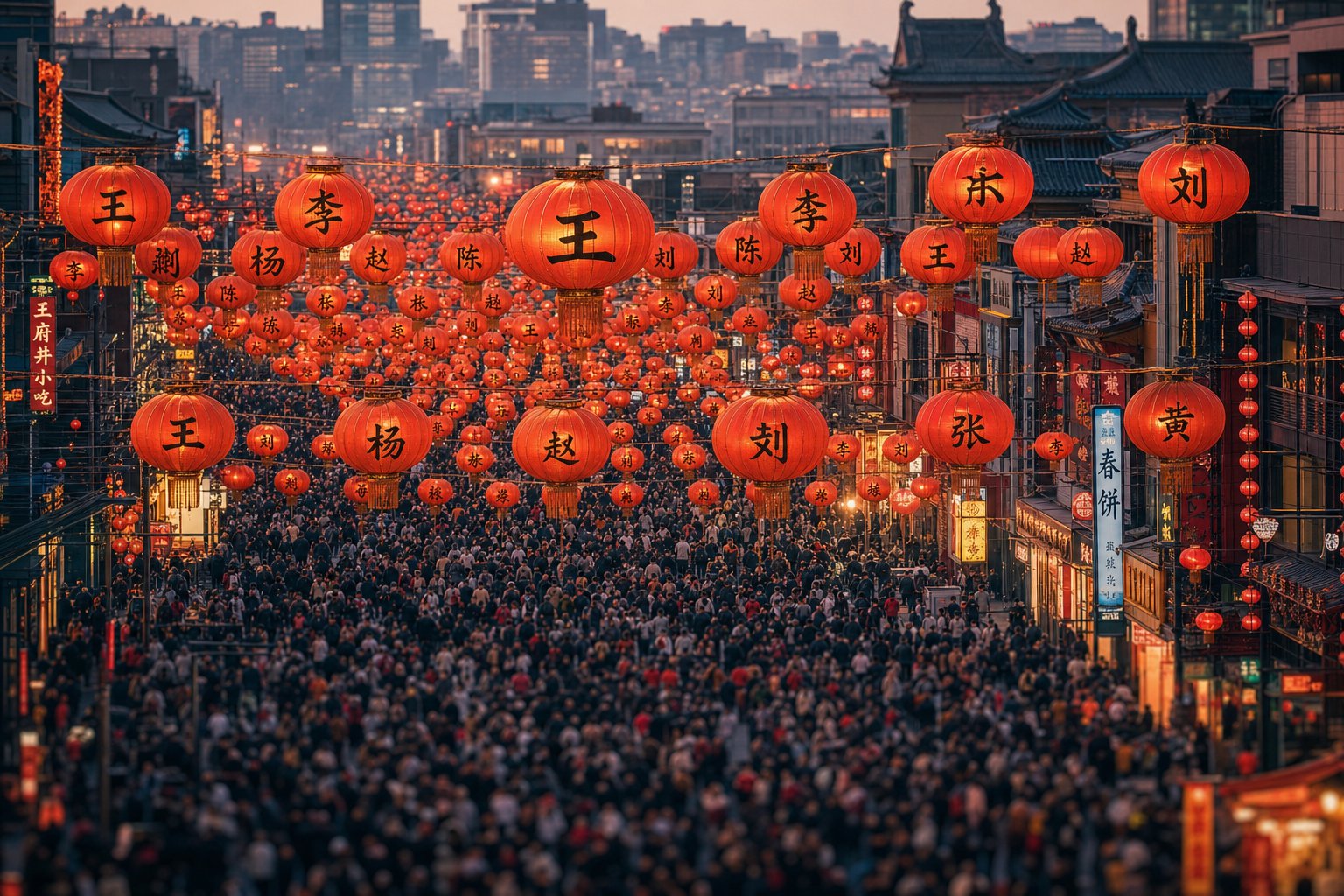
That accumulated result is staggering in scale. Stop a random person on the street in China, and there is roughly a one-in-three chance their surname is Wang, Li, Zhang, Liu, or Chen. These five most common chinese surnames alone are shared by more than 433 million people — approximately 30% of the entire population. Zoom out slightly further, and the concentration becomes even more striking: just 100 surnames cover nearly 86% of all Chinese citizens.
For comparison, the United States — with less than a quarter of China's population — recorded 6.3 million distinct surnames in its 2010 census. China, with over 1.3 billion people, uses only about 6,000. So what is the most common chinese surname, and how did this extreme concentration happen?
Why So Few Surnames Dominate a Billion People
The answer is Wang (王). With over 100 million bearers, it edges out Li (李) and Zhang (张) for the top position — though the margins between these three are razor-thin and shift slightly between surveys. Here is how the most popular chinese surnames break down:
| Rank | Surname | Character | Approximate Share of Population |
|---|---|---|---|
| 1 | Wang | 王 | ~7.2% |
| 2 | Li | 李 | ~7.1% |
| 3 | Zhang | 张 | ~6.7% |
| 4 | Liu | 刘 | ~5.1% |
| 5 | Chen | 陈 | ~4.6% |
| 6 | Yang | 杨 | ~3.1% |
| 7 | Huang | 黄 | ~2.7% |
| 8 | Zhao | 赵 | ~2.3% |
| 9 | Wu | 吴 | ~2.1% |
| 10 | Zhou | 周 | ~2.0% |
These ten common chinese surnames alone account for roughly 43% of the population. That is nearly 600 million people sharing just ten family names.
The Historical Forces Behind Surname Concentration
This did not happen by accident. Three interlocking forces drove the concentration over millennia:
- Political favor and imperial grants: The chinese surname Li offers the clearest example. Tang dynasty emperors (618-907) routinely bestowed their own surname on loyal generals, allied tribal leaders, and meritorious officials. Overnight, entire families and their descendants became "Li" — not by blood, but by decree. Centuries of this practice inflated the Li population far beyond what natural reproduction alone could explain. The chinese surname Zhang followed a similar trajectory, boosted by its association with powerful clans across multiple dynasties.
- Geographic expansion of dominant clans: Families with political power and economic resources had more children who survived to adulthood. These large clans expanded into new territories, carrying their surname with them. Over dozens of generations, a single well-positioned family could populate entire provinces.
- Forced surname adoption and natural extinction: During periods of conquest, ethnic minorities and defeated populations were often compelled to adopt the surnames of ruling groups. Meanwhile, smaller surname lineages disappeared through a process researchers call the Galton-Watson effect — in patrilineal societies, surnames carried only by families with few or no male heirs simply vanish over time. A 1992 study by Stanford University and the Chinese Academy of Sciences confirmed that China's long history amplified this extinction effect, since surnames appeared there at least 3,000 years earlier than in Europe or Japan.
The common chinese surname landscape you see today is the product of these forces compounding over three millennia. Each imperial grant, each clan expansion, each small lineage dying out — all of it pushed the distribution further toward a handful of dominant names. The result is a population of over a billion people funneled into a remarkably narrow set of identifiers.
Yet within this apparent uniformity, pockets of extraordinary diversity survive. Some families carry compound surnames — two-character names that trace back to ancient titles and places — while others hold names so rare they exist in only a single village. These outliers reveal a different layer of the naming story entirely.
Compound Surnames and Rare Chinese Family Names
Those outliers are not just curiosities. They are windows into a naming system far more varied than the dominant five or ten surnames suggest. While Wang, Li, and Zhang blanket the population in massive numbers, a parallel tradition of 2 character chinese surnames has survived for millennia — carrying with them stories of ancient officialdom, noble estates, and vanished kingdoms.
Compound Surnames and Their Noble Origins
Compound surnames, known as fuxing (复姓), consist of two characters rather than one. They are immediately recognizable and often carry an air of distinction. You might encounter them through historical figures like the strategist Zhuge Liang (诸葛亮) or modern celebrities like the actress Ouyang Nana. These names feel different because they are different — their origins trace to specific institutional roles and geographic markers that single-character surnames rarely preserve.
Where did they come from? The sources are varied, but most fall into a few clear categories:
- Sima (司马): Derived from the official title "Master of Horses," a senior military position responsible for cavalry and warfare. The historian Sima Qian, author of the Records of the Grand Historian, carried this surname.
- Ouyang (欧阳): A geographic compound meaning "south of Mount Ou," linking the family to a specific landscape feature. It is currently China's most-used compound surname, with over 1.1 million bearers.
- Zhuge (诸葛): Originated from a combination of the place name Zhu and the surname Ge, merged when a family relocated during the Warring States period.
- Shangguan (上官): Literally "upper official," derived from a high-ranking court position in the state of Chu. Approximately 88,000 people carry this surname today.
- Huangfu (皇甫): Traces to a title granted by the Zhou royal house, combining "imperial" (huang) with "auxiliary" (fu).
- Situ (司徒): From the official title "Minister of Education" or "Minister of the Masses," one of the Three Excellencies in ancient government.
- Dongguo (东郭): Meaning "eastern outer city wall," a locational surname indicating a family that lived near the eastern gate of a walled city.
You'll notice the pattern: these unique chinese surnames encode specific information about what an ancestor did or where they lived. A single-character surname like Li or Wang has been worn smooth by billions of bearers over millennia. A compound surname, by contrast, still carries its original fingerprint — readable, specific, and historically anchored.
So why are they so rare? In ancient times, China had over 1,000 compound surnames. Today, fewer than 100 remain in active use. The decline happened gradually through several forces: administrative simplification during imperial unification periods, social pressure to conform to single-character norms, and the practical inconvenience of longer names in bureaucratic systems that allocated fixed character slots for surnames. Many families voluntarily shortened their compound names — Sima became Si or Ma, Ouyang became Ou — sacrificing historical specificity for everyday convenience.
Lost and Vanishing Chinese Surnames
Compound surnames are rare but visible. Truly lost surnames are another matter entirely. Across China's turbulent history, hundreds of uncommon chinese surnames have disappeared completely — erased by political persecution, forced assimilation, or the simple mathematics of patrilineal inheritance.
Consider what happened during dynastic transitions. When a ruling house fell, families bearing the imperial surname sometimes faced retribution from the new regime. They changed their names to survive. The chinese surname Zuo (左), meaning "left," is one example of a name with ancient roots that has become increasingly uncommon over centuries — its bearers scattered and diminished through successive upheavals despite its origins tracing back to official titles in the Zhou period.
The most dramatic losses came through ethnic assimilation. When non-Han peoples — Xianbei, Khitan, Jurchen, Mongol, Manchu — entered Chinese political life, they faced enormous pressure to adopt Han-style single-character surnames. The Xianbei people, who ruled northern China during the Northern Wei dynasty (386-534), underwent a systematic renaming campaign under Emperor Xiaowen. He ordered over 100 Xianbei clan names converted to Chinese equivalents. The multi-syllable Tuoba became Yuan (元). Entire tribal identities were compressed into single characters.
The Manchu experience repeated this pattern centuries later. The Qing imperial clan name Aisin Gioro and hundreds of other Manchu surnames — Niohuru, Guwalgiya, Nara — were abandoned after 1912. Families adopted Chinese surnames like Jin (金, from "Aisin," meaning gold), Guan (关), Lang (郎), and Zhao (赵) to avoid anti-Manchu sentiment during the early Republic. An entire naming tradition, representing millions of people, was voluntarily erased within a single generation.
Even among Han Chinese, the rarest chinese surnames face extinction through pure demographics. A surname carried by only a few hundred people in a single village can vanish if one generation produces no male heirs — or if that village's young people migrate to cities and marry into larger surname groups. Researchers estimate that China loses several surnames per century to this quiet attrition, a process invisible at the national level but devastating at the local one.
What compound and rare surnames reveal, taken together, is that the naming system was never as uniform as the dominance of Wang and Li suggests. Beneath the surface of those massive surname populations lies a graveyard of lost names — each one a compressed history of a family, a title, a place, or a people that once existed and left only this trace behind. The characters that survive carry meaning far deeper than simple identification. They are, in fact, miniature historical documents — if you know how to read them.
Chinese Surname Meanings Hidden in Characters
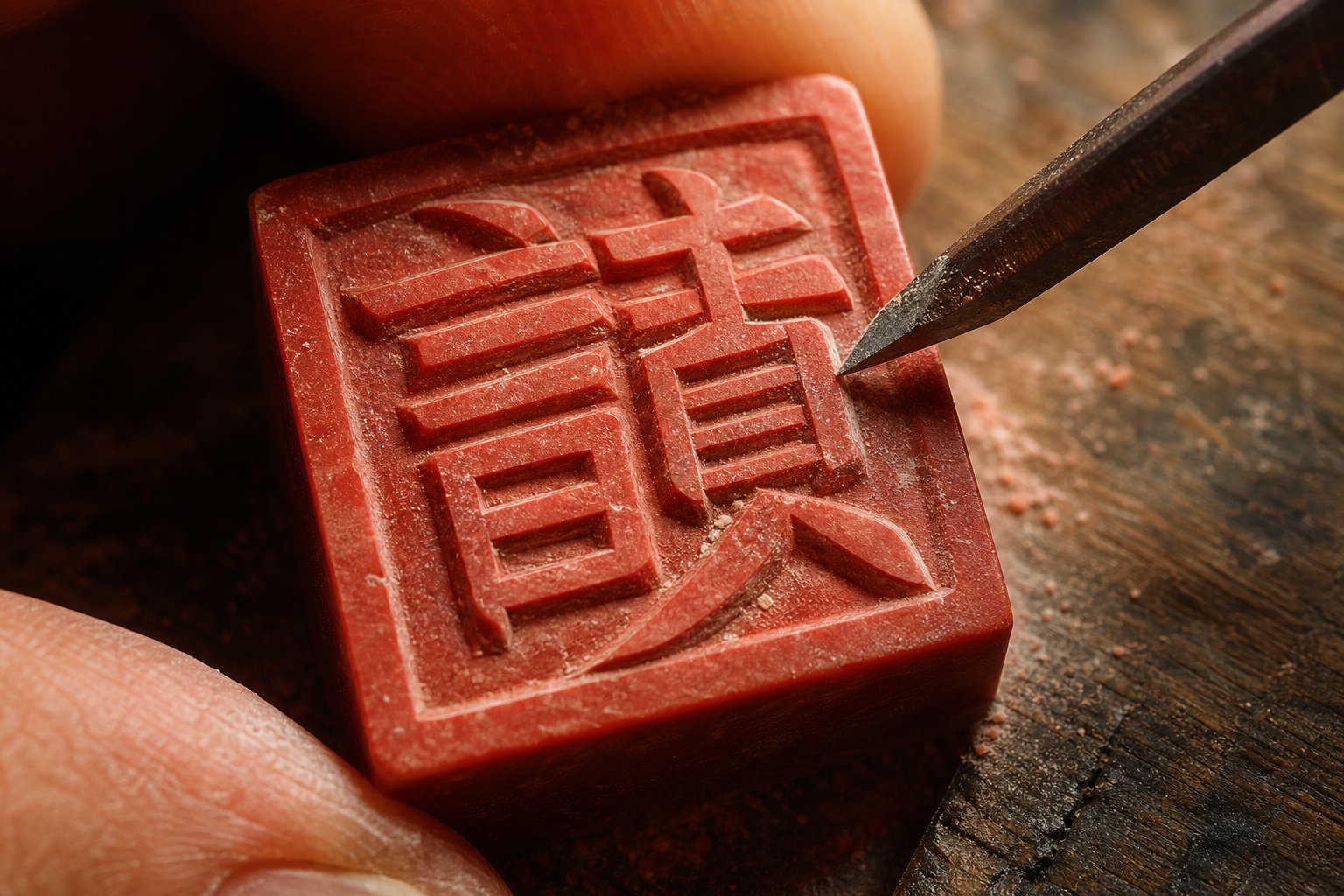
Reading those miniature historical documents requires one skill: understanding how Chinese characters are built. Unlike alphabetic scripts that represent sounds, Chinese characters are constructed from semantic and phonetic components called radicals. Each radical carries its own meaning. When you break a surname character into its parts, you are essentially reverse-engineering a naming decision made thousands of years ago. The meaning of chinese surnames is not abstract — it is structural, visible right there in the brushstrokes.
Reading History Inside Chinese Characters
Think of a Chinese character as a compressed file. The radicals are the data inside. A tree radical (木) tells you something relates to wood or vegetation. A mound radical (阝on the left) signals geography or terrain. A bow radical (弓) points toward weaponry or stretching. When these components appear inside surnames, they preserve information about what an ancestor did, where they lived, or what natural feature defined their homeland.
This is what makes chinese surnames and meanings so deeply intertwined. You cannot fully understand a surname without understanding its character — and you cannot fully understand the character without knowing the history it encodes. The relationship runs both ways.
For anyone researching ancient chinese surnames and meanings, radical analysis is the essential first step. It transforms an opaque symbol into a readable story. Let's apply this method to the most widely carried surnames in the world.
Etymology of Li, Zhang, Chen, and Wang
The li chinese surname (李) is carried by roughly 100 million people. Break it apart and you find two components: 木 (mu, meaning "tree" or "wood") on top, and 子 (zi, meaning "child" or "seed") on the bottom. Together they point toward the plum tree — a fruit-bearing tree whose seeds propagate new growth. Historical accounts connect the name to an ancestor who served as a judge under the legendary Emperor Yao and was associated with plum groves. The character literally reads as "child of the tree" — a poetic image of lineage branching outward from a rooted source.
The zhang chinese surname (张) tells a different story entirely. Its left component is 弓 (gong, "bow"), and its right component is 长 (chang, "long" or "to stretch"). The combined meaning relates to drawing a bow — stretching it to full length before releasing an arrow. Tradition holds that the surname traces to Huizhang, a grandson of the Yellow Emperor credited with inventing the bow and arrow. With approximately 95 million bearers, this surname preserves the memory of archery's importance to early Chinese civilization in every stroke.
The chen chinese surname (陈) carries geographic DNA. Its left radical is 阝(fu, the "mound" or "hill" radical, often indicating place names), while its right component is 东 (dong, "east") in its older form. The character connects directly to the ancient State of Chen, located in present-day Henan province. When you write this surname, you are writing a compressed map reference — a marker pointing to a specific territory that existed during the Zhou dynasty over 3,000 years ago.
Wang (王) is perhaps the most visually elegant. Three horizontal lines connected by a single vertical stroke. Ancient cosmological interpretation reads the top line as heaven, the middle as humanity, and the bottom as earth — with the vertical stroke representing the ruler who connects all three realms. The chinese surname meanings embedded in this character could not be more direct: it means "king." Descendants of various royal houses adopted it as their identifier, carrying the claim of sovereign ancestry in four simple strokes.
The table below breaks down these and other major surnames by their component parts:
| Character | Pinyin | Radical Breakdown | Historical Meaning |
|---|---|---|---|
| 李 | Li | 木 (tree) + 子 (child/seed) | Plum tree; linked to an ancestor associated with plum groves under Emperor Yao |
| 王 | Wang | Three horizontal lines + vertical connector | King; the ruler connecting heaven, humanity, and earth |
| 张 | Zhang | 弓 (bow) + 长 (long/stretch) | Drawing a bow; traces to the legendary inventor of archery |
| 刘 | Liu | 文 variant (pattern) + 刂 (knife/blade) | Battle axe or weapon; associated with the Han dynasty imperial house |
| 陈 | Chen | 阝 (mound/place) + 东 (east, archaic form) | The ancient State of Chen in modern Henan; geographic origin marker |
| 杨 | Yang | 木 (tree) + 昜 (sun rising) | Poplar tree; a family rooted near poplar groves or sunlit highlands |
Each entry in that table represents a chinese surnames meaning that has survived intact for millennia — not in a history book, but in the living act of writing one's own name. Every time someone signs "李" or "张," they are reproducing a pictographic record of plum orchards or drawn bows, whether they realize it or not.
This is what makes the Chinese writing system uniquely powerful for surname research. The characters are not arbitrary labels. They are fossils with readable anatomy. And as Chinese communities carried these characters across oceans and continents, the names did not always travel unchanged. Dialects, foreign scripts, and immigration bureaucracies transformed how these surnames appeared on paper — sometimes beyond recognition.
Chinese Surnames in the Global Diaspora
Dialects, foreign scripts, and immigration bureaucracies did not just alter how surnames sounded — they fractured single names into dozens of unrecognizable variants. A family named 李 in China might become Lee in San Francisco, Ly in Saigon, Lei in Macau, and Lee in Hong Kong — all from the same character, all pointing to the same ancestry, yet appearing as completely different names on paper. For anyone tracing chinese american surnames back to their origins, this fragmentation is the first puzzle to solve.
How One Surname Becomes Many Spellings
The root cause is dialect. Mandarin is only one of many Chinese languages, and each dialect group pronounces the same written character differently. When communities emigrated, they carried their spoken pronunciation — not the Mandarin standard — into foreign romanization systems. The result? A single surname character spawned multiple spellings depending on which dialect the emigrant spoke and which country they landed in.
The chinese surname Lee is a perfect example. In Mandarin pinyin, 李 is romanized as "Li." But Cantonese speakers pronounce it closer to "Lei" or "Lee," and that Cantonese pronunciation became the dominant spelling across Hong Kong, much of Southeast Asia, and early American Chinatowns — since the majority of 19th-century emigrants came from Guangdong province. The lee surname chinese communities carry today is not a different name from Li. It is the same character filtered through a different spoken language.
Here is how this plays out across regions for a single character:
| Character | Mandarin (Pinyin) | Cantonese | Hokkien | Teochew | Vietnamese-Chinese | Macanese |
|---|---|---|---|---|---|---|
| 李 | Li | Lee / Lei | Lee / Li | Lee | Ly / Le | Lei |
| 王 | Wang | Wong | Ong | Heng | Vuong | Wong |
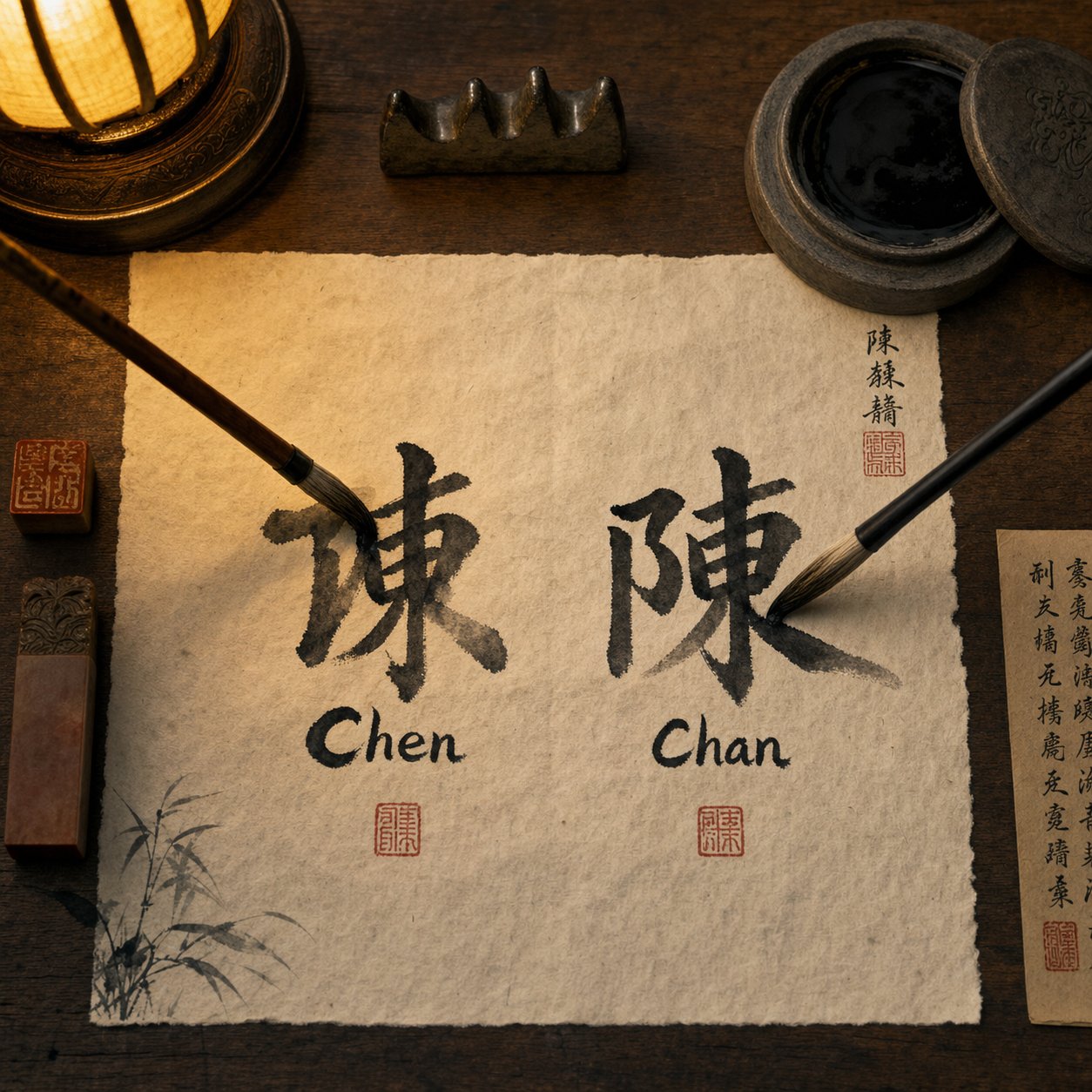
| 陈 | Chen | Chan | Tan | Tan | Tran | Chan |
| 张 | Zhang | Cheung | Teo / Teoh | Teo | Truong | Cheong |
| 刘 | Liu | Lau | Lau / Low | Lau | Luu | Lao |
In places like Singapore and Malaysia, the spelling of a family name functions as a signifier of ancestral origin. A person surnamed Wong is understood to have Cantonese heritage — likely from Guangdong or Hong Kong. Someone surnamed Ong carries the same character (王) but signals Hokkien roots, probably from Fujian province. The surname itself becomes a dialect marker, readable by anyone familiar with the community's history.
Chinese Surnames in Southeast Asia and the Americas
The Philippines produced one of the most distinctive transformations of chinese surnames in the philippines. During the Spanish colonial period, Chinese immigrants — predominantly Fujianese from Fujian province — who converted to Catholicism were encouraged to adopt Hispanicized names. Some took their Spanish godparents' surnames outright. Others created hybrid names by combining modified Hokkien pronunciations with Spanish honorific suffixes like -co, -son, and -zon. The result was a unique category of chinese filipino surnames: Cojuangco (from the Hokkien pronunciation of a surname plus a place name), Ongpin, Singson, Tecson, Dizon, and Yuchengco — names that are unmistakably Filipino yet carry embedded Chinese linguistic DNA.
American chinese surnames followed a different path. Early immigration officials at Angel Island and Ellis Island often recorded names phonetically, based on whatever dialect the arriving immigrant spoke. Families from the same village with the same written surname could end up with different legal spellings depending on which clerk processed their paperwork. This bureaucratic randomness is why american chinese surnames show such variation even within a single family tree.
And then there is the structural confusion that still trips people up daily: are chinese names written surname first? Yes — in Chinese convention, the family name always precedes the given name. Wang Xiaoming is Mr. Wang, not Mr. Xiaoming. But Western systems expect given-name-first order, creating persistent mix-ups. As the Asia Media Centre notes, early Chinese immigration to New Zealand produced generations of families carrying the "wrong" surnames because officials reversed the name order in official records. Today, many Chinese professionals fully capitalize their surname on business cards — WANG Xiaoming — to prevent exactly this confusion. The convention of chinese names surname first is simple enough, but its collision with Western naming assumptions has created decades of administrative tangles across every country with a significant diaspora.
These spelling variations and structural misunderstandings are not just bureaucratic headaches. They represent real barriers for families trying to reconnect scattered branches of their lineage across continents and centuries. Fortunately, a tradition of meticulous record-keeping — clan genealogies maintained for dozens of generations — offers a path back through the confusion.
Tracing Your Chinese Surname Through History
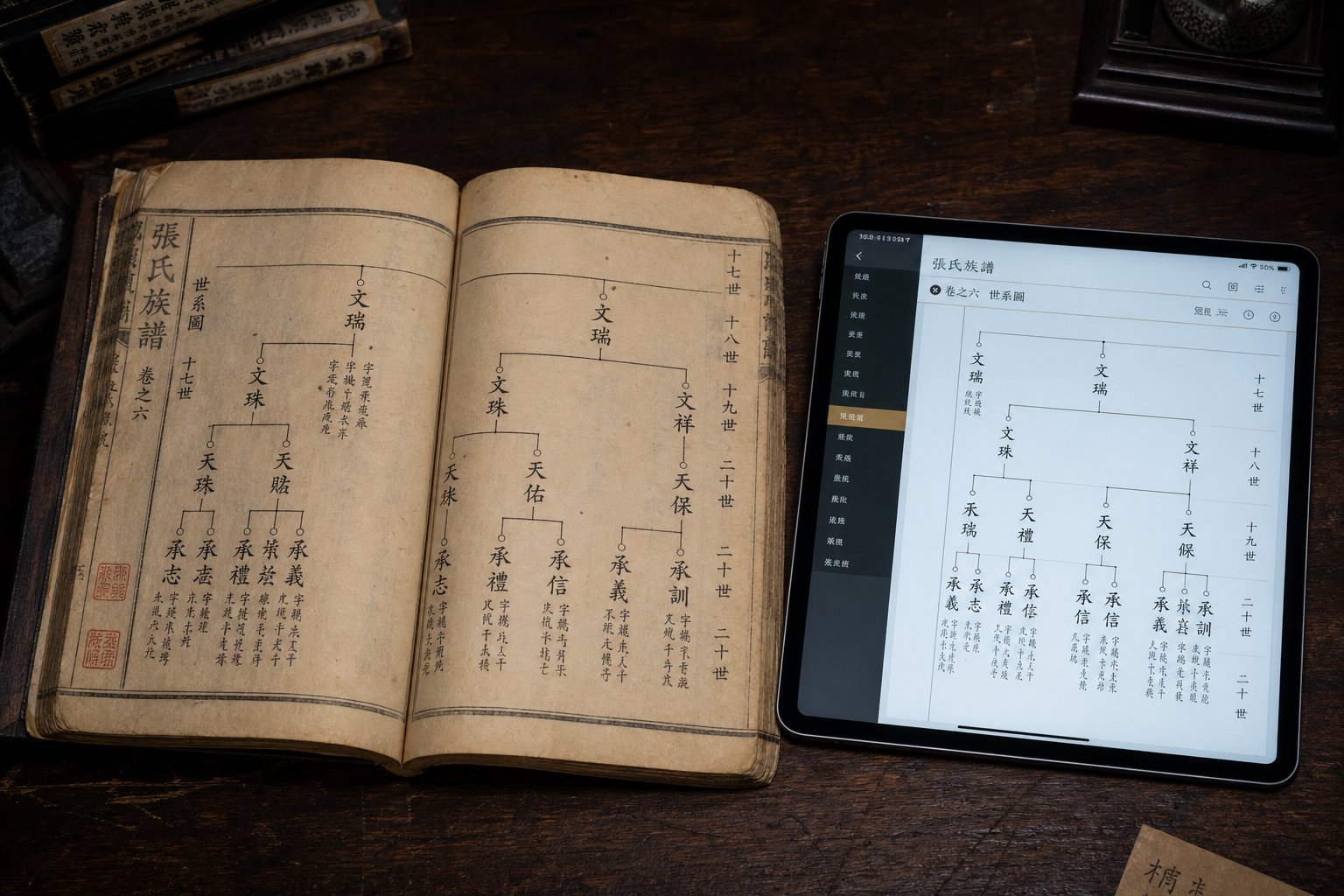
Those meticulous records have a name: zupu (族谱), or clan genealogies. For centuries, these documents served as the primary vehicle for preserving chinese names and surnames across generations — long before government censuses or civil registries existed in China. If you have ever wondered what is your surname in chinese and what story it carries, the zupu is where that story lives in its fullest form.
Clan Genealogies as Living Historical Documents
A zupu is not a simple family tree. It is a multi-volume compilation that can include detailed lineage charts stretching back hundreds or even thousands of years, biographies of prominent ancestors, clan migration histories, generation-naming poems, and rules governing membership. Some zupu trace a single chinese name surname lineage from a mythical progenitor all the way to living descendants — an unbroken chain spanning 80 or more generations.
These documents functioned as both identity papers and historical archives. They recorded births, marriages, deaths, and migrations with a specificity that no imperial census matched. For researchers trying to understand how many chinese surnames are there and how they distributed across geography, zupu collections are irreplaceable primary sources. Libraries in Guangdong, Fujian, Shanghai, and Beijing have digitized thousands of these records, and FamilySearch maintains a searchable database of Chinese genealogies accessible worldwide.
A word of caution, though. Zupu were compiled by clans to honor their ancestors, which means they carry inherent biases. Disgraced family members were often omitted. Women received only minimal entries. And mythical origin stories — linking a clan to the Yellow Emperor or a legendary sage — should be treated as cultural narrative rather than verified fact. Still, for the periods they cover reliably (typically the last 500-800 years), zupu offer a level of genealogical detail unmatched by any other Chinese historical source.
Connecting Your Surname to Ancient Roots
Imagine you want to trace the history behind the name chinese surnames carry in your own family. Where do you start? The process is more accessible than most people assume, especially with digital tools now bridging the gap between diaspora communities and ancestral villages. Here is a practical approach:
- Identify your ancestral Chinese character. If your family uses a romanized spelling like Lee, Chan, or Ong, determine which Chinese character it represents. Dialect and country of emigration are your best clues — Lee from a Cantonese family is almost certainly 李, while Tan from a Hokkien family is likely 陈.
- Research your surname's origin story. Consult a comprehensive chinese surname list or reference text like the Baijiaxing to understand the historical roots of your specific name. Online databases now catalog all chinese surnames with their geographic origins, ancestral states, and notable historical figures.
- Locate your ancestral hometown. Ask older family members for the village or county name your emigrating ancestor came from. Village names may have changed, so cross-reference with local government records or historical gazetteers.
- Search for your clan's zupu. Check FamilySearch's Chinese genealogy collection, provincial library databases, or contact the village leadership directly. In Southeast Asian countries like Malaysia and Singapore, local clan associations sometimes preserve zupu for their members.
- Connect with clan associations. Many surname groups maintain active organizations — both in China and abroad — that facilitate genealogical research, organize ancestral pilgrimages, and compile updated records. These communities can help verify your connection and provide context that documents alone cannot.
The path is not always straightforward. Many zupu were destroyed during the Cultural Revolution in the 1960s, when genealogical record-keeping was branded a feudalist tradition. Yet a revival has been underway since the 1990s, with clans across southern China recompiling their records and digitizing surviving volumes. For diaspora families, this means windows that were closed for decades are reopening.
What makes this research so compelling is what it reveals beyond individual family history. Surname distribution patterns across modern China function as a demographic map of ancient migrations, political upheavals, and cultural assimilation events. The concentration of Chen in Guangdong, Li in Hebei, and Zhang in Henan is not random — it reflects where those clans first took root and how they expanded over millennia. Your own surname, wherever you carry it today, is a data point in that larger story — a thread connecting you to the deep currents of Chinese civilization that this naming system has recorded, generation by generation, for over four thousand years.
Frequently Asked Questions About the History of Chinese Surnames
1. What is the oldest Chinese surname?
Several surnames containing the female radical (女) are considered among the oldest, including Ji (姬), Jiang (姜), Yao (姚), and Si (姒). These date back to the Neolithic period and reflect a matrilineal society where clan identity passed through the mother's line. The character for surname itself — 姓 (xing) — combines 'woman' (女) and 'born' (生), providing linguistic evidence that the earliest Chinese naming systems were rooted in maternal lineage over 4,000 years ago.
2. Why do so few surnames dominate China's population?
Three historical forces created extreme surname concentration. First, emperors routinely granted their royal surname to loyal subjects, artificially inflating certain names like Li during the Tang dynasty. Second, powerful clans with more resources produced more surviving descendants who spread across wider territories. Third, smaller surname lineages naturally went extinct over millennia when families failed to produce male heirs — a demographic process called the Galton-Watson effect that compounds over thousands of years of patrilineal inheritance.
3. Are Chinese names written surname first?
Yes, in Chinese convention the family name always comes before the given name. Someone named Wang Xiaoming is Mr. Wang, not Mr. Xiaoming. This surname-first order is the opposite of most Western naming conventions, which has caused persistent confusion in international contexts. Many Chinese professionals now capitalize their surname on business cards (e.g., WANG Xiaoming) to prevent mix-ups, and early immigration records in countries like the US and New Zealand contain errors where officials reversed the name order.
4. How many Chinese surnames exist today?
China currently uses approximately 6,000 surnames, though the number continues to shrink as rare names disappear. This is remarkably few compared to the 6.3 million distinct surnames recorded in the US 2010 census — despite China having over four times the population. The famous Baijiaxing text from the Song dynasty cataloged around 503 surnames, while later Ming dynasty editions recorded nearly 2,000. Ancient China likely had even more, including over 1,000 compound surnames, but fewer than 100 compound names remain in active use today.
5. Why is the surname Li so common in China?
Li (李) became one of China's most common surnames primarily because Tang dynasty emperors (618-907) used it as a political reward. For nearly 300 years, the Li imperial family bestowed their surname on loyal generals, allied tribal leaders, and meritorious officials. Each grant created an entirely new lineage of 'Li' families with no blood connection to the royal house. This practice, compounded over centuries of natural population growth from these artificially enlarged clans, inflated the Li surname far beyond what organic reproduction alone could produce.