The Art Behind Choosing a Unique Chinese Boy Name
When English-speaking parents search for a name, they often browse alphabetical lists looking for something that sounds appealing. Chinese names for boys work differently at a fundamental level. Every Chinese given name is built from characters, and each character carries its own meaning, tone, and visual structure. A name isn't just a label. It's a compressed statement of hope, identity, and cultural philosophy.
Why Chinese Names Carry Deeper Meaning
Imagine choosing a name where every syllable holds a specific meaning, where the sound itself must harmonize with your family name, and where even the number of brushstrokes in the written form matters. That's the reality of Chinese naming. As Temple University's Center for Chinese Language Instruction explains, Chinese names are composed of characters known as Hanzi, and each character can carry cultural, historical, and even spiritual significance. The choice of characters conveys deeper meanings and invokes connections to heritage stretching back thousands of years.
Chinese names reflect philosophical traditions, most notably Confucianism, which emphasizes family and ancestral heritage. Parents select characters that symbolize strength, wisdom, courage, or natural beauty. Boys' names often carry aspirations of resilience and power. The process is believed to influence a person's destiny, making the act of naming far more deliberate than simply picking something that sounds pleasant.
In Western naming traditions, uniqueness usually means rarity of sound. In Chinese culture, uniqueness means a one-of-a-kind combination of meaning, tone, and visual form that no list can fully capture.
What Makes a Chinese Boy Name Truly Unique
Here's what most parents miss: unique chinese names aren't just uncommon. They're thoughtfully constructed. Consider that in 2014 alone, roughly 290,000 newborns in China were registered with the single most popular full name, Zhang Wei. Finding a genuinely distinctive name among over a billion people requires more than creativity. It requires methodology.
A truly unique boy name with meaning emerges from the intersection of several factors: the semantic depth of each character, how those characters sound together, their tonal relationship with the family surname, and sometimes even cosmological balance through the Five Elements system. Younger Chinese parents today draw inspiration from ancient poetry, Daoist philosophy, and classical literature to craft names that feel both timeless and fresh.
This guide walks you through the full picture. You'll learn how Chinese boy names are structurally built, how to evaluate character combinations for meaning and sound, and you'll find curated lists of nature-inspired, literary, and strength-based names complete with characters, pronunciation, and cultural context. Whether you're exploring asian boy names for a child with Chinese heritage or you're a non-Chinese parent drawn to the depth of this naming tradition, the goal is the same: understanding enough to make a choice that carries real weight.
The starting point for all of this is understanding how Chinese names actually work, from the mechanics of characters and tones to the structural relationship between surname and given name.
How Chinese Names Work From Characters to Tones
Before you can choose a meaningful name, you need to understand the mechanics behind how mandarin names are assembled. Chinese names and characters follow a logic that's entirely different from English. The structure is compact, usually just two or three characters total, but each character does heavy lifting across sound, meaning, and visual form.
Surname Plus Given Name Structure
In Chinese full names, the family name (xing) always comes first, followed by the given name (ming). So in the name Yao Ming, "Yao" is the surname and "Ming" is the given name. This order reflects a cultural emphasis on family lineage preceding individual identity.
Most Chinese surnames are a single character, though rare compound surnames like Ouyang (欧阳) exist. The given name is typically one or two characters. When it's two characters, they function together as a unified first name rather than a first-plus-middle arrangement. A full chinese name is therefore remarkably brief: two or three characters packing in ancestral connection, personal aspiration, and tonal harmony all at once.
For parents exploring chinese first names male options, this means your creative space is the one or two given-name characters. That's where meaning, sound, and elemental balance all come into play.
Why Pinyin Alone Is Never Enough
Here's where many parents get tripped up. Pinyin is the romanized spelling system for Mandarin, and it's useful for pronunciation. But the same pinyin syllable can represent dozens of completely different mandarin characters, each with its own meaning.
Take the syllable "shi." Depending on the tone and character chosen, it could mean lion (狮), ten (十), stone (石), time (时), or poetry (诗). When you're browsing male chinese given names online and see a romanized spelling like "Wei," you might be looking at 伟 (great), 威 (powerful), 微 (subtle), or 卫 (protect). These are entirely different names that happen to share a sound.
This is why selecting a name based on pinyin alone is like choosing a paint color based only on its name without seeing the actual shade. The character itself is the name. The pinyin is just a pronunciation guide. Always confirm the specific hanzi character, its stroke count, and its meaning before committing to any name.
A Simple Guide to Mandarin Tones
Mandarin Chinese has four tones, and they change meaning entirely. You'll notice this matters for naming because tonal flow between surname and given name affects how a name sounds when spoken aloud. A name that looks elegant on paper but creates awkward tonal collisions won't feel right in daily use.
Here's a plain-English breakdown of each tone:
| Tone | Pinyin Mark | How It Sounds | Example Character |
|---|---|---|---|
| 1st Tone | ā (macron) | High and flat, like singing and holding a steady note | 妈 (mā) - mother |
| 2nd Tone | á (rising) | Rises upward, like asking "what?" in English | 麻 (má) - hemp |
| 3rd Tone | ǎ (dipping) | Dips low then rises, like expressing surprise | 马 (mǎ) - horse |
| 4th Tone | à (falling) | Drops sharply from high to low, like a firm command | 骂 (mà) - to scold |
When evaluating mandarin names for a boy, say the full name aloud: surname plus given name. Ideally, the tones should move through different pitches rather than repeating the same tone three times in a row. A sequence like third-first-second (e.g., Lǐ Jīn Zé) creates a natural, melodic rhythm that carries well when spoken across a room.
Stroke count is another practical consideration. Each character is made up of individual brushstrokes, ranging from just one stroke (一, yī) to over twenty. Naming tradition suggests balancing stroke counts between the surname and given name characters so the full name looks visually harmonious when written. A dense, complex surname pairs well with simpler given-name characters, and vice versa. This visual balance matters because in Chinese culture, your name will be written on documents, seals, and red envelopes far more often than it's spoken.
With this structural foundation in place, the real art begins: combining characters intentionally to create layered meaning. That process draws on ancient systems like the Five Elements and generational naming traditions that give each name its deeper purpose.
A Naming Methodology for Building Meaningful Names
Browsing a list of chinese baby names and meanings can spark ideas, but the most resonant names aren't found. They're built. Chinese naming is a constructive process where parents layer meaning, sound, and even cosmological balance into a compact one- or two-character given name. Three traditional systems guide this construction: the Five Elements framework, character pairing logic, and generational naming conventions.
The Five Elements and Birth-Based Naming
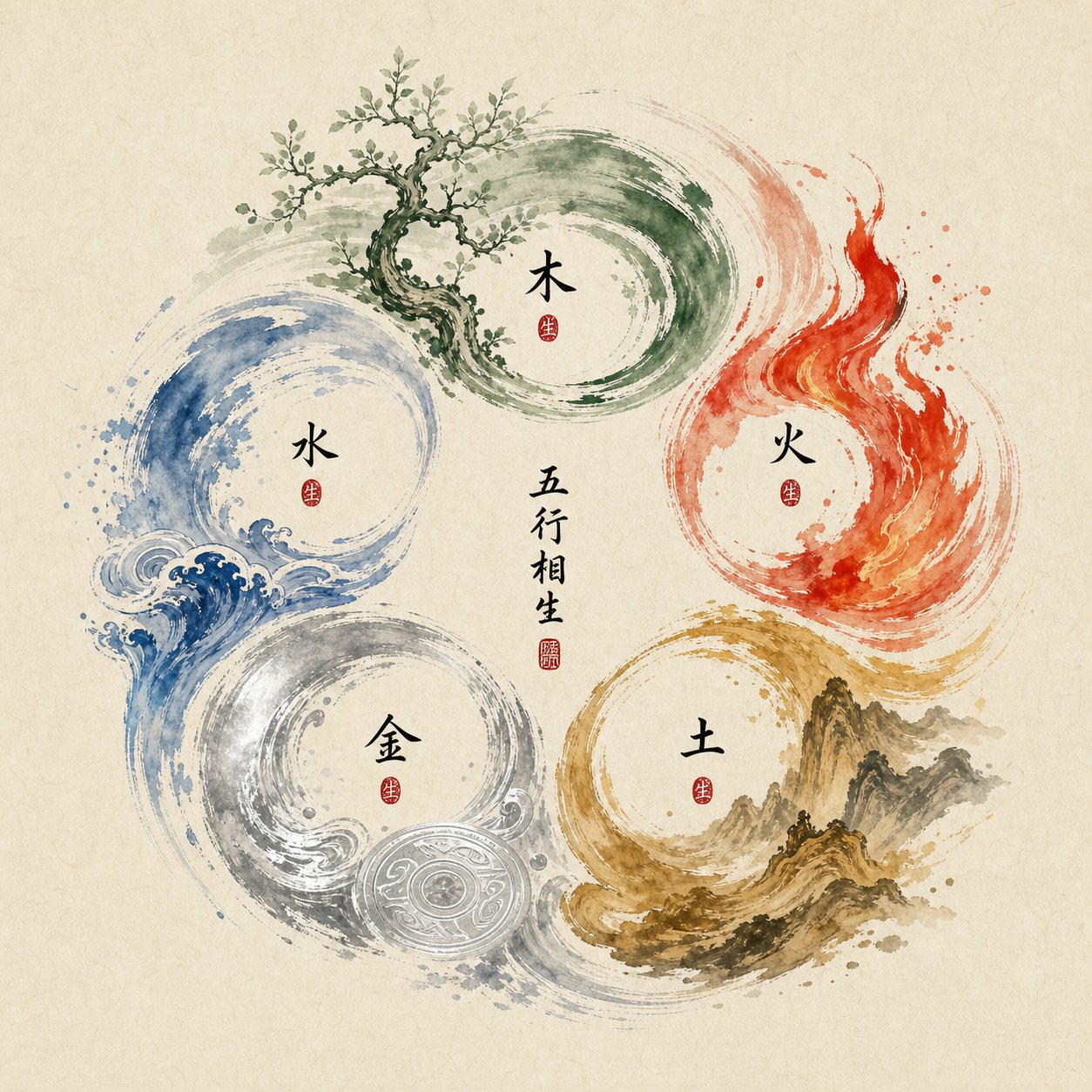
The Wu Xing (五行) system describes five phases of energy: Wood, Fire, Earth, Metal, and Water. Despite the common translation, these aren't physical elements like those on the periodic table. The character Xing (行) means "movement" or "phase," referring to dynamic patterns of energy that cycle through nature and human life.
In traditional chinese name interpretation, a child's exact birth date and time are mapped into a BaZi (八字) chart that reveals which elemental energies are strong, weak, or absent. A naming specialist then selects characters that reinforce the missing or deficient element, restoring balance. Think of it as diagnosing what's lacking and prescribing the right character to fill that gap.
Here's how each element functions in naming:
- Wood (木, Mù) — Energy of growth and spring. Associated with benevolence and vitality. Common radicals: 木 (wood), 艹 (grass). Example characters: 林 (lín, forest), 桐 (tóng, paulownia tree).
- Fire (火, Huǒ) — Energy of radiance and summer. Associated with passion and leadership. Common radicals: 火 (fire), 灬 (fire dots). Example characters: 煜 (yù, radiant), 炎 (yán, flame).
- Earth (土, Tǔ) — Energy of stability and transition. Associated with trust and steadfastness. Common radicals: 土 (earth), 山 (mountain). Example characters: 坤 (kūn, earth/receptive), 岳 (yuè, great mountain).
- Metal (金, Jīn) — Energy of refinement and autumn. Associated with righteousness and clarity. Common radicals: 金 (metal), 钅 (metal variant). Example characters: 铭 (míng, inscription), 锐 (ruì, sharp/keen).
- Water (水, Shuǐ) — Energy of wisdom and winter. Associated with adaptability and depth. Common radicals: 氵 (water), 雨 (rain). Example characters: 泽 (zé, marsh/beneficence), 涵 (hán, contain/encompass).
These elements interact through generating and controlling cycles. Wood feeds Fire, Fire creates Earth, Earth bears Metal, Metal collects Water, and Water nourishes Wood. A skilled namer considers not just the missing element but how it relates to the dominant ones already present in the chart. If a boy's chart is heavy in Fire but lacks Water, adding a Water-radical character creates natural regulation since Water quenches Fire.
How Character Combinations Create Compound Meanings
Two-character given names make up over 80% of modern Chinese names, and for good reason. Pairing two characters creates compound meaning that neither character carries alone. This is where understanding chinese name meaning becomes genuinely creative.
The pairing logic typically follows a pattern: one character establishes a domain (nature, cosmos, virtue) while the second adds specificity or aspiration. Consider these combinations:
A nature character like 泽 (zé, marsh/generosity) paired with a virtue character like 明 (míng, bright/clear) creates 泽明, suggesting "generosity illuminated" or "clarity that nourishes." Neither character alone carries that layered significance. The compound meaning emerges from the relationship between them.
Common pairing strategies include nature plus virtue (天德, sky + virtue), element plus aspiration (金志, metal + ambition), and literary allusion plus grounding character. Parents exploring names in chinese and meanings will find that the most distinctive names use unexpected but harmonious pairings rather than two characters from the same semantic field.
The key principle: each character should do different work. Two strength characters side by side can feel heavy-handed. A strength character balanced by a wisdom or nature character creates depth and an auspicious meaning that reads as intentional rather than blunt.
Generational Naming Traditions
Many traditional Chinese families follow a generational naming system called zibei (字辈), where all males within the same generation share one character in their given name. This shared character is predetermined, sometimes generations in advance, often drawn from a family poem or ancestral record.
For example, if the generational character for a particular generation is 志 (zhì, ambition), all male cousins born in that generation might be named 志明, 志远, 志强, each sharing 志 as the first character of their given name while the second character is personalized. As the Asia Media Centre notes, these generation names are often worked out long in advance and written into family histories.
For diaspora families, this tradition offers a meaningful way to maintain connection across distance. Even if you're not following a formal zibei poem, choosing a shared character among siblings creates a visible bond in their names. It's a practice that gives meaning chinese names carry beyond the individual, linking each child to something larger than themselves.
Understanding chinese men's names and meanings at this structural level transforms the naming process from passive selection to active creation. You're not just picking a name that sounds nice. You're engineering a name that balances elemental energy, compounds meaning through character pairing, and optionally connects to family lineage. The next step is seeing these principles in action through specific name examples drawn from nature, literature, and philosophy.

Nature-Inspired Chinese Boy Names With Character and Meaning
Nature isn't just a naming theme in Chinese culture. It's a philosophical foundation. Daoist thought, which shaped Chinese literature for over two thousand years, teaches that humans exist within nature rather than apart from it. Shanshui (mountain-water) poetry emerged as an entire genre where poets used vivid descriptions of natural scenery to express spiritual and philosophical insights. That same reverence flows directly into naming traditions. When parents choose a nature character, they're drawing on centuries of literary meaning compressed into a single chinese symbol and its meanings.
One important distinction before diving in: some names that sound exotic to English speakers are actually extremely common in China. A name like Hao (浩, vast) appears in millions of registrations. The names below were selected for genuine rarity in Chinese-speaking communities, not just unfamiliarity to Western ears.
Names Inspired by Mountains and Earth
Mountains represent permanence, ambition, and moral steadfastness in Chinese literary tradition. A boy named after a mountain carries the weight of something unmovable.
| Character | Pinyin | Stroke Count | Pronunciation Guide | Meaning |
|---|---|---|---|---|
| 岳 | Yuè | 8 | Sounds like "yoo-eh" with a falling tone, rhymes with "way" spoken sharply | Sacred mountain. Refers specifically to China's Five Great Mountains. Suggests someone destined for greatness and reverence. |
| 峻 | Jùn | 10 | Sounds like "jwin" with a sharp downward tone, similar to "June" but clipped | Steep, lofty, towering. Evokes a mountain peak that demands effort to reach. Implies high standards and moral rigor. |
| 岩 | Yán | 8 | Sounds like "yen" with a rising tone, as if asking a question | Rock face, cliff. Suggests resilience and an unyielding character. Less common than Shan (mountain) in modern naming. |
| 磊 | Lěi | 15 | Sounds like "lay" with a dipping tone that drops then rises | Stacked rocks, open and upright. The character literally shows three stones piled together. Implies transparency and integrity. |
Water and Sky Names With Poetic Origins
Water characters carry particular depth in Chinese naming. The character for water, 水 (shuǐ), is pronounced "shway" with a dipping third tone. If you're wondering how to pronounce water in Mandarin, think of saying "shway" while your voice dips low then rises slightly. But parents rarely use 水 directly in names. Instead, they reach for more poetic water-related characters that carry layered literary associations.
As one Chinese naming tradition explains, the character 泽 evolved to represent accumulated kindness, grace spreading outward like water filling a basin, expressing hope that a child will create ripples of beneficence extending to future generations.
| Character | Pinyin | Stroke Count | Pronunciation Guide | Meaning |
|---|---|---|---|---|
| 涵 | Hán | 11 | Sounds like "hahn" with a rising tone, similar to saying "Han" as a question | To contain, to encompass. Suggests intellectual depth and tolerance. Poetically linked to a deep pool that holds everything calmly. |
| 霖 | Lín | 15 | Sounds like "lean" with a rising tone | Continuous, nourishing rain. In classical poetry, timely rain represents heaven's blessing on the earth. A rain name in modern Chinese naming that remains genuinely uncommon. |
| 霄 | Xiāo | 15 | Sounds like "shee-ow" with a high flat tone, similar to "show" but starting with "sh" | The highest reaches of the sky. Refers to the xia celestial realm where clouds dissolve into atmosphere. Implies lofty aspirations beyond ordinary ambition. |
| 澈 | Chè | 15 | Sounds like "chuh" with a sharp falling tone, similar to "check" without the k | Crystal clear, transparent. Describes water so pure you can see the bottom. Suggests moral clarity and honesty. |
Seasonal and Celestial Names
Celestial names connect a child to the cosmos. In Chinese tradition, stars and celestial bodies aren't just astronomical objects. They're markers of fate and fortune. The concept of a lucky star in Chinese culture (福星, fúxīng) refers to a person who brings good fortune to those around them. Parents who choose celestial characters are tapping into this deep association between heavenly bodies and destiny.
| Character | Pinyin | Stroke Count | Pronunciation Guide | Meaning |
|---|---|---|---|---|
| 曦 | Xī | 20 | Sounds like "shee" with a high flat tone, like saying "she" but brighter | First rays of dawn. Not full sunlight but the moment before sunrise when the sky brightens. Represents hope and anticipation of great things. |
| 辰 | Chén | 7 | Sounds like "chun" with a rising tone, similar to "chen" in "chenille" | Celestial body, time, the Dragon in the zodiac. One of the Earthly Branches. Suggests someone aligned with cosmic timing and natural rhythm. |
| 旭 | Xù | 6 | Sounds like "shoo" with a falling tone, quick and decisive | Rising sun. Specifically the sun as it first appears above the horizon. Implies energy, warmth, and a life that ascends steadily. |
| 枫 | Fēng | 8 | Sounds like "fung" with a high flat tone, similar to "phone" but with an "f" | Maple tree. Maples turn brilliant red in autumn, symbolizing maturity and transformation. A seasonal name suggesting someone who grows more striking with time. |
You'll notice these names share something: they avoid the most overused nature characters like 浩 (vast) or 宇 (universe) that dominate Chinese naming registries. Each one draws from a specific literary or philosophical tradition while remaining genuinely uncommon in practice. The characters carry entire landscapes within them, connecting your child to Daoist reverence for the natural world and classical poetry that celebrated harmony between humans and their environment.
Nature provides one rich source of naming inspiration, but Chinese literary tradition offers another equally deep well. Classical poetry, Confucian philosophy, and legendary historical figures have shaped naming conventions for millennia, giving parents access to names that carry stories and moral weight far beyond their surface meaning.
Literary and Historical Chinese Names for Boys
Classical poetry and philosophy aren't just academic subjects in China. They're living reservoirs that parents draw from when naming their sons. For over two thousand years, the Analects of Confucius, Tang Dynasty verse, and legendary historical figures have supplied characters and character pairings that carry moral weight, narrative depth, and cultural prestige. When you look behind the name in Chinese tradition, you'll find stories, philosophical arguments, and entire worldviews compressed into one or two characters.
Understanding what's chinese behind the name requires knowing the source material. A name like 子轩 (Zǐxuān) isn't just pleasant-sounding. It references the term 子 (zǐ), which Confucius used to address scholars and masters in the Analects. Parents who choose literary names are signaling a connection to intellectual heritage that stretches back to the fifth century BCE.
Names From Classical Poetry and Literature
Tang Dynasty poetry (618-907 CE) represents the golden age of Chinese literary expression. Poets like Li Bai and Du Fu created imagery so vivid that their phrases became naming material for centuries afterward. These traditional chinese names carry the prestige of China's most celebrated literary period.
| Character | Pinyin | Literary Source | Meaning |
|---|---|---|---|
| 子瞻 | Zǐ Zhān | Courtesy name of Su Shi (Su Dongpo), greatest literary figure of the Song Dynasty | "Far-sighted gentleman." Su Shi was a poet, painter, calligrapher, and statesman whose works remain central to Chinese literary education. |
| 渊明 | Yuān Míng | Name of Tao Yuanming, founder of pastoral poetry in the Eastern Jin Dynasty | "Clear and bright heart." Tao Yuanming rejected imperial chinese court life to write poetry celebrating rural simplicity and inner peace. |
| 逸少 | Yì Shào | Courtesy name of Wang Xizhi, the "Saint of Calligraphy" from the Eastern Jin Dynasty | "Extraordinary outstanding talent." Wang Xizhi's brushwork remains the gold standard for Chinese calligraphy. |
| 幼安 | Yòu Ān | Courtesy name of Xin Qiji, patriotic poet and general of the Southern Song Dynasty | "Peaceful original heart." Xin Qiji wrote bold, unconstrained verse while serving as a military leader defending Song territory. |
These ancient chinese names male readers encounter in historical texts weren't arbitrary. Each courtesy name (字, zì) was chosen at adulthood to complement or expand upon the birth name, creating a layered identity that reflected both personal character and aspirational ideals.
Confucian Virtue Names With Historical Weight
Confucian philosophy, founded by Kong Zi (孔子, Confucius, 551-479 BCE), established five constant virtues that directly shape naming traditions to this day: ren (仁, benevolence), yi (义, righteousness), li (礼, propriety), zhi (智, wisdom), and xin (信, trustworthiness). These aren't abstract concepts. They're active naming ingredients. Parents select virtue characters to embed moral aspiration directly into a child's identity.
The logic works like this: naming a boy with a virtue character is both a hope and a gentle instruction. Every time the name is spoken or written, it reinforces the value it represents. A boy named 仁 carries benevolence as part of his daily identity.
| Character | Pinyin | Literary Source | Meaning |
|---|---|---|---|
| 仁杰 | Rén Jié | Confucian virtue 仁 (benevolence) from the Analects, combined with 杰 (outstanding) | "Benevolent and outstanding." Ren is the highest Confucian virtue, representing shared humanity and empathy toward others. |
| 思齐 | Sī Qí | From the Analects: "When you see a worthy person, think of equaling them" (见贤思齐) | "Striving for virtue." Expresses the Confucian ideal of continuous moral self-improvement through emulation of the wise. |
| 明哲 | Míng Zhé | From the Book of Songs (诗经): "Wise and discerning, protecting oneself" (明哲保身) | "Bright wisdom." Combines clarity of perception with philosophical depth. Suggests someone who sees truth clearly. |
| 文博 | Wén Bó | Confucian emphasis on scholarly achievement from the Book of Rites (礼记) | "Cultured and erudite." Wen represents literary refinement while Bo suggests breadth of knowledge across disciplines. |
Names of Legendary and Historical Figures
China's historical and names mythical traditions offer another category entirely: names drawn from legendary strategists, generals, and cultural heroes. These carry the weight of specific stories that any educated Chinese person would recognize instantly. A chinese warrior name doesn't just sound strong. It invokes a particular narrative of courage, loyalty, or brilliance.
| Character | Pinyin | Literary Source | Meaning |
|---|---|---|---|
| 孔明 | Kǒng Míng | Courtesy name of Zhuge Liang, legendary Three Kingdoms strategist from Records of the Three Kingdoms | "Infinitely wise and bright." Zhuge Liang is China's archetype of strategic genius, a figure whose name alone implies unmatched intellect. |
| 云长 | Yún Cháng | Courtesy name of Guan Yu, China's revered Martial Saint from the Three Kingdoms period | "Boundless as the cloud." Guan Yu represents absolute loyalty and martial honor. He's worshipped in temples across East Asia. |
| 子房 | Zǐ Fáng | Courtesy name of Zhang Liang, the "Saint of Strategists" who helped found the Han Dynasty | "Virtuous gentleman like fine jade." Zhang Liang combined intellectual brilliance with moral integrity, advising Emperor Liu Bang to victory. |
| 凤雏 | Fèng Chú | Art name of Pang Tong, top strategist of Shu Han in the Three Kingdoms period | "Young phoenix." Implies someone whose brilliance is still unfolding, destined for greatness that hasn't yet fully revealed itself. |
These names carry narrative gravity. A boy named 孔明 isn't just given two characters. He's given a story of a man who could predict the wind and outthink armies. That's the difference between a name chosen from a list and one chosen from a tradition. Each name above connects to a specific figure whose life embodied the qualities parents hope their son will develop.
Literary and historical names draw their power from cultural memory. But not every parent wants a name rooted in the past. Some seek characters that project forward, conveying strength, intelligence, and ambition in ways that feel contemporary while remaining culturally grounded.
Strong and Intelligent Chinese Boy Names That Stand Apart
Strength and intelligence are the two most sought-after qualities in masculine chinese names. Parents want a name that projects power without aggression, wisdom without pretension. The challenge? Many characters that seem bold and distinctive to English speakers are actually among the most overused in China. Choosing powerful chinese male names requires knowing which characters carry genuine weight and which ones have been diluted by sheer popularity.
Names Meaning Bright, Wise, or Intelligent
Intelligence-related characters are perennial favorites in chinese male names. The aspiration is universal: parents hope their son will be sharp, perceptive, and capable of deep thought. But not all "smart" characters are created equal in terms of rarity. The names below avoid the most saturated options while still conveying intellectual brilliance.
| Character | Pinyin | Stroke Count | Tone Description | Meaning |
|---|---|---|---|---|
| 哲 | Zhé | 10 | 2nd tone, rising like a question | Philosophical wisdom. Not just clever but deeply discerning. Implies someone who grasps underlying truths others miss. |
| 睿 | Ruì | 14 | 4th tone, drops sharply like a command | Farsighted intelligence. Suggests the ability to see consequences before they unfold. Used historically for emperors known for wise governance. |
| 聪 | Cōng | 15 | 1st tone, high and flat like holding a note | Quick-witted, perceptive. The character contains the radical for ear (耳), implying someone who listens well and understands fast. |
| 彦 | Yàn | 9 | 4th tone, falling sharply | Accomplished scholar. In classical usage, referred specifically to a person of outstanding talent and moral character combined. |
| 晟 | Shèng | 10 | 4th tone, decisive downward drop | Bright and prosperous. Contains the sun radical (日) suggesting radiance. Less common than 明 (bright) but carries similar luminous energy. |
For parents searching for names meaning bright or smart, the key is moving beyond the obvious choices. Characters like 明 (míng, bright) and 智 (zhì, wise) are perfectly valid but appear in hundreds of thousands of registered names. Options like 晟 or 彦 deliver the same intellectual aspiration with far less duplication.
Strength and Leadership Names
What makes cool chinese names for guys resonate isn't volume or aggression. It's contained power. The most compelling strength characters in Chinese suggest force held in reserve, authority earned rather than demanded. These asian male names project leadership through character rather than bluster.
| Character | Pinyin | Stroke Count | Tone Description | Meaning |
|---|---|---|---|---|
| 毅 | Yì | 15 | 4th tone, sharp and decisive | Resolute determination. Not brute strength but the will to persist through difficulty. Implies someone who finishes what they start regardless of obstacles. |
| 铮 | Zhēng | 11 | 1st tone, high and sustained | The sound of metal striking metal. Suggests someone whose character rings true under pressure. An uncommon choice that evokes integrity tested and proven. |
| 赫 | Hè | 14 | 4th tone, commanding downward | Imposing, awe-inspiring. Historically described the brilliance of fire or the authority of a respected leader. Implies natural charisma and vitality. |
| 骁 | Xiāo | 9 | 1st tone, high and level | A valiant, spirited horse. By extension, a brave and skilled warrior. Carries martial energy without the heaviness of more common strength characters. |
| 铭 | Míng | 11 | 2nd tone, rising upward | To inscribe, to engrave permanently. Suggests someone whose words and actions leave lasting marks. Implies both strength of conviction and permanence of legacy. |
These cool chinese names carry weight because each character tells a specific story about what kind of strength matters. 毅 is about endurance. 赫 is about presence. 骁 is about spirited courage. The specificity is what makes them powerful rather than generic.
What Modern Naming Data Reveals About Uniqueness
Here's where intention meets reality. China's Ministry of Public Security analyzes millions of newborn registrations annually. Their data reveals that certain characters dominate naming choices so heavily that any name containing them is statistically common, regardless of how fresh it sounds to foreign ears.
The top characters appearing in boys' names include 泽 (zé, benevolence), 宇 (yǔ, universe), 沐 (mù, bathe), 浩 (hào, vast), and 辰 (chén, celestial). In 2021 alone, over 22,000 boys were registered as 沐宸 (Mùchén), making it the single most popular name that year. Names like 浩宇 (Hàoyǔ) and 浩然 (Hàorán) each had over 11,000 registrations in the same period.
Characters that feel unique to English speakers are often the most overused in China. If a name contains 宇, 泽, 浩, 轩, or 辰, it's statistically likely to be shared by tens of thousands of boys born in the same year. True rarity requires looking beyond these trending characters.
What does this mean for parents seeking rare names for boys? Avoid stacking popular characters together. A name combining two top-50 characters like 宇轩 (Yǔxuān) or 奕泽 (Yìzé) might sound distinctive in an English-speaking context, but in China these are the equivalent of naming your son "Liam" or "Noah." LTL Mandarin School's research with 17 Chinese teachers confirms this trend: names emphasizing strength and success are popular, but the specific characters parents reach for tend to cluster around the same small set.
To find genuinely uncommon territory, consider these strategies:
- Choose characters ranked outside the top 50 in frequency data. Characters like 铮, 骁, or 晟 carry strong meanings without mass adoption.
- Pair a moderately popular character with a rare one rather than combining two trending characters.
- Draw from classical literary sources rather than contemporary naming guides, which tend to recycle the same options.
- Verify your chosen name against China's duplicate name checking platform run by the Ministry of Public Security.
The irony of modern Chinese naming is that parents all seeking uniqueness end up converging on the same "unique-sounding" characters. Real distinctiveness comes from deeper research, less obvious character choices, and the kind of intentional pairing logic covered earlier in this guide.
Selecting the right characters is only half the equation, though. Even the most meaningful name can fall flat if it clashes tonally with the family surname or accidentally triggers a cultural taboo. The mechanics of pairing a given name with a surname involve their own set of rules and pitfalls.
Pairing Names With Surnames and Avoiding Taboos
A beautifully chosen given name can sound clumsy or even comical when paired with the wrong surname. In Mandarin, tonal flow between characters determines whether a full name rolls off the tongue or stumbles. And beyond sound, certain character combinations carry cultural baggage that no parent wants attached to their child. Getting this pairing right is where phonetic awareness meets cultural literacy.
Tonal Harmony With Common Surnames
The most common chinese last names each carry a fixed tone. Wang (王) is second tone, Li (李) is third tone, Zhang (张) is first tone, Liu (刘) is second tone, and Chen (陈) is also second tone. These five surnames alone cover roughly 30% of China's population. When you pair a given name with a chinese surname, the tones need to create movement rather than monotony.
The general principle: avoid repeating the same tone across all characters. Three consecutive third tones create a choppy, labored sound. Three first tones feel flat and robotic. The most pleasing combinations alternate between rising and falling pitches, creating a natural melodic arc.
| Surname | Tone | Recommended Given Name Tones | Combinations to Avoid |
|---|---|---|---|
| 王 (Wáng) | 2nd (rising) | 4th + 1st, 4th + 3rd, 1st + 4th | 2nd + 2nd (three rising tones feel repetitive) |
| 李 (Lǐ) | 3rd (dipping) | 4th + 2nd, 1st + 4th, 2nd + 4th | 3rd + 3rd (three dipping tones are physically difficult to pronounce) |
| 张 (Zhāng) | 1st (flat) | 4th + 2nd, 3rd + 4th, 2nd + 1st | 1st + 1st (monotone, lacks energy) |
| 刘 (Liú) | 2nd (rising) | 4th + 1st, 3rd + 4th, 1st + 3rd | 2nd + 2nd (same issue as Wang) |
| 陈 (Chén) | 2nd (rising) | 4th + 3rd, 1st + 4th, 4th + 2nd | 2nd + 2nd (monotonous rising pattern) |
Say your candidate name aloud at conversational speed. If you find yourself straining or if the syllables blur together, the tonal pairing likely needs adjustment. Names ending on a fourth tone tend to sound decisive and strong. Names ending on a first tone feel open and calm. Match the ending tone to the personality you want the name to project.
Characters and Combinations to Avoid
Beyond tonal awkwardness, certain character pairings create unintended homophones. Mandarin is rich with words that share identical pronunciation but carry wildly different meanings. A name that reads beautifully on paper might sound like something embarrassing when spoken aloud at speed.
For example, pairing the surname 杨 (Yáng) with the given name 伟 (Wěi) creates Yáng Wěi, which sounds identical to 阳痿 (impotence). The surname 史 (Shǐ) combined with certain characters can sound like 死 (sǐ, death). These aren't obscure edge cases. They're well-known pitfalls that native speakers catch immediately.
When researching chinese surnames and meanings, always test the full name's pronunciation against common words and phrases. Read it quickly, slur it slightly, and ask a native speaker whether any unfortunate homophones emerge. What looks fine in careful, character-by-character reading can reveal problems at natural speaking speed.
Stroke Count Balance and Naming Taboos
Visual balance matters in a culture where names are written by hand on documents, red envelopes, and calligraphy scrolls. A single-stroke surname like 一 paired with a 20-stroke given name looks top-heavy. Most naming guides recommend keeping the total stroke difference between surname and given name characters within a reasonable range, typically no more than 10-12 strokes apart.
Understanding chinese family names and meanings also means understanding what's forbidden. Traditional naming taboos remain widely observed:
- Never use characters from parents' or grandparents' names. This is the most strictly observed taboo. Using an elder's name character is considered deeply disrespectful, as if claiming equality with someone who holds authority over you.
- Avoid characters associated with death, illness, or misfortune. Characters containing radicals linked to sickness (疒) or those that sound like 死 (death), 苦 (bitter), or 败 (defeat) are universally rejected.
- Skip overly rare or archaic characters. If a character doesn't appear in standard computer encoding systems, your child will face a lifetime of administrative headaches with official documents.
- Don't use names of famous historical figures directly. Naming a boy 孔子 (Confucius) or 李白 (Li Bai) is considered presumptuous rather than honorable. Drawing inspiration from their courtesy names or associated virtues is the respectful alternative.
- Avoid characters with vulgar, arrogant, or overly aggressive connotations. Names suggesting dominance over others (霸, bà, tyrant) or excessive self-praise are considered poor taste.
- Watch for negative homophone combinations. Even individually positive characters can create unfortunate sounds when combined with specific surnames.
Among the most common chinese surnames, some carry particular pairing challenges. The surname 吴 (Wú) sounds like 无 (wú, without/lacking), so 吴德 (Wú Dé) inadvertently sounds like "without virtue." The surname 贾 (Jiǎ) sounds like 假 (jiǎ, fake), making combinations like 贾仁 sound like "fake benevolence." Knowing chinese last names and meanings at this level prevents well-intentioned names from becoming lifelong jokes.
These constraints aren't limitations. They're guardrails that channel creativity in productive directions. A name that clears every tonal, visual, and cultural checkpoint carries a quiet confidence. It signals that someone took the time to get it right. And for families navigating between Chinese and English-speaking worlds, there's one more layer to consider: how well a name travels across linguistic boundaries.
Chinese Names That Work Across Languages and Cultures
Families living between two linguistic worlds face a practical question that purely domestic Chinese families don't: will this name survive the transition into English? For diaspora families maintaining cultural roots and non-Chinese parents drawn to the depth of these naming traditions, the goal is finding asian names for boys that carry authentic meaning in Mandarin while functioning smoothly in English-speaking classrooms, workplaces, and social settings.
The good news? Mandarin and English share enough phonetic overlap that certain names travel between both languages without modification. The key is knowing where those overlaps exist and how to use them strategically.
Phonetic Bridging Between Chinese and English
Phonetic bridging means selecting a Chinese name whose pronunciation closely mirrors an English name or word. The result is a single name that feels native in both contexts. Consider the name Kai. The kai meaning in Chinese, written as 凯 (kǎi), signifies triumph and victory. In English, Kai reads as a short, modern name that requires no explanation or pronunciation coaching. One name, two complete identities.
This approach works because Mandarin syllables are compact and many align naturally with English phonetics. Sounds like "lee," "ray," "an," "ming," and "bo" exist comfortably in both languages. The trick is ensuring the Chinese character behind the sound carries genuine meaning rather than being chosen purely for phonetic convenience. A name that sounds right but means nothing in Chinese defeats the purpose of choosing names in mandarin in the first place.
Three Strategies for Cross-Cultural Naming
Parents navigating this decision typically land on one of three approaches, each with distinct advantages:
- One name that works in both languages. Choose a Chinese name whose pinyin pronunciation doubles as an English given name. This is the simplest path. The child uses one name everywhere, avoiding the confusion of switching between identities. Best for families who want seamless integration without code-switching.
- Complementary Chinese and English names. Select a formal Chinese name (used with family and in Chinese contexts) alongside a separate English name (used at school and work). Many chinese guy names pair this way: a child might be 志远 (Zhìyuǎn) at home and "Ethan" at school. The two names don't need to sound alike but ideally share thematic resonance.
- Chinese name as a middle name. Use an English first name with a Chinese middle name that preserves heritage on official documents. This works well for families where daily life operates primarily in English but cultural identity matters on a deeper, personal level. The asian name meaning remains present in the child's full legal name even if it's not used daily.
Names That Work Seamlessly Across Languages
The following chinese names boys can carry without explanation in English-speaking environments all have legitimate characters and meanings behind them. They aren't transliterations or approximations. Each is a real Chinese name that happens to cross linguistic boundaries naturally.
| Name | Character | Pinyin | Meaning in Chinese | Why It Works in English |
|---|---|---|---|---|
| Kai | 凯 | Kǎi | Triumph, victory, celebration | Recognized English name (Hawaiian for "sea," Scandinavian origins). No pronunciation barrier. |
| Leo | 力欧 / 利奥 | Lì Ōu / Lì Ào | Strength combined with grandeur | Classic English name meaning "lion." Familiar worldwide. |
| Ray | 睿 | Ruì | Farsighted wisdom, sagacity | Common English name. The "Rui" sound approximates "Ray" closely enough for daily use. |
| Ian | 毅安 | Yì Ān | Perseverance and peace | Scottish form of John. The "Yi-An" pronunciation maps naturally to "Ian." |
| Bo | 博 | Bó | Extensive knowledge, erudition | Short, punchy English name. Requires zero explanation in Western contexts. |
| Ming | 明 | Míng | Bright, clear, illuminated | Familiar to English speakers through cultural exposure. Easy to pronounce and spell. |
| Rowan | 荣安 | Róng Ān | Glory and peace | Established English/Irish name meaning "little red one" or referencing the rowan tree. |
You'll notice a pattern: the most successful cross-cultural asian names tend to be short, one or two syllables, with consonant-vowel structures that both languages handle easily. Names starting with K, L, M, R, and B sounds cross over particularly well because these consonants behave similarly in Mandarin and English.
For families weighing these options, the deciding factor often comes down to daily context. If your child will grow up primarily in an English-speaking environment with regular Chinese family contact, a phonetically bridged name offers the least friction. If Chinese language and culture will be central to daily life, a complementary pair gives each identity its full, uncompromised expression.
Whichever strategy you choose, the underlying principles remain the same: verify the character's meaning, check tonal harmony with the surname, and confirm the name doesn't trigger any cultural taboos. Those fundamentals apply whether a name lives in one language or two. With all these layers of consideration in mind, the final step is assembling them into a clear, actionable decision-making process.
Bringing It All Together to Choose the Perfect Name
You've explored the structure, the philosophy, the elemental systems, and the cultural guardrails. That's a lot of moving parts. The difference between a good chinese names list and a great naming decision is having a clear process that puts all these layers in the right order. Think of it less like shopping from a catalog and more like building something from carefully chosen materials.
Your Step-by-Step Naming Checklist
Whether you're selecting chinese names male family members will recognize and respect, or crafting male chinese names that bridge two cultures, this sequence keeps the process grounded and intentional:
- Define your core values and aspirations. Before touching a single character, decide what qualities matter most. Strength? Wisdom? Connection to nature? Moral integrity? This filters thousands of possible characters down to a manageable field.
- Identify any elemental needs. If your family observes the Five Elements tradition, determine which element the child's birth chart lacks. Choose characters with radicals that reinforce the missing element.
- Check generational naming requirements. Confirm whether your family follows a zibei poem or shared-character tradition. If so, one character is already decided, and your creative energy focuses on the second.
- Draft character combinations. Pair characters using the compound-meaning logic: one character establishes a domain, the other adds specificity. Aim for 5-10 candidate pairings.
- Test tonal harmony with your surname. Say each full name aloud at conversational speed. Listen for monotone repetition, awkward dips, or accidental homophones. Eliminate any combination that stumbles.
- Verify stroke count balance. Check that the visual weight of your given-name characters complements the surname. A 3-stroke surname pairs better with moderate-complexity given-name characters than with 20-stroke options.
- Screen for taboos. Confirm no character duplicates an elder's name, sounds like a negative word when combined with the surname, or carries inauspicious associations in your family's dialect.
- Check popularity data. Run your top candidates through naming frequency databases to confirm they aren't among the year's most registered combinations.
- Test cross-cultural usability (if relevant). For families in English-speaking environments, say the name to someone unfamiliar with Mandarin. Can they approximate the pronunciation? Does it invite confusion or mockery?
- Get the family test. Share your shortlist with elders or trusted family members. As one naming guide puts it, the real test is whether the name holds up to a Chinese auntie squinting at it across a dinner table.
How to Verify Your Name Choice Is Truly Unique
Feeling confident about a name is one thing. Confirming it's genuinely uncommon is another. China's Ministry of Public Security operates a duplicate name checking platform where you can enter a proposed name and see how many people currently share it nationwide. This is the most reliable way to distinguish between a name that feels rare and one that actually is.
Beyond that database, search your candidate name on Chinese social media platforms like Weibo or Xiaohongshu. If dozens of profiles share the exact combination, it's more common than you'd expect. Cross-reference against annual popular chinese names reports published by Chinese media outlets each year, which list the top registered names for newborns.
For parents browsing a chinese name list from English-language sources, remember that these lists tend to recycle the same 50-100 characters. The best chinese names aren't found on lists at all. They're constructed through the methodology this guide outlines: meaning first, then sound, then verification.
Chinese names for men carry weight precisely because they're built with intention. Every character chosen, every tone tested, every taboo avoided represents a deliberate act of care. The process might feel complex at first, but that complexity is the point. A name assembled through this kind of thoughtful construction doesn't just identify your son. It speaks for him before he ever says a word.
Frequently Asked Questions About Unique Chinese Boy Names
1. How do I choose a unique Chinese boy name that isn't overused in China?
Avoid stacking popular characters like 宇, 泽, 浩, 轩, or 辰, which appear in tens of thousands of registrations annually. Instead, draw from classical literary sources, choose characters ranked outside the top 50 in frequency data, and verify your candidate name through China's Ministry of Public Security duplicate name checking platform. Pairing one moderately popular character with a genuinely rare one is more effective than combining two trending characters that only sound unique to English speakers.
2. What is the structure of a Chinese boy's full name?
A Chinese full name places the family surname (xing) first, followed by a one- or two-character given name (ming). Most surnames are a single character, making the total name two or three characters long. The given name is where parents express meaning, tonal harmony, and elemental balance. Two-character given names are most common today, functioning as a unified first name rather than a first-plus-middle arrangement like in English naming conventions.
3. Can a Chinese name work in both English and Mandarin?
Yes, through phonetic bridging. Names like Kai (凯, triumph), Bo (博, erudition), and Ming (明, bright) function naturally in both languages without modification. The key is selecting Chinese characters whose pinyin pronunciation closely mirrors an English name while still carrying authentic meaning in Mandarin. Short names with one or two syllables and consonant-vowel structures common to both languages cross over most smoothly, particularly those starting with K, L, M, R, or B sounds.
4. What are the Five Elements in Chinese naming and why do they matter?
The Five Elements (Wu Xing) system includes Wood, Fire, Earth, Metal, and Water, representing dynamic phases of energy rather than physical substances. A child's birth date and time are mapped into a BaZi chart to identify which elemental energies are deficient. Parents then choose name characters containing radicals associated with the missing element to restore balance. For example, a child lacking Water energy might receive a name with the water radical (氵), like 涵 (hán, encompass) or 泽 (zé, beneficence).
5. What naming taboos should I avoid when choosing a Chinese boy name?
The most critical taboos include never using characters from parents' or grandparents' names, avoiding characters associated with death or illness, and screening for negative homophones when combined with the family surname. For instance, the surname 吴 (Wú) sounds like 无 (without), so 吴德 inadvertently means 'without virtue.' Also avoid overly rare characters not in standard computer encoding, names of famous historical figures used directly, and characters with arrogant or aggressive connotations.