The Chinese Character for Beauty at a Glance
When you look up how to say beauty in Mandarin Chinese, one character dominates the results: 美. But this single character carries far more weight than any English translation can capture. It functions as an adjective, a philosophical concept, and a building block for dozens of compound words that stretch across food, art, morality, and everyday compliments.
What Does the Chinese Character 美 Mean
美 (měi, third tone) is the primary Chinese character for beauty. It means "beautiful," "good," or "aesthetically pleasing" and serves as both a standalone adjective and a root component in compound words spanning physical appearance, moral virtue, fine arts, and positive experiences.
The pinyin romanization is měi, pronounced with the third tone — a dipping tone that falls and then rises. You'll encounter this character everywhere in Mandarin, from casual compliments like 你很美 (you are beautiful) to formal vocabulary like 美术 (fine arts) and even country names like 美国 (America, literally "beautiful country"). Its meaning in English shifts depending on context, covering "beautiful," "good," "fine," and "pleasing" all at once.
What makes 美 unusual among Chinese characters is its dual nature. It works as a simple descriptive word — calling a landscape or a person beautiful — but it also encodes cultural logic about what beauty actually is. The character appears in words for moral virtue (美德), aesthetic judgment (审美), and delicious food (美食), suggesting that the Chinese concept of beauty was never limited to visual appearance alone.
Why 美 Is More Than a Simple Translation
This character has roots stretching back over 3,000 years. It appears in oracle bone script from the Shang dynasty — the earliest known form of Chinese writing — carved into animal bones and turtle shells for divination purposes. That historical depth signals something important: the meaning of 美 was shaped by ancient pastoral culture, Confucian ethics, Daoist philosophy, and centuries of poetic tradition long before it landed in modern dictionaries.
Understanding the beauty Chinese character meaning requires peeling back these layers. The surface definition is straightforward enough. But hidden inside the character's structure is a story involving sheep, ceremonial headdresses, and a worldview where goodness and beauty were inseparable. That story begins with the character's radical breakdown — specifically, why 美 hides a sheep on top of a person.
Etymology and Radical Breakdown of 美
Split 美 down the middle and you'll find two familiar characters stacked on top of each other: 羊 (yang, sheep) sitting above 大 (da, big — or more precisely, a person with arms outstretched). This isn't a coincidence or a quirk of calligraphic evolution. It's the character's origin story, baked directly into its visual structure. So why does 美 have a sheep radical? The answer takes us back to a time when flocks meant survival, and a healthy animal was the most beautiful thing a community could imagine.
The Sheep and Person Story Behind 美
Chinese characters aren't random arrangements of lines. Many are built from smaller components called radicals — semantic building blocks that hint at a character's meaning or category. The radical system works like a cultural filing cabinet: characters containing 水 (water) often relate to liquids, those with 木 (wood) connect to trees or materials, and those built on 羊 (sheep) frequently carry connotations of goodness, nourishment, or beauty.
The positional decomposition of 美 is written as ⿱羊大 — meaning 羊 stacked vertically above 大. The top component contributes six strokes forming the sheep radical. The bottom component adds three strokes representing a person standing with arms spread wide. Together, they create an ideographic character: one whose meaning emerges from the combination of its parts rather than from a phonetic clue.
But what does a sheep on top of a person actually mean? This is where two scholarly interpretations diverge, and both reveal something fascinating about how ancient Chinese culture defined beauty.
How Ancient Pastoral Culture Shaped the Idea of Beauty
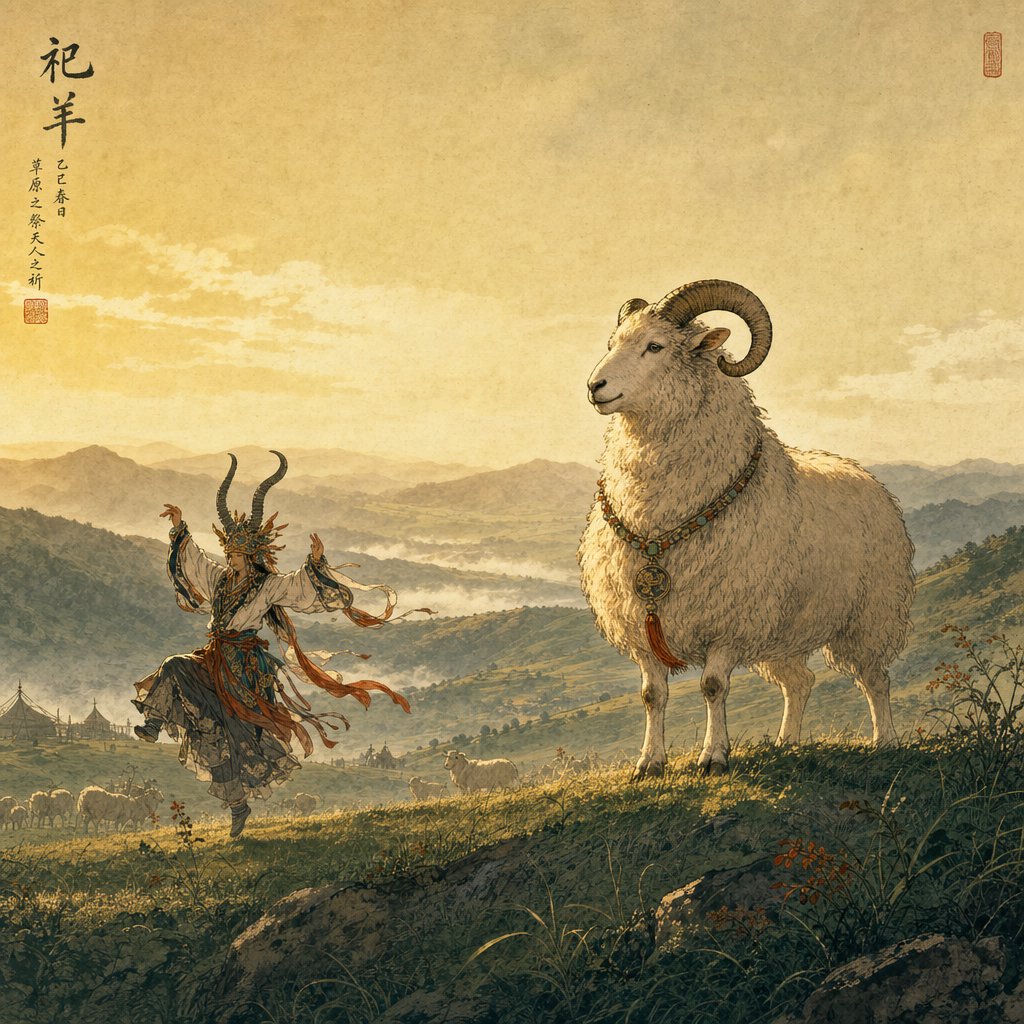
The first interpretation is the most intuitive. Imagine a pastoral society in northwestern China around 1100 BC — the ancestors of the Zhou dynasty, whose economy depended entirely on the health and reproduction of their flocks. In that world, a large, well-built sheep represented prosperity, abundance, and everything desirable. As columnist Hing Chao notes, this linguistic evidence suggests that to an ancient Chinese, what most symbolized beauty was a well-built, good-looking sheep. The character 大 (big) amplifies the sheep above it: a big sheep equals a beautiful thing.
This reading gains weight when you notice that 羊 appears in a whole family of positive words beyond 美. The character 善 (shan, goodness) contains 羊. The character 养 (yang, to nurture) combines 羊 with 食 (food). Even 羹 (geng, thick soup) incorporates the sheep radical — because the finest soups were made with lamb. The pattern is consistent: sheep equaled sustenance, goodness, and beauty in the ancient Chinese worldview.
The second interpretation focuses on the 大 component not as "big" but as a pictograph of a person. In this reading, 美 depicts a person wearing an ornamental headdress resembling sheep horns — the kind worn during ceremonial dances and ritual performances. Picture a figure adorned with curving ram's horns, arms extended in a ritual posture. That image of splendor and ceremony became the written symbol for beauty itself.
Both interpretations point to the same cultural truth: beauty in ancient China was never purely visual. It was tied to prosperity, ritual, community well-being, and the sacred. Whether you see a prized animal or a dancer in ceremonial dress, the etymology of the Chinese beauty character connects aesthetics to something deeper than surface appearance.
Oracle Bone to Modern Script Evolution
The character 美 didn't always look the way it does in modern print. Its earliest known form appears in oracle bone script from the Shang dynasty — carved into turtle shells and animal bones over 3,000 years ago. Across centuries of use, the character's shape shifted through several major script eras while preserving its core semantic structure.
| Script Era | Approximate Period | Visual Features |
|---|---|---|
| Oracle Bone Script (甲骨文) | c. 1200-1050 BC | A stick figure of a person with a large horned headdress clearly visible on top. The sheep horns are prominent and curved, the human body is simplified to basic lines. |
| Bronze Inscription (金文) | c. 1050-500 BC | The figure becomes more stylized. The horned headdress and human body are still recognizable but rounder, cast into ritual bronze vessels. The sheep element begins separating visually from the person below. |
| Seal Script (篆书) | c. 500-200 BC | Strokes become more uniform and flowing. The two components — 羊 above and 大 below — are now clearly distinct sections. The character takes on a balanced, symmetrical appearance. |
| Regular Script (楷书) | c. 200 AD-present | The modern standard form. Nine crisp strokes with 羊 (six strokes) neatly positioned above 大 (three strokes). Fully standardized for print and handwriting. |
What's remarkable about this evolution is how stable the meaning remained. The visual form shifted from a recognizable pictograph of a person in a horned headdress to an abstract arrangement of strokes — yet the semantic core never drifted. Beauty, goodness, and the sheep radical stayed fused together across three millennia of writing reform.
This stability tells you something about the character's cultural weight. Characters that encode deep values tend to resist radical redesign. And 美 encodes one of the deepest: the idea that beauty is not separate from goodness, nourishment, or communal prosperity. That philosophical DNA, planted in a pastoral society's admiration for healthy flocks, still lives inside every modern use of the character — from beauty filters on smartphones to classical poetry about mountain landscapes.
Knowing the story behind the strokes transforms how you write and remember 美. Each time you draw the sheep radical on top, you're tracing a line back to those ancient herders for whom a thriving animal was the most beautiful sight in the world. And that visual logic — top component plus bottom component equals layered meaning — is exactly how you'll approach writing the character stroke by stroke.
How to Write and Pronounce 美 Correctly
You know the story behind the strokes — sheep above, person below. But when your pen hits paper, where do you actually start? The character 美 contains 9 strokes total, divided neatly between its two structural components. Two basic stroke order principles guide the entire sequence: write top before bottom, and within each section, draw horizontal strokes before vertical ones. Follow those rules and the character practically writes itself.
Step-by-Step Stroke Order for 美
The top component is a modified form of 羊 (sheep), accounting for the first six strokes. The bottom component is 大 (big/person), completed in the final three strokes. Here's the full sequence broken down one stroke at a time:
- Stroke 1 — Short horizontal dot (点/丶) at the top left, angling slightly downward to the right. This begins the sheep radical's horns.
- Stroke 2 — Short horizontal dot (撇) at the top right, mirroring stroke 1. Together, these two strokes form the tips of the sheep's horns.
- Stroke 3 — Short horizontal stroke (横) connecting the space just below the two dots. Keep it compact.
- Stroke 4 — Longer horizontal stroke (横) below stroke 3, extending wider on both sides. This creates the sheep radical's broader middle.
- Stroke 5 — Central vertical stroke (竖) dropping straight down through the middle of the horizontal lines. This is the spine of the sheep radical.
- Stroke 6 — The longest horizontal stroke (横), stretching across the full width of the character. It serves as both the base of the sheep radical and the top boundary of 大 below.
- Stroke 7 — Left-falling stroke (撇) sweeping down and to the left from the center of stroke 6. This is the left arm of 大.
- Stroke 8 — Right-falling stroke (捺) sweeping down and to the right, starting from the same central point. This is the right arm of 大.
- Stroke 9 — A final left-falling stroke (撇) or short downward tick, completing the lower portion of the character and grounding the figure.
Notice how the principle of top-before-bottom keeps the sequence logical. You finish the entire sheep radical (strokes 1-6) before touching the person component below. Within the sheep section, horizontal strokes come before the vertical stroke that cuts through them. This isn't arbitrary — it mirrors how ink flows most naturally when writing with a brush, preventing smudging and maintaining balance.
A practical tip: stroke 6 is the character's widest horizontal line. It acts as a visual shelf separating the two components. If you get this stroke's width and position right, the whole character looks balanced. Too narrow, and 美 feels cramped. Too wide, and the bottom component looks disconnected.
Pronouncing Měi with the Correct Third Tone
Writing 美 is half the challenge. Saying it correctly is the other half. The pinyin is měi, and that little caret-shaped mark above the "e" signals the third tone — often the trickiest of Mandarin's four tones for English speakers to master.
Sounds complex? Think of it this way. Imagine someone offers you a surprising piece of news and you respond with a drawn-out, skeptical "may...?" — your voice dips low and then curls back up at the end. That dipping contour is close to what the third tone does. It starts at a mid-low pitch, drops to the bottom of your vocal range, and then rises slightly. The key sensation is that low, creaky bottom — that's where the third tone lives most of its life.
In reality, as Hacking Chinese explains, the third tone is better understood as a low tone rather than a full dipping tone. When 美 appears before another syllable in a compound word (like 美丽, měili), you'll mostly hear just the low portion without the rising tail. The full dip-and-rise only surfaces when the syllable is spoken in isolation or at the end of a phrase.
If you already know other third-tone words, use them as anchors. The word 你 (nǐ, "you"), 我 (wǒ, "I/me"), and 好 (hǎo, "good") all share this same tonal shape. Say 我很美 (wǒ hěn měi — "I am beautiful") and you'll feel three consecutive low tones in sequence, with the sandhi rule turning the first two into rising tones before the final měi stays low-dipping. Practicing these familiar words alongside 美 helps your muscle memory lock in the correct pitch contour.
One more thing worth noting: the vowel sound in měi rhymes with English "may" — it's a clean /ei/ diphthong. Combine that vowel with the low dipping pitch, and you have the complete pronunciation. Get comfortable with both the stroke sequence and the sound, and you'll have a solid foundation for the dozens of compound words that 美 builds when paired with other characters.
Compound Words That Show the Full Range of 美
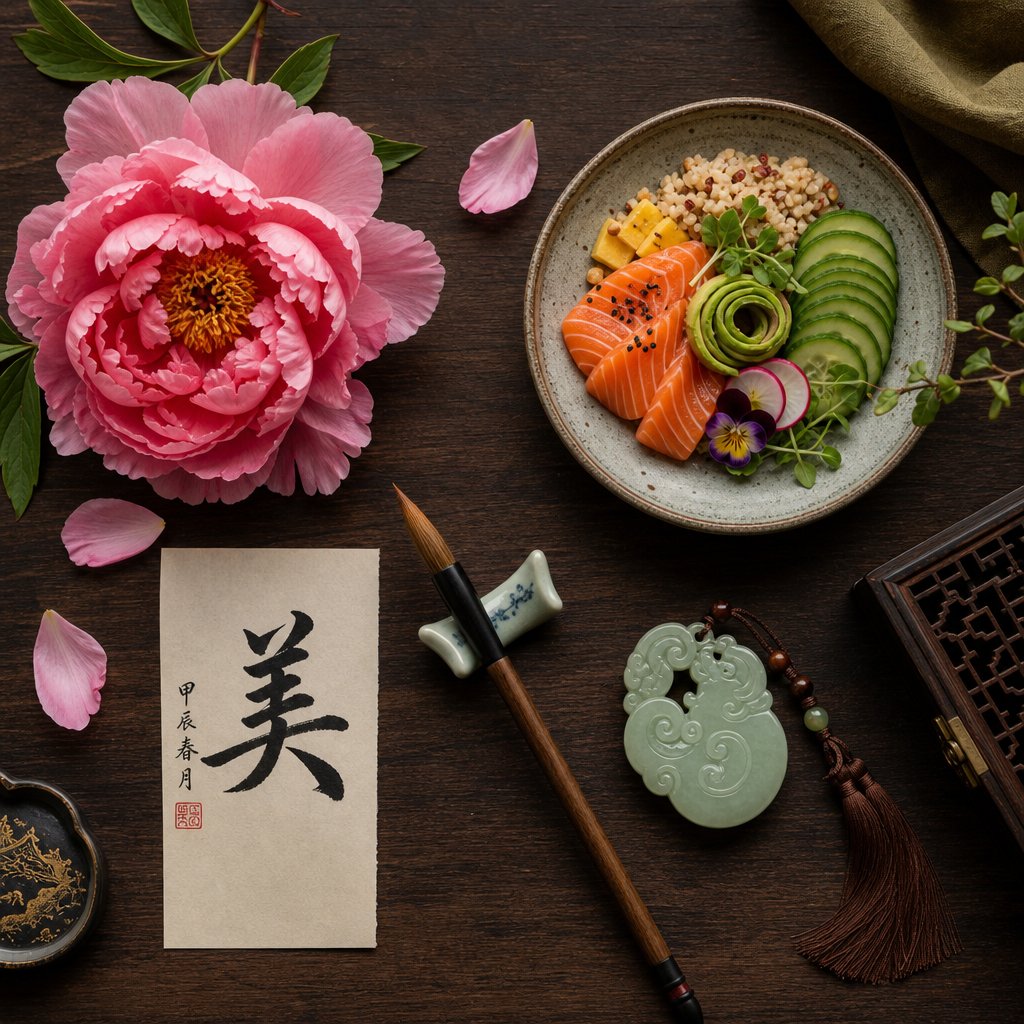
Those dozens of compound words aren't just vocabulary trivia. They reveal how Chinese speakers actually think about beauty — stretching it across appearance, character, taste, and experience in ways that a single English adjective never could. Because Mandarin is fundamentally a language of compound words, learning common words using the 美 character unlocks an entire web of related meanings from a single root.
Each compound pairs 美 with another character, and the combination creates a specific shade of meaning. The logic is consistent: 美 contributes its core sense of "beautiful" or "good," while the second character narrows the focus. Think of it like a color wheel where 美 is the base hue and each partner character shifts it toward a different tone.
美 as Physical and Inner Beauty
The most intuitive Chinese compound words with 美 describe outward appearance. But the character pulls equal weight in vocabulary about moral character — a direct echo of its etymological roots, where beauty and goodness were never separate concepts.
| Compound | Pinyin | Literal Meaning | English Equivalent |
|---|---|---|---|
| 美丽 (měilì) | měilì | beauty + beautiful/elegant | beautiful, gorgeous |
| 美貌 (měimào) | měimào | beauty + appearance/looks | good looks, attractive features |
| 美人 (měirén) | měirén | beauty + person | a beauty, beautiful woman |
| 美德 (měidé) | měidé | beauty + virtue/morality | virtue, moral excellence |
| 审美 (shěnměi) | shěnměi | examine/judge + beauty | aesthetic sense, aesthetic taste |
| 美观 (měiguān) | měiguān | beauty + appearance/view | visually appealing, aesthetically pleasing |
Notice the 美丽 vs 美好 difference here. While 美丽 pairs beauty with elegance to describe something visually stunning — a landscape, a dress, a face — 美好 (covered below) pairs beauty with goodness to describe experiences and feelings. The second character steers the meaning in each case.
审美 deserves special attention. The 审美 meaning is "aesthetic taste" in Chinese — literally "to examine beauty." It's the word used when discussing someone's sense of style, artistic judgment, or cultural taste. You'll hear it in conversations about fashion, interior design, and art criticism. Unlike the other compounds here, 审美 places 美 in the object position: beauty is the thing being examined rather than the quality being described.
美 in Food and Positive Experiences
Here's where the character's range gets interesting. In English, you wouldn't normally use "beautiful" to describe a bowl of noodles or a happy memory. In Chinese, 美 does exactly that — connecting sensory pleasure, emotional satisfaction, and visual beauty under one linguistic roof.
| Compound | Pinyin | Literal Meaning | English Equivalent |
|---|---|---|---|
| 美食 (měishí) | měishí | beauty + food | delicious food, culinary delicacy |
| 美味 (měiwèi) | měiwèi | beauty + flavor | delicious, tasty |
| 美酒 (měijiǔ) | měijiǔ | beauty + wine/alcohol | fine wine, good liquor |
| 美好 (měihǎo) | měihǎo | beauty + good | wonderful, happy, fine |
| 美满 (měimǎn) | měimǎn | beauty + full/complete | happy and fulfilling (life, marriage) |
| 美梦 (měimèng) | měimèng | beauty + dream | sweet dream, fond wish |
The 美食 meaning in Chinese goes beyond "delicious food" — it carries a sense of culinary artistry and cultural appreciation. You'll see it on restaurant signs, food blogs, and travel guides. A street vendor's dumplings and a Michelin-starred banquet can both qualify as 美食, as long as the food delivers genuine pleasure.
美好 is the go-to word for describing positive life experiences: a 美好的回忆 (wonderful memory), a 美好的未来 (bright future), or a 美好的时光 (happy times). Where 美丽 stays anchored to visual beauty, 美好 floats into emotional territory — it's about how something feels rather than how it looks.
Example Sentences for Different Levels
Seeing these compounds in context makes the differences click. Here are sentences scaled from beginner to intermediate, showing how the same root character shifts meaning depending on its partner and context.
Beginner level:
- 美丽的花 (měilì de huā) — beautiful flowers
- 这个美食很好吃 (zhège měishí hěn hǎochī) — this food is delicious
- 她很美 (tā hěn měi) — she is beautiful
Intermediate level:
- 她的审美很独特 (tā de shěnměi hěn dútè) — her aesthetic taste is unique
- 我们度过了一段美好的时光 (wǒmen dùguò le yī duàn měihǎo de shíguāng) — we spent a wonderful time together
- 这座城市的夜景美得让人窒息 (zhè zuò chéngshì de yèjǐng měi de ràng rén zhìxī) — this city's night view is breathtakingly beautiful
What emerges from these compounds is a portrait of a character that refuses to stay in one lane. Physical beauty, moral virtue, culinary pleasure, emotional warmth, and critical judgment all live under the same one-syllable roof. That semantic flexibility raises a natural question: if 美 covers so much ground, how does it differ from other Chinese words that also translate as "beautiful" or "pretty"?
How 美 Differs from Other Chinese Words for Pretty
Mandarin gives you several ways to call something beautiful, and picking the wrong one won't cause a misunderstanding — but it will shift the tone of what you're saying. Imagine complimenting a friend's new haircut with a word that sounds like it belongs in classical poetry. Awkward, right? The difference between 美, 漂亮, 好看, and 靓 comes down to register, depth, and the specific flavor of beauty each word carries.
美 vs 漂亮 vs 好看 in Daily Use
Each of these terms translates roughly to "beautiful" or "pretty" in English, yet native speakers choose between them instinctively based on context. Here's how they compare across the dimensions that matter most:
| Term | Pinyin | Formality | Usage Context | Connotation | Example Phrase |
|---|---|---|---|---|---|
| 美 (měi) | měi | Elevated, literary | Poetry, philosophy, formal praise, abstract beauty | Beauty fused with goodness and virtue; can describe non-visual qualities | 山河壮美 (mountains and rivers are magnificently beautiful) |
| 漂亮 (piàoliang) | piàoliang | Neutral, everyday | Complimenting people, objects, or work well done | Visually pleasing; bright and attractive in form; can mean "impressive" for actions | 你今天很漂亮 (you look pretty today) |
| 好看 (hǎokàn) | hǎokàn | Casual, colloquial | Informal speech, texting, quick reactions | Pleasant to look at; comfortable on the eyes; no deeper implication | 这部电影很好看 (this movie is good/enjoyable to watch) |
| 靓 (liàng) | liàng (Cantonese: leng3) | Regional, informal | Common in Cantonese-speaking areas (Guangdong, Hong Kong); increasingly seen in trendy Mandarin usage | Attractive, good-looking; often applied to people directly | 靓女 (pretty girl — a casual address in Cantonese regions) |
The practical takeaway: if you're chatting with friends about someone's outfit, 好看 or 漂亮 fits naturally. If you're writing about the beauty of a sunset in an essay or describing someone's inner character, 美 is the word that carries enough weight. And if you're in Guangzhou or Hong Kong, you'll hear 靓 (leng3) used casually the way Mandarin speakers use 好看 — as a quick, friendly compliment.
When to Choose 美 Over Other Beauty Words
The key distinction is depth. As Keats Chinese School explains, 好看 simply means something looks comfortable — it works for people, handwriting, or movies, and it stays firmly in spoken Chinese. 漂亮 emphasizes brightness and pleasing form, and it can stretch beyond appearance to describe impressive actions (这件事干得很漂亮 — "that task was done beautifully"). But 美丽 — the compound form of 美 — carries a solemn, formal tone and emphasizes well-balanced elegance, making it more common in written Chinese.
What truly sets 美 apart from the others is its philosophical baggage. Remember the sheep radical? That etymological DNA means 美 still carries connotations of goodness, virtue, and nourishment that 漂亮 and 好看 simply don't possess. When a Chinese speaker says something is 美, there's an implicit suggestion that the beauty runs deeper than the surface — that it connects to harmony, moral quality, or some essential rightness. The other words describe how things look. 美 hints at what things are.
This is why 美 appears in philosophical compounds like 美德 (virtue) and 审美 (aesthetic judgment), while 漂亮 and 好看 never do. You can't say 漂亮德 or 好看德 — those combinations don't exist because those words lack the moral dimension that 美 inherently carries. The character's ancient roots in pastoral prosperity and ceremonial splendor gave it a semantic gravity that lighter synonyms never developed.
That gravity is precisely what makes 美 the character Chinese philosophers chose when building their frameworks for understanding beauty — frameworks where appearance, virtue, and natural harmony were never separate categories but facets of a single concept.
Beauty Across Chinese Philosophy and Idioms
Three philosophical traditions dominated Chinese intellectual life for over two thousand years — Confucianism, Daoism, and Buddhism. Each built a distinct framework for understanding what beauty means, why it matters, and how humans should relate to it. And each framework left its fingerprints on how 美 functions in the language today. The Chinese philosophy of beauty concept isn't a single idea but a conversation between these three schools, sometimes harmonious, sometimes in creative tension.
Confucian Moral Beauty and 美德
For Confucian thinkers, beauty was inseparable from ethical cultivation. A person's outward grace was supposed to reflect inner moral development — not the other way around. The compound 美德 (měidé) captures this perfectly: beauty plus virtue, fused into a single concept where one cannot exist without the other.
The 美德 meaning in Confucian virtue goes deeper than "being a good person." It describes a state where moral refinement becomes visible through behavior, speech, and bearing. Research on Confucian aesthetics explains that Confucianism integrates aesthetic values into social norms, believing that human virtues are unified with moral cultivation, and realizes social harmony by following etiquette and human relations. Beauty, in this view, radiates outward from a cultivated interior. A person who practices benevolence (仁 ren) and propriety (礼 li) becomes beautiful through those practices — not through cosmetics or adornment.
This is why the idiom 尽善尽美 (jin shan jin mei — perfect in goodness and beauty) places 善 (goodness) before 美 (beauty). The sequence isn't accidental. Goodness comes first; beauty follows as its natural expression. Confucius himself reportedly used this phrase to describe the music of Emperor Shun — praising it as both morally uplifting and aesthetically complete. For Confucian thought, separating the two was simply incoherent.
Daoist Natural Beauty and Harmony
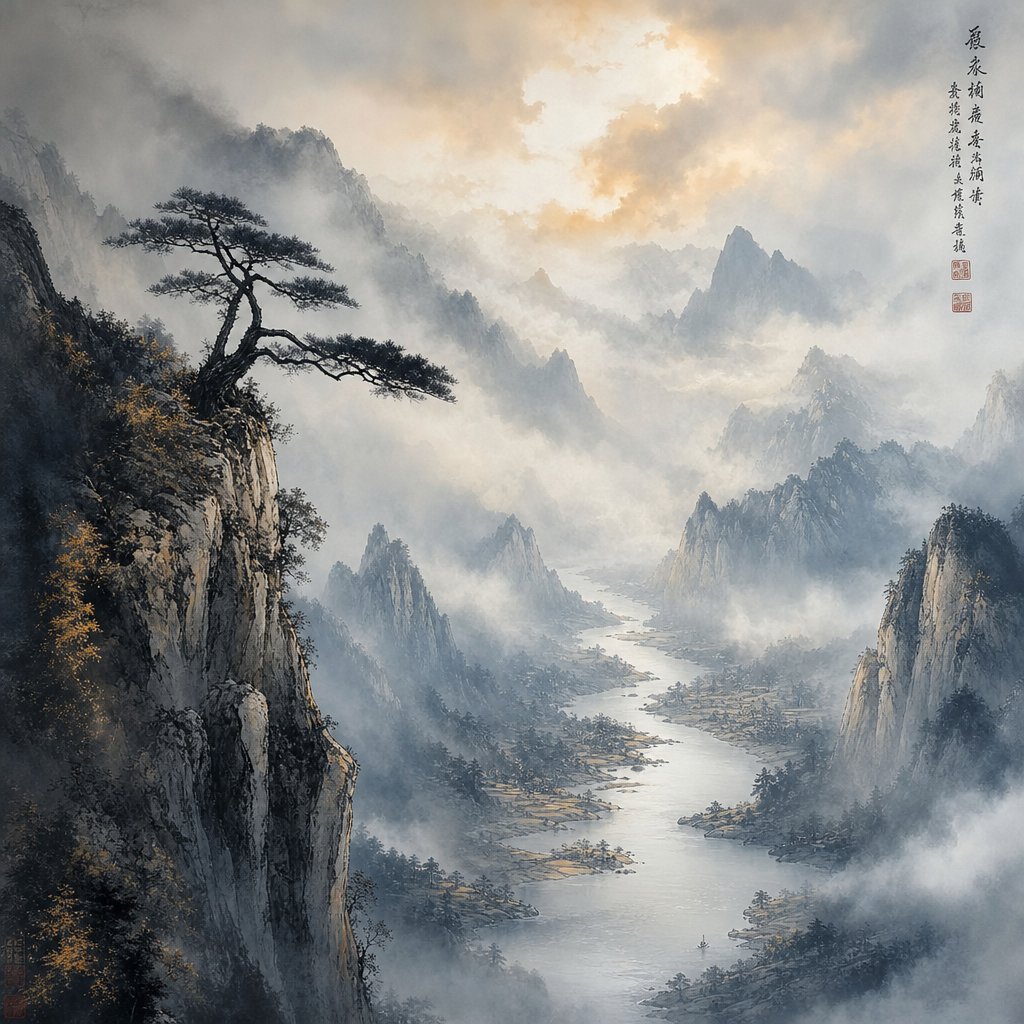
Daoism took a radically different path. Where Confucianism located beauty in social cultivation and ritual propriety, Daoism found it in nature's unforced patterns — the curve of a river, the asymmetry of a pine branch, the silence between sounds. The concept of 自然 (ziran, naturalness or "self-so-ness") became the Daoist aesthetic ideal: beauty that arises without effort, intention, or human interference.
Imagine a waterfall. Nobody designed it. Nobody arranged its spray pattern for maximum visual impact. Yet it strikes viewers as profoundly beautiful precisely because it follows its own nature without trying. That's the Daoist principle at work. As scholars note, Daoism believes that nature is the highest beauty, pursues integration with nature, and embodies the realm of beauty through inner peace — a stark contrast to Confucianism's focus on social order and human relationships.
The Daoist contribution to Chinese aesthetics shows up in landscape painting, garden design, and poetry where 天然之美 (tianran zhi mei — natural beauty) is prized above all artifice. A garden that looks "too designed" fails the Daoist test. A poem that tries too hard loses its beauty. The paradox is deliberate: the highest art conceals its own artistry.
Buddhist Impermanence and the Fleeting Nature of Beauty
Buddhism introduced a third dimension: impermanence. All beauty fades. Cherry blossoms fall. Youth passes. Even mountains erode. Rather than treating this as tragic, Buddhist aesthetics reframes impermanence as the very thing that makes beauty precious. A flower is beautiful partly because it will not last.
Buddhist thought combines aesthetics with liberation of the mind, believing that liberation is the highest beauty, beyond the cycle of life and death. This doesn't mean Buddhists reject beauty — they simply refuse to cling to it. The practice of non-attachment transforms how a person experiences beautiful things: you appreciate fully in the present moment without grasping or grieving when the moment passes.
This perspective gave Chinese culture its deep appreciation for seasonal beauty, fading light, and the poignancy of transient moments — themes that saturate classical poetry and ink painting.
意境: Where Inner Feeling and Outer Scene Merge
All three traditions converge in one uniquely Chinese aesthetic concept: 意境 (yijing). This term has no clean English equivalent, though "integrated aesthetic realm" comes closest. The yijing aesthetic meaning in Chinese describes the moment when an artist's inner emotion and the external scene fuse into something greater than either alone.
意境 (yijing) is the aesthetic realm where external imagery and internal emotions are harmoniously merged into a transcendent experience. It is neither purely subjective imagination nor mechanical reproduction of reality, but a poetic state where mind and object, the real and the imagined, are interwoven.
As traditional Chinese art criticism explains, 意境 occupies a central position in Chinese aesthetics because it represents the highest realm of aesthetic experience — the ultimate spiritual pursuit of the artist. The word itself breaks into two characters: 意 (yi, inner intention and feeling) and 境 (jing, scene or realm). Together they describe a fusion where landscapes become mirrors of emotion and emotions take the shape of landscapes.
You'll notice this concept draws from all three philosophical streams. The Confucian emphasis on cultivated feeling, the Daoist reverence for natural scenery, and the Buddhist awareness of transcendence all feed into what 意境 demands of an artwork. A painting with strong 意境 doesn't just depict a mountain — it makes you feel the solitude, the vastness, the particular quality of light at that hour. The blank space on the scroll isn't empty; it invites your spirit to wander.
Beauty Idioms That Reveal Cultural Values
Chinese idioms about beauty — known as chengyu — compress these philosophical ideas into four-character phrases that native speakers use in everyday conversation. Two are especially revealing:
- 美不胜收 (mei bu sheng shou) — literally "beauty cannot be fully absorbed." Used when surrounded by so much beauty that you can't take it all in. Picture standing in a vast flower field or walking through a gallery of masterworks. The idiom acknowledges that beauty can overwhelm human perception — an idea rooted in Daoist humility before nature's abundance.
- 尽善尽美 (jin shan jin mei) — literally "exhaust goodness, exhaust beauty." Describes something perfect in both moral quality and aesthetic form. This is pure Confucian DNA: the insistence that true perfection requires both ethical and aesthetic completeness, never one without the other.
These chengyu aren't museum pieces. You'll hear 美不胜收 in travel writing, social media captions, and spoken reactions to stunning scenery. 尽善尽美 appears in workplace contexts when someone wants to describe a flawless outcome. The philosophical roots stay alive through daily use, even when speakers aren't consciously thinking about Confucius or Laozi.
What connects all these traditions is a shared refusal to reduce beauty to surface appearance. Whether through moral cultivation, natural harmony, mindful impermanence, or the fusion of feeling and scene, Chinese thought consistently treats 美 as something that lives beneath and beyond the visible. That philosophical depth didn't stay locked in ancient texts — it evolved into the vocabulary Chinese speakers use right now, scrolling through social media feeds and debating modern aesthetic standards.
美 in Modern Chinese Life and Internet Culture
Scroll through any Chinese social media app and you'll encounter 美 dozens of times within minutes — not in poetry or philosophy, but in beauty filter buttons, cosmetics hashtags, and viral debates about aesthetic standards. The character that once described ceremonial splendor and pastoral prosperity now lives inside smartphone interfaces and e-commerce listings. Its philosophical DNA hasn't disappeared, though. It just found new hosts.
美 in Social Media and Digital Culture
Chinese internet culture has generated an entire vocabulary layer built on 美, blending the ancient character with digital-age realities. The most visible example sits on nearly every Chinese camera app: the 美颜 (měiyán) button. The 美颜 beauty filter meaning in Chinese is literally "beauty face" — a one-tap function that smooths skin, enlarges eyes, and slims jawlines in real time. When someone asks 这张自拍你美颜了吗? (did you beautify this selfie?), they're using a word that didn't exist twenty years ago yet feels completely natural because 美 has always meant "to make beautiful."
That single feature spawned a whole ecosystem of modern Chinese beauty standards vocabulary. Here are the key terms you'll encounter across platforms like Xiaohongshu, Douyin, and Weibo:
- 美颜 (měiyán) — beauty filter or beautification function on camera apps. Used as both a noun ("turn on the 美颜") and a verb ("I 美颜-ed this photo"). So widespread that 照骗 (zhào piàn, a pun meaning "photo-fraud") emerged as pushback against over-filtered images.
- 美妆 (měizhuāng) — beauty makeup; refers to the entire cosmetics industry and content category. 美妆博主 (měizhuāng bózhǔ) means "beauty blogger" — one of the most lucrative influencer niches in China.
- 美白 (měibái) — skin whitening or brightening. Combines 美 with 白 (white/fair) to describe both cosmetic products and photo-editing tools that lighten skin tone.
- 网红美女 (wǎnghóng měinǚ) — internet-famous beauty. 网红 means "internet celebrity" and 美女 means "beautiful woman." The compound describes influencers whose fame rests primarily on their appearance and aesthetic content.
- 审美疲劳 (shěnměi píláo) — aesthetic fatigue. The 审美疲劳 meaning describes the exhaustion people feel when bombarded by homogeneous beauty content — identical filtered faces, repetitive makeup tutorials, and cookie-cutter aesthetics. It's a cultural critique compressed into four characters.
- 审美积累 (shěnměi jīlěi) — aesthetic accumulation. Originally a trend encouraging people to collect beautiful imagery to refine their taste, it became a satirical meme on Xiaohongshu where users flooded the hashtag with absurd images, pushing back against the pressure to be perpetually "aesthetic."
Modern Beauty Vocabulary Built on Ancient Roots
What makes these terms fascinating isn't just their novelty — it's how they recycle the same character that Shang dynasty scribes carved into oracle bones. 美颜 uses 美 as a verb meaning "to beautify," which is exactly how the character functioned in classical Chinese. 审美 (aesthetic judgment) appears in both ancient literary criticism and modern internet slang for beautiful content. The infrastructure is old; only the applications are new.
The cultural conversation around 审美 has grown especially charged. On one side, platforms like Douyin and Xiaohongshu promote curated beauty ideals through algorithms that reward conventionally attractive content. On the other, a growing counter-movement questions whose standards define 美 in the first place. The hashtag #万物皆可审美积累 ("everything can be aesthetic accumulation") amassed over 800 million views on Xiaohongshu — a collective joke that doubled as genuine resistance to prescribed aesthetics.
This tension echoes something deeper. Chinese Gen Z increasingly frames beauty as self-directed rather than externally imposed. The 2025 Sohu Fashion Awards adopted the slogan 我为自己而美 (wǒ wèi zìjǐ ér měi) — "I am beautiful for myself" — signaling a shift where 美 becomes an act of personal agency rather than social compliance. Meanwhile, feminist discussions on Weibo and Douban use the term 服美役 (fú měi yì, "beauty servitude") to critique how beauty standards function as mechanisms of social discipline, particularly for women expected to invest time and money meeting mainstream aesthetic ideals.
The character 美 sits at the center of all these debates — simultaneously the thing being pursued, the thing being questioned, and the linguistic tool used to frame the conversation. Its meaning hasn't narrowed in the digital age. If anything, it has expanded, absorbing new contexts while retaining the philosophical weight that separates it from lighter synonyms. A beauty filter and a Confucian virtue share the same written root, and that shared root is precisely what gives modern discussions about aesthetics their cultural depth.
That depth becomes visible in a different way when 美 moves from screens to paper — when the character itself becomes an object of aesthetic contemplation through the art of calligraphy.
The Visual Beauty of Writing 美 in Calligraphy
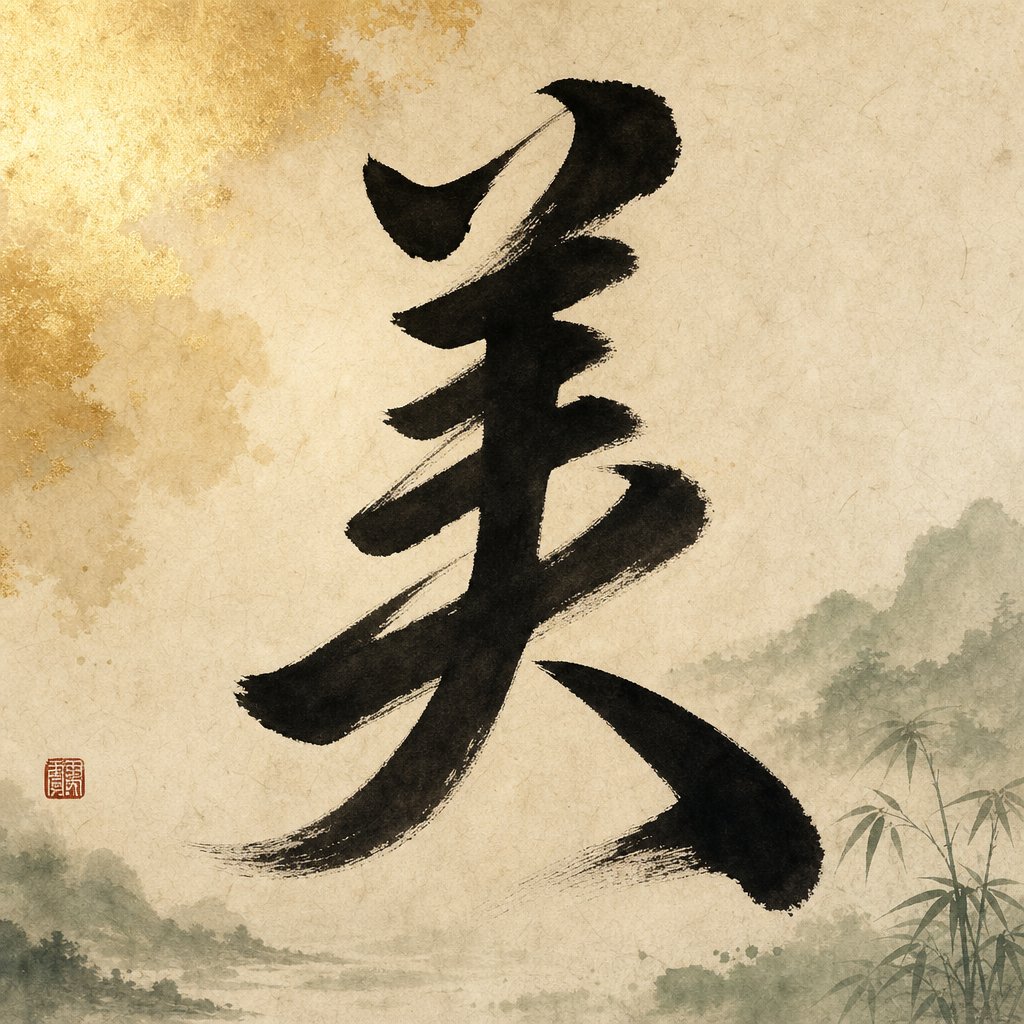
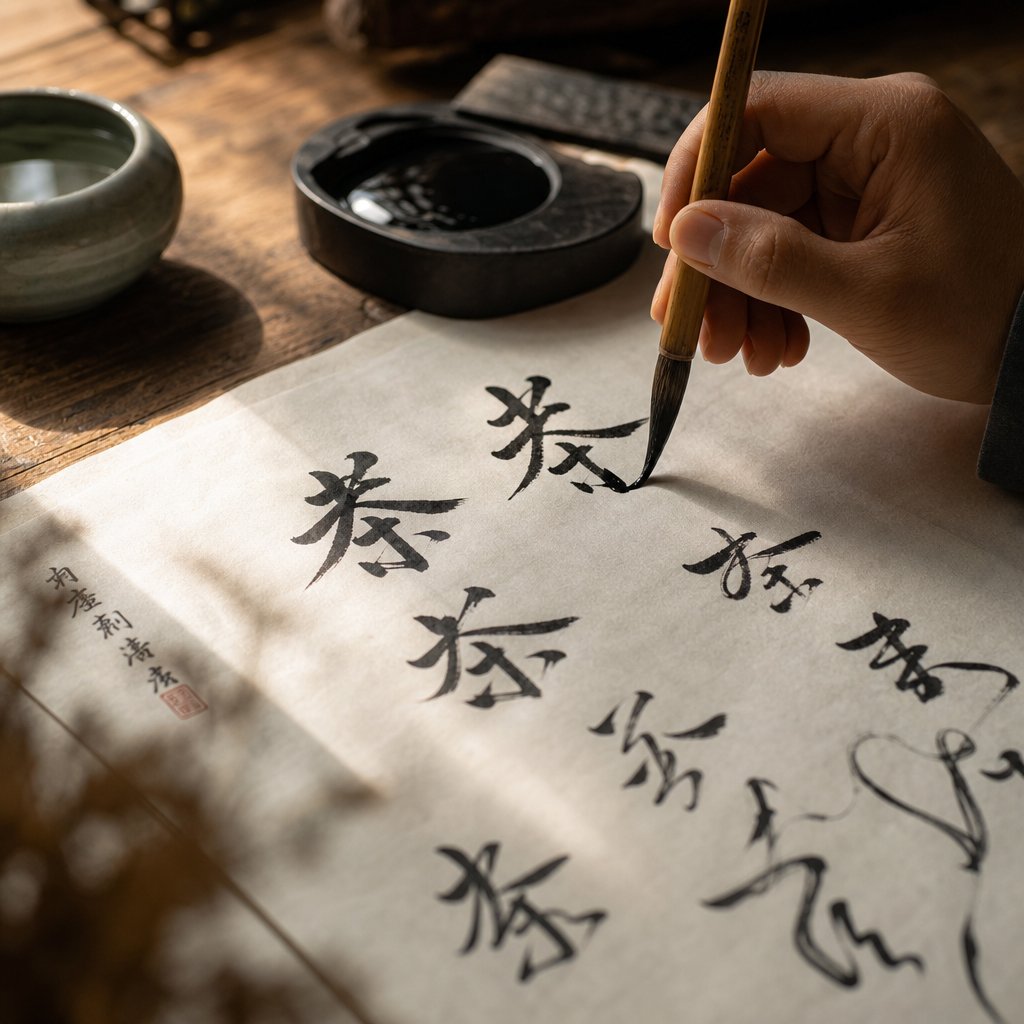
There's a satisfying circularity here: a character that means beauty can itself become an object of beauty when rendered with a brush. In Chinese calligraphy, writing 美 isn't just communication — it's a miniature exercise in the very aesthetic principles the character represents. The calligrapher must balance a top-heavy sheep radical against the grounding sweep of 大 below, creating visual harmony stroke by stroke. Get the proportions right, and the character embodies its own definition on the page.
美 as a Calligraphic Art Form
The structural challenge of 美 is what makes it rewarding to practice. The upper component (羊) carries six strokes packed into a relatively compact space — three horizontals, a vertical, and two short dots. Below it, 大 spreads wide with its left-falling and right-falling strokes extending outward like arms opening. A skilled calligrapher treats this contrast as a design problem: the dense, contained top needs to feel anchored by the expansive, grounded bottom.
As Written Chinese explains, balance is an extremely important part of Chinese philosophy, essential to traditional Chinese medicine as well as aesthetically in the written language. For 美 specifically, the character follows a top-bottom structure where the widest horizontal stroke (stroke 6) acts as a visual fulcrum. Everything above it compresses inward; everything below it opens outward. That diamond-like shape — narrow at top and bottom, widest in the middle — gives 美 its distinctive visual rhythm.
How does 美 look across the major calligraphy styles? Each script interprets the character's balance differently through brushwork and movement:
Regular script (楷书 kaishu) — The standard form most people learn first. Each of the nine strokes is distinct, deliberate, and clearly separated. The horizontals are crisp, the vertical drops straight, and the two falling strokes of 大 splay symmetrically. Columbia University's calligraphy guide notes that regular script preserves precision and modulation of line width while remaining less formal than clerical script. For 美 in regular script, you'll see every structural relationship on full display — the sheep radical sitting neatly above the person, each component legible and balanced.
Running script (行书 xingshu) — Here, speed enters the equation. Strokes that were separate in regular script begin connecting through fluid transitions. The three horizontal lines of the sheep radical might merge into a single flowing gesture, and the vertical stroke links directly into the sweeping arms of 大 below. The Smithsonian's National Museum of Asian Art describes running script as allowing more freedom and fluidity in movement, where strokes written separately in regular style are joined together in a single sweep of the brush. For 美, this means the character gains a sense of momentum — beauty in motion rather than beauty at rest.
Cursive script (草书 caoshu) — The most expressive and abstract form. In cursive, 美 can become almost unrecognizable to untrained eyes. The nine strokes collapse into perhaps three or four continuous movements, with the sheep radical reduced to a few suggestive curves and 大 implied by a final sweeping gesture. What's lost in legibility is gained in pure aesthetic energy — the calligrapher's emotion, speed, and breath become visible in the ink. Cursive 美 doesn't describe beauty so much as perform it.
The progression from regular to running to cursive mirrors a philosophical arc: from controlled precision to spontaneous expression, from Confucian discipline to Daoist naturalness. A beginner practices 美 in regular script to understand its bones. An advanced calligrapher writes it in cursive to release its spirit.
Practical Next Steps for Learning and Using 美
You've traced this character from oracle bones to smartphone screens, from pastoral sheep fields to philosophical treatises. The question now is: what do you do with all of this? Here are concrete ways to deepen your relationship with 美 — whether you're a language learner, a calligraphy beginner, or simply someone curious about how Chinese culture encodes meaning into written form.
- Practice writing 美 as a meditation on its meaning. Set aside ten minutes with a brush pen or even a regular marker. Write the character slowly, paying attention to the balance between the compact top and the open bottom. Each repetition is a chance to feel the structural logic — density resolving into spaciousness, containment releasing into expansion. After twenty repetitions, you'll notice which version looks most balanced. That's your eye developing 审美.
- Explore the 羊 radical family. Once you recognize 羊 inside 美, start spotting it in other characters: 善 (shan, goodness), 义/義 (yi, righteousness), 养 (yang, to nurture), 鲜 (xian, fresh). Notice how the sheep radical consistently appears in words connected to positive qualities. This pattern reinforces the cultural logic: sheep equaled prosperity, and prosperity equaled goodness and beauty.
- Use compound words in daily Mandarin practice. Pick one 美-compound per week and build it into your active vocabulary. Start with high-frequency words like 美食 (delicious food) or 美好 (wonderful), then graduate to more nuanced terms like 审美 (aesthetic taste) or 美德 (virtue). Use them in sentences, text messages, or journal entries until they feel natural.
- Compare calligraphy styles side by side. Search for 美 written in 楷书, 行书, and 草书 online or in calligraphy dictionaries. Notice how the same nine strokes transform across styles. This visual comparison trains your eye to see structure beneath surface variation — a skill that transfers directly to reading handwritten Chinese.
- Connect the character to its philosophy. Next time you encounter 美 in a Chinese text, pause and ask: is this 美 closer to Confucian moral beauty, Daoist natural beauty, or something else entirely? That one-second reflection builds cultural literacy that no flashcard app can replicate.
The beauty Chinese character meaning isn't a single definition you memorize and move on from. It's a living system — a character that has absorbed three thousand years of cultural thinking about what beauty is, where it comes from, and why it matters. From a sheep on an ancient bone to a filter button on a modern phone, 美 keeps doing what it has always done: holding beauty and goodness together in a single written form, waiting for the next person to pick up a brush and trace its strokes.
Frequently Asked Questions About the Chinese Character for Beauty
1. What does the Chinese character 美 (mei) literally mean?
The character 美 (mei, third tone) primarily means beautiful, good, or aesthetically pleasing. It functions as both a standalone adjective and a root element in compound words covering physical appearance, moral virtue, fine arts, food, and positive experiences. Unlike English where beauty is mainly visual, 美 carries connotations of goodness and inner quality rooted in its 3,000-year etymology.
2. Why does the Chinese character for beauty have a sheep radical on top?
The character 美 combines 羊 (sheep) above 大 (big/person). Two scholarly interpretations explain this: first, in ancient pastoral society, a large healthy sheep symbolized prosperity and everything desirable, so big sheep equaled beauty. Second, the character may depict a person wearing a sheep-horn headdress during ceremonial dances, representing ritual splendor. Both readings connect beauty to communal well-being rather than mere appearance.
3. What is the difference between 美, 漂亮, and 好看 in Chinese?
These three words all translate as beautiful or pretty but differ in register and depth. 美 (mei) is elevated and literary, carrying philosophical weight and moral connotations suitable for poetry or abstract beauty. 漂亮 (piaoliang) is neutral and everyday, used for visual compliments about people or objects. 好看 (haokan) is the most casual and colloquial, meaning pleasant to look at without deeper implication. Only 美 appears in philosophical compounds like 美德 (virtue) because it inherently carries moral dimension.
4. How many strokes does the character 美 have and what is the correct stroke order?
The character 美 contains 9 strokes total, divided between two components. The top section (modified 羊 sheep radical) takes 6 strokes: two short dots, three horizontal strokes of increasing width, and one central vertical stroke. The bottom section (大 person) takes 3 strokes: a left-falling stroke, a right-falling stroke, and a final downward tick. The key principle is top before bottom, with the widest horizontal stroke acting as the visual dividing line between components.
5. What does 美颜 (meiyan) mean in modern Chinese internet culture?
美颜 (meiyan) literally means beauty face and refers to the beauty filter or beautification function found on nearly every Chinese camera app. It smooths skin, enlarges eyes, and adjusts facial features in real time. The term works as both a noun and a verb in daily conversation. It represents how the ancient character 美 has been absorbed into digital culture, spawning related terms like 美妆 (beauty makeup industry) and 审美疲劳 (aesthetic fatigue from homogeneous beauty content).