The Chinese Character for Family and What It Really Means
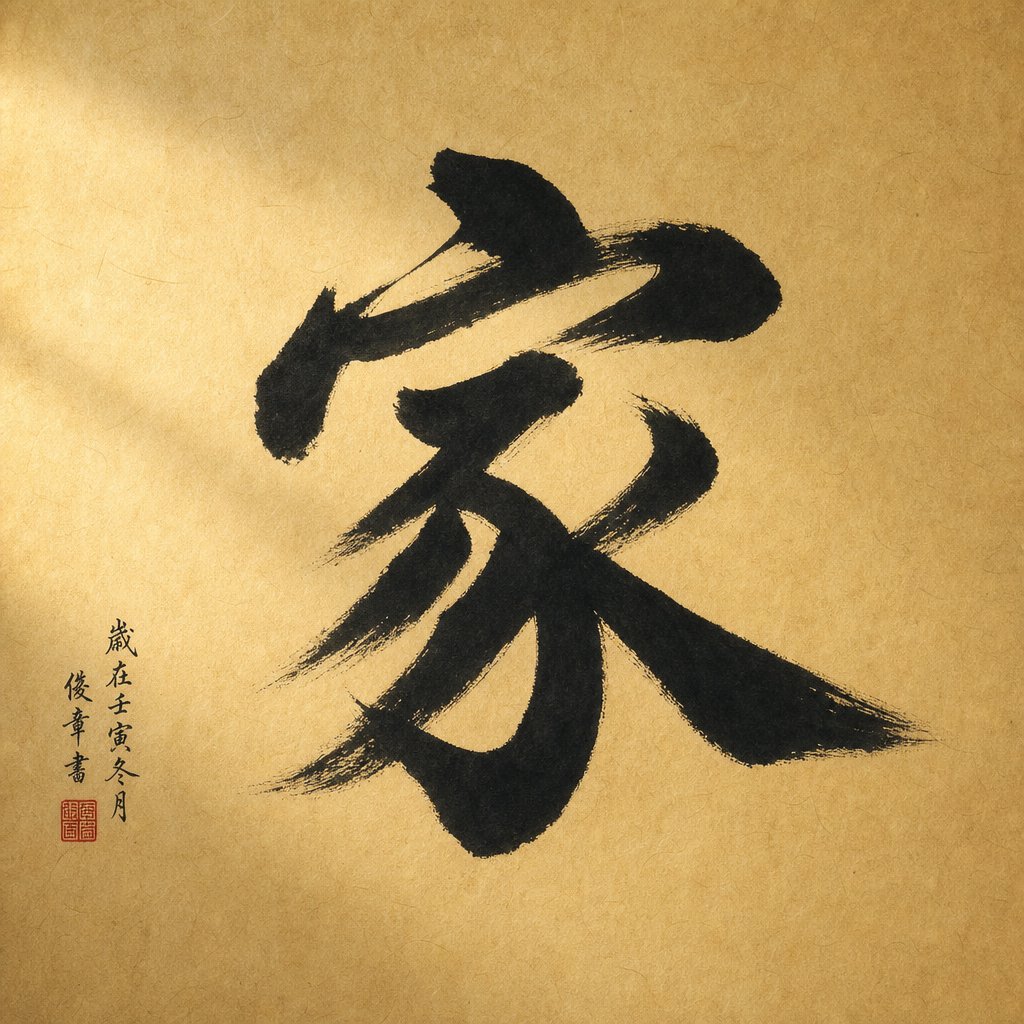
When you look up the word "family" in a Chinese dictionary, you won't find a direct one-to-one match with English. Instead, you'll encounter a single character that holds an entire worldview inside its strokes. The Chinese character for family is 家 (jiā), and it simultaneously means family, home, and household. No separation, no distinction. Just one symbol carrying all three ideas at once.
What Is the Chinese Character for Family
家 (jiā) - pronounced in the first tone (flat and high-pitched) - means family, home, and household simultaneously. It functions as both a standalone word and a building block for dozens of compound words across the Chinese language.
In English, you live in a home, you have a family, and you manage a household. Three separate words, three separate mental categories. The family Chinese character collapses all of that into a single concept. When someone says 家 in Mandarin, they're referring to the people, the place, and the shared life all at once. This is the word for family in Chinese at its most fundamental level - a reflection of how deeply intertwined these ideas are in Chinese thought.
For those familiar with Japanese, you might recognize this as the chinese kanji for family, since Japan adopted this character centuries ago with similar meanings. Whether you encounter it as family in chinese letters on a scroll or in a modern text message, 家 remains one of the most culturally loaded characters in the language.
Why One Character Carries So Much Meaning
This isn't a quirk of translation. It's a window into how Chinese civilization has understood human life for over three thousand years. Family in Mandarin isn't just about blood relations - it's about belonging, shelter, and shared purpose wrapped into one. The character 家 reflects a worldview where the people you love and the roof over your head are not separate categories but a single, inseparable reality.
And here's what makes the family chinese character meaning truly fascinating: the character's physical structure tells a story. Two visual components - a roof and, surprisingly, a pig - combine to create this symbol. Why a pig? That question opens up a rich history of ancient Chinese life, agricultural society, and competing scholarly theories that reveal just how much meaning can be packed into a few brushstrokes.
Why a Pig Under a Roof Means Family
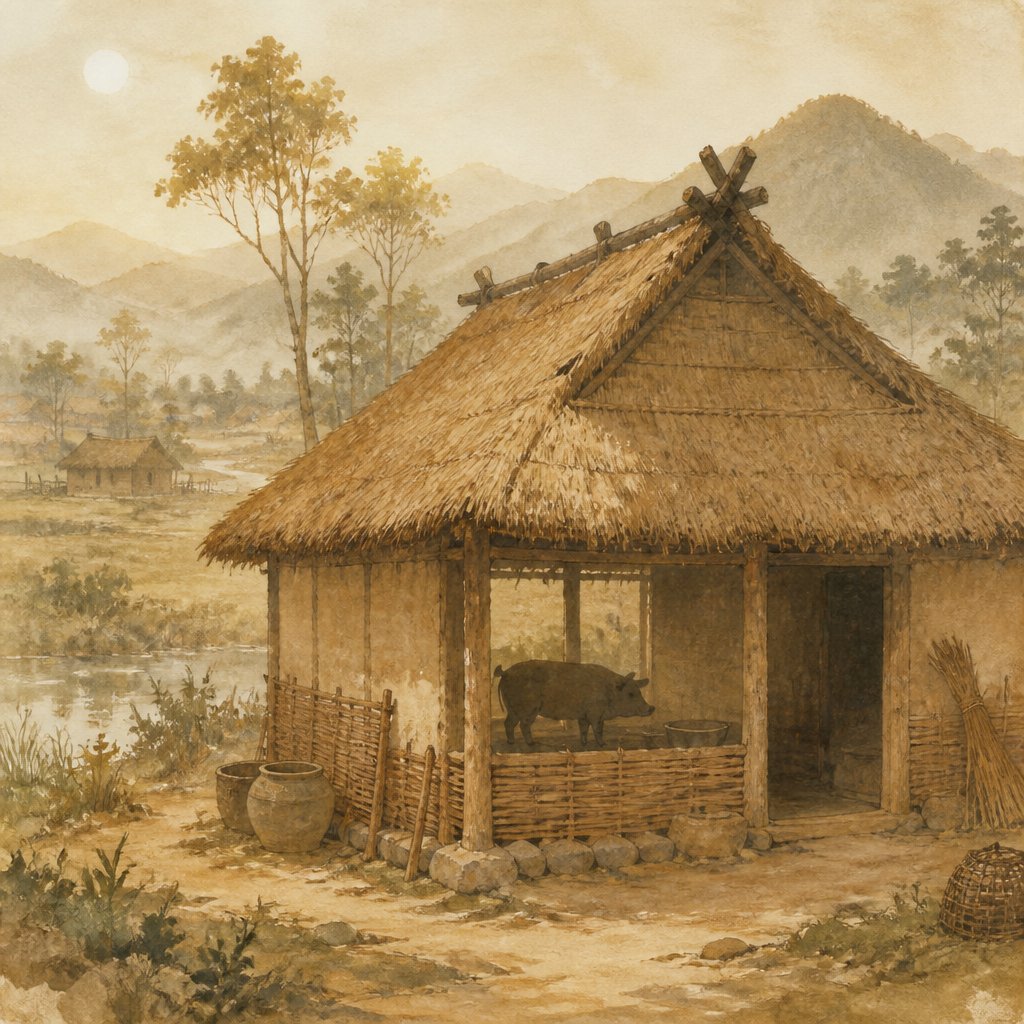
Imagine drawing a picture of "family." You'd probably sketch people, maybe a house. Ancient Chinese scribes took a different approach entirely. They drew a pig sitting beneath a roof - and that image became the chinese character jia (家) we still use today. Sounds strange? It makes more sense once you understand what daily life looked like over 3,000 years ago in ancient China.
Breaking Down the Radicals of 家
The chinese character for home is built from two distinct components, each carrying its own meaning. In Chinese linguistics, these building blocks are called radicals, and they function like visual clues that hint at a character's origin and meaning.
| Component | Character | Pinyin | Meaning | Position in 家 |
|---|---|---|---|---|
| Roof radical | 宀 | mián | Roof, shelter, house covering | Top (enclosing element) |
| Pig component | 豕 | shǐ | Pig, hog, swine | Bottom (enclosed element) |
The roof radical 宀 (mián) cannot stand alone as an independent character - it only functions as a component within other characters. You'll find it in dozens of words related to buildings and shelter, like 室 (shì, room), 宫 (gōng, palace), and 安 (ān, peace). It visually represents a structure with walls and a covering overhead.
The lower component 豕 (shǐ) can function as a standalone character meaning pig or hog. In the earliest forms of the chinese character for house, this element was drawn as a clearly recognizable pig - four legs, a body, and even a curly tail. The modern form is more abstract, but the structure remains: a pig enclosed within a shelter.
So the question that has puzzled scholars for centuries is straightforward: why would a pig under a roof represent family and home rather than, say, a person under a roof?
Three Scholarly Theories Behind the Pig and Roof
There's no single accepted answer. Instead, researchers have proposed several compelling explanations, each grounded in what we know about Shang Dynasty (c. 16th-11th century BC) society and earlier Neolithic settlements. Here are the three most widely discussed theories:
- The Domestication Theory (pigs marked a settled home). By the Shang Dynasty, animal husbandry was well established. People had domesticated pigs, sheep, oxen, and horses. Because pigs were kept indoors with their owners, a house with a pig inside indicated that people also lived there. In other words, the pig served as visual shorthand for human habitation - if there's a domesticated pig, there must be a family caring for it. Some oracle bone inscriptions even show versions of 家 with two pigs inside the house, reinforcing this domestic scene.
- The Livestock-as-Wealth Theory (pigs represented household prosperity). In agrarian ancient China, pigs were among the most valuable assets a family could own. They reproduced quickly, required relatively little grazing land, and provided meat, fat, and fertilizer. A household wealthy enough to keep pigs under its roof was a household that had achieved stability and prosperity. Under this interpretation, the chinese character home is essentially a picture of economic security - a family defined by its ability to sustain itself.
- The Ancestral Sacrifice Theory (pigs honored family ancestors). Pigs were commonly used as sacrificial offerings to family ancestors, particularly during important rituals and festivals. Because ancestor worship took place within the home, the pig beneath the roof may represent this sacred domestic practice. The family, in this reading, is defined not just by the living members but by the ongoing spiritual connection to those who came before - with the pig symbolizing devotion and respect for lineage.
Each theory highlights a different facet of ancient Chinese life - practical survival, economic stability, or spiritual continuity. Rather than competing, they may actually complement each other. A settled home where a family kept pigs, built wealth, and honored ancestors through sacrifice captures the full picture of what 家 meant to the people who first scratched it into bone and bronze.
What's remarkable is that this layered meaning persists. The character hasn't been redesigned or modernized to show a person instead of a pig. Over three millennia of continuous use, 家 has kept its original visual logic intact - even as its physical form evolved dramatically from those earliest pictographic drawings into the streamlined strokes we write today.
How 家 Evolved Over 3,000 Years of Chinese Writing
That pig-under-a-roof image didn't always look the way it does on your screen right now. The earliest versions of 家 were unmistakably pictographic - you could literally see the animal's legs, snout, and the pitched roof above it. Over more than three millennia, the character underwent a gradual transformation from a recognizable drawing into the abstract set of strokes used in modern Chinese writing. Each stage of that evolution tells us something about the era that shaped it.
Oracle Bone Script and the Earliest Form of 家
The oldest surviving examples of family in Chinese writing come from oracle bone inscriptions (甲骨文, jiǎgǔwén), carved into turtle shells and animal bones during the Shang Dynasty (roughly 1600-1100 BC). These inscriptions represent the earliest body of writing we possess for East Asia, and the degree of maturity in this archaic script suggests even earlier writing remains undiscovered.
In oracle bone script, 家 looks like a simple sketch: a triangular or angled roof structure sitting over a clearly drawn pig with visible legs, a body, and sometimes a tail. There's no abstraction here. You're looking at a picture. Some variants even show two pigs beneath the roof, emphasizing the domestic scene. The character was already being used to mean both "family" and "home" - confirming that this conceptual fusion existed from the very beginning of recorded Chinese language.
What's striking about the Shang-era form is how functional it is. These weren't decorative carvings. Diviners scratched them into bone to ask ancestors questions about harvests, wars, and family matters. The chinese writing for family was, from its first appearance, tied to ritual and kinship.
From Bronze Age to Modern Simplification
After oracle bones came bronze inscriptions (金文, jīnwén), dating roughly from 1400 to 700 BC. These characters were cast into ceremonial bronze vessels during the Shang and Zhou dynasties. The style sat somewhere between oracle bone writing and the more formalized seal scripts that followed. In bronze script, 家 retained its pictographic quality but gained smoother, rounder lines - a result of the casting process, where characters were first written with brush and ink on clay, then carved into molds.
The pig was still recognizable, but the strokes became more fluid. The roof took on a more standardized shape. You can think of this stage as the character settling into a more "official" look, reflecting the growing bureaucratic culture of the Zhou Dynasty.
Next came seal script, divided into two phases. Greater seal script (大篆, dàzhuàn, roughly 1000-200 BC) preserved much of the pictographic heritage while introducing more geometric regularity. Then lesser seal script (小篆, xiǎozhuàn) emerged around 221 BC when Qin Shi Huang unified China and his prime minister Li Si standardized the writing system. In xiǎozhuàn, 家 became more symmetrical and stylized - the pig's legs transformed into balanced, uniform strokes, and the roof radical took its now-familiar angular form. The character looked carved and deliberate, with what scholars describe as "iron wire" precision.
Clerical script (隶书, lìshū) changed everything. Emerging around 500 BC and becoming dominant during the Han Dynasty (206 BC-220 AD), lìshū was designed for speed. Clerks staffing the imperial bureaucracy needed to write quickly, so strokes became flatter, wider, and more varied in thickness. The pig component in 家 lost its last traces of animal resemblance. What had once been a drawing became a pattern of abstract brushstrokes - efficient, readable, but no longer pictographic.
Finally, regular script (楷书, kǎishū) crystallized the form we use today. Developed during the late Han and refined through the Tang Dynasty, kǎishū gave 家 its modern appearance: ten clean strokes, a clearly defined roof radical on top, and the lower component that only scholars would recognize as a pig. This is the family in Chinese writing that appears in textbooks, on signs, and in digital fonts worldwide.
Here's a detail worth noting: 家 is one of the characters that survived China's 1950s simplification campaign completely unchanged. The simplified and traditional forms are identical. Many family-related characters were altered during simplification - 親 became 亲 (qīn, parent/relative), 愛 became 爱 (ài, love) - but 家 kept its structure intact across both systems. Whether you're reading a classical poem from the Tang Dynasty or a text message sent today, the character looks the same. That continuity across 3,000 years of chinese writing family history makes 家 one of the most stable and universally recognized symbols in the Chinese language.
Compound Words Built from 家 in Everyday Chinese
A character that has remained stable for three millennia doesn't just sit quietly in isolation. 家 functions as one of the most productive building blocks in the Chinese word for family, home, and far beyond. It appears in dozens of compound words that Chinese speakers use daily - from describing relatives to talking about furniture to identifying someone's profession. Understanding these compounds reveals how deeply 家 is woven into the fabric of the family in Chinese language.
Family and Home Compound Words Using 家
Chinese builds vocabulary by combining characters, and 家 pairs with other characters to create precise meanings across two major categories: family relationships and home-related concepts. You'll notice that many of these words feel intuitive once you know the components.
| Chinese | Pinyin | English Meaning | Category |
|---|---|---|---|
| 家庭 | jiātíng | family (formal) | Family |
| 家人 | jiārén | family members | Family |
| 家族 | jiāzú | clan, extended family lineage | Family |
| 家长 | jiāzhǎng | parent, head of household | Family |
| 家属 | jiāshǔ | family dependents | Family |
| 家乡 | jiāxiāng | hometown, native place | Home |
| 家务 | jiāwù | housework, household chores | Home |
| 家具 | jiājù | furniture | Home |
| 家门 | jiāmén | family door, household entrance | Home |
| 国家 | guójiā | country, nation | Extended |
| 搬家 | bānjiā | to move house | Home |
| 回家 | huíjiā | to go home, to return home | Home |
Look at how the logic works. 家人 (jiārén) combines 家 with 人 (person) to mean "family members" - literally, the people of your home. 家乡 (jiāxiāng) pairs 家 with 乡 (village, countryside) to create "hometown" - the place where your family roots are. Even 国家 (guójiā), meaning "country" or "nation," treats the entire state as a family unit, combining 国 (nation) with 家 (family). This reflects the Confucian idea that governing a country mirrors governing a household.
The word 家具 (jiājù) is one you'll encounter constantly if you ever shop for furniture in Chinese. It literally means "home tools" or "household implements." And 家务 (jiāwù) - housework - combines 家 with 务 (affairs, duties), capturing the idea that maintaining a home is serious business, not just chores. As one Chinese vocabulary resource notes, 做家务 (zuò jiāwù, to do housework) is among the most practical phrases for daily life in a Chinese-speaking environment.
When 家 Means Expert or Specialist
Here's where the family in Chinese character takes a surprising turn. Beyond family and home, 家 functions as a suffix that transforms nouns and verbs into words meaning "expert" or "specialist." When attached to the end of a word describing a field or discipline, it indicates someone who has achieved mastery in that domain.
The cultural logic is elegant: if you've devoted your life to a field, that field becomes your 家 - your home. A scientist lives in science. A writer lives in words. The suffix implies not just professional competence but deep, sustained dedication. As linguistic analysis of Chinese person-indicating suffixes explains, occupational roles using 家 require specialized skills or knowledge, and the word carries connotations of respect and distinction.
| Chinese | Pinyin | English Meaning | Field of Mastery |
|---|---|---|---|
| 科学家 | kēxuéjiā | scientist | Science (科学) |
| 艺术家 | yìshùjiā | artist | Art (艺术) |
| 作家 | zuòjiā | writer, author | Writing (作) |
| 画家 | huàjiā | painter | Painting (画) |
| 音乐家 | yīnyuèjiā | musician | Music (音乐) |
| 哲学家 | zhéxuéjiā | philosopher | Philosophy (哲学) |
| 历史学家 | lìshǐxuéjiā | historian | History (历史) |
| 经济学家 | jīngjìxuéjiā | economist | Economics (经济) |
Notice the pattern. For broader fields, 家 attaches directly: 作家 (writer), 画家 (painter). For academic disciplines, the structure often becomes [field] + 学 (study/science) + 家: 科学家 (science-study-home = scientist), 哲学家 (philosophy-study-home = philosopher). The word 专家 (zhuānjiā) - meaning "expert" in general - makes the connection explicit: 专 (specialized) + 家 (home) = someone who has made specialization their home.
This usage distinguishes 家 from other Chinese suffixes that indicate people. The suffix 员 (yuán) marks someone who performs a job or holds membership - like 服务员 (fúwùyuán, waiter) or 演员 (yǎnyuán, actor). The suffix 者 (zhě) indicates someone engaged in an activity - like 记者 (jìzhě, journalist) or 读者 (dúzhě, reader). But 家 implies something more: scholarly depth, creative mastery, or intellectual authority. You wouldn't call a casual hobbyist a 画家. That title is reserved for someone whose life's work is painting.
This dual nature of 家 - simultaneously the most intimate word (family, home) and a marker of professional distinction - captures something profound about how family in Chinese Mandarin culture views achievement. Your expertise isn't separate from your identity. When you master something, it becomes part of your home, part of who you are.
Yet all these compound words, whether describing your 家人 or labeling a 科学家, still orbit around the same core concept: belonging. The character 家 always points to where someone or something fundamentally belongs. And nowhere is that sense of belonging more precisely defined than in the elaborate system Chinese uses to name every single family member - a system so detailed it makes English kinship terms look like rough sketches.
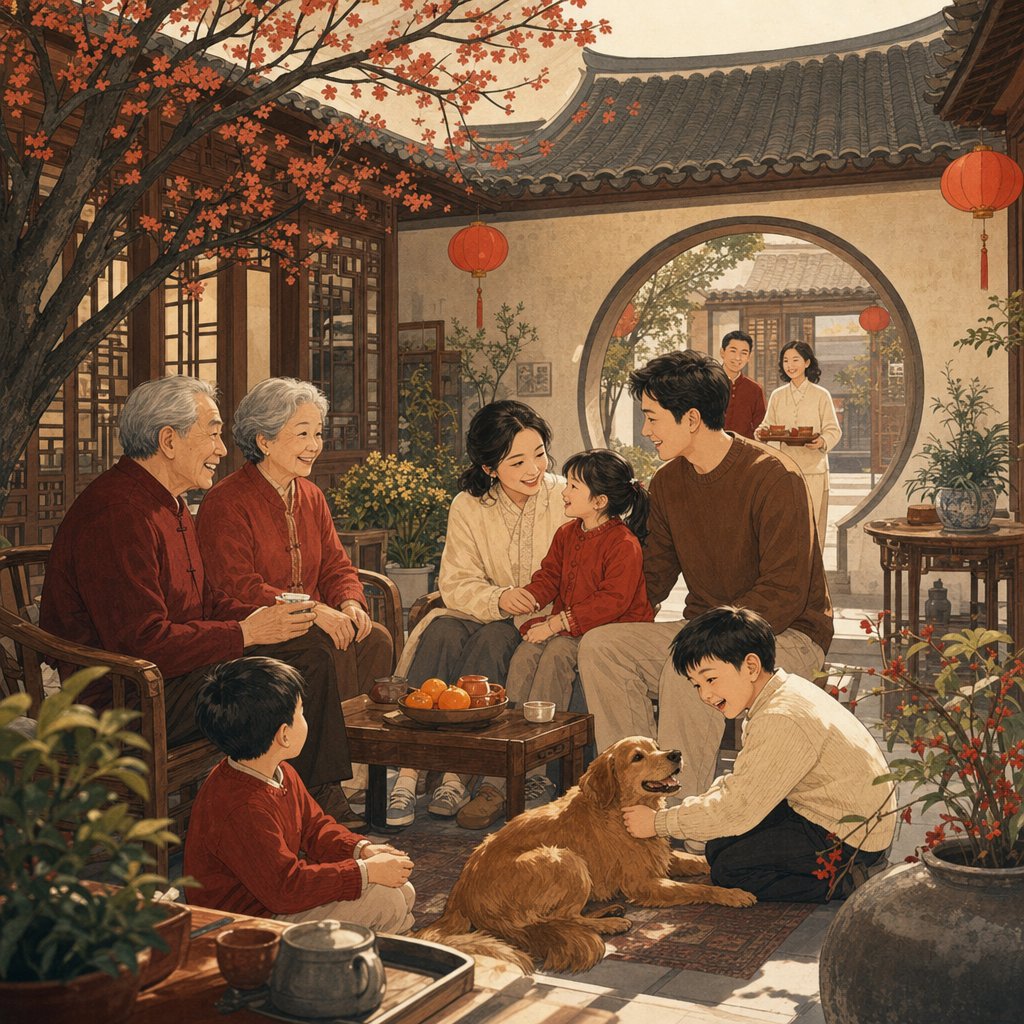
Chinese Family Member Terms That English Cannot Capture
In English, you have one word for "uncle." It covers your dad's older brother, your dad's younger brother, your mom's brother, and even your aunt's husband. One word, four completely different people. Chinese doesn't work that way. Each of those relationships gets its own distinct term - a separate word with its own pronunciation, its own character, and its own place in the family hierarchy.
This isn't complexity for the sake of complexity. Chinese kinship vocabulary is precise because precision mattered. Three cultural forces shaped this system over thousands of years: Confucian hierarchy demanded that every person know their exact position relative to others. Patrilineal traditions required clear distinctions between the father's bloodline and the mother's. And the historical importance of lineage - who inherits what, who carries the family name forward, who performs ancestral rites - made vague terms like "uncle" or "cousin" dangerously inadequate.
The result? A vocabulary system where the father chinese symbol 爸爸 (bàba) is just the starting point. Every branch of the family tree has its own dedicated terminology, and using the correct term is considered a sign of respect in Chinese culture. Getting it wrong can genuinely offend.
Paternal Side Family Terms with Pinyin
Your father's side of the family - the "inner" family in traditional Chinese thinking - uses a specific set of terms. The most important distinction here is age-based: your father's older brother and younger brother are completely different words. Their wives also carry different titles. And paternal cousins share the prefix 堂 (táng), which refers to the ancestral hall where the paternal clan gathered. If you're looking for the chinese symbol for brother, you'll find that even siblings require age-specific terms: 哥哥 (gēge) for older brother and 弟弟 (dìdi) for younger brother. There is no generic "brother" in everyday speech.
| Chinese | Pinyin | Literal Meaning | Relationship |
|---|---|---|---|
| 爷爷 | yéye | paternal grandfather | Father's father |
| 奶奶 | nǎinai | paternal grandmother | Father's mother |
| 伯伯 | bóbo | elder uncle | Father's older brother |
| 叔叔 | shūshu | younger uncle | Father's younger brother |
| 姑姑 | gūgu | paternal aunt | Father's sister |
| 伯母 | bómǔ | elder uncle's wife | Wife of father's older brother |
| 婶婶 | shěnshen | younger uncle's wife | Wife of father's younger brother |
| 堂哥 | tánggē | hall older brother | Older male paternal cousin |
| 堂姐 | tángjiě | hall older sister | Older female paternal cousin |
| 堂弟 | tángdì | hall younger brother | Younger male paternal cousin |
| 堂妹 | tángmèi | hall younger sister | Younger female paternal cousin |
Notice how the cousin terms work. The prefix 堂 (táng) literally means "ancestral hall" - the central room in a traditional Chinese home where the paternal clan worshipped together. Paternal cousins share this prefix because they share the same surname, the same ancestral hall, and the same bloodline. They are "inside" the family in the deepest sense.
The symbol for sister in chinese follows the same age-based logic as brothers: 姐姐 (jiějie) for older sister and 妹妹 (mèimei) for younger sister. When referring to paternal cousins who are female, you combine 堂 with the appropriate sister term based on whether she's older or younger than you.
Maternal Side Family Terms with Pinyin
Your mother's side of the family uses an entirely different vocabulary set. And here's where the language reveals its patrilineal roots most clearly. The chinese character for grandparents on the maternal side carries the prefix 外 (wài), meaning "outside" or "external." Your mother's parents are literally called your "outside grandparents."
This isn't meant as an insult in modern usage - it's a linguistic fossil from an era when a woman "married out" of her birth family and into her husband's clan. Her parents became the "outer" family relative to her children. The character 外 (wài) highlights the idea that maternal relatives belong to the family through marriage rather than through the core patrilineal line.
| Chinese | Pinyin | Literal Meaning | Relationship |
|---|---|---|---|
| 外公 | wàigōng | outside grandfather | Mother's father |
| 外婆 | wàipó | outside grandmother | Mother's mother |
| 姥爷 | lǎoye | old master (regional) | Mother's father (northern China) |
| 姥姥 | lǎolao | old lady (regional) | Mother's mother (northern China) |
| 舅舅 | jiùjiu | maternal uncle | Mother's brother |
| 阿姨 | āyí | maternal aunt | Mother's sister |
| 舅妈 | jiùmā | uncle's wife | Wife of mother's brother |
| 表哥 | biǎogē | external older brother | Older male maternal cousin |
| 表姐 | biǎojiě | external older sister | Older female maternal cousin |
| 表弟 | biǎodì | external younger brother | Younger male maternal cousin |
| 表妹 | biǎomèi | external younger sister | Younger female maternal cousin |
A quick note on regional variation: in northern China, particularly Beijing and surrounding provinces, 姥爷 (lǎoye) and 姥姥 (lǎolao) are the standard terms for maternal grandparents. In southern China, 外公 (wàigōng) and 外婆 (wàipó) dominate. Both are widely understood across the country, but which one feels natural depends on where you grew up.
The cousin prefix 表 (biǎo) on the maternal side contrasts directly with 堂 (táng) on the paternal side. While 堂 points inward to the ancestral hall, 表 originally meant "outside" or "surface" - reinforcing the traditional classification of maternal relatives as external connections. As Chinese language educators note, once you internalize this 堂 versus 表 distinction, the entire cousin system clicks into place.
The chinese symbol for dad - whether written as the informal 爸爸 (bàba) or the formal 父亲 (fùqīn) - anchors one entire half of this vocabulary system. Every paternal term traces back through him. And every maternal term traces through 妈妈 (māma) or 母亲 (mǔqīn). Two parents, two completely separate lexicons, two different ways of belonging to a family.
What makes this system more than just vocabulary is the philosophy underneath it. These aren't arbitrary naming conventions. They encode a complete moral framework - one where your position in the family determines your obligations, your behavior, and even how you speak to the people around you. That framework has a name, and it shaped Chinese civilization for over two thousand years.
Confucian Philosophy Behind Chinese Family Structure
That framework is Confucianism - a philosophical system founded by Confucius (551-479 BC) that placed family relationships at the absolute center of moral life. In traditional Chinese family culture, 家 isn't just a word for the people you live with. It represents an entire ethical universe where every relationship carries specific duties, every position demands specific behavior, and harmony depends on everyone fulfilling their role.
This isn't abstract philosophy locked in old books. For over two thousand years, these ideas actively shaped laws, education, daily rituals, and the emotional texture of Chinese family life. Understanding them is the key to grasping why the character 家 carries a weight that "family" in English simply doesn't.
The Five Relationships and Family Hierarchy
Confucian ethics revolves around the Five Cardinal Human Relationships (五伦, wǔlún), first formulated explicitly by Mencius (372-289 BC). These five relationships define the primary bonds through which people cultivate virtue and maintain social harmony. Notice how many of them are family-based:
- 父子 (fù-zǐ) - Parent and Child: The foundational relationship. Parents show kindness (慈, cí); children show devotion (孝, xiào). This bond is considered the starting point for all moral development.
- 夫妇 (fū-fù) - Husband and Wife: The relationship that creates the family unit itself. Each partner carries distinct responsibilities that sustain the household.
- 兄弟 (xiōng-dì) - Elder and Younger Sibling: Older siblings show care and guidance; younger siblings show respect and deference (悌, tì). This extends to all age-based relationships.
- 君臣 (jūn-chén) - Ruler and Subject: The political relationship, modeled on the family. A ruler governs with benevolence (仁, rén); subjects respond with loyalty (忠, zhōng).
- 朋友 (péngyou) - Friend and Friend: The one egalitarian relationship, built on mutual trustworthiness (信, xìn).
Three of these five relationships are explicitly familial. A fourth - ruler and subject - was traditionally understood as an extension of the father-child bond. In ancient Chinese family structure, the emperor was called 天子 (tiānzǐ, Son of Heaven) and governed his people as a father governs his household. Politics and family weren't separate domains; they were nested inside each other.
Crucially, these relationships are reciprocal, not one-directional. A father who fails in kindness cannot demand blind obedience. A ruler who governs unjustly forfeits the loyalty of his subjects. Each role carries duties that only hold when the other party fulfills theirs - a point often missed by critics who dismiss Confucianism as purely authoritarian.
Filial Piety as the Root of Chinese Family Values
Among all Confucian virtues, one stands above the rest as the foundation of the entire system: 孝 (xiào), filial piety. Look at the character itself. It combines 老 (lǎo, old) on top with 子 (zǐ, child) below - literally depicting a child supporting an elder. The structure tells you everything about the concept: the young carrying the old, the next generation upholding the previous one.
Confucius taught that filial piety is the basis of ren (仁, humanity) - the cultivated love of other people that was the Confucian moral ideal. If you cannot nurture a harmonious relationship with your parents, there can be no way to enjoy similar relationships with others.
As Britannica notes, xiào consists in putting the needs of parents and family elders over self, spouse, and children, while observing the prescribed behavioral proprieties. But it's not simple obedience - it includes gentle remonstrance when parents err. A truly filial child corrects a parent's mistakes respectfully rather than enabling harm through silence.
This is why 家 carries such extraordinary cultural weight. In the Confucian worldview, the family isn't merely where you happen to live. It's where moral life begins, where virtue is first practiced, and where social harmony either takes root or fails. The traditional Chinese family functioned as a training ground for every other relationship in society - from friendships to governance. Get the family right, and everything else follows. Get it wrong, and no amount of laws or institutions can compensate.
These philosophical roots run so deep that they shaped not just behavior but language itself. The elaborate kinship vocabulary, the reverence embedded in the character 家, the very structure of Chinese proverbs and idioms - all of it flows from this Confucian conviction that family is the moral center of human existence. And those proverbs? They crystallize thousands of years of family wisdom into phrases that Chinese speakers still reach for in daily conversation.
Related Chinese Characters for Family Compared
The reverence Chinese culture places on family didn't produce just one character to express the concept. Several characters orbit the idea of family, kinship, and domestic life - each capturing a different angle. If you've ever searched for the chinese symbol for family and felt overwhelmed by options, that's because Chinese offers multiple characters that all relate to family but carry distinct meanings and usage contexts.
Knowing which character does what prevents confusion - and prevents mistakes if you're choosing a symbol for family in chinese art, calligraphy, or a tattoo.
家 vs 族 vs 庭 in Meaning and Usage
Five characters commonly appear when discussing family-related concepts in Chinese. They overlap in some contexts but are not interchangeable. Here's how they compare:
| Character | Pinyin | Core Meaning | Common Compounds | Usage Context |
|---|---|---|---|---|
| 家 | jiā | Family, home, household | 家人 (family members), 家庭 (household), 回家 (go home), 国家 (nation) | Everyday speech, informal and formal. The most versatile and widely recognized family character. |
| 族 | zú | Clan, ethnicity, tribe | 家族 (family clan), 民族 (ethnic group), 种族 (race), 贵族 (aristocracy) | Refers to large kinship groups, ethnic identity, or social classes. Emphasizes bloodline and collective identity over individual households. |
| 庭 | tíng | Courtyard, formal family unit | 家庭 (family/household), 法庭 (court of law), 庭院 (courtyard) | Rarely used alone for "family." Appears primarily in the compound 家庭, where it adds formality and structure to the concept. |
| 室 | shì | Room, chamber, wife | 教室 (classroom), 卧室 (bedroom), 室内 (indoor), 皇室 (royal family) | Primarily means "room" in modern usage. The "wife" meaning is classical/literary. Used for royal or imperial families in 皇室. |
| 户 | hù | Door, household (administrative) | 户口 (household registration), 住户 (resident), 户外 (outdoor), 万户 (ten thousand households) | Administrative and bureaucratic contexts. Refers to a household as a registered unit rather than an emotional or relational concept. |
You'll notice that 家 and 庭 often appear together as 家庭 (jiātíng). As AllSet Learning explains, 家 is informal and translates best as "home," while 家庭 is more formal and refers to the family as an abstract social unit - closer to "household" in English. You'd say 回家 (go home) but 家庭教育 (family education). The standalone 家 feels warm and personal; 家庭 feels institutional.
The character 族 (zú) operates at a larger scale entirely. Where 家 is your immediate family under one roof, 族 is the extended clan sharing a surname and ancestral lineage. Think of it as the difference between "my family" and "my people." The compound 家族 (jiāzú) bridges both - it means a family clan, the multi-generational lineage connected by blood and name.
Meanwhile, 户 (hù) is the bureaucratic face of family. China's household registration system (户口, hùkǒu) uses this character because it treats families as administrative units - countable, registerable, tied to a specific location. There's no warmth in 户. It's a door, a number, a slot in a government database.
Choosing the Right Family Symbol for Your Purpose
So what symbol represents family best? That depends entirely on what you're trying to express.
For a tattoo or artwork, 家 (jiā) is the strongest choice. It's the most universally recognized mandarin symbol for family, it carries emotional warmth, and it works as a standalone character. Because 家 remained identical through China's script simplification, there's no risk of accidentally choosing an outdated or regional variant. Any Chinese reader - whether from Beijing, Taipei, Singapore, or overseas - will immediately understand it.
If you want to emphasize lineage, heritage, or ancestral pride, 族 (zú) or the compound 家族 (jiāzú) might resonate more. These work well for artwork celebrating multi-generational connections or ethnic identity.
For academic writing or formal contexts, 家庭 (jiātíng) is the standard term when discussing family as a sociological concept. Research papers, government documents, and formal speeches use 家庭 rather than the informal 家 alone.
And if you're simply looking for a symbol that means family in the broadest, most emotionally resonant sense - a symbol for family that captures home, belonging, and the people you love - 家 remains the definitive chinese symbol of family. Three thousand years of continuous use, unchanged across traditional and simplified scripts, recognized across every Chinese-speaking community on earth. No other character comes close to matching its versatility and cultural depth.
Chinese Family Proverbs and Idioms Using 家
Chinese speakers don't just use 家 in compound words and formal vocabulary. They reach for it in proverbs, four-character idioms (成语, chéngyǔ), and folk sayings that distill centuries of family wisdom into memorable phrases. These expressions function as cultural shorthand - a way to invoke deep values in a few syllables. If the character 家 is the symbol of family, these idioms are its living voice.
Essential Family Proverbs and Chengyu
Chengyu are fixed four-character expressions, most originating from classical literature, historical events, or folk wisdom. They carry far more weight than their brevity suggests. Here are six essential family-related idioms that Chinese speakers still use in everyday conversation:
- 家和万事兴 (jiā hé wàn shì xīng)
Literal meaning: Family harmony makes everything prosper.
This is arguably the most widely quoted family proverb in Chinese culture. You'll see it painted on scrolls hanging in living rooms, printed on Spring Festival decorations, and invoked during family disputes as a gentle reminder. It encapsulates the Confucian belief that domestic peace is the prerequisite for success in all other areas of life. When the family is united, everything else falls into place. - 成家立业 (chéng jiā lì yè)
Literal meaning: Establish a family, build a career.
This chengyu describes the two milestones that traditionally define adulthood in Chinese culture - marriage and professional achievement. The order matters: family comes first. Parents still use this phrase when discussing their children's life progress, and it reflects the enduring expectation that personal fulfillment requires both a stable home and meaningful work. - 家喻户晓 (jiā yù hù xiǎo)
Literal meaning: Every family knows, every household understands.
Used to describe something universally known - the Chinese equivalent of "a household name." Notice how both 家 and 户 appear here, reinforcing the idea that true fame means penetrating every single domestic unit. It's commonly used in news, marketing, and casual speech alike. - 家家有本难念的经 (jiājiā yǒu běn nán niàn de jīng)
Literal meaning: Every family has a scripture that's hard to recite.
This proverb acknowledges that no family is perfect - every household has its private struggles and unsolvable problems. The "scripture" metaphor suggests difficulties so complex they resist easy resolution. Chinese speakers use it to express empathy or to deflect judgment about their own family issues. As Chinese language educators note, it's the equivalent of "every family has its skeletons." - 家丑不可外扬 (jiāchǒu bù kě wài yáng)
Literal meaning: Family ugliness must not be spread outside.
A direct instruction: keep family problems private. Don't air dirty laundry in public. This reflects the Confucian emphasis on maintaining face (面子, miànzi) and protecting the family's collective reputation. It's still invoked when someone shares too much about internal family conflicts with outsiders. - 修身齐家治国平天下 (xiū shēn qí jiā zhì guó píng tiānxià)
Literal meaning: Cultivate the self, regulate the family, govern the state, bring peace to the world.
Originally from the Confucian classic The Great Learning (大学, Dàxué), this phrase lays out the progression from personal virtue to global harmony. The family (齐家) sits at the critical middle position - the bridge between individual morality and political leadership. It remains one of the most quoted passages in Chinese intellectual history.
How These Sayings Reflect Chinese Family Values
Look at what these idioms share. They treat the family not as a private matter but as the foundation of everything - prosperity, reputation, social order, even governance. This isn't coincidental. As CLI's research on Chinese family proverbs explains, Chinese people attach great importance to family because they believe it is the foundation of society, and that a harmonious family is the prerequisite for success and well-being.
家和万事兴 (jiā hé wàn shì xīng) - "Family harmony makes everything prosper." This single proverb captures the core conviction of Chinese family philosophy: that domestic peace is not merely desirable but structurally necessary for all other forms of success. Without harmony at home, no career achievement, no wealth, and no social standing can truly flourish.
These sayings also reveal something about how symbols of family unity function in Chinese thought. Harmony isn't passive - it requires active effort, mutual respect, and the willingness to subordinate individual desires to collective well-being. The proverb 家丑不可外扬 doesn't just protect reputation; it reinforces the boundary between the family's internal world and the outside, treating the household as a sacred space with its own rules.
In modern conversation, these idioms haven't faded into obscurity. Parents quote 成家立业 when nudging adult children toward marriage. Colleagues reference 家喻户晓 in business presentations. Friends offer 家家有本难念的经 as comfort during tough times. The phrases live on because the values they encode - harmony, privacy, ambition grounded in domestic stability - still resonate deeply with what represents family in Chinese culture today.
What's powerful about these expressions is how naturally they translate philosophy into daily speech. You don't need to have read Confucius to use them. They've become instinctive, woven into the rhythm of how Chinese speakers talk about life, responsibility, and belonging. And that same instinct - the desire to carry 家 with you as a permanent reminder of identity - drives one of the most common modern uses of the character: wearing it on your body as a tattoo or displaying it as art.
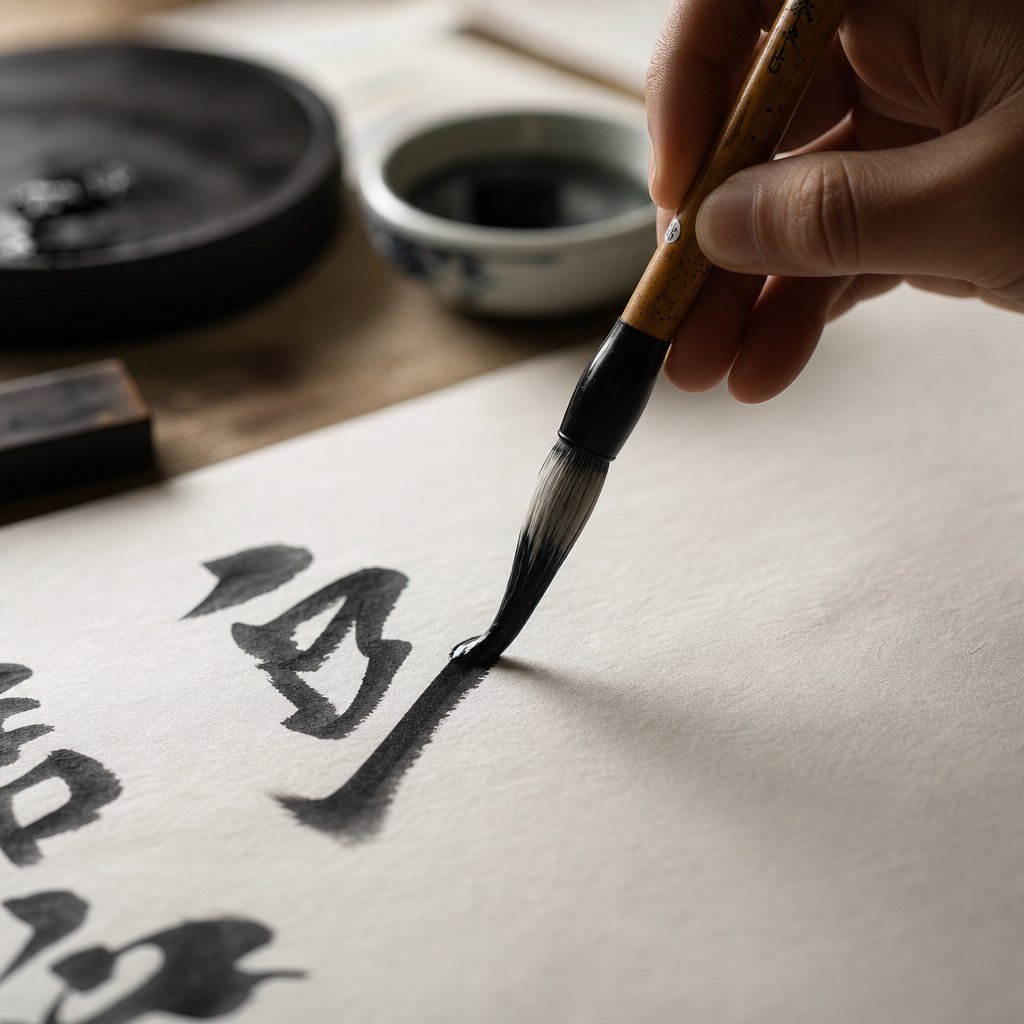
Writing and Using the Family Character in Modern Life
Carrying 家 on your body or hanging it on your wall transforms a 3,000-year-old character into something deeply personal. But permanence demands precision. Whether you're practicing calligraphy, commissioning artwork, or choosing a chinese symbol for family tattoo, you need to know exactly how this character is constructed - stroke by stroke, in the correct sequence. A single misplaced line can turn a meaningful symbol into an embarrassing mistake.
The good news? 家 is a 10-stroke character with a logical structure that breaks cleanly into two components. Once you understand the order, writing it becomes intuitive.
Writing 家 Stroke by Stroke
Chinese characters follow strict stroke order rules that have been standardized for over a thousand years. For 家, you write the roof radical 宀 (mián) first - top to bottom, left to right - then complete the lower pig component 豕 (shǐ). Here's the full sequence:
- Stroke 1 (dot): A short dot pressing down and to the right, placed at the top center of the character. This is the peak of the roof.
- Stroke 2 (left-falling stroke): Starting from just below the dot on the left side, draw a short diagonal stroke falling to the lower left. This forms the left wall of the roof.
- Stroke 3 (horizontal + turn + vertical): A connected stroke that begins with a horizontal line moving right, then turns downward at the corner to form the right wall of the roof. This single continuous stroke creates the top-right structure of 宀.
- Stroke 4 (short left-falling stroke): Inside the roof space, a short diagonal stroke falling to the lower left. This begins the pig component.
- Stroke 5 (horizontal): A horizontal stroke crossing from left to right, forming the upper body of the lower component.
- Stroke 6 (vertical with bend): A vertical stroke descending from the horizontal line, curving slightly at the bottom. This forms the central spine of the pig component.
- Stroke 7 (short left-falling stroke): A small diagonal stroke falling to the lower left from the mid-section of the component.
- Stroke 8 (left-falling stroke): A longer diagonal stroke sweeping to the lower left, forming one of the pig's "legs."
- Stroke 9 (dot): A short dot on the right side of the lower component.
- Stroke 10 (right-falling stroke): A diagonal stroke sweeping to the lower right, completing the character with a balanced finishing stroke.
The key principle: always complete the enclosing element (the roof) before filling in what's inside. This rule applies to every Chinese character with a top-down enclosure. If you practice this sequence a few times, you'll notice how the proportions naturally fall into place - the roof should be slightly wider than the lower component, creating a sense of shelter and containment.
Getting a Family Chinese Character Tattoo Right
A family in chinese tattoo is one of the most popular character choices for body art worldwide. The appeal is obvious: 家 is visually balanced, culturally rich, and universally understood across all Chinese-speaking communities. But as tattoo culture guides emphasize, getting a Chinese character tattoo right requires more than choosing a beautiful font from the internet.
Here's what you need to consider before the needle touches skin:
Font choice matters enormously. The two most common calligraphic styles for a chinese tattoo symbol for family are regular script (楷书, kǎishū) and running script (行书, xíngshū). Regular script gives you clean, precise strokes - every line is distinct and readable. Running script offers a more fluid, artistic look where strokes connect and flow into each other, carrying the energy of a calligrapher's brush. Cursive script (草书, cǎoshū) looks dramatic but is often illegible even to native readers, making it risky for tattoos.
Avoid digital computer fonts. A font-generated character looks flat and mechanical on skin. Chinese characters are brushwork - they're meant to have variation in stroke width, pressure, and flow. The best approach? Have a native Chinese speaker who practices calligraphy write the character by hand. Use that handwritten version as your tattoo reference, not a screenshot from a translation app.
Common mistakes to watch for:
- Mirrored characters - if the stencil is applied incorrectly, the entire character can be reversed. Always verify orientation before tattooing begins.
- Incorrect proportions - the roof radical should sit above and slightly wider than the lower component. If the bottom is wider than the top, the character looks structurally wrong to any native reader.
- Missing or extra strokes - 家 has exactly 10 strokes. A missing dot or an added line creates a different character or pure nonsense.
- Mixing simplified and traditional elements - though 家 itself is identical in both systems, if you're combining it with other characters in a phrase, make sure all characters use the same script system.
One major advantage of choosing 家 as a chinese tattoo family symbol: it remained unchanged through China's 1950s script simplification. Unlike characters such as 愛/爱 (love) or 親/亲 (parent), where traditional and simplified forms differ significantly, 家 looks the same whether you're reading a Tang Dynasty poem or a modern Shenzhen street sign. There's no risk of accidentally choosing an outdated variant. For anyone considering family in chinese writing tattoos, this consistency makes 家 one of the safest and most reliable choices available.
Cultural considerations: Tattoos historically carried stigma in Chinese culture - Confucian values held that the body is a gift from parents and shouldn't be permanently altered. This attitude is shifting rapidly among younger generations in urban China, but it's worth knowing the context. The character 家 itself, however, carries no negative connotations. It's universally positive, deeply respected, and immediately understood.
How Modern Chinese Family Concepts Are Evolving
The character hasn't changed in 3,000 years, but what 家 means in practice is shifting dramatically. Two terms capture the modern tension: 大家庭 (dà jiātíng, extended family) and 小家庭 (xiǎo jiātíng, nuclear family). For most of Chinese history, the 大家庭 was the default - multiple generations living under one roof, grandparents helping raise children, resources pooled across the clan. The character 家 was built for this reality.
Today, the 小家庭 dominates urban China. Parents and one or two children, often living hundreds of miles from grandparents. This shift accelerated under the one-child policy (1980-2015), which didn't just limit family size - it fundamentally reshaped how Chinese people think about family itself.
Research from the London School of Economics reveals something striking: growing up as an only child reduces a person's ideal family size by 0.6 to 0.7 children. The policy created what demographers call a "low-fertility trap" - only children who experienced concentrated parental investment now prefer to have just one child themselves. The cycle reinforces itself across generations. China's fertility rate has dropped to approximately 1.0 births per woman, well below the 2.1 replacement level, and despite government incentives including cash bonuses and extended maternity leave, birth rates continue to fall.
The cultural implications run deep. That elaborate kinship vocabulary - all those distinct terms for paternal uncles, maternal cousins, elder and younger siblings - is becoming less relevant in daily life when many children have no siblings, no cousins, and only two grandparents they see regularly. The language preserves a family structure that fewer and fewer people actually experience.
Yet 家 endures. Whether it describes a multigenerational clan of thirty or a young couple with one child in a Shanghai apartment, the character still carries its ancient promise: the people you belong to and the place where you belong. The pig may be long gone from under the roof, but the meaning - shelter, kinship, home - remains as vital as ever.
Frequently Asked Questions About the Chinese Character for Family
1. What is the Chinese character for family and how is it pronounced?
The Chinese character for family is 家, pronounced 'jia' in the first tone (jiā). It simultaneously means family, home, and household - three concepts that English treats separately but Chinese unifies into a single symbol. This reflects the cultural belief that the people you love and the place you live are inseparable.
2. Why does the Chinese character for family have a pig under a roof?
The character 家 combines the roof radical 宀 (mian) with the pig component 豕 (shi). Scholars offer three main theories: pigs kept indoors signaled human habitation, pigs represented household wealth and stability in agrarian society, or pigs were sacrificial offerings to ancestors within the home. All three theories point to how ancient Chinese life connected domestic animals with settled family life.
3. Is the Chinese character for family the same in simplified and traditional Chinese?
Yes, 家 is one of the rare characters that remained completely unchanged during China's 1950s script simplification. Unlike characters such as 愛/爱 (love) or 親/亲 (parent), the family character looks identical in both traditional and simplified systems. This makes it a reliable choice for tattoos, artwork, and calligraphy regardless of which script system you follow.
4. What is the difference between 家 and 家庭 in Chinese?
家 (jia) is informal and translates best as 'home' with emotional warmth - you say 回家 (hui jia) to mean 'go home.' 家庭 (jiating) is more formal and refers to the family as a social or institutional unit, used in contexts like 家庭教育 (family education) or official documents. Think of 家 as personal and 家庭 as structural.
5. How many strokes does the Chinese character 家 have and what is the correct stroke order?
家 has exactly 10 strokes written in a specific sequence. You complete the roof radical 宀 first (3 strokes: a top dot, a left-falling stroke, then a horizontal-turn-vertical stroke), then write the lower pig component 豕 (7 strokes). The key rule is always finishing the enclosing roof element before filling in what sits beneath it.