Understanding Tiger Zodiac Radicals in Chinese Naming
Imagine you're choosing a name for your child, and every stroke within each character carries invisible energy that either lifts them up or holds them back. That's the core idea behind selecting the best Chinese name radicals for tiger zodiac babies. It's not random, and it's far more than aesthetics.
What Are Chinese Name Radicals and Why They Matter
Chinese characters aren't monolithic symbols. Most are built from smaller components called radicals, or bushou (部首). These radicals often carry semantic meaning. The water radical (氵), for instance, connects a character to liquid, flow, or emotion. The person radical (亻) ties a character to human qualities. When you can identify a character's radical, you unlock a layer of meaning hidden inside the name itself.
In traditional Chinese nameology, these radicals do more than hint at definitions. They channel elemental energy. A name isn't just a social tag; it's a carefully constructed blend of Five Elements theory, stroke numerology, and zodiac alignment designed to harmonize with a person's destiny. The radical components you choose can either support or clash with the chinese zodiac sign tiger, making radical selection one of the most critical steps in the naming process.
The Tiger's Symbolic Role in Chinese Zodiac Naming
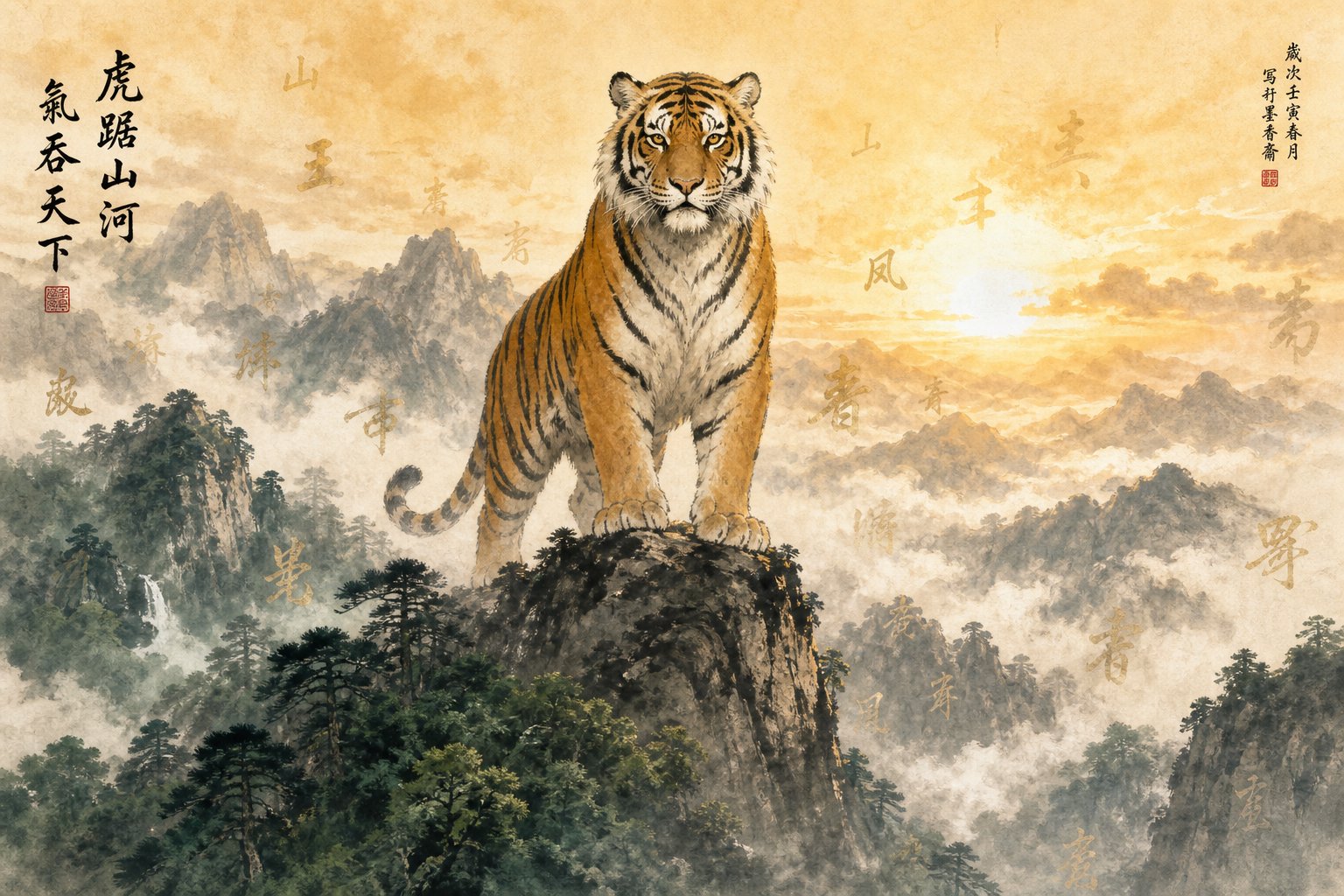
So what does the tiger mean in chinese zodiac culture? The Tiger is King of the Forest, a creature of authority, courage, and raw vitality. Its native element is Wood, rooting it in growth, ambition, and expansive energy. This tiger zodiac meaning shapes everything about how radicals are chosen: mountain radicals give the Tiger its domain, king radicals honor its royal status, and meat radicals promise abundance.
Radicals channel elemental energy that either supports or conflicts with the Tiger's innate Wood element nature. A well-chosen radical strengthens the Tiger; a poorly chosen one cages it.
The sections ahead cover auspicious radicals ranked by priority, radicals you should avoid, gender-specific recommendations, and how the elemental sub-type of a particular Tiger year fine-tunes your choices. Whether you're a parent planning a name or an adult exploring a name change, understanding these radical principles gives you a meaningful framework grounded in centuries of cultural wisdom.
Cultural and Mythological Foundations Behind Tiger Radicals
Radical recommendations for Tiger zodiac names don't come from thin air. They're rooted in thousands of years of mythology, folk belief, and cultural reverence for the tiger as a creature of supreme authority. When you understand why the Tiger holds its mythological position, the logic behind each radical category clicks into place.
The Tiger as King of the Mountain in Chinese Mythology
In Chinese culture, the tiger isn't simply a powerful predator. It's a cosmic force. The stripes on a tiger's forehead naturally form a pattern resembling the character for "king" (王), earning it the title "king of all beasts" in Chinese folklore. This visual connection between the living animal and the written symbol for royalty has reinforced the tiger's status for centuries.
The characteristics of the year of the tiger trace directly back to these ancient associations. As one of the Four Symbols in Chinese cosmology, the White Tiger (白虎) guards the western quadrant of the heavens. In The Classic of Mountains and Seas (山海经), the god of Kunlun Mountain, Lu Wu, possesses the body of a tiger, linking the animal to sacred peaks and wild terrain. The Eastern Han scholar Ying Shao wrote that the tiger is a "yang" animal and "the king of all beasts" that "can quell war and devour ghosts."
These mythological layers give us the core characteristics of tiger personality in Chinese thought: dominance over territory, command over lesser creatures, and protective spiritual power. The year of the tiger personality reflects these same qualities, which is why people born under this sign are described as brave, heroic, resolute, and vigorous.
- The Tiger rules mountains and forests, commanding its natural domain
- The Tiger commands respect among all animals as undisputed king
- The Tiger represents courage, protection, and the power to ward off evil spirits
How Cultural Symbolism Translates to Radical Selection
Here's where mythology becomes practical. Each of these cultural roles maps directly onto a radical category used in naming:
Because the Tiger rules mountains and forests, radicals like 山 (mountain) and 木 (wood/tree) place the Tiger in its rightful domain. A Tiger with a mountain radical in its name has territory to roam, a kingdom to govern. Without that domain, the Tiger's energy has nowhere to expand.
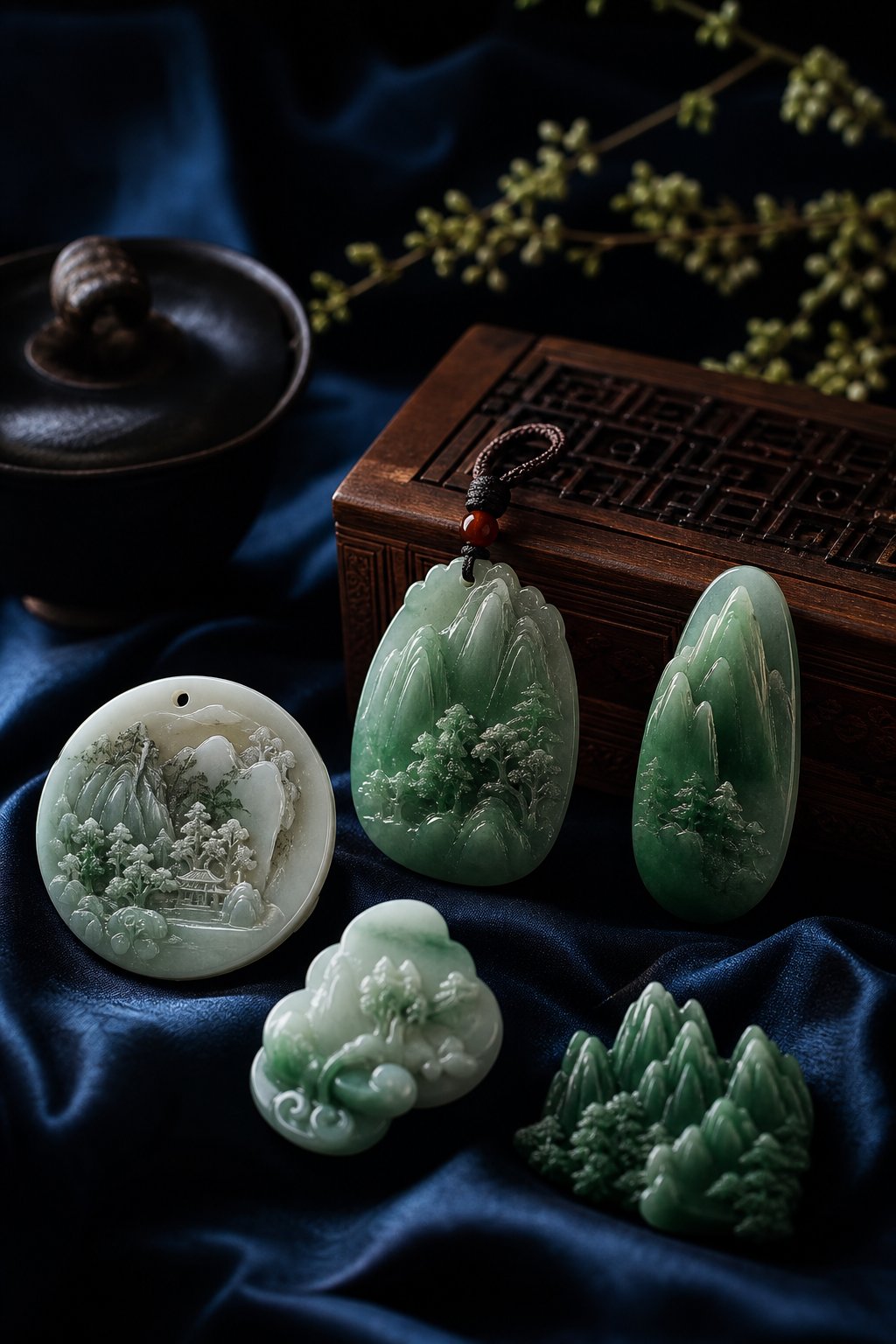
Because the Tiger is king, radicals like 王 (king) and 玉 (jade) honor its royal nature. Tiger-shaped bronze tallies were used to command armies as far back as the Warring States period, reinforcing the animal's link to authority and military power. Jade radicals carry this same regal energy in a name.
Because the Tiger is a powerful carnivore, meat and heart radicals (月/肉, 心) symbolize abundance and satisfaction. A well-fed tiger is a content tiger. These radicals signal that the person will never lack for sustenance or emotional fulfillment.
Understanding these traits of the tiger chinese zodiac helps parents make informed decisions rather than blindly copying character lists. When you know that chinese zodiac tiger traits center on authority, territory, and protective strength, you can evaluate any character by asking a simple question: does this radical support the Tiger's nature, or does it work against it? That filter transforms naming from guesswork into purposeful cultural practice.
The mythology tells us what the Tiger needs. The next step is understanding the elemental framework that determines which radicals deliver that support most effectively.
Five Elements Theory and Tiger Zodiac Radical Selection
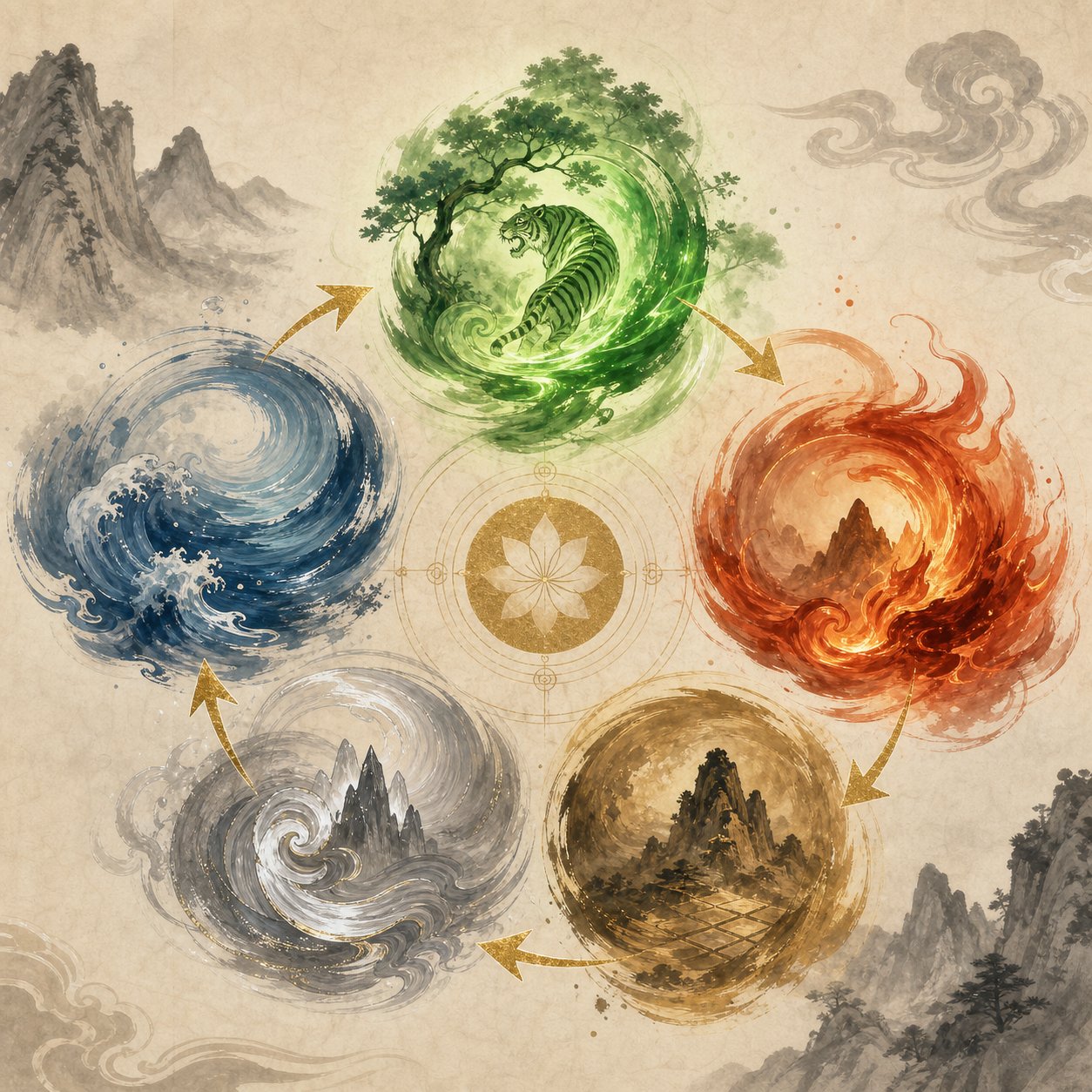
The Tiger's mythological role tells you what it needs symbolically. The Five Elements framework (Wu Xing, 五行) tells you how those needs translate into specific elemental relationships, and ultimately, into radical choices that either nourish or weaken the Tiger's core energy.
The Tiger's Wood Element and the Productive Cycle
In chinese astrology tiger is classified as a Yang Wood animal. Wood represents creativity, growth, benevolence, and flourishing energy. Think of it as a tall tree reaching upward, always expanding, always seeking light. This native element becomes the anchor point for every radical decision you make.
The Five Elements interact through two primary cycles:
- Generating cycle (productive): Water feeds Wood. Wood fuels Fire. Fire forms Earth. Earth bears Metal. Metal carries Water.
- Overcoming cycle (destructive): Metal chops Wood. Wood breaks Earth. Earth absorbs Water. Water quenches Fire. Fire melts Metal.
For a Wood-element Tiger, the generating cycle reveals a clear hierarchy. Water is the Tiger's "parent" element, the one that nourishes and sustains its growth. Fire is the Tiger's "child" element, drawing energy away. And Metal? Metal is the element that directly overcomes Wood, cutting it down like an axe through timber.
This isn't abstract philosophy. It's a practical filter. When you see a character with the water radical (氵) or ice radical (冫), you're looking at elemental support flowing toward the Tiger's Wood nature. When you see a character built on the metal radical (金 or 钅), you're looking at a potential source of conflict.
Balancing Elements Through Strategic Radical Choices
How does this play out in actual radical selection? The table below maps each element's relationship to the Tiger's native Wood and shows which radicals carry that elemental energy:
| Element | Relationship to Tiger's Wood | Effect on Tiger | Common Radicals |
|---|---|---|---|
| Water | Parent (generates Wood) | Strongly supportive | 氵(water), 冫(ice), 雨 (rain) |
| Wood | Same element | Reinforcing | 木 (tree), 林 (forest), 艹 (grass) |
| Fire | Child (Wood generates Fire) | Mildly draining | 火 (fire), 灬 (dots of fire), 日 (sun) |
| Earth | Grandchild (two steps away) | Neutral to mildly taxing | 土 (earth), 山 (mountain), 石 (stone) |
| Metal | Overcomer (destroys Wood) | Potentially destructive | 金 (gold), 钅(metal), 刂 (blade) |
You'll notice something interesting: the mountain radical (山) falls under Earth, yet it's widely considered auspicious for Tiger names. That's because the zodiac tiger meaning as "King of the Mountain" overrides the purely elemental calculation. Cultural symbolism and elemental theory work together, not in isolation. When both align, you get the strongest possible radical choice. When they diverge, context and the specific character's overall meaning help you decide.
For the earth tiger chinese zodiac sub-type specifically, Earth radicals carry even less conflict because the Tiger already holds Earth as part of its elemental makeup. A chinese zodiac earth tiger born in a year ending in 8 or 9 naturally resonates with grounding energy, making 山 and 土 radicals doubly appropriate.
Three Talents Framework Applied to Tiger Names
Traditional Chinese naming goes beyond individual characters. The "Three Talents" (三才) framework evaluates how the elements of your surname, middle character, and final character interact as a complete system. Astrologers analyze whether the elemental flow across all three positions follows a generating sequence rather than a destructive one.
For a Tiger child, an ideal Three Talents configuration might flow like this: a surname carrying Water energy, a middle character with Wood energy, and a final character with mild Fire or additional Wood. That sequence follows the natural generating cycle: Water nourishes Wood, Wood can gently fuel Fire. The energy moves forward without conflict.
A problematic configuration would place Metal energy directly adjacent to the Tiger's Wood characters, creating a chopping or cutting dynamic within the name itself.
The strongest Tiger names align zodiac symbolism, elemental support, and Three Talents harmony into a single cohesive structure where every radical reinforces rather than undermines the Tiger's Wood nature.
Should you pursue a full Bazi (八字) birth chart analysis? If precision matters to you, absolutely. Bazi examines all four pillars of a child's birth data, year, month, day, and hour, revealing which specific elements are missing or overrepresented. This gives a far more personalized picture than zodiac-level guidance alone. But for parents who want a solid, culturally grounded starting point without commissioning a professional reading, the elemental framework above provides a reliable filter for evaluating any character you're considering.
With the elemental logic in place, the next question becomes practical: which specific radical categories deliver the most benefit, and in what order of priority?
Auspicious Radical Categories Ranked by Priority
Not all auspicious radicals carry equal weight. Some directly activate the Tiger's core identity, while others offer complementary support. Thinking of it as a tiered system helps you prioritize when building a name, especially when stroke count or tonal flow limits your character options.
Here's the full ranking at a glance:
| Tier | Radical Category | Example Radicals | Symbolic Meaning for Tiger |
|---|---|---|---|
| Tier 1 (Essential) | Mountain / Forest | 山, 木, 林, 森 | Gives the Tiger its natural domain and kingdom to rule |
| Tier 1 (Essential) | King / Authority | 王, 玉, 君, 令, 大 | Honors the Tiger's royal status as King of the Forest |
| Tier 2 (Strongly Beneficial) | Meat / Abundance | 月 (肉), 心, 忄 | Ensures the Tiger is well-fed, symbolizing fulfillment |
| Tier 2 (Strongly Beneficial) | Zodiac Ally (Horse, Dog) | 马, 午, 戌, 犬 | Activates the Tiger-Horse-Dog harmony trio for support |
| Tier 3 (Supportive) | Water | 氵, 冫, 雨 | Nourishes the Tiger's Wood element through the generating cycle |
| Tier 3 (Supportive) | Clothing / Adornment | 衣, 彡, 巾, 系, 采 | Makes the Tiger more majestic and visually commanding |
Tier One Radicals for Maximum Auspiciousness
Mountain and forest radicals sit at the top because they address the Tiger's most fundamental need: territory. A tiger without a mountain is a tiger without a throne. Characters built on 山 (mountain) and 木 (wood/tree) place the Tiger exactly where it belongs, roaming freely through its domain with full authority. As traditional naming guides explain, these radicals allow the Tiger to "give its potential into full play."
King and authority radicals (王, 玉, 大) work on the same principle from a different angle. They don't give the Tiger a place; they give it a crown. The tiger zodiac personality is fundamentally one of leadership and command. Radicals connected to royalty, jade, and greatness affirm that identity rather than suppressing it. Characters containing 王 or 玉 signal power, prestige, and the right to lead.
Tier Two Radicals for Strong Zodiac Harmony
Meat and heart radicals (月 as a flesh component, 心, 忄) address a practical reality: the Tiger is a carnivore. In naming symbolism, a well-fed tiger is a satisfied, powerful tiger. These radicals indicate plentiful sustenance and a rich inner world, both emotional depth and material abundance.
Zodiac ally radicals tap into a different kind of support. In Chinese astrology, Tiger, Horse, and Dog form a harmonious trio (三合) of free spirits who share passion, independence, and adventurous energy. Characters containing Horse-related radicals (马, 午) or Dog-related radicals (戌, 犬) activate this alliance within the name itself. The zodiac tiger traits of courage and boldness are amplified when surrounded by compatible allies.
Beyond the primary trio, Tiger also shares a seasonal relationship (三会) with Rabbit (卯) and Dragon (辰). Characters like 卿 (containing 卯) or 宸 (containing 辰) draw on this spring-season bond. It's worth noting that while tiger goat compatibility is sometimes questioned in romantic contexts, the naming framework focuses specifically on the Tiger's strongest alliances. The Tiger-Horse-Dog trio and Tiger-Rabbit-Dragon seasonal group consistently outperform other pairings in nameology, which is why they occupy Tier 2 rather than a lower position.
Tier Three Supportive Radicals
Water radicals (氵, 冫, 雨) earn their place through elemental logic. Water generates Wood in the Five Elements cycle, so these radicals quietly nourish the Tiger's core nature. They indicate riches and honor in traditional naming interpretation. Characters like 波 (wave), 洋 (ocean), and 凝 (condense) all carry this supportive water energy.
Clothing and adornment radicals (衣, 彡, 巾, 采) serve an aesthetic function with real symbolic weight. A tiger's stripes are its glory. Radicals associated with garments, patterns, and color make the Tiger more visually commanding, more majestic. Think of it as dressing the king in robes befitting its station. Characters with these radicals signal dignity and presence.
One nuance to keep in mind: tiger goat compatibility concerns don't directly affect radical selection because the Goat (未) doesn't appear in the Tiger's conflict relationships. The real enemies, Snake and Monkey, are the ones whose associated radicals you'll want to actively avoid. That distinction between neutral pairings and genuinely harmful ones matters when you're evaluating characters that might carry ambiguous zodiac associations.
The personality of tiger zodiac, bold, territorial, regal, and hungry for life, maps cleanly onto this tier system. Tier 1 feeds identity. Tier 2 feeds relationships and sustenance. Tier 3 feeds elemental balance and outward presentation. Together, they give you a complete toolkit for selecting characters that resonate with chinese tiger zodiac traits at every level.
Knowing which categories to draw from is one thing. Seeing specific characters with their meanings, pronunciations, and full name examples brings the system to life.
Specific Characters and Full Name Examples by Category
Categories and tiers give you direction. But when you're staring at a blank page trying to build an actual name, you need concrete characters with clear meanings and pronunciation. Below you'll find curated selections from each major radical group, along with complete name examples that show how these characters work together in practice.
Mountain and Forest Characters with Meanings
These characters place the Tiger in its natural habitat, giving it territory to command. Each one carries the mountain radical (山) or wood/forest radical (木, 林), directly activating the Tiger's identity as ruler of wild terrain.
- 岳 (yue) - Great mountain; evokes sacred peaks and grandeur
- 峻 (jun) - Towering, steep; suggests lofty ambition and strength
- 峰 (feng) - Summit, peak; represents reaching the highest point
- 林 (lin) - Forest; the Tiger's domain where it roams freely
- 柏 (bai) - Cypress tree; symbolizes longevity and resilience
- 桐 (tong) - Paulownia tree; associated with nobility and the phoenix
- 楠 (nan) - Phoebe nanmu wood; prized timber representing lasting value
- 栋 (dong) - Ridgepole, pillar; implies being a backbone or leader
- 森 (sen) - Dense forest; triple wood radical for maximum woodland energy
The tiger personality traits of ambition and expansiveness find a natural home in these characters. A Tiger with mountain and forest radicals has room to grow, hunt, and lead without constraint.
King and Jade Characters for Authority
Characters with the king/jade radical (王/玉) honor the Tiger's royal status. Most of these relate to precious stones and fine jade, connecting authority with beauty and lasting value.
- 瑞 (rui) - Auspicious jade; signals good fortune and blessings
- 琪 (qi) - Fine jade, precious and rare; implies exceptional quality
- 珩 (heng) - Jade pendant worn on a sash; elegance with authority
- 琳 (lin) - Blue-green jade; beauty and preciousness
- 瑾 (jin) - Beautiful jade; often paired with 瑜 to mean virtue
- 璇 (xuan) - Fine jade, also a star name; celestial beauty
- 瑶 (yao) - Precious jade or jade-like stone; purity and grace
- 珏 (jue) - Two pieces of jade joined together; harmony and connection
These characters reflect the personality characteristics of a tiger in Chinese culture: commanding presence paired with inherent nobility. The jade radical doesn't just signal wealth. It signals the kind of authority that's recognized naturally, not forced.
Heart and Abundance Characters for Fulfillment
The heart radical (心, 忄) and the moon/meat radical (月 as flesh component) ensure the Tiger is emotionally rich and physically sustained. A satisfied tiger is a powerful tiger.
- 慧 (hui) - Wisdom, intelligence; depth of mind and perception
- 恒 (heng) - Perseverance, constancy; enduring strength
- 悦 (yue) - Joy, delight; contentment and inner peace
- 志 (zhi) - Ambition, will; determination and purpose
- 忠 (zhong) - Loyalty, devotion; steadfast character
- 慕 (mu) - Admiration, longing; depth of feeling
- 朗 (lang) - Bright, clear (contains 月); openness and clarity
- 胜 (sheng) - Victory, triumph (contains 月 as meat radical); success
These characters address the chinese zodiac tiger characteristics of emotional intensity and inner fire. The Tiger isn't just physically powerful; it possesses deep feeling and unwavering resolve. Heart radicals honor that inner dimension.
Full Name Examples with Breakdowns
Seeing individual characters is helpful. Seeing them assembled into complete names with reasoning is where everything clicks. Below are example names structured for diaspora parents who may not read Chinese fluently:
- 林峻 (Lin Jun) - Surname: 林 (lin, forest). Given name: 峻 (jun, towering). Both characters carry Tiger-auspicious radicals. The forest surname places the Tiger in its kingdom, while the mountain-radical given name elevates it to the peak. Double Tier 1 energy.
- 王瑞恒 (Wang Rui Heng) - Surname: 王 (wang, king). Given name: 瑞恒 (rui heng, auspicious perseverance). The surname itself is the king radical. 瑞 adds jade/authority energy, and 恒 contributes the heart radical for emotional depth. This name layers Tier 1 and Tier 2 radicals across all three positions.
- 陈柏慧 (Chen Bai Hui) - Surname: 陈 (chen). Given name: 柏慧 (bai hui, cypress wisdom). 柏 carries the wood radical for forest energy, while 慧 contains the heart radical for inner richness. A balanced name pairing the Tiger's domain with intellectual fulfillment.
- 马骏峰 (Ma Jun Feng) - Surname: 马 (ma, horse). Given name: 骏峰 (jun feng, fine steed summit). The Horse surname activates the Tiger-Horse-Dog zodiac trio. 骏 reinforces the Horse alliance, and 峰 adds mountain energy. This name draws from both Tier 1 and Tier 2 simultaneously.
- 李琪悦 (Li Qi Yue) - Surname: 李 (li, contains 木 wood radical). Given name: 琪悦 (qi yue, fine jade joy). The surname carries hidden wood energy. 琪 delivers king/jade authority, and 悦 provides heart-radical contentment. Three tiers represented in a single elegant name.
Notice how each example balances multiple radical categories rather than loading everything into one tier. The characteristics of a tiger chinese zodiac, territorial dominance, regal bearing, emotional depth, are best served when a name addresses several dimensions at once. A name that's all mountain with no heart, or all jade with no forest, misses the full picture of what makes the Tiger thrive.
These characters represent what to reach for. But equally important is knowing what to steer clear of, because some radicals actively work against the Tiger's energy in ways that aren't always obvious at first glance.

Radicals to Avoid and Common Naming Pitfalls
Choosing the right radicals is only half the equation. A name can contain perfectly auspicious characters in one position and quietly undermine the Tiger's energy in another. Some radicals actively cage, shrink, or antagonize the Tiger, and the tricky part is that many of them hide inside characters that look perfectly elegant on the surface.
Confinement Radicals That Cage the Tiger
Picture a tiger locked in a cage. All that power, all that authority, compressed into a space too small to contain it. That's exactly what happens symbolically when you place confinement-related radicals in a Tiger zodiac name.
The enclosure radical (囗) and the mouth radical (口) are the primary offenders. Characters built inside a box structure represent walls closing in around the Tiger. In nameology, this creates a "caged tiger" dynamic where the person's potential is perpetually constrained, their ambitions blocked, their natural leadership suppressed.
The small radical (小) and the few radical (少) work differently but cause similar harm. They diminish the Tiger's grandeur. A Tiger is meant to be large, commanding, and expansive. Radicals that signal smallness or scarcity shrink that energy, suggesting a life of limitation rather than abundance.
Opposing Zodiac Animal Radicals to Avoid
Every zodiac animal has natural adversaries, and the Tiger's conflicts are well-documented in Chinese astrology. The tiger enemy sign in the zodiac system is the Monkey (申), which sits in direct opposition. Snake (巳) also clashes with the Tiger's energy. These aren't mild incompatibilities. They represent fundamental friction.
Characters containing the insect/snake radical (虫) or components related to 巳 carry Snake energy into the name. Characters with 申 embedded in their structure bring Monkey opposition. The chinese zodiac tiger enemy relationships exist because these animals compete for dominance in ways that create ongoing tension rather than productive challenge.
The Sun radical (日) presents a more nuanced case. Tigers are traditionally nocturnal hunters, creatures of shadow and stealth. Excessive sun exposure in a name can symbolically weaken the Tiger by forcing it into an environment where it's exposed and vulnerable. This doesn't mean every character with 日 is off-limits, but stacking multiple sun-heavy characters creates an imbalance worth avoiding.
Understanding who is the enemy of the tiger in zodiac terms helps you screen characters quickly. If a character contains Snake or Monkey components, it introduces adversarial energy regardless of how beautiful the character looks or sounds.
Common Mistakes with Hidden Inauspicious Radicals
Here's where many parents get tripped up. Some characters appear graceful and carry lovely meanings, yet contain problematic radicals buried within their structure. You won't spot them unless you break the character down to its component parts.
| Radical to Avoid | Reason | Example Characters That Contain It |
|---|---|---|
| 口 (mouth/enclosure) | Cages the Tiger, restricts freedom and power | 品 (pin), 哲 (zhe), 嘉 (jia), 唯 (wei) |
| 囗 (full enclosure) | Traps the Tiger completely within walls | 国 (guo), 园 (yuan), 圆 (yuan), 图 (tu) |
| 小 / 少 (small/few) | Diminishes the Tiger's grandeur and authority | 尖 (jian), 尚 (shang), 省 (sheng) |
| 虫 (insect/snake) | Snake is a tiger enemy chinese zodiac conflict | 虹 (hong), 蝶 (die), 融 (rong) |
| 申 (monkey) | Direct zodiac opposition to the Tiger | 伸 (shen), 绅 (shen), 神 (shen) |
| 日 (sun, in excess) | Exposes the nocturnal Tiger, drains stealth energy | 晶 (jing), 昊 (hao), 晨 (chen) when paired with other sun characters |
| 人/亻 (person, in certain contexts) | Can imply the Tiger is tamed or domesticated | Use cautiously; context-dependent |
Take 嘉 (jia) as an example. It means "excellent" or "praiseworthy" and sounds wonderful in conversation. But look at its structure: it contains not one but two 口 components. For a Tiger zodiac name, that's two layers of confinement wrapped around an otherwise positive meaning. Similarly, 神 (shen, meaning "divine" or "spirit") seems ideal until you notice the 申 radical on its left side, bringing Monkey opposition directly into the name.
The tigers enemy sign conflict with Monkey and Snake isn't just theoretical. Traditional naming practitioners consistently flag these radicals as sources of interpersonal friction, career obstacles, and restless energy in a Tiger person's life. Whether you view this as literal metaphysical influence or as cultural symbolism worth respecting, the practical advice remains the same: verify every character's internal structure before committing to it.
A simple verification habit solves this problem. Before finalizing any character, break it into its radical components using a dictionary or character decomposition tool. Ask yourself: does any hidden component cage, shrink, or oppose the Tiger? If the answer is yes, find an alternative that delivers the same meaning or sound without the structural conflict.
With both the auspicious and inauspicious radicals mapped out, the next consideration is how gender influences which characters from the recommended categories work best for boys versus girls.
Gender-Specific Radical Recommendations for Tiger Names
The Tiger's energy is bold, expansive, and commanding regardless of gender. But in traditional Chinese naming culture, parents often shape that raw power differently depending on whether they're naming a son or a daughter. The same radical categories apply, yet the emphasis shifts to highlight different facets of the chinese tiger personality.
Recommended Radicals and Characters for Tiger Boys
For boys, the goal is to lean into the Tiger's most outward-facing qualities: leadership, physical strength, and territorial command. Mountain radicals (山), king radicals (王), and large-scale forest radicals (林, 森) pair naturally with the tiger personality characteristics of dominance and ambition.
Characters that work well for Tiger boys:
- 峻 (jun) - Towering, lofty; mountain radical conveys height and ambition
- 岳 (yue) - Great mountain; sacred peaks and grandeur
- 森 (sen) - Dense forest; triple wood for maximum domain energy
- 栋 (dong) - Ridgepole, pillar; the backbone of a structure
- 骏 (jun) - Fine steed; Horse radical activates the zodiac trio
- 威 (wei) - Might, authority; Dog radical with commanding presence
- 胜 (sheng) - Victory; meat radical ensures abundance
Complete name examples for boys:
- 陈峻森 (Chen Jun Sen) - Surname: 陈 (chen). Given name: 峻森 (jun sen, towering forest). The mountain radical in 峻 gives the Tiger its peak, while 森 provides an expansive woodland kingdom. Double Tier 1 energy with a strong, resonant tonal flow.
- 马恒威 (Ma Heng Wei) - Surname: 马 (ma, horse, activating the zodiac trio). Given name: 恒威 (heng wei, enduring might). 恒 carries the heart radical for perseverance, and 威 contains the Dog radical for zodiac ally support. This name layers Tier 2 radicals across every position.
Recommended Radicals and Characters for Tiger Girls
When choosing a tiger female name, the approach often balances the Tiger's fierce energy with grace and inner depth. Jade radicals (玉), heart and wisdom radicals (心, 忄), and select plant radicals (艹 for elegant flowers) create names that honor the Tiger's strength without overwhelming it. The tiger chinese zodiac personality female expression tends toward characters that convey brilliance, beauty, and emotional richness alongside quiet authority.
Characters that work well for Tiger girls:
- 琪 (qi) - Fine jade; rare and precious quality
- 瑾 (jin) - Beautiful jade; virtue and inner radiance
- 慧 (hui) - Wisdom; heart radical for intellectual depth
- 悦 (yue) - Joy, delight; contentment and warmth
- 彤 (tong) - Vermilion red; color radical for vibrancy
- 荣 (rong) - Glory, flourishing; plant radical with wood energy
- 璇 (xuan) - Fine jade, star name; celestial elegance
Complete name examples for girls:
- 李琪慧 (Li Qi Hui) - Surname: 李 (li, contains the wood radical 木). Given name: 琪慧 (qi hui, jade wisdom). 琪 delivers king/jade authority, while 慧 adds heart-radical depth. The surname's hidden wood energy grounds the Tiger in its forest domain.
- 林瑾彤 (Lin Jin Tong) - Surname: 林 (lin, forest). Given name: 瑾彤 (jin tong, jade radiance). The forest surname places the Tiger in its kingdom. 瑾 carries regal jade energy, and 彤 adds the clothing/color radical for visual majesty. A name that's both powerful and graceful.
Balancing Strength and Grace in Tiger Names
Here's an important note: these are cultural conventions, not rigid rules. The chinese zodiac tiger personality traits of courage, independence, and confidence belong to every Tiger regardless of gender. A girl named 峻 or a boy named 琪 isn't breaking any cosmic law. Many modern parents deliberately cross these traditional boundaries, giving daughters mountain-strength names or sons jade-elegance names to reflect their own values.
What matters most is that the radicals themselves remain auspicious for the Tiger zodiac. Whether you lean toward commanding strength or refined grace, the underlying principle stays the same: choose radicals that give the Tiger territory, honor its authority, and nourish its Wood element nature. The gendered recommendations above simply offer two different lenses for expressing the same powerful zodiac energy.
Gender shapes the aesthetic direction. But the Tiger's elemental needs don't change based on whether you're naming a boy or a girl. What does change, sometimes dramatically, is the specific Tiger year your child was born in, because each year carries a different elemental sub-type that shifts which radicals within these categories deserve top priority.
How Tiger Year Sub-Types Influence Radical Choices
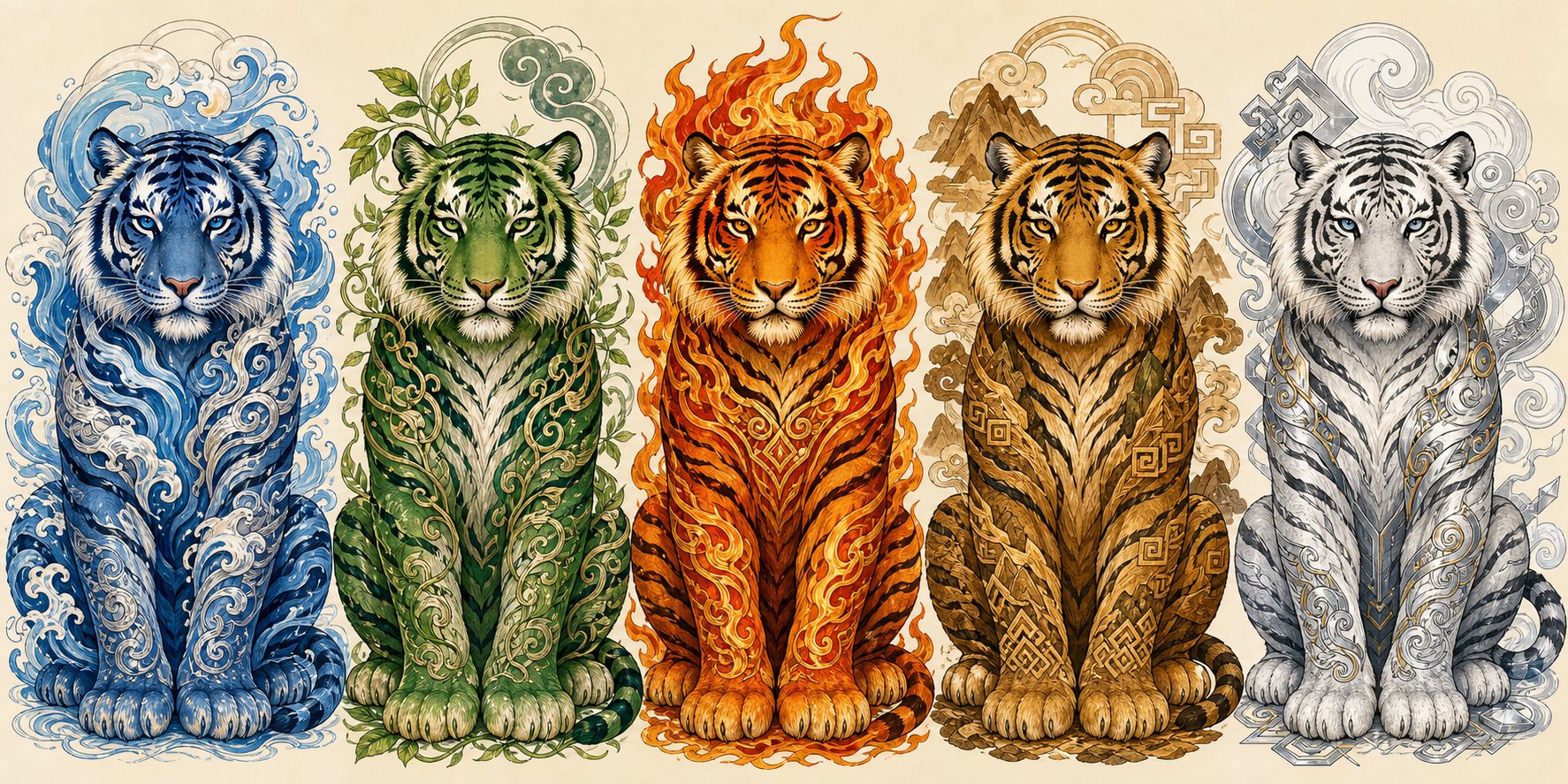
Every Tiger shares the same zodiac animal, but not every Tiger carries the same elemental fingerprint. The Heavenly Stems cycle assigns one of five elements to each Tiger year, creating distinct sub-types that repeat every 60 years. A Water Tiger born in 2022 has fundamentally different elemental needs than a Fire Tiger born in 1986. This distinction matters because it tells you which radicals within the auspicious categories deserve top priority for a specific child.
Water Tiger Radical Priorities
The Water Tiger (1962, 2022) combines the Tiger's native Wood energy with Water's flowing, adaptive quality. Since Water generates Wood in the productive cycle, this sub-type already enjoys strong internal harmony. The elemental personality is sedate, curious, and innovative, with excellent learning ability.
For Water Tigers, Wood and Water radicals reinforce what's already working. Characters with 木, 林, and 氵 amplify the natural Water-feeds-Wood dynamic, creating a name that flows with the person's innate energy rather than against it. Forest radicals (林, 森) are especially potent here because the Water element ensures the Tiger's woodland domain stays lush and thriving. Fire radicals can be used sparingly for warmth and expression, but stacking too many creates excessive drain on the Wood element.
Wood and Fire Tiger Radical Adjustments
The wood tiger zodiac sub-type (1914, 1974) presents a unique situation: double Wood energy. The Tiger is already a Wood animal, and the Heavenly Stem adds more Wood on top. This creates tremendous growth energy but risks imbalance. Too much Wood without grounding becomes restless expansion with no anchor.
For Wood Tigers, Earth radicals (山, 土) provide essential grounding. Mountain radicals serve double duty here, giving the Tiger its domain while stabilizing all that upward-reaching Wood energy. Fire radicals (火, 灬) also work well because Wood naturally feeds Fire, allowing the excess Wood to express itself creatively rather than building internal pressure.
The fire tiger chinese zodiac sub-type (1926, 1986) flips this dynamic. If you look up the 1986 chinese zodiac, you'll find it's the year of the Fire Tiger, a combination that produces passionate, independent individuals with strong drive but sometimes poor self-control. The 1986 year of the tiger ran from February 9, 1986 to January 28, 1987, meaning anyone born during chinese new year 1986 celebrations entered life under this fiery influence. The chinese symbol 1986 associates with is Bing Yin (丙寅), combining Yang Fire with the Tiger's Yang Wood.
For Fire Tigers, Wood radicals (木, 林) are highly beneficial because Wood feeds Fire, keeping the Tiger's passionate energy well-fueled. Water radicals (氵, 冫) serve as a moderating force, preventing the fire tiger astrology profile from burning too hot. The key is balance: enough fuel to sustain the fire tiger's ambition without letting it consume everything around it.
Earth and Metal Tiger Elemental Balance
The Earth Tiger (1938, 1998) blends the Tiger's Wood nature with Earth's stabilizing, ambitious quality. Since Wood overcomes Earth in the destructive cycle, there's inherent internal tension in this sub-type. Earth Tigers are adventurous and realistic, but they benefit from radicals that bridge the gap between their two elements.
Fire radicals work beautifully here because Fire is the connecting element: Wood produces Fire, and Fire produces Earth. Adding Fire energy to an Earth Tiger's name creates a smooth generative bridge between the two native elements. Metal radicals (金, 钅) can also provide structure and discipline, since Earth produces Metal in the generating cycle, giving the Earth Tiger a productive outlet.
The Metal Tiger (1950, 2010) faces the sharpest internal conflict. Metal chops Wood in the overcoming cycle, meaning this sub-type carries a built-in tension between its zodiac nature and its elemental assignment. Metal Tigers are described as frank, strong-willed, and confident, but that internal friction can manifest as stubbornness or rigidity.
Water radicals are the priority here. Water exhausts Metal's cutting energy (Metal produces Water) while simultaneously nourishing the Tiger's Wood nature. Characters with 氵, 冫, and 雨 create a softening, flowing effect that eases the Metal-Wood conflict. Wood radicals remain beneficial for reinforcing the Tiger's core identity, but Metal radicals (金, 钅) should be used cautiously since they amplify the internal tension rather than resolving it.
| Tiger Sub-Type | Native Elements | Most Beneficial Radicals | Radicals to Use Cautiously |
|---|---|---|---|
| Water Tiger (1962, 2022) | Wood + Water | 木, 林, 氵, 冫, 山 (forest and water radicals) | 火, 灬 (excessive Fire drains Wood) |
| Wood Tiger (1914, 1974) | Wood + Wood | 山, 土, 火, 灬, 王 (grounding Earth and expressive Fire) | 木, 林 in excess (too much Wood creates instability) |
| Fire Tiger (1926, 1986) | Wood + Fire | 木, 林, 氵, 冫 (Wood fuels Fire; Water moderates) | 火, 灬 in excess (amplifies volatility) |
| Earth Tiger (1938, 1998) | Wood + Earth | 火, 灬, 金, 山 (Fire bridges Wood-Earth; Metal gives structure) | 木 in excess (intensifies Wood-Earth conflict) |
| Metal Tiger (1950, 2010) | Wood + Metal | 氵, 冫, 雨, 木, 林 (Water softens Metal; Wood reinforces Tiger) | 金, 钅 (amplifies Metal-Wood internal tension) |
Notice how the general Tiger guidelines from earlier chapters still apply. Mountain radicals, king radicals, and meat radicals remain auspicious across all sub-types. What changes is the secondary emphasis: which supporting radicals you prioritize when choosing between equally attractive characters. A Water Tiger parent might choose 泽 (ze, marsh) over 炎 (yan, flame) for a supporting character, while a Wood Tiger parent might make the opposite call.
This sub-type layer transforms radical selection from a one-size-fits-all list into a personalized framework. You're no longer just naming a Tiger. You're naming a specific kind of Tiger with specific elemental needs. That precision is what separates a good name from one that truly resonates with the child's energetic blueprint.
With the theoretical framework complete, from cultural foundations through elemental sub-types, the final piece is a practical methodology that pulls every layer together into a repeatable, step-by-step naming process.
Practical Name Construction Methodology and Final Checklist
You've got the cultural foundations, the elemental logic, the tiered radical system, and the sub-type adjustments. The question now is: how do you actually sit down and build a name from scratch? Below is a repeatable process that pulls every layer together into a clear sequence you can follow whether you're naming a newborn or evaluating an existing name.
Step-by-Step Name Construction Process
Think of this as your roadmap. Each step narrows the field until you're left with a small set of strong candidates rather than an overwhelming sea of characters.
- Identify the Tiger year sub-type and its elemental needs. Determine whether your child is a Water, Wood, Fire, Earth, or Metal Tiger based on their birth year. This tells you which supporting elements to prioritize. A Metal Tiger needs Water radicals to soften internal tension; a Wood Tiger benefits from grounding Earth and expressive Fire.
- Select a primary radical category from Tier 1. Choose your anchor character from either the Mountain/Forest group (山, 木, 林) or the King/Authority group (王, 玉). This character carries the heaviest symbolic weight and should appear in the given name's first or most prominent position.
- Choose a supporting radical from Tier 2 or Tier 3 for the second character. Pair your Tier 1 anchor with a complementary radical: Meat/Heart (月, 心, 忄) for emotional depth, Zodiac Ally (马, 犬) for relational harmony, or Water (氵, 冫) for elemental nourishment. This layering ensures the name addresses multiple dimensions of the tiger chinese zodiac personality rather than just one.
- Verify total stroke count falls within auspicious ranges. Add the strokes of all characters in the full name (surname + given name). Traditional naming numerology considers certain totals more fortunate than others, with numbers like 3, 5, 6, 7, 8, 11, 13, 15, 16, 17, 18, 21, 23, 25, 29, 31, 32, 33, 37, 39, and 81 considered auspicious for the overall name count.
- Check that no hidden inauspicious radicals are present. Decompose every character into its component parts. Look specifically for enclosure radicals (口, 囗), Snake components (虫, 巳), and Monkey components (申). A character that seems perfect on the surface may contain a buried conflict.
- Test tonal flow and pronunciation. Say the full name aloud. The three characters should move through different tones, creating a natural rhythm. Avoid stacking identical tones or creating homophones with negative words. The name needs to sound clear and confident when spoken across a room.
Stroke Count Considerations for Tiger Names
Stroke count (筆劃) adds a numerological dimension that many parents overlook. In traditional practice, the total strokes of a name carry Yin or Yang energy: even-numbered totals are Yin, odd-numbered totals are Yang. Since the Tiger is a Yang animal, names with Yang stroke counts in key positions can reinforce its nature.
The Bazi-informed naming process also evaluates whether the Yin-Yang pattern across all three characters follows a harmonious sequence. Acceptable patterns include Yang-Yang-Yin, Yin-Yin-Yang, Yang-Yin-Yin, and Yin-Yang-Yang. Avoid all-Yin or all-Yang configurations, which create energetic monotony.
For parents who want to honor the traits of tiger chinese zodiac without diving into full numerological analysis, a practical shortcut is to ensure the total stroke count doesn't land on traditionally inauspicious numbers (4, 9, 10, 12, 14, 19, 22, 28, 34, 36). This single check eliminates the most problematic configurations.
Final Verification Checklist
A well-constructed Tiger name balances four dimensions simultaneously: zodiac harmony, elemental support, stroke count auspiciousness, and phonetic beauty. When all four align, the name becomes more than a label. It becomes a quiet ally.
Before you commit, run through this final filter:
- Does the name contain at least one Tier 1 radical (Mountain/Forest or King/Authority)?
- Does the elemental energy match the specific Tiger sub-type's needs?
- Are all hidden radicals verified as non-conflicting?
- Does the stroke count total fall within an auspicious range?
- Does the Yin-Yang pattern across characters follow an acceptable sequence?
- Does the name sound natural and rhythmic when spoken aloud?
- Does the name avoid homophones with negative or embarrassing words?
If you can answer yes to all seven, you've built a name that honors the characteristics of tiger chinese zodiac at every structural level. The personality of tiger, bold, territorial, regal, and deeply feeling, finds expression through radicals that give it room to roam, authority to lead, and nourishment to thrive.
For parents seeking the deepest possible precision, consulting a Bazi master remains the gold standard. A full Four Pillars analysis examines the exact birth year, month, day, and hour to identify which elements are truly missing or overrepresented in your child's chart. This personalized reading can reveal nuances that zodiac-level guidance alone cannot capture, such as whether a specific Water radical serves better than a Wood radical for a particular child's unique configuration.
But even without a professional consultation, the methodology above gives you a culturally grounded, systematically sound framework for constructing Tiger names that resonate. You're not guessing. You're building with intention, layer by layer, radical by radical, until the name holds together as a complete expression of the tiger characteristics chinese zodiac has celebrated for thousands of years.
Frequently Asked Questions About Tiger Zodiac Name Radicals
1. What are the most auspicious radicals for Tiger zodiac names?
The most auspicious radicals fall into three tiers. Tier 1 (essential) includes mountain and forest radicals (山, 木, 林) that give the Tiger its domain, plus king and jade radicals (王, 玉) that honor its royal status. Tier 2 (strongly beneficial) covers meat and heart radicals (月, 心, 忄) for abundance, and zodiac ally radicals related to Horse and Dog. Tier 3 (supportive) includes water radicals (氵, 冫) that nourish the Tiger's Wood element and clothing radicals (衣, 彡) that enhance its majestic appearance.
2. Which radicals should you avoid in a Tiger zodiac name?
Avoid enclosure radicals (口, 囗) because they symbolically cage the Tiger and restrict its power. Small or diminishing radicals (小, 少) shrink the Tiger's grandeur. Snake-related radicals (虫, 巳) and Monkey-related components (申) introduce zodiac enemy energy. Excessive sun radicals (日) can also weaken the Tiger since it is traditionally a nocturnal hunter. Always decompose characters to check for hidden problematic radicals buried within their structure.
3. How does the Five Elements theory affect Tiger zodiac naming?
The Tiger's native element is Wood, so the Five Elements productive cycle guides radical selection. Water radicals support the Tiger because Water generates Wood. Wood radicals reinforce the Tiger's core nature. Metal radicals are potentially harmful since Metal overcomes Wood in the destructive cycle. Fire radicals mildly drain Wood energy, while Earth radicals are generally neutral. The specific Tiger year sub-type (Water, Wood, Fire, Earth, or Metal Tiger) further refines which elemental radicals to prioritize.
4. Does the Tiger year sub-type change which radicals are best?
Yes, significantly. A Water Tiger (2022) benefits most from Wood and Water radicals that amplify its natural harmony. A Wood Tiger (1974) needs grounding Earth radicals to balance double Wood energy. A Fire Tiger (1986) thrives with Wood radicals as fuel and Water radicals for moderation. An Earth Tiger (1998) pairs well with Fire radicals that bridge its Wood-Earth tension. A Metal Tiger (2010) needs Water radicals to soften the Metal-Wood internal conflict.
5. Are Tiger zodiac radical recommendations different for boys and girls?
Traditional conventions suggest different emphases rather than entirely different radical sets. For boys, mountain radicals (山), king radicals (王), and large-scale forest radicals (林, 森) highlight leadership and territorial command. For girls, jade radicals (玉), heart and wisdom radicals (心, 忄), and elegant plant radicals balance fierce Tiger energy with grace and inner depth. However, these are cultural preferences, not strict rules. The underlying principle remains the same: choose radicals that give the Tiger territory, honor its authority, and nourish its Wood element.