Why Chinese Names Carry More Meaning Than You Think
Imagine spending weeks choosing a single word, consulting dictionaries, grandparents, even fortune tellers, all to find two characters that compress an entire life's worth of hope into a child's identity. That's how Chinese families approach naming. It's not about finding something that sounds pleasant. It's about composing meaning.
In English, "Rose" might evoke a flower. "Grace" might suggest elegance. But these connections feel incidental compared to what happens in Chinese. Every character in a Chinese name is a deliberate semantic choice, built from radicals that carry their own meaning, pronounced with tones that distinguish it from dozens of homophones, and layered with literary and philosophical associations stretching back millennia. A chinese name meaning isn't something you look up once and move on. It's something you unpack.
Names as Wishes Written in Characters
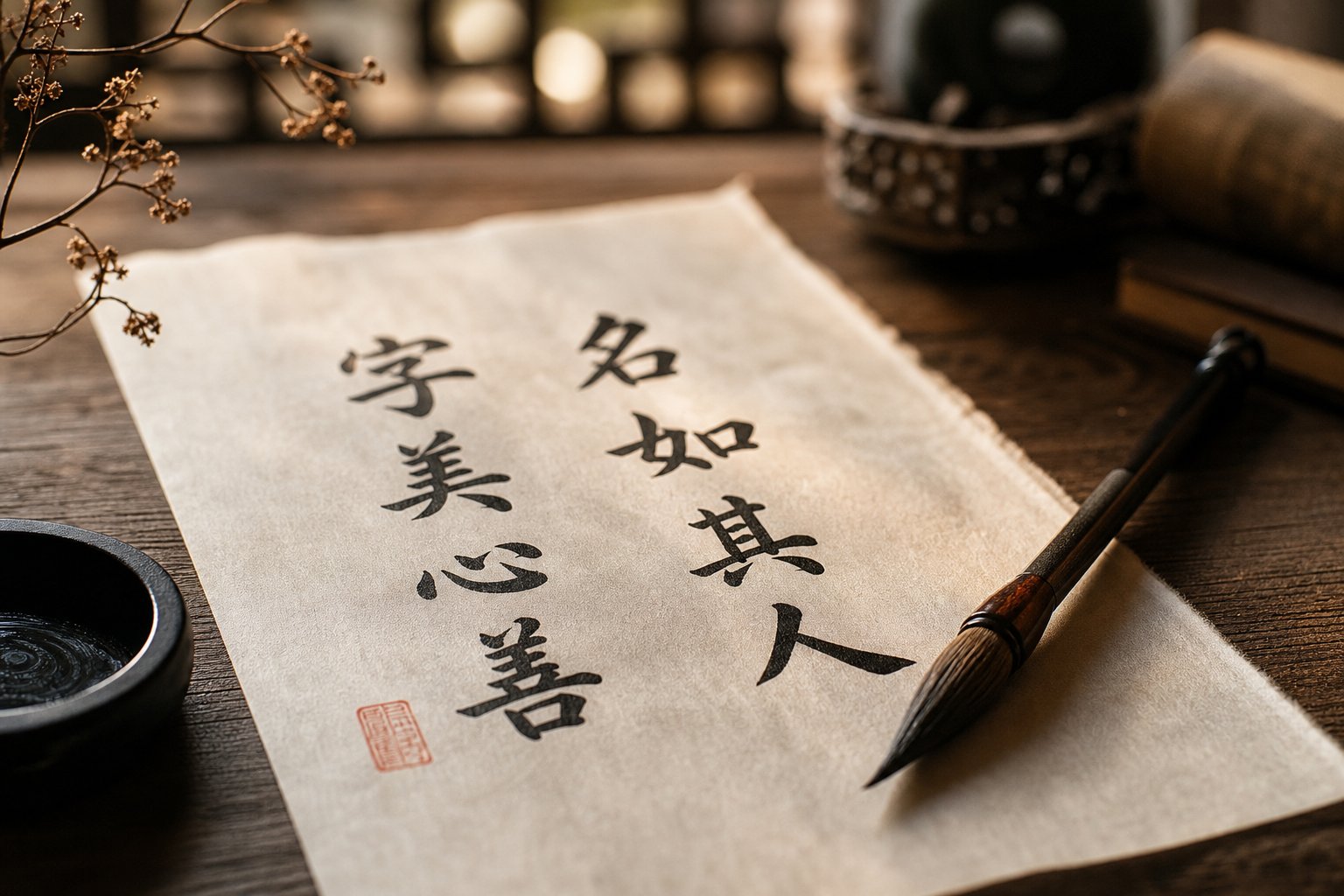
There's a saying in Chinese culture: 名如其人 (ming ru qi ren), meaning "a name reflects the person." But it goes deeper than reflection. The belief is that a name actively shapes destiny. When parents choose a character like 智 (wisdom) or 仁 (benevolence), they aren't describing their newborn. They're encoding an aspiration into the child's very identity, a moral compass the child will carry through life.
A Chinese name is a parent's deepest aspiration compressed into language, the first and most enduring gift a family gives.
So do chinese names have meanings? Every single one. Not as a bonus feature, but as the entire point. Chinese families look through thousands of characters searching for one with the right wishes for a newborn. The choices are nearly infinite because meaning chinese names carry isn't limited to dictionary definitions. It lives in the visual structure of the character, its sound, its literary history, and how it interacts with the surname beside it.
Why Meaning Matters More Than Sound
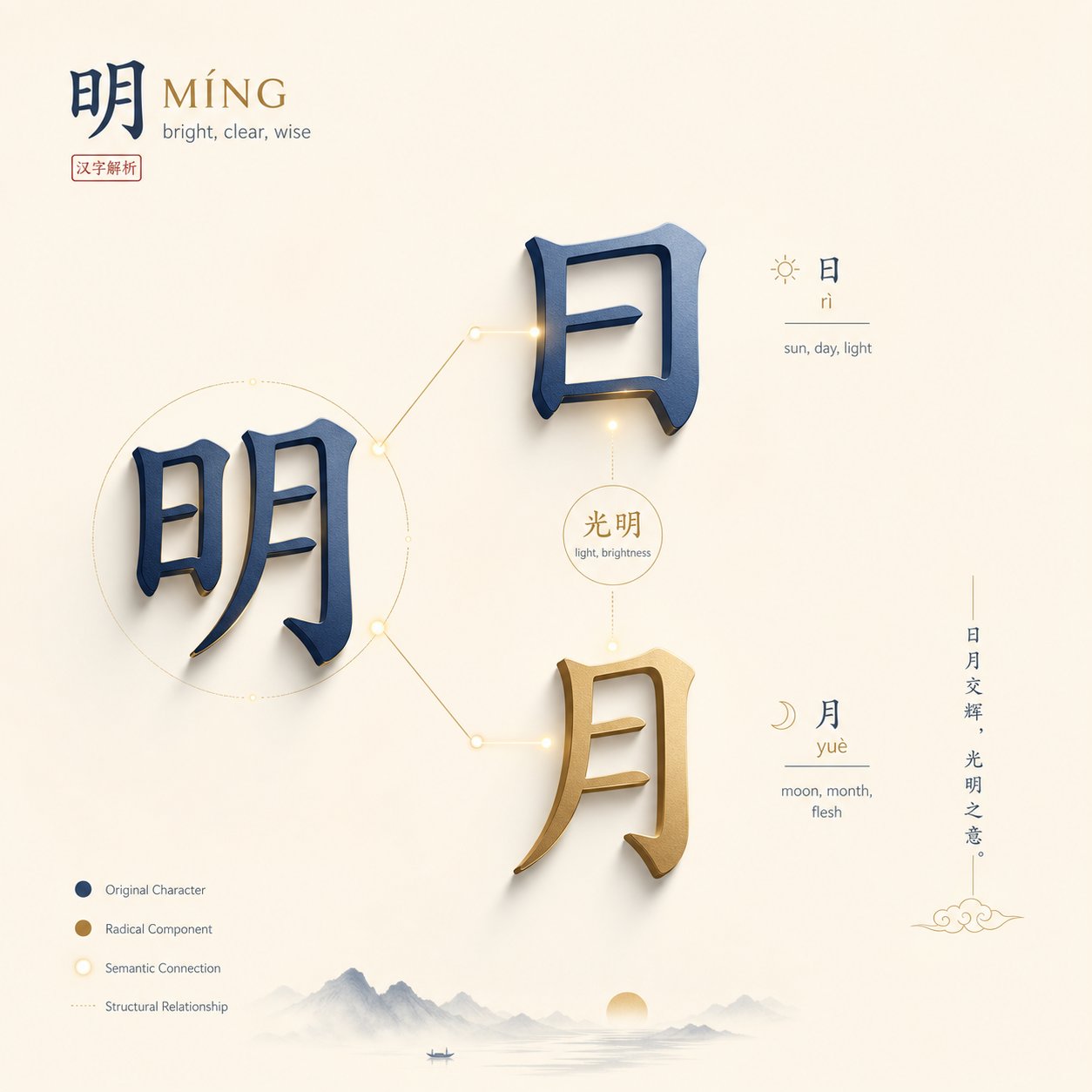
In alphabetic naming systems, sound comes first. Parents choose "Sophia" because they like how it rolls off the tongue, and the Greek meaning of "wisdom" is a nice bonus. Chinese naming inverts this entirely. Meaning leads. Sound follows. A name in chinese meaning operates through visible, structural logic: you can literally see the sun (日) and moon (月) inside the character 明 (bright). Names in chinese and meanings are inseparable because the writing system itself is built from semantic components, not phonetic letters.
This is why romanized spellings like "Li" or "Wei" tell you almost nothing. The same syllable can represent dozens of different characters, each with a completely different meaning. Understanding how those characters actually build meaning, layer by layer, is where the real story begins.
How Chinese Characters Build Meaning Layer by Layer
Every Chinese character is a small machine of meaning. Unlike letters in an alphabet, which represent sounds, characters are assembled from components that carry semantic weight. When you encounter a name meaning chinese families have chosen, you're looking at a composition where visual structure, sound, and cultural resonance all work together. Understanding how these layers operate is the key to grasping what any Chinese name actually says.
Radicals as Building Blocks of Meaning
Think of radicals as the DNA of Chinese characters. There are 214 radicals in the traditional system, and each one signals a category of meaning. Spot the radical 女 (woman) inside a character, and you know it likely relates to something feminine. See 水 or its compressed form 氵 (water), and the character connects to liquid, fluidity, or emotion. The radical 金 (metal) points toward wealth, sharpness, or precious materials. And 木 (wood) signals growth, trees, or organic life.
In naming, parents use this knowledge deliberately. A child whose birth chart lacks the water element might receive a name containing 海 (sea), 洁 (pure), or 涵 (contain), all built with the water radical. A name with 琳 (beautiful jade) carries the 王/玉 radical for jade and royalty. You'll notice that radicals don't just hint at meaning. They anchor the character to an entire conceptual family.
One Sound, Many Characters
Here's where things get fascinating and where most confusion about what a chinese name mean arises. Mandarin has roughly 400 distinct syllables. Spread across four tones, that gives about 1,600 possible sounds to represent tens of thousands of characters. The result? Massive homophony.
The li chinese name meaning question is a perfect example. When someone tells you their name is "Li," you've learned almost nothing. Are they 丽 (beautiful)? 力 (strength)? 利 (sharp, profitable)? 李 (plum tree, also one of China's most common surnames)? 礼 (ritual, propriety)? Each character carries a completely different identity, different radicals, different stroke counts, different cultural weight. The li name meaning chinese parents intended can only be understood by seeing the actual character.
| Pinyin | Character | Meaning | Common Usage in Names |
|---|---|---|---|
| lì | 丽 | Beautiful, elegant | Female given names suggesting grace |
| lì | 力 | Strength, power | Male given names suggesting capability |
| lì | 利 | Sharp, profitable | Names wishing success and prosperity |
| lǐ | 李 | Plum tree | One of the top 3 Chinese surnames |
| lǐ | 礼 | Ritual, propriety | Names emphasizing Confucian virtue |
This same principle applies across the language. The kai name meaning chinese families select could be 凯 (triumphant), 开 (open), or 楷 (model, standard), each projecting a different aspiration. Similarly, the huan name meaning chinese parents choose might be 欢 (joyful), 焕 (radiant), or 环 (ring, circle), each painting a distinct picture of who they hope their child will become.
Why Pinyin Alone Cannot Convey a Name
Mandarin's four tones add another layer of complexity. A high, flat first tone (mā) means mother. A rising second tone (má) means hemp. A dipping third tone (mǎ) means horse. A falling fourth tone (mà) means scold. Same syllable, four completely different realities. In names, tonal differences separate 伟 (wěi, great) from 卫 (wèi, protect) from 威 (wēi, mighty).
This is why romanized pinyin, the system that converts Chinese sounds into Latin letters, strips a name of its meaning entirely. Writing "Wei" on a passport tells you how to approximate the sound. It tells you nothing about whether the person's name means "great," "protect," or "mighty." The meaning lives in the character itself, in its radicals, its strokes, and the centuries of literary association it carries.
Characters don't just encode meaning individually, though. When two characters sit side by side in a given name, they create something new, a compound image greater than either part alone. That interaction between surname, generational marker, and personal character is where the full poetry of a Chinese name emerges.
The Three Layers of Meaning in Every Chinese Name
A typical Chinese name has three characters, and each one operates on a different level of meaning. The surname anchors you to ancestry. The generational character links you to siblings and cousins. The individual character carries your parents' personal hopes. Together, these three layers create a compressed narrative: who your family is, where you sit within it, and what they wish for you. Understanding chinese names and meanings requires seeing how all three layers interact.
Surname as Ancestral Identity
The surname comes first in Chinese, both in word order and in cultural priority. It's inherited, unchangeable, and connects you to a lineage stretching back centuries. Unlike Western surnames that often evolved from occupations (Smith, Baker), Chinese surnames carry their original character meanings alongside their clan identity. Wang (王) still visibly means "king." Li (李) still contains the character for "plum tree." Zhang (张) still shows the radical for "bow," referencing the legendary inventor of the bow and arrow.
With only about 400 surnames covering the vast majority of China's population, your surname doesn't individualize you. It situates you within a clan, a geographic origin, and sometimes a royal lineage. The meaning layer here is collective, not personal.
Generational Characters That Link Siblings and Cousins
The middle character in many traditional chinese names with meaning is the generational marker, part of the 字辈 (zibei) system. Families pre-select a sequence of characters, sometimes drawn from a poem or a set of Confucian ideals, and every child born in the same generation shares that character. Your brother, your male cousins, even distant relatives of the same generation all carry the same middle character.
These generation names are worked out long in advance and recorded in family genealogies. They cannot be changed. If the generational character is 建 (build), every cousin in that generation carries "build" in their name, linking them visibly across households and even cities. The chinese meaning of names in this layer is relational: it tells you exactly where someone sits in the family tree.
The Individual Character Where Parents Encode Their Hopes
The final character is where personal meaning lives. This is the space parents agonize over, the character that expresses what they wish for this specific child. A parent hoping for health might choose 康 (kang). One wishing for courage selects 勇 (yong). Beauty calls for 美 (mei). Wisdom points to 灵 (ling). Each chinese name with meaning at this level is a tiny declaration of intent.
What makes chinese names and their meanings so rich is that the individual character doesn't exist in isolation. It interacts with the surname and generational character to form a compound image. Two characters placed together can produce emergent meaning that neither carries alone:
- 明 (bright) = 日 (sun) + 月 (moon), two sources of light merging into brilliance
- 安 (peace) = 宀 (roof) + 女 (woman), a woman under a roof suggesting domestic tranquility
- 信 (trust) = 人 (person) + 言 (speech), a person standing by their word
- 好 (good) = 女 (woman) + 子 (child), the bond between mother and child
- 森 (forest) = 木 + 木 + 木, three trees becoming something greater than the sum
When you look at a chinese name and meanings encoded within it, you're reading a three-part composition. The surname says "this is where I come from." The generational character says "this is who walks beside me." The individual character says "this is who my family hopes I'll become." Together, they form a single poetic line, a compressed story of identity, belonging, and aspiration.
Chinese names meaning something specific at each structural level explains why the same character carries different weight depending on its position. But the story doesn't end with structure. The surnames themselves, those inherited anchors of identity, hold surprising histories that reveal how ancient clans, kingdoms, and legends shaped the names hundreds of millions of people carry today.
Chinese Last Names and Their Hidden Histories
Given names are chosen. Surnames are inherited. That distinction shapes everything about how chinese last name meanings operate. While parents spend weeks selecting the perfect given name character, the surname arrives automatically, carrying the weight of clan identity, ancient geography, and sometimes royal blood. Yet each surname character still holds its original meaning, a fossil of the story that created it thousands of years ago.
The Hundred Family Surnames and Their Origins
During the Song Dynasty (960-1279 AD), a scholar compiled the Hundred Family Surnames (百家姓, Bai Jia Xing), a rhyming poem listing 438 surnames that Chinese children memorized for generations. The poem opens with Zhao (赵) not because it was the most common, but because it was the Song emperor's surname. Politics shaped even the ordering of names.
What's remarkable about chinese last names and meanings is how concentrated they remain. The top 100 surnames cover roughly 85% of China's 1.4 billion people. The top three alone, Li, Wang, and Zhang, account for nearly 300 million people. This concentration happened because Chinese surnames consolidated early in history, originating from a limited set of sources: ancient tribal clans, imperial family lines, geographic states, and occupational roles.
What the Most Common Surnames Originally Meant
Every chinese last name meaning traces back to a concrete image or concept. Wang (王) meant "king," its three horizontal lines representing heaven, humanity, and earth connected by a vertical stroke of authority. Li (李) meant "plum tree," combining the radicals for wood (木) and child (子). Zhang (张) meant "to draw a bow," referencing a legendary ancestor credited with inventing the bow and arrow.
These original meanings still live inside the characters, visible to anyone who reads them. But unlike given names, where meaning is the entire point of selection, surname meanings have faded into the background over millennia. Nobody chooses the surname Wang because they want their child associated with kingship. They carry it because their ancestors did.
| Surname | Pinyin | Original Meaning | Historical Origin | Approx. Population |
|---|---|---|---|---|
| 王 | Wang | King, monarch | Royal families and nobility | ~101 million |
| 李 | Li | Plum tree | Tang Dynasty imperial surname | ~101 million |
| 张 | Zhang | To draw a bow | Yellow Emperor's grandson, bow inventor | ~95 million |
| 刘 | Liu | Battle axe, to conquer | Han Dynasty imperial surname | ~70 million |
| 陈 | Chen | To display, ancient | State of Chen (Zhou Dynasty) | ~60 million |
| 杨 | Yang | Poplar tree | Geographic origin, tree-related clan | ~40 million |
| 黄 | Huang | Yellow (imperial color) | Connected to the Yellow Emperor | ~34 million |
| 赵 | Zhao | Ancient kingdom | State of Zhao (Warring States period) | ~30 million |
| 周 | Zhou | Complete circle, cycle | Zhou Dynasty (longest Chinese dynasty) | ~25 million |
| 林 | Lin | Forest | Two tree radicals side by side | ~20 million |
Zou, Bai, and Other Surnames With Surprising Histories
Beyond the dominant surnames, less common ones reveal unexpected stories. The zou meaning chinese name scholars trace back points to the ancient State of Zou in present-day Shandong province, the birthplace of Mencius, one of Confucianism's greatest thinkers. Ranked 68th in frequency, 邹 (Zou) carries the weight of philosophical heritage in a single character.
Bai (白), meaning "white" or "pure," ranks 70th and connects to the legendary poet Li Bai, whose courtesy name became a surname for his descendants. Jin (金) means "gold." Ma (马) means "horse." Shi (石) means "stone." Each surname is a window into what mattered to the clan that first carried it: their land, their trade, their totemic animal, or their royal patron.
Understanding chinese last names meaning requires recognizing this fundamental difference from given names. Surnames are identity fossils. They preserve ancient meanings without requiring the bearer to embody them. Given names are living aspirations. They demand interpretation. When you explore chinese family names and meanings together, you see two different relationships to language: one frozen in history, the other freshly composed with every new generation.
The meaning of chinese last names tells you where a family came from. The meaning of given names tells you where they hope to go. And those given names don't scatter randomly across the dictionary. They cluster into recognizable categories, each rooted in a distinct philosophical tradition about what makes a life worth naming.
A Taxonomy of Meaning Categories in Chinese Names
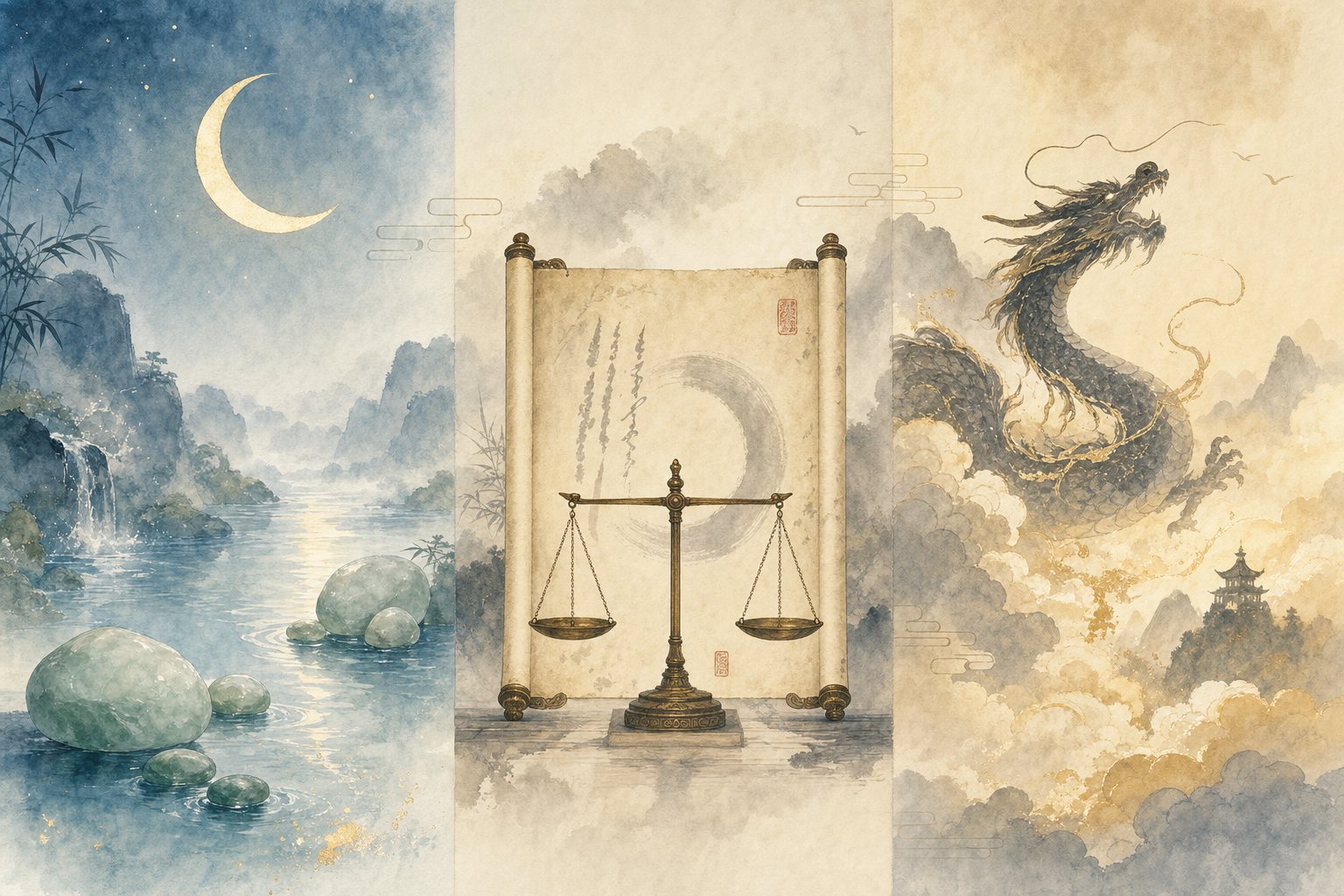
Chinese given names don't scatter randomly across the dictionary. They cluster into recognizable families of meaning, each rooted in a distinct philosophical tradition about what makes a life worth living. When you map these clusters, a clear taxonomy emerges: nature and element names drawn from the physical world, virtue names encoding moral character, and aspiration names projecting worldly success. Beneath each category lies a different answer to the question of what a name should do.
Nature and Element Names
Daoist philosophy teaches harmony with the natural world, and this influence runs deep through Chinese naming. Parents who choose nature characters are placing their child within the rhythms of the earth, sky, and seasons rather than above them.
The yue chinese name meaning is one of the most beloved examples. 月 (yue) means moon, and chinese names that mean moon carry associations of beauty, gentleness, and cyclical renewal. The moon appears constantly in classical poetry as a symbol of longing and elegance, making it a favorite for daughters. Related characters like 映月 (yingyue, reflection of the moon) create even richer imagery.
Chinese names meaning water draw from characters like 海 (hai, sea), 洋 (yang, ocean), 涵 (han, contain), and 溪 (xi, stream). These suggest depth, adaptability, and emotional richness. Chinese names meaning fire use characters like 炎 (yan, flame), 焕 (huan, radiant), and 煜 (yu, brilliant glow), projecting warmth, passion, and transformative energy. Nature names work because they borrow the permanence and beauty of the physical world and attach it to a person.
Virtue and Character Names
Confucian philosophy provides the backbone for virtue-based naming. These names don't describe what a child is. They prescribe what a child should become. The core Confucian virtues, 仁 (ren, benevolence), 义 (yi, righteousness), 礼 (li, propriety), 智 (zhi, wisdom), and 信 (xin, trustworthiness), appear directly in names or through related characters that echo the same ideals.
A name like 浩然 (haoran, vast and righteous) references Mencius's concept of cultivating a "vast, flowing spirit" of moral courage. 德 (de, virtue) appears in names like 俊德 (junde, handsome virtue). 忠 (zhong, loyalty) and 孝 (xiao, filial piety) encode specific relational duties. These names function as moral compasses, daily reminders of the character traits a family values most.
Buddhist-influenced names add another dimension. Characters like 慧 (hui, wisdom), 悟 (wu, enlightenment), and 净 (jing, purity) reflect spiritual aspiration rather than social virtue, pointing toward inner clarity rather than outward conduct.
Aspiration and Fortune Names
Where virtue names focus on who you should be, aspiration names focus on what you should achieve. These are the most direct expressions of parental hope: prosperity, victory, strength, and success written plainly into a child's identity.
Characters like 福 (fu, blessing), 兴 (xing, prosperity), 胜 (sheng, victory), and 富 (fu, wealth) leave little room for ambiguity. The chinese name meaning dragon falls squarely in this category. 龙 (long) represents imperial power, excellence, and extraordinary achievement. Chinese names meaning dragon have been popular for boys across centuries because the dragon symbolizes the highest possible aspiration in Chinese culture, strength paired with wisdom and cosmic authority.
Literary allusion names form a sophisticated subcategory. Parents draw from Tang Dynasty poetry, the Book of Songs (诗经), or the Analerta of Confucius to find two-character combinations that carry the weight of classical literature. A name like 思远 (siyuan, thinking far) echoes philosophical texts about long-term vision, while 若水 (ruoshui, like water) references Laozi's teaching that the highest good flows like water.
| Theme | Character | Pinyin | Meaning | Traditional Gender Use |
|---|---|---|---|---|
| Nature - Moon | 月 | yue | Moon | Girls |
| Nature - Flora | 花 | hua | Flower | Girls |
| Nature - Mineral | 玉 | yu | Jade | Both |
| Nature - Water | 海 | hai | Sea, ocean | Boys |
| Nature - Fire | 煜 | yu | Brilliant glow | Boys |
| Virtue | 仁 | ren | Benevolence | Boys |
| Virtue | 慧 | hui | Wisdom | Both |
| Virtue | 忠 | zhong | Loyalty | Boys |
| Aspiration | 福 | fu | Blessing, fortune | Both |
| Aspiration | 龙 | long | Dragon | Boys |
| Aspiration | 胜 | sheng | Victory | Boys |
| Literary | 若 | ruo | Like, as if (poetic) | Girls |
These categories aren't rigid walls. Modern parents blend them freely, pairing a nature character with a virtue character to create names like 林信 (linxin, forest + trust) or 海智 (haizhi, sea + wisdom). The taxonomy reveals the philosophical roots, but living names grow in every direction. What remains constant is that each character chosen carries the weight of a tradition, whether Daoist, Confucian, or Buddhist, that tells parents what kind of meaning is worth giving a child.
These meaning categories also carry a dimension that the taxonomy alone doesn't capture: gender. Certain characters have been coded masculine or feminine for centuries, shaping which meanings parents reach for depending on whether they're naming a son or a daughter. That gendered landscape is shifting rapidly, but understanding its traditional contours reveals yet another layer of how meaning operates in Chinese names.
Gendered Meanings and How Modern Naming Is Evolving
For centuries, Chinese naming followed an unspoken rule: certain meanings belong to sons, others to daughters. A boy's name should project strength, ambition, and vastness. A girl's name should evoke beauty, grace, and delicacy. These conventions weren't arbitrary. They reflected Confucian ideals about gender roles, encoding social expectations into the very first gift a child receives. But the landscape of chinese girl names and meanings versus chinese boy names and meanings is shifting faster than any generation before.
Traditional Feminine Name Meanings
When you look at chinese female names and meanings from the traditional canon, you'll notice a consistent palette: softness, beauty, nature's gentler elements, and moral grace. Parents reaching for a daughter's name historically drew from characters associated with flowers, jade, the moon, and elegance.
- 美 (mei) - beautiful, the most direct expression of aesthetic aspiration
- 雅 (ya) - elegant, refined, cultured
- 兰 (lan) - orchid, symbolizing quiet nobility
- 玉 (yu) - jade, representing purity and preciousness
- 月 (yue) - moon, evoking gentle luminosity
- 婷 (ting) - graceful posture
- 淑 (shu) - virtuous, gentle-natured
- 芳 (fang) - fragrant, often paired with flower imagery
A name like 美丽 (meili, beautiful) is about as traditionally feminine as it gets, combining two characters that both mean beauty. 雨桐 (yutong, rain and paulownia tree) represents a more poetic approach, pairing spring rain with the elegant paulownia, a tree associated with the phoenix in Chinese mythology. Among beautiful chinese names for girl with meaning, this style of nature-poetry naming has become especially popular with modern parents who want femininity without being too literal about it.
The chinese female names meaning patterns also draw heavily from the 女 radical. Characters like 娜 (na, graceful), 妍 (yan, beautiful), and 婉 (wan, gentle) all carry this radical, visually signaling their gendered intent right in the character's structure.
Traditional Masculine Name Meanings
Chinese male names and meanings traditionally occupy the opposite end of the spectrum: power, scale, moral fortitude, and worldly achievement. Where feminine names look inward and downward (flowers, streams, jade), masculine names look outward and upward (mountains, sky, dragons, armies).
- 强 (qiang) - strong, powerful
- 龙 (long) - dragon, imperial excellence
- 伟 (wei) - great, mighty
- 勇 (yong) - brave, courageous
- 志 (zhi) - ambition, will
- 山 (shan) - mountain, immovable strength
- 杰 (jie) - heroic, outstanding
- 昊 (hao) - vast sky
浩然 (haoran, vast and righteous) is a classic example of chinese boy names and meanings at their most aspirational. The name references Mencius's philosophical concept of cultivating an expansive moral spirit, combining physical vastness with ethical uprightness. It's been one of China's most popular boy names for years precisely because it balances strength with virtue.
Other popular patterns for boys include characters suggesting brightness and leadership: 明 (ming, bright), 辉 (hui, radiance), 鹏 (peng, the mythical roc bird). The underlying logic is consistent. A son's name should project what he'll become in the world, while a daughter's name should reflect who she is in character.
How Modern Parents Are Breaking Gendered Naming Rules
That traditional divide is eroding. Contemporary parents, especially urban families born after the 1980s, increasingly reject the idea that meaning should be gendered at all. The shift shows up in several ways.
Gender-neutral nature names are gaining ground rapidly. Characters like 安 (an, peace), 禾 (he, grain), 宁 (ning, tranquility), and 言 (yan, speech) appear in names for both boys and girls without raising eyebrows. Modern naming guides now routinely include gender-neutral sections, reflecting how quickly conventions are shifting. Names like 安然 (anran, peaceful), 清宁 (qingning, clear tranquility), and 乐言 (leyan, joyful speech) work for any child regardless of gender.
Parents are also crossing traditional gender lines deliberately. Girls receive names with 智 (wisdom) and 毅 (perseverance), characters once reserved for sons. Boys get names with 柔 (gentle) or 安 (peaceful), qualities previously coded feminine. The female chinese names and meanings landscape now includes characters like 凯 (triumphant) and 睿 (astute) that would have seemed exclusively masculine a generation ago.
Even names with darker or unconventional meanings are finding acceptance. Characters suggesting night, solitude, or melancholy, once avoided as inauspicious, now appeal to parents who value individuality over traditional blessing formulas. 墨 (mo, ink), 夜 (ye, night), and 寂 (ji, solitude) appear in contemporary names that prioritize aesthetic depth over conventional good fortune.
This evolution in chinese names female and meanings reflects broader cultural change. As gender roles shift in Chinese society, the naming system absorbs those shifts character by character. The old categories haven't disappeared. They've simply stopped being mandatory. A parent today can still choose 美 for a daughter or 强 for a son. The difference is that they're choosing it, not defaulting to it.
Gender is one dimension parents navigate. But it's far from the only consideration shaping their final choice. Behind every name lies a selection process that can involve fortune tellers, elemental analysis, stroke-count calculations, and a web of cultural taboos that most outsiders never see.
How Chinese Parents Actually Choose a Meaningful Name
Choosing chinese baby names and meanings isn't a casual afternoon activity. It's a multi-step process that can stretch over weeks or months, involving calculations most Western parents would never imagine. Fortune tellers, elemental charts, stroke-count numerology, and a minefield of cultural taboos all feed into the final decision. The goal isn't just a name that sounds nice. It's a name that aligns a child's identity with cosmic forces, family lineage, and linguistic harmony all at once.
The Five Elements and Name Balance
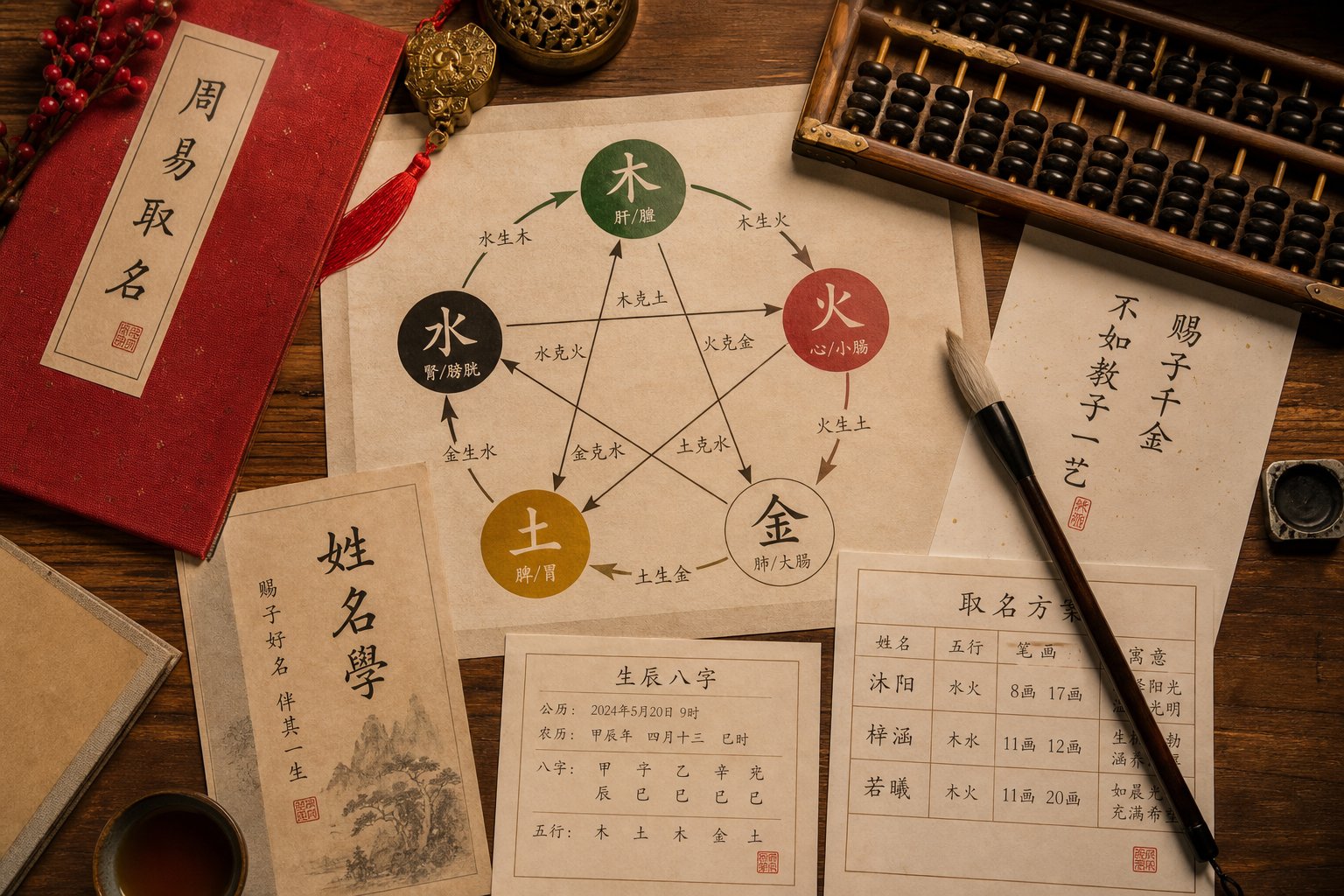
At the heart of traditional Chinese naming sits Wu Xing (五行), the system of five elemental phases: Wood (木), Fire (火), Earth (土), Metal (金), and Water (水). These aren't physical materials. They're dynamic patterns of energy that describe how the universe transforms, first documented in the Book of Documents roughly 3,000 years ago.
Here's how it connects to naming. Every person's birth date and time generates a BaZi (八字) chart, sometimes called the Four Pillars of Destiny. This chart maps which elements are strong, weak, or completely absent in your personal energy profile. A child born with abundant Fire but no Water in their chart is considered imbalanced. The name becomes the remedy.
Each element corresponds to specific radicals and characters that a naming specialist can draw from:
| Element | Common Radicals | Example Name Characters | Qualities Invoked |
|---|---|---|---|
| Wood (木) | 木, 艹 (grass) | 林 (forest), 桐 (paulownia), 芳 (fragrant) | Growth, vitality, flexibility |
| Fire (火) | 火, 灬 (fire dots) | 炎 (flame), 煜 (radiant), 照 (illuminate) | Passion, warmth, visibility |
| Earth (土) | 土, 山 (mountain) | 坤 (earth/feminine), 岳 (peak), 城 (city) | Stability, reliability, grounding |
| Metal (金) | 金, 钅 | 鑫 (prosperity), 铭 (inscription), 锐 (sharp) | Discipline, clarity, resilience |
| Water (水) | 氵, 雨 (rain) | 涵 (contain), 泽 (marsh/beneficence), 润 (moist) | Wisdom, adaptability, depth |
So a child lacking Water energy might receive a name like 泽 (ze, meaning marsh or beneficence), which carries strong Water energy while also suggesting generosity, like water flowing to sustain fertile land. When parents search for a chinese name for boy with meaning that balances his elemental chart, they're not just picking a nice word. They're prescribing cosmic medicine.
Stroke Count Analysis and Numerology
Beyond elemental balance, many families analyze 笔画 (bihua), the stroke count of each character. Traditional numerology assigns lucky or unlucky values to specific numbers of strokes, and the total stroke count across a full name matters as much as the individual characters. A name might carry perfect meaning and elemental balance but get rejected because its stroke count falls on an inauspicious number.
This is where the process becomes genuinely complex. The character must satisfy meaning, elemental alignment, tonal harmony with the surname, visual balance in calligraphy, and favorable stroke numerology simultaneously. Finding chinese names with meanings that check every box is why families sometimes consult professionals rather than choosing alone.
Birth Charts and Fortune Telling in Name Selection
The traditional naming process, still practiced by millions of families in modern China, follows a structured sequence:
- Record the child's exact birth date and time (year, month, day, hour) to calculate the BaZi (八字) chart
- Analyze the chart to identify which of the five elements are dominant, weak, or missing
- Determine which element the name should reinforce based on the Day Master's strength
- Select candidate characters that carry the needed elemental radical and positive meaning
- Check stroke counts for numerological favorability across the full name
- Test tonal flow by speaking the full name aloud repeatedly, ensuring it sounds natural
- Verify the name against taboos: no shared characters with ancestors, no unlucky homophones, no overly rare characters that cause daily inconvenience
- Consult family elders or a professional naming specialist for final approval
Even families who don't consult fortune tellers often follow a simplified version of this process. The belief that a name shapes destiny, that 姓名学 (xingmingxue, "name science") is a legitimate practice, remains deeply embedded in Chinese culture. Name consultants stay busy in modern cities like Beijing and Shanghai whenever babies are born.
A chinese name generator with meanings can offer starting points for parents exploring options, but most families treat automated tools as inspiration rather than final answers. The reason is simple: no algorithm can fully replicate the layered judgment of checking elemental balance, stroke numerology, tonal harmony, and cultural taboos simultaneously. When searching for chinese boys names and meaning that satisfy all these dimensions, human expertise still matters.
The Taboos That Eliminate Options
Equally important as what goes into a name is what must stay out. Chinese naming taboos (避讳, bihui) eliminate entire categories of otherwise beautiful characters:
- Never reuse a direct ancestor's name characters, especially grandparents or great-grandparents. This is considered deeply disrespectful.
- Avoid characters that sound like negative words. Any syllable resembling 死 (si, death), 苦 (ku, suffering), or 败 (bai, defeat) gets eliminated regardless of the character's actual meaning.
- Historically, using an emperor's name characters was forbidden across the entire empire. Modern families still avoid names of prominent political figures.
- Characters that are too rare or complex create practical problems: people can't read them, computers can't always render them, and government systems may reject them.
These taboos aren't quaint superstitions that modern families have abandoned. They're living constraints. A 2024 survey by Chinese parenting platforms found that over 70% of urban parents still check homophones for negative associations before finalizing a name. The number four (四, si) remains so strongly associated with death (死, si) that entire naming categories get avoided simply because they share a similar sound.
What emerges from this process is a name that has survived multiple filters: elemental analysis, numerological scrutiny, tonal testing, taboo checking, and family consensus. A chinese name maker with meaning built into its algorithm can simulate parts of this process, but the cultural weight behind each decision reflects thousands of years of accumulated belief about the relationship between language and fate.
This elaborate selection process hasn't remained static, though. The criteria parents prioritize, the meanings they reach for, and the taboos they observe have shifted dramatically across generations, shaped by revolution, globalization, and the internet in ways that make each era's names instantly recognizable.
How Chinese Name Meanings Have Shifted Across Generations
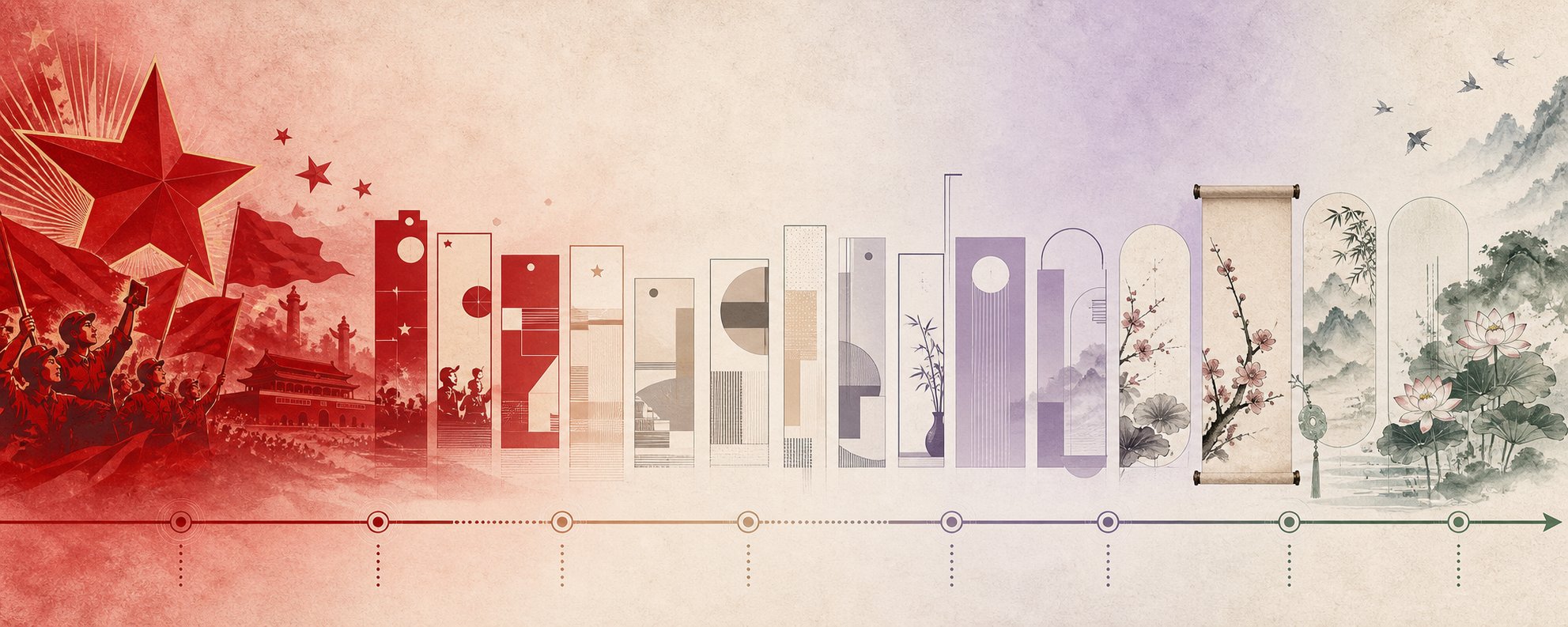
Chinese names meanings don't exist in a vacuum. They reflect the political climate, cultural mood, and collective aspirations of the era in which they were given. Look at a person's name in China, and you can often guess their birth decade within a few years. Revolutionary fervor, economic reform, classical revival, and internet culture have each left distinct fingerprints on the naming landscape, turning chinese names into a living timeline of modern history.
This generational layering also has deep roots. Before the modern era, educated Chinese people didn't carry just one name. They operated within a multi-name system where meaning functioned across several layers simultaneously.
The 字 (zi, courtesy name) was given at adulthood, typically complementing or expanding the birth name's meaning. If your given name meant "bright," your courtesy name might mean "illuminating the path." The 号 (hao, art name) was self-chosen, often reflecting personal philosophy or artistic identity. A poet might take an art name meaning "hermit of the eastern mountain" to signal his Daoist leanings. Ancient chinese names and meanings operated across this entire system, with each layer adding nuance and depth to a person's identity.
The multi-name tradition faded during the 20th century, but the impulse behind it, encoding meaning at multiple levels, never disappeared. It simply compressed into the two or three characters of a modern given name. And those characters shifted dramatically with the times.
Revolutionary Era Names and Political Meaning
From the late 1950s through the 1970s, Chinese naming became intensely political. The Great Leap Forward, the Cultural Revolution, and Mao's promotion of the People's Liberation Army as a national model all flooded the naming pool with ideological characters. Parents weren't just expressing personal hopes. They were declaring political allegiance.
The Chinese name database covering 1.2 billion Han Chinese individuals born between 1930 and 2008 reveals just how dominant these patterns were. In the 1960s and 1970s birth cohorts, the most popular name characters read like revolutionary slogans:
- 红 (hong) - red, the color of communism and revolution
- 军 (jun) - army, military
- 建国 (jianguo) - build the nation
- 卫东 (weidong) - defend the East (a reference to Mao)
- 海军 (haijun) - navy
- 忠 (zhong) - loyalty (to the Party)
A 64-year-old foreign trade merchant named Feng Aimin (love the people) told the Global Times that her brother is Feng Jianguo (build the country) and her sister is Feng Yongjun (support the army). Three siblings, three political declarations. "It's my parents' way of reminding me never to forget where I came from and what I am," she said.
These names weren't subtle. They weren't poetic. They were ideological commitments stamped onto children, reflecting an era when personal aspiration was subordinated to collective purpose. The meaning was political before it was personal.
The Classical Revival and Literary Names
After Mao's death in 1976 and Deng Xiaoping's economic reforms, naming shifted rapidly. The 1980s generation, often called "little emperors" due to the one-child policy, saw a surge in single-character given names. With no siblings to share a generational character, parents opted for more direct, individual expressions. Characters like 伟 (wei, great), 强 (qiang, powerful), and 杰 (jie, excellence) dominated, reflecting the pioneering spirit of reform-era China.
But single-character names created an unexpected problem. With limited syllables and a massive population, millions of people ended up sharing identical names. The Chinese internet coined the term "market names" (菜市场名) to describe how calling out a common name in a crowded space could turn dozens of heads. Two-character given names returned with force in the 1990s.
The 1990s and 2000s brought a dramatic pivot toward romanticism and literary elegance. Influenced by Hong Kong and Taiwanese pop culture, parents favored characters like 梦 (meng, dream), 雨 (yu, rain), and 涵 (han, cultivation). Names became softer, more poetic, less about what a child should achieve and more about who they might be.
The shift from 建国 (build the nation) in the 1960s to 梦涵 (dream and cultivation) in the 2000s captures an entire civilization pivoting from collective ideology to individual poetry in just two generations.
By the 2010s and 2020s, the classical revival deepened further. Young parents, particularly the post-1990 generation, began drawing directly from ancient texts. Names like 锦程 (Jincheng), rooted in the idiom "the future is like brocade," and 砚舟 (Yanzhou), drawn from a Northern Song Dynasty poem comparing an inkstone to a boat carrying thought, appeared on newborn name lists across multiple provinces. Cultural sociologist Xu Shumin described this trend as young parents "reclaiming traditional Chinese culture as a living aesthetic in everyday life."
Contemporary Trends From Internet Culture to Global Influence
Today's naming landscape is the most fragmented in Chinese history. Multiple trends coexist simultaneously, driven by globalization, internet culture, and a generation of parents who grew up with unprecedented access to information.
Four-character names (combining both parents' surnames plus a two-character given name) are gaining visibility as a way to honor maternal lineage. Internet-influenced names borrow from anime, gaming, and online fiction. Some parents choose characters that sound like English names, creating bilingual puns. Others deliberately seek chinese names with dark meanings, selecting characters associated with night, solitude, or melancholy that would have been considered inauspicious a generation ago.
This last trend deserves attention. Chinese names that mean night, like those using 夜 (ye, night), 暮 (mu, dusk), or 冥 (ming, darkness), were traditionally avoided because of associations with death and misfortune. Parents seeking chinese girl names with dark meanings might now choose characters like 墨 (mo, ink/darkness), 霜 (shuang, frost), or 寒 (han, cold), valuing aesthetic depth and individuality over conventional blessings. The shift toward chinese names with dark meanings girl parents select reflects a broader cultural move away from superstition and toward personal expression.
Meanwhile, the classical-literary trend continues accelerating. A village in Jinhua, Zhejiang Province, still derives every resident's name from an 80-character poem in their family genealogy, with each character rotating every five years. "It serves as a reminder of my responsibility as a descendant: to protect and preserve my family's heritage," village leader Zhuge Kunheng told the Global Times.
The tension between these approaches, tradition-heavy naming versus contemporary minimalism, internet aesthetics versus classical allusion, defines the current moment. Chinese names meanings have always reflected the zeitgeist. What's new is that the zeitgeist itself has fractured into dozens of simultaneous currents, giving parents more freedom and more confusion than any previous generation faced.
All of this historical context matters for anyone trying to understand what a specific Chinese name means today. But the practical question remains: if you encounter a Chinese name, whether your own or someone else's, how do you actually uncover the meaning hidden inside its characters?
Reading the Meaning Behind Any Chinese Name
You've seen how chinese name meanings operate through radicals, elements, tones, and generational layers. The natural next question is practical: how do you actually decode a specific name? Whether you're curious about a colleague's name, researching your own heritage, or choosing a name for a child, the process starts with one critical insight.
Why Romanized Names Hide Their Meaning
If someone tells you their name is "Li Wei," you're holding a shell with no pearl inside. Romanized pinyin captures approximate sound but strips away everything that carries meaning: the radical structure, the stroke composition, the tonal distinction, and the literary associations. As we explored earlier, "Li" alone could mean plum tree, beautiful, strength, or ritual. "Wei" could mean great, protect, mighty, or danger. Without seeing the actual characters, you're guessing among dozens of possibilities.
This is why a chinese name meaning translator that works from pinyin alone will always fall short. The meaning of chinese names lives in the characters themselves, not in their romanized shadows. Any reliable chinese name translation and meaning must begin with identifying the specific characters, either by asking the person directly or by seeing the name written in Chinese.
How to Discover What a Chinese Name Truly Means
So what does my name mean in chinese? If you're asking this about a name you've only seen in pinyin or English letters, you'll need to work backward to the characters first. Here's a practical approach:
- Ask the person to write their name in Chinese characters, or find it on a document, business card, or social media profile where characters appear
- Look up each character individually using a dictionary that shows radical breakdown, stroke order, and multiple definitions
- Check how the characters interact together, since two-character combinations often create compound meanings beyond their individual parts
- Research the cultural and literary associations of each character, especially connections to classical poetry, philosophy, or historical figures
- Consider the character's position in the name: is it a surname (inherited meaning), a generational marker (relational meaning), or an individual character (aspirational meaning)?
A chinese name meaning translation that skips any of these steps will miss layers of significance. The character 明 isn't just "bright." It's sun and moon combined, two celestial lights merging into clarity. That visual poetry is part of the name's meaning, invisible to anyone who only reads the pinyin "ming."
Choosing or Understanding a Chinese Name With Intention
If you're wondering what does my name in chinese mean and you already know your characters, the process is simpler but still requires depth. Don't stop at the first dictionary definition. Explore which radical family your characters belong to, what element they carry, and what cultural significance they hold. A name that seems straightforward on the surface often reveals unexpected richness when you examine its components.
For those choosing a Chinese name, whether as a heritage connection or for use while living in China, the most common mistake is transliterating an English name into characters that approximate its sound but carry no coherent meaning. The result sounds neither like the original nor like an authentic Chinese name. A better approach is to start with meaning: what qualities, images, or aspirations do you want your name to carry? Then find characters that express those ideas while sounding natural together.
What does my chinese name mean is ultimately a question about identity. Every Chinese name is a living composition, a compressed poem that encodes family values, cultural philosophy, and personal aspiration into two or three characters. Understanding that composition, whether it belongs to you or someone you know, opens a window into how an entire civilization thinks about the relationship between language and life. The meaning isn't hidden. It's built right into the strokes.
Frequently Asked Questions About Chinese Name Meanings
1. Do Chinese names have meanings?
Every Chinese name carries deliberate meaning. Unlike alphabetic names where meaning is often secondary to sound, Chinese names are built from characters specifically chosen for their semantic content. Each character contains radicals that signal categories of meaning, literary associations from classical texts, and philosophical weight. Parents spend weeks selecting characters that encode aspirations like wisdom, strength, beauty, or harmony. The belief that a name shapes destiny (名如其人) makes meaning the primary consideration in Chinese naming, not a bonus feature.
2. How do I find out what my Chinese name means?
Start by identifying the actual Chinese characters, not just the romanized pinyin spelling. Pinyin like 'Li Wei' could represent dozens of different character combinations with completely different meanings. Once you have the characters, look up each one individually in a Chinese dictionary that shows radical breakdown and multiple definitions. Then examine how the characters interact together, since two-character combinations often create compound meanings. Consider each character's position: surnames carry inherited clan meaning, while given name characters express personal aspirations chosen by parents.
3. Why do Chinese names sound the same but mean different things?
Mandarin Chinese has only about 400 distinct syllables, which expand to roughly 1,600 when you include the four tones. These limited sounds must represent tens of thousands of characters, creating massive homophony. The syllable 'li' alone can mean beautiful (丽), strength (力), sharp (利), plum tree (李), or ritual (礼). Tonal differences add another layer: a high flat tone versus a falling tone produces entirely different characters. This is why romanized spellings strip Chinese names of their meaning, and why you must see the written characters to understand what a name actually says.
4. How do Chinese parents choose a name with the right meaning?
Traditional Chinese naming involves multiple steps beyond simply picking a pleasant-sounding character. Many families calculate the child's BaZi (Eight Characters) birth chart to identify which of the five elements (wood, fire, earth, metal, water) need strengthening. They then select characters containing the appropriate elemental radicals. Stroke count numerology, tonal harmony with the surname, and cultural taboos (avoiding ancestor names, unlucky homophones, overly rare characters) all filter the options further. Some families consult professional naming specialists who balance all these factors simultaneously.
5. What are the most common meaning categories in Chinese names?
Chinese given names cluster into three main philosophical traditions. Nature names draw from Daoist harmony with the physical world, using characters for moon, jade, water, flowers, and mountains. Virtue names reflect Confucian moral ideals like benevolence (仁), wisdom (智), loyalty (忠), and righteousness (义). Aspiration names project worldly success through characters meaning prosperity, victory, dragon, or blessing. A fourth category, literary allusion names, borrows two-character combinations from classical poetry and philosophy to carry the weight of ancient texts into a modern identity.