Understanding Buddhist Chinese Names and Their Deep Roots
Imagine a single name that carries a thousand years of spiritual philosophy, compressed into two or three carefully chosen characters. That is the power behind Buddhist Chinese names. They sit at the intersection of two rich traditions: the philosophical depth of Buddhism and the meaning-dense nature of Chinese characters. Unlike a typical secular Chinese name chosen for luck or family legacy, and unlike a Sanskrit Buddhist name rooted in Indian phonetics, these names translate awakening itself into written form.
What Makes a Name Buddhist and Chinese
So what is a Buddhist Chinese name, exactly? It is any name that encodes Buddhist concepts using Chinese characters, whether given during a formal dharma name ceremony (法名 fǎmíng), adopted upon monastic ordination, chosen by parents inspired by Buddhist teachings, or carried by historical figures whose names reflected their spiritual path.
The difference between a dharma name and a standard Chinese name comes down to intent and source. A secular name like 志强 (Zhiqiang, "strong-willed") draws from Confucian ideals of ambition. A Buddhist Chinese name like 慧明 (Huiming, "wisdom-bright") draws directly from dharma vocabulary. The characters themselves often reference sutras, meditation states, or bodhisattva qualities.
Buddhist concepts enter Chinese not through sound-copying but through meaning-translation. The Sanskrit term "prajna" becomes 般若 when transliterated, but transforms into 智慧 (wisdom) when translated by meaning. This meaning-based approach gives Buddhist Chinese names their unique depth: each character is a philosophical statement, not merely a phonetic echo.
Why Buddhist Chinese Names Matter Today
These names appear across surprisingly varied contexts. Practitioners receive them at refuge ceremonies. Parents select them for newborns. Scholars study them in historical texts. Diaspora families use them to reconnect with spiritual heritage. Each context carries its own conventions, yet all share the same foundation: Buddhist philosophy rendered through the precision of Chinese script.
Whether you are exploring Buddhist naming traditions in Chinese culture, preparing for a refuge ceremony, or simply searching for a name with spiritual resonance, understanding how these names work unlocks a deeper appreciation of both the language and the philosophy they carry. The structure behind them, from character selection to tonal balance, follows patterns refined over centuries of practice.
How Buddhist Chinese Names Are Structured and Formed
Every Chinese name packs meaning into a compact frame of two or three characters. Buddhist Chinese names follow the same structural logic but bend the rules in specific ways. Understanding how these names are structured reveals why they feel different from secular names, even when they share the same script.
Surname Placement and Given Name Structure
In standard Chinese naming, the surname (姓 xing) always comes first, followed by a one- or two-character given name (名 ming). A secular name like 王志强 (Wang Zhiqiang) places the family name Wang up front, then the personal name Zhiqiang. The total length is typically two or three characters.
Buddhist dharma names break this pattern. When a lay practitioner receives a dharma name during a refuge ceremony, it usually consists of two characters without a surname attached. A name like 果慧 (Guohui, "fruit of wisdom") stands alone as a spiritual identity. Monastic names go further: ordained monks and nuns abandon their birth surname entirely and adopt 釋 (Shi), derived from Shakyamuni Buddha's clan name. Their full monastic name becomes something like 釋淨空 (Shi Jingkong).
Generational characters in Buddhist lineages add another layer. Within a monastic lineage, all disciples ordained by the same master share one character in their dharma name. If the generational character is 果 (guo, "fruit"), every disciple in that generation carries it as the first character of their two-character name. This system mirrors the secular tradition of generation names (字辈 zibei) but serves a spiritual purpose: it maps your place within a teaching lineage rather than a family tree.
| Component | Secular Example | Buddhist Example |
|---|---|---|
| Surname | 王 (Wang) — inherited family name | 釋 (Shi) — universal monastic surname from Shakyamuni |
| Given name length | 1–2 characters (e.g., 志强 Zhiqiang) | 2 characters (e.g., 淨空 Jingkong) |
| Generational character | Shared among siblings/cousins | Shared among all disciples of one master |
| Source of meaning | Confucian virtues, nature imagery, family hopes | Sutras, dharma concepts, bodhisattva qualities |
| Naming authority | Parents or elders | Ordaining master or presiding teacher |
Transliteration Versus Meaning-Based Translation
When Buddhist terminology entered Chinese from Sanskrit and Pali, translators faced a choice. They could approximate the original sound using Chinese characters (音譯 yinyi, transliteration), or they could find Chinese characters that captured the concept's meaning (意譯 yiyi, meaning-based translation). Both approaches shaped how Buddhist Chinese names sound and feel.
Transliteration produces names like 般若 (Boruo, from Sanskrit "prajna") or 達摩 (Damo, from "Dharma"). These names preserve the foreign phonetics but sacrifice immediate semantic clarity for a Chinese reader. You hear the Sanskrit echoes, yet the characters themselves (般 "sort of," 若 "like") do not convey "transcendent wisdom" on their own.
Meaning-based translation works differently. The same concept of prajna becomes 智慧 (zhihui, "wisdom"), where each character independently communicates the idea. Names built this way feel native to Chinese. A name like 明覺 (Mingjue, "bright awakening") reads as naturally Buddhist to any Chinese speaker because both characters carry clear dharmic weight.
Most personal Buddhist names today favor meaning-based translation. Transliterated terms tend to appear in formal religious titles or historical references rather than in names given to practitioners or children. When parents choose a Buddhist-inspired baby name, they almost always select characters for their meaning rather than their phonetic resemblance to Sanskrit.
Tonal Harmony and Character Selection Principles
Sounds complex? The tonal dimension matters just as much in Buddhist naming as in secular naming. Mandarin's four tones create a musical quality in every name. A well-formed name moves through contrasting tones so it flows when spoken aloud. Two consecutive third-tone characters, for instance, create an awkward dip that skilled namers avoid.
Character selection in Buddhist naming also involves radical analysis. The radical (部首 bushou) is the semantic component embedded within a character. Characters containing the heart radical (忄) often relate to mental states: 悟 (wu, "awakening"), 慈 (ci, "compassion"), 慧 (hui, "wisdom"). The water radical (氵) appears in characters suggesting purity and flow: 淨 (jing, "pure"), 清 (qing, "clear"), 涅 (nie, as in nirvana). Recognizing these radicals helps you understand why certain characters cluster in Buddhist names and how Chinese Buddhist name character selection draws on deep etymological roots.
A name like 淨慧 (Jinghui) combines the water radical's purity with the heart radical's wisdom. Both the visual structure and the semantic content reinforce Buddhist meaning. This layered approach, where sound, form, and philosophy align, is what distinguishes a thoughtfully constructed Buddhist name from a random pairing of pleasant-sounding characters.
Dharma Names and the Refuge Ceremony Tradition
Structure and theory only go so far. At some point, a Buddhist Chinese name stops being an abstract concept and becomes something personal, something spoken aloud by a teacher and received by a practitioner in a moment of spiritual commitment. That moment is the refuge ceremony, and it remains the primary living tradition through which these names are given today.
Dharma Names Given During Refuge Ceremonies
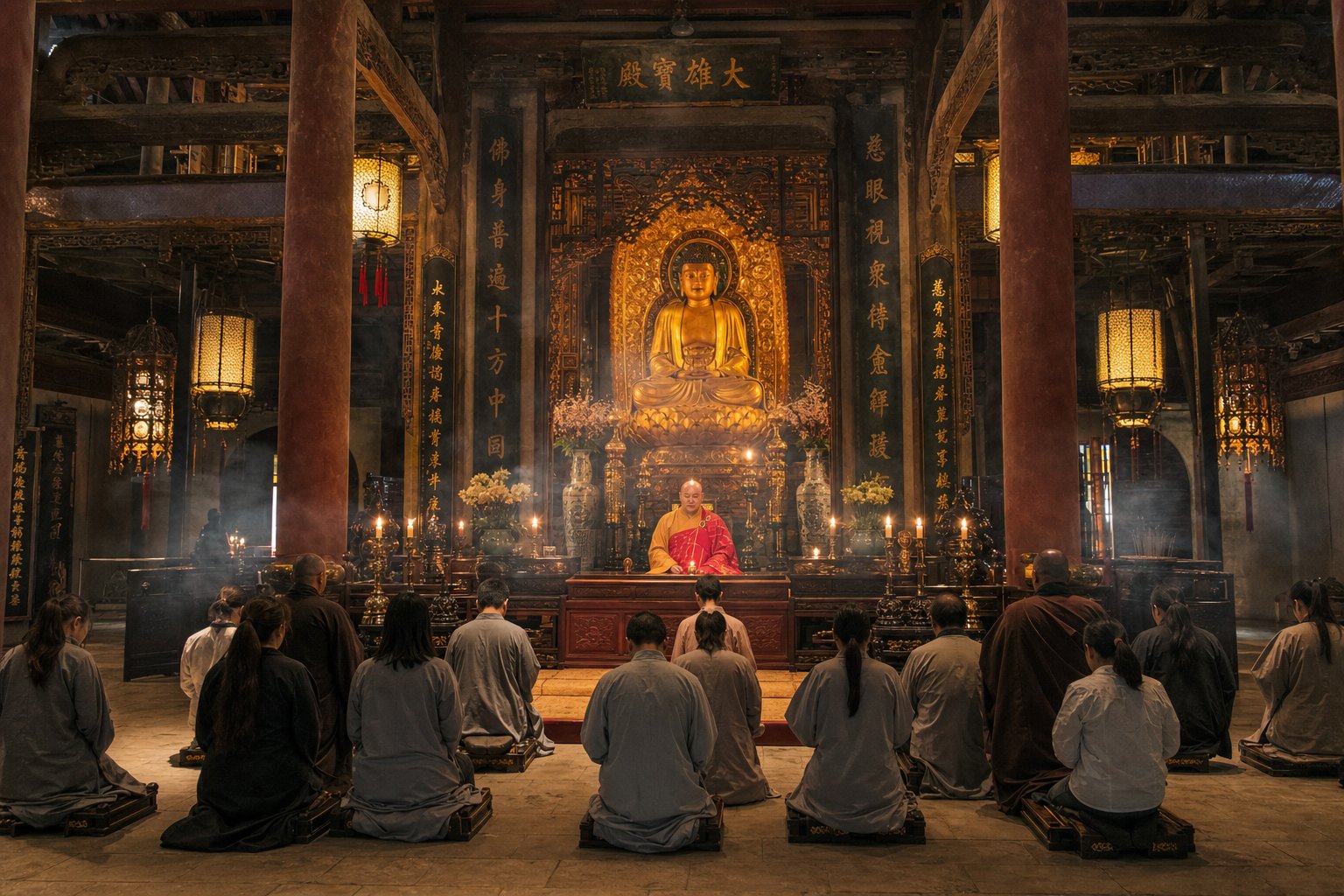
The refuge ceremony (皈依 guiyi) marks a practitioner's formal entry into Buddhism. During this ritual, you take refuge in the Three Jewels: the Buddha, the Dharma, and the Sangha. In Chinese Buddhist temples, this ceremony almost always includes the bestowal of a dharma name (法名 faming). It is your Buddhist identity, distinct from your birth name, signaling a new relationship with the teachings.
How does the refuge ceremony Buddhist name process actually work? For lay practitioners, the dharma name is typically two characters long and carries no surname. You might receive a name like 淨心 (Jingxin, "pure mind") or 覺明 (Jueming, "awakened clarity"). The name is not chosen by you. It is assigned by the presiding master or drawn from a pre-established sequence within that temple's lineage. This distinction matters: the name comes to you rather than from you, reflecting the idea that spiritual identity is recognized by a teacher, not self-declared.
The lay dharma name vs monastic name difference is significant. A lay practitioner keeps their secular surname and uses the dharma name primarily in Buddhist contexts, during meditation retreats, temple visits, or dharma study groups. A monastic, by contrast, undergoes full ordination (受戒 shoujie) and receives a monastic name that replaces their secular identity entirely. Their surname becomes 釋 (Shi), and their dharma name becomes their only name in daily life.
How Chan and Zen Masters Assign Names
Within the Chan (Zen) tradition, the assignment of dharma names carries particular weight. A Chan master does not simply pick characters at random or follow a formula. The name often reflects something the master perceives in the student: a quality to cultivate, an obstacle to overcome, or an aspiration to embody. A student prone to overthinking might receive a name containing 簡 (jian, "simplicity") or 默 (mo, "silence"). Someone with natural compassion might be given 慈光 (Ciguang, "light of compassion").
This Chan master dharma name assignment tradition turns naming into a teaching act. The name itself becomes a koan of sorts, something the practitioner carries and contemplates throughout their practice life. In some lineages, the master writes the name in calligraphy on a certificate (皈依證 guiyi zheng), making the moment both spiritual and tangible.
Temples facilitate this process with varying degrees of formality. Large monasteries like Fo Guang Shan conduct group refuge ceremonies where dozens of practitioners receive names simultaneously, often following a systematic generational character. Smaller temples may offer more personalized ceremonies where the master spends time with each individual before selecting their name.
Generational Characters in Buddhist Lineages
Generational characters (字辈 zibei) are the connective tissue of Buddhist lineages. Each generation of disciples shares one fixed character in their dharma name, creating a visible map of spiritual descent. If your teacher's generation uses the character 淨 (jing, "pure"), and your generation uses 果 (guo, "fruit"), then every practitioner ordained alongside you will carry 果 as the first character of their two-character name.
These generational sequences are often drawn from poems or verses composed by the lineage's founding master. A famous example is the Linji (Rinzai) school's generational poem, where each character in the verse corresponds to one generation of disciples. When you know the poem, you can identify exactly where someone sits in the lineage tree just by reading their name.
Curious about how to receive a dharma name in Chinese Buddhism? Here is the typical process at most Chinese Buddhist temples:
- Express your intention to take refuge by contacting a temple or attending introductory dharma talks.
- Complete a preparation period, which may include attending classes on basic Buddhist teachings and precepts.
- Register formally for the refuge ceremony, providing your secular name and sometimes your birth date.
- Attend the ceremony itself, where you recite the Three Refuges and Five Precepts before the presiding master and sangha.
- Receive your dharma name, either announced during the ceremony or written on your refuge certificate.
- Use your new name in Buddhist practice contexts, signing it on temple registers and using it during retreats.
The spiritual weight of this process should not be underestimated. A dharma name is not a nickname or a spiritual accessory. It represents a vow, a direction, and a connection to a living lineage stretching back centuries. That lineage connection becomes even more visible when you look at how monastic names have functioned across Chinese Buddhist history, where entire communities of monks carried their teacher's imprint in every syllable of their names.
Chinese Buddhist Monk Names and Monastic Conventions
Lay practitioners carry their dharma names alongside their secular identities. Monks take a more radical step: they shed their family names entirely. This act of renunciation, encoded directly into their naming conventions, transforms a monastic name into a public declaration of spiritual commitment. The history of Chinese monastic naming conventions stretches back over 1,600 years, and its logic still governs how monks are named today.
The Tradition of Adopting the Surname Shi
Why do Chinese monks use the surname Shi? The answer traces back to a single figure: Master Dao'an (道安) of the Eastern Jin Dynasty (fourth century CE). Before his time, Chinese monks had no unified surname convention. Foreign monks like Kumarajiva kept their original names after ordination. Chinese monks often adopted their teacher's secular surname or used various ad hoc conventions. The result was confusion, with no visible marker uniting all Buddhist monastics under one identity.
Dao'an proposed a simple, powerful solution. He advocated that all Buddhist monks adopt the character 釋 (Shi), derived from the first syllable of Shakyamuni (釋迦牟尼), as their monastic surname. The reasoning was elegant: all Buddhists are spiritual descendants of Shakyamuni Buddha, so all monastics should share his clan name. Just as members of a family share a surname, members of the sangha share 釋.
This convention stuck. From the Eastern Jin onward, virtually every Chinese Buddhist monk and nun has carried 釋 as their surname. When you see a name beginning with 釋, you immediately know you are looking at a monastic. The character itself carries weight beyond phonetics. Its meaning in Chinese relates to "release" or "explain" (as in 解釋 jieshi, "to explain"), adding a layer of resonance: a monastic is one who has been released from worldly attachments.
The full structure of a Chinese monk's name, then, follows a three-part pattern: 釋 (Shi) + generational character + personal name character. In practice, the surname Shi is sometimes dropped in informal contexts, leaving just the two-character dharma name. But on official documents, temple registers, and formal introductions, the full three-character form appears.
Famous Monk Names and Their Buddhist Significance
Famous Chinese Buddhist monk names and meanings reveal how deeply naming connects to spiritual aspiration. Each name is a compressed teaching, chosen to reflect either the monk's qualities, their teacher's hopes for them, or a core Buddhist concept they embody. Consider these notable examples:
- 釋道安 (Shi Dao'an) — 道 (dao, "the Way") + 安 (an, "peace"). The monk who established peace through the Way, and who created the Shi surname convention itself.
- 釋慧遠 (Shi Huiyuan) — 慧 (hui, "wisdom") + 遠 (yuan, "far-reaching"). Founder of Pure Land Buddhism in China, whose wisdom reached far beyond his mountain monastery.
- 釋玄奘 (Shi Xuanzang) — 玄 (xuan, "profound/mysterious") + 奘 (zang, "grand/robust"). The great Tang Dynasty pilgrim whose name suggests profound grandeur, fitting for someone who traversed continents to retrieve scriptures.
- 釋弘一 (Shi Hongyi) — 弘 (hong, "vast/to propagate") + 一 (yi, "one/unity"). The modern monk and artist whose name encodes the aspiration to propagate the singular truth of dharma.
- 釋淨空 (Shi Jingkong) — 淨 (jing, "pure") + 空 (kong, "emptiness"). A contemporary Pure Land master whose name directly references the Buddhist concept of sunyata (emptiness) purified of defilements.
- 釋星雲 (Shi Xingyun) — 星 (xing, "star") + 雲 (yun, "cloud"). Founder of Fo Guang Shan, whose name evokes the vastness of stars and clouds, suggesting boundless compassion spreading across the sky.
- 釋聖嚴 (Shi Shengyan) — 聖 (sheng, "sacred/sage") + 嚴 (yan, "solemn/dignified"). Founder of Dharma Drum Mountain, whose name conveys sacred solemnity in practice and teaching.
You'll notice a pattern. These names do not describe mundane qualities like strength or wealth. They point toward Buddhist ideals: wisdom, purity, emptiness, vastness, the propagation of dharma. Each name functions as both identity and aspiration, a constant reminder of what the monastic life aims toward.
The Shaolin Temple tradition offers a particularly structured example. Shaolin monk names follow the formula of Shi + generational character + personal name, with the generational character drawn from a 70-character poem composed by Abbot Xueting Fuyu during the Song Dynasty. Each character in the poem corresponds to one generation. A monk of the 34th generation carries 延 (Yan) as their generational character, while the 33rd generation uses 永 (Yong). This system has governed Shaolin naming for over 700 years, creating an unbroken chain where any monk's position in the lineage is immediately readable from their name.
Naming Across Different Chinese Buddhist Schools
Chinese Buddhism is not monolithic. Different schools developed distinct naming flavors, even while sharing the universal Shi surname. The Mahayana vs Theravada monk naming differences become visible when you compare traditions side by side.
In Chinese Mahayana traditions, which dominate mainland China, Taiwan, and much of East Asia, the generational poem system is widespread. Chan (Zen) lineages, Pure Land schools, and Tiantai communities all use generational characters to track dharma descent. The names tend to draw from a rich vocabulary of Mahayana concepts: emptiness (空 kong), compassion (慈 ci), vows (願 yuan), and bodhisattva qualities. A Chan monk might carry a name like 虛雲 (Xuyun, "empty cloud"), while a Pure Land monk might be named 印光 (Yinguang, "seal of light").
Theravada-influenced Chinese communities, found primarily in Yunnan province among the Dai ethnic group, follow different conventions. These monks often receive Pali-derived names rather than Chinese meaning-translations. Their naming aligns more closely with Southeast Asian Theravada practice, where Pali terms are transliterated into the local script. A Dai Buddhist monk might carry a name phonetically derived from Pali rather than composed of semantically meaningful Chinese characters. The Shi surname convention is less uniformly applied in these communities, reflecting their distinct historical connection to Southeast Asian Buddhism rather than the Central Chinese Mahayana mainstream.
Tibetan Buddhist monks operating within Chinese-speaking contexts present yet another variation. They typically retain Tibetan dharma names (like Tenzin or Lobsang) and may or may not adopt the Shi surname when interacting with Han Chinese Buddhist institutions. Their names encode Tibetan Buddhist concepts, often referencing specific deities or qualities from Vajrayana practice.
What unites all these traditions is the principle that a monastic name is not merely a label. It is a lineage marker, a spiritual aspiration, and a public renunciation of secular identity, all compressed into a few characters. The specific characters chosen, whether drawn from Mahayana sutras, Pali canon, or Tibetan liturgy, reflect which stream of Buddhist teaching flows through that particular monk's practice life.
This naming architecture does not exist in isolation. The same characters, concepts, and philosophical vocabulary that shape monastic names also flow into the names parents choose for their daughters and sons, adapted from the monastery to the nursery with surprising grace.
Buddhist Chinese Girl Names With Meanings and Origins
Monastic names carry the weight of renunciation and lineage. But the same Buddhist vocabulary that shapes a monk's identity also offers a rich source of inspiration for naming daughters. Parents drawn to Buddhist philosophy often seek names that carry spiritual depth without sounding overtly religious, names that work in everyday life while quietly encoding compassion, wisdom, or awakening beneath the surface.
What makes a character traditionally feminine in Chinese Buddhist naming? Gender conventions in Chinese naming rely heavily on radical composition and associative meaning. Characters containing the grass radical (艹) suggest flowers and natural beauty. Characters with the jade radical (王 when used as a component) evoke preciousness and refinement. The water radical (氵) and heart radical (忄) appear across genders but lean feminine when paired with softer-sounding tones. Buddhist virtue names for girls in Chinese tend to favor characters associated with gentleness, illumination, purity, and grace, though many Buddhist concepts are inherently gender-neutral and work beautifully for any child.
Names Derived from Buddhist Virtues and Qualities
Buddhist virtues translate naturally into elegant girl names. These characters draw from core teachings on compassion (慈悲 cibei), wisdom (智慧 zhihui), mindfulness (正念 zhengnian), and equanimity (捨 she). When used in names, they carry both aesthetic beauty and philosophical weight.
| Chinese Characters | Pinyin | Meaning | Buddhist Source |
|---|---|---|---|
| 慧心 | Huixin | Wisdom heart | Prajna (般若) teachings on innate wisdom of the mind |
| 慈恩 | Ci'en | Compassionate grace | Maitri (loving-kindness), one of the Four Immeasurables |
| 念慈 | Nianci | Mindful compassion | Sati (mindfulness) combined with karuna (compassion) |
| 靜慧 | Jinghui | Tranquil wisdom | Samatha-vipassana (calm-insight) meditation tradition |
| 善妙 | Shanmiao | Virtuous and wondrous | Kushala (wholesome action) in the Eightfold Path |
| 安禪 | Anchan | Peaceful meditation | Dhyana (meditative absorption) practice |
| 悅捨 | Yueshe | Joyful equanimity | Upekkha (equanimity), fourth of the Brahmaviharas |
You'll notice that many of these names pair two Buddhist concepts together. 念慈 (Nianci) combines mindfulness with compassion, creating a name that reads as both a personal quality and a practice instruction. This layering is what gives Buddhist Chinese girl names with meanings their distinctive depth: the name is not just a label but a quiet aspiration.
Names from Sutras and Sacred Texts
Chinese baby girl names from sutras draw directly from the language of Buddhist scripture. The Lotus Sutra (法華經 Fahua Jing) and the Heart Sutra (心經 Xin Jing) are particularly rich sources because their Chinese translations use characters that are both philosophically resonant and aesthetically graceful.
The Lotus Sutra, in particular, contains vivid imagery of light, jewels, and flowering that lends itself to feminine naming. Lotus Sutra inspired girl names in Chinese often reference the sutra's metaphors of spiritual blossoming and radiant illumination.
| Chinese Characters | Pinyin | Meaning | Buddhist Source |
|---|---|---|---|
| 妙蓮 | Miaolian | Wondrous lotus | Lotus Sutra (妙法蓮華經) — the lotus that blooms pure from muddy water |
| 心澄 | Xincheng | Clear mind | Heart Sutra — clarity achieved when form is seen as emptiness |
| 法喜 | Faxi | Dharma joy | Lotus Sutra — the joy arising from hearing true dharma |
| 般若 | Boruo | Transcendent wisdom | Heart Sutra (般若波羅蜜多心經) — prajna paramita |
| 寶光 | Baoguang | Jeweled light | Lotus Sutra — radiance of the Buddha's teaching illuminating all realms |
| 淨華 | Jinghua | Pure blossom | Avatamsaka Sutra (華嚴經) — purity of the flower ornament |
| 妙音 | Miaoyin | Wondrous sound | Lotus Sutra, Chapter 24 — Bodhisattva Gadgadasvara (妙音菩薩) |
A name like 妙蓮 (Miaolian) works on multiple levels. The character 妙 (miao, "wondrous") appears in the sutra's full Chinese title, 妙法蓮華經, while 蓮 (lian, "lotus") is Buddhism's most recognizable symbol of purity emerging from suffering. Together they create a name that sounds naturally feminine in Chinese while carrying the full weight of the Lotus Sutra's central metaphor.
Female Bodhisattva and Deity-Inspired Names
Female bodhisattva inspired Chinese names draw from figures who hold special significance in East Asian Buddhism. The most prominent is Guanyin (觀音), the bodhisattva of compassion, who is revered as a mother figure across Chinese Buddhist culture. As the saying goes, "There is an Amitabha Buddha in every home, a Guanyin Bodhisattva in every family," reflecting how deeply this figure is woven into everyday spiritual life.
Guanyin's full Chinese name, 觀世音 (Guanshiyin), means "Observer of the Sounds of the World" — one who hears the cries of all beings and reaches out to relieve suffering. She is also known as 觀自在 (Guanzizai), meaning "Lord who has attained self-mastery." Both names offer rich material for girl names that honor this tradition without directly copying the bodhisattva's title.
| Chinese Characters | Pinyin | Meaning | Buddhist Source |
|---|---|---|---|
| 觀慈 | Guanci | Observing with compassion | Guanyin (觀音) — the compassionate observer |
| 妙光 | Miaoguang | Wondrous radiance | Venerable Miao Guang tradition at Fo Guang Shan |
| 自在 | Zizai | Self-mastery / at ease | 觀自在 (Guanzizai) — Guanyin's alternate name in the Heart Sutra |
| 普慧 | Puhui | Universal wisdom | Samantabhadra (普賢) Bodhisattva's quality of universal virtue |
| 文心 | Wenxin | Literary/cultured heart | Manjushri (文殊) Bodhisattva — patron of wisdom and learning |
| 度母 | Dumu | Liberating mother | Tara (度母) — female bodhisattva of compassionate action |
| 蓮心 | Lianxin | Lotus heart | Padma (lotus) symbolism central to Guanyin iconography |
Among these, 自在 (Zizai) deserves special attention. It captures Guanyin's quality of remaining perfectly at ease while gaining complete insight into reality. As a girl's name, it reads as "freedom" or "being at ease with oneself," a meaning that resonates with modern parents while staying rooted in the Heart Sutra's opening line: 觀自在菩薩 (Guanzizai Pusa). The name works beautifully in contemporary life without requiring any explanation of its Buddhist origins, yet for those who recognize it, the spiritual depth is unmistakable.
Whether drawn from virtues, sutras, or bodhisattva figures, these names share a common quality: they encode aspiration rather than description. A girl named 慧心 is not being described as wise. She is being given wisdom as a direction, a seed planted in language that may quietly shape how she understands herself. The same principle applies when parents seek Buddhist-inspired names for sons, though the character palette and the philosophical emphasis shift in interesting ways.
Buddhist Chinese Male Names and Their Significance
Where girl names tend to favor characters evoking gentleness, illumination, and flowing grace, Buddhist Chinese boy names with meanings often gravitate toward characters that suggest solidity, clarity, and expansive vision. Characters containing the mountain radical (山), the strength radical (力), or the metal radical (金) carry traditionally masculine energy in Chinese naming. When paired with Buddhist concepts like awakening (覺 jue), resolve (願 yuan), or dharma (法 fa), they produce names that feel both grounded and spiritually ambitious.
That said, modern families increasingly treat many Buddhist characters as gender-neutral. A name like 明覺 (Mingjue, "bright awakening") works for any child. The categories below lean toward characters that Chinese speakers typically associate with masculine naming, but the boundaries are softer than they once were. Think of these as starting points rather than rigid rules.
Names from Chan and Zen Buddhist Tradition
Chan Buddhism prizes directness, simplicity, and sudden insight. Its vocabulary reflects these values: characters suggesting clarity, emptiness, stillness, and the natural world. Zen inspired Chinese names for boys often draw from the imagery of Chan poetry and the terse language of koan literature, where a single word can point toward enlightenment.
| Chinese Characters | Pinyin | Meaning | Buddhist Connection |
|---|---|---|---|
| 悟空 | Wukong | Awakened to emptiness | Sunyata (emptiness) realization, the core Chan insight that all phenomena lack inherent self |
| 明禪 | Mingchan | Bright meditation | Dhyana (Chan/Zen meditation) combined with prajna clarity |
| 虛明 | Xuming | Luminous openness | Chan concept of the mind as open sky, empty yet radiant |
| 一行 | Yixing | One practice / single-minded action | Ekayana (one vehicle) and the Chan emphasis on unified practice; also the name of the famous Tang Dynasty monk-astronomer |
| 淨悟 | Jingwu | Pure awakening | The Chan ideal of sudden realization arising from a purified mind |
| 默照 | Mozhao | Silent illumination | Caodong (Soto) school's meditation method of silent illumination (默照禪) |
| 宗明 | Zongming | Lineage clarity | Zong (宗) refers to the ancestral lineage of dharma transmission in Chan |
Notice how these names avoid ornament. They are spare, direct, and conceptually precise, mirroring Chan aesthetics. A name like 默照 (Mozhao) references an entire meditation tradition in just two characters: the Caodong school's practice of sitting in silence until illumination arises naturally. For a boy, it suggests quiet strength and inner clarity without needing to announce itself loudly.
Names Inspired by Historical Buddhist Figures
Historical Buddhist figure inspired names borrow character combinations from monks, scholars, and masters whose lives shaped Chinese Buddhism. Parents do not typically copy a famous monk's name directly. Instead, they extract one character or echo the naming logic behind it, creating a name that honors the tradition without claiming the title.
Drawing from the Dictionary of Buddhism's index of Chinese proper names, you can trace how historical figures' names encode specific Buddhist aspirations:
| Chinese Characters | Pinyin | Meaning | Buddhist Connection |
|---|---|---|---|
| 弘毅 | Hongyi | Vast resolve | Echoes Master Hongyi (弘一), the modern monk-artist; 弘 means to propagate the dharma widely |
| 道明 | Daoming | The Way illuminated | Follows the naming pattern of Dao'an (道安) and Daoxin (道信), where 道 references the Buddhist path |
| 玄覺 | Xuanjue | Profound awakening | Echoes Xuanzang (玄奘); 玄 suggests the mysterious depth of dharma |
| 慧能 | Huineng | Wisdom capacity | The Sixth Patriarch of Chan Buddhism, whose name means the capacity (能) for wisdom (慧) |
| 法源 | Fayuan | Dharma source | Follows the Fa- (法) naming pattern seen in Faxian (法顯), Fazang (法蔵), and Fayan (法眼) |
| 承恩 | Cheng'en | Receiving grace | Honors the lineage transmission tradition; 承 means to inherit or carry forward the teacher's dharma |
The character 法 (fa, "dharma") appears across centuries of Chinese male names from Buddhist teachings. In the reference index alone, you find Faxian, Fazang, Fayan, Fayun, Fashun, and dozens more. Using 法 as a name component immediately signals Buddhist orientation while remaining a perfectly natural Chinese given name. Similarly, 慧 (hui, "wisdom") runs through generations of monk names: Huiyuan, Huineng, Huike, Huisi. Borrowing one of these characters and pairing it with a fresh complement creates a name that resonates with history without duplicating it.
Virtue-Based Names for Boys
Enlightenment themed Chinese boy names built on Buddhist virtues tend to emphasize qualities associated with the bodhisattva path: determination, courage, compassion in action, and unwavering commitment to awakening. These differ from Confucian virtue names (which stress filial piety, loyalty, and social harmony) by pointing toward liberation rather than social obligation.
| Chinese Characters | Pinyin | Meaning | Buddhist Connection |
|---|---|---|---|
| 覺行 | Juexing | Awakened action | Bodhi (awakening) expressed through practice; the union of insight and conduct |
| 正念 | Zhengnian | Right mindfulness | Samma sati, the seventh factor of the Noble Eightfold Path |
| 願力 | Yuanli | Power of vows | Pranidhana (vow-power) that drives bodhisattvas to save all beings |
| 定遠 | Dingyuan | Far-reaching concentration | Samadhi (meditative absorption) extending toward boundless realization |
| 普賢 | Puxian | Universal virtue | Samantabhadra Bodhisattva, embodiment of practice and vows |
| 精進 | Jingjin | Diligent effort | Virya paramita, the perfection of energy, one of the Six Paramitas |
| 智勇 | Zhiyong | Wise courage | The bodhisattva's fearlessness (無畏 wuwei) rooted in prajna wisdom |
A name like 願力 (Yuanli) carries real weight. In Buddhist philosophy, vow-power is what sustains a bodhisattva across countless lifetimes of service. As a boy's name, it suggests someone whose strength comes from deep commitment rather than brute force. Similarly, 精進 (Jingjin) references the paramita of diligent effort, one of the six perfections a bodhisattva cultivates. It reads as "dedicated and advancing" in everyday Chinese while carrying its full Buddhist meaning for those who recognize it.
Modern families often balance these traditional elements with contemporary sound preferences. A name like 覺行 (Juexing) works well because it sounds crisp and modern while encoding a profound Buddhist teaching: that true awakening is never separate from action in the world. Parents who want spiritual resonance without an overtly religious tone might lean toward names like 定遠 (Dingyuan) or 道明 (Daoming), which pass easily in secular contexts while quietly honoring Buddhist roots.
These personal names, whether for daughters or sons, represent one branch of a much larger naming tradition. The same Buddhist vocabulary that shapes individual identity also shaped the names of the great pilgrims who carried Buddhism across continents, monks whose journeys transformed Chinese civilization and whose names still echo through history.
Famous Chinese Buddhist Pilgrims and Their Names Explained
The great pilgrims who walked from China to India did more than retrieve scriptures. They carried Buddhist concepts back in their travel records, their translations, and even in their own names. Each pilgrim's monastic name functioned as a compressed mission statement, encoding the spiritual aspiration that drove them across deserts, mountains, and oceans. Understanding how Chinese Buddhist pilgrims got their names reveals the monastic naming system at its most purposeful.
These monks all followed the convention established by Master Dao'an: they bore the surname 釋 (Shi) and carried two-character dharma names assigned within their lineages. But what makes their names especially instructive is how clearly each one maps to the pilgrim's life work. The characters were not random. They were prophetic.
Faxian and Xuanzang as Naming Examples
Consider Faxian (法顯), one of the first Chinese monks to reach India. He departed Chang'an around 399 CE, already over sixty years old, and spent fourteen years trekking across the Taklamakan desert, visiting major Buddhist pilgrimage sites, and surviving a perilous sea voyage home. His name breaks down with precision:
法 (fa) means "dharma" or "law," the foundational term for Buddhist teaching itself. 顯 (xian) means "to manifest" or "to make visible." Together, the Faxian name Buddhist meaning breakdown reads as "one who makes the dharma visible." And that is exactly what he did. His A Record of the Buddhist Kingdoms was the first eyewitness account of Buddhist practices and pilgrimage sites in Central and South Asia written in Chinese, making the dharma visible to an entire civilization that had never seen its source lands.
The Xuanzang name meaning in Chinese Buddhism carries equal weight. 玄 (xuan) means "profound" or "mysterious," pointing toward the deep, ineffable nature of ultimate truth. 奘 (zang) means "grand" or "robust," suggesting both physical and spiritual magnitude. Born around 600 CE, Xuanzang was ordained at twenty and set out for India in 627, dissatisfied with existing Chinese translations of Buddhist texts. "In the course of translation, mistakes may have crept into the texts, and idioms may have been misapplied," he wrote. "When words are wrong, the meaning is lost, and when a phrase is mistaken, the doctrine becomes distorted." His name, "profound grandeur," matched the scale of his mission: he returned with 657 Buddhist texts and became one of the three greatest translators of Buddhist scripture in Chinese history.
Then there is Yijing (義淨), who embarked for India in 671 and returned in 695. His name pairs 義 (yi, "meaning" or "righteousness") with 淨 (jing, "pure" or "purified"). The combination reads as "purified meaning" or "righteous purity." This fits his life's work perfectly. Yijing focused on correcting what he called "errors" in the application of original Buddhist principles in China. His detailed records of Indian monastic rules aimed to purify Chinese Buddhist practice by returning it to its authentic meaning.
What Pilgrim Names Reveal About Buddhist Naming Traditions
When you line these names up, a pattern emerges. Each pilgrim's name encodes not just a Buddhist concept but a specific relationship to the dharma: making it visible (顯), plumbing its depths (玄), or purifying its transmission (淨). These are not generic spiritual aspirations. They describe distinct vocations within the Buddhist project of bringing teachings from India to China.
This specificity reveals something important about how famous Chinese Buddhist pilgrim names explained the naming system's deeper logic. A dharma name was not merely decorative. It was directional. The ordaining master who assigned these names was, in effect, identifying the student's particular gift or calling within the sangha. The name then became a lifelong compass.
Here are the major Chinese Buddhist pilgrims with their name breakdowns:
- 法顯 (Faxian) — 法 (dharma) + 顯 (to manifest/reveal). "One who makes the dharma visible." Traveled 399–413 CE. Authored the first Chinese eyewitness account of Indian Buddhism. His mission to procure Vinaya texts literally made monastic law visible to the Chinese sangha.
- 玄奘 (Xuanzang) — 玄 (profound/mysterious) + 奘 (grand/robust). "Profound grandeur." Traveled 627–645 CE. Retrieved 657 texts and translated 75 of them. His name reflects both the depth of the teachings he sought and the monumental scale of his achievement.
- 義淨 (Yijing) — 義 (meaning/righteousness) + 淨 (pure/purified). "Purified meaning." Traveled 671–695 CE. Focused on correcting Chinese monastic practice by documenting how rules were applied at their Indian source. His two major works sent from Srivijaya (present-day Indonesia) detailed forty monastic practices and biographies of fifty-six Chinese pilgrim monks.
- 玄照 (Xuanzhao) — 玄 (profound) + 照 (to illuminate). "Profound illumination." A seventh-century monk whose biography appears in Yijing's Memoirs of Eminent Monks. Traveled to India through Tibet and was later sent back by Emperor Gaozong to procure medicines. Died before returning to China.
- 道整 (Daozheng) — 道 (the Way/path) + 整 (to arrange/complete). "Completing the Way." Accompanied Faxian to India and was so moved by the Buddhist sites that he refused to return to China, declaring he would not be "reborn in the borderland."
Notice how the character 法 (fa, "dharma") and 玄 (xuan, "profound") recur across pilgrim names. These are not coincidences. They reflect the naming vocabulary of specific lineages and eras. During the Tang Dynasty, when Xuanzang and Yijing traveled, characters suggesting depth, purity, and illumination dominated monastic naming. The pilgrims' names belong to the same generational naming streams that governed their home monasteries.
These journeys also shaped how Buddhist concepts entered the Chinese language itself. Xuanzang's translations standardized hundreds of Buddhist terms in Chinese. The very characters that appear in modern Buddhist names, words like 般若 (boruo, prajna), 涅槃 (niepan, nirvana), and 菩薩 (pusa, bodhisattva), were refined through the translation work these pilgrims undertook. In a real sense, the naming vocabulary available to Chinese Buddhists today exists because these monks walked thousands of miles to retrieve it.
The pilgrims named places as well as concepts. Their travel records introduced Chinese readers to monasteries, temples, and sacred sites across Asia, each carrying names that encoded Buddhist philosophy in exactly the same way personal names did. That parallel between naming people and naming places runs deep in Chinese Buddhist culture, and the temples that dot the Chinese landscape carry the same philosophical DNA as the monks who built them.
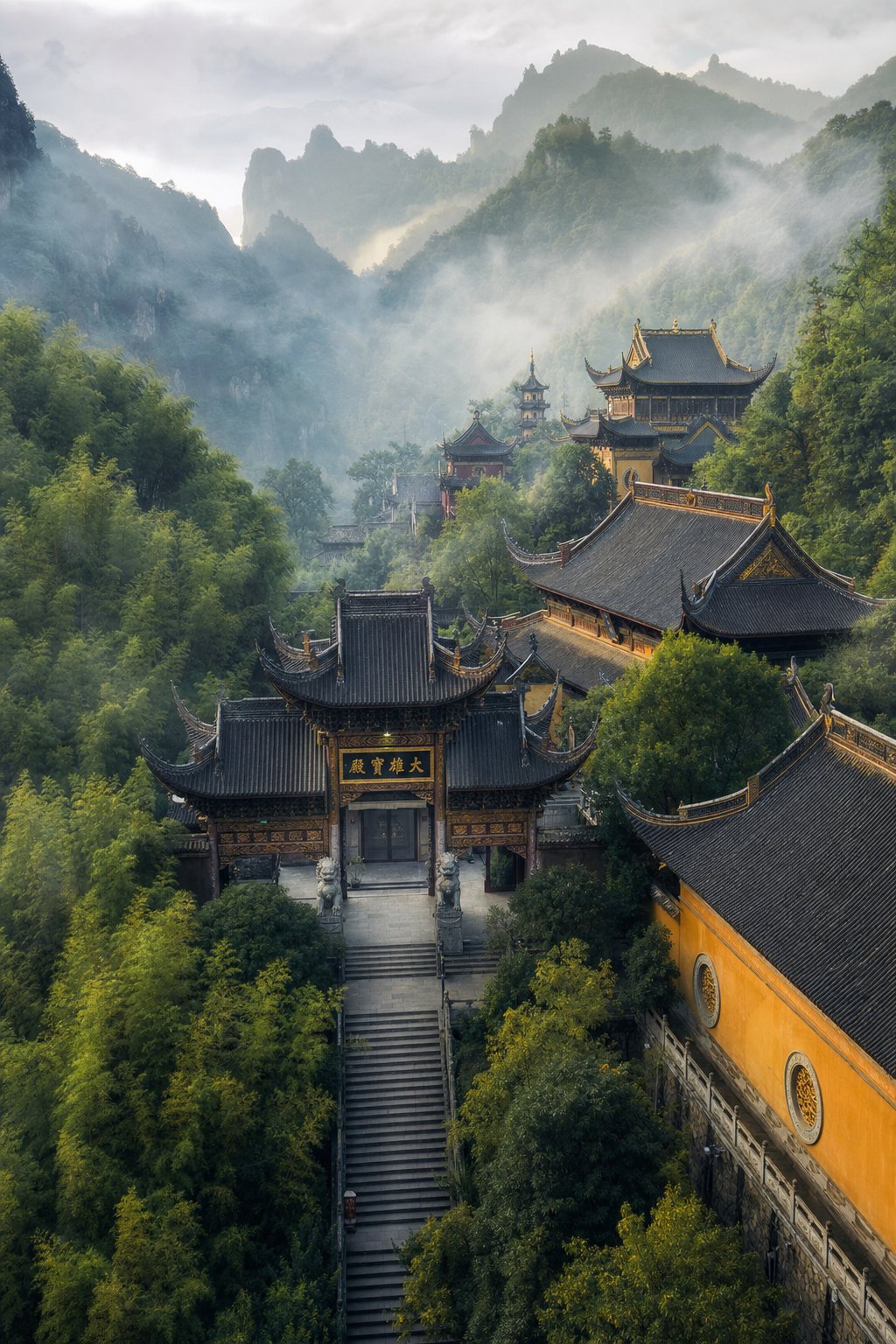
Chinese Buddhist Temple Names and Their Hidden Meanings
Pilgrims named the concepts they brought home. But the places where those concepts took root, the temples and monasteries scattered across China's mountains and river valleys, carry names built from the same philosophical vocabulary. When you understand how Chinese Buddhist temple names and meanings work, you gain a deeper lens for reading personal Buddhist names too. The logic is identical: compress a Buddhist teaching into a few characters, then let the name speak across centuries.
Tang Dynasty Temple Naming Conventions
The Tang Dynasty (618–907 CE) was the golden age of Chinese Buddhism, and it standardized many temple naming patterns still visible today. Emperors granted official names to major monasteries, often embedding imperial favor directly into the characters. A temple might receive a name containing 國 (guo, "nation") or 恩 (en, "grace") to signal its status as a state-sponsored institution. Others drew from Buddhist cosmology, referencing pure lands, sacred mountains, or qualities of the Buddha.
Tang dynasty Buddhist temple naming conventions followed a general formula: a two- or three-character name combining a geographic or descriptive element with a Buddhist concept, followed by a suffix indicating the institution's type. The suffix 寺 (si) designated a major temple, 院 (yuan) a smaller cloister or sub-temple, and 庵 (an) a hermitage. These distinctions mattered. A 寺 was typically imperially recognized and could house hundreds of monks. An 庵 might shelter a single practitioner in mountain solitude.
During this period, the convention of naming temples after their geographic features merged with Buddhist symbolism. A mountain's shape, a valley's atmosphere, or a grove's character could all become the seed of a temple name, but always filtered through Buddhist meaning.
How Temple Names Encode Buddhist Philosophy
Imagine walking up to a temple and reading its name as a teaching before you even step inside. That is exactly how these names function. Each one encodes a specific Buddhist concept, aspiration, or quality of practice.
Take the Shaolin Temple (少林寺). The Shaolin name meaning in Buddhism is more geographic than doctrinal: 少 (shao) comes from Mount Shaoshi (少室山) where the temple sits, and 林 (lin) means "grove" or "forest." Founded in 496 CE when Emperor Xiaowen of the Northern Wei gave the Indian monk Buddhabhadra (Batuo) funds to establish a monastery, the name literally means "young forest temple" or "temple in the Shaoshi grove." Yet even this geographic name carries resonance. A grove suggests growth, shelter, and the quiet conditions needed for practice.
Most temple names, however, are more explicitly philosophical. Here are notable examples with their character breakdowns and Buddhist significance:
- 靈隱寺 (Lingyin Si) — 靈 (ling, "spirit/soul") + 隱 (yin, "hidden/secluded"). "Temple of the Soul's Retreat." Located in Hangzhou, this name suggests that the spirit finds its true home in seclusion from worldly distraction, a core Buddhist teaching on renunciation.
- 法門寺 (Famen Si) — 法 (fa, "dharma") + 門 (men, "gate"). "Gate of the Dharma Temple." In Xi'an, this name references the Buddhist metaphor of dharma as a gateway to liberation. The same character 法 that appears in pilgrim names like Faxian anchors this temple's identity.
- 淨慈寺 (Jingci Si) — 淨 (jing, "pure") + 慈 (ci, "compassion"). "Pure Compassion Temple." A West Lake temple whose name pairs two Buddhist virtues, exactly the way personal dharma names combine concepts.
- 普陀山 (Putuo Shan) — A transliteration of Sanskrit "Potalaka," the mythical island home of Avalokiteshvara (Guanyin). This name uses the sound-borrowing approach (音譯) rather than meaning-translation, preserving the Sanskrit sacred geography in Chinese phonetics.
- 大慈恩寺 (Daci'en Si) — 大 (da, "great") + 慈恩 (ci'en, "compassionate grace"). "Great Compassionate Grace Temple." Built in Tang-era Chang'an, this is where Xuanzang translated his scriptures. The name honors both Buddhist compassion and imperial gratitude.
- 華嚴寺 (Huayan Si) — 華嚴 (huayan, "flower ornament"). Named directly after the Avatamsaka Sutra (華嚴經), this temple's identity is inseparable from the text it venerates.
- 寒山寺 (Hanshan Si) — 寒 (han, "cold") + 山 (shan, "mountain"). Named after the Tang poet-monk Hanshan, whose name itself meant "Cold Mountain," a reference to the austere mountain hermit life.
You'll notice the same characters cycling through both temple names and personal names: 淨, 慈, 法, 慧, 華. This shared vocabulary is not coincidental. Temples and people draw from the same well of Buddhist concepts, just arranged at different scales.
Modern Temple and Monastery Naming
How do Chinese monasteries get their names today? The process varies by scale. Major temples, especially those rebuilt or newly established with government approval, often revive historical names or adopt names that reference their lineage affiliation. A new Pure Land temple might include 淨 (jing, "pure") or 蓮 (lian, "lotus") in its name. A Chan meditation center might use 禪 (chan) or 默 (mo, "silence").
The Maha Vihara naming convention, drawn from the Sanskrit term for "great monastery" (大寺 dasi in Chinese), influences how large institutions distinguish themselves from smaller ones. A 大 (da, "great") prefix signals institutional prominence: 大悲院 (Dabei Yuan, "Great Compassion Cloister"), 大覺寺 (Dajue Si, "Great Awakening Temple"). Smaller monasteries and hermitages tend toward humbler, more poetic names. A mountain hermitage might simply be called 雲居 (Yunju, "Cloud Dwelling") or 竹林 (Zhulin, "Bamboo Grove"), evoking the natural setting rather than grand doctrinal claims.
This distinction between grand and intimate naming mirrors what happens in personal names. A monastic dharma name might carry the weight of lineage and doctrine, while a lay practitioner's name might favor gentler, more personal imagery. The naming philosophy scales up and down, from a single person to an entire institution, without losing its Buddhist core.
Understanding temple naming deepens your ability to read personal Buddhist Chinese names. When you see 淨 in someone's name, you can hear the echo of 淨慈寺 and 淨土 (Pure Land). When you encounter 法 in a child's name, you sense the same gateway that 法門寺 promises. The vocabulary is one continuous tradition, and knowing how it works at the architectural scale makes its personal applications feel richer and more intentional. That same intentionality becomes practical when you face the task of choosing or verifying a Buddhist Chinese name for yourself or your child.
How to Choose a Buddhist Chinese Name Today
Knowing the history and structure behind these names is one thing. Actually selecting one, whether for a newborn, for yourself as a practitioner, or as a way to reconnect with heritage, requires a more hands-on approach. The good news: the tradition is accessible to anyone willing to engage with it respectfully and carefully.
Choosing a Buddhist-Inspired Baby Name
When figuring out how to choose a Buddhist Chinese name for baby, start with intention rather than aesthetics. What quality or aspiration do you want the name to carry? Compassion, wisdom, clarity, peace? Once you identify the core concept, you can search for characters that encode it. A parent drawn to mindfulness might explore characters like 念 (nian, "mindfulness"), 覺 (jue, "awakening"), or 定 (ding, "concentration").
Pair your chosen concept character with a complement that balances tone and meaning. As noted in Chinese naming conventions, pronunciation matters as much as meaning. Say the full name aloud, surname included. Does it flow? Do the tones contrast rather than clash? A name like 李慧明 (Li Huiming) moves from third tone to fourth to second, creating a natural rise that sounds pleasing in Mandarin.
Also consider how the name reads in everyday contexts. Names that are too overtly religious, like 涅槃 (Niepan, "nirvana"), may feel heavy for a child navigating school and social life. Subtler choices like 安禪 (Anchan, "peaceful meditation") or 明心 (Mingxin, "bright mind") carry Buddhist resonance without announcing it to everyone in the room.
Seeking a Dharma Name as a Western Practitioner
This Western convert dharma name selection guide is straightforward: you do not choose your own dharma name. The tradition is clear on this point. A dharma name is given by a refuge master during a formal ceremony, serving as a "token of remembrance" that you have taken the Three Refuges. It marks your entry into a lineage, not a personal branding exercise.
If you are a Western practitioner preparing for a refuge ceremony at a Chinese Buddhist temple, here is what to expect. The presiding master will assign your name based on the temple's generational character system. You may not get to request specific characters. The name might not immediately resonate with you, and that is fine. Its purpose is directional, not decorative. Some practitioners receive names they grow into over years of practice.
For diaspora families reconnecting with Buddhist heritage, the process often blends both paths. You might choose a Buddhist-inspired given name for a child while also seeking a formal dharma name through a temple community. These serve different functions: one is a legal identity, the other a spiritual one. They can complement each other beautifully.
Verifying Meaning and Authenticity of Your Chosen Name
However you arrive at a name, verification is essential. Characters can carry unintended meanings, unfortunate homophones, or associations that only native speakers would catch. Here is a step by step process for choosing a Chinese Buddhist name and confirming it works:
- Identify your core Buddhist concept or aspiration and list two to three characters that express it.
- Cross-reference each character in the Digital Dictionary of Buddhism (DDB) to confirm its usage in Buddhist contexts and check for unintended meanings.
- Combine characters into candidate names and verify tonal harmony by reading them aloud with the intended surname.
- Check for negative homophones. Search the pinyin of your full name to ensure it does not sound like an unfortunate word or phrase in Mandarin.
- Consult a native Chinese speaker, ideally one familiar with Buddhist terminology, to confirm the name reads naturally and carries the meaning you intend.
- If possible, bring your candidate name to a Buddhist teacher or temple community for feedback on its appropriateness and authenticity.
The DDB, maintained by Charles Muller, is the most comprehensive English-accessible resource for verifying Buddhist Chinese name meaning authenticity. It catalogs thousands of Buddhist terms with their Chinese characters, Sanskrit equivalents, and doctrinal context. If a character combination appears in the DDB with the meaning you intend, you can be confident it carries genuine Buddhist weight rather than a superficial resemblance.
One final consideration: respect the tradition's boundaries. Using a monastic-style name (with the 釋 surname) without ordination, or claiming a generational character from a lineage you do not belong to, crosses a line. Buddhist naming is an open tradition, generous with its vocabulary and welcoming to sincere seekers. But it is still a tradition with structure, and honoring that structure is part of engaging with it authentically. Choose with care, verify with diligence, and let the name do what Buddhist names have always done: point you toward awakening, one character at a time.
Frequently Asked Questions About Buddhist Chinese Names
1. What is the difference between a dharma name and a regular Chinese name?
A dharma name (法名 faming) is a spiritual identity given during a Buddhist refuge ceremony or ordination, drawing its characters from Buddhist sutras, virtues, and bodhisattva qualities. A regular Chinese name typically reflects Confucian ideals, family hopes, or nature imagery chosen by parents. Dharma names are assigned by a presiding master rather than self-selected, and they usually consist of two characters without a family surname for lay practitioners, or carry the universal monastic surname 釋 (Shi) for ordained monks and nuns.
2. How do you receive a Buddhist name in a Chinese temple?
To receive a Buddhist name, you attend a refuge ceremony (皈依 guiyi) at a Chinese Buddhist temple. The process involves expressing your intention to take refuge, completing a preparation period with classes on Buddhist teachings, formally registering for the ceremony, reciting the Three Refuges and Five Precepts before the presiding master, and then receiving your dharma name either during the ceremony or on your refuge certificate. The name is assigned by the master based on the temple's lineage system, not chosen by the practitioner.
3. Why do all Chinese Buddhist monks share the surname Shi?
The convention was established by Master Dao'an in the fourth century CE during the Eastern Jin Dynasty. Before his reform, Chinese monks used inconsistent surname practices, causing confusion. Dao'an proposed that all monastics adopt 釋 (Shi), derived from the first syllable of Shakyamuni Buddha's name (釋迦牟尼), reasoning that all Buddhists are spiritual descendants of the Buddha and should share his clan name. This unified practice has continued for over 1,600 years and immediately identifies someone as an ordained monastic.
4. Can non-Chinese people get a Buddhist Chinese name?
Yes, non-Chinese practitioners can receive a Buddhist Chinese name through a formal refuge ceremony at a Chinese Buddhist temple. The tradition welcomes sincere seekers regardless of ethnicity. However, the name is given by a refuge master during the ceremony rather than self-selected. Western practitioners should approach the process respectfully, understanding that the name represents a vow and lineage connection. Using a monastic-style name with the 釋 surname without ordination, or claiming a generational character from a lineage you do not belong to, would be inappropriate.
5. What are popular Buddhist characters used in Chinese baby names?
Common Buddhist characters for baby names include 慧 (hui, wisdom), 淨 (jing, pure), 覺 (jue, awakening), 禪 (chan, meditation), 蓮 (lian, lotus), 慈 (ci, compassion), 明 (ming, bright/clarity), and 妙 (miao, wondrous). These characters encode Buddhist philosophy while sounding natural in everyday Chinese. Parents typically use meaning-based translation characters rather than Sanskrit transliterations, pairing a Buddhist concept character with a complement that balances tonal harmony and avoids negative homophones.