Why Chinese Surnames Are More Than Just Names
Imagine telling your grandfather you want to drop his family name. In most Western contexts, that conversation might be awkward. In a Chinese family, it can feel like erasing an entire lineage from existence. That emotional weight is exactly why changing Chinese surnames remains one of the most culturally charged decisions a person can make, whether they live in Beijing, Taipei, or Toronto.
The phrase itself covers far more ground than a simple legal name change. Chinese surnames, or xing (姓), are among the oldest hereditary family names in the world, with a history stretching back more than 4,000 years. Unlike many Western naming conventions where surnames shifted freely through occupation, geography, or personal preference, Chinese last names function as direct links to ancestral clans, genealogical records, and burial grounds. They are collective property, not individual accessories.
What Changing a Chinese Surname Actually Means
When we talk about this topic, we are really talking about three distinct dimensions happening at once. First, there is the historical evolution of Chinese family names across dynasties, where emperors granted, revoked, and restructured surnames as tools of political power. Second, there is the modern sociological trend inside China, where families increasingly give children maternal surnames or create compound surnames that recognize both parents. Third, there is the diaspora reality, where the same Chinese character gets romanized as Chen, Chan, Tan, or Chin depending on dialect, era of immigration, and the whims of a long-dead immigration officer.
Each dimension carries its own set of pressures. A woman in Shanghai negotiating to give her child her surname faces different obstacles than a third-generation Chinese Australian correcting a romanization error inherited from the 1920s. Yet both are navigating the same fundamental tension: Chinese names carry ancestral weight that makes any alteration feel consequential.
Why This Topic Matters Now
Several forces have pushed this conversation into sharper focus. Gender equality debates in China have turned surname inheritance into a feminist battleground. Research published by Sixth Tone shows that matrilineal naming practices are rising, driven partly by the legacy of the one-child policy and partly by shifting attitudes toward patrilineal tradition. Meanwhile, immigration patterns continue to scatter Chinese diaspora communities across new countries, creating fresh generations who must decide how their family names fit into unfamiliar naming systems.
Chinese surnames are not labels you wear. They are living cultural artifacts that connect you to a recorded lineage, a geographic origin, and a community of millions who share your ancestral story.
Among common Chinese names like Wang, Li, and Zhang, each carries an origin story traceable to a specific ancestor, a specific place, a specific moment in history. Out of the roughly 12,000 Chinese family names recorded throughout history, about 25 percent remain in use today. That consolidation itself tells a story of conquest, migration, and survival.
What no single existing resource provides is the bridge between this deep cultural context and the practical realities people face when they actually consider altering their surname. The cultural significance, the legal procedures, the generational tensions, and the diaspora complications all interlock. Understanding one without the others leaves you with an incomplete picture, and incomplete pictures lead to decisions that carry unintended consequences for years.

How Chinese Surnames Evolved Across Dynasties
That 4,000-year history did not unfold in a straight line. Ancient Chinese names operated under a system so different from today's that it barely looks like the same tradition. Understanding where surnames originate from requires going back to a time when one person could carry two distinct family identifiers, each serving a completely different social function.
From Xing and Shi to Modern Surnames
Here is something most people do not realize: the modern surname in Chinese (姓, xing) is actually a merger of two separate naming systems. In ancient China, xing referred to the broad clan name, a marker of shared blood that determined who you could and could not marry. The shi (氏) was a subordinate branch identifier, a more precise lineage marker that traced back to a concrete, identifiable ancestor rather than a semi-mythical clan founder. Think of xing as the trunk and shi as the branches.
This dual system worked while China's feudal hierarchy held firm. But as that hierarchy collapsed during the Warring States period (481-221 BC), the distinction between xing and shi blurred. By the Qin and Han dynasties, the two concepts merged into the single-character surname (surname 中文: 姓) we recognize today. Ordinary people, who previously had no formal surname at all, gradually adopted family names. The full popularization of surnames across all social classes was not complete until the end of the Western Han Dynasty or the middle of the two Han dynasties (roughly 9-25 AD).
Emperors wielded surnames as political weapons throughout this consolidation. Granting a royal surname elevated a loyal general's entire lineage. Revoking one could erase a disgraced family from official records. Surnames were not just inherited; they were bestowed, confiscated, and strategically reassigned.
Surname Changes Through Conquest and Migration
Foreign conquest reshaped the surname landscape repeatedly. When the Manchu people established the Qing dynasty, they initially maintained distinct Manchu clan names like Aisin-Gioro. Over centuries of assimilation, many adopted Han Chinese surnames. The imperial house itself eventually took the surname Jin (金), since both jin and aisin mean "gold." Similar patterns played out under Mongol rule during the Yuan dynasty, and earlier when Turkic, Persian, and Sogdian peoples took surnames like Hu (胡) to integrate into Chinese society.
By the Song Dynasty (960-1279 AD), the famous Baijiaxing, or Hundred Family Surnames, cataloged 504 surnames in a poem used to teach children to read. It became so iconic that the Chinese expression for ordinary people, laobaixing ("one hundred old surnames"), derives directly from it. Among surnames in Asia, this text remains one of the most significant records of how naming conventions consolidated over time.
The key historical periods when surname changes were most common each had distinct drivers:
- Warring States through Qin unification (481-206 BC): Collapse of feudal hierarchy merged xing and shi into a single surname system and extended surnames to commoners.
- Han Dynasty (202 BC - 220 AD): Imperial surname grants and revocations became routine political tools; universal surname adoption reached completion.
- Tang Dynasty (618-907 AD): Foreign peoples of Persian, Turkic, and Central Asian origin adopted Chinese surnames to integrate into the empire at its cultural peak.
- Yuan Dynasty / Mongol rule (1271-1368): Mongol and other ethnic groups adapted their names to fit Chinese conventions, while some Chinese families altered surnames to avoid persecution.
- Qing Dynasty / Manchu rule (1644-1912): Manchu clans gradually adopted Han surnames through centuries of cultural assimilation, completing the process after the dynasty's fall.
Each of these shifts involved real people making calculated decisions about identity, survival, and belonging. The pattern is clear: changing a Chinese surname has never been purely personal. It has always been tangled up in politics, power, and the pressure to fit into whatever order currently holds authority. That entanglement is precisely what gives surname changes their emotional charge, a charge that intensifies when the decision touches not just history but deeply held beliefs about family obligation and ancestral duty.
The Cultural Weight of Abandoning a Family Name
Politics and power shaped how surnames moved through history, but something deeper explains why altering one still triggers visceral resistance at the family level. Changing a given name in Chinese culture? Relatively unremarkable. People do it after bad luck, after marriage, after a fortune teller's advice. But touch the surname and you are not just changing a word. You are pulling a thread that connects to ancestral halls, burial plots, and genealogical records stretching back centuries.
Ancestral Worship and Clan Registry Ties
To understand why this feels like betrayal, you need to understand what a Chinese surname actually connects you to. It is not just a family identifier. It is your entry point into the zupu (族谱), the clan genealogy that documents every generation of your lineage. These records, known more broadly as jiapu (家谱), served as official documents proving identity and social standing as far back as the Song Dynasty. Before that era, lineage determined a person's social class outright, and jiapu functioned as proof of one's right to power and privilege.
Your surname ties you to an ancestral hall (ci tang, 祠堂), a physical building where ancestral tablets are housed and where rites are performed to honor the dead. It connects you to clan burial grounds, to generation name poems that dictate the naming of your children, and to communal lands (ji tian, 祭田) whose revenue funds everything from hall maintenance to support for needy clan members. When you study chinese surnames and meanings, you quickly realize each one encodes a geographic origin, a founding ancestor, and often a specific historical event that gave the clan its identity.
Change your surname and you sever access to all of this. Your name disappears from the generation chart. Your descendants lose their place in a documented lineage that may span 30 or 40 generations. In communities where clan associations still operate, particularly across Southeast Asia and southern China, this is not abstract. It means losing material resources, social networks, and the right to participate in ancestral rites that reinforce your chinese roots within a living community.
Then there is the concept of mianzi, or face. A surname change can be read as a public rejection of paternal lineage, an announcement that the father's family was somehow insufficient. In a culture where filial piety remains a core value, that reading carries real social consequences, not just for the person changing their name but for the entire paternal family.
Taboos and Social Consequences
Here is where history casts a long shadow. Traditionally, the people who changed their surnames fell into a few specific categories, and none of them were flattering:
- Criminals fleeing justice who needed to disappear from official records
- Families escaping political persecution, like the Bai clan ancestor who fled to Anxi after being falsely accused of treason during the Ming Dynasty
- Adopted children taken into families without male heirs, often carrying the stigma of their birth family's inability to continue its own line
- Conquered peoples forced to adopt new surnames under foreign rule
Notice the pattern. Each scenario involves either shame, coercion, or desperation. Voluntary surname changes carried no positive associations in traditional Chinese society. Even uncommon surnames or rare last names that drew unwanted attention were typically kept rather than abandoned, because the social cost of changing outweighed the inconvenience of explaining an unusual name.
These stigmas have not vanished. They have softened in urban environments and among younger generations, but in rural communities and among older family members, the old associations persist. A person who changes their surname may still face whispered speculation about what they are hiding or whom they have rejected.
A Chinese surname does not belong to the individual who carries it. It belongs to every ancestor who passed it down and every descendant who will inherit it. Changing it is not a personal decision; it is a collective loss.
This collective ownership principle is what makes the surname question fundamentally different from given-name changes. Your given name is yours to shape. Your surname is held in trust. You received it from the dead and owe it to the unborn. That framing may sound dramatic in a modern context, but it remains the emotional bedrock beneath family arguments about naming, even when no one states it so explicitly. And it is precisely this bedrock that modern movements around gender equality and maternal surname adoption are now challenging head-on.
Modern China and the Rise of Maternal Surnames
That collective ownership principle did not stop millions of Chinese families from quietly renegotiating who gets to pass on their name. Something had to give, and it was demographics that forced the issue.
How Family Planning Policy Reshaped Surname Practices
Picture this: you are the only daughter of your parents, who are themselves the only children of their parents. Your maternal grandparents have no grandson, no nephew, no one to carry their surname forward. Under the one-child policy, enforced from 1980 to 2015, this scenario played out across tens of millions of families. The result was an entire generation of daughter-only households facing what researchers call a "crisis of patrilineage" with no traditional solution in sight.
The traditional workaround, called zhao-xu, required a husband to marry into his wife's family and give their children her surname. But zhao-xu carried stigma. It implied the husband's family had lower status. Modern families needed a less loaded arrangement.
Enter liang-tou-dun, literally "two places to stay." In this newer practice, each set of parents provides the couple with a wedding apartment. The couple maintains close ties with both families, moving between residences. When they have two children, one takes the father's surname and the other the mother's. Both family lines continue. No one technically loses face.
With China's shift to two-child and then three-child policies, surname splitting between siblings has become increasingly practical. Families that once had no room to negotiate now have a second or third child to "allocate" to the maternal line. Among common Chinese last names like Wang, Li, and Zhang, which rank as the most common Chinese surnames in the country, this splitting means both grandparental lines see their name carried forward into the next generation.
Competing Explanations for the Maternal Surname Rise
Scholars disagree on what is actually driving this shift. The 20th-century sociologist Fei Xiaotong famously cited Mencius' line about "the three ways of being unfilial, the greatest of which is to have no posterity" to illustrate how deeply Chinese families value lineage continuity. For centuries, this meant surnames followed the father without question. So what changed?
Research using China's 1% National Population Sample Survey found that matrilineal naming was more common in families where the husband had lower socioeconomic status and the wife had no brothers. Kids were also more likely to take their mother's name in eastern regions like Shanghai, Zhejiang, and Jiangsu, and surprisingly, among families where mothers had lower education levels. That pattern does not fit a simple "progressive values" narrative.
The competing explanations break down along clear lines:
| Driving Factor | Mechanism | Where Most Common | Surname Outcome |
|---|---|---|---|
| Economic bargaining power | Wife's family has greater wealth; husband's lower socioeconomic status reduces his family's naming leverage | Rural and semi-urban eastern China (Zhejiang, Jiangsu, Shanghai) | Maternal surname for child |
| Family structure (no male heir) | Wife has no brothers; maternal grandparents face lineage extinction without a surname heir | Widespread, especially in daughter-only families created by one-child policy | Maternal surname or surname splitting |
| Cultural modernization | Progressive gender attitudes; rejection of patrilineal norms as outdated | Major cities; families where mother is well-educated | Compound surnames combining both parents' names |
| Practical compromise (liang-tou-dun) | Both families provide housing and resources; grandparents invest in the grandchild sharing their surname | Urban couples who are each only children | One child per surname, split between siblings |
The distinction matters. Maternal surname adoption appears driven primarily by strategic lineage preservation rather than feminist ideals. Compound surnames, on the other hand, correlate with modernized attitudes and higher maternal education. Both trends are rising, but for fundamentally different reasons.
There is a catch, though. In liang-tou-dun arrangements, grandparents tend to funnel resources toward the grandchild who carries their surname. Education funding, recreational opportunities, medical care all flow preferentially along surname lines. The most common Chinese last name in a family may determine which sibling gets better life prospects, creating inequalities between siblings based not on birth order or ability but on whose name they carry.
What emerges is a picture far messier than either "tradition is dying" or "nothing has changed." China's compressed modernization has produced what sociologists call a mosaic: traditional lineage preservation strategies coexisting with genuinely progressive naming experiments, sometimes within the same family. The surname question is no longer just about fathers versus mothers. It is about which family has more money, more property, more leverage, and whether equality in naming actually produces equality in outcomes. That tension between legal naming rights and lived family dynamics becomes even sharper when viewed through an explicitly feminist lens.
Gender Equality and the Surname Inheritance Debate
Economic bargaining and lineage preservation explain part of the maternal surname trend, but they do not explain the anger. When Chinese internet celebrity Papi Jiang (Jiang Yilei) posted a Mother's Day photo with her newborn in 2020, critics did not attack her finances or her family structure. They attacked her choice. The baby carried the father's surname, and for a vocal segment of Chinese feminists, that was an unforgivable capitulation. Some called her a "married donkey" (hunlv, 婚驴), a derogatory term for women who conform to patriarchal family norms. The backlash revealed something the economic data alone cannot capture: for a growing number of younger Chinese women, surname inheritance is not a family negotiation. It is a political statement.
Feminist Movements Pushing for Maternal Surname Adoption
The argument is straightforward. Women endure pregnancy, labor, and the physical risks of childbirth. Yet the child automatically receives the father's surname in over 90 percent of cases across Chinese-speaking societies. Feminist advocates frame this as one of the last unexamined pillars of patriarchal inheritance, a system where men's lineage is perpetuated through women's bodies without question.
Social media has amplified this framing dramatically. Shortly before the Papi Jiang controversy, another Chinese woman sparked a firestorm by announcing she planned to divorce her husband because he refused to give their son her surname. She framed the decision explicitly as vital to her pursuit of gender equality in marriage. The post went viral, splitting public opinion between those who saw her as courageous and those who called her unreasonable.
Gender expert Yu Ning has pointed out that the pattern is not really about progressive values at all in most cases. "Typically, if a child has his mother's surname, it means that the woman comes from a much richer or more powerful family than her husband," she explained. "In order to avoid giving the impression of being inferior to their wives, comparatively few Chinese men are willing to give their children their wives' family names." That dynamic means maternal surname adoption still functions within a power hierarchy rather than dismantling one.
Yet the feminist framing persists and grows louder, particularly among urban women under 35. For them, the question is not who has more money. It is why the default exists at all. Why should a child automatically carry the father's name when both parents contributed equally, or when the mother contributed more physically? That reframing shifts the debate from family strategy to structural critique.
Regional Differences in Surname Gender Norms
Attitudes toward changing chinese surnames along gender lines vary sharply across Chinese-speaking regions, and Taiwan offers the clearest case study of what legal reform can accomplish.
Taiwan's Civil Code was amended in the late 1990s to remove mandatory paternal surname inheritance. Under Article 1059, parents must jointly decide whose surname their child will take before registration. If they cannot agree, the surname is determined by drawing lots at the Household Registration Office. No default favoring the father exists in law.
The results are measurable. Ministry of the Interior data shows that 6 percent of babies born in Taiwan in the first nine months of 2025 took their mother's surname, up from 5.2 percent during the same period in 2020. That number may sound small, but it represents steady growth in a society where over 95 percent of children still take the father's name. Among taiwan last names, the shift is most pronounced in eastern counties like Taitung (16.8 percent) and Hualien (16.5 percent), where larger Indigenous populations with matrilineal traditions push the average higher.
Taiwanese legal scholar Chao-Ju Chen has argued that legal reform alone remains insufficient. Her research highlights a paradox: while fewer than 5 percent of Taiwanese wives take their husband's surname (a practice only mandated during Japanese colonial rule and the early Republic era), more than 95 percent of children still take the father's. The difference, Chen argues, is timing. A surname assigned at birth creates an "anchoring effect" that stabilizes identity over a lifetime, making later changes psychologically and administratively burdensome. Taiwanese surnames, in other words, are sticky precisely because they are assigned before the child has any say.
Hong Kong and Singapore present different pictures. Hong Kong follows common-law traditions where married women may use their husband's surname socially but retain their birth surname on official documents. Cantonese last names like Chan, Wong, and Ng pass patrilineally with little public debate about alternatives. Singapore's multiethnic framework means Chinese Singaporean families largely follow patrilineal naming without legal pressure either way, though cantonese surnames and Hokkien surnames coexist with Malay and Tamil naming conventions in ways that make the issue less culturally monolithic.
Mainland China sits somewhere in between. The law permits maternal surnames, but no institutional mechanism like Taiwan's lot-drawing system exists to break deadlocks. Social pressure remains the deciding factor, and that pressure overwhelmingly favors the father's line.
The key arguments from each side reveal how deeply this debate cuts:
- Progressive position: Surname inheritance is a patriarchal institution that treats women as vessels for male lineage. True equality requires either maternal surname adoption, compound surnames, or randomized assignment to break the default.
- Progressive position: Children who carry their mother's surname normalize the practice for future generations, creating a cultural shift that legal reform alone cannot achieve.
- Progressive position: The physical burden of pregnancy and childbirth gives mothers a stronger claim to naming rights than tradition acknowledges.
- Traditionalist position: Surnames connect children to centuries of recorded genealogy. Disrupting patrilineal inheritance severs access to clan resources, ancestral records, and community belonging.
- Traditionalist position: Forcing surname changes onto families in the name of equality imposes one ideology onto diverse family arrangements. Respecting individual choice means accepting that most families will choose the father's name.
- Traditionalist position: Splitting surnames between siblings creates unequal treatment within families, as grandparents invest preferentially in the child carrying their name.
Neither side has a clean answer. The feminist critique correctly identifies a structural default that advantages male lineage. But the traditionalist concern about severing genealogical ties is not imaginary, particularly for families whose clan records span dozens of generations. What makes this debate so intractable is that both sides are describing real consequences. The question is which consequences a society is willing to accept, and that answer looks different in Taipei, where legal infrastructure supports maternal naming, than in a rural Guangdong village where the ancestral hall still anchors community life.
The tension only deepens when you move beyond the question of which parent's surname a child receives and into the messier territory of how that surname gets written down in the first place. For diaspora families, the character on the hukou or birth certificate is just the beginning. The romanized version that appears on passports, school records, and immigration documents introduces an entirely separate layer of identity negotiation.
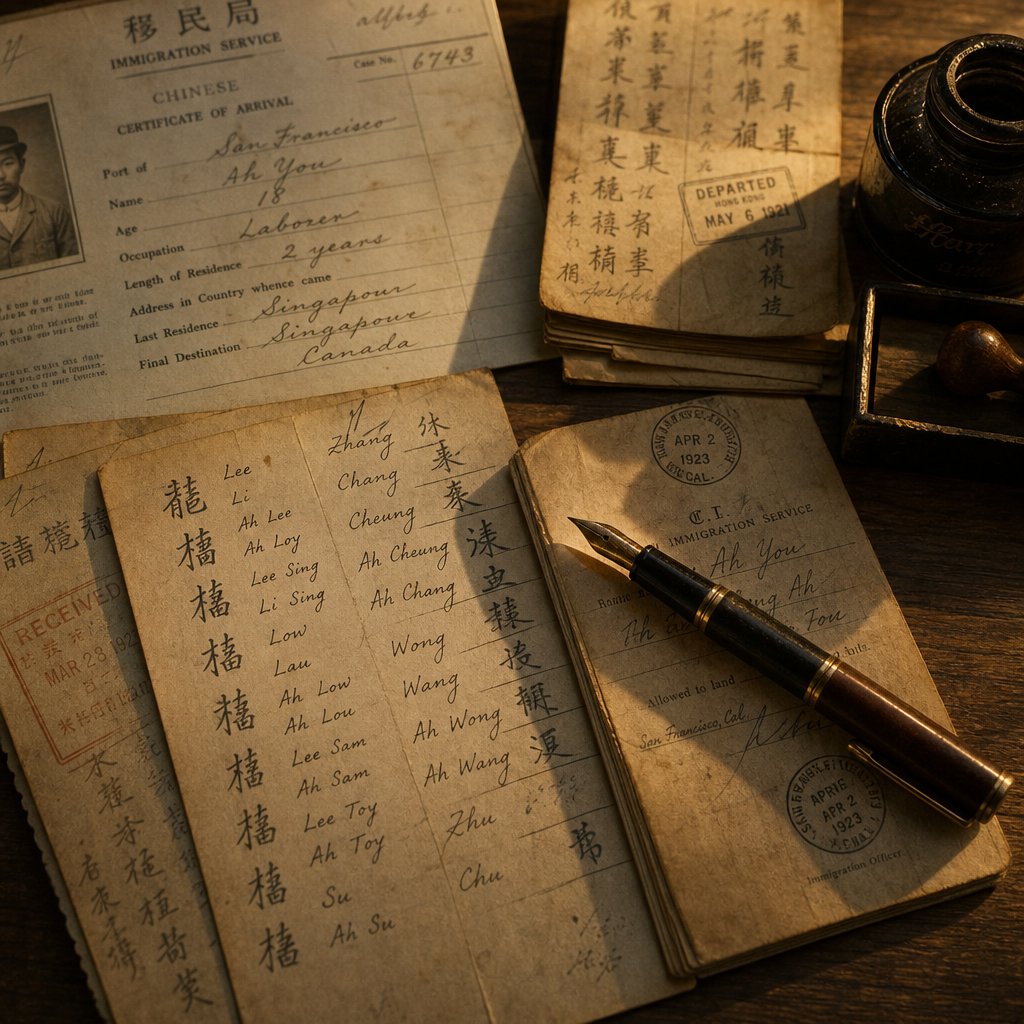
Romanization and Why the Same Surname Has Many Spellings
That separate layer of identity negotiation starts with a deceptively simple problem: Chinese is not written in the Roman alphabet. Every Chinese surname character must be transliterated into English (or French, or Dutch, or Malay) before it can appear on a passport or a school enrollment form. And here is where things get tangled. The Chinese language encompasses seven to ten major dialect groups with over 300 individual languages. Each dialect pronounces the same character differently. So the same surname character, written identically in Chinese, can produce wildly different romanized spellings depending on who is speaking and who is writing it down.
One Character, Many Spellings
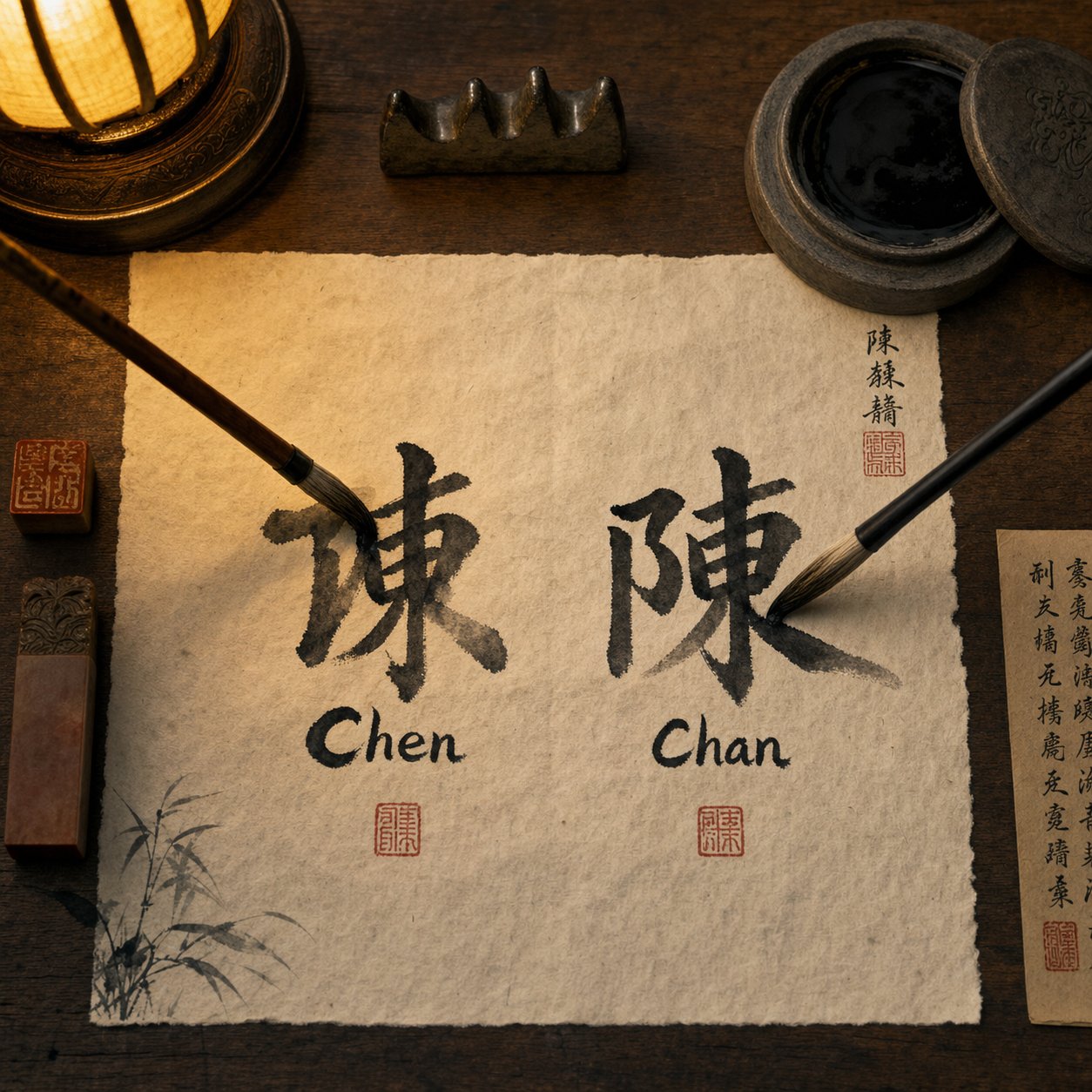
Consider the chen surname: 陳. In Mandarin, it is Chen. In Cantonese, it becomes Chan. Hokkien speakers say Tan. Hakka speakers may register it as Chin or Chun. Cross into Vietnam, where the same character traveled centuries ago, and it becomes Tran. One character, one meaning, one clan, but the chen last name origin looks completely different on paper depending on which branch of the family you ask. According to My China Roots, the character 陈 alone has been romanized as Chen, Chan, Chin, Chinn, Ching, Chun, Chang, Chance, Dan, Zan, Zen, Tan, Tang, Tchen, Tin, Ting, Tjin, and Jin.
The huang surname (黃) follows the same pattern. Mandarin speakers write Huang. Cantonese speakers produce Wong. Teochew speakers say Ng. Hokkien speakers may register as Ooi or Ong. Korean romanization gives Hwang. If you are researching the wong last name origin or the ng last name origin, you may be surprised to discover they trace back to the exact same Chinese character.
The wang last name (王), meaning "king," becomes Wong in Cantonese, Ong in Hokkien, and Heng in Teochew. The lin surname (林), meaning "forest," appears as Lim in Hokkien and Teochew, Lam in Cantonese, and Hayashi when it crossed into Japanese usage centuries ago. Two cousins carrying the lin last name might spell it completely differently on their passports and never realize they share an ancestor.
How did this happen? In many cases, families inherited a romanization from an immigration officer's best guess decades ago. Research from the NJ State Library documents how 19th-century record takers often wrote Chinese names phonetically as they heard them, without any standardized system. The Wade-Giles romanization system existed by 1859, but there is no evidence every immigration clerk knew or used it. Dialects compounded the confusion further. A Cantonese-speaking immigrant arriving in San Francisco in 1882 would have his name transcribed by an English-speaking officer who had never heard Cantonese before. Whatever spelling landed on that document became the family's official surname for generations.
The following table illustrates how common surname characters produce different romanizations across dialects:
| Chinese Character | Mandarin (Pinyin) | Cantonese | Hokkien | Teochew | Other Variants |
|---|---|---|---|---|---|
| 陳 | Chen | Chan | Tan | Tan | Chin (Hakka), Tran (Vietnamese) |
| 黃 | Huang | Wong | Ooi / Ng | Ng | Hwang (Korean), Vong (Macanese) |
| 王 | Wang | Wong | Ong | Heng | Vuong (Vietnamese) |
| 林 | Lin | Lam | Lim | Lim | Hayashi (Japanese), Rim (Korean) |
| 吳 | Wu | Ng | Goh | Goh | Ngo (Vietnamese), Oh (Korean) |
Changing Romanized Surnames for Consistency or Identity
Given this chaos, why do diaspora Chinese decide to formally change their romanized surname? The reasons cluster into a few categories:
- Reunifying family spelling: Siblings or cousins whose documents were processed by different officials may carry different romanizations of the same character. A legal name change can bring the family back under one consistent spelling.
- Correcting historical errors: Some families discover their surname was simply transcribed wrong. An immigration officer misheard, misspelled, or confused the surname with the given name, a common mistake since Chinese names place the surname first.
- Reclaiming dialect identity: A family that speaks Cantonese at home but carries a Mandarin pinyin spelling may switch to the Cantonese romanization to better reflect their heritage. A Hokkien family registered as "Chen" might change to "Tan" to match how they actually pronounce their name.
- Simplifying for the host country: Some romanizations create pronunciation difficulties in specific countries. Ng, for instance, baffles English speakers unfamiliar with syllabic nasals. Some families adopt a more phonetically intuitive spelling to reduce daily friction.
None of these changes alter the underlying Chinese character. The zupu entry remains the same. The ancestral hall still recognizes you. Yet the process of legally changing even a romanized spelling involves navigating bureaucracies that were never designed with multilingual naming in mind. Matching documents across languages, updating immigration records, ensuring your passport name aligns with your birth certificate and your bank account: these practical headaches multiply quickly, especially when different countries impose different rules on what counts as a valid name change.
Legal Procedures for Changing a Chinese Surname
Those practical headaches are not hypothetical. They are the lived reality of anyone who decides to move from intention to action. Whether you are in Shenzhen trying to register a child under the maternal surname or in Sydney correcting a romanization error from 1987, the legal machinery you must navigate was built with assumptions about how names work, assumptions that rarely account for how do chinese names work in practice. The gap between what the law permits and what the bureaucracy can actually process is where most people get stuck.
Surname Change Procedures in China and Taiwan
In mainland China, your legal name lives inside the hukou (户口), the household registration system that ties every citizen to a specific locality. Changing a surname chinese authorities have already registered requires approval from the local public security bureau. The restrictions are tight. Adults can generally only change their surname under specific circumstances: adoption, recognition of biological parentage, or other situations deemed legitimate by local officials. Children's surnames can be changed with the agreement of both parents, but if one parent objects, the change typically will not proceed. In practice, this means a mother who wants her child to carry her chinese last name needs the father's documented consent, or a court order overriding his objection.
There is no national standardized process. Local public security bureaus have discretion, and approval rates vary by region. Urban offices in Shanghai or Beijing may process requests more routinely than rural bureaus where officials are less familiar with non-traditional naming arrangements. The bureaucratic friction is intentional. China's system treats surname stability as a default, and any deviation requires justification.
Taiwan takes a markedly different approach. The Name Act (姓名條例) explicitly outlines when surname changes are permitted. Article 8 allows surname alterations when a biological father acknowledges paternity (or that acknowledgment is revoked), when adoption occurs or is terminated, when a transliteration is too long, or when other laws require it. Married persons may apply to take their spouse's surname or restore their original surname, though restoration is limited to once per marriage.
Taiwan's framework also addresses the unique situation of indigenous peoples, allowing them to restore ethnic names that were replaced by Han Chinese surnames during earlier assimilation periods. For foreign nationals who naturalize, the law requires adopting a Chinese-language name conforming to ROC practices, with one opportunity to alter it afterward. The system is more permissive than mainland China's, but it is not unlimited. Article 15 bars anyone with an outstanding arrest warrant or active prison sentence from changing their name, a safeguard against identity evasion.
Legal Processes in Western Countries
For diaspora communities, the legal mechanics depend entirely on where you live. The good news: most Western countries allow name changes without proving a specific reason. The bad news: the process was designed for people with one name in one script, not for someone whose identity spans a Chinese character, a romanized spelling, and possibly a Western given name layered on top.
Here are the typical steps in a surname change process across major jurisdictions:
- Determine your pathway. In the US, you can change your name through marriage, divorce, or a court petition. Marriage and divorce changes happen automatically through the certificate. A standalone court petition requires filing paperwork with your local court and, in most states, appearing before a judge.
- File the required paperwork. This typically includes a petition or application form, proof of identity, and sometimes a background check or fingerprinting (varies by US state).
- Publish notice (where required). Some US states and Australian states require you to publish your intended name change in a newspaper or government gazette. This step exists to prevent fraud but can feel invasive for people making culturally sensitive changes.
- Attend a hearing or receive approval. US court petitions usually require a brief hearing. In the UK and Australia, a deed poll or change of name registration can be completed without a court appearance. Canada varies by province: some require a formal application to vital statistics, others accept a simple statutory declaration.
- Update all downstream documents. Once you have your legal name change document, you must notify every agency and institution that holds your old name. In the US, this means starting with the Social Security Administration, then your state motor vehicle office, then your passport, tax records, voter registration, and financial institutions.
Common documents required across jurisdictions typically include:
- Current valid photo identification (passport or driver's license)
- Birth certificate or citizenship certificate
- Proof of current legal name (if different from birth certificate due to prior changes)
- Marriage or divorce certificate (if the change is marriage-related)
- Court order or deed poll (for standalone changes)
- Completed application form specific to your jurisdiction
- Filing fee (ranges from roughly $20 for a UK deed poll to $300+ for US court petitions depending on the state)
Sounds manageable? For someone changing Smith to Jones, it is. For someone whose legal identity spans two writing systems, the complications multiply fast.
The first challenge is document matching. Your Chinese passport shows your name in Chinese characters with a romanized version underneath. Your Australian citizenship certificate shows only the romanized version. Your birth certificate from Guangdong is entirely in Chinese. When you change your romanized surname, you need every document to tell a consistent story. If your new romanized spelling does not match what appears on your Chinese-language documents, immigration authorities may question whether you are the same person.
Passport implications deserve special attention. If you hold dual nationality or travel frequently between your country of residence and China or Taiwan, a surname change on one passport that is not reflected on the other creates border-crossing complications. Some countries require you to enter and exit under the same name. A mismatch between your common chinese full names on different documents can trigger secondary screening or outright denial of entry.
Then there is the consistency problem between your Chinese-character name and your romanized name. Imagine your surname chinese character is 黃 and your family has used "Wong" for three generations. You decide to change it to "Huang" to match standard Mandarin pinyin. Legally, nothing about your Chinese-language identity has changed. But every English-language document now tells a different story than it did before. Banks, universities, employers, and immigration databases all need updating. Miss one, and you have a paper trail that looks like two different people.
For adoptees, the complications are even more layered. A Chinese-born person adopted into a Western family may carry an anglicized surname with no connection to their birth name. Reclaiming a chinese surname later in life means navigating adoption records, potentially sealed court files, and the emotional weight of a name that connects to a family they may never have known. The legal process is the same as any other name change, but the documentary evidence required to establish the original name can be difficult to obtain, especially if adoption records from China are incomplete.
The practical takeaway is this: the legal right to change your name exists in virtually every jurisdiction where Chinese diaspora communities live. The difficulty is not permission. It is coordination. Every document must align, every database must update, and every border crossing must go smoothly with your new name. For people whose identity already spans languages, scripts, and countries, that coordination demands patience, meticulous record-keeping, and often professional legal help to ensure nothing falls through the cracks.

Generational Shifts in How Chinese People View Surnames
Legal frameworks tell you what is possible. They do not tell you what it feels like to actually make the decision. And for younger generations of Chinese people, both inside China and scattered across the diaspora, the emotional calculus around surnames is shifting in ways their grandparents would barely recognize.
Generational Attitudes Toward Surname Identity
The clan structures that once gave asian last names their social power have weakened considerably. Urbanization pulled families away from ancestral villages where the surname meant access to communal land, ancestral halls, and mutual aid networks. When you live in a Shenzhen high-rise 800 kilometers from your family's ancestral hall, the surname still carries emotional weight, but it no longer functions as a social safety net the way it did for your great-grandparents.
Smaller family sizes accelerated this shift. A clan of hundreds sharing a surname and a village has a gravitational pull that a nuclear family of three simply does not. Globalization added another layer: young Chinese professionals who have studied abroad, consumed international media, and built friendships across cultures increasingly view asian names and surnames as personal identity markers rather than collective lineage obligations. The surname becomes something you carry for yourself, not something you hold in trust for the dead.
That does not mean tradition has evaporated. Research on the new generation Chinese diaspora shows that locally born members are more closely aligned with their countries of residence than with China, yet many still maintain cultural connections through language, food, and yes, family names. The relationship is selective rather than wholesale. Young people pick which traditions feel meaningful and release the ones that feel like obligations imposed by a world that no longer exists.
Diaspora Identity and Choosing Your Name
For diaspora Chinese, the surname question sits at the intersection of heritage and belonging. You might carry an asian family name that nobody in your school can pronounce. You might have parents who romanized their surname one way while your cousins spell it differently. You might be mixed-heritage, navigating two naming traditions that follow completely different rules about what gets passed down and how.
Mixed-heritage families face a particularly layered decision. If one parent is Chinese and the other is not, which asian last name does the child carry? A hyphenated compromise? The father's by default? The mother's as a statement? Each choice signals something about which culture the family prioritizes, and children grow up reading those signals whether parents intend them or not.
For adoptees, the stakes are different again. Stories from Chinese adoptees reveal how names function as the only tangible link to a birth identity. Some adoptees carry orphanage-assigned surnames that identified them as parentless rather than connecting them to any real lineage. Reclaiming a heritage name later in life, or choosing to keep the adoptive surname while honoring the Chinese name as a middle name, becomes an act of self-definition. As one adoptee described it, her name as a whole tells the story of her multicultural existence: "a sandwich of American adopted American, which is kind of what I am."
Psychologist Amanda Baden has described this as reclamation culture, where people take back birth names to feel more connected to their Asian heritage. Among the most common chinese names carried by adoptees, surnames like Gong, Yang, and Fu were often institutional identifiers rather than family names, making the question of what to reclaim even more complex. Some adoptees embrace their Chinese name in asian second names or middle name positions, code-switching between white and Asian spaces depending on where they feel safe sharing that part of themselves.
A surname decision in a globalized world is no longer just about lineage. It is about choosing which story you want your name to tell, and accepting that the answer may change as you do.
That flexibility would have been unthinkable two generations ago. For older family members, a surname is fixed, sacred, non-negotiable. For younger people navigating multiple cultures, languages, and identities, it is one thread in a larger tapestry of self-determination. The tension between these two views is not going away. If anything, as the estimated 49.33 million Chinese diaspora continues to grow and diversify, with 73 percent now belonging to the locally born second generation or later, the question of what an asian family name means will only become more personal, more contested, and more free.
Frequently Asked Questions About Changing Chinese Surnames
1. Can you legally change your surname in China?
Yes, but the process is restrictive. In mainland China, surname changes require approval from the local public security bureau through the hukou (household registration) system. Adults can typically only change their surname under specific circumstances such as adoption or recognition of biological parentage. For children, both parents must consent to the change. If one parent objects, the change usually will not proceed without a court order. Taiwan offers a more permissive framework under its Name Act, which explicitly lists conditions allowing surname alterations including marriage, adoption, and restoration of indigenous names.
2. Why do Chinese families give children the mother's surname?
The rise of maternal surnames in China is driven by multiple factors. The one-child policy created millions of daughter-only families where maternal grandparents faced lineage extinction. Modern arrangements like liang-tou-dun (two places to stay) allow couples with two children to split surnames between siblings, giving one child the father's name and the other the mother's. Economic bargaining power also plays a role: when the wife's family holds greater wealth, they have more leverage in surname negotiations. In some cases, feminist ideals motivate the choice, though research suggests economic and structural factors are more common drivers than progressive values alone.
3. Why does the same Chinese surname have different spellings?
Chinese encompasses seven to ten major dialect groups with over 300 individual languages, and each pronounces the same character differently. For example, the character 陳 becomes Chen in Mandarin, Chan in Cantonese, Tan in Hokkien, and Tran in Vietnamese. Many diaspora families also inherited romanizations from immigration officers who transcribed names phonetically without standardized systems. A Cantonese speaker arriving in the 1800s might have their name spelled by an English-speaking officer who had never heard the dialect, and that spelling became the family's permanent surname across generations.
4. What documents do you need to change a Chinese surname in Western countries?
Requirements vary by jurisdiction but typically include current valid photo identification, a birth or citizenship certificate, proof of current legal name, a completed application form, and a filing fee ranging from roughly $20 (UK deed poll) to $300+ (US court petitions). For Chinese-origin applicants, additional complications arise from matching documents across languages, ensuring consistency between Chinese-character names and romanized versions, and updating immigration records and passports. Professional legal help is often recommended to ensure all documents align across multiple systems and languages.
5. Is changing a Chinese surname considered disrespectful?
Traditionally, yes. Chinese surnames connect individuals to clan genealogies (zupu), ancestral halls, and burial grounds spanning centuries. Historically, people who changed surnames were associated with criminals hiding their identity, families fleeing persecution, or adopted children, none of which carried positive connotations. While these stigmas have softened in urban areas and among younger generations, older family members and rural communities may still view a surname change as a rejection of paternal lineage and a collective loss rather than a personal choice. The concept of face (mianzi) means the social consequences can extend beyond the individual to the entire family.