How Chinese Artist Names Work and Why They Matter
Imagine searching for a single Chinese painter and finding six different names across museum catalogs, auction records, and academic texts. The landscape master Huang Binhong, for instance, was born Huang Maozhi, later called Huang Zhi, adopted the courtesy name Pucun, chose the art name Binhong, and signed works from studios like Binhong Caotang and Honglu. One artist, half a dozen identities. If you've ever felt lost navigating Chinese names and characters on a scroll or in a database, you're not alone.
Understanding chinese artist name conventions is essential for anyone working with East Asian art, whether you're authenticating a painting, cataloging a collection, or writing a research paper. Yet most English-language resources only cover general chinese naming conventions without addressing the specific layers artists used to construct their creative identities.
Why Chinese Artists Have Multiple Names
So how do chinese names work in the context of art? Unlike Western artists who typically operate under a single legal name, Chinese artists historically accumulated names throughout their lives. Each name served a distinct social, philosophical, or creative function. A birth name connected them to family. A courtesy name signaled their entry into adult scholarly society. An art name declared their aesthetic philosophy. A studio name rooted their practice in a specific creative space. And seal names, carved into stone, authenticated their works for centuries to come.
This layered chinese name structure wasn't arbitrary. It reflected a culture where identity was relational, evolving, and deeply tied to intellectual life. For art historians, museum professionals, collectors, and students, recognizing these layers is the difference between confidently identifying an artist and misattributing a masterpiece.
The Five Categories of Artist Names
Every name in chinese carries specific cultural weight. Here are the five core categories that form the naming hierarchy for Chinese artists:
- Ming (名) — Birth Name: The given name assigned at birth by parents, forming the artist's legal identity.
- Zi (字) — Courtesy Name: A formal name bestowed at adulthood, used by peers and colleagues as a sign of respect.
- Hao (號) — Art Name / Pseudonym: A self-chosen name expressing the artist's philosophical ideals, spiritual aspirations, or literary sensibility.
- Zhai Hao (齋號) — Studio Name: The name of the artist's studio, study, or retreat, often appearing in inscriptions and on seals.
- Yin Ming (印名) — Seal Name: Names carved into seals and stamped directly onto paintings and calligraphy for authentication.
These five categories form an interconnected system of chinese names and characters that appear across scrolls, colophons, and seal impressions. Recognizing how they relate to one another is the foundation for navigating Chinese art with confidence.
Each category carries its own rules, history, and cultural logic. The most fascinating distinction lies in which names were assigned by others and which the artist claimed for themselves.
Birth Names and Courtesy Names in Chinese Art
The distinction between assigned names and self-chosen names begins at the very foundation of a Chinese artist's identity. Before any art name or studio name entered the picture, two names defined how an artist moved through the world: the birth name (ming) and the courtesy name (zi). These two layers governed every social interaction, every inscription, and every signature an artist placed on a work.
Birth Names and the Surname-First Structure
If you're accustomed to Western naming order, the first thing to internalize is that a chinese surname always comes first. The family name (xing 姓) precedes the given name (ming 名), reversing the Western pattern entirely. When you see "Tang Yin," Tang is the last name in chinese convention, and Yin is the personal given name. This surname-first structure reflects a cultural priority: family lineage before individual identity.
Chinese last names are typically one character, though compound surnames like Zhuge (諸葛) or Ouyang (歐陽) exist. The given name, what Western readers might think of as chinese first names, usually consists of one or two characters chosen by parents or grandparents. These characters carried aspirations, literary references, or even deliberate plainness. In ancient times, some families intentionally chose humble birth names, believing that beautiful names attracted misfortune.
For artists, the birth name was intensely private. According to the Book of Rites, once a man reached adulthood, it was disrespectful for peers to address him by his given name. The ming was reserved for use by elders, the emperor, and oneself. This meant that in the literati circles where painters, calligraphers, and poets gathered, you would almost never hear an artist called by their birth name in conversation.
Consider the painter Tang Yin (唐寅), one of the Ming dynasty's most celebrated figures. Among friends and fellow scholars, no one would have called him "Yin" directly. That would have been a social transgression, an assertion of superiority over him. His birth name appeared in official records and family contexts, but in the artistic world, other names took precedence.
Courtesy Names and Social Hierarchy in Art
At around age twenty, a young man underwent the capping ceremony (guanli 冠禮), a coming-of-age ritual marking his entry into adult society. At this moment, he received his chinese courtesy name, the zi (字). This name was typically bestowed by a father, teacher, or respected elder, and it became the primary way peers addressed him for the rest of his life.
Among literati artists, using someone's courtesy name was not merely polite — it was the only acceptable form of address between equals. The zi functioned as a mark of mutual respect, signaling that both parties recognized each other as full members of the scholarly community.
The courtesy name was rarely random. It usually bore a semantic relationship to the birth name, through synonyms, complementary meanings, or literary allusions. Tang Yin's courtesy name was Bohu (伯虎). The character "bo" (伯) indicated he was the eldest son, while "hu" (虎, tiger) connected to "yin" (寅), which corresponds to the Tiger in the Chinese zodiac. This kind of elegant wordplay was typical of how surname in chinese culture intertwined with personal naming.
The social rules were strict and layered:
- Peers and colleagues used the zi exclusively when speaking to or about each other.
- Elders and superiors could use the ming, asserting their higher status.
- The artist himself used his own ming in self-deprecating contexts, such as formal letters or memorials to the emperor.
- Students and juniors used the zi plus an honorific, never the bare ming.
This hierarchy directly shaped how artists signed their works. When inscribing a painting meant as a gift to a peer, an artist might sign with his zi as a gesture of humility. When writing a colophon on his own work, he might use his ming in a self-referential, modest way. The choice of which name appeared on a scroll was never casual — it encoded the relationship between artist and audience.
The poet and calligrapher Su Shi (蘇軾) offers a vivid example. His courtesy name was Zizhan (子瞻). Fellow literati like Huang Tingjian would refer to him as Zizhan in correspondence. But Su Shi also adopted the art name Dongpo Jushi (東坡居士), and over time, this self-chosen identity eclipsed both his ming and zi in popular memory. That shift from socially assigned names to self-created ones marks the threshold where artistic identity truly begins.
The Art Name (Hao) as Creative Identity
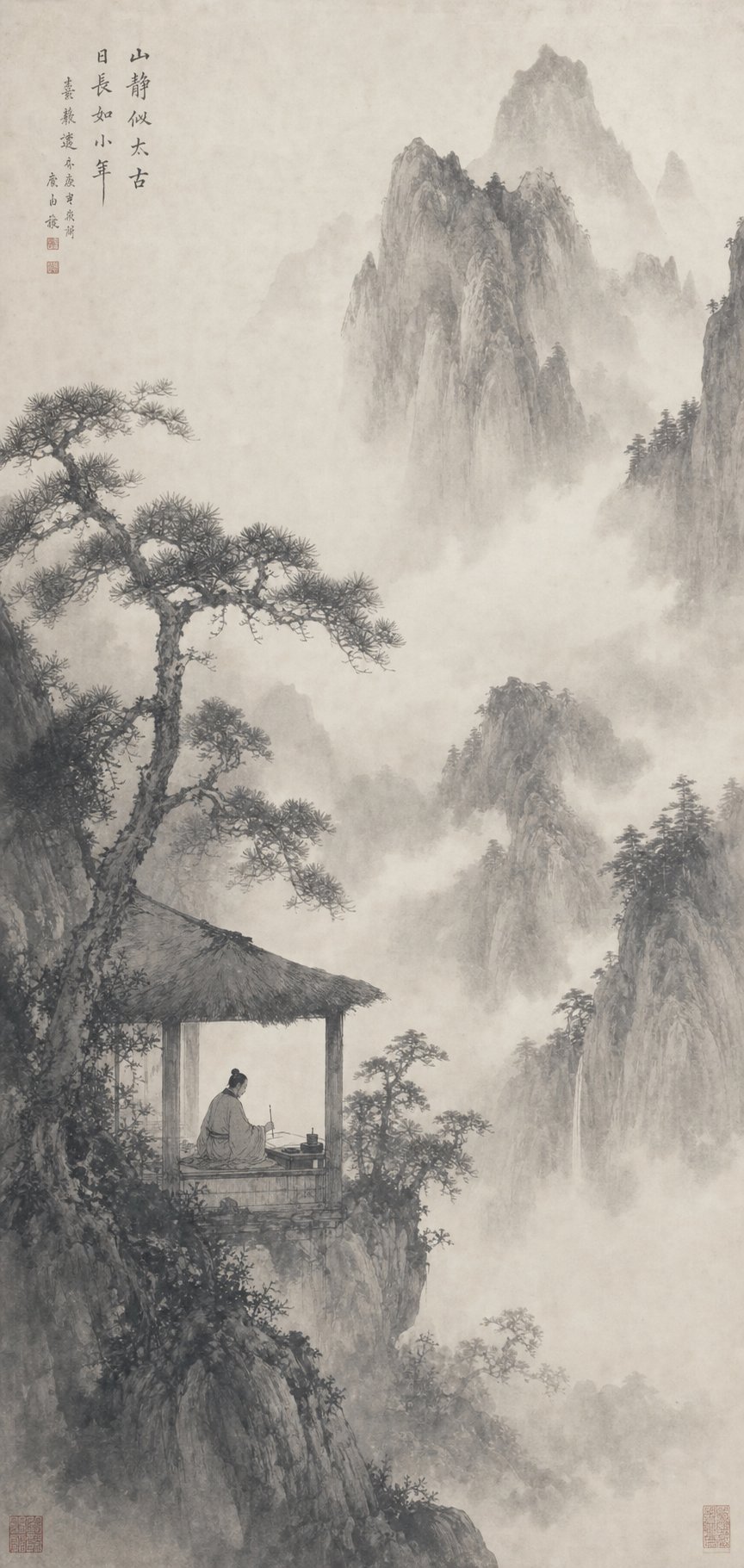
The birth name was given by parents. The courtesy name was bestowed by elders. But the hao (號) belonged entirely to the artist. This is the name category where creative self-determination enters the picture, and it's the single most important chinese name definition to understand when studying Chinese art. While the ming and zi anchored an artist within family and social hierarchies, the hao freed them to declare who they aspired to be.
What Makes the Hao Unique Among Chinese Names
Think of the hao as an artistic manifesto compressed into a few characters. Unlike every other name in the Chinese system, it was self-chosen. No ceremony required, no elder's approval needed. An artist could adopt a hao at any point in life, change it when their worldview shifted, or accumulate several simultaneously. This freedom made the hao the most personal and philosophically charged element of chinese artist name conventions.
The hao represents the only name in the traditional Chinese naming hierarchy that an artist claimed through personal choice rather than social assignment. It is the point where identity shifts from something received to something created.
This distinction matters for chinese name interpretation. When you encounter a hao on a painting or in a colophon, you're reading a deliberate statement of artistic identity, not a bureaucratic label. The landscape painter Jing Hao (c. 855-915), for example, chose the art name Hongguzi (洪谷子), meaning "Master of Honggu Valley." That name wasn't inherited or assigned. It was a declaration: this artist defined himself through the remote mountain valley where he lived and painted in seclusion.
Philosophical and Spiritual Roots of Art Names
So what drove these naming choices? The meaning chinese names carried in the hao tradition drew from three deep wells of Chinese thought:
- Daoist philosophy: Nature imagery, reclusion, and spontaneity dominated. Artists chose names referencing mountains, clouds, rivers, and hermit life. Jing Hao's retreat to the Taihang Mountains and his adoption of a valley-based art name perfectly embodied this impulse. His aversion to political turmoil led him to define his identity through landscape rather than social position.
- Buddhist concepts: Impermanence, emptiness, and detachment from worldly concerns inspired names referencing monks, lay practitioners, or spiritual states. The suffix "jushi" (居士, lay Buddhist) appeared frequently, as with Su Shi's famous hao Dongpo Jushi.
- Literary allusion: Classical poetry, historical texts, and philosophical works provided endless material. An artist might reference a line from the Zhuangzi or a Tang poem, embedding layers of meaning that educated viewers would immediately recognize.
Understanding chinese names meaning in this context requires reading the hao as a cultural text. Each character was chosen with precision, carrying associations that placed the artist within specific intellectual traditions. A name referencing bamboo signaled resilience and integrity. A name invoking clouds suggested freedom from constraint. These weren't decorative choices — they were philosophical positions.
How Artists Chose and Changed Their Hao
One of the most distinctive features of the hao system is its fluidity. Artists weren't locked into a single art name for life. As their philosophy matured, as they experienced exile or loss, as they moved between cities and mountains, they adopted new names to mark these transitions. A single artist might use three, five, or even a dozen hao across a lifetime.
Jing Hao's choice of Hongguzi reflected a specific life decision: abandoning the collapsing Tang dynasty's political world for the isolation of Shanxi's mountain forests. Had he remained in court, he might never have adopted that name in chinese meaning tied to wilderness and solitude. The name emerged from lived experience, not abstract preference.
This multiplicity creates both richness and complexity for researchers. When you encounter an unfamiliar name on a scroll, it might be a lesser-known hao used during a brief period of the artist's life. Recognizing this possibility is essential for accurate attribution. The hao wasn't static identity — it was identity in motion, tracking an artist's intellectual and spiritual journey across decades.
Yet the hao didn't exist in isolation. It appeared alongside other names on artworks, particularly in the physical spaces where artists created: their studios. The names artists gave to these creative spaces formed yet another layer of identity, one that was literally stamped onto every work that left the room.
Studio Names and Seal Names on Artworks
A hao declared who an artist aspired to be. But where did that aspiration take physical form? Often, it was rooted in a specific place: the studio, study, or mountain retreat where the artist worked. Chinese artists didn't just name themselves — they named the rooms they created in. And those room names, carved into seals and brushed into inscriptions, became inseparable from the art itself.
Studio Names and the Artist's Creative Space
The studio name, or zhai hao (齋號), refers to the name an artist gave to their workspace. This could be a formal study (zhai 齋), a hall (tang 堂), a pavilion (ge 閣), a hut (an 庵), or even an imagined retreat that existed only in the artist's mind. Whatever the physical reality, the studio name functioned as a creative address — a declaration of the environment in which art was born.
Imagine a painter signing a landscape scroll not just with his personal name but with the phrase "painted at the Hall of Ten Thousand Pines." That studio name tells you something the artist's birth name never could: it evokes atmosphere, philosophy, and aesthetic commitment. Writing chinese names in this way layered geographic and spiritual identity onto every inscription.
Studio names appeared in two key locations on artworks. First, in the colophon or inscription text, where an artist might write something like "completed in the autumn at my Thatched Hall of Ink Play." Second, on dedicated seals that stamped the studio name in vermillion beside the artist's signature. Over time, certain studio names became so famous that they functioned as shorthand for the artist himself. Qi Baishi's Jieshan Guan (借山館, "Borrowed Mountain Studio") is a prime example — the studio name became part of his public identity, appearing across decades of work in name chinese characters carved into stone.
The naming logic followed the same philosophical currents as the hao. Daoist-leaning artists chose names evoking nature and simplicity. Buddhist-influenced painters referenced meditation halls or quiet retreats. Confucian scholars might name their studios after classical texts they revered. Each studio name was a miniature essay on creative values, compressed into two or three characters of name chinese writing that appeared again and again across an artist's output.
Seal Names on Paintings and Calligraphy
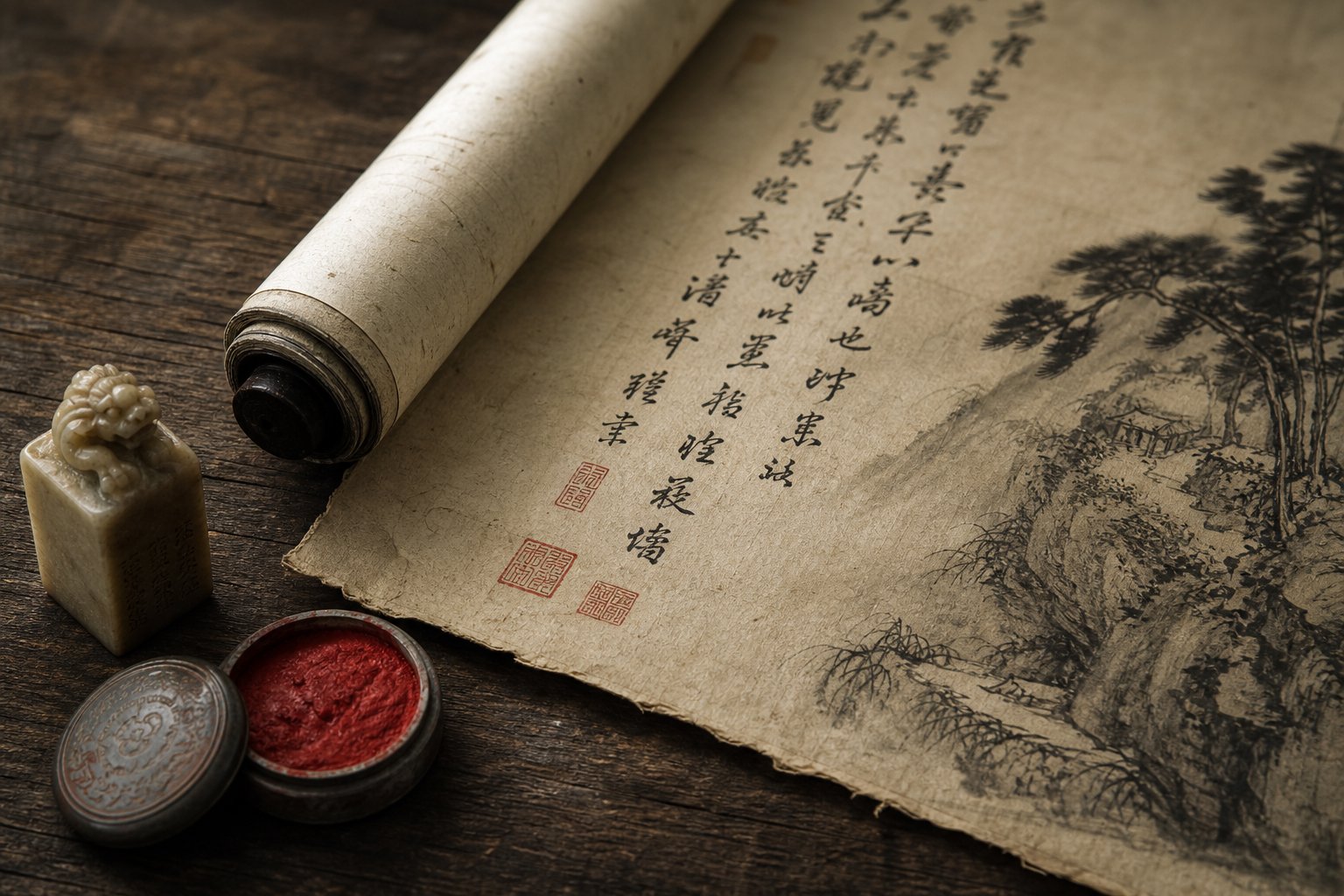
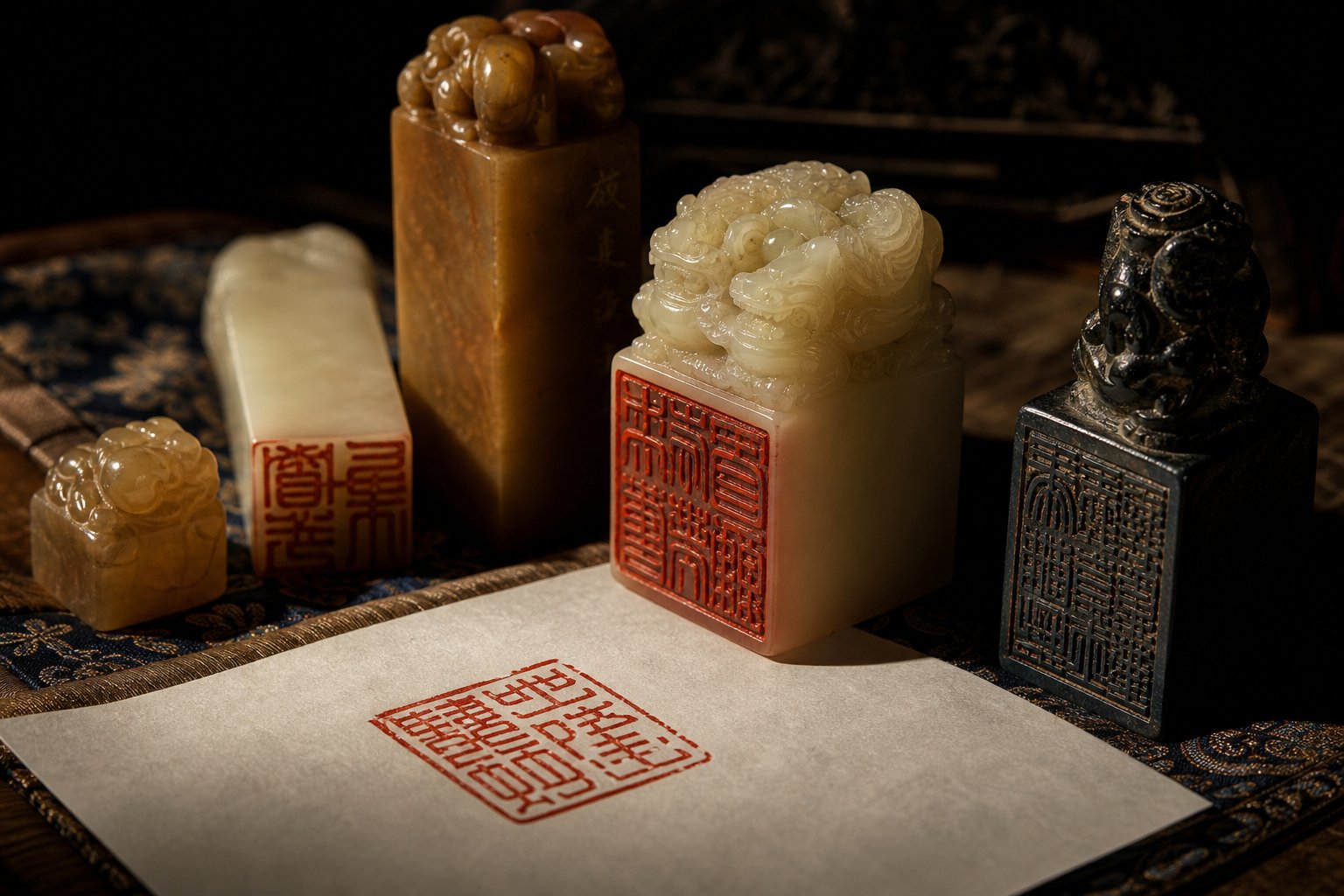
If studio names anchored identity in space, seal names anchored it in material form. A Chinese painting seal is a small block of stone, jade, or wood with characters carved in relief, inked with vermillion paste, and stamped directly onto the painting. The carving uses seal script (篆書), the most archaic of Chinese script families, derived from bronze-inscription forms dating to the Shang and Zhou dynasties.
Here's what makes seal names essential for anyone studying chinese name characters on artworks: a single major painting typically carries at least two seals, and often more. Each seal serves a distinct function:
- Name seal (姓名印): The formal authenticator, bearing the artist's surname and given name in seal script.
- Alias or studio seal (字号印 / 室名印): Indicates the artist's literary identity or studio name at the time of painting — crucial for dating works, since artists used different aliases at different career phases.
- Motto seal (闲章): A poetic phrase or personal motto that adds emotional or philosophical meaning. Qi Baishi's read "old man of the white stone"; Pan Tianshou's declared "painting fool."
Reading these seals isn't optional for serious provenance research. Because artists used different seals at different life stages, the specific seal on a work helps scholars date it, confirm authenticity, and trace its history. Qi Baishi, for instance, used roughly thirty distinct seals across his career, each corresponding to specific periods and name in mandarin characters that shifted as his identity evolved.
Placement matters too. Painters didn't stamp seals randomly. The position is compositional — balancing heavy brushwork on the opposite side, anchoring an empty corner, or extending a calligraphic stroke into the lower edge. Look at any major Qi Baishi painting of shrimp and you'll notice seals at the right end balancing the leftward swim of the figures. The seal isn't punctuation; it's a closing chord in the visual composition.
Beyond the artist's own seals, paintings accumulate collector seals over centuries. A famous Song-dynasty work might bear ten or twenty collector seals from successive owners. These don't diminish value — they are provenance written directly onto the work, a physical chain of custody in vermillion ink.
| Dimension | Studio Name (齋號) | Seal Name (印名) |
|---|---|---|
| Definition | Name given to the artist's workspace, study, or retreat | Name carved into stone seals and stamped in vermillion onto works |
| Where it appears | Colophon inscriptions, dedicated studio seals, title pages | Directly on paintings and calligraphy, near the signature |
| Relationship to other names | Often incorporates elements of the hao or reflects the same philosophy | May contain the ming, zi, hao, or studio name — any layer of identity |
| Who creates it | Self-chosen by the artist | Carved by the artist or by a master seal-carver friend |
| Function for researchers | Identifies creative periods and geographic context | Essential for authentication, dating, and provenance tracking |
| Historical example | Qi Baishi's Jieshan Guan (借山館, Borrowed Mountain Studio) | Wu Changshuo carved seals for most of his contemporaries; Qi Baishi carved his own in a rough, archaic style |
What makes this system so powerful — and so challenging for Western researchers — is that a single painting might carry seals carved by two or three different masters. The painter's own seals sit alongside seals carved by celebrated friends like Wu Changshuo (1844-1927), one of the greatest seal-carvers in Chinese history. Inspecting a painting at close range means encountering multiple artists' work in a single composition, each contributing to the web of names and identities that write chinese name traditions directly onto the surface of art.
These naming practices didn't emerge in a vacuum. They evolved across centuries of dynastic change, political upheaval, and shifting cultural values — each era leaving its mark on how artists chose to identify themselves.
How Artist Naming Evolved Across Chinese Dynasties
Political upheaval didn't just change who held power — it changed how artists named themselves. Each dynasty brought new social pressures, new philosophical currents, and new reasons for an artist to adopt, abandon, or reinvent a name. Tracing these shifts reveals that naming in chinese art was never a static tradition. It was a living response to the world outside the studio door.
Song and Yuan Dynasty Naming Traditions
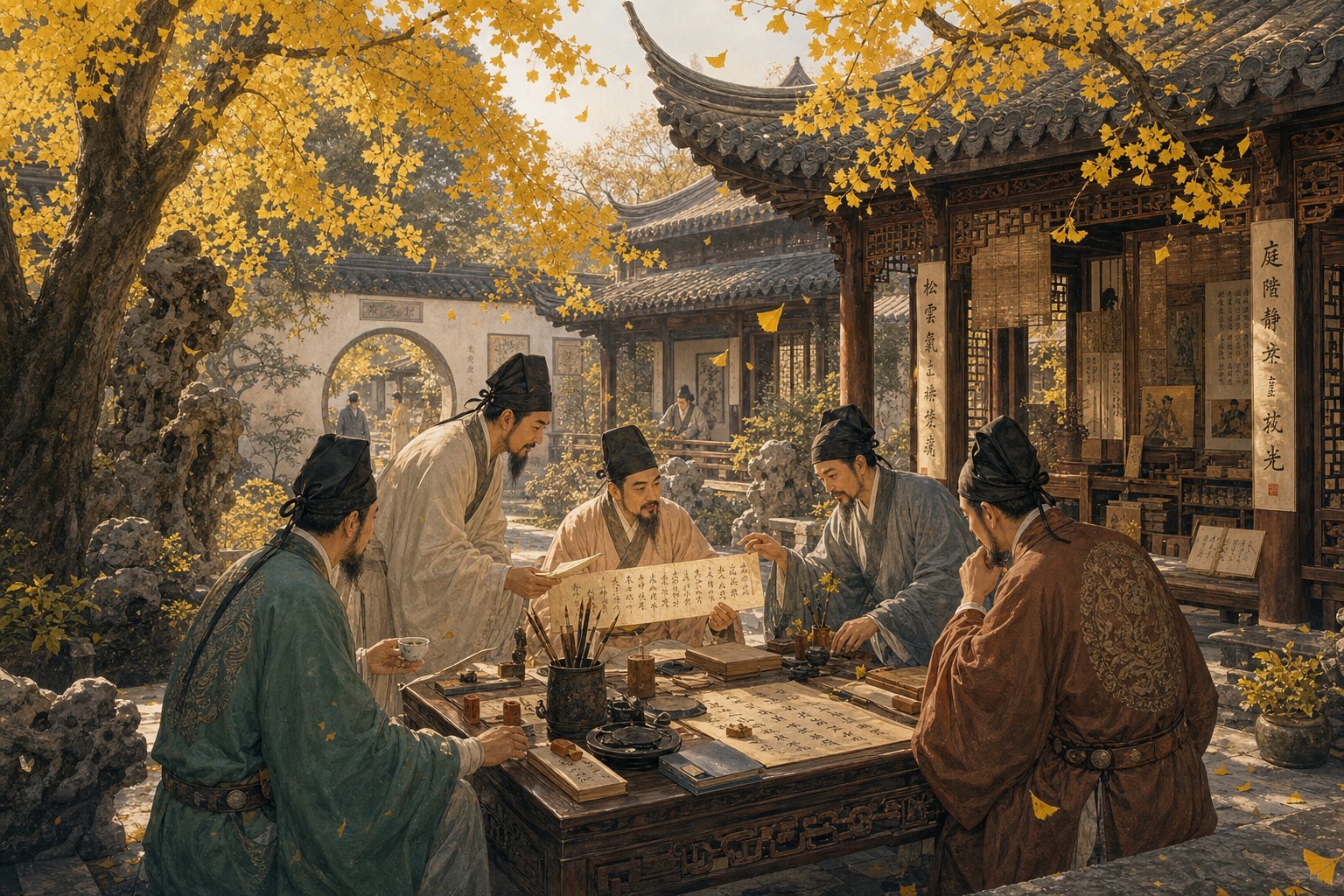
The Song dynasty (960-1279) marks the moment when art names became standard practice among the educated class. Before this period, the hao existed but remained relatively uncommon. By the Northern Song, the majority of literati were calling each other by their art names, and these names changed frequently as careers and philosophies evolved.
Why the explosion? Song-era scholar-officials held dual identities. By day, they served as bureaucrats, tax collectors, and provincial governors. By evening, they painted landscapes, composed poetry, and practiced calligraphy. The art name gave them a way to separate these worlds. A man known in court by his formal ming and zi could become someone entirely different when he picked up a brush. Su Shi's transformation into Dongpo Jushi — the Buddhist layman of the Eastern Slope — is the defining example. His political career ended in exile; his artistic identity flourished precisely because of it.
The Yuan dynasty (1271-1368) pushed this logic further. When Mongol rulers displaced the Song court, many Chinese intellectuals refused to serve the new government. Their art names became declarations of resistance. Ancient chinese names referencing reclusion, mountain hermitage, and withdrawal from worldly affairs proliferated. Painters like Ni Zan adopted hao such as Yunlin (雲林, "Cloud Forest"), signaling that they had retreated from political life entirely. The hao wasn't just personal expression anymore — it was political statement, a quiet refusal encoded in two characters.
Chinese honorifics and naming etiquette also shifted during this period. Under Song rule, the courtesy name system functioned smoothly within a shared Confucian bureaucracy. Under Yuan Mongol rule, many scholars abandoned the examination system altogether, making the zi less socially relevant. The hao filled the gap, becoming the primary identifier among artists who no longer defined themselves through government service.
Ming and Qing Dynasty Shifts in Artist Names
The Ming dynasty (1368-1644) restored Chinese rule and revived the examination system, but artist naming practices had already transformed. Studio names flourished as never before. Professional painters in cities like Suzhou and Nanjing named their workshops with increasing creativity, and these zhai hao appeared prominently on paintings destined for wealthy merchant patrons. The typical chinese names of this era reflected commercial confidence rather than political withdrawal.
How are chinese names structured during the Ming? Consider Tang Yin, who accumulated more than ten hao across his lifetime. This wasn't unusual — it reflected a culture where artists reinvented themselves with each major life event. Tang Yin's early names referenced scholarly ambition; his later names, adopted after a devastating examination scandal, embraced wine, pleasure, and defiant independence. The naming system had become a biographical record in miniature.
The Qing dynasty (1644-1911) introduced new complexity. Manchu rulers imposed their own naming conventions on the bureaucracy, and the examination system grew more rigid. Artists responded by multiplying their identities. Common chinese names in the Qing art world often included Buddhist-inflected hao, elaborate studio names referencing specific collections or prized objects, and seals that shifted with each decade of work. The painter Zheng Xie (Zheng Banqiao) used his studio name and hao so interchangeably that modern scholars sometimes struggle to determine which name appeared first.
Here's a chronological overview of how these naming practices shifted dynasty by dynasty:
- Six Dynasties (220-589): Earliest recorded use of self-chosen hao among literati, including Tao Yuanming's "Mister Five-Willows" — art names remain rare and informal.
- Tang dynasty (618-907): Art names gain popularity among poets and painters; names often derive from residence locations, famous poetic lines, or official posts.
- Song dynasty (960-1279): Hao become standard among scholar-officials; artists use them to separate political from creative identity; names change frequently throughout life.
- Yuan dynasty (1271-1368): Reclusive and nature-based hao proliferate as Chinese intellectuals withdraw from Mongol governance; the art name becomes a tool of political resistance.
- Ming dynasty (1368-1644): Studio names flourish among professional urban painters; artists accumulate numerous hao marking different life phases; naming becomes increasingly elaborate.
- Qing dynasty (1644-1911): Maximum complexity — artists maintain multiple hao, studio names, and seal identities simultaneously; Manchu influence and rigid examinations drive further naming diversification.
Each shift responded to a specific historical pressure. Exile produced reclusive names. Commercial patronage produced studio brands. Foreign rule produced coded resistance. The system was never merely decorative — it was a mirror of Chinese intellectual life under changing political conditions.
These patterns become vivid when you examine specific artists whose naming choices tell the story of their entire lives — from birth name to final seal.
Famous Chinese Artists and Their Multiple Names
Abstract naming categories only go so far. The real power of this system becomes clear when you trace how individual artists accumulated, discarded, and reinvented their names across a lifetime. Three figures — Qi Baishi, Xu Beihong, and Bada Shanren — offer some of the most revealing case studies among famous chinese names in art history. Each artist's naming choices encode personal tragedy, philosophical transformation, and creative ambition in just a few characters.
Qi Baishi and His Many Names
Qi Baishi (1864-1957) is the name the world knows, but it was neither his birth name nor his courtesy name. Born into a poor farming family in Xiangtan, Hunan, he was registered as Qi Chunzhi (齊純芝), meaning "pure iris." His formal given name was Qi Huang (齊璜), where Huang (璜) refers to a semicircular jade pendant — a character carrying associations of purity and value. The chinese surnames meaning behind Qi (齊) traces back to the ancient state of Qi, one of the most powerful kingdoms of the Spring and Autumn period.
His courtesy name evolved too. He first used Weiqing (渭清, "clear as the Wei River"), then later adopted Binsheng (濒生, "born by the water"). But it was his self-chosen art name that stuck. "Baishi" (白石) means "white stone," referencing Baishi Pu — a small station with white stone hills near his childhood home. The mandarin name meaning is deceptively simple: by naming himself after a humble geographic feature rather than a grand philosophical concept, Qi Baishi signaled his identity as a rural craftsman-turned-painter, never fully at home in Beijing's elite circles.
Over his long career, Qi Baishi used more than a dozen additional hao. He called himself Baishi Shanren (白石山人, "Mountain Man of White Stone"), Jieshan Yingguan Zhuren (借山吟馆主人, "Master of the Borrowed Mountain Poetry Hall"), Xing Douchen (星塘老屋后人, "Descendant of the Old House by Star Pond"), and Mu Ju Shi (木居士, "Wooden Lay Buddhist"). Each name marked a different phase: the young woodcarver, the traveling painter, the Beijing master, the elderly sage. His studio name, Jieshan Guan (借山館, "Borrowed Mountain Studio"), appeared on seals across five decades of work.
You'll notice that Qi Baishi's chinese names and meanings consistently reference landscape, humility, and rootedness in place. He never chose grandiose literary allusions. Even at the height of his fame, his names pointed back to Hunan's hills and ponds — a deliberate rejection of the cosmopolitan posturing common among Beijing intellectuals.
Xu Beihong: A Name Born from Hardship
Xu Beihong (1895-1953) presents a different pattern. His parents originally named him Xu Shoukang (徐壽康), meaning "longevity and health" — a hopeful name for a child born into a struggling family. His father, Xu Dazhang, was a painter and calligrapher who had fallen on hard times and supported the family by growing watermelons.
As a young man facing poverty and rejection in Shanghai, Xu Shoukang renamed himself Beihong (悲鴻), meaning "sad wild goose." The china name meaning is poignant: a wild goose separated from its flock, crying out in solitude. This wasn't philosophical posturing — it was autobiography. Desperate and nearly suicidal after failing to find work as an illustrator, the young artist chose a name that encoded his emotional reality. The goose, a traditional symbol of communication and longing in Chinese poetry, became his permanent identity.
Unlike Qi Baishi's dozen-plus art names, Xu Beihong largely maintained this single self-chosen identity throughout his career. His courtesy name was Jibei (吉北), but it was "Beihong" that appeared on his paintings of galloping horses and epic historical compositions. The stability of his naming reflects his artistic mission: a single-minded drive to modernize Chinese painting through Western realism. Where Qi Baishi's multiplying names tracked an evolving inner life, Xu Beihong's fixed name tracked an unwavering external purpose.
Bada Shanren and the Art of Reinvention
No artist in Chinese history demonstrates the naming system's full expressive range like Bada Shanren (八大山人, 1626-1705). Born Zhu Da (朱耷), he was a descendant of the Ming imperial family — his surname Zhu (朱) was the imperial clan name itself. When the Ming dynasty fell to Manchu invaders in 1644, the eighteen-year-old prince lost everything: status, safety, and the right to use his own family name publicly.
What followed was one of the most dramatic sequences of name changes in Chinese art. Understanding the chinese name meanings behind each identity reveals a man reinventing himself through successive crises:
- Zhu Da (朱耷): His birth name, abandoned after the Ming collapse made the imperial surname dangerous to carry.
- Chuanqi (傳綮): His Buddhist monastic name, adopted when he entered a Chan monastery around 1648 to escape persecution.
- Xuege (雪个): An early art name meaning "snow individual" — suggesting purity, isolation, and the coldness of his new existence.
- Ge Shan (个山): "Individual Mountain" — a name emphasizing solitary independence, used during his years as an abbot.
- Renqu (人屋): "Person-house" — a cryptic name scholars have interpreted as meaning "a person who is also a shelter," reflecting his role as a spiritual leader housing others' faith.
- Lü (驴): Simply "donkey" — adopted during a period of apparent madness in the 1680s when he wandered the streets laughing and weeping.
- Bada Shanren (八大山人): His final and most famous art name, adopted around 1684 and used for the last two decades of his life.
The chinese last name meanings embedded in "Bada Shanren" remain debated among scholars. Literally, it translates as "Mountain Man of the Eight Greats," possibly referencing eight scenic mountains near Nanchang. But Bada Shanren deliberately wrote the four characters in a way that made "八大" (eight great) resemble "哭" (cry) and "笑" (laugh) when brushed together, while "山人" (mountain man) could look like "之" (of/this). The ambiguity was intentional — a former prince encoding grief and dark humor into his very signature.
His paintings of fish with rolling eyes and birds perched on impossibly thin branches carry the same coded defiance. The name and the art were inseparable: both communicated what could not be spoken aloud under Qing rule.
| Artist | Ming (Birth Name) | Zi (Courtesy Name) | Primary Hao (Art Name) | Studio Name | Key Name Meaning |
|---|---|---|---|---|---|
| Qi Baishi | Qi Huang (齊璜) — "jade pendant" | Binsheng (濒生) — "born by the water" | Baishi (白石) — "white stone" | Jieshan Guan (借山館) — "Borrowed Mountain Studio" | Names reference humble rural origins and local geography near Xiangtan, Hunan |
| Xu Beihong | Xu Shoukang (徐壽康) — "longevity and health" | Jibei (吉北) | Beihong (悲鴻) — "sad wild goose" | — | Self-renamed during youthful poverty; the lonely goose encodes isolation and artistic ambition |
| Bada Shanren | Zhu Da (朱耷) — imperial Zhu surname | Not publicly used after Ming fall | Bada Shanren (八大山人), Xuege (雪个), Ge Shan (个山), Lü (驴), others | — | Each name marks a life phase: monastic retreat, solitary defiance, madness, and coded political grief |
What connects these three artists is how legibly their names track their lives. Qi Baishi's names map a journey from rural poverty to national treasure. Xu Beihong's single self-chosen name captures a young man's pain transformed into lifelong purpose. Bada Shanren's cascading identities record the destruction of a dynasty and one man's refusal to disappear quietly.
These examples also reveal a practical challenge. When the same artist appears in Western catalogs under different romanized spellings — Xu Beihong or Hsu Pei-hung, Qi Baishi or Ch'i Pai-shih — the confusion multiplies. Navigating these variants requires understanding not just the names themselves, but the romanization systems that translated them into English.
Romanization Challenges When Researching Chinese Artists
Qi Baishi or Ch'i Pai-shih? Xu Beihong or Hsu Pei-hung? The same artist, the same characters, yet two completely different spellings in English. This isn't a typo problem — it's a systemic one. When you try to render chinese names into english, the romanization system you choose determines the spelling you get. And because Western institutions adopted different systems at different times, a single artist can appear under multiple spellings across catalogs, auction records, and academic journals. Layer that on top of the five-name hierarchy we've already explored, and you're looking at a research maze.
Pinyin vs Wade-Giles and Other Romanization Systems
Two major systems dominate the chinese name translation landscape. Wade-Giles, developed in the 19th century by British diplomats Thomas Wade and Herbert Giles, was the standard in English-language scholarship for over a hundred years. Pinyin, created by the People's Republic of China in the 1950s and adopted internationally by the 1980s, is now the global default. The problem? Older museum records, pre-1980s publications, and many auction catalogs still use Wade-Giles.
The Library of Congress identifies several quick ways to distinguish the two systems. Wade-Giles uses apostrophes to mark aspiration (ch'i, t'ang, p'an), hyphens between syllables of given names (Pai-shih), and letter combinations like "hs" and "ts" that never appear in Pinyin. Pinyin joins syllables together (Baishi), uses letters like Q, X, and Z that Wade-Giles avoids, and drops the apostrophe system entirely. Once you recognize these visual cues, identifying which system you're reading becomes straightforward.
But the confusion doesn't stop at two systems. Cantonese names add another layer. Artists from Guangdong, Hong Kong, or Macau often appear in Western records under Cantonese romanizations rather than Mandarin-based ones. The photographer Lai Afong (赖阿芳), active in 19th-century Hong Kong, is cataloged under his Cantonese pronunciation — not the Mandarin "Lai Afang." For researchers working across regions, these cantonese names create yet another set of variants to track.
Historical transliterations from French, German, and Portuguese sources introduce still more variants. A Qing-dynasty painter referenced in a 19th-century French exhibition catalog might appear under a spelling that matches neither Wade-Giles nor Pinyin, because the romanization followed French phonetic conventions instead.
Searching for Artists Across Databases and Catalogs
When you need to name translate chinese artists for research purposes, the practical challenge is this: no single search term will catch every record. A museum that cataloged its collection in the 1960s may still list an artist under Wade-Giles, while the same artist appears in Pinyin on a 2020 auction site. Academic databases compound the issue by indexing older publications under their original romanizations without cross-referencing modern equivalents.
Tools like the Getty Union List of Artist Names (ULAN) help bridge this gap by linking variant spellings to a single authority record. But not every artist is in ULAN, and not every researcher knows to check it. No universal chinese name converter exists that reliably handles all historical variants, regional pronunciations, and legacy catalog entries simultaneously.
Here are common pitfalls and practical strategies for cross-referencing artist names in research:
- Always search both Pinyin and Wade-Giles spellings. If you know the Pinyin (Qi Baishi), construct the Wade-Giles equivalent (Ch'i Pai-shih) and search both. Drop apostrophes too — many databases strip them.
- Account for regional pronunciation. Artists from southern China may be cataloged under cantonese names or other dialect romanizations, especially in Hong Kong and overseas collections.
- Search by Chinese characters when possible. Characters bypass romanization entirely. If a database supports CJK input, use the original 齊白石 rather than any romanized form.
- Check for art names and studio names separately. An artist might be filed under their hao in one catalog and their ming in another. Bada Shanren and Zhu Da are the same person — but they won't appear in the same search result.
- Use authority files and cross-reference tools. ULAN, the Library of Congress Name Authority File, and China Biographical Database Project all link variant names to unified records.
- Watch for hyphenation and spacing differences. "Xu Beihong," "Hsü Pei-hung," and "Hsu Peihung" are all attempts to name convert to chinese the same two characters (徐悲鴻) back into roman letters — and all appear in published sources.
- Note the publication date. Pre-1979 English-language sources almost certainly use Wade-Giles. Post-2000 sources almost certainly use Pinyin. The transition period (1979-2000) is unpredictable.
The chinese translation for names problem isn't going away. Legacy records won't be retroactively corrected in most institutions, and new romanization variants continue to emerge as artists from different dialect regions gain international attention. Building the habit of searching multiple variants — and understanding why those variants exist — is the single most practical skill for anyone working seriously with Chinese art across english to chinese name boundaries.
These romanization headaches multiply further when contemporary artists enter the picture. Living painters and sculptors face a different version of the naming question: how to present themselves across languages, platforms, and markets that operate under entirely different cultural assumptions.
Modern Chinese Artist Names in a Global Art World
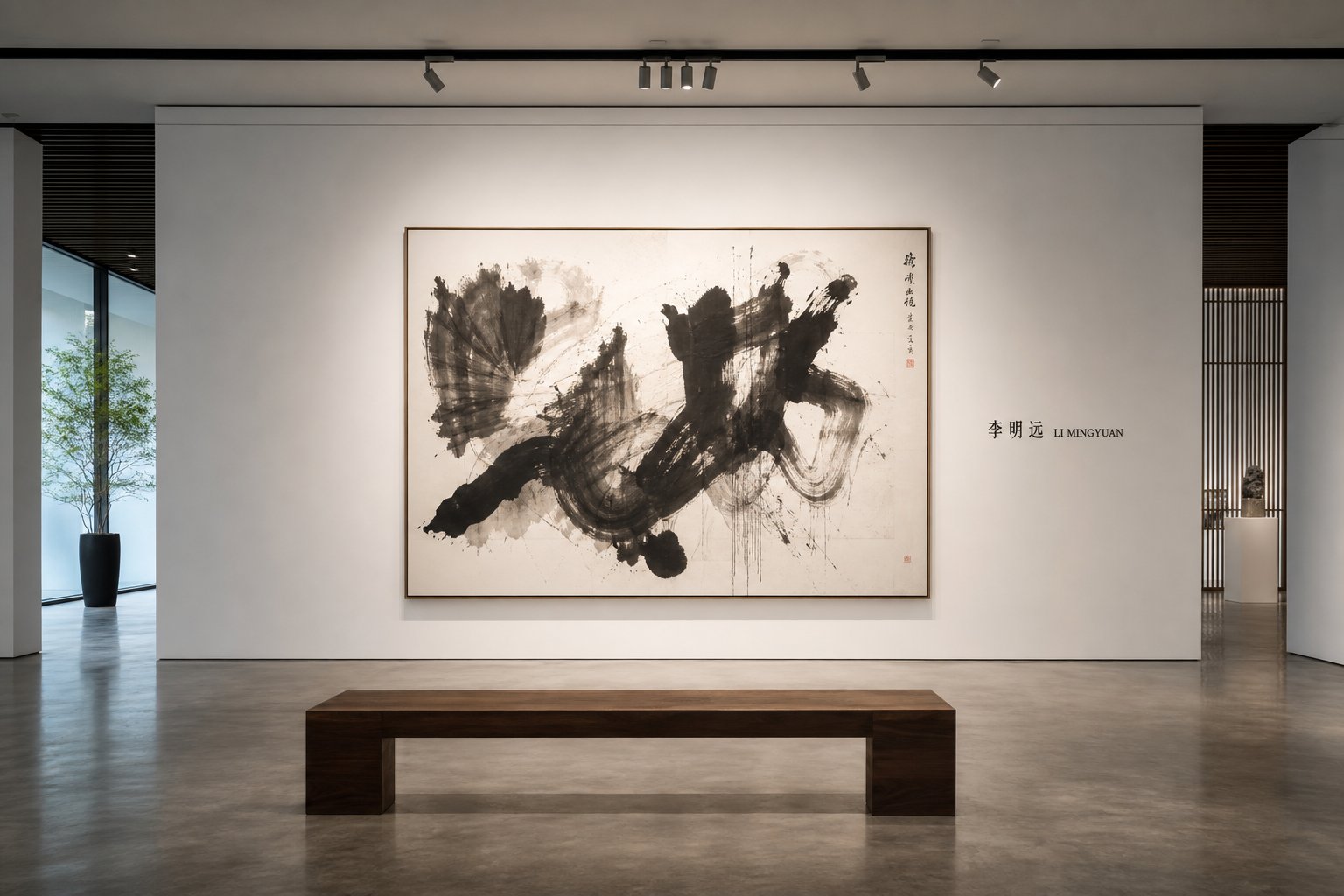
A younger generation of Chinese artists has largely abandoned the question "what is my chinese name in the traditional sense?" altogether. Born in the 1980s and 1990s, many of these artists grew up with open-door policies, Western brands, and unrestricted internet access. Their naming strategies reflect a fundamentally different relationship to identity — one shaped less by Daoist philosophy or dynastic politics and more by Instagram handles, gallery branding, and international residencies.
Contemporary Artists Between East and West
Today's Chinese artists navigate a split audience. Domestically, they may exhibit under their full Chinese name in surname-first order. Internationally, they face a choice: adopt a Western first name, use a pinyin rendering of their given name, revive the hao tradition in modern form, or build an entirely new brand identity that transcends both systems.
Some artists resolve this by maintaining parallel identities. A painter might be Zhang Wei in Beijing galleries and "William Zhang" on a New York gallery roster — the english name chinese name pairing functioning as a practical bridge between markets. Others reject this duality entirely. As artist Lu Yang told researcher Barbara Pollack, "I don't have a nationality — I live on the internet." For artists like Lu Yang, the question of how to make a chinese name legible to Western audiences is irrelevant. Their identity exists in digital space, beyond geography or linguistic convention.
This "post-passport" generation, as Pollack describes them, often insists on relinquishing the label "Chinese artist" altogether. They sample from global visual cultures the way a DJ samples tracks — freely, without obligation to signal national origin through their names or iconography. Yet the practical reality of art markets still demands a searchable, consistent asian name across auction databases, exhibition catalogs, and social media platforms. The tension between fluid identity and fixed branding is the defining naming challenge for contemporary Chinese artists.
Several strategies have emerged:
- Pinyin-only: Artists use their full Chinese name in pinyin (Cao Fei, Liu Wei) without adopting a Western first name, letting the romanization stand on its own.
- Western first name + Chinese surname: Common among artists educated abroad or represented by international galleries (e.g., choosing a chinese name from english phonetics for accessibility).
- Mononym or brand name: Some artists create single-word identities that function across languages, sidestepping the surname-first/given-name-first confusion entirely.
- Revived hao: A smaller number of contemporary ink painters and calligraphers still adopt traditional art names, connecting their practice to historical lineage.
The old five-name hierarchy hasn't disappeared — but for many living artists, it has compressed into a single professional identity optimized for global searchability rather than philosophical expression.
Chinese vs Japanese and Korean Artist Naming Traditions
Readers working across East Asian art will notice parallel traditions in Japan and Korea. The Japanese go (号) and Korean ho (호) share deep roots with the Chinese hao — all three derive from the same classical Chinese literary culture. But each tradition evolved differently under local conditions, and understanding these distinctions prevents conflating asian names across cultures.
In Japan, the go tradition flourished among ukiyo-e artists and tea masters. Hokusai alone used over thirty art names across his career — a practice directly inherited from Chinese literati conventions. Korean yangban scholars similarly adopted ho as markers of intellectual identity, though the tradition was more restrained than in China, with most scholars maintaining one or two art names rather than a dozen.
| Dimension | Chinese Hao (號) | Japanese Go (号) | Korean Ho (호) |
|---|---|---|---|
| Self-chosen vs assigned | Self-chosen; no approval required | Self-chosen or bestowed by a master within an artistic lineage | Self-chosen, often with input from a teacher or mentor |
| When adopted | Any time; often multiple names across a lifetime | Upon entering an artistic school or achieving mastery | Typically upon reaching scholarly maturity |
| Typical sources of inspiration | Nature, Daoist/Buddhist philosophy, literary allusion, personal geography | Nature, Zen concepts, artistic lineage references, seasons | Confucian virtues, landscape features, classical Chinese poetry |
| Number typically used | Often 3-10+ across a career | Often 2-5; some artists (Hokusai) used 30+ | Usually 1-2; restraint valued |
| Modern usage | Declining among contemporary artists; replaced by brand identities and pinyin names | Still active in traditional arts (tea ceremony, ikebana, kabuki); rare in contemporary art | Largely historical; modern Korean artists use legal names internationally |
The key difference lies in lineage. Japanese go names often carry the weight of a school or tradition — accepting a name from a master signals belonging to a specific artistic lineage. Chinese hao, by contrast, emphasize individual self-determination. Korean ho sit somewhere between: personally chosen but culturally expected to reflect Confucian modesty rather than bold self-expression.
For collectors and researchers working across these traditions, the practical takeaway is clear. When you encounter a chinese name from english sources, check whether the name is a birth name, courtesy name, or art name — because the same ambiguity exists in Japanese and Korean records. A single ukiyo-e print might be attributed to an artist's go in one catalog and their legal name in another, creating the same cross-referencing challenges that plague Chinese art research.
Digital platforms are slowly resolving some of these issues. Online databases increasingly link variant names across languages, and younger artists tend to maintain consistent identities across platforms. But for anyone researching historical works — or navigating the transition zone where traditional naming meets global branding — the five-name system remains the essential framework. Understanding it doesn't just decode the past. It clarifies why contemporary artists make the naming choices they do, and what those choices reveal about the ongoing negotiation between cultural heritage and international visibility.
Frequently Asked Questions About Chinese Artist Name Conventions
1. Why do Chinese artists have so many different names?
Chinese artists accumulated names throughout their lives because each served a unique function. The birth name (ming) connected them to family, the courtesy name (zi) marked adult social status, the art name (hao) expressed personal philosophy, the studio name identified their creative workspace, and seal names authenticated their works. This layered system reflected a culture where identity was relational and evolving rather than fixed. A single artist like Qi Baishi used over a dozen names across his career, each marking a different life phase or philosophical shift.
2. What is the difference between a Chinese artist's hao and their birth name?
The birth name (ming) was assigned by parents at birth and functioned as a legal identity, while the hao was entirely self-chosen by the artist at any point in life. The ming was governed by strict social etiquette — peers could not use it directly, as that implied superiority. The hao, by contrast, was a creative declaration with no rules about when or how it could be adopted. Artists often chose hao referencing nature, Buddhist or Daoist philosophy, or personal geography to express their artistic ideals rather than family lineage.
3. How do you identify which name a Chinese artist used on a painting?
Chinese paintings typically carry multiple name indicators. The artist's signature in the inscription may use their ming, zi, or hao depending on the social context of the work. Vermillion seal impressions stamped near the signature contain name seals (formal identity), alias seals (art name or studio name), and motto seals (personal phrases). Because artists used different seals at different career stages, identifying which specific seal appears helps scholars date the work and confirm its authenticity through comparison with documented seal impressions.
4. What is the difference between Pinyin and Wade-Giles when searching for Chinese artists?
Pinyin and Wade-Giles are two romanization systems that produce different English spellings for the same Chinese characters. Wade-Giles, dominant before the 1980s, uses apostrophes and hyphens (Ch'i Pai-shih), while Pinyin joins syllables without apostrophes (Qi Baishi). Pre-1979 museum catalogs, auction records, and academic publications almost always use Wade-Giles, while modern sources use Pinyin. Researchers should search both spellings and, when possible, use original Chinese characters to bypass romanization inconsistencies entirely.
5. How do contemporary Chinese artists choose their professional names?
Modern Chinese artists use several strategies depending on their target audience. Some maintain pinyin-only names (like Cao Fei or Liu Wei) without adopting Western first names. Others pair a Western first name with their Chinese surname for international gallery representation. A smaller group creates mononym brand identities that work across languages, while traditional ink painters may still adopt classical hao to connect with historical lineage. The trend is toward a single consistent identity optimized for global searchability rather than the multi-layered philosophical naming of earlier centuries.