The Art That Defined Chinese Civilization
Imagine a culture where handwriting carries more prestige than painting, sculpture, or any other visual art. In China, that culture has thrived for over two thousand years. The ancient Chinese art of beautiful handwriting is called calligraphy, or shufa (书法), and it stands as one of the most revered artistic traditions in human history. More than decorative penmanship, it is a practice that fuses philosophy, physical discipline, and personal expression into every brushstroke.
The Ancient Art of Beautiful Handwriting in China
What sets Chinese calligraphy apart from writing traditions elsewhere? For one, it was recognized as a fine art long before painting ever achieved that status. As the Asia Society notes, calligraphy in China was viewed as the supreme visual art form, more valued than painting and sculpture, and ranked alongside poetry as a means of self-expression and cultivation. Painting only rose to comparable prestige during the Song dynasty (960-1279 CE), when it deliberately adopted calligraphic techniques and aims.
In traditional China, calligraphy was not just a form of decorative art. It was the supreme visual art form, ranked alongside poetry as a vehicle for self-expression, moral cultivation, and the revelation of one's inner character.
This elevated status grew from a simple but powerful idea: how you wrote revealed who you were. Each character, traced stroke by stroke in a set order, became a window into the writer's temperament, discipline, and spirit. A viewer could mentally retrace the calligrapher's movements, sensing where the brush moved swiftly or slowly, where pressure was applied with force or delicacy. Famous Chinese calligraphy, then, was never just about beauty on the page. It was about the human being behind the brush.
Why Certain Masters Became Legendary
Thousands of scholars practiced calligraphy across imperial China. So why did only a handful achieve lasting fame? The answer lies in three qualities: innovation in script styles, philosophical depth, and generational influence.
Famous chinese calligraphers earned their reputations by transforming the art itself. Some invented entirely new ways of forming characters. Others brought a philosophical vision, rooted in Confucian discipline or Daoist spontaneity, that gave their brushwork a dimension beyond technical skill. And the greatest among them created lineages, schools of style that students carried forward for centuries after the master's death.
Their stories span from the Qin dynasty's standardization of writing in the third century BCE to the expressive individualism of Song dynasty poets a millennium later. Each era produced masters who responded to the cultural pressures of their time, whether imperial patronage, political exile, or spiritual seeking. What follows is a chronological journey through these lives and their signature works, tracing how ink on paper outlived the dynasties that produced it.
Chinese Calligraphy History and Culture: Philosophy Behind the Brush
A calligrapher in ancient China was never simply making letters. Every stroke carried the weight of philosophical tradition, social expectation, and spiritual aspiration. To understand why certain masters rose to legendary status, you first need to understand the cultural soil that nourished their art. Two great philosophical currents, Confucianism and Daoism, shaped calligraphy from opposite directions, and together they gave the brush its extraordinary depth.
Confucian Values and the Imperial Examination System
In Confucian thought, self-cultivation was the highest human pursuit, and calligraphy was one of its primary vehicles. A person's brushwork was read as a direct expression of moral character. Disciplined strokes suggested a disciplined mind. Elegant composition implied inner harmony. This belief turned calligraphy into far more than an aesthetic exercise; it became a social marker of education, refinement, and fitness for public service.
The connection between brushwork and career was not merely symbolic. China's imperial civil service examinations, which operated for over a thousand years from the Han dynasty onward, explicitly tested writing and calligraphy alongside knowledge of Confucian classics, law, and government. Candidates spent years developing their script to make a pleasing impression on examiners. In the Tang dynasty (618-907 CE), calligraphy was listed among the core examination subjects, and only about 1% of examinees passed. The stakes were enormous: success meant entry into the scholar-official class, with all its privileges and prestige.
This system created a direct pipeline between calligraphic skill and political power. Many of the most celebrated calligraphers in Chinese history, figures like Yan Zhenqing and Su Shi, were also high-ranking government officials. Their brushwork carried the authority of their positions, and their positions validated the seriousness of their art.
Daoism and the Spiritual Dimension of Brushwork
Where Confucianism emphasized discipline and moral structure, Daoism brought a complementary force: spontaneity. Daoist philosophy taught that the greatest art arises not from rigid control but from alignment with the natural flow of qi, the vital energy that animates all things. A calligrapher (书法家, shufa jia, or in shorthand, calligrapher 中文) working in this tradition sought to channel rather than command the brush.
You'll notice this influence most clearly in cursive script, where characters dissolve into fluid, almost abstract gestures. The brush moves as if guided by wind or water, responding to the moment rather than following a rigid plan. Daoist concepts of emptiness also shaped how calligraphers used blank space, treating the unmarked paper as an active element rather than a passive background. Harmony with nature, balance between opposites, the unity of stillness and motion: these ideas gave calligraphy its spiritual dimension and elevated it beyond craft into meditation.
The Four Treasures of the Study
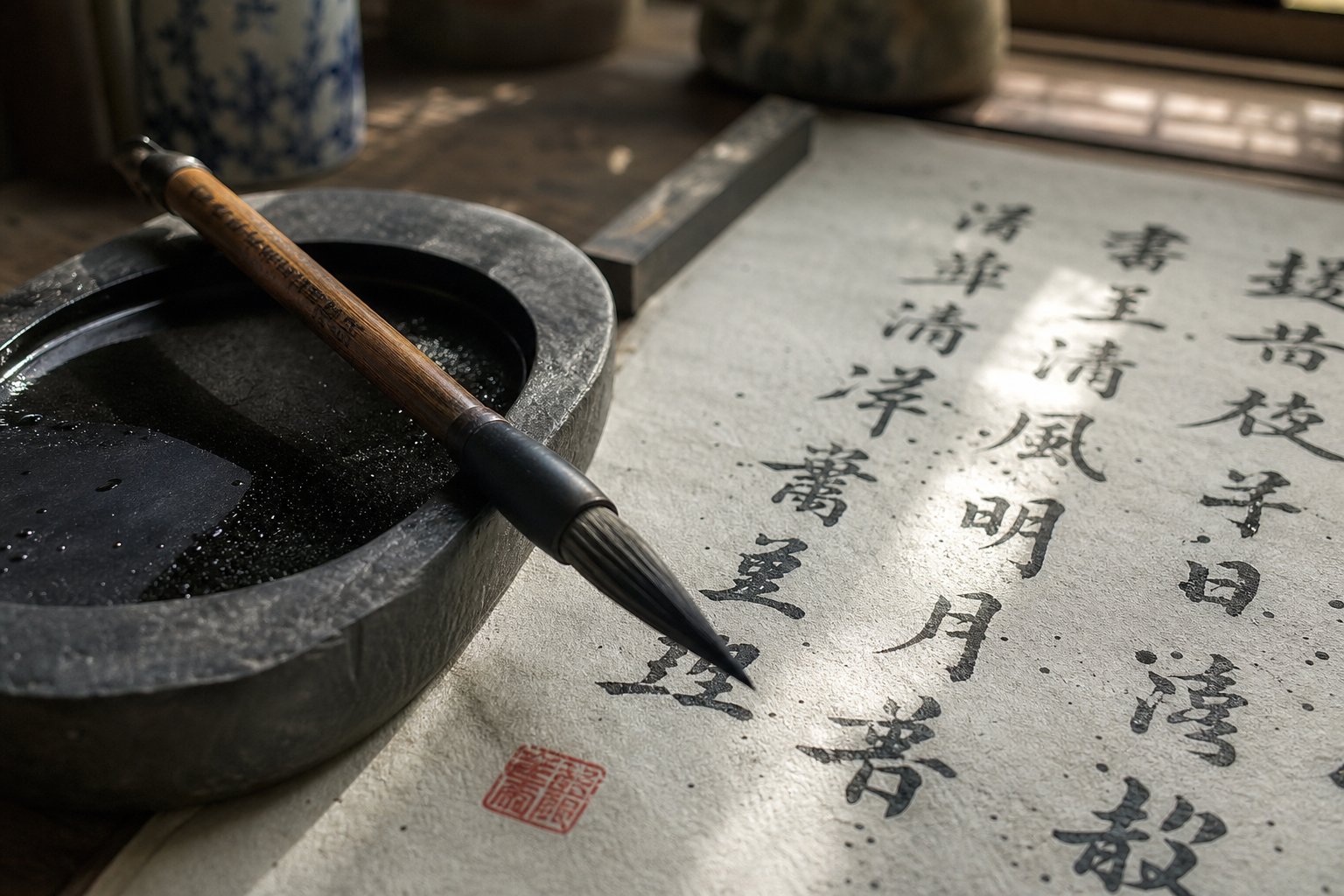
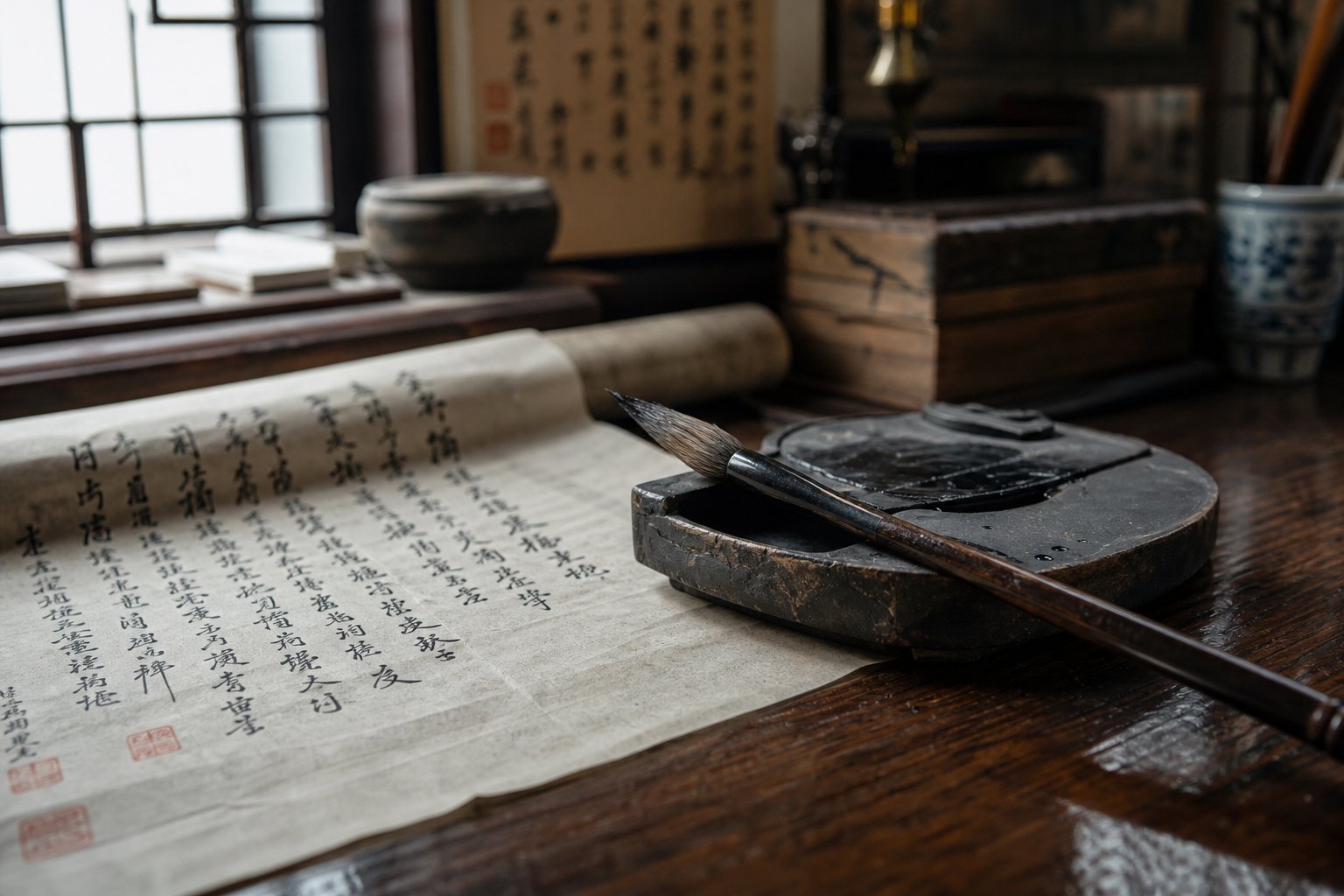
Every calligrapher, whether a Confucian official or a Daoist recluse, relied on the same essential toolkit. Known as the Four Treasures of the Study (文房四宝, wenfang sibao), these instruments were revered objects in their own right:
- Brush (毛笔, maobi) - Made from animal hair (goat, rabbit, weasel, or combinations) bound to a bamboo handle. Different hair types produce different stroke qualities, from soft and absorbent to firm and precise.
- Ink (墨, mo) - Solid inksticks crafted from pine or oil soot mixed with glue, ground fresh on an inkstone before each writing session. The density of the ink could be adjusted to create variations in tone.
- Paper (纸, zhi) - Most prized is Xuan paper, a soft, highly absorbent rice paper with exceptional longevity. Its responsiveness to the brush makes every hesitation or surge of confidence visible.
- Inkstone (砚, yan) - A flat, finely textured stone used to grind the inkstick with water. Fine inkstones were treasured heirlooms, sometimes valued as highly as the calligraphy they helped produce.
These tools were not interchangeable with Western writing instruments. The flexible brush tip responds to the slightest change in pressure, angle, and speed, making calligraphy in ancient China a uniquely physical art. The calligrapher's entire body participates: wrist, arm, shoulder, even breath.
One final distinction shaped who became famous and how their legacy survived. Scholar-officials like Wang Xizhi or Ouyang Xun practiced calligraphy as part of a broader life of governance, poetry, and philosophy. Their social standing gave their work immediate visibility and institutional preservation. Professional calligraphers and monks, by contrast, often worked in relative obscurity, their innovations absorbed into the tradition without the same personal fame. Chinese calligraphy history and culture, in other words, was never separate from the politics of who had access to power, patronage, and posterity.
These philosophical and material foundations set the stage, but the art itself evolved through specific innovations in how characters were formed. Each new script style represented a breakthrough in visual language, and each breakthrough had a master behind it.
Five Script Styles and Their Master Innovators
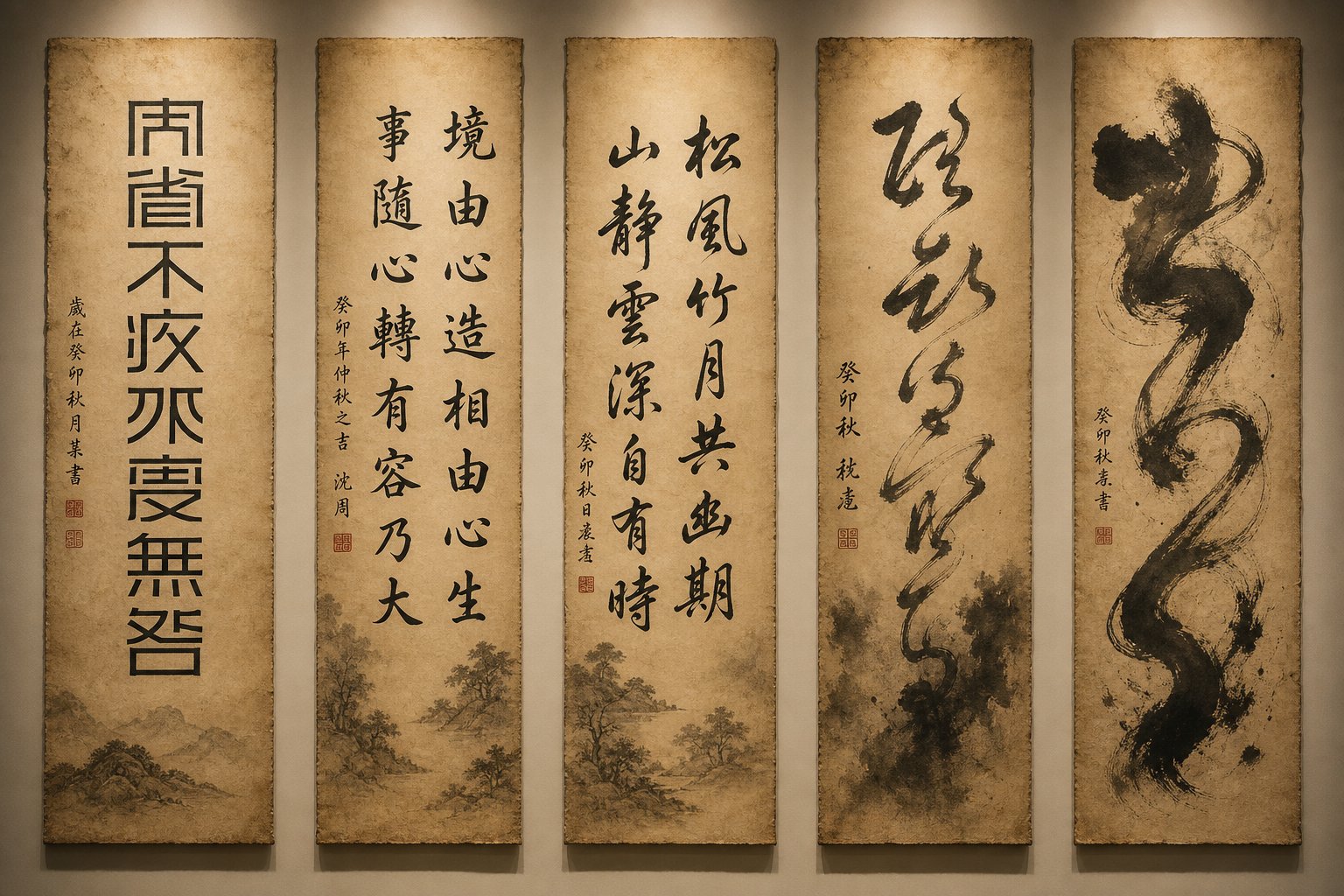
Chinese calligraphy names its visual traditions through five major script styles, each born from a different era's needs and each shaped by a master who pushed the brush in a new direction. Think of these scripts not as replacements for one another but as layers. The Smithsonian's National Museum of Asian Art notes that all major scripts developed over more than three thousand years and remain in active use today. One script builds upon the other, and understanding the types of chinese calligraphy scripts is the key to reading the history of the art itself.
Seal Script and Clerical Script Origins
The oldest formal script still practiced is seal script, or zhuanshu (篆书). Its characters are symmetrical structures made with thin, even lines, giving them an architectural quality. During the Qin Dynasty (221-206 BCE), Prime Minister Li Si standardized seal script across the newly unified empire, making it the first official national writing system. You'll recognize it today on traditional name seals and ceremonial inscriptions.
Clerical script, or lishu (隶书), emerged during the Han Dynasty (206 BCE-220 CE) as a faster, more practical alternative. Where seal script demanded careful, rounded strokes, clerical script introduced prominent horizontal strokes with distinctive flared endings, sometimes called "silkworm head and wild goose tail." This shift from rounded to angular forms was revolutionary. It made writing more efficient for government clerks handling the empire's growing bureaucracy, and it laid the structural foundation for every script that followed.
Regular, Running, and Cursive Scripts
By the late Han and into the Wei-Jin period (220-420 CE), three more scripts matured into distinct art forms. Regular script, kaishu (楷书), became the standard for formal writing. Each stroke is clearly separated, balanced, and legible, making it the script most people learn first. Zhong Yao is credited as its earliest master, and Tang Dynasty calligraphers later perfected it into the model still taught in schools.
Running script, xingshu (行书), sits between formal and freehand. Imagine regular script loosened up: strokes connect slightly, and the brush lifts less often. Wang Xizhi elevated running script into the most celebrated form of Chinese calligraphy, proving that speed and beauty could coexist.
Cursive script, caoshu (草书), pushes fluidity to its extreme. Characters dissolve into abbreviated, flowing gestures where individual strokes merge. Zhang Zhi of the Han Dynasty earned the title "Sage of Cursive" for pioneering this style, which later masters like Zhang Xu and Huaisu transformed into wild, almost abstract expression.
The table below maps each script style to its period, defining traits, and the famous chinese characters associated with its greatest practitioner:
| Script Style | Chinese Name (Pinyin) | Period of Development | Key Characteristics | Master Calligrapher |
|---|---|---|---|---|
| Seal Script | 篆书 (zhuanshu) | Qin Dynasty (221-206 BCE) | Symmetrical, thin even lines, rounded forms | Li Si (李斯) |
| Clerical Script | 隶书 (lishu) | Han Dynasty (206 BCE-220 CE) | Flared horizontal strokes, angular structure, wave-like endings | Cai Yong (蔡邕) |
| Regular Script | 楷书 (kaishu) | Late Han to Wei-Jin (2nd-4th century CE) | Clear, balanced strokes, highly legible, formal standard | Zhong Yao (钟繇) |
| Running Script | 行书 (xingshu) | Eastern Jin Dynasty (4th century CE) | Semi-connected strokes, fluid yet readable, natural rhythm | Wang Xizhi (王羲之) |
| Cursive Script | 草书 (caoshu) | Han Dynasty onward (2nd century CE) | Highly abbreviated, merged strokes, abstract and expressive | Zhang Zhi (张芝) |
Each of these scripts demanded different skills from the calligrapher. Seal script rewarded patience and geometric precision. Cursive script rewarded spontaneity and courage. The greatest masters often worked across multiple styles, but their fame rested on the one they transformed. And no single figure transformed more, or cast a longer shadow, than the man who perfected running script in a wine-fueled gathering at the Orchid Pavilion.
Wang Xizhi the Sage of Calligraphy
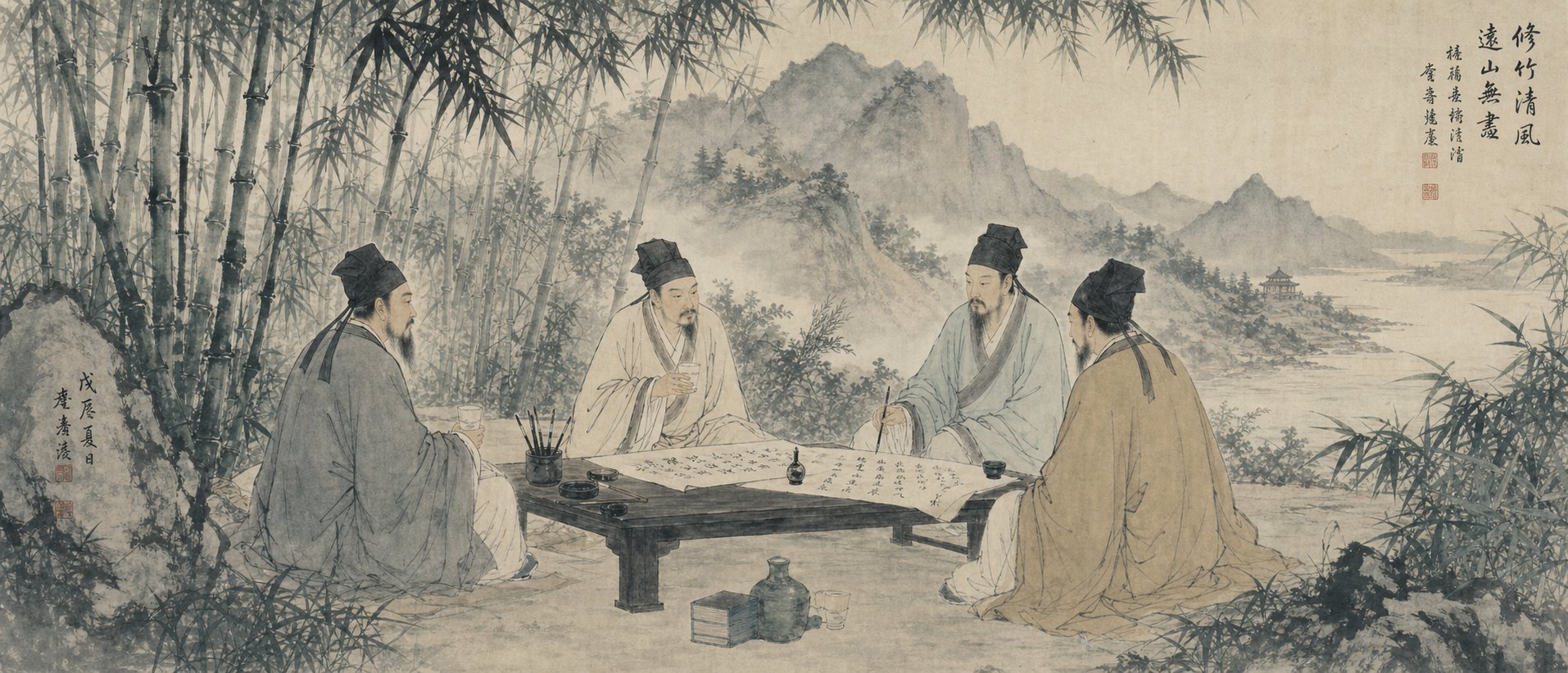
In the spring of 353 CE, a government official invited forty-one friends to a pavilion in the hills of modern-day Zhejiang province. Wine floated down a winding stream, poems were composed under pressure of a drinking forfeit, and the host dashed off a preface to the collected verses. That host was Wang Xizhi (王羲之, c. 303-361 CE), and the preface he wrote that day became the single most celebrated piece of calligraphy in Chinese history. No other chinese calligrapher has held such an unshakable position at the summit of the art for over sixteen centuries.
Wang Xizhi and the Preface to the Orchid Pavilion
Born into the aristocratic Wang clan of Langya in present-day Shandong, Wang Xizhi fled south as a child after the collapse of the Western Jin dynasty. He studied calligraphy under Wei Shuo (Lady Wei), a specialist in clerical, regular, and semi-cursive scripts, and later served in various government posts during the Eastern Jin period. His highest title, General of the Right Army, earned him the lasting nickname "Wang Youjun." Yet it was his brushwork, not his bureaucratic career, that made him immortal.
Wang Xizhi's most famous calligraphy work, the Lantingji Xu (蘭亭集序, "Preface to the Poems Composed at the Orchid Pavilion"), was composed at the legendary Orchid Pavilion Gathering. The event itself became one of the most referenced moments in Chinese literary history: forty-two participants composing poetry beside a meandering stream, drinking wine from floating cups, celebrating the Double Third Festival's purification rites.
What made the preface's calligraphy revolutionary? Wang achieved something no predecessor had managed: a perfect balance between structural discipline and spontaneous fluidity. His semi-cursive script flows with lively rhythmic energy, yet every character maintains internal coherence. As the University of Washington's Visual Sourcebook of Chinese Civilization notes, the handwriting is praised for its spontaneity, variation, and masterful use of space. Characters that repeat throughout the text appear in different visual forms each time, creating a sense of living movement rather than mechanical repetition.
Wang's innovation lay in his brush technique. He regularly varied the speed and direction of his strokes, producing distinctive visual characteristics even within recurring elements. His characters were more vertically elongated and compact than the wide forms of earlier clerical script, giving his running script a sense of disciplined energy flowing down the page. The result reads as both carefully formed and rapidly executed, a paradox that later chinese calligraphers spent centuries trying to replicate.
Emperor Taizong of Tang personally wrote a postscript to Wang Xizhi's biography in the Jin Shu, declaring him the greatest calligrapher in history and establishing his style as the defining standard for all Chinese calligraphy.
The Wang Family Legacy and Calligrapher Lineages
Wang Xizhi's seventh son, Wang Xianzhi (王献之, 344-386 CE), became a renowned calligrapher in his own right. In his own lifetime, the younger Wang's reputation even eclipsed his father's. His writing featured bolder connections between characters and a more dramatic sense of continuous movement. Together, father and son became known as the "Two Wangs" (二王), and their combined influence defined the mainstream of Chinese calligraphy for a millennium.
This family transmission illustrates a broader pattern. Calligraphic mastery in China passed through lineages, teacher to student, parent to child, generation to generation. The factors thought essential for developing a great calligrapher were natural ability, literary background, family connections, and exposure to a wide variety of written models. Innovation was always grounded in deep study of previous masters. Wang Xizhi himself built upon the work of Zhong Yao and his teacher Wei Shuo, then pushed beyond them. His descendants and stylistic followers carried the tradition forward through the Six Dynasties and into the Tang.
Here is the sobering detail: no original work by Wang Xizhi survives today. Emperor Taizong of Tang, who amassed over 2,000 pieces attributed to Wang, reportedly ordered the original Lantingji Xu buried in his own mausoleum. What remain are Tang dynasty tracing copies and ink rubbings. The finest tracing copy, attributed to the court calligrapher Feng Chengsu, is held at the Palace Museum in Beijing. Another important version resides at the National Palace Museum in Taipei. The Kuaixue Shiqing Tie ("Sudden Clearing after a Lively Snowfall"), a short letter in semi-cursive script, is also preserved in Taipei's collection. These copies, despite being one remove from the master's hand, remain among the most treasured objects in East Asian art.
Wang Xizhi's shadow loomed so large that every subsequent generation of chinese calligraphers had to reckon with his legacy, either building upon it or deliberately breaking away. The Tang dynasty masters who followed chose both paths, and in doing so created what many consider calligraphy's golden age.
Tang Dynasty Calligraphy Masters and the Golden Age
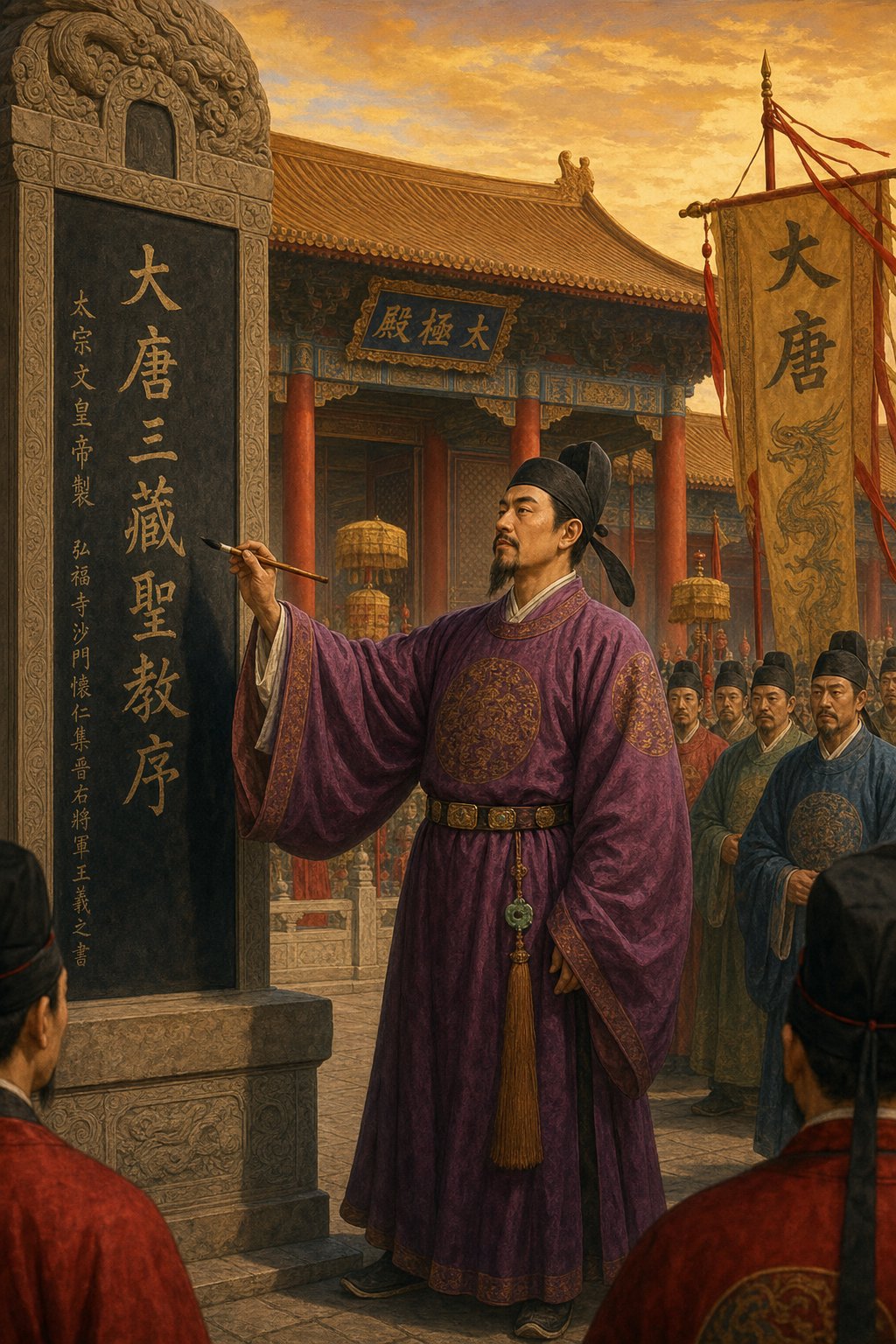
The Tang dynasty (618-907 CE) inherited Wang Xizhi's legacy and did something extraordinary with it: it produced an entire generation of masters who both honored and challenged that inheritance. If Wang Xizhi defined what calligraphy could be, the Tang dynasty calligraphy masters showed how far it could go. No other period in Chinese history concentrated so many transformative figures within a single era, and no other era left such a lasting imprint on how calligraphy is taught and practiced today.
Yan Zhenqing and the Power of Regular Script
To describe ancient chinese calligraphers of the Tang, you have to start with Yan Zhenqing (颜真卿, 709-785 CE). He was a high-ranking official, a military leader, and ultimately a martyr, executed by a rebel general whose cause he refused to join. His moral reputation and his brushwork became inseparable in the Chinese imagination: powerful, upright, and uncompromising.
Yan's regular script broke decisively from the elegant, slender tradition that had dominated since Wang Xizhi. His characters are muscular and broad, with thick horizontal strokes and a distinctive squared-off structure. Where earlier masters favored delicacy, Yan brought robust, almost architectural weight to the page. His right-falling strokes feature a pronounced boldness that gives each character a sense of planted solidity. This was not refinement for refinement's sake. It was calligraphy that embodied Confucian strength.
Yet Yan's most celebrated work is not a formal monument. His Ji Zhi Wen Gao (祭侄文稿, "Eulogy for a Nephew"), written around 758 CE, is ranked as the second greatest piece of semi-cursive script in Chinese history, just behind Wang Xizhi's Lantingji Xu. The circumstances of its creation are harrowing. During the An Lushan Rebellion, over thirty members of Yan's family were killed. His young nephew Yan Jiming was captured and beheaded after his father refused to surrender. When Yan Zhenqing later recovered the boy's severed head, he poured his grief into a eulogy that remains one of the most emotionally raw documents in Chinese art.
The manuscript is visibly imperfect: blotched with corrections, crossed-out characters, and uneven ink density. The brush moves from controlled sorrow into near-illegible anguish. That rawness is precisely what makes it extraordinary. If Yan's monumental steles like Da Tang Zhong Xing Song represent his public face, the Ji Zhi Wen Gao reveals the private man behind the brush, a famous chinese artist whose greatest work emerged from the worst moment of his life.
Ouyang Xun, Liu Gongquan, and Chu Suiliang
Yan Zhenqing did not work in isolation. Three other masters shaped the Tang's calligraphic identity, each contributing a distinct innovation that expanded what regular script could achieve.
Ouyang Xun (欧阳询, 557-641 CE) bridged the Sui and early Tang periods. His characters are tall, tightly structured, and precisely balanced, representing the height of the orthodox Wang Xizhi lineage filtered through centuries of refinement. His most famous work, the Jiucheng Gong Liquan Ming (九成宫醴泉铭, "Inscription on the Sweet Spring at Jiucheng Palace"), remains a standard model for students learning regular script. Ouyang's innovation was architectural: he gave each character an internal geometry so rigorous that his style became synonymous with disciplined elegance.
Chu Suiliang (褚遂良, 596-658 CE) took a different path. Building on the foundations laid by Ouyang Xun and Yu Shinan, he developed a style described as both vigorous and graceful. His brushwork introduced more visible variation in stroke thickness, giving characters a rhythmic quality that hinted at running script's fluidity while maintaining regular script's clarity. His Ni Kuan Zan and the Yanta Sheng Jiao Xu (雁塔圣教序) showcase this balance between strength and suppleness.
Liu Gongquan (柳公权, 778-865 CE) arrived in the Late Tang and synthesized everything that came before him. He studied the styles of Ouyang Xun, Chu Suiliang, and Yan Zhenqing, then distilled them into a refined, spacious script with thin but firm strokes and generous spacing between elements. His Xuan Mi Ta Bei (玄秘塔碑, "Stele of the Mysterious Pagoda") became one of the most widely copied models in Chinese calligraphy education. Where Yan's characters feel planted and heavy, Liu's feel poised and airy, achieving power through precision rather than mass.
Together, these four masters are often paired in Chinese calligraphic tradition: "Yan's muscle and Liu's bone" (颜筋柳骨) is a phrase still used to contrast their approaches. The table below compares their contributions:
| Name (Chinese + Pinyin) | Script Specialty | Key Innovation | Most Famous Work |
|---|---|---|---|
| Ouyang Xun (欧阳询, Ouyang Xun) | Regular script (楷书) | Tall, geometrically precise character structure with rigorous internal balance | Jiucheng Gong Liquan Ming (九成宫醴泉铭) |
| Chu Suiliang (褚遂良, Chu Suiliang) | Regular script (楷书) | Rhythmic stroke-weight variation blending vigor with graceful fluidity | Yanta Sheng Jiao Xu (雁塔圣教序) |
| Yan Zhenqing (颜真卿, Yan Zhenqing) | Regular and running script | Bold, muscular forms with squared structure, breaking from the elegant Wang tradition | Ji Zhi Wen Gao (祭侄文稿) |
| Liu Gongquan (柳公权, Liu Gongquan) | Regular script (楷书) | Synthesis of prior masters into a refined, spacious style with firm, slender strokes | Xuan Mi Ta Bei (玄秘塔碑) |
Why the Tang Dynasty Was Calligraphy's Golden Age
What made this single dynasty so productive? Three forces converged. First, imperial patronage reached unprecedented levels. Emperor Taizong (598-649 CE) personally championed calligraphy, amassing a collection of over 700 historical pieces and establishing an Academy of Calligraphy that trained court officials. His promotion of Wang Xizhi's style as the national standard created a shared foundation from which innovation could spring. Later emperors, particularly Xuanzong, continued this tradition of active sponsorship.
Second, the imperial examination system made calligraphy a practical necessity for anyone seeking government office. Candidates were tested on their brushwork alongside their knowledge of classics and governance. This created a massive, educated population of serious practitioners, a talent pool from which genius could emerge.
Third, the Tang possessed a cultural confidence born from political power. It was the largest empire China had known, a cosmopolitan civilization that attracted scholars, monks, and merchants from across Asia. That confidence gave calligraphers permission to innovate boldly. Yan Zhenqing could break from Wang Xizhi's graceful tradition precisely because the era's self-assurance allowed departure from orthodoxy without being dismissed as ignorance.
The result was a period that codified regular script into its final mature form, pushed cursive script into wild new territory through figures like Zhang Xu and the monk Huaisu, and produced theoretical treatises like Sun Guoting's Shu Pu (书谱, "Treatise on Calligraphy") that articulated principles still referenced today. After the Tang, no major structural changes occurred to standard script. The golden age had set the template.
Yet the Tang masters did not appear from nowhere. Their innovations built upon centuries of earlier experimentation, from the Qin dynasty's first standardization of writing to the political fragmentation that paradoxically fueled artistic breakthroughs in the Wei and Jin periods. Those earlier pioneers deserve their own reckoning.
Ancient Chinese Calligraphy: Early Masters From Qin Through the Six Dynasties
Every golden age has its roots in rougher ground. The Tang dynasty masters refined and codified calligraphy, but the raw material they worked with, the scripts themselves, was forged centuries earlier by figures operating under very different pressures. Political unification, imperial collapse, and prolonged civil war each left a distinct mark on how the brush moved across paper. Ancient chinese calligraphy owes its foundational breakthroughs to a handful of pioneers who worked during China's most turbulent centuries.
Qin and Han Dynasty Pioneers
The story of ancient china calligraphy as a unified tradition begins with a single political act. When Qin Shi Huang conquered the six rival states and established the Qin Dynasty (221-206 BCE), his chancellor Li Si (李斯, Li Si) implemented one of history's most consequential writing reforms: the standardization of Chinese script. Before unification, each state used its own regional character variants. Li Si eliminated that diversity by establishing Small Seal Script (小篆, xiaozhuan) as the empire's sole official writing system.
Li Si's contribution went beyond administrative convenience. He authored the Canjie Pian (倉頡篇), the first recorded Chinese language primer, and is credited with drafting the inscriptions on the Qin Stelae, monumental stone tablets placed at ritual sites across the empire to assert Qin legitimacy. None of his original brushwork survives due to the extreme antiquity of the period, but rubbings from surviving stelae show the Xiao Zhuan style's defining qualities: symmetrical characters formed with thin, even lines of uniform width. The script prioritized clarity and orthographic consistency over personal expression. It was calligraphy in service of state power.
The Han Dynasty (206 BCE-220 CE) brought a different kind of innovation. As the empire's bureaucracy expanded, the slow precision of seal script became impractical for daily administrative work. Clerical script (lishu) matured into its full form during this period, with its distinctive horizontal emphasis and flared stroke endings. Han dynasty calligraphy history also produced the art's first great individualist: Zhang Zhi (张芝, Zhang Zhi), active in the late Eastern Han.
Zhang Zhi earned the title "Sage of Cursive Script" (草圣, caosheng) for transforming cursive writing from a shorthand convenience into a legitimate art form. He is credited with developing "modern cursive" (jincao), in which characters within a line connect fluidly rather than remaining isolated. Legend holds that he practiced so obsessively that the pond where he washed his brushes turned permanently black. His work established cursive script as a vehicle for personal expression, a radical departure from the impersonal uniformity Li Si had imposed three centuries earlier.
Wei and Jin Dynasty Breakthroughs
When the Han dynasty collapsed in 220 CE, China fractured into competing kingdoms. You might expect artistic decline during such instability, but the opposite occurred. Political fragmentation freed calligraphers from the constraints of a single imperial orthodoxy. Without a centralized court dictating aesthetic standards, individual experimentation flourished.
The pivotal figure of this transitional era was Zhong Yao (钟繇, Zhong Yao, 151-230 CE), a high official who served under the Cao Wei kingdom during the Three Kingdoms period. The Shanghai Museum identifies him as the calligrapher "revered as the 'Ancestor of Regular Script.'" His innovation was decisive: he took the angular, spread-out forms of clerical script and compressed them into a more upright, compact structure with clearly separated strokes. This was the birth of kaishu, the regular script that would become the standard for formal writing across all subsequent dynasties.
Zhong Yao's regular script still carried traces of its clerical origins, with slightly flattened proportions and occasional wave-like strokes. But the essential architecture was new. He gave later calligraphers, especially Wang Xizhi, the structural vocabulary they needed to develop running and cursive scripts into high art. Without Zhong Yao's regularization of stroke forms, Wang Xizhi's fluid innovations would have had no stable foundation to depart from.
The following timeline traces the major ancient chinese calligraphers from the Qin through the Six Dynasties, showing how each built upon or reacted against the work of predecessors:
- Li Si (李斯, Li Si) - Qin Dynasty (active c. 280-208 BCE): Standardized Small Seal Script as the empire's unified writing system; authored the first Chinese language primer.
- Cheng Miao (程邈, Cheng Miao) - Late Qin Dynasty (c. 3rd century BCE): Traditionally credited with formalizing clerical script (lishu) from earlier proto-clerical forms used by government clerks.
- Cai Yong (蔡邕, Cai Yong) - Eastern Han (133-192 CE): Master of mature clerical script; created the "Flying White" (feibai) technique where dry brush leaves white streaks within strokes.
- Zhang Zhi (张芝, Zhang Zhi) - Eastern Han (active c. 150-192 CE): "Sage of Cursive Script"; developed modern cursive with connected characters, transforming shorthand into expressive art.
- Zhong Yao (钟繇, Zhong Yao) - Wei Kingdom, Three Kingdoms (151-230 CE): "Ancestor of Regular Script"; established the structural principles of kaishu from clerical script foundations.
- Wei Shuo (卫铄, Wei Shuo) - Eastern Jin (272-349 CE): Known as Lady Wei; master calligrapher and teacher of Wang Xizhi; authored influential treatises on brush technique.
- Wang Xizhi (王羲之, Wang Xizhi) - Eastern Jin (303-361 CE): "Sage of Calligraphy"; perfected running script and set the aesthetic standard for all subsequent generations.
- Wang Xianzhi (王献之, Wang Xianzhi) - Eastern Jin (344-386 CE): Extended his father's innovations with bolder character connections and more dramatic continuous movement.
What emerges from this timeline is a clear pattern: each breakthrough responded to a specific tension. Li Si imposed uniformity on chaos. Zhang Zhi liberated individual expression from uniformity. Zhong Yao created structural clarity from clerical complexity. And Wang Xizhi synthesized all of it into a style so complete that it dominated Chinese aesthetics for over a thousand years. The political disorder of the Wei and Jin periods, far from suppressing creativity, created the conditions for calligraphy's most fertile era of invention, one that the Tang dynasty would later codify and the Song dynasty would deliberately challenge with a new emphasis on personal feeling over inherited rules.
Song Through Qing: Ancient Chinese Calligraphers and the Modern Legacy
The Tang dynasty codified calligraphy's rules. The Song dynasty broke them on purpose. Where Tang masters pursued structural perfection, Song calligraphers asked a different question: what if the brush could reveal the writer's inner world rather than demonstrate technical mastery? This shift from discipline to self-expression reshaped the art for the next thousand years and produced some of the most distinctive chinese famous artists in the calligraphic tradition.
Song Dynasty Individualists
The Song dynasty (960-1279 CE) gave rise to a group known as the four masters of song dynasty calligraphy: Su Shi, Huang Tingjian, Mi Fu, and Cai Xiang. What united them was not a shared style but a shared philosophy. They believed calligraphy should express personal feeling and literary sensibility rather than conform to inherited models. Each developed a voice so individual that their works are instantly recognizable.
The National Palace Museum in Taipei holds a celebrated handscroll that brings all four masters together in a single mounting. An early Qing collector named Li Zongkong (1620-1689) assembled four separate works into one scroll, creating what became "a standard bearer for the study of Chinese calligraphy." Each section reveals a distinct personality at work:
- Cai Xiang (蔡襄, Cai Xiang, 1012-1067) - The most traditional of the four, Cai grounded his style in the Tang master Yan Zhenqing's bold regular script. His "Haiyu" modelbook, a letter written in his thirties to his friend Han Qi, demonstrates Northern Song calligraphy at its most refined and disciplined. Cai served as a bridge between Tang orthodoxy and Song experimentation.
- Su Shi (苏轼, Su Shi, 1037-1101) - Poet, painter, essayist, and political exile, Su Shi brought a free-spirited confidence to the brush. His characters are steady and firm yet deliberately unconventional, "not confined to conventional methods" as the National Palace Museum describes them. He wrote with a slightly tilted brush held flat, producing broad, fleshy strokes that feel relaxed rather than labored. His calligraphy at age 52, preserved in the handscroll, is considered a classic example of his mature voice.
- Huang Tingjian (黄庭坚, Huang Tingjian, 1045-1105) - A student of Su Shi in poetry, Huang developed a calligraphic style that was entirely his own. His brushwork incorporated the turning methods of the Tang monk Huaisu's wild cursive, creating strokes that are "strong and thorough" with character forms that slant mostly to the right. The result has a high-spirited, almost restless energy, with dramatically elongated horizontal and diagonal strokes that stretch outward like branches.
- Mi Fu (米芾, Mi Fu, 1051-1107) - Perhaps the most technically dazzling of the group, Mi Fu was famous for his eccentric personality and his obsessive study of ancient masterworks. His brushwork "ranges greatly from light to heavy and fast to slow," producing dramatic contrasts within a single piece. His "Daowei" modelbook, written at age 49, is described as masterful in both technique and spirit. Mi Fu's characters tilt and sway with a controlled unpredictability that no predecessor had attempted.
What made these four ancient chinese calligraphers revolutionary was not just their individual styles but their collective rejection of a single standard. The Tang had established Yan Zhenqing and Liu Gongquan as models everyone should follow. The Song masters said: follow your own nature. Su Shi famously declared that his calligraphy was like "a fine horse running free," guided by instinct rather than rules. This philosophy opened the door for every subsequent generation to claim personal expression as a legitimate artistic goal.
Yuan, Ming, and Qing Developments
The Song's emphasis on individuality created a paradox: once everyone pursues originality, where does the tradition go next? The answer, across the Yuan, Ming, and Qing dynasties, involved a recurring dialogue between innovation and revival.
The Yuan dynasty (1279-1368) was established by Mongol conquerors, yet its greatest calligrapher was a descendant of the Song imperial family. Zhao Mengfu (赵孟頫, Zhao Mengfu, 1254-1322) was a scholar, painter, and calligrapher who deliberately turned back to Wang Xizhi and the Jin dynasty masters. His running and regular scripts are elegant, polished, and classically balanced, a conscious corrective to what he saw as the Song masters' excessive informality. His Luo Shen Fu (洛神赋, "Tale of the Goddess of Luo River") demonstrates this return to ancient grace. Zhao's influence was enormous: he proved that looking backward could itself be a form of innovation.
The Ming dynasty (1368-1644) swung in the opposite direction. Artists "frequently broke with tradition, exhibiting a free, liberated, diverse style of calligraphy," as scholars at Cleveland State University note. Dong Qichang (董其昌, Dong Qichang, 1555-1636) stands out as the era's most influential theorist and practitioner. A high official and connoisseur, Dong developed a calligraphic style that appeared effortless and spontaneous, with a light, dry brushwork that emphasized rhythm over weight. More importantly, he articulated a theory of artistic lineage that divided Chinese painting and calligraphy into "Northern" and "Southern" schools, a framework that shaped aesthetic debate for centuries.
The Qing dynasty (1644-1911) produced calligraphy's last great revolution before the modern era. Scholars grew dissatisfied with the modelbook tradition that had dominated since the Tang, finding it overly refined and disconnected from calligraphy's ancient roots. They turned instead to stelae, stone inscriptions from the Han dynasty and earlier that preserved the raw energy of seal and clerical scripts. This "Stelae School" (碑学, beixue) movement treated overlooked ancient inscriptions as sources of fresh inspiration.
Two figures defined this revival. Deng Shiru (邓石如, Deng Shiru, 1743-1805) reinvigorated seal script as a living art form, bringing personal expression to a style that had been treated as purely archival for centuries. Zhao Zhiqian (赵之谦, Zhao Zhiqian, 1829-1884) pushed further, blending seal, clerical, and regular scripts into hybrid forms that no earlier dynasty would have recognized. Together, they demonstrated that the oldest scripts still held untapped creative potential.
Modern Continuations
The tradition did not end with the last dynasty. Throughout the twentieth century and into the present, calligraphers have continued to practice, teach, and innovate within the classical framework. Figures like Wu Changshuo (吴昌硕, 1844-1927) carried the Qing stelae revival into the Republican era, while contemporary practitioners explore the tension between traditional brush methods and modern aesthetics. University programs across China, Japan, Korea, and increasingly in Western institutions keep the art alive as both a scholarly discipline and a living practice.
What connects all these eras, from the Song individualists through the Qing revivalists, is a single recurring impulse: the belief that calligraphy is never finished evolving. Each generation found new meaning in old forms, whether by breaking rules, restoring forgotten ones, or inventing entirely new conversations between past and present. The result is a tradition that spans over two millennia without ever becoming static.
Knowing who these masters were is one thing. Recognizing what makes their work distinctive when you stand before it in a museum is another skill entirely, one that rewards even a few minutes of focused looking.
How to Identify Chinese Calligraphy Styles
Knowing the names and histories of great calligraphers is valuable. But when you stand in front of an actual piece of calligraphy, whether in a museum gallery or an online archive, how do you read what you are seeing? Learning how to identify chinese calligraphy styles does not require years of training. It requires knowing where to look and what questions to ask.
Reading Brushwork Like an Expert
Every chinese calligraphy writer leaves a fingerprint in their brushwork. The key is learning to see it. According to traditional evaluation criteria outlined by Xiang Li Art, four elements separate masterful calligraphy from average work: structure, strength, rhythm, and personality. Here is how to observe each one:
Stroke weight refers to how thick or thin the lines are, and whether that thickness varies within a single stroke. A calligrapher like Yan Zhenqing uses heavy, muscular strokes. Liu Gongquan's lines are thinner and more precise. Notice whether the weight feels deliberate or hesitant.
Rhythm is the visual tempo of the piece. Look at the spacing between characters and the transitions between strokes. Does the brush seem to accelerate and slow down? Strong calligraphy flows like music, with pauses and surges that feel intentional rather than mechanical.
Ink density tells you about speed and brush loading. Dark, saturated strokes suggest a freshly loaded brush moving slowly. Lighter, drier strokes (called "flying white") indicate speed or a brush running low on ink. Variation in density across a piece creates visual depth.
Structural balance is the internal architecture of each character. Even in the most expressive cursive, a skilled calligrapher maintains an invisible framework. Ask yourself: does each character feel stable, or does it seem about to collapse? Balance does not mean rigidity. It means every element has a reason for being where it is.
Distinguishing the Five Scripts at a Glance
You do not need to read Chinese to tell the five scripts apart. Each has visual signatures that are recognizable once you know what to look for:
- Seal Script (篆书) - Even, rounded lines of uniform thickness. Characters appear tall and symmetrical, almost like architectural drawings. No sharp angles or flared endings. The overall impression is ancient and ceremonial.
- Clerical Script (隶书) - Wider, flatter characters with distinctive horizontal strokes that flare outward at the ends, sometimes described as "silkworm head and goose tail." The overall shape is broader than it is tall, with a grounded, stable feeling.
- Regular Script (楷书) - Clear, separate strokes with no connections between them. Characters are roughly square in proportion, balanced, and highly legible. This is the script that looks most like printed Chinese text.
- Running Script (行书) - Strokes begin to connect slightly, and the brush lifts less often between elements. Characters remain mostly readable but have a flowing, natural quality. Imagine regular script written at a comfortable, relaxed pace.
- Cursive Script (草书) - Highly abbreviated characters where strokes merge into continuous, fluid gestures. Individual characters may be difficult or impossible to read without training. The overall impression is abstract, energetic, and fast-moving.
A simple test: if every stroke is clearly separate and the characters look square, you are likely seeing regular script. If the piece looks almost like abstract art with sweeping, connected lines, it is cursive. Everything else falls on the spectrum between those two poles.
These visual tools transform you from a passive viewer into an active reader. The next question becomes practical: where can you actually see the masterworks discussed throughout this article, and which institutions hold the most important surviving pieces?
Where to See Chinese Calligraphy Art: Viewing Masterworks Today
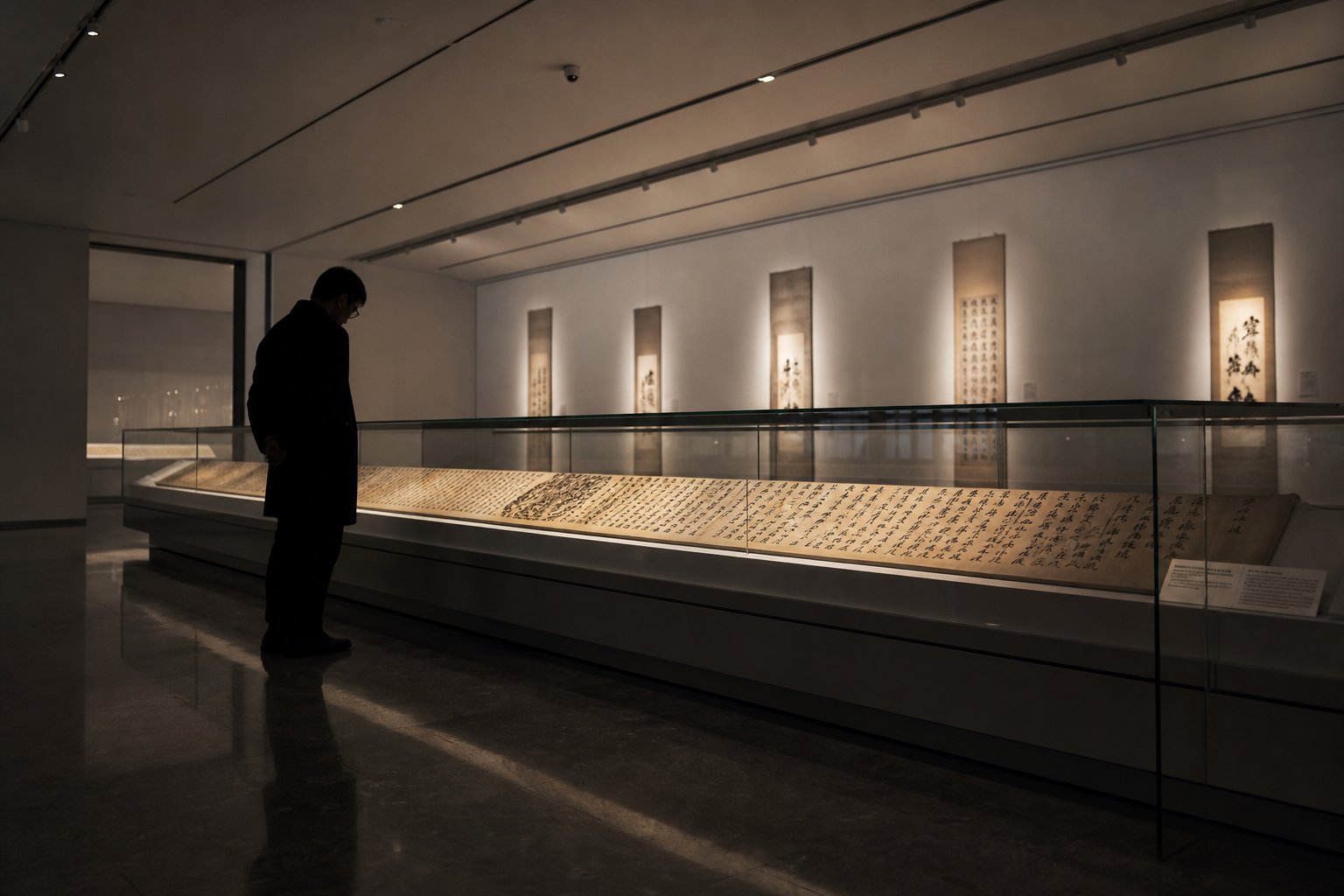
Reproductions in books and on screens can teach you a great deal. But standing before an original piece of calligraphy, close enough to see where the brush hesitated or surged, where ink pooled at the start of a stroke or faded to dry white at its end, is an entirely different experience. The physical presence of a calligraphers work reveals dimensions that no photograph captures: the texture of the paper, the sheen of aged ink, the scale of characters relative to your own hand. Fortunately, major institutions around the world preserve and display these treasures.
Major Museum Collections Worldwide
The most important surviving works by famous chinese calligraphers are concentrated in a handful of institutions, each with distinct strengths. Some hold Tang dynasty tracing copies of lost originals. Others specialize in Song dynasty individualists or Qing revival pieces. Knowing which museum holds what helps you plan a focused visit rather than wandering through galleries hoping to stumble upon something relevant.
The Palace Museum in Beijing houses the largest collection of Chinese calligraphy in the world. Its holdings include the Feng Chengsu tracing copy of Wang Xizhi's Lantingji Xu, widely considered the finest surviving version of the most celebrated work in Chinese calligraphic history. The museum also preserves major pieces by Yan Zhenqing, Su Shi, and Zhao Mengfu, along with thousands of lesser-known but historically significant manuscripts.
Across the Taiwan Strait, the National Palace Museum in Taipei holds a complementary collection of extraordinary depth. Its calligraphy holdings include Wang Xizhi's Kuaixue Shiqing Tie ("Sudden Clearing after a Lively Snowfall"), the celebrated handscroll combining works by all four Song dynasty masters, and important pieces by Huang Tingjian and Mi Fu. The museum's online exhibitions provide detailed scholarly commentary alongside high-resolution images.
The Shanghai Museum focuses on the regional artistic tradition of the Jiangnan area while maintaining a collection of national significance. Its Painting and Calligraphy of Shanghai Gallery traces a millennium of calligraphic development, from the Wei-Jin period through the modern era. Holdings include works by Dong Qichang, pieces from the Chunhua Ge Tie compendia of Northern Song rubbings, and calligraphy by figures connected to the Songjiang School. The museum's research trilogy on Shanghai painting and calligraphy has made it a leading center for the study of literati art traditions.
In Japan, the Tokyo National Museum preserves important Chinese calligraphy that crossed the sea centuries ago through diplomatic exchange and scholarly trade. Its collection includes Tang and Song dynasty works, some of which are no longer represented in Chinese institutions. The museum's East Asian art galleries regularly rotate calligraphic pieces alongside painting and ceramics.
For viewers in the West, the Metropolitan Museum of Art in New York offers the most accessible entry point. Its 2014 exhibition "Out of Character: Decoding Chinese Calligraphy" surveyed works from the 13th through early 20th centuries drawn from the collection of Akiko Yamazaki and Jerry Yang. The Met's Asian art department continues to display calligraphy in rotating installations. The Freer and Sackler Galleries (Smithsonian) in Washington, D.C. also maintain significant holdings, including Song and Yuan dynasty pieces featured in dedicated online exhibitions.
| Museum/Institution | Location | Notable Calligraphy Holdings |
|---|---|---|
| Palace Museum (故宫博物院) | Beijing, China | Feng Chengsu copy of Wang Xizhi's Lantingji Xu; works by Yan Zhenqing, Su Shi, Zhao Mengfu |
| National Palace Museum (國立故宮博物院) | Taipei, Taiwan | Wang Xizhi's Kuaixue Shiqing Tie; Four Song Masters handscroll; Huang Tingjian and Mi Fu pieces |
| Shanghai Museum (上海博物馆) | Shanghai, China | Dong Qichang calligraphy; Chunhua Ge Tie rubbings; Songjiang School works; modern Shanghai-school pieces |
| Tokyo National Museum | Tokyo, Japan | Tang and Song dynasty works acquired through historical exchange; rotating East Asian calligraphy displays |
| Metropolitan Museum of Art | New York, USA | 13th-20th century calligraphy from the Yamazaki-Yang collection; rotating Asian art installations |
| Freer and Sackler Galleries (Smithsonian) | Washington, D.C., USA | Song and Yuan dynasty painting and calligraphy; dedicated online exhibitions |
Digital Archives and Scholarly Resources
Not everyone can travel to Beijing or Taipei. Digital collections have made it possible to study calligraphy in remarkable detail from anywhere. The National Palace Museum in Taipei offers one of the richest online experiences, with high-resolution scans that let you zoom into individual brushstrokes. The Calligraphic World of Mi Fu microsite, for example, presents Mi Fu's writings and calligraphy with scholarly context and detailed imagery.
Patricia Buckley Ebrey's Visual Sourcebook of Chinese Civilization at the University of Washington provides accessible introductions to calligraphic history, including material on contemporary practices and avant-garde developments. For academic research, Oxford Bibliographies Online offers curated bibliographies covering both English-language and Chinese scholarship on calligraphy. JSTOR's image database contains over 1,300 calligraphy-related artworks searchable by artist, period, and subject.
These digital resources are valuable for study, but they cannot fully replace the experience of seeing original ink on paper. A screen flattens the subtle three-dimensionality of brushwork, the way ink sits on the paper's surface, the faint ridges left by a loaded brush. If you have the opportunity to visit any of the institutions listed above, take it. Stand close. Look at how the strokes begin and end. Try to feel the rhythm of the calligrapher's hand moving across the surface centuries ago.
The masters profiled throughout this article, from Li Si's imperial standardization to Mi Fu's eccentric brilliance, left behind more than beautiful objects. They left a living tradition that continues to describe ancient chinese calligraphers as relevant voices rather than historical curiosities. Their ink outlived the dynasties that produced it because it spoke to something permanent in human experience: the desire to make meaning visible, one stroke at a time.
Frequently Asked Questions About Famous Chinese Calligraphers
1. Who is considered the greatest Chinese calligrapher of all time?
Wang Xizhi (303-361 CE) holds the title 'Sage of Calligraphy' and is universally regarded as the greatest Chinese calligrapher. His Preface to the Orchid Pavilion (Lantingji Xu) is considered the finest work of Chinese calligraphy ever produced. Emperor Taizong of Tang officially declared him the supreme calligrapher, and his running script style became the defining standard for over 1,600 years. No original works survive, but Tang dynasty tracing copies preserved in Beijing and Taipei remain among the most treasured objects in East Asian art.
2. What are the five main styles of Chinese calligraphy?
The five major script styles are Seal Script (zhuanshu), Clerical Script (lishu), Regular Script (kaishu), Running Script (xingshu), and Cursive Script (caoshu). Seal Script features symmetrical, rounded lines and dates to the Qin Dynasty. Clerical Script introduced angular forms with flared horizontal strokes during the Han Dynasty. Regular Script offers clear, balanced characters used for formal writing. Running Script connects strokes slightly for a natural flow. Cursive Script is the most abstract, with merged strokes creating fluid, expressive gestures.
3. Why was calligraphy so important in ancient Chinese culture?
Calligraphy held a unique position as the supreme visual art form in China, ranked above painting and sculpture for centuries. Its importance stemmed from Confucian philosophy, which treated brushwork as a direct expression of moral character and intellectual cultivation. The imperial examination system reinforced this by testing candidates on their calligraphic skill alongside knowledge of classics and governance. Success in these exams meant entry into the powerful scholar-official class, creating a direct link between beautiful handwriting and political advancement.
4. What is the most famous piece of Chinese calligraphy?
The Lantingji Xu (Preface to the Orchid Pavilion) by Wang Xizhi, written in 353 CE, is widely considered the most famous piece of Chinese calligraphy. It was composed during a gathering of 42 poets at the Orchid Pavilion in modern Zhejiang province. The work is celebrated for its spontaneous variation, masterful use of space, and the way repeated characters appear in different visual forms throughout the text. The original was reportedly buried with Emperor Taizong of Tang, but high-quality tracing copies from the Tang dynasty survive in major museums.
5. Where can I see original Chinese calligraphy masterworks today?
The Palace Museum in Beijing holds the world's largest collection of Chinese calligraphy, including the finest tracing copy of Wang Xizhi's Lantingji Xu. The National Palace Museum in Taipei preserves Wang Xizhi's Kuaixue Shiqing Tie and a celebrated handscroll combining all four Song dynasty masters. The Shanghai Museum, Tokyo National Museum, and the Metropolitan Museum of Art in New York also display significant holdings. Many institutions now offer high-resolution digital archives, with Taipei's National Palace Museum providing particularly detailed online exhibitions with scholarly commentary.