What Are Chinese Company Names in Pinyin
You see "Huawei" on a smartphone box. You spot "Xiaomi" in a news headline. A supplier invoice lists "Shenzhen Huanyu Keji Youxian Gongsi." These are all Chinese company names romanized in English using a system called pinyin, and they carry far more meaning than a random brand label ever could.
What Pinyin Means for Company Names
Pinyin, short for Hanyu Pinyin, is the official romanization system for Mandarin Chinese. Developed in the 1950s as a standardized phonetic system using the Latin alphabet, it was designed to represent the sounds of Standard Mandarin precisely and consistently. When applied to company names, pinyin acts as a bridge. It translates Chinese characters into letter combinations that anyone familiar with the Latin alphabet can at least attempt to read and pronounce.
So what is pinyin for Chinese company names in practice? It is the spelled-out pronunciation of the original Chinese characters. Unlike an English brand name such as "Apple" or "Amazon," a pinyin company name is not arbitrary. Each syllable maps directly to a Chinese character with a specific meaning. "Huawei" is not just a catchy word. It is hua (splendid) + wei (achievement).
Every pinyin company name is a pronunciation key to Chinese characters that carry literal meaning. Unlike arbitrary English brand names, these romanized names can be decoded once you understand the system behind them.
Why Understanding Pinyin Names Matters
Whether you are a language learner trying to read Chinese business names in pinyin or a professional reviewing contracts, import documents, and wire transfer details, knowing how to decode these names gives you a practical edge. You can verify the company behind the name, understand its industry focus, and even pronounce it correctly in meetings.
This article breaks down the four-part structure of registered Chinese company names, shows you how to read and pronounce them, and gives you a reference list of major brands with their full pinyin breakdowns. The system is more logical than it first appears, and it starts with understanding how pinyin formatting actually works in business contexts.
How Pinyin Romanization Rules Apply to Business Names
Pinyin is not a free-form spelling system. It follows a precise set of government-mandated rules that dictate how syllables are grouped, which letters get capitalized, and whether tone marks appear. When you encounter Chinese company names on official paperwork, the formatting you see is not random. It reflects specific conventions from China's national orthography standard, GB/T 16159, which governs how Mandarin is written in the Latin alphabet.
Understanding these rules helps you distinguish a company's registered pinyin name from a casual transliteration or a marketing-friendly English brand. It also helps you spot errors in documents, which matters when money or legal obligations are on the line.
Tone Marks and Syllable Separation Rules
In standard Hanyu Pinyin, every syllable carries one of four tone marks (or a neutral tone). You will see these in textbooks and dictionaries: ma with a flat line means "mother," ma with a falling-rising mark means "horse." Tones change meaning entirely.
In business contexts, however, tone marks almost always disappear. Business licenses, bank account registrations, invoices, and contracts use pinyin without tonal diacritics. The reasoning is practical: most international databases, banking systems, and legal filing platforms do not support the special characters required for tone marks. So "Huawei" appears as plain text rather than "Huawei" with accent marks over the vowels.
Syllable separation follows a different logic. According to the national standard, multi-syllable words that express a single concept are written together without spaces. A company name element like keji (technology) stays as one unit because it represents a single two-character word (科技). You will not see it split into "ke ji" on a business license. Longer compound terms of four or more syllables may be divided at word boundaries for readability.
Capitalization Conventions in Business Pinyin
Capitalization in pinyin company names follows clear patterns drawn from the orthography standard. Here are the key formatting rules you will encounter:
- The first letter of each word in a proper noun is capitalized (e.g., Beijing, Huawei)
- Multi-syllable words that form a single concept are written together with only the initial letter capitalized (e.g., "Zhongguancun" not "Zhong Guan Cun")
- Common nouns like industry descriptors and entity types typically appear in lowercase when following the proper name portion
- Tone marks are omitted in virtually all commercial and legal documents
- An apostrophe separates syllables that could otherwise be misread (e.g., Xi'an to prevent reading as "xian")
Imagine a technology company registered in Shenzhen. Its trade name portion might appear as "Huanyu" (one capitalized word), while the industry and entity type follow in lowercase: "keji youxian gongsi." The full registered pinyin name reads as a structured phrase, not a jumble of random syllables.
How Pinyin Appears on Official Documents
On a Chinese business license (营业执照), the company name appears primarily in Chinese characters. The pinyin version surfaces in contexts where Latin-alphabet representation is required: international bank accounts, cross-border contracts, customs declarations, and foreign trade invoices.
In these settings, the pinyin transliteration standard demands consistency. The name on a company's bank account must match the name on its registration documents exactly. A single spacing error or capitalization inconsistency can trigger rejection during wire transfers or regulatory filings. This is why Chinese company name formatting in pinyin is not merely an academic concern. It has direct financial and legal consequences.
You will also notice that pinyin on official documents does not include the English brand name. A company known globally as "Lenovo" still appears on its Chinese registration as "Lianxiang" (联想). The pinyin version and the international brand name are two separate identities, governed by different rules and serving different purposes.
With these formatting conventions in mind, the next question becomes structural: what are the actual components that make up a full registered company name, and how does each part function within the whole?

The Four-Part Structure of Chinese Company Names
Every registered company name in China follows a formula. It is not a creative exercise like naming a startup in Silicon Valley. Chinese regulations mandate a specific structure, and once you understand it, you can decode virtually any registered business name you encounter in pinyin.
The Four Components of a Registered Chinese Company Name
According to China's Regulations on the Administration of Enterprise Name Registration, Article 7 states that an enterprise name shall consist of four parts arranged in order:
- Administrative division (地域 diyu) - The city or province where the company is registered. Examples: 北京 Beijing, 深圳市 Shenzhenshi, 杭州 Hangzhou.
- Trade name (字号 zihao) - The core identifier chosen by the company's founders. This is the unique, creative part. It must be at least two Chinese characters and cannot duplicate existing names in the same jurisdiction.
- Industry descriptor (行业 hangye) - A term reflecting the company's main business activity. Think 科技 keji (technology), 贸易 maoyi (trade), or 计算机系统 jisuanji xitong (computer systems).
- Organization form (组织形式 zuzhi xingshi) - The legal entity type. Most commonly 有限公司 youxian gongsi (limited company) or 股份有限公司 gufen youxian gongsi (joint-stock limited company).
The standard formula reads: Administrative Division + Trade Name + Industry Descriptor + Organization Form. So when you see a long pinyin string on an invoice or contract, you are looking at these four parts strung together in sequence.
Imagine a technology company registered in Beijing with the trade name "Xingyun" (星云, meaning nebula). Its full registered name would be: 北京星云科技有限公司, or in pinyin: Beijing Xingyun Keji Youxian Gongsi. Each segment serves a distinct legal and informational purpose.
Real Examples With Full Pinyin Breakdowns
Seeing this structure applied to companies you already recognize makes the pattern click. The table below breaks down the registered names of major Chinese companies into their four components, showing characters, pinyin, and English meaning side by side.
| Company (English Brand) | Administrative Division | Trade Name (字号) | Industry Descriptor | Organization Form |
|---|---|---|---|---|
| Baidu | 北京 Beijing (Beijing) | 百度网讯 Baidu Wangxun (Hundred Times Net News) | 科技 Keji (Technology) | 有限公司 Youxian Gongsi (Limited Company) |
| Tencent | 深圳市 Shenzhenshi (Shenzhen City) | 腾讯 Tengxun (Galloping Message) | 计算机系统 Jisuanji Xitong (Computer Systems) | 有限公司 Youxian Gongsi (Limited Company) |
| JD.com | 北京 Beijing (Beijing) | 京东世纪 Jingdong Shiji (Jingdong Century) | 贸易 Maoyi (Trade) | 有限公司 Youxian Gongsi (Limited Company) |
| Xiaomi | 北京 Beijing (Beijing) | 小米 Xiaomi (Little Rice) | 科技 Keji (Technology) | 有限责任公司 Youxian Zeren Gongsi (Limited Liability Company) |
| Alibaba | 杭州 Hangzhou (Hangzhou) | 阿里巴巴 Alibaba (Ali Baba) | 网络技术 Wangluo Jishu (Network Technology) | 有限公司 Youxian Gongsi (Limited Company) |
Notice a few patterns. The trade name is often what becomes the international brand. Baidu's trade name is "Baidu," Tencent's is "Tengxun," and Xiaomi's is simply "Xiaomi." The rest of the registered name, the parts most English speakers never see, tells you where the company is based, what industry it operates in, and what legal form it takes.
You will also notice that the order can sometimes vary. Some companies place the administrative division after the trade name or omit it entirely if they have national-level approval. But the four components themselves remain consistent across virtually all registered entities in China.
This structure explains why the same company can appear under different names in different contexts. The brand you know internationally is usually just the trade name component. The full registered pinyin name, the one that shows up on legal documents and bank accounts, includes all four parts. Recognizing which segment is which gives you the ability to parse any unfamiliar name you encounter, provided you know the common vocabulary used in each component.
Naming Strategies From Pinyin to English Brand Names
A company's registered trade name in pinyin and its international brand name are not always the same thing. Some companies carry their pinyin straight into global markets. Others abandon it entirely and invent something new. The strategy a company chooses reveals a lot about its branding priorities, target audience, and how it wants to be perceived outside China.
Broadly, Chinese to English company naming strategies fall into a few distinct categories. Each one balances cultural identity, pronunciation ease, and global marketability differently.
Direct Pinyin Names and Why Companies Keep Them
The simplest approach is to use the pinyin spelling of the Chinese trade name as the international brand. These companies bet that their original name, even if unfamiliar to Western ears, will become recognizable through product quality and market presence alone.
- Huawei - 华为 (huawei) - meaning "splendid achievement." The pinyin is short, phonetically manageable, and has become globally recognizable through sheer market scale.
- Xiaomi - 小米 (xiaomi) - meaning "little rice." Two clean syllables that are easy for most non-Chinese speakers to approximate.
- Haier - 海尔 (haier) - meaning "sea" + a phonetic character. Simple, short, and already sounds close to an English word.
- Baidu - 百度 (baidu) - meaning "hundred times," referencing a classical poem. Two syllables, easy rhythm.
- Moutai - 茅台 (maotai) - the famous liquor brand, using a slightly older romanization but still essentially pinyin-based.
Why do these companies use pinyin as their brand name? The advantage, as branding experts at Lab Brand have noted, is the ability to preserve the pronunciation of the original Chinese name while conveying a strong sense of Chinese cultural identity. For brands that want to emphasize their Chinese heritage, pinyin is a natural fit.
The key requirement is that the pinyin must be short, phonetically smooth, and easy for foreign consumers to pronounce. Not every Chinese name qualifies. A name like "Lianxiang" (联想, Lenovo's original Chinese name) breaks Western language habits. English speakers tend to fracture it into awkward segments like "Li-An-Xi-Ang" rather than reading it as two fluid syllables.
Modified and Translated Naming Strategies
When pinyin does not work well internationally, companies pursue alternative approaches. These range from slight phonetic tweaks to complete reinventions.
Meaning-translated names take the semantic content of the Chinese characters and express it in English words:
- Evergrande - from 恒大 (hengda), where 恒 means "ever/permanent" and 大 means "grand." The English compound name directly translates the meaning of each character.
- Great Wall - from 长城 (changcheng), a literal translation used by the automaker and wine brand.
Phonetic adaptations take the sound of the Chinese name and reshape it into something that feels more natural in English:
- Alibaba - from 阿里巴巴 (alibaba). The Chinese name was itself chosen because it references the globally known folk tale character, making it instantly familiar across cultures. The pinyin happens to already read like an English word.
- Midea - from 美的 (meidi), meaning "beautiful." The pinyin is tweaked slightly to create a word that suggests "my idea" or evokes positive English associations.
- Mobike - from 摩拜 (mobai). The sound is adapted into an English compound that suggests "mobile" + "bike," aligning perfectly with the product.
Completely invented names bear no phonetic or semantic relationship to the original Chinese:
- Lenovo - from 联想 (lianxiang, meaning "association/legend"). The brand name was invented to suggest "le" (from Legend, its former English name) + "novo" (Latin for new). No trace of the pinyin remains.
- Tencent - from 腾讯 (tengxun, meaning "galloping message"). The English name is an unrelated compound that sounds corporate and tech-forward.
- Vivo / Oppo - Chinese smartphone brands that chose Latin-sounding names with no connection to any Chinese characters. They read as smooth, rhythmic, and internationally neutral.
Some companies also use acronyms derived from their pinyin initials or English translations:
- JD - from 京东 (Jingdong), using the pinyin initials.
- BYD - officially stands for "Build Your Dreams," though the Chinese name is 比亚迪 (Biyadi).
- ZTE - from Zhongxing Telecommunication Equipment, itself derived from the Chinese 中兴通讯 (Zhongxing Tongxun).
What Drives the Choice Between Pinyin and New English Names
The decision is rarely arbitrary. Several factors push companies toward or away from keeping their pinyin name internationally:
- Pronunciation ease - If the pinyin contains sounds that trip up English speakers (zh, x, q, or long multi-syllable strings), companies tend to abandon it. Huawei works because it is two short syllables. Lianxiang does not.
- Negative connotations - Some pinyin names accidentally sound like problematic words in other languages. The car brand Hongqi (红旗, "red flag") sounds uncomfortably close to a racial slur in English, making direct pinyin use risky for Western markets.
- Cultural positioning - Brands that want to project Chinese heritage and authenticity lean toward pinyin. Brands targeting a perception of global sophistication or tech innovation often prefer invented names that sound culturally neutral.
- Industry norms - Tech and consumer electronics brands tend toward shorter, punchier names (Vivo, Oppo, NIO). Traditional industries like liquor and food more often retain pinyin (Moutai, Tsingtao).
- Market stage - Newer brands entering international markets from day one often design globally friendly names upfront. Established domestic brands that later expand abroad face the harder choice of keeping a recognized pinyin name or rebranding entirely.
A pinyin name has real potential in global markets when the pronunciation fits foreign language habits and the meaning or connotation aligns with the brand's intended image. The water purifier brand Qinyuan, for example, recently changed its international name from its pinyin to "Truliva," an invented word combining "true" and "life" that communicates more effectively with overseas consumers.
These naming strategies explain why you might encounter the same Chinese company under completely different names depending on the context. The registered pinyin name lives on legal documents and bank accounts. The international brand name lives on packaging and advertising. Knowing both, and understanding which is which, becomes essential when you need to match a brand you recognize to the actual entity behind it.
Major Chinese Brands With Full Pinyin and English Name List
You now know the naming strategies. You understand why some companies keep their pinyin while others reinvent themselves entirely. But when you are sitting across from a supplier, scanning a shipping document, or researching a potential partner, what you really need is a quick reference. Which characters match which brand? What does the name actually mean? And how does the pinyin connect to the English name you already recognize?
This section gives you that reference, organized by industry, covering the most prominent Chinese company names with characters and pinyin translation side by side.
Technology and Internet Companies
Tech companies dominate the list of Chinese brands most frequently encountered internationally. You will notice a pattern: their trade names tend to be short, usually two to four syllables in pinyin, making them easier to adopt as global brand names. Many of these companies kept their pinyin or something very close to it.
Huawei, Baidu, and Xiaomi all use their pinyin directly. Tencent and Lenovo invented entirely new English names. The literal meanings behind these names often reflect ambitious aspirations or poetic references that resonate in Chinese culture but would sound unusual if translated directly into English. "Hundred Times" as a search engine name or "Galloping Message" as a social media company would not land the same way in Western markets.
Manufacturing and Consumer Brands
Manufacturing and consumer-facing companies show more variety in their naming approaches. Some, like Haier, kept short pinyin names that happen to sound natural in English. Others, like BYD, moved to acronyms because their full pinyin (Biyadi) felt clunky for international branding. Traditional brands in food and beverage, such as Tsingtao beer, often use older romanization systems that predate pinyin, which is why their spelling does not match modern pinyin rules.
Consumer brands also tend to carry more evocative literal meanings. Names reference beauty, luck, prosperity, or natural imagery, reflecting the cultural weight that Chinese founders place on auspicious naming.
Finance and State-Owned Enterprises
State-owned enterprises and financial institutions follow a different convention entirely. Their names are typically longer, more formal, and almost always translated into English rather than romanized in pinyin. A name like "Industrial and Commercial Bank of China" is a direct translation of 中国工商银行 (Zhongguo Gongshang Yinhang). These organizations use acronyms like ICBC internationally because their full translated names are unwieldy.
You will rarely see a state-owned bank or energy company using pinyin as its international brand. The formality of these institutions demands English translations that communicate authority and scope. Their pinyin versions still matter, though, because they appear on domestic registration documents, contracts, and interbank communications within China.
The table below consolidates this reference across all three sectors:
| English Brand Name | Chinese Characters | Full Pinyin | Literal Meaning | Industry |
|---|---|---|---|---|
| Huawei | 华为 | Huawei | Splendid Achievement | Technology |
| Baidu | 百度 | Baidu | Hundred Times (from a classical poem) | Internet / Search |
| Tencent | 腾讯 | Tengxun | Galloping Message | Internet / Social Media |
| Xiaomi | 小米 | Xiaomi | Little Rice | Consumer Electronics |
| Alibaba | 阿里巴巴 | Alibaba | Ali Baba (folk tale reference) | E-commerce |
| JD.com | 京东 | Jingdong | Capital East (Beijing + East) | E-commerce |
| Lenovo | 联想 | Lianxiang | Association / Connected Thinking | Technology |
| ByteDance | 字节跳动 | Zijie Tiaodong | Byte Bounce | Internet / Media |
| BYD | 比亚迪 | Biyadi | Phonetic adaptation (no direct meaning) | Automotive / Manufacturing |
| Haier | 海尔 | Haier | Sea (hai) + phonetic character | Home Appliances |
| Midea | 美的 | Meidi | Beautiful | Home Appliances |
| Geely | 吉利 | Jili | Auspicious / Lucky | Automotive |
| NIO | 蔚来 | Weilai | Blue Sky Coming | Automotive |
| Tsingtao | 青岛 | Qingdao | Green Island | Beverage |
| ICBC | 中国工商银行 | Zhongguo Gongshang Yinhang | Industrial and Commercial Bank of China | Finance |
| Ping An | 平安 | Ping'an | Safe and Well | Insurance / Finance |
| China Mobile | 中国移动 | Zhongguo Yidong | China Mobile (direct translation) | Telecommunications |
| Sinopec | 中国石化 | Zhongguo Shihua | China Petrochemical | Energy |
A few things stand out when you scan this list. Tech companies with two-syllable pinyin names (Huawei, Baidu, Xiaomi) kept their romanization intact. Companies with three or more syllables (Lianxiang, Biyadi, Tengxun) almost always adopted a different English brand. And state-owned enterprises universally translate their names into English or use acronyms derived from those translations, as China Checkup's research on naming categorization confirms.
Industry conventions also play a role. Traditional consumer brands like Tsingtao use older romanization that predates modern pinyin, which is why the spelling reads "Tsingtao" rather than the correct pinyin "Qingdao." Financial institutions prioritize clarity and formality over brand personality, leading them toward full English translations. Tech companies, competing for global consumer attention, optimize for memorability and phonetic simplicity.
This reference gives you the ability to match a brand you recognize to its underlying Chinese name and meaning. But recognizing individual companies is only part of the puzzle. Many of the terms you see repeated across these names, words like keji, youxian gongsi, and jituan, appear in thousands of other company names too. Learning to spot these recurring building blocks turns you from someone who can look up a specific name into someone who can parse any unfamiliar one on sight.
How to Decode Chinese Company Name Parts in Pinyin
Thousands of registered Chinese companies share the same handful of building-block terms. Once you recognize these common Chinese company name words in pinyin, you stop needing to look up every unfamiliar name character by character. Instead, you can scan a long pinyin string on an invoice or contract and immediately identify what industry the company operates in and what legal form it takes.
Think of it like learning word roots in English. If you know that "tele" means far and "com" means together, you can guess the meaning of "telecommunication" without a dictionary. The same logic applies here. A small vocabulary of roughly 15 to 20 recurring terms covers the vast majority of industry descriptors and entity types you will encounter in Chinese business names.
Industry Descriptor Terms in Pinyin
The industry descriptor (行业 hangye) is the third component of a registered name, sitting between the trade name and the entity type. It tells you what the company does. You will see the same terms repeated across tens of thousands of registrations because Chinese regulations require this descriptor to accurately reflect the company's approved business scope.
Here are the most frequently occurring industry terms and their Chinese business name elements pinyin meaning:
| Chinese Characters | Pinyin | English Meaning | Example Company |
|---|---|---|---|
| 科技 | keji | Technology | Xiaomi Keji (Xiaomi Technology) |
| 网络 | wangluo | Network | Alibaba Wangluo Jishu (Alibaba Network Technology) |
| 信息 | xinxi | Information | Zhongguo Yidong Xinxi (China Mobile Information) |
| 电子 | dianzi | Electronics | Shenzhen Dianzi (Shenzhen Electronics) |
| 贸易 | maoyi | Trade | Jingdong Shiji Maoyi (JD Century Trade) |
| 商务 | shangwu | Business / Commerce | Alibaba Shangwu (Alibaba Commerce) |
| 通讯 | tongxun | Telecommunications | Zhongxing Tongxun (ZTE Telecommunications) |
| 文化 | wenhua | Culture | Beijing Guangxian Chuanmei Wenhua (Beijing Enlight Culture) |
| 咨询 | zixun | Consulting | Huaxin Zixun (Huaxin Consulting) |
| 实业 | shiye | Industry / Industrial | Biyadi Shiye (BYD Industrial) |
You will notice that some companies combine two industry terms for greater specificity. "Wangluo jishu" (网络技术, network technology) is more precise than "keji" alone. "Xinxi jishu" (信息技术, information technology) is the Chinese equivalent of IT. These compound descriptors still follow the same pattern: recognizable building blocks stacked together.
Entity Type Terms You Will See Repeatedly
The final segment of every registered name is the organization form. This is where the youxian gongsi meaning in Chinese company names becomes clear. It tells you the legal structure of the entity, much like "Ltd.," "Inc.," or "GmbH" does in Western business names.
Here are the entity type terms that appear most often:
| Chinese Characters | Pinyin | English Meaning | Usage Notes |
|---|---|---|---|
| 有限公司 | youxian gongsi | Limited Company (Co., Ltd.) | The most common entity type for private companies in China |
| 有限责任公司 | youxian zeren gongsi | Limited Liability Company (LLC) | Emphasizes limited liability of shareholders; functionally similar to youxian gongsi |
| 股份有限公司 | gufen youxian gongsi | Joint-Stock Limited Company | Used by publicly traded companies and larger enterprises |
| 集团 | jituan | Group / Conglomerate | Indicates a parent company with multiple subsidiaries |
| 股份 | gufen | Shares / Stock | Appears in names of companies with share-based ownership structures |
| 总公司 | zong gongsi | Head Office / General Company | Designates the main entity in a corporate group |
| 分公司 | fen gongsi | Branch Company | A branch office without independent legal person status |
When you see "youxian gongsi" at the end of a pinyin name, you are looking at a standard limited company, the default structure for the vast majority of Chinese businesses. "Gufen youxian gongsi" signals something larger, typically a company that has issued shares and may be publicly listed. And "jituan" tells you the entity is a conglomerate operating across multiple business lines or subsidiaries.
Putting it all together, imagine you encounter this pinyin string on a document: "Shenzhen Chuangxin Dianzi Keji Youxian Gongsi." You can now parse it instantly:
- Shenzhen - administrative division (the city)
- Chuangxin - trade name (meaning "innovation")
- Dianzi Keji - industry descriptor (electronics technology)
- Youxian Gongsi - entity type (limited company)
No dictionary needed. You have just decoded a complete registered company name from its pinyin alone. This toolkit works because Chinese naming regulations enforce consistency. The same terms appear in the same positions across millions of registrations, making the system predictable once you learn the vocabulary.
Of course, recognizing these terms on paper is one thing. Saying them correctly in a meeting or phone call is another challenge entirely, especially when pinyin letters do not behave the way English speakers expect them to.
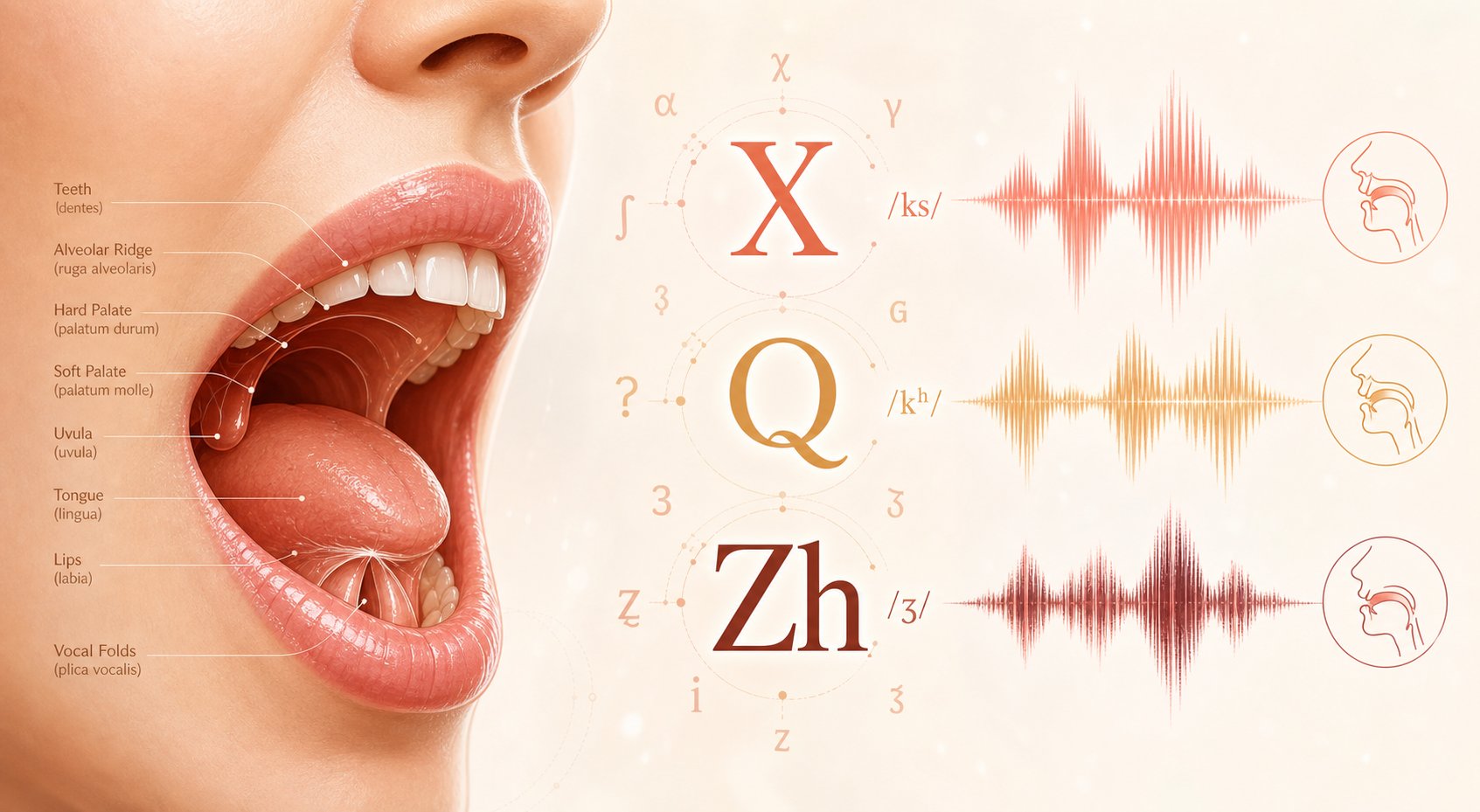
How to Pronounce Chinese Company Names in Pinyin Correctly
Pinyin uses the Latin alphabet, but it is not English. That single fact trips up more people than any other aspect of Chinese company names. When you see "Xiaomi" on a product box, your brain automatically applies English spelling rules and produces something like "ZAI-oh-mee." The actual pronunciation is closer to "SHOW-mee." The gap between what English speakers assume and what pinyin actually represents is where most mispronunciations are born.
The root of the problem is straightforward: pinyin was never designed with English speakers in mind. It was created for native Mandarin speakers who already knew the sounds and just needed a consistent way to write them in Latin letters. Several consonants and vowel combinations were assigned to letters that mean something completely different in English. Once you learn which letters behave unexpectedly, the whole system becomes far more readable.
Pinyin Letters That Trick English Speakers
A handful of consonants cause the majority of pronunciation mistakes for company names. Here is what you need to know about each one:
X sounds similar to "sh" in English. It is not a "z" sound, not a "ks" sound, and not a hard "x" like in "xylophone." Think of it as a softer, lighter version of "sh" with the tongue positioned forward. So Xiaomi starts with a sound close to "sh," giving you "show-mee" rather than "zai-oh-mee."
Q sounds like "ch" in English. There is no "kw" sound anywhere in pinyin. The beer brand Qingdao? Pronounce it "Ching-dow," not "Kwing-day-oh." The car brand Qoros? "Chor-os" is closer than "Kwor-os."
Zh sounds like "j" in "John" or "dr" in "dream." It is a retroflex sound, meaning your tongue curls back slightly. Zhongguancun, Beijing's tech district, starts with a sound like "jong," not "zong."
C sounds like "ts" in "pants" or "boots." It is never a soft "s" or a hard "k." The electronics retailer Cainiao (Alibaba's logistics arm) starts with a "ts" sound.
R is not quite the English "r." It sits somewhere between the "r" in "root" and the "s" in "vision," with the tongue curled upward. You will hear this in brand names like Roewe (荣威, Rongwei).
Vowel combinations also behave differently than English intuition suggests:
- ei sounds like "ay" in "day" or "ei" in "eight." Huawei ends with this sound: "Hwah-way," not "Hwah-wee."
- ai sounds like "eye" or the "i" in "bike." Baidu's first syllable rhymes with "buy": "Buy-doo."
- ou sounds like "oh" in "go." Moutai's first syllable is "moh," not "moo."
- u after j, q, x, or y is actually pronounced as "u" (like the French "u" or saying the English letter "u"). This sound does not exist in standard English, which is why Huayu and Xuzhou give English speakers trouble.
How to Pronounce the Most Common Company Names Correctly
Knowing the rules is useful. Seeing them applied to names you actually encounter is better. Here are the most commonly mispronounced Chinese brand names with guidance on getting closer to the correct sound:
- Xiaomi (小米) - Incorrect: "Zai-OH-mee" or "Eks-ee-OW-mee." Correct approximation: "SHOW-mee" (like "show me" with the first syllable rhyming with "shower"). The BBC Pronunciation Unit recommends this as the standard English approximation.
- Huawei (华为) - Incorrect: "Huh-WAH-way" (three syllables). Correct approximation: "HWAH-way" (two syllables, with "hua" as a single unit starting with a "hw" blend, and "wei" rhyming with "way").
- Qingdao / Tsingtao (青岛) - Incorrect: "Kwing-DAY-oh." Correct approximation: "Ching-dow" ("qing" sounds like "ching," "dao" rhymes with "cow").
- Baidu (百度) - Incorrect: "BAY-doo" or "Bah-EE-doo." Correct approximation: "BYE-doo" ("bai" sounds like "buy," "du" like "do").
- Zhongguancun (中关村) - Incorrect: "Zong-gwan-sun." Correct approximation: "Jong-gwan-tsun" ("zh" like "j," "c" in "cun" like "ts").
- Geely (吉利 Jili) - The English brand name "Geely" sidesteps the pinyin entirely. The actual pinyin "Jili" is pronounced "Jee-lee," with "j" sounding like a soft English "j."
- BYD (比亚迪 Biyadi) - Incorrect: "Bee-YAH-dee" with a flat "a." Correct approximation: "Bee-yah-dee" where the "ya" sounds like "ya" in "yard."
A practical tip: when you encounter an unfamiliar pinyin company name, resist the urge to apply English spelling logic. Instead, mentally substitute "sh" for "x," "ch" for "q," and "j" for "zh" as a first approximation. You will not achieve perfect Mandarin pronunciation this way, but you will get close enough to be understood and to avoid the most jarring errors in professional settings.
Pronunciation gets you through meetings and phone calls. But what happens when you encounter a pinyin name on a document and need to trace it back to the actual registered company? That requires a different set of tools entirely.
How to Look Up and Verify Chinese Company Pinyin Names
You have a pinyin name on a contract, an invoice, or a supplier email. You can parse its structure and even pronounce it reasonably well. But can you confirm it belongs to a real, registered entity? Can you find the Chinese characters from a pinyin company name and verify the details match what you have been told? This is where publicly available business registries become essential.
The challenge is specific: pinyin without tone marks is ambiguous. Multiple Chinese characters can share the same romanized spelling. "Huaxin" could be 华信, 华新, or 华鑫, each representing a completely different company. You need tools that let you search by pinyin and then confirm the match against registration records.
Going From Pinyin Back to Chinese Characters
When you only have a romanized name, your first task is converting it back into Chinese characters so you can search official databases effectively. Here is a practical workflow:
- Use a pinyin input method or converter. Type the pinyin into any Chinese input method editor (built into Windows, macOS, or Google Translate's pinyin input). The system will suggest matching characters. For a name like "Chuangxin Keji," you will see candidate characters for each syllable.
- Narrow by context. Use the structural knowledge from earlier sections. If the last words are "youxian gongsi," you know those map to 有限公司. If the name starts with a city, match it to the known pinyin of Chinese cities (Shenzhen, Guangzhou, Hangzhou). This eliminates ambiguity for the standard components.
- Focus on the trade name. The trade name portion (the creative, unique part) is where ambiguity concentrates. If you have any additional context, such as the industry, location, or a partial English translation, use it to filter candidates.
- Cross-reference with a search engine. Paste the pinyin into Baidu or Google with quotes. Results often surface the company's Chinese-language website or directory listings that reveal the correct characters.
Using Chinese Business Registries for Verification
Once you have candidate characters, or even if you are working with pinyin alone, several databases let you verify a Chinese company's registration status. The National Enterprise Credit Information Publicity System (NECIPS, known in Chinese as 国家企业信用信息公示系统) is the most authoritative. Maintained by China's State Administration for Market Regulation (SAMR), it contains registration data for every legally registered company in the country.
The EU IP Helpdesk recommends NECIPS as the primary resource for verifying whether a company is officially registered, who can legally represent it, what its business scope covers, and where it is located. The database is free to access, though the interface is entirely in Chinese.
Two commercial alternatives offer more user-friendly experiences:
- Tianyancha (天眼查) - A comprehensive business intelligence platform that aggregates registration data, legal disputes, shareholder information, and corporate relationships. It offers limited free searches but locks detailed reports behind a paywall. A Chinese phone number may be required for full access.
- Qichacha (企查查) - Similar to Tianyancha in scope and function. Both platforms allow searching by partial company names and display results with Chinese characters, making it easier to match a pinyin name to its registered entity.
For those who cannot navigate Chinese-language interfaces, paid verification services provide English-language reports that consolidate registration data, legal history, and financial standing into a single document.
Search Tips When You Only Have a Romanized Name
Searching a Chinese business registry by pinyin name requires a few adjustments, since these databases are designed for character-based input. Here are strategies that improve your results:
- Convert the trade name portion to characters first. The registry search works best with Chinese characters. Even a partial match on the trade name (the unique identifier) will surface relevant results.
- Search by known components separately. If you can identify the city and industry descriptor from the pinyin structure, search for those in combination. "Beijing" + "keji" + "youxian gongsi" narrows results dramatically compared to searching the full string.
- Try multiple character combinations. Because pinyin is ambiguous without tone marks, the trade name "Huaxin" might be 华信 or 华新. Search both variations.
- Use the Unified Social Credit Code if available. Every registered Chinese company has an 18-digit code (统一社会信用代码) that works like a tax ID. If your documents include this number, it provides a direct, unambiguous lookup in NECIPS regardless of name spelling.
- Check for the company's English name in international databases. If the company trades internationally, its English brand name may appear in export records, trademark databases, or Hong Kong company registries, which can lead you back to the Chinese registered name.
Always confirm that the registered pinyin name on official documents matches the entity you intend to transact with. A single-character difference in the trade name means you are dealing with a completely different legal entity.
This verification step is not optional for anyone sending payments or signing contracts. The gap between a company's international brand name and its registered pinyin name creates real confusion in cross-border transactions, a problem that becomes even more consequential when legal obligations and money transfers are involved.

How to Use Pinyin Company Names in Cross-Border Transactions
Verification is only half the equation. Once you have confirmed a company's registered pinyin name, you still need to know where and how that name functions across international business documents. The official pinyin name vs English brand name difference is not just a branding curiosity. It creates real operational friction when contracts, payments, and customs declarations each reference a different version of the same entity.
Official Pinyin Names vs International Brand Names
A Chinese company's registered name in characters is its sole legally recognized identity under Chinese company law. The pinyin version of that name is a direct romanization of those characters. The international brand name, however, can be anything the company chooses for marketing purposes. It carries no legal weight in China.
This means a single company can legitimately appear under three different names depending on context:
- Chinese characters - The only version that matters in Chinese courts and government filings
- Pinyin romanization - Used on bank accounts, cross-border contracts, and customs paperwork
- English brand name - Used on websites, product packaging, and international marketing
Consider Tencent. Its registered name is 深圳市腾讯计算机系统有限公司. The pinyin version reads "Shenzhenshi Tengxun Jisuanji Xitong Youxian Gongsi." The brand name "Tencent" appears nowhere in the official registration. If you sign a contract with "Tencent" but the legal entity on the document does not match the registered characters exactly, you may have an unenforceable agreement.
Which Name Appears on Which Business Document
Knowing which version of a Chinese company name on international business documents to expect saves you from confusion and costly errors. Here is how names typically appear across different transaction types:
| Document Type | Name Version Used | Why |
|---|---|---|
| Chinese business license | Chinese characters only | Legal requirement under SAMR regulations |
| Bilingual contracts | Characters + pinyin or English translation | Characters govern; pinyin/English is for reference |
| Bank wire transfers | Pinyin (registered with the bank) | International banking systems require Latin-alphabet names |
| Commercial invoices | English brand name or pinyin | Company's choice; may not match registration exactly |
| Customs declarations | Pinyin or registered English trade name | Must match the Foreign Trade Registration Certificate |
| Trademark filings | Characters (China) or brand name (international) | Separate registrations in each jurisdiction |
The critical detail: Chinese banks only process payments under the precise name registered on the company's bank account. That name is typically the pinyin romanization of the registered Chinese name, not the English brand name. If your wire transfer references "Tencent Holdings" but the bank account is registered under "Shenzhenshi Tengxun Jisuanji Xitong Youxian Gongsi," the payment can be delayed or rejected entirely.
The same principle applies to contracts. China law practitioners consistently emphasize that the Chinese-character version of the company name is the only version with legal standing in Chinese courts. A contract that lists only an English brand name or an incorrect pinyin spelling may be unenforceable or dismissed if a dispute arises. Even a single misplaced character can mean the name refers to a different legal entity altogether.
Before signing any contract or sending any payment, confirm that the registered pinyin name on the document matches the exact entity you intend to do business with. A mismatch, even a minor one, can render your agreement legally meaningless in China.
For professionals working with Chinese companies, the practical takeaway is straightforward. Always request the company's full registered name in Chinese characters and its Unified Social Credit Code (USCC). Use the pinyin version for banking and correspondence, but treat the characters as the authoritative reference. When the English brand name and the pinyin name diverge, as they do for most major Chinese companies, verify both against the registration database before committing to any transaction. The few minutes spent confirming a name match can prevent months of legal headaches down the line.
Frequently Asked Questions About Chinese Company Names in Pinyin
1. What does 'youxian gongsi' mean at the end of a Chinese company name?
Youxian gongsi (有限公司) translates to 'Limited Company' and is the most common entity type suffix in registered Chinese business names. It functions like 'Ltd.' or 'Co., Ltd.' in English. When you see this term at the end of a pinyin company name on invoices, contracts, or bank documents, it indicates a standard private limited company structure. A longer variant, 'gufen youxian gongsi' (股份有限公司), means Joint-Stock Limited Company and typically indicates a larger enterprise or publicly traded firm.
2. How do you correctly pronounce Huawei and Xiaomi in pinyin?
Huawei (华为) is pronounced as two syllables: 'HWAH-way,' where 'hua' blends into a single unit starting with 'hw' and 'wei' rhymes with 'way.' Xiaomi (小米) is pronounced 'SHOW-mee,' not 'Zai-oh-mee,' because the pinyin letter 'x' produces a sound similar to 'sh' in English. The key rule is that pinyin letters like x, q, and zh do not follow English phonetic conventions. Substituting 'sh' for 'x,' 'ch' for 'q,' and 'j' for 'zh' gives English speakers a workable approximation for most Chinese brand names.
3. Why do some Chinese companies use pinyin as their English brand name while others create new names?
The decision depends on pronunciation ease, syllable count, and branding goals. Companies with short, phonetically smooth pinyin names like Huawei (two syllables) or Baidu tend to keep their romanization intact because it is easy for international consumers to say and remember. Companies whose pinyin is longer or contains sounds that trip up English speakers, such as Lianxiang (Lenovo) or Tengxun (Tencent), typically invent entirely new English names. Cultural positioning also matters: brands emphasizing Chinese heritage favor pinyin, while those seeking a globally neutral image prefer invented names like Vivo or Oppo.
4. How can I verify a Chinese company's pinyin name is legitimate?
The most authoritative source is China's National Enterprise Credit Information Publicity System (NECIPS) at gsxt.gov.cn, which contains registration data for every legally registered entity in China. Commercial platforms like Tianyancha and Qichacha offer more user-friendly search interfaces. To search effectively, convert the pinyin trade name back to Chinese characters using an input method editor, then search the registry. If available, the company's 18-digit Unified Social Credit Code provides a direct, unambiguous lookup regardless of name spelling variations.
5. What are the four parts of a registered Chinese company name?
Every registered Chinese company name follows a mandated four-part structure: (1) Administrative division, the city or province of registration such as Beijing or Shenzhen; (2) Trade name (字号 zihao), the unique identifier chosen by founders; (3) Industry descriptor (行业 hangye), a term reflecting the main business activity like keji for technology or maoyi for trade; and (4) Organization form (组织形式 zuzhi xingshi), the legal entity type such as youxian gongsi for limited company. These four components appear in sequence on all official registration documents and banking records.