What Makes Chinese Fantasy Names So Powerful in Fiction
Imagine naming a ruthless sect leader "Ai He" — which translates to "Love and Harmony." Or giving your destined hero the name "Wu Yong," literally meaning "Useless." In Western fantasy, you can invent names freely and get away with it. In wuxia and xianxia fiction, a poorly chosen name doesn't just fall flat — it shatters immersion instantly.
That's the core problem a Chinese fantasy name generator solves. But not just any generator. A generic asian name generator or random name tool pulls from modern databases without understanding the philosophical, poetic, and narrative weight that Chinese fantasy names carry. Your characters deserve something built for the genre.
Why Chinese Fantasy Names Require Specialized Tools
Chinese fantasy names aren't labels. They're built from individual characters (hanzi), each carrying its own meaning, tone, and cultural resonance. A name like "Lei Wu Jie" (雷无桀) literally means "Thunder Without Restraint" — and that's exactly who the character is. Every syllable does narrative work.
A standard name generator chinese tools offer won't account for this. It won't check whether your character combinations create unintended meanings, violate tonal flow, or contradict the character's role in the story. You need a chinese name maker with meaning baked into the process, not bolted on afterward.
What Sets Fantasy Naming Apart from Modern Chinese Names
Modern Chinese names prioritize simplicity and auspicious meaning for everyday life. Fantasy names operate on a completely different register — drawing from Daoist cosmology, classical poetry, Confucian virtue, and martial philosophy. They reference centuries of literary tradition, where names like "Xiao Se" (萧瑟, "Desolate") foreshadow a prince's fall from power.
Chinese fantasy names function as compressed character descriptions, conveying power level, moral alignment, and narrative role through carefully chosen characters.
This guide won't just hand you a list of chinese fantasy names. It teaches the construction logic behind them — surname selection, thematic character pairing, tonal aesthetics, and genre-specific conventions — so you can use any fantasy chinese name generator as a starting point and refine the output into something authentic.
Anatomy of a Chinese Fantasy Name
Every Chinese name follows a deceptively simple formula: surname first, given name second, totaling two or three characters. That's it. A character named Wang Xiaoming (王小明) breaks down as Wang (surname) + Xiaoming (given name). But within that compact structure, fantasy authors pack layers of meaning that shape how readers perceive a character before they speak a single line of dialogue.
Understanding this anatomy is what separates authentic chinese names from awkward inventions that break immersion. You'll notice that the structure itself — short, dense, meaning-rich — forces every character choice to carry weight.
Surname Selection and Its Hidden Connotations
In real life, there are only about 400 different family names in China, with the most common chinese last names like Wang, Li, and Zhang covering roughly 85 percent of the population. Fantasy fiction, however, operates by different rules.
Writers gravitate toward chinese surnames that carry literary weight rather than statistical frequency. A chinese surname like Xiao (萧) immediately evokes nobility and melancholy — it's the imperial surname of the Southern Qi and Liang dynasties, and appears throughout classical poetry meaning "desolate" or "whistling wind." Ye (叶, "leaf") suggests transience and quiet grace. Gu (顾, "to look back") implies contemplation and hidden depth. Mu (慕, "to admire" or "to long for") carries romantic undertones perfect for protagonists in love-driven narratives.
These aren't the most common chinese last names you'd encounter on a modern street, but they dominate fantasy fiction because their meanings do double duty as characterization. Compare that to naming your swordsman "Zhang" — a perfectly valid surname, but one that carries no inherent narrative signal beyond ordinariness.
Some authors go further, inventing rare or compound surnames to signal otherworldly origins. Compound surnames like Sikong (司空), Ouyang (欧阳), or Shangguan (上官) already feel elevated in everyday Chinese. In fantasy, they mark characters as aristocratic, ancient, or connected to powerful lineages.
Given Name Structure in One and Two Character Forms
Given names come in two forms: single-character and double-character. A single-character given name like Xue (雪, "snow") feels sharp and decisive. A two-character given name like Ruo Yi (若依, "as if reliant") creates more nuance and poetic rhythm.
Fantasy fiction tends to favor two-character given names because they allow authors to layer meaning. The first character often sets the tone — a modifier or quality — while the second anchors the concept. In the name Chu He (楚河), Chu evokes the ancient state of Chu (grandeur, ambition) while He (river) grounds it in natural imagery. Together, they paint a character who is both powerful and flowing.
How Generational Characters Work in Clan Naming
Here's a detail many Western writers miss: in traditional chinese family names systems, males of the same generation within a clan share the first character of their given name. These generational characters are predetermined — sometimes written into family poems generations in advance.
In fantasy fiction, this convention becomes a worldbuilding tool. If three brothers are named Lin Zhi Yuan (林志远), Lin Zhi Hao (林志浩), and Lin Zhi Ming (林志明), readers immediately understand they belong to the same generation of the Lin clan. The shared "Zhi" (志, "ambition") character signals their family's values while the final character differentiates each individual.
When a character breaks from their generational name — adopting a new identity after exile or betrayal — it carries enormous narrative weight. The name change itself becomes a plot point.
| Surname (Pinyin) | Character | Meaning | Literary/Historical Association | Genre Frequency |
|---|---|---|---|---|
| Xiao | 萧 | Desolate, whistling wind | Southern Qi/Liang imperial family; classical poetry | High in both wuxia and xianxia |
| Ye | 叶 | Leaf | Lightness, transience; poetic imagery | High in wuxia and danmei |
| Gu | 顾 | To look back, to care for | Contemplation, hidden loyalty | Moderate in wuxia |
| Mu | 慕 | To admire, to long for | Romantic longing; rare surname with emotional weight | High in xianxia and danmei |
| Ling | 凌 | To rise above, ice | Cold precision, superiority | High in xianxia |
| Sikong | 司空 | Minister of Works (ancient title) | Aristocratic compound surname; ancient officialdom | Moderate in xianxia |
| Tang | 唐 | Tang Dynasty reference | Golden age of Chinese culture and poetry | Moderate in wuxia |
| Ji | 姬 | Noble lady, ancient royal clan | Zhou Dynasty royal surname; aristocratic lineage | Moderate in xianxia |
The pattern is clear: fantasy authors select chinese surnames and meanings that do narrative work from the very first syllable. A surname isn't just identification — it's the opening note of a character's entire thematic composition. And that composition only deepens once you factor in how different subgenres treat naming conventions entirely differently.
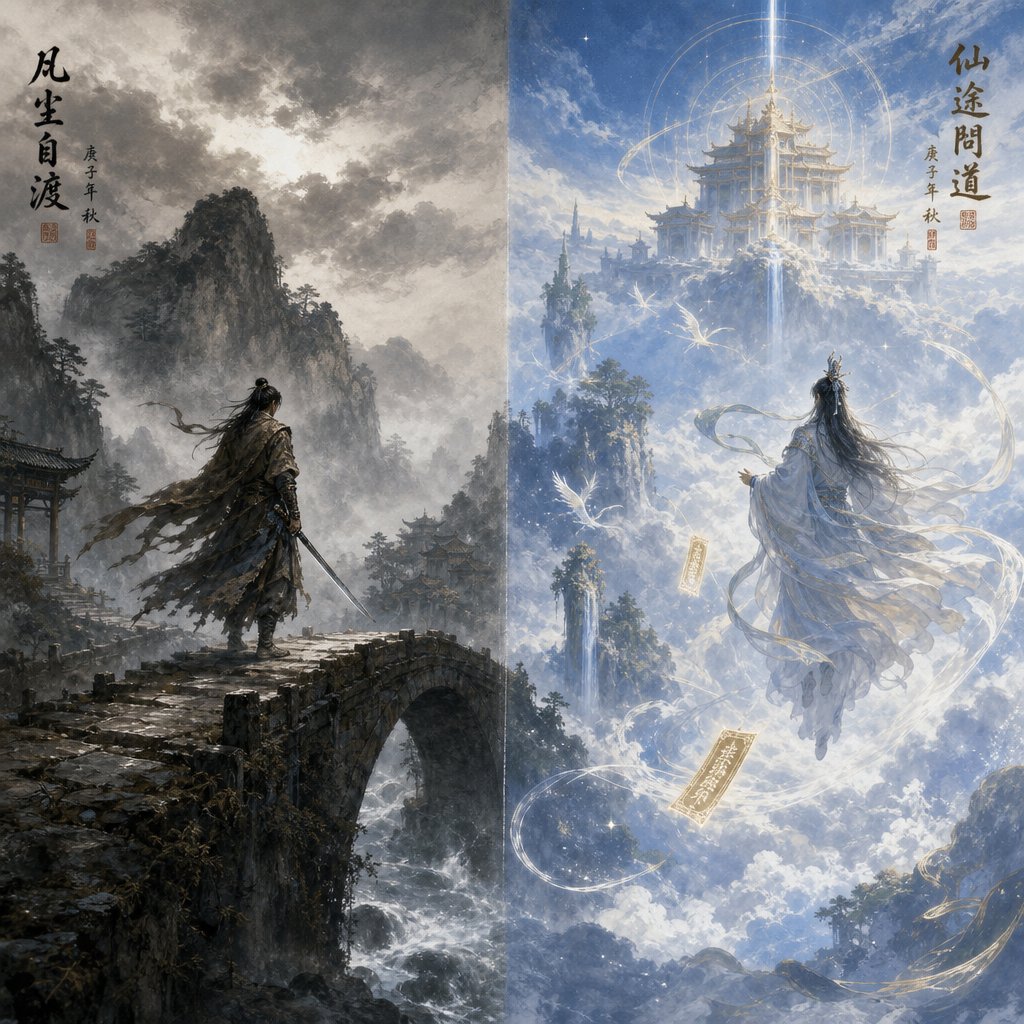
Genre-Specific Naming Rules for Wuxia and Xianxia
The difference between wuxia vs xianxia isn't just about power scaling or plot structure — it shows up in the very syllables characters carry. A grounded swordsman wandering the jianghu needs a name rooted in earth, steel, and flowing water. An immortal ascending through celestial tribulations demands something that sounds like it was carved from starlight. Picking the wrong register for your genre is like giving a cowboy a spaceship name. It just doesn't land.
Wuxia Naming Conventions and the Jianghu Aesthetic
Wuxia fiction lives in the human world. Its heroes are martial artists, wanderers, and outlaws navigating the jianghu — that sprawling underworld of sects, rivalries, and codes of honor. Wuxia names reflect this grounded reality. They pull from Confucian virtues, natural landscapes, and martial imagery rather than cosmic abstraction.
When you're searching for a wuxia name generator approach, think rivers, not heavens. Think iron, not jade. The best jianghu names feel like they belong to someone who has walked dusty roads and drawn a blade in anger.
- Feng (风, wind) — freedom, wandering, unpredictability. Common in lone swordsman names.
- Jian (剑, sword) — directness, martial identity, lethal precision.
- He/Jiang (河/江, river) — the jianghu itself, flow, adaptability, the martial world's lifeblood.
- Yi (义, righteousness) — Confucian loyalty, brotherhood, moral code.
- Tie (铁, iron) — unyielding will, physical toughness, commoner origins.
- Qiu (秋, autumn) — melancholy, maturity, the weight of experience.
A character named Jiang Feng Yi (江风义) immediately reads as a righteous wanderer of the martial world. No explanation needed — the name does the work. That's the power of authentic wuxia names: they situate a character within the jianghu's moral landscape before the plot even begins.
Xianxia Names and Cultivation Power Signaling
Xianxia operates on a completely different plane. Characters aren't just fighting — they're cultivating toward immortality, transcending mortal limits, and navigating Daoist cosmology. Names in xianxia lean celestial, ethereal, and philosophically abstract. Where wuxia grounds itself in rivers and swords, xianxia reaches for clouds and void.
The naming vocabulary shifts dramatically:
- Tian (天, heaven) — cosmic authority, supreme cultivation, divine connection.
- Xu/Wu (虚/无, void/nothingness) — Daoist emptiness, transcendence beyond form.
- Yun (云, cloud) — ethereal movement, detachment, high cultivation realms.
- Xuan (玄, profound/mysterious) — hidden knowledge, deep cultivation, arcane power.
- Ling (灵, spirit) — spiritual sensitivity, connection to qi, innate talent.
- Chen (尘, dust/mortal world) — often used to signal a character's relationship to the mundane realm they've left behind.
A cultivator named Tianxu Zhenren (天虚真人, "Celestial Void True Person") signals someone who has transcended mortal attachment through their name alone. Compare that to a wuxia hero named Zhao Qiang (赵强, "Zhao the Strong") — both are effective, but they belong to entirely different narrative worlds. Xianxia names often incorporate Daoist cosmological terms that function as power-level indicators, telling readers exactly where a character sits in the cultivation hierarchy.
Xuanhuan, the third major subgenre, blends both registers with more creative license. It borrows xianxia's cosmic vocabulary but isn't bound by strict Daoist frameworks, allowing authors to mix martial grounding with celestial flair more freely.
How Danmei Fiction Uses Names for Romantic Foreshadowing
Danmei — meaning "indulgence in beauty" — is the genre of male/male romance within Chinese fantasy settings. The danmei meaning extends into how authors construct protagonist names: they're designed as complementary pairs, encoding romantic tension and thematic duality before the characters ever meet on the page.
This pairing logic is deliberate and sophisticated:
- Opposing elements — one name carries light imagery (明, bright) while the other holds shadow (暗, dark), creating tension through contrast.
- Complementary nature imagery — cloud and moon, mountain and water, frost and flame paired across two protagonists.
- Shared radicals or tonal mirrors — subtle phonetic echoes between names that suggest destined connection.
- Virtue and transgression — one name signals righteousness while the other hints at moral ambiguity, foreshadowing the push-pull dynamic.
In Mo Dao Zu Shi, the protagonist Wei Wuxian (魏无羡, "Wei Without Envy") pairs against Lan Wangji (蓝忘机, "Lan Forgetting Worldly Machinations"). Both names contain negation — "without" and "forgetting" — creating a philosophical mirror. Their names suggest two different paths toward the same detachment, which is exactly what their love story explores.
Whether you're building names for a lone swordsman or a pair of star-crossed cultivators, genre dictates vocabulary. But names in Chinese fantasy don't stop at the personal — characters accumulate titles, courtesy names, and feared epithets as their stories unfold, creating an entire ecosystem of identity that shifts with every arc.
Beyond Personal Names and the Full Naming Ecosystem
A single character in Chinese fantasy fiction is rarely known by just one name. As their story unfolds — through coming-of-age ceremonies, sect initiations, legendary feats, and bitter rivalries — they accumulate layers of identity. Each name functions differently depending on who's speaking and what relationship they hold. This layered system isn't invented for fiction. It mirrors historical Chinese naming traditions where a single person could carry up to five distinct names, each governed by strict social rules about when and by whom it could be used.
Understanding chinese names and meanings at this deeper level transforms how you generate chinese name options for your characters. A name isn't a single label — it's an evolving system.
Courtesy Names and When Characters Receive Them
The courtesy name (字, zi) is given around age twenty — the traditional marker of adulthood. In fantasy fiction, this often coincides with a character completing their first major trial or being accepted into a sect. The zi becomes the name peers and equals use in daily interaction. Using someone's birth name (名, ming) directly? That's reserved for parents, elders, or deliberate insult.
Here's what makes this powerful for storytelling: the courtesy name is thematically linked to the birth name, but through contrast or expansion. The historical figure Zhuge Liang (诸葛亮) carried the courtesy name Kongming (孔明). Both "Liang" and "Ming" mean "bright" — the zi reinforces and deepens the birth name's meaning. Han Yu (韩愈), whose name means "to advance," received the zi Tuizhi (退之, "to retreat") — a deliberate antonym creating philosophical tension within a single identity.
For writers, this means a chinese name generator with meaning should account for paired names, not isolated ones. Your character's zi is a chance to add subtext — agreement, irony, or aspiration — that enriches every scene where the name appears.
Art Names and Daoist Titles in Cultivation Settings
Beyond the courtesy name sits the art name (号, hao) — a self-chosen alias that reflects personality, philosophy, or circumstance. Think of it as an ancient username. The poet Tao Yuanming called himself Wuliu Xiansheng (五柳先生, "Mr. Five Willows") after the trees outside his home. The scholar Ouyang Xiu chose Liuyi Jushi (六一居士, "Hermit of Six Ones") referencing his collection of books, inscriptions, a lute, a chess set, wine, and himself.
In cultivation fiction, the hao evolves into something more formal: the Daoist title. When a character enters a sect or achieves a cultivation breakthrough, they adopt a title that signals their path. Titles like Zhenren (真人, "True Person"), Shangren (上人, "Superior One"), or Jushi (居士, "Lay Practitioner") mark spiritual attainment. A cultivator might be born as Li Wei, receive the courtesy name Mingzhi, and eventually become known as Qingyun Zhenren (清云真人, "Azure Cloud True Person") — three names, three stages of life, three different relationships to the world.
How Multiple Names Create Narrative Layers
The real craft lies in how different characters use different names for the same person. Each form of address reveals the speaker's relationship, emotional state, and social position relative to the named character. This is where chinese name interpretation becomes a storytelling tool rather than just a labeling exercise.
Consider a sect leader named Chen Yuanzhuo, courtesy name Haoran, Daoist title Tianshu Zhenren, feared in the jianghu as the Ashen Blade. His disciples call him Shifu or Tianshu Zhenren. His childhood friend still uses Haoran. His enemies spit "Chen Yuanzhuo" — the birth name wielded as disrespect. And commoners whisper only "the Ashen Blade." Four names, four completely different emotional registers, all pointing to one man.
This system gives writers enormous flexibility. A shift in how someone addresses your character — from courtesy name to birth name, from title to epithet — can signal betrayal, intimacy, or challenge without a single line of exposition. When you generate chinese name sets for your cast, planning these layers from the start creates moments that land with cultural weight.
The names in chinese and meanings you assign aren't just identification. They're a social map, tracking who knows whom, who respects whom, and who has declared war simply by choosing the wrong form of address. That social dimension extends beyond individuals — into the sects, clans, and archetypes that shape how characters present themselves to the world.
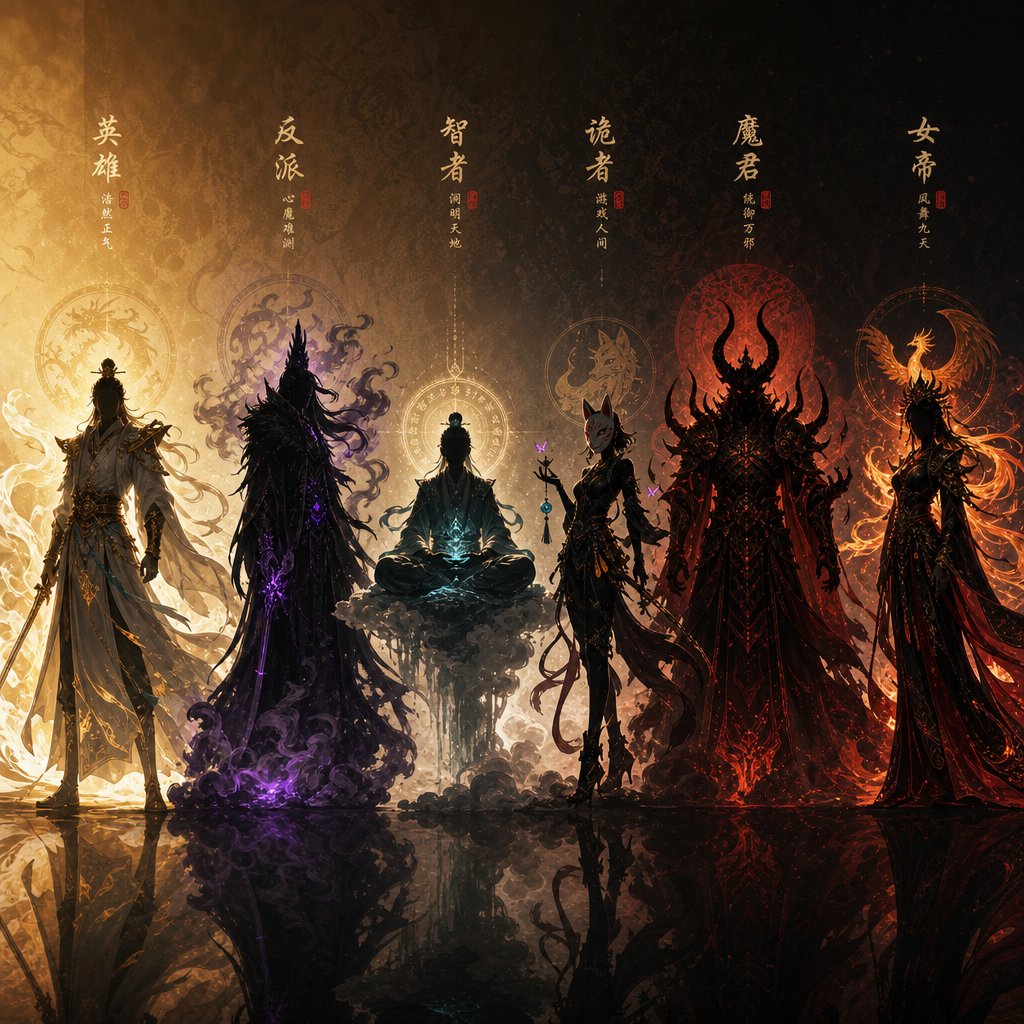
Matching Name Style to Character Archetype
Knowing the naming ecosystem is one thing. Knowing which characters to pull from that ecosystem for a specific role is where craft meets instinct. A chinese fantasy name generator can produce hundreds of options, but the real question is: does this name sound like a hero, a villain, or a sage? Each archetype carries its own phonetic signature and thematic vocabulary — and getting that match wrong undermines everything else you've built.
Naming Heroes and Righteous Cultivators
Heroes in Chinese fantasy carry names that sound clear, upright, and open. Think rising tones, bright vowels, and characters associated with light, justice, or natural strength. When selecting chinese male names for protagonists, you'll notice a pattern: the best ones feel like a declaration. They don't whisper — they stand tall.
Characters commonly used in heroic chinese boy names include Ming (明, bright), Hao (浩, vast), Zhi (志, ambition), and Yun (云, cloud). These project moral clarity and forward momentum. A hero named Gu Mingyuan (顾明远, "looking toward the bright distance") immediately reads as someone with vision and purpose. The tonal flow matters too — a mix of rising and level tones creates a name that sounds steady and confident when spoken aloud.
Avoid fourth-tone-heavy combinations for heroes. Consecutive falling tones sound harsh and aggressive, which works against the righteous archetype. A name like Wu Xing (无形, "Formless") uses tonal contrast to suggest adaptability and hidden strength — far more effective than brute-force naming.
Villain and Demon Lord Name Construction
Villains get the opposite treatment. Their names lean into sharp consonants, dark imagery, and characters that evoke cold, shadow, or domination. Where heroes carry brightness, antagonists carry weight — names that feel heavy in the mouth and ominous on the page.
Effective villain naming draws from characters like Mo (魔, demon), Xuan (玄, dark/profound), Ye (夜, night), Han (寒, cold), and Sha (煞, malevolent). A demon lord named Mo Tianlie (魔天烈, "Demonic Sky Fury") doesn't need an introduction — the name does the intimidation work. Fourth-tone clusters actually serve villains well, creating that harsh, commanding sound that heroes avoid.
The subtler approach? Give your villain a name that sounds almost noble but carries a buried contradiction. A character named Shen Jingxu (沈静虚, "Sinking into Silent Void") sounds contemplative until you realize every character points toward absence and disappearance. That quiet menace often hits harder than overt darkness.
Female Warrior Names That Balance Strength and Grace
Female warrior names in Chinese fantasy perform a specific balancing act. The best ones subvert expectations by combining traditionally delicate imagery with martial or elemental force — creating names that acknowledge femininity without reducing the character to it.
When building female chinese names for warriors, pair a graceful element with something sharp or powerful. Ling Fei (凌霏, "Rising Mist") merges ascension with ethereal beauty. Ji Xue (姬雪, "Noble Snow") combines aristocratic lineage with cold precision. The name for warrior female characters works best when it contains internal tension — softness and steel coexisting in two or three characters.
Common chinese girl names in fantasy draw from Xue (雪, snow), Shuang (霜, frost), Lan (兰, orchid), Yue (月, moon), and Ying (影, shadow). But pairing these with martial elements like Jian (剑, sword), Feng (锋, blade's edge), or Lie (烈, fierce) creates the duality that defines memorable female characters. A swordswoman named Yue Shuangjian (月霜剑, "Moon Frost Blade") carries both beauty and lethality in every syllable.
This approach to chinese female names avoids the trap of making women sound either too delicate for combat or too masculine to feel authentic within the genre's aesthetic traditions.
| Archetype | Recommended Character Themes | Tonal Pattern | Example Name Components |
|---|---|---|---|
| Hero | Light, justice, sky, ambition | Rising + level tones; open vowels | Ming (明), Hao (浩), Zhi (志), Yuan (远) |
| Villain | Shadow, cold, domination, void | Falling tones; sharp consonants | Mo (魔), Han (寒), Ye (夜), Sha (煞) |
| Sage/Immortal | Cloud, void, truth, mountain | Level + rising tones; flowing rhythm | Yun (云), Xu (虚), Zhen (真), Shan (山) |
| Trickster | Fox, mist, illusion, laughter | Mixed tones; playful rhythm | Hu (狐), Wu (雾), Huan (幻), Xiao (笑) |
| Demon | Blood, fire, abyss, fury | Fourth-tone heavy; guttural sounds | Xue (血), Yan (炎), Yuan (渊), Nu (怒) |
| Empress | Phoenix, gold, heaven, authority | Level tones; regal cadence | Feng (凤), Jin (金), Tian (天), Huang (凰) |
A chinese warrior name generator that accounts for these archetype-to-sound mappings produces dramatically better results than one that treats all characters as interchangeable. The table above isn't exhaustive, but it gives you a framework: match the emotional register of your character's role to the phonetic and semantic register of their name.
These archetype patterns hold across subgenres, but the specific characters you choose gain even more power when drawn from Chinese mythology's deep well of elemental and celestial motifs — the dragons, phoenixes, and jade imagery that signal exactly where a character sits in the cosmic hierarchy.
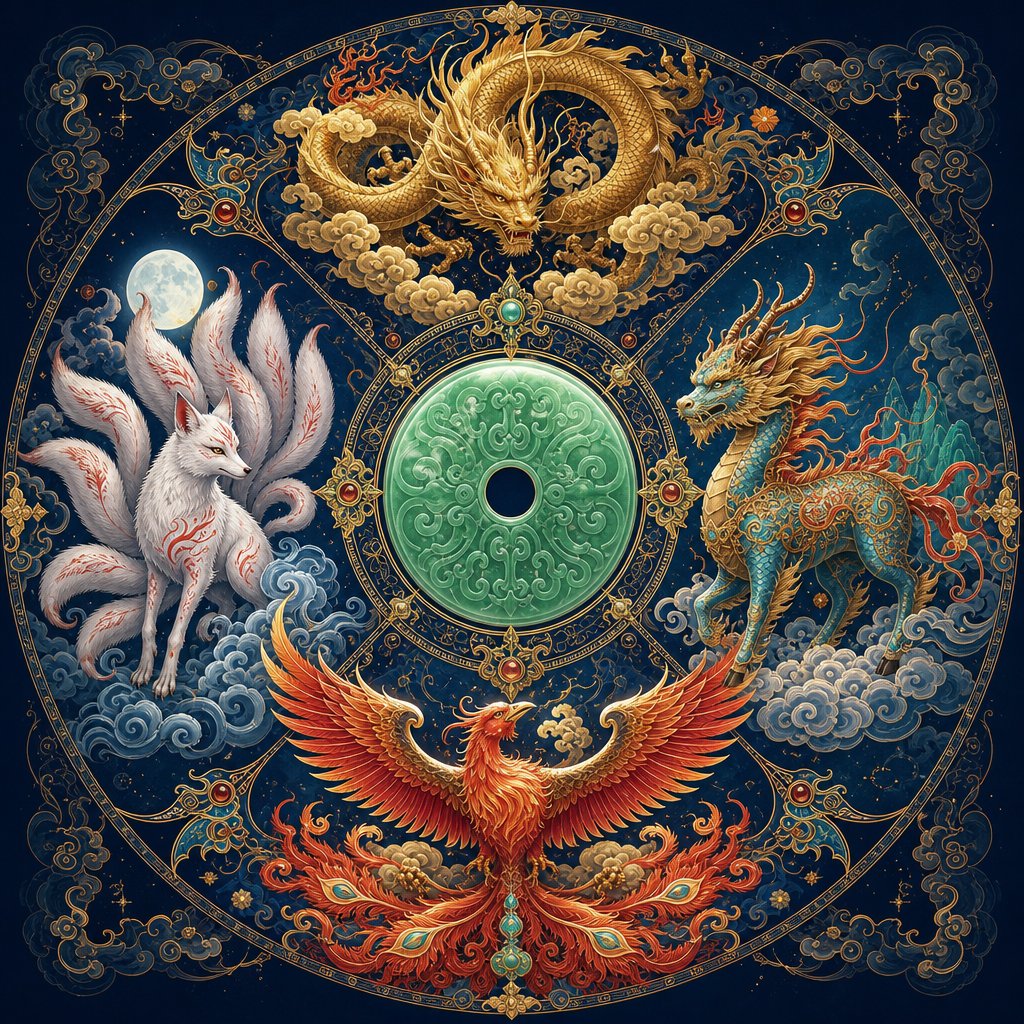
Elemental and Mythological Naming Themes
Dragons, phoenixes, and jade aren't just decorative motifs in Chinese fantasy — they're a naming vocabulary with thousands of years of accumulated meaning. When a character carries the character for "dragon" in their name, readers don't just see a cool word. They see authority, imperial power, and cosmic force compressed into a single syllable. These elemental and mythological building blocks form the core palette that any serious chinese fantasy name generator draws from, and understanding their weight lets you wield them with precision rather than guesswork.
Jade, Dragon, and Phoenix as Name Elements
Three motifs dominate Chinese fantasy naming above all others: jade, dragon, and phoenix. Each carries a distinct symbolic register that shapes how readers perceive a character instantly.
The jade name meaning runs deep in Chinese culture — it represents moral perfection, purity, and noble character. A name containing Yu (玉) signals someone refined, incorruptible, or spiritually elevated. The mythical Jade Rabbit (玉兔, Yutu) lives on the moon preparing elixirs of life, and the Jade Emperor (玉皇, Yu Huang) rules all of Heaven as the supreme deity among chinese myth gods. When you place Yu in a character's name — like Yu Qinghuan (玉清寰, "Jade of the Pure Realm") — you're invoking that entire tradition of celestial virtue.
Dragon (龙, long) carries imperial authority and raw cosmic power. In Chinese mythology, dragons are benevolent forces associated with health, strength, and protection — unlike their fire-breathing Western counterparts. A name like Long Tianyu (龙天宇, "Dragon of Heaven's Expanse") immediately positions a character at the apex of the power hierarchy. The Dragon King (龙王, Longwang) rules oceans and commands all other dragons, making this character a natural fit for sect leaders, emperors, and apex cultivators.
Phoenix (凤, feng) signals grace, rebirth, and feminine sovereignty. The Fenghuang (凤凰) is the legendary ruler of all birds, appearing only in peaceful and prosperous times. In naming, Feng works beautifully for empresses, female sect leaders, and characters undergoing transformation. A name like Feng Lingxiao (凤凌霄, "Phoenix Rising Above the Clouds") encodes both elegance and ascension.
Celestial and Elemental Characters for Immortal Beings
Beyond the big three, a rich vocabulary of celestial and natural elements lets you calibrate exactly how powerful or ethereal a character feels. The higher a character sits in the cultivation hierarchy, the more abstract and cosmic their naming elements become. A mortal martial artist might carry "river" or "iron" in their name. An immortal carries "void" or "star."
- Celestial elements:
- 星 (xing) — star; used for characters with fated destinies or celestial origins
- 月 (yue) — moon; solitude, hidden power, feminine mystique
- 日 (ri) — sun; supreme yang energy, imperial authority
- 辰 (chen) — celestial body/time; cosmic timing, fate-bound characters
- Martial elements:
- 剑 (jian) — sword; martial identity, lethal precision, cultivator's path
- 锋 (feng) — blade's edge; sharpness, decisive action
- 戟 (ji) — halberd; ancient warfare, overwhelming force
- 弓 (gong) — bow; precision, distance, calculated strategy
- Natural elements:
- 云 (yun) — cloud; freedom, ethereal detachment, high cultivation
- 莲 (lian) — lotus; purity rising from corruption, Buddhist resonance
- 松 (song) — pine; endurance, integrity through hardship
- 霜 (shuang) — frost; cold beauty, emotional restraint, deadly calm
- Spiritual elements:
- 魂 (hun) — soul; characters dealing with death, the underworld, or spiritual combat
- 道 (dao) — the Way; philosophical cultivators, sage archetypes
- 禅 (chan) — zen/meditation; Buddhist-influenced characters, inner peace
- 灵 (ling) — spirit; innate spiritual talent, sensitivity to qi
Notice the pattern: celestial elements signal the highest power tiers, spiritual elements mark philosophical depth, natural elements suggest cultivation stage, and martial elements ground characters in physical combat. A name like Yun Lingdao (云灵道, "Cloud Spirit's Way") stacks three registers — natural, spiritual, philosophical — creating a character who reads as a transcendent sage without a word of exposition.
Naming Non-Human Entities from Chinese Mythology
Chinese mythology creatures bring their own naming logic that differs sharply from human conventions. When your character is a fox spirit, a reanimated corpse, or a demon, their name needs to signal their nature while still functioning within the story's aesthetic.
The huli jing (狐狸精, fox spirit) is among the most iconic chinese mythological creatures in fantasy fiction. These shape-shifting tricksters — with the nine-tailed fox (九尾狐, Jiuweihu) being the most famous — traditionally disguise themselves as beautiful women. Names for fox spirit characters often combine seductive beauty with hidden danger: Hu Meiyin (狐魅吟, "Fox Enchantment Song") or Su Jiuwei (苏九尾, "Su of Nine Tails"). The surname Hu (狐, fox) can appear directly, or authors use Su (苏) as a subtle nod — it sounds elegant while carrying literary associations with fox spirits from classical tales.
The jiangshi (殭屍) — sometimes called the chinese for vampire, though "hopping corpse" is more accurate — represents reanimated dead who feed on qi, the life force. Unlike Western vampires, jiangshi move by hopping because their stiff limbs cannot bend. Naming jiangshi characters draws from death imagery: Ming (冥, underworld), Gui (鬼, ghost), Shi (尸, corpse), or Han (寒, deathly cold). A jiangshi antagonist named Ming Hansheng (冥寒生, "Born of the Cold Underworld") carries its nature in every character.
Yaoguai (妖怪, demon-monsters) encompass a vast category of chinese mythology creatures — from mountain spirits to river demons. Their names often incorporate the element they're associated with or the animal they originate from. A wolf yaoguai might carry Lang (狼, wolf) embedded in a more elegant name. A tree spirit could use Mu (木, wood) or Lin (林, forest). The key principle: non-human names in Chinese fantasy balance their monstrous nature against whatever human disguise or aspiration the creature holds.
Even the Qilin (麒麟), a dragon-like creature symbolizing good fortune, and the Xiezhi (獬豸), a justice-embodying beast that devours corrupt officials, lend their imagery to character naming. A righteous judge character named Zhi (豸) or carrying Qi (麒) in their name borrows that creature's moral authority.
These mythological and elemental building blocks give you a vocabulary. But vocabulary alone doesn't build a world — you also need the organizational structures that hold characters together: the sects, clans, and imperial hierarchies that give individual names their social context.
Sect Names and Clan Names in Cultivation Fiction
Individual names tell you who a character is. Sect and clan names tell you where they belong — and in Chinese fantasy, belonging is power. A cultivator's sect affiliation shapes their reputation, fighting style, and social standing more than any personal trait. The organizational names in your world need to carry the same deliberate weight as your character names, because readers will encounter them just as often.
How to Construct Sect and School Names
Most sect names in Chinese fantasy follow a consistent formula: a concept or location element paired with a martial or organizational suffix. Think of it as building blocks. Cloud Sword Sect (云剑宗), Jade Peak Hall (玉峰堂), Azure Lotus Palace (青莲宫) — each combines an evocative image with a structural marker that tells readers what kind of organization they're looking at.
Here's a step-by-step method for constructing sect names that feel authentic:
- Choose a location or natural element — mountains, rivers, peaks, valleys, or celestial bodies. Examples: Yun (云, cloud), Hua (华, flower/splendor), Cang (苍, azure/vast), Xue (雪, snow).
- Add a concept or quality character — this defines the sect's philosophy or martial focus. Examples: Jian (剑, sword), Ling (灵, spirit), Xuan (玄, profound), Qing (清, pure).
- Attach an organizational suffix — this signals the sect's structure and prestige level. Zong (宗, sect) is the most common and implies a large, established school. Men (门, gate/school) suggests a smaller or more secretive group. Gong (宫, palace) implies wealth and elegance. Tang (堂, hall) indicates a branch or sub-organization. Gu (谷, valley) suggests seclusion and hidden mastery.
- Check tonal flow — read the full name aloud. A mix of tones sounds natural; three consecutive fourth tones sound aggressive (which might be intentional for a demonic sect).
- Verify no unintended meanings — combining characters can create accidental words. Ensure your sect name doesn't accidentally sound like a common phrase or product brand.
Following this method, you might build Cangxuan Zong (苍玄宗, "Vast Mystery Sect") for a cultivation school focused on esoteric arts, or Xuefeng Gu (雪峰谷, "Snow Peak Valley") for a secluded mountain community of hermit cultivators. The formula is flexible enough to produce hundreds of combinations while maintaining genre authenticity.
Dynasty-Era Naming Conventions for Worldbuilding
Fantasy worldbuilding doesn't happen in a vacuum. The naming conventions of real imperial Chinese dynasties provide a foundation that readers instinctively recognize, even if they can't articulate why something feels "right." Studying the chinese dynasty timeline reveals how naming philosophy evolved across eras — and that evolution gives you distinct aesthetic registers to draw from.
Early dynasties took their names from the geographic regions where their founders held power. The Tang dynasty was named after the Duke of Tang's fief in the Taihang Mountains. The Song dynasty referenced the ancient state of Song. This convention — dynasty meaning rooted in territorial claim — dominated Chinese political naming for over a millennium. Fantasy authors who want their fictional kingdoms to feel grounded in tradition can follow this same logic: name your ruling houses after the land they control.
A shift occurred with the Yuan dynasty. Kublai Khan broke from geographic convention and chose Yuan (元, "primal origin") based on Daoist cosmological concepts. The following Ming (明, "bright") and Qing (清, "pure") dynasties continued this abstract approach. This gives fantasy writers two distinct registers: territorial names for grounded, martial settings, and abstract philosophical names for more elevated or spiritual empires.
When you look at a list of chinese dynasties — Xia, Shang, Zhou, Qin, Han, Sui, Tang, Song, Yuan, Ming, Qing — you're also looking at a menu of aesthetic flavors. A Tang-inspired setting carries connotations of cosmopolitan openness and poetic flourishing. A Ming-inspired world suggests rigid hierarchy and military strength. A Qing-era aesthetic evokes elaborate court ritual and Manchu-Han cultural fusion. Each period on the chinese dynasties list offers different naming textures for your fictional world.
Imperial Titles and Court Name Hierarchies
Fantasy court settings demand their own naming logic. A chinese emperor doesn't just have a personal name — he carries a reign title, a temple name, and a posthumous name, each used in different contexts. Understanding this hierarchy lets you build imperial chinese court scenes that feel layered rather than flat.
The imperial meaning of titles follows strict rules. The Emperor (皇帝, Huangdi) is addressed as Bixia (陛下, "Your Majesty") in formal settings. The Empress (皇后, Huanghou) holds the title Niangniangn (娘娘). Princes receive ranked titles — Qin Wang (亲王, First-Rank Prince) or Jun Wang (郡王, Second-Rank Prince) — that determine their political power and form of address. Each title carries specific privileges, residences, and modes of address that shift depending on who's speaking.
For fantasy writers building court intrigue, the empress of china archetype offers rich naming territory. An empress's personal name often combines authority with beauty — characters like Feng (凤, phoenix), Tian (天, heaven), or Huang (凰, female phoenix). But her title and how others address her matters more than her birth name. Servants use Niangniangn. Officials use Huanghou Niangniangn. Her enemies might whisper only her surname — a deliberate breach of protocol that signals political threat.
The five ranks of nobility below the imperial family — Duke (公, Gong), Marquis (侯, Hou), Count (伯, Bo), Viscount (子, Zi), and Baron (男, Nan) — provide a complete hierarchy for your fictional courts. Each rank carries its own form of address and naming conventions. A Duke Who Defends the State (镇国公, Zhenguo Gong) wears his function in his title. A Loyal and Brave Marquis (忠勇侯, Zhongyong Hou) carries his reputation in every syllable.
These organizational and hierarchical naming systems — sects, dynasties, imperial courts — give your world structural depth. But even the most carefully constructed names can fail if they violate the linguistic rules that Chinese-literate readers instinctively recognize. Tonal clashes, accidental meanings, and romanization choices can shatter immersion in ways that no amount of worldbuilding can repair.
Common Naming Pitfalls That Break Immersion
You've built a rich world, chosen thematic characters, and mapped your cast to archetypes. Then a Chinese-literate reader hits your protagonist's name and winces — because it accidentally sounds like a household cleaning product, or its tones crash together like a pile-up on a highway. Even the most sophisticated chinese character name generator can't save you if you don't know what to avoid. These pitfalls are invisible to writers who don't read chinese hanzi, but they're glaring to anyone who does.
Character Combinations That Create Unintended Meanings
Chinese is dense with homophones. A name that looks elegant on paper can sound identical to an embarrassing common phrase when spoken aloud. As naming experts note, the characters Si (思, "to think") and Wang (旺, "prosperous") seem like a strong pairing — until you realize "Siwang" sounds exactly like 死亡, the word for "death." That's not subtext. That's a naming disaster.
This problem multiplies in fantasy because authors reach for unusual characters with poetic meaning, creating combinations that native speakers would instinctively avoid. A random chinese name pulled from a generator without verification is especially vulnerable to this.
- Homophone collisions — Characters that individually mean "grace" and "arrival" might together sound like a word for "diarrhea" or a brand name. Always check the full pinyin string against common words.
- Vulgar readings — The character Ri (日, "sun") carries a vulgar slang meaning in colloquial Mandarin. Placing it prominently in a hero's name undermines their dignity instantly.
- Naming taboo violations — Using characters from a revered historical figure's name (like naming someone Kongming) reads as presumptuous or parodic, similar to a Western character casually named "Jesus Shakespeare."
- Number associations — Incorporating Si (四, "four") into a name invokes death by homophone. The number 250 (二百五) is a well-known insult meaning "fool" — any name that sounds like a number sequence risks unintended comedy.
- Gendered mismatch — Characters like Hua (花, "flower") or Mei (美, "beautiful") in a male warrior's name will confuse readers about gender unless the subversion is intentional and acknowledged.
The fix is straightforward but non-negotiable: after assembling any name from a chinese name generator with characters, read the full pinyin aloud and check it against a dictionary for unintended compound meanings. What looks distinct in written hanzi can collapse into embarrassment in speech.
Tonal Flow and How It Affects Name Aesthetics
Mandarin has four tones — flat, rising, dipping, and falling — and the sequence of tones in a name creates its musicality. This applies whether you're writing for mainland Mandarin or taiwanese mandarin speakers; tonal aesthetics are universal across dialects that use the four-tone system.
Imagine four consecutive fourth-tone (falling) characters: every syllable drops hard, creating a name that sounds like someone hammering nails. That aggressive cadence works for a demon lord but destroys the ethereal quality you want for a celestial maiden. Conversely, a string of first-tone (flat) characters sounds monotone and lifeless — technically smooth but emotionally empty.
The principle is simple: vary your tones. The most pleasing chinese fantasy names alternate between tones, creating a natural rise-and-fall rhythm. A name like Yun Qinghe (云清河) moves through first tone, first tone, second tone — smooth with a gentle lift at the end. Compare that to Mu Shi Da (暮世大), which stacks fourth, fourth, fourth — harsh and blunt. Neither is wrong in isolation, but each creates a radically different impression. A chinese writing name generator that displays tone marks alongside characters gives you the information needed to make this judgment.
Romanization Versus Translation for Western Readers
Here's the question every English-language fantasy author faces: do you present names in pinyin romanization (Wei Wuxian) or translate them into meaning-names (Wei Without Envy)? There's no single correct answer, but the wrong choice for your audience breaks flow just as badly as a tonal clash breaks sound.
Authors like Jeannie Lin have discussed this tension extensively — the choice between romanization and translation is both an artistic and political decision. Lisa See uses "Snow Flower" (translated) in one novel and pinyin names in another, depending on the intimacy she wants readers to feel. Cindy Pon mixes both approaches within a single book, using pinyin for personal names but english in mandarin chinese translation for titles and epithets.
A practical framework:
- Use pinyin for personal names — it preserves the sound and foreignness that signals "this is a Chinese fantasy world," not a translated one. Readers learn to associate the sound with the character.
- Translate epithets and titles — "The Ashen Blade" lands harder than "Hui Ren" for English readers because the meaning is the point. Epithets are meant to be understood immediately.
- Provide meaning through context, not parentheticals — instead of writing "Xue Lian (Snow Lotus)," let another character comment on the name's beauty or a narrator reflect on its significance. This preserves immersion while delivering the poetic meaning to readers who can't parse pinyin.
- Stay consistent within your system — mixing approaches randomly confuses readers. Decide your rules early and apply them uniformly across your cast.
The romanization question also affects how readers distinguish your characters. Names that look visually similar in pinyin — like Zhou and Cho, or Xiao and Shao — can blur together on the page even though they sound distinct in spoken Mandarin. Jeannie Lin discovered this problem firsthand when she realized two characters named "Cho" and "Zhou" in her own novel looked different to the eye but sounded identical aloud. Vary your initial consonants and vowel patterns across your cast to prevent this visual confusion.
These pitfalls — homophone traps, tonal monotony, and romanization missteps — are the difference between names that feel crafted and names that feel generated. Avoiding them requires a verification step that no tool can fully automate. But that verification becomes far easier when you have a structured workflow that builds checking into every stage of the naming process.
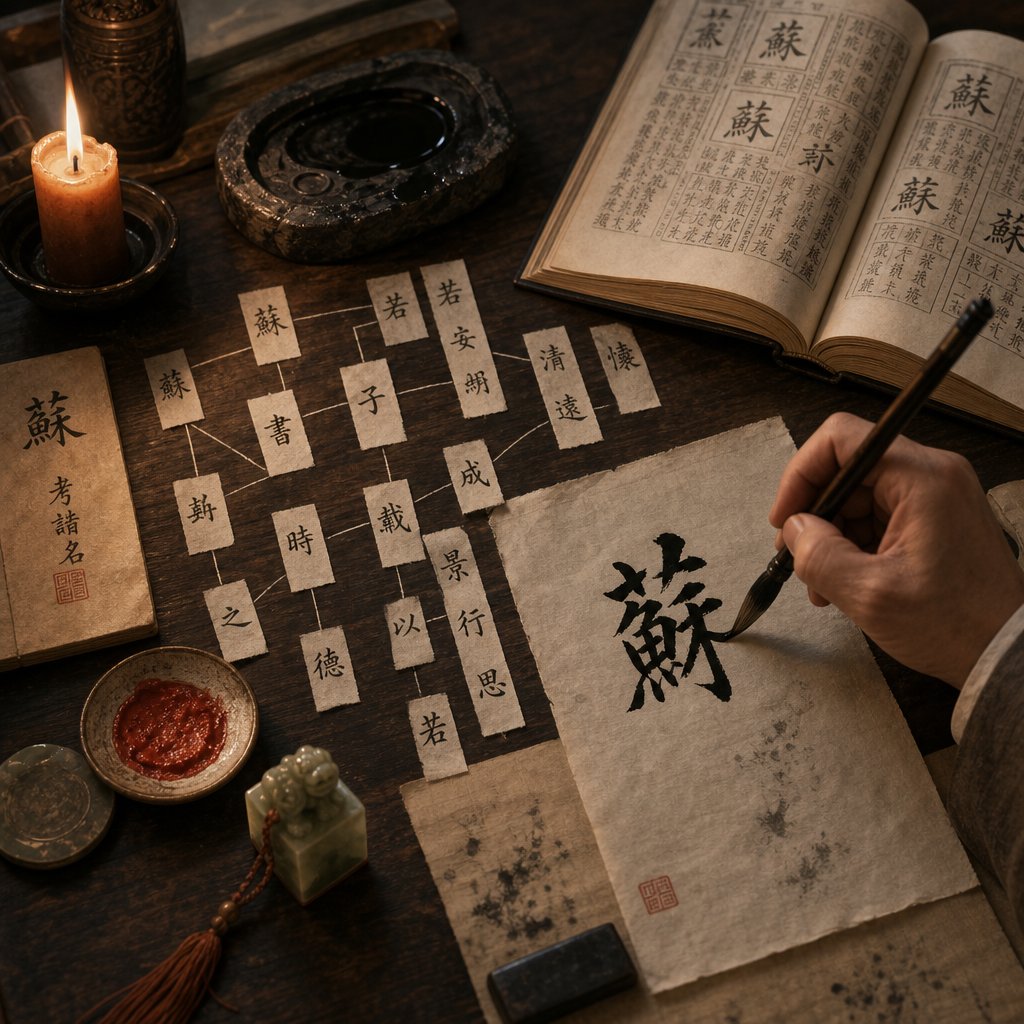
How to Build Authentic Names Step by Step
Knowing what to avoid is half the battle. The other half is having a repeatable process that turns raw knowledge into finished names — names that sound right, mean something, and fit your character like a tailored coat. The good news: you don't need to be fluent in Mandarin or spend years studying classical poetry. You need a workflow that combines the speed of a random chinese name generator with the cultural precision of manual construction.
Think of it like cooking. A mandarin name generator gives you ingredients. The workflow below tells you how to combine them into something that actually tastes good.
A Step-by-Step Name Construction Workflow
This process works whether you're naming a single protagonist or building an entire cast of thirty characters. Each step builds on the previous one, and skipping steps is how you end up with names that sound like cleaning products.
- Define the character's role and emotional register — Before touching any tool, decide: hero or villain? Grounded martial artist or ethereal cultivator? Male or female? The archetype determines which character themes and tonal patterns you'll draw from. A china names generator can't make this decision for you.
- Select a surname — Use a chinese surname generator or the surname table from earlier in this guide. Match the surname's connotations to your character's background. Noble lineage? Try Mu, Ling, or a compound surname like Shangguan. Common origins? Li, Zhang, or Chen ground a character in the everyday world. Write down two or three options.
- Choose thematic characters for the given name — Pull from the elemental and mythological vocabulary that matches your character's archetype. A righteous cultivator gets brightness and sky imagery. A fox spirit gets mist and enchantment. Select three to five candidate characters and note their tones.
- Assemble combinations and check tonal flow — Pair your surname candidates with your given name characters. Read each combination aloud. You want tonal variety — a mix of rising, falling, and level tones that creates natural rhythm. Discard any combination where three consecutive characters share the same tone.
- Verify no unintended meanings — Take your top two or three candidates and check the full pinyin string against a Chinese dictionary. Search for the character combination online to see if it matches a common word, brand name, or unfortunate slang. This step catches the problems that break immersion for Chinese-literate readers.
- Add courtesy name or title if needed — For major characters, build a zi (courtesy name) that complements or contrasts the birth name. For cultivators, assign a Daoist title that reflects their sect and attainment level. Minor characters can skip this step.
- Test against your existing cast — Check that the new name doesn't visually or phonetically blur with other names in your story. Vary initial consonants and vowel patterns across your cast to prevent reader confusion in romanized text.
This workflow takes five to ten minutes per character once you're familiar with it. For a full cast, batch the surname selection and thematic character steps — you'll find natural groupings emerge that reinforce your worldbuilding.
Using Generators as Creative Starting Points
A random name generator chinese tools provide isn't your enemy — it's your brainstorming partner. The mistake is treating generated output as final. Instead, use generators to surface character combinations you wouldn't have considered, then run those combinations through your manual verification steps.
Here's how to get the most from a chinese name generator male or chinese name generator female tool:
- Generate in batches — Pull ten to twenty names at once rather than evaluating one at a time. Patterns emerge when you see multiple options together. You'll notice which characters keep appearing and which feel fresh.
- Harvest individual characters, not complete names — A generated name might not work as a whole, but one character within it could be perfect. Treat generators as character libraries rather than finished-name dispensaries.
- Cross-reference with your archetype table — Does the generated name's tonal pattern match your character's role? Does it use characters from the right thematic family? If a generator gives you celestial imagery for a grounded wuxia swordsman, keep the surname but swap the given name elements.
- Use multiple generators for comparison — Different tools draw from different databases. An ancient chinese name generator emphasizes classical characters and historical patterns. A modern tool might lean toward contemporary usage. Running both gives you a wider palette to work from.
The key insight: generators excel at the combinatorial work — pairing characters you might never have put together. Humans excel at the judgment work — deciding whether a combination serves the story. Neither alone produces the best results.
Customizing Generated Names for Your Characters
You've pulled a name from a generator. It's close but not quite right. Maybe the meaning fits but the tone pattern clashes with your character's archetype. Maybe the surname feels too common for a mysterious antagonist. Customization is where generic output becomes something personal.
The most effective customization techniques:
- Swap the surname while keeping the given name — If a generator produces "Li Qingyu" but your character needs aristocratic weight, replace Li with Shangguan or Sikong. The given name's meaning stays intact while the surname shifts the social register.
- Replace one given name character — Keep the character that carries your core theme and swap the other for something that adjusts the tonal flow or adds a secondary meaning layer. Changing one character can shift a name from generic to distinctive.
- Add a generation character for clan members — If your character belongs to a family, insert a shared generational character as the first element of the given name. This instantly connects them to siblings and cousins while the second character remains unique.
- Build the courtesy name as a mirror — Once you've finalized the birth name, construct a zi that either reinforces its meaning (synonym approach) or creates philosophical tension (antonym approach). This paired-name technique follows the same logic used in historical Chinese naming, where the zi expanded or challenged the ming.
Consider the four dimensions that traditional Chinese naming operates across: sound, form, meaning, and elemental balance. A generated name might satisfy meaning but fail on sound. Your customization work addresses whichever dimension the generator missed. Check how the characters look written together — do they have visual balance in stroke density? Does the name flow when spoken across a room? These are the refinements that separate a name that merely works from one that resonates.
The best fantasy names emerge from combining generator efficiency with manual cultural knowledge — letting tools handle the combinatorial heavy lifting while human judgment handles meaning, tone, and narrative fit.
This workflow isn't about perfection on the first try. It's about building a repeatable system that gets you to strong names faster, with fewer embarrassing mistakes and more intentional craft. Run through it once for your protagonist, and by the time you're naming your fifth character, the process becomes instinct — surname, theme, tone, verify, layer. Five steps from blank page to a name that carries your character's entire identity in two or three carefully chosen characters.
Frequently Asked Questions About Chinese Fantasy Name Generators
1. How do Chinese fantasy names differ from modern Chinese names?
Modern Chinese names prioritize simplicity and everyday auspicious meaning, while fantasy names draw from Daoist cosmology, classical poetry, Confucian virtue, and martial philosophy. Fantasy names function as compressed character descriptions that signal a character's power level, moral alignment, and narrative role. They reference centuries of literary tradition where individual characters like jade, dragon, or cloud carry layered symbolic weight that modern naming conventions don't require.
2. What is the basic structure of a Chinese fantasy name?
Chinese fantasy names follow a surname-first, given-name-second structure, typically totaling two or three characters. The surname carries literary connotations and clan identity, while the given name layers thematic meaning through one or two carefully chosen characters. Fantasy authors often select rare or compound surnames like Sikong or Shangguan to signal aristocratic or otherworldly origins, and use generational characters within clan systems to show family connections.
3. What are the naming differences between wuxia and xianxia fiction?
Wuxia names use grounded, martial imagery like wind, sword, river, iron, and autumn to reflect the human-scale jianghu world of wandering swordsmen. Xianxia names lean celestial and abstract, incorporating characters for heaven, void, cloud, spirit, and profound mystery to signal cultivation toward immortality. Xuanhuan blends both registers freely, while danmei fiction constructs protagonist names as complementary pairs that encode romantic tension through opposing or mirroring elements.
4. Why do characters in Chinese fantasy have multiple names?
Chinese fantasy mirrors historical naming traditions where a single person carries distinct names for different life stages and social contexts. A character receives a birth name from parents, a courtesy name at adulthood used by peers, possibly a Daoist title upon entering cultivation, and feared epithets earned through reputation. Each name type governs who may use it and when, making shifts in address a powerful storytelling tool that signals changes in relationship, respect, or hostility without exposition.
5. How can I avoid common mistakes when creating Chinese fantasy names?
The most critical pitfalls include homophone collisions where elegant characters sound like embarrassing common words, tonal monotony from stacking same-tone characters, violating naming taboos by using revered historical figures' characters, and gendered mismatches that confuse readers. Always read the full pinyin aloud, check combinations against a dictionary for unintended compound meanings, vary tones for natural rhythm, and verify that your name doesn't accidentally match a brand name or slang term.