Understanding 避讳 and Chinese Funeral Name Avoidance
Imagine attending a funeral in Chinese culture and casually speaking the deceased person's given name aloud. To you, it might feel natural. To the mourning family, it could feel like a slap across the face of the dead.
This is the weight carried by 避讳 (bihuì), the traditional Chinese practice of name avoidance. At its core, bihuì refers to the prohibition against speaking or writing the given names of respected persons, particularly the deceased. The practice governed how names appeared in speech, on paper, and even in the strokes of individual characters for centuries. As Piotr Adamek's research at Leiden University documents, bihuì had such enormous impact on Chinese culture that violating it could historically result in punishment, exile, or even execution.
What Is Bihuì and Why It Governs Chinese Funerals
Chinese funeral traditions treat the moment of death as a transition, not an ending. The deceased moves from the world of the living into an elevated spiritual status among the ancestors. Their given name, once an everyday identifier, becomes something sacred. Using it carelessly is considered a violation that can disturb the spirit's journey toward peace.
Speaking or writing a deceased person's given name is not a minor social misstep. It is a breach of respect believed to unsettle the spirit and dishonor their new place among the ancestors.
This is not superstition in the dismissive sense. Bihuì operated as a codified cultural system with rules, exceptions, and enforcement mechanisms spanning from the Western Zhou period (1046-771 BC) through the end of imperial China. The first written evidence of name avoidance dates back over three thousand years, and the oral custom likely predates even that.
How Name Avoidance Differs from General Funeral Etiquette
You'll notice that most guides to funeral etiquette in Chinese communities cover dress codes, gift-giving, and ritual sequences. Name taboos operate on a different level entirely. While etiquette governs behavior, bihuì governs language itself, controlling which words, sounds, and characters are permissible around the dead. The Chinese symbol for death (死 sǐ) is itself subject to avoidance, replaced by gentler alternatives during mourning.
General etiquette tells you what color to wear. Name avoidance tells you what syllables your mouth is forbidden to form. It shapes how obituaries are written, how eulogies are delivered, and how the deceased is referenced for generations afterward. This distinction matters because a well-meaning attendee can follow every visible rule of a funeral in Chinese culture and still commit a serious offense through a single spoken name.
The philosophical roots behind these naming rules reach deep into Confucian thought, where reverence for the dead was never optional but foundational to moral life itself.
The Confucian Roots Behind Funeral Naming Rules
Why would an entire civilization build a system around not saying someone's name? The answer lives in Confucian philosophy, where respect for the dead was never a suggestion but a moral obligation woven into the fabric of society.
Filial Piety as the Foundation of Name Taboos
Filial piety (孝 xiào) is the Confucian principle that children owe their parents absolute devotion, both in life and after death. As Columbia University's Asia for Educators program explains, the word for filial piety is the same as the word for mourning in classical Chinese thought. The child who acts with piety toward living parents is equated with the child who mourns them through proper rituals.
This connection is key. In traditional chinese customs surrounding death, using a deceased parent's or grandparent's given name implied a kind of casual familiarity, as though the dead person were still your equal. Death elevated them. Their name became sacred, something to be protected rather than spoken freely. To say it aloud was to pull them back down, to deny their transition into the ancestral realm.
The Analects (論語 Lunyu) reinforced this through Confucius's teachings on ritual propriety (禮 li). Proper mourning behavior, including how you referenced the dead, demonstrated your moral character. A person who failed to observe chinese mourning customs around naming revealed a deficiency not just in manners but in virtue itself.
How the Book of Rites Codified Mourning Language
The philosophical principle became law through the Book of Rites (禮記 Liji), one of the Five Confucian Classics compiled during the Warring States period and Former Han dynasty. This text dedicated multiple chapters to mourning, including the Greater Record of Mourning Rites (喪大記 Sangdaji) and Questions about the Mourning for Three Years (三年問 Sannianwen).
The Liji established that mourning rites were "appointed in harmony with the feelings produced by the occasion" and represented "the unchanging rules" that could not be diminished or added to. Within this framework, name avoidance became codified. The text specified how the deceased should be referenced on spirit tablets, during sacrificial rites, and in everyday speech throughout the mourning period. Until the end of imperial China in 1912, observing a three-year mourning period for a father's death remained a common expression of xiào, and throughout those years, the father's given name stayed off-limits.
The concept of china afterlife in Confucian thought is less about a supernatural heaven and more about continuity. Ancestors remain present through tablets, sacrifices, and memory. Their names carry ongoing spiritual weight because the dead are not gone. They are watching, receiving offerings, and occupying a place in the family's moral universe. Saying their name without proper context disrupts that relationship.
These philosophical foundations did not stay abstract. They scaled into two distinct systems of enforcement: one imposed by the state on entire populations, and another practiced quietly within individual families during their most private moments of grief.
Imperial Taboos Versus Family Mourning Taboos
Two systems, one principle. The same logic that made an emperor's name untouchable for millions also made a grandfather's name unspeakable at his own funeral. The difference was scale, not substance. Both operated on the belief that a name carries the essence of a person, and misusing it after death disrupts the spiritual order.
Imperial Name Taboos and Their Historical Power
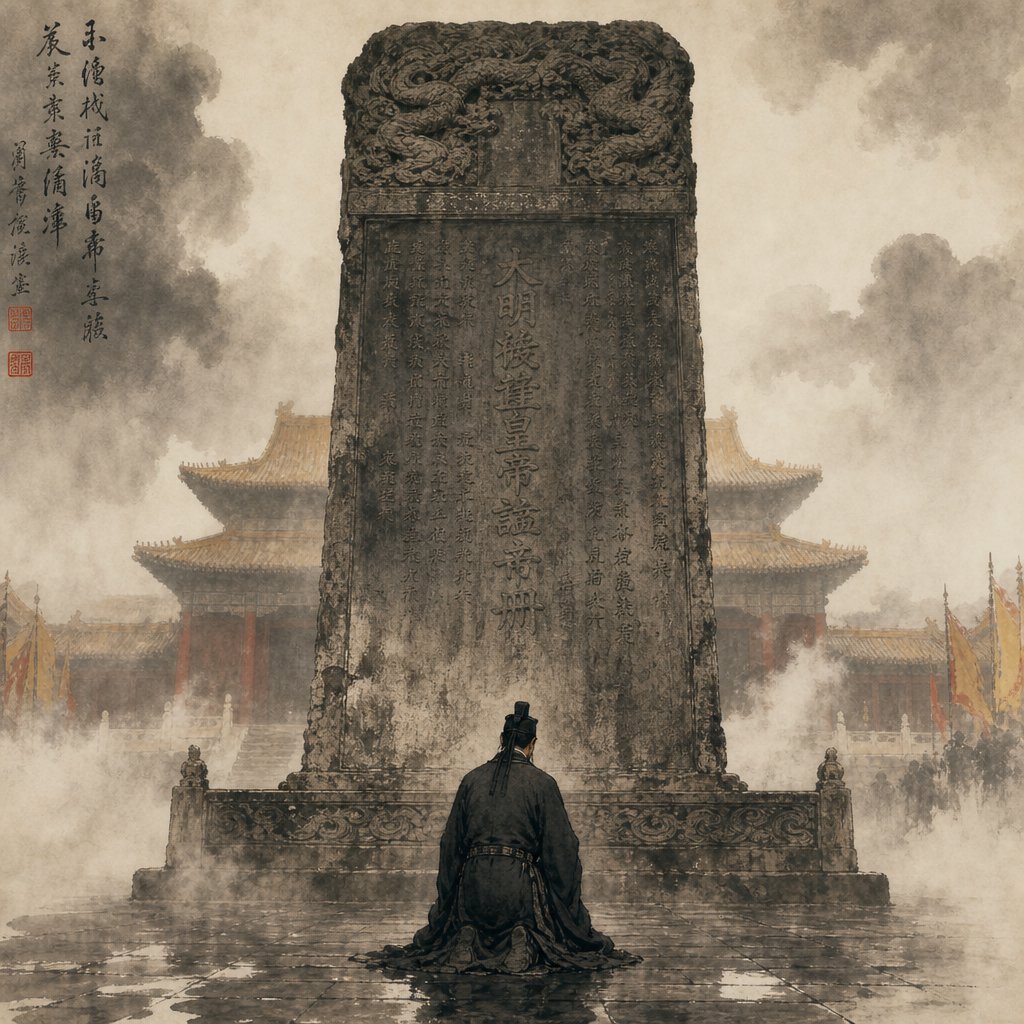
The naming taboo of the state (国讳 guohuì) required entire populations to avoid using characters from the emperor's given name. This was not a polite request. It was enforced by law, and violations could bring severe punishment.
Consider the case of Wang Xihou, a scholar during the Qing dynasty. In 1777, he wrote the Qianlong Emperor's name in his dictionary without omitting the required stroke. The result? Execution for him and his family, plus confiscation of all property. One missing brushstroke was the difference between life and death.
The system worked like this: when a new emperor took the throne, his given name characters became off-limits nationwide. People with those characters in their own names had to change them. Place names were altered. Even common words sharing the same character required substitution. During the Qin dynasty, the First Emperor's name Zheng (政) forced the pronunciation of the first month (正月 Zhēngyuè) to shift its tone, and eventually the entire word was replaced with 端月 (Duānyuè).
The strength of guohuì depended on the dynasty. Some emperors, recognizing the burden, deliberately chose uncommon characters for their children's names. Emperor Xuan of Han even changed his own name from the common characters Bingyi (病已) to the rare character Xun (询) specifically to ease the burden on his people. Others were less merciful. During the Song dynasty, a single imperial name could trigger the avoidance of up to 55 homophonous characters.
Family-Level Taboos in Domestic Mourning
The naming taboo of the clan (家讳 jiāhuì) operated within a smaller circle but carried equal emotional weight. When a patriarch or matriarch died, their given name became forbidden within the family. Children, grandchildren, and often neighbors and friends all observed the restriction.
China funeral customs around family name avoidance followed specific rules drawn from the Book of Rites (禮記 Liji). The taboo officially began after the mourning ceremony of wailing (卒哭 zuku), roughly one hundred days after death. From that point forward, the deceased's name belonged to the spirit world. As the Liji states: "When the ceremony of wailing is over, tabooing starts. Affairs of living are finished, and affairs of ghosts begin."
In practice, family taboos shaped everyday life in tangible ways. The Tang dynasty poet Du Fu (杜甫) is believed to have tabooed his mother's name Haitang (海棠), which is why crab apple blossoms never appear in his extensive body of poetry. The compiler of the Book of the Later Han, Fan Ye (范晔), avoided the character 泰 (tài) throughout his entire work because it appeared in a family member's name, substituting 太 (tài) wherever it occurred.
Chinese customs for funerals required that when visitors entered a home in mourning, they first asked which names were forbidden. The Liji codified this expectation directly: "Before entering the door of a house, one should ask about the names to be avoided in it." Ignorance was no excuse. Failing to observe a family's private taboo brought shame to both the speaker and the bereaved.
How Historical Practice Shaped Modern Funeral Customs
The imperial system collapsed in 1912, and state-level name taboos disappeared with it. No one today avoids characters from a president's name. But family-level taboos persisted because they were never about political power. They were about grief, respect, and the relationship between the living and the dead.
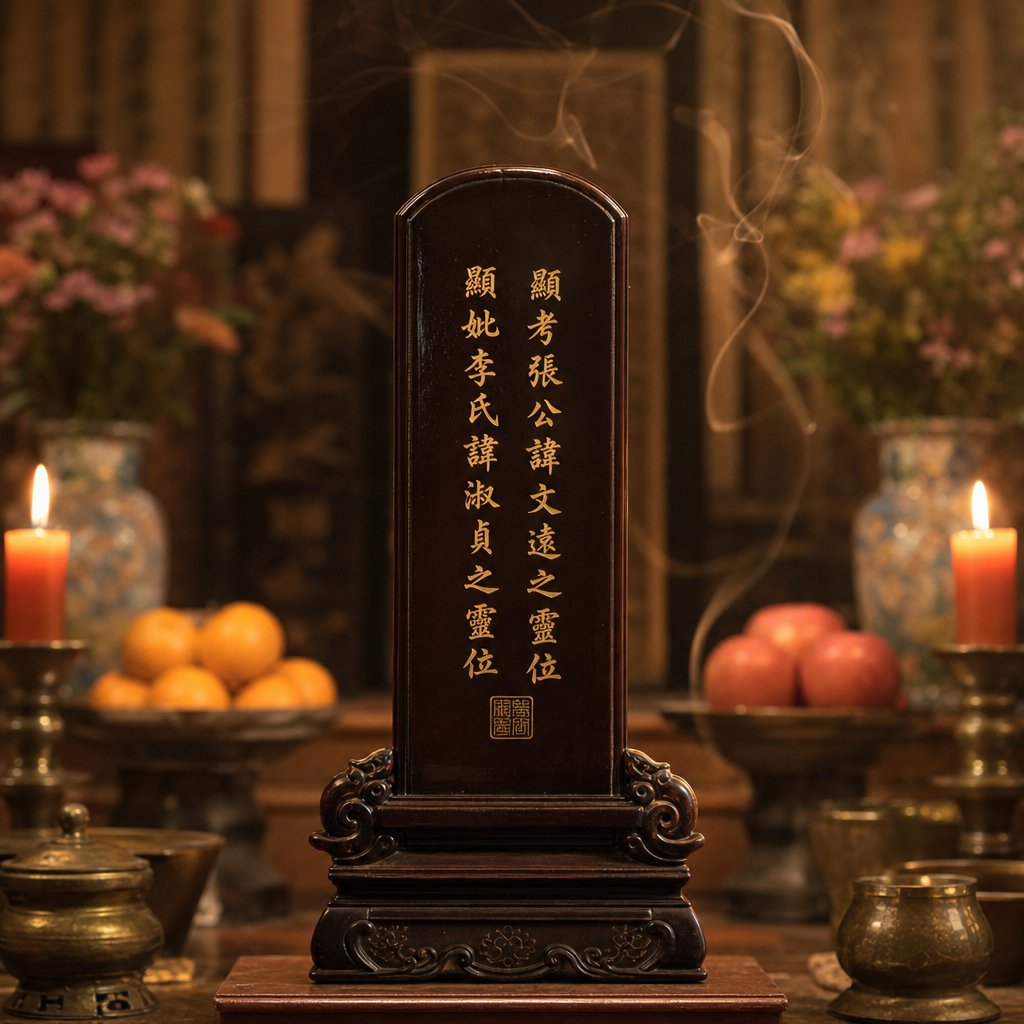
The chinese custom for funeral name avoidance today draws directly from jiāhuì traditions. When a family elder dies, their given name is replaced on spirit tablets (牌位 páiwèi) with formal titles. Funeral banners (挽联 wǎnlián) follow calligraphic protocols for how the name appears in written form. Mourners at the wake refer to the deceased by kinship terms rather than given names. These are all scaled-down versions of the same principle that once governed empires.
| Category | Imperial Taboo (国讳 guohuì) | Family Taboo (家讳 jiāhuì) |
|---|---|---|
| Scope | Entire population of the empire | Family members, close friends, and neighbors |
| Enforcement | Legal punishment, including execution and property confiscation | Social shame and perceived spiritual consequences |
| Duration | Seven generations for most emperors; entire dynasty for founders | Typically two to three generations; strongest during the mourning period |
| Modern Relevance | No longer practiced; ended with imperial China in 1912 | Still observed in funeral contexts, naming of descendants, and ancestral rites |
The gap between these two systems reveals something important. Imperial taboos were about power. Family taboos were about love. Both used the same mechanism, avoiding a name, but the motivation differed. And it is the family version, rooted in genuine reverence rather than political fear, that survived into the present day.
Yet knowing which names to avoid is only half the challenge. The spoken dimension of these taboos introduces another layer of complexity, where the tonal nature of Chinese languages turns even similar-sounding words into potential violations.
Spoken Taboos and Forbidden Words at Chinese Funerals
Chinese is a tonal language. A single syllable like "shi" can mean poem, ten, stone, death, or history depending on the tone. This phonetic density is what makes spoken name taboos so treacherous at funerals. It is not just the deceased's exact name that mourners must avoid. Any word that sounds similar, shares a tone, or rhymes too closely can trigger a violation.
Phonetic Taboos and Why Sound Matters in Chinese Mourning
Imagine the deceased's given name contains the character 明 (ming, meaning "bright"). During the funeral, mourners would avoid not only that exact character but also words with identical or near-identical pronunciation: 命 (ming, fate), 名 (ming, name), or even 鸣 (ming, to cry out). The reasoning is spiritual, not linguistic. In Chinese cosmology, sound carries energy. A spoken word does not simply describe reality; it participates in it. Uttering a sound too close to the dead person's name is believed to call their spirit back, disturbing their passage to the ancestral realm.
This is why the chinese sign for death itself, the character 死 (si), is almost never spoken aloud at funerals. The word carries such concentrated negative energy that even in everyday conversation, Chinese speakers avoid it. At a wake or burial ceremony, saying si is considered deeply inauspicious, as though you are inviting more death into the room.
The tonal dimension compounds the problem. Mandarin has four tones plus a neutral tone, but Cantonese has six to nine depending on the classification system. More tones mean more potential homophones, which means more words to avoid. A Cantonese funeral may require navigating a wider minefield of forbidden sounds than a Mandarin one, simply because the dialect's tonal richness creates more phonetic overlaps.
Euphemisms and Substitutions Used at the Wake
Because direct language about death is forbidden, Chinese mourning relies on an elaborate system of euphemistic substitution. The concept of grief in chinese culture is expressed through indirection rather than bluntness. You do not say someone died. You say they left, they departed, they returned to the ancestors.
Here are the most common euphemisms for death used during funeral ceremonies:
- 走了 (zou le) — "gone" or "left," the most common everyday substitute for 死 (si)
- 去世了 (qu shi le) — "departed the world," equivalent to "passed away" in English
- 不在了 (bu zai le) — "no longer here," a gentle way to acknowledge absence
- 没了 (mei le) — "no more," used in casual speech among close family
- 仙逝 (xian shi) — "departed like an immortal," reserved for elderly persons and formal eulogies
- 作古 (zuo gu) — "became an ancient one," used in written condolences and spoken tributes
- 圆寂 (yuan ji) — used exclusively when a Buddhist monk passes away
- 老了 (lao le) — "grown old," a rural euphemism meaning someone has died of old age
When offering condolences in mandarin, mourners typically say 节哀顺变 (jie ai shun bian), meaning "restrain your grief and accept the change." This phrase itself demonstrates the principle of indirection. It acknowledges sorrow without naming death directly. Chinese condolences follow this same pattern: comfort the living, honor the dead, but never speak the harsh word itself.
Beyond the word for death, other terms carry taboo weight at funerals. The number four (四 si) is avoided because it is homophonous with death. Words associated with repetition, like 再 (zai, "again"), are forbidden because they imply the death could happen again to another family member. Even the word 回来 (hui lai, "come back") is used cautiously, since it might be interpreted as calling the spirit back from its journey.
Addressing Family Members Without Using Forbidden Names
During eulogies and conversations at the wake, mourners never refer to the deceased by their given name. Instead, they use kinship terms, titles, or honorifics. A deceased grandfather becomes 爷爷 (yeye) or 祖父 (zufu). A deceased mother is 妈妈 (mama), 母亲 (muqin), or the formal 先母 (xian mu, "late mother"). The prefix 先 (xian, meaning "late" or "former") attaches to any kinship term to indicate the person has died without ever requiring their actual name.
For non-family members, the deceased is referenced by their surname plus a respectful title: 王老先生 (Wang lao xiansheng, "Old Mr. Wang") or 李女士 (Li nushi, "Ms. Li"). The given name stays unspoken. In formal eulogies, the speaker may use the full name once, at the very beginning, in a ritualized context, then switch to titles for the remainder.
The expression of grief in chinese funeral settings is channeled through wailing, physical gestures, and carefully chosen words rather than through direct naming. This is not emotional suppression. It is emotional precision, directing sorrow through language that honors rather than disturbs.
Spoken taboos govern what leaves your mouth. But the written dimension of name avoidance introduces its own set of rules, where the deceased's name must appear in certain sacred contexts yet remain protected by specific calligraphic conventions.
Written Name Taboos on Tablets, Banners, and Obituaries
Here is the paradox. The deceased's given name is forbidden in speech, yet it must appear in writing on certain sacred objects. The difference lies in context and protocol. Written name usage at Chinese funerals follows strict conventions that dictate where the name appears, how it is rendered, and who is permitted to read it aloud. Think of it as controlled exposure: the name exists on the tablet or banner not for casual reference but as a spiritual anchor, handled with the same care you would give a flame near dry paper.
Name Conventions on Spirit Tablets and Ancestral Records
The spirit tablet (牌位 páiwèi) is the one written context where the deceased's full formal name not only appears but is required. The tablet serves as the spirit's earthly residence, a place where the consciousness of the dead can recognize itself and receive offerings. As Buddhist funeral practice explains, writing the name on a tablet shows the deceased's consciousness "something tangible to see, to know they are cared for." Without the name, the tablet has no spiritual address.
But the name on a páiwèi is not written casually. Traditional calligraphic protocols govern the process:
- The full name is written vertically in the center of the tablet, preceded by the surname and followed by formal titles or generational markers
- The character count of the inscription must land on an auspicious number, often calculated using the formula 生老病死苦 (sheng lao bing si ku), cycling through birth, age, illness, death, and suffering, with the final character needing to fall on 生 (life)
- Red ink is reserved exclusively for tablets of the living; the deceased's tablet uses black or gold characters on a dark background
- In Buddhist contexts, tablets for the deceased carry the inscription 往生超度牌位 (wangsheng chaodu páiwèi), meaning "rebirth with transcendental deliverance," with the name placed in a central blank
- Ancestral records (族谱 zúpǔ) include the full name but mark it with a specific notation indicating the person is deceased, often a small dot or circle beside the character
The critical distinction: the name exists on the tablet as a chinese symbol for loss made sacred, not as an invitation to speak it. Family members bow before the tablet, burn incense, and offer food, but they address the spirit by kinship title, never reading the written name aloud.
Funeral Banners and the Art of Written Mourning
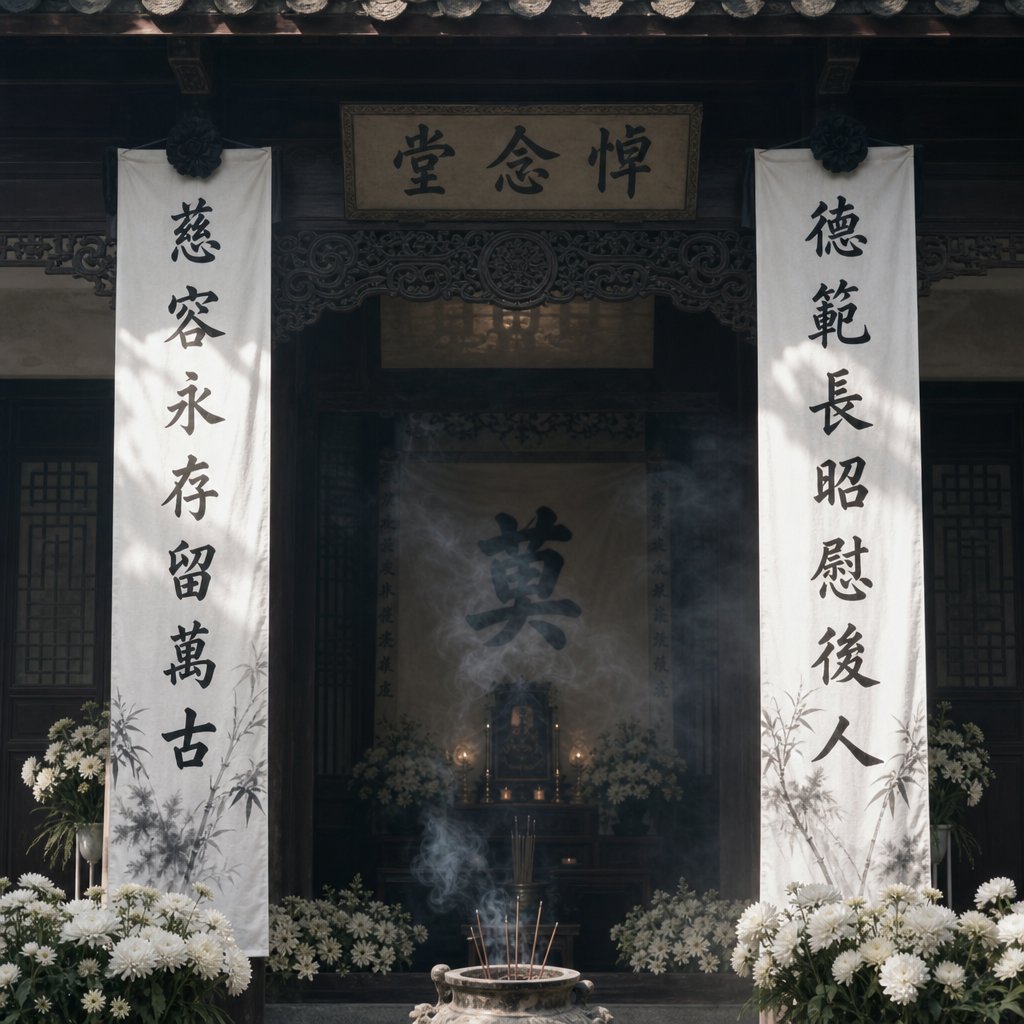
Funeral banners (挽联 wǎnlián) operate under different rules than spirit tablets. These paired vertical scrolls, hung at the wake or funeral hall, contain poetic couplets expressing grief and praise. The deceased's name may or may not appear on the banner itself, depending on regional custom.
When the name does appear on a wǎnlián, it follows specific placement rules. Traditional funeral banner conventions require vertical printing with correct character alignment, and traditional brush-style calligraphy is preferred over printed text. Common inscriptions include phrases like 永远怀念 (yongyuan huainian, "forever in our memory") and 深切哀悼 (shenqie aidao, "deepest condolences").
The distinction between wǎnlián and páiwèi is worth noting. On the spirit tablet, the name functions as a spiritual identifier. On the banner, it functions as a dedication. The banner's name tells visitors who is being mourned. The tablet's name tells the spirit where to reside. One faces outward toward the living; the other faces inward toward the dead.
The sender's name also appears on funeral banners and condolence cards, written smaller and positioned lower than the deceased's name. This hierarchy of placement reflects the chinese writing for death conventions: the dead occupy the highest position, literally and figuratively.
Modern Written Contexts Including Digital Obituaries
Digital communication has introduced complications that no Confucian scholar anticipated. Social media memorial posts, online obituaries, and group chat announcements all require writing the deceased's name in contexts where traditional calligraphic protocols cannot apply. A WeChat message does not have vertical alignment or brush-style characters. A chinese memorial page on a social platform cannot control who reads the name aloud.
Modern families navigate this tension in several ways. Some use only the surname plus a title in digital announcements, reserving the full name for the physical spirit tablet. Others include the full name in the digital obituary but frame it within formal language that signals respect, treating the online post as a modern extension of the funeral 中文 written tradition. Younger generations, as Sixth Tone reports, are increasingly open to reimagining farewell customs, with some families creating personalized chinese memorial tributes that blend traditional name conventions with contemporary formats like video montages and illustrated posts.
The underlying principle remains consistent across all formats: the deceased's name in writing is handled with deliberate care, never tossed off casually, always positioned with awareness of its spiritual weight. Whether carved into a wooden tablet or typed into a digital obituary, the name carries the same gravity it has carried for three thousand years.
Written conventions tell you how the name appears on objects. But there is another layer to how the deceased is referenced entirely: the practice of assigning new names after death, replacing the birth name with something that belongs solely to the spirit world.
Posthumous Names and How the Deceased Is Referenced
Death does not simply silence a name. In many Chinese funeral traditions, it replaces the name entirely. The deceased receives a new title, one that belongs exclusively to the spirit world, and this new designation becomes the primary way family members and monks reference them from that point forward. The birth name does not just become taboo. It becomes obsolete.
Posthumous Names and How the Deceased Is Renamed
The practice of posthumous naming (谥号 shìhào) dates back to the Western Zhou dynasty, when rulers and high officials received evaluative titles after death that summarized their character or achievements. A just ruler might receive the posthumous name 文 (wén, cultured). A cruel one might receive 厉 (lì, severe). These were not compliments or insults from the living. They were spiritual identifiers meant to fix the deceased's essence for eternity.
In non-Buddhist families, the deceased is referenced through a combination of kinship honorifics and formal titles rather than a newly assigned name. The prefix 先 (xiān, "late" or "former") attaches to the person's role: 先父 (xiān fù, late father), 先祖 (xiān zǔ, late ancestor). For formal ancestral rites, the deceased may be called by their generational title within the family lineage, a system that identifies them by position rather than personal name. The given name effectively disappears from active use, replaced by relational language that emphasizes the person's elevated status among the ancestors.
Buddhist Dharma Names Versus Non-Buddhist Honorifics
Buddhist funerals take the renaming principle further. The deceased receives a dharma name (法名 fǎmíng) that becomes their identity in the spiritual realm. According to Jodo Shinshu funeral tradition, the dharma name presentation ceremony (法名授与 Hōmyō Juyo) is a formal part of the funeral service. The name is given to all followers of the Buddha path, and while it is preferable to receive it while still alive, those who did not receive one before death undergo a special presentation ceremony during the funeral itself.
The structure of the dharma name carries meaning. In Jodo Shinshu practice, the name comprises three characters. The first character, 釈 (shì, from Shakamuni), indicates that the deceased now belongs to the family of the Buddha. The remaining two characters are drawn from scriptural sources, chosen to reflect the person's spiritual journey. This is not a nickname or a memorial label. It is a complete identity replacement. Once assigned, the dharma name becomes the primary way to reference the deceased during chanting, offerings, and ancestral rites.
Non-Buddhist families achieve a similar effect through different means. Daoist funerals may assign a spirit name used on the memorial tablet. Secular families rely on the combination of surname plus honorific title, ensuring the given name stays protected. The common thread across all traditions is the same: the birth name served the living person, and a new form of address serves the spirit.
How Name Taboos Shape the Naming of Descendants
The taboo does not end with the funeral. It reaches forward into future generations. When a grandparent or great-grandparent dies, the characters in their given name become permanently off-limits for naming newborns in the family. A child born after the death of a grandfather named 建国 (Jiànguó) would never receive either 建 or 国 in their own name. Using those characters would imply equality with the ancestor, a violation of the generational hierarchy that name avoidance exists to protect.
So why chinese add 3 years after death to the actual mourning period? The calculation follows a Confucian principle: a child is carried and nursed for three years before gaining independence, so three years of mourning repays that debt. During this chinese mourning period, the naming restrictions are at their strictest. No descendant born within those years would receive any character even phonetically similar to the deceased's name.
The 49 days after death chinese tradition marks another critical threshold. In Buddhist practice, the soul is believed to wander in an intermediate state (中阴 zhōngyīn) for up to 49 days before rebirth. During this window, the family performs merit-transfer rituals every seven days, and the deceased's birth name is considered especially sensitive. Speaking it could confuse or anchor the wandering spirit, preventing its passage. After the 49th day, the spirit is believed to have moved on, and some of the strictest spoken taboos begin to relax slightly.
Chinese funeral customs 100 days after death introduce another shift. The hundred-day mark (百日 bǎirì) traditionally signals the end of the most intense mourning restrictions. Some families resume using the deceased's surname in casual reference after this point, though the given name remains protected. The layered timeline, 49 days, 100 days, one year, three years, creates a graduated system where naming restrictions loosen in stages rather than disappearing all at once.
These timelines and naming rules are not uniform across all Chinese communities. Dialect groups, regional traditions, and the degree of religious observance all create variations in how strictly and how long these taboos are maintained.

Regional and Dialect Variations in Funeral Name Taboos
A Cantonese family in Hong Kong and a Hokkien family in Penang may both avoid speaking the deceased's name, but the specific words they sidestep, the duration of their restrictions, and the way they inscribe spirit tablets can look remarkably different. Chinese funeral name taboos are not a single monolithic system. They are a family of related practices shaped by dialect, geography, and the degree of contact with non-Chinese cultures.
Dialect-Specific Variations in Name Avoidance
Why do dialect differences matter so much? Because homophonic taboos depend entirely on how words sound, and Chinese dialects are essentially separate spoken languages. Cantonese operates with six to nine tones. Hokkien uses seven or eight. Mandarin has only four plus a neutral tone. More tones mean more distinct syllables, which means a different landscape of dangerous sound-alikes for each community.
Consider a deceased person whose name contains the character 发 (fa). In Mandarin, this sounds like 罚 (fa, punishment) and 乏 (fa, lacking), creating two avoidance triggers. In Cantonese, the same character is pronounced "faat," which overlaps with a different set of words entirely. A Hokkien speaker pronounces it "huat" or "hoat," generating yet another cluster of forbidden sounds. The same name, the same funeral, but three completely different sets of words that mourners must navigate depending on which dialect they speak at home.
Spirit tablet conventions also diverge. Research on Singaporean Chinese death rituals documents that funeral practices "differ according to dialect group and may incorporate elements from more than one dialect group." Cantonese families traditionally use more elaborate tablet inscriptions with generational poems embedded in the name. Hokkien families in Southeast Asia often include the ancestral village name on the tablet, tying the deceased's identity to a geographic origin rather than relying solely on the personal name. Hakka communities tend toward simpler inscriptions but maintain stricter spoken avoidance during the mourning period.
| Category | Cantonese | Hokkien | Mandarin |
|---|---|---|---|
| Primary taboo triggers | Six to nine tonal homophones create a wide net of forbidden sounds; strong avoidance of number-based homophones (e.g., 4 sounds like death) | Seven to eight tones plus nasal finals generate unique sound overlaps; ancestral village naming conventions add extra restricted characters | Four tones produce fewer homophones but broader character overlap; phonetic taboos are simpler but applied more uniformly |
| Mourning period naming rules | Strict avoidance for one year; relaxed after annual death anniversary (对年 deoi nin) | 49-day and 100-day markers observed closely; naming restrictions strongest during initial mourning | Three-year mourning framework from Confucian tradition; gradual relaxation after 100 days |
| Spirit tablet conventions | Elaborate inscriptions with generational poem characters; gold lettering on dark wood preferred | Ancestral village name included; tablets often housed in clan temples rather than home altars | Standard vertical format with formal titles; character count calculated for auspicious landing |
| Level of modern observance | Moderate to high in Hong Kong and Guangdong; younger generations observe core rules but simplify peripheral ones | High in Southeast Asian diaspora communities (Singapore, Malaysia, Philippines); clan associations reinforce traditions | Variable across mainland China; urban families observe less strictly than rural ones; Taiwan maintains stronger observance |
How Diaspora Communities Adapt Traditional Taboos
Sounds complex? It gets more layered when these dialect communities leave China. Southeast Asian Chinese communities, particularly in Singapore, Malaysia, and Indonesia, have maintained asian funeral customs with remarkable tenacity, partly because clan associations and dialect-group organizations actively preserve them. In Singapore, where Hokkien, Teochew, Cantonese, Hakka, and Hainanese communities coexist, funerals often blend practices from multiple dialect traditions, especially in families where intermarriage between dialect groups has occurred over generations.
The monetary condolence contribution illustrates this blending. It is called baijin (白金) in Mandarin, peh kim in Hokkien, and "white gold" in English, all referring to the same white envelope practice. But the name written on that envelope, and the conventions for how the deceased is referenced in the accompanying condolence note, may follow whichever dialect tradition the bereaved family identifies with most strongly.
In North America and Europe, adaptation takes a different form. Diaspora families often face a practical challenge: younger generations may not speak the ancestral dialect fluently enough to recognize homophonic taboos. A third-generation Chinese American attending a grandparent's funeral might speak only English and basic Mandarin, unaware that certain Cantonese or Toishanese syllables carry taboo weight. Families navigate this by simplifying the rules to their core principle: do not say the deceased's given name, use kinship terms instead, and follow the lead of the eldest family members present.
Taiwan and Mainland Differences in Modern Practice
Taiwan funeral traditions preserve name avoidance with notably more consistency than urban mainland China. The reasons are historical. Taiwan was not subject to the Cultural Revolution (1966-1976), which actively dismantled traditional mourning customs on the mainland as "feudal superstition." Taiwanese families maintained unbroken transmission of funeral rituals across generations, including the full system of spoken and written name taboos.
On the mainland, modern chinese funeral customs vary dramatically between rural and urban settings. Rural communities in Fujian, Guangdong, and Jiangxi provinces still observe elaborate name avoidance during mourning periods. Urban families in Beijing or Shanghai may limit their observance to the spirit tablet inscription and a general avoidance of the given name during the funeral itself, without extending the taboo into daily life afterward.
The generational divide matters too. Older Chinese adults, those who grew up before or during the early reform era, tend to observe naming taboos instinctively. Younger adults in their twenties and thirties often know the principle but may not practice it beyond the funeral day itself. What remains consistent across all these variations is the core rule: at the funeral, you do not casually speak the dead person's given name. Everything else, the duration, the scope of homophonic avoidance, the tablet conventions, flexes according to dialect, region, and generation.
Understanding these regional differences is useful context. But if you are a non-Chinese person preparing to attend a Chinese funeral, the practical question is simpler and more urgent: what exactly should you say, write, and avoid to show respect without accidentally causing offense?

Practical Guide for Non-Chinese Funeral Attendees
You have been invited to a Chinese funeral. You want to show respect. You are terrified of saying the wrong thing. That fear is actually a good sign. It means you already understand that language carries weight in this context. The good news is that the core rules are straightforward, and the family will appreciate your effort far more than they will judge minor missteps.
Here is what you need to know about the do's and don'ts after chinese funeral attendance, specifically around naming and language.
What to Say and What Never to Say at a Chinese Funeral
The single most important rule: do not say the deceased's given name. Use their surname plus a title ("Mr. Chen," "Auntie Wong") or follow whatever term the family uses. If you hear family members saying "Grandpa" or "Mom," mirror that language. If you are unsure what to call the deceased, listen first and speak second.
Beyond the name itself, avoid these words and phrases during the ceremony:
- Never say 死 (si, death) or use the English word "dead" bluntly. Say "passed away," "departed," or simply "gone." If speaking Mandarin, use 去世了 (qu shi le) or 走了 (zou le).
- Do not say the number four aloud if you can avoid it. It is homophonous with death in Mandarin and Cantonese. If handing over a monetary contribution, avoid amounts containing four (e.g., $40, $400).
- Never say 再 (zai, "again") in the context of the death or funeral. Phrases like "hope this never happens again" imply repetition of death within the family.
- Avoid saying "come back" or "return" (回来 hui lai) when speaking about the deceased. This can be interpreted as calling the spirit back from its journey.
- Do not ask the family to "cheer up" or suggest they "move on." The phrase 节哀顺变 (jie ai shun bian, "restrain grief and accept change") is appropriate. Telling someone to stop being sad is not.
- Never compliment the funeral arrangements with words like "beautiful" or "wonderful." A simple "everything is very respectful" or "the family has honored them well" is safer.
- Avoid discussing your own health, recent good fortune, or happy news. The funeral space belongs to grief, and introducing joy-related language is considered disrespectful.
When offering condolences in chinese tradition, keep your words brief and sincere. A simple "I am sorry for your loss" works in English. If you want to use Mandarin, 请节哀 (qing jie ai, "please accept my condolences") or 愿逝者安息 (yuan shizhe anxi, "may the departed rest in peace") are both safe and appropriate. Speak softly. Maintain a somber expression. Physical gestures like a slight bow or a gentle hand on the bereaved person's arm communicate more than elaborate speeches.
Writing Condolence Messages That Respect Name Taboos
Written condolences follow the same principle as spoken ones: reference the deceased by title, not given name. When writing a card or message, use "your father," "your grandmother," or "Uncle [surname]" rather than the person's full name. If you must include the name for clarity, such as in a formal letter, place it once at the beginning in a respectful framing and use titles for the remainder.
The chinese funeral envelope deserves special attention. In Chinese funeral customs, the white envelope (白金 baijin, literally "white gold") is how attendees offer monetary condolences to help the family with funeral expenses. What you write on this envelope matters. According to Singapore funeral etiquette guides, the envelope should be plain white with no decorations, and the writing on it follows specific conventions.
Here is what to write on chinese funeral envelopes:
- Write 奠仪 (dian yi, "funeral offering") or 帛金 (bo jin, "silk money") on the front center of the envelope if attending a Chinese funeral
- Write your own name on the back or lower portion of the envelope, smaller than any text on the front
- Do not write the deceased's name on the condolence envelope. The money is for the living family, not addressed to the dead
- Use a white or plain envelope only. Never use red envelopes (红包 hongbao), which are reserved for celebrations
- Avoid even amounts in some traditions. Odd numbers are preferred for funeral contributions in certain dialect groups, though this varies by community
The chinese funeral customs white envelope practice exists across all dialect groups, though the exact amount and presentation vary. A funeral white envelope is typically handed directly to a designated family member or placed in a collection box near the entrance of the wake. Do not present it with both hands and a smile as you would a gift. A slight bow and a quiet, brief expression of sympathy is the appropriate gesture.
For digital condolence messages sent via text or social media, the same naming rules apply. Do not type the deceased's given name casually in a group chat. Use their title or relationship to the bereaved. Keep the message short, sincere, and free of emojis or exclamation marks.
Navigating Cross-Cultural Mourning Situations
Cross-cultural marriages create a specific challenge. When one partner is Chinese and the other is not, the non-Chinese spouse may attend a funeral where they understand neither the language nor the unspoken rules. The best approach is preparation and humility.
Before the funeral, ask your partner or a trusted family member three questions: What should I call the deceased? Are there specific words I should avoid? What is expected of me during the ceremony? Most families will appreciate the asking. It shows awareness that these conventions exist and willingness to honor them.
During the ceremony itself, follow the lead of the family. If everyone bows, bow. If incense is offered, accept it and follow the motions of the person beside you. If you are unsure whether to speak, silence is always safe. No one has ever offended a mourning family by being too quiet.
One often-overlooked aspect of the do's and don'ts after chinese funeral ceremonies: many families observe a belief that funeral attendees carry residual spiritual energy. Some traditions hold that you should not visit friends or enter someone else's home directly after attending a funeral without first going to your own home, changing clothes, or stepping over a small fire or incense at your doorstep. As Memorial Funeral Services notes, respecting cultural taboos and traditional superstitions is part of showing sensitivity to the bereaved family's beliefs.
If a family member asks you not to visit for a few days after the funeral, do not take it personally. This is not rejection. It is an extension of the same protective logic that governs name avoidance: certain energies, including the energy carried by names and by proximity to death, must be handled with care to protect both the living and the dead.
The white envelope for chinese funeral attendance, the careful avoidance of the given name, the soft-spoken condolences: these are all expressions of the same underlying principle. You do not need to understand every philosophical layer to get it right. You just need to approach the moment with genuine respect and a willingness to follow rather than lead.
Honoring the Dead Through the Power of Names
Every rule covered in this article, from the phonetic minefields of spoken Cantonese to the calligraphic protocols on a spirit tablet, reduces to a single idea: a name is not just a label. It is a thread connecting the living to the dead, and pulling it carelessly unravels something sacred.
Core Principles to Remember About Name Avoidance
If you carry only three things away from this guide, let them be these:
- Never speak the deceased's given name at the funeral. Use kinship terms, titles, or honorifics instead.
- Avoid words that sound like death (死 si), the number four, or any syllable that echoes the deceased's name in the relevant dialect.
- In writing, follow the family's lead. The name appears on the spirit tablet under strict protocol, but it does not belong in casual messages, envelopes, or conversation.
These principles hold whether you are attending a traditional chinese funeral with burial rites or a chinese cremation funeral in a modern urban setting. The format of the ceremony changes. The respect encoded in language does not.
How Respecting Name Taboos Honors the Deceased
The dual purpose of these taboos is worth restating. They protect the living from spiritual disruption, yes. But more fundamentally, they honor the dead by acknowledging that death changes a person's status. The deceased is no longer your peer. They have joined the ancestors. Their name now belongs to a realm you address with reverence, not familiarity.
Name taboos are ultimately an expression of love and respect, not fear. They say: you mattered enough that even your name is treated as something precious.
In multicultural workplaces, mixed-heritage families, and increasingly global communities, understanding traditional chinese death rituals like name avoidance is no longer niche knowledge. It is basic cultural literacy. You do not need to memorize every regional variation or historical precedent. You need to grasp the principle: be careful with the names of the dead, and let the bereaved family guide you.
Chinese funeral rituals have survived dynastic collapses, political revolutions, and the shift from earth burial to chinese cremation funeral practices. The specific forms flex and adapt. Families simplify, diaspora communities blend traditions, younger generations negotiate between heritage and convenience. But the philosophical core, rooted in Confucian filial piety and the belief that language shapes spiritual reality, remains intact. Three thousand years of practice do not dissolve in a generation. They evolve, carrying forward the same quiet conviction: to name the dead with care is to love them well.
Frequently Asked Questions About Chinese Funeral Name Taboos
1. Why can't you say a dead person's name at a Chinese funeral?
In Chinese culture, death elevates a person to ancestral status. Speaking their given name implies casual familiarity that denies this spiritual transition. The practice stems from Confucian filial piety, where using the name is believed to disturb the spirit's journey and disrespect their new position among the ancestors. Mourners use kinship terms like 'Grandpa' or honorific titles like 'Mr. Wang' instead of the birth name throughout the funeral and mourning period.
2. What words are forbidden to say at a Chinese funeral?
Beyond the deceased's given name, mourners avoid the word 死 (si, death), the number four (which sounds like death in Mandarin and Cantonese), the word 再 (zai, again) in death-related contexts, and 回来 (hui lai, come back). Any word that shares a similar sound or tone with the deceased's name characters is also off-limits. Mourners substitute euphemisms like 走了 (zou le, gone), 去世了 (qu shi le, passed away), or 仙逝 (xian shi, departed like an immortal).
3. How long do Chinese funeral name taboos last after someone dies?
The duration varies by tradition and dialect group. The strictest avoidance applies during the first 49 days in Buddhist practice, when the spirit is believed to be in an intermediate state. Restrictions ease slightly after 100 days (百日 bairi), then again after one year. The full Confucian mourning period lasts three years, during which the given name remains protected. For naming descendants, the taboo on using the deceased's name characters can extend two to three generations permanently.
4. What should I write on a white envelope for a Chinese funeral?
Write 奠仪 (dian yi, funeral offering) or 帛金 (bo jin, silk money) on the front center of a plain white envelope. Place your own name on the back or lower portion in smaller text. Never write the deceased's name on the envelope, as the monetary contribution is directed to the living family. Avoid red envelopes entirely, as those are reserved for celebrations. The amount should avoid the number four, and some dialect groups prefer odd-numbered amounts.
5. Do Chinese funeral name taboos differ between Cantonese and Mandarin speakers?
Yes, significantly. Because homophonic taboos depend on pronunciation, different dialect systems create different sets of forbidden words. Cantonese has six to nine tones, generating more potential sound-alikes to avoid than Mandarin's four tones. Spirit tablet conventions also vary: Cantonese families prefer elaborate inscriptions with generational poems, while Hokkien families often include ancestral village names. The mourning period timeline and strictness of observance also differ, with Southeast Asian diaspora communities often maintaining stronger adherence than urban mainland Chinese families.