Why Chinese Business Names Demand Strategic Thinking
Imagine spending years building a brand only to discover that consumers in the world's second-largest economy have nicknamed your company something embarrassing. This is not hypothetical. Mercedes-Benz initially entered China under the name "Bensi," which translates roughly to "rush to die". Not exactly the image a car manufacturer wants to project. The company eventually corrected course with "Benchi" (run quickly), but the lesson is clear: choosing Chinese names for businesses is a strategic decision with real financial consequences, not a translation exercise you hand off to an intern with a dictionary.
Why Your Chinese Business Name Is a Strategic Asset
A Chinese business name functions differently from its English counterpart. Every character carries meaning, tone, and visual weight. When Chinese consumers encounter your brand, they don't just hear a sound. They read characters that tell a story, evoke emotions, and signal values. A name like Coca-Cola's "Kekoukele" (可口可乐) doesn't just sound similar to the original. It literally means "delicious happiness," reinforcing the brand's identity with every glance at the label.
This is why Chinese business names matter far beyond basic communication. A majority of Chinese consumers won't remember a brand name in English. Your Chinese name becomes the primary way hundreds of millions of people think about, search for, and recommend your company. It shapes first impressions, influences purchasing decisions, and determines whether your brand feels local or foreign.
If you don't proactively choose a Chinese name for your company, the market will choose one for you. And the market is rarely kind to brands that leave this decision to chance.
Chinese consumers routinely assign nicknames to brands that haven't claimed their own identity. BMW owners in China call the brand "Bie Mo Wo" (don't touch me), a playful riff on the initials. Luxury handbags, beauty products, and tech gadgets all receive consumer-generated nicknames based on packaging, function, or whatever association sticks first. Some brands eventually adopt these nicknames. Others spend years trying to override them.
Two Paths to a Chinese Business Name
If you're reading this, you likely fall into one of two camps. The first: you're a business preparing to enter Chinese-speaking markets and you need an actual Chinese-character name that works linguistically, culturally, and legally. The second: you're a Western entrepreneur looking for Chinese-inspired English names that convey qualities like prosperity, harmony, or innovation to a global audience.
Both paths require understanding how to choose a Chinese business name that resonates. But the considerations differ significantly. A Chinese-character name must navigate tonal pitfalls, character connotations, dialect variations, and trademark law. A Chinese-inspired English name draws on cultural symbolism without the same linguistic constraints.
This guide covers both. You'll find a Chinese brand naming strategy that walks through core naming approaches, cultural symbolism, legal registration structures, industry-specific conventions, digital platform compatibility, native speaker testing, and multi-market protection. Whether you need characters on a storefront in Shanghai or a culturally rich English name for a startup in San Francisco, the framework ahead will get you there without getting lost in translation.
Three Core Strategies for Chinese Business Naming
Every brand entering a Chinese-speaking market faces the same fundamental question: do you prioritize how your name sounds, what it means, or both? The answer shapes everything from consumer recall to emotional resonance. Understanding how to translate a brand name into Chinese starts with recognizing that you're not translating at all. You're creating a new linguistic identity built from characters that each carry their own weight.
Three distinct strategies have emerged over decades of international brands navigating this challenge. Each carries specific advantages and risks depending on your industry, brand recognition, and target demographic.
Phonetic Transliteration and When It Works
Phonetic transliteration selects Chinese characters primarily for their sound, aiming to approximate the pronunciation of the original brand name. The meaning of the individual characters takes a back seat to sonic similarity.
Consider Ferrari's Chinese name: 法拉利 (Fǎlālì). The characters were chosen because they sound close to "Ferrari" when spoken in Mandarin. However, the characters themselves don't carry a cohesive meaning that reinforces the brand's identity as a luxury automaker. Chinese consumers can recognize the connection to the original name, but the characters alone don't tell them anything about speed, prestige, or Italian craftsmanship.
This approach works best when a brand already has strong global recognition. If Chinese consumers have already encountered your name through international media, advertising, or word of mouth, a phonetic match helps them connect the Chinese characters to the brand they already know. Carlsberg uses 嘉士伯 (Jiāshìbó), which sounds similar to the original Danish name but carries no product-related meaning in Chinese.
The risk? A purely phonetic name can feel hollow to Chinese consumers. Without meaningful characters reinforcing your brand story, you're relying entirely on external marketing to build associations. Worse, some phonetic combinations can accidentally produce awkward or negative meanings. Coca-Cola's first attempt in 1927 used characters 蝌蝌啃蜡 (kē kē kěn là), which evoked images of tadpoles gnawing on wax. Sales were predictably dismal.
Semantic Adaptation for Meaning-First Names
Semantic adaptation takes the opposite approach. Instead of matching sounds, you create a Chinese name that conveys the essence, values, or product category of your brand through character meaning. The result often sounds nothing like the original name, but it communicates clearly to Chinese-speaking consumers.
Red Bull's Chinese name 红牛 (Hóngniú) is a straightforward literal translation: "red" plus "bull." Simple, direct, and instantly communicative. BMW uses 宝马 (Bǎomǎ), meaning "precious horse," which abandons any phonetic connection to the German initials but brilliantly evokes luxury, speed, and power through imagery that resonates deeply in Chinese culture, where horses symbolize success.
Semantic naming shines when your original brand name contains a translatable concept or when the meaning of your brand matters more than global name recognition. It's particularly effective for businesses entering China without existing brand awareness, because the name itself does marketing work from the first encounter.
The downside is the complete disconnect from your international identity. A consumer who knows your brand as "Red Bull" can still connect 红牛 through literal meaning. But more abstract semantic adaptations may leave no breadcrumb trail back to the original name, which complicates global brand consistency.
The Hybrid Approach That Combines Sound and Meaning
The hybrid strategy, often called phono-semantic matching, is widely considered the gold standard for Chinese business name transliteration examples. It selects characters that simultaneously approximate the original pronunciation and carry positive, brand-relevant meanings. You get sonic recognition and semantic depth in one package.
Coca-Cola's corrected name 可口可乐 (Kěkǒu Kělè) is the textbook case. "可口" means "delicious" or "tasty," while "可乐" means "can be happy." The full name sounds remarkably close to "Coca-Cola" while telling Chinese consumers that this product delivers deliciousness and joy. That's not translation. That's brand storytelling compressed into four characters.
IKEA achieved something similar with 宜家 (Yíjiā), meaning "suitable for home." The sound echoes "IKEA" while the meaning perfectly reflects the brand's core offering of home furnishings. Nike's 耐克 (Nàikè) combines characters meaning "endurance" and "to overcome," aligning with the brand's athletic identity while maintaining phonetic similarity.
Why does this strategy succeed so consistently? It works with how Chinese consumers actually process language. When you encounter 可口可乐, your brain registers both the familiar sound pattern and the positive meaning simultaneously. This dual encoding creates stronger memory traces and more favorable brand associations than either sound or meaning alone could achieve.
The challenge is that hybrid names are significantly harder to create. Finding characters that satisfy both phonetic and semantic requirements while avoiding tonal clashes, negative connotations in regional dialects, and trademark conflicts requires deep linguistic expertise. Not every brand name lends itself to this approach, particularly shorter names or those with sounds that don't map cleanly to Chinese phonology.
| Approach | Best Suited For | Advantages | Risks |
|---|---|---|---|
| Phonetic Transliteration | Globally recognized brands with strong existing awareness | Maintains sonic connection to original name; easy for bilingual consumers to identify | Characters may lack meaning or accidentally produce negative associations; harder to remember without brand context |
| Semantic Adaptation | Brands entering China without prior recognition; names with translatable concepts | Immediately communicates brand values; easy for Chinese consumers to remember and understand | No phonetic link to original name; may complicate global brand consistency |
| Hybrid (Phono-Semantic) | Brands seeking both recognition and cultural resonance; consumer-facing products | Dual encoding strengthens recall; reinforces brand identity through sound and meaning simultaneously | Difficult to execute well; requires expert linguistic knowledge; not all names have viable hybrid options |
Choosing between these strategies isn't purely a creative decision. It depends on your current brand awareness in Chinese-speaking markets, the phonetic structure of your original name, your industry context, and how much you're willing to invest in the naming process. A tech startup with zero China presence might benefit most from a meaning-rich semantic name that instantly communicates innovation. A luxury fashion house with global cachet might lean phonetic to preserve its international mystique.
The characters you choose also interact with tonal patterns in Mandarin. Names that flow through pleasant tonal sequences, avoiding consecutive falling tones or awkward tonal repetitions, feel more natural and memorable to native speakers. This is why brands like FILA chose 斐乐 (Fēi lè), where the character "斐" means "rich in literary grace" and "乐" means "joyful," creating both a pleasing tonal contour and culturally resonant meaning.
Regardless of which strategy you choose, the underlying principle remains constant: every character in a Chinese name is doing work. It carries sound, meaning, visual form, and cultural association all at once. The brands that succeed in Chinese markets treat naming as a creative act equal in importance to logo design or product development, not as an afterthought handled by machine translation.
Cultural Symbolism and Auspicious Elements in Chinese Naming
Every character carries cultural weight, but some carry centuries of accumulated symbolism that can make or break a brand's first impression. Chinese consumers don't just read a name. They feel it. The cultural meaning of Chinese name characters triggers associations rooted in philosophy, folklore, numerology, and collective memory. Understanding these layers is what separates a name that merely functions from one that resonates.
For Western entrepreneurs, this is the part of the naming process that no dictionary can teach you. Native speakers absorb these associations from childhood. You'll need to learn them explicitly.
Auspicious Characters and Lucky Numbers in Naming
Certain characters appear in Chinese company names with striking frequency, and it's not coincidence. These characters carry built-in positive associations that give a brand an immediate psychological advantage.
Lucky characters for Chinese business names tend to cluster around themes of prosperity, growth, and harmony:
- 福 (fu) - blessing, good fortune. One of the most universally positive characters in Chinese culture.
- 发 (fa) - to prosper, to generate wealth. Central to business naming because it directly signals financial success.
- 隆 (long) - prosperous, grand. Commonly found in traditional business names suggesting established success.
- 瑞 (rui) - auspicious, lucky omen. Conveys a sense of divine favor and good timing.
- 华 (hua) - magnificent, China itself. Adds grandeur and national pride.
- 盛 (sheng) - flourishing, abundant. Suggests a business at its peak.
- 嘉 (jia) - excellent, praiseworthy. Carries warmth and approval.
- 鑫 (xin) - three gold radicals stacked together. Visually and semantically screams prosperity.
Characters to avoid are equally important to recognize:
- 死 (si) - death. Obviously problematic, but also any character that sounds similar.
- 败 (bai) - defeat, failure. No business wants this association.
- 衰 (shuai) - decline, decay. Suggests a business past its prime.
- 苦 (ku) - bitter, suffering. Creates negative emotional associations.
- 散 (san) - to scatter, to break apart. Implies instability or dissolution.
Auspicious numbers in Chinese company names follow a similar logic. The number 8 (八, ba) is the most coveted because its pronunciation closely resembles 发 (fa), meaning "to prosper." Companies go to extraordinary lengths to incorporate 8 into phone numbers, addresses, and brand identities. The 2008 Beijing Olympics opening ceremony began at exactly 8:08 PM on 8/8/2008, illustrating just how deeply this association runs.
The number 6 (六, liu) signals smoothness and good fortune in business. It sounds similar to 流 (liu, "to flow") and 溜 (liu, "smooth"), suggesting operations that run without friction. The Chinese idiom 六六大顺 (liu liu da shun) literally means "double six, great smoothness," making it a favorite for business contexts.
The number 9 (九, jiu) represents longevity and enduring success because it sounds identical to 久 (jiu, "long-lasting"). For a business wanting to signal permanence and legacy, 9 carries powerful connotations.
Conversely, the number 4 (四, si) is widely avoided because it sounds nearly identical to 死 (si, "death"). Many buildings in China skip the 4th floor entirely, and businesses avoid phone numbers, addresses, and pricing that feature this number prominently. If your brand name contains characters that sound like "four" in any tonal variation, you'll want to test carefully for negative associations.
Tonal Harmony and How Sound Shapes Perception
Mandarin Chinese has four tones plus a neutral tone, and the tonal sequence of a name creates an auditory personality. Imagine hearing a name where every syllable drops sharply in the fourth tone. It sounds harsh, commanding, almost aggressive. Compare that to a name alternating between the gentle rise of the second tone and the level first tone. It feels calm, approachable, and balanced.
This isn't subjective. Chinese consumers process tonal patterns as emotional cues. A brand name with pleasant tonal flow is easier to remember, more enjoyable to say aloud, and more likely to be recommended to others. Names that feel awkward in the mouth get shortened, altered, or replaced by consumers who prefer something smoother.
Effective tonal patterns for business names typically follow a few principles:
- Avoid consecutive fourth tones (falling sharply), which can sound abrupt or aggressive
- Mix rising and level tones for a sense of optimism and stability
- End on a rising or level tone rather than a falling one, leaving a positive auditory impression
- Keep the name to two or three syllables for maximum memorability
Consider how Nike's 耐克 (Nai ke) moves from a fourth tone to a fourth tone. It works because the brand intentionally projects strength and determination. But for a wellness brand or children's product, that same tonal pattern would feel wrong. The tones need to match the emotional territory your brand occupies.
Feng Shui Principles Applied to Business Names
Feng shui business naming principles extend the concept of balance and energy flow from physical spaces into language itself. In traditional Chinese thought, everything, including words, carries elemental energy classified under the five elements: wood, fire, earth, metal, and water.
Each Chinese character is associated with one or more of these elements based on its radical, meaning, and stroke composition. A feng shui approach to naming seeks harmony between the elements present in the name and the nature of the business. A restaurant might benefit from fire and wood elements (cooking, growth), while a financial services firm might align with metal and earth (stability, value).
The number of strokes in a name also matters within this framework. Certain stroke counts are considered more auspicious than others, and practitioners analyze the total stroke count of a business name for its numerological implications. While this may seem esoteric to Western entrepreneurs, many Chinese business owners consult feng shui masters before finalizing a company name, particularly for family businesses and enterprises in traditional industries.
Even if you don't subscribe to feng shui philosophy personally, understanding that your Chinese customers and partners might gives you a practical edge. A name that aligns with these principles won't raise eyebrows. A name that violates them, even accidentally, might create subtle resistance among stakeholders who notice the imbalance.
The visual balance of characters matters too. Characters with roughly equal visual complexity look harmonious together on signage and packaging. Pairing a visually dense character like 鑫 (three gold radicals, 24 strokes) next to a simple character like 一 (one stroke) creates visual dissonance that feels unbalanced, regardless of the meaning.
All of these cultural layers, lucky characters, number symbolism, tonal flow, and elemental balance, operate simultaneously in the mind of a Chinese consumer. They don't consciously analyze each factor. They simply feel whether a name is "right" or "off." Your job is to stack as many of these invisible advantages in your favor as possible, so that when someone encounters your brand for the first time, the cultural current is already flowing in your direction.
Legal Structure and Registration Rules for Chinese Company Names
Cultural resonance and tonal harmony are only half the equation. A name that delights consumers but fails regulatory scrutiny never makes it onto a business license. The legal structure of Chinese business names follows a rigid formula mandated by the State Administration for Market Regulation (SAMR), and understanding this formula is essential before you invest time in creative brainstorming.
Here's the part that catches many foreign entrepreneurs off guard: your brand name and your legally registered company name in China are two separate things. You might market yourself as "BlueWave" to consumers, but the government requires a full Chinese-character name that follows a specific four-part structure. English names have no legal status in China. Every contract, invoice (fapiao), bank account, and company chop uses the registered Chinese name exclusively.
The Four-Part Structure of a Legal Chinese Company Name
Every company registered in China must follow this format:
Administrative Region + Trade Name + Industry Descriptor + Organizational Form
Think of it like a formula where each slot has specific rules. You choose the trade name. The other three components are dictated by where you register, what you do, and what type of entity you form.
| Component | What It Means | Example (Tech Company) | Example (Trading Company) | Example (Consulting Firm) |
|---|---|---|---|---|
| Administrative Region | City or province of registration | Shanghai (上海) | Shenzhen (深圳) | Beijing (北京) |
| Trade Name (字号) | Your unique brand identifier, 2-6 Chinese characters | ZhiSheng (智胜) | HuiTong (汇通) | RuiDe (瑞德) |
| Industry Descriptor | Standardized term matching your business scope | Technology (科技) | Trading (贸易) | Consulting (咨询) |
| Organizational Form | Legal entity type | Co., Ltd. (有限公司) | Co., Ltd. (有限公司) | Co., Ltd. (有限公司) |
So the full registered name for that tech company reads: 上海智胜科技有限公司 (Shanghai ZhiSheng Technology Co., Ltd.). Every piece must align. The administrative region must match your actual registered address. The industry descriptor must reflect your declared business scope. A mismatch between any component is one of the most common reasons for rejection during the Chinese business name approval process.
The trade name itself, the part where your brand identity lives, must be between 2 and 6 Chinese characters. Two-character combinations are heavily registered in major cities, so expect to test 5 to 10 candidates before finding one that's available in your target city and industry.
SAMR registers only the Chinese-character name. Your English brand name has no legal force in China. It won't appear on your business license, your company chops, or any official government documentation.
Restricted Characters and Naming Prohibitions
Chinese company name registration requirements include a long list of restrictions that go beyond simple trademark conflicts. SAMR will reject your name if it contains:
- Words implying government association or political authority
- Terms like "China," "National," or "International" without State Council or provincial SAMR approval
- Sector-specific terms like "Bank," "Insurance," or "Securities" without the corresponding financial license
- Superlatives such as "best," "top," or "No. 1"
- The word "Group" unless the company has multiple subsidiaries and meets minimum capital requirements
- Names identical or confusingly similar to existing registrations in the same city and industry
- Foreign characters, numbers, or letters as the trade name portion
Regional enforcement varies too. Shanghai tends to be stricter with creative or English-style names, while Shenzhen shows more flexibility with tech-related descriptors. Second-tier cities may allow broader naming creativity simply because fewer names are already registered there.
From Brand Name to Legal Registration
How to register a company name in China follows a structured sequence. You'll prepare 3 to 5 alternative names, submit them through the SAMR online portal, and receive feedback on availability. Once a name clears the structural check, it's reserved for six months while you complete the full business license application.
A critical distinction: SAMR's availability check is structural, not a trademark check. Your name can pass SAMR review and still infringe on someone else's registered trademark. This is where many foreign businesses get blindsided. You'll want to run a parallel search through the China National Intellectual Property Administration (CNIPA) trademark database to confirm your proposed trade name doesn't conflict with existing registrations in your industry classes.
The practical timeline looks like this: budget one week for the entire name-resolution phase. One to three days for brainstorming and running checks, then one to three days for SAMR to process the reservation. Prepare more candidates than you think you'll need. Common two-character combinations in popular industries like consulting, technology, and trading are saturated in first-tier cities. Having a deep bench of alternatives prevents delays when your first choice is already taken.
Keep in mind that your registered company name and your consumer-facing brand name can differ. Many international companies register a compliant four-part legal name for government purposes while marketing under a shorter, catchier brand name to consumers. The legal name satisfies regulators. The brand name wins customers. Both need to be protected, but they serve different functions in your China market strategy.

Industry-Specific Chinese Naming Conventions
A legally compliant name gets you registered. An industry-appropriate name gets you customers. The characters, tonal patterns, and symbolic associations that work brilliantly for a restaurant would feel completely wrong on a fintech app. Chinese business name ideas by industry vary because consumer expectations shift dramatically depending on what you're selling and who you're selling it to.
Industry context also determines which naming strategy, phonetic, semantic, or hybrid, delivers the strongest results. A food brand benefits from meaning-rich characters that evoke flavor and warmth. A tech startup might lean toward characters signaling speed and transformation. Understanding these conventions gives you a head start over competitors who treat naming as a one-size-fits-all exercise.
Naming Conventions for Food and Restaurant Businesses
Chinese restaurant name ideas and meanings tend to orbit a few core themes: taste, family, prosperity, and tradition. Diners want to feel that a restaurant is established, generous, and rooted in culinary heritage, even if it opened last month.
- Taste and abundance characters: 香 (xiang, fragrant), 鲜 (xian, fresh), 丰 (feng, abundant), 味 (wei, flavor). These immediately signal food quality.
- Family and warmth: 家 (jia, home/family), 园 (yuan, garden), 坊 (fang, workshop/studio). These create intimacy and trust.
- Prosperity and longevity: 福 (fu, blessing), 兴 (xing, thriving), 隆 (long, prosperous). Traditional restaurants lean heavily on these to suggest enduring success.
- Regional identity: Referencing a province, city, or geographic feature signals authenticity for cuisine-specific restaurants. Sichuan, Hunan, and Cantonese restaurants often embed regional markers directly in the name.
Semantic naming dominates this sector. Diners don't need your name to sound like an English word. They need it to make them hungry. Two to three characters that combine a flavor descriptor with a prosperity or family character create the classic formula you'll see on restaurant signs across every Chinese-speaking city.
Tech and E-Commerce Naming Patterns
If you're searching for a Chinese name for a tech startup, the character palette shifts entirely. Technology brands favor characters that evoke innovation, connectivity, intelligence, and forward motion.
- Intelligence and wisdom: 智 (zhi, wisdom/smart), 慧 (hui, intelligent), 思 (si, thought). These position a company as cerebral and cutting-edge.
- Speed and connectivity: 迅 (xun, swift), 通 (tong, connected/through), 达 (da, to reach/achieve). They suggest efficiency and reach.
- Innovation and creation: 创 (chuang, to create/innovate), 新 (xin, new), 启 (qi, to open/initiate). These signal disruption and fresh thinking.
- Mythological and classical references: Characters drawn from Chinese mythology convey ambition and cultural depth. Huawei's product names, including Kirin (麒麟), Kunpeng (鲲鹏), and Hongmeng (鸿蒙, HarmonyOS), draw from ancient texts like The Classic of Mountains and Seas and Zhuangzi to symbolize transformation and boundless potential.
This trend toward culturally rooted tech naming reflects growing confidence among Chinese companies. As one Beijing Foreign Studies University lecturer observed, Chinese tech names are "striding confidently to the center of the world stage," moving from foreign-sounding names toward identifiers that carry mythological resonance and national pride. For Western companies entering this space, the lesson is clear: tech naming in Chinese markets rewards ambition and cultural literacy, not just functional descriptors.
The best Chinese names for e-commerce brands specifically balance trust with accessibility. Characters like 优 (you, excellent/superior), 易 (yi, easy), and 惠 (hui, benefit/value) appear frequently because online shoppers need instant reassurance about quality and convenience. Pinduoduo (拼多多, "together, more, more") succeeds because it communicates the platform's group-buying model in three memorable syllables.
Professional Services and Import-Export Name Strategies
Professional services and trading companies operate in a different emotional register. Clients aren't looking for excitement or flavor. They want reliability, international scope, and established credibility.
- Trust and reliability: 信 (xin, trust/faith), 诚 (cheng, sincere/honest), 正 (zheng, upright/correct). These are foundational for consulting, legal, and financial firms.
- International reach: 环 (huan, global/ring), 洋 (yang, ocean/foreign), 远 (yuan, far-reaching). Import-export businesses use these to signal cross-border capability.
- Stability and strength: 恒 (heng, permanent/constant), 坚 (jian, solid/firm), 基 (ji, foundation). These reassure clients that the firm won't disappear overnight.
- Excellence and leadership: 卓 (zhuo, outstanding), 领 (ling, to lead), 冠 (guan, champion/crown). Consulting firms use these to position themselves as industry leaders.
Hybrid naming works well here because professional services firms often need bilingual clients to recognize the connection between their English and Chinese identities. A consulting firm called "Vertex" might choose 维泰 (Wei Tai), where the sound echoes the original while the characters suggest "to maintain" and "peace/prosperity."
Wellness and beauty brands occupy yet another niche, gravitating toward natural elements and harmony. Characters like 美 (mei, beautiful), 雅 (ya, elegant), 兰 (lan, orchid), 清 (qing, pure/clear), and 泉 (quan, spring water) dominate this space. The naming convention mirrors the product promise: gentle, natural, and restorative.
Across every industry, the pattern holds: your character choices must match the emotional expectations consumers bring to your category. A restaurant named with tech characters feels cold. A tech company named with food characters feels unserious. The conventions exist because they work, and deviating from them requires a very deliberate reason backed by strong brand positioning.
Of course, choosing the right characters for your industry is only part of the challenge. Those characters also need to perform in digital environments where consumers actually discover, search for, and share brand names today.
Digital Presence and Platform Compatibility for Chinese Names
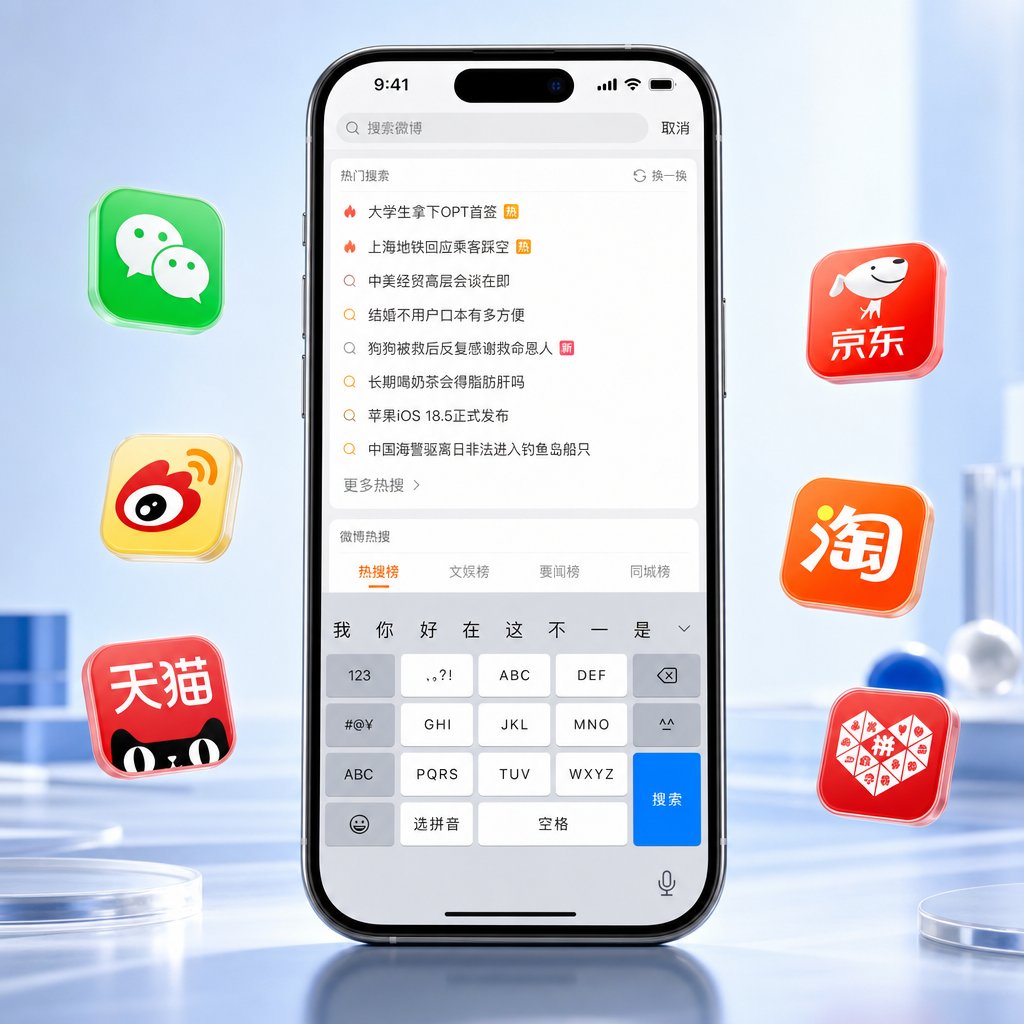
A name that looks elegant on a business card can fall apart the moment someone tries to type it into a search bar. Chinese consumers discover brands through digital platforms first, whether that's scrolling Xiaohongshu for product reviews, searching Tmall for purchases, or scanning a WeChat QR code. Your digital naming strategy for Chinese markets needs to account for how people actually input, search, and share names on screens, not just how they look on paper.
Input methods are the invisible gatekeeper here. Most Chinese users type using pinyin (romanized spelling) on their phones, then select the correct characters from a dropdown list. If your brand name uses uncommon characters, rare character combinations, or characters that share pinyin with dozens of other options, you're creating friction at the most basic level of digital interaction. Every extra tap to find the right character is a moment where a potential customer might give up or misspell your name.
Chinese Social Media Handle Considerations
When choosing a Chinese business name for social media, you're dealing with platform-specific constraints that go beyond character meaning and tone. WeChat Official Accounts, Weibo handles, and Xiaohongshu profiles each have their own naming rules and search behaviors.
WeChat Official Accounts allow Chinese characters, English letters, and numbers in the account name, but once registered, the name is extremely difficult to change. Weibo permits more flexibility with display names but penalizes accounts that change names frequently by reducing search visibility. Xiaohongshu prioritizes keyword-rich names in its discovery algorithm, meaning a name that includes your product category or key benefit will surface more easily in user searches.
The practical implication? Your Chinese name needs to be easy to type via pinyin input, distinctive enough to avoid confusion with other accounts, and ideally contain at least one character related to your industry or offering. A beauty brand with 美 (mei, beautiful) or 肌 (ji, skin) in its name gains a slight algorithmic advantage on platforms where users search by product category.
Also consider how your name appears when shared in chat. WeChat users constantly forward brand content to friends and group chats. A name that's too long, visually cluttered, or hard to remember won't get typed out in recommendations. Two to four characters is the sweet spot for shareability.
Domain Names and E-Commerce Platform Searchability
Chinese brand name domain availability operates on two parallel tracks: pinyin domains (.cn, .com) and platform store names on marketplaces like Taobao and Tmall.
For web domains, most Chinese brands secure the pinyin spelling of their name as a .cn or .com domain. If your brand name is 智云 (ZhiYun), you'd want zhiyun.cn or zhiyun.com. The problem? Common pinyin combinations are heavily registered. Two-syllable pinyin domains in .com are nearly exhausted, pushing brands toward longer combinations, hyphens, or alternative extensions like .com.cn and .net.
On e-commerce platforms, how Chinese names work on WeChat and Tmall depends on search algorithm behavior. Tmall Global caters to quality-focused consumers searching for authentic international brands, while Taobao's open marketplace attracts price-sensitive shoppers browsing by product category. On both platforms, your store name and product listings are indexed by Chinese characters, pinyin, and associated keywords. A name with characters that double as common search terms for your product category gives you organic visibility without additional advertising spend.
Imagine a skincare brand named 清泉 (QingQuan, "clear spring"). Consumers searching for 清洁 (cleansing) or 泉水 (spring water) skincare might see your brand surface in related results. This isn't guaranteed, but character overlap with high-volume search terms creates opportunities that a purely phonetic transliteration would miss entirely.
Cross-Border Digital Commerce and Name Consistency
Cross-border sellers face an additional layer of complexity: maintaining name recognition across platforms that serve different markets simultaneously. Your English brand name appears on your international website and Amazon listings. Your Chinese name appears on Tmall Global and WeChat. Consumers who encounter both need to connect them as the same brand.
This is where hybrid naming strategies pay dividends digitally. A name that sounds similar to your English brand while carrying Chinese meaning gives bilingual consumers an instant bridge between your international and Chinese identities. When a customer sees your English name on Instagram and your Chinese name on Xiaohongshu, the phonetic echo helps them recognize it's the same company.
Platform-specific requirements also affect consistency. Tmall Global requires overseas brands to have a registered foreign trademark and formal brand authorization, meaning your Chinese store name must align with your trademark registration. If you've trademarked one Chinese name but want to use a different variation on social media, you'll create confusion in both consumer perception and legal protection.
Before finalizing any Chinese business name, run it through a digital validation checklist that tests real-world platform performance:
- Pinyin input test: Type the pinyin on a smartphone and check how many taps it takes to produce the correct characters. If your name requires scrolling through multiple candidate lists, it's too hard to type.
- Platform search test: Search the name on WeChat, Weibo, Xiaohongshu, Taobao, and Tmall. Check what existing results appear and whether your name would get buried under unrelated content.
- Domain availability check: Verify pinyin domain availability across .cn, .com, and .com.cn extensions before committing to a name.
- Social handle availability: Confirm the name (or a close variation) is available as a WeChat Official Account, Weibo handle, and Xiaohongshu profile name.
- Character confusion test: Identify whether any characters in your name are commonly confused with visually similar characters (e.g., 己/已/巳 or 未/末). Mistyped searches should still lead to your brand.
- Voice search compatibility: Say the name aloud and check whether voice-to-text accurately produces the correct characters. Voice search usage is growing rapidly on Chinese platforms.
- Cross-platform consistency audit: Ensure the same name works across all target platforms without requiring different variations that fragment your brand identity.
Skipping this digital validation is one of the most expensive mistakes brands make. A name that passes cultural and legal checks but fails the pinyin input test on a smartphone creates daily friction for every consumer trying to find you, recommend you, or purchase from you online.
Digital validation confirms that your name works in the environments where consumers actually interact with it. But even a digitally optimized name can harbor hidden problems that only surface when real people, native speakers with diverse backgrounds and dialect exposure, say it aloud and react to it instinctively.
Testing Your Chinese Business Name With Native Speakers
You've selected characters with auspicious meaning, verified legal compliance, confirmed digital platform compatibility, and feel confident about your shortlist. Here's the uncomfortable truth: none of that guarantees your name will land the way you intend. The only reliable way to know how a Chinese business name actually performs is to put it in front of native speakers and watch their reactions. Not read their survey responses. Watch their faces.
Chinese name validation with native speakers isn't optional polish. It's where hidden problems surface, the kind that no amount of dictionary research or cultural reading can predict. A character that looks perfect on paper might trigger an obscure regional slang association. A tonal combination that seems smooth in isolation might remind listeners of a well-known idiom with unfortunate implications. These are the landmines that only real people can help you find.
Step-by-Step Native Speaker Testing Process
Knowing how to test a Chinese business name effectively requires structure. Random opinions from a few friends won't cut it. You need a systematic approach that captures diverse reactions across demographics, dialects, and contexts.
- Prepare 3 to 5 finalist names. Don't test a single candidate in isolation. Presenting multiple options gives testers a basis for comparison and reveals relative strengths you'd miss with a single-name evaluation.
- Recruit testers across key demographics. Aim for a minimum of 15 to 20 native speakers spanning different age groups (18-30, 31-50, 51+), genders, education levels, and regional backgrounds. Include both Mandarin and Cantonese speakers if your target market extends beyond Mainland China.
- Present names without context first. Show or say each name without explaining your brand, product, or the meaning you intended. Record first impressions. What do they think the company does? What feelings does the name evoke? What associations come to mind immediately?
- Test pronunciation and recall. Say each name aloud once, then ask testers to repeat it back after a short distraction task. Names that get garbled, forgotten, or confused with other words have a memorability problem.
- Reveal brand context and re-evaluate. Explain what your company actually does, then ask testers to reassess each name. Does the name feel fitting now? Does it enhance or contradict the brand's identity?
- Probe for negative associations. Ask directly: does this name remind you of anything unpleasant, funny, or inappropriate? Does it sound like any slang, insult, or awkward phrase in your dialect?
- Conduct a final preference vote. Ask each tester to rank the names and explain their top choice. Look for consensus patterns, but also pay close attention to strong negative reactions from even a small minority.
Where do you find qualified testers? University language departments, cultural associations, and Chinese community organizations in major cities are good starting points. Online platforms like Wenjuanxing (China's equivalent of SurveyMonkey) allow you to distribute surveys to targeted demographics within China. For higher-stakes naming decisions, professional agencies conduct structured focus groups with recruited participants matching your exact customer profile.
How many opinions constitute adequate validation? For consumer brands targeting broad audiences, 20 to 30 testers across at least three demographic segments provides a reliable signal. For niche B2B services with a narrow target market, 10 to 15 well-matched testers may suffice. The key isn't raw numbers but demographic diversity. Five opinions from Shanghai professionals in their 30s tell you nothing about how retirees in Guangzhou or students in Chengdu will react.
What to Listen for During Name Validation
The most valuable feedback often isn't what testers say directly. It's the hesitation before they respond, the slight wince, or the laugh they try to suppress. When running your Chinese business name focus group process, train yourself to notice these signals:
- Unintended meanings: Characters combine in ways that create secondary readings. A name might technically mean "bright achievement" but sound like a phrase for "obvious failure" when spoken quickly. Testers will catch these overlaps instinctively.
- Dialect variations: A name that sounds elegant in standard Mandarin might be comical or negative in Cantonese, Shanghainese, or Hokkien. If your market includes Hong Kong, Guangdong, or Southeast Asian Chinese communities, dialect testing is non-negotiable.
- Tonal confusion: When spoken at conversational speed, some tonal combinations blur together or get misheard as different characters entirely. If multiple testers mishear the same syllable, that's a structural problem with the name.
- Cultural and generational associations: Older testers might associate certain characters with historical events or classical literature that younger consumers have never encountered. Younger testers might catch internet slang connections that older participants miss. Both perspectives matter.
- Effort to explain: If testers need the name explained before they appreciate it, you have a problem. Nanjing Marketing Group found this firsthand when conducting focus groups for a European furniture brand. Names with clever linguistic wordplay fell flat because even highly-educated participants couldn't pick up on the subtle references without explanation. First impressions proved far more important than hidden depth.
Common Pitfalls Revealed Only Through Testing
Some of the most common Chinese naming mistakes to avoid only become visible when real people interact with your candidates. These patterns emerge repeatedly across naming projects:
The "clever" name nobody gets. Brands often fall in love with names containing layered cultural references or sophisticated character pairings. The problem? If your target audience doesn't immediately grasp the meaning, the cleverness works against you. That same furniture brand focus group revealed that participants overwhelmingly preferred names that were elegant but easy to follow without prior knowledge of the brand. Subtlety lost to clarity every time.
The character with a hidden negative shade. Individual characters carry connotations that dictionaries don't fully capture. The character 末 (mo) can mean "tip" or "end," but focus group participants associated it with reaching the end of the road, a sense of finality that felt discouraging for a brand name. The team liked the character's visual elegance, but consumer perception overruled internal preference.
The name that misaligns with product priorities. Testing reveals not just whether people like a name, but whether it matches what they actually value about your product. In the furniture example, participants cared more about material quality than design craftsmanship. Names emphasizing artistry (using characters like 艺, meaning "art") felt less fitting than names highlighting premium materials like oak (橡) or teak (柚). Your name should reflect what customers care about, not what you assume they care about.
The name that sounds fine in isolation but fails in context. Say your brand name in a sentence: "I bought this from [name]" or "Have you heard of [name]?" Some names that sound acceptable alone become awkward or ambiguous when embedded in natural speech. Testing in conversational context catches these issues.
The investment in proper testing is minimal compared to the cost of rebranding after launch. A few weeks of structured feedback gathering can save years of consumer confusion, lost search traffic, and brand equity dilution. Even agencies with predominantly Chinese-speaking teams find focus groups indispensable for confirming assumptions and surfacing blind spots that internal teams develop through familiarity.
Validation confirms your name works with real people in your target market. The next challenge is ensuring that name remains exclusively yours across every Chinese-speaking market where you plan to operate.
Protecting Your Name Across Chinese-Speaking Markets
A validated name that resonates with native speakers is only as valuable as the legal protection behind it. Here's a reality that trips up many foreign brands: China operates on a 'first-to-file' system for trademarks. The first entity to register a name owns it, regardless of who used it first internationally. This means someone else can register your Chinese brand name before you do, then charge you to buy it back or block you from using it entirely. This practice, known as trademark squatting, has cost foreign companies millions.
The urgency compounds when you realize that Chinese-speaking markets don't share a single registration system. Mainland China, Taiwan, Hong Kong, and Singapore each maintain independent trademark offices with separate databases, different governing laws, and distinct filing requirements. Registering in one market gives you zero protection in the others. A multi-market Chinese name protection strategy requires filing in each jurisdiction independently or leveraging international treaty systems to cover multiple territories.
Registration Differences Across Chinese-Speaking Markets
Each market has its own governing body, preferred character system, and procedural quirks. If you plan to protect your brand name in China, Taiwan, and Hong Kong simultaneously, you'll need to navigate four distinct bureaucracies.
| Market | Governing Body | Character System | Key Requirements |
|---|---|---|---|
| Mainland China | China National Intellectual Property Administration (CNIPA) | Simplified Chinese | First-to-file priority; Chinese-character applicant name required; classes and subclasses system; 3-6 month processing; 10-year validity |
| Taiwan | Taiwan Intellectual Property Office (TIPO) | Traditional Chinese | First-to-file with use requirements; examination takes 6-8 months; 10-year validity with renewal |
| Hong Kong | Intellectual Property Department (IPD) | Traditional Chinese | Separate system from Mainland China; accepts English and Chinese marks; 6-month processing typical; 10-year validity |
| Singapore | Intellectual Property Office of Singapore (IPOS) | Simplified Chinese | Accepts Chinese-character marks; examination in 6-9 months; 10-year validity; multi-class applications allowed |
Notice the character system column. Mainland China and Singapore use simplified characters. Taiwan and Hong Kong use traditional characters. This isn't just a formatting difference. It affects your Chinese business name trademark registration directly because a trademark filed in simplified characters in Beijing doesn't automatically protect the traditional-character equivalent in Taipei.
Trademark Protection vs Company Name Registration
One of the most dangerous misconceptions foreign businesses carry into China: they assume that registering a company name with SAMR (the market regulation authority) also protects that name as a trademark. It doesn't. These are entirely separate processes governed by different agencies with different databases.
Company name registration through SAMR gives you the right to use that name as your legal entity identifier in a specific city and industry. Trademark registration through CNIPA gives you exclusive rights to use that name commercially across China within specific goods or services classes. You need both. A competitor in a different city could register an identical company name in the same industry without infringing your SAMR registration. But if you hold the trademark, you can challenge their use of that name in commerce nationwide.
The reverse is also true. Your trademark registration doesn't prevent someone from incorporating a company with a similar name in a different administrative region. The two systems operate in parallel, and gaps between them create vulnerabilities that sophisticated competitors exploit.
Register your Chinese trademark before announcing your market entry. In a first-to-file system, the window between public awareness of your brand and your filing date is when squatters strike.
Simplified and Traditional Character Adaptations
When your brand operates across both simplified and traditional Chinese markets, you face a decision: use the same characters (where possible) or create adapted versions for each system. Many characters have direct simplified-to-traditional equivalents. 华 (simplified) becomes 華 (traditional). 国 becomes 國. These conversions are straightforward and maintain brand consistency.
The complication arises when a simplified character maps to multiple traditional characters, or when the visual aesthetics shift dramatically between systems. A name that looks balanced and elegant in simplified characters might appear overly complex or visually heavy in traditional form. Some brands choose slightly different character combinations for traditional markets to preserve the visual harmony and meaning that made the simplified version effective.
Regardless of which approach you take, register both versions as trademarks in their respective markets. A simplified-character registration in Mainland China won't protect you against someone filing the traditional-character version in Taiwan. File the traditional version in Hong Kong and Taiwan. File the simplified version in Mainland China and Singapore. If budget allows, file both versions in all markets for maximum coverage.
Timing matters enormously. The recommended sequence is to file in Mainland China first, since it's the largest market and the most active for trademark squatting, then file in Taiwan and Hong Kong within the six-month priority window available under the Paris Convention. This priority claim lets you use your Mainland China filing date as the effective date in subsequent jurisdictions, blocking anyone who might try to file between your first and second applications.
Brands can also extend protection through the Madrid System, an international treaty that allows a single application to cover multiple member countries. China, Singapore, and many other jurisdictions participate. Taiwan does not, requiring a direct national filing. Hong Kong also requires a separate direct application despite being part of China politically.
Once registered, trademarks in these markets are valid for 10 years and renewable indefinitely. However, a critical maintenance requirement applies: if a trademark goes unused for three consecutive years in China, third parties can apply to cancel it. Register with the intent to use, and document your commercial activity to defend against cancellation challenges down the road.
Protection is the final structural layer that transforms a creative naming decision into a durable business asset. With legal coverage secured across your target markets, the remaining question is how to pull the entire process together, from initial brainstorm through cultural validation to confident final selection, into a repeatable framework you can execute with clarity.
Your Step-by-Step Chinese Business Naming Process
You've absorbed the cultural layers, legal structures, digital requirements, testing protocols, and protection strategies. The question now is practical: how do you actually move from a blank page to a finalized Chinese business name you're confident in? The answer is a structured framework that prevents you from getting stuck in endless brainstorming or, worse, rushing to a decision you'll regret once real consumers encounter it.
The step-by-step Chinese business naming process below synthesizes everything covered in this guide into a repeatable sequence. Whether you're a solo founder working with limited resources or a multinational with a dedicated branding team, this framework scales to fit your situation.
A Practical Framework From Brainstorm to Final Name
Think of this as your roadmap. Each stage builds on the previous one, and skipping steps creates gaps that surface later as expensive problems.
- Define your naming intent. Before generating a single character, clarify what your name needs to accomplish. Are you prioritizing phonetic recognition for an established global brand? Communicating product benefits to first-time Chinese consumers? Signaling industry credibility to B2B buyers? Your intent determines which naming strategy (phonetic, semantic, or hybrid) serves you best.
- Audit your original name's phonetic profile. Map your English brand name's syllables to Mandarin phonology. Identify which sounds translate cleanly and which create tonal problems or negative homophones. This audit tells you immediately whether a hybrid approach is feasible or whether you'll need to lean fully semantic.
- Generate a broad candidate list (30-50 options). Cast a wide net using multiple brainstorming methods (covered below). Don't self-edit at this stage. Quantity matters more than quality in early ideation because unexpected combinations often outperform the "obvious" choices.
- Apply cultural and linguistic filters. Screen every candidate against the criteria from earlier chapters: auspicious character associations, tonal harmony, stroke balance, number symbolism, and industry conventions. Eliminate names with negative connotations, awkward tonal sequences, or characters that clash with your sector's expectations. This typically cuts your list to 8-12 survivors.
- Run legal and digital checks. Search CNIPA's trademark database, check SAMR availability in your target registration city, verify pinyin domain availability, and confirm social media handle accessibility. Legal and digital conflicts eliminate another 30-50% of candidates, leaving you with 4-6 viable options.
- Conduct native speaker testing. Put your shortlist through the structured testing process with 15-20 diverse native speakers. Gather first impressions, pronunciation recall, dialect checks, and negative association probes. Testing typically reveals a clear top 2-3 performers.
- Make your final selection and file immediately. Choose your winner based on testing consensus, file trademark applications in your priority markets within days, and register the company name through SAMR. Speed matters in a first-to-file system.
The entire process, from intent definition through filing, typically takes 4-8 weeks when executed with focus. Rushing it below three weeks risks skipping validation steps. Stretching it beyond three months risks losing name availability to other filers.
Tools and Resources for Generating Name Ideas
Stage three, generating that initial broad list, is where most people get stuck. You're staring at thousands of possible characters and have no idea where to start. Several approaches can break the logjam, and the best results come from combining multiple methods rather than relying on any single one.
Chinese company name generator tools provide a useful starting point for ideation. Online generators like Good Characters and various AI-powered naming platforms let you input parameters (industry, desired meaning, phonetic targets) and receive character combinations to evaluate. These tools won't hand you a finished name, but they surface character pairings you might never have considered. Treat generator output as raw material for refinement, not as final candidates.
Character dictionaries organized by radical and meaning allow you to browse systematically. If you know you want characters related to water (for a beverage brand) or metal (for a financial firm), you can explore every character sharing that radical and evaluate combinations methodically. The Xinhua Dictionary and online resources like MDBG Chinese Dictionary organize characters in ways that support creative exploration.
Competitor name analysis reveals which characters and patterns dominate your industry. Search your product category on Tmall or Taobao and catalog the Chinese names of the top 20 brands. You'll quickly see recurring characters and structural patterns. Your goal isn't to copy these but to understand the conventions you're either aligning with or deliberately breaking.
Classical Chinese literature and idioms (chengyu) offer a rich source of culturally resonant character pairings. Four-character idioms carry built-in positive associations that Chinese consumers recognize instantly. Drawing two characters from a well-known idiom gives your name depth and cultural credibility without requiring explanation.
The critical distinction here is between generating ideas and refining them. Generation is divergent: you want volume, variety, and surprise. Refinement is convergent: you apply filters, test rigorously, and narrow ruthlessly. Mixing these two modes, editing while brainstorming, kills creativity. Keep them separate.
Making Your Final Decision With Confidence
When you're down to your final 2-3 candidates and testing data supports multiple options, a decision matrix helps you choose based on strategic priorities rather than gut feeling alone. Score each finalist across these dimensions, weighting them according to your specific business goals:
| Decision Factor | Weight for Global Brand | Weight for China-Only Brand | Weight for Budget-Conscious Startup |
|---|---|---|---|
| Phonetic similarity to original name | High | Low | Medium |
| Semantic clarity and positive meaning | Medium | High | High |
| Memorability in testing | High | High | High |
| Trademark availability across markets | High | Medium | Low (single market) |
| Digital platform performance | Medium | High | High |
| Industry convention alignment | Medium | High | Medium |
| Dialect safety (no negative associations) | High | High | Medium |
Should you handle this process yourself or hire a professional? The honest answer depends on your stakes and resources. A Chinese naming consultant vs DIY naming comparison comes down to risk tolerance. If you're launching a consumer product into a competitive category where brand perception directly drives revenue, professional naming services from firms with native Chinese linguists, cultural researchers, and trademark attorneys pay for themselves many times over. Expect to invest $3,000-$15,000 for a comprehensive naming engagement from a reputable agency.
If you're a small business testing the waters with a limited China presence, or choosing a Chinese-inspired English name for a Western audience, a DIY approach using the framework above can produce strong results, provided you still invest in native speaker testing. The testing step is the one you cannot skip regardless of budget. Everything else can be self-directed with sufficient research. Testing requires outside perspectives you simply cannot replicate internally.
The best Chinese business names balance creativity with cultural respect. Push boundaries in how characters combine, but never in what those characters mean to the people who read them daily.
How to brainstorm Chinese brand names effectively comes back to one principle: respect the weight that every character carries. In English, brand names can be invented nonsense syllables (Kodak, Xerox, Häagen-Dazs). In Chinese, every character has existed for centuries with accumulated meaning, cultural context, and emotional resonance. You're not inventing from nothing. You're selecting from a living system of symbols that your audience already has deep relationships with.
That constraint is also your greatest advantage. When you choose well, your name arrives pre-loaded with positive associations, cultural credibility, and emotional warmth that no amount of advertising could manufacture from scratch. The framework above ensures you find that name systematically rather than stumbling onto it by luck, and that once found, it's protected, validated, and ready to represent your brand across every market and platform where Chinese-speaking consumers will encounter it.
Frequently Asked Questions About Chinese Names for Businesses
1. What are the three main strategies for creating a Chinese business name?
The three core strategies are phonetic transliteration (matching the sound of your original name using Chinese characters), semantic adaptation (creating a meaning-based name that conveys your brand values regardless of sound), and the hybrid phono-semantic approach (selecting characters that approximate your original pronunciation while carrying positive, brand-relevant meanings). The hybrid method is widely considered the gold standard because it creates dual encoding in consumers' minds, strengthening both recognition and emotional association simultaneously. Your choice depends on existing brand awareness in Chinese markets, your name's phonetic compatibility with Mandarin, and your industry context.
2. How do I legally register a company name in China?
Chinese company names must follow a mandatory four-part structure: Administrative Region + Trade Name + Industry Descriptor + Organizational Form. You submit 3 to 5 alternative names through the SAMR online portal, which checks structural compliance and availability within your registration city and industry. The trade name portion must be 2 to 6 Chinese characters with no English letters or numbers. Importantly, SAMR registration is separate from trademark registration through CNIPA. You need both to fully protect your name, as company name registration only covers your specific city and industry while trademark registration provides nationwide commercial protection.
3. Which Chinese characters are considered lucky for business names?
Characters frequently used in Chinese business names carry built-in positive associations rooted in centuries of cultural symbolism. Top choices include 福 (fu, blessing), 发 (fa, to prosper), 隆 (long, grand prosperity), 瑞 (rui, auspicious omen), 华 (hua, magnificent), 盛 (sheng, flourishing), 嘉 (jia, excellent), and 鑫 (xin, triple gold meaning extreme wealth). Numbers also matter: 8 is highly coveted because it sounds like 'prosper,' 6 signals smooth operations, and 9 represents longevity. Avoid characters associated with death (死), failure (败), decline (衰), and the number 4, which sounds like 'death' in Mandarin.
4. Why is native speaker testing essential before finalizing a Chinese brand name?
Native speaker testing reveals problems that no amount of dictionary research can predict. Characters may trigger obscure regional slang associations, tonal combinations might echo unfortunate idioms, or a name that works in Mandarin could sound negative in Cantonese or Hokkien. Testing with 15 to 20 diverse speakers across age groups, dialects, and regions surfaces these hidden issues. Focus groups consistently show that names requiring explanation underperform names with immediate clarity, and that consumer priorities often differ from what brand teams assume. The investment of a few weeks in structured testing prevents years of consumer confusion after launch.
5. Do I need to register my Chinese business name as a trademark in multiple markets?
Yes, if you plan to operate across Chinese-speaking regions. Mainland China, Taiwan, Hong Kong, and Singapore each maintain independent trademark offices with separate databases and different character systems. China and Singapore use simplified characters while Taiwan and Hong Kong use traditional characters, meaning a simplified-character filing in Beijing does not protect the traditional-character equivalent in Taipei. China's first-to-file system makes early registration critical since trademark squatters actively target foreign brands. The recommended approach is filing in Mainland China first, then using the six-month Paris Convention priority window to file in other jurisdictions before squatters can act.