How Chinese Names Work and Why Structure Matters
Imagine meeting someone named Wang Xiaoming. Which part is the first name? If you guessed "Wang," you just made the most common mistake non-Chinese speakers make. Wang is actually the family name. Chinese naming conventions flip the order you're used to — surname first, given name second. It's a small structural difference that carries enormous cultural weight.
How Chinese Names Are Structured
So how are chinese names structured? A Chinese name typically consists of two or three characters total, built from up to three components:
- Surname (姓, xing) — The family name comes first and is usually a single character. It represents lineage, heritage, and belonging to a larger clan. In the name Wang Xiaoming, "Wang" (王) is the surname.
- Generation name (字辈, zibei) — An optional middle character shared among siblings or cousins of the same generation. Not every family uses one, but when present, it occupies the second position. For example, siblings named Jia Zhenni and Jia Zhenhai share the generation character "Zhen."
- Given name (名, ming) — The personal name chosen by parents, typically one or two characters. This is where families express hopes, aspirations, or meaningful qualities for their child.
A name like Li Wei (李伟) contains just two characters — the surname Li and the given name Wei. A three-character name like Wang Xiaoming (王小明) includes the surname Wang plus a two-character given name. There's no standard list parents must choose from, which means Chinese names offer far more creative freedom than most Western naming systems. Parents select from thousands of characters, each carrying its own meaning, tone, and visual form.
Why Name Order Matters in Chinese Culture
You'll notice that Chinese name conventions place the collective before the individual. This isn't arbitrary. It reflects a deeply rooted Confucian worldview where family identity takes precedence over personal identity. The surname — shared by an entire lineage — comes first because belonging matters more than standing apart.
Chinese names read from general to specific, moving from family (large unit) to individual (small unit). This mirrors how Chinese addresses list country before city before street, and how Chinese dates place the year before the month before the day. The pattern is consistent: the broader context always frames the particular.
This structure stands in direct contrast to Western conventions, where given names lead. As Temple University's Center for Chinese Language Instruction explains, a common name like Joe Smith in America would effectively become Smith Joe in Chinese order. The family name isn't just a label — it carries a sense of pride and responsibility, reinforcing connection to extended family members across generations.
Most chinese names are remarkably compact. Two to three characters hold an entire identity: who your people are, which generation you belong to, and what your parents wished for you. That density is part of what makes the chinese name structure so distinct — and why understanding how do chinese names work requires looking beyond simple translation into the cultural logic underneath.
This compactness, though, is a relatively modern development. Chinese naming wasn't always this streamlined. For most of imperial history, a single person might carry five or more different names across their lifetime — each serving a different social function.
The Historical Evolution of Chinese Naming Systems
In ancient China, a single person could carry up to five different names — and using the wrong one in the wrong context was a serious social offense. Chinese traditional names operated within a layered system where each name served a distinct purpose, governed by strict rules about who could use it and when. Understanding this history explains why modern naming feels so streamlined by comparison.
The Ancient Multi-Name System Explained
Imagine watching a Chinese historical drama. One character calls someone Kongming (孔明), another refers to the same person as Zhuge Liang (诸葛亮), and a third mentions Wolong Xiansheng (卧龙先生). They're all talking about the same man. Confusing? It makes perfect sense once you understand the five-layer naming system that governed ancient chinese names.
Here's how it worked:
- 姓 (xing) — Clan name: Originally tied to maternal bloodlines. The character 姓 itself combines the radicals for "woman" (女) and "born" (生), reflecting China's early matrilineal society. The eight great ancestral clan names all contain the 女 radical.
- 氏 (shi) — Lineage name: As society shifted toward patriarchal structures, 氏 emerged to represent the father's noble house and social status. It indicated tribal leadership rather than blood relation.
- 名 (ming) — Birth name: Given at birth, used only by family elders and oneself. The character shows a mouth (口) calling out in the evening (夕) — literally identifying yourself in the dark. These names were often deliberately plain, as beautiful names were believed to attract bad luck.
- 字 (zi) — Courtesy name: Received around age twenty for men or at marriage for women. Peers and social equals used this name to show respect. The chinese courtesy name was typically connected to the birth name through synonyms, antonyms, or complementary meanings.
- 号 (hao) — Literary pseudonym: A self-chosen alias, often poetic or whimsical. The poet Tao Yuanming called himself "Mr. Five Willows" (五柳先生) after the trees near his home.
The social rules were rigid. Using someone's birth name (名) in public was a grave insult — the idiom 指名道姓 (zhiming daoxing, "to call out someone's name") still means to publicly criticize someone. Even sworn enemies observed this protocol. During the Three Kingdoms period, when the general Ma Chao recounted how Cao Cao had slaughtered his family, he still used Cao Cao's courtesy name "Mengde" rather than his birth name. Rage didn't override respect for the system.
The courtesy name often had a clever linguistic relationship with the birth name. Zhuge Liang (亮, meaning "bright") had the courtesy name Kongming (孔明) — where 明 also means "bright." The Tang dynasty poet Han Yu (愈, meaning "to advance") received the courtesy name Tuizhi (退之, meaning "to retreat"). These pairings demonstrated literary sophistication and were a mark of education.
From Dynastic Complexity to Modern Simplicity
By the Warring States period, the distinction between 姓 and 氏 had already begun collapsing. The aristocracy declined, the 氏 lost its separate function, and both merged into the single concept of 姓 that Chinese speakers use today. But the courtesy name and pseudonym persisted for over two thousand more years.
The real break came in the twentieth century. Republican-era reforms, followed by the sweeping social changes after 1949, dismantled the old naming hierarchy. The courtesy name system depended on a Confucian social order built around rigid distinctions between elders, peers, and juniors. When that order was deliberately disrupted — through land reform, the Cultural Revolution, and rapid urbanization — the multi-name system lost its social infrastructure. There was simply no context left in which a courtesy name served a practical function.
The result is the streamlined two-part structure used today: surname plus given name. No courtesy names, no pseudonyms, no separate clan and lineage markers. Among famous chinese names from the modern era — Mao Zedong, Deng Xiaoping, Xi Jinping — you'll find only this simplified format.
That said, the cultural memory hasn't vanished entirely. Literary scholars and calligraphers in Taiwan and Hong Kong occasionally adopt pseudonyms in the 号 tradition. Some families still reference classical naming principles when choosing characters. And the old system remains essential knowledge for anyone reading pre-modern Chinese texts, where a single historical figure might appear under three or four different names across different sources.
| Name Type | Chinese | Function | Who Used It | Modern Equivalent |
|---|---|---|---|---|
| Clan name | 姓 (xing) | Identified maternal bloodline | Official records | Merged into modern surname (姓) |
| Lineage name | 氏 (shi) | Indicated paternal noble house | Formal address among nobility | Merged into modern surname (姓) |
| Birth name | 名 (ming) | Personal identity from birth | Elders and oneself only | Given name (名) |
| Courtesy name | 字 (zi) | Social name for respectful address | Peers, juniors, and acquaintances | No direct equivalent; largely disappeared |
| Pseudonym | 号 (hao) | Self-chosen artistic or literary alias | Literary and social circles | Pen names, online aliases (informal) |
This collapse from five names to one raises a practical question: with only a single given name to carry all that cultural weight, how do modern Chinese families make it count? The answer lies in the extraordinary concentration — and deep history — of Chinese surnames, which narrows the field before parents even begin choosing a given name.

Chinese Surnames and Their Origins
Over 12,000 chinese surnames have been recorded throughout history. Yet walk down any street in Beijing or Shanghai, and you'll encounter the same handful of family names over and over again. This extreme concentration isn't a coincidence — it's the product of thousands of years of clan-based social organization, imperial politics, and mass migration.
Why So Few Surnames Dominate a Billion People
Here's a striking fact: approximately 86% of China's population shares just 100 surnames. The top five alone — Wang, Li, Zhang, Liu, and Chen — account for over 433 million people, roughly 30% of the entire population. In a country of 1.4 billion, that level of concentration is remarkable.
How did so few chinese last names come to dominate so many people? Several historical forces drove this consolidation:
- Clan-based societies: Ancient Chinese communities organized around patrilineal clans. As powerful clans grew, their surnames spread across entire regions. Smaller clans were absorbed or displaced.
- Imperial naming grants: Emperors sometimes bestowed the royal surname on loyal subjects as a reward. During the Tang Dynasty, the Li surname expanded dramatically because the ruling Li family granted their name to allies and generals.
- Surname adoption during migrations: When ethnic minorities integrated into Han Chinese society, many adopted common Han surnames. The surname Ma (马), for instance, was widely adopted by Hui Muslim communities.
Understanding chinese surnames and meanings reveals how each chinese last name carries a story. Wang (王) means "king" — the character's three horizontal strokes represent heaven, humanity, and earth, connected by a vertical line symbolizing the ruler who unites them. Descendants of royal lineages adopted this name. Li (李) means "plum tree," combining the radicals for "tree" (木) and "child" (子). The Li family founded the Tang Dynasty, one of China's golden ages, which further spread the surname. Chen (陈) traces back to the ancient state of Chen, making it one of many chinese family names derived from geographic origins.
Other common surnames follow similar patterns. According to My China Roots, surnames derive from titles of nobility, places of origin, occupations, and ethnic groups — each category reflecting a different path into the historical record.
- Wang (王) — "King." Over 101.8 million people. Descended from royal lineages.
- Li (李) — "Plum tree." Approximately 101.3 million people. Connected to the Tang Dynasty imperial family.
- Zhang (张) — "To stretch/draw a bow." Over 95.7 million people. Linked to legendary archers.
- Liu (刘) — "To kill/battle-axe." Associated with the Han Dynasty ruling family.
- Chen (陈) — "Ancient state of Chen." One of the most common chinese last names in southern China and Southeast Asia.
- Yang (杨) — "Poplar tree." Tied to the Sui Dynasty imperial clan.
- Huang (黄) — "Yellow." Nearly 34 million people. Connected to the legendary Yellow Emperor.
- Zhao (赵) — "To walk/run." The imperial surname of the Song Dynasty.
- Wu (吴) — Named after the ancient state of Wu in eastern China.
- Zhou (周) — Named after the Zhou Dynasty, China's longest-ruling dynasty.
Single-Character vs Compound Surnames
Most of the most common chinese surnames are a single character. But compound surnames — two characters long — also exist, and they carry a certain poetic prestige. You might recognize names like Sima (司马), Ouyang (欧阳), or Zhuge (诸葛) from historical dramas or martial arts novels.
China currently has fewer than 100 compound surnames still in active use — down from over 1,000 in ancient times. Ouyang leads with more than 1.1 million bearers, followed by Shangguan (88,000 people), then Huangfu, Linghu, Zhuge, Situ, and Sima. Their origins vary: some came from official titles, others from geographic regions (Ouyang literally means "south of the Ou mountains"), and still others from ethnic minority tribal names.
Famous figures with compound surnames include the historian Sima Qian, the strategist Zhuge Liang, and the poet Ouyang Xiu. Their names carry an antique elegance that single-character surnames rarely match, which is why wuxia novelists love giving fictional heroes compound surnames like Linghu Chong or Dongfang Bubai.
Many compound surnames have gradually disappeared as families simplified them into single characters. People surnamed Ou or Yang today may well be descendants of the Ouyang clan. One compound surname — Xushi — reportedly has only a single living inheritor, tracing back to a fifteenth-century Ceylon prince who settled in Fujian province.
Whether single or compound, a chinese last name sets the stage. It tells you which clan someone belongs to, hints at geographic roots, and narrows the field of identity before a single character of the given name is chosen. And it's in that given name where Chinese naming becomes truly creative — where parents encode gender, aspiration, and even cosmological balance into one or two carefully selected characters.
Given Names and Gender Conventions in Chinese Naming
With the surname fixed by inheritance, the given name becomes the canvas. It's where parents pour meaning, ambition, and identity into one or two characters. And for centuries, those characters have followed recognizable gender patterns — patterns that reveal what Chinese culture values in men and women, even as those values shift with each generation.
Characters That Signal Gender in Chinese Names
When browsing chinese names male characters, you'll notice recurring themes. Traditional chinese given names male lean toward strength, ambition, and the forces of nature. Female names gravitate toward beauty, grace, and delicate natural imagery. These aren't rigid rules — they're cultural tendencies that have shaped naming for generations.
Common characters in chinese male first names include:
- 伟 (wei) — greatness, grand accomplishment
- 强 (qiang) — strength, power
- 志 (zhi) — ambition, will, aspiration
- 龙 (long) — dragon, symbol of imperial power and masculine energy
- 山 (shan) — mountain, steadfastness
- 刚 (gang) — firm, unyielding
- 博 (bo) — abundant knowledge, broad-minded
- 国 (guo) — country, nation
- 明 (ming) — bright, clear-sighted
- 豪 (hao) — heroic, prosperous
Chinese first names female draw from a different palette entirely:
- 美 (mei) — beauty
- 花 (hua) — flower
- 莲 (lian) — lotus, purity
- 玉 (yu) — jade, preciousness
- 雅 (ya) — elegance, grace
- 芳 (fang) — fragrance
- 静 (jing) — calm, quiet
- 丽 (li) — pretty, beautiful
- 燕 (yan) — swallow (the bird), grace in motion
- 秀 (xiu) — elegant, refined
These patterns reflect deep cultural associations. Chinese names for boys often invoke the external world — mountains, dragons, nations — while names for girls reference inner qualities or natural beauty. A boy named 浩宇 (Haoyu, "vast universe") carries the weight of cosmic ambition. A girl named 美莲 (Meilian, "beautiful lotus") evokes purity rising from muddy water.
But here's where it gets interesting: modern naming trends are blurring these lines. Recent surveys from China's Ministry of Public Security show that today's most popular boy names — like 子墨 (Zimo, "refined ink") and 奕辰 (Yichen, "grand celestial") — favor literary elegance over raw strength. Meanwhile, top girl names like 梓涵 (Zihan, "catalpa tree, mellow") and 语桐 (Yutong, "speak, firmiana tree") lean toward nature and intellect rather than physical beauty. Gender-neutral characters like 安 (an, peace), 晨 (chen, daybreak), and 文 (wen, literate) appear in names for both boys and girls with increasing frequency.
Research confirms this shift is measurable. A 2025 study published in Scientific Data analyzing over 30 million Chinese names found that approximately 4.82% of names in Chinese characters are genuinely gender-neutral — used nearly equally by men and women. That percentage rises to 7.66% when names are converted to Pinyin, since different characters with distinct gender associations can share identical pronunciations. The study also found that over 80% of individuals have names strongly associated with one gender, confirming that while conventions are loosening, they haven't disappeared.
The Linguistic Layers Within a Single Name
What makes chinese names and meanings so rich is that a single given name operates on multiple linguistic levels simultaneously. It's not just what the character means — it's how it looks, how it sounds, what its components suggest, and even how many brushstrokes it takes to write.
Consider the male chinese given name 浩然 (Haoran), one of the most popular names for boys today. Here's how it works across four dimensions:
| Dimension | 浩 (Hao) | 然 (Ran) |
|---|---|---|
| Semantic meaning | Vast, grand, like a great body of water | Correct, natural, "so it is" |
| Radical etymology | Contains 氵(water radical) — connects to flowing, expansive imagery | Contains 灬 (fire radical at bottom) — suggests illumination and warmth |
| Tonal sound | Fourth tone (hao) — falling, decisive, strong | Second tone (ran) — rising, open, uplifting |
| Stroke count | 10 strokes | 12 strokes |
Together, 浩然 carries the combined meaning of "vast and righteous" — a phrase that originates from the philosopher Mencius, who described cultivating a "浩然之气" (haoran zhi qi), a boundless moral energy. So the name simultaneously references classical philosophy, evokes the imagery of great waters, sounds tonally balanced (a falling tone followed by a rising tone), and visually presents two moderately complex characters that look substantial on paper without being unwieldy.
This multi-layered quality is what separates Chinese naming from systems where names are primarily phonetic labels. Every character is a small universe of meaning. The radical — the structural component that hints at category — tells you whether a character relates to water, wood, metal, fire, or earth. The remaining components often suggest pronunciation or add secondary meaning. Parents who choose 浩 aren't just picking a sound; they're selecting a visual image (water flowing vastly), a philosophical association (moral grandeur), and a tonal quality (decisive and strong).
This density explains why choosing a Chinese given name takes so much deliberation. Parents aren't just finding something that "sounds nice." They're composing a tiny poem — one that must balance visual beauty on the page, pleasant rhythm when spoken aloud, and layers of meaning that will accompany their child for a lifetime. That compositional process, as it turns out, often involves far more than personal taste. Many families consult ancient cosmological systems to ensure the name aligns with forces they believe shape a child's destiny.
How Chinese Parents Choose Names Today
Picking a name in English usually comes down to one question: does it sound good? Maybe you flip through a baby name book, check popularity rankings, or honor a family member. The process for chinese baby names works nothing like that. Chinese parents aren't just choosing a label — they're engineering a tiny system of interlocking forces meant to shape their child's fortune from day one.
The process blends linguistics, aesthetics, philosophy, and what many Westerners would call superstition — though for Chinese families, it's closer to applied cosmology. A name in chinese meaning goes far beyond dictionary definitions. It encompasses elemental balance, numerical harmony, tonal flow, and visual beauty, all evaluated simultaneously before a single character gets inked on a birth certificate.
Five Elements and Stroke Count Analysis
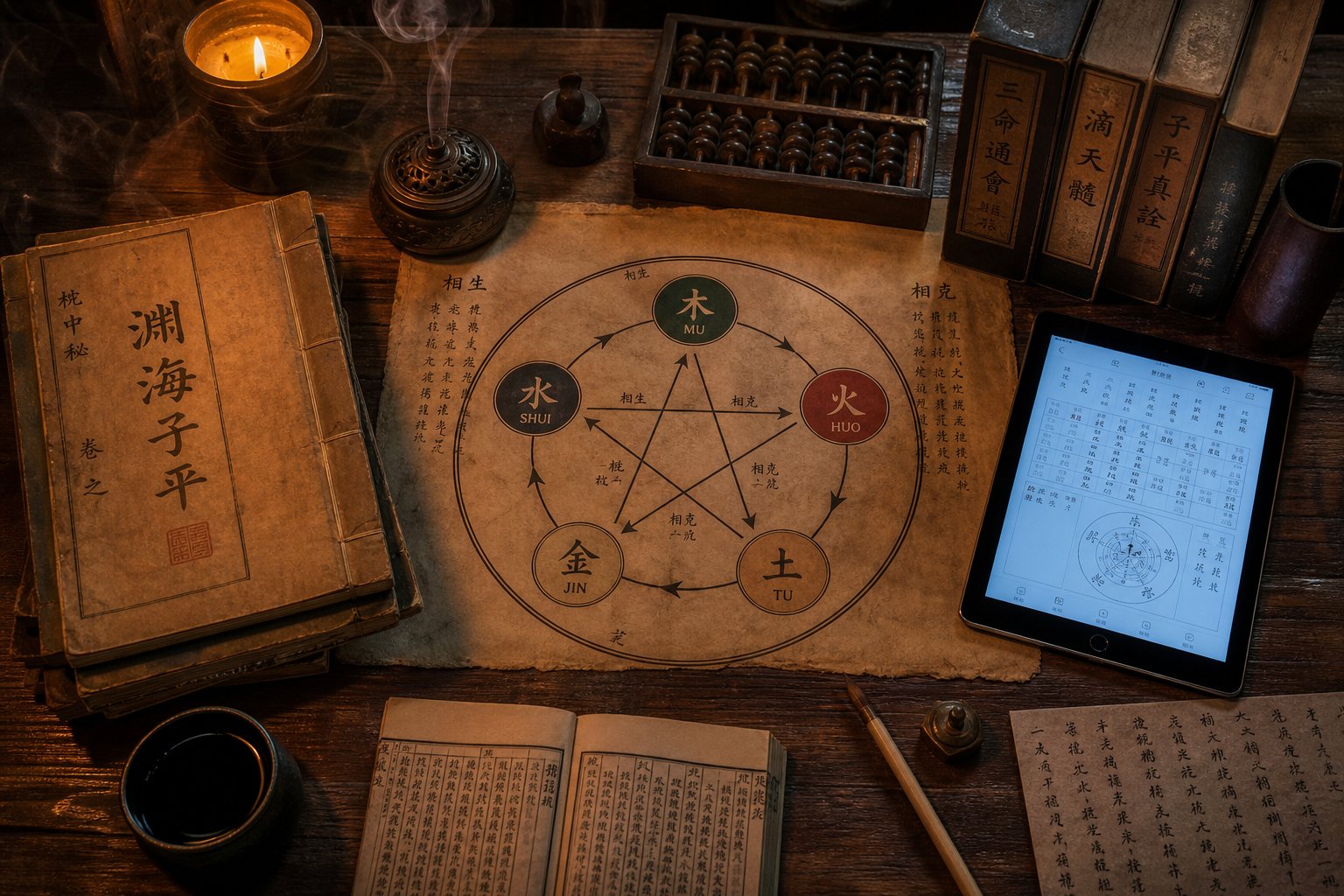
At the heart of traditional chinese name meaning lies the concept of 五行 (wuxing) — the five elements of wood, fire, earth, metal, and water. These aren't just abstract categories. In Chinese metaphysical thinking, everything in the universe belongs to one of these elements, and a balanced life requires all five to be present in harmony.
Here's how it works in practice. When a baby is born, the exact year, month, day, and hour of birth are converted into eight characters called 八字 (bazi, "Eight Characters" or "Four Pillars of Destiny"). Each character corresponds to a Heavenly Stem and Earthly Branch, and each carries a specific elemental association. A naming specialist analyzes these eight characters to determine which elements are strong, which are weak, and which are missing entirely.
If a child's bazi reveals a deficiency in water, for example, parents will seek characters containing the water radical (氵) — like 泽 (ze, "marsh"), 涵 (han, "contain"), or 海 (hai, "ocean"). If metal is lacking, characters like 鑫 (xin, "prosperous"), 铭 (ming, "inscribe"), or 锋 (feng, "sharp edge") might be chosen. The goal is compensation: using the name to supply what the cosmos didn't provide at birth.
But elemental balance is only half the equation. Stroke count analysis (笔画, bihua) adds another layer of numerical scrutiny. According to nameology traditions, the total number of strokes in a name — calculated using traditional character forms from the Kangxi Dictionary, not simplified characters — carries its own fortune. The system divides stroke counts into five categories:
- Heaven Stroke (天格) — derived from the surname's stroke count, representing ancestral blessings
- Man Stroke (人格) — the last character of the surname plus the first character of the given name, governing mid-life fortune and personality
- Earth Stroke (地格) — the total strokes of the given name, influencing early-life luck
- Outer Stroke (外格) — total strokes minus the Man Stroke, reflecting interpersonal relationships
- Total Stroke (总格) — all strokes combined, governing late-life fortune
Each number maps to an auspiciousness rating. The number 21, for instance, is considered a leadership pattern. The number 34 signifies ruin and loss. Parents — or the specialists they consult — will test multiple character combinations until they find one where all five stroke categories land on favorable numbers. It's a puzzle with real constraints: the character must carry the right elemental radical, produce an auspicious stroke count, and still mean something beautiful.
Consulting Fortune Tellers and Modern Naming Tools
Given this complexity, it's no surprise that many families don't go it alone. The tradition of consulting naming specialists or fortune tellers (算命先生, suanming xiansheng) remains widespread. As one parent recounted after moving to China, fortune tellers were able to describe their children's personalities accurately based solely on the eight characters — without ever meeting the kids. Whether you view this as genuine insight or skilled cold reading, the practice carries real cultural authority.
These specialists do more than crunch numbers. They evaluate how the full name sounds when spoken aloud — a consideration called tonal harmony. Mandarin's four tones mean that certain combinations create natural rhythm while others feel clunky or flat. A name where all three characters share the same tone sounds monotonous. A name that alternates between rising and falling tones feels dynamic and memorable. The test is practical: does the name carry clearly when you introduce yourself across a crowded room?
Beyond tonal flow, parents must watch for unfortunate homophones. Chinese is rich with words that sound identical but carry wildly different meanings. A name that looks elegant on paper might sound like "bad luck," "illness," or something embarrassing when spoken in certain dialects. Careful parents will read a candidate name aloud in both Mandarin and their local dialect, checking for any phonetic collisions with negative words.
What's changed in recent decades is the delivery method, not the underlying logic. Digital naming tools and apps now perform the same bazi analysis and stroke calculations that fortune tellers once did by hand. Parents can input their child's birth details and receive algorithmically generated name suggestions filtered by element, stroke count, and tonal pattern. Some platforms even score names across multiple dimensions and flag homophone risks automatically. The tradition hasn't faded — it's been digitized.
A Chinese name must balance three forces simultaneously: visual beauty in its written characters, aural harmony in its pronunciation, and semantic depth in its meaning. A name that succeeds on one dimension but fails on another is considered incomplete — like a song with a beautiful melody but clashing lyrics.
This triple requirement — form, sound, and meaning chinese names must satisfy all at once — is what makes the process so demanding. It's also what gives chinese name meanings their extraordinary density. A two-character given name isn't just a phonetic tag. It's a carefully composed unit where every stroke, every tone, and every layer of meaning has been weighed against cosmological, aesthetic, and practical considerations.
Some families spend weeks deliberating. Others commission multiple specialists and compare results. A few even schedule cesarean deliveries for specific dates and times, engineering a bazi that pairs well with a name they've already designed. Whether you find this meticulous or excessive depends on your worldview — but within Chinese culture, the logic is consistent: if a name accompanies you for life, it deserves the same care you'd give any lifelong investment.
All of this deliberation happens within the nuclear family. But historically, naming wasn't a private decision at all. Many Chinese families followed coordinated naming systems that linked siblings, cousins, and entire generations through shared characters — systems that also came with strict taboos about which characters could never be used.
Generational Names and Naming Taboos
Picture a family reunion where thirty cousins share the same middle character in their names. That's not a coincidence — it's a system. For centuries, Chinese families coordinated naming across entire generations using a tool that's part poetry, part genealogical record, and part identity marker. At the same time, equally powerful rules dictated which characters could never appear in a name at all. These two forces — one prescriptive, one prohibitive — shaped chinese name origins in ways that still echo today.
How Generation Poems Coordinate Family Names
The 字辈 (zibei) system works like this: a clan's elders compose a poem — typically in lines of five or seven characters — and each character in that poem is assigned to a successive generation. When a child is born, the father takes the next character in the sequence and places it in the child's name, usually as the middle character in a three-character name. The result is that all brothers, sisters, and paternal cousins of the same generation share one identical character, making their generational position immediately visible to anyone who knows the poem.
Take Mao Zedong's family as a concrete example. According to research by Li Zhonghua and Edwin Lawson, the Mao clan's generation poem was composed in 1737 and contains 40 characters spanning 40 generations. Mao Zedong's generation character is 泽 (Ze) — the fourteenth character in the poem, marking him as the fourteenth generation since the poem's creation. His grandfather's generation character was 恩 (En), his father's was 贻 (Yi). Even though Mao used several aliases throughout his life, the name containing his generation character — Zedong — never changed.
The poem itself typically expresses hopes for the clan's future or praises ancestral virtues. As FamilySearch explains, these poems function like genealogical fingerprints — even a handful of generation characters can identify which clan a person belongs to and locate their specific jiapu (家谱, clan genealogy book). The generation character's placement varies by family: most commonly it appears first in the given name, though some clans place it second.
What about chinese middle names in this system? The generation character effectively functions as a middle name — a shared identifier sandwiched between the inherited surname and the unique personal character. A name like Li Yao Ming breaks down as: Li (surname), Yao (generation character), Ming (personal character). Siblings and cousins would all carry "Yao" while differing only in their final character.
Does the practice survive? The answer depends on where you look. Research tracking 493 male respondents across four historical periods found that generation name usage dropped dramatically during the Mao era — from 90.4% in the pre-Mao period (1940-1949) to just 41.2% during the Cultural Revolution years (1960-1976). Four forces drove the decline: urbanization severed ties to ancestral villages, migration broke clan structures, intellectuals rejected generation names as feudal relics, and political pressure during the Cultural Revolution made traditional naming dangerous.
The Post-Mao period showed a significant recovery — usage climbed back to 53% among men born between 1977 and 1983. The generation name didn't die; it retreated and partially returned. Today, the practice has declined further in urban China, where two-character names (surname plus single given character) dominate. But it remains active in rural southern China and among overseas Chinese communities maintaining ancestral records. Some families still consult their generation poem when naming children, even if they treat it as optional rather than obligatory.
Naming Taboos That Shaped Chinese History
If generation poems told you which characters to use, naming taboos — 避讳 (bihui) — told you which characters were absolutely forbidden. The rule was simple in principle: you could never use a character that appeared in the name of an emperor, a direct ancestor, or a living elder. The consequences of this rule, however, were anything but simple.
During imperial China, violating a naming taboo wasn't just rude — it could be criminal. When an emperor took the throne, every character in his name became off-limits for the entire population. Official documents were rewritten. Exam candidates who accidentally used a taboo character could be failed. Common words had to be replaced with synonyms or written with missing strokes to avoid reproducing the forbidden character exactly.
Consider the Tang Dynasty emperor Li Shimin (李世民). The character 世 (shi, meaning "world" or "generation") became taboo across the empire. The common phrase 观世音 (Guanshiyin, the Buddhist bodhisattva of compassion) had to be shortened to 观音 (Guanyin) — a change so deeply embedded that most Chinese speakers today don't realize the name was ever three characters. Similarly, during the Song Dynasty, the character 玄 (xuan) from Emperor Kangxi's name forced scholars to substitute it with 元 (yuan) in countless texts.
The taboo extended beyond emperors. Within families, children could never share name chinese characters with their parents, grandparents, or any living elder in the direct line. Using an ancestor's character — even unintentionally — was considered deeply disrespectful, as if you were claiming equality with someone who held authority over you. This created a cascading constraint: the more generations a family tracked, the more characters became unavailable for new names.
Imperial naming taboos officially ended with the fall of the Qing Dynasty in 1912. But the family-level version persists. Many Chinese parents today still avoid using characters from their own parents' or grandparents' names when naming children. The logic has softened from strict prohibition to respectful preference — you won't face legal consequences, but older relatives might feel uncomfortable seeing their name character on a grandchild. Some families have relaxed this entirely, while others maintain it as a quiet mark of respect.
Between generation poems prescribing shared characters and taboos prohibiting ancestral ones, traditional Chinese naming operated within surprisingly tight constraints. The relationship between names and characters was never casual — it was governed by systems that linked individual identity to clan history, political power, and intergenerational respect. These systems also explain why the same underlying name can surface in so many different written forms across regions — a complexity that multiplies further when Chinese characters meet romanization systems designed by entirely different linguistic traditions.
Regional Romanization and How One Name Gets Many Spellings
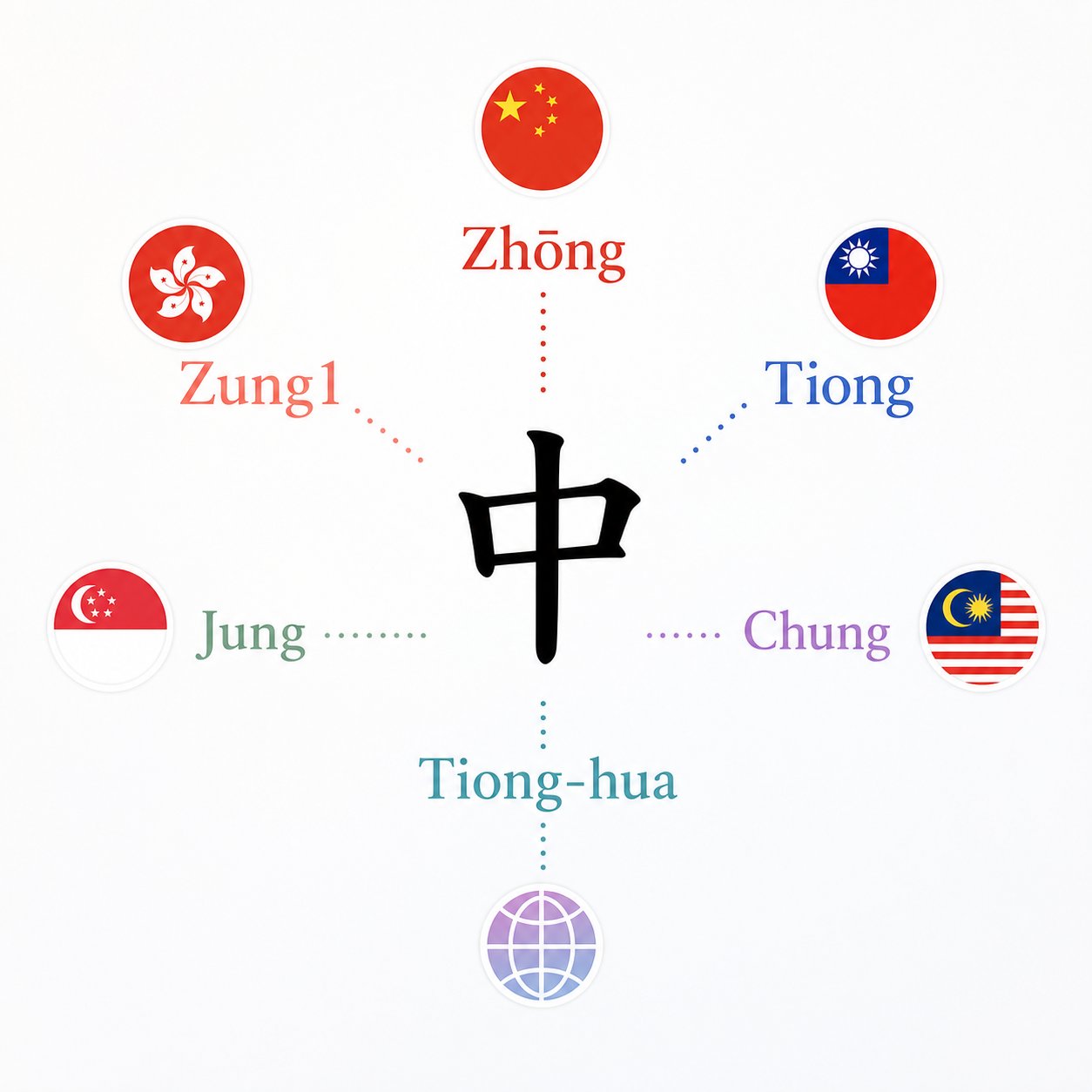
A person surnamed 張 might spell it Zhang, Chang, Cheung, Teo, or Chong — all from the same single character. This isn't inconsistency or error. It's the inevitable result of one writing system colliding with multiple spoken languages and several competing romanization standards developed across different political territories over the past 150 years. Understanding chinese name pronunciation requires knowing which system produced the spelling you're looking at.
Pinyin vs Wade-Giles vs Cantonese Romanization
Three major romanization systems dominate the Chinese-speaking world, each tied to a specific region and historical moment:
- Hanyu Pinyin — Developed in mainland China during the 1950s and adopted as the international standard. It's what most Mandarin learners study today. Under Pinyin, 張 becomes Zhang, 李 becomes Li, and 陈 becomes Chen.
- Wade-Giles — Created by British diplomats Thomas Wade and Herbert Giles in the 19th century. Taiwan historically used this system, and many older Taiwanese names still reflect it. Under Wade-Giles, 張 becomes Chang, 李 becomes Li, and 陈 becomes Ch'en. The apostrophes and hyphens that mark aspirated consonants often get dropped in casual use, creating further confusion.
- Cantonese romanization — Hong Kong and Macau never adopted Pinyin or Wade-Giles for personal names. Instead, names reflect Cantonese pronunciation using informal English approximations. Under this system, 張 becomes Cheung, 李 becomes Lee, and 陈 becomes Chan.
So when you encounter the name "Chang" on a Taiwanese passport and "Zhang" on a mainland Chinese passport, you're likely looking at the same surname written in two different systems. Yale University's library guide on Chinese romanization notes that the Pinyin system has replaced Wade-Giles as the standard in U.S. libraries, but well-established personal names in Wade-Giles — like Chiang Ching-kuo (蒋经国) or Lee Teng-hui (李登辉) — were never converted. The result is a permanent layer of historical spellings coexisting with modern ones.
Want to pronounce Zhang correctly? The "zh" in Pinyin sounds roughly like the "j" in "judge" but with the tongue curled further back. It doesn't map to any intuitive English pronunciation of "zh," which is exactly why Wade-Giles chose "ch" instead — and why neither system fully captures the sound for English speakers unfamiliar with the conventions.
Taiwan adds another wrinkle. While officially transitioning toward Pinyin for some purposes, personal names on Taiwanese passports still largely follow Wade-Giles or idiosyncratic local spellings. A person surnamed 黄 might appear as Huang (Pinyin) on a mainland document but as Hwang or Huang (Wade-Giles variant) on a Taiwanese one — same character, same Mandarin pronunciation, different spelling traditions.
Dialect-Based Spellings in Southeast Asia
The romanization puzzle gets far more complex once you move beyond Mandarin entirely. In Singapore, Malaysia, Indonesia, and other Southeast Asian countries with large Chinese diaspora communities, surnames reflect the dialect group of the original immigrants — typically Hokkien, Teochew, Cantonese, or Hakka. These aren't just different romanization systems for the same sound. They're genuinely different pronunciations of the same written character, because Hokkien and Cantonese are as different from Mandarin as French is from Spanish.
Consider the character 林. In Mandarin Pinyin, it's Lin. But in Singapore and Malaysia, you'll overwhelmingly encounter it as Lim — the Hokkien pronunciation — because most Chinese immigrants to those regions came from Fujian province, where Hokkien is spoken. Similarly, 黄 becomes Ng in Cantonese (a syllabic nasal with no vowel, baffling to English speakers), Ooi or Wee in Hokkien, and Huang in Pinyin.
As the Asia Media Centre explains, in territories with a sizeable Chinese diaspora, the way a family name is spelled functions as a signifier of ancestral origin. A person surnamed Wong is understood to have Cantonese heritage — likely ancestral ties to Guangdong province or Hong Kong. Someone surnamed Ong with the same character (王) signals Hokkien roots, probably from Fujian. The spelling itself tells you which region of China a family left generations ago.
This means that when you see chinese names in chinese characters, you're looking at a single unified identity. But the moment those characters get transliterated into English letters, they fracture into multiple spellings depending on which dialect the family speaks and which country they settled in. Two cousins with the identical surname character — one in Hong Kong, one in Penang — might spell their names completely differently on their passports.
The surname 張 alone appears as Teo (Hokkien), Cheung (Cantonese), Teo (Teochew), Chong (Hakka), and Tio (Hainanese) across the Asian diaspora — five different English spellings for one character. None of these are "wrong." Each accurately represents how the character sounds in a specific Chinese language.
| Character | Pinyin (Mainland) | Wade-Giles (Taiwan) | Cantonese (Hong Kong) | Hokkien (Singapore/Malaysia) | Hakka |
|---|---|---|---|---|---|
| 張 | Zhang | Chang | Cheung | Teo | Chong |
| 王 | Wang | Wang | Wong | Ong | Wong |
| 陈 | Chen | Ch'en | Chan | Tan | Chin |
| 林 | Lin | Lin | Lam | Lim | Lim |
| 黄 | Huang | Huang | Wong / Ng | Ooi / Wee | Wong |
| 刘 | Liu | Liu | Lau | Low | Liew |
This table reveals why translating chinese names into english is never a straightforward one-to-one conversion. The "correct" romanization depends entirely on context: which dialect does the person speak? Which country issued their documents? Which generation immigrated? A Malaysian Chinese person surnamed Tan and a mainland Chinese person surnamed Chen may share the exact same character (陈) and the exact same ancestry — separated only by which port their great-grandparents sailed from and which language they spoke at home.
For anyone working across borders — in business, academia, or immigration — this multiplicity creates real practical challenges. How do you know which "Lee" is a 李 and which is a 黎? How do you match a person's English-spelled name back to their chinese names in chinese characters? The answer often requires asking directly, because no algorithm can reliably reverse-engineer a romanized Chinese name back to its original character without additional context.
These spelling variations aren't just a linguistic curiosity. They create daily friction in professional settings — on business cards, in email signatures, and across international databases — where a single person's name might appear in three different forms depending on the document. Navigating that complexity gracefully is a skill that matters more than most professionals realize.
Chinese Names in Professional and Business Settings
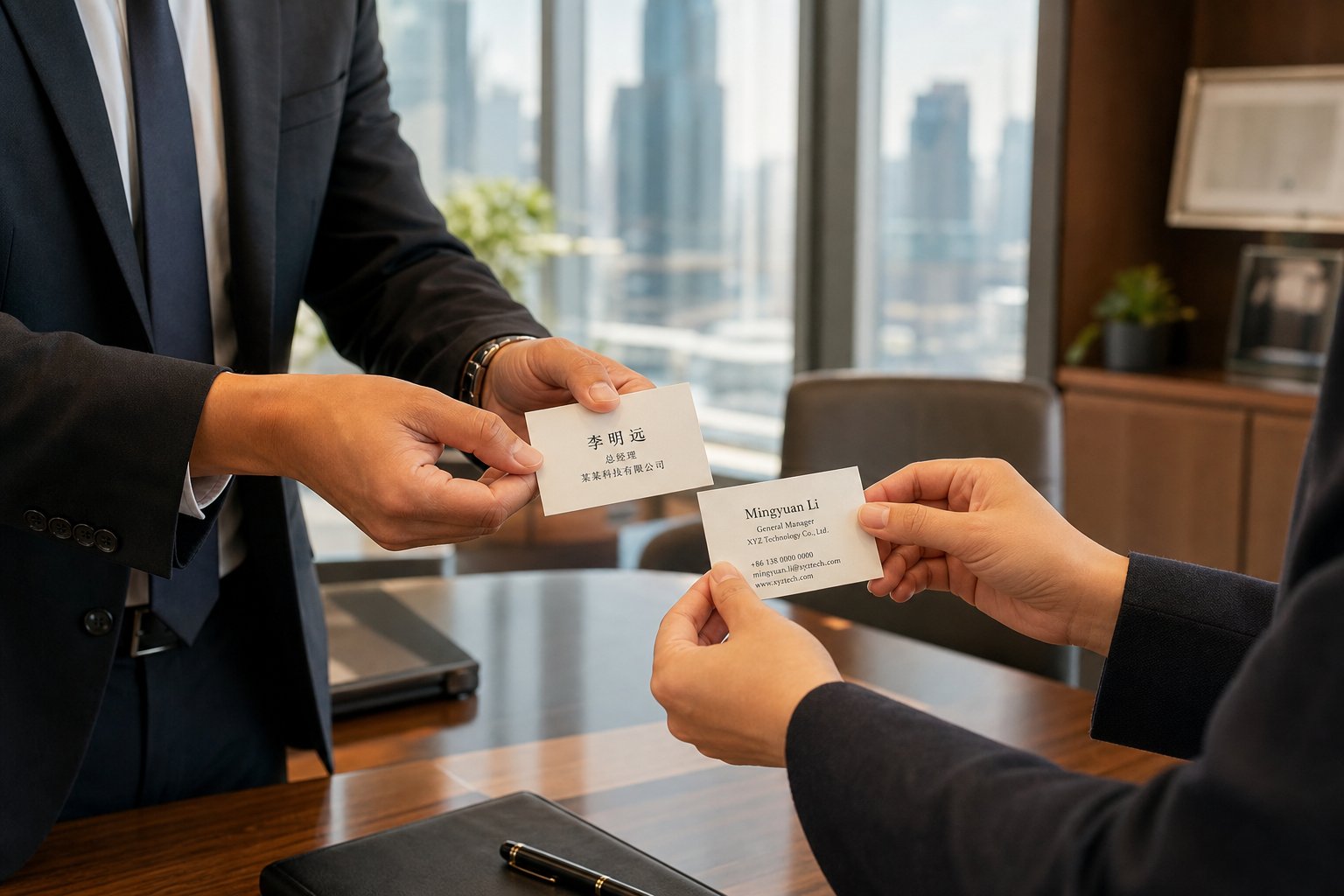
You receive a business card at a conference in Shanghai. One side reads 张伟明 with "Zhang Weiming" beneath it. The other side says "William Zhang, Senior Director." Which name do you use? Which is the surname? And when you send a follow-up email, do you write "Dear Mr. Zhang" or "Dear William"? These questions come up constantly in cross-border professional settings — and getting them right signals cultural awareness that Chinese colleagues genuinely notice.
Reading Business Cards and Email Signatures
Bilingual business cards follow a predictable pattern. The Chinese side preserves traditional name order: surname first, given name second, with characters displayed prominently and Pinyin underneath. The English side often flips to Western order — given name first, surname last — to match what international contacts expect. So "张伟明" on one side becomes "Weiming Zhang" or "William Zhang" on the other.
The key detail? On the Chinese side, the surname in chinese always comes first. Zhang (张) is the family name. Weiming (伟明) is the given name. If you're unsure which is which on the English side, look for these clues:
- A single syllable followed by two syllables (Zhang Weiming) — the single syllable is almost always the surname
- ALL CAPS on one element (ZHANG Weiming) — the capitalized portion signals the family name
- A Western name paired with a Chinese surname (William Zhang) — the Chinese surname sits where you'd expect a Western last name
Email signatures and LinkedIn profiles use similar conventions. Many Chinese professionals write their surname in full capitals — ZHANG Wei or CHEN Jing — specifically to help international colleagues identify which part is the family name. Others adopt the format "Wei Zhang (张伟)" with characters in parentheses. When you see both a Chinese name and an English name in a signature, they refer to the same person. The english name chinese name pairing exists purely for accessibility across languages.
Consistency matters here. As professional naming guides emphasize, the same format should appear across all platforms — business cards, email signatures, LinkedIn, and conference badges. If a colleague's card says "CHEN Jing / Lisa Chen," you can be confident that Chen is the surname and that Lisa is an adopted English name.
Proper Forms of Address and Chinese Honorifics
Here's where things diverge sharply from Western practice. In English-speaking offices, you might default to "Mr. Smith" or "Ms. Johnson." Chinese honorifics work differently — and using someone's professional title carries more weight than a generic courtesy title.
The basic honorifics are straightforward:
- 先生 (xiansheng) — Mr. in chinese, used for men in formal contexts
- 女士 (nushi) — Ms., the safe default for women in professional settings
- 小姐 (xiaojie) — Miss, but use cautiously as it carries potentially impolite connotations in some contexts
But in Chinese business culture, the preferred form of address is title + surname rather than Mr./Ms. + surname. A manager surnamed Wang is addressed as 王经理 (Wang Jingli — "Manager Wang"), not 王先生 (Wang Xiansheng — "Mr. Wang"). A director surnamed Li becomes 李总监 (Li Zongjian — "Director Li"). This pattern — surname plus professional title — is the standard in Chinese business etiquette and signals that you recognize someone's professional standing, not just their gender.
Common title-based forms you'll encounter:
- 王经理 (Wang Jingli) — Manager Wang
- 李总 (Li Zong) — General Manager Li / Boss Li (informal but respectful)
- 张教授 (Zhang Jiaoshou) — Professor Zhang
- 陈主任 (Chen Zhuren) — Director Chen
What about English names? Many Chinese professionals adopt them for international convenience — a chinese name from english name isn't a legal change but a practical tool for cross-cultural communication. Some choose names phonetically similar to their Chinese name (Weiming becomes "William"), while others pick names they simply like. The important thing: never assume someone has or wants an English name. And if they offer one, use it — but also learn their Chinese name's pronunciation. Both gestures show respect.
When you're unsure how to address someone, asking directly is always appropriate. A simple "What would you prefer I call you?" or "How do you pronounce your name?" demonstrates cultural sensitivity rather than ignorance. Chinese colleagues appreciate the effort far more than they mind the question.
For professionals who need a chinese name translation — converting their own English name into Chinese characters for use in Chinese-speaking markets — the process involves more than phonetic transliteration. A good english to chinese name adaptation considers character meaning, tonal flow, and cultural associations, much like how Chinese parents select names for their children. Generic transliteration tools often produce awkward results because they prioritize sound over meaning.
Here's a practical reference for navigating these situations:
- Do use the name format your colleague presents on their business card or email signature
- Do address someone by title + surname (Manager Wang, Director Li) in formal Chinese business contexts
- Do ask how to pronounce a name you're unsure about — it's respectful, not awkward
- Do learn which part is the surname before your first meeting if possible
- Do use both hands when receiving a business card and take a moment to read it
- Don't assume every Chinese person has or wants an English name
- Don't shorten a two-character given name to one syllable without permission (calling "Weiming" just "Wei")
- Don't default to first-name basis immediately — wait for your colleague to invite informality
- Don't guess at chinese names for english names — ask the person directly what they use
- Don't assume the first name listed in Western-order documents is the given name without checking
These conventions aren't just etiquette trivia. In Chinese business culture, how you address someone communicates whether you see them as a peer, a superior, or a stranger. Getting it right opens doors. Getting it wrong — especially by accidentally treating a surname as a given name or ignoring someone's professional title — creates an impression of carelessness that's hard to undo.
The good news: Chinese professionals working internationally understand that cross-cultural name confusion is inevitable. They won't hold an honest mistake against you. What they will notice is whether you made the effort to learn. That effort — asking, listening, remembering — matters more than perfect pronunciation on the first try.
Common Mistakes When Using Chinese Names
Effort matters — but effort without the right framework still leads to predictable errors. Even well-intentioned professionals stumble over the same handful of mistakes when encountering names in china for the first time. Most of these errors stem from one root cause: applying Western naming logic to a system that operates on entirely different principles.
Assuming the First Written Name Is the Given Name
This is the single most common mistake. In English, "John Smith" puts the given name first. So when someone sees "Li Wei," instinct says Li must be the first name chinese speakers use personally. It's not. Li is the surname — the family name shared by an entire lineage. Wei is the given name, chosen specifically for that individual.
The confusion deepens with two-syllable names like "Wang Yang," where both parts are single characters. Which is which? Context clues help:
- In a three-syllable name like "Li Xiaoming," the lone syllable (Li) is almost always the surname, and the two-syllable portion (Xiaoming) is the given name
- Among the most common chinese names, single-character surnames dominate — Wang, Li, Zhang, Liu, Chen all follow this pattern
- If a name appears in a Chinese-language document or formal context, the first element listed is the surname by default
Remember: as the Asia Media Centre notes, the chinese naming convention places family name before given name — the opposite of English order. When former U.S. Secretary of State Mike Pompeo referred to North Korea's Kim Jong-un as "Chairman Un," he made exactly this error on a global stage. "Un" isn't a surname — Kim is. The mistake is equivalent to calling President Biden "President Joe."
Other Misconceptions About Chinese Names
Beyond name order, several other errors crop up repeatedly:
Splitting compound surnames into two names. Ouyang (欧阳) is a single surname — not a first name "Ou" and a last name "Yang." The same applies to Sima, Zhuge, and Shangguan. If you see a name like "Ouyang Xiu," the entire "Ouyang" is the family name and "Xiu" is the given name. Treating compound surnames as two separate names is like splitting "McDonald" into "Mc" and "Donald."
Assuming all Chinese people want English names. Many Chinese professionals adopt English names for international convenience, but many don't — and assuming they should feels dismissive. Some people use their chinese first names exclusively and prefer that colleagues learn the pronunciation rather than substitute a Western alternative. Never assign someone an English name because you find their Chinese name difficult.
Ignoring tones entirely. The name in chinese carries tonal information that changes meaning. "Ma" in the first tone means "mother," in the third tone means "horse." When you flatten all tones into monotone English pronunciation, you're not just mispronouncing — you may be saying something entirely different. Perfect tones aren't expected from non-native speakers, but making an effort signals respect.
Assuming Chinese, Japanese, and Korean naming customs are interchangeable. While all three cultures place surnames first, the systems differ significantly. Korean names use a much smaller pool of surnames (Kim, Lee, and Park alone cover nearly half the population). Japanese names use kanji that may have multiple readings. Chinese naming customs — from five-element analysis to generation poems — are distinct traditions that don't transfer across borders.
Asking someone their preferred name and pronunciation is always appropriate and always appreciated. It's not an admission of ignorance — it's a demonstration of respect. No one has ever been offended by the question "How would you like me to address you?"
Here's how one person's name might appear across different contexts, showing why confusion is understandable — and why asking matters:
| Context | Format | Example |
|---|---|---|
| Formal Chinese order | Surname + Given name (characters) | 张伟明 (Zhang Weiming) |
| Western-adapted order | Given name + Surname | Weiming Zhang |
| Business card (English side) | English name + Surname | William Zhang, Senior Director |
| Email signature | Capitalized surname + given name | ZHANG Weiming (张伟明) / William |
| Colleagues in China | Title + Surname | 张总 (Zhang Zong — "Director Zhang") |
The same person — five different presentations. None are wrong. Each serves a different audience and context. The most common chinese names appear in all these variations daily across international business, academia, and media. Recognizing that a single identity can surface in multiple legitimate formats is the first step toward navigating any chinese naming convention with confidence.
Every system covered in this article — from five-element analysis to generational poems to regional romanization — exists because Chinese naming carries weight that goes far beyond identification. A name in chinese is simultaneously a family record, a philosophical statement, a phonetic composition, and a visual artwork. Approaching it with curiosity rather than assumptions is the only reliable strategy. When in doubt, ask. The answer will always teach you something worth knowing.
Frequently Asked Questions About Chinese Naming Conventions
1. Why do Chinese names put the surname first?
Chinese names place the surname before the given name because of Confucian values that prioritize collective identity over individual identity. The family name represents lineage and belonging to a larger clan, so it takes precedence. This general-to-specific pattern mirrors other Chinese conventions: addresses list country before city before street, and dates place year before month before day. The structure reflects a worldview where the broader context always frames the particular, making family membership the first thing communicated in any introduction.
2. How can I tell which part of a Chinese name is the surname?
In a three-syllable Chinese name like Li Xiaoming, the single syllable (Li) is almost always the surname, while the two-syllable portion (Xiaoming) is the given name. For two-syllable names like Wang Yang, context helps: check if the first element matches common Chinese surnames such as Wang, Li, Zhang, Liu, or Chen. In formal Chinese documents, the first element listed is always the surname. Some professionals capitalize their surname in email signatures (ZHANG Wei) to signal which part is the family name for international colleagues.
3. Why does the same Chinese name get spelled differently across countries?
A single Chinese character can produce multiple English spellings because different regions use different romanization systems and speak different Chinese dialects. Mainland China uses Pinyin, Taiwan historically uses Wade-Giles, and Hong Kong uses Cantonese-based romanization. Beyond these systems, Southeast Asian Chinese communities spell names according to Hokkien, Teochew, or Hakka pronunciations. For example, the character 陈 becomes Chen in Pinyin, Chan in Cantonese, and Tan in Hokkien. None of these spellings are incorrect — each accurately represents how the character sounds in a specific Chinese language or system.
4. What role do the five elements play in choosing a Chinese name?
The five elements (wood, fire, earth, metal, water) are central to traditional Chinese name selection. When a baby is born, specialists analyze the exact birth date and time to determine which elements are strong, weak, or missing in the child's destiny chart. Parents then choose name characters containing radicals associated with the deficient element — for instance, characters with the water radical if water is lacking. This practice aims to create cosmological balance, compensating through the name for what the birth chart didn't provide. Modern apps now perform these calculations digitally, but the underlying logic remains unchanged.
5. How should I address a Chinese colleague in a business setting?
In Chinese business culture, the preferred form of address is professional title plus surname rather than Mr. or Ms. A manager surnamed Wang is best addressed as Wang Jingli (Manager Wang), and a professor surnamed Zhang as Zhang Jiaoshou (Professor Zhang). If your colleague has offered an English name, use it in international contexts. Never assume someone has or wants an English name, and avoid shortening a two-character given name without permission. When uncertain, simply asking 'How would you like me to address you?' demonstrates cultural respect and is always appreciated.