How Chinese Naming Laws Shape Every Citizen's Identity
Imagine naming your child, only to have a government computer reject the name because it cannot process the characters. In China, this is not a hypothetical scenario. It happens regularly. Chinese naming laws and restrictions form one of the most codified regulatory frameworks governing personal identity anywhere in the world, touching everything from which characters you can use to whose surname your child inherits.
So how do chinese names work within this legal system? At its core, a Chinese name consists of a surname followed by a given name, but the rules governing each component are far more layered than that simple structure suggests. The People's Republic of China regulates character selection, name length, surname inheritance, and the entire registration process through a web of overlapping legal instruments.
What Chinese Naming Laws Actually Govern
The legal foundation for names in China rests on three pillars. First, the Civil Code (specifically Articles 1012 through 1017) establishes the fundamental right to a personal name while setting boundaries on how that right can be exercised. Second, the Regulations on Household Registration, originally enacted in 1958 and still in force, govern how names are recorded and changed within the hukou system. Third, the Table of General Standard Chinese Characters defines the approximately 8,105 characters that are officially permissible in registered names.
Together, these instruments create a regulatory environment where the state determines not just how you register a name, but which names are possible in the first place. Latin characters, numerals, and non-Chinese symbols are all prohibited. Only Chinese characters are permitted, and even then, only those the government's computer systems can process.
Citizens have the right to a name and the choice of naming therein, but that right operates within boundaries set by law, technology, and administrative practice.
This framework covers far more than most people realize. It dictates whether a child takes the father's or mother's surname, whether rare or archaic characters can appear on an ID card, and what happens when someone wants to change their name later in life. Chinese name conventions are shaped as much by digital infrastructure as by legal text.
Who Needs to Understand These Restrictions
These rules matter to several distinct groups. Parents choosing a name for a newborn in China need to know which characters will actually pass registration at the local public security bureau. Researchers studying naming policy will find that China offers a unique case study in how technology and law intersect to shape identity. And diaspora Chinese navigating naming across jurisdictions often discover that a name perfectly legal in one system creates complications in another.
Whether you are selecting a chinese name definition that carries cultural weight, studying how naming customs interact with state power, or simply trying to understand why certain characters get rejected at registration, the answers trace back to this regulatory framework. The rules are specific, the enforcement mechanisms are real, and the consequences of running afoul of them range from bureaucratic headaches to legal disputes that reach the courts.
The structure of a Chinese name itself, surname first and given name second, is where these regulations begin to bite. Each component carries its own set of legal constraints, and the interplay between them reveals just how deeply the state reaches into personal identity.
Legal Structure of Chinese Names From Surname to Given Name
How are chinese names structured at the legal level? The answer is deceptively simple on the surface: a chinese surname comes first, followed by a given name. But each component operates under its own distinct set of rules, and the Civil Code spells out exactly who gets to decide what goes where.
Surname Rules Under the Civil Code
The right to a name falls under the Part on Personality Rights in China's Civil Code, specifically Articles 1012 through 1017. Article 1012 establishes that natural persons have the right to "decide on, use, change, or authorize others to use" their names, provided the choice is consistent with "public order and good morals." But it is Article 1015 that governs the most contested question in chinese naming customs: whose last name in chinese does the child carry?
Under current law, a child's surname in chinese must come from one of the following sources:
- The father's surname
- The mother's surname
- The surname of an elder direct blood relative (such as a grandparent), in limited circumstances
- The surname of a person other than the biological parents, where there are legitimate reasons such as adoption by a legal guardian
Ethnic minorities may follow their own ethnic traditions and customs when selecting a chinese family name, giving them broader flexibility than Han Chinese families. In practice, though, the overwhelming majority of children still take their father's surname. Research on national population data shows that matrilineal naming remains relatively uncommon and is often a strategic choice in families where the mother has no brothers, rather than a reflection of progressive attitudes alone.
Given Name Length and Character Limits
When it comes to the given name portion, there are no hard statutory limits on character count. A typical chinese name structure consists of two to three characters total, meaning a one-character surname paired with a one- or two-character given name. A 3 letter chinese name, in this sense, refers to three characters total, which is the most common format.
Four or more characters are rare among Han Chinese but perfectly legal. Non-Han ethnic groups such as Tibetans, Mongolians, and Uyghurs routinely have longer names after transliteration into Chinese characters, and the law accommodates this. Regulatory discussions have periodically floated the idea of capping total name length, but no formal character limit has been enacted into statute. The practical constraint comes from government computer systems rather than the law itself, a problem explored later in this article.
The Compound Surname Debate
One of the most active areas of change in chinese last names involves compound surnames, where parents combine both their family names into a new two-character surname for the child. This is legally distinct from traditional compound surnames like Ouyang or Sima, which have existed for centuries.
The Civil Code does not explicitly authorize or prohibit newly created compound surnames. Article 1015's language permits the child to take "the father's or mother's surname," which some legal scholars interpret narrowly as an either-or choice. Others argue that combining both surnames falls within the spirit of the law, especially as the practice grows in urban, educated households.
Data from population surveys suggests that compound surnames are more common in modernized cities and among families where the mother is well-educated. Unlike maternal surname adoption, which correlates with lower socioeconomic status of the husband, compound surnames appear driven by changing attitudes about gender equality rather than lineage preservation strategies. The trend is rising, but its legal footing remains ambiguous, sitting in a gray zone that future legislation or judicial interpretation will eventually need to clarify.
The question of which characters can fill these name slots, whether in a single-character surname or a newly minted compound one, depends on an entirely separate regulatory layer: the standardized character set that defines what the state will actually accept.
Which Characters Are Legally Permitted in Chinese Names
A name in chinese is only as valid as the characters it contains. You might craft a beautiful, meaningful given name using a rare classical character, only to discover that the state simply will not accept it. The boundary between a permissible and impermissible name often comes down to a single document: the Table of General Standard Chinese Characters.
The Table of General Standard Chinese Characters
The 通用规范汉字表, or Table of General Standard Chinese Characters, is the official character set that governs written Chinese in all social application domains, including personal names. The State Council formally published this table after a decade of development, consolidating and replacing earlier standards like the 1988 Modern Chinese Common Character Table. It contains exactly 8,105 characters organized into three tiers:
- Level 1: 3,500 commonly used characters for basic education and cultural literacy
- Level 2: 3,000 characters of slightly lower frequency, covering publishing, dictionary compilation, and information processing
- Level 3: 1,605 characters for specialized needs, including surnames, place names, scientific terminology, and classical Chinese texts used in education
That third tier is particularly relevant for names in chinese. It explicitly includes characters that appear in surnames and personal names but are not common enough for everyday writing. If a character falls outside all three levels, it effectively has no official standing for registration purposes. This means the relationship between names and characters in China is mediated by a government-curated list rather than the full breadth of the Chinese writing system, which contains tens of thousands of characters across historical dictionaries.
Banned and Restricted Character Categories
Beyond the character set boundary, additional content-based restrictions apply to name chinese characters. The regulatory framework prohibits names that:
- Contain obscene or vulgar meanings
- Express discriminatory content targeting ethnicity, religion, or gender
- Reference politically sensitive terms or figures in ways deemed harmful to public order
- Use numerals, foreign letters, or non-standard symbols in place of Chinese characters
The legal basis for these restrictions traces to the Civil Code's "public order and good morals" clause, which gives registration authorities broad discretion to reject names they consider socially harmful. In practice, this means a name in chinese language must pass both a technical check (is the character in the approved set?) and a substantive review (does the name violate public morality standards?). The combination creates a two-layer filter that narrows the universe of possible chinese name in chinese language choices far more than most parents initially expect.
Simplified vs Traditional Character Requirements by Region
The character set question becomes more complex when you consider that Greater China operates under different writing systems depending on jurisdiction. Mainland China mandates simplified characters for all official documents, including name registration. Hong Kong and Taiwan each maintain their own standards using traditional characters, with different rules about what is permissible.
| Jurisdiction | Character Standard | Approved Set for Names | Script Requirement |
|---|---|---|---|
| Mainland China (PRC) | Table of General Standard Chinese Characters | 8,105 characters (3 tiers) | Simplified characters only |
| Hong Kong SAR | Hong Kong Supplementary Character Set (HKSCS) | Broader set; rare characters accommodated | Traditional characters (simplified accepted in some contexts) |
| Taiwan (ROC) | Standard Form of National Characters | ~13,000+ characters | Traditional characters only |
Notice the gap: Taiwan's approved character pool is significantly larger than the mainland's, meaning a name in chinese that is perfectly registrable in Taipei may be impossible to register in Beijing. Hong Kong occupies a middle ground, with its supplementary character set designed to accommodate Cantonese-specific characters and rare surname characters that the mainland standard excludes.
For families moving between jurisdictions or holding dual residency, these differences create real friction. A child named using a traditional character in Hong Kong may need a simplified equivalent for mainland documents, and if no standard simplified form exists, the name can become administratively unprocessable. The character set is not just a linguistic standard. It is the gatekeeping mechanism that determines whether a name can exist in official records at all, and as the next section reveals, the computer systems that enforce these standards introduce restrictions that go even beyond what the law intends.
Technology as a Hidden Gatekeeper of Chinese Names
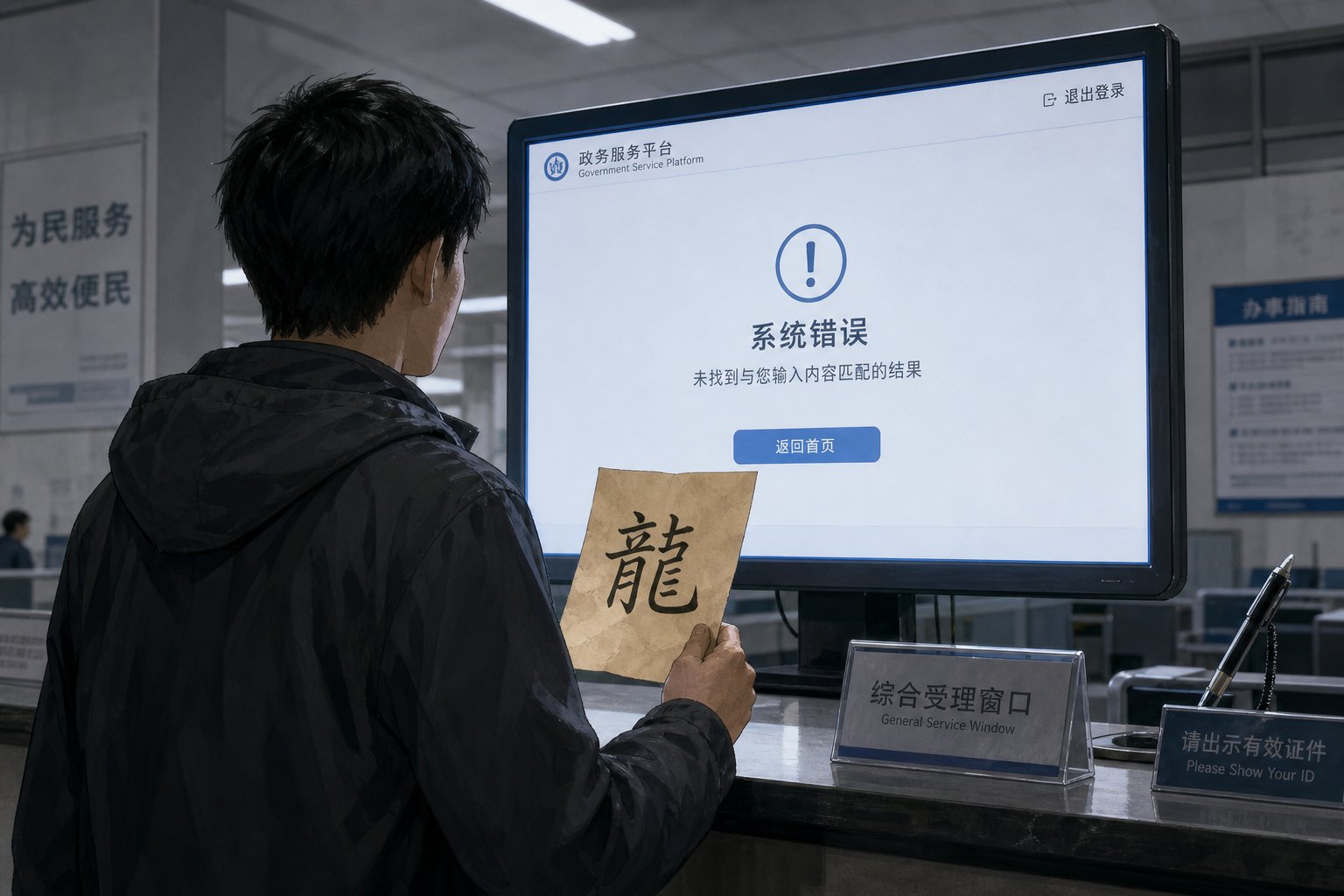
The law says you can use a character. The computer says you cannot. Who wins? In China, the answer is almost always the computer. The household registration database maintained by public security bureaus operates on character encoding standards that support far fewer characters than the Chinese writing system contains, creating a layer of restriction that no statute explicitly authorizes but that millions of citizens experience firsthand.
How Government Computer Systems Restrict Names
China's population registration runs on a centralized digital system managed by the Ministry of Public Security. Every citizen's name must be entered into this system to generate a Resident Identity Card, and the system can only process characters included in its supported encoding standard. The primary standard used is GBK, which supports approximately 32,232 characters, including both simplified and traditional forms. That sounds like a lot until you consider that over 70,000 Chinese characters are documented across historical dictionaries.
The gap between what exists in the language and what the system can handle creates a de facto restriction. If a parent selects a character that falls outside the encoding set, the registration officer at the local public security bureau simply cannot type it in. The name is not rejected on legal grounds. It is rejected because the machine has no way to represent it. This means the actual boundary of chinese naming laws and restrictions is drawn not by legislators but by software engineers who designed character encoding tables decades ago.
The latest version of China's official coded character set, GB18030, has expanded to register more than 80,000 characters. But here is the catch: most computers deployed in government offices only support the input and display of about 30,000 commonly used characters, according to reporting by Xinhua. The standard exists on paper, but the hardware and software in the field have not caught up.
The Rare Character Problem in Digital Registration
Characters that fall outside standard computer support are called 生僻字, or rare characters. Roughly 60 million people in China have names containing these characters, according to experts cited by the China Electronics Standardization Institute. That is not a fringe issue. It is a population larger than most countries.
Consider the case of Ma Cheng from Beijing. Her given name uses a character composed of three horse radicals placed side by side, a legitimate character found in the Kangxi Dictionary. But because no standard encoding supports it, government systems record her name as "马CHENG" or even "马马马马." Her temporary Resident Identity Card had the character written in by hand, a workaround that fails entirely in digital-only environments like airport check-in kiosks or online banking portals.
A village in Yunnan Province gained national attention when an entire family surname, "Nia" (meaning "a flying bird"), could not be typed into computers. Villagers were forced to register under a similar-sounding character meaning "duck" just to obtain ID cards. Imagine your family name being replaced by a word for poultry because a database cannot accommodate it. That is the reality for people whose names fall outside the encoding boundary.
For anyone attempting a chinese translation for names that include rare characters, the problem compounds. If the source character has no digital representation, no chinese name converter or translation tool can process it either. The character effectively does not exist in the digital world, regardless of its centuries-long history in written Chinese.
Government and public services in China are accelerating digital transformation and moving operations online. However, due to insufficient technical support, many people's names and place names cannot be input, causing troubles in transactions such as opening bank accounts and purchasing transportation tickets.
Practical Consequences of System Limitations
The downstream effects touch nearly every aspect of modern life. When your name cannot be entered into the national database, you face cascading failures across interconnected systems:
- ID cards display incorrect characters or placeholder symbols, creating identity verification problems
- Bank accounts cannot be opened because the name on the application does not match the name on the ID card
- Train and flight tickets show garbled characters, leading to boarding denials
- Exam admission cards display question marks in place of name characters, as Beijing-based lawyer Lin Sumiao experienced throughout her education
- Online government services reject login attempts when name fields cannot process the correct characters
Lin's given name contains the rare character "su," which combines "geng" and "sheng" to express her parents' wish for independence. She has refused to change it despite years of administrative friction, but many others simply give up. The path of least resistance is to pick a name the computer can handle, which means technology is quietly shaping which names survive into the next generation.
The policy response has been slow but is accelerating. The China Electronics Standardization Institute, working with tech companies like Tencent, launched initiatives to solicit rare characters from the public through a WeChat mini program. Since its launch, the program received more than 1,400 submissions. Tencent's Sogou Keyboard also released an industrial solution aimed at making rare characters accessible across finance, transportation, education, and healthcare systems. The goal is to close the gap between what the encoding standard technically supports and what deployed systems can actually process.
The case of Zhao C illustrates the opposite end of this problem. A young man who had used the Latin letter "C" as his given name his entire life was forced to change it when upgrading to a second-generation ID card. The Public Security Bureau told him the system could not handle non-Chinese characters. He sued, won initially, but ultimately settled and changed his name. The technology did not bend. The citizen did.
This tension between digital infrastructure and personal identity rights is not just a technical footnote. It shapes how registration officers evaluate names at the point of submission, what criteria they apply, and what options parents have when a name is rejected. The process itself, from application to approval or denial, carries its own set of rules and timelines that determine whether a chosen name ever makes it onto an official document.
Registering a Name in China From Application to Approval
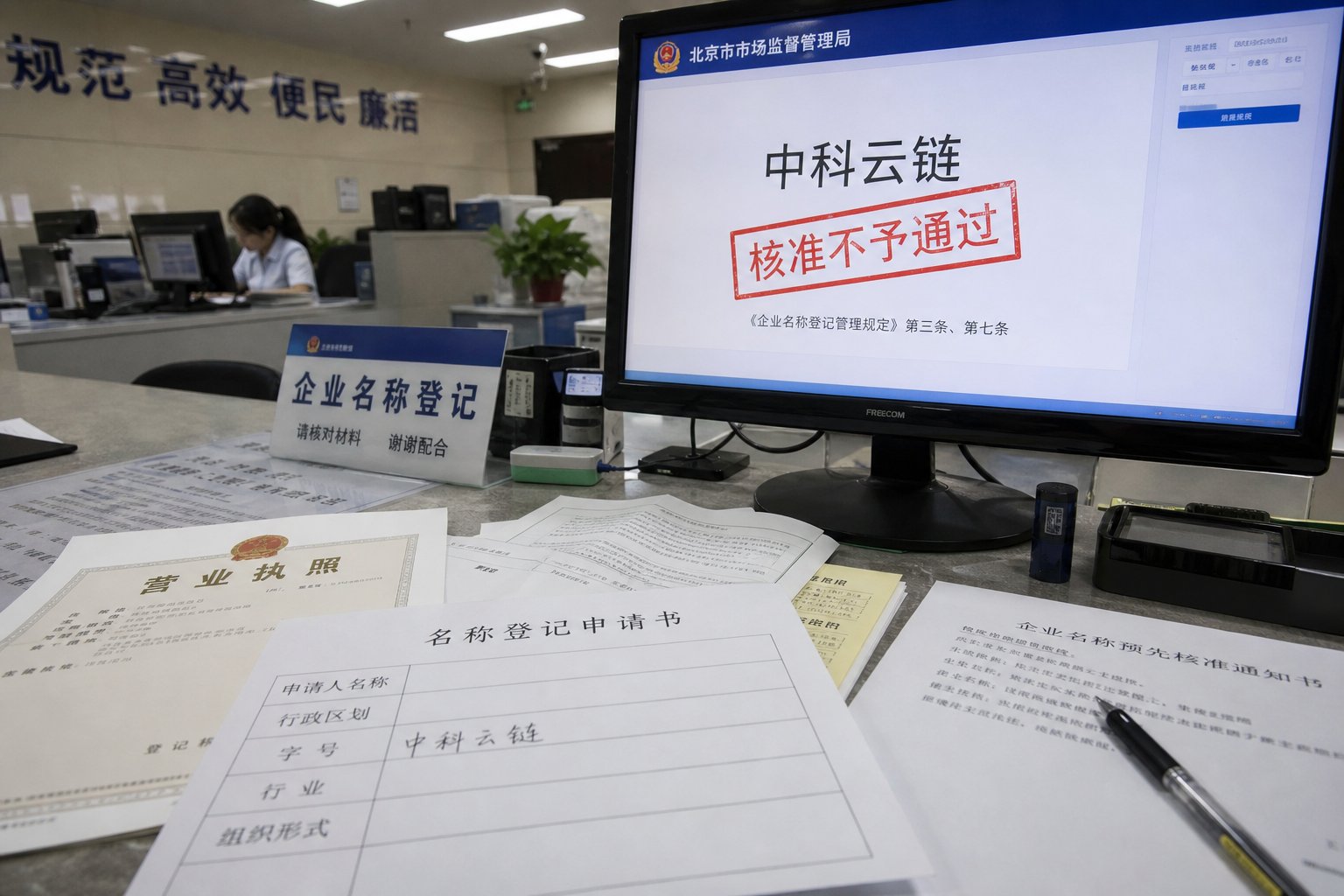
A name only becomes real when it enters the system. Regardless of how carefully parents select chinese baby names, the chosen name must survive a multi-step bureaucratic process before it appears on a hukou booklet or Resident Identity Card. That process runs through local public security bureaus, and it involves more documentation, more departments, and more potential failure points than most parents anticipate.
Step-by-Step Name Registration at Public Security Bureaus
The registration of a newborn's name in China is inseparable from the broader birth registration (hukou) process. Under the 1958 Regulations on Household Registration, parents must register a child within 30 days of birth in urban areas, though rural areas often extend this deadline to three months or longer in practice. The process involves three separate government departments, each issuing a prerequisite document before the name can be officially recorded.
Here is how the process unfolds from birth to official name entry:
- Obtain a Birth Certificate (BC) from the Population and Family Planning department, typically applied for during pregnancy or shortly after delivery.
- Obtain a Medical Birth Certificate (MBC) from the hospital or Public Health department where the child was born, confirming the birth details.
- Gather the parents' hukou booklets and identity cards from the Public Security department's records.
- Visit the local police station (派出所) or hukou registry office at the place of the child's permanent residence.
- Submit all three documents along with the chosen name to the registration officer.
- The officer checks the name against the approved character database, verifies it does not duplicate existing names in the local registry in problematic ways, and reviews it for compliance with naming regulations.
- If approved, the child's name is entered into the household registration system and printed on the family's hukou booklet.
The proposed Name Registration Regulations, which have been under discussion since the early 2010s, aim to consolidate these scattered rules into a single framework. Their draft provisions address character restrictions, name length guidance, and standardized review criteria that would apply uniformly across all jurisdictions. Until these regulations are formally enacted, the review process remains somewhat discretionary, varying by locality and even by individual officers.
In practice, parents choosing common chinese names or typical chinese names drawn from the most popular chinese names lists rarely encounter problems. Names using frequently seen chinese first names pass through the system without friction. The difficulties arise at the margins, when parents reach for unusual characters, unconventional structures, or names that trigger a content review.
What Happens When a Name Is Rejected
When a registration officer determines that a submitted name cannot be processed, the rejection typically falls into one of two categories: technical failure or substantive objection.
A technical failure means the character simply does not exist in the computer system. The officer will inform the parents that the name cannot be entered and ask them to select an alternative. There is no formal written rejection in most cases. The parent is told verbally, sometimes shown the error on screen, and sent home to choose again.
A substantive objection is different. If the officer believes the name violates public order, contains banned content, or uses an impermissible surname, the rejection should be documented. In high-profile cases, parents have been told their chosen chinese names for boys or girls were rejected for being "too unusual," "potentially confusing," or "not in the public interest." One widely reported case involved a couple in Zhengzhou who attempted to name their child "@" (pronounced "ai ta" in Chinese, meaning "love him"), which was rejected on the grounds that it was not a Chinese character. Another involved parents who chose the character "王" repeated multiple times, which officers refused as frivolous.
The lack of standardized rejection criteria means outcomes can be inconsistent. A name rejected in one district might be accepted in another, depending on the officer's interpretation of the rules and the capabilities of the local computer system.
The Appeals Process for Name Disputes
When parents disagree with a rejection, they have limited but real options. The formal path begins with an administrative reconsideration request filed with the public security bureau at the next higher level, typically the county or district bureau. This request must be submitted within 60 days of the rejection and should include the chosen name, the reason given for rejection, and the legal basis the parents believe supports their choice.
If administrative reconsideration fails, the next step is filing an administrative lawsuit in the local People's Court. Several such cases have reached the courts, with mixed results. The case of "Zhao C" discussed earlier is one example where the citizen initially won but ultimately changed the name anyway. In another case, a father in Jinan who wanted to give his daughter a four-character name combining both parents' surnames won his appeal after arguing that no law explicitly prohibits compound surnames.
The reality, though, is that most parents never appeal. The process is time-consuming, the outcome uncertain, and the practical pressure to register the child quickly, so they can access healthcare, vaccination records, and eventually schooling, pushes families toward compliance. For every parent who fights a rejection in court, thousands simply pick a different name and move on. The system's power lies less in explicit prohibition than in the friction it creates around non-standard choices, quietly steering the population toward names the infrastructure can handle without complaint.
Changing Your Legal Name Under Chinese Law
Picking a different name at registration is one thing. But what if you already have a legal name and want to change it years later? Maybe your parents chose a character the computer could handle rather than the one they actually wanted. Maybe your life circumstances have shifted. Whatever the reason, changing a registered name in China is possible but far from simple. The Civil Code affirms the right to change one's name, yet the administrative process imposes enough friction that many people never follow through.
Legal Grounds for Changing Your Name in China
Not every reason qualifies. Public security bureaus evaluate name change requests against a set of recognized justifications, and applications outside these categories face near-certain rejection. The generally accepted grounds include:
- Adoption, where the child takes the adoptive family's surname
- Restoration of a birth name after an adoption is dissolved
- Gender transition or gender identity alignment, where the existing name is clearly gendered in a way that no longer fits
- Ethnic minority name adaptation, such as converting a transliterated name to a more accurate rendering or adopting a Han-style name for practical purposes
- Avoiding duplicate names within a community or workplace that cause persistent confusion
- Religious conversion requiring a name consistent with the new faith tradition
- Correction of clerical errors made during original registration
Notably absent from this list: simply disliking your name. Personal preference alone is not a recognized legal ground, though some applicants frame aesthetic dissatisfaction as a "duplicate name" issue or cite professional confusion to strengthen their case. Officers have discretion here, and outcomes vary by jurisdiction.
Documentary Requirements and Approval Process
The process begins at the same local police station where names are first registered. Applicants must submit a written application stating the desired new name and the specific legal ground for the change, along with supporting documents. For adoption cases, that means the adoption certificate. For gender transition, medical documentation. For duplicate name avoidance, evidence such as workplace rosters or community records showing the conflict.
The local public security bureau reviews the application and, if the change is approved, updates the household registration. A new hukou page is issued, and the applicant must then cascade the change across every linked document: Resident Identity Card, passport, bank accounts, property deeds, educational certificates, and employment records. Each of these requires a separate application at a separate office, often with its own processing time and fees.
Here is where the practical limitation bites hardest. Property ownership records, court judgments, and social credit entries are all tied to the original registered name. A name change does not automatically propagate across these systems. The individual must proactively update each one, and gaps between the old and new name can trigger identity verification failures. Someone asking "what is my chinese name" in a legal sense may find the answer depends on which database you query, especially during the transition period when some records reflect the old name and others the new one.
Adults face stricter scrutiny than minors. A parent can change a young child's name with relative ease, but once a citizen reaches adulthood and holds a full set of identity documents, the bar rises. Multiple name changes are viewed with suspicion, and some jurisdictions impose informal limits of one change per lifetime, though no national statute codifies this restriction.
The Modern Legal Status of Courtesy Names
Historically, Chinese individuals often carried more than one name. The courtesy name, or 字 (zi), was a formal name given at adulthood, used by peers and in professional contexts while the given name remained reserved for family and elders. A chinese courtesy name carried deep cultural significance, often reflecting aspirations or complementing the meaning of the birth name. Confucius, for example, had the given name Qiu and the courtesy name Zhongni.
Does this tradition have any legal standing today? The short answer is no. Modern PRC law recognizes only one official registered name per citizen. A courtesy name cannot appear on identity documents, cannot be used for legal transactions, and has no formal status in the household registration system. You can adopt one socially, use it in literary or artistic contexts, or include it on a personal seal, but it carries no legal weight.
This matters for people researching their heritage or trying to derive a chinese name from english name equivalents. Services that generate chinese names for english names or help users find an english to chinese name pairing sometimes produce results styled as courtesy names, complete with classical literary references. These are culturally meaningful but legally inert. If you want a name that functions in official Chinese systems, it must go through the formal registration or change process described above.
The question "what is my chinese name" takes on different dimensions depending on whether you mean your legal registered identity or a culturally resonant name for personal use. The law only cares about the former. But for the roughly 55 ethnic minority groups in China whose naming traditions do not follow Han conventions at all, even the legal registered name raises questions the system was not originally designed to answer.
Ethnic Minority Naming Rights and Restrictions in China
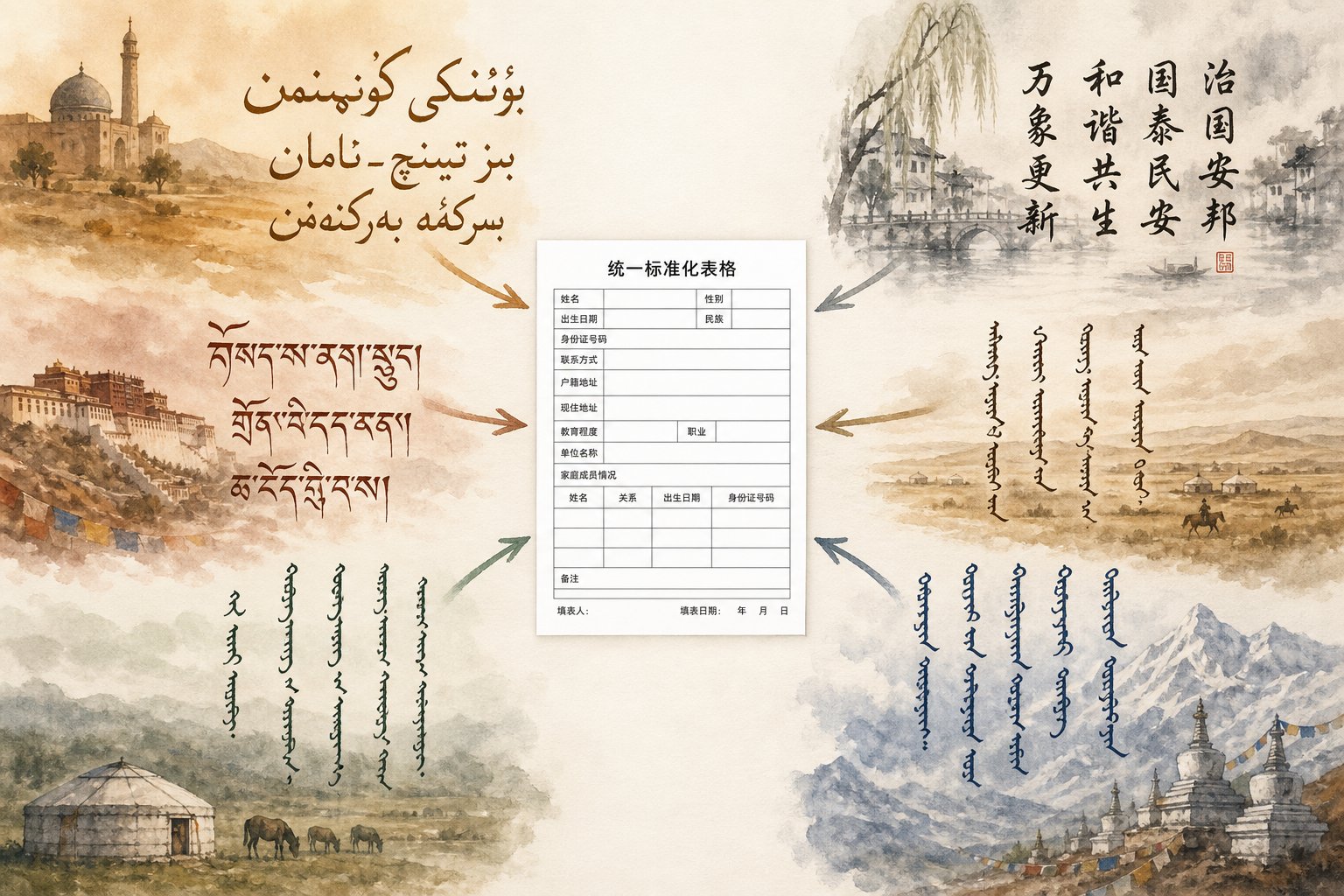
China officially recognizes 56 ethnic groups, and 55 of them are not Han Chinese. Many of these groups carry naming traditions that look nothing like the surname-plus-given-name format the registration system was built around. Patronymic chains, names without surnames entirely, religious honorifics embedded in personal names, names that run six or seven syllables long. The chinese naming convention most people picture, a one-character surname followed by a one- or two-character given name, is really a Han convention. For tens of millions of minority citizens, fitting their identity into that mold requires compromise, transliteration, and sometimes outright loss of meaning.
How Minority Naming Traditions Fit PRC Law
The legal framework does acknowledge that non-Han groups have different naming structures. Article 1015 of the Civil Code explicitly permits ethnic minorities to follow their own customs when selecting surnames, and the household registration system technically allows names longer than the typical two-to-three character Han format. But "allows" and "accommodates smoothly" are very different things.
Consider how different these traditions actually are:
| Ethnic Group | Name Structure | Surname Convention | Typical Length (in Chinese characters after transliteration) | Key Challenge Under PRC Registration |
|---|---|---|---|---|
| Han Chinese | Surname + given name | Inherited patrilineal surname (1-2 characters) | 2-3 characters | Rare character encoding |
| Uyghur | Given name + father's name (patronymic) | No fixed surname in the Han sense; father's name functions as identifier | 4-8 characters | Interpunct formatting; religious name bans |
| Tibetan | Given name only (often 2-4 syllables) or clan name + given name | Clan names exist but are not universally used as surnames | 4-6 characters | No clear surname/given name division for system fields |
| Mongolian | Clan name + given name (historically); given name only (modern PRC practice) | PRC does not recognize Mongolian clan names as official surnames | 3-6 characters | Surname field left blank or filled with "XXX" on passports |
The Mongolian case is particularly striking. Because the PRC government does not recognize Mongolian clan names as surnames, many ethnic Mongolians are registered with only a given name and no surname at all. Their ID cards leave the surname field empty, and their passports display "XXX" where a family name should appear. Some individuals adopt a single Han Chinese character that phonetically resembles their clan name, essentially inventing a surname to satisfy a system that demands one.
Tibetan names present a different puzzle. Chinese traditional names in Tibetan culture often consist of four syllables drawn from Buddhist vocabulary, like "Tashi Delek" or "Lobsang Gyatso," without a clear division between what counts as a surname and what counts as a given name. Registration officers must decide where to split the name for database entry, and that decision is often arbitrary. Two siblings with names of identical structure might end up with different "surnames" in the system depending on which officer processed their registration.
Transliteration Challenges for Non-Han Names
Every minority name that enters the household registration system must be rendered in Chinese characters, regardless of the language it originates from. This transliteration process introduces distortion at multiple levels.
First, there is the phonetic mismatch. Uyghur, Tibetan, and Mongolian languages contain sounds that have no precise equivalent in Mandarin Chinese. Transliterators must choose the closest-sounding Chinese character, which inevitably carries its own meaning. A name that means "brave" in Uyghur might be transliterated into characters that mean "iron pot" in Chinese, stripping the name of its intended significance. The chinese name origins and cultural weight embedded in the original language simply do not survive the conversion.
Second, there is the length problem. A Uyghur name like "Abdulrehim Tohti" requires six or more Chinese characters when transliterated. Government computer systems, online banking platforms, and e-commerce websites were designed around the assumption that asian names are short, typically three characters or fewer. The BBC reported that Uyghur, Kazakh, and Tibetan minorities frequently encounter problems inputting their names on official documents built to accommodate short Mandarin names.
Third, there is the interpunct issue. Longer minority names use a middle dot (the interpunct) to separate the given name from the patronymic or clan name on ID cards. But many digital systems, from bank account applications to train ticket platforms, do not support this punctuation mark. In 2011, Bank of China branches introduced a standardized format for inputting the interpunct, but other banks and services were slow to follow. As recently as 2016, Xinjiang's population management bureau acknowledged that "many e-commerce developers know little about ethnic names and the format of the dot used in ID card registration," leaving millions of minority citizens locked out of online services that require name verification.
Reported Restrictions on Minority Name Choices
Beyond the technical friction, there are content-based restrictions that apply specifically to minority communities. In 2017, authorities in Xinjiang enacted bans on a list of Muslim names deemed to "exaggerate religious fervor" or carry "connotations of holy war or of splittism." Human Rights Watch documented that banned names included Islam, Quran, Mecca, Jihad, Imam, Saddam, Muhammad, Hajj, and Medina, among others.
The practical enforcement mechanism is the hukou system itself. Children given banned names cannot obtain household registration, which means they cannot access public school, healthcare, or social services. For parents, the choice is stark: select a different name or leave your child without legal identity. This goes well beyond the general "public order and good morals" restriction that applies to all citizens. It targets specific religious and cultural naming traditions of a particular ethnic group.
These restrictions sit alongside broader policies in Xinjiang that regulate religious expression, including rules on beards, veils, and religious education. The naming bans are part of what rights organizations describe as a systematic effort to reshape Uyghur cultural identity through administrative control. Whether framed as counter-extremism or cultural standardization, the effect is the same: a narrowing of permissible cantonese names, Uyghur names, Tibetan names, and other minority naming traditions into a format the state finds acceptable.
Xinjiang authorities also launched a campaign to "clear up" inconsistencies in minority names across identity documents, social security cards, and medical insurance records. Radio Free Asia reported that authorities had "corrected" 20 million names on social security accounts where data was deemed "non-standardized." The stated goal was administrative consistency, but critics argue the real purpose is to increase state control over minority populations by forcing their identities through a standardization process designed around Han norms.
These minority-specific restrictions reveal something important about how naming regulation functions in China more broadly. The system was designed for one dominant naming convention and has been retrofitted, sometimes clumsily and sometimes coercively, to handle the rest. That tension between a unified administrative system and genuine cultural diversity is not unique to China. Other countries face similar questions about how much naming freedom to permit, and comparing their approaches helps put China's framework in perspective.
Chinese Naming Laws in Global Context and Ongoing Debates
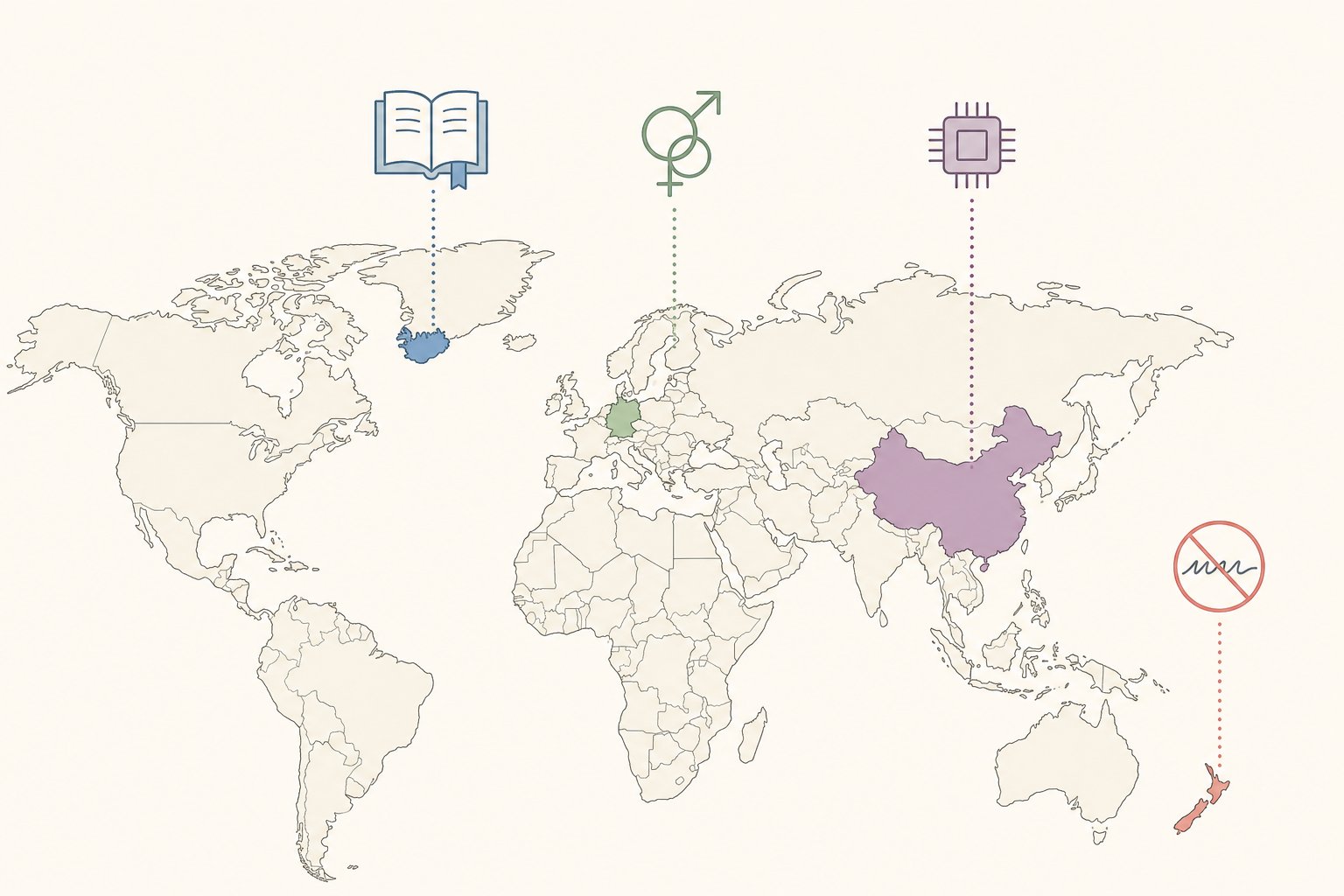
Is China unusually strict about names, or does every government draw lines somewhere? The answer depends on what you compare. Several countries maintain formal naming regulations, each reflecting different cultural priorities. Placing China's framework alongside Iceland's grammar-based system, Germany's gender rules, and New Zealand's decency standards reveals that naming restriction is a global phenomenon, but China's version is uniquely shaped by the intersection of character-based writing, digital infrastructure, and political control.
How China Compares to Global Naming Restrictions
Every country on this list restricts names. The differences lie in what they restrict, who decides, and how much room parents have to push back.
| Country | Regulatory Mechanism | Primary Restriction Criteria | Approved List? | Appeals Process |
|---|---|---|---|---|
| China | Public security bureau review + computer system encoding | Character set limits, public morals, political sensitivity, system compatibility | Yes (8,105 approved characters) | Administrative reconsideration, then court |
| Iceland | Personal Names Committee (Mannanafnanefnd) | Must conform to Icelandic grammar, gender assignment, and be writable in Icelandic script | Yes (1,853 female / 1,712 male approved names) | District court appeal |
| Germany | Local civil registry office (Standesamt) | Must indicate gender, cannot be a surname, must not endanger child welfare | No formal list, but precedent-based guidance | Court appeal |
| New Zealand | Registrar-General of Births, Deaths and Marriages | Cannot resemble a title, be unreasonably long, or cause offense | No approved list, but a banned names list exists | Family court |
Iceland's system is the closest structural parallel to China's. Both maintain pre-approved lists, and both require names to fit within a specific linguistic framework. A 15-year-old Icelandic girl named Blaer spent her entire childhood listed as "Girl" on official documents because the committee classified her name as masculine. She won the right to keep it only after a district court ruling. The difference? Iceland's list contains roughly 3,500 names. China's approved character set contains 8,105 characters that can be combined in virtually unlimited ways, making the restriction less about specific names and more about the building blocks available to construct them.
Germany takes a different approach. There is no master list, but registrars apply a gender-identifiability rule: a name must make the child's sex recognizable. A Turkish couple in Germany was blocked from naming their baby "Osama Bin Laden" on child welfare grounds, and a boy could not be named "Matti" because the registrar deemed it gender-ambiguous. China does not require names to signal gender, though cultural norms around chinese masculine names and chinese feminine names create strong informal pressure in that direction. Parents choosing chinese feminine names like "Mei" or "Xiu" and chinese masculine names like "Wei" or "Gang" are following convention, not law.
New Zealand's banned names list is reactive rather than preventive. The name "4Real" was rejected because names cannot begin with a number. A judge made a girl named "Talula Does The Hula From Hawaii" a ward of court so she could change it. But New Zealand does not pre-screen names against an approved database the way China does. The restriction kicks in only when something obviously problematic is submitted.
What makes China's system distinct is the technology layer. No other country's naming restrictions are so deeply mediated by computer encoding standards. Iceland might reject a name for grammar. Germany might reject one for gender ambiguity. But only in China can a name be rejected because the database literally cannot store it.
Notable Naming Controversies and Policy Debates
China's naming landscape has produced several high-profile disputes that illuminate where the system's boundaries are tested. Each case reveals a different pressure point in the regulatory framework.
The "Zhao C" case remains the most legally significant. A citizen who had used the Latin letter "C" as his given name since birth was forced to change it when upgrading to a second-generation ID card. He sued, arguing that his name was part of his established identity. The court initially sided with him, but the public security bureau appealed, and Zhao ultimately changed his name rather than continue fighting. The case established that non-Chinese characters have no place in the registration system, regardless of how long they have been used informally.
More recently, a 23-year-old man from Hunan province made national news by repeatedly applying to change his name. Born as Zhu Yunfei, he first renamed himself "Zhu Que Xuan Wu" and then "Zhu Que Xuan Wu Chi Ling," a six-character name referencing mythical creatures. He then applied for a 48-character name, which authorities rejected. His father publicly criticized the behavior, and the case reignited debate about whether the law should impose explicit character limits on name length.
The rare character debate is equally contentious. Linguists and cultural preservationists argue that restricting names to the 8,105-character standard table erases centuries of literary heritage. Famous chinese names from classical literature and history use characters that no longer appear in the approved set. Parents who want to honor ancestors or draw on classical chinese names and meanings find themselves blocked by a system that privileges administrative convenience over cultural continuity. On the other side, government officials argue that standardization reduces confusion, prevents fraud, and ensures interoperability across digital systems.
There is also the ongoing question of chinese name meaning and parental intent. Should the state care why a parent chose a particular name? Current law says yes, at least when the meaning crosses into obscenity or political sensitivity. But the boundary is fuzzy. A name referencing a historical figure might be fine in one political climate and problematic in another. The discretion given to local officers means that chinese name interpretation is partly a matter of who reviews your application and what they think the name implies.
The Future Direction of Chinese Naming Regulation
Where is all this heading? Three trends are converging to reshape how naming works in China.
First, digitization is expanding, not contracting, the system's reach. As more government services move online and biometric identity verification becomes standard, the pressure for names to be machine-readable intensifies. Every new digital system that requires name input creates another checkpoint where non-standard names can fail. The push to support rare characters through expanded encoding standards and input tools is real, but it is racing against the proliferation of systems that were built without them.
Second, the proposed Name Registration Regulations, if enacted, would formalize many practices that currently exist only as informal guidance. Draft provisions suggest explicit character limits, standardized rejection criteria, and a national appeals framework. This would reduce the inconsistency that currently allows one district to approve a name that another rejects, but it would also codify restrictions that some families currently navigate through local discretion.
Third, cultural attitudes are shifting. Younger parents increasingly view naming as a form of self-expression rather than pure lineage signaling. The rise of compound surnames, the growing interest in classical chinese name meaning and literary references, and the willingness to fight rejections in court all point toward a population that expects more flexibility than the system currently offers. The 48-character application from Hunan is an extreme case, but it reflects a broader impulse to test boundaries.
The tension is structural. China's naming system was designed for administrative efficiency in a pre-digital era when most people chose from a small pool of common characters. It now must accommodate a population that is more educated, more mobile, more digitally connected, and more interested in individuality than any previous generation. Whether the system adapts through expanded character support and clearer legal standards, or whether it doubles down on standardization as a tool of social control, will depend on which institutional pressures win out. For now, the computer still has the last word.
Frequently Asked Questions About Chinese Naming Laws and Restrictions
1. What characters are allowed in Chinese names?
Only characters from the Table of General Standard Chinese Characters are officially permitted for name registration in mainland China. This government-curated list contains 8,105 characters across three tiers. Characters outside this set, along with numerals, Latin letters, and non-Chinese symbols, are prohibited. In practice, the restriction is even tighter because government computer systems using GBK encoding can only process around 32,000 characters, and many deployed systems handle far fewer. Hong Kong and Taiwan maintain separate, broader character standards for their own registration systems.
2. Can a child take the mother's surname in China?
Yes, Chinese law explicitly permits children to take either the father's or mother's surname. Article 1015 of the Civil Code lists both as equally valid options. In limited circumstances, a child may also take the surname of an elder direct blood relative or a legal guardian. Despite legal equality, population data shows that matrilineal naming remains uncommon and is often linked to specific family circumstances, such as the mother having no brothers, rather than reflecting widespread adoption of the practice.
3. How do you legally change your name in China?
Name changes require an application at your local public security bureau with documented justification. Accepted grounds include adoption, gender transition, ethnic minority name adaptation, avoiding community duplicate names, and correcting clerical errors. Simply disliking your name is not a recognized reason. Once approved, the individual must separately update every linked document including ID cards, passports, bank accounts, and property records. Adults face stricter scrutiny than minors, and some jurisdictions informally limit citizens to one name change per lifetime.
4. Why do some Chinese names get rejected during registration?
Names are rejected for two main reasons. Technical failures occur when the chosen character does not exist in the government computer system's encoding standard, making it impossible to enter. Substantive objections arise when officers determine a name violates public morals, contains politically sensitive content, uses banned characters, or employs non-Chinese symbols. Roughly 60 million Chinese citizens have names containing rare characters that cause ongoing digital processing problems, affecting everything from banking to travel bookings.
5. Do ethnic minorities in China follow the same naming rules?
Ethnic minorities have legal flexibility to follow their own naming customs, including longer names and non-surname traditions. However, all names must be transliterated into Chinese characters for official registration, which often distorts meaning and creates length problems. Uyghur patronymic names, Tibetan Buddhist names, and Mongolian clan names all face structural mismatches with a system designed around short Han Chinese names. Additionally, authorities in Xinjiang have banned specific Muslim names deemed to exaggerate religious fervor, a restriction that goes beyond the general rules applied to Han citizens.