Why Chinese Has So Many Names for Grandparents
If you've ever tried looking up chinese nicknames for grandparents, you probably noticed something surprising: there isn't just one word for "grandma" or "grandpa." There are at least four standard terms in Mandarin alone, and dozens more across regional dialects. So what's going on?
Why Chinese Has More Than One Word for Grandma and Grandpa
In English, "grandmother" covers every grandmother regardless of which parent she belongs to. Chinese doesn't work that way. The language draws a clear line between your father's parents and your mother's parents, giving each a completely different name. This means a child growing up in a Chinese-speaking household uses distinct words for all four grandparents from the very start.
The reason traces back to China's patrilineal family structure, where bloodlines were carried through male heirs and a woman traditionally joined her husband's clan after marriage. Maternal relatives were linguistically marked as "outside" the core family unit. That cultural logic is baked directly into the chinese character for grandparents on the mother's side, which includes the character 外 (wai), meaning "outside" or "external."
The Paternal vs Maternal Distinction Explained
Chinese kinship terms encode which side of the family someone belongs to — paternal or maternal — something English simply does not do.
This single distinction is the key to understanding why chinese names for grandparents feel so numerous to English speakers. Your father's mother is 奶奶 (nai nai). Your mother's mother is 外婆 (wai po) or 姥姥 (lao lao), depending on the region. Different characters, different sounds, different cultural weight. The same split applies to grandfathers: 爷爷 (ye ye) on the paternal side, 外公 (wai gong) or 姥爷 (lao ye) on the maternal side.
And that's just Mandarin. Factor in Cantonese, Hokkien, Hakka, and Shanghainese, and the list of chinese grandparents names grows considerably. Add informal baby-talk versions, modern blended nicknames, and regional slang, and you'll see why families sometimes feel overwhelmed choosing the right term.
This guide covers all of it: formal and informal terms for grandparents in chinese, pronunciation tips for non-native speakers, dialect comparisons, and a practical framework for picking the name that fits your family best. Whether your child's grandparents speak Mandarin, Cantonese, or a mix of both, you'll find the right nickname here.
Paternal Grandmother in Chinese — Nai Nai
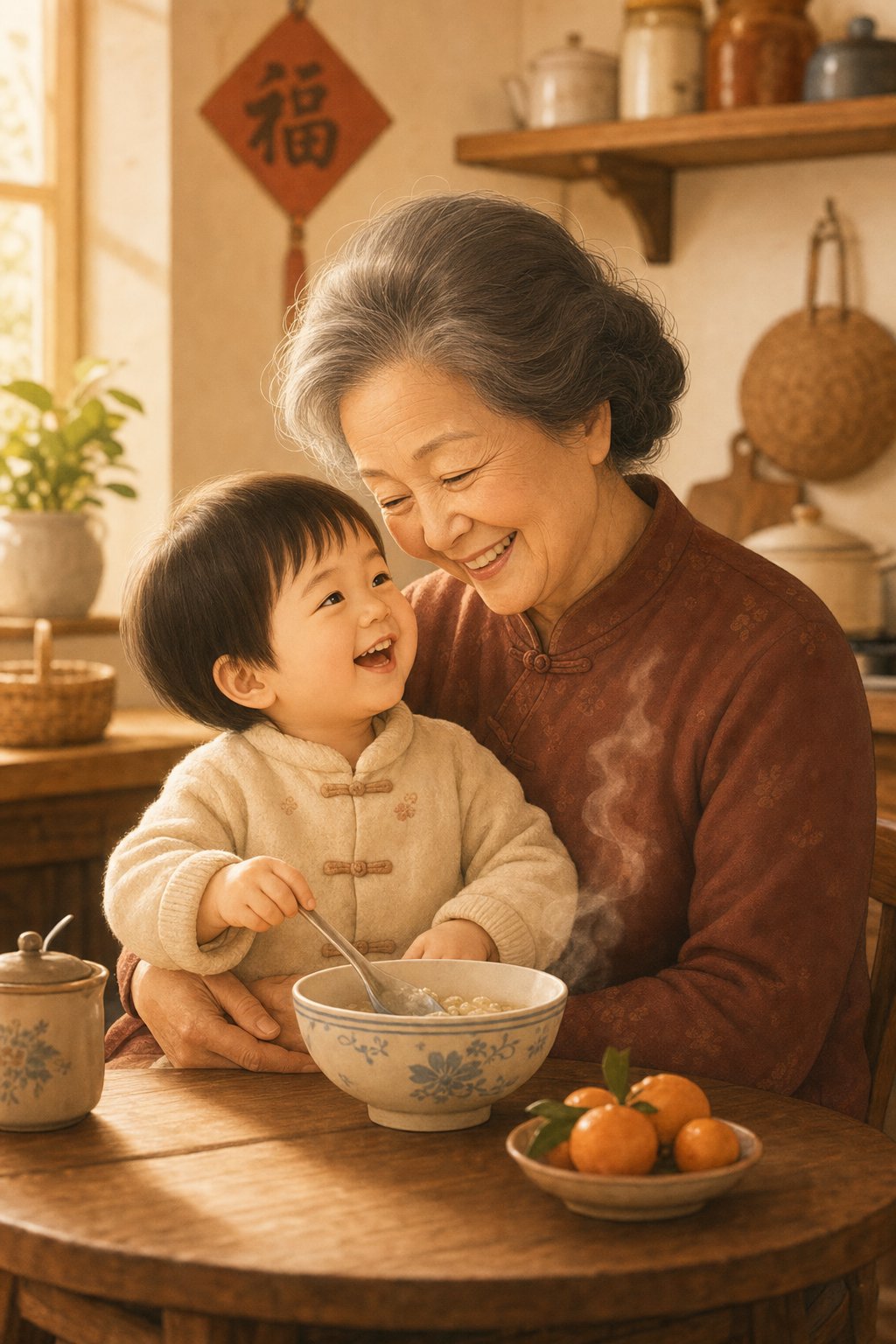
The paternal vs maternal distinction makes more sense once you see it in action. Your father's mother gets her own dedicated term in Mandarin, and it's one of the first family words Chinese children learn to say.
Nai Nai — Your Father's Mother in Mandarin
When you look up grandma in chinese on the paternal side, you'll find 奶奶 (nǎi nai) everywhere. This is the standard, universally recognized term for your father's mother across all Mandarin-speaking regions — mainland China, Taiwan, and Singapore alike. Unlike the maternal grandmother terms that vary by region (more on that later), nai nai chinese speakers use this one consistently no matter where they live.
The nainai meaning is straightforward: it refers specifically and exclusively to your paternal grandmother. There's no ambiguity. When a child says 奶奶, everyone in the room knows they're talking about their father's mother. This precision is exactly what makes Chinese kinship terms so useful once you get the hang of them.
In everyday life, children use 奶奶 as both a form of address (calling out to grandma directly) and a reference term (talking about grandma to someone else). You'll hear kids shout "奶奶!" when they run to greet her at the door, or say "奶奶说..." (nǎi nai shuo — grandma said...) when relaying a message.
How to Write and Pronounce Nai Nai
Pronunciation trips up a lot of English speakers, so let's break it down clearly. When you say nai nai in chinese conversation, the first syllable carries a third tone (falling then rising), while the second syllable is spoken in a neutral, unstressed tone. Imagine saying "nigh-nigh" — like the English word "nigh" repeated — but dipping your voice down and back up on the first syllable, then keeping the second one light and flat.
- Characters: 奶奶 (Traditional and Simplified are identical)
- Pinyin: nǎi nai (third tone + neutral tone)
- Tone description: The first syllable dips low then rises, like the surprised "huh?" sound you make when you didn't hear something. The second syllable stays short and unstressed.
- English phonetic approximation: "nigh-nigh" — rhymes with "my my" but with an "n" at the start
- Character breakdown: The character 奶 (nǎi) combines the female radical 女 (nu) on the left with 乃 (nǎi) on the right, which provides the sound. The 女 radical signals that this character relates to a female family member.
- Stroke count: 5 strokes per character, 10 total for 奶奶
The character 奶 originally carried the meaning of "breast" or "milk" — think of it as the nurturing, feeding figure in a child's life. Over time, its primary everyday usage shifted to mean paternal grandmother when doubled as 奶奶. You'll still see the "milk" meaning in words like 牛奶 (niu nai, meaning "cow's milk"), which gives you a helpful memory hook: the character connects to nourishment and caregiving.
One common mistake English speakers make is pronouncing both syllables with equal stress and the same tone. In natural Mandarin speech, the second 奶 softens into a neutral tone, making the word sound more like "NAI-nai" with the emphasis clearly on the first syllable. Getting this rhythm right will make your child's pronunciation sound much more natural to native speakers.
For families where the paternal grandmother in chinese culture holds a particularly close caregiving role — which is common in three-generation households — 奶奶 often becomes one of a toddler's very first words, right alongside 妈妈 (mama) and 爸爸 (baba). It's a term loaded with warmth and daily familiarity, not formality.
Paternal Grandfather in Chinese — Ye Ye
Every 奶奶 has her counterpart. On the paternal side, your father's father gets an equally distinct and widely used term that Chinese children pick up just as early in life.
Ye Ye — Your Father's Father in Mandarin
The standard chinese name for grandpa on the paternal side is 爷爷 (ye ye). Like 奶奶, this term is universal across Mandarin-speaking regions — you'll hear it in Beijing, Taipei, Shanghai, and Singapore without any regional variation. When a child wants to call their father's father, 爷爷 is the go-to word every single time.
So how to say grandpa in chinese on the paternal side? Think "yeh-yeh" — similar to the English word "yeah" repeated twice, but with a rising pitch on the first syllable. Your voice should glide upward on that first "yeh," almost like you're asking a question, then drop to a light, neutral tone on the second syllable.
- Characters: 爷爷 (Simplified) / 爺爺 (Traditional)
- Pinyin: ye ye (second tone + neutral tone)
- Tone description: The first syllable rises in pitch from mid to high, like the upward inflection when you say "really?" in English. The second syllable stays short and unstressed.
- English phonetic approximation: "yeh-yeh" — rhymes with "yeah-yeah" with a rising lilt on the first sound
- Character breakdown: The simplified character 爷 (ye) is composed of 父 (fu, meaning "father") on top and 卩 on the bottom. The traditional form 爺 places 父 above 耶, making the "father" component visually prominent.
- Usage context: Everyday speech, direct address, and reference — children use it the same way English-speaking kids use "Grandpa"
The character 爷 carries historical weight. Its top component 父 literally means "father," signaling that this is a senior male figure one generation above your own father. In imperial China, 爷 was also used as an honorific for men of authority and status — landlords, officials, and clan elders were all addressed with titles ending in 爷. That association with respect and patriarchal authority still lingers in the character's cultural DNA, even though today it's simply what toddlers shout when grandfather in mandarin walks through the door.
Formal vs Everyday Terms for Paternal Grandfather
You might also encounter 祖父 (zu fu) in textbooks, official documents, or formal writing. This is the literary chinese name for grandfather on the paternal side, and it's the term you'd see on genealogical records or in news articles. Think of the difference between "grandfather" and "grandpa" in English — 祖父 is the buttoned-up version, while 爷爷 is what people actually say at home.
The character 祖 (zu) means "ancestor" or "forefather," giving 祖父 a more solemn, reverent tone. Children almost never use 祖父 in conversation. If your kid said 祖父 at the dinner table, it would sound oddly formal — like a five-year-old saying "I shall retire to my chambers" instead of "I'm going to bed."
Regional usage stays remarkably consistent for the paternal grandfather in chinese families. Unlike maternal grandparent terms (which split sharply between Northern and Southern China), 爷爷 dominates everywhere Mandarin is spoken. Northern speakers in Beijing use it. Southern speakers in Guangdong who also speak Mandarin use it. Taiwanese families use it alongside the Hokkien-influenced 阿公 (a gong). This consistency makes 爷爷 one of the easiest grandparent terms for multilingual families to adopt — no matter which region your child's paternal grandfather comes from, 爷爷 will always land correctly.
In daily life, children often shorten it to a single 爷 (ye) when speaking quickly or casually, especially in Northern China. You'll hear phrases like "爷, 我饿了" (ye, wo e le — Grandpa, I'm hungry) in the same way English-speaking kids might drop "Grandpa" down to "Gramps." This shortened form sounds natural and affectionate rather than disrespectful.
The paternal side of the family tree is now covered — but the maternal grandparents bring a whole different set of terms, and this is where regional differences really come into play.
Maternal Grandmother in Chinese — Wai Po and Lao Lao
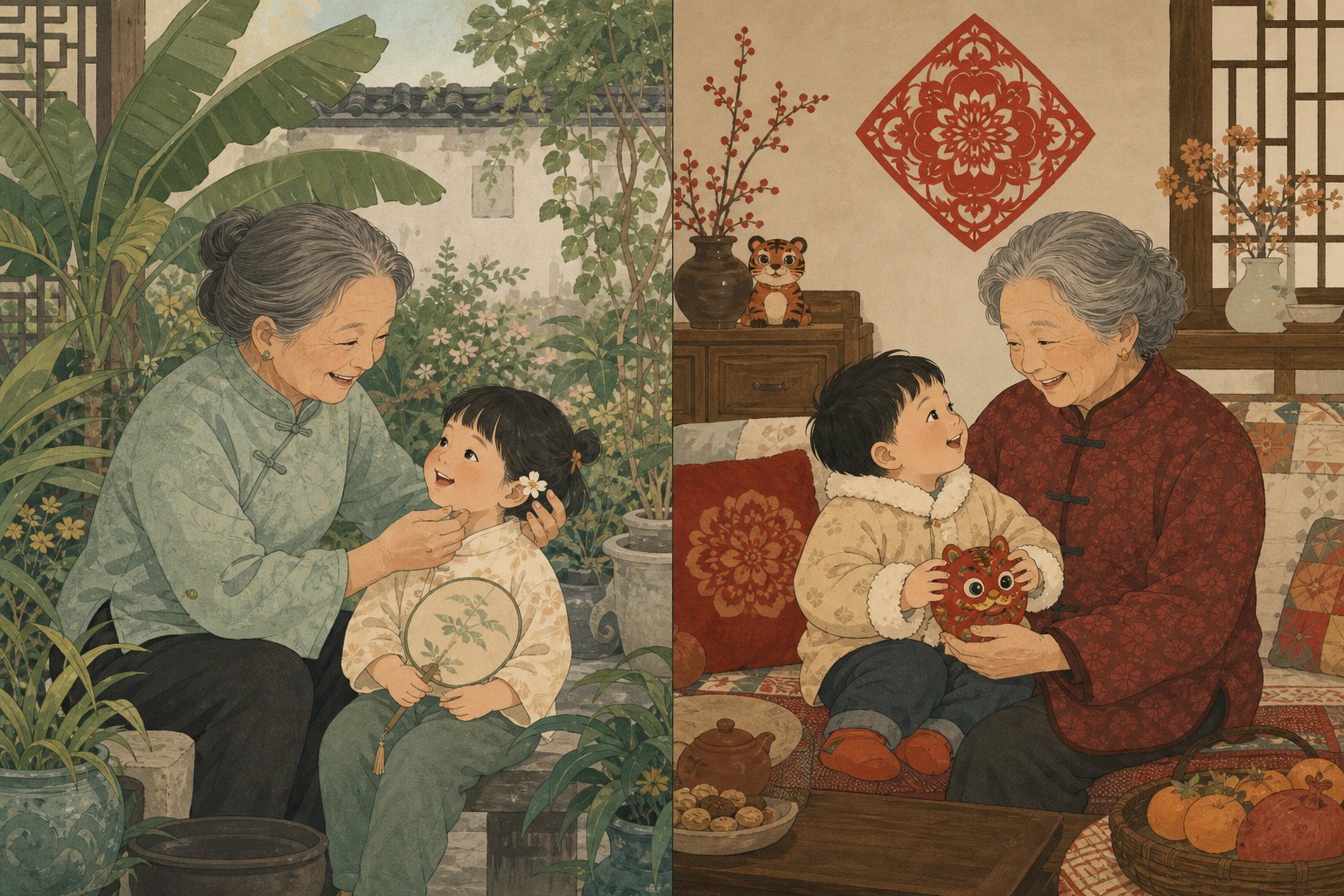
Here's where Chinese grandparent terms get interesting. Unlike the paternal side, where 奶奶 reigns unchallenged across all regions, the maternal grandmother in chinese has two equally valid names — and which one your family uses depends almost entirely on geography.
Wai Po vs Lao Lao — Two Terms for Your Mother's Mother
If you ask someone in Shanghai, Guangzhou, or Taipei what they call their mother's mother, they'll say 外婆 (wai po). Ask the same question in Beijing or Harbin, and you'll hear 姥姥 (lao lao). Both are correct. Both are standard Mandarin. Neither is more "proper" than the other. The split is purely regional, and most Chinese speakers understand both terms regardless of where they grew up.
So what does wai po in chinese actually mean at the character level? The first character 外 (wai) means "outside" or "external." The second character 婆 (po) means "elderly woman" or "grandmother." Put them together and you get something like "outside grandmother" — a direct linguistic marker that this grandparent belongs to the mother's side of the family, which traditional Chinese kinship systems considered "external" to the patrilineal household.
That 外 character is the key cultural detail here. In China's historical family structure, children belonged to their father's clan and carried his surname. The mother's relatives — while loved and respected — were linguistically categorized as "outer kin." You'll notice this same 外 prefix on the maternal grandfather term (外公) and even on terms for a daughter's children (外孙). It's a pattern woven throughout the entire kinship system.
姥姥 (lao lao) takes a different approach. The character 姥 (lao) simply means "grandmother" or "old woman" — no "outside" marker attached. Some families in Northern China prefer it precisely because it feels warmer and less distancing than the 外 prefix. The character contains the female radical 女 on the left, signaling a female family member, paired with 老 (lao, meaning "old" or "venerable") as the phonetic component.
Here's a quick comparison to help you see the differences at a glance:
| Term | Characters | Region Primarily Used | Phonetic Guide |
|---|---|---|---|
| Wai Po | 外婆 | Southern China, Taiwan, Singapore | "why-pwaw" — falling tone on first syllable, rising tone on second |
| Lao Lao | 姥姥 | Northern China (Beijing, Northeast) | "lao-lao" — dipping tone on first syllable (sounds rising due to tone sandhi), dipping tone on second |
For pronunciation, 外婆 breaks down like this: 外 (wai) uses a falling fourth tone — a short, sharp downward pitch, like saying "why" with conviction. 婆 (po) uses a rising second tone — your voice glides upward, like asking a question. Together it sounds roughly like "why-pwaw" with that upward lilt at the end.
姥姥 is trickier because of Mandarin's tone sandhi rule. Both characters are third tone (the dipping tone), but when two third tones appear back-to-back, the first one shifts to a rising second tone in natural speech. So lao lao in chinese conversation actually sounds more like "lao-lao" with the first syllable rising and the second one dipping low. Think of it as "lao" (rhymes with "cow") repeated twice, with a rising pitch on the first and a low dip on the second.
Understanding Po Po and Its Regional Meanings
You might also encounter 婆婆 (po po) when researching the maternal grandma in mandarin. This is where things get a little confusing, because po po in chinese carries different meanings depending on where you are.
In some Southern Chinese dialects and older usage patterns, 婆婆 can refer to a maternal grandmother — essentially a shortened, more affectionate version of 外婆 with the 外 dropped. However, in most of mainland China today, 婆婆 primarily means "mother-in-law" (specifically, your husband's mother). A married woman referring to her 婆婆 is almost always talking about her husband's mom, not her own grandmother.
In Taiwan and among some overseas Chinese communities, the meaning can shift again. Context usually makes it clear, but if you're choosing a term for your child to use, sticking with 外婆 or 姥姥 avoids any ambiguity. Save 婆婆 for when your child is old enough to understand the contextual nuances — or when the grandmother herself prefers it.
The practical takeaway? Ask your child's maternal grandmother which term she actually uses. A grandmother from Sichuan will likely respond to 外婆. A grandmother from Heilongjiang will probably prefer 姥姥. And a grandmother who grew up hearing 婆婆 in her own family might want that tradition carried forward. Regional preference matters, but personal preference matters more.
With the maternal grandmother covered, her counterpart — the maternal grandfather — brings his own North-South split and a few naming surprises of his own.
Maternal Grandfather in Chinese — Wai Gong and Lao Ye
The same North-South split that gives us 外婆 and 姥姥 for maternal grandmother shows up again on the grandfather side. Your mother's father has two common names in Mandarin, and the one your family uses follows the same regional logic.
Wai Gong vs Lao Ye — Your Mother's Father
In Southern China, Taiwan, and Singapore, children call their maternal grandfather 外公 (wai gong). In Northern China — Beijing, the Northeast, and surrounding regions — the preferred term is 姥爷 (lao ye). Both are standard Mandarin, both are widely understood, and neither is more correct than the other. The choice comes down to where your family is from.
So what does gong gong in chinese family terms actually refer to? The character 公 (gong) carries a dual meaning: "grandfather" and "public" or "venerable male elder." You'll see 公 in words like 公园 (gong yuan, public park) and 公司 (gong si, company), where it conveys the sense of something communal or respected. When used in kinship terms, 公 signals a senior male figure — a grandfather. Pair it with 外 (wai, meaning "outside") and you get 外公: literally "outside grandfather," marking this person as belonging to the mother's side of the family tree.
The gong gong meaning shifts depending on dialect and context. In Cantonese-speaking families, 公公 (gong gong) on its own often refers to the maternal grandfather — essentially doubling the character for emphasis and affection. In standard Mandarin, however, 公公 more commonly means "father-in-law" (a husband's father), so sticking with the full 外公 avoids confusion when speaking Mandarin.
姥爷 (lao ye) takes a different construction. The character 姥 (lao) means "grandmother" or "elderly woman" — the same character used in 姥姥 — while 爷 (ye) means "grandfather" or "venerable man," the same character from 爷爷 on the paternal side. Together, 姥爷 creates a compound that Northern speakers immediately associate with the maternal grandfather. Think of it as pairing the maternal family marker (姥) with the grandfather character (爷) to produce a term that feels natural in Northern dialects.
For pronunciation, here's what you need:
- 外公 (wai gong): "why-gohng" — the first syllable uses a sharp falling fourth tone (like saying "why!" with emphasis), and the second syllable uses a flat first tone (steady high pitch, like singing one sustained note). Rhymes roughly with "why gong" as in the percussion instrument.
- 姥爷 (lao ye): "lao-yeh" — the first syllable uses a third tone (dips low then rises, like a surprised "huh?"), and the second syllable uses a neutral tone in casual speech. Sounds like "lao" (rhymes with "cow") followed by a light "yeh."
The formal written term for maternal grandfather is 外祖父 (wai zu fu). You'll encounter this in textbooks, legal documents, and school essays, but children never use it in conversation. It's the equivalent of writing "maternal grandfather" in a formal English letter instead of just saying "Grandpa." A 2022 update to Taiwan's Ministry of Education dictionary added a footnote clarifying that maternal grandparent terms carry the same meaning and status as paternal ones — a reflection of how modern families are moving away from the hierarchical implications of the 外 prefix while still preserving the terms in everyday use.
Using Grandfather Terms in Everyday Conversation
Imagine your child on a video call with their gong gong grandpa, or running to greet 姥爷 at the train station. What do they actually say? Here are natural sentences Chinese children use when addressing their maternal grandfather in daily life:
- 外公早上好! (wai gong zao shang hao!) — Good morning, Grandpa! A warm, polite greeting for morning video calls or breakfast time.
- 外公,您休息一下,我来帮您。 (wai gong, nin xiu xi yi xia, wo lai bang nin.) — Grandpa, take a rest, I'll help you. Shows care and uses the respectful "您" (nin) instead of casual "你" (ni).
- 姥爷,我想吃您做的饺子。 (lao ye, wo xiang chi nin zuo de jiao zi.) — Grandpa, I want to eat your dumplings. A classic Northern China sentence that connects food, family, and affection.
- 外公,给我讲个故事吧! (wai gong, gei wo jiang ge gu shi ba!) — Grandpa, tell me a story! Perfect for bedtime or quiet afternoons together.
- 姥爷,我爱您! (lao ye, wo ai nin!) — Grandpa, I love you! Simple, sincere, and worth practicing until it rolls off the tongue.
You'll notice the pattern: the grandparent term comes first in the sentence, functioning as a direct address before the child says what they want or feel. This mirrors how English-speaking kids say "Grandpa, look!" or "Grandpa, can we go?" The structure is intuitive even for children growing up bilingual.
For families where the gonggong chinese term feels more natural — particularly Cantonese-speaking households — simply swap 外公 for 公公 in these sentences and the grammar stays identical. The key is consistency: pick one term, use it regularly, and your child will internalize it faster than you expect.
With all four core grandparent terms covered in Mandarin, a bigger question emerges: what happens when your family doesn't speak Mandarin at all? Cantonese, Hokkien, and Hakka each bring their own set of grandparent nicknames — and for many overseas Chinese families, those dialect terms are the ones that actually get used at home.
Cantonese, Hokkien, and Other Dialect Variations
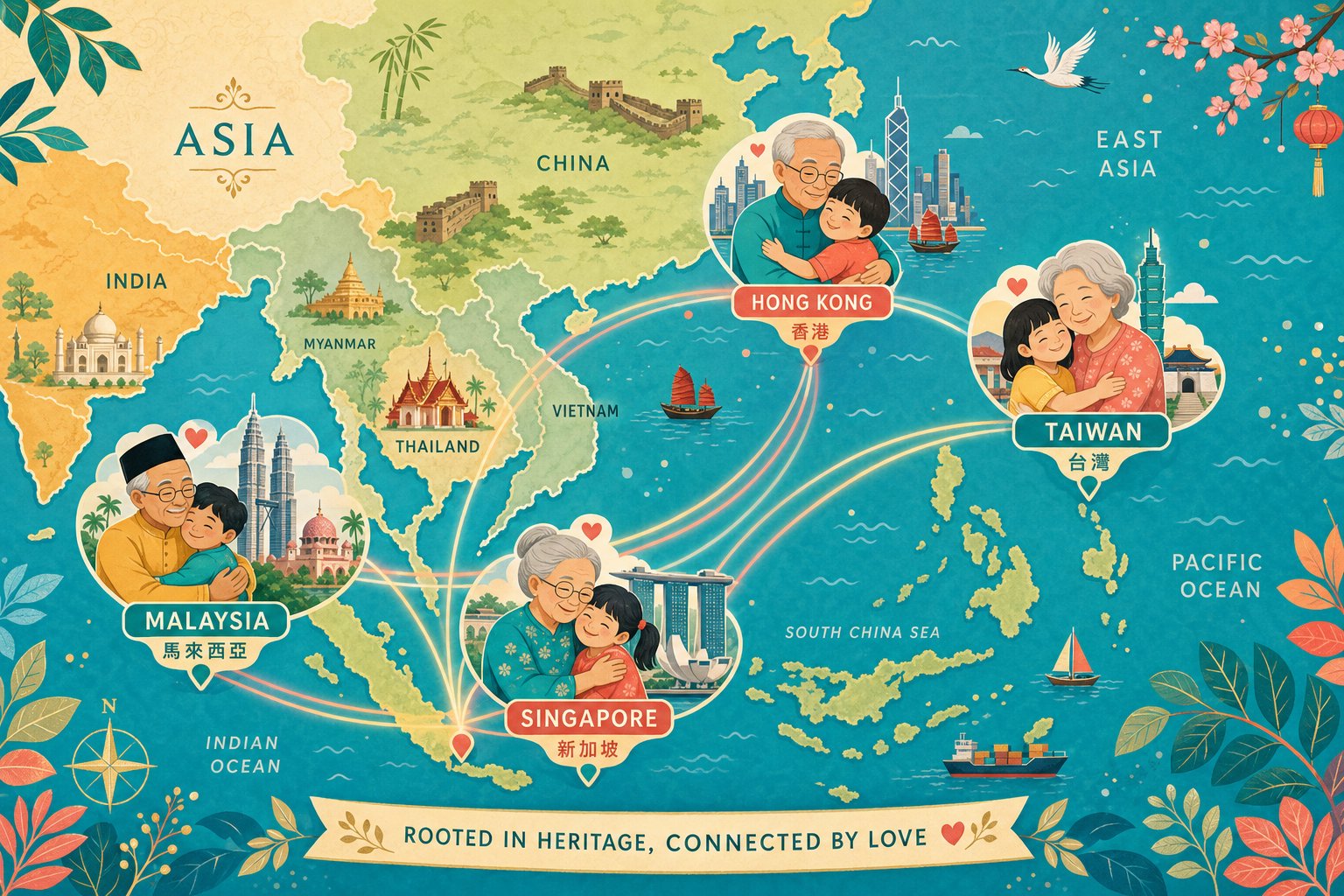
Mandarin terms dominate textbooks and language apps, but millions of Chinese families don't speak Mandarin at home. In Hong Kong, Guangdong province, and much of Southeast Asia, children grow up calling their grandparents by Cantonese, Hokkien, or Hakka names instead. If your child's grandparents emigrated from one of these regions, the Mandarin terms covered above might not be what they actually want to hear.
Cantonese Grandparent Nicknames Used in Hong Kong
Wondering how to say grandma in cantonese? The answer depends on which side of the family she belongs to — just like in Mandarin, the paternal-maternal split holds firm across all Chinese dialects.
For the paternal grandmother, Cantonese speakers use 嫲嫲 (maa4 maa4) or the affectionate prefixed form 阿嫲 (aa3 maa4). This is the cantonese for grandma on your father's side — a term you'll hear constantly in Hong Kong households and Cantonese-speaking communities worldwide. The paternal grandfather is 爺爺 (je4 je4) or 阿爺 (aa3 je4), carrying the same character as Mandarin's 爷爷 but with distinctly Cantonese pronunciation.
On the maternal side, the cantonese grandmother term is 外婆 (ngoi6 po4), often shortened in casual speech to 婆婆 (po4 po4) or 阿婆 (aa3 po4). The maternal grandfather in cantonese is 外公 (ngoi6 gung1), with the casual form 公公 (gung1 gung1) or 阿公 (aa3 gung1). You'll notice the same 外 (ngoi6, meaning "outside") prefix that appears in Mandarin — the cultural logic carries across dialect boundaries even when the pronunciation changes completely.
If you're trying to figure out how to say grandmother in cantonese for a specific family situation, the safest bet is 阿嫲 for paternal and 阿婆 for maternal. These prefixed forms sound warm and natural coming from a child's mouth, and they're the versions most commonly used in face-to-face address throughout Hong Kong and Guangdong.
Hokkien and Hakka Variations Across Southeast Asia
Hokkien-speaking communities — concentrated in Taiwan, Fujian province, and Southeast Asian countries like Malaysia, Singapore, and the Philippines — use their own distinct set of terms. According to Hokkien honorific conventions, the prefix 阿 (a-) attaches to base kinship nouns to create the address form children use.
In Hokkien, grandmother is 阿媽 (a-ma), and grandfather is 阿公 (a-kong). These terms don't distinguish between paternal and maternal sides the way Mandarin and Cantonese do — context and family convention fill that gap instead. Some Hokkien families add 外 (goa-) to mark the maternal side, producing 外媽 (goa-ma) or 外公 (goa-kong), but many simply use 阿媽 and 阿公 for whichever grandparent they see most often.
Hakka communities, spread across Guangdong, Taiwan, and parts of Southeast Asia, use 阿公 (a-kung) for grandfather and 阿婆 (a-pho) for grandmother. Like Hokkien, Hakka terms are less rigidly split between paternal and maternal in everyday speech, though formal reference terms maintain the distinction.
Here's a side-by-side comparison across all four major dialect groups:
| Relationship | Mandarin | Cantonese | Hokkien | Hakka |
|---|---|---|---|---|
| Paternal Grandmother | 奶奶 (nai nai) | 阿嫲 (aa3 maa4) | 阿媽 (a-ma) | 阿婆 (a-pho) |
| Paternal Grandfather | 爷爷 (ye ye) | 阿爺 (aa3 je4) | 阿公 (a-kong) | 阿公 (a-kung) |
| Maternal Grandmother | 外婆 / 姥姥 (wai po / lao lao) | 阿婆 (aa3 po4) | 外媽 (goa-ma) | 姐婆 (jia-pho) |
| Maternal Grandfather | 外公 / 姥爷 (wai gong / lao ye) | 阿公 (aa3 gung1) | 外公 (goa-kong) | 姐公 (jia-kung) |
A few patterns jump out from this table. Hokkien and Hakka share the 阿公 construction for grandfather, reflecting their common roots as Southern Min and Hakka branches of Chinese. Cantonese maintains the paternal-maternal split more explicitly through different base characters (嫲 vs 婆, 爺 vs 公). And across all dialects, the prefix 阿 (a-/aa3) serves as a universal softener that makes formal kinship terms sound affectionate and child-friendly.
For families in Hong Kong, Macau, and Cantonese-speaking diaspora communities in Canada, Australia, and the UK, the Cantonese terms are what children actually grow up saying. Similarly, Chinese families in Malaysia and Singapore often default to Hokkien or Hakka terms depending on their ancestral dialect group — even if they also speak Mandarin at school or work.
The practical implication? If your child's grandparents grew up speaking Cantonese in Hong Kong, teaching your kid to say 阿嫲 or 阿婆 will land far more naturally than the Mandarin equivalents. The grandmother cantonese speakers recognize is 嫲嫲 or 婆婆 — not 奶奶 or 外婆. Matching the dialect to the grandparent makes the connection feel genuine rather than textbook-learned.
Dialect terms carry family identity in a way that standardized Mandarin sometimes can't replicate. But beyond formal kinship vocabulary — whether Mandarin, Cantonese, or Hokkien — there's a whole layer of informal baby talk, shortened forms, and affectionate nicknames that Chinese children actually use when they're too young or too comfortable to bother with full terms.
Informal and Affectionate Nicknames Children Really Use
Textbook terms are one thing. What a three-year-old actually says when she runs toward her grandmother with arms outstretched? That's something else entirely. Chinese children rarely use the full, formal kinship terms in relaxed moments at home. Instead, they shorten, repeat, mash up, and invent — just like kids everywhere do with language they use every single day.
Baby Talk and Shortened Forms Kids Actually Use
Think about how English-speaking toddlers turn "grandmother" into "gramma" or "nana." Chinese children do the same thing with their grandparent terms, trimming them down to single syllables or stretching them into playful repetitions. These shortened forms aren't slang or sloppiness — they're natural, affectionate speech patterns that even adult family members adopt.
Here are the informal nicknames you'll hear in real Chinese households:
- 奶 (nai) alone: Children often drop the second syllable of 奶奶 entirely, calling out just "奶!" when they want grandma's attention quickly. Common in Northern China, especially in casual moments like mealtimes or when a child is being carried.
- 婆 (po) alone: A shortened form of 外婆, used the same way — one quick syllable to get maternal grandma's attention. You'll hear "婆, 来!" (po, lai! — Grandma, come!) from kids in Southern Chinese families.
- 公 (gong) alone: Maternal grandfather 外公 gets trimmed to just 公 in fast, casual speech. Less common than the grandmother shortenings, but still heard in families where the child sees 外公 daily.
- 爷 (ye) alone: The single-syllable version of 爷爷, especially popular in Northern China. "爷, 我饿了" (ye, wo e le — Gramps, I'm hungry) sounds completely natural from a child over age four or five.
- 阿嬤 (a ma): This warm, cross-dialect chinese grandma name originates from Hokkien and Taiwanese but has spread into general use across Taiwan and parts of Southeast Asia. The ah ma meaning is simply "grandma" — it carries a cozy, home-kitchen feeling that formal terms can't quite match. In Taiwan, 阿嬤 is used as an affectionate family term for grandmother regardless of paternal or maternal side.
- 阿公 (a gong): The grandfather counterpart to 阿嬤, used widely in Taiwanese and Hokkien-influenced families. Children in Taiwan often grow up saying 阿公 and 阿嬤 as their primary grandparent names rather than the Mandarin standard forms.
- 奶奶奶 or 爷爷爷: Toddlers learning to talk sometimes repeat syllables one too many times. A child might say "奶奶奶" (nai-nai-nai) before their speech settles into the standard two-syllable form. Most families find this adorable rather than something to correct immediately.
- 姥 (lao) alone: In some Northern families, children shorten 姥姥 to a single 姥, though this is less common than the 奶/婆/公 shortenings because the standalone character can sound abrupt.
The pattern is clear: children gravitate toward the shortest, easiest sound that still gets the right grandparent to turn around. These single-syllable forms work because Chinese is a context-heavy language — everyone in the room already knows which grandparent the child means.
For families searching for the right chinese name for grandma that feels natural rather than stiff, these shortened forms are worth considering. A child who says "奶!" with genuine excitement sounds far more connected than one reciting a full formal title they learned from a flashcard.
Modern Blended Nicknames in Younger Families
Something interesting is happening in urban Chinese families and diaspora households: English and Chinese are blending into hybrid grandparent names that didn't exist a generation ago. Younger parents — especially those raising bilingual children — are creating nicknames that bridge both languages.
You might hear any of these in a modern bilingual home:
- Grandpa Ye Ye or Grandpa Wai Gong: The English word "Grandpa" paired with the Chinese term, used by children who switch between languages throughout the day. It sounds redundant on paper, but for a child still sorting out two language systems, the doubling provides clarity.
- Nai Nai + a surname: Families with multiple grandmother figures sometimes add a surname for distinction — 李奶奶 (Li nai nai) versus 王奶奶 (Wang nai nai). This mirrors the English pattern of "Grandma Smith" or "Grandma Rose."
- Location-based nicknames: Cross-cultural families living abroad sometimes label grandparents by geography — 中国爷爷 (zhongguo ye ye, "China Grandpa") versus "American Grandpa." Some kids even coin 网络爷爷 (wangluo ye ye, "Internet Grandpa") for the grandparent they mostly see on video calls.
- Gong Gong and Yeh Yeh in English spelling: Cantonese-speaking families overseas often romanize the sounds directly — writing "Gong Gong" or "Yeh Yeh" in English texts, birthday cards, and family group chats. These spellings have become established chinese grandmother names and grandfather names in diaspora communities across Canada, Australia, and the UK.
- Ah Ma in English contexts: The Hokkien/Taiwanese 阿嬤 gets written as "Ah Ma" or "Ama" in English, and many families use this romanized form as the grandmother's official nickname even in English-language settings. The ama grandmother tradition is especially strong in Taiwanese-American and Malaysian-Chinese families.
This blending isn't a sign of language loss — it's adaptation. Children in multilingual environments naturally create systems that work for their specific family. A kid who says "Ah Ma" to her Taiwanese grandmother and "Grandma" to her American grandmother has solved a practical communication problem with zero confusion.
The generational shift is real, though. Grandparents who grew up in monolingual Chinese environments sometimes feel uncertain about these hybrid forms. The key is that the child is using a name consistently and with affection. Whether that name is a textbook-perfect 外婆, a shortened 婆, or a blended "Grandma Wai Po," the emotional connection matters more than linguistic purity.
Young children are also remarkably good at code-switching once they understand the system. A four-year-old might say 奶奶 on a video call to Beijing and "Grandma" five minutes later when talking to a friend at preschool. The informal nicknames — the single syllables, the hybrid forms, the baby-talk repetitions — are the bridge that makes this switching feel effortless rather than forced.
Of course, all these nicknames only work if the child can actually pronounce them. And for families where the parents themselves didn't grow up speaking Chinese, getting the tones and sounds right presents its own challenge — one that a few simple techniques can solve.
How to Say Grandma in Chinese — Pronunciation Guide for Non-Chinese Speakers
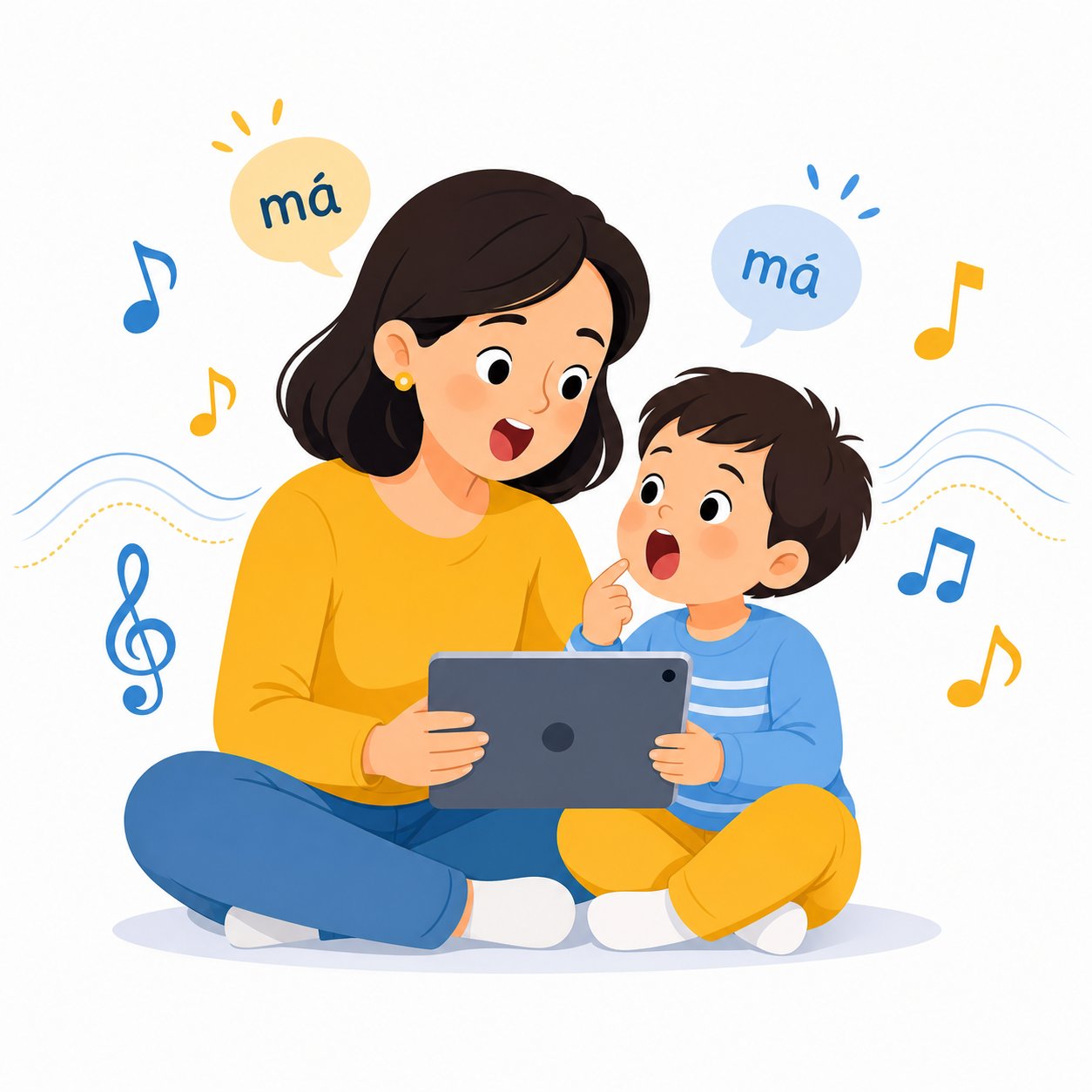
You've picked the right grandparent nickname. You know the characters. But when you try to say it out loud, something feels off — and your mother-in-law gently corrects you for the third time this week. Sound familiar? Mandarin pronunciation trips up English speakers not because the sounds are impossibly foreign, but because the tonal system works differently from anything in English. The good news: you don't need to master all of Mandarin to teach your child a handful of family terms. A few key concepts and some consistent practice will get both of you there.
Mandarin Tones Made Simple for English Speakers
Mandarin has four main tones plus a neutral (unstressed) tone. Each tone changes the pitch of your voice in a specific way, and using the wrong tone can change the word entirely. Think of it like this: in English, pitch signals emotion or grammar (a question rises, a command falls). In Mandarin, pitch signals meaning at the word level.
Here's how each tone maps to something you already do in English:
- First tone (high and flat): Imagine holding a single note while singing — steady, level, and slightly higher than your normal speaking voice. The "gong" in 外公 (wai gong) uses this tone. Think of the sustained "aah" you say at the dentist.
- Second tone (rising): This sounds like the upward inflection when you ask a one-word question: "What?" or "Huh?" The "ye" in 爷爷 (ye ye) uses this rising pitch. Start in the middle of your range and glide up.
- Third tone (low and dipping): Picture the creaky, low grumble you make when something goes wrong — a drawn-out "uhhh" that dips to the bottom of your voice. The "nai" in 奶奶 (nai nai) uses this tone. A common misconception is that it must dip down and bounce back up dramatically. In natural speech, it mostly just stays low.
- Fourth tone (falling): Say "No!" firmly to a child reaching for something hot. That sharp, decisive drop from high to low is your fourth tone. The "wai" in 外婆 (wai po) uses this falling pitch.
- Neutral tone (light and short): The second syllable in most grandparent terms (the second "nai" in 奶奶, the second "ye" in 爷爷) loses its original tone and becomes short, soft, and unstressed — like the "uh" in "sofa."
The musical analogy works well for children too. If your kid takes music lessons, you can describe the first tone as holding a high note, the second tone as a scale going up, the third tone as the lowest note on the piano, and the fourth tone as a quick slide from high to low. These aren't perfect parallels, but they give young ears a reference point.
One critical detail: when two third tones appear in a row (like in 姥姥, lao lao), the first one automatically shifts to a rising second tone in natural speech. This is called tone sandhi — a built-in rule that native speakers apply without thinking. So 姥姥 actually sounds more like "lao-lao" with a rise-then-dip pattern rather than two identical dips. Knowing this rule prevents one of the most common mistakes English speakers make with grandparent terms.
Tips for Teaching Children to Say Grandparent Names
Children absorb pronunciation far more easily than adults — their ears haven't yet locked into English-only sound patterns. Your job isn't to be a perfect Mandarin speaker yourself. It's to create enough exposure and repetition that the correct sounds stick. Here's a step-by-step approach that works even if you're learning alongside your child:
- Start with one term at a time. Don't introduce all four grandparent names in a single week. Pick the one your child will use most often — probably the grandparent they see or video-call regularly — and focus on that name for two to three weeks before adding another.
- Use audio models, not just your own voice. Search for native speaker recordings of the term on YouTube, language apps, or dictionary sites like MDBG. Play the recording, repeat it together, and compare. If you're wondering how to say grandmother in chinese with accurate tones, a native speaker recording is always more reliable than your own approximation.
- Make it a greeting ritual. Every video call or visit starts with the child saying the grandparent's name. Repetition in a real, emotionally meaningful context beats flashcard drills every time. The grandparent's delighted reaction becomes the reward.
- Play the echo game. Say the grandparent name, have your child repeat it, then you repeat their version. Go back and forth five or six times, getting slightly faster each round. Kids love the rhythm of it, and the repetition builds muscle memory for the tones.
- Sing it. Turn the grandparent name into a simple melody. "Nai-nai, nai-nai, wo ai nai-nai" (Grandma, grandma, I love grandma) set to any tune your child already knows works surprisingly well. Music reinforces tonal patterns because it forces the voice to hit specific pitches.
- Record and compare. Use your phone to record your child saying the term, then play it back alongside a native speaker recording. Even young children can hear the difference and self-correct when they have a clear comparison. This builds the ear-training foundation that makes all future pronunciation easier.
- Ask the grandparent to gently correct. Native-speaking grandparents are the best pronunciation coaches available — they're patient, motivated, and available on every call. Let them model the word slowly and clearly. A grandparent saying "listen: NAI-nai" with exaggerated tones teaches more in five seconds than a week of solo practice.
Common mistakes to watch for: English speakers tend to flatten all tones into a monotone delivery, stress both syllables equally (when the second should be light), and pronounce the "ai" in 奶 like the "ay" in "day" instead of the "eye" sound it actually is. The vowel in 奶 rhymes with "my," not "may." Getting that single vowel right makes a noticeable difference.
Another frequent error is adding an English "r" sound to words that don't have one. The "ao" in 姥 (lao) is a pure vowel glide — "ah-oh" blended together — not "lawr" with an r-colored ending. Keep your tongue flat and let the vowel do the work.
For parents curious about how to write grandmother in chinese, stroke-order guides are freely available on sites like Arch Chinese and the LINE Dictionary app. Each character follows a specific stroke sequence (generally top to bottom, left to right), and tracing the strokes helps children connect the written form to the spoken word. Start with 奶 — at only five strokes, it's one of the simplest grandparent characters to learn. If your child enjoys writing practice, how do you write grandma in chinese becomes a fun activity rather than a chore when you frame it as "drawing Grandma's special name."
The characters 外婆 and 姥姥 are slightly more complex (six and thirteen strokes respectively for the full two-character terms), so save those for after your child is comfortable with the pronunciation. Sound first, writing second — that's the natural order for children acquiring any language, and it applies here too.
Pronunciation confidence builds faster than most parents expect. A child who practices one grandparent name consistently for a month — on video calls, at bedtime, during car rides — will internalize the tones without conscious effort. The key is frequency and genuine use, not perfection from day one.
With pronunciation handled, one practical question remains for many families: when you have grandparents from different dialect backgrounds, or when one parent isn't Chinese at all, how do you decide which nickname your child should actually use?
Choosing the Right Nickname for Your Family
You've seen the full menu of options — Mandarin terms, Cantonese terms, Hokkien variations, baby-talk shortenings, and modern blends. But knowing every possible chinese word for grandmother doesn't answer the question that actually keeps parents up at night: which one should my kid use?
This decision feels weightier than it probably should. You want your child to connect with their grandparents. You want the grandparents to feel honored. And if your family spans multiple dialects, countries, or cultural backgrounds, the "right" answer isn't always obvious. A child with a Cantonese-speaking grandmother in Hong Kong and a Mandarin-speaking grandfather in Beijing is navigating two linguistic worlds before they even start preschool.
When Your Family Spans Multiple Dialects
Imagine this: your mother grew up speaking Cantonese in Guangdong, but your father's parents speak Mandarin with a strong Northern accent. You live in Toronto and speak English at home. Your child hears three languages before breakfast. Which grandparent terms do you teach first?
This scenario is more common than you might think. Research on family language policy in transnational families shows that multilingual households often adopt flexible strategies — starting with strict one-language-per-person rules, then gradually allowing natural blending as the child grows. The same principle applies to grandparent names. You don't need one unified system. You need a system that matches each grandparent relationship individually.
Many families solve the multi-dialect challenge by simply using each grandparent's native term. The Cantonese grandmother becomes 阿婆 (aa3 po4). The Mandarin grandfather becomes 爷爷 (ye ye). The child learns that different grandparents have different names — and this actually reinforces the paternal-maternal distinction that Chinese kinship terms are built on, even in an English-dominant household.
Children handle this better than adults expect. A child who says "Ah Ma" to one grandmother and "Nai Nai" to another isn't confused — she's code-switching, the same skill that bilingual kids use dozens of times per day. The different names become identity markers for each grandparent, as personal and specific as a first name.
For families where one parent is non-Chinese, the dynamic shifts again. The non-Chinese grandparents get "Grandma" and "Grandpa" (or whatever that family's tradition dictates), while the Chinese grandparents get their Chinese title. This natural split gives the child a built-in system: English names for one side, Chinese names for the other. No overlap, no confusion, and each grandparent feels recognized in their own language.
The grandparent's own preference should always come first. Ask them what they want to be called — then build your family's system around their answer.
This sounds simple, but it solves most of the overthinking parents do. A chinese grandmother who grew up hearing 姥姥 in Harbin might feel strange being called 外婆 just because a textbook says it's the "standard" Southern term. A grandfather from Taiwan might strongly prefer 阿公 over 外公 because that's what he called his own grandfather. The emotional resonance of a name matters more than its geographic correctness.
A Simple Framework for Choosing the Right Name
If you're still unsure where to start, here's a practical decision framework that works for most families — whether you're a grandmother in mandarin household, a Cantonese-speaking family abroad, or a mixed-heritage home figuring things out for the first time:
- Step 1: Ask each grandparent directly. What did they call their own grandparents? What do they want your child to call them? Their answer overrides any regional rule or textbook recommendation. Some grandparents have strong opinions. Others will say "anything is fine" — in which case, move to step two.
- Step 2: Match the dialect they actually speak. If Grandma speaks Cantonese at home, use the Cantonese term. If Grandpa speaks Mandarin, use the Mandarin term. The goal is for the name to feel natural when the child and grandparent interact — not to impose a dialect neither of them uses daily.
- Step 3: Keep the paternal-maternal distinction if possible. Using different terms for each side (even something as simple as "Nai Nai" vs "Grandma") helps your child internalize the family structure without needing a lecture on Chinese kinship systems. The distinction teaches itself through daily use.
- Step 4: Pick something your child can physically pronounce. A two-year-old might struggle with 姥姥 (the third-tone dip is genuinely hard for tiny mouths) but nail 婆婆 on the first try. Start with what's phonetically accessible, and refine later as their speech develops. A grandma in mandarin terms might be easier for some kids than Cantonese equivalents, or vice versa — let your child's mouth decide.
- Step 5: Be consistent, then let it evolve. Use the chosen name every single time you reference that grandparent — in conversation, on video calls, in bedtime stories. Consistency builds recognition. But also accept that your child may naturally shorten or modify the name over time. That's not failure; it's ownership.
One scenario deserves special mention: families where the grandparents live far away and interactions happen primarily through screens. Video calls are where grandparent names get tested in real time. If your child hesitates or stumbles over a name during a call, the grandparent notices — and it can feel like distance made tangible. Practicing the name before the call (even just saying "Let's call Wai Po!" as you dial) primes the child and makes the greeting feel effortless.
Some families also find that maintaining the chinese for grandma distinction helps children understand their own heritage more concretely. A child who knows she has a 奶奶 and a 外婆 — two different words for two different people — absorbs the idea that her family has two distinct cultural branches. That awareness becomes a foundation for deeper cultural learning later, without requiring any formal instruction at age three.
The bottom line? There's no single correct answer. A family in Shanghai, a family in San Francisco, and a family in Sydney will each arrive at different solutions — and all of them can work beautifully. What matters is that your child has a name for each grandparent that feels warm, specific, and easy to say with love. The rest is just linguistics.
Frequently Asked Questions About Chinese Nicknames for Grandparents
1. What is the difference between Nai Nai and Wai Po in Chinese?
Nai Nai (奶奶) refers specifically to your paternal grandmother — your father's mother. Wai Po (外婆) refers to your maternal grandmother — your mother's mother. Chinese kinship terms encode which side of the family a grandparent belongs to, unlike English where 'grandmother' covers both. The character 外 in Wai Po means 'outside,' reflecting the traditional patrilineal family structure where maternal relatives were considered external to the core household.
2. How do you say grandma and grandpa in Cantonese?
In Cantonese, the paternal grandmother is called 阿嫲 (aa3 maa4) and the paternal grandfather is 阿爺 (aa3 je4). On the maternal side, grandmother is 阿婆 (aa3 po4) and grandfather is 阿公 (aa3 gung1). These terms are standard in Hong Kong, Macau, and Cantonese-speaking communities worldwide. The prefix 阿 (aa3) adds warmth and makes the terms sound natural coming from a child.
3. What does Ah Ma mean in Chinese?
Ah Ma (阿嬤 or 阿媽) is an affectionate term for grandmother used primarily in Hokkien and Taiwanese-speaking families. It does not strictly distinguish between paternal and maternal sides — context and family convention determine which grandmother it refers to. The term has spread beyond Hokkien communities and is widely used across Taiwan and Southeast Asia as a warm, informal alternative to formal Mandarin kinship terms.
4. Why do some Chinese families say Lao Lao instead of Wai Po for grandmother?
Both Lao Lao (姥姥) and Wai Po (外婆) mean maternal grandmother in standard Mandarin, but their usage splits along regional lines. Northern Chinese families — particularly in Beijing and the Northeast — prefer Lao Lao, while Southern Chinese families, Taiwanese, and Singaporean families use Wai Po. Neither term is more correct than the other. Some Northern families prefer Lao Lao because it lacks the 外 (outside) prefix, which can feel distancing.
5. Which Chinese grandparent name should I teach my child first?
Start with the grandparent your child interacts with most frequently — whether through daily visits or regular video calls. Ask that grandparent what they prefer to be called, then match the dialect they actually speak. A Cantonese-speaking grandmother will respond more naturally to 阿婆 than to the Mandarin 外婆. Focus on one term for two to three weeks before introducing another, and use it consistently in real contexts like greetings and bedtime routines to build recognition.