Why Chinese Needed Romanization in the First Place
When you type a Chinese text message, you're relying on a system that took over four centuries of trial, error, and political upheaval to build. Chinese romanization — the practice of representing Chinese sounds using the Latin alphabet — stands as one of the most complex linguistic puzzles ever tackled. And the story behind it reads less like a dry academic timeline and more like a clash of empires, ideologies, and competing visions for how a civilization communicates with the world.
So what is romanization, exactly? In simple terms, it means converting a non-Latin script into Latin letters so that speakers of alphabetic languages can read and pronounce it. Spanish, French, and German already use the Latin alphabet, so they don't need romanization. Chinese does — and the challenge is enormous.
What Makes Chinese Romanization Uniquely Challenging
Does Chinese have an alphabet? Not in the way English speakers understand one. The Chinese language writing system is logographic — each character represents a meaning and a syllable, not an individual sound. There's no built-in spelling to guide pronunciation. A single character like 行 can be read as xing or hang depending on context. Multiply that ambiguity across tens of thousands of characters, add four tonal distinctions that change meaning entirely, and layer in dozens of mutually unintelligible dialects. You begin to see why no single romanization system satisfied everyone for long.
Does Mandarin have an alphabet? Again, no — but it has Pinyin, which functions as a phonetic code rather than a true alphabet. That distinction matters, and it took generations of linguists to arrive at it.
Romanization bridges two fundamentally different ways of encoding language: one where symbols carry meaning directly, and another where symbols represent sounds that build into meaning. Spanning that gap required reinventing the relationship between writing and speech.
Why Romanization Matters Beyond Pronunciation
Chinese romanization isn't just a pronunciation guide for foreign learners. It determines how over a billion people type on their phones every day, how libraries catalog millions of texts, and how place names appear on every international map. The history behind it — from 16th-century Jesuit missionaries to Cold War committee rooms — shaped the digital infrastructure we now take for granted.
That history begins with Europeans arriving on Chinese shores, armed with Latin letters and a burning need to decode a language unlike anything they'd encountered before.

Missionaries and the First Attempts to Spell Chinese
Imagine arriving in a country where nothing you hear maps to any sound pattern you've ever known. No shared alphabet. No cognates. No familiar phonetic footholds. That was the reality for the first Europeans who tried to write down Chinese — and their improvised solutions laid the groundwork for every romanization system that followed.
Marco Polo and the First Western Encounters with Chinese Sounds
Long before any systematic Chinese transliteration existed, European travelers were already scribbling approximations. When Marco Polo dictated his accounts of China in the late 13th century, he rendered place names and titles using whatever Italian and French phonetics felt close enough. The results were rough — "Cathay" for the northern regions, "Quinsai" for Hangzhou — but they reveal something important. Without a consistent romanized alphabet for Chinese, every European writer was essentially inventing their own system from scratch.
This ad hoc approach persisted for nearly three centuries. Portuguese traders arriving in Macau in the 1550s produced their own phonetic guesses, filtered through Portuguese spelling conventions. French merchants did the same through their own linguistic lens. The result? A chaotic patchwork where the same Chinese word might appear in a dozen incompatible spellings across European texts.
Matteo Ricci and the Jesuit Romanization Breakthrough
The real turning point came with the Jesuits. When you pronounce Matteo — as in Matteo Ricci — you're naming the figure who, alongside his colleague Michele Ruggieri, created what scholars consider the first consistent system for transcribing Chinese words in the Latin alphabet. Between 1583 and 1588, working in Zhaoqing in Guangdong province, Ricci and Ruggieri developed their romanization while compiling a Portuguese-Chinese dictionary — the first European-Chinese dictionary ever produced.
Their motivation was practical, not academic. Jesuit missionaries needed to learn spoken Chinese quickly for evangelization. They also needed to produce catechisms — religious instruction texts — that converts could pronounce correctly. Ruggieri had already printed his Chinese-language catechism in 1583, but the latinization system they built together was designed to help future missionaries decode Chinese sounds without years of immersion.
A Chinese Jesuit lay brother named Sebastiano Fernandez assisted in this work, bridging the gap between European phonetic assumptions and actual Chinese pronunciation. The manuscript was later misplaced in the Jesuit Archives in Rome and wasn't rediscovered until 1934 — meaning this pioneering system had almost no direct influence on later developments.
The work that did shape the future came from Nicolas Trigault. His 1626 publication Xiru Ermu Zi ("An Aid to the Eyes and Ears of Western Literati") was, as Victor Mair of the University of Pennsylvania has noted, an epoch-making text that theoretically explained a method for transcribing Chinese characters in the Latin alphabet and presented a complete table of all syllables in Nanjing Mandarin. Trigault's system provided the basis for phonetic transcription of Chinese used across Europe for generations. Even modern Hanyu Pinyin owes its parentage to the work of Ricci and Trigault.
Other missionaries expanded the effort. Dominican friar Francisco Varo published his Arte de la lengua mandarina in 1703 — the earliest known published Chinese grammar — building on Trigault's framework through Portuguese and Spanish linguistic conventions. French missionaries contributed their own systems, many based on Nanjing pronunciation, which was China's prestige dialect at the time.
Here's a chronological view of how missionary romanization evolved:
- 1583-1588 — Matteo Ricci and Michele Ruggieri develop the first consistent latinization of Chinese for their Portuguese-Chinese dictionary in Zhaoqing.
- 1598 — Ricci and Lazzaro Cattaneo compile a Chinese-Portuguese dictionary that marks tones with diacritical marks — the first known attempt to represent Chinese tones in romanized form.
- 1625-1626 — Nicolas Trigault publishes Xiru Ermu Zi, establishing a comprehensive and theoretically grounded romanization system based on Nanjing Mandarin.
- 1667 — Michal Boym uses Cattaneo's tone-marking system in the first romanized publication of the Xi'an Stele text, appearing in Athanasius Kircher's China Illustrata.
- 1670-1703 — Francisco Varo expands Trigault's system through Portuguese and Spanish-language dictionaries and grammars of Mandarin.
- 1732 — Matteo Ripa founds the Collegio dei Cinesi in Naples, one of Europe's oldest sinology schools, further institutionalizing Chinese language study through romanized texts.
- Early 1800s — Protestant missionaries arrive in Southeast Asia and China, creating new romanization systems designed for broader literacy efforts among Chinese-speaking populations.
You'll notice a pattern across all these milestones: every system was built by Europeans, for Europeans. The pronunciation of Jesuit-era romanizations reflected Italian, Portuguese, or French phonetic habits — not any Chinese speaker's intuition about their own language. The catechism pronounce guides were tools for outsiders looking in, not resources Chinese communities chose for themselves.
That distinction would matter enormously in the centuries ahead. As Western powers gained political leverage in China, their romanization systems stopped being private missionary tools and became instruments of diplomacy, scholarship, and eventually, institutional power.
Wade-Giles and a Century of Western Dominance
Missionary romanization was scattered — dozens of competing systems, each shaped by the phonetic habits of whichever European language its creator spoke. What Chinese scholarship needed was a single authoritative reference that could anchor all future work. That reference arrived in 1815, and it came from a Scottish Protestant missionary working under extraordinary constraints in Canton.
Robert Morrison and the Dictionary That Changed Everything
Robert Morrison arrived in Canton in 1807 with a singular mission: translate the Bible into Chinese. But to do that, he first had to master a language that was, at the time, illegal for foreigners to study. Chinese law prohibited teaching the language to outsiders, and Morrison relied on the intervention of Sir George Staunton — a British diplomat with deep China connections — to find language tutors willing to take the risk.
The result of Morrison's obsessive labor was his Dictionary of the Chinese Language, published in parts between 1815 and 1823. As the University of Southampton's Special Collections notes, Morrison worked with such intensity that he "scarcely had the pen out of his hand from six in the morning till ten at night." The East India Company recognized the dictionary's value to its own employees and shipped a printing press to Macau specifically so it could be published.
Morrison's dictionary was the first comprehensive Chinese-English dictionary ever produced. It gave English-speaking scholars and diplomats a standardized romanized reference for thousands of Chinese characters — a bridge between the ad hoc missionary systems of the past and the more rigorous scholarly approaches that would follow. His accompanying Grammar of the Chinese Language (1815) further systematized how Westerners could approach Chinese phonetics through Latin letters.
How Wade-Giles Dominated Western Sinology
Morrison's work set the stage, but the system that would dominate English-language sinology for over a century came from British diplomats, not missionaries. Thomas Francis Wade, a Cambridge professor and former British ambassador to China, published his Yue yan tzu erh chi textbook in 1859. Wade designed his romanization specifically for British diplomatic staff who needed functional spoken Mandarin — not theological understanding, but practical communication in treaty ports and consulates.
Wade's system introduced a distinctive feature: apostrophes to mark aspirated consonants. In his notation, p' represented the aspirated sound (like English "p" in "pin"), while plain p represented the unaspirated sound (closer to English "b"). Tones were indicated by superscript numbers following each syllable. These conventions were precise but counterintuitive for English readers unfamiliar with the system's logic.
Herbert Giles, another sinologist and Cambridge professor, refined Wade's approach in his 1892 Chinese-English Dictionary. The combined system — known as Wade-Giles — became the standard way to romanize a name, a place, or any Chinese term in English-language academia, diplomacy, and journalism for the next hundred years. Every major Western university, every English-language newspaper bureau in Asia, and every diplomatic cable from China used Wade-Giles as its default romanized Chinese framework.
The system worked well enough for trained scholars, but it created persistent confusion for general readers. Consider how these familiar place names look in both systems:
| Wade-Giles Spelling | Pinyin Equivalent | Notes |
|---|---|---|
| Peking | Beijing | Still used in "Peking University" and "Peking duck" |
| Chungking | Chongqing | Persists in the brand name "Chungking Mansions" (Hong Kong) |
| Tao | Dao | "Taoism" remains more common than "Daoism" in popular usage |
| Kuangtung | Guangdong | Source of the English word "Canton" and older romanized forms |
| Mao Tse-tung | Mao Zedong | Hyphenated given name is a hallmark of Wade-Giles personal names |
| T'ai-pei | Taipei | The familiar spelling "Taipei" is itself a Wade-Giles legacy |
You'll notice something interesting: many of these older spellings never fully disappeared. Universities, food names, and institutions established during the Wade-Giles era kept their original romanized name forms. "Peking University" didn't rebrand. "Taoism" didn't vanish from bookstore shelves. When you romanize a name during a particular historical period, that spelling can outlive the system that created it by generations.
The Library of Congress identifies several quick ways to distinguish Wade-Giles from Pinyin: Wade-Giles syllables use apostrophes for aspiration, hyphens between syllables of personal names, and letter combinations like hs and ts that Pinyin never employs. Pinyin, by contrast, uses letters like x, q, and z at the start of syllables — combinations that simply don't appear in Wade-Giles.
For all its dominance, Wade-Giles had a fundamental limitation: it was designed by Westerners for Western use. Chinese speakers had no voice in its creation, no stake in its conventions. By the early 20th century, a generation of Chinese intellectuals began asking a pointed question — why should foreigners control how Chinese sounds are written in Latin letters? Their answers would produce radically different systems, built from the inside out.
When China Took Control of Its Own Romanization
The frustration was real. For centuries, every system used to romanize Chinese had been invented by outsiders — missionaries, diplomats, and scholars whose phonetic instincts were shaped by Italian, Portuguese, or English. Chinese intellectuals in the early 20th century weren't just dissatisfied with these foreign-made tools. They saw romanization as something far more urgent: a potential weapon against mass illiteracy and a vehicle for national modernization.
The political backdrop made this personal. China's illiteracy rate hovered near 80 percent. Old chinese characters — thousands of them, each requiring years of study to master — were increasingly seen by reformers not as cultural treasures but as barriers keeping ordinary people locked out of knowledge. The May Fourth Movement of 1919 had already called for vernacular writing and cultural renewal. Romanization fit neatly into that revolutionary energy. If Latin letters could make reading accessible to farmers and factory workers within months rather than years, why not try?
Two systems emerged from this ferment, each reflecting a different vision of how to latinize Chinese on China's own terms.
Gwoyeu Romatzyh and the Tone-Spelling Experiment
In 1928, the Kuomintang government officially adopted a system called Gwoyeu Romatzyh — literally "National Language Romanization." Its chief architect was the brilliant linguist Zhao Yuanren (also known as Y.R. Chao), supported by a committee that included Lin Yutang and other prominent scholars. Their goal was ambitious: create a romanisation of Chinese that could stand entirely on its own, without needing any supplementary marks or numbers to indicate tones.
Sounds straightforward? It wasn't. Mandarin has four tones, and changing the tone changes the meaning completely. Previous systems handled this with diacritics (accent marks above vowels) or superscript numbers. Gwoyeu Romatzyh took a radically different approach — it encoded tones directly into the spelling itself by altering the letters.
Imagine the syllable "ma." In Gwoyeu Romatzyh, the four tones would be spelled as four visually distinct words: ma (first tone), mar (second tone), maa (third tone), and mah (fourth tone). Every syllable in the language had its own set of spelling variations depending on its tone. The system's designers believed this would force learners to internalize tonal distinctions as part of the word's identity — not as an afterthought tacked on with a symbol.
The idea was linguistically elegant. In practice, it was overwhelming. The tone-spelling rules involved dozens of exceptions and special cases. A learner had to memorize not just one romanised Chinese spelling per syllable, but effectively four. Textbooks using the system remained scarce, and adoption outside academic circles was minimal. The system served as the Republic of China's second official phonetic standard (alongside the Zhuyin/Bopomofo symbols), but it never achieved widespread public use.
Still, Gwoyeu Romatzyh left a lasting trace. The spelling "Shaanxi" — used to this day to distinguish the province from Shanxi — comes directly from its tone-doubling convention for the third tone.
Latinxua Sin Wenz and the Soviet Connection
While Gwoyeu Romatzyh was an intellectual experiment born in Nationalist China, a far more radical system was taking shape thousands of miles away. In 1931, Chinese and Russian revolutionaries in the Soviet Union joined hands to devise the Chinese Latin Alphabet — known as Latinxua Sin Wenz ("Latinized New Script"). This wasn't just a phonetic tool. It was designed to replace Chinese characters entirely.
The political context matters here. The Soviet Union was in the midst of a massive Latinization campaign, converting Arabic-script languages across Central Asia to Latin letters in the name of socialist modernization and efficiency. Chinese communist intellectuals like Qu Qiubai — who famously called traditional mandarin characters "the world's filthiest, most vile, and most despicable" — saw an opportunity. If Turkic languages could be Latinized, why not Chinese?
The system had a fascinating origin. As scholar Ulug Kuzuoglu of Columbia University has documented, the Latinxua Sin Wenz drew its letter assignments from the Unified New Turkic Alphabet of 1928, which itself descended from Arabic script reform movements across Eurasia. The CLA's quirky letter choices — using "x" where Pinyin uses "h," or "j" where Pinyin uses "y" — trace back to secret correspondences with Arabic letters like ha and ya.
Latinxua Sin Wenz made one bold decision that set it apart from every previous system: it dropped tone marks altogether. Its creators argued that context would resolve tonal ambiguity, just as English readers distinguish "read" (present) from "read" (past) without special symbols. The system also developed separate schemes for different dialects — Shanghainese, Cantonese, and others — rather than privileging Beijing Mandarin alone.
By 1935, the system had serious momentum. A joint statement signed by Lu Xun, Peking University President Cai Yuanpei, and 686 other scholars endorsed it as "a vital tool for advancing mass culture and the national liberation movement." In communist-controlled regions of China, the government declared it legal script. Literacy classes used it to teach reading in weeks rather than years.
The experiment ended abruptly. Stalin's Russification policies triggered a USSR-wide shift from Latin to Cyrillic scripts in 1938, killing the international Latinization movement. Within China, promotion of the system ground to a halt by 1944, reportedly due to a shortage of qualified instructors. But its DNA lived on — Latinxua Sin Wenz was the direct precursor to Pinyin, and many of its core design principles resurfaced when the People's Republic began building its own system in the 1950s.
What made these Chinese-created systems fundamentally different from earlier Western efforts? The contrasts run deep:
- Purpose: Missionary systems helped foreigners learn Chinese. Chinese-led systems aimed to make literacy accessible to China's own population — potentially replacing characters altogether.
- Audience: Wade-Giles and its predecessors served diplomats and scholars abroad. Gwoyeu Romatzyh and Latinxua Sin Wenz targeted Chinese farmers, workers, and students at home.
- Tone handling: Western systems treated tones as annotations (numbers or diacritics). Gwoyeu Romatzyh embedded tones in spelling; Latinxua Sin Wenz eliminated tone marking entirely.
- Dialect scope: Western systems focused almost exclusively on Mandarin. Latinxua Sin Wenz created parallel schemes for multiple Chinese dialects.
- Political vision: For missionaries, romanization was a learning aid. For Chinese reformers, it was a revolutionary act — a path to mass literacy, national strength, and cultural transformation.
Neither system ultimately prevailed. Gwoyeu Romatzyh was too complex for mass adoption. Latinxua Sin Wenz was too politically entangled with Soviet internationalism to survive shifting geopolitics. But together, they proved something essential: Chinese speakers could design their own romanization, on their own terms, for their own purposes. The question that remained was whether the next attempt could find the sweet spot between phonetic precision and practical simplicity — a balance that a committee in Beijing would soon spend years trying to strike.
The Birth of Pinyin and Modern Standardization
That sweet spot — phonetic precision without overwhelming complexity — is exactly what a small committee in Beijing set out to find in 1955. The result would become the most widely used mandarin romanization system in history, reshaping how Chinese is taught, typed, and transmitted across the globe. But when was Pinyin invented, exactly? The answer involves an unlikely protagonist: a banker turned economist who had never formally studied linguistics.
Zhou Youguang and the Committee Behind Pinyin
In 1955, the newly established People's Republic of China created the Committee for the Reform of the Chinese Written Language under the Ministry of Education. Premier Zhou Enlai personally assigned the romanization task to Zhou Youguang, a 49-year-old economics professor at Fudan University who had recently returned from banking work in New York and Europe. Zhou wasn't a linguist by training — he was an economist with a passion for language. That unconventional background may have been an asset. He approached the problem practically rather than dogmatically.
Zhou didn't work alone. The committee included prominent Chinese linguists — Wang Li, Lu Zhiwei, Li Jinxi, and Luo Changpei among them. An initial draft was authored in January 1956 by Ye Laishi, Lu Zhiwei, and Zhou Youguang. A revised scheme proposed by Wang Li, Lu Zhiwei, and Li Jinxi became the main focus of discussion in June 1956, incorporating wide-ranging feedback before reaching its final form. Zhou himself later deflected the "father of Pinyin" title, saying: "I'm not the father of pinyin. I'm the son of pinyin. It's the result of a long tradition from the later years of the Qing dynasty down to today. But we restudied the problem and revisited it and made it more perfect."
The political context shaped every decision. Mao Zedong's government saw language reform as essential to national unity and modernization. China's illiteracy rate remained staggering, and the country's 80-plus dialects made spoken communication across regions nearly impossible. The government had already decided to promote Putonghua ("common speech") based on Beijing pronunciation as the national standard. A romanization system anchored to that standard would serve a dual purpose: teach correct pronunciation to dialect speakers across China, and provide foreigners with a consistent way to learn the language.
One critical early debate concerned whether to use Latin letters at all. Some committee members proposed Cyrillic (reflecting Soviet influence), while others advocated for entirely new symbols. Zhou Youguang argued forcefully for the Latin alphabet — not because of Western cultural superiority, but because Latin letters were already the world's most widely recognized script. Practicality won.
Design Decisions That Made Pinyin Work
The pinyin system that emerged on February 11, 1958 — officially approved at the Fifth Session of the 1st National People's Congress — was elegant in ways that only become clear when you compare it to its predecessors. The committee drew on elements from Gwoyeu Romatzyh, Latinxua Sin Wenz, and even the diacritical conventions of Bopomofo (Zhuyin), but synthesized them into something more streamlined than any prior attempt.
Several design choices stand out. First, the committee repurposed Latin letters in unconventional ways to avoid multi-letter combinations. The letter x represents the alveolo-palatal fricative sound [ɕ] — a sound that Wade-Giles spelled as hs and Yale rendered as sy. If you've ever wondered how do you pronounce xi in Chinese, the answer is roughly like "she" but with the tongue positioned further forward. Pinyin's single-letter solution keeps syllables compact and visually clean.
Similarly, q represents an aspirated palatal affricate [tɕʰ] — nothing like the "kw" sound English speakers associate with that letter. And zh represents a retroflex affricate, so if you're asking how to pronounce zhao, think of the "j" in English "judge" but with the tongue curled slightly back. These assignments confused English speakers initially, but they achieved something important: every Mandarin syllable could be written with at most six letters, and most needed only two or three.
For tones, the committee chose diacritical marks placed above vowels — a macron for first tone (ā), acute accent for second (á), caron for third (ǎ), and grave accent for fourth (à). This was a deliberate middle path. Gwoyeu Romatzyh's tone-spelling had proven too complex. Latinxua Sin Wenz's decision to drop tones entirely sacrificed too much precision. Diacritics preserved tonal information without multiplying the number of spellings a learner had to memorize.
Pinyin succeeded where earlier systems failed because it prioritized usability over theoretical elegance — accepting imperfect letter assignments that were easy to type and remember, rather than pursuing phonetic purity that only linguists could appreciate.
Crucially, the government positioned Pinyin as a pronunciation aid — a tool to annotate characters, not replace them. This was a political compromise. Radicals like Qu Qiubai had wanted full character abolition. Conservatives saw any romanization as cultural vandalism. By framing the chinese phonetic alphabet as supplementary rather than substitutive, the committee sidestepped the most explosive ideological landmine in Chinese language politics.
The system was introduced to primary schools immediately after approval, teaching children standard pronunciation alongside character writing. Adults in literacy campaigns used it as a bridge to reading characters faster. But its full potential — as a pinyin transliteration standard for international use, as the backbone of digital text input, as the default way the world spells Chinese — wouldn't be realized for decades.
To appreciate how much Pinyin simplified things, compare how four different systems render the same Chinese words:
| Chinese Word | Pinyin | Wade-Giles | Yale | Gwoyeu Romatzyh (Tone 1) |
|---|---|---|---|---|
| 中国 (China) | Zhongguo | Chung-kuo | Jung-gwo | Jongguo |
| 北京 (Beijing) | Beijing | Pei-ching | Bei-jing | Beejing |
| 学习 (study) | Xuexi | Hsueh-hsi | Sywe-syi | Shyueshyi |
| 请问 (excuse me) | Qingwen | Ch'ing-wen | Ching-wen | Chingwen |
| 道 (way/path) | Dao | Tao | Dau | Daw |
| 赵 (surname Zhao) | Zhao | Chao | Jau | Jaw |
You'll notice that Pinyin tends to be the most compact. It avoids apostrophes, hyphens, and multi-letter clusters that clutter other systems. Yale comes closest in readability for English speakers, but it never gained official backing from any government. Gwoyeu Romatzyh's tone-altered spellings make each entry look like a different word entirely — powerful for memorization, exhausting for everyday use.
The pinyin system's genius wasn't any single innovation. It was the accumulation of pragmatic choices — borrowing what worked from predecessors, discarding what didn't, and anchoring everything to a clear political mandate. Zhou Youguang and his colleagues built a tool that was good enough for linguists, simple enough for schoolchildren, and flexible enough to eventually power technologies its creators never imagined.
Zhou lived to see all of it. He survived the Cultural Revolution (including two years of forced labor), published prolifically into his hundreds, and witnessed Pinyin's adoption by the United Nations, the International Organization for Standardization, and billions of smartphone users. At the time of his death in 2017 at age 111, the system he helped create had become infrastructure so fundamental that most Chinese speakers barely thought about it — the highest compliment any design can receive.
Pinyin's domestic success was clear by the 1960s. But its journey from a Chinese national tool to a global standard — and the regional resistance it encountered along the way — would take another half-century of political negotiation, institutional conversion, and sometimes bitter identity politics.
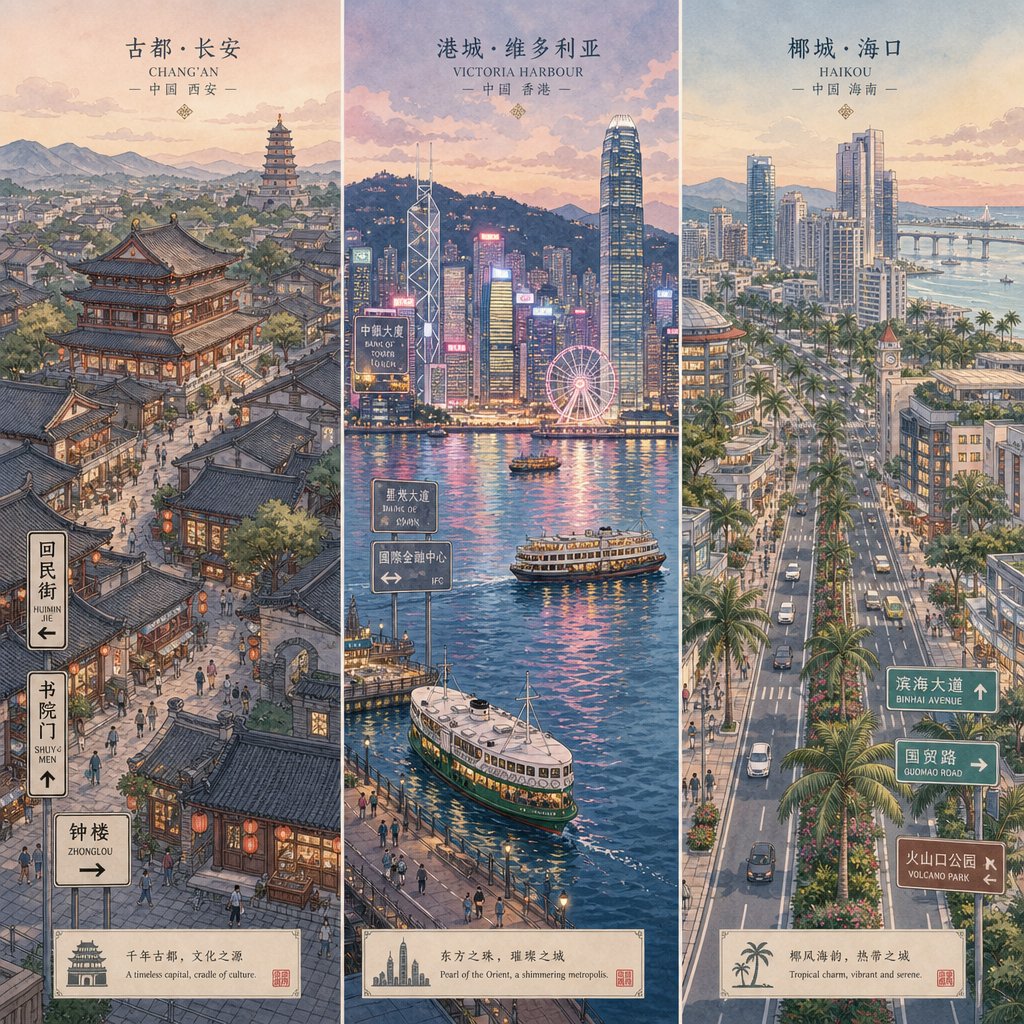
Regional Rivalries From Taiwan to Hong Kong
Pinyin may have become China's official standard, but Chinese isn't spoken in just one place — and the communities outside mainland China had their own linguistic identities, political histories, and practical needs. The result? A patchwork of romanization systems across the Chinese-speaking world that persists to this day, shaping everything from passport spellings to street signs. If you've ever wondered why the same Chinese last names appear as both "Li" and "Lee" on different people's business cards, the answer lies in this regional fragmentation.
Taiwan's Romanization Tug-of-War
What language do they speak in Taiwan? The answer is more layered than most people realize. Mandarin Chinese is the official language, but Taiwanese Hokkien, Hakka, and indigenous Austronesian languages are all widely spoken. Is Taiwanese a language? Linguists debate the classification, but the political sensitivity around that question spilled directly into Taiwan's romanization battles — because choosing a romanization system meant choosing an identity.
For decades after the Kuomintang government relocated to Taiwan in 1949, the island used Wade-Giles as its default romanization for Mandarin. Street signs, passport names, and official documents all followed the older British system. This wasn't just inertia — it was a deliberate distinction from the mainland's Pinyin, which carried associations with the People's Republic.
In 2002, Taiwan's government under President Chen Shui-bian introduced Tongyong Pinyin — a homegrown system designed to handle not just Mandarin but also Taiwanese Hokkien and Hakka. The logic was appealing: one unified framework for all of Taiwan's languages, distinct from the mainland's Hanyu Pinyin. Tongyong Pinyin differed from Hanyu Pinyin in roughly 15 percent of its spellings — enough to assert separateness, but close enough to cause constant confusion.
The experiment was contentious from the start. As Taiwan Panorama documented, the debate became a proxy war between those prioritizing international compatibility and those insisting on Taiwan-first identity. Cities governed by different political parties adopted different systems simultaneously — Taipei used Hanyu Pinyin while Kaohsiung used Tongyong. Tourists encountered street signs that changed romanization conventions from one district to the next.
The confusion ended — mostly — in 2009, when Taiwan officially adopted Hanyu Pinyin as its standard for romanizing Mandarin in government publications and signage. Practicality won over politics. International maps, library catalogs, and digital systems already used Hanyu Pinyin, and maintaining a separate standard created friction without clear benefit. Yet the transition was incomplete. Many place names retained their older Wade-Giles or postal romanization spellings. "Taipei" didn't become "Taibei." "Kaohsiung" didn't become "Gaoxiong." These legacy spellings had become part of the cities' international identities — too embedded to uproot.
Hong Kong, Singapore, and Diaspora Approaches
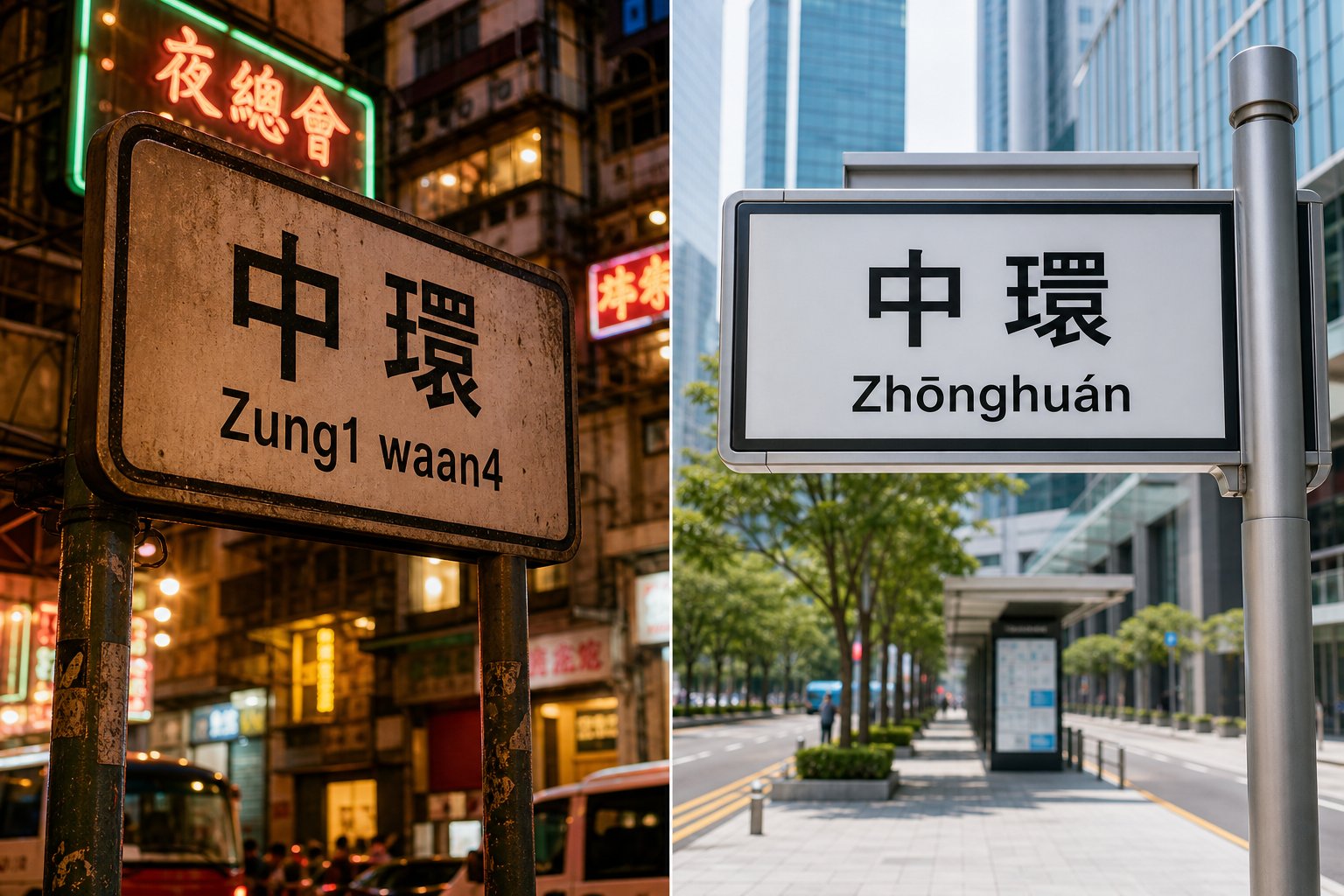
Hong Kong's situation is different again. The city speaks Cantonese, not Mandarin, and its romanization traditions reflect over 150 years of British colonial administration. The Hong Kong Government Cantonese Romanisation system — based on an 1888 standard described by Roy T. Cowles in 1914 — remains the default for street names, identity documents, and official place names. It's an unpublished, loosely codified system that omits tone markings entirely and doesn't distinguish between aspirated and unaspirated consonants.
The results are familiar to anyone who's visited: Tsim Sha Tsui, Mong Kok, Kowloon. These spellings predate any modern standardization effort and carry deep local identity. "Kowloon" would be "Kau Lung" under the government's own post-1888 conventions and "Gau Lung" in Jyutping — but the older spelling persists because it's woven into the city's fabric.
For Cantonese speakers seeking more systematic options, two academic systems compete. The Yale romanization of Cantonese, developed in the 1960s at Yale University, uses tone marks and letter combinations familiar to English speakers. Jyutping, created by the Linguistic Society of Hong Kong in 1993, offers a more internally consistent framework with numbered tones. Neither has displaced the government system in everyday life, but both serve learners and linguists who need precision that colonial-era spellings can't provide.
Singapore took a cleaner path. The city-state adopted Hanyu Pinyin early — in 1982 — as part of its broader "Speak Mandarin" campaign. Chinese family names on identity documents were standardized to Pinyin spellings, though many Singaporean Chinese retained dialect-based romanizations (Hokkien, Teochew, Cantonese) that their families had used for generations. The result is a population where official documents use Pinyin but personal names still reflect ancestral dialect origins.
Across the global diaspora, the picture is even more varied. Chinese immigrants who left before Pinyin's adoption carry surnames romanized through whatever system — or lack thereof — was in use at their port of departure. A family that emigrated from Guangdong in the 1920s might spell their name using Cantonese pronunciation and colonial-era conventions. A family from Taiwan might use Wade-Giles. A family from post-1980s mainland China almost certainly uses Pinyin.
This is why the most common chinese last names have so many international variants. Consider how regional systems produce completely different spellings for identical characters:
| Chinese Character | Pinyin (Mainland) | Wade-Giles (Taiwan) | Cantonese (Hong Kong) | Hokkien (Singapore) |
|---|---|---|---|---|
| 李 | Li | Li | Lee | Lee |
| 王 | Wang | Wang | Wong | Ong |
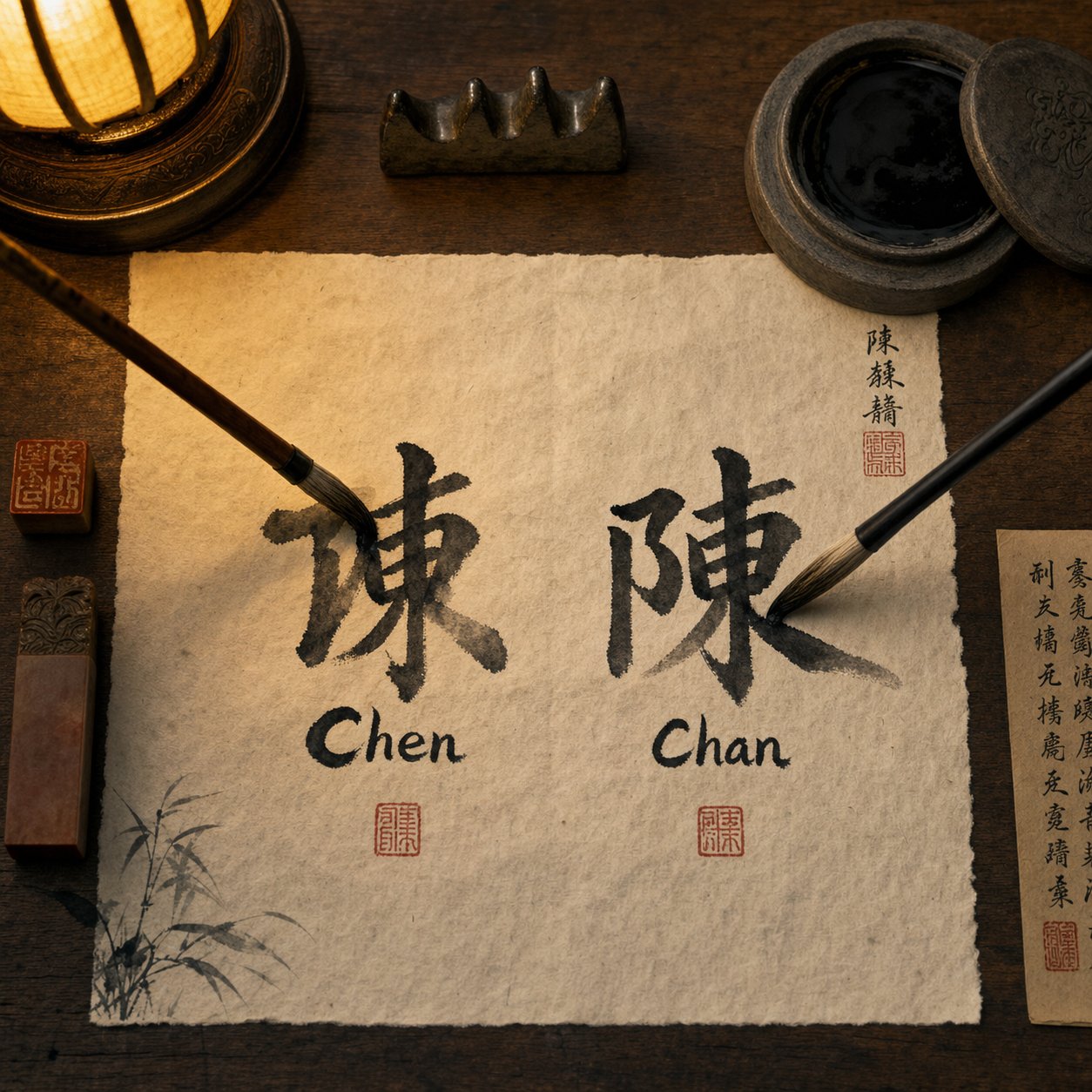
| 陈/陳 | Chen | Ch'en | Chan | Tan |
| 黄/黃 | Huang | Huang | Wong | Ng/Ooi |
| 林 | Lin | Lin | Lam | Lim |
| 台北 | Taibei | T'ai-pei (Taipei) | — | — |
| 香港 | Xianggang | — | Hong Kong | — |
You'll notice that "Wong" in Hong Kong and "Huang" in mainland China are the same surname — same character, same family lineage — rendered unrecognizably different because Cantonese and Mandarin pronounce it differently, and each region's romanization system captures its own local pronunciation. Chinese surnames aren't just spelled differently for arbitrary reasons. They're spelled differently because they're pronounced differently across dialects, and each community's romanization system faithfully records its own sound.
These regional differences aren't just historical curiosities. They create real-world friction in databases, immigration systems, and genealogical research. Two cousins with the surname 陈 might appear as "Chen" and "Tan" in different countries' records — invisible to any search algorithm that doesn't understand the romanization history behind the variation.
The fragmentation also reveals something deeper about the relationship between romanization and identity. For Hong Kong residents, keeping "Tsim Sha Tsui" instead of adopting "Jian Sha Zui" isn't stubbornness — it's an assertion that Cantonese is a living language with its own legitimate written representation, not a dialect subordinate to Mandarin. For Taiwanese who kept "Taipei" instead of switching to "Taibei," the spelling carries decades of international recognition and political distinctness.
Romanization, it turns out, was never just about phonetics. It was always about who gets to decide how a place — or a person — is represented to the world. And as these regional systems collided with the growing need for global digital standards, a new question emerged: could any single system serve both local identity and international interoperability?

From International Standards to Digital Infrastructure
The answer to that question — whether one system could serve both local identity and global interoperability — came not from linguists or politicians, but from institutions that needed consistency at scale. Libraries, the United Nations, and international standards bodies all faced the same practical problem: you can't catalog, index, or cross-reference information when the same Chinese word appears under five different spellings. One by one, they converged on Pinyin.
ISO Standards and Global Library Systems
The shift happened faster than most people realize. Within three decades of its domestic approval, Pinyin went from a Chinese classroom tool to the world's default chinese to romanization standard. Here are the key milestones:
- 1958 — Pinyin officially approved by China's National People's Congress for domestic use in education and publishing.
- 1979 — China's Xinhua News Agency begins using Pinyin for all proper nouns in English-language dispatches, prompting Western media to follow.
- 1982 — The International Organization for Standardization publishes ISO 7098, establishing Pinyin as the international standard for romanizing modern Chinese.
- 1986 — The United Nations adopts Pinyin as its standard romanization for Chinese geographic names and personal names in all official documents.
- 1997-2000 — The U.S. Library of Congress converts its entire Chinese-language catalog from Wade-Giles to Pinyin — a massive undertaking affecting millions of bibliographic records accumulated over a century.
- 2009 — Taiwan officially adopts Hanyu Pinyin, making it the standard across virtually all major Chinese-speaking governments.
The Library of Congress conversion deserves special attention. For decades, every Chinese text romanized in American academic libraries followed Wade-Giles conventions. Researchers looking up a book about Daoism would search under "Taoism." A biography of Mao Zedong sat filed under "Mao Tse-tung." The conversion required not just relabeling entries but reconciling decades of cross-references, subject headings, and catalog links. It was the largest single romanization overhaul in library history — and it signaled definitively that Pinyin had won the global standardization battle.
How Pinyin Powers Chinese Computing
Standardization mattered for libraries and diplomats. But the truly transformative impact of Pinyin arrived with computers and smartphones. Here's the core challenge: how do you spell Chinese in Chinese on a device built around a 26-letter keyboard? The chinese language written in Chinese uses tens of thousands of characters — far too many for any keyboard to hold directly. You need an intermediary layer, and Pinyin became that layer.
When a Chinese speaker wants to type the character 中 on their phone, they type "zhong" in Latin letters. The input method software recognizes the Pinyin, offers a list of matching characters, and the user selects the correct one. This process — called hypographic writing by Stanford historian Thomas Mullaney — means humans don't create characters keystroke by keystroke. Instead, they signal which character to retrieve from the device's memory.
Over 80% of Chinese users rely on Pinyin-based input methods for daily typing. That's more than a billion people whose ability to send a text message, write an email, or search the internet depends directly on a romanization system designed in the 1950s. Every time someone asks how to write Chinese in Chinese on a digital device, the practical answer is: you write it through Pinyin first.
The implications run deeper than text messaging. Search engines index chinese text romanized through Pinyin to improve query matching. Natural language processing systems use Pinyin as a phonetic bridge for speech recognition. Chinese typesetting software relies on Pinyin-based sorting for everything from phone contacts to dictionary apps. Even the predictive text algorithms that suggest your next word evolved from the challenge of disambiguating Pinyin syllables — since dozens of characters can share the same romanized spelling, early chinese romanizer software had to develop sophisticated context-prediction models. As Mullaney documents, these prediction systems became precursors to the auto-complete and AI language models we use across all languages today.
The irony is striking. Pinyin was originally designed as a pronunciation guide for schoolchildren — a supplement to characters, never a replacement. Yet it became the invisible infrastructure powering Chinese digital communication. Billions of keystrokes per day flow through a system whose roots trace back to Jesuit missionaries, Soviet linguists, and a committee of scholars working in 1950s Beijing. How do you spell Chinese for the digital age? Through four centuries of romanization history, compressed into a split-second software lookup every time a thumb hits a screen.
Legacy and Future of Spelling Chinese in Latin Letters
Four centuries. Dozens of competing systems. A journey from Jesuit study rooms to the neural networks inside your phone. So what does romanization mean when you zoom out and look at the full arc? It means something different at every stage — a missionary's survival tool, a diplomat's filing system, a revolutionary's weapon against illiteracy, and finally, invisible infrastructure that a billion people use without thinking.
What Romanization Reveals About Language and Power
Every romanisation system in this story carried a political signature. When Matteo Ricci romanizes Chinese through Italian phonetics, that reflects European assumptions about which sounds matter. When Wade-Giles becomes the global default, that reflects British imperial reach. When Pinyin wins international adoption, that reflects the People's Republic's growing institutional weight. The romanized meaning of a Chinese word was never purely phonetic — it always encoded who held authority over representation.
The tension between standardization and regional identity hasn't disappeared. Hong Kong residents still resist Pinyin spellings for Cantonese place names. Taiwanese passports preserve Wade-Giles surnames chosen decades ago. Diaspora communities carry chinese romanized names that reflect ancestral dialects no single system can capture. Standardization brings efficiency; it also flattens difference. That tradeoff remains unresolved.
The Future of Chinese Romanization in an AI World
Does AI make romanization obsolete? Not quite. As research on AI-powered input methods shows, Pinyin is becoming more deeply embedded in technology, not less — serving as an input layer, annotation system, and computational tool simultaneously. Voice recognition may bypass typing, but the phonetic framework underneath still runs on Pinyin. Machine translation models use phonetic encoding to improve accuracy. Even as the interface changes, the underlying romantization layer persists.
What does romanized mean in this context? It means the phonetic bridge between character and machine is now permanent infrastructure — quietly essential, rarely noticed.
What began as a foreign tool imposed on Chinese by outsiders has become essential infrastructure owned, maintained, and evolved by Chinese speakers themselves — the deepest kind of linguistic reclamation.
The story isn't over. As long as Chinese characters exist alongside alphabetic systems, someone will need to decide how those worlds connect. That decision — what does romanization mean for the next generation — will be shaped by AI, by politics, and by the same fundamental question that drove Ricci, Wade, Zhou Youguang, and every figure in between: who gets to decide how a language sounds on paper?
Frequently Asked Questions About Chinese Romanization History
1. What is the difference between Wade-Giles and Pinyin?
Wade-Giles was developed by British diplomats in the mid-1800s and uses apostrophes for aspirated consonants and superscript numbers for tones. Pinyin, created by a Chinese government committee in 1958, uses unconventional Latin letter assignments (like x, q, zh) and diacritical marks for tones. Wade-Giles dominated English-language academia for over a century, producing familiar spellings like Peking and Mao Tse-tung, while Pinyin replaced it as the international standard through ISO 7098 in 1982 and UN adoption in 1986. Many legacy Wade-Giles spellings persist in institution names and place names today.
2. When was Pinyin invented and who created it?
Pinyin was officially approved on February 11, 1958, by China's National People's Congress. It was developed by a committee led by Zhou Youguang, a 49-year-old economics professor assigned to the task by Premier Zhou Enlai in 1955. The committee included prominent linguists like Wang Li, Lu Zhiwei, and Li Jinxi. Zhou Youguang, often called the father of Pinyin, deflected that title, noting the system built on a long tradition stretching from the late Qing dynasty through earlier romanization experiments like Gwoyeu Romatzyh and Latinxua Sin Wenz.
3. Why do Chinese surnames have so many different English spellings?
Chinese surnames vary in English spelling because different regions use different romanization systems that reflect local dialect pronunciations. For example, the character 陈 appears as Chen in Pinyin (mainland China), Ch'en in Wade-Giles (Taiwan), Chan in Cantonese romanization (Hong Kong), and Tan in Hokkien (Singapore). These aren't arbitrary differences — they faithfully record how each dialect community actually pronounces the same character. Families who emigrated before Pinyin's adoption carry romanizations from whatever system was in use at their point of departure.
4. How does Pinyin work for typing Chinese on computers and phones?
Pinyin serves as an intermediary input layer between the Latin-letter keyboard and Chinese characters. When a user types a Pinyin syllable like 'zhong,' the input method software displays a list of matching characters, and the user selects the correct one. Over 80% of Chinese users rely on this Pinyin-based method daily. The system requires sophisticated prediction algorithms because dozens of characters can share the same Pinyin spelling, making context-based disambiguation essential. These prediction models became precursors to modern auto-complete and AI language tools.
5. Did China ever try to replace Chinese characters with a Latin alphabet?
Yes, multiple attempts were made. The most radical was Latinxua Sin Wenz (1931), developed by Chinese and Soviet revolutionaries, which was explicitly designed to replace characters entirely. It gained endorsement from 688 scholars including Lu Xun and was used as legal script in communist-controlled regions. Earlier, Gwoyeu Romatzyh (1928) was also conceived as a potential full writing system. Ultimately, Pinyin was positioned as a pronunciation aid supplementing characters rather than replacing them — a political compromise between radicals who wanted character abolition and conservatives who saw romanization as cultural vandalism.