Chinese Surnames That Mean Forest and Why They Matter
Chinese surnames meaning forest refer to a group of related family names rooted in the character 林 (lín) and other botanical characters that evoke trees, groves, and woodlands. This isn't a single surname with a single story. It's an entire category of nature-based Chinese family names, each carrying centuries of history inside a few brushstrokes.
If your last name is Lin, Lim, Lam, or even Hayashi, you belong to this family of forest surnames. And you're far from alone.
What Makes a Chinese Surname Mean Forest
The most prominent name meaning lin is built from a beautifully simple visual logic. The Chinese word for tree is 木 (mù). Place two of those tree characters side by side and you get 林, which literally depicts a grove or forest. Other surnames in this botanical group draw from related characters like 森 (sēn, dense forest), 柏 (bǎi, cypress), and 柳 (liǔ, willow). Together, these names that mean tree form a rich subset of Chinese family names tied directly to the natural world.
What connects them all is a shared root in wood and woodland imagery, a reflection of how deeply nature shaped ancient Chinese identity.
Why Forest Surnames Are Among China's Most Common
Lin (林) ranks as the 18th most common surname in China and is even more prominent globally, particularly in Singapore, where it is the second most common Chinese surname, with tens of millions of bearers worldwide.
The Lin surname alone accounts for a massive share of the Chinese-speaking population. When you add regional spellings like Lim in Southeast Asia and Lam in Hong Kong, the numbers grow even larger. The Lin Chinese diaspora stretches across every continent, making this one of the most widely distributed surnames on Earth.
So why did a word for forest become so popular as a family name? The answer reaches back over 3,000 years to a dramatic story of loyalty, betrayal, and survival in the Shang dynasty. The Lin surname carries that origin in every stroke, and the etymology of the character itself reveals exactly how two trees became a name for millions.
The Character 林 and How Trees Became a Family Name
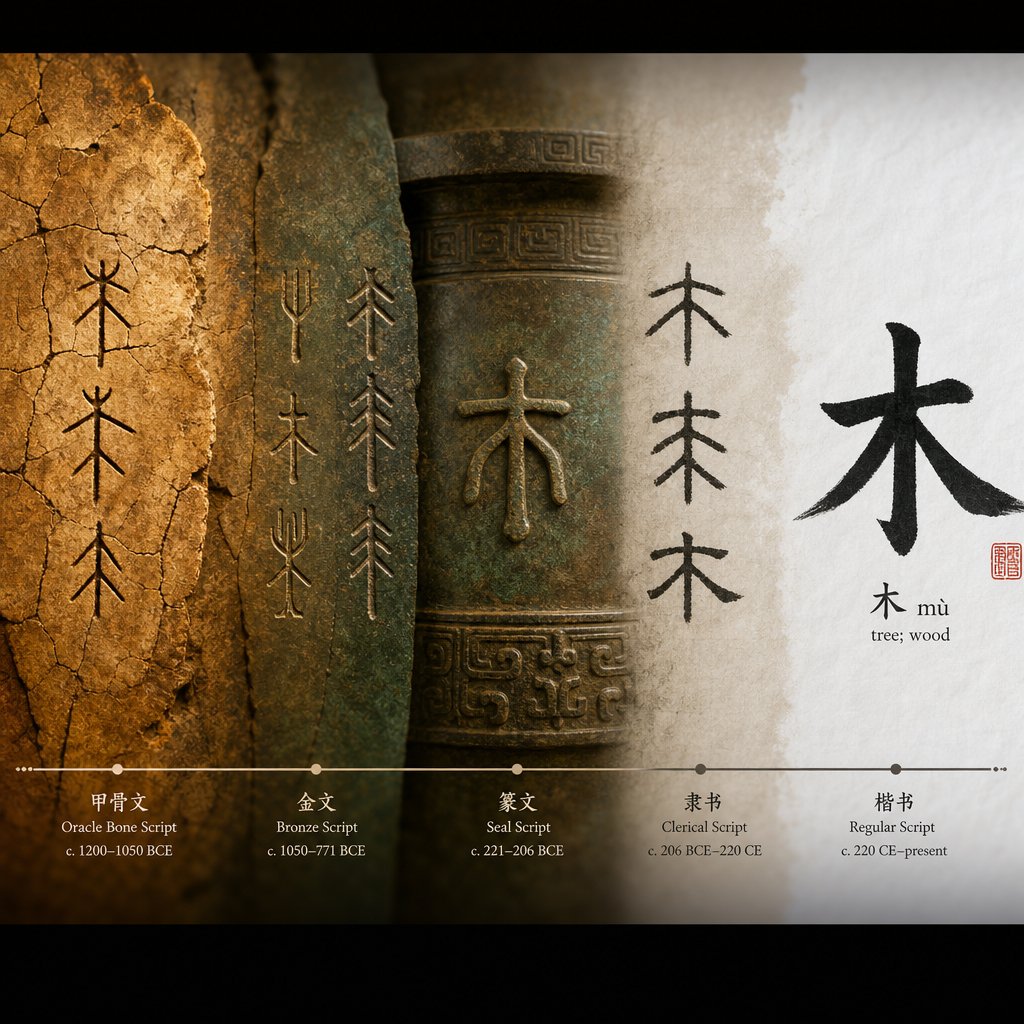
Picture a single tree. In Chinese, that image is captured by the character 木 (mù), the chinese word for tree and one of the oldest pictograms in the language. Its earliest forms, carved into oracle bones over 3,000 years ago, looked exactly like what they represented: a trunk with branches reaching upward and roots stretching below.
Now imagine placing two of those trees side by side. That's precisely how the character 林 (lín) was born, and it's the visual logic that gave millions of people their family name.
How Two Trees Became a Surname
The progression from tree to forest in Chinese writing follows an elegant, additive pattern:
- 木 (mù) — one tree, meaning "tree" or "wood"
- 林 (lín) — two trees, meaning "grove" or "forest"
- 森 (sēn) — three trees, meaning "dense forest" or "jungle"
Each character builds on the last by adding another 木. It's one of the clearest examples of how Chinese writing encodes meaning visually rather than phonetically. You don't need to memorize an abstract symbol. You can literally see the forest growing.
So what does lin mean at its core? The character 林 is classified as a huìyì (会意) character, also called a compound ideograph. This category of Chinese characters creates new meaning by combining two or more semantic elements. Unlike phono-semantic compounds, which pair a meaning component with a sound component, huìyì characters are purely about joined meaning. For 林, the logic is straightforward: tree plus tree equals a grove of trees.
This matters for understanding the surname because the meaning of lin is not arbitrary. It wasn't assigned by sound or borrowed from another word. The character visually encodes the concept of a woodland, and that direct pictorial connection is what made it such a powerful surname when it was eventually adopted as one.
From Oracle Bones to Modern Characters
The character 木 (mù) is a pictograph (象形字, xiàngxíngzì), one of the oldest formation methods in Chinese writing. Its earliest known forms appear on Shang dynasty oracle bones, where it depicted a young tree with visible branches and roots. Over centuries, the image was gradually stylized into the angular form we recognize today.
When scribes doubled this pictograph to create 林, the character followed the same evolutionary path:
- Oracle bone script (circa 1200 BC): Two tree-like drawings placed next to each other, clearly recognizable as paired trees
- Bronze inscriptions (Western Zhou): The forms became slightly more standardized but retained their pictorial quality
- Seal script (Qin dynasty): The strokes grew more uniform and flowing, moving away from direct pictorial representation
- Clerical script (Han dynasty): Angular strokes replaced curves, giving the character a more geometric appearance
- Regular script (modern): The form stabilized into the 林 we write today, with two identical 木 components standing side by side
Throughout this entire evolution, the fundamental structure never changed. Two trees remained two trees. The Shuowen Jiezi, China's first comprehensive dictionary compiled in the 2nd century AD, defined 林 simply as a gathering of trees, confirming that the character's meaning stayed consistent across more than a millennium of script changes.
Beyond its literal definition, 林 also extended into figurative territory. Classical texts used it to describe any gathering of similar things: a "forest" of scholars, a "forest" of literary works, a "forest" of swords. The character carried connotations of abundance and community, qualities that made it especially fitting as a family name meant to represent a thriving lineage.
This etymological foundation, two trees standing together as a symbol of collective strength, set the stage for one of Chinese history's most dramatic origin stories. The character was waiting. It just needed a family to claim it.

Origin Stories Behind the Forest Surname
Every surname has a founding moment, a point where a character stops being just a word and becomes someone's identity. For the Lin family name, that moment arrived during one of ancient China's bloodiest political crises.
The lin last name origin traces back over 3,000 years to the fall of the Shang dynasty, and it reads less like a genealogical footnote and more like a survival epic. A loyal minister, a tyrant king, a pregnant woman fleeing into the wilderness, and a newborn child who would carry the forest in his name forever.
The Bi Gan Legend and the Shang Dynasty
The most widely accepted origin of the lin last name begins with Bi Gan (比干), a prince and senior minister of the Shang dynasty (circa 1600-1046 BC). Bi Gan was the son of King Wen Ding and served faithfully under both his brother and his nephew, Di Xin (帝辛), the infamous last ruler of the Shang. Known in later histories simply as King Zhou, Di Xin became a byword for tyranny and cruelty.
Bi Gan was a man of moral conviction. He repeatedly urged Di Xin to reform his corrupt governance and abandon his brutal punishments. Imagine advising a ruler who responds to criticism with execution orders. That was Bi Gan's reality. Eventually, Di Xin's patience ran out. Enraged by his uncle's persistent counsel, the king ordered Bi Gan's arrest and execution.
At the time of his death, Bi Gan's wife was pregnant. Sympathetic soldiers, moved by the injustice of the minister's fate, allowed her to escape the capital. Accompanied by four loyal maidservants, she fled into the wilderness and found refuge in a remote cave deep within a forest. There, hidden from the tyrant's reach, she gave birth to a son. She named him Changsi (泉), meaning "endless longing," in memory of her husband.
The forest sheltered them. It kept them alive. And it would soon give them a new identity.
Shortly after, the Shang dynasty collapsed. King Wu of Zhou (周武王) overthrew Di Xin and established the Zhou dynasty. The new king sought to honor those who had suffered under the former regime. Aware of Bi Gan's unwavering loyalty and tragic death, King Wu repaired his tomb and sent officials to locate his surviving family.
When Bi Gan's wife and son were finally discovered in their forest hideaway, King Wu brought them before the court. In recognition of their survival and the place that had protected them, he officially conferred the surname "Lin" (林) on Bi Gan's son, directly referencing the forest of his birth. He also bestowed the name "Jian" (坚), meaning "strength" or "fortitude." From that day forward, Lin Jian became the founding ancestor of the Lin family name.
King Wu further awarded Lin Jian noble titles and lands, securing the family's position in the new dynasty. The lin family name was born not from geography or occupation, as many Chinese surnames were, but from a specific act of survival. The forest wasn't just a backdrop. It was the reason the lineage continued at all.
Alternative Origin Branches of the Lin Lineage
While the Bi Gan legend is the most prominent origin story, it isn't the only one. Chinese genealogical traditions recognize several additional branches that fed into the Lin surname over the centuries:
- The Royal Zhou Connection: Historical accounts trace a secondary origin to King Ping of Zhou (周平王). His grandson bore the personal name Ji Lin (姬林) and later became King Huan of Zhou (周桓王). Descendants of this royal line adopted Lin as their surname, creating a branch with roots in Zhou dynasty royalty rather than Shang dynasty tragedy.
- The Xianbei Adoption: During the Northern and Southern Dynasties period (420-589 AD), Emperor Xiaowen of the Northern Wei ordered the Xianbei (鲜卑), a Mongolian nomadic tribe, to adopt Chinese-style surnames as part of a broader sinicization policy. Some Xianbei families were assigned or chose the surname Lin, adding a non-Han Chinese branch to the lineage.
- The Gaoshan Tribe of Taiwan: The Gaoshan (高山) people, one of Taiwan's indigenous groups with ancestral ties to mainland migration, adopted the Lin surname in tribute to the forests of their homeland. This branch connects the surname's literal meaning directly to lived geography rather than historical narrative.
These alternative origins mean that not every person carrying the lin last name descends from Bi Gan. The surname absorbed new branches across dynasties, regions, and even ethnic groups. Each branch carried its own story into the larger Lin family tree.
How do we know all this? Chinese genealogical culture is remarkably thorough. Families maintained zupus (族谱), or family history books, that recorded ancestors' names, migration journeys, values, and lineage connections across generations. Hundreds of Lin clan zupus survive today, documenting branches that stretch from the Shang dynasty through the modern era. These records serve as the primary evidence for tracing which origin branch a particular Lin family belongs to.
The Bi Gan story remains the most emotionally resonant because it ties the surname's literal meaning to its founding moment so perfectly. A forest sheltered a child. A king named him after that forest. And millions of descendants still carry that name today. But the surname's history is richer than any single legend. It's a living record of how one character accumulated families across three millennia of Chinese history.
Of course, the story doesn't end with origin. As Lin descendants migrated across China and eventually overseas, the same character began sounding different on different tongues, and a single surname splintered into half a dozen spellings.
Lin Lim Lam and Other Romanizations of the Same Surname
Here's something that catches many people off guard: Lin, Lim, and Lam are not three different surnames. They're the same character, 林, spoken through different tongues and written down by different colonial administrators. If you've ever wondered whether your Lim cousin in Singapore and your Lam friend in Hong Kong share a common ancestor, the answer is yes, at least linguistically.
The confusion exists because Chinese is not one spoken language. It's a family of mutually unintelligible dialects that share a written script. When Chinese families migrated across Southeast Asia, their surnames were romanized based on how they actually pronounced them, not how Mandarin speakers in Beijing would say them.
Why Lin Becomes Lim Lam and Lai Across Dialects
Imagine a British colonial officer in 1890s Malaya asking a Hokkien-speaking immigrant for his family name. The man says something that sounds like "Lim." The officer writes it down. A few ports over in Hong Kong, a Cantonese speaker pronounces the same character as "Lam." That gets recorded too. Neither spelling is wrong. Both are faithful phonetic transcriptions of how real people said their own name.
This is exactly what happened across the Chinese diaspora. As documented in Malaysian surname history, the majority of Chinese migrants to Malaya came from Fujian and Guangdong provinces, speaking Hokkien, Teochew, Cantonese, and Hakka rather than Mandarin. Their dialect pronunciations were treated as final. Mainland China later standardized 林 as "Lin" through the pinyin system, but by then, millions of overseas families had already locked in Lim and Lam on birth certificates, land titles, and school records.
The lim last name is overwhelmingly Hokkien or Teochew in origin. If your surname is Lim, your ancestors almost certainly came from Fujian province or the Teochew-speaking region of eastern Guangdong. The lam last name, on the other hand, signals Cantonese heritage, pointing back to Guangdong's Pearl River Delta or Hong Kong.
Malaysia never standardized Chinese surname spellings after independence. In territories with a sizeable Chinese diaspora, the way a family name is spelled became a permanent signifier of ancestral dialect and region. Your spelling tells a migration story.
Regional Romanization Systems Explained
The table below maps every major romanization of 林 to its dialect origin and the regions where you'll most commonly encounter it:
| Character | Romanization | Dialect / Language | Primary Regions |
|---|---|---|---|
| 林 | Lin | Mandarin (Pinyin) | Mainland China, Taiwan, newer diaspora communities |
| 林 | Lim | Hokkien / Teochew | Singapore, Malaysia, Philippines, Indonesia |
| 林 | Lam | Cantonese | Hong Kong, Macau, Cantonese-speaking diaspora |
| 林 | Lim | Hakka / Hainanese | Malaysia, parts of Southeast Asia |
| 林 | Lim / Liem | Hokkien (Indonesian romanization) | Indonesia |
| 林 | Hayashi | Japanese (kun'yomi reading) | Japan |
| 林 | Im / Lim (임) | Korean | South Korea, North Korea |
| 林 | Lâm | Vietnamese (Sino-Vietnamese) | Vietnam |
Notice how the lim surname dominates across Southeast Asia. That's no coincidence. The overwhelming majority of Chinese migrants to the region between the 17th and early 20th centuries came from Fujian and eastern Guangdong, both Hokkien and Teochew-speaking areas. The lim chinese spelling became the default in Singapore, Malaysia, the Philippines, and Indonesia simply because those were the communities that built Chinatowns across the region.
The lam surname tells a different geographic story. Cantonese speakers dominated migration to Hong Kong (which was already Cantonese-speaking) and certain pockets of Southeast Asia, particularly in communities tied to the Pearl River Delta trade networks.
What's remarkable is that all these variants, Lin, Lim, Lam, Hayashi, Im, and Lâm, trace back to the same two-tree character and the same founding stories. The spelling on your passport is essentially a dialect fingerprint, a record of which part of southern China your ancestors called home and which colonial administration first wrote their name in Roman letters.
Understanding this connection matters. A person researching the lim last name in Malaysia and another tracing the lam last name in Hong Kong are exploring branches of the same tree. The romanization differs, but the character, the meaning, and the origin remain identical.
Yet 林 is only the most prominent member of a much larger family. Dozens of other Chinese surnames draw their meaning from trees, forests, and botanical imagery, and some of them are far rarer than you might expect.
Beyond Lin and the Full Family of Tree Surnames
The lin name meaning of "grove" or "forest" is the most famous example, but it's far from the only Chinese surname rooted in botanical imagery. An entire constellation of family names draws from trees, woods, and plant life. Some are carried by tens of millions. Others belong to fewer people than could fill a small town. Together, they form a complete taxonomy of chinese tree names functioning as surnames.
Think of it this way: if 林 represents a grove, the broader family of tree-related surnames represents the entire ecosystem around it, from individual species like pine and willow to the dense canopy of a primeval forest.
The Complete Family of Forest and Tree Surnames
The most significant names with lin and tree-related characters span a wide range of prevalence. Some rank among China's top ten surnames. Others hover near the bottom of national surveys. What unites them is a shared connection to wood, bark, leaf, and root.
Here's the full picture, drawn from China's national surname data:
| Character | Pinyin | Literal Meaning | Approx. Prevalence | Notable Bearers |
|---|---|---|---|---|
| 林 | Lín | Grove / forest (two trees) | ~15.1 million in China (rank 16) | Lin Zexu (Qing official), Lin Yutang (author), Jeremy Lin (athlete) |
| 杨 | Yáng | Poplar tree | ~42.7 million in China (rank 6) | Yang Liwei (astronaut), Yang Zhenning (Nobel physicist) |
| 柳 | Liǔ | Willow tree | ~1.29 million in China (rank 136) | Liu Zongyuan (Tang poet), Liu Yong (Song lyricist) |
| 柏 | Bǎi | Cypress tree | ~460,000 in China (rank 216) | Bai Juyi's clan connections, various regional lineages |
| 桂 | Guì | Osmanthus / cassia tree | ~440,000 in China (rank 219) | Gui Youguang (Ming essayist) |
| 松 | Sōng | Pine tree | Rare (below top 400) | Regional lineages in southern China |
| 森 | Sēn | Dense forest (three trees) | Very rare as a surname | More common in Japanese (Mori) |
| 木 | Mù | Tree / wood | Very rare as a Han surname | Found among Uyghur and other minority groups |
| 樊 | Fán | Fence / hedge (woody enclosure) | ~2 million in China (rank 109) | Fan Kuai (Han dynasty general) |
The contrast in scale is striking. Yang (杨, poplar) is the sixth most common surname in all of China, shared by over 42 million people. Pine (松) and dense forest (森) are so rare they don't even crack the top 400. Yet each chinese tree name on this list encodes a specific relationship between a family and the natural world.
Rare Botanical Surnames You May Not Know
A few of these deserve closer attention because they reveal how differently tree imagery can function in a surname.
杨 (Yáng, poplar) is the giant of the group. With over 42 million bearers concentrated heavily in Sichuan province, it dwarfs even Lin in raw numbers. The poplar tree grows fast and tall, and the surname carries associations with vitality and upward growth. Its prominence makes it one of the most recognizable chinese tree names in daily life.
柳 (Liǔ, willow) carries a more poetic resonance. In Chinese culture, willows symbolize grace, parting, and resilience. The willow bends without breaking. Families bearing this surname are concentrated in Hubei province, and the name appears frequently in classical literature.
樊 (Fán) is an interesting edge case. Its original meaning refers to a fence or hedge made from woody branches, placing it at the boundary between "tree surname" and "structure surname." With roughly 2 million bearers, it's more common than many people realize, concentrated primarily in Henan province.
森 (Sēn, three trees) is the logical extension of 林's two-tree structure, yet it barely exists as a Chinese surname. Interestingly, it thrives in Japan as Mori (森), where it ranks among the more common family names. This divergence shows how the same character can follow completely different paths across cultures.
柏 (Bǎi, cypress) and 桂 (Guì, osmanthus) both name specific tree species rather than forests in general. Cypress symbolizes longevity and steadfastness in Chinese thought, while osmanthus is associated with scholarly achievement and the autumn moon. These surnames carry their symbolism quietly, embedded in the character itself.
What emerges from this full taxonomy is a pattern: the more general the tree reference, the more common the surname tends to be. Lin (grove) and Yang (poplar, a widespread genus) dominate. Specific species like cypress and osmanthus remain niche. And the most abstract concept, dense forest (森), barely registers as a Chinese surname at all.
These botanical surnames didn't spread evenly across China. Geography shaped which tree names took root where, and migration carried them to unexpected corners of the world.

Where Forest Surname Holders Live Around the World
Geography tells you a lot about a surname. If you plot every Lin, Lim, and Lam bearer on a map, you won't see an even spread. You'll see dense clusters, migration corridors, and dialect-shaped pockets that reveal exactly how this forest surname traveled from a single province in southern China to every continent on Earth.
Fujian Guangdong and Taiwan as Lin Heartlands
Within China, the Lin surname is overwhelmingly southern. National census data shows Fujian Province alone holds approximately 4.72 million Lin bearers, accounting for 14.8% of the province's entire population. That's nearly one in seven people. Guangdong Province follows with about 3.11 million, and Taiwan adds another 2 million. The areas of highest density, Fuzhou, Putian, southern Fujian (Minnan), and eastern Guangdong, form a coastal belt where Lin isn't just common. It's dominant.
Why this concentration? The answer traces back to Lin Lu (林禄), who entered Fujian in 325 CE during the Eastern Jin dynasty. His descendants multiplied across the region for over 1,700 years, branching into sub-lineages like the Nine Mu Lin and the Golden Purple Lin, all rooted in Putian and its surrounding counties. Lin in China is essentially a southern coastal phenomenon, with Fujian as its undisputed heartland.
Zhejiang Province contributes another 1.84 million bearers, and South Korea hosts approximately 1.8 million people with the surname, descended from Lin Baji, who crossed the sea from Fujian during the Tang dynasty.
Forest Surnames in Southeast Asia and Beyond
When Hokkien and Teochew speakers left Fujian's ports for Southeast Asia between the 17th and early 20th centuries, they carried the Lim pronunciation with them. The lim family name became a fixture of Chinese communities across the region, particularly in countries where Fujian migrants formed the majority of early settlers.
Meanwhile, Cantonese speakers from the Pearl River Delta brought the family name Lam to Hong Kong, Macau, and Cantonese-dominant pockets of Southeast Asia. The spelling on a passport still functions as a dialect map.
Here's where the major diaspora concentrations sit today:
- Singapore — Lim (Hokkien/Teochew). The second most common Chinese surname in the country, with roots tracing primarily to Quanzhou and Zhangzhou in Fujian.
- Malaysia — Lim (Hokkien/Teochew/Hakka). Heavily concentrated in Penang, Johor, and the Klang Valley, reflecting waves of Fujian migration.
- Philippines — Lim (Hokkien). One of the most recognizable Chinese-Filipino surnames, carried by families from Fujian's Jinjiang and Nan'an counties.
- Indonesia — Lim or Liem (Hokkien). Many families adopted Indonesian names during assimilation policies but retain Lim in family records.
- Hong Kong and Macau — Lam (Cantonese). The dominant spelling in all official documents and daily life.
- Thailand — Lim (Teochew). Among the common surnames in Thailand's Chinese-Thai community, often paired with a Thai given name or carried alongside a Thai surname for official purposes.
- Vietnam — Lam (Sino-Vietnamese). Used by ethnic Chinese families, particularly in Ho Chi Minh City's Cholon district.
- South Korea — Im/Lim (임). A well-established Korean surname with its own clan associations and genealogical records.
The global total exceeds 20 million people. What's striking is how tightly the diaspora pattern mirrors dialect geography. Hokkien-speaking regions produced Lim communities. Cantonese-speaking regions produced Lam communities. The surname didn't just travel. It traveled in linguistically coherent waves, each one preserving the pronunciation of the port it departed from.
Numbers and maps tell you where forest surname holders ended up. They don't tell you why the forest metaphor resonated so deeply in the first place, or what it meant to Chinese families to carry a name built from trees.
Cultural Symbolism of Forest Names in Chinese Thought
A surname isn't just an identifier. In Chinese culture, it's a wish, a philosophy compressed into a single character. When you understand the lin meaning chinese families embedded in their naming traditions, you realize that 林 was never just a description of trees standing together. It was a prayer for what a family should become.
Why trees? Why forests? Because in Chinese thought, no image captures the ideal family better than a woodland with deep roots and spreading branches.
Forests as Symbols of Prosperity and Deep Roots
The phrase 子孙繁茂 (zisun fanmao) means "descendants flourishing abundantly," and it borrows directly from botanical language. 繁茂 describes lush, thriving vegetation. When applied to a family, it expresses the hope that future generations will multiply and prosper like trees in a healthy forest, each new branch adding strength to the whole.
This isn't a casual metaphor. It's woven into the fabric of how Chinese families talk about themselves. Consider the vocabulary:
- 家谱 (jiapu) — family genealogy, literally "family register," but commonly called a "family tree" in both Chinese and English
- 根 (gen) — roots, used to describe ancestral origins and one's connection to homeland
- 扎根 (zha gen) — to take root, meaning to establish oneself firmly in a place
- 分支 (fenzhi) — to branch out, describing how lineages split into sub-clans over generations
- 落叶归根 (luoye gui gen) — "falling leaves return to their roots," expressing the belief that one should return to ancestral land
You'll notice that every stage of family life maps onto tree biology. A clan takes root (扎根) in a region. It branches out (分支) as sons establish new households. Descendants flourish (繁茂) across generations. And eventually, those who wandered far feel the pull to return to their roots (归根). The meaning of name lin sits at the center of this entire metaphorical system. A grove of trees is exactly what a thriving family looks like across time.
The forest metaphor in Chinese naming encodes a profound wish: that a family will grow deep roots no single storm can uproot, spread branches wide enough to shelter every descendant, and stand together as a grove rather than as isolated trees.
This is why 林 resonated so powerfully as a surname. It didn't just describe where Bi Gan's son was born. It described what every Chinese family hoped to become.
Confucian and Daoist Ideas in Naming Traditions
Two philosophical traditions shaped how Chinese families understood the relationship between names, nature, and identity.
Confucianism placed ancestor worship and family continuity at the core of moral life. Filial piety (孝, xiao) demanded that descendants honor those who came before and ensure the lineage continued into the future. A surname wasn't just inherited. It was a responsibility. Carrying the lin meaning name forward meant maintaining the family's reputation, recording genealogies in zupus, and producing descendants who would continue the cycle of remembrance. The forest image reinforced this duty: each tree in the grove depends on the others, and removing one weakens the whole stand.
Daoism contributed a different layer. Rooted in nature worship from China's earliest periods, Daoist thought taught that harmony with the natural world was the path to understanding the Way (道, Dao). Trees embodied patience, resilience, and effortless growth. They didn't strive. They simply grew according to their nature. A forest surname, from this perspective, aligned a family with the Daoist ideal of wu wei (无为), or natural action without force.
The symbolic meanings of specific trees in Chinese culture reinforced these ideas further. Pine (松) represented integrity and perseverance, qualities admired by Confucian scholars. Willow (柳) symbolized grace in parting and emotional resilience. Cypress (柏) stood for longevity and steadfastness. Each tree surname carried not just a visual image but an entire set of virtues encoded in the character itself.
Together, these philosophical currents meant that a forest surname was never neutral. It carried expectations. A family named Lin was implicitly associated with collective strength, deep ancestral connection, and natural harmony. The character on a genealogical register wasn't just a label. It was a condensed philosophy of what family means.
This cultural weight explains why forest surnames traveled so well across borders. The symbolism wasn't tied to a specific dialect or region. It was universal enough to resonate wherever Chinese families settled. And as the character 林 crossed into Japanese, Korean, and Vietnamese naming systems, it carried much of that symbolic freight with it, adapting to new cultural contexts while retaining its core image of trees standing together.
How the Same Forest Character Works Across East Asia
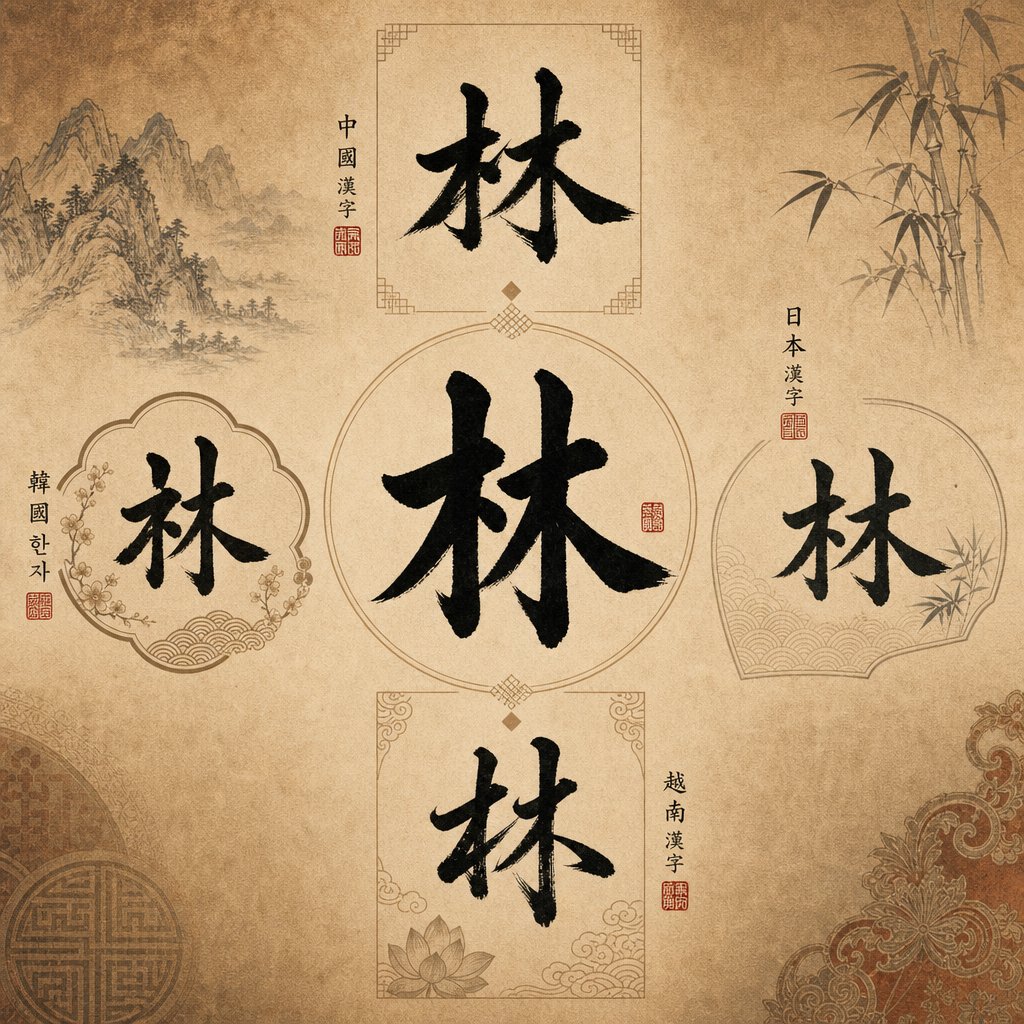
The character 林 didn't stop at China's borders. As Chinese writing spread across East Asia over centuries of cultural exchange, neighboring civilizations absorbed the character into their own naming systems. The result? A single two-tree symbol that functions as a surname in four different languages, pronounced four completely different ways, and governed by four distinct sets of naming conventions.
If you carry the lin name, the surname Lim, or the lam family name, your character has cousins in Tokyo, Seoul, and Hanoi. Understanding how 林 operates across these cultures reveals both the shared heritage and the surprising divergences that developed over millennia of independent evolution.
Lin in Japanese Korean and Vietnamese Cultures
Each East Asian language that adopted Chinese characters (known as hanzi in Chinese, kanji in Japanese, hanja in Korean, and chu Han in Vietnamese) developed its own pronunciation system for them. The character 林 entered each language at different historical moments and settled into different roles.
Japanese: Hayashi (林)
In Japan, 林 is read as Hayashi using the native Japanese reading (kun'yomi) and is the 19th most common Japanese surname. The word literally means "woods" in Japanese, preserving the original botanical meaning. A well-known variant, Kobayashi (小林, meaning "small forest"), ranks even higher as the 9th most common surname in Japan. Together, these two forest-related names account for millions of Japanese citizens.
Here's where it gets interesting. Unlike in China, where Lin functions almost exclusively as a surname, Hayashi can also appear as a given name in Japan. Japanese naming conventions are more flexible about which characters can serve which roles. A character that works only as a family name in one culture operates as both family and personal name in another.
Korean: Im or Lim (임/林)
In Korean, 林 is romanized as Im or Lim and pronounced with a short, clipped vowel sound. The surname is well established in Korea, with approximately 1.8 million bearers. Korean genealogical records trace many Im/Lim families back to Lin Baji, who crossed from Fujian to the Korean peninsula during the Tang dynasty. The surname carries its own Korean clan associations (본관, bon-gwan) and genealogical traditions independent of Chinese Lin clan records.
Vietnamese: Lam (林)
Vietnamese adopted the Sino-Vietnamese reading Lam for 林. Among ethnic Chinese families in Vietnam, particularly in Ho Chi Minh City's historic Cholon district, the surname functions much as it does in Cantonese-speaking communities. Vietnam's complex relationship with Chinese characters means that while the country officially uses a Latin-based script (chu Quoc ngu), the underlying character and its meaning remain understood within families that trace their heritage to Chinese migration.
Shared Heritage Across East Asian Naming Systems
The table below maps how 林 functions across each language, highlighting the differences in pronunciation, usage, and cultural context:
| Language | Romanization | Pronunciation Guide | Cultural Context |
|---|---|---|---|
| Mandarin Chinese | Lin | "leen" with a rising tone | Almost exclusively a surname; 16th most common in China with ~15 million bearers |
| Japanese | Hayashi | "hah-YAH-shee" | 19th most common surname; can also be a given name; variant Kobayashi (小林) ranks 9th |
| Korean | Im / Lim | "eem" (short vowel) | Established surname with ~1.8 million bearers; own clan system (bon-gwan) independent of Chinese records |
| Vietnamese | Lam | "lahm" with a level tone | Used by ethnic Chinese families; written in Latin script but character origin understood within families |
| Hokkien/Teochew | Lim | "leem" (short) | Dominant in Singapore, Malaysia, Philippines; 2nd most common Chinese surname in Singapore |
| Cantonese | Lam | "lahm" with a level tone | Standard in Hong Kong and Macau; used in all official documents |
A few patterns stand out. The Japanese reading (Hayashi) diverges most dramatically from the others because it uses the native Japanese word for woods rather than a borrowed Chinese pronunciation. Korean, Vietnamese, Cantonese, and Hokkien readings all derive from older layers of Chinese pronunciation, preserved like linguistic fossils from the era when each culture first absorbed the character.
As one cross-cultural observer noted, a single person bearing the character 林 could be addressed as Mr. Lin in Taipei, Mr. Lim in Singapore, Mr. Lam in Hong Kong, or Mr. Hayashi in Tokyo, and every version would be correct. The character stays the same. The world around it shifts.
This shared character creates a quiet bond across East Asian cultures. A Japanese person named Hayashi visiting Fujian can point to a temple inscription bearing 林 and recognize their own surname in a foreign language. A Korean Im family researching their genealogy may trace their lineage back through Chinese Lin clan records. The character functions as a bridge, connecting naming traditions that diverged centuries ago but never fully separated.
Yet the differences matter too. In China, you would never name a child "Lin" as a given name. In Japan, Hayashi works in either position. Korean Im families maintain entirely separate genealogical structures from Chinese Lin clans, even when both acknowledge a shared ancient origin. Vietnamese families may carry the surname Lam while having no living connection to the Chinese character system at all.
These cross-border connections raise a practical question for diaspora families today. If your surname is Lim, Im, Lam, or Hayashi, how do you trace the thread back? How do you determine which branch of this vast forest your particular family grew from? The answer involves understanding not just the character's history, but the specific tools and steps available for reconnecting with a lineage that spans millennia.
Tracing Your Forest Surname Heritage Today
Maybe you grew up knowing your last name was Lim, Lam, or Lin without ever connecting it to a forest. Maybe you never saw the two trees hiding inside your surname until now. You're not alone. For many diaspora families, the romanized spelling on a passport became the entire identity of the name, severed from the character, the pictograph, and the 3,000-year story behind it.
That disconnect is common and understandable. Generations of migration, language shifts, and assimilation policies created gaps between families and their naming heritage. But here's the thing: the meaning of the name lin never changed. The character still holds two trees. The origin story still traces back to a forest that sheltered a child. And the tools to reconnect with that history are more accessible than ever.
Rediscovering Heritage Through Your Surname
Understanding the last name lim origin or lam origin surname isn't just an academic exercise. For many people, it's the first concrete step toward reconnecting with a cultural identity that felt abstract or distant. When you learn that your surname literally means "grove" and was granted by a king to honor a family's survival, the name stops being just a label. It becomes a story you carry.
Clan associations around the world, from Singapore's Hainan Lin Clan Association to regional Lim groups in Malaysia and the Philippines, exist specifically to maintain these connections. They organize gatherings, preserve genealogical records, and help members trace their specific branch within the larger Lin family tree. Lin clan associations had their origins in China but were reproduced overseas by migrant populations, playing a vital role in keeping heritage alive across generations.
Practical Steps to Trace a Forest Surname Lineage
If you're ready to dig deeper, here's a structured path forward:
- Identify your romanization system. Is your surname spelled Lin, Lim, Lam, Liem, or something else? The spelling itself is your first clue. It tells you which dialect your ancestors spoke and narrows down their likely region of origin.
- Determine the dialect origin. Lim points to Hokkien or Teochew speakers from Fujian or eastern Guangdong. Lam signals Cantonese heritage from the Pearl River Delta or Hong Kong. Lin in pinyin suggests either a mainland or Taiwanese connection. Historical migration patterns to your family's destination country can help confirm the dialect if you're unsure.
- Search for family documents. Look for tombstone inscriptions, old letters, immigration papers, or ID documents that might contain your ancestor's name in Chinese characters. Even a single character on a grave marker can confirm the connection to 林.
- Research regional genealogical records. Lin clan zupus (family history books) exist for hundreds of sub-lineages. Once you know your dialect and approximate region of origin, you can search for the specific zupu that documents your branch.
- Connect with surname associations. Lin/Lim/Lam clan associations operate in Singapore, Malaysia, the Philippines, Indonesia, Hong Kong, Taiwan, and beyond. These organizations maintain member records, organize heritage trips, and can sometimes connect you with researchers who specialize in your specific lineage.
- Use online surname tools. Platforms like My China Roots' surname search tool let you enter your romanized last name and narrow down possibilities for its original Chinese character based on dialect and geography.
A word of caution from genealogical researchers: sometimes Chinese immigrants' surnames were incorrectly transcribed as first names on arrival documents, due to the Chinese practice of placing the surname before the given name. If your family's records seem inconsistent, this common clerical error may be the reason.
Whether your spelling is Lin, Lim, Lam, Im, or Hayashi, the character underneath remains the same two trees standing side by side. It encodes a founding story of survival, a philosophy of collective strength, and a wish for descendants who flourish like a forest. Three thousand years of history, compressed into eight brushstrokes. That's what you carry in your name.
Frequently Asked Questions About Chinese Forest Surnames
1. What Chinese surname means forest?
The most common Chinese surname meaning forest is 林 (lin), which depicts two trees standing side by side to represent a grove or woodland. It ranks as the 16th most common surname in China with approximately 15 million bearers. Depending on dialect and region, this same character is romanized as Lin (Mandarin), Lim (Hokkien/Teochew), or Lam (Cantonese). A rarer option is 森 (sen), which uses three tree characters to mean dense forest, though it barely registers as a Chinese surname and is more common in Japan as Mori.
2. Are Lin, Lim, and Lam the same surname?
Yes, Lin, Lim, and Lam all represent the identical Chinese character 林. The different spellings result from dialect pronunciations and colonial-era romanization systems. Lim comes from Hokkien and Teochew speakers primarily in Singapore, Malaysia, and the Philippines. Lam reflects Cantonese pronunciation used in Hong Kong and Macau. Lin is the standard Mandarin pinyin spelling used in mainland China and Taiwan. Your specific spelling serves as a dialect fingerprint indicating which region of southern China your ancestors likely came from.
3. What is the origin of the Lin surname?
The most widely accepted origin traces to Bi Gan, a loyal minister of the Shang dynasty who was executed by the tyrant King Zhou around 1100 BC. His pregnant wife fled into a forest where she gave birth to a son. When King Wu of Zhou later overthrew the Shang, he honored the family by granting them the surname 林 (lin) after the forest that sheltered them. Secondary origins include a connection to King Ping of Zhou's royal line and later adoptions by Xianbei tribes and Taiwan's Gaoshan people.
4. What other Chinese surnames are related to trees?
Beyond 林 (lin, grove), several Chinese surnames draw from tree and plant imagery. The most common is 杨 (yang, poplar) with over 42 million bearers in China. Others include 柳 (liu, willow) with about 1.29 million bearers, 樊 (fan, fence/hedge) with roughly 2 million, 柏 (bai, cypress), 桂 (gui, osmanthus), 松 (song, pine), and 木 (mu, wood). Each carries distinct symbolic associations, from longevity and resilience to scholarly achievement.
5. How do I trace my Lin, Lim, or Lam family heritage?
Start by identifying your romanization, as the spelling indicates your ancestral dialect and likely region of origin. Lim points to Fujian or eastern Guangdong, while Lam signals Cantonese heritage. Search for family documents like tombstone inscriptions or immigration papers that may contain the original Chinese character. Connect with Lin/Lim/Lam clan associations in your country, which maintain genealogical records and can help identify your specific lineage branch. Online tools like My China Roots also allow surname searches by dialect and geography.