What Chinese Generational Names Mean in Pinyin
Imagine scanning a list of relatives and noticing that your father, his brothers, and all their cousins share the same syllable in the middle of their names. That shared syllable is not a coincidence. It is a generational name, a tradition stretching back thousands of years in Chinese culture.
What Are Chinese Generational Names
Chinese generational names, known as 字辈 (zibei), are a systematic naming practice where one specific character is assigned to every member of the same generation within a family. Siblings, cousins, and all patrilineal relatives of the same generation carry this shared character in their given name. The practice was decided beforehand by forefathers, both in terms of the pool of characters and the order they should follow.
Generational names in pinyin refer to the romanized spelling of the shared Chinese character (字辈/zibei) assigned to all family members of the same generation, serving as a phonetic key to identify lineage position within a clan's naming system.
For example, if a family's generational character for one generation is 振 (zhen), you'll notice siblings and cousins all carrying "Zhen" in their names: Jia Zhenni, Jia Zhenhai, Jia Zhenhua. That repeating syllable is the generational marker, linking each person to their place in the family tree. As Temple University's Center for Chinese Language Instruction explains, it is common for siblings and cousins related patrilineally from the same generation to share this generational name element.
Why Pinyin Matters for Generational Naming
When these names appear on passports, immigration records, or academic publications, they are written in pinyin, the official romanization system for Mandarin Chinese. Without Chinese characters visible, pinyin becomes the only clue for identifying generational patterns. Heritage learners trying to decode their own family names and researchers working through romanized genealogical records both depend on recognizing these patterns in their alphabetic form.
The tradition carries deep historical roots tied to Confucian values of filial piety and lineage continuity, yet it remains relevant in every international document bearing a Chinese name today. Understanding how generational names work in pinyin opens a direct path into your family's history, one syllable at a time.
The real question, though, is where this tradition began and how it evolved into the structured system families still reference in their genealogies.
Historical Origins of Chinese Generation Names
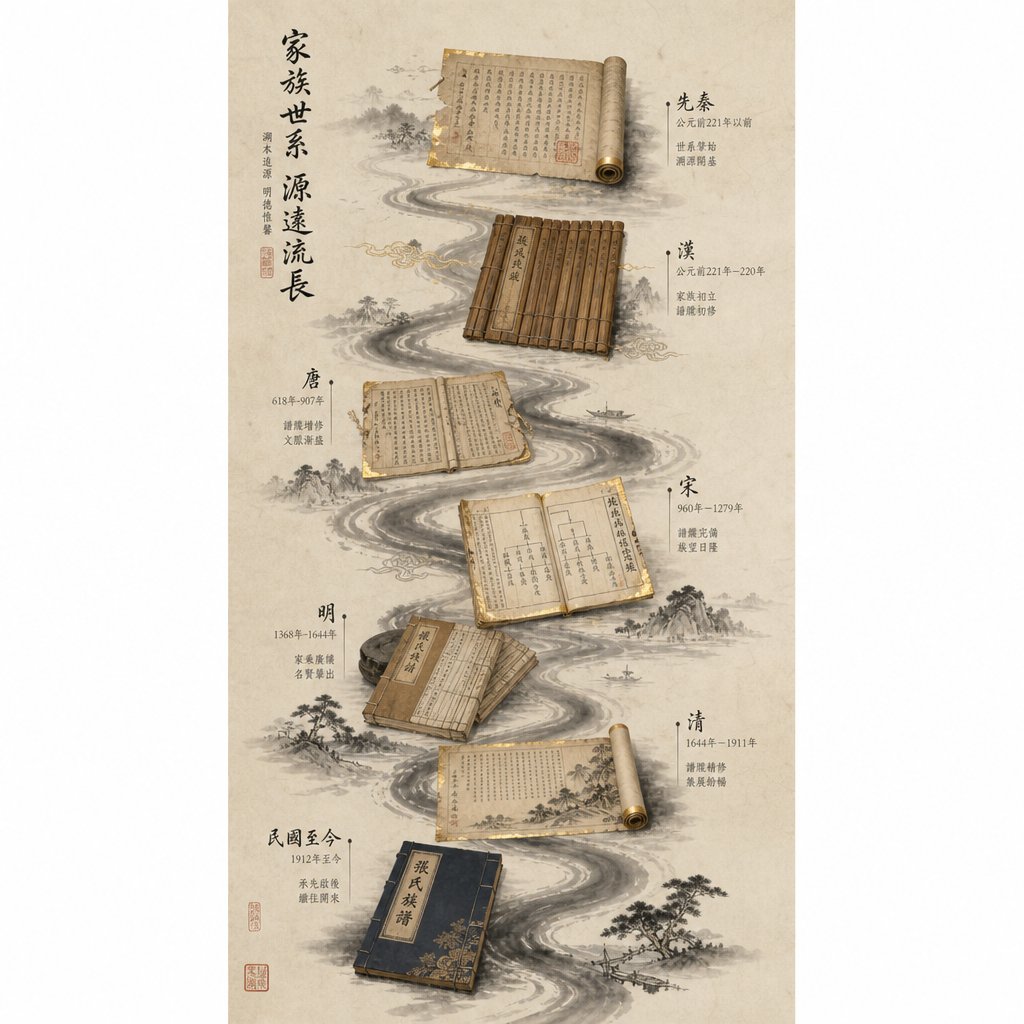
Chinese generation names did not appear overnight. They grew out of centuries of experimentation with kinship markers, gradually evolving from informal shared-character patterns into a fully codified system embedded in clan genealogies (族谱/zúpǔ). Tracing that evolution reveals how deeply family structure and philosophical ideals shaped the way Chinese families named their children.
Origins From the Han Dynasty to Song Dynasty
So when did we start naming generations in this systematic way? The earliest recognizable examples date to the late Han Dynasty (汉朝/Hàn Cháo, 206 BCE - 220 CE). The warlord Liu Biao (刘表/Liú Biǎo) named his two sons Liu Qi (刘琦/Liú Qí) and Liu Cong (刘琮/Liú Cóng), both sharing the radical 王 (wáng, meaning "king") as a visual generational link. This was not yet a formal system, but the seed of one.
During the Three Kingdoms period (三国/Sān Guó, 220-265 CE), the pattern became more deliberate. The famous strategist Sima Yi and his seven brothers all shared the character 达 (dá, meaning "eminence") in their courtesy names, making their generational bond unmistakable.
By the Northern and Southern Dynasties (南北朝/Nán Běi Cháo, 420-589 CE), generation naming entered the formal naming system. Emperor Song Wudi gave all seven of his sons the generational character 义 (yì, meaning "righteousness"). A key shift happened here: the father or elder generation now determined the generational character at birth, rather than leaving it to coincidence.
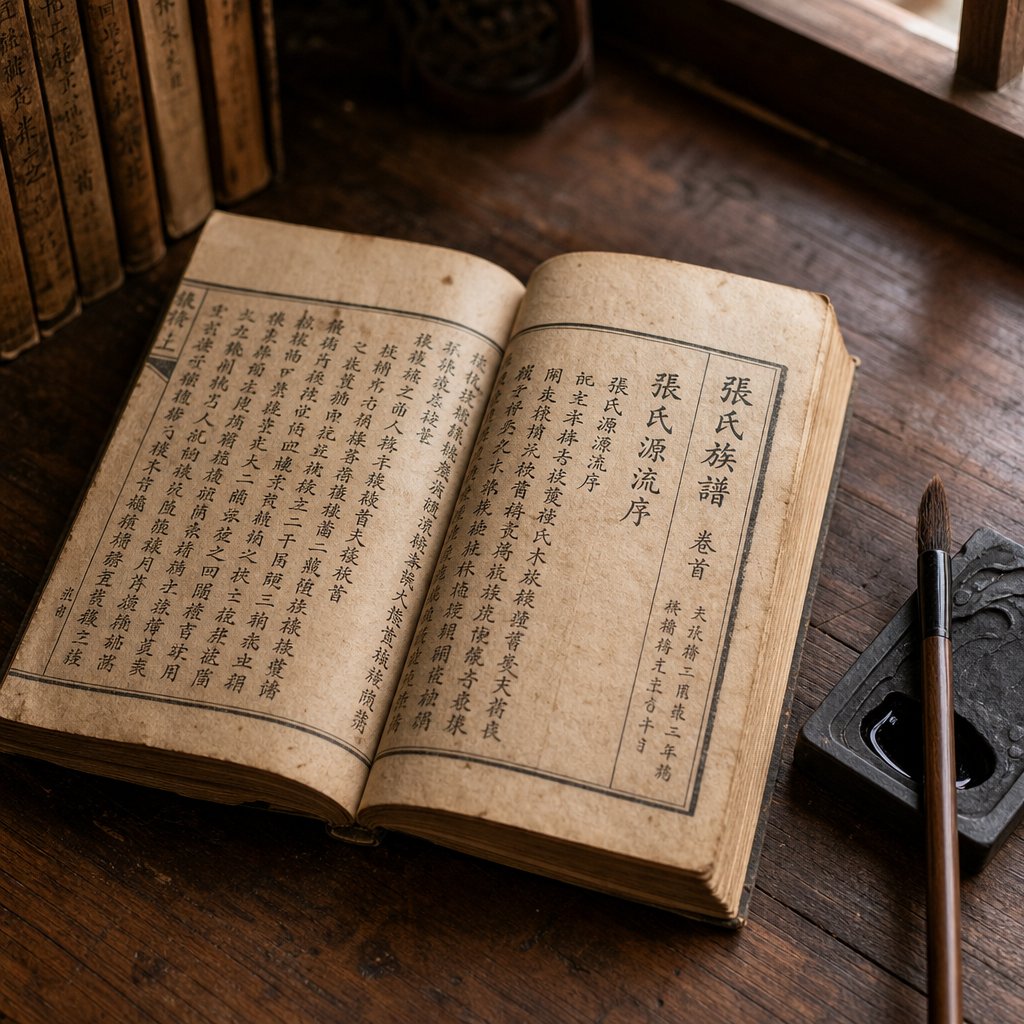
The practice reached full maturity during the Song Dynasty (宋朝/Sòng Cháo, 960-1279 CE). Instead of choosing a single character per generation on the spot, families pre-selected an entire sequence of characters, often composed as a poem. Emperor Song Taizu's descendants followed a fixed chain: 德 (Dé), 惟 (Wéi), 从 (Cóng), 世 (Shì), 令 (Lìng), and so on. When a child was born, the father simply took the next character in the sequence. This same era saw clan genealogies shift from exclusive court documents into tools for unifying families across social classes, as documented in Singapore's National Library research on jiapu traditions.
| Historical Period | Chinese (Pinyin) | Key Development in Generational Naming |
|---|---|---|
| Han Dynasty (206 BCE - 220 CE) | 汉朝 (Hàn Cháo) | Earliest shared-character patterns appear among elite families |
| Three Kingdoms (220 - 265 CE) | 三国 (Sān Guó) | Deliberate use of shared characters among siblings becomes visible |
| Northern & Southern Dynasties (420 - 589 CE) | 南北朝 (Nán Běi Cháo) | Elders formally assign generational characters at birth; practice enters the naming system |
| Late Tang to Early Song (c. 900 - 960 CE) | 唐末宋初 (Táng mò Sòng chū) | Generation poems (派诗/pàishī) emerge, encoding characters in verse form |
| Song Dynasty (960 - 1279 CE) | 宋朝 (Sòng Cháo) | Full codification: pre-determined character sequences recorded in clan genealogies (族谱/zúpǔ) |
How Confucian Values Shaped the Tradition
The history of generational names in China cannot be separated from Confucian naming traditions. Confucianism placed filial piety (孝/xiào) and respect for hierarchical order (礼/lǐ) at the center of social life. Generation names served both values simultaneously. They made lineage position visible at a glance, so any clan member could immediately determine seniority and kinship distance when meeting another person with the same surname.
This concept was called 排行 (páiháng), the system of ranking by generation. As the tradition matured, it reinforced the Confucian ideal that individual identity is inseparable from family identity. Your name did not belong to you alone. It carried your ancestors' aspirations and your position within a living chain of descendants.
The Song Dynasty's pioneering genealogists, Ouyang Xiu (欧阳修/Ōuyáng Xiū) and Su Xun (苏洵/Sū Xún), formalized documentation methods that spread genealogy writing beyond the aristocracy to merchants, farmers, and scholars alike. Their work democratized the practice, ensuring that generation names became embedded in Chinese cultural identity across every social class.
With the system fully established, families needed a way to make their generational sequences memorable and meaningful. The solution was elegant: they composed poems where each character served double duty as both literature and a name for one generation. Understanding how those poems work requires a closer look at the sounds themselves, starting with how pinyin captures the tones and syllables that give each generational character its distinct identity.
Pinyin Basics for Reading Generational Names
Every generational character carries a specific tone, and that tone changes its meaning entirely. If you want to learn how to read Chinese names in pinyin, grasping tones and formatting rules is the essential first step. Without them, a generational name is just a string of letters with no clear identity.
Tones and Syllable Structure in Pinyin
Mandarin Chinese has four tones plus a neutral (unstressed) tone. Each tone changes the pitch contour of a syllable, and each pitch contour points to a completely different character. Imagine the syllable "shi." Depending on the tone, it could represent 世 (shi4, meaning "generation"), 诗 (shi1, meaning "poem"), 时 (shi2, meaning "time"), or 仕 (shi4, meaning "official"). Two of those, 世 and 诗, appear frequently in generation names, so confusing their tones means confusing which ancestor you are referencing.
Pinyin tones for names are written in two ways: diacritical marks placed above the main vowel (shi4 becomes shi), or numbers appended after the syllable (shi4). Tone marks are the standard in formal publications and dictionaries, while tone numbers are common in digital input and informal notes. Here is how the system works with characters commonly found in generational sequences:
| Tone | Character | Pinyin (Tone Mark) | Tone Number | English Meaning |
|---|---|---|---|---|
| 1st (high level) | 德 | de | de1 | Virtue |
| 2nd (rising) | 明 | ming | ming2 | Bright |
| 3rd (dipping) | 永 | yǒng | yong3 | Eternal |
| 4th (falling) | 世 | shi | shi4 | Generation |
| Neutral (unstressed) | 子 | zi | zi0 / zi5 | Child (suffix) |
Each pinyin syllable consists of an optional initial consonant (like "sh" or "m"), a final (the vowel core plus any ending nasal like "-ng"), and a tone. When two syllables sit next to each other and the boundary is ambiguous, an apostrophe separates them. For example, the generational name sequence "xi'an" clarifies that you mean two syllables (xi + an), not the single syllable "xian." As AllSet Learning's pinyin spelling rules explain, this apostrophe prevents misreading and is especially important in names where clarity matters most.
Formatting Conventions for Names in Pinyin
When generational names appear in official documents, specific formatting rules apply. Understanding these conventions helps you spot generation names in passports, academic papers, and genealogical databases.
Here are the key rules, drawn from China's national standard for romanizing personal names:
- Capitalization: The surname is capitalized, and the given name is capitalized as a separate word. A two-syllable given name is written as one continuous word with only the first letter capitalized: Wang Shiming (not Wang Shi Ming or Wang shi-ming).
- No hyphenation: Modern standard practice joins the two syllables of a given name without a hyphen. Older records and some diaspora conventions still use hyphens (Shi-Ming), so you may encounter both formats.
- Tone marks omitted on documents: Passports and ID cards typically strip tone marks entirely, leaving only bare letters. This means "Shiming" on a passport could represent dozens of character combinations, making pattern recognition across family members even more critical.
This last point is where pinyin tone marks explained in reference materials become vital for researchers. Without tones, the syllable "shi" maps to over 40 common characters. When you see generation.names listed in a genealogy database without tone marks, comparing the names of known siblings or cousins is often the only reliable way to confirm which syllable is the shared generational element and which is the individual name.
Sounds complex? It becomes far more intuitive once you see how a full Chinese name breaks down into its structural parts, with the generational syllable sitting in a predictable position between surname and personal character.
How to Identify Generational Names in Pinyin Text
A Chinese name written in pinyin looks like two or three syllables strung together. Without characters to guide you, how do you figure out which part is the generational character in pinyin and which part is the personal name? The answer lies in understanding the predictable architecture of Chinese names and applying a few pattern-recognition techniques.
Chinese Name Structure and the Generational Syllable
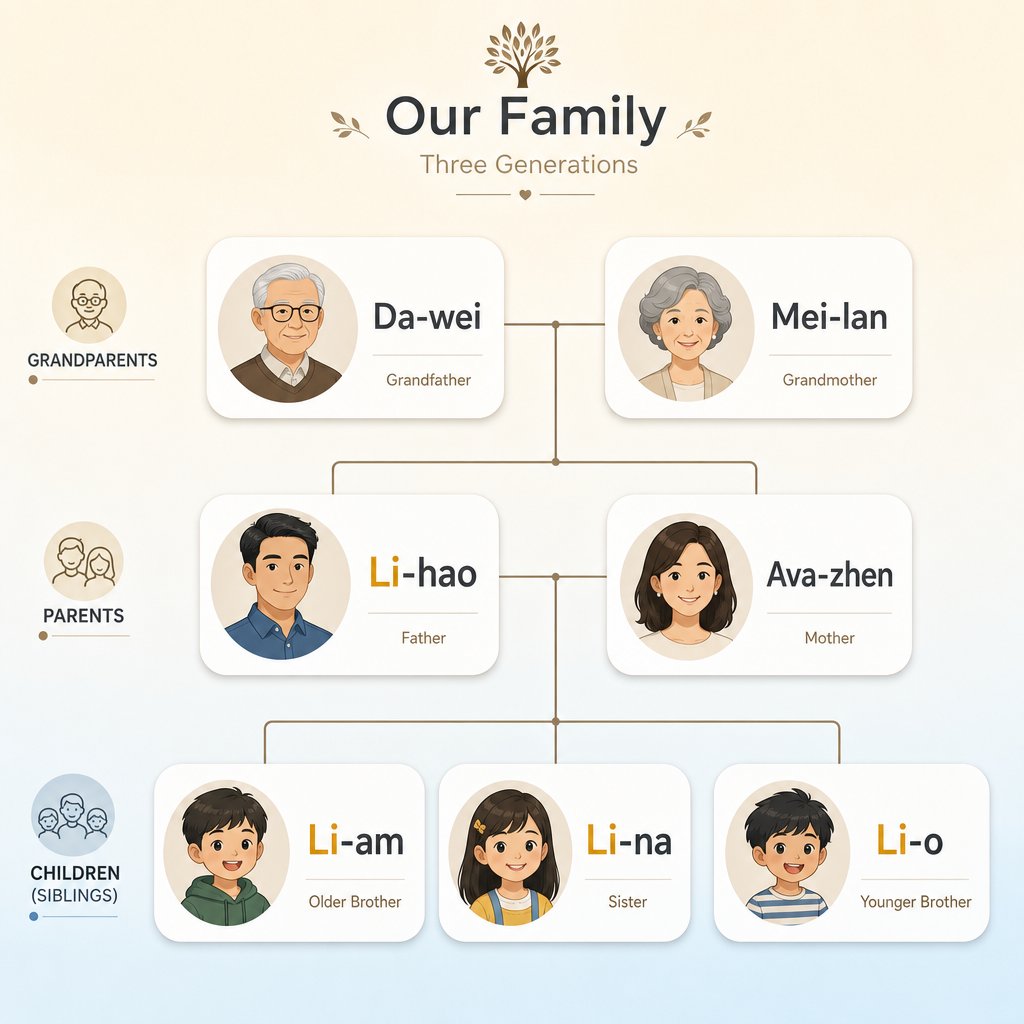
The Chinese name structure explained in its simplest form follows a three-part pattern: surname + generational character + personal character. The surname (姓/xìng) comes first and is almost always one syllable. The remaining two syllables form the given name, and one of those syllables is the generational marker shared across an entire generation of the family.
Consider this set of names from the Temple University naming guide: Jia Zhenni, Jia Zhenhai, Jia Zhenhua, Jia Zhendong, Jia Zhenguo, and Jia Zhenxing. Here is how each name breaks down:
| Full Name (Pinyin) | Surname | Generational Character | Personal Character |
|---|---|---|---|
| Jia Zhenni | Jia | Zhen | ni |
| Jia Zhenhai | Jia | Zhen | hai |
| Jia Zhenhua | Jia | Zhen | hua |
| Jia Zhendong | Jia | Zhen | dong |
You'll notice the repeating syllable "Zhen" occupies the first position of the given name. This is the most common placement. However, FamilySearch's research on generation poems notes that some clans place the generational character second, making the personal character come first instead. So the pattern could also look like: surname + personal character + generational character. This variation is less frequent but important to keep in mind.
What many English speakers call the "chinese middle name" is often this generational element. It is not a middle name in the Western sense, chosen freely by parents. It is a predetermined character assigned to an entire generation, carrying the weight of ancestral planning.
A Step-by-Step Method to Identify Generation Characters
When you encounter a list of Chinese names in pinyin and want to identify which syllable is the generational marker, follow this process:
- Isolate the surname. The first syllable (or occasionally two syllables for compound surnames like Ouyang or Sima) is the family name. Separate it from the rest.
- Identify the given name syllables. The remaining one or two syllables form the given name. If only one syllable remains, the name may not contain a generational element, as single-character given names became popular in the mid-20th century when many families abandoned the tradition.
- Gather names of known relatives. Collect the pinyin names of siblings, cousins, or anyone confirmed to be from the same generation and same patrilineal clan.
- Compare the given-name syllables across relatives. Look for the syllable that repeats in the same position. If three cousins are named Wang Shiming, Wang Shihua, and Wang Shijun, the repeating "Shi" is almost certainly the generational character.
- Check the non-repeating syllable. The syllable that differs among relatives (ming, hua, jun) is the personal character, unique to each individual.
- Verify position consistency. Confirm that the shared syllable appears in the same position (first or second within the given name) across all relatives. If it does, you have identified the generational character with high confidence.
This comparison method is the most reliable way to identify a generation name in Chinese when working solely from pinyin. A single name in isolation offers no certainty because pinyin is inherently ambiguous. The syllable "shi" alone could be dozens of different characters. Only when you see it repeated across relatives does the pattern confirm its role as a generational marker.
There is one more complication worth noting. As Ancestry's guide to Chinese names points out, some families assign one shared character for all males and a different shared character for all females within the same generation. If you are comparing names across genders, you might see two different generational syllables for the same generation. Comparing within the same gender first eliminates this confusion.
Pattern recognition becomes even more powerful when you have access to multiple generations. If the father's generation shares "De" and the children's generation shares "Shi," you are looking at consecutive characters from a generation poem, a pre-composed verse that assigns one character per generation in sequence. Recognizing that sequence is the next key to unlocking your family's naming history.
Generation Poems Decoded With Full Pinyin Annotation
Those consecutive generational characters you spotted across family members are not random selections. They are fragments of a poem, a carefully composed verse where each character serves as the generational name for one successive generation. These poems, called 派诗 (paishi) or 字辈歌 (zibei ge), are the master key behind how generation poems work in Chinese naming tradition.
Understanding Generation Poems and Their Structure
A generation poem is a short verse, typically arranged in lines of five or seven characters, that a clan's elders or a respected scholar composed to guide naming for centuries to come. Each character in the poem corresponds to exactly one generation. The first character names the first generation after the poem's adoption, the second character names the next generation, and so on down the line. When a family reaches the final character of the poem, they cycle back to the beginning and start again.
Imagine a poem with 20 characters. That single verse covers 20 generations of naming, roughly 500 to 600 years of family history. Because each clan's poem is unique, even a handful of generation characters can act like a fingerprint, helping you discover your family's genealogical records.
The structure follows consistent patterns:
- Line length: Most poems use lines of 5 or 7 characters, mirroring classical Chinese poetry forms.
- Total length: Poems range from 16 to 40+ characters, depending on how far into the future the composers planned.
- Thematic content: Lines typically praise ancestors, invoke Confucian virtues, and express hopes for prosperity and moral integrity in future generations.
- Phonetic design: Many poems incorporate rhyme schemes and tonal balance, making them easier to memorize and recite across generations.
This last point becomes visible when you read a generation poem in pinyin. The romanized syllables reveal end-rhymes and tonal patterns that were intentionally composed, turning the poem into both a literary work and a mnemonic device.
Annotated Generation Poem Examples With Pinyin
One well-documented example comes from the Wong clan of Gom Benn village in Taishan. Attributed to Wong Shi Jun (黄士俊/Huang Shijun, 1570-1661), a Ming Dynasty scholar-official, this poem guided the family's naming from the 1600s through the early 1900s:
| Line | Chinese Characters | Pinyin (With Tone Marks) | English Translation |
|---|---|---|---|
| 1 | 圣帝启文明 | Sheng di qi wenming | The Holy Emperor begot civilization |
| 2 | 道德尊朝廷 | Daode zun chaoting | The imperial court respects morality |
| 3 | 世传礼义重 | Shichuan li yi zhong | Etiquette is passed down from generation to generation |
| 4 | 奕祀振家声 | Yi si zhen jia sheng | Family traditions are invigorated from age to age |
This zibei poem pinyin translation reveals 20 characters across four lines of five. Each character served one generation of the Wong clan. The 22nd through 26th generations, for instance, drew their names from the third line: 世 (Shi, 22nd), 传 (Chuan, 23rd), 礼 (Li, 24th), 义 (Yi, 25th), 重 (Zhong, 26th). Brothers and cousins within the 23rd generation all carried "Chuan" in their names, making their generational bond immediately recognizable.
Reading the pinyin aloud, you'll notice the end syllables of lines two and four: "chaoting" and "sheng" share a similar nasal ending pattern, while "wenming" in line one echoes that resonance. This tonal and phonetic balance was deliberate. Classical Chinese poets composed generation poems with the same care they brought to regulated verse, ensuring the lines were pleasant to recite and easy to pass down orally.
The thematic content is equally intentional. This poem moves from cosmic authority (the emperor and civilization) through moral philosophy (virtue and propriety) to family continuity (traditions passed across ages). These are not arbitrary words. They encode the clan's values: reverence for order, commitment to ethical conduct, and faith that the family line will endure. As author Wendy Chen notes, generation poems were typically composed by important progenitors of the family, and sometimes even gifted by emperors to honor noble clans.
The beauty of these chinese generation poem examples is their dual function. They are literature and infrastructure at the same time, a verse you can appreciate aesthetically and a practical tool that tells you exactly where someone stands in a lineage spanning centuries. When you encounter a generational name in pinyin and can trace it back to its position in the poem, you have not just identified a name. You have located a person in time.
Of course, the same poem sounds different depending on who is reading it. A Cantonese speaker, a Hokkien speaker, and a Mandarin speaker will each pronounce these characters with entirely different sounds, and each community developed its own romanization system to capture those pronunciations on paper.
Regional and Dialect Variations in Romanization
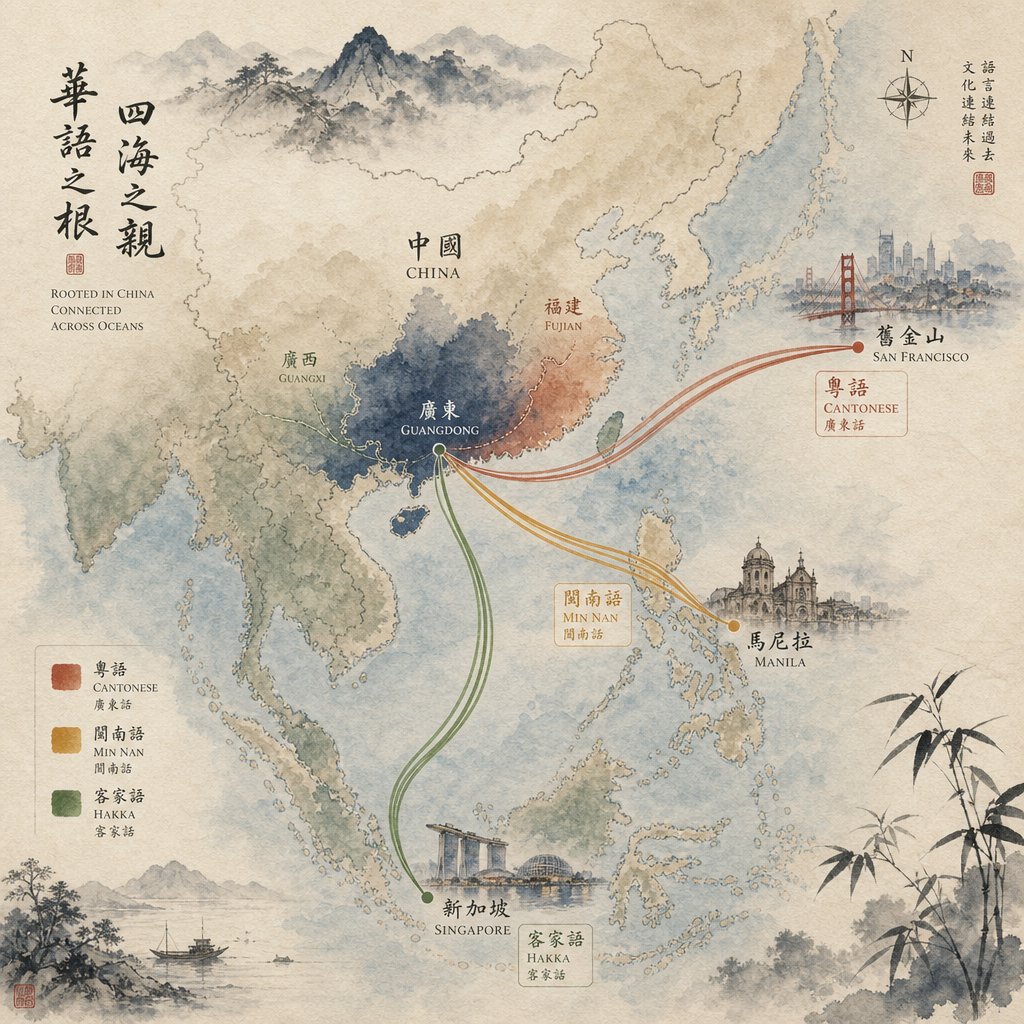
A Cantonese grandmother in San Francisco, a Hokkien merchant in Manila, and a Mandarin-speaking professor in Beijing might all descend from the same clan and share the same generational character in their names. Yet their names on paper look nothing alike. The dialect differences in Chinese names create a maze for anyone trying to trace generational patterns across diaspora records, because the same character produces entirely different romanized spellings depending on who pronounced it and which system recorded it.
Mandarin Pinyin Versus Other Romanization Systems
Mandarin pinyin is the internationally recognized standard for romanizing Chinese characters based on Beijing Mandarin pronunciation. But it is only one system among many. Before pinyin became dominant in the late 20th century, Wade-Giles was the primary romanization used in English-language scholarship and many government records. Cantonese speakers in Hong Kong and overseas communities used various informal systems, later standardized as Jyutping by the Linguistic Society of Hong Kong. Hokkien speakers in Taiwan, Southeast Asia, and the Philippines relied on Pe̍h-ōe-jī (POJ), a romanization developed by missionaries in the 19th century.
Each system captures a different dialect's pronunciation of the same character. Consider the generational character 明 (meaning "bright"). A Mandarin speaker says "ming," a Cantonese speaker says "ming" (similar in this case), and a Hokkien speaker says "beng." The Wade-Giles system would render the Mandarin pronunciation as "ming" as well, but diverges sharply from pinyin on other characters. For instance, 德 ("virtue") is "de" in pinyin but "te" in Wade-Giles, "dak" in Jyutping, and "tek" in Hokkien POJ.
Here is how several common generational characters appear across these four major romanization systems:
| Character | Meaning | Mandarin Pinyin | Wade-Giles | Cantonese Jyutping | Hokkien POJ |
|---|---|---|---|---|---|
| 德 | Virtue | de2 | te2 | dak1 | tek |
| 明 | Bright | ming2 | ming2 | ming4 | beng5 |
| 志 | Ambition | zhi4 | chih4 | zi3 | chi3 |
| 国 | Nation | guo2 | kuo2 | gwok3 | kok |
| 文 | Literature | wen2 | wen2 | man4 | bun5 |
| 振 | Invigorate | zhen4 | chen4 | zan3 | chin2 |
| 世 | Generation | shi4 | shih4 | sai3 | se3 |
You'll notice that wade giles vs pinyin names differ most on consonants: pinyin's "zh," "z," and "g" become Wade-Giles "ch," "ch," and "k." Cantonese romanization of chinese names diverges even further because the underlying pronunciation is a different language entirely, not just a different spelling convention. Hokkien POJ introduces yet another layer of variation, with initial consonants and vowel structures that bear little resemblance to either Mandarin system.
Dialect Variations That Affect Genealogical Research
Why does this matter for tracing generational names? Because Chinese emigration happened in waves from different regions, and each wave carried its own dialect and romanization habits into official records. Nearly all early Chinese immigrants to the United States came from six districts in Guangdong Province, meaning their names were recorded in Cantonese pronunciation. A family's generational character 国 would appear as "Kwok" or "Kok" in San Francisco immigration files from the 1880s, not "Guo" as modern pinyin would render it.
A 2025 study from University College London demonstrated this problem quantitatively. Researchers found that Hong Kong Government Cantonese Romanisation (HKG-romanisation) represented the same Chinese character using multiple different codes. The surname 周, for example, appeared as "Chow," "Chau," or "Chiau" in different records, while Jyutping would consistently render it as "Zau1" and pinyin as "Zhou1." This inconsistency meant that blocking strategies using HKG-romanisation achieved only 68.8% recall, compared to over 95% recall when standardized Jyutping or Pinyin was used.
For genealogical researchers, this creates a practical challenge. Imagine searching for all descendants sharing the generational character 文. You would need to search for "Wen" (pinyin), "Wen" (Wade-Giles), "Man" (Cantonese), and "Bun" (Hokkien) to capture the full diaspora picture. A single gens name in the family poem fractures into four or more spellings depending on where each branch settled.
Immigration records compound the problem further. Officers who processed arrivals often had no training in Chinese languages and transcribed names phonetically based on what they heard. The same person might appear as "Shih" on one document and "Sze" on another, both attempts at capturing 世. Historical linkage of US census data matched only 3.6% of male Chinese migrants between 1880 and 1900, compared to 16.3% of English migrants, largely because of these romanization inconsistencies.
The takeaway for anyone researching generational names across borders: never assume a single spelling. Build a mental map of how your family's dialect would render each generational character, and search across all plausible romanizations. The generational pattern is still there, hidden beneath layers of dialect variation and historical spelling conventions, waiting to be recognized once you know what forms it can take.
These dialect differences become even more complex when the generational naming tradition itself crossed national boundaries, adapting to Vietnamese and Korean naming systems with their own romanization conventions entirely.
Cross-Cultural Generational Naming Traditions Compared
Chinese generational naming did not stay within China's borders. As Confucian culture spread across East Asia, Vietnam and Korea each absorbed the practice and reshaped it to fit their own languages and social structures. The result is a family of related east asian generational naming customs that share a common ancestor but look and sound quite different on paper.
Vietnamese and Korean Adaptations of the Tradition
In Vietnam, the vietnamese middle name tradition known as ten dem (tên đệm) functions much like Chinese zibei. Family members of the same generation share a middle character placed between the surname and the personal name. The practice arrived with centuries of Chinese cultural influence and became deeply embedded in Vietnamese aristocratic and clan life. One of the most famous examples is the Nguyen dynasty's Đế hệ thi (帝係詩, "Poem of the Generations of the Imperial Family"), composed by Emperor Minh Mạng to govern naming for all future imperial descendants. Each character in that poem assigned a generational title to one successive generation, exactly mirroring the Chinese model.
Korean generational names dollimja (돌림자, also called hangnyeolja/항렬자) follow the same logic but with a distinctive twist. In Korean names, the generational character frequently alternates position between generations. One generation places it as the first syllable of the given name, the next generation places it second. This alternating pattern is far more common in Korea than in China or Vietnam, giving Korean genealogical records a rhythmic quality that can actually help researchers identify generational markers once they recognize the pattern.
Both traditions share a key feature with their Chinese source: the sequence of generational characters is predetermined, recorded in a poem or list, and passed down through clan records. The underlying philosophy is identical. Individual identity is anchored within collective lineage, and your name announces your place in a chain stretching back centuries.
Comparative Romanization Across East Asian Systems
When the same original Chinese character crosses into Vietnamese Quốc Ngữ or Korean revised romanization, it transforms dramatically. Vietnamese uses a Latin-based script with extensive diacritics, while Korean romanization reflects the phonology of hangul. The table below shows how several common generational characters appear across all three systems:
| Character | Meaning | Mandarin Pinyin | Vietnamese Quốc Ngữ | Korean Revised Romanization |
|---|---|---|---|---|
| 明 | Bright | ming | Minh | Myeong |
| 文 | Literature | wen | Văn | Mun |
| 德 | Virtue | de | Đức | Deok |
| 世 | Generation | shi | Thế | Se |
| 永 | Eternal | yǒng | Vĩnh | Yeong |
| 光 | Glory | guāng | Quang | Gwang |
Notice how "文" becomes "Văn" in Vietnamese and "Mun" in Korean. A researcher tracing a single clan that branched across China, Vietnam, and Korea would encounter three completely different spellings for the same generational character. Yet the underlying structure is identical: one shared character, one generation, one position in a predetermined poem.
This shared origin is precisely what makes cross-border genealogical research possible. If you know your family's generation poem in Mandarin pinyin, you can map each character to its Sino-Vietnamese or Sino-Korean pronunciation and search records in those countries. The generational titles change their sound, but their sequence and meaning remain constant. A "Đức" in a Vietnamese family tree and a "Deok" in a Korean one may point back to the same 德 in a Chinese clan's original poem, revealing connections that transcend national boundaries and centuries of linguistic drift.
These cross-cultural patterns become especially relevant when generational names move from ancestral poems into the practical world of modern documents, where passports, databases, and immigration records each impose their own formatting rules on these ancient naming conventions.
Practical Applications for Documents and Genealogy Research
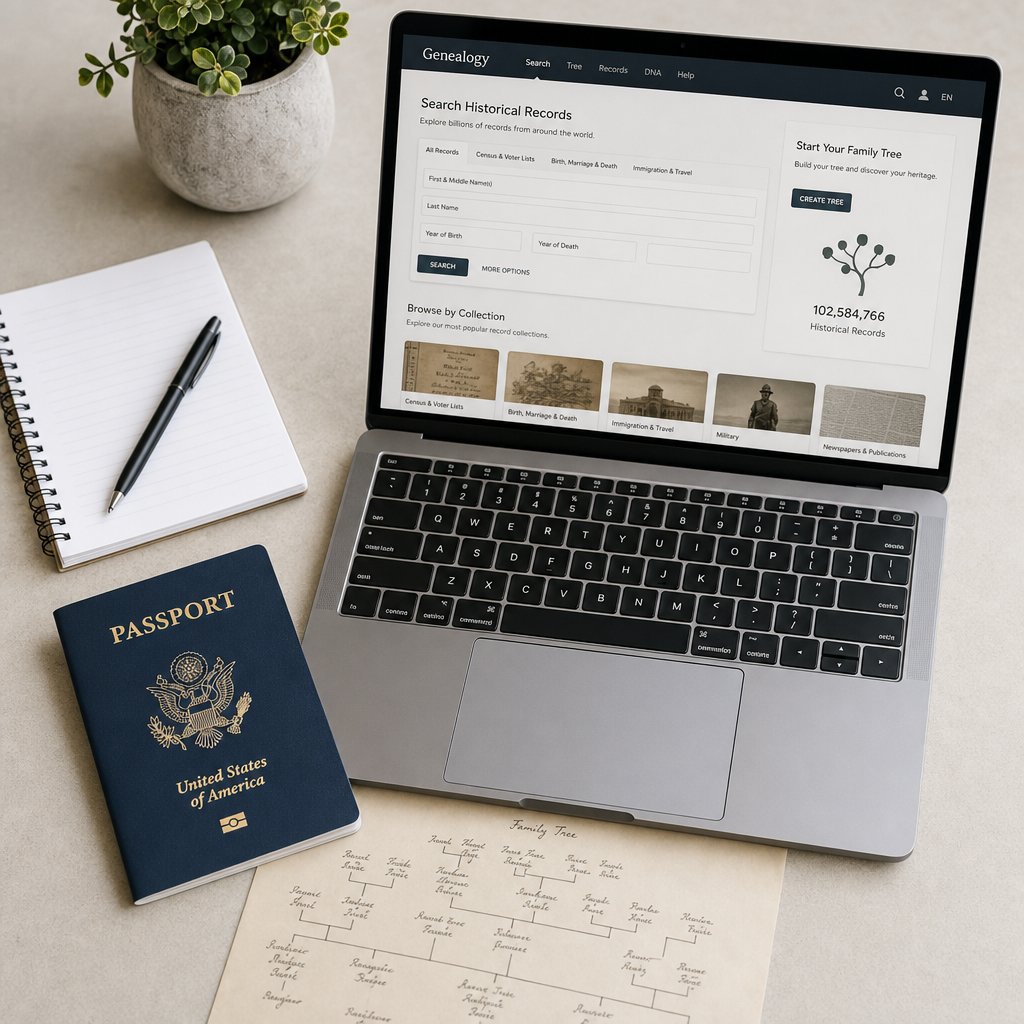
Generational names live in ancestral poems, but they also live in passport offices, university registrars, and immigration databases. Every time a Chinese name is rendered in Latin letters for official use, the generational character becomes part of a pinyin string that follows specific government formatting rules. Knowing those rules, and knowing how to search chinese generational names in digital records, turns abstract tradition into a practical research tool.
Generational Names on Passports and Official Documents
China's official standard for romanizing personal names on identity documents uses Hanyu Pinyin exclusively. The Guidelines for Transliteration of Chinese specify that the surname comes first, followed by the given name as a single continuous word with only the initial letter capitalized. No hyphen, no space between syllables of the given name. So a person named 王世明 appears as "Wang Shiming" on their passport, with the generational syllable "Shi" merged seamlessly into the given-name block.
This formatting means the chinese name on passport pinyin does not visually separate the generational element from the personal element. You cannot tell from "Shiming" alone where "Shi" ends and "ming" begins unless you already know the family's generational pattern. Tone marks are stripped entirely from travel documents, collapsing dozens of possible characters into a single ambiguous spelling.
Here are practical scenarios where recognizing generational names in their romanized form becomes essential:
- Matching family members across passport records when verifying kinship for immigration applications
- Identifying generational patterns in academic publication author lists to confirm clan relationships
- Reading international business cards where only pinyin appears alongside an English name
- Linking historical immigration documents to modern family records across spelling variations
- Navigating digital genealogy databases that index names exclusively in romanized form
- Resolving duplicate entries in hospital, school, or government systems where multiple people share similar pinyin names
Pinyin Search Techniques for Genealogy Research
When searching genealogy databases like FamilySearch's China Collection of Genealogies, a few strategies dramatically improve your results. Start with a surname search using the pinyin spelling of your family name, then look for clusters of given names sharing the same initial syllable. If three or four results under the surname "Chen" all have given names beginning with "De," you are likely looking at generation nicknames from the same cohort.
Because tone marks are absent from most databases, cast a wide net. Search for all plausible spellings of your generational syllable, including Wade-Giles and dialect variants identified in earlier research. Use wildcard characters when available. A search for "Li Shi*" might surface Li Shiming, Li Shihua, and Li Shijun, revealing an entire generational cluster in one query.
Cross-reference results against known generation poems. If your family's poem places "Shi" in the 14th position and "De" in the 13th, finding a "Li Deqiang" alongside your "Li Shiming" results suggests you have located the previous generation. This vertical pattern across generations is often more conclusive than horizontal matches within a single generation.
The challenge going forward is that fewer families maintain these traditions. Research from NUS Faculty of Arts and Social Sciences found that among young Chinese Singaporeans, only a small handful of students had been named according to their family's genealogy books. Modern parents, particularly those who primarily speak English, often view generations nicknames and long-term naming sequences as outdated. Some adapt the tradition informally, choosing common characters or initials for siblings rather than following a clan poem.
This shift means that pinyin-based genealogical records from the 21st century will increasingly lack the generational markers that made earlier records so traceable. For researchers, the implication is clear: the window for connecting living family members to their ancestral poems through shared pinyin syllables is narrowing. If your family still carries a generational character in its names, that syllable is not just a sound. It is a thread connecting you to a poem your ancestors composed centuries ago, waiting for someone to read it aloud and recognize where they belong in the verse.
Frequently Asked Questions About Generational Names in Pinyin
1. What are Chinese generational names and how do they appear in pinyin?
Chinese generational names (字辈/zibei) are predetermined characters shared by all family members of the same generation within a patrilineal clan. In pinyin, they appear as a repeating syllable in the given-name portion of romanized names. For example, cousins named Wang Shiming, Wang Shihua, and Wang Shijun all share the generational syllable 'Shi,' which identifies their generation within the family's naming sequence. On official documents like passports, tone marks are removed, so the generational syllable merges into the given name as plain letters without visual separation.
2. How can I identify the generational character in a Chinese name written in pinyin?
The most reliable method is comparing names of known siblings or cousins from the same clan. Isolate the surname (first syllable), then examine the remaining given-name syllables across multiple relatives. The syllable that repeats in the same position among all relatives of the same generation is the generational character. For instance, if you find Jia Zhenni, Jia Zhenhai, and Jia Zhenhua in a family, 'Zhen' is clearly the generational marker. A single name in isolation cannot confirm a generational element because pinyin without tone marks is inherently ambiguous.
3. What is a Chinese generation poem and how does it relate to naming?
A generation poem (派诗/paishi or 字辈歌/zibei ge) is a pre-composed verse where each character assigns the generational name for one successive generation. Typically written in lines of five or seven characters mirroring classical poetry forms, these poems can cover 20 to 40+ generations spanning centuries. Clan elders or respected scholars composed them to encode family values, Confucian virtues, and aspirations for descendants. When read in pinyin, the poems reveal intentional rhyme schemes and tonal balance designed to aid memorization across generations.
4. Why do the same generational names look different across Chinese dialect romanizations?
Different Chinese dialects pronounce the same character with entirely different sounds, and each dialect community developed its own romanization system. The character 德 (virtue), for example, is 'de' in Mandarin pinyin, 'te' in Wade-Giles, 'dak' in Cantonese Jyutping, and 'tek' in Hokkien POJ. Because Chinese emigration occurred in waves from different regions, immigration records captured names in whichever dialect the speaker used. This means a single generational character can appear under four or more spellings in diaspora records, requiring researchers to search all plausible variants.
5. Do Vietnamese and Korean families also use generational naming traditions similar to Chinese zibei?
Yes, both Vietnam and Korea adopted generational naming from Chinese Confucian culture. Vietnamese ten dem places a shared middle character between the surname and personal name, functioning identically to Chinese zibei. Korean dollimja (돌림자) follows the same principle but often alternates the position of the generational character between generations. The same original Chinese character takes different romanized forms in each system. For example, 明 appears as 'ming' in Mandarin pinyin, 'Minh' in Vietnamese Quoc Ngu, and 'Myeong' in Korean revised romanization, yet all trace back to the same ancestral naming tradition.