What Makes Chinese WeChat Names Unique
When you set a username on most social platforms, you probably grab something quick: a nickname, a random handle, maybe your name plus a few numbers. Chinese WeChat names work differently. On WeChat (微信), the dominant messaging app in China with over a billion active users, your display name is a small but deliberate act of self-expression, shaped by centuries of linguistic tradition.
Chinese names carry cultural weight that goes far beyond identification. As Chinese naming traditions show, names are a culmination of history, heritage, family hopes, and individual identity. That same philosophy extends to WeChat, where users treat their display names as personal statements built from carefully chosen characters.
Why Your WeChat Name Matters in Chinese Culture
Imagine choosing a name where every syllable holds a hidden meaning, a literary echo, or a clever tonal pun. That is the norm for common chinese names on WeChat. Unlike Western platforms where usernames tend to be straightforward identifiers, Chinese users draw from thousands of characters to craft names and characters that reflect mood, aspiration, or poetic sensibility. A single character can reference classical poetry, invoke good fortune, or play on homophones that only native speakers catch.
Chinese WeChat users rarely pick names for convenience alone. They choose names with layered meanings, literary references, or tonal wordplay, treating a display name as a miniature form of personal art.
What This Guide Covers
This guide gives you authentic chinese names suited for WeChat, organized by gender, style, and purpose. Every suggestion includes Chinese characters, pinyin romanization, and an English translation so you understand exactly what each name communicates. Whether you want something elegant, playful, professional, or poetic, you will find options that sound natural to native speakers rather than awkward to them.
Understanding WeChat Naming Conventions and Settings
Picking the perfect Chinese characters for your name is only half the equation. WeChat actually gives you three separate name fields, and each one behaves differently depending on where it appears. Confusing your display name with your WeChat ID is one of the most common mistakes new users make, and it can limit your options later.
Display Name vs WeChat ID vs Group Nickname
Think of it this way: your display name is what friends see in conversations and on your profile. Your WeChat ID is a permanent-ish identifier others use to find and add you. Your group nickname is a per-group alias that overrides your display name inside specific group chats. Each serves a distinct purpose, and each has its own rules.
Your display name is the most visible element of your chinese wechat names strategy. It shows up in private chats, group chats (unless overridden by a group alias), Moments posts, and your profile card. You can change it anytime, and it supports Chinese characters, English letters, emojis, and special symbols.
Your WeChat ID functions more like a username on other platforms. It is a unique alphanumeric string that people search to add you as a contact. According to WeChat's official help center, your wechat id must be between 6 to 20 characters long and should not include your name, birthday, or other personal information. Here is the critical detail: once you set a custom WeChat ID, it can only be changed once per year. If you have not created one yet, your contacts see the original ID automatically generated by WeChat.
Your group nickname (or group alias) is entirely separate. You can set a different alias for every group chat you belong to, and it only appears within that specific group. This is useful for professional groups where you want your real name visible, while keeping a creative display name for personal conversations.
An example of wechat id might look like "skywalker_2024" or "lx_studio" - purely alphanumeric with underscores or hyphens allowed. Compare that to a display name like "清风明月" (qingfeng mingyue, clear wind and bright moon), which uses Chinese characters and poetic imagery. They live in completely different worlds.
Character Limits and Formatting Rules
The formatting constraints differ significantly across the three fields. Here is a quick comparison:
| Name Type | Character Limit | Visibility | Change Frequency |
|---|---|---|---|
| Display Name | Up to 16 characters (Chinese) or 32 characters (English) | Profile, private chats, Moments, group chats (if no alias set) | Unlimited changes |
| WeChat ID | 6-20 alphanumeric characters | Profile card, search results, contact info | Once per year |
| Group Nickname | Up to 16 characters | Only within that specific group chat | Unlimited changes |
A few practical notes worth keeping in mind. Display names accept emojis and symbols freely, which is why you will see names like "小🌸花" mixing characters with emoji. WeChat IDs, on the other hand, are strictly alphanumeric: letters, numbers, underscores, and hyphens only. No Chinese characters, no emojis, no spaces. If your preferred wechat id is already taken, you will need to get creative with letter-number combinations or add meaningful prefixes.
One more thing that catches people off guard: your WeChat ID cannot be hidden from your profile. Anyone who views your contact card will see it. So while your display name can be as whimsical or poetic as you like, your WeChat ID should be something you are comfortable sharing publicly for the long term.
Understanding these distinctions matters because the cultural symbolism behind Chinese characters, the part that makes a name feel authentic rather than random, applies primarily to your display name and group nicknames. That is where the real creative expression happens, and where character choice carries the most weight.
Cultural Symbolism Behind Popular Chinese Characters
Character choice is where a WeChat name goes from generic to genuinely expressive. Each mandarin character carries centuries of accumulated meaning, literary association, and phonetic resonance. When you see a name like 汐梦瑶 on someone's profile, you are not just reading syllables. You are reading a compressed story about beauty, aspiration, and identity.
With tens of thousands of characters in existence, you might wonder: how many chinese characters are there, exactly? Estimates range from 50,000 to over 100,000 recorded in comprehensive dictionaries, though educated native speakers typically use around 6,000 to 8,000 in daily life. For WeChat names, the pool narrows further. Users gravitate toward characters that are visually elegant, phonetically pleasing, and rich in cultural connotation.
Popular Characters and Their Hidden Meanings
Certain characters appear again and again in Chinese WeChat names because they pack multiple layers of meaning into a single stroke pattern. Here are some of the most popular, along with what makes them resonate:
- 梦 (meng, dream) - Beyond its literal meaning, 梦 evokes aspiration, imagination, and the boundary between reality and desire. It appears in classical poetry as a metaphor for fleeting beauty and in modern usage as a symbol of personal ambition.
- 星 (xing, star) - Represents brilliance, guidance, and rarity. In Chinese culture, stars are tied to fate and destiny. A name containing 星 suggests someone who shines or who follows their own path.
- 雨 (yu, rain) - Rain carries poetic weight in Chinese literature, symbolizing renewal, gentle emotion, and melancholy beauty. It is one of the most common nature characters in female WeChat names.
- 福 (fu, fortune) - One of the most culturally loaded characters in Chinese. It represents luck, happiness, and blessings. During Lunar New Year, the character is famously hung upside down on doors because "inverted" (倒, dao) sounds like "arrived" (到, dao), creating the pun "fortune has arrived."
- 瑶 (yao, jade) - The jade name meaning here goes deeper than the gemstone itself. 瑶 specifically refers to a precious, luminous variety of jade and carries connotations of purity, nobility, and otherworldly beauty. It frequently appears in names like 沐瑶 (mu yao, bathed in jade) and 书瑶 (shu yao, scholarly jade).
- 汐 (xi, evening tide) - A character that has surged in popularity among younger users. 汐 evokes the gentle rhythm of tidal waters at dusk, suggesting softness, mystery, and natural elegance. Names like 汐玥 (xi yue) and 锦汐 (jin xi) rank among the most trending girl names in China.
- 晨 (chen, morning) - Symbolizes new beginnings, hope, and vitality. Among names that mean sun or dawn, 晨 is one of the most versatile, pairing well with characters for hope (希), light (曦), or elegance (雅).
- 澜 (lan, great waves) - Conveys a sense of grandeur, broad-mindedness, and extraordinary presence. It is a single-character name that works on its own or as part of longer combinations.
- 安 (an, peace) - Simple yet powerful. 安 represents safety, calm, and contentment. It appeals to users who want their name to project stability and quiet confidence.
- 昕 (xin, sunrise) - Another character in the family of names that mean sun and brightness. 昕 specifically refers to the first light of dawn, making it hopeful and forward-looking without being overly common.
How Wordplay and Homophones Shape WeChat Names
Mandarin Chinese is one of the languages with the largest number of homophones. Words that share identical pronunciation but carry completely different meanings create a playground for double entendres, hidden jokes, and layered symbolism in WeChat names.
The character 福 (fu, fortune) offers a classic example. It shares its pronunciation with 蝠 (fu, bat), which is why bats appear as symbols of good luck throughout Chinese art and decoration. A WeChat user choosing 福 is tapping into this entire web of auspicious associations, not just the surface meaning of "good fortune."
Number-based homophones are equally common. The sequence 520 (wu er ling) sounds close to 我爱你 (wo ai ni, "I love you"), so couples sometimes incorporate these digits into their WeChat IDs or display names. Similarly, 1314 (yi san yi si) echoes 一生一世 (yi sheng yi shi, "forever"), making it a popular addition to romantic name pairs.
Tonal puns add another dimension. Because Mandarin has four tones plus a neutral tone, characters that look nothing alike on paper can sound nearly identical in speech. This means a seemingly innocent WeChat name might carry a second, humorous or romantic meaning that only native speakers catch. It is one reason why non-native speakers sometimes accidentally choose names with unintended connotations.
Generational preferences shape how this wordplay gets deployed. Older WeChat users, particularly those over 40, tend to favor characters drawn from classical poetry collections like the Shijing (Book of Songs) or Chuci (Songs of Chu). Their names might reference well-known literary phrases or use characters associated with Confucian virtues like 德 (de, virtue) or 贤 (xian, worthy).
Younger users take a different approach. Naming trends among younger Chinese generations lean toward aesthetic characters that feel visually beautiful on screen, internet-culture references, or minimalist single-character names that project understated coolness. Characters like 汐, 瑶, and 澜 have risen sharply in popularity precisely because they look elegant in chat interfaces and carry a modern, ethereal quality that resonates with Gen Z sensibilities.
This generational split means the same platform hosts wildly different naming philosophies. A name like 静水流深 (jing shui liu shen, "still waters run deep") signals classical literary taste, while something like 星野 (xing ye, "starfield") reflects anime-influenced aesthetics. Both are authentic. Both sound natural. The difference lies in which cultural layer the user is drawing from.
Beautiful Chinese WeChat Names for Girls
Those layered meanings and cultural connotations come alive most vividly in the names Chinese women choose for their WeChat profiles. Female chinese names on the platform tend to lean into poetic imagery, natural beauty, and emotional resonance, drawing from the same character traditions discussed above but combining them in ways that feel distinctly personal.
Whether you are looking for chinese names for girls that sound refined, playful, or bold, the key is matching character combinations to the mood you want to project. Below, you will find authentic options organized by style, each with Chinese characters, pinyin romanization, and English meaning so you know exactly what you are communicating.
Elegant and Literary WeChat Names for Women
Literary names draw from classical poetry, traditional aesthetics, and characters associated with grace and refinement. These are the chinese girl names that feel timeless rather than trendy, the kind that signal cultural depth without trying too hard. You will notice many pair a nature element with a virtue or emotion, creating a compressed poetic image in just two to four characters.
- 静雅 (Jing Ya) - Serene elegance. A pairing of calm (静) and refinement (雅) that projects quiet sophistication.
- 书怡 (Shu Yi) - Knowledge and joy. Suggests someone who finds happiness in learning, a popular choice among educated Chinese women for its scholarly warmth.
- 若兰 (Ruo Lan) - Like an orchid. The orchid symbolizes integrity and understated beauty in Chinese culture, making this one of the most enduring chinese female names on WeChat.
- 烟舟渡晚 (Yan Zhou Du Wan) - A lone boat crossing at dusk. This four-character poetic phrase evokes classical landscape painting and appeals to users who love literary aesthetics.
- 风华 (Feng Hua) - Style and brilliance. Represents someone who possesses both charm and talent, often chosen by women in creative fields.
- 砚台生香 (Yan Tai Sheng Xiang) - Fragrance rising from the inkstone. A beautifully literary image that signals a love of calligraphy, writing, and traditional arts.
- 清欢 (Qing Huan) - Pure joy. Drawn from a famous Su Shi poem, this name communicates finding happiness in simplicity.
What makes these combinations work is balance. Each pairs a grounding element (quiet, book, orchid) with something aspirational or sensory (elegance, joy, fragrance). That tension between restraint and beauty is central to how elegant asian names for girls function in Chinese culture.
Cute and Playful Female WeChat Names
Not every name needs to sound like it belongs in a Tang Dynasty anthology. Younger users, especially women in their teens and twenties, often prefer names that feel lighthearted, sweet, or slightly whimsical. These lean into reduplication (repeating characters for a childlike softness), food imagery, or playful metaphors.
- 甜柚气泡 (Tian You Qi Pao) - Sweet grapefruit bubbles. Energetic and fresh, this name uses food and texture to create a bubbly personality image.
- 星星打瞌睡 (Xing Xing Da Ke Shui) - Stars falling asleep. Whimsical and slightly dreamy, perfect for someone with a lazy-cute persona.
- 蜜桃撞月球 (Mi Tao Zhuang Yue Qiu) - Peach crashing into the moon. Combines girly sweetness with cosmic imagination.
- 小雨 (Xiao Yu) - Little rain. Simple, soft, and endearing. The 小 (little) prefix is a classic way to make any character feel more intimate.
- 奶泡小熊爪 (Nai Pao Xiao Xiong Zhua) - Milk foam bear paw. Inspired by the popular latte art trend, this name is cozy and approachable.
- 兔球咕噜 (Tu Qiu Gu Lu) - Bunny ball rumble. Pure playful energy with onomatopoeia that sounds as cute as it reads.
- 可爱 (Ke Ai) - Adorable. Sometimes the most direct approach works. This single-word name is bold in its simplicity.
Playful names like these work because they do not take themselves seriously. On a platform where your name appears hundreds of times a day in chat threads, a lighthearted name keeps the tone warm and approachable. Many of these draw from the same trending nickname styles popular on Chinese social platforms, blending internet culture with traditional character aesthetics.
Nature-Inspired Names for Girls
Nature imagery runs deep in Chinese naming traditions. Flowers, water, moonlight, and seasons all carry specific emotional associations that make them ideal building blocks for WeChat display names. If you are browsing a chinese names list female options, you will find nature-based names dominate because they feel universally beautiful without being generic.
- 云栀浅眠 (Yun Zhi Qian Mian) - Gardenia clouds in light sleep. Combines floral fragrance with dreamy softness for a name that feels like a watercolor painting.
- 萤火坠入海 (Ying Huo Zhui Ru Hai) - Fireflies falling into the sea. A romantic, fantastical image that blends two natural elements in an unexpected way.
- 秋月 (Qiu Yue) - Autumn moon. Classic and evocative, this two-character name references one of the most celebrated images in Chinese poetry.
- 风屿蓝 (Feng Yu Lan) - Wind island blue. Minimal and modern, evoking coastal serenity with just three characters.
- 雪梅 (Xue Mei) - Snow plum blossom. The plum blossom blooming in winter snow is a powerful symbol of resilience and beauty under pressure.
- 月下折竹声 (Yue Xia Zhe Zhu Sheng) - Sound of bamboo breaking under moonlight. A four-character phrase that creates an entire scene, quiet, atmospheric, and distinctly Chinese.
- 沐晴 (Mu Qing) - Bathed in sunshine. Warm and optimistic, this name pairs the sensory character 沐 (to bathe, to be immersed) with clear skies.
- 寒梅 (Han Mei) - Winter plum. Similar to 雪梅 but with a cooler, more solitary tone that appeals to users who prefer understated strength.
Nature names resonate because they connect personal identity to something larger. A woman who calls herself 云栀浅眠 is not just picking pretty words. She is positioning herself within a tradition where chinese names girl choices have always drawn from the natural world to express inner qualities: resilience through plum blossoms, purity through jade, gentleness through rain.
The most effective names in any category share a common trait: they sound like something a native speaker would actually use. Avoid stacking too many heavy characters together or mixing incompatible tones. Two to four characters is the sweet spot for display names, long enough to create meaning but short enough to read at a glance in a chat list. If you are exploring asian girl names for your WeChat profile, prioritize combinations that flow naturally when spoken aloud. That phonetic harmony is what separates an authentic-sounding name from one that feels assembled from a dictionary.
Character choice also shifts depending on whether you want your name to feel warm and approachable or cool and mysterious. The playful names above invite conversation. The literary ones create a sense of distance and depth. Nature names fall somewhere in between, grounding identity in imagery that feels both personal and universal. Whichever direction appeals to you, the same principle applies: let meaning guide your selection, and the authenticity follows.

Chinese WeChat Names for Boys and Men
Female names on WeChat lean toward poetic beauty and emotional texture. Male naming patterns pull in a different direction entirely. Chinese names for boys on the platform tend to favor ambition, natural force, intellectual depth, or dry humor over delicate aesthetics. Where a woman might choose characters evoking moonlight or flowers, a man is more likely to reach for characters that suggest mountains, dragons, or quiet resolve.
This difference is not arbitrary. Traditional chinese male names have always emphasized strength, virtue, and aspiration. Characters like 勇 (yong, brave), 强 (qiang, strong), and 龙 (long, dragon) appear frequently in popular male chinese given names because they reflect cultural expectations around masculinity and achievement. On WeChat, those same values get filtered through modern sensibilities, producing names that range from classically powerful to casually cool.
Strong and Masculine WeChat Names for Men
These boy names with meaning draw from characters associated with power, leadership, and unyielding determination. They work well for users who want their name to project confidence without sounding aggressive.
- 浩然 (Hao Ran) - Vast and righteous. A name rooted in Confucian philosophy, referencing the concept of 浩然之气 (an overwhelming sense of moral courage). One of the most respected chinese first names male users choose.
- 伟龙 (Wei Long) - Great dragon. Combines grandeur with China's most powerful cultural symbol, suggesting strength and good fortune.
- 力威 (Li Wei) - Power and authority. Direct and commanding, this pairing leaves no ambiguity about the personality it projects.
- 孤城傲影 (Gu Cheng Ao Ying) - Proud shadow of a lone city. A four-character phrase that evokes solitary strength and self-reliance.
- 逐风 (Zhu Feng) - Chasing the wind. Suggests restless ambition and forward momentum in just two characters.
- 战无不胜 (Zhan Wu Bu Sheng) - Invincible in battle. A classical idiom (成语) that conveys absolute determination, popular among competitive gamers and sports fans on WeChat.
- 龙飞冲天 (Long Fei Chong Tian) - Dragon soaring to the sky. Another four-character idiom expressing limitless ambition and upward trajectory.
Cool and Modern Male WeChat Names
Younger Chinese men often gravitate toward minimalist names that feel understated rather than loud. Single-character names and short modern phrases dominate this category, projecting effortless cool through restraint. Many of these work as one syllable boy names that look clean in a chat list.
- 墨 (Mo) - Ink. A single character that suggests artistic depth and quiet intensity. Minimalist names like this are trending among men in their twenties.
- 辰 (Chen) - Stars, or the fifth Earthly Branch. Carries cosmic weight in a single stroke, modern and ancient at once.
- 溯汐潮 (Su Xi Chao) - Tracing the evening tide. Poetic but not overly soft, blending nature imagery with a sense of exploration.
- 薄衫少年 (Bo Shan Shao Nian) - Youth in a thin shirt. Evokes carefree youthfulness and a breezy, unbothered attitude.
- 清酒浪人 (Qing Jiu Lang Ren) - Sake wanderer. Combines Japanese-influenced aesthetics with Chinese character poetry, a style popular among anime fans.
- 野 (Ye) - Wild. Another powerful single-character option that communicates untamed energy with zero excess.
- 星野 (Xing Ye) - Starfield. Modern, slightly anime-influenced, and visually clean on screen.
Scholarly and Intellectual Names for Boys
For users who want their name to signal intellect, culture, or philosophical depth, these options draw from literary traditions and academic virtues. Among asian male names on social platforms, this category bridges classical Chinese values with contemporary identity.
- 博文 (Bo Wen) - Broad knowledge and literary refinement. A name that signals intellectual curiosity and a love of learning.
- 执笔画浮尘 (Zhi Bi Hua Fu Chen) - Painting fleeting dust with a brush. A literary phrase suggesting artistic contemplation and philosophical awareness.
- 梓轩 (Zi Xuan) - Resilient tree and elegant pavilion. Blends natural strength with aesthetic refinement, one of the most popular modern chinese names for boys.
- 明浩 (Ming Hao) - Bright and immense. Suggests intellectual clarity paired with expansive thinking.
- 厚德载物 (Hou De Zai Wu) - Great virtue carries all things. A classical idiom from the I Ching (易经), often used as a personal motto by scholars and professionals.
- 文渊 (Wen Yuan) - Literary depths. Evokes someone with profound knowledge, the kind of person who reads widely and thinks deeply.
- 化为须臾 (Hua Wei Xu Yu) - Dissolving into a fleeting moment. Philosophical and poetic, referencing the Buddhist concept of impermanence.
A handful of funny boy names also circulate widely on WeChat, especially among younger users who prefer humor over gravitas. Names like 油焖大侠 (You Men Da Xia, "braised hero"), 谈情不如逗狗 (Tan Qing Bu Ru Dou Gou, "flirting is worse than teasing dogs"), and 衣服又瘦了 (Yi Fu You Shou Le, "my clothes shrunk again") use self-deprecating wordplay to project approachability. These humorous names work because they subvert expectations. In a culture where names traditionally carry weight and aspiration, choosing something deliberately absurd signals confidence and social ease.
The common thread across all these categories is intentionality. Whether a man picks a single-character name like 墨 or a four-character idiom like 厚德载物, the choice communicates something specific about how he wants to be perceived. Strong names project ambition. Cool names project effortlessness. Scholarly names project depth. And humorous names project the kind of relaxed self-awareness that says the user does not need a powerful name to feel powerful.
One practical note: male WeChat users in China change their display names less frequently than female users on average. A name chosen with care tends to stick around longer, which is why many men invest more thought upfront into finding something that ages well across different life stages and social contexts.
Trending WeChat Name Styles and Matching Pairs
Individual expression is only part of the picture. Chinese WeChat names also function as social signals, trend markers, and even relationship announcements. Native speakers cycle through naming styles the way fashion rotates seasonal collections, and certain patterns dominate at any given moment. If you want a name that feels current rather than dated, understanding these trends matters as much as understanding individual characters.
Trending Name Styles Among Native Speakers
Scroll through any Chinese person's contact list and you will notice distinct style clusters. Some feel timeless, others are unmistakably of-the-moment. Here are the categories generating the most awesome names for usernames right now:
- Classical poetry quotes - Lifting phrases directly from Tang or Song Dynasty poems. Examples: 人间忽晚 (ren jian hu wan, "suddenly evening in the human world"), 山有木兮 (shan you mu xi, "the mountain has trees"), 长安故里 (chang'an gu li, "homeland of Chang'an"). These signal literary taste and nostalgia for classical culture.
- Four-character idioms (成语) - Condensed wisdom in exactly four characters. Examples: 浮生若梦 (fu sheng ruo meng, "life is like a dream"), 风轻云淡 (feng qing yun dan, "light breeze and thin clouds"). These work because they carry instant recognition among native speakers.
- English-Chinese hybrids - Mixing scripts for a cosmopolitan feel. Examples: 半sugar (ban sugar, "half sugar"), Mr.温柔 (Mr. wenrou, "Mr. Gentle"), 小Lucky (xiao Lucky, "little Lucky"). This style is especially popular among bilingual users and those in international cities.
- Minimalist single characters - One character, maximum impact. Examples: 寂 (ji, "solitude"), 尘 (chen, "dust"), 渊 (yuan, "abyss"). The restraint itself becomes the statement, projecting confidence through what is left unsaid.
- Internet slang and meme names - Drawing from platform-specific humor. Examples: 摆烂达人 (bai lan da ren, "master of giving up"), 卷不动了 (juan bu dong le, "too tired to hustle"), 佛系青年 (fo xi qing nian, "Buddhist-style youth"). These names reference shared cultural moments and signal in-group awareness.
- Anime and C-drama aesthetic names - Influenced by the 二次元 (er ci yuan) subculture and popular television dramas. Examples: 星辰大海 (xing chen da hai, "stars and ocean"), 长歌行 (chang ge xing, "song of the long march"), 清平乐 (qing ping yue, "joy of peace"). Fans of domestic anime and C-dramas often adopt character names or poetic titles directly from their favorite works, blending fandom identity with personal expression.
Seasonal shifts also drive naming trends. Around Lunar New Year, names incorporating 福 (fortune), 旺 (prosperity), or zodiac animal references spike in popularity. Spring brings floral characters like 樱 (cherry blossom) and 桃 (peach). Autumn inspires names with 枫 (maple) and 霜 (frost). Users who change their display names seasonally treat their profile as a living reflection of the calendar, something that feels names that is unique to Chinese social media culture compared to Western platforms where usernames tend to stay static.
Couples Matching Names and Group Coordinated Names
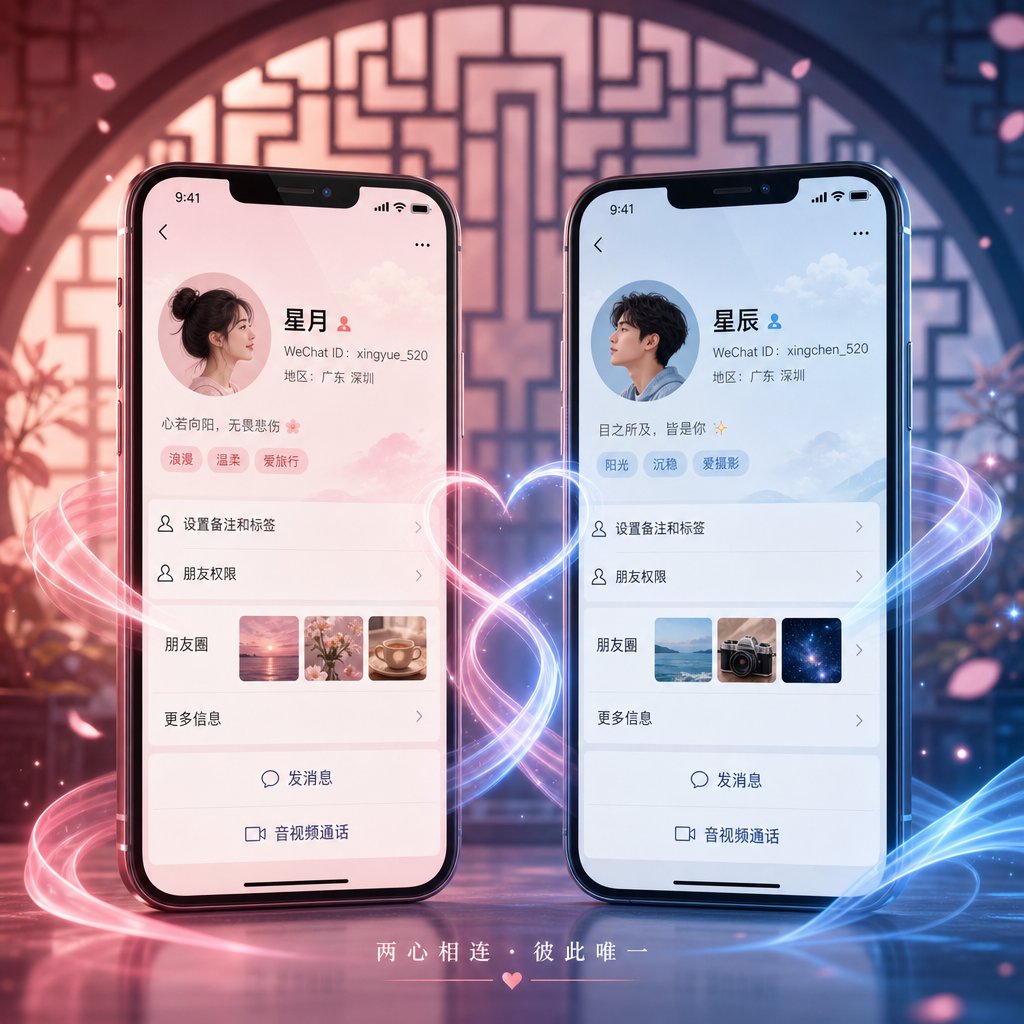
One of the most distinctive practices on WeChat is coordinated naming. Couples create matching display names that only make sense as a pair, functioning as a public declaration of their relationship. Friend groups do the same, adopting themed name sets that identify them as a unit. Think of it as the digital equivalent of matching outfits, but with more linguistic creativity.
Matching couple names typically work through complementary imagery, split phrases, or antonyms that complete each other. Popular structures include boy and girl names that mirror one another through opposing natural elements or through splitting a single poetic line across two profiles.
A classic matching pair: 南风知我意 (nan feng zhi wo yi, "the south wind knows my heart") paired with 吹梦到西洲 (chui meng dao xi zhou, "blowing dreams to the western isle"). Together they form a complete line from a famous ancient poem, but separated they each stand as beautiful independent names. The wordplay works because neither name reveals its full meaning without the other.
Other popular couple formats include:
- Antonym pairs - 向阳 (xiang yang, "facing the sun") and 背月 (bei yue, "back to the moon"). Light and shadow, together forming a complete sky.
- Numeric codes - One partner uses 520 (sounds like "I love you") while the other uses 1314 (sounds like "forever"). Subtle enough that only those who know the code catch the meaning.
- Split idioms - 执子 (zhi zi, "holding your hand") and 之手 (zhi shou, "in mine"), splitting the classical phrase 执子之手 ("to hold your hand") across two profiles.
Friend-group coordination follows similar logic but scales up. A group of four friends might each take one character from a four-character idiom, or a trio might adopt names based on sun, moon, and stars. This practice resembles how some Western parents search for twin boy names or twin names boy and girl that share a thematic thread, except here it extends beyond family into chosen social bonds. The coordinated naming signals belonging and mutual affection in a way that is immediately visible to anyone browsing a group chat member list.
What all these trends share is a sense of play within structure. Chinese WeChat names at their best treat language as a collaborative game, one where cultural literacy, personal taste, and social connection intersect in a few carefully chosen characters.
Professional vs Personal WeChat Name Etiquette
Creative names and matching pairs are great for personal circles, but the moment you add a business contact on WeChat, the rules shift. In China, WeChat functions as the primary professional communication tool, often more important than email for day-to-day business exchanges. Your display name becomes your digital first impression, and colleagues, clients, and partners will judge your professionalism partly based on what they see.
This creates a tension most users navigate carefully: how do you maintain personal expression while projecting credibility to professional contacts who share the same platform?
Professional WeChat Name Best Practices
Chinese professionals typically solve this problem through clarity rather than creativity. When your WeChat contact list includes both your college friends and your company's CEO, the safest approach is a name that reads as straightforward and identifiable. That usually means incorporating your real name.
Chinese surnames play a central role here. The most common chinese last names like 王 (Wang), 李 (Li), 张 (Zhang), 刘 (Liu), and 陈 (Chen) are instantly recognizable, and including your surname in your display name helps contacts locate you quickly in their list. Many professionals use formats like "张伟-市场部" (Zhang Wei - Marketing Dept) or "李明 Michael" to combine their chinese family names with a role identifier or English name.
Among asian last names, chinese surnames are distinctive for being placed first. This convention carries into professional WeChat names, where leading with your surname signals formality and respect for hierarchy. You will notice that senior professionals almost always display their full name, while junior employees might add their department or company for extra context.
Here is how the two approaches compare in practice:
| Context | Recommended Style | Example | What to Avoid |
|---|---|---|---|
| Business contacts | Full real name, optionally with title or company | 陈思远 Kevin | ABC Corp | Poetic aliases, emoji-heavy names, internet slang |
| Industry networking | Surname + given name + field | 王磊-设计 (Wang Lei - Design) | Single-character names, anonymous handles |
| Close colleagues | Real name or common nickname | 小刘 (Xiao Liu) or 刘畅 | Overly casual meme names, romantic names |
| Personal friends | Creative alias, poetic name, or playful handle | 清风明月, 星野, 奶泡小熊爪 | Nothing off-limits for personal circles |
Some professionals maintain what amounts to a dual identity. They keep their display name professional and neutral for their main contact list, then use group nicknames to express personality within close friend groups. Others take a middle path: a real name that incorporates one aesthetically chosen character, like using 晨 (morning) or 瑞 (auspicious) as part of their given name, which reads as both professional and intentional.
The role of asian surnames extends beyond identification. In Chinese business culture, how you present your surname signals your understanding of social hierarchy. Addressing someone as 王总 (Director Wang) or 李老师 (Teacher Li) in group chats shows respect, and your own name should make it easy for others to address you properly in return. If your display name is a cryptic four-character poem, colleagues may hesitate to tag you in professional discussions simply because they are unsure how to refer to you.
When and How to Change Your WeChat Name
Here is something that surprises many non-Chinese users: frequent name changes carry social meaning. In Chinese digital culture, someone who changes their WeChat name every few days may be perceived as emotionally unstable, going through personal turmoil, or simply immature. Research on Chinese social media self-presentation confirms that users are highly conscious of how their profile choices are perceived and evaluated by their contacts.
For professional contexts, stability matters even more. A business contact who notices your name shifting from "张伟" to "孤城傲影" to "摆烂达人" within a single month may question your reliability. The general expectation is that professional names stay consistent unless you change jobs, get promoted, or have another legitimate reason to update your identifier.
Personal name changes are more socially acceptable, but even among friends, the timing communicates something. Changing your name after a breakup, during a mood shift, or at the start of a new year are all understood patterns. Changing it daily reads as attention-seeking. The sweet spot for most users is updating a personal display name a few times per year, often aligned with life transitions or seasonal shifts.
If you are navigating both worlds on a single account, the practical advice is simple: keep your surname visible at all times. Whether your full display name is "刘畅" or "刘畅 | 星辰大海," the presence of your chinese last names anchors your identity for professional contacts while still leaving room for personal flair. Among the most common chinese last names, surnames like 王, 李, 张, 刘, and 陈 are shared by hundreds of millions of people, so adding a given name or identifier alongside your surname is not optional in professional settings. It is essential for being findable.
The underlying principle across all of this is audience awareness. Chinese WeChat users, particularly professionals, think carefully about who will see their name and what impression it creates. That same intentionality that makes personal names so culturally rich also makes professional naming a deliberate, strategic choice.
Choosing a Chinese WeChat Name as a Non-Native Speaker
Audience awareness guides how native Chinese users pick their names. But what if you are not a native speaker? Choosing a chinese for name that sounds natural rather than awkward requires a different approach entirely. You cannot rely on instinct built from years of reading Chinese characters, hearing tonal patterns, or absorbing cultural connotations. Instead, you need a deliberate process that accounts for what you do not know.
The good news: non-native speakers absolutely can have authentic-sounding chinese wechat names. The key is understanding that a good Chinese name is not a translation of your English name. It is a new name, built from Chinese linguistic logic, that happens to connect to your identity in some meaningful way.
How to Pick a Chinese Name That Sounds Natural
Think of this less like translating and more like crafting something new. As Hacking Chinese explains, Mandarin is limited to roughly 400 syllables (ignoring tones), compared to over 10,000 in English. That phonetic gap means forcing your English name into Chinese characters almost always produces awkward results. A name like "Christopher" becomes something like 克利斯朵夫 (ke li si duo fu), which translates character-by-character to "gram advantage thus earlobe man." Not exactly the impression you want.
A better strategy is to start from meaning and work outward. Here is a step-by-step process that produces names people actually use:
- Decide what you want your name to communicate. Pick one or two qualities that matter to you: brightness, calm, strength, creativity, warmth. If you are drawn to names that mean sunshine or optimism, characters like 晨 (chen, morning), 曦 (xi, dawn light), or 阳 (yang, sun) give you a starting point. If you prefer names meaning bright or smart, look at 明 (ming, bright), 慧 (hui, wise), or 睿 (rui, astute).
- Choose a surname. Pick a common Chinese surname that sounds vaguely like your own last name, or adopt one from a Chinese friend or teacher. Common options include 李 (Li), 王 (Wang), 林 (Lin), 陈 (Chen), and 石 (Shi). One writer on Taiwan Quest chose 石 (Shi, meaning "stone") for his surname Smith because it sounds broadly similar and is a common, neutral-sounding name.
- Select one or two given-name characters. Two-character given names are the most common format. Combine characters that sound pleasant together and carry complementary meanings. For example, 瑞峰 (rui feng, "auspicious peak") or 晨曦 (chen xi, "morning light") both flow naturally and carry clear positive associations.
- Check for homophones and unintended meanings. This is where things get dangerous without native-speaker input. The characters you chose might sound identical to an embarrassing word when spoken aloud. One foreigner nearly named himself the Chinese equivalent of "euthanasia" because his transliterated name (安樂死, an le si) sounded like the medical term. Always say your proposed name out loud and search it online to check for unfortunate overlaps.
- Verify with at least two or three native speakers. Not advanced learners. Not language apps. Actual native Chinese speakers who can tell you whether your name sounds like a real person's name or like something assembled from a textbook. Ask them what feelings or images the name evokes, whether it sounds age-appropriate, and whether it carries any regional slang meanings you might have missed.
This process works whether you are looking for sun names with warm connotations, scholarly names that project intellect, or something understated and modern. The structure stays the same: meaning first, characters second, verification last.
Common Mistakes to Avoid as a Non-Native Speaker
Even with a solid process, certain pitfalls trip up non-native speakers repeatedly. These are the errors that make a name sound immediately foreign, and not in a charming way:
- Direct transliteration of your full name. Forcing every syllable of "Jonathan" or "Elizabeth" into Chinese characters produces multi-character strings that no native speaker would ever use as a name. Chinese personal names are almost always two or three characters total (surname plus one or two given-name characters). A five-character transliteration immediately marks you as foreign.
- Ignoring tonal meaning. Mandarin is tonal, and the same syllable pronounced with different tones means completely different things. The character 日 (ri) literally means "sun," but in colloquial speech it functions as a vulgar expletive. Choosing characters based solely on their dictionary definition without understanding spoken connotations is a recipe for embarrassment.
- Using overly archaic or literary characters. Picking characters from classical poetry might seem sophisticated, but if you choose something that sounds like a Tang Dynasty general's name, native speakers will find it jarring. As one language educator notes, a name like "Ma Teng" (borrowed from an ancient military figure) feels "jarringly archaic in modern contexts." Aim for characters that real people born in the last few decades actually use.
- Disregarding gender conventions. Chinese names carry clear gender signals through character choice. A man using characters like 花 (hua, flower) or 美 (mei, beautiful) will confuse every native speaker he meets. Similarly, a woman choosing 刚 (gang, hard/strong) or 军 (jun, military) will face constant gender assumptions. When browsing asian names and surnames for inspiration, pay attention to which characters appear in male versus female names.
- Choosing stereotypical "Chinese-sounding" syllables. Defaulting to syllables like "Chang," "Shang," or "Wong" because they sound generically Chinese to Western ears can carry problematic connotations rooted in outdated media portrayals. Move beyond these overused sounds and explore the full range of Chinese phonetics.
- Skipping the homophone check. Characters that look fine on paper can sound identical to unfortunate words when spoken. The combination 思王 (si wang, "to think" + "prosperous") sounds nearly identical to 死亡 (si wang, "death"). Always test your name's full pronunciation, not just its written form.
The underlying principle is respect for how the language actually works. Chinese naming is not a puzzle you solve with a dictionary and a pinyin chart. It is a cultural practice with its own internal logic, and the fastest path to an authentic result is collaboration with people who grew up inside that system. A name like 振康 (zhen kang, "rise up to good health") works because it was brainstormed collaboratively with native speakers who could catch problems before they stuck.
If you want a name chinesisch speakers will take seriously, invest the time to get it right. A well-chosen name opens doors. A poorly chosen one becomes a story people tell about you when you are not in the room.
How to Set and Change Your WeChat Display Name
You have the perfect name picked out. The characters carry the right meaning, the tones flow naturally, and a native speaker gave you the thumbs up. The last step is actually putting it on your profile. The process is straightforward, but a couple of platform quirks are worth knowing before you tap "save."
Step-by-Step Guide to Changing Your WeChat Name
Whether you are setting a display name for the first time or updating an existing one, the path through the app is the same. According to WeChat's Help Center, here is exactly how to do it:
- Open WeChat and tap the "Me" tab at the bottom right of the screen.
- Tap your profile photo or user alias at the top of the page. This takes you to the "My Profile" screen.
- Tap the Name field. Your current display name appears here. Tap it to enter editing mode.
- Type your new name. You can use Chinese characters, English letters, emojis, or a combination. Keep it within 16 Chinese characters or 32 English characters.
- Tap Save. Your new display name takes effect immediately across all chats, Moments, and your profile card.
Display names can be changed as often as you like with no waiting period. Your wechatid, however, follows different rules. To set or modify your WeChat ID, navigate to the same profile page and tap the WeChat ID field. As WeChat's official documentation confirms, your ID must be 6 to 20 alphanumeric characters and can only be changed once per year after the initial setup. Choose carefully because you are living with that decision for at least twelve months.
If your preferred WeChat ID is already taken, try adding a meaningful prefix or suffix rather than random numbers. Something like "studio_lin" or "chen_writes" reads as intentional. Appending your birth year or a number with cultural significance (like 88 for prosperity) works better than arbitrary digits. Think of it the way you might approach finding unique names and surnames for a handle: specificity beats randomness.
Key Principles for a Memorable WeChat Name
Across every category covered in this guide, from elegant literary names to playful internet slang, a few principles hold constant. Whether you are searching for cool last names to pair with a given name, browsing interesting last names for your WeChat ID, or crafting a poetic display name from scratch, these fundamentals separate names that stick from names that fall flat:
- Meaning over complexity. A two-character name with clear emotional resonance beats a four-character phrase stuffed with obscure characters. If people cannot read it at a glance, it loses impact in a chat list.
- Audience awareness. Who sees this name? Professional contacts need clarity. Friends appreciate creativity. A name that works for both usually anchors on a real surname with one expressive element.
- Phonetic harmony. Say the name out loud. Do the tones flow or clash? Does it sound like something a native speaker would actually call someone? Tonal rhythm matters as much as written beauty.
- Intentional identity. The best chinese wechat names reflect who you are or who you want to become. They are not random. They are chosen with the same care you would bring to any form of self-introduction.
A great Chinese WeChat name is not the cleverest or most complex. It is the one that feels true to you and legible to the people who matter most in your contact list.
Unlike hunting for the best cool names for instagram where visual aesthetics dominate, WeChat naming rewards depth. Your name lives inside conversations, not on a public grid. It gets read dozens of times a day by the people closest to you. That intimacy is exactly why Chinese users invest so much thought into a handful of characters, and why getting it right, even as a non-native speaker, is worth the effort.
Frequently Asked Questions About Chinese WeChat Names
1. What is the difference between a WeChat display name and a WeChat ID?
Your display name is the visible name friends see in chats, Moments, and your profile. It supports Chinese characters, emojis, and English letters, and you can change it anytime. Your WeChat ID is a unique alphanumeric identifier (6-20 characters) that others use to search and add you. Once set, it can only be changed once per year. Think of the display name as your creative expression space and the WeChat ID as your permanent handle.
2. How do I choose a Chinese WeChat name if I don't speak Chinese?
Start by deciding what meaning you want your name to convey, such as brightness, calm, or strength. Then pick a common Chinese surname that loosely matches your own name's sound. Select one or two given-name characters with complementary meanings, check for unintended homophones, and verify the result with native speakers. Avoid direct transliteration of your English name, as multi-syllable transliterations sound unnatural and no native speaker would use them as a real name.
3. Can I use emojis and special characters in my WeChat name?
Yes, but only in your display name and group nicknames. WeChat display names accept Chinese characters, English letters, emojis, and special symbols within a 16-character limit for Chinese or 32 characters for English. WeChat IDs, however, are strictly alphanumeric, allowing only letters, numbers, underscores, and hyphens. No emojis, Chinese characters, or spaces are permitted in the ID field.
4. How often should I change my WeChat display name?
In Chinese digital culture, frequent name changes can signal emotional instability or immaturity. For professional contacts, consistency is expected unless you change jobs or roles. For personal use, updating a few times per year aligned with life transitions or seasons is socially acceptable. Changing daily may be perceived as attention-seeking. If you maintain both professional and personal contacts, keep your surname visible at all times for easy identification.
5. What are popular matching WeChat name styles for couples?
Chinese couples commonly use complementary display names that form a complete meaning only when paired together. Popular formats include splitting a classical poem line across two profiles, using antonym pairs like sun and moon imagery, incorporating numeric codes such as 520 (sounds like 'I love you') and 1314 (sounds like 'forever'), or dividing a four-character idiom between partners. Each name works independently but gains deeper significance when seen alongside its match.