The Chinese Character for Courage Explained
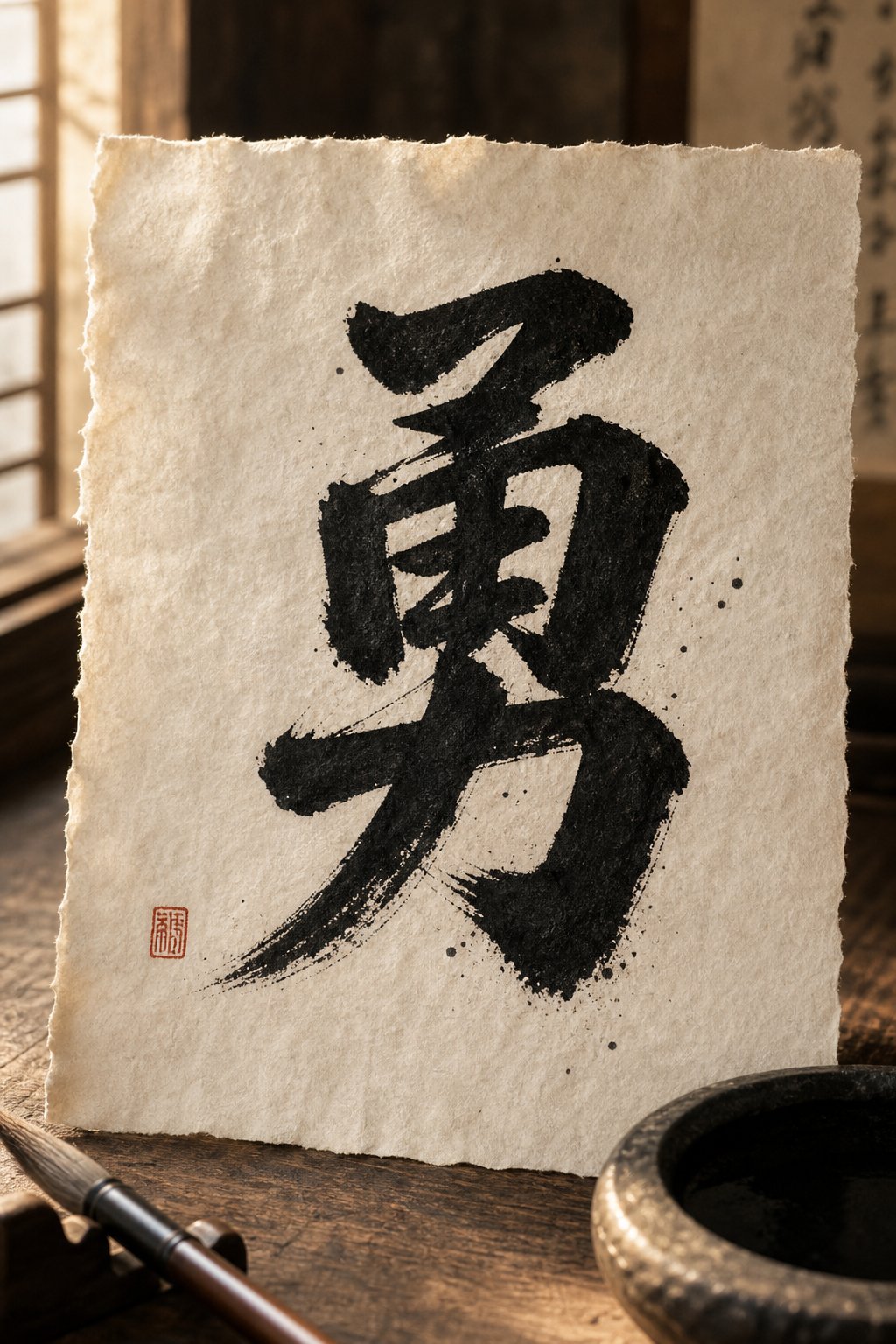
When you look up "courage" in a Chinese dictionary, one character rises above the rest: 勇 (yǒng). It is the most direct, widely recognized courage symbol in Chinese writing, used across Mainland China, Taiwan, Hong Kong, and anywhere Mandarin or Cantonese is spoken. Pronounced with a falling-rising third tone, yǒng carries the weight of bravery, valor, and bold action in a single brushstroke.
勇 (yǒng): The primary Chinese character for courage. Meaning bravery, valor, or boldness. Pronounced in the third tone. Radical: 力 (strength). Stroke count: 9.
So what is the Chinese character for courage in everyday use? It is 勇. The Collins English-Chinese Dictionary translates "courage" as 勇气 (yǒngqi), a compound built directly on this character. Whether someone is describing a firefighter rushing into a burning building or a student speaking up in class, 勇 is the root that anchors the idea of bravery in the Chinese language.
What Is the Chinese Character for Courage
Imagine you want to say courage in Mandarin Chinese. You would reach for 勇气 (yǒngqi) in conversation, but the core meaning lives inside that first character alone. 勇 functions both as a standalone word and as a building block for dozens of compounds. In classical texts, it appeared on its own to describe warriors and acts of valor. In modern Mandarin, it pairs with other characters to express shades of bravery, from quiet moral resolve to fierce battlefield aggression.
The character's versatility is part of what makes it the default courage symbol. As The World of Chinese notes, ancient Chinese believed that if you could gallantly wield a weapon, you were blessed with 勇. That martial origin still echoes in the character today, but its meaning has expanded far beyond the battlefield into everyday life.
Why 勇 Is the Most Common Courage Symbol
Chinese actually has several characters that touch on the concept of bravery, and each carries a different flavor:
- 勇 (yǒng) - General courage, valor, bravery. The broadest and most common choice.
- 膽/胆 (dǎn) - Literally "gallbladder," but used to mean boldness or guts. Rooted in traditional Chinese medicine beliefs about the body.
- 敢 (gǎn) - To dare. Emphasizes the willingness to act rather than the quality of being brave.
Among these, 勇 holds the central position. It is the character you will find in philosophical texts from Confucius, in military strategy from Sun Tzu, on motivational calligraphy scrolls, and in modern compound words like 勇敢 (brave) and 勇士 (warrior). The Chinese character yong meaning encompasses not just physical bravery but also moral courage, making it the most versatile of the three.
This article digs into everything behind that single character: how its radicals reveal hidden meaning, how philosophers debated its proper use, why the gallbladder became linked to boldness, and how 勇 travels across Japanese and Korean writing systems. Each layer adds depth to a character that looks simple on the surface but carries centuries of cultural weight beneath its nine strokes.
Radical Breakdown and Character Construction
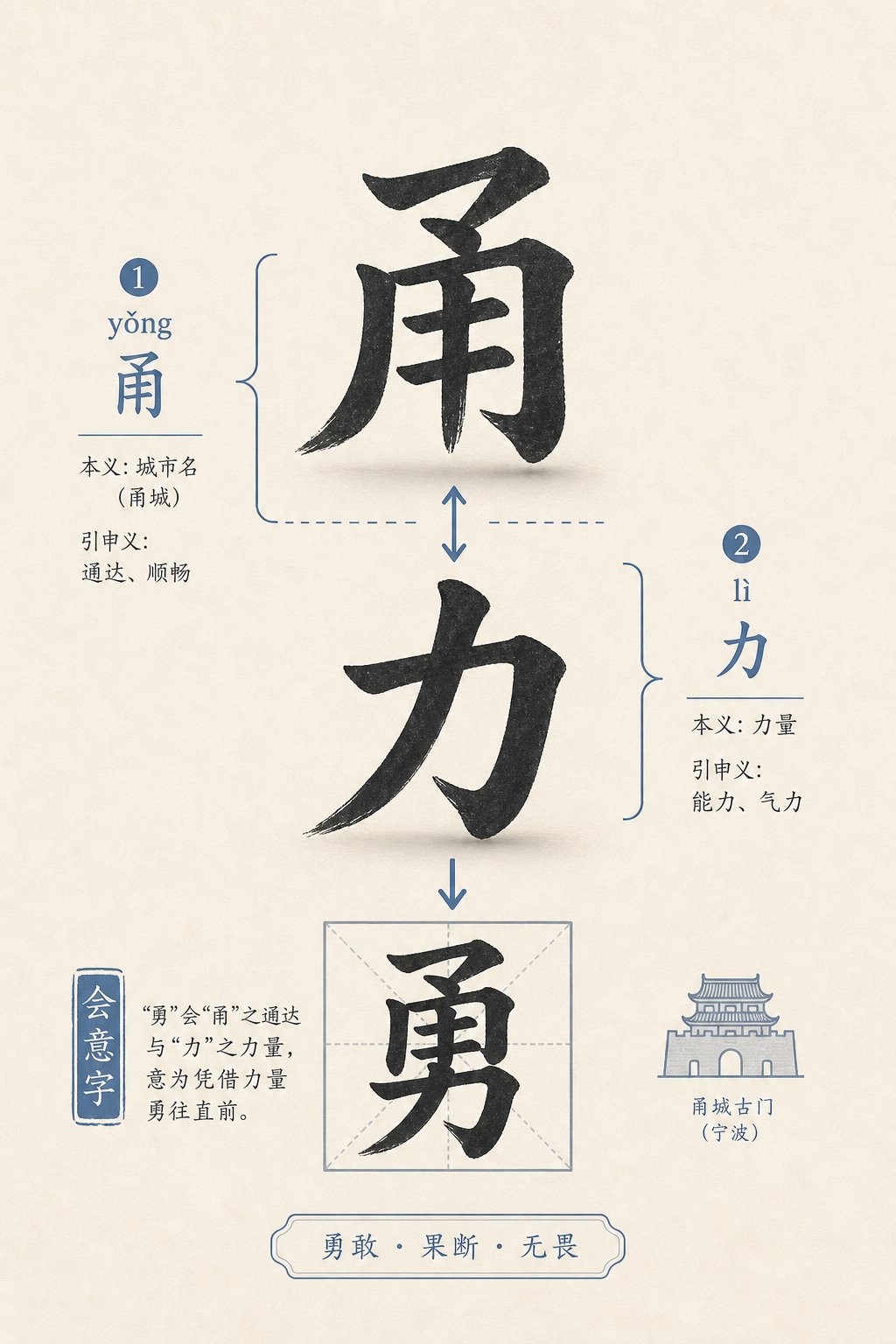
Nine strokes. Two core components. One powerful meaning. The courage character radical breakdown in Chinese reveals exactly why 勇 looks the way it does and how each piece contributes to the whole. Understanding these Chinese character components for courage turns memorization into logic, giving you a framework that applies to thousands of other characters.
How 勇 Is Built From Radicals and Components
Chinese characters are rarely random collections of lines. Most follow a construction system called 形声 (xingsheng), meaning "form and sound." In this system, one part of the character hints at pronunciation while another part signals meaning. The character 勇 is a textbook example of this principle in action.
Here is how the two main pieces fit together:
- 甬 (yǒng) sits on top. This is the phonetic component. It tells you how to pronounce the character. On its own, 甬 refers to a path or corridor, but inside 勇, its job is purely sonic: it gives the character its "yǒng" sound.
- 力 (lì) sits on the bottom. This is the semantic radical. It means "strength" or "force," and it tells you the character belongs to a meaning category related to physical power and exertion.
Put them together and you get a character that sounds like 甬 and means something related to 力. The result is 勇: strength applied with boldness.
| Component | Pinyin | Meaning | Role in 勇 | Position |
|---|---|---|---|---|
| 甬 | yǒng | Path, corridor | Phonetic (gives pronunciation) | Top |
| 力 | lì | Strength, force | Semantic (gives meaning category) | Bottom |
This top-bottom structure is called 上下结构 (shangxia jiegou). When you write 勇 in Chinese stroke order, you complete the upper component 甬 first (strokes 1 through 7), then finish with the two strokes of 力 at the base. The total comes to nine strokes in standard form.
Understanding the Phonetic and Semantic Elements
Why does this matter for learners? Because once you recognize the phonetic and semantic radicals in Chinese characters, you unlock a pattern that repeats everywhere. Consider these examples:
- 通 (tōng) - uses 甬 as its phonetic element, paired with the movement radical 辶. Meaning: to pass through.
- 痛 (tòng) - uses 甬 again, this time with the illness radical 疒. Meaning: pain.
- 动 (dòng) - uses 力 as its semantic radical, just like 勇. Meaning: to move.
- 努 (nǔ) - also built on 力. Meaning: to exert effort.
You'll notice the pattern: any character carrying 力 at its base tends to involve effort, force, or exertion. Any character carrying 甬 tends to rhyme with "ong" or "ung" sounds. Recognizing these building blocks means you can make educated guesses about unfamiliar characters rather than starting from zero each time.
There is also a visual mnemonic worth noting. As one interpretation suggests, 甬 can be read as a figure moving forward along a path, while 力 represents the raw power driving that motion. Picture someone charging ahead with full force, and you have the image of courage itself: a person running forward using all their strength. That mental picture makes the character stick far more effectively than rote repetition.
This construction method also explains why 勇 remained unchanged when China simplified its writing system in the 1950s. Both components, 甬 and 力, were already simple enough that no reduction was needed. That stability across writing systems is something the next section explores in detail, along with how other courage-related characters did change between Traditional and Simplified forms.
Simplified and Traditional Chinese Forms
Not every Chinese character survived the simplification reforms of the 1950s unchanged. Many lost strokes, merged with homophones, or were restructured entirely. The courage character 勇, however, is one of those rare cases where the simplified vs traditional Chinese courage character is exactly the same. Whether you are reading a newspaper in Beijing, a novel in Taipei, or a street sign in Hong Kong, 勇 looks identical. Its nine strokes were already compact enough that reformers left it untouched.
This makes life easier if you are learning to write courage in Chinese. You do not need to memorize two versions. Is yong the same in simplified and traditional Chinese? Yes, completely. The character, its stroke order, and its meaning are consistent across both systems.
Simplified vs Traditional Forms of Courage Characters
The story changes when you look at the other courage-related characters. The gallbladder-boldness character is where the split becomes obvious:
- 膽 (Traditional) - 17 strokes. Uses the full form of the phonetic component 詹 on the right side.
- 胆 (Simplified) - 9 strokes. Replaces 詹 with the much simpler 旦 (dan), keeping the pronunciation hint while cutting the stroke count nearly in half.
The character 敢 (gan, to dare) also stays the same across both systems, just like 勇. So two out of three core courage characters require no conversion at all.
| Character | Meaning | Simplified Form | Traditional Form | Changed? |
|---|---|---|---|---|
| 勇 | Courage, valor | 勇 | 勇 | No |
| 胆/膽 | Gallbladder, boldness | 胆 | 膽 | Yes |
| 敢 | To dare | 敢 | 敢 | No |
| 气/氣 | Spirit, energy (as in 勇气) | 气 | 氣 | Yes |
Regional Differences in Usage Across Chinese-Speaking Areas
The character itself may be stable, but regional preferences shape which courage words people actually reach for. In Mainland China, you will encounter simplified forms exclusively in print, education, and official documents. Taiwan uses traditional characters for everything, and Hong Kong maintains traditional forms as well, though mainland norms are increasingly prescribed in post-handover education and officialdom.
For the courage character in Taiwan vs mainland China, the practical difference is minimal when it comes to 勇 itself. A tattoo artist in Taipei and a calligrapher in Shanghai will write it the same way. The divergence only matters when you build compounds: 勇氣 in Taiwan versus 勇气 in the mainland, for instance. The meaning is identical, but the second character in the pair looks different depending on which system you are reading.
This consistency is one reason 勇 works so well as a traditional Chinese character for bravery in cross-regional contexts. It travels without conversion, without confusion, and without the ambiguity that plagues characters merged during simplification. That clarity carries over into the compound words built from it, which is where the character truly comes alive in everyday speech.
Chinese Compound Words With the Courage Character
A single character can hold a concept, but compound words bring it to life. In modern Mandarin, 勇 rarely appears alone in conversation. Instead, it pairs with other characters to create specific shades of bravery, each suited to different situations. Think of 勇 as the root and these compounds as the branches, each growing in a slightly different direction depending on context, tone, and formality.
Building a solid courage vocabulary list in Mandarin Chinese starts with knowing which compounds show up most often and when to use each one. Below are the essential words, ranked by how frequently you will encounter them in daily life, media, and written Chinese.
Essential Compound Words Using 勇
- 勇气 (yǒngqi) - courage, nerve, guts
Literal breakdown: 勇 (courage) + 气 (spirit/energy). This is the most common way to say "courage" as a noun in everyday Mandarin. It refers to the inner spirit or energy that drives someone to act bravely. You will hear it in casual conversation, self-help books, movie dialogue, and motivational speeches. It is neutral in formality, appropriate in nearly any context.
Formality: Neutral. Works in both spoken and written Chinese. - 勇敢 (yǒnggǎn) - brave, courageous
Literal breakdown: 勇 (courage) + 敢 (to dare). This functions primarily as an adjective meaning "brave" or "courageous." It combines the quality of courage with the willingness to act, creating a word that emphasizes active bravery rather than passive possession of nerve. Parents use it to encourage children. Teachers use it to praise students. It appears in news headlines describing rescue workers or whistleblowers.
Formality: Neutral to slightly formal. Extremely versatile. - 勇士 (yǒngshi) - warrior, brave person
Literal breakdown: 勇 (courage) + 士 (scholar/warrior/person of standing). This noun describes someone who embodies courage, a warrior or champion. It carries a slightly elevated, respectful tone. You will find it in historical texts, sports commentary (the Golden State Warriors are called 勇士 in Chinese), and literary descriptions of heroes.
Formality: Slightly formal. Often literary or honorific. - 英勇 (yīngyǒng) - heroic, valiant
Literal breakdown: 英 (outstanding/heroic) + 勇 (courage). This adjective intensifies the idea of bravery by pairing it with 英, a character associated with excellence and heroism. It is reserved for acts of extraordinary courage, the kind reported in news stories about soldiers, firefighters, or civilians who risk their lives. Using it for minor acts of bravery would sound exaggerated.
Formality: Formal. Common in news reports, official commendations, and written narratives. - 勇猛 (yǒngměng) - fierce, valiant, bold in attack
Literal breakdown: 勇 (courage) + 猛 (fierce/violent). This word carries a physical, aggressive edge. It describes courage expressed through fierce action, charging into battle, fighting relentlessly, or competing with overwhelming intensity. You will encounter it in martial arts fiction, military history, and sports writing.
Formality: Neutral to formal. Carries strong physical connotations.
Two classical four-character phrases (成语, chengyu) round out this vocabulary. The expression 有勇无谋 (yǒu yǒng wu mou) describes someone who is brave but lacks strategy, all muscle and no plan. Its counterpart, 智勇双全 (zhi yǒng shuāng quan), praises a person who possesses both wisdom and courage in equal measure. These idioms show up in literary writing, historical commentary, and everyday speech when evaluating someone's decision-making.
Example Sentences for Everyday Usage
Seeing these compounds in context makes the difference between yonggan and yongqi much clearer. Here is how to use yongqi in a sentence, along with examples for the other key compounds:
| Compound | Example Sentence (Chinese) | Pinyin | English Translation |
|---|---|---|---|
| 勇气 | 她终于鼓起勇气说出了真相。 | Ta zhongyu guqi yǒngqi shuochu le zhenxiang. | She finally gathered the courage to speak the truth. |
| 勇敢 | 你要勇敢面对困难。 | Ni yao yǒnggǎn miandui kunnan. | You need to bravely face difficulties. |
| 勇士 | 他是一位真正的勇士。 | Ta shi yi wei zhenzheng de yǒngshi. | He is a true warrior. |
| 英勇 | 消防员英勇地冲进了火场。 | Xiaofangyuan yīngyǒng de chongjin le huochǎng. | The firefighter heroically rushed into the blaze. |
| 勇猛 | 这支球队打得非常勇猛。 | Zhe zhī qiudui dǎ de feichang yǒngměng. | This team played with tremendous ferocity. |
Notice the pattern: 勇气 is what you gather before acting, 勇敢 describes how you act, 勇士 is what you become through repeated brave action, 英勇 elevates that action to heroic status, and 勇猛 adds raw physical intensity. Each word occupies its own lane.
For learners building Chinese words for bravery and valor into active vocabulary, start with 勇气 and 勇敢. These two cover the vast majority of situations where you need to express courage in conversation. Add 勇士, 英勇, and 勇猛 as you move into reading news articles, historical texts, or fiction where more precise shades of bravery matter.
These compounds reflect modern usage, but the philosophical weight behind them stretches back thousands of years. Confucius himself drew sharp lines between different types of courage, distinguishing the bravery worth praising from the recklessness worth condemning. Those ancient debates shaped how each of these words carries moral weight today.
Philosophical Roots in Classical Chinese Thought
Courage in Chinese philosophy and culture was never a simple concept. The ancient thinkers did not treat bravery as universally good. Instead, they asked harder questions: Courage for what purpose? Directed by what principles? Restrained by what wisdom? These debates, recorded over two thousand years ago, built the moral architecture that still shapes how Chinese speakers understand 勇 today.
Confucian Views on Moral Courage
Confucius placed courage among his three core virtues, but always with a condition attached. In the Analerta (论语, Lunyu), he ranked it below benevolence and wisdom, insisting that bravery without moral grounding becomes dangerous.
见义不为,无勇也。(jian yi bu wei, wu yǒng ye.) - To see what is right and not act on it is a lack of courage. — Analerta 2.24
This single line captures the Confucian position: courage is not about fearlessness or aggression. It is the willingness to do what is morally correct even when doing so is difficult or costly. The concept of 义勇 (yiyǒng), righteous courage, emerges directly from this idea. Courage must serve justice, or it is not courage at all.
Confucius drew the line between moral courage vs recklessness in Confucianism even more sharply in a later passage:
君子有勇而无义为乱,小人有勇而无义为盗。(Junzi yǒu yǒng er wu yi wei luan, xiaoren yǒu yǒng er wu yi wei dao.) - A gentleman with courage but no righteousness creates chaos. A petty person with courage but no righteousness becomes a thief. — Analerta 17.23
The message is direct: courage without 义 (yi, righteousness) is not a virtue. It is a liability. This is why the compound 有勇无谋 (brave but reckless) carries a negative connotation in modern Chinese. The Confucian framework treats undirected bravery as a character flaw rather than a strength.
Confucius also listed courage as the third of three qualities that define a complete person:
仁者不忧,知者不惑,勇者不惧。(Ren zhe bu you, zhi zhe bu huo, yǒng zhe bu ju.) - The benevolent do not worry, the wise are not confused, the courageous do not fear. — Analerta 14.28
Notice the ordering. Benevolence (仁) comes first, wisdom (知) second, courage (勇) third. This hierarchy was intentional. Confucius believed that courage only becomes a true virtue when it is guided by compassion and informed by understanding. Strip away those foundations, and bravery degenerates into recklessness or violence.
His student Mencius (孟子) extended this thinking by introducing the concept of 浩然之气 (haoran zhi qi), often translated as "flood-like energy" or "vast, flowing vital force." Mencius described this as a moral courage that fills the body when a person consistently acts with righteousness over time. It cannot be faked or forced. It grows naturally from accumulated ethical action, like a river that swells from steady rain rather than a single storm.
Courage in Daoist and Military Philosophy
Daoism took a different angle entirely. The Dao De Jing (道德经) warns against the kind of aggressive courage that Confucians debated. Laozi distinguished between 勇于敢 (yǒng yu gǎn, courage to dare) and 勇于不敢 (yǒng yu bu gǎn, courage to not dare), suggesting that sometimes the braver act is restraint. This paradox, that true courage might look like inaction, challenged the martial associations that 勇 carried in its earliest uses.
Military philosophy offered yet another framework. The Sun Tzu Art of War courage concept treats 勇 as one of five essential qualities of a general, listed alongside 智 (wisdom), 信 (trustworthiness), 仁 (benevolence), and 严 (strictness). In this context, courage is not personal heroism. It is the commander's ability to make decisive choices under pressure without hesitation or panic. Sun Tzu valued calculated boldness over blind bravery, warning that a general who is too easily angered or too eager to fight can be manipulated by the enemy.
Legalist thinkers like Han Feizi took the most pragmatic view. They saw courage as a resource to be channeled by the state through rewards and punishments. Individual bravery mattered only insofar as it served collective goals. This perspective influenced how Chinese dynasties structured military incentives for centuries.
These philosophical layers never disappeared. When a modern Chinese speaker uses 勇气 to describe someone standing up against injustice, the Confucian echo is there. When a coach praises a team's 勇猛 performance, the martial tradition resonates. And when someone admires the courage of restraint, choosing not to retaliate, choosing patience over aggression, Laozi's paradox lives on in the language itself.
The philosophers shaped the words, but they also shaped the body. Traditional Chinese medicine took the connection between courage and physicality in a literal direction, locating bravery not in the heart or the mind but in a small organ most Westerners would never associate with boldness: the gallbladder.

The Gallbladder Connection and Character Confusions
Why does gallbladder mean courage in Chinese? The answer sits at the intersection of medicine, philosophy, and language. For over two thousand years, Chinese medical theory held that the gallbladder was not just a digestive organ. It was the seat of decisiveness, boldness, and the will to act. That belief embedded itself so deeply into the language that the dan Chinese character courage meaning persists in everyday speech, even among people who have never studied traditional medicine.
The Gallbladder as the Seat of Courage
In Traditional Chinese Medicine, the gallbladder (胆, dan) holds a unique dual classification. It is both a regular Yang organ and an Extraordinary Fu organ. The Huangdi Neijing, China's foundational medical text from around 200 BCE, describes its psychological function in a single definitive line:
胆者,中正之官,决断出焉。(Dan zhe, zhongzheng zhi guan, jueduan chu yan.) - The Gallbladder is the official of what is upright and just; decision-making stems from it.
This is the Chinese medicine gallbladder bravery connection in its purest form. The Huangdi Neijing assigns the gallbladder a governing role over courage, judgment, and decisive action. While the Liver plans and strategizes, the Gallbladder executes those plans with conviction. A healthy gallbladder gives a person boldness. A weak one produces timidity and indecision.
This medical framework explains why 膽/胆 (dan) carries both an anatomical meaning and a psychological one. The character literally refers to the organ, but idiomatically it means guts, nerve, or boldness. The language treats them as inseparable because the medicine did too.
Several common expressions grew directly from this belief:
- 大胆 (dadan) - "big gallbladder," meaning bold or audacious
- 胆小 (danxiao) - "small gallbladder," meaning timid or cowardly
- 胆量 (danliang) - "gallbladder capacity," meaning nerve or guts
- 胆怯 (danqie) - "gallbladder timidity," a clinical term in TCM for fearfulness linked to Gallbladder Qi deficiency
Notice the logic: courage scales with the size and strength of the organ. A person with a "big gallbladder" fears nothing. A person with a "small gallbladder" startles easily. TCM practitioners still recognize 胆怯 as a distinct clinical pattern, treating patients who present with chronic indecision, anxiety, and an inability to commit to action.
Related Characters That Learners Often Confuse
The character 胆 creates confusion for learners in several directions. Some mix-ups are visual, others phonetic, and at least one stems from search engine auto-suggestions linking unrelated characters. Here are the commonly confused Chinese characters for courage that trip people up:
- 胆 (dan) vs 担 (dan) - Same pinyin, completely different meaning. 胆 is gallbladder/courage. 担 means to carry or to bear a burden. The left radical is the giveaway: 月 (flesh/body radical) for the organ, 扌 (hand radical) for carrying.
- 胆 (dan) vs 旦 (dan) - The simplified form of 胆 contains 旦 as its right component, which is simply a phonetic indicator. On its own, 旦 means dawn or daybreak. It has nothing to do with courage.
- 膽 (dan) vs 湯/汤 (tang) - This confusion appears in search queries, likely because both traditional forms look complex and share visual density. 膽 (courage/gallbladder) and 湯 (soup/hot water) are entirely unrelated. The formula name Wen Dan Tang (温胆汤, "Warm the Gallbladder Decoction") may contribute to the association, since it contains both 胆 and 汤 in the same phrase. But 汤 here simply means "decoction," a standard suffix for herbal formulas.
- 勇 (yong) vs 涌 (yong) - Same pronunciation, different tone behavior in compounds. 涌 means to gush or surge (note the water radical 氵). Learners sometimes confuse these when hearing compounds spoken aloud.
- 胆 (dan, gallbladder) vs 勇 (yong, courage) - These are not visually similar, but learners sometimes wonder which one "means courage." Both do, but differently. 勇 is the abstract virtue. 胆 is the embodied, visceral version, closer to English "guts" or "nerve."
The simplest way to keep these straight: look at the radical. The flesh radical 月 on the left of 胆 tells you the character relates to the body. The strength radical 力 at the base of 勇 tells you it relates to force and action. Radicals are your navigation system through these look-alike and sound-alike characters.
This body-mind connection in Chinese is not unique to the gallbladder. But 胆 is the most dramatic example of an organ shaping abstract vocabulary. And because 勇 travels across borders into Japanese and Korean writing systems, the next question becomes: does the gallbladder connection follow it, or does each language chart its own path?
Courage Across Japanese and Korean Writing Systems
The character 勇 did not stay within Chinese borders. When Japan and Korea adopted Chinese writing centuries ago, they imported thousands of characters along with their meanings. The courage kanji in Japanese vs Chinese is a perfect case study in how a single character can carry shared roots yet develop distinct local identities across East Asia.
How 勇 Functions in Japanese Kanji
In Japanese, every kanji carries at least two types of readings. The on'yomi (Chinese-derived reading) of 勇 is yū, preserving an echo of the original Mandarin pronunciation. The kun'yomi (native Japanese reading) is isamu, meaning "to be brave" or "to be in high spirits." Both readings remain active in modern Japanese.
The yuki Japanese word for courage kanji is 勇気 (yūki), written with the exact same two characters as Chinese 勇气. The meaning is identical: courage, bravery, nerve. Japanese speakers use it the same way Mandarin speakers use yǒngqi, to describe the inner resolve needed before taking a difficult action. Other common compounds include:
- 勇者 (yūsha) - brave person, hero. Extremely common in video games and fantasy media, where it often translates as "the Hero."
- 勇敢 (yūkan) - brave, courageous. Same characters and meaning as Chinese 勇敢, though used more in written Japanese than casual speech.
- 勇ましい (isamashii) - brave, gallant. Uses the kun'yomi reading and functions as a native Japanese adjective.
As a given name, 勇 (Isamu) is a classic masculine name in Japan, chosen by parents who want their son to embody bravery. It ranks among the most recognizable single-kanji names in the language.
Shared CJK Vocabulary Across East Asia
Korean uses 勇 as a hanja character, read as 용 (yong). While modern Korean writing relies primarily on the Hangul alphabet, hanja still appears in formal contexts, personal names, and academic writing. The courage character in Korean hanja shows up in words like 용기 (yonggi, courage) and 용감 (yonggam, brave), direct parallels to Chinese 勇气 and 勇敢.
The overlap across all three languages is striking. Here is how these CJK shared characters for bravery compare side by side:
| Feature | Chinese (Mandarin) | Japanese | Korean |
|---|---|---|---|
| Character | 勇 | 勇 | 勇 |
| Reading | yǒng | yū (on) / isamu (kun) | 용 (yong) |
| "Courage" compound | 勇气 (yǒngqi) | 勇気 (yūki) | 용기 (yonggi) |
| "Brave" compound | 勇敢 (yǒnggǎn) | 勇敢 (yūkan) | 용감 (yonggam) |
| "Warrior" compound | 勇士 (yǒngshi) | 勇士 (yūshi) | 용사 (yongsa) |
| Used in names? | Yes | Yes (Isamu) | Yes |
The pronunciation drifted over centuries, but the meanings stayed remarkably aligned. A learner studying any one of these languages already has a head start on the other two when it comes to courage vocabulary. The character itself, its radical structure, and its core meaning remain constant across all three writing systems.
One notable divergence: the gallbladder-courage connection discussed earlier does exist in Japanese (胆力, tanryoku, meaning nerve or guts) and Korean (담력, damnyeok, same meaning), but it plays a smaller role in everyday speech compared to Chinese. The philosophical weight of 勇 traveled more successfully across borders than the medical metaphor of 胆.
This cross-linguistic consistency also means that choosing 勇 for visual purposes, whether for artwork, calligraphy, or body art, communicates the same core idea to readers across China, Japan, and Korea. That universality is part of what makes it such a popular choice for tattoos and decorative use, though selecting the right character still requires care to avoid common pitfalls.
Best Chinese Symbol for Courage Tattoo and Naming Guide
Universality across three writing systems is appealing, but it does not eliminate the risk of getting the wrong character permanently inked on your body. A Chinese courage character tattoo guide comes down to one core decision: which version of "courage" matches your intended meaning?
Choosing the Right Character for Tattoos and Art
Each option carries a different weight and tone. Picking the best Chinese symbol for courage tattoo depends on what you want to communicate:
| Character | Pinyin | Meaning | Best For | Tone/Feel |
|---|---|---|---|---|
| 勇 | yǒng | Courage, valor | Single-character tattoos, calligraphy art, names | Classic, balanced, universally readable |
| 勇敢 | yǒnggǎn | Brave, courageous | Two-character tattoos, personal mantras | Active, modern, emphasizes daring |
| 胆 / 膽 | dǎn | Guts, boldness | Edgier designs, visceral meaning | Raw, physical, closer to English "guts" |
| 勇气 / 勇氣 | yǒngqi | Courage (as inner spirit) | Inspirational pieces, personal reminders | Reflective, internal, spiritual energy |
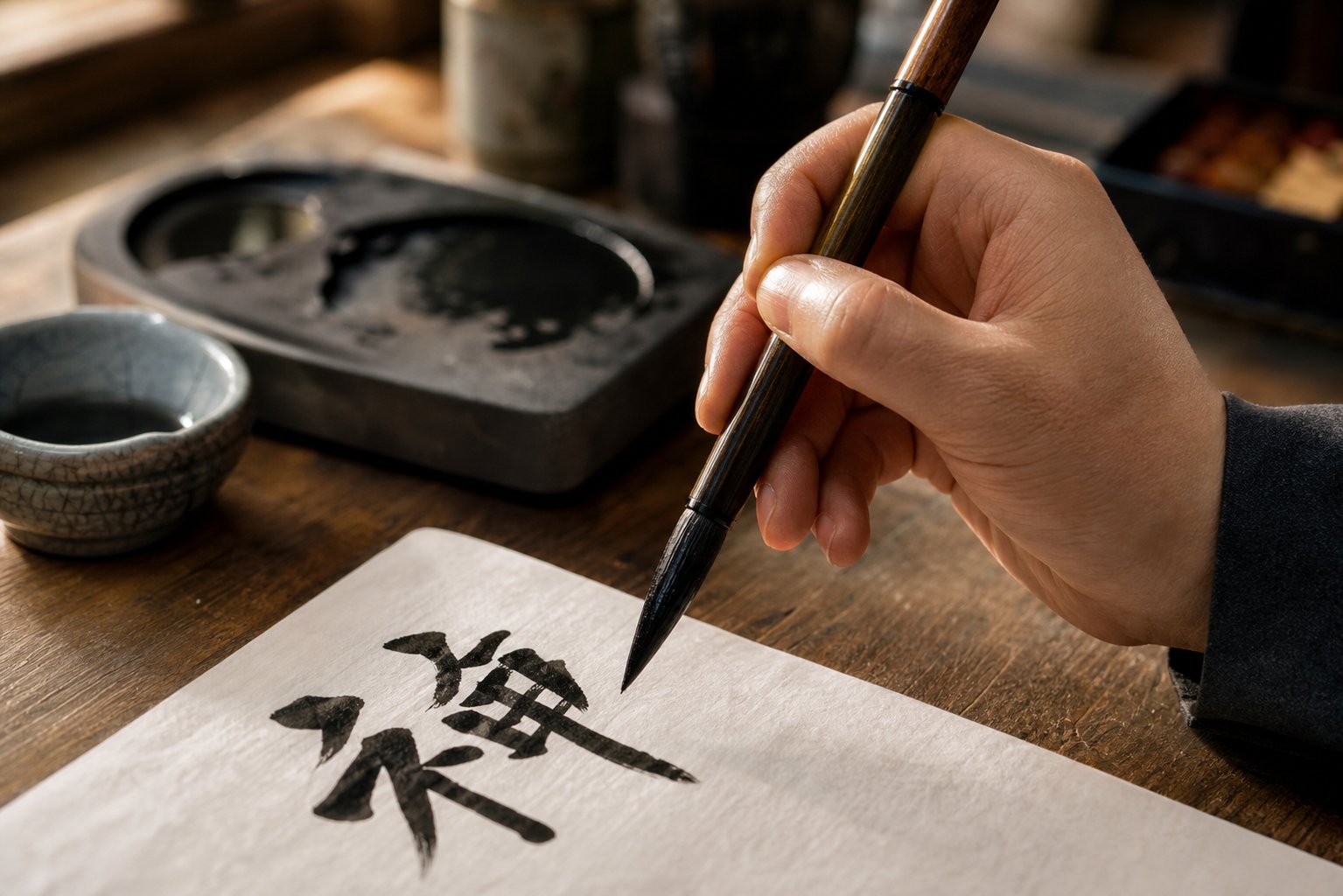
If you want a single character that reads cleanly across China, Japan, and Korea, 勇 is the safest and most elegant choice. It works in any calligraphic style, from bold kaishu (regular script) to flowing caoshu (cursive). For a two-character piece, 勇敢 reads naturally and avoids ambiguity. Avoid 胆 unless you specifically want the gallbladder-guts connotation and are comfortable explaining it, since native speakers will read the anatomical meaning first.
Common Mistakes and How to Avoid Them
The most common mistakes with Chinese character tattoos are not about choosing the wrong concept. They are about execution errors that turn a meaningful symbol into nonsense or, worse, something embarrassing. Here is what goes wrong:
- Mirrored characters. Non-Chinese tattoo artists sometimes flip the reference image, producing a mirror-reversed character. As That's Mandarin notes, this is one of the most common and easily preventable mistakes. A reversed 勇 is not a character at all.
- Missing or extra strokes. 勇 has exactly nine strokes. Drop one stroke from 甬 and you may produce an unrecognizable form. Add an extra line to 力 and you create 办 or something close to it. Every stroke matters.
- Mixing simplified and traditional in the same design. Writing 勇氣 (traditional) is fine. Writing 勇气 (simplified) is fine. Writing 勇氣 next to a simplified character like 爱 looks inconsistent to any literate reader. Pick one system and stay in it.
- Choosing overly aggressive characters. Some people reach for 勇猛 (fierce valor) wanting intensity, but in Chinese this carries a violent, combative edge. For a personal tattoo meant to represent inner strength, 勇气 or 勇敢 reads more appropriately than a word associated with battlefield ferocity.
- Using outdated seal script forms without understanding them. Ancient forms of 勇 look dramatically different from the modern character. They can make beautiful art, but if the artist copies from an unreliable source, the result may be a different character entirely or a hybrid that never existed historically.
- Confusing visually similar characters. 勇 (courage) and 涌 (to gush) share a pronunciation but look different on paper. 胆 (gallbladder/guts) and 担 (to carry) share a sound but different radicals. A single wrong radical transforms the meaning completely.
To verify your chosen character before committing to ink, follow these steps:
- Look up the character in at least two reputable dictionaries (MDBG, Pleco, or LINE Dictionary) and confirm the definition matches your intent.
- Check stroke order using an animated stroke-order tool to ensure your reference image is written correctly and not reversed.
- Have a native Chinese speaker review the final design in context. As language educators consistently recommend, confirming with a native speaker catches subtle errors that dictionaries cannot flag.
- Verify the calligraphic style is internally consistent. If using traditional characters, every character in the design should be traditional.
- Ask your tattoo artist to place a temporary stencil first so you can photograph it and send it for one final check before the needle touches skin.
These five steps take less than an hour combined. Considering the permanence of a tattoo, that small investment protects you from joining the long list of people whose "courage" tattoo actually says "soup" or "to carry." The character 勇 deserves the same care in its physical rendering that Chinese philosophers gave to its moral meaning: deliberate, precise, and guided by understanding rather than impulse.
Frequently Asked Questions About the Chinese Character for Courage
1. What is the Chinese character for courage?
The primary Chinese character for courage is 勇 (yong, third tone). It means bravery, valor, or boldness and consists of nine strokes. In everyday Mandarin, it most commonly appears in the compound 勇气 (yongqi), which translates directly to 'courage' as a noun. The character is built from two components: 甬 (a phonetic element giving it the 'yong' sound) and 力 (meaning strength), which signals its connection to force and exertion.
2. Why does the Chinese word for courage relate to the gallbladder?
Traditional Chinese Medicine assigned psychological functions to internal organs. The Huangdi Neijing, China's foundational medical text, describes the gallbladder (胆, dan) as the organ responsible for decisiveness and bold action. This belief created expressions like 大胆 (big gallbladder, meaning audacious) and 胆小 (small gallbladder, meaning timid). The organ's perceived strength directly correlated with a person's capacity for brave decision-making, embedding this body-mind connection permanently into the Chinese language.
3. Is the courage character the same in simplified and traditional Chinese?
Yes, 勇 is identical in both simplified and traditional Chinese writing systems. Its nine strokes were already compact enough that reformers left it unchanged during China's simplification reforms in the 1950s. However, related characters differ between systems. For example, the compound 勇气 (simplified) becomes 勇氣 (traditional), where only the second character changes. The gallbladder-courage character also differs: 胆 (simplified, 9 strokes) versus 膽 (traditional, 17 strokes).
4. What is the difference between 勇气 and 勇敢 in Chinese?
勇气 (yongqi) is a noun meaning 'courage' or 'nerve,' referring to the inner spirit or energy someone gathers before acting. You 'summon' or 'gather' 勇气. In contrast, 勇敢 (yonggan) is primarily an adjective meaning 'brave' or 'courageous,' describing how someone acts. You can be 勇敢 (brave) or do something 勇敢地 (bravely). Think of 勇气 as what you need inside, and 勇敢 as what others see on the outside.
5. Does the courage character 勇 mean the same thing in Japanese and Korean?
The core meaning of bravery and valor remains consistent across all three languages. In Japanese, 勇 is read as 'yu' (on'yomi) or 'isamu' (kun'yomi) and appears in 勇気 (yuki, courage), which mirrors Chinese 勇气. In Korean, it reads as 용 (yong) and forms 용기 (yonggi, courage). The character's radical structure, stroke count, and fundamental meaning are identical, though pronunciation shifted as each language evolved independently over centuries.